




Abstract
Measures of prosocial behavior can influence policy, legislation, investment, and inform assessments of the overall state of society. Evidence suggests that methods are important in determining these measures. To widen and deepen our understanding of the complex relationship between these items, we compared participation and volunteering data from a national birth cohort study (National Child Development Study [NCDS]) with data from a linked qualitative study, the Social Participation and Identity Study (SPIS). We evaluated the strengths and prosocial behavior content of each and explored possible links between their respective methodologies and participation and volunteering estimates. We found that prompts and probes were associated with higher estimates and narrow filter questions with lower estimates. The SPIS afforded detailed insights into lived experiences and personal narratives of volunteering and participating, whereas the NCDS supported analysis of these behaviors over time and from a lifecourse perspective. Implications for researchers and policy makers are considered.
Introduction
Prosocial behaviors, as commonly defined, refer to other-orientated behaviors, including helping, sharing, caring, and comforting (Dunfield, Kuhlmeier, O’Connell, & Kelley, 2011), that seek to improve the situation of the help recipient (Bierhoff, 2002). This definition allows some forms of participation (Bierhoff, 2002), volunteering (Penner, 2002), and giving (Cnaan, Jones, Dickin, & Salomon, 2011) to be understood as varieties of prosocial behavior.
Rates of prosocial behavior matter. They matter to politicians, governments, social commentators, nonprofits, and the wider public. For Putnam (2000), depressed and declining rates of prosocial behavior indicated a society in difficulty. He argued that low rates negatively affected everything from health, happiness, and well-being to education, the economy, and neighborhoods; even our very democracy was said to be at risk. Although Putnam’s assertions about deep and widespread declines in participation have been disputed (see Paxton, 1999; Rotolo & Wilson, 2004; Stolle & Hooghe, 2005), his analysis remains influential. In the United Kingdom, for instance, politicians and social commentators have spoken of Britain’s broken society and disintegrating social ties with opting out, or nonparticipation, presented as a pressing social problem (Conservative Party, 2010). Posed as a response to these concerns, in recent years the U.K. government has introduced policy and legislation that, it claims, provide new opportunities for individuals to participate in the decisions that affect their lives (Brookfield, 2016; Corbett & Walker, 2013).
The way we measure prosocial behavior matters. Different measurement instruments identify different rates of prosocial behavior in the population (O’Neill, 2001). Many have interpreted this as evidence that methods determine identified levels and trends in this behavior (Hall, 2001; Havens & Schervish, 2001). Studies have, for example, concluded that memory prompts and recall cues, question content, specificity and order, proxy responses, and the time period about which respondents are questioned are linked to the under- and overreporting of giving and volunteering in surveys (Hall, 2001; Kennedy & Vargus, 2001; Nesbit, 2010; Rooney, Steinberg, & Schervish, 2001, 2004; Wilhelm, 2007). To date, research on the complex relationship between methods and measures has focused almost exclusively on survey methodology. Consequently, we know comparatively little about the influence and impacts of other methods.
To widen and deepen our understanding of the relationship between methods and measures, this Research Note, informed by Nesbit’s (2010) Note, compares participation and volunteering data from the United Kingdom’s National Child Development Study (NCDS; University of London, Institute of Education, Centre for Longitudinal Studies, 2008a, 2008b, 2008c, 2008d, 2012), with data from the associated Social Participation and Identity Study (SPIS) 2008 (Elliott, Savage, Parsons, & Miles, 2013). Where previous studies have compared giving and volunteering rates in different surveys completed with different populations (Bekkers & Wiepking, 2006; Hall, 2001; Nesbit, 2010), we compare participation and volunteering rates identified in a survey-based study, the NCDS, with those identified in a biographical interview study, the SPIS, which engaged with the same population. Holding the participants constant in this comparison focuses attention onto each study’s methodology and positions differences in these methodologies as a possible explanation for any variation in rates. The focus on two very different methodologies illuminates the distinctive and characteristic traits of each, and the manner in which these might structure estimates. Furthermore, helping to widen understanding, studying the SPIS facilitates consideration of the impact of aspects of in-depth interview methodology on estimates.
Many studies have utilized data from the NCDS, and some data from the SPIS, but relatively rarely have volunteering and participation been the concern. Both studies, though, provide rich data on these activities. Those that have considered these activities have tended to use NCDS data to examine associations and effects. Examples include Denny and Doyle (2008, 2009) on determinants of, and persistence in, voter turnout, Hietanen, Aartsen, Kiuru, Lyyra, and Read (2014) on the development of social participation and volunteering over time by gender, and the relationship between socioeconomic status and involvement in these behaviors, and Bowling, Pikhartova, and Dodgeon (2016) on the effect of social participation on cognitive status. In addition, several studies have looked at links between education and certain forms of participation and volunteering (Brown & Taylor, 2007; Huang, Maassen van den Brink, & Groot, 2012; Paterson, 2014). Although our central aim is to develop understanding of the link between methods and measures, we also seek to raise awareness of the opportunities afforded by the NCDS and SPIS to explore prosocial behavior. To this end, in subsequent sections, we detail each study’s background, aims, and method; discuss their participation and volunteering specific content; and explore their relative strengths and limitations. We then compare their participation and volunteering estimates and consider how these might have been influenced by each study’s unique methodology. We close by presenting brief recommendations on possible uses of the data sets.
Study Backgrounds and Methods
This section details the background, aims, and methodology, including data collection techniques, response rates, and sample sizes of the NCDS and SPIS. Key features of their methodologies are captured in Table 1. Both data sets can be accessed via the UK Data Service (www.ukdataservice.ac.uk/). 1
Headline Features of the NCDS and the SPIS.
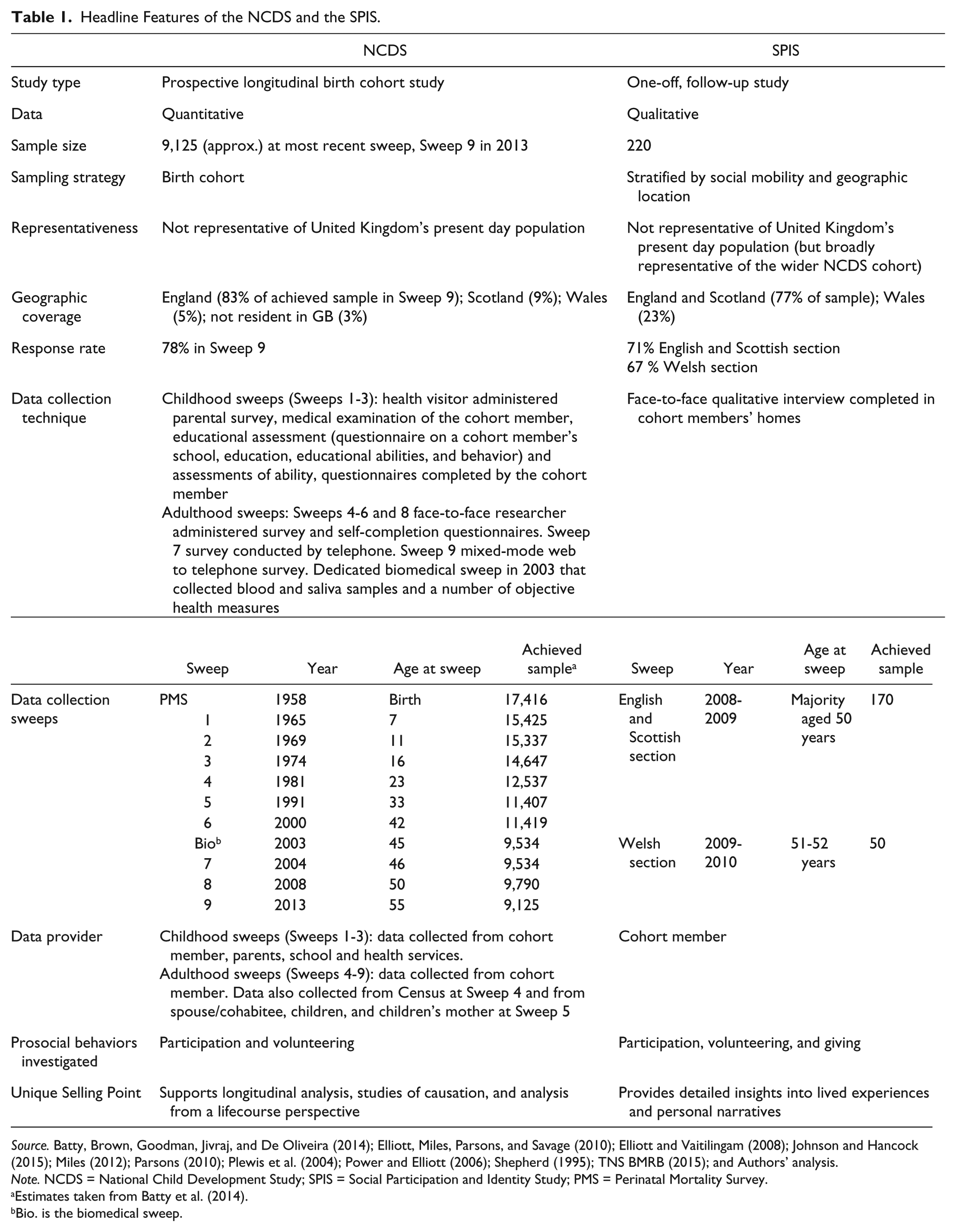
Source. Batty, Brown, Goodman, Jivraj, and De Oliveira (2014); Elliott, Miles, Parsons, and Savage (2010); Elliott and Vaitilingam (2008); Johnson and Hancock (2015); Miles (2012); Parsons (2010); Plewis et al. (2004); Power and Elliott (2006); Shepherd (1995); TNS BMRB (2015); and Authors’ analysis.
Note. NCDS = National Child Development Study; SPIS = Social Participation and Identity Study; PMS = Perinatal Mortality Survey.
Estimates taken from Batty et al. (2014).
Bio. is the biomedical sweep.
NCDS
Background
The NCDS began as the Perinatal Mortality Survey (PMS) in 1958. It collected information on 17,416 babies born in a week in March 1958 (3-9 March) in England, Scotland, and Wales (Power & Elliott, 2006). Initially, the concern was to examine the social and obstetric factors associated with stillbirth and death in early infancy (Parsons, 2010). At this time, Britain’s perinatal mortality rate was 35 per 1,000 births (Shepherd, 1995). Since then, it has evolved into a national longitudinal birth cohort study and, through 10 (at the time of writing) subsequent data collection sweeps, has gathered information on cohort members’ physical and mental health, health-related behavior, demographic characteristics, employment, income, education, housing, and attitudes (Elliott, Miles, Parsons, & Savage, 2010). It has also solicited information on participation and volunteering; it has not investigated giving.
Sample type and size
Since birth, cohort members have, so far, been followed up in nine data collection sweeps and one dedicated biomedical sweep at ages 7, 11, 16, 23, 33, 42, 45 (biomedical sweep), 46, 50, and 55. Additional cohort members who had immigrated to Britain and who were born in the target week in 1958 were recruited to the study during the childhood sweeps (Batty, Brown, Goodman, Jivraj, & De Oliveira, 2014). The sample size of the cohort achieved at each sweep has varied with four notable decreases observed, as highlighted in Table 1. For example, almost 2,000 fewer cohort members participated in the first data collection sweep at age 7 than did in the PMS, whereas some 2,110 fewer cohort members participated in Sweep 4 at age 23 than did in Sweep 3 at age 16 (Batty et al., 2014). Just over 9,000 cohort members took part in Sweep 9, presently the most recent sweep (Batty et al., 2014). The next sweep will take place in 2018 when cohort members will be 60 (Batty et al., 2014). The sample, although capturing approximately 98% of babies born in the target week (Shepherd, 1995), does not reflect the United Kingdom’s current population, lacking, for example, its ethnic diversity (Power & Elliott, 2006).
Response rates
Response rates have declined as cohort members have aged (Plewis, Calderwood, Hawkes, & Nathan, 2004). In Sweep 9, the response rate was 78% (TNS BMRB, 2015). Overall, nonresponse rates have been low with fewer than 22% of cohort members who were contacted at each sweep not taking part (Batty et al., 2014). The main reasons for nonresponse have been cohort members moving address and difficulties in tracing them (Batty et al., 2014). Although very low, refusal rates have also contributed to sample loss. The proportion of cohort members refusing to participate at each follow-up survey stands at around 5% (Elliott & Vaitilingam, 2008).
Data collection
From age 23 (Sweep 4) onwards, data have been collected direct from cohort members, usually through face-to-face researcher-administered questionnaires completed in members’ homes and self-completion questionnaires (Elliott & Vaitilingam, 2008). Up to age 16 (Sweep 3), data were collected from cohort members themselves, their parents, schools, and medical practitioners (Elliott & Vaitilingam, 2008). This change in respondent type might explain the drop in participation observed between Sweeps 3 and 4 (see Table 1; Hawkes & Plewis, 2006). On occasion, alternatives and/or additions to the face-to-face interview have occurred. Sweep 5 collected data from cohort members’ spouses/cohabitees and, for a random sample of one in three members, from members’ children and the mothers of these children (Elliott & Vaitilingam, 2008). As noted, a dedicated biomedical sweep was conducted in 2003 (Batty et al., 2014). Sweep 7 was conducted by telephone. Sweep 9 used a mixed-mode web to telephone approach, with cohort members first invited to complete an online survey and nonrespondents then invited to take part in a telephone survey (TNS BMRB, 2015).
SPIS
Background
The SPIS was a one-off, follow-up, biographical interview study involving a subset of the NCDS cohort. It was designed to investigate associations between individuals’ social mobility experiences and patterns of social participation and provided an opportunity to link biographical narratives to structured survey data collected over the lifecourse (Elliott et al., 2010, p. 3). It was timed to coincide with the 2008 sweep engaging with cohort members at age 50. Through in-depth, qualitative interviews, it collected data on identity, life history, neighborhood and belonging, family and friendships, leisure activities, and the experience of being part of the NCDS (Elliott et al., 2010). In addition, it solicited information on participation, volunteering, and giving.
Sample type and size
Adopting a stratified sampling approach, stratified by social mobility (based on the occupation of cohort members’ fathers and a member’s own occupation at age 46) and geographic location, 220 cohort members were recruited from the NCDS and took part in a successful qualitative interview (Elliott et al., 2010). Initially, the study focused on cohort members in England (living in North West and South East England) and Scotland, with 170 interviews completed (Elliott et al., 2010). Additional funding enabled the study’s focus to expand to include cohort members in Wales with 50 useable interviews completed (the audio file relating to a 51st interview was corrupted; Miles, 2012). There was an effort to ensure that the Mosaic profile of the SPIS sample matched the Mosaic profile of the total sample of cohort members living in these regions. Mosaic profiles provide a detailed picture of U.K. households in terms of lifestyle, sociodemographic, cultural, and behavioral factors (Elliott et al., 2010, p. 21). Although not representative of the present day population of the United Kingdom, lacking, for example, its ethnic diversity, the SPIS sample was broadly representative of the wider NCDS cohort. There was, however, a deliberate strategy to oversample downwardly mobile cohort members and those from the stable service class, whereas certain groups were underrepresented (Elliott et al., 2010). In the English and Scottish branch of the study, for instance, underrepresented groups included cohort members who reported that they did not vote in the last general election, who were cohabiting, and who reported only poor or fair self-rated health (Elliott et al., 2010, p. 33).
Response rates
The response rate for the English and Scottish branch of the study was 71%; 238 cohort members were contacted, and 170 interviews were completed (Elliott et al., 2010). The main reasons for nonparticipation were refusal (40 members) and individuals not being contactable (28 members; Elliott et al., 2010). The response rate for the Welsh section of the study was slightly lower at 67%; 76 cohort members were contacted, and 51 interviews completed (Miles, 2012). The main reasons for nonparticipation were, as before, individuals not being contactable (14 members) and refusal (11 members; Miles, 2012).
Data collection
Cohort members took part in an in-depth, face-to-face interview completed in their own home. Interviews were steered by a six-part topic guide. Topics included identity, life history, neighborhood and belonging, family and friendships, leisure activities, and the experience of being part of the NCDS. Interviews were audio-recorded and transcribed. Interviews were designed to take approximately 90 min to complete with the average interview length falling just short of this at 84.75 min (Elliott et al., 2010).
Study Content
This section discusses the participation and volunteering specific content of the NCDS and SPIS. Table 2 summarizes and compares this content. Box 1 (Supplementary material) presents this content for the SPIS, and Table 3 (Supplementary material) presents this content for all completed sweeps of the NCDS (Sweeps 1-9).
The Volunteering and Participation Content of the NCDS and the SPIS.
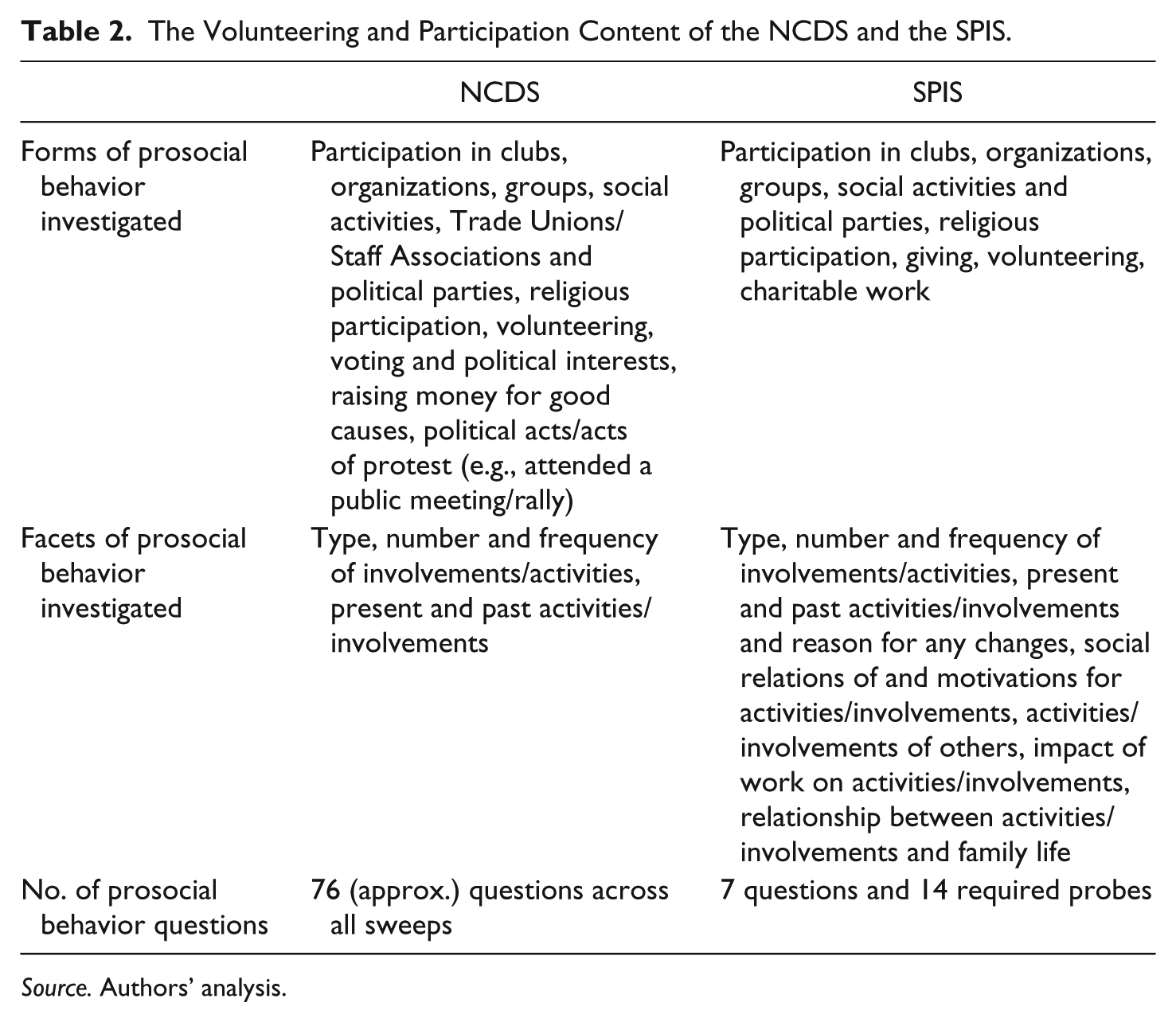
Source. Authors’ analysis.
NCDS
Although regularly included, questions on participation and volunteering have altered from sweep to sweep in terms of content, number, and placement within the NCDS (see Supplementary material). Initially, over Sweeps 2 to 4, (no relevant questions featured in Sweep 1), the activities that members participated in were of interest, for example, working for community groups and going to clubs. This turned, over Sweeps 5 to 8, into an interest in the organizations and groups that members were involved with, for example, charity/voluntary groups, tenants/residents’ groups. However, by Sweep 9 activities had again become the concern, for example, attending meetings of local groups. Attention has turned from the organizations and groups that cohort members had “anything to do with” (Sweep 4) to the organizations and groups of which they were “members” (Sweeps 5, 6, and 8). There has been a long-standing focus on participation that takes place within the context of membership-based groups and organizations, with the range of groups and organizations considered widening from sweep to sweep. In Sweep 4, there was a relatively narrow interest in a cohort member’s links to youth clubs, councils and organizations, community groups, pressure groups, and trade unions. By Sweep 8, information was solicited on members’ attachments to 15 diverse types of group and organization. In Sweep 9, however, reversing this trend, respondents were only asked about their connections to two types of group—“leisure activity groups” and “local/voluntary organizations.” This sweep also departed from all previous adulthood sweeps by including no questions on religion or religious participation.
The attention paid to volunteering has varied from sweep to sweep. Direct mention of volunteering first appeared in Sweep 3 when cohort members were 16. Respondents were asked whether they did “voluntary work to help others.” At the time of writing, volunteering has been directly explored only three times in the adulthood sweeps, in Sweeps 4, 8, and 9. However, other sweeps have explored involvements in “voluntary groups” and various groups/organizations in the context of which one might assume volunteering could take place, for example, community/civic groups.
Against this background of change, there have been some constants. Most obviously, from sweep to sweep, there has been a focus on collecting data on the magnitude, frequency, and field of cohort members’ involvements and activities. Counts of the type and number of groups with which cohort members engage, and data on the frequency of these involvements, have been a routine concern.
SPIS
The participation section of the SPIS topic guide (see Supplementary material) included questions on participation, volunteering, and giving. It was programed to take between 15 and 20 min and comprised seven questions, with interviewers encouraged to probe on almost 40 further points. Interviewers were advised that they did not have to “read out each question verbatim” from the topic guide, whereas longer questions could be “rephrased or adapted slightly” as long as the substantive content was covered (Elliott et al., 2010, p. 52). Only when a word or phrase within a question or statement was emboldened were interviewers required to use it exactly as it appeared. The probes included within the topic guide were identified as “possible lines of development/areas to request expansion on depending on the interviewee’s response to the preceding question” (Elliott et al., 2010, p. 52). Only when a probe was placed in italics was the interviewer required to cover the supplementary question or the subject area to which it referred. Interviewers had a degree of freedom, then, in regard to structuring, phrasing, pacing, and progressing the interviews, as is typical within qualitative interviews.
Questions covered spare time interests and activities, involvements in clubs, organizations, groups and political parties, religious participation, participation in learning, giving, volunteering, charitable work, how interests and involvements evolved over time, how leisure time and social life overlapped with family life and how work affected leisure activities. Similar to the NCDS, established involvements, that is, the organizations that respondents “belonged” to, were “members” of, had “formal associations” with, rather than loose and informal connections, were the concern, although, being open-ended questions, cohort members were not restricted to discussing just these types of attachment. Several questions explored the social relations of participation and volunteering. Questions were reflective providing opportunities for respondents to explore the motivations behind their behaviors, how and why their behaviors had changed, how their behaviors fitted in with family and work, and how their behaviors compared with the behaviors of others.
Study Strengths and Limitations
The NCDS and SPIS are high quality data sets that follow carefully constructed, transparent methodologies. Both allow volunteering and participation to be situated in a whole life context. Both provide information on a raft of life domains, factors, and behaviors in addition to participation and volunteering. Bringing together both data sets enables a more complete picture of how, why, and where participation and volunteering operate within, and interact with different components of, an individual’s life over time.
In terms of strengths, the NCDS supports longitudinal analysis allowing trends in participation and volunteering to be tracked over time. Due to its extensive data coverage, and collection of data at multiple points in time, researchers can explore associations and effects and examine links and potential causal pathways between participation, volunteering, and a huge array of socioeconomic, demographic, attitudinal, and health-related variables. They can also adopt a lifecourse perspective to examine how participation and volunteering relate to other parts of, and transitions within, an individual’s life such as education, work, and family (Elder, 1998; Morrow-Jones & Wenning, 2005). The large study size, with over 9,000 cohort members participating in the most recent sweep (Batty et al., 2014), forms another key strength.
Limitations of the NCDS include its focus on closed questions that collect data on the frequency and scale of participating and volunteering. Although useful for understanding rates, patterns, and trends, these questions are less useful for understanding how and why people participate and volunteer, the meanings incorporated in these different forms of engagement, what leads people to these behaviors, why they are maintained, and what might encourage or discourage greater involvement. Such information is essential for policy makers and others interested in growing participation and volunteering. This is where the complementary qualitative SPIS data can offer pertinent insights. Other limitations include regular question revision and the use of questions that explore broad behaviors. Both factors make it difficult to track, and gain accurate measures of, more nuanced forms of involvement.
Regarding the SPIS, strengths include the provision of data that facilitate detailed insights into lived experiences and personal narratives of participating and volunteering, along with multiple other areas of life. Open-ended, follow-up, and probing questions, plus prompts and a relaxed pace, provided opportunities for cohort members to reflect on past behaviors, build and develop answers, and provide responses in their own words. They were not restricted to a prescribed range of responses or wedded to a specific set and order of subjects. Forming another key strength, the achieved sample was broadly representative of the wider NCDS cohort allowing tentative conclusions to be drawn about this wider group (Elliott et al., 2010). Limitations include the comparatively small study size with 220 cohort members completing successful interviews, although this sample size is still large for a qualitative study, and the relatively unstructured nature of the collected data, which makes comparisons between cases less easy.
Comparison of the NCDS and SPIS Participation and Volunteering Estimates
To widen and deepen understanding of the relationship between methods and measures, in this section, we compare volunteering and participation estimates from the NCDS and SPIS. To do this, we draw on findings from an investigation into three “extreme” patterns of participation and volunteering in the NCDS cohort (Brookfield, Parry, & Bolton, 2014). Ethics approval for this study was provided by a University Research Ethics Committee (reference number ERN 09-256).
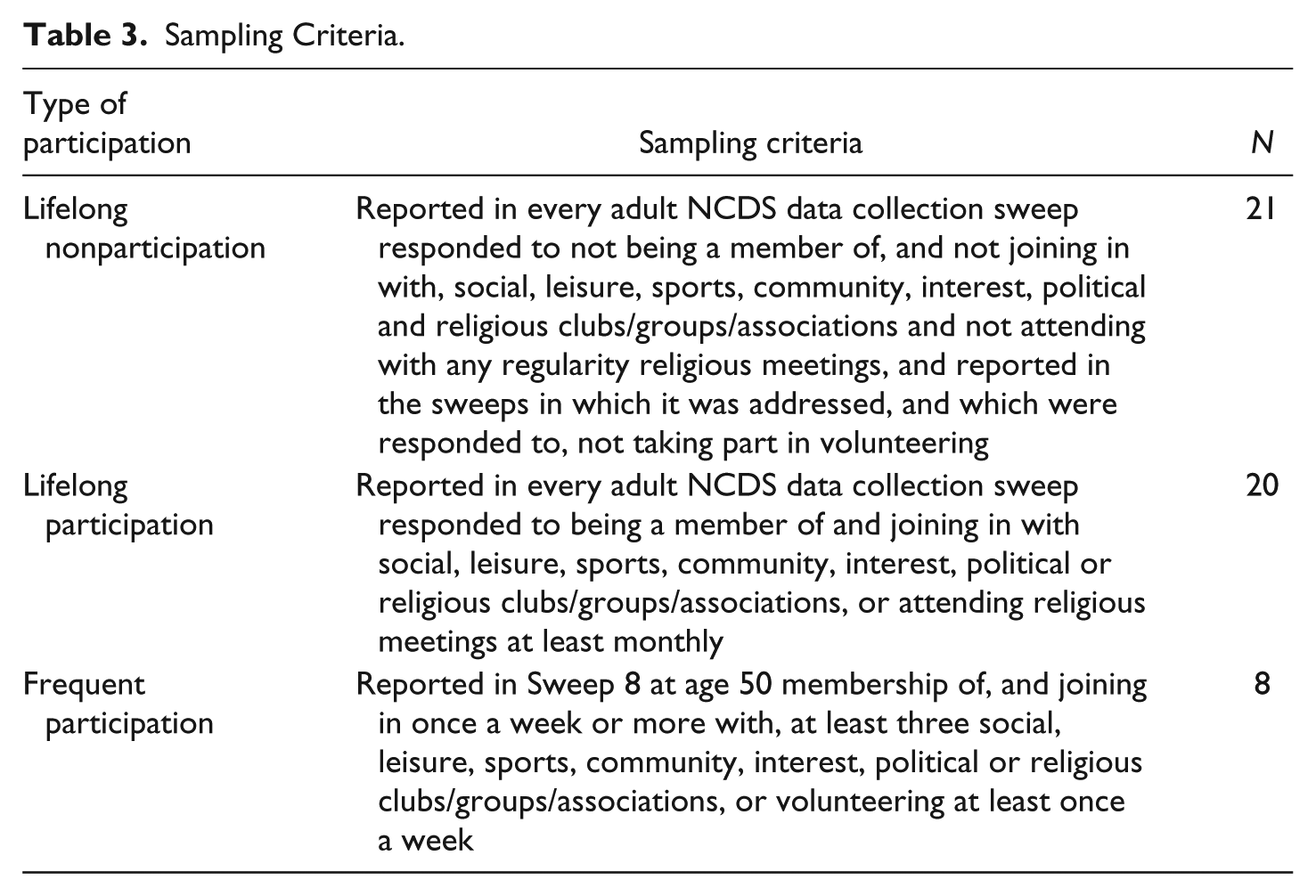
Steered by Patton’s (1990: 170) argument that “more can be learned from intensively studying extreme or unusual cases than can be learned from statistical depictions of what the average case is like,” we purposively sampled the SPIS interview transcripts for a set of cohort members who presented in their NCDS data records “extreme,” yet particularly policy relevant, participation narratives. Cohort members each have a Participant ID that allows easy matching across the two data sets. We sampled the interview transcripts associated with every individual (n = 21) in the SPIS who, in every adult NCDS data collection sweep to which they responded, encompassing Sweeps 4 to 8, (Sweep 9 was not available at the time of our study), reported not being members of and not joining in with clubs/groups/associations, and not attending with any regularity religious meetings. In addition, in the sweeps where it was explored, these individuals reported not taking part in volunteering. We termed these individuals “lifelong nonparticipants.” We also sampled the interview transcripts associated with every individual (n = 20) included in the SPIS who always reported participating in clubs/groups/associations or regular (monthly) attendance at religious meetings, and a random sample (n = 8) of transcripts associated with cohort members who reported frequent participation in clubs/groups/associations, or volunteering, at age 50. We termed these individuals, respectively, “lifelong participants” and “frequent participants.” This produced a sample of 49 interview transcripts, related to 49 individuals, for analysis. 2 Table 3 provides further information on the sampling criteria. To maximize the number of cases available, we did not exclude cohort members who presented incomplete NCDS data.
Sampling Criteria.
The quantitative NCDS data were analyzed in Stata (Hamilton, 2012) and Excel. Personalized timelines detailing the participation commitments of each member of our sample at each data collection point were created. At the group level, descriptive statistics were developed to identify headline sociodemographic characteristics (e.g., gender, education) by participant “type.” The qualitative SPIS data were analyzed in NVivo (Bazeley & Jackson, 2013). An inductive thematic analysis (Kawulich, 2017) was performed on the interview transcripts.
Considered side-by-side, findings from the analyses of the two data sets revealed, in respect of our sample, quite different estimates of participation. The NCDS data indicated that 57% of this sample, equating to the eight frequent and 20 lifelong participants, were (as exepected) participants. However, analysis of the SPIS data suggested that 86% of this sample were participants (present or past; see Table 4). Several methodological factors seemed to explain this discrepancy. We explore these factors here.
NCDS and SPIS Participation and Volunteering Estimates.
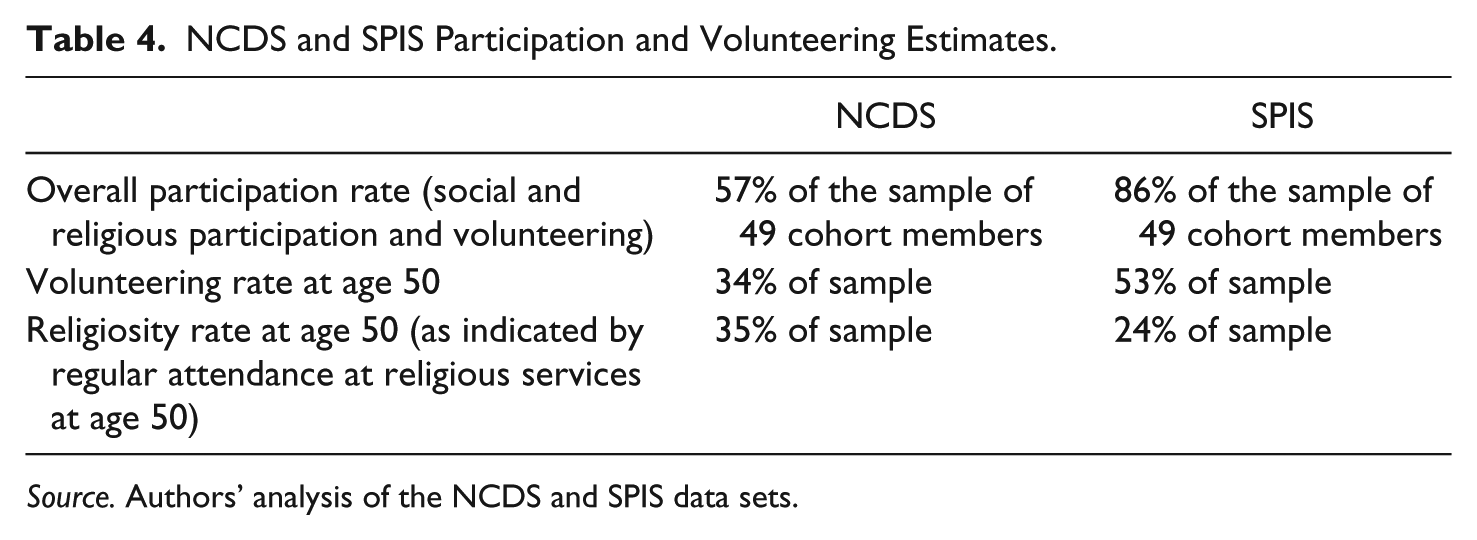
Source. Authors’ analysis of the NCDS and SPIS data sets.
The NCDS has consistently employed narrow filter questions that privilege participation located within, and performed by the members of, a prescribed set of membership-based groups/organizations. Alternative forms of participation occurring outside these settings are effectively “missed” by the survey instrument. Cnaan and colleagues (2011) found something similar in respect of measures of giving. Examining the Center on Philanthropy Panel Study (COPPS), they found that only individuals who said they donated US$25 or more were asked detailed questions about their donating. Smaller donors and their giving behavior were effectively “missed.” Compared with the NCDS, the semistructured, open-ended questions of the SPIS allowed respondents to present information about any form of participation occurring in any context. As a result, just seven of the 21 individuals identified as “lifelong nonparticipants” in the NCDS data emerged as lifelong nonparticipants in the SPIS data. Indeed, most of the 21 NCDS-identified lifelong nonparticipants, 14 in fact, emerged in the SPIS data as occasional, past, ad hoc, and informal participants. Around half, for example, had previously attended gyms, exercise classes, and/or participated in sports clubs and teams. Four had “helped out” at groups and activities associated with their children, at Parent Teacher Associations and Brownie packs for instance. Three occasionally volunteered, one had worked as a marshal on a sponsored walk, whereas another assisted with annual day trips organized for disabled children. Four were or had been members of diverse interest groups and societies, including a school alumni association and an informal motorbike enthusiasts’ group. Two had been past members of social clubs, and one a member of a band. SPIS interviewers that regularly used probes and follow-up questions to solicit information tended to be more likely to identify forms of participation among cohort members. Finding something similar, Wilhelm (2007), examining surveys on giving, noted that interviewers proficient in obtaining information about dollar amounts tended to identify larger sums of charitable giving among respondents and concluded that interactions between the researcher and research instrument were important in determining measures of giving. Our work suggests this is also true in respect of measures of participation.
The NCDS has rarely solicited information on volunteering. When it has, formal volunteering has been the concern and contested terms have been employed (Hall, 2001). Over the period we studied, questions on volunteering only featured in Sweep 4 at age 23 and Sweep 8 at age 50 (see Supplementary material). It is unlikely, then, that instances of volunteering occurring between ages 24 and 49 were recorded. Yet this might have been a peak time for volunteering. The SPIS interviews revealed that those cohort members who had children performed a variety of informal “helping out” roles at clubs, organizations, and activities associated with these children, and according to NCDS data, it was between ages 24 and 49 that individuals tended to have children. When the NCDS has explored volunteering, attention has focused on formal volunteering with cohort members questioned about their involvement in “voluntary work,” a widely interpretable term (Hall, 2001), whereas narrow filter questions may have privileged volunteering located within, and performed by the members of, prescribed membership-based groups/organizations. These various factors might help explain why 12 cohort members recorded as nonvolunteers in the NCDS, totaling one frequent participant, five lifelong participants, and six lifelong nonparticipants, presented in the SPIS data as formal, informal, occasional, and/or past volunteers. In the SPIS, free to describe behaviors and involvements in their own words and discuss volunteering of any shape that occurred at any time, these “nonvolunteers” were found to be past or current participants in a range of voluntary activities. They had, for instance, “helped out” at groups and activities linked to their children, assisted neighbors with everyday tasks, supported church-related charitable activities, coached sports teams, and held unpaid management roles in organizations (e.g., chairperson of a national interest group).
Some 35% of our sample reported in the eighth NCDS data collection sweep at age 50 regular (monthly or more) attendance at religious services, an unsurprising finding given the inclusion of regular attendance at religious services in our sampling criteria. One might infer, then, that the sample comprised many religiously oriented respondents, with attending religious services often understood as an indicator or dimension of religiosity (Kim, Smith, & Kang, 2015). However, studying the SPIS data suggested that only 24% of the sample regularly attended these services at age 50. The inclusion of discrete questions on this activity within the NCDS (see Supplementary material), but its inclusion with multiple other activities, behaviors, and involvements in a single question (Question 8) within the SPIS (see Supplementary material), might explain this difference. Within the SPIS interviews, although some cohort members discussed, and some interviewers probed on, each activity, behavior, and so forth, other interviewers and cohort members attended to just one or two items. As a result, certain associations and activities might have been “missed.” Furthermore, and perhaps most interestingly, the SPIS data revealed that motivations other than taking part in collective acts of worship appeared to prompt participation in some individuals. Being with or supporting family, opportunities to think and reflect, and/or the potential to access social support seemed to explain their attendance. Obscured by the closed questions of the NCDS, the open-ended questions of the SPIS allowed these complex narratives of religious participation to emerge.
Conclusion
This Research Note has helped highlight the research opportunities afforded by the NCDS and SPIS to those interested in prosocial behaviors. It has identified the SPIS as a useful resource for researchers, policy makers, and others interested in understanding the lived reality of participating and volunteering and individuals’ perspectives on where, why, and how these activities fit into everyday life. In terms of specific issues, the SPIS data could support enquires into the role of family formation and caring duties in prompting, curbing, and/or stopping participation and volunteering and, likewise, the role of work in these matters. Work and caring duties have both been identified as important factors in participation (Putnam, 2000). The data could also support investigations into connections between different participatory activities; participation in one activity or group tends to be associated with participation in another (Putnam, 2000). Findings on such matters could inform the development of responsive provolunteering and proparticipation policy that recognizes the social relations, meanings, barriers, and motivations surrounding these behaviors. The NCDS has been identified as a useful data set for those interested in exploring associations and effects and potential causal pathways between participation, volunteering, and a huge array of person-related variables. In terms of particular issues, noting accumulating evidence of the importance of the early years on later life outcomes (Elder, 1998), the NCDS data could support investigations into such things as participation in childhood and health outcomes in adulthood, and social interaction in childhood and social interaction in adulthood. Findings on such matters could support the identification of potentially modifiable factors and desirable outcomes related to prosocial behaviors that could structure provolunteering and proparticipation interventions. Bringing together both data sets as we did produced a more complete picture of how, why, and where participation and volunteering occurred within, and interacted with different components of, an individual’s life over time. Using the NCDS data to, as we did, steer the selection of SPIS data offers many opportunities to researchers. For example, noting the often-cited association between education and participation (Brodie et al., 2009), the SPIS interview transcripts associated with cohort members presenting within their NCDS data records particular combinations of these factors could be sampled. For instance, researchers could select for analysis any transcripts associated with individuals reporting no qualifications but regular participation in adulthood and, conversely, any reporting higher level qualifications but no participation.
Seeking to widen and deepen our understanding of the relationship between methods and measures, this Note has compared participation and volunteering data from a birth cohort study (NCDS) with data from a linked, biographical interview study (SPIS). These studies identified different rates and forms of participation and volunteering within the same population. Aspects of their respective methodologies appeared key in explaining these differences. Matching studies which have compared data from different surveys, it appeared that prompts and probes were related to higher estimates (Bekkers & Wiepking, 2006; Hall, 2001; O’Neill, 2001; Rooney et al., 2001, 2004). In contrast, narrow filter questions appeared to be related to lower estimates (Cnaan et al., 2011). Furthermore, contested terms (Hall, 2001), the frequency and point in time of data collection, the use of open-ended questions, and interactions between the researcher and research instrument (Wilhelm, 2007) all seemed important in structuring the rate and forms of participation and volunteering identified. These items point to issues that researchers ought to bear in mind when designing data collection tools. Contested terms ought to be avoided or a clear definition provided; researchers ought to be trained in the use of any data collection tool; the construction of filter questions ought to be given careful consideration, as should decisions about revising or removing questions from longitudinal studies.
Ultimately, this Research Note has further highlighted the importance of methods, in this case aspects of survey methodology and in-depth interview methodology, in determining measures of prosocial behavior. Moreover, it has underlined the need to pay equal attention to a study’s methods and findings, to reflect critically on the implications of alternative methods when designing studies and, when reporting research, to be transparent about how findings should be interpreted.
Supplemental Material
NVSQ786470_Supplementry_material – Supplemental material for Getting the Measure of Prosocial Behaviors: A Comparison of Participation and Volunteering Data in the National Child Development Study and the Linked Social Participation and Identity Study
Supplemental material, NVSQ786470_Supplementry_material for Getting the Measure of Prosocial Behaviors: A Comparison of Participation and Volunteering Data in the National Child Development Study and the Linked Social Participation and Identity Study by Katherine Brookfield, Jane Parry and Vicki Bolton in Nonprofit and Voluntary Sector Quarterly
Supplemental Material
Supp_material – Supplemental material for Getting the Measure of Prosocial Behaviors: A Comparison of Participation and Volunteering Data in the National Child Development Study and the Linked Social Participation and Identity Study
Supplemental material, Supp_material for Getting the Measure of Prosocial Behaviors: A Comparison of Participation and Volunteering Data in the National Child Development Study and the Linked Social Participation and Identity Study by Katherine Brookfield, Jane Parry and Vicki Bolton in Nonprofit and Voluntary Sector Quarterly
Footnotes
Acknowledgements
We acknowledge the valuable input provided by the Centre for Longitudinal Studies. Our paper is modeled on work by Nesbit (2010) published in Nonprofit and Voluntary Sector Quarterly. The analyses in this work are based wholly or in part on analysis of data from the National Child Development Study (NCDS) and the Social Participation and Identity Study (SPIS). The data were deposited at the UK Data Service by the Centre for Longitudinal Studies at the UCL Institute of Education. NCDS is funded by the Economic and Social Research Council (ESRC). We are grateful to The Centre for Longitudinal Studies for the use of these data and to the UK Data Archive and UK Data Service for making them available. However, they bear no responsibility for the analysis or interpretation of these data. We thank the anonymous reviewers and editor for their comments on earlier versions of the Research Note.
Author(s) note
Jane Perry is now affiliated to Southampton Solent University, UK.
Declaration of Conflicting Interests
The author(s) declared no potential conflicts of interest with respect to the research, authorship, and/or publication of this article.
Funding
The author(s) disclosed receipt of the following financial support for the research, authorship, and/or publication of this article: This work was supported by the ESRC and the Barrow Cadbury U.K. Trust and formed part of the program of the joint ESRC, OCS, Barrow Cadbury Third Sector Research Centre based at the University of Birmingham and the University of Southampton.
Notes
Supplemental Material
Supplemental material for this article is available online.
Author Biography
References
Supplementary Material
Please find the following supplemental material available below.
For Open Access articles published under a Creative Commons License, all supplemental material carries the same license as the article it is associated with.
For non-Open Access articles published, all supplemental material carries a non-exclusive license, and permission requests for re-use of supplemental material or any part of supplemental material shall be sent directly to the copyright owner as specified in the copyright notice associated with the article.
