



Abstract
Halitosis, or oral malodor, is caused by unwanted oral microbes that metabolize proteins and produce volatile sulfur compounds (VSCs). These malodorous VSCs may negatively impact oral health as they are pro-inflammatory, and halitosis is generally considered an important marker of oral health status. A previous clinical study with 24 dogs showed that daily administration of 250 mg of a novel canine oral health postbiotic (COHP) significantly decreased VSCs by 26% compared to placebo on Day 14, with twice as many dogs showing perceptibly improved breath in the COHP group on Day 7. The present double-blinded, placebo-controlled validation study evaluated COHP's ability to reduce canine oral malodor at a reduced dose of 150 mg to confirm that the previously reported efficacy of COHP is reproducible and maintained at a lower dose. Twenty-four dogs were stratified by starting VSC levels and received either COHP or placebo as a powder topper over standard chow for 14 days. VSC levels were measured via a halimeter, and perceived malodor was assessed using a 10-point scale on Days 0, 7, and 14. VSC levels increased in the placebo group by 24% on Day 7 (P = .006) and 38% on Day 14 (P = .002), while COHP prevented VSC increases on both days, resulting in a −26% change compared to placebo on Day 14 (P = .04). VSC levels correlated with perceived malodor, and COHP trended toward a 1-point reduction in perceived malodor compared to placebo (P = .06). These findings agree with the previous study, suggesting COHP effectively reduces canine halitosis across 2 doses.
Introduction
Halitosis arises from oral microbes that metabolize sulfur-rich amino acids such as cysteine and methionine, generating volatile sulfur compounds (VSCs), notably hydrogen sulfide (H₂S) and methyl mercaptan (CH₃SH).1–6 Halitosis currently affects as many as 80% of dogs over the age of 3 years that are affected with periodontal disease and is an important marker of canine oral health.7,8 Over time, microbes can accumulate in biofilm or plaque, resulting in a high abundance of unwanted VSC-producing bacteria.9–11 These VSCs are not only perceived by humans to be malodorous, which may negatively impact the human-animal bond, but can further contribute to poor oral health status, as they are inherently pro-inflammatory and may contribute to gingival inflammation and periodontal degradation.12–17 Maintaining oral health is of great importance to dogs, particularly as periodontal disease may be linked to more systemic health concerns across the body in dogs and humans.18,19
Practical, effective solutions to maintain good canine oral health are lacking. Daily tooth brushing and professional dental cleanings are the gold standard for canine oral care, which can also reduce halitosis, but compliance by pet owners remains low due to uncooperative pet behavior and practical difficulties. Additional considerations include the costs and health risks associated with general anesthesia, which is required for professional cleanings in dogs and may prevent an owner from having it performed.2,20–25 In a survey study in Sweden, only 13% of dogs had undergone professional dental cleaning under anesthesia. 8 Alternative oral health products that have a higher adoption rate may be less effective at affecting the microbial factors that may contribute to poor oral health. The Veterinary Oral Health Council (VOHC) provides acceptance for products that demonstrate efficacy against plaque and tartar accumulation; however, VOHC acceptance does not directly address halitosis, and solutions targeting VSC reduction specifically remain limited. Chemical ingredients, such as chlorhexidine, are limited in their ability to support a healthy oral microbiome as they indiscriminately target a wide array of oral microbes, including those associated with a healthy oral microbiome state.26–28 There is little evidence that herbal ingredients, such as essential oils and polyphenols, provide additional oral health benefits compared to conventional dental products that utilize mechanical action or have chemical activity, particularly because many studies test herbal ingredients in the context of toothbrushing or as adjuncts to chemical constituents.29–33 Finally, other natural ingredients, such as Ascophyllum nodosum, work through unclear mechanisms with variable efficacy greatly impacted by the product format (eg, powder, chew, treat, or supplement).31,32
Postbiotics are microbially derived ingredients that show potential for improving halitosis. Microbial metabolites may target VSC-producing bacteria, and postbiotics should be able to retain efficacy under the physical constraints associated with the manufacturing of pet products (high temperature, pressure, and/or moisture).33–39 Postbiotics have also been shown to improve oral health across models, including mice and humans.40,41 An administered postbiotic repaired damage to gingival epithelial cells caused by Porphyromonas gingivalis in vitro, and it suppressed degradation and inflammation in the gingival tissue of mice. 40 Postbiotic lozenges have also been shown to decrease microbes associated with VSCs in humans, including Rothia and Streptococcus. 41 Nevertheless, there is limited clinical evidence that postbiotics can positively affect canine oral health. 42
A novel canine oral health postbiotic (COHP) was recently shown to reduce halitosis in dogs within 7 days, resulting in a 27% reduction compared to the placebo after 14 days. 43 In this study, the authors evaluated COHP's ability to reduce canine halitosis at a lower dose in a double-blind, placebo-controlled, randomized clinical trial.
Materials and Methods
Animals
The study was conducted at a registered research facility that complied with all local regulations governing the care and use of laboratory animals and was conducted in accordance with the Ontario Ministry of Agriculture, Food and Rural Affairs (OMAFRA) and the CCAC Guide to the Care and Use of Experimental Animals. To ensure compliance, the protocol was reviewed and approved by the facility's Institutional Care and Use Committee (IACUC). All dogs were classified as USDA Category C for the full duration of the study. This includes animal use activities that involve no more than momentary or slight pain or distress and for which there is no need for the use of pain-relieving drugs.
All dogs were part of a permanent colony made up of Beagles and small mixed-breed dogs. All participants were between 2 and 12 years of age. Both intact and neutered animals of both sexes were included in the study. No female dogs were in estrus during the study period. Dogs were allowed to socialize in groups in outside dog runs for at least 1 hour each day and had access to a larger dog park at least twice weekly for robust play and exercise. The study cohort was distinct from that of the previous COHP trial.
All dogs were either pair-housed in 10-foot × 10-foot runs that can be divided into 5-foot × 10-foot runs for individual housing or group-housed in 6.1 m × 4.9 m rooms, with 6 to 8 dogs per room. Beds and blankets were provided for all dogs. Fresh, clean drinking water was provided ad libitum, but was withheld during feeding (∼30 min/day) to standardize administration across participants. Dogs remained in the same room for the duration of the study. Animal rooms were cleaned at least once daily, disinfected twice weekly, and descaled when needed.
The inclusion criteria in the study were as follows: (1) participants were not taking any prescribed medications or only prescribed NSAIDs or routine medication for fleas, ticks, or heartworm, (2) participants’ body condition scores were between 4 and 7 on a 9-point scale, and (3) participants were not pregnant and had not been pregnant in the last 6 months. No dogs were receiving NSAIDs at the time of enrollment or during the study period. All dogs had normal head shapes with little to no brachycephaly and had dental anatomy compatible with standardized breath sampling. Dogs with visible fractured teeth were excluded during screening. As colony animals were under regular veterinary supervision, it was possible to identify dogs with gastrointestinal, respiratory, or systemic diseases that could contribute to halitosis and exclude them. Comprehensive blood work was not performed.
Study Design
The study was a double-blinded, placebo-controlled, randomized design. The duration of the study was 15 days (Days 0-14), and the test mixture or placebo were administered for 14 days (Days 1-14). VSC levels were measured on Day 0, and groups were assigned through stratified randomization. Considering the number of dogs in the study, only 4 strata were used, 2 per covariate. The dogs were randomly assigned to a group based on (1) total VSC levels on Day 0 to achieve a similar average total VSC level in both groups and (2) sex to achieve a sex ratio of ∼1:1 in both groups (Tables 1 and 2). Sex was balanced to account for potential hormonal influences on oral health.
Stratified Group Summary Statistics.

Abbreviations: F, intact female; SF, spayed female; M, intact male; NM, neutered male; COHP, canine oral health postbiotic; VSC, volatile sulfur compounds.
Stratified Group Assignments Based on Baseline VSC Levels and Sex.
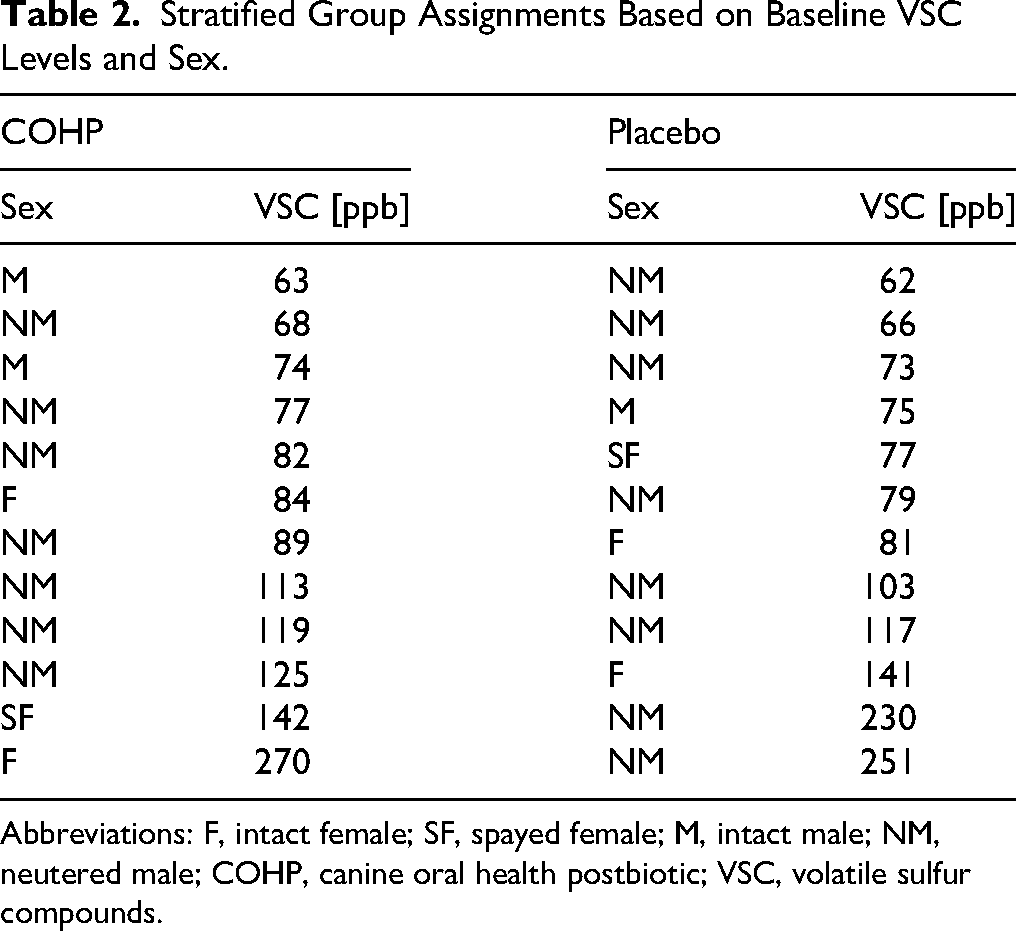
Abbreviations: F, intact female; SF, spayed female; M, intact male; NM, neutered male; COHP, canine oral health postbiotic; VSC, volatile sulfur compounds.
The study used a dirty tooth model (professional dental cleanings were not performed as part of the study). Prior to the study, there was a 5-day acclimation period, during which the participants did not receive any oral care from a veterinary dentist, did not have their teeth brushed, and did not consume or use any oral health product, including dental chews, treats, and food supplements. Dogs were monitored daily by trained animal care technicians for general health status, food consumption, and any adverse events. No dental chews, treats, or supplements were provided through the duration of the study other than the test mixture or placebo. In addition, ad libitum access to routine dental enrichment, such as chew toys and bones that may disrupt plaque/tartar via mechanical action, was interrupted for the duration of the study, as is standard for dental studies. This dental enrichment is the only oral health care regularly provided to the dog colony. All participants had mild to medium halitosis (50-400 ppb VSCs were detected in breath samples as measured experimentally by a halimetera on Day 0). Within this range, dogs were stratified by initial VSC levels to ensure balanced distribution between test mixture and placebo groups.
There were 2 termination criteria for the study: (1) abnormal changes in a dog's health as assessed by a veterinarian followed by a recommendation by a veterinarian to remove the dog from the study and (2) refusal to eat more than 2 consecutive meals.
Intervention
COHPb is a commercially available mixture composed of a tapioca maltodextrin carrier, dried Pediococcus pentosaceus fermentation product, and dried Bacillus subtilis fermentation product. Both fermentation products are heat treated to inactivate live cells, then spray or freeze dried. The placebo was tapioca maltodextrinc, the same carrier utilized in the COHP mixture.
On Days 1 to 14, each dog received 150 milligrams of either COHP or the placebo added to their daily standard dry diet meald, as a powder topper. The daily food portion was placed into a bowl and sprayed with enough water to moisten the food and promote adhesion of the powder to the food. The dog's water source was removed, then the dog was served the food containing the powder topper. The dog was allowed up to 30 min to eat all the food. The dog's water source was replaced upon completion of the meal, and the dog had access to water ad libitum for the rest of the day.
Breath Sampling
After the dog's meal, a single trained technician, who was different from the breath scoring technician, performed all breath sampling measurements on Days 0, 7, and 14 using the halimeter and recorded the VSC level data in a separate spreadsheet from the breath scoring data. In advance of any measurements, the halimeter was zeroed and calibrated to the ambient air, and the dog's mouth was gently held closed for 1 min. The halimeter probe was inserted between the canine teeth such that the air in the oral cavity could be sampled (being careful to maintain a central position in the mouth), and the mouth was then gently held closed around the probe during measurement (30 s). The process was repeated for 3 measurements, after which an automatic average was generated. The 3 raw data points and the average were saved. Measurements were obtained within 4 hours after feeding.
Breath Scoring
On Days 0, 7, and 14 after the dog's meal, a single technician who was different from the technician who conducted the halimeter measurements recorded each dog's breath score using a 10-point scale with defined anchor points, a methodology validated in previous canine halitosis research.44–46 The specific anchor descriptions are listed below. Intermediate scores were assigned based on relative proximity to these anchors. This subjective organoleptic assessment was included alongside halimeter measurements because human perception represents the relevant intervention endpoint for pet owners. Assessments were made within 4 hours after food consumption was completed. The technician was blinded to treatment assignment and assessed all dogs using the following prompt and scale:
On a scale of 1 to 10, how do you rate the breath of the dog today? (1—no bad odor present, 5—smelling the dog's breath is unpleasant; some bad odor is present, 10—you cannot stand the smell of the dog's breath). Technicians performing breath sampling and breath scoring were blinded to treatment assignment and worked independently of each other. The breath sampling technician recorded VSC data in a separate spreadsheet from the breath scoring data to maintain blinding.
Statistical Analysis
The use of 1-tailed statistical tests was predetermined based on trends observed in data collected from (1) a preliminary internal study (unpublished) and (2) a previous clinical trial. 43
The following statistical analyses were performed on the VSC level data: A Shapiro-Wilk test was used to assess if the data were normally distributed. A 1-tailed Wilcoxon matched-pairs signed-rank test was performed on the average VSC level for each participant to assess how VSC levels changed from baseline within a group. The absolute and relative change from baseline was calculated for each participant on Day 7 and on Day 14. A 1-tailed ranked Mann-Whitney U test on the absolute and relative change in VSC levels was used to assess any difference between the 2 groups.
The following statistical analyses were performed on the breath score data: A Shapiro-Wilk test was used to assess if the data were normally distributed. Either a 1-tailed paired Wilcoxon matched-pairs signed-rank test or a paired t-test was performed on the breath score of each participant to assess how malodor perception changed from baseline within a group. The absolute and relative change from baseline was calculated for each participant on Day 7 and on Day 14. A 1-tailed ranked Mann-Whitney U test on the absolute and relative changes in breath score was used to assess any difference between the 2 groups.
Results
No adverse events were recorded, and no participants were removed from the study. All dogs consumed the bulk of their meals containing the powder topper throughout the study. No palatability issues were observed, all dogs maintained their starting body weight, and no dogs refused meals or required removal from the study due to reduced food intake.
COHP effectively prevented an increase in the compounds responsible for halitosis during the study, as assessed by the halimeter. In the placebo group, VSC levels increased from baseline by 24% on Day 7 and by 38% on Day 14 (median paired change; P = .006 and P = .002, respectively, 1-tailed Wilcoxon signed-rank test). In contrast, COHP trended toward an increase in VSC levels from baseline on Day 7 (17%, P = .06, 1-tailed Wilcoxon signed-rank test), but not on Day 14 (2.3%, P = .2, 1-tailed Wilcoxon signed-rank test). Overall, COHP resulted in −26% change compared to the placebo on Day 14 (difference between group medians; P = .04, 1-tailed ranked Mann-Whitney U test (Figures 1 and 2).

Volatile sulfur compound (VSC) levels at each timepoint, by group. Bars indicate the mean, and error bars indicate standard deviation.

Change in volatile sulfur compound (VSC) levels at Days 7 and 14, by group. Bars indicate the mean, and error bars indicate the standard deviation.
In addition to reducing VSCs when compared to the placebo group, COHP caused a trend toward decreased perception of halitosis. VSC level was correlated with perceived malodor (Figure 3). Placebo use demonstrated an increasing trend in odor score at Day 14 (0.8 points, P = .06, paired t-test), whereas perceived malodor did not change in the COHP group (P = .4, Wilcoxon matched-pairs signed-rank test). Accordingly, COHP trended toward decreasing perceived malodor by 1 point more from baseline compared to the placebo group on Day 14 (P = .06, ranked Mann-Whitney U test).
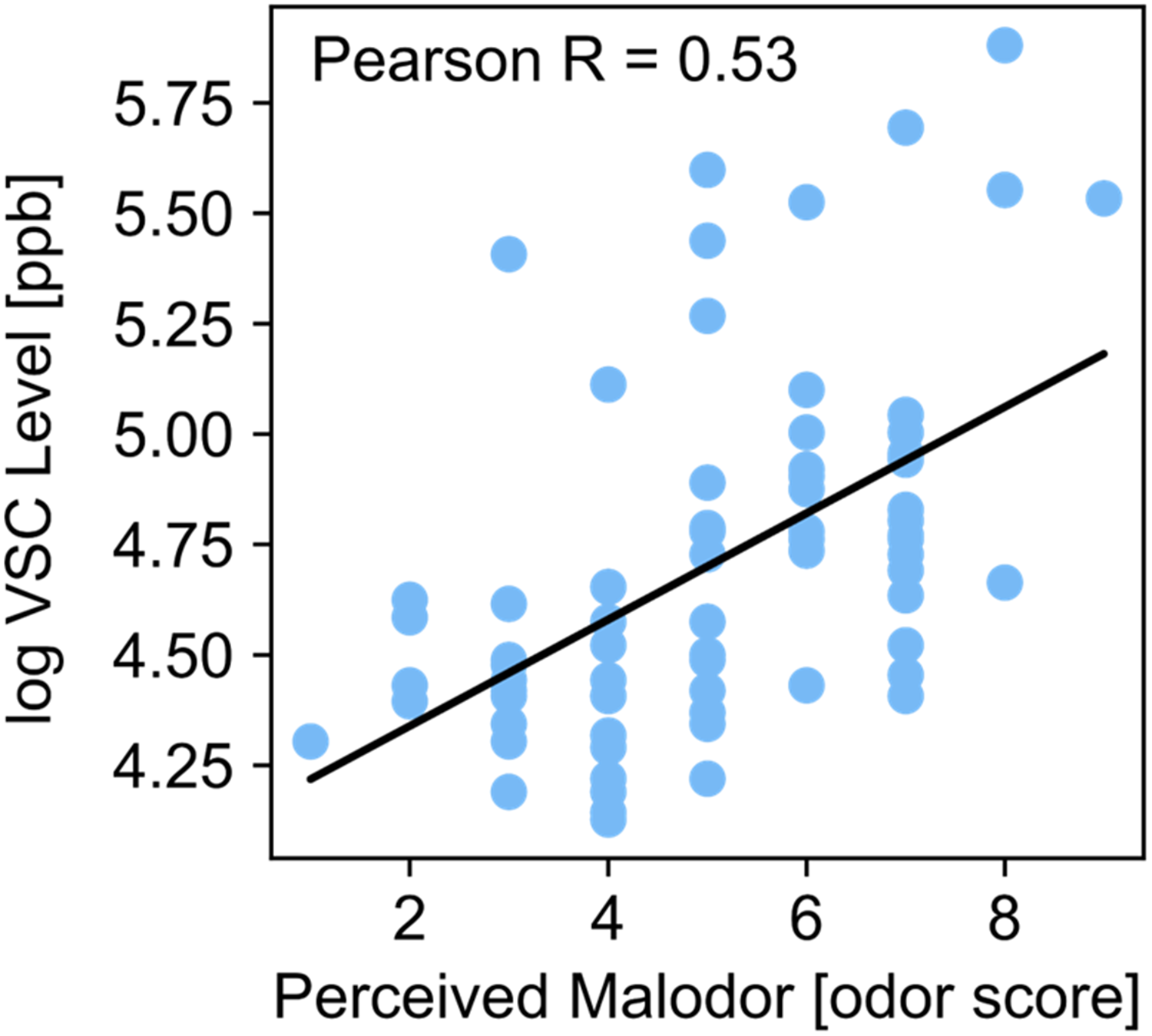
Correlation between volatile sulfur compound (VSC) level and perceived halitosis. The base-10 logarithmic transformation of measured VSCs correlated with perceived halitosis (Pearson R coefficient of 0.53). Points represent measurements of single participants from both groups at a single timepoint. The line represents a linear fit of the data.
Discussion
COHP, at a 40% lower dose than in the previous study, demonstrated a 26% reduction in VSCs compared to the placebo on Day 14, suggesting its ability to reduce canine halitosis in this group of dogs. These results provide further clinical evidence that COHP may be a practical approach for reducing canine halitosis, an important indicator of overall oral health.3,11,47–50 Testing at a 40% lower dose was motivated by the need to confirm that the previously reported efficacy of COHP on canine halitosis is reproducible and desire to determine whether this efficacy is maintained at a lower dose. These results support further dose-ranging studies at lower levels to fully define the minimum effective dose,51–54 which will increase the accessibility of formulations including COHP.
In the current study, there was no change in VSCs in the COHP group on Day 7, which may be due to a difference in VSC dynamics. In the current study, there was a 24% increase in VSCs at Day 7 in the placebo group. In the previous study, there were no changes for the placebo group on Day 7, and COHP significantly reduced VSCs on Day 7. In both studies, dogs in the COHP group did not show significant increases in VSCs throughout the study, and the relative difference between groups was similar on Day 14 in both studies. 43 Beyond these observations, it is difficult to conclude the relative impact of dose on VSC reduction, given that these were 2 separate studies.
A correlation between measured VSC levels and perceived malodor was observed across 2 studies. In both studies, there was a trend toward an increase in malodor perception in the placebo group, but not the COHP group. This provides further evidence that COHP could improve human perception of a pet's breath, thereby improving relations between dogs and humans.25,44 The moderate correlation between VSCs and human perception of malodor is consistent with prior veterinary studies demonstrating significant relationships between instrumented and organoleptic halitosis measurements in dogs.55,56 While the changes to perceived malodor were not statistically significant in this study, there was a trend toward a 1-point difference in odor score on Day 14 in the COHP group compared to the placebo group. This result was obtained despite the fact that this study was designed to assess changes to VSC levels, and the groups were stratified based on VSC levels. In this context, the trend toward a change in human odor perception across both clinical studies is a strong indicator that the postbiotic components can modulate human perception of canine oral malodor. While this study used a single odor assessor, prior research has validated halitosis assessment by nonspecialist raters, 56 including pet owners who can reliably detect breath changes following treatment. 46 Nevertheless, a dedicated sensory study with groups balanced based on odor perception, together with a larger cohort, could further characterize COHP's effects on canine malodor perception and its impact on pet-owner interactions.45,57,58 Ultimately, owner perception represents the meaningful intervention endpoint, as it directly influences the human-animal bond and motivates owners to seek oral health interventions.
Replicating the earlier trial with an identical protocol but a reduced dosage offers confirmation that the observed result is a consistent biological response across a range of doses. 43 By holding all husbandry, randomization, blinding, measurement, and exclusion procedures constant, it minimizes contextual noise and isolates dosage as the sole experimental variable. Concordant directional changes in VSCs at the lower dose strengthen confidence that the ingredient addresses halitosis. This prospective replication aligns with current reproducibility guidance for companion-animal studies (eg, PetSORT, ARRIVE) and meets growing calls for confirmation cohorts in veterinary nutrition research.59,60 Accordingly, this replication study strengthens the evidence supporting the original findings.
Dental chews are regularly evaluated for their ability to reduce halitosis in the context of a clean tooth model. While cross-study comparisons are limited by the different models used in each study, in particular between clean and dirty tooth models, these dental chew studies can be contextualized by considering how the chews perform compared to the respective control group.61–64 Considering the effects compared to the placebo groups, COHP outperformed market-leading chews that exceeded others in VSC reduction by about 40% to 90% across 2 studies.61–64 The chews allowed for an increase in VSCs that was about 50% of the controls. 63 In contrast, even at 60% of the original dosage, COHP fully prevented any increase in VSC level on Day 14, whereas the placebo group's VSC level had increased by 38% from its baseline. 43 More recent studies on dental chews failed to show improved reduction, even after 29 days of intervention.63,65 COHP's efficacy across 2 studies and doses as a single-ingredient powder topper is particularly salient given that other dental chews combine mechanical action, the extended contact time of a chew, and many different oral health ingredients.
While postbiotics have been shown to have positive effects on the human oral microbiota and increased markers associated with oral immune health, such as salivary IgA, there is no evidence that they reduce VSCs.34,35,66 Evidence of postbiotic efficacy in dogs is largely limited to other health benefits, such as improvements to gut and immune health,67–73 and in a recent oral health study in dogs, a Lactiplantibacillus plantarum postbiotic showed little effect on oral health indices and no improvement in VSCs. 42 In contrast, COHP's ability to reduce VSCs suggests that it reduces VSC-producing bacterial activity, which is otherwise known to damage oral tissue.4,12–17 This indicates that COHP reduces halitosis, which is well-associated with oral health status in dogs and humans.3,9–11,47–50
While halitosis and elevated VSCs are primarily associated with periodontal disease,3,9–11,47–50 oral malodor can also arise from other oral pathologies (eg, endodontic infections, mucosal diseases) and extraoral conditions, including gastrointestinal, respiratory, and metabolic disorders.1,74,75 Importantly, the dogs enrolled in the present study were healthy animals with no known endodontic, mucosal, or systemic disease, and inclusion criteria excluded those on prescribed medications (aside from routine preventatives), thereby minimizing the likelihood of confounding pathology. Future studies in dogs with documented systemic comorbidities may help elucidate whether COHP confers additional benefits in these populations.
The primary focus of this study was to validate previous findings but at a lower COHP dose, with halitosis as the primary endpoint. As such, it implemented a dirty tooth model—reflecting real-world conditions for the majority of dogs that do not receive regular professional dental care—and it did not assess baseline plaque, gingivitis, or calculus scores. While formal periodontal indices were not collected, several factors support the validity of this study's findings. VSC levels correlate significantly with oral health status, plaque accumulation, and gingivitis indices in both dogs and humans, providing an indirect indicator of oral health status.3,9–11,47–50 Therefore, stratification by baseline VSC levels should have limited imbalances in plaque and tartar accumulation between groups. Additionally, the significant effect of COHP observed here is consistent with the authors’ previous published study using identical methodology at a higher dose, providing cross-study validation. 43 Regardless, no claims are made with respect to formal periodontal indices, including plaque and tartar.
Conclusions
This clinical study further validated COHP's ability to reduce the compounds that cause halitosis in dogs. COHP significantly reduced VSCs by 26% compared to the placebo on Day 14, fully preventing any increase in halitosis. Additionally, measured VSCs were positively correlated with human perception of malodor, and COHP trended toward decreasing perceived malodor by 1 point more from baseline compared to the placebo group on Day 14, suggesting that COHP may have the potential to improve the human perception of a pet's breath. These findings validate COHP's efficacy at both the original 250 mg and reduced 150 mg dosages, confirming that the previously reported efficacy of COHP is reproducible and maintained at a lower dose. Collectively, the results show that COHP reliably lowers canine oral malodor and may offer a safe solution to support dogs’ oral hygiene.
Materials
a Halimeter® PLUS, Interscan Corporation, Camas, WA, USA
b Superculture® Pet Oral, Kingdom, Brooklyn, NY, USA
c Tapioca maltodextrin, Mike's Mix, Mazomanie, WI, USA
d Purina Dog Chow, Nestlé Purina PetCare Company, St. Louis, MO, USA
Footnotes
Acknowledgments
The authors would like to thank all Kingdom employees for their contributions to this project. In particular, Antonio Diaz for his contributions to the project administration, partner management, and help with manuscript preparation; and Emily Daley for her review of the manuscript.

Ethical Considerations
The study was conducted at a registered research facility that complied with all local regulations governing the care and use of laboratory animals and was conducted in accordance with OMAFRA, the CCAC Guide to the Care and Use of Experimental Animals. To ensure compliance, the protocol was reviewed and approved by the facility's Institutional Care and Use Committee (IACUC). Date: July 12, 2024. Ethical Approval Code: ONL 2024.33.
Author Contributions
RUS, RT, and AS: conceptualization; AS and RT: methodology; AS: formal analysis; AS: data curation; AS: writing—original draft preparation; AS, RT, and RUS: writing—review and editing; AS: visualization; RT: supervision; AS and RT: validation; AS: project administration. All authors have read and agreed to the published version of the manuscript.
Funding
The authors disclosed receipt of the following financial support for the research, authorship, and/or publication of this article: This research received no external funding. Kingdom provided support in the form of salaries for the authors, and funding and resources for study execution.
Declaration of Conflicting Interests
The authors declared the following potential conflicts of interest with respect to the research, authorship, and/or publication of this article: All authors are employees of Kingdom and hold stocks and/or stock options in the company. Kingdom funded this research and is the supplier of the commercial material assessed in this study. The authors are committed to maintaining scientific integrity and adhering to ethical research practices. The paper reflects the view of the scientists and not the company.
Data Availability Statement
Datasets available upon reasonable request from the authors.