




Abstract
To evaluate the effectiveness of photobiomodulation therapy (PBMT) in reducing gingivitis following professional dental prophylaxis in dogs in a prospective, randomly controlled, double-blind study. The study included 47 dogs (male n = 23, female n = 24), with a mean age of 6.5 ± 2.6 years and a bodyweight of 28.9 ± 5.3 kg. Breeds included: Belgian Malinois Shepherd Dogs (n = 23), German Shepherd Dogs (n = 14), Labrador Retriever (n = 4), and Dutch Shepherd Dogs (n = 3). The left side of the mouth was treated by performing dental prophylaxis (control group). The right side received dental prophylaxis and a single session of PBMT using a Class IV therapeutic laser (treatment group). Each side was graded individually for periodontal disease (PD), gingivitis, and calculus. Follow-up observations were conducted on days 1, 3, 8, and 15 post-treatment. Results were compared using a Mann-Whitney Test. Multiple regression was run to predict PD, gingivitis, and calculus scores using age, sex, and breed. A p < .05 was considered significant. The PBMT group (PG) showed significantly lower gingivitis scores from day 1 to 15 post-treatment. PD had an increasing prevalence with age. Age and breed contributed to the prediction of PD, gingivitis, and calculus grading. This study showed that PBMT significantly reduced the grade of gingivitis following dental prophylaxis, and may be a useful adjuvant procedure following dental prophylaxis.
Introduction
Periodontal disease (PD) is a significant health problem in dogs, consisting of inflammation of the tissues of the periodontium.1–3 The disease progresses through stages that include the formation of plaque and inflammation of the gingiva. If left untreated, it will lead to periodontal pocket formation, alveolar bone resorption, tooth mobility, and ultimately, tooth loss. 4 Gingivitis, the inflammation confined to the gingiva, is the first stage of periodontal disease and is induced by bacterial plaque. Dental calculus is often present concurrently with gingivitis.1,5 Several studies have reported the prevalence of PD, with a wide variation, from 9.3% in England, to 80% in the United States, and 90% in other regions.5–7 The prevalence of PD has been reported to increase with age, and smaller dogs appear to be predisposed. 8 Additional predisposing factors include breed predisposition, malocclusion, and chewing habits. 1 Gingivitis is reversible and preventable. Since plaque is a major inducer of gingivitis, the removal of the bacteria allied with an at-home oral hygiene program, can have a major impact on PD. 1 The treatment of canine gingivitis consists of professional dental prophylaxis (scaling and polishing) and toothbrushing.4,9,10
Photobiomodulation therapy (PBMT) uses red/near infrared light to produce a clinical effect. Several effects have been attributed to PBMT, including the stimulation of tissue healing, analgesia, and reduced inflammation. These beneficial effects combined with the noninvasive nature and a lack of adverse effects, make PBMT an interesting treatment option for several conditions.11–13 Specifically, PBMT has been described in the treatment of chronic gingivostomatitis and wound healing.12,14,15 Currently, a need to outline and test specific protocols for particular conditions exists and this includes dentistry procedures.12,14
This study aimed to evaluate the effectiveness of PBMT in reducing gingivitis following professional dental prophylaxis in dogs. It was hypothesized that the application of PBMT would result in the reduction of gingivitis. Secondarily, the study determined the incidence of PD, gingivitis, and plaque in this population of police working dogs.
Materials and Methods
The study protocol was approved by the ethical review committee of the University of Évora (Organismo Responsável pelo Bem-estar dos Animais da Universidade de Évora, GD/11670/2020/P1). Forty-seven dogs were selected after the screening of the population of police working dogs of the Guarda Nacional Republicana (Republican National Guard Canine Unit, Portugal). Inclusion criteria were bodyweight 15 to 35 kg, age 2 to 8 years, a mesocephalic or dolichocephalic skull, and a PD score of 1 or 2. The scoring method of PD is presented in Table 1.7,16 Dogs were excluded if they presented with a PD score > 2, if not available for follow-up, or if fractured teeth were found during dental prophylaxis.
Periodontal Disease Grades, Gingivitis and Calculus Scoring Criteria.
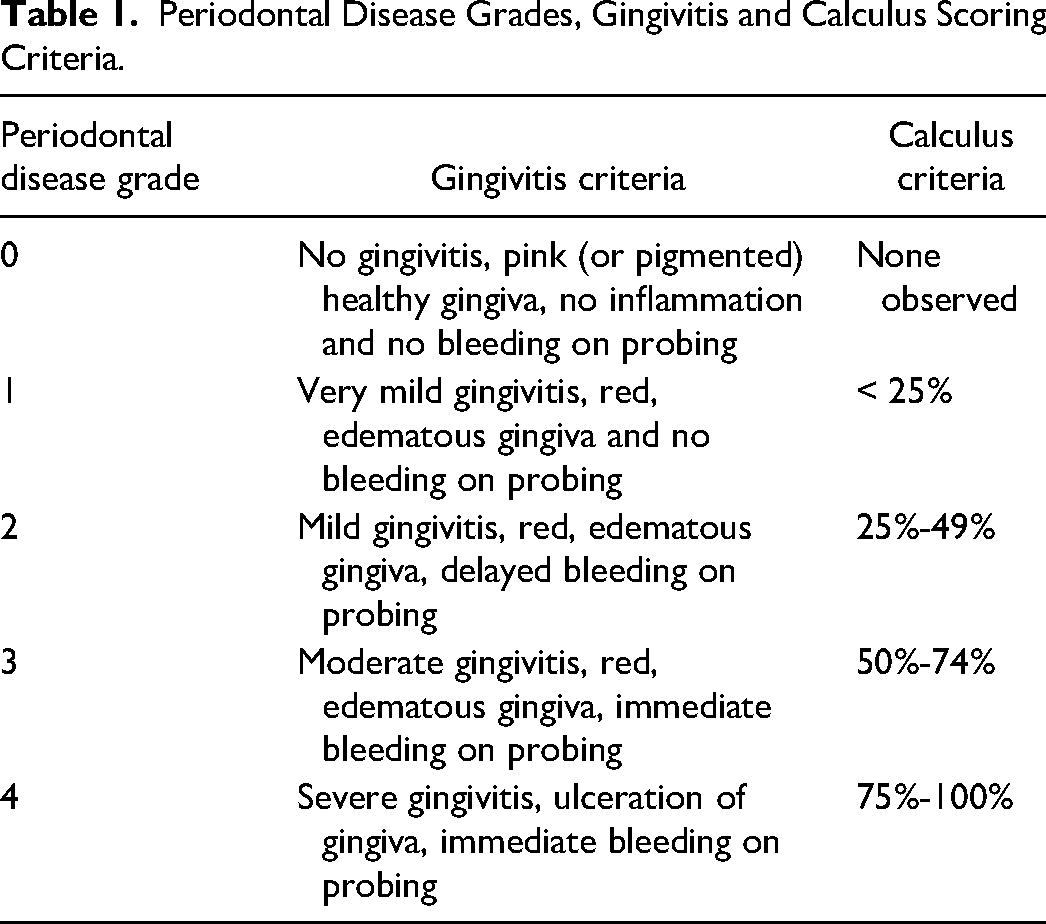
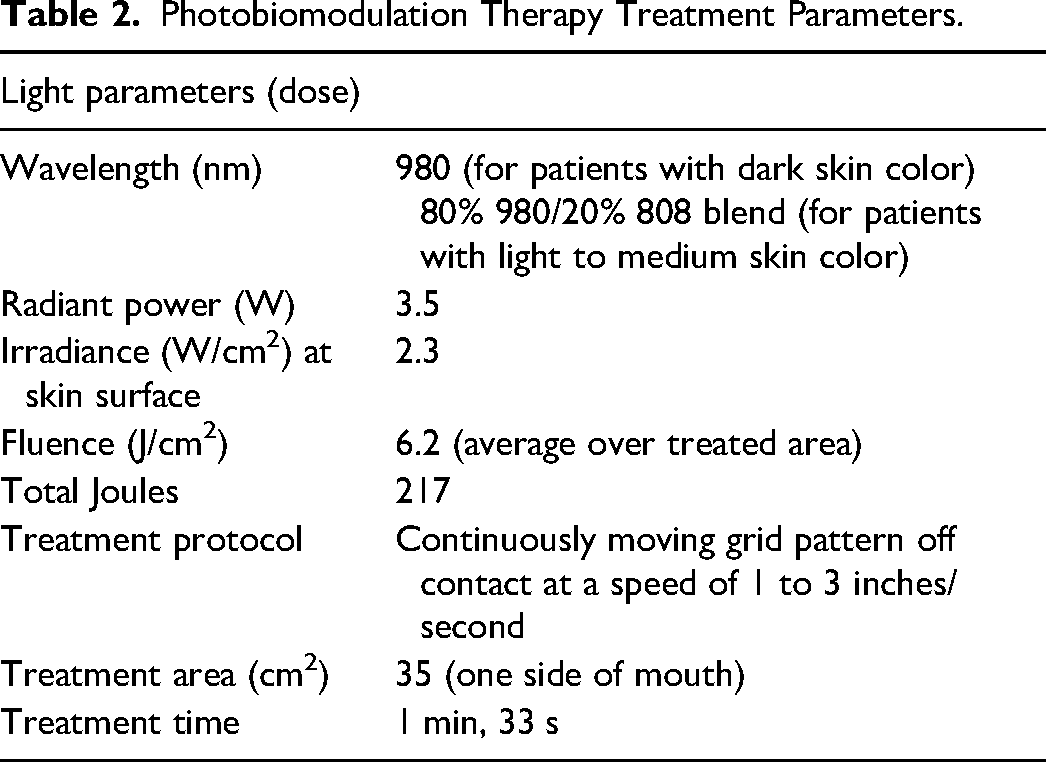
Dental prophylaxis and grading on day 0 were conducted while under general anesthesia. Patients were sedated using a mixture of medetomidinea (0.01 mg/kg) and butorphanolb (0.1 mg/kg) intravenously (IV). Induction was achieved using propofolc (1.0 mg/kg) IV to permit tracheal intubation, followed by maintenance of general anesthesia using sevofluraned. Additional analgesia was obtained using meloxicame (0.2 mg/kg) subcutaneously and by blocking the infraorbital and mandibular nerves using lidocainef (4 mg/kg).17–19 Each dog's mouth was divided into left and right halves and graded individually 16 for gingivitis4,6 and calculus10,20 (Table 1). The left side was treated by using dental prophylaxis only and it served as a control group (CG). 21 The right side, in addition to dental prophylaxis, received a single session of PBMT (PG) with a therapeutic laserg. PBMT parameters are presented in Table 2. All dental prophylaxis and PBMT treatments were conducted by the same researcher. Grading was performed by a different researcher, blinded to the assigned groups. Teeth scored included maxillary I3, C, P2, P3, P4, M1, and mandibular C, P2, P3, P4, M1.22,23 Gingivitis grading was performed on the buccal gingiva for each scored tooth which was divided vertically into three equal areas: mesial, central, and distal. The score of an individual tooth consisted of the mean score of the three areas. The score for each mouth half was calculated as the mean score of all teeth scored.9,10 Calculus grading was performed as previously described for gingivitis.10,24
Photobiomodulation Therapy Treatment Parameters.
Follow-up observations were conducted on days 1, 3, 8, and 15 post-treatment. Groups were compared using a Mann-Whitney Test. Multiple regression was used to predict PD, gingivitis, and calculus scores for age, sex, and breed. All results were analyzedh and a level of p < .05 was considered significant.
Results
One hundred and eighteen dogs were screened, and a sample of 47 (39.8%) active police working dogs were selected for the study. Forty-one were excluded for not having PD, 11 due to fractured teeth, and 19 for age (> 8-years-old). Dogs included both sexes (male n = 23, female n = 24) and had a mean age range of 6.5 ± 2.6 years and bodyweight of 28.9 ± 5.3 kg. Four dog breeds were represented: Belgian Malinois Shepherd Dogs (BM, n = 23), German Shepherd Dogs (GSD, n = 14), Labrador Retriever (LR, n = 4), and Dutch Shepherd Dog (DSD, n = 3). All dogs were followed up to day 15, and during this period, no additional medications were administered. No side-effects were recorded following PBMT.
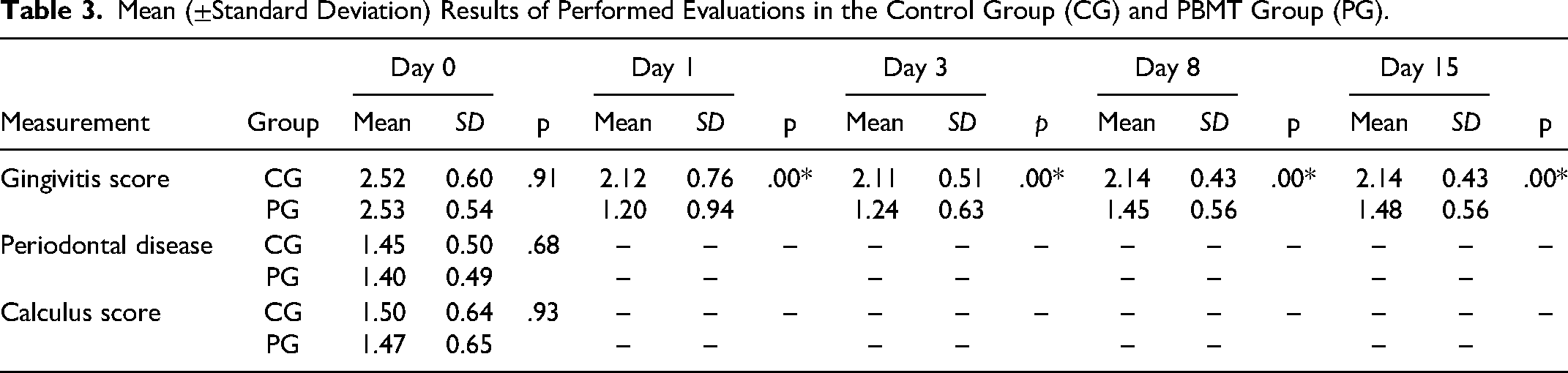
The results of the conducted evaluations are presented in Table 3. No significant differences were observed on the initial treatment day. PG showed significantly lower gingivitis scores, observed from days 1 to 15. PD had an increasing prevalence with age, 26% in dogs aged 2 to 4 years, 52% in 4 to 6 years, and 60% in 6 to 8 years. Female dogs had a higher prevalence (62%) than males (29%). Differences were also found between breeds, with PD higher in LR (67%) compared to BM (42%), GSD (37%), and DSD (21%). All of the considered variables, age, sex, and breed, significantly predicted PD, F(3, 90) = 11.840, p < .01, R2 = 0.283. Breed and age also predicted calculus grading, F(3, 90) = 18.775, p < .01, R2 = 0.385, with p < .01 for both. The same prediction was found for gingivitis grading, F(3, 90) = 23.035, p < .01, R2 = 0.434, with p < .01 for both.
Mean (±Standard Deviation) Results of Performed Evaluations in the Control Group (CG) and PBMT Group (PG).
Discussion
PBMT has several documented effects, including anti-inflammatory actions, which are attributed to an improvement in circulation.13,25 This effect has been described in humans and rodents, 13 and may be the reason this study observed a significantly lower grade of gingivitis in PG. A reduction in mean gingivitis grade was also observed in CG, but was not as significant as for PG. This reduction was expected, as PD grades were low in this sample cohort, and it were at a stage where gingivitis could be reversed through a recommended combination of dental prophylaxis followed by homecare. 7 Even though the dental prophylaxis procedure can influence inflammation due to the pressure applied to remove dental plaque and calculus from the teeth, 13 the authors do not believe it affected the results in this study.
Homecare may include different modalities, but daily tooth brushing is usually considered the gold standard for the prevention of PD, and can help reduce gingivitis following dental prophylaxis.22,26 Other options are also available such as a dental gel or chews.24,27–29 These options were not introduced in this study, as it would make it difficult to isolate the effect of PBMT. However, the dogs included in the sample were presented with different forms of environmental enrichment and rewards, such as rawhides and enrichment toys, which have a documented effect on supragingival calculus.30,31 They were also fed a commercially available dry kibble, which should ensure proper nutrition to maintain periodontal health. 7
The results of this study showed that the prediction of PD grading had a significant correlation with age, breed, and sex. The correlation between PD and age has been documented before, in terms of prevalence and severity.6,32,33 The disease has been described to be present in dogs as young as 1.3 years. 6 This study found similar results, with increasing age corresponding to a higher prevalence of PD. An additional relation between PD and the size of the dog has been described, as the disease has a higher prevalence in small breeds.6,20 Although all the breeds represented in the study are large breed dogs, LR had a higher prevalence and they are smaller dogs than GSD and DSD. That the LRs exhibited more severe PD would be consistent with them being the smaller and older dogs in this study, though with only 4 LRs, the sample size was not significant. Sex also contributed to the prediction of PD but, as with breed, this finding may be because the females in the sample were older.
Similar to PD, calculus and gingivitis grade could also be predicted by age and breed. It has been described that the extent of calculus deposition increases significantly with age, and this study supports this finding. 8 As dental calculus often exists concurrently with gingivitis, it was not surprising to observe that gingivitis could also be predicted by age and breed.1,5 Analogous to the effect described for PD, it is possible that the breed result may be affected by the fact that LR were older dogs.
Side-effects of therapeutic laser are attributed to misuse and include the potential to be hazardous to the eyes and skin. 34 Side effects were not observed in this study.
This study presents some limitations, namely the fact that only the lower grades of PD were included. For that reason, future studies should evaluate the effect of PBMT in the treatment of higher grades of PD, and also in other treatments, as it can promote tissue healing and oral comfort. 12 Analgesia assessment is beyond the scope of this study. Still, as a known effect of PBMT is analgesia, this should also be addressed in future studies.
Conclusion
This study showed that PBMT significantly reduced grades of gingivitis following dental prophylaxis. Age and breed contributed to the prediction of PD grade, gingivitis, and calculus, with increasing age corresponding to increasing PD grade and a possible breed predisposition for PD. PBMT should be considered as a noninvasive, cost-effective, low-risk adjuvant procedure following dental prophylaxis for every patient.
Footnotes
Acknowledgments
The authors would like to thank Manuel Pereira for the assistance in the statistical analysis of the data.
Author Contribution
JCA designed the protocol, conducted treatments and prepared the manuscript. PJ and AS selected patients and conducted treatments.
Declaration of Conflicting Interest
The authors declared no potential conflicts of interest with respect to the research, authorship, and/or publication of this article.
Funding
The authors received no financial support for the research, authorship, and/or publication of this article.
Materials
Sedastart, BBrown, Portugal Torbugesic, Zoetis, Portugal Lipuro, BBrown, Portugal Sevoflurano, Abbot, Portugal Melovem, Prodivet, Portugal Lidoject, Labesfal, Portugal CTC Class IV Laser, Companion, Litecure LLC, DE, USA IBM SPSS Statistics version 20, Armonk, NY, USA
