




Abstract
Background
Retirement often increases time availability, promoting unpaid activities. Reforms delaying retirement may unintentionally reduce such contributions, with social and public health implications. This study examines how the retirement transition affects unpaid caregiving, grandparenting, and volunteering, with attention to sex differences.
Methods
We used 5-year panel data from the Italian Survey on Participation, Employment and Unemployment, focusing on individuals aged 55–65, employed at baseline. Adjusted logistic regression and propensity score matching were applied. Analyses included 4180 participants for caregiving, 658 for grandparenting, and 1026 for volunteering.
Results
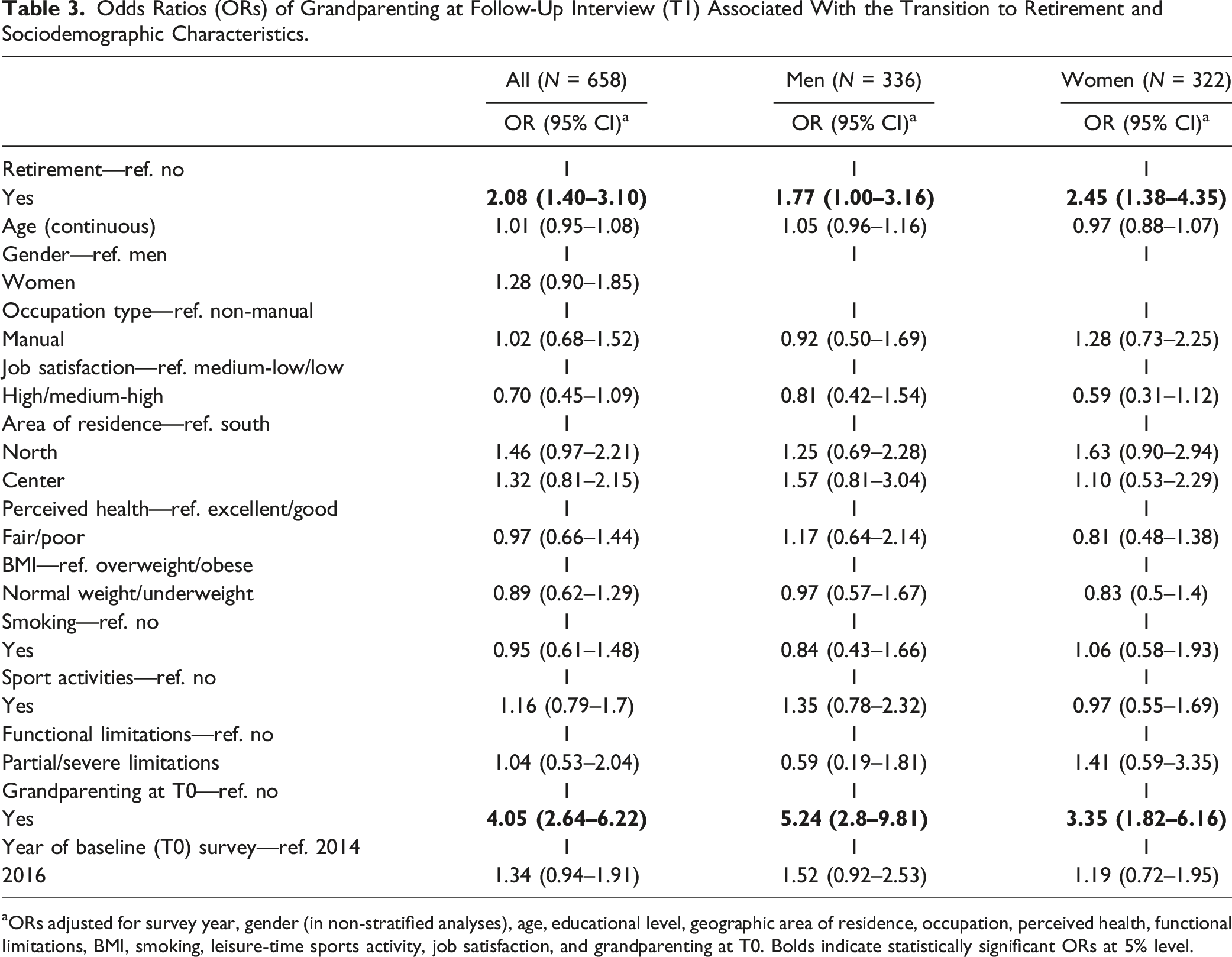
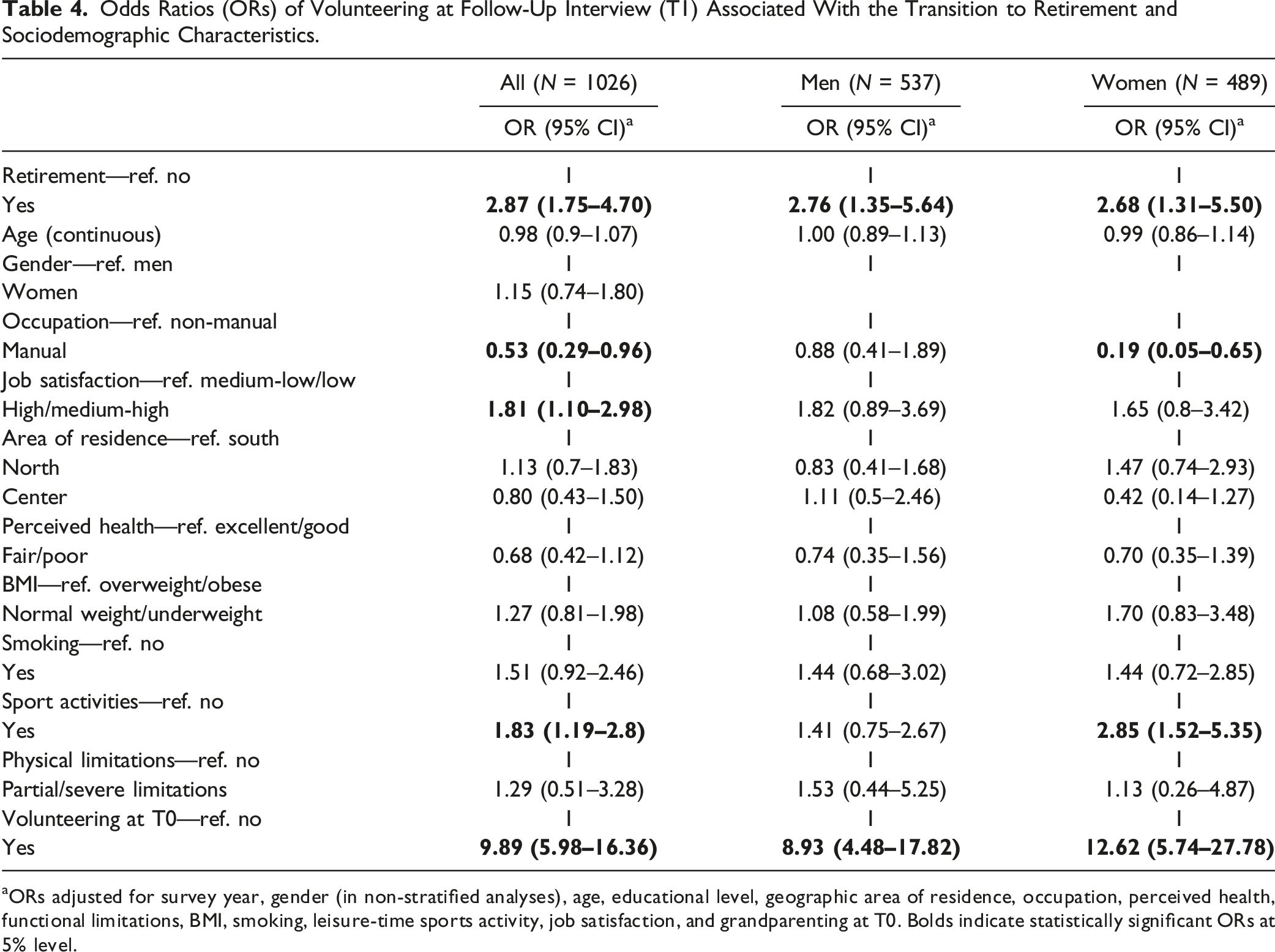
Retirement was associated with increased grandparenting (OR = 2.08, 95% CI: 1.40–3.10) and volunteering (OR = 2.87, 95% CI: 1.75–4.70). No association was found with caregiving for people with disabilities. No significant sex differences emerged. Robustness checks supported the main findings.
Conclusion
Retirement is associated to greater involvement in grandparenting and volunteering. Policymakers should consider the potential social and health costs of reduced unpaid care when designing pension reforms.
Introduction
In most high-income countries, population aging has induced governments to increase the Statutory Pension Age (SPA) and tighten requirements for early retirement (OECD, 2017). In Italy, the pension reform issued in 2012 raised SPA by 7 years for women and 2 years for men (from 60 to 67 years and from 65 to 67 years, respectively) and increased the years of pension contribution needed for seniority retirement from 40 to almost 42 for women and to almost 43 years for men (Serrano-Alarcon et al., 2023).
While such reforms are designed to ensure the sustainability of pension systems, they may also have unintended consequences. One key concern is that prolonged labor market participation could reduce individuals’ availability for unpaid productive activities within and outside the household, creating time conflict for those engaged in caregiving and other social roles (Fischer et al., 2022). Unpaid work—including informal caregiving to people with disabilities (Colombo & Mercier, 2012), grandparenting, and volunteering—plays a crucial role in social cohesion and individual well-being. These activities generate substantial economic and social value, particularly in contexts where public care services are limited (Adams et al., 2011; Bass & Caro, 2001; Carrino et al., 2025).
In particular, family-provided care has tangible economic implications, as it substitutes services that would otherwise entail significant public or private costs. Furthermore, access to grandparental childcare has been associated with increased maternal employment (Aassve et al., 2012; Bratti et al., 2018) and shifts in fertility decisions (Eibich et al., 2020). Understanding how retirement affects engagement in these unpaid activities is therefore essential for informing policies that aim to balance fiscal and economic sustainability with social welfare.
A first contribution of this study is its simultaneous analysis of three distinct types of unpaid work: caregiving for people with disabilities, grandparenting, and volunteering. Few studies have examined these outcomes together; to our knowledge, only one Dutch study (Grunwald et al., 2021) has adopted such a comprehensive approach. Moreover, most existing research is based on Northern European contexts, where more generous welfare systems may mitigate the impact of retirement on unpaid caregiving roles. In contrast, Southern European countries—including Italy, the focus of this study—are characterized by a more fragmented and familialistic welfare regime (Ferrera, 1996), where families are often expected to fill the gaps left by limited public support (Dragano et al., 2011). In such social contexts, the transition to retirement may be more strongly associated with increased involvement in unpaid work, especially in caregiving for people with disabilities and grandparenting. Supporting this, cross-county analyses of SHARE data have found that the increase in grandparenting following retirement is significantly larger in Southern European countries compared to other regions (Tanskanen et al., 2021). 1
From a gender perspective, evidence remains limited and mixed. Few studies have explicitly compared the effect of retirement on unpaid work activities between men and women, and those that have reported inconsistent findings (Bergeot & Fontaine, 2020; Feng & Zhang, 2018; Grunwald et al., 2021; Tanskanen et al., 2021). This study addresses this gap by exploring gender-specific patterns in the relationship between retirement and unpaid work.
To address these gaps, we draw on a large, nationally representative longitudinal dataset from Italy to examine how the transition from employment to retirement influences caregiving for people with disabilities, grandparenting, and volunteering. We also assess whether these associations differ by gender, providing a more nuanced understanding of the social implications of delayed retirement in countries with weaker welfare infrastructures. To strengthen the robustness of our findings and address potential concerns about reverse causality, we conducted a series of sensitivity analyses, including propensity score matching (PSM), to better isolate the causal effect of retirement on unpaid work engagement.
Theoretical Background
The transition from work to retirement is an important step in people’s lives, often bringing changes in daily routines, time use, social relationships, perceived social identity, and health (Bordia et al., 2020; Mosconi et al., 2023; Odone et al., 2021; Vigezzi et al., 2025). Several theoretical frameworks have hypothesized that retirees may be more involved in unpaid work activities, including the Continuity theory, the Role theory, and the Resource Perspective theory.
According to the Continuity theory, people would try to maintain the continuity of their identities, behaviors, and social environment throughout their life course, in particular during periods of transition (Atchley, 1989). In this view, retirees may compensate for the loss of time structure, social relationships, and sense of purpose associated with paid work by increasing their involvement in unpaid work activities directed towards family, friends, and the community. Such engagement would help retirees to maintain their sense of social connectedness, status, and sense of societal contribution (Erlinghagen, 2010; Mutchler et al., 2003).
Role theory posits that individuals occupy multiple personal and social roles throughout their lives, and that transitions between these roles involve psychological adjustment. Retirement entails the loss of the occupational role and the acquisition of the new role as “retiree” (Ebaugh, 1988, Hank & Stuck, 2008). According to this theory, engagement in unpaid caregiving, grandparenting, or volunteering may facilitate this transition by providing meaningful alternative roles, that help retirees redefine their identity and maintain a sense of purpose (Hank & Stuck, 2008).
The Resource Perspective theory similarly predicts an increase in unpaid work with retirement, primarily due to greater time availability (Wang et al., 2011). However, the extent and type of unpaid activity retirees undertake depends on their individual resources—such as physical health, cognitive ability, financial security, emotional resilience, and social support (Eismann et al., 2019). These personal assets influence what kind of unpaid work activities are more suitable or attractive to different individuals after retirement (Eismann et al., 2019).
Grunwald et al. (2021) build on these theories to offer a more nuanced framework, emphasizing that the type of unpaid work undertaken in retirement is shaped by the nature of social ties and the motivations for engagement. They argue that activities aimed at family support—such as caregiving or grandparenting—help retirees to take on the role of a contributing family member, although in their view time substitution would also be an important underlying mechanism for caregiving after retirement (Vigezzi et al., 2023). In contrast, volunteering and other forms of participation in the community offer retirees a means to maintain continuity of self-concept and social integration, by providing time structure, expanding social contacts beyond the family, and offering external validation and social recognition—functions previously fulfilled by paid work. According to this conceptual framework, every form of unpaid work is expected to become both more likely and more frequent after retirement. The magnitude of this increase, however, depends on individuals’ pre-retirement social embeddedness and on personal resources which help them navigate the transition and take on new roles meaningfully. As Grunwald et al. show, these psychological and relational resources mediate the impact of major life stressors such as retirement by shaping people’s capacity to create purpose and structure in their daily activities. Moreover, patterns of unpaid work after retirement are also shaped by gendered social roles and labor market dynamics. Women, who are more often employed part-time or in less stable jobs (OECD, 2021), usually dedicate more time to caring activities than men across the life course (Da Ross et al., 2015; Gerstel, 2000; Kahn et al., 2011). According to Grunwald et al.’s hypotheses, then, because women display greater pre-retirement involvement in such activities, retirement may result in a relatively smaller increase in caregiving and grandparenting for women compared to men (as also suggested in Tanskanen et al., 2021).
In summary, building on these frameworks, we hypothesize that the transition to retirement involves changes in time availability and an identity shift negotiated through patterns of unpaid work engagement. Successful adjustment to retirement may be supported by two main types of unpaid activities: (i) informal caring and grandparenting, which help retirees strengthen strong family ties and maintain a sense of belonging, and (ii) volunteering, which fosters weak social ties outside the household, enhancing feelings of usefulness, social esteem, and self-redefinition in the absence of formal employment. Additionally, given the gendered nature of caregiving before retirement, we hypothesize that (iii) the transition to retirement leads to a smaller increase in caregiving and grandparenting among women than men.
Review of Previous Findings
Empirical evidence from cross-sectional studies shows, in general, a negative association of being in employment, or the number of hours worked, with both informal caregiving (Hank & Stuck, 2008; Harris et al., 2020; He & McHenry, 2016; Jacobs et al., 2014; Prevo et al., 2018) and grandparenting (Hank & Buber, 2009; Igel & Szydlik, 2011; Lee & Bauer, 2010). However, from these studies, it is not possible to assess the direction of the association, as it is plausible that the need to provide care to relatives with disabilities or grandchildren may also cause older workers to retire earlier.
Although the need for caregiving for people with disabilities has been found to increase significantly the likelihood of leaving paid work (Berecki-Gisolf et al., 2008; Carr et al., 2018; Jacobs et al., 2017; Kolodziej et al., 2018; Michaud et al., 2010; Pavalko & Artis, 1997), some longitudinal studies have also reported a positive effect of retirement on the likelihood of caregiving (Spiess & Schneider, 2003; Van den Bogaard et al., 2014; Michaud et al., 2010). An increase in the likelihood of caregiving, or the intensity of care after retirement, is also suggested by a few quasi-experimental studies exploiting variation over time or across countries in the legal retirement age (Bergeot & Fontaine, 2020; Carrino et al., 2023; Fischer & Müller, 2020; Korfhage & Fischer, 2024).
The few available longitudinal studies on grandparenting have generally found a positive effect of retirement on the probability of caring activities (Feng & Zhang, 2018; Grunwald et al., 2021; Tanskanen et al., 2021). However, some studies have rather observed that caring for grandchildren or becoming a grandparent significantly increased the probability of early retirement, while retirement did not have any effect on changes in grandchildren care (Lumsdaine & Vermeer, 2015; Bolano and Bernardi, 2024).
Retirement seems also to increase volunteer work quite consistently (Bjälkebring et al. 2021; Dosman et al., 2006; Erlinghagen, 2010; Grunwald et al., 2021; Mutchler et al., 2003; van der Bogaard et al., 2014), although the effect found in some of these studies appears rather small. Most available studies focused on formal volunteering, defined as voluntary work performed with organizations (Grunwald et al., 2021; van den Bogaard et al., 2014; Erlinghagen, 2010; Eibich et al., 2022). Only a few of them did not distinguish formal from informal volunteering (Dosman et al., 2006; Bjälkebring et al. 2021; Hamalainen et al., 2024), which can be instead defined as help provided informally (not through organizations) to people living outside the household, such as friends, relatives, and acquaintances (Erlinghagen, 2010). Results do not appear to differ substantially by type of volunteering investigated, although in the study by Mutchler et al. (2003) an association with retirement was found for formal but not for informal volunteering. It seems important to emphasize that the issue of reverse causality is not as relevant for volunteering as it is for caring for people with disabilities and grandchildren, as subjects’ engagement is strongly correlated with the demand for care, while it seems unlikely that subjects retire to become unpaid volunteers or to increase their time spent in volunteer activities.
Materials and Methods
Data Sources
Data from five waves (2010, 2011, 2014, 2016, and 2018) of the Istituto Nazionale per l'Analisi delle Politiche Pubbliche (INAPP) Survey on Participation, Employment and Unemployment (PLUS) were used for the study. PLUS is a nationwide survey conducted periodically since 2005 to investigate different aspects of the Italian labor force. Respondents are recruited in each wave through stratified random sampling (strata are defined by the intersection of the following variables: region, type of municipality, gender, age class, and employment status) comprising 34,000 to 55,000 subjects, who are interviewed using the Computer-Assisted Telephonic Interviewing (CATI) technique. Starting from its second wave in 2006, a substantial proportion of interviews (about 60%) were included in the following edition sample, resulting in a classic panel design. In addition, since the 2014 wave, there has been an expansion of the surveyed target population, including also women and men aged 65–74 who are employed, seeking employment, retired from work, or otherwise inactive (excluding students), inactive women aged 40–64, and inactive men aged 18–64. Over time, some modules and questions of the survey were inserted, deleted, or varied. The participation rate is not available for these waves, but in the 2021 edition, it was 56.3% (Abbafati & Rosano, 2024).
Study Design and Population
The study has a two-period panel design, with a baseline year (T0) and a follow-up interview year (T1). Subjects aged 55–65 who participated in at least two consecutive waves and declared to be employed in the first wave in which they participated were enrolled in the study. Three separate samples were constructed, one for each outcome investigated (caregiving for people with disabilities, grandparenting, and volunteering), as the inclusion criteria and the number of survey waves containing the information about each outcome varied, as specified below. For subjects who retired across two consecutive waves, the one before retirement was taken as the baseline interview and the one after retirement as the follow-up one. For subjects who remained in employment across all available waves, the baseline and the follow-up interviews were chosen randomly among consecutive waves.
Key Measures
Transition to Retirement
The exposure of interest is the transition to retirement, with exposed subjects identified through a change in self-reported employment status from “employed” to “retired” in consecutive interviews, while unexposed individuals were those who declared themselves “employed” at both interviews.
Outcomes
Three unpaid work (UW) activities were investigated as outcomes in the study, which were all assessed at both the baseline (T0) and the follow-up interviews (T1): (1) Caregiving for people with disabilities, which was constructed from the responses to the question “Do you carry out caring activities for relatives or acquaintances with an ongoing reduction in independence?” and the corresponding possible answers: “Yes, regularly,” “Yes, occasionally,” and “No.” Answers were dichotomized, assigning “1” to subjects who reported to care regularly for people with disabilities and “0” otherwise. This question was present in the surveys of all waves (2010, 2011, 2014, 2016, and 2018). It should be noted that, given the characteristics of the questionnaire, it is not possible to distinguish between those who never provide care because they do not have relatives or friends with disabilities and those who do not provide care even when they have. (2) Grandparenting, which was assessed by means of the questions “Do you have grandchildren that you care for? If yes, how often?”, assigning caring for grandchildren to subjects who answered “Yes, daily” and “Yes, a few days a week” and no care to subjects who answered “Yes, less than few days a week,” “Yes, occasionally,” or “No.” Only people who reported having grandchildren were selected for this analysis. The question was present in the 2014, 2016, and 2018 waves. (3) Volunteering, which was assessed through the question “Could you indicate how often you engage in volunteering-helping people in need?”, present in the 2014 and 2016 waves, with the possible answers “Weekly,” “Monthly,” “Occasionally,” and “Never.” Only those who reported to volunteer at least weekly were considered to perform volunteer work.
Methods
To estimate the effect of the transition to retirement on the outcomes examined, logistic regression models were used for each outcome on the corresponding sample, controlling for the following covariates collected at the baseline interview (T0): survey year, gender (in non-stratified analyses), age (continuous), geographic area of residence (North, Centre, and South), occupation type (two categories: manual, non-manual), perceived health (two categories: excellent or good, fair or poor, assessed through the question: “How do you rate overall your health?”), presence of functional limitations (two categories: none, partial or severe limitations, ascertained by asking whether subjects have partial or severe physical limitations), smoking (yes, no), leisure-time sports activity (yes, no), BMI (two categories: normal or underweight, overweight or obese), and job satisfaction (two categories: high or medium-high, medium-low or low, assessed through the question “What is overall your level of satisfaction regarding your job?”). For each outcome, performing the corresponding unpaid activity at T0 (i.e., caring for people with disabilities, grandparenting, and volunteering, respectively) was also included in the models among the covariates, to account for possible differences in the initial levels of the outcomes between workers who had or had not retired at the follow-up interview (T1) (Johnson, 2005). Differences between men and women in the association of each unpaid work activity with retirement were tested including an interaction term between gender and retirement in the models on both genders.
A sensitivity analysis was also performed on the three outcomes, using the propensity score matching (PSM) technique to confirm the robustness of the adjustment for potential confounders obtained from the main analysis, as well as to assess whether the results could have been affected by selection (Da Ross et al., 2015; Vigezzi et al., 2021). In the PSM analysis, the matching was based on the probability of retirement estimated through logistic regression controlling for age, occupation type, area of residence, and the corresponding unpaid work activity performed at baseline interview. The regressions were estimated separately for men and women and by survey year, as requirements for statutory retirement were different by gender and across time. The matching was performed using the PSMATCH Procedure of the statistical software SAS, using the replacement method, a maximum of three unique matching control units for each treatment unit, and a caliper width of 0.15. On the resulting weighted sample, the probability of performing each unpaid work activity was estimated through logistic regression models adjusted for the same variables as in the main analysis. As this analysis included fewer subjects than those included in the main analysis, to account for the reduced statistical power the associations were estimated for both genders combined, adjusting the analyses for gender.
The results are presented with estimated values of the odds ratios (ORs) associated with retirement and their corresponding 95% confidence intervals (CIs) for the selected outcomes.
In a further analysis, the reverse causality hypothesis (i.e., the demand for caring and volunteer work influences the future probability of retirement) was also evaluated by estimating the association between each outcome at baseline (T0) and the transition to retirement at follow-up (T1). This analysis was also conducted using logistic regression models, controlling for the same set of covariates as in the main analysis.
Results
Descriptive Statistics
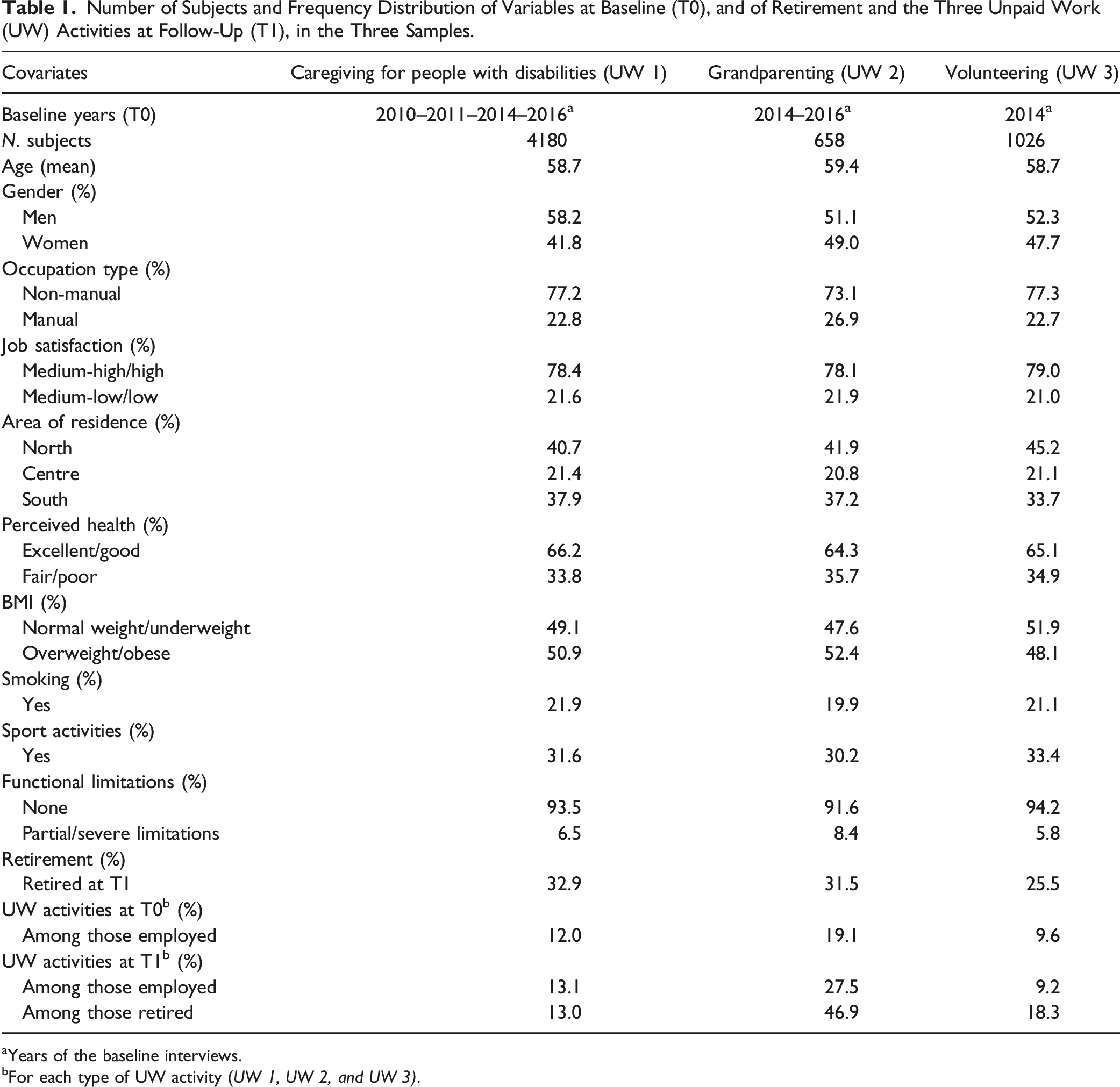
Number of Subjects and Frequency Distribution of Variables at Baseline (T0), and of Retirement and the Three Unpaid Work (UW) Activities at Follow-Up (T1), in the Three Samples.
aYears of the baseline interviews.
bFor each type of UW activity (UW 1, UW 2, and UW 3).
Around 13% of subjects reported providing care for people with disabilities at T1, with small differences by employment status. A higher proportion of subjects used to care for grandchildren among those employed (around 28%), which increased to 47% among those who retired. The proportion of subjects involved in volunteering was around 9% among the employed and twice as high among those who retired (18%).
Regression Analysis
Association Between Retirement and Caring for People with Disabilities
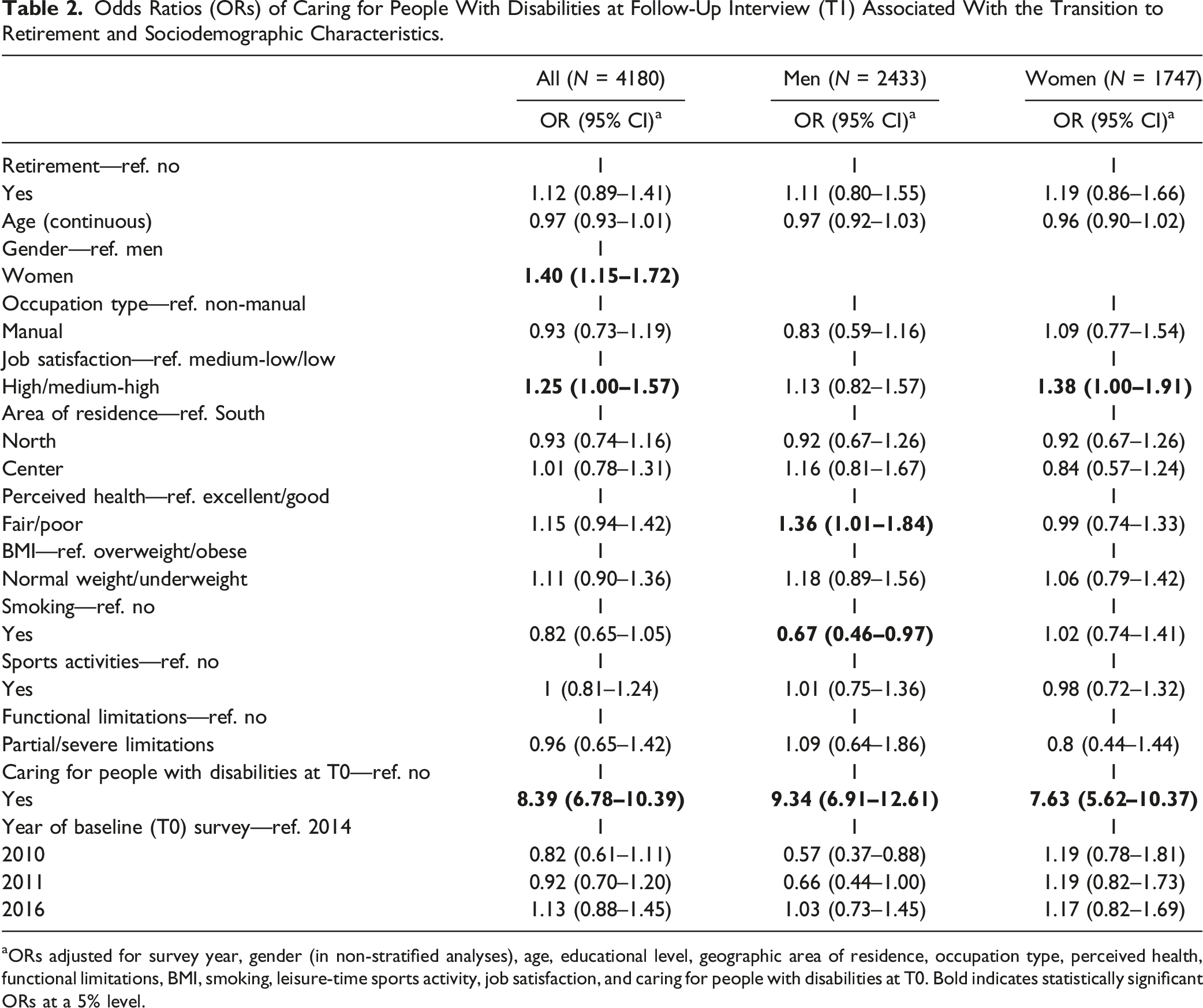
Odds Ratios (ORs) of Caring for People With Disabilities at Follow-Up Interview (T1) Associated With the Transition to Retirement and Sociodemographic Characteristics.
aORs adjusted for survey year, gender (in non-stratified analyses), age, educational level, geographic area of residence, occupation type, perceived health, functional limitations, BMI, smoking, leisure-time sports activity, job satisfaction, and caring for people with disabilities at T0. Bold indicates statistically significant ORs at a 5% level.
Association Between Retirement and Grandparenting
Odds Ratios (ORs) of Grandparenting at Follow-Up Interview (T1) Associated With the Transition to Retirement and Sociodemographic Characteristics.
aORs adjusted for survey year, gender (in non-stratified analyses), age, educational level, geographic area of residence, occupation, perceived health, functional limitations, BMI, smoking, leisure-time sports activity, job satisfaction, and grandparenting at T0. Bolds indicate statistically significant ORs at 5% level.
Association Between Retirement and Volunteering
Odds Ratios (ORs) of Volunteering at Follow-Up Interview (T1) Associated With the Transition to Retirement and Sociodemographic Characteristics.
aORs adjusted for survey year, gender (in non-stratified analyses), age, educational level, geographic area of residence, occupation, perceived health, functional limitations, BMI, smoking, leisure-time sports activity, job satisfaction, and grandparenting at T0. Bolds indicate statistically significant ORs at 5% level.
Sensitivity Analysis
Results from the Propensity Score Matching
To validate the robustness of our main analysis and assess potential selection bias, we performed a sensitivity analysis using propensity score matching (PSM) for each of the three outcomes. The results of the PSM exercise showed associations between retirement and the three outcomes very similar to those obtained from the main analysis including both genders. In these analyses, the odds ratio for caregiving for people with disabilities was 1.12 (95% CI 0.89–1.41), for grandparenting 1.90 (95% CI: 1.19–3.00), and for volunteering 3.06 (1.65–5.66) (Appendix Table A1).
To assess the quality of the matching procedure, we verified that the common support assumption was met, showing a relatively homogeneous distribution of the propensity score between the two groups of exposed (retired) and unexposed (not retired, still in the labor force) (Appendix Figure A2). Furthermore, we evaluated the balance of covariates in the post-matching samples of exposed and unexposed in Appendix Table A3, displaying whether the treatment status was associated to several characteristics, using t-test for continuous variables and chi-square test for categorical ones. The tests revealed that the matching procedure effectively achieved a good balance between the treated and untreated groups for all three outcomes (Appendix Table A3).
Assessment of Reverse Causality
To further investigate the relationship between retirement and unpaid work, the possibility of reverse causality was also examined, that is, the possibility that the need for care and volunteering at T0 influences the future probability of retirement at T1. This was done using logistic regression models adjusted for the same variables as in the main analysis. The results show that caregiving for people with disabilities at T0 was not associated with retirement at T1 among women (OR = 1.02, 95% CI 0.75–1.37) or among men (OR = 1.26, 95% CI: 0.95–1.69). Grandchildren care at T0 was not associated with the probability of retirement at T1, either among men (OR = 0.92, 95% CI: 0.44–1.92) or women (OR = 1.28, 95% CI: 0.66–2.48). Similarly, no effect of volunteering was found on the probability of retirement at T1 (men: OR = 0.77, 95% CI: 0.43–1.36; women: OR = 0.79, 95% CI: 0.41–1.52). 2
Discussion
Main Results
The results of this study show a strong and significant increase in the likelihood of volunteering and grandparenting associated with retirement. However, caregiving for people with disabilities was not found to be associated with retirement. The transition to retirement more than doubled the probability of grandparenting and tripled that of volunteering in both genders, while for caregiving for people with disabilities the increase was not significant. The lack of association observed for caregiving for people with disabilities appears likely attributable to the fact that this activity is less discretionary and mainly demand-driven, being generally due to the presence of relatives with disabilities living in the household (Broese van Groenou & De Boer, 2016). As a matter of fact, retirement allows more time to be devoted to caregiving, but if subjects face a high demand for caregiving, they will be required to perform it even while they are still at work, resulting in a lesser influence of retirement on providing care for people with disabilities than on the other two outcomes. No significant difference was found between genders in the extent of the increase in any of these unpaid work activities across retirement.
The results of the sensitivity analysis conducted using the PSM technique showed findings similar to those obtained through logistic regression on both genders combined, with small differences found between the two methods for all the outcomes investigated, demonstrating good internal validity of the main analysis.
This study also shows no influence of performing these unpaid work activities at baseline on the probability of retiring at the follow-up interview (T1), a finding which also supports the hypothesis that the transition to retirement itself increases the likelihood of engaging in caregiving and volunteering. Among men, the OR for caregiving for people with disabilities at baseline and retirement at follow-up (OR = 1.26) was slightly higher than the reverse (retirement at baseline and caregiving at follow-up; OR = 1.11), but both estimates were small and not statistically significant.
Interpretation of the Findings
Our results provide empirical support for the main theories of the older adults’ adjustment to retirement, showing that the transition increases the likelihood of grandparenting and volunteering, but not caregiving for people with disabilities, likely because caregiving is highly demand-driven and less influenced by retirement status. The stronger association with volunteering than grandparenting suggests that, with the retirement transition, the need to replace weak social ties and seek for social recognition may be more important than strengthening family bonds in adapting to the new role of retiree. Moreover, our study shows that retirement has a similar impact on the likelihood of unpaid work for men and women, contrary to the hypothesis that the increase in informal care activities would be smaller for women, given their larger proportion already involved in care before retirement. Indeed, although not significantly different, the increases in caring for the disabled and grandparenting associated with retirement were greater for women than for men.
These findings provide valuable insights into the changes in unpaid work activities that occur during the retirement transition among older Italian workers and, therefore, might inform retirement policies. Pension reforms that impose stricter retirement requirements and limit workers’ ability to exit the labor market may negatively affect their participation in unpaid activities, potentially resulting in broader social costs. Reduced engagement in caregiving and volunteering may impact not only the individuals affected by delayed retirement but also the wider community that benefits from their support. Notably, however, the transition to retirement does not appear to influence the likelihood of caring for sick relatives or people with disabilities. This suggests that pension reforms that raise the retirement age may not lead to fewer caregivers but rather to a greater number of double-burdened older workers who have to juggle caregiving responsibilities with their jobs, with possible negative consequences for their physical and psychological well-being.
Comparison with Other Studies
First, with regard to caregiving for people with disabilities, existing literature reports mixed findings. However, several studies using longitudinal or causal designs suggest a modest positive effect of retirement—findings that align with our own results. Among them, a study using an Instrumental Variable (IV) approach based on SHARE (Survey of Health, Ageing and Retirement in Europe) data—leveraging cross-country differences in retirement rules—found a modest but statistically significant increase in the probability of providing care at least once a week (Bergeot & Fontaine, 2020). Stronger associations were found by a study which used a discontinuity analysis based on changes in the age at early retirement for women in Germany (Fischer & Müller, 2020). This study estimated that the probability of providing care doubled with retirement, and the number of caregiving hours per week increased fivefold. Similarly, another study using an IV design that exploited the increase in the state pension age (SPA) for women in the UK found a rise in the intensity of caregiving, measured by the number of hours provided (Carrino et al., 2023). In contrast, based on variations in the legal pension age in Australia, Zhu and Onur did not retrieve any differences in the likelihood of providing care before and after retirement, either among men or women (Zhu & Onur, 2023). However, following an increase in retirement age, Australian men and women workers have significantly reduced the time spent on other activities, such as housework, hobby time, and exercise, showing the significant challenges to people’s time management that may arise from extending working life. Eventually, no effect of retirement on either the likelihood of providing care or hours of care was found in a Dutch cohort (Grunwald et al., 2021).
Secondly, with regard to grandparenting and volunteering, our findings are broadly consistent with the limited number of available longitudinal studies, which generally report positive associations with retirement, though the strength of the estimates varies across studies.
Among studies on grandchild care, one based on panel data from 15 European countries from 2004 to 2015 found that retirement was associated with a significant 30% increase in the probability of caring for grandchildren, with a stronger effect observed among grandfathers compared to grandmothers (Tanskanen et al., 2021). The same work also tested for the possibility of reverse causality (i.e., that the demand for grandparenting could lead to an increase in the probability of future retirement among working grandparents) and found no significant effect. Another longitudinal analysis, based on Dutch panel data from 2015 to 2018, reported a significant 60% increase in the probability of grandparenting associated with the transition to retirement, as well as an increase of more than 2 hours per week in grandchild care (Grunwald et al., 2021). Similarly, using a regression discontinuity design based on the variability of SPA on panel data, Feng and Zhang (2018) retrieved in both genders a significant increase in the probability (29% increase for women and 21% increase for men) and in the time spent for grandparenting associated with the transition to retirement. By contrary, a U.S. study based on women’s data from eight waves of the Health and Retirement Study appreciated no difference in the likelihood of caring for grandchildren after retirement (Lumsdaine & Vermeer, 2015).
With regard to volunteering, a U.S. study found only small, non-significant changes in formal volunteer participation after retirement among those already volunteering, but a substantial fivefold higher likelihood, compared to employed subjects, among those who had not been volunteering while employed (Mutchler et al., 2003). Retirement was also associated with an increase in the probability of formal volunteering and in the related time spent in two Dutch studies (Van den Bogaard et al., 2014; Grunwald et al., 2021), as well as in different studies not distinguishing between types of voluntary work (Bjälkebring et al. 2021; Dosman et al., 2006; Hamalainen et al., 2024). In addition, a paper exploiting differences in legal retirement age between England, Ireland, and the United States using an IV technique estimated a significant increase in the likelihood of formal volunteering, which was higher for volunteering performed at high intensity (more than 50 and more than 100 hours per year) (Eibich et al., 2022). In contrast, another U.S. analysis using data from the Health and Retirement Study observed, among those who had moved into retirement, a slight reduction in the likelihood of formal volunteering (about 10%) and no significant changes in the amount of time devoted to such activities (Tang, 2016).
Associations with Covariates
In terms of sociodemographic characteristics, the likelihood of caring for people with disabilities and grandchildren was significantly higher among women. A higher percentage of women involved in informal care is a well-established finding in current literature (Lindqvist et al., 2004; Da Roit et al., 2015; Airey et al., 2021; Garcia-Jimenez et al., 2024), which has been mainly attributed to the prominent role that women have within families in caring activities, in the traditional gendered division of labor (Revenson et al., 2016). In contrast, no gender differences were found for volunteering, for which previously mixed findings were reported (Windebank, 2008; Plagnol & Huppert, 2010; Forbes & Zampelli, 2014; Helms & McKenzie, 2014; Rodell et al., 2016).
Age was associated in both genders with a slightly decreased probability of caregiving but not of grandparenting or volunteering; this finding is likely attributable to a decreased proportion of subjects (in the age range selected) who have people with disabilities as household members, such as old parents, whose probability of dying increases over time.
Among other covariates, higher job satisfaction was consistently associated with an increased likelihood of caring for people with disabilities and for volunteering in both genders, suggesting that stronger attachment to one’s own job might lead to higher engagement in social work activities, as was reported in a study on the antecedents of community volunteering (Lup & Booth, 2019). In particular, higher job satisfaction and non-manual occupations are strongly associated with a greater likelihood of engaging in volunteering, in line with the hypothesis put forward by Grunwald et al. (2021). They suggest that individuals in higher-status roles—who may face a significant loss of social status, professional networks, and cognitive engagement upon retirement—are more inclined to compensate through increased participation in volunteering. However, these associations could also be explained by personality factors, which could be the underlying drivers of both job satisfaction and greater involvement in social work (Li et al., 2010). Finally, the probability of volunteering was reduced among subjects with poorer perceived health, who may be limited in their volunteering activities by their health. At the same time, other associations appear to be inconsistent across genders and outcomes and possibly due to sampling variability.
Strengths and Limitations
A key strength of this study is that it is the first longitudinal analysis conducted in a Southern European country to examine the association between the transition to retirement and engagement in caregiving for people with disabilities, grandparenting, and volunteering. The longitudinal design, along with adjustment for prior involvement in these unpaid activities, allowed us to assess the directionality of the relationship—demonstrating a direct effect of retirement on these forms of unpaid work. Furthermore, the national representativeness of the data supports the generalizability of the findings to the Italian working population in the same age range. However, the samples showed an unexpectedly high proportion of non-manual workers, and the overall survey participation rate was relatively low (likely not exceeding 60%). This suggests potential underrepresentation of individuals with lower socioeconomic status, which may limit the external validity of the results to some extent.
A main limitation is the self-reported nature of the information on retirement and outcomes, which might lead to misclassification of these variables. Nevertheless, on the one hand, the use of a CATI procedure for data collection guarantees a discrete reliability of the information provided by participants (De Leeuw et al., 1995); on the other hand, given the longitudinal design of the study, this information bias is expected to be predominantly non-differential, resulting in an attenuation of the estimated associations. Another limitation is the lack of information on the presence of people with disabilities among household members, which prevents the analysis from being restricted to subjects with potential care demands, likely leading to an underestimation of the association between retirement and caregiving. Moreover, the wording of the question on volunteering in the surveys used did not allow us to distinguish between formal and informal volunteering, limiting the comparability of our results with those of studies investigating formal volunteering. Finally, the relatively short period between the baseline and follow-up interviews (approximately two years in all samples) implies that, among those who retired, the transition to retirement occurred relatively recently, even if the precise date of retirement is not available. As a result, some individuals may not have had sufficient time to adjust to their new retirement status and engage in the unpaid activities examined, potentially leading to an underestimation of the associations between retirement and the selected outcomes.
Conclusions
This study explores the impact of retirement on unpaid work activities, including caring for people with disabilities, grandparenting, and volunteering. Using 5-year panel data from the Italian Survey on Participation, Employment and Unemployment (PLUS), the results reveal that retirement is associated with a significant surge in grandparenting and volunteering activities among both men and women. However, the increase in caring for people with disabilities is more modest and not significant, suggesting that this type of care is mainly demand-driven.
These findings have important implications for policymakers and public health professionals. As the population ages, the demand for informal care is likely to increase, and older adults are likely to play a crucial role in meeting this demand. However, pension reforms that delay retirement may have a dual negative effect: they may inadvertently overburden older workers who must balance caregiving responsibilities with paid work, while also limiting the availability of older adults for unpaid caregiving work, potentially exacerbating social isolation, increasing healthcare costs, and worsening other outcomes for individuals who are left without adequate support. Our study highlights the importance of policymakers considering the social and public health implications of pension reforms and developing strategies that support older adults in their unpaid caregiving and volunteering roles.
Supplemental Material
Supplemental Material - Transition to Retirement Impact on Caregiving, Grandparenting, and Volunteering: Analysis From a Nationwide Italian Cohort
Supplemental Material for Transition to Retirement Impact on Caregiving, Grandparenting, and Volunteering: Analysis From a Nationwide Italian Cohort by Angelo d’Errico, Michelangelo Filippi, Giacomo Pietro Vigezzi, Anna Odone, and Chiara Ardito in Journal of Aging and Health
Footnotes
Acknowledgments
The authors would like to thank Prof. Giuseppe Costa, who was the PI of the RF-2019-12370893 project before Angelo d'Errico took over the PI role. The information and views expressed in this publication are those of the authors and do not reflect the official position of the European Commission. Chiara Ardito is also a fellow of Netspar, Network for Studies on Pensions, Aging and Retirement, and of LABORatorio Revelli, Centre for Employment Studies.
Funding
The author(s) disclosed receipt of the following financial support for the research, authorship, and/or publication of this article: The current study has been funded partly by the Fondazione Cariplo (Project n. 2018-0863) and Ministero della Salute (RF-2016-02364270).
Declaration of Conflicting Interests
The author(s) declared no potential conflicts of interest with respect to the research, authorship, and/or publication of this article.
Data Availability Statement
The empirical analysis is based on national representative survey data collected and made available by the National Institute for Public Policy Analysis (Inapp). The procedures for requesting access to Inapp’s Micro Files for Research (MFRs) and Public User Files (PUFs) are detailed on the official website https://www.inapp.gov.it/en/surveys/microdata. The specific survey analyzed in this paper is described here  and the associated functional mailbox is
Supplemental Material
Supplemental material for this article is available online.
Notes
References
Supplementary Material
Please find the following supplemental material available below.
For Open Access articles published under a Creative Commons License, all supplemental material carries the same license as the article it is associated with.
For non-Open Access articles published, all supplemental material carries a non-exclusive license, and permission requests for re-use of supplemental material or any part of supplemental material shall be sent directly to the copyright owner as specified in the copyright notice associated with the article.
