




Abstract
Introduction
In the context of population aging, it is important to examine ways to mitigate potential health complications in later life, including cognitive function (Hale et al., 2020). Cognitive function is a salient indicator of quality and valuation of life for older adults (Pan et al., 2015), and Alzheimer’s disease is one of the leading causes of death in the United States. (Centers for Disease Control and Prevention, 2023). Although participation in cognitively challenging activities in later life may be good for maintaining cognitive function, the life course perspective recognizes that early life may shape outcomes in subsequent life stages (Braveman & Barclay, 2009; Elder, 1998). Incorporating the life course perspective into the current study, we examine how the home environment during childhood and the school environment during adolescence influence cognitive function among older adults.
Childhood and adolescence are sensitive periods of cognitive development and are particularly suited life course stages to identify activities that have far-reaching health implications (Furhrmann et al., 2015; Steinburg, 2005). Multiple studies have found that older adults who retrospectively report greater early-life enrichment have better cognitive function compared to older adults who lack such enrichment (Brandt et al., 2012; Chan et al., 2019; Crane et al., 2023; Frank et al., 2023; Fritsch et al., 2007; Greenfield et al., 2022; Oveisgharan et al., 2020; Wilson et al., 2015). However, research has produced inconsistent results for whether early-life enrichment is associated with change in cognitive function over time. On one hand, some longitudinal research reports that early-life enrichment is protective against cognitive decline (Frank et al., 2023; Oveisgharan et al., 2020), while others report no such relationship (Everson-Rose et al., 2003; Greenfield et al., 2022; Walsemann & Ailshire, 2020; Wilson et al., 2015). Moreover, research tends to focus on enrichment in one environment (i.e., home or school), and few studies examine how multiple environments of enrichment may influence later-life cognitive function. Therefore, the current study examines whether enriched home and school environments are independently associated with better cognitive function over 8 years among older adults.
Theoretical Framework and Relevant Research
Enrichment is a term that has been used to refer to stimulation received from a variety of sources, such as the community, home, school, and social networks (Frank et al., 2023; Hertzog et al., 2008). Frank et al. (2023) further specify that “enrichment can be considered as the utility received from doing an activity, while engagement is the act of participation itself” (p. 264). That is, enrichment refers to the potential benefits gained from stimulating engagement. In the current study, we conceptualize enrichment as the cognitive stimulation provided at home and in school.
Although enrichment at any life course stage may be cognitively beneficial, because childhood and adolescence are identified as sensitive periods of cognitive development, they may be particularly salient life stages to engage in activities that promote cognitive development (Frank et al., 2023; Fuhrmann et al., 2015; Moored et al., 2020; Steinberg, 2005). In this line of inquiry, a sensitive period represents a window of opportunity when the brain is more susceptible to experiences and behaviors, potentially due to greater brain plasticity (Fuhrmann et al., 2015). Indeed, Greenfield et al. (2022) reported that cognitively enriching activities during adolescence were advantageous for cognitive function at age 65 because they happened during a sensitive period of development.
Further, early-life enrichment may protect against cognitive decline by building up one’s cognitive reserve, which refers to the brain’s ability to cope with and respond to damage or degeneration in order to maintain cognitive function, even in the face of neuropathology that might indicate dementia (Stern, 2012). Educational attainment, IQ, and occupation are likely to contribute to cognitive reserve, yet researchers have also suggested that early-life enrichment may be salubrious (de Rooij, 2022; Morris et al., 2021; Stern, 2012). Indeed, Stern (2012) argues that “participation in cognitively stimulating activities has been suggested to slow the rate of hippocampal atrophy in normal ageing” (Stern, 2012, p. 1006). Enrichment at home and school may provide the cognitively stimulating activities that make individuals more resilient to detrimental brain changes, thereby protecting against cognitive decline. The current study is informed by the concepts of sensitive periods and cognitive reserve to examine whether early-life enrichment—at home and at school—is associated with cognitive function in later life.
Enriched Home Environments
An enriched home environment (EHE) is not only associated with an array of childhood health advantages (Bradley et al., 1989) but also health benefits that extend into adulthood (Oveisgharan et al., 2020). An EHE is one that has resources, such as books, that are cognitively stimulating to developing brains (Ball et al., 2019). Reading stimulates nearly every region of the brain, such that children who read frequently are often more cognitively developed than children who read less (Cunningham & Stanovich, 1998; Horowitz-Kraus & Hutton, 2018).
Parents are often the first “teachers” a child has. Therefore, parental education level may also contribute to an EHE and serve as a resource for a child’s cognitive development. Indeed, empirical research shows that children who have more highly educated parents generally have better cognitive function in childhood and later life, potentially because more educated parents are able to invest more time and resources in their child’s cognitive development (Davis-Kean et al., 2021; Duncan & Magnuson, 2012; Greenfield & Moorman, 2019).
Oveisgharan et al. (2020) examined the relationship between cognitive resources in the home environment and later-life cognitive health. The researchers created a composite score of enrichment, which included information on parental education levels, having a newspaper, encyclopedia, globe, or atlas, being read to, and foreign language instruction. Greater early-life cognitive enrichment was not only associated with lower risk of Alzheimer’s disease pathology but also less cognitive decline. Other studies have reported the lifelong cognitive benefits of parental education and growing up in a home with access to books (Brandt et al., 2012; Rindermann & Ceci, 2018).
Enriched School Environments
To more holistically capture the various sources that individuals receive enrichment, we also examine the cognitive implications of an enriched school environment (ESE) during adolescence. Adolescence marks a “reorganization of regulatory systems” associated with cognitive development “that is fraught with both risks and opportunities” (Steinberg, 2005, p. 69). For many, entering high school means exposure to an array of enrichment opportunities through participation in various clubs and academic courses. Having an ESE may therefore represent opportunities to gain cognitive and social stimulation that provide lifelong cognitive benefits (Crane et al., 2023; Fritsch et al., 2007; Greenfield et al., 2022).
Crane et al. (2023) created a sum score that measured participation in a variety of high school activities, such as being a member of science club or taking woodworking classes. Older adults who reported greater enrichment had incrementally higher global cognition scores. Other studies have examined the relationship between an ESE and specific domains of cognitive function. For example, Fritsch et al. (2007) reported that participation in cognitively enriching activities in high school, such as academic clubs and honorary societies, was associated with better verbal fluency in later life. Participation in cognitively enriching school activities have also been linked to better language/executive function and memory among older adults (Greenfield et al., 2022).
Besides participation in clubs, college preparatory courses may provide enrichment during high school. For example, Walsemann and Ailshire (2020) reported that high school students enrolled in a college preparatory curriculum had better cognitive functioning in later life compared to respondents in a vocational or general education curriculum. Because they occur during a sensitive period of development, taking college preparatory courses may be directly associated with better cognitive function in later life. Additionally, college preparatory courses may be indirectly associated with cognitive function by increasing the likelihood of graduating from college (Jackson, 2014).
Contributions
We contribute to the early-life enrichment and cognitive function literature in two ways. First, although some studies that examine ESE and cognitive function adjust for early-life socioeconomic status (Crane et al., 2023; Fritsch et al., 2007; Greenfield et al., 2022), research on early-life enrichment and cognitive function tends to focus on either EHE or ESE; we use multiple enrichment indicators in each environment to examine the independent influence of both EHE and ESE. Some researchers may use measures of enrichment in different environments to create a composite score of early-life enrichment (Chan et al., 2019; Frank et al., 2023; Moored et al., 2020). This method of investigation is useful for demonstrating the advantageous association between early-life enrichment and cognitive function but obscures whether an EHE has a similar relationship to cognitive function as an ESE. Perhaps one environment is more conducive to maintaining cognitive function in later life. Therefore, in the current study, we distinguish between EHE and ESE to provide more clarity to how early-life enrichment influences later-life cognitive function, which may also be helpful for designing effective interventions and public policy.
Second, although research that measures cognitive function at a single time point provides convincing evidence that early-life enrichment is associated with better cognitive function in later life, research on the relationship between early-life enrichment and cognitive function over time yields inconsistent findings (Everson-Rose et al., 2003; Frank et al., 2023; Greenfield et al., 2022; Oveisgharan et al., 2020; Walsemann & Ailshire, 2020; Wilson et al., 2015). For example, Greenfield et al. (2022) examined cognitive performance at two time points, 7 years apart. Students who participated in cognitively enriching activities during high school had better language/executive function at age 65, but there was no association between high school enrichment and cognitive change (Greenfield et al., 2022). On the other hand, Frank et al. (2023) reported that early-life enrichment was associated with slower cognitive decline for older adults. Based on these findings, our study uses growth curve models to examine whether two environments of early-life enrichment are independently associated 1) with higher cognitive function at baseline and 2) change in cognitive function over 8 years.
Research Design and Methods
Sample
This study uses data from the 2010–2018 Health and Retirement Study (HRS), a longitudinal panel study of adults aged 50 years and older. We integrated data from the cross-wave 2015–2017 Life History Mail Survey (LHMS) Harmonized and Aggregated Data Resource. The LHMS is a questionnaire that was completed via mail or telephone and gathered information on geographic, residential, and education histories (Larkina et al., 2021).
We limited our analysis sample to respondents who met the following criteria: (1) participated and had non-zero weights in the 2010 core survey (resulting in N = 20,337); (2) participated in either the 2015 or 2017 LHMS (N = 10,640); (3) self-identified as non-Hispanic White, non-Hispanic Black, or Hispanic (hereafter, White, Black, and Hispanic, respectively) (N = 10,332); (4) reported cognitive function for at least one wave of data (N = 10,262); and (5) scored greater than 6 on cognitive function at first report (≤6 indicates presence of dementia on the modified version of the Telephone Interview for Cognitive Status [TICS] survey using the Langa–Weir classification of cognitive function (Langa, 2020)). These selection criteria yielded an analytic sample of 10,070 adults.
Measures
Cognitive function
Data on our dependent variable, cognitive function, was gathered for each respondent from the Cross-Wave Imputation of Cognitive Function data file for up to five waves, from 2010 to 2018 (Wave 1 [W1])–2018 [W5]). We use 2010 as our baseline because HRS refreshed the sample that year by adding persons 51–56 years of age to counterbalance nonrandom mortality selection. By using the most recently refreshed sample before the LHMS, we reduce the likelihood of attrition bias due to mortality selection. For each wave, the HRS measured cognitive function using a modified version of the TICS survey. This measure included 10-word immediate and delayed recall tests of memory (0–20), a serial 7s subtraction test of working memory (0–5), and a counting backward test to assess attention and processing speed (0–2). A sum score using all items was created to measure cognitive function on a scale of 0–27, in which higher values reflected better function.
From 2010 to 2016, respondents were randomly assigned to answer questions about cognitive function via telephone or face to face. Respondents who were assigned face-to-face assessments in 2016 were randomly assigned to either the phone or a new web-based mode for the 2018 survey. There were several eligibility requirements for the web survey including (1) entered the study prior to 2016 and were internet users; (2) did not complete the last interview in Spanish, by proxy, or while residing in a nursing home; and (3) were not pending a baseline, exit, or post-exit interview. We adjusted for web survey mode in the W5 survey because scholars have found a positive bias in cognitive function scores when using the web modality (Ofstedal et al., 2022).
Early-life enrichment
We assessed early-life enrichment within two environments: home and school. Enriched home environment was created by summing two indicators: books in the household at age 10 and parental education level. Number of books in the household was categorized as low (none or very few [i.e., 0–10], reference group) or high (enough to fill one shelf [i.e., at least 11]), coded as 1, which is similar to cutoffs used in previous literature (Brandt et al., 2012; Epstein et al., 2021; Evans et al., 2010; Rao et al., 2010). Parental education for these cohorts was dichotomized as father having less than an eighth grade education (reference group) or at least an eighth grade education (coded as 1). In households without fathers, the mother’s education level was utilized. It is a common practice among HRS researchers to use a cutoff of eighth grade given that majority of parents of HRS respondents had less than a 12th grade education (Myrskylä & Fenelon, 2012; Puterman et al., 2016). Enriched home environment was coded as 0 (had low books in the household and had a parent with less than an eighth grade education); 1 (had a high number of books in the household or a parent with at least an eighth grade education); or 2 (had a high number of books in the household and a parent with at least an eighth grade education).
Enriched school environment was assessed with two indicators: high school club participation and college preparatory classes. In the 2015 LHMS, respondents were asked: “Approximately how many school clubs or organizations were you involved in during high school?” with response options of 0–1, 2–5, 6–9, 10–19, and 20+. In 2017, respondents were asked the same question; however, they reported the number of clubs they participated in and were not given response categories from which to choose. Therefore, to accommodate these discrepancies, we created a binary variable of club participation in which 0 = 0–1 club and 1 = 2+ clubs. Respondents were also asked: “When you were in high school, did you take special courses or classes to better prepare you for college?” College preparatory classes were coded as 0 (no) and 1 (yes). Enriched school environment was created by summing these two indicators such that a zero indicated participation in 0 or 1 club and no college preparatory classes. Respondents who participated in either 2+ clubs or college preparatory classes were scored as one, while a two indicated participation in at least 2 clubs and college preparatory classes.
Covariates
We adjusted for an array of demographic, socioeconomic, and health characteristics known to influence cognitive function in later life (Carvalho et al., 2014; Dotson et al., 2008; Lyu & Burr, 2016; Prickett et al., 2015). Demographic characteristics included age (years; at baseline), women (men, reference group), and race and ethnicity (White [reference group], Black, and Hispanic). We also adjusted for region born (born in the south, other as reference group) because respondents born in the south during the first half of the 20th century, especially Black respondents, generally received a lower quality education, hindering their cognitive development (Zhang et al., 2016). In terms of socioeconomic status, we adjusted for education (years of schooling, top coded at 17+) and household wealth (tens of thousands of dollars and cube rooted to account for skewness).
Descriptive Statistics for the Analytic Sample, Health and Retirement Study, N = 10,070.
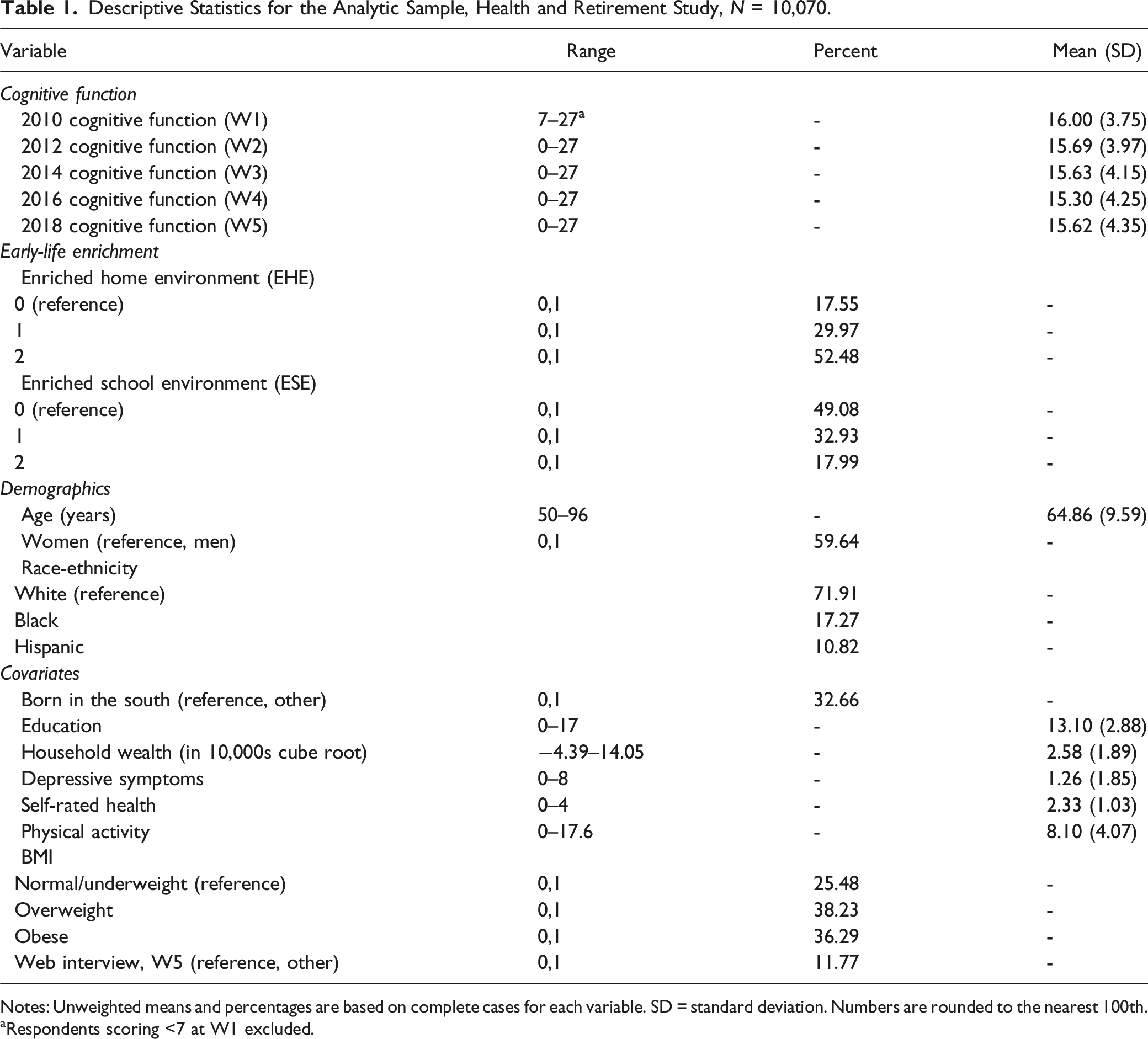
Notes: Unweighted means and percentages are based on complete cases for each variable. SD = standard deviation. Numbers are rounded to the nearest 100th.
aRespondents scoring <7 at W1 excluded.
Analysis
We used latent growth curve models to examine the influence of early-life enrichment on cognitive function over time. First, we fit an unconditional model to characterize average trajectories of cognitive function and to determine the extent of variation in the latent slope. Second, we built our model by sequentially adding (1) demographic characteristics, (2) early-life enrichment, and (3) all other covariates.
Full information maximum likelihood (FIML) estimation was employed to handle missing data on the independent variables only. We employed a conservative approach within the EHE and ESE indexes such that if a respondent was missing on both indicators, we allowed FIML to account for the missing data; however, if respondents reported a score for 1 indicator, we used that information as the final score. Most of the other predictors in our analytic sample were missing less than 1% of cases. Exceptions include ESE (7%), depressive symptoms (1.18%), and 2018 web interview (11.21%).
Most respondents (81%) had cognitive function scores for all five waves of data, but missing data on cognitive function was more likely during later waves (ranging from about 1% at baseline to 16% at W5). Part of this is simply because about 5% of the sample died during the observation period, but latent growth curve models do not require observations at each follow-up survey. Respondents with a baseline score for cognitive function but none thereafter contribute useful information to estimate the intercept but not the slope. In this way, we used the available data from each respondent in our estimation. The growth curves were estimated with Mplus version 8.
Sensitivity Analyses
We conducted a series of sensitivity analyses to strengthen the conclusions presented herein. First, we wanted to determine whether our results varied when we used different imputation strategies. We found that conclusions using unimputed data were not different than the conclusions reported using FIML. Second, we explored different strategies to handle missing data for our focal independent variables. Specifically, we used FIML to impute data on respondents who were missing on either indicator of enrichment within the school and home domains. Our substantive conclusions remained unchanged regardless of what imputation strategy we used for our focal independent variables. Third, we compared model fit indices between a linear growth curve model and a growth curve model that included a quadratic term. Model fit indices revealed that the linear model was preferred over the quadratic model (i.e., the BIC was lower for the linear model than the quadratic model).
Results
Descriptive statics for the analytic sample are listed in Table 1. The average age of respondents was 64.86 years old, and about 60% of the sample were women. About 72% of the sample was White, 17% was Black, and 11% was Hispanic. The mean of cognitive function was 16.00 at W1 and 15.62 at W5. Approximately 52% of the sample had at least one parent with an eighth grade or higher education and grew up in a household with more than 10 books. In terms of ESE, 49% of the respondents did not participate in either activity, with 18% participating in both activities (i.e., at least 2 clubs and college preparatory courses). Supplementary analyses (not shown) revealed that EHE and ESE had a correlation of 0.32.
Predictors of Trajectories
We first fit an unconditional growth curve model to characterize average trajectories of cognitive function and to determine the extent of variation in the latent intercept and slope (not shown). On average, cognitive function decreased over time (b = −0.07, p < .001). In addition, the mean and variance of the slope revealed that individuals who started out with higher levels of cognitive function had a slower decline over time, while individuals who began with lower levels of cognitive function had a faster decline.
Parameter Estimates From Latent Growth Curve Models for Cognitive Function (N = 10,070).
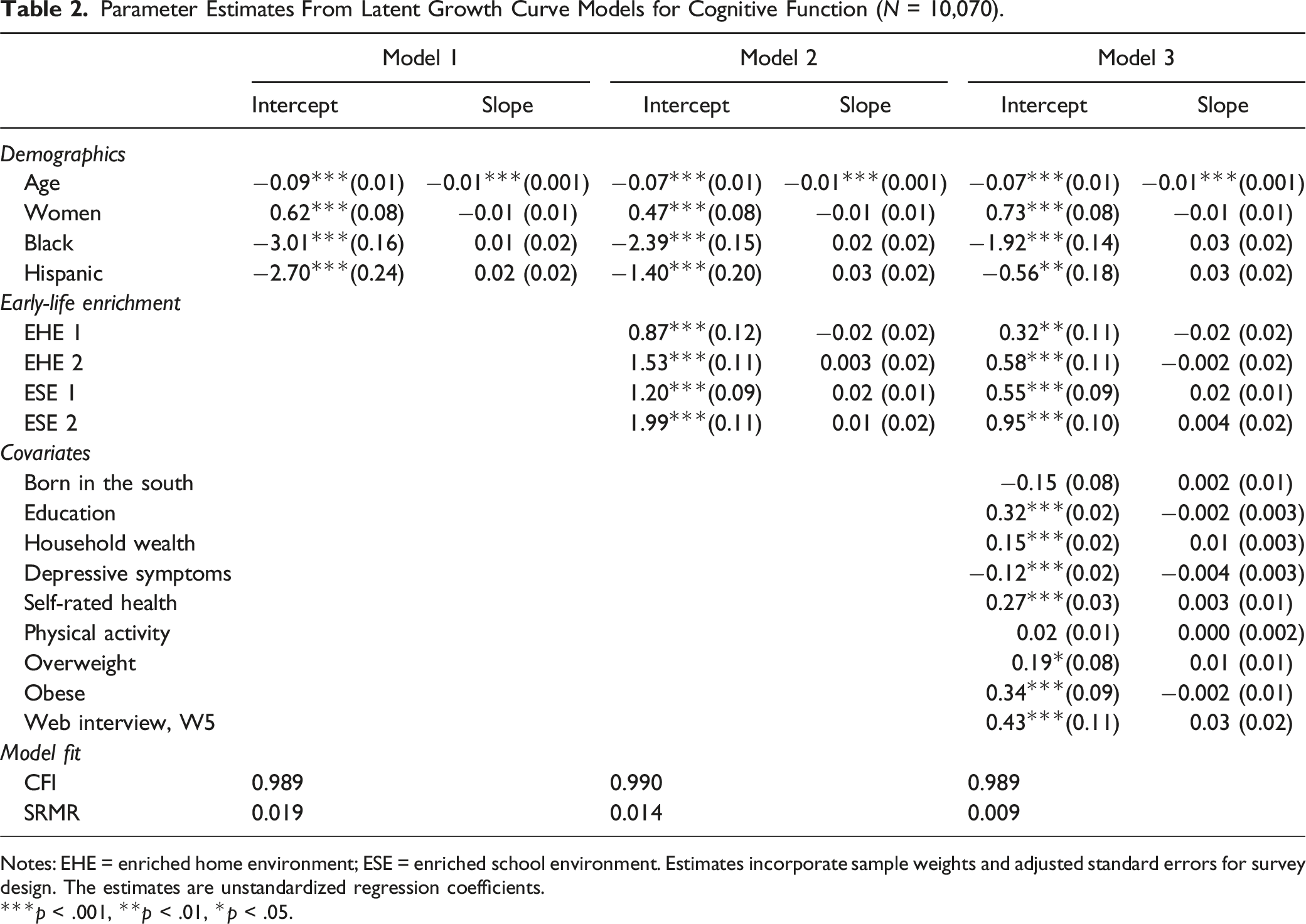
Notes: EHE = enriched home environment; ESE = enriched school environment. Estimates incorporate sample weights and adjusted standard errors for survey design. The estimates are unstandardized regression coefficients.
***p < .001, **p < .01, *p < .05.
Model 2 incorporates our focal predictor variables revealing that both environments of early-life enrichment were beneficial for cognitive function. Growing up in a home with 1 enrichment indicator was associated with a 0.87 higher level of cognitive function (p < .001), and growing up in a home with both enrichment indicators was associated with a 1.53 higher level of cognitive function (p < .001). Compared to not participating in either ESE activity, participating in one was associated with a 1.20 higher level of cognitive function (p < .001), while participating in 2 ESE activities was associated with a 1.99 higher level of cognitive function (p < .001) at W1. Neither ESE nor EHE was associated with cognitive decline.
After adjusting for covariates known to influence cognitive function in Model 3, we found a consistent relationship between EHE and cognitive function and ESE and cognitive function, although the magnitude of association was slightly attenuated. More specifically, enrichment in each environment was independently associated with incrementally better cognitive function at baseline. For example, compared to not growing up in a home with either enrichment indicator, growing up in a home with 1 indicator was associated with a 0.32 higher level of cognitive function (p < .01) and growing up in a home with both a high level of books in the household and a parent with at least an eighth grade education was associated with a 0.58 higher level of cognitive function (p < .001). In terms of schooling, participating in enriching activities was associated with higher levels of cognitive function compared to not participating (b = 0.55, p < .001, one activity; b = 0.95, p < .001, two activities). Neither environment of enrichment was associated with cognitive decline in the fully adjusted model.
Older respondents had lower cognitive function at baseline (b = −0.07, p < .001) and a steeper decline in cognitive function over time (b = −0.01, p < .001). Compared to men, women had higher cognitive function (b = 0.73, p < .001). Black and Hispanic respondents had lower levels of cognitive function compared to White respondents (b = −1.92, p < .001; b = −0.56, p < .01, respectively). Higher levels of education and household wealth were associated with higher levels of cognitive function (b = 0.32, b = 0.15, both p < .001, respectively). Self-rated health and being overweight or obese were associated with higher levels of cognitive function (b = 0.27, p < .001; b = 0.19, p < .05; b = 0.34, p < .001, respectively). More depressive symptoms were associated with lower cognitive function (b = −0.12, p < .001). We found a positive effect for web interview, revealing that participants that completed the W5 cognitive function test via web had higher initial levels of cognitive function than those that participated in the face-to-face or telephone survey (b = 0.43, p < .001).
Figure 1 illustrates the cross-sectional relationship between each environment of early-life enrichment (ESE and EHE) and cognitive function at W1. This figure reveals that respondents who reported more early-life enrichment had better cognitive function compared to respondents who reported less. Relationship between two environments of early-life enrichment and baseline cognitive function among respondents with available data. Note: EHE = enriched home environment; ESE = enriched school environment.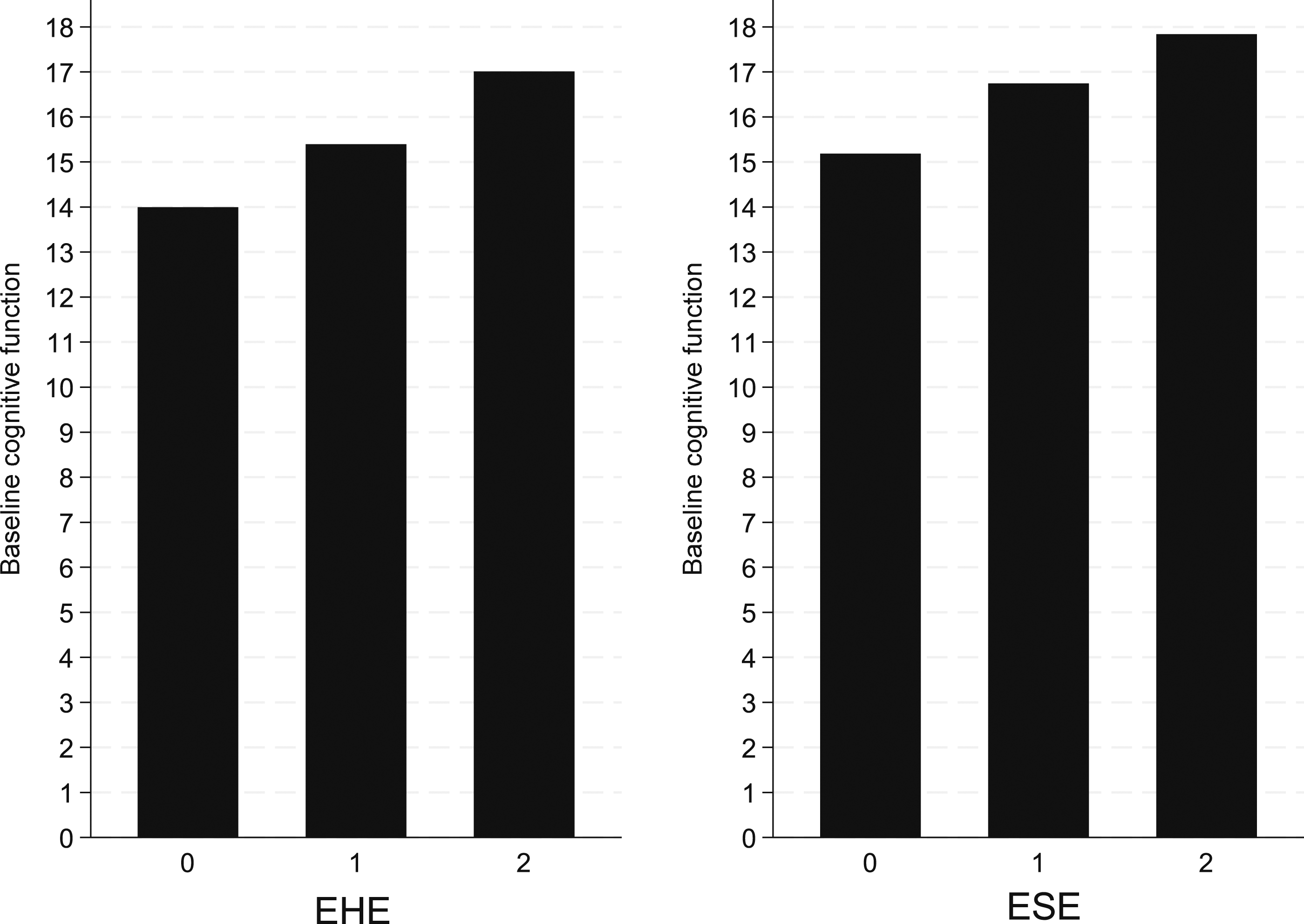
Discussion and Implications
The current study adds to the growing body of evidence that illustrates how early-life enrichment shapes cognitive function in later life. We contribute to the extant literature on early-life enrichment and health in later life by examining 1) distinct environments of enrichment (i.e., home and school) and 2) cognitive function over time. Our results revealed that having either an enriched home or school environment was associated with better cognitive function—but neither was protective against cognitive decline during later life. More specifically, greater enrichment in each environment was associated with independent and incremental increases in cognitive function; these results persisted even after adjustment for adult socioeconomic status, health, and lifestyle factors.
Our results align with previous studies that report an advantageous relationship between early-life enrichment and cognitive function in later life (Brandt et al., 2012; Chan et al., 2019; Crane et al., 2023; Frank et al., 2023; Fritsch et al., 2007; Greenfield et al., 2022; Oveisgharan et al., 2020). These studies, however, tend to focus on enrichment at home or school or use a composite measure that does not distinguish between enrichment environments. Examining multiple environments of enrichment is important given that some respondents may have lacked enrichment at home but were able to fill the gap at school and vice versa. Higher ESE scores were associated with somewhat higher cognitive function at baseline compared to EHE scores, signaling the importance of having access to academic programs and clubs during adolescence.
Enriched home and school environments may provide lifelong cognitive benefits because they are experienced during sensitive periods of cognitive development. For example, in terms of an EHE, reading is associated with more advanced neurocognitive development, as evidenced by higher functional connectivity in the brain (Horowitz-Kraus & Hutton, 2018). Reading can also indirectly influence later-life cognitive function by equipping one to excel in higher educational attainment (Cheung & Andersen, 2003). Some caution should be taken when interpreting the relationship between EHE and cognitive function given that access to books does not necessarily mean the respondent read them during childhood. However, prior research reports that having books in the home is associated with greater engagement with reading, as well as reading ability among children, suggesting that access to books in the home is an important component of cognitive enrichment (Merga, 2015; van Bergen et al., 2017).
Besides having books readily available in the home, an EHE may provide cognitive benefits because parents with higher educational attainment are more likely to implement a parenting style of concerted cultivation. Concerted cultivation is a term coined by Annette Lareau to refer to how more socioeconomically advantaged parents “deliberately try to stimulate their children’s development and foster their cognitive and social skills” by structuring leisure time with organized activities (Lareau, 2011, p. 5). That is, most parents with higher educational attainment can invest more in resources that are conducive to cognitive development—benefits of which extend over the life course (Davis-Kean et al., 2021; Duncan & Magnuson, 2012; Greenfield & Moorman, 2019). Because our measure of EHE includes parental educational attainment, it is possible that we are capturing some of the cognitive health benefits accrued from early-life socioeconomic status (Greenfield & Moorman, 2019; Lyu & Burr, 2016). However, results from Christensen et al. (2014) reveal that enrichment attenuated the effects of childhood SES and had an independent association with cognitive performance during childhood, demonstrating the distinct benefits of enrichment that extend above and beyond those of childhood SES.
In terms of an ESE, we hypothesized that involvement in college preparatory courses and extracurricular activities would be cognitively beneficial. It is important to note, however, that students in higher SES neighborhoods attend schools that have greater resources to offer enrichment opportunities (Owens, 2010; Pribesh et al., 2011). As such, students may have unequal opportunities to cognitively “grow” during sensitive periods of development. Indeed, results from Greenfield et al. (2022) underscore the importance of enrichment during sensitive periods of cognitive development: participation in cognitively enriching activities during high school was associated with better language/executive function and memory even after adjustment for an array of cognitive resources during adulthood. Participating in clubs, such as debate team, math club, or theater, and taking college prep courses are likely to be mentally, physically, and socially stimulating, which may subsequently improve structural networks in the brain known to be conducive to cognitive functioning (Schoentgen et al., 2020).
We hypothesized that early-life enrichment may be associated with cognitive function over time among older adults because it builds up one’s cognitive reserve, yet we found no evidence to support this hypothesis. That is, both environments of early-life enrichment were associated with better cognitive function at baseline but not change over time. It is possible that some degree of cognitive reserve is obtained through early-life enrichment, but protection against cognitive decline is more likely via persistent enrichment across the life course (Hertzog et al., 2008). We cannot completely discount the idea that early-life enrichment increases levels of cognitive reserve given that we did not study changes in brain pathology. Future research should examine the relationship between early-life enrichment, changes in brain pathology, and cognitive function.
Research on the relationship between early-life enrichment and cognitive decline in later life remains mixed, with some results suggesting that early-life enrichment is associated with slower decline in cognitive function (Frank et al., 2023; Overisgharan et al., 2020). Others, however, report little evidence in support of the relationship (Greenfield et al., 2022; Wilson et al., 2015). Results presented here align with the latter.
Limitations and Future Research
To interpret the findings and design future studies, it is important to recognize the limitations of our study. Use of the 2015/2017 LHMS presents two limitations. First, respondents had to live to 2015 or 2017, which may mean our analytic sample is healthier than would be expected. Indeed, supplemental analyses found that respondents who participated in the 2010 core survey (baseline) but did not participate in the LHMS 5 to 7 years later were disadvantaged in several ways, including lower socioeconomic status (measured by education and household wealth), worse physical health (measured by self-rated health and physical activity), and more depressive symptoms. Black and Hispanic adults as well as men were also less likely to participate in the LHMS. Thus, our results are likely a conservative estimate of association between enriched environments and cognitive function in an advantaged sample.
Second, there is coarseness in the measure of club participation because the HRS did not ask identical survey questions about clubs in 2015 and 2017. In particular, the response categories presented to respondents of the 2015 LHMS combined zero and one into a single category. Theoretically, investigators often distinguish between zero and one, but we were unable to do so with this measure. Thus, future research that is able to distinguish between zero and any club participation is warranted.
Although this study contributes to the literature by showing the independent effect of two environments of enrichment, future research may benefit from consideration of other environments. The HRS question focuses on “school clubs or organizations,” but a more comprehensive inventory of early-life activities (e.g., religious, community recreation, internships, and summer camps) may be helpful for identifying additional venues for intervention, especially because some less-funded schools may have offered fewer enrichment opportunities, forcing students to seek enrichment elsewhere in the community. As such, we speculate that our findings are likely a conservative estimate of the association between enrichment and cognitive function in later life. Finally, given the vast literature on childhood adversity and adult health, it may be fruitful to consider the influence of negative exposures (childhood adversity) along with positive exposures (early-life enrichment) in future research.
Conclusion
Cognitive function is a salient indicator of quality and valuation of life for older adults (Pan et al., 2015), and our study provides promising results for the cognitive benefits of early-life enrichment in two environments. Although enrichment at any life course stage is likely to be helpful, public health interventions focused on youth and adolescence may have a noteworthy influence on cognitive function in later life. Targeting enrichment in multiple domains of a child’s environment is a prudent public goal, especially in underserved communities where access to enrichment may be limited.
Footnotes
Declaration of Conflicting Interests
The author(s) declared no potential conflicts of interest with respect to the research, authorship, and/or publication of this article.
Funding
The author(s) disclosed receipt of the following financial support for the research, authorship, and/or publication of this article: This work was supported by the National Institute on Aging (AG043544, AG068388; awarded to Kenneth F. Ferraro, PhD).

Data Availability Statement
Data are available upon request.