




Abstract
Holistic nursing should be a goal for all nurses. Patients that receive holistic nursing feel acknowledged, valued, and appreciated. Caring for patients holistically requires student nurses to possess and display attributes of mindfulness and Ubuntu. Student nurses therefore need to be supported and taught how to provide caring holistically to patients while being aware, being present, and conscious in the caring moment. The purpose of this article was to describe the model developed as a frame of reference to facilitate holistic nursing through developing mindfulness and Ubuntu. A theory generative, exploratory, and contextual research design was followed. A diagrammatic structure was constructed after the concept analysis was conducted. The model consisted of three phases with an outcome of a student nurse who is caring holistically and mindfully. The model provides a framework of reference to facilitate holistic nursing through the development of mindfulness. This study adds a model of mindfulness and a lens of looking at mindfulness through an African philosophy of Ubuntu.
What Is Already Known About the Subject?
Models of caring have been developed.
There are models available on mindfulness.
There are insufficient models that focus on the facilitation of caring through the development of mindfulness globally.
What This Paper Adds?
The model is an original contribution that adds to facilitating caring through the development of mindfulness and Ubuntu.
An Afrocentric lens for the facilitation of caring through the development of mindfulness.
Introduction and Background
As caring is seen to be the heart of nursing, caring should be an essential quality for nurses in providing holistic nursing, quality and relevant patient care (Downing & Hastings-Tolsma, 2016; Labrague et al., 2015; Watson, 2008). Holistic nursing includes caring for the patient entirely considering all the aspects of their being namely, mental, physical, emotional, and spiritual. Therefore, includes holistic healing of the patient with a focus on all the aspects of the patient (Muhammad-Lawal et al., 2023). Holistic nursing ensures that the student nurse does not neglect the patient’s needs, both visible and not-so-visible (Matshaka et al., 2020; Ninivaggi, 2020). Holistic nursing is provided when student nurses spend time with the patients to really understand their suffering and pain (Jasemi et al., 2017). Holistic nursing requires the student nurse to come to the level of the patient and to empathize with the patient. Jasemi et al. (2017) assert that holistic nursing leads to greater patient satisfaction because the patient feels understood and receives relevant care to cater to their needs. Student nurses are undergoing training which should assist them to be ready to provide holistic nursing.
Ubuntu philosophy provides a cultural and ethical framework that aligns with the principles of holistic nursing (Muhammad-Lawal et al., 2023). Ubuntu fosters interconnectedness, compassion and community which are foundational to the practice of holistic nursing and caring for patients (Corpuz, 2023; Cowling, 2021). Embracing Ubuntu can enhance caring practices by student nurses. Ubuntu fosters a deeper sense of empathy, compassion, respect for patients and holistic and patient-centered care (Corpuz, 2023). It is through Ubuntu that nurses consider the physical, emotional, spiritual, and social dimensions of patient care (Muhammad-Lawal et al., 2023). Furthermore, Ubuntu encourages nurses to be present, and attentive while showing empathy and compassion in their interactions with patients.
For student nurses to care holistically for the patient, they need to be present at the moment and show that they are interested in the patient as a whole (Bullington & Fagerberg, 2013). Therefore, they need to develop mindfulness and Ubuntu to provide this holistic nursing (Jasemi et al., 2017). As with holistic care, mindfulness and Ubuntu will enable them to pay attention to the patient's mental, physical, emotional, and spiritual aspects. Whitesman and Mash (2015) define mindfulness as a technique that enables one to be present and aware in the moment.
By being present, the student nurse is enabled to acknowledge the patient as a whole and therefore pick up the problems that the patient does not even verbally mention and become conscious of their needs (Fazio et al., 2020). Being conscious of the patients’ needs implies being guided by the ethics of care which is Ubuntu (Sarpong et al., 2016) to act in alleviating the suffering. Through Ubuntu, the student nurse empathizes with the patient meaning that they cannot leave the patient in the position they found them in. The patient is treated with dignity, treating them as the student nurse would like to be treated (Buqa, 2015). Ubuntu upholds empathy, compassion, kindness, humanness, and cohesion (Fazio et al., 2020). For this reason, the student nurse needs to possess mindfulness and Ubuntu to be able to provide holistic nursing. There is a direct link between Ubuntu and caring, Ubuntu moves the student nurse to acknowledge the patient or the person in need of caring (Chisale, 2018). Once the student nurse has acknowledged the person they are moved with compassion to provide care to the patient (Matshaka et al., 2020). A student nurse who has Ubuntu recognizes the strong connection that they have to the patient by virtue of being a human being, and the student nurse acknowledges that they are because of the patient and therefore they show empathy, love, respect, and care to the patient (Chisale, 2018). The student nurse through the spirit of communalism cannot resist to increase the patient's comfort to enhance their human dignity because Ubuntu compels them to treat the patient as they would like to be treated (Mangwegape, 2019). Ubuntu is a unique African philosophy that enhances togetherness, thoughtfulness for other people's suffering, and caring for the humanity of other people (Waghid, 2018). Therefore, Ubuntu can be used to facilitate holistic nursing in student nurses (Muhammad-Lawal et al., 2023).
This study was built on previous research by the first author entitled “Student nurses’ perceptions of the relationship between mindfulness and caring” (Matshaka, 2018). The aim of this study was to investigate the relationship between mindfulness and caring with the aim of explaining how mindfulness influences caring in student nurses (Matshaka, 2018). The results of the study revealed that even though student nurses did care, they lacked mindfulness. They were not aware, and they lacked presence in caring. Figure 1 provides a summary on the results of the study and provides the concept through which the model was developed.
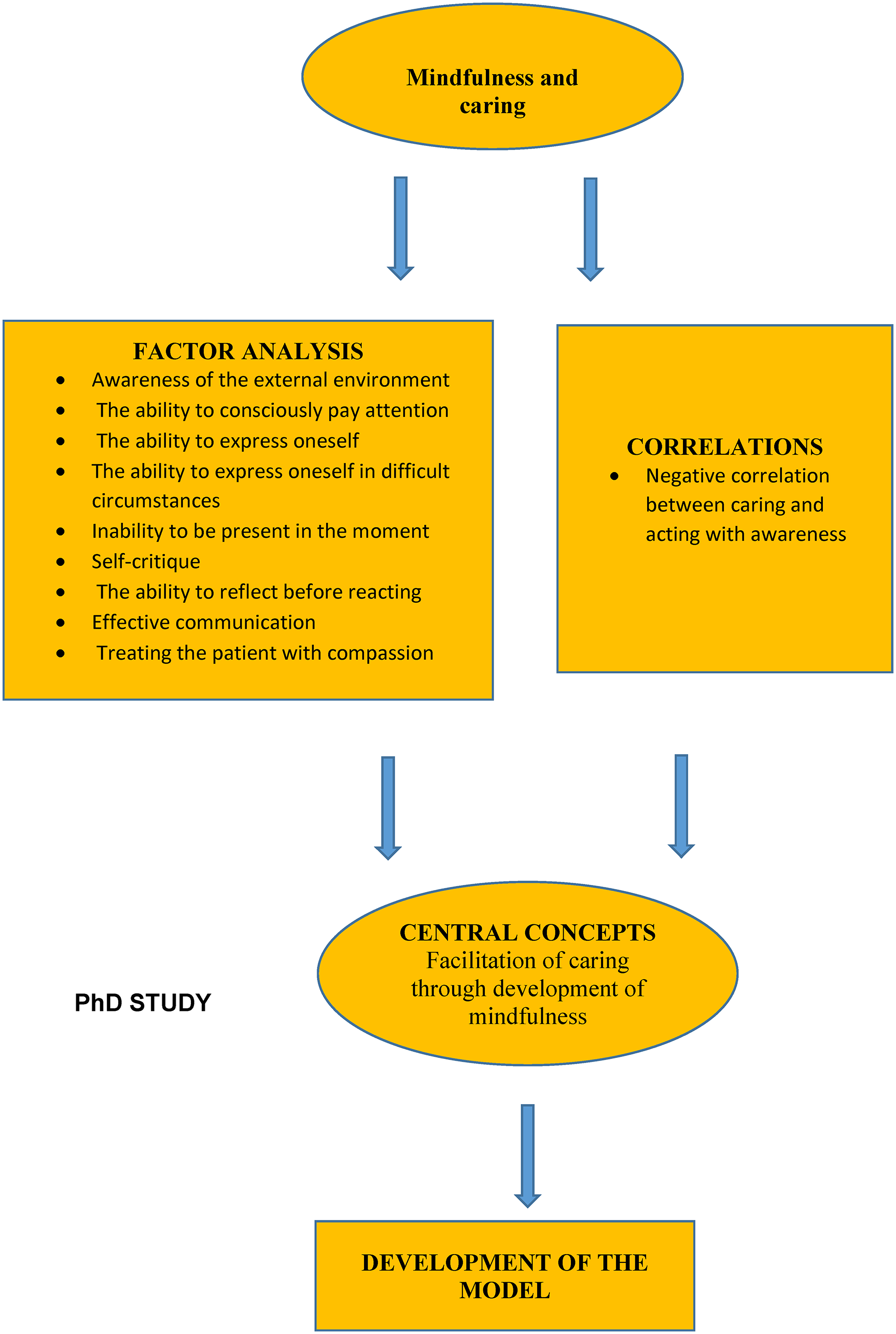
Reasoning map indicating the derivation of the central concept (Matshaka, 2022).
PhD Study
Figure 1 provides a summary of the results obtained from the previous study conducted by the author and shows the concept that guided the model development.
A search for models developed on mindfulness and caring for student nurses nationally and internationally was conducted. The identified models included a model on leadership, conducted in the United States of America (Miles & Scott, 2019), a model of emotional support for student nurses working in mental health settings in the Western Cape (Martin & Daniels, 2015), a model of professional nurses caring—nursing students’ experience conducted in Australia (Wilkes & Wallis, 1998) and the development and implementation of a model to facilitate self-awareness of professionalism for enrolled nurses, in Johannesburg (de Klerk et al., 2022). This limited number of models suggested a gap regarding models to assist student nurses in facilitating holistic nursing through the development of mindfulness. Thus, the aim was to describe the model developed as a frame of reference to facilitate holistic nursing through the development of mindfulness. The proposed model described in this article could act as a frame of reference to assist student nurses in facilitating holistic nursing through the development of mindfulness.
Context Where the Model Was Developed
The model was developed in a higher education institution in South Africa. The institution offers undergraduate, postgraduate diplomas and postgraduate degrees. The number of undergraduate students who were the focus of this study was ±150 at the time. The students are placed in public health facilities where they integrate theory and clinical and where they cover their clinical hours as required by the South African Nursing Council. In the clinical facilities, the student nurses practice under direct supervision of professional nurses and they are accompanied by the nurse educator and the clinical preceptors in the clinical facilities.
Study Design
A theory generative, qualitative, descriptive and exploratory design was employed in the larger study to develop a model to facilitate caring through the development of mindfulness. The steps by Chinn and Kramer (2018) were followed for the model development. These steps are described below.
Step 1: Concept Analysis
Step 1 is divided into two phases namely identification of the central concept and definition and classification of the central concept (Chinn & Kramer, 2018). The concept ‘facilitation of mindfulness through the development of mindfulness’ was derived from an earlier concept analysis by the author (refer to Figure 1; Matshaka, 2022). To define the central concept the researcher used English dictionaries, subject and subject-related literature (Matshaka, 2022). The following data bases were consulted Africa-wide Information, Business Source Ultimate, CINAHL, Medline, Psych INFO, ScienceDirect, EBSCO (Health Source: Nursing and Academic Edition), Sage, Ujoogle, Google Scholar, and Google.
Concepts that were defined are facilitation, caring, development and mindfulness.
Facilitation is a process of assisting and empowering. Caring as the ability to love and show Ubuntu. Development can be defined as a process of becoming. Mindfulness is a process of being able to focus on the present moment and enhancing empathy for self and others.
This concept analysis was conducted prior to developing the model according to the steps of Walker and Avant (2019). The results of the concept analysis guided the model development process and data collection, the results of which are presented in a different article. The purpose of this article is to describe the development of the model as a framework of reference to facilitate caring through the development of mindfulness.
Step 2: Placing Concepts in Relationships
Relation statements show the interrelations between concepts (Chinn & Kramer, 2018). Concepts were grouped together according to how they relate to each other, and assumptions were drawn regarding these relationships between concepts.
The relationships denoted among the concepts are as follows:
The student nurse acknowledges the patient as a unique individual and thus makes the patient feel valued. The student nurse shows kindness, love, compassion, and Ubuntu to the patient, and the patient is thus empowered and encouraged to love herself. The student nurse spends time with the patient and is focused on the present moment with no distractions; thus, the patient feels comfortable and important. The student nurse pays attention with an open heart and is able to note everything around the patient, including the patient's nonverbal communication. The student nurses enhance empathy for themselves and others, thereby empowering the patient to show empathy and kindness to the self. The student nurse has shown belief in the patient, and the patient thus becomes positive and is empowered to believe in themself. The student nurse empowers the patient to have a positive outlook on life, and thus the patient becomes positive and starts to value life; a positive change is noted in their health. The student nurse's role is to facilitate caring through the development of mindfulness. This process will take place in three phases, namely the relationship phase, the working phase, and the termination phase.
Step 3: Description and Evaluation of the Model
The method by Chinn and Kramer was followed to provide the purpose of the model, a description of the model, assumptions of the model, identification of central concepts, definitions of the concepts, relationships between concepts, the structure of the model, and process description of the model (Chinn & Kramer, 2018). Following development, the model was presented to a panel of experts who were well-versed in model development and who had a PhD qualification, and an evaluation of the model was conducted by this panel of experts.
After the evaluation of the model by a panel of experts, the model was presented to the participants through a workshop and the participants implemented the model for three months in the clinical setting. Focus groups were then conducted to evaluate the implementation of the model. Further details and findings of the focus group are presented in a separate article.
Ethical Considerations
Ethical clearance was obtained before conducting the study (REC-01-128-2019) and approval from the Higher Degrees Committee (HDC-01-55-2019) from the Higher Education Institution where the study was conducted. All the ethical principles namely, autonomy, beneficence and nonmaleficence, and justice were adhered to throughout the research. The participants consented to be part of the study and they were informed that they have a right to withdraw from the research at any time without suffering any consequences.
Data Analysis and Trustworthiness
Data were analyzed by following the strategies of Saldaña (2013) revealing five themes with related subthemes. The strategies of trustworthiness were upheld namely, credibility, transferability, dependability, and confirmability (Lincoln & Guba, 1985). Prolonged engagement and member checking were applied to ensure the credibility of the findings.
Findings and Discussions
Model Description and Evaluation by Experts
This model provides a frame of reference for student nurses’ facilitation of caring through the development of mindfulness for a caring and interactive relationship between the student nurse and the nurse educator, ensuring that the student nurse is being mentored to be a mindful carer.
This model was based on the theoretic underpinnings of Watson's human caring theory focused on human-to-human interaction (2008). The model is about facilitating caring through the development of mindfulness in student nurses to assist in patient and student nurse interactions. The theory focuses on love as a source of healing in nursing care (Watson, 2008). The model focuses on love and Ubuntu as a premise of caring for the self and patients. This theory has 10 carative factors central to caring (Wei & Watson, 2019). The model has three phases, which the student nurse must navigate to accomplish caring. Watson's theory focuses on authentic presence, caring moment and awareness. The model focuses on the student nurse's ability to be present in the moment with awareness. This theory does not only focus on the patient receiving care but also on the nurse or the person providing care (Wei & Watson, 2019). The model focuses on the student nurse's ability to show empathy to self and be empowered so they can bring to their interaction with the patient what they have available and not move from an empty cup.
Structure of the Model
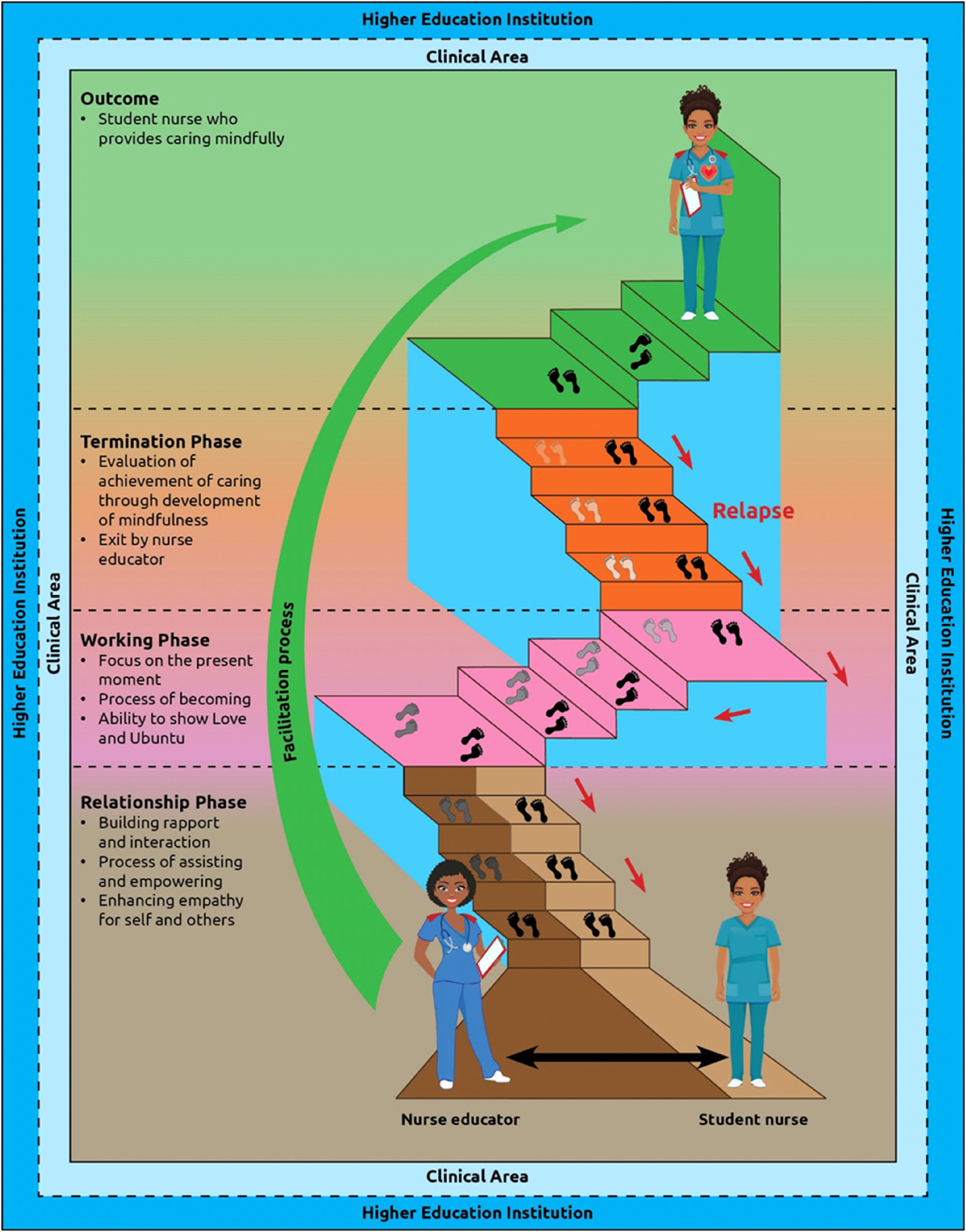
The structure of the model is discussed following the strategies of Chinn and Kramer (2018, pp. 178–183) in Figure 2.
A model to facilitate caring through the development of mindfulness.
Figure 2 presents the structure of the model that shows the relationship between the nurse educator and the student nurse. The relationship starts with the relationship phase where the nurse educator works with the student nurse until the outcome is reached. The section that follows describes this figure in more detail.
The context of the model is a caring environment in which student nurses interact with the nurse educator and with patients to provide healing and support. The context of the study is divided into two sections, namely a higher education institution and a clinical area. These contexts for the model were selected because student nurses are placed in different facilities where they interact with patients and need to provide them caring (Matshaka, 2022). The higher education institution represents the place where the student nurse receives education and guidance on how to provide caring. The clinical area represents various clinical facilities, including public secondary, tertiary, and district facilities where the student nurse is allocated to complete clinical hours.
At the beginning of the process, the student nurse is in a position where they are not able to be present in a caring moment, and they lack awareness (Matshaka, 2022). The student nurse lacks the ability to care mindfully, as indicated by not having a radiating heart, a stethoscope, and a notepad as the tools to care mindfully (refer to Figure 2).
The nurse educator works as an expert to assist and empower the student nurse and support them through the process of facilitating caring through the development of mindfulness. The nurse educator possesses the attributes of the profession, namely accountability, competencies, leadership, self-regulation, and a commitment to excellence (Matahela & Van Rensburg, 2021). In this process, the student nurse will be assisted to focus on the present moment and attain awareness and a love for themselves, treating themselves with Ubuntu and acknowledging themselves as unique and valuable individuals. The nurse educator brings support and encouragement to the student nurse. The nurse educator is knowledgeable, qualified, and full of encouragement and motivation to ensure that the student nurse moves from the stage of lacking awareness and an inability to be present at the moment to a point where they provide caring through the development of mindfulness (Matshaka, 2022).
The process of facilitating caring through the development of mindfulness takes place in three phases, namely the relationship phase, the working phase, and the termination phase.
In the relationship phase, the nurse educator meets the student nurse at the position the student nurse is in. The nurse educator cultivates an environment of warmth, support, and encouragement for the student nurse, and acknowledges the student nurse as a unique and valuable human being. The nurse educator does not impose their sense of power and authority over the student nurse. They accept and acknowledge the contribution that the student nurse brings and create space for growth. The nurse educators commence the relationship phase with knowledge and expertise as they embark on an empowering journey with the student nurses. They aim to assist them in becoming aware of how to facilitate caring through the development of mindfulness. Refer to Figure 2 for a graphical representation of the relationship phase. The color brown was chosen for this foundation of the relationship phase as it represents earth, reliability, comfort and stability. Brown also represents a strong foundation. There are two shades of brown; the nurse educator stands on more fertile soil, which is depicted by the darker shade of brown; a symbol of the qualities they bring to the relationship phase. The nurse educator is qualified and knowledgeable. The nurse educator possesses the tools required to facilitate caring through the development of mindfulness. The tools are represented by a notepad and a stethoscope. The student nurse stands on less fertile soil, depicted by the lighter shade of brown, indicating the qualities they still have to gain as the relationship and facilitation process commences. In the relationship phase, the feet of the nurse educator and the student nurse have a different shade signifying the involvement of the nurse educator. The nurse educator starts by being fully involved, moving to being less involved. The student nurse's feet stay consistently the same, indicating consistent involvement by the student nurse.
In the working phase, the nurse educator empowers and assists the student nurse to acknowledge themselves as valuable and unique individuals, to love themselves, and to show Ubuntu. The nurse educator assists the student nurse to become mindful as they learn to be present in the moment, to pay attention with an open heart and show empathy to themselves. This phase of the model occupies a significant space because the nurse educator spends time involved and engaged with the student nurse as they assist and empower the student nurse. The color chosen for this phase is pink. Pink represents love, empathy and compassion. Akin to the relationship phase, the nurse educator becomes less involved, hence the change in the shade of the footprints from the nurse educator. The graphical representation of the working phase can be seen in Figure 2.
During the termination phase, the focus is on evaluating if the student nurse has achieved the ability to facilitate caring through the development of mindfulness. The aim of this phase is to see the student nurses being able to be on their own. The termination phase is represented by the orange stairs, with fading footprints of the nurse educator and solid student nurse's footprints (Matshaka, 2022). The nurse educator exits the process in this phase to ensure that the student nurse can be on their own. The color for this phase is represented by orange which is associated with joy, sunshine, and the tropics. Orange represents enthusiasm, fascination, happiness, creativity, determination, attraction, success, encouragement, and stimulation. In the termination phase, the student nurse continues to become, and this is signified by the darker and more solid footprints of the student nurse. Figure 2 shows a graphical representation of the termination phase.
The process of facilitating caring through the development of mindfulness is represented by a thick green arrow pointing toward the outcome (refer to Figure 2). This arrow cuts through the three phases, namely the relationship, working, and termination phases. The process of facilitation is initiated by triggers, including an inability to act with awareness in caring, an inability to be present in the moment and self-critique. The color green was most fitting as it represented growth and stability. The red arrows pointing down show possible relapse by the student nurse, which may indicate that the nurse educator still has to assist and empower the student nurse more, so they gain the ability to facilitate caring through the development of mindfulness. The color red was used in this case as it represents caution or a warning of danger.
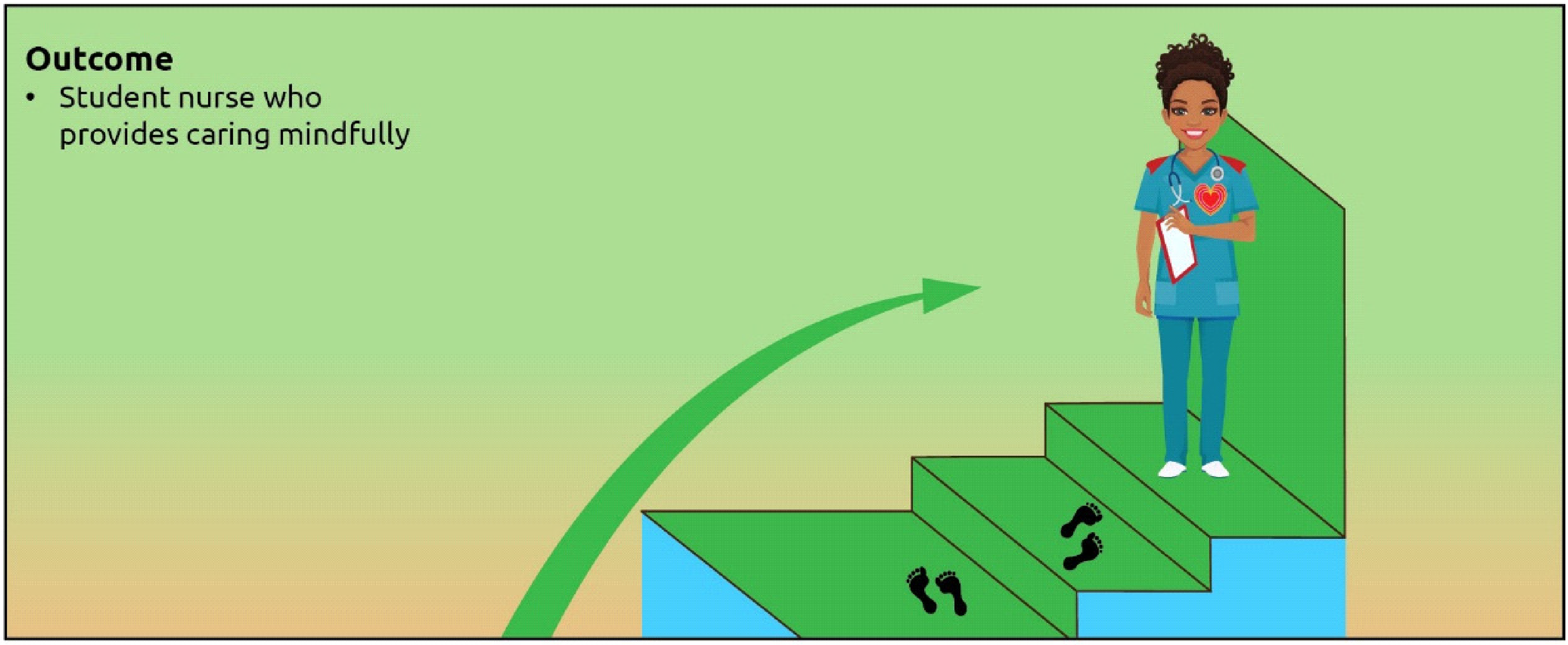
The outcome of the process is a student nurse who facilitates caring through the development of mindfulness. This is represented by the student nurse with a stethoscope and radiating heart, showing that the student nurse has now gained the tools to provide caring mindfully. The student nurse lacked this tool in the relationship phase (refer to Figure 2). The solid single footprints show that the student nurse is able to be on their own. Green represents growth, renewal, and security and evokes feelings of harmony, stability and safety. (Refer to Figure 3 for a graphical representation of the outcome.
Graphical representation of the outcome.
Evaluation of the Model
According to Chinn and Kramer (2018), once developed, a model must be described to ascertain whether it is applicable and purposeful in terms of its contribution to current practice. The model was evaluated by using Chinn and Kramer (2018)'s strategies of model evaluation, and these speak to clarity, simplicity, generality, accessibility, and importance. These questions are addressed below.
The following participants were made up of two full Professors (FP), one senior lecturer (SL) and one lecturer (L) who all had a PhD qualification. The invite to evaluate the model was also extended to other persons, including one full professor, one senior lecturer and a lecturer with a PhD; unfortunately, they could not attend the session.
Clarity
The clarity of the model in this evaluation referred to semantic clarity, consistency, structural clarity, and structural consistency (Chinn & Kramer, 2018). The participants were asked, ‘how clear is the model?’ They reported the model was clear, and suggestions to further enhance the model's clarity were provided.
Participants had this to say in answer to this question: Clear. Arrows down too large. Please make smaller. Footsteps too small especially at the beginning in comparison with feet of the agent and the recipient?. FP1
Modifications were implemented as suggested by the participant. The down arrow was made smaller, and the footprints were enlarged. The model is clear. FP2 The model is clear. The model is clear to understand. We could remove the arrows behind the relationship, working and termination phase. It is clear which phase it is without those arrows.
The arrows on the phases were removed as suggested by the participant. Clear.
The suggestions provided were applied to enhance the clarity of the model.
Simplicity
Chinn and Kramer (2018) state that the model should have minimal concepts to ensure simplicity. The evaluators stated that the model was easy to follow; suggestions were provided to enhance further clarity. Easy to follow. Don’t let the student fold arms at the bottom—arms on the side. Relationship below not clear, maybe use a double arrow (↔) may be necessary. FP1.
The image of the student was replaced as suggested by the participant, and the double arrow indicating the relationship between the student nurse and the nurse educator was added. The model is simple to follow. The model is simple to understand Slightly complex, need to revisit diagram and concepts.
The comments and suggestions evaluators offered were applied to further simplify the model and address one participant's comment that the model was slightly complex
Generality
The generality of the model refers to the applicability, purpose, and breadth of scope of the model (Chinn & Kramer, 2018). The question was: “how general is the model?’ and the participants gave the following responses: Applicable. Can be applied to all nursing situations. FP1 General. FP2 The model is general, it can be applied widely in the context that it is developed for, namely higher education and the clinical practice of nurses. SL The model is general, it can be applied widely in the context that it is developed for, namely higher education and the clinical practice of nurses. L
All the participants reported that the model was general and could be applied to other contexts.
Accessibility
The model's accessibility speaks to the empiric indicators of the model and the extent to which the purpose of the model can be realized (Chinn & Kramer, 2018). The question “how accessible was the model” was posed, and the participants had this to say: Easy to access. FP1 Accessible. FP2 The model is accessible. I do think that the assumptions of the model should clearly state what you assume to be in place regarding the preparedness and readiness of the nurse educator in terms of facilitating mindfulness in care. SL The doctoral candidate should ensure that this model is made accessible to HEI (i.e., GCON) where there are nurse educators and nursing students who will develop mindfulness through caring. L
The participants’ overall feeling was that the model is indeed accessible. It was noted that the relevant stakeholders should be notified about the model.
Importance
Chinn and Kramer (2018) argue that the importance of the model speaks to its practical value and significance toward nursing education, practice, and research. The question “how important is the model?” was posed to the participants, and the following responses were obtained: Very important. Most patients and families complain about noncaring behaviors from nurses. It is important that caring should be facilitated. FP1 Important. FP2 Very important. Mindfulness in caring is needed, as it facilitates connection between the nurse and the patient, which leads to a positive health/illness experience for the patient and a positive caregiving experience for the nurse. SL This is an important model to ensure that future nurses can be taught how to care mindfully as caring in nursing is so crucial. L
Considering the feedback received from the evaluators, the researcher concludes that this model is necessary for improving the caring provided to patients.
Original Contribution
This article contributes a description of a model to professional nursing science as a frame of reference to facilitate caring through the development of mindfulness and Ubuntu. This model is relevant to nursing education, student nurses, nursing research and nursing practice. The description of the model which could empower student nurses who are the next generation of professional nurses and aims to improve quality care and patient satisfaction. The model will assist student nurses to practice self-care and self-love, which will enhance the relationship between the student nurses and the patients. In turn, this will help to decrease burnout and may increase student nurse retention in the nursing profession. The model adds to other professions outside nursing the importance of self-love which empowers one to love others and the aspect of mentorship.
Strengths and Limitations of the Study
The study's findings provided insight into how student nurses experience their learning in the wards and how they are valued by patients. Conducting the study only in one higher education institution.
Conclusions
As per the results of the previous study on student nurses’ perceptions of the relationship between mindfulness and caring, student nurses provide caring to patients without being mindful. Student nurses lack awareness, they are not present in the moment when caring for patients. Hence the need to develop a model to assist student nurses to facilitate caring through the development of mindfulness and Ubuntu. Therefore, the purpose of this study was to describe the model and provide guidelines as a frame of reference to facilitate holistic nursing through the development of mindfulness and Ubuntu. The model was described, and the relationship steps and guidelines of the model implementation were provided. The model was evaluated by a panel of experts. This model provides a frame of reference for student nurses to provide caring through the development of mindfulness and Ubuntu to the patients. Embracing Ubuntu can contribute to the development of culturally competent and compassionate student nurses who are better equipped to provide holistic caring to diverse patient populations.
