




Abstract
Diabetes is a serious issue for African American women. The purpose of this project was to develop and test the feasibility of a culturally appropriate and faith-based healthy eating program for African American women at risk for developing diabetes. At total of 30 women from two churches completed a 12-week, faith-based program using a community-based approach with lay health educators in the church setting. Participants set healthy eating goals, attended weekly education classes, and received daily text messaging reminders related to their goals. Outcomes included high levels of social support, frequent engagement with the program, and improved healthy eating. This program demonstrated the ability to target African American women at risk for diabetes and engage them in a health-related program.
Introduction
In 2014 the Centers for Disease Control and Prevention (CDC) reported that 29 million Americans have diabetes, a number expected to increase as another 86 million Americans have prediabetes (CDC, 2014). Blood sugar levels for those with prediabetes are higher than what is considered “normal” but not high enough for a diabetes diagnosis (Rydén et al., 2013); thus, prediabetes has become a serious public health concern. The most effective way of addressing prediabetes and preventing diabetes is through lifestyle modifications such as weight management, diet, and exercise (Lindström et al., 2013; Schellenberg, Dryden, Vandermeer, Ha, & Korownyk, 2013).
The risk of diabetes is especially profound for African Americans, who are twice as likely to develop diabetes as Caucasians (CDC, 2014). In addition, health disparities for African Americans continue to persist even after diagnosis. African Americans are more likely to develop end-stage renal disease, have limb amputations, and have higher rates of mortality than their Caucasian counterparts (Lynch, Hunt, & Egede, 2014; Rosenstock, Whitman, West, & Balkin, 2014). Research has demonstrated that some of these health disparities may be a consequence of other health disparities including higher obesity rates, less exercise, poorer diet, and lower socioeconomic status (Flegal, Carroll, Kit, & Ogden, 2012; Katzmarzyk & Staiano, 2012). African American women are at greater risk of developing diabetes compared with African American men or Caucasian women (Lynch et al., 2014). Therefore, a need exists for programs that target lifestyle health behaviors of African American women who are prediabetic or already managing diagnosed diabetes.
Research has demonstrated the importance of culturally relevant programs and interventions as a means to improve health behaviors, educate regarding disease risk, and improve health outcomes (Lancaster, Carter-Edwards, Grilo, Shen, & Schoenthaler, 2014; Newlin, Dyess, Allard, Chase, & Melkus, 2012). In particular, faith-based interventions for African Americans that involve the church have shown improvements in healthy eating, weight loss, and increased physical activity (Lancaster et al., 2014; Wilcox et al., 2013). The utilization of both the church and the community as resources in interventions has been suggested as an effective tool in delivering programs for specific populations (Maton, Sto Domingo, & Westin, 2013).
Multiple modes of delivery, such as a combination of both online and in-person interventions, have proven to be the most effective method to administer an intervention in any setting (Mouton & Cloes, 2015). Reviews of the literature have also demonstrated that technology utilization, particularly with mobile devices, can be very effective in health promotion and behavior change (Coons et al., 2012; Free et al., 2013). In particular, text messaging has proven to be highly effective when combined with education and other resources (Stephens & Allen, 2013).
The purpose of this project was to develop and test the feasibility of a faith-based healthy eating program for African American women either at risk of developing diabetes (e.g., prediabetes), with a family history of diabetes, or a diabetes diagnosis. This program, titled Claim More, attempted to engage women who expressed interest in making active lifestyle changes in an effort to achieve improved health. Using daily text messaging and weekly support groups, Claim More was designed to encourage a healthier lifestyle. The pilot program was developed to determine if the utilization of the church setting, weekly classes, and daily text messages would be feasible with the intent of extending the program to other churches and ultimately other community groups in the area.
Methods
Intervention
This program was a project between AARP® Services Inc (ASI), UnitedHealthcare (UHC), and two local churches in the greater Greensboro, NC, area. Connecting a large insurance company and AARP with community resources to administer a health-related program was a different approach than what has been done in the past, especially since many of the participants were not UHC insureds or AARP members. UHC and AARP collaborated with the community to develop and test Claim More and determine its potential feasibility in other communities. Therefore, in line with some of the principles of enduring community-based participatory collaboration such as a trusting partnership and a highly engaged community (Israel et al., 2006), Claim More was sponsored by UHC and ASI but operated with appropriate flexibility to meet community needs entity. Two local pastors in the greater Greensboro area were identified to advocate for the program in their churches. The churches were selected because of their innovative ministry, focus on health-related issues, technology and staff resources, and age diversity. A Church Champion and a Lieutenant were then chosen from each congregation. The Champion was designated as the face of Claim More for her respective congregation and was responsible for managing the program for her church. Each Church Champion was required to be passionate about health, motivating and encouraging, technologically savvy, and female, to serve as a role model in order for women who could identify with their health challenges and goals. Importantly, the Church Champion was responsible for registering participants, leading the weekly in-person meetings, recognizing women for their participation during church services, and acting as the liaison between the program designers (UHC) and the participants. The Lieutenant served as an assistant for the Church Champion.
The Claim More program set its mission statement as follows:
A social movement and healthy eating program that relishes what is special about African American women. It helps them be more accountable and more easily engage in lifestyle behaviors that reduce their risk of diabetes and other chronic diseases. Combining community, technology and nutrition support, Claim More empowers women to create healthy life-long habits around food while still enjoying the flavors of life.
A total of 162 women applied to participate. Eligibility to participate in the program included being female, age 45 to 64 years, having access to technology (the Internet, email, and text messaging), and a goal of a healthier lifestyle. Potential participants completed a prescreening survey, which included questions related to age, gender, access to text messaging and email, a pledge and accountability to health change, satisfaction with one’s health, and a commitment to attend the kickoff meeting if accepted for the program. Of the 162 eligible participants, 31 were chosen to participate in the program based on their survey responses, with particular attention to current satisfaction with one’s health (Table 1) and the commitment to attending the kickoff session. No other baseline data was collected.
Summary of Baseline Characteristics
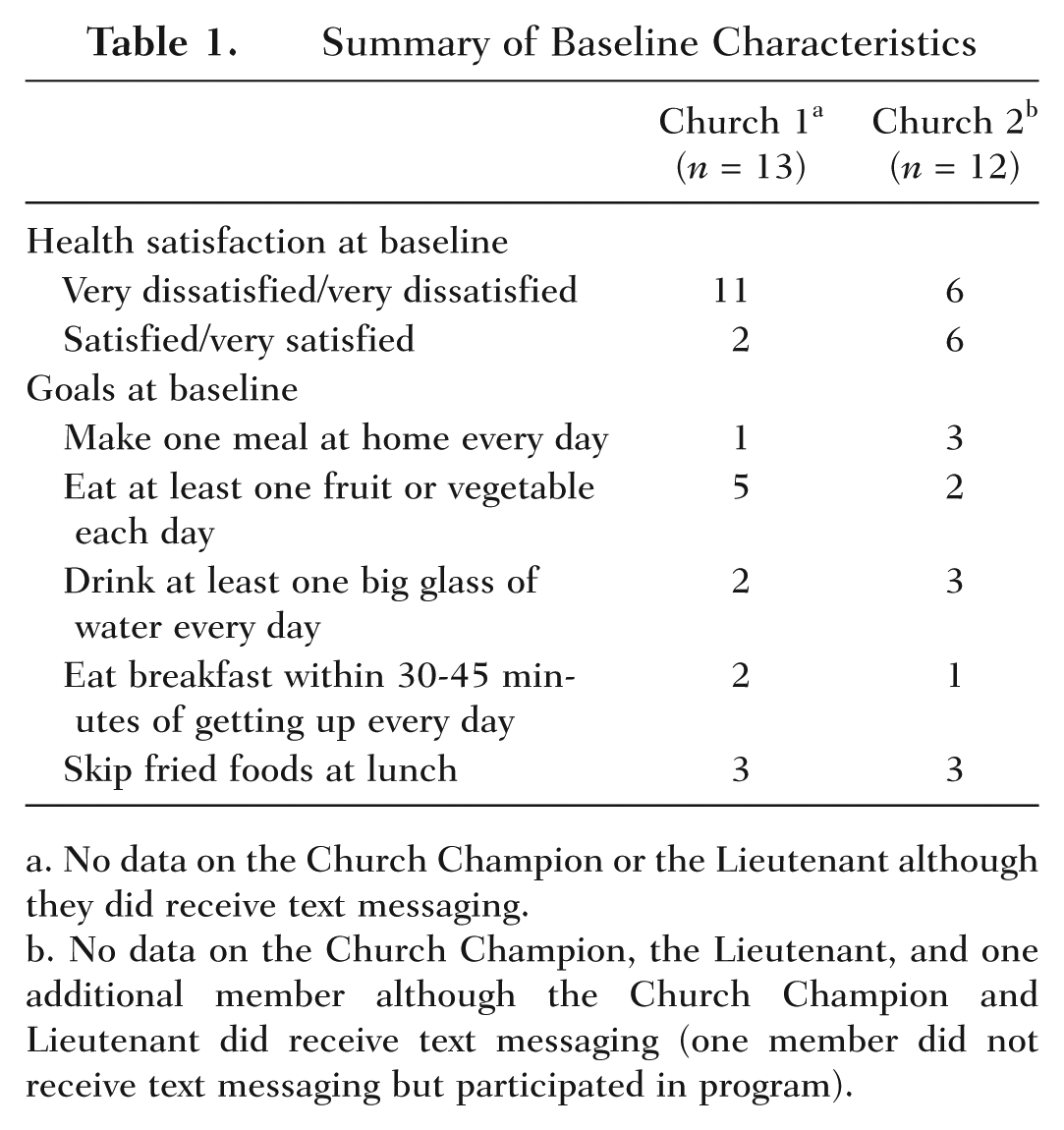
No data on the Church Champion or the Lieutenant although they did receive text messaging.
No data on the Church Champion, the Lieutenant, and one additional member although the Church Champion and Lieutenant did receive text messaging (one member did not receive text messaging but participated in program).
Thirty-one women were accepted and agreed to participate in the program and 30 completed the program including the Church Champions and Lieutenants (one individual dropped out due to illness). Each church had 15 participants. The program ran from October 2015 through January 2016 for 104 days total. During this time period, 12 modules were delivered on a weekly basis with breaks for holidays.
The Claim More program was designed around six elements.
Personal Promise
At the start of the program, women were asked to make a personal pledge and to select their health goals. The pledge stated,
African American women are dying at rates greater than any other group of women in this country and I believe that this is unacceptable. I have the power to create change and claim better health, and I will do my part to make this happen. I won’t let diabetes claim me. It’s time to change the story, I promise to fully participate in the Claim More movement.
Women then selected a health goal to target throughout the duration of the program. Common goals included to make one meal at home every day, eat at least one fresh fruit and vegetable each day, drink at least one big glass of water every day, eat breakfast within 30 to 45 minutes of getting up every day, and skip fried foods at lunch (Table 1).
Mobile Tips and Nudges
Participants received one daily reminder with a related tip customized to their specific goals via text messaging. The tips provided information such as recipes for participants to try. Participants were then expected to respond “Yes” or “No” to confirm whether or not they had met that specific daily goal. These text messages were imperative in supporting each member’s accountability to their personal promise, commitment to the program, and active engagement.
Support Partners
A large part of this program was dependent on the support that the participants gave to one another. At the beginning of the program, women formed smaller teams to provide encouragement to each other. Text messaging was used as way for participants to encourage each other through “High-5s,” which were acknowledgements from fellow team members of a goal having been met. Participants received text messages twice a week (Monday and Thursday) encouraging them to send a “High-5” via text message to one of their teammates who had met a goal. They were asked to send a “High-5” only to that particular assigned teammate. The assignments rotated on a schedule so each team member had the opportunity to encourage each of their teammates at least twice per month. The giving and receiving of a “High-5” on goal completion helped participants to keep up with one another’s goals and provide encouragement and support for maintaining new behaviors.
During the crucial weekly in-person meetings, health-related modules were delivered and participants had the opportunity to support each other regularly. The discussion periods of these meetings served a dual purpose of both education and encouragement of one another. In addition, because of the program’s relationship with the church, participants had the opportunity to share struggles and pray together. Participants were also recognized for their efforts during a Sunday church service by the Pastor.
Nutritional Guidance
The healthy lifestyle education classes, developed by an African American nutritionist, were another focus of the weekly in-person meetings. The content was adapted from the Diabetes Prevention Program (CDC, 2014) and was specifically designed to address the unique needs of African American women. Topics covered included nutrition, movement, sleep, and stress. Guidance included education on healthy eating, recipe preparation, and shopping for healthy food in the grocery store.
Culturally Relevant Recipes
Participants were taught how to prepare traditional African American dishes such as fried fish and collard greens in a healthier way. They received recipes throughout the program via text messages, handouts, recipe cards, and during special events like a cooking class.
Claim More “Swag.”
At certain intervals throughout the program, women were rewarded with different items displaying the Claim More logo. These items were usually related to the topic of the weekly class, such as a lunch bag and water bottle.
Modules
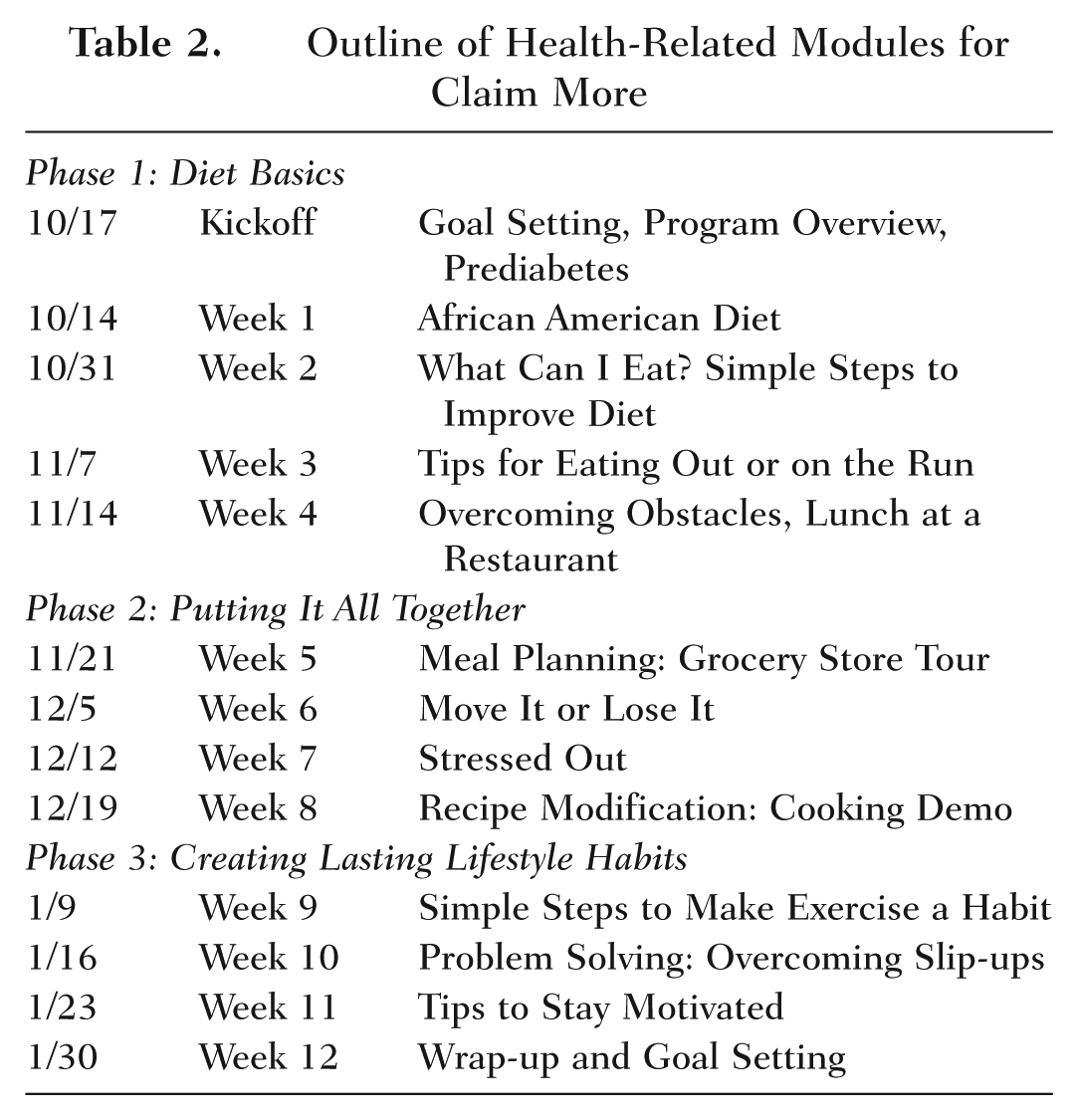
Twelve health-related modules were developed by an African American nutritionist and then divided into three phases: diet basics, putting it all together, and creating lasting lifestyle habits. The modules heavily emphasized nutrition and adapting healthy eating habits, supplemented with modules on exercise and stress (Table 2). Modules included education on reading labels, planning meals, using healthy ingredients, and cooking for family members as well as a grocery store field trip to look at ingredient labels with the nutritionist. The nutritionist attended some of the meetings and delivered the modules when she attended; the Church Champion or a group member delivered the others. A member of the program staff was present at every in-person meeting to ensure fidelity of the content, although the discussion varied by group. Each weekly meeting lasted an hour and participants often stayed longer for continuing discussion. Due to the weather, one module was delivered via teleconference.
Outline of Health-Related Modules for Claim More
Postprogram Evaluation
The purpose of the postprogram evaluation was to determine how to expand this program to additional churches and a larger group of women and then, ultimately, to other community settings. The program evaluation consisted of two parts: a short survey and personal interviews. These evaluations were developed to better understand participants’ experiences with the program, what they considered successful, and changes they would suggest for future versions.
Survey
Participants were invited to complete a 15-question survey related to the format and features of the program as well as health behavior change. Some examples of the questions were the following: What could we do different to improve the experience of the program? How much has Claim More enabled you to live a healthier life? How would you rate the content of the daily text messages (on frequency, relevance, and usefulness)? How likely are you to recommend Claim More to a friend? Eighteen participants (69%) completed the survey, all of whom said they would recommend this program to others. There was no compensation for the survey.
Interviews
To obtain a comprehensive perspective on how to expand future versions of this program, in-depth, one-on-one interviews were conducted with 10 participants (five women from each church). Interviews focused on what made this program unique and effective and what might need to be adapted for a future expansion. Women were asked to participate based on their various levels of engagement in the program (i.e., some participants had engaged more and some had engaged less). Interviews lasted about an hour. Specific questions addressed how the program helped participants achieve a healthy lifestyle, how it fit into their daily lives, and the kinds of changes they made. Other questions queried how the text messaging helped them integrate their goals into their lifestyle. Interview participants received a gift card for their participation but were not told they would receive compensation in advance of the interviews.
Results
Overall engagement in the Claim More program was high, including responses to the text messaging (97%) and the average completion of goals (69%) across both churches. Goal completion was lower during the holiday weeks. An average of 15 “High-5s” were sent to each church every week. In total, 644 “High-5s” were sent during the course of the program with 23 opportunities per person (average of 11.26 were sent per person). In addition, 67% of participants used or planned to use the recipes provided. Women reported in the surveys and interviews that the text messages increased their overall accountability to their goal and to the program. Survey responses found that 94% of women thought the frequency of text messages was just right and 100% believed that the text messages were useful and encouraging.
Women reported that Claim More was a key factor in healthy living with 89% of participants saying that the program helped them live a healthier life. In addition, seven of the women who were interviewed reported weight loss as a result of the program. Women requested that future programs include recipes with fewer ingredients and that more exercise, including Zumba and other activities, be incorporated. They also reported the holidays to be a particularly challenging time to complete their goals.
The program coordinators reviewed the interviews and, using content analysis, identified four leading ideas that emerged from the discussion.
Claim More Empowered Women to Make Healthier Choices
Women in the program felt that making their own personal promises led to a greater sense of commitment. Women discussed that before entering this program they had a negative perspective on healthy eating and were not always sure how to determine what was healthy.
I used to think if it tastes good it can’t be healthy. You don’t see black women reading labels. We got an education.
Claim More Was Delivered Through an Inspiring Source (Church) Which Gave Them the Inspiration to Participate and Engage
Women discussed the importance of having their church at the center of this program. In particular, one of the Church Champions was the wife of the bishop and her role made a significant impression on the Claim More women.
The church is where everything begins in the African-American community. Why were we chosen? It was a gift from God. [Church Champion] wouldn’t lend herself to something not important.
Women Felt This Program Was More Approachable
The Claim More women discussed how supportive the program was, how it made them accountable, and how it inspired them to continue without feeling punished for not meeting goals or regular “weigh-ins” that characterized other programs they had tried.
They didn’t beat you up. It was a choice. When I failed, I didn’t feel bad. I just started over the next day. This was different because they allowed it to be ours and make it our own. I didn’t want to say “no” (regarding the text message) so I’d eat a piece of fruit so I could say “yes.”
Claim More Women Formed a Sisterhood of Support and Connected in Unexpected Ways
Women discussed how the support of the women in the group was a key component to its success.
We came together for a purpose and it ended up being so much more. It was God ordered. I loved being with the ladies who laughed, talked, cried, and prayed.
Discussion
The primary goal of the Claim More program was to consider the feasibility of a health-related program for African American women that focused heavily on healthy eating and incorporated faith, support, and technology. A secondary goal was to encourage participants to adopt a healthier lifestyle. The primary goal was successful. Women regularly participated in the program by attending meetings, responding to daily texts, meeting their health goals, and providing encouragement to others (via the “High-5’s”). This program demonstrated that implementing a faith-based program in the church setting using both technology and social support can be an effective mode of delivering a health program. Importantly, the six core elements of the program held women accountable for their goals and gave them the tools they needed to be successful. These elements underscore the research on health behavior change that demonstrates that tailored interventions work best at addressing health concerns on a level that is meaningful (Barrera, Castro, Strycker, & Toobert, 2013). Addressing the unique barriers and needs of African American women gave this program the opportunity for its success and validation for future opportunities.
The primary measure of success for this program was the high level of engagement. The frequency of responses to daily texts was remarkable, especially since women did not complete their goals every day. In addition, regular attendance at the in-person meetings and the personal connections that women reported really helped to maintain these high levels of engagement. Importantly, this program was delivered over the busy holiday season from before Thanksgiving until after New Year’s. Although the goal completion was lower during this time period, the personal investment that these women made is clearly a demonstration of the effective program design.
Another important element of this program was the feedback that the women provided after completion. Women reported that they felt this program was unique as it held them accountable but did not make them feel guilty when they did not meet their goals. They felt they had built genuine friendships as a result of the program. Importantly, women provided feedback for the future of the program, including more exercise, more goal options, and the ability to change or adapt their goals.
The secondary goal of adopting a healthier lifestyle and achieving better health outcomes was not measured systematically as feasibility was the primary focus. However, during the interviews women provided their own self-reports of integrating a healthy lifestyle and gave anecdotal examples. Participants reported positive health-related outcomes such as weight loss, reduction in A1C levels, reduced stress and anxiety, a more diverse diet, and a reduction in the consumption of sugary drinks. Nevertheless, the limitations of this study include the lack of measurements and outcome variables to determine if this program significantly reduced weight loss, risk of diabetes, or any other outcomes. In addition, it is possible that the high level of engagement was unique to this sample and to the selection bias of the pastors and Church Champions of these churches. However, research has demonstrated that faith-based interventions can be a successful method to deliver health interventions for African American women (Lancaster et al., 2014).
Future Directions
Prediabetes and diabetes are serious public health concerns. This program demonstrates that tailoring a health program, designing it in an accessible way, using simple technology, and implementing it in a faith-based setting were effective in engaging women to participate. This could be applied to a number of other contexts including other community settings.
Concerns exist regarding future funding for prevention programs such as the one reviewed in this article. Recently, the Centers for Medicaid and Medicare Services announced that it will now expand reimbursements for diabetes prevention programs due to the data demonstrating significant cost savings of these prevention programs on Medicare spending. Although this program targeted women below the age of 65 years, perhaps it could be extended to a Medicare-eligible older adult population, including those who may already have diabetes and are looking to making health behavior changes. For older individuals, social support may be conducive to promoting health behavior changes and the texting technology may be an engaging tool for them to use. Ultimately, the combination of a culturally sensitive program that uses technology and support may have the opportunity to be tested on a larger scale and/or implemented into other faith-based and multicultural contexts.