




Abstract
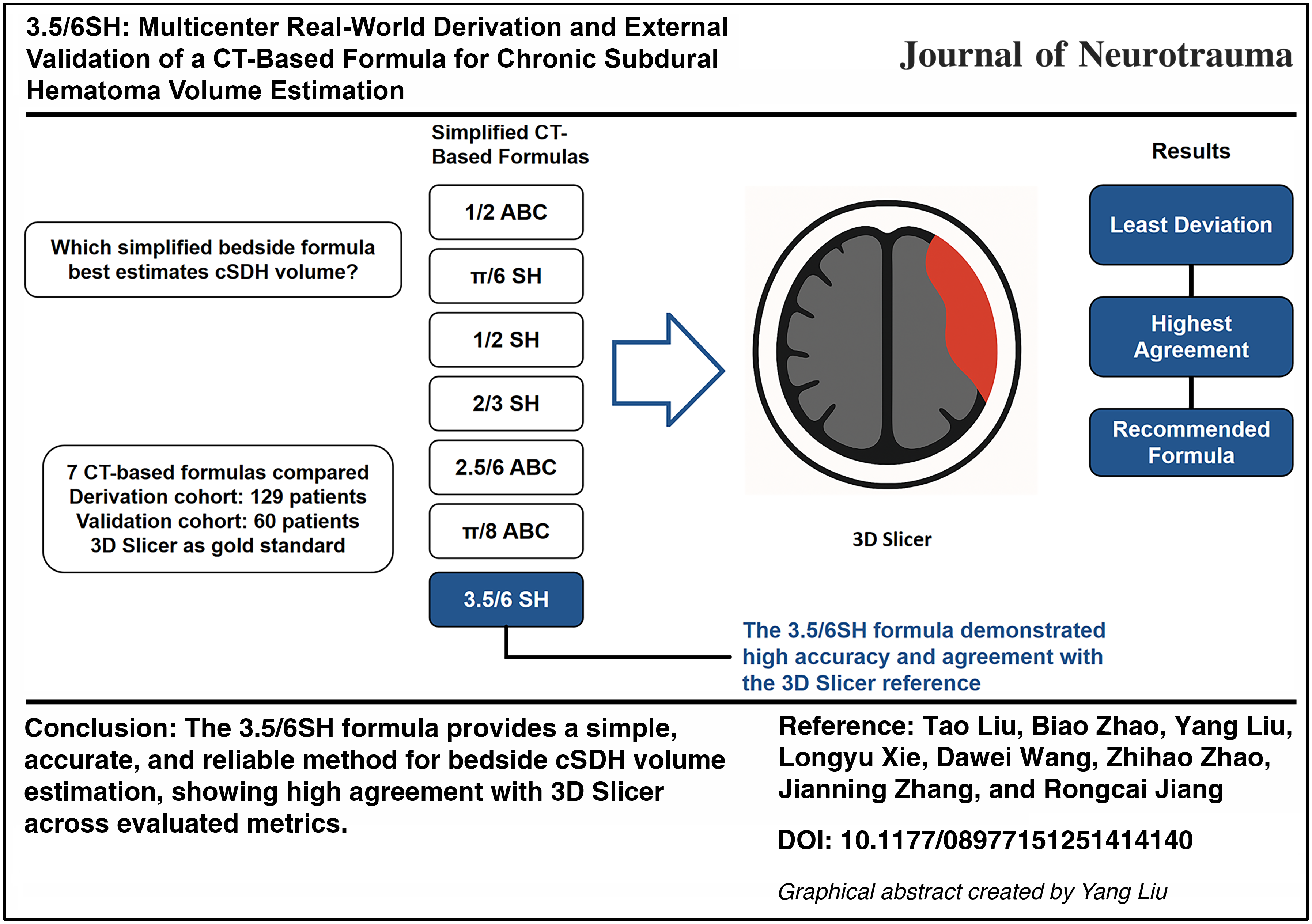
Accurate hematoma volume estimation in chronic subdural hematoma (cSDH) is crucial for clinical decision-making. The commonly used 1/2ABC formula, originally developed for small, regular hematomas, may be inaccurate for cSDH due to its irregular morphology. A rapid, reliable, and practical method for bedside assessment is needed. This post hoc analysis of a multicenter, real-world study compared seven simplified computed tomography-based formulas with volumetric measurements obtained using three-dimensional (3D) Slicer in a derivation cohort of 129 patients with cSDH. We further evaluated the newly proposed 3.5/6SH formula in an independent validation cohort of 60 additional patients. Accuracy, agreement, and efficiency were evaluated using estimation error, percentage deviation, intraclass correlation coefficients (ICCs), and Bland–Altman (BA) analysis. In the derivation cohort, the 3.5/6SH formula yielded the lowest median volume deviation (−0.82 mL, interquartile range [IQR] 13.12 mL), the smallest percentage deviation (−1.00%, IQR 17.08%), and the highest ICC (0.973), indicating high accuracy and close agreement with the 3D Slicer reference standard. In contrast, the widely used 1/2ABC formula exhibited a larger negative percentage deviation (−4.64%) and a lower ICC (0.910). BA analysis further confirmed that 3.5/6SH had the narrowest limits of agreement and a clinically acceptable maximum absolute percentage deviation (29.33%), whereas the maximum deviation for 1/2ABC (65.04%) exceeded the clinical acceptability threshold (33%). In an independent validation cohort of 60 patients, 3.5/6SH maintained a small bias (median deviation −1.29 mL; percentage deviation −1.27%) and excellent agreement with 3D Slicer (ICC = 0.979). Inter- and intrarater ICCs for 3.5/6SH measurements in the validation cohort were 0.994 and 0.998, respectively, supporting excellent reproducibility. The average calculation time was 77.95 sec for 3.5/6SH—longer than for 1/2ABC (35.95 sec), but substantially shorter than for 3D Slicer (19.04 min). The 3.5/6SH formula showed high accuracy and agreement with 3D Slicer across all metrics and offers a reliable, simplified method for bedside cSDH volume estimation that may facilitate more consistent volume assessment in multicenter research and clinical practice, particularly for more sensitive monitoring of hematoma changes in resource-limited environments.
Graphical Abstract
Get full access to this article
View all access options for this article.
References
Supplementary Material
Please find the following supplemental material available below.
For Open Access articles published under a Creative Commons License, all supplemental material carries the same license as the article it is associated with.
For non-Open Access articles published, all supplemental material carries a non-exclusive license, and permission requests for re-use of supplemental material or any part of supplemental material shall be sent directly to the copyright owner as specified in the copyright notice associated with the article.
