




Abstract
Plain Language Summary
A blocked or stuffy nose is a common symptom of hayfever and colds that can make daily activities and sleeping difficult. Over-the-counter nasal decongestant sprays or drops work within a few minutes to ease a blocked nose and provide symptom relief. Some studies from around 30 years ago suggested that, when these medicines were used regularly for weeks or months, they might cause a condition called rhinitis medicamentosa, also known as rebound congestion (RC). This is where the lining of the nose swells leading to the nose feeling blocked when the medicines are stopped. We looked for other studies that investigated this effect to see when it might occur and if people developed tolerance to the medicines, meaning they needed to take more for them to work. We included information to help pharmacists treat patients with RC. We found 18 studies that looked at medicines containing xylometazoline or oxymetazoline. When people used these medicines for 7 days (oxymetazoline) or up to 10 days (xylometazoline) there was no evidence of RC. Some well-designed studies found no evidence for RC or tolerance with up to 4-weeks of oxymetazoline use. No studies were found for other medicines in nasal decongestants. When people use xylometazoline- or oxymetazoline-containing medicines as described in the patient information leaflet there is no evidence for RC or tolerance. Pharmacists can play an important role in making sure that patients know how to use the medicines properly, at the correct dose and for no longer than stated in the instructions.
Please click on the image to play the video (also available as supplemental material). Concerned about rebound congestion from nasal sprays? Review suggests no robust evidence for rebound with oxymetazoline or xylometazoline when used as directed.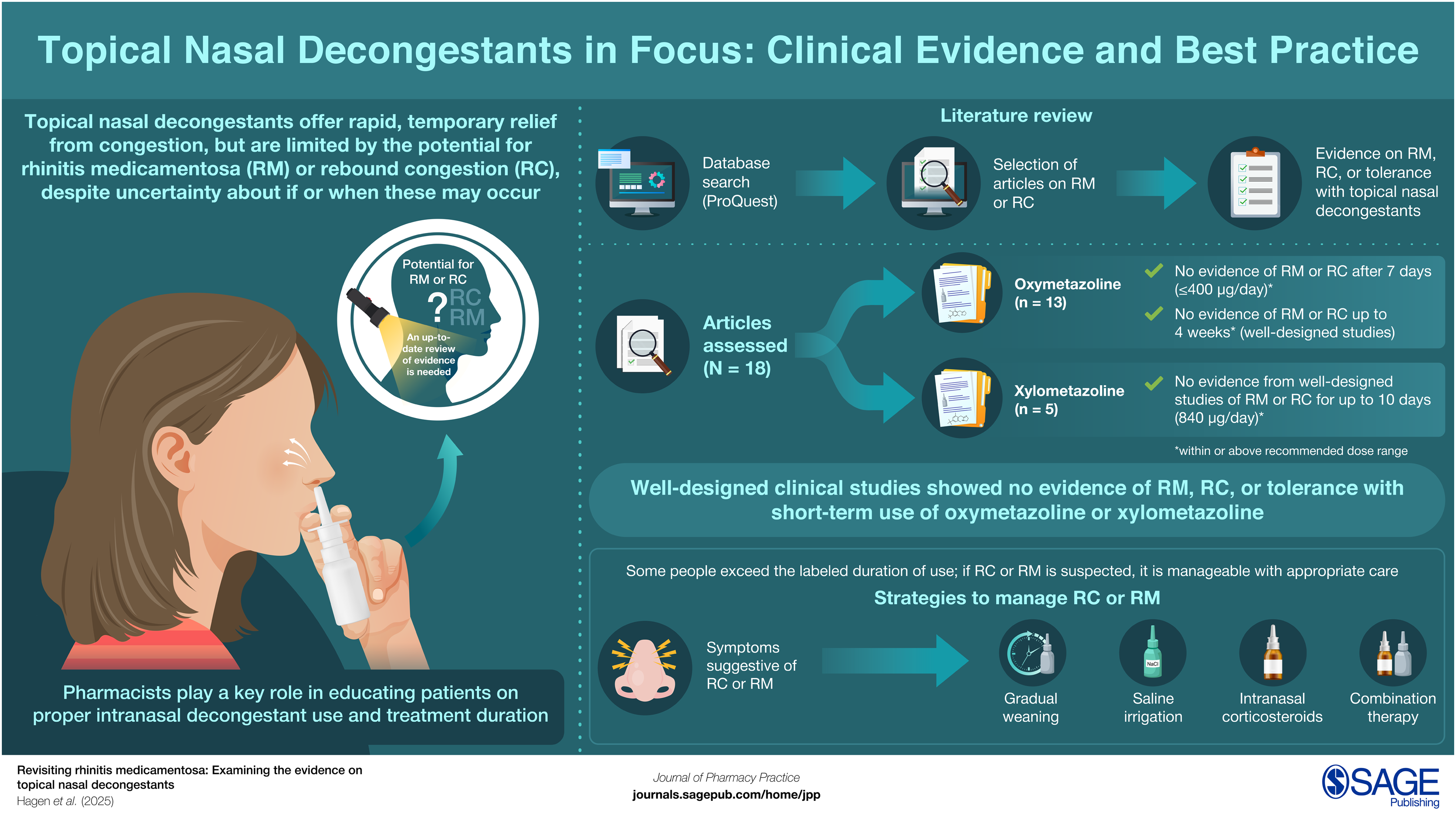
Get full access to this article
View all access options for this article.
References
Supplementary Material
Please find the following supplemental material available below.
For Open Access articles published under a Creative Commons License, all supplemental material carries the same license as the article it is associated with.
For non-Open Access articles published, all supplemental material carries a non-exclusive license, and permission requests for re-use of supplemental material or any part of supplemental material shall be sent directly to the copyright owner as specified in the copyright notice associated with the article.
