




Abstract
In November 2022, 48,000 workers across the University of California initiated the largest strike in the history of United States higher education. But although the strike ended 6 weeks later with the ratification of a new contract, support for this new contract diverged sharply across campuses: what accounts for these varying assessments of the strike? Drawing on ethnographic participation, documents, and interviews with strikers, organizers, and union staff across Berkeley and Santa Cruz, two campuses exemplary of this divergence, we develop a strikers’ inquiry into how differing strategies and organizing tactics produced opposed understandings of the strike’s possibilities and limits. Engaging the power resources approach, we describe and contrast Berkeley’s “broad, visible, and complete” strategy with Santa Cruz’s “long haul” strategy. Whereas the former envisioned a brief, but absolute, labor withholding that would overwhelm the university, the latter anticipated a more attritional and dynamic struggle structured by various leverage points. These strategies articulated contrasting ideas about the strike’s collective power, revealing how associational power must be actively organized. The strategic questions raised in 2022 remain central to future academic labor struggles and the exercise of collective power.
Dedicated to the memory of our beloved mentor, Michael Burawoy (Image 1).
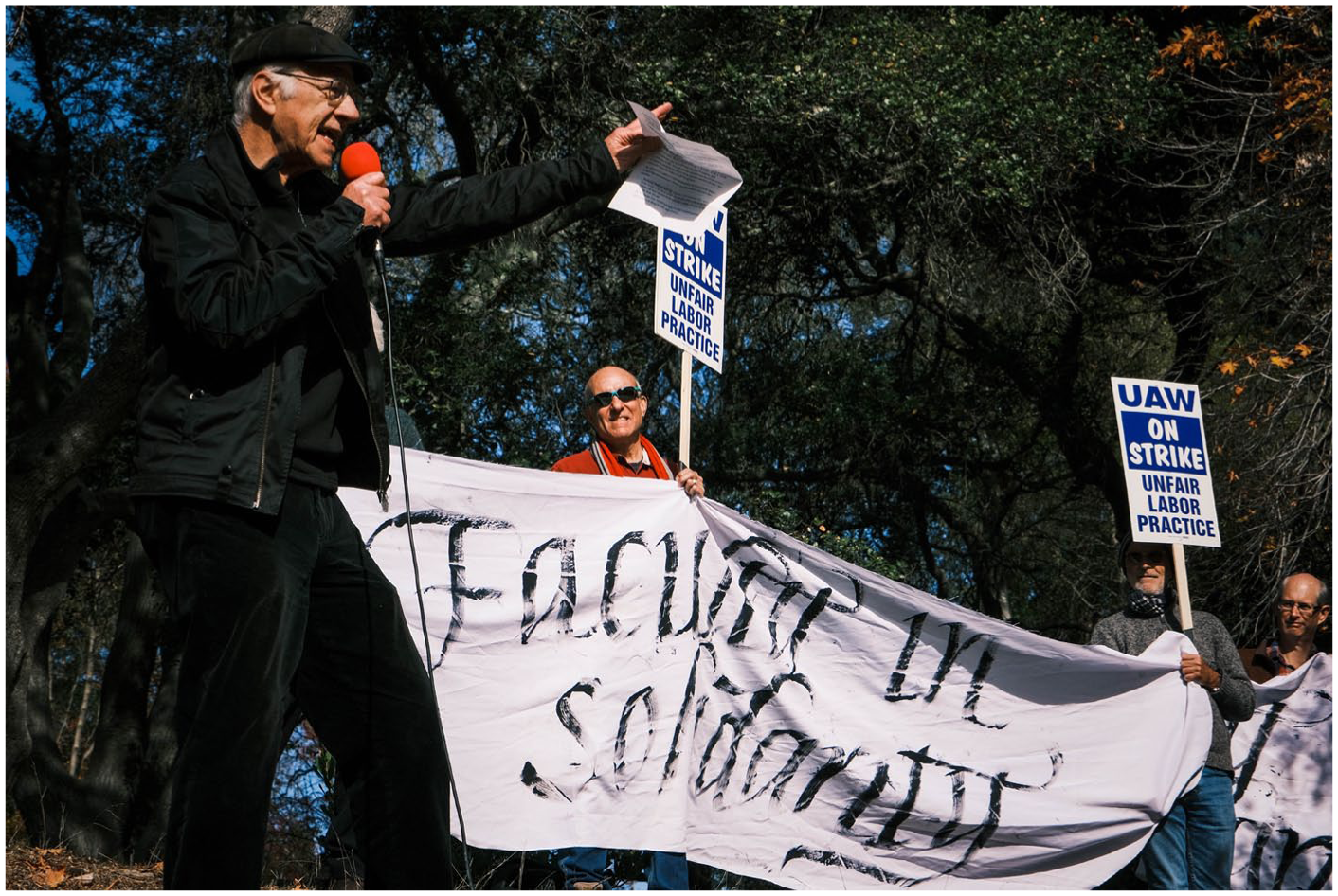
Michael Burawoy speaking at a faculty solidarity rally at UC Berkeley during the 2022 UAW-UC strike.
Introduction
On 14 November 2022, 48,000 academic workers across all 10 University of California (UC) campuses, organized under the United Auto Workers (UAW), launched the largest strike in the history of US higher education (Langin, 2023). The demands of the strike were multiple. Among the graduate student workers, 1 compensation was of utmost importance, with the initial demands calling for a base salary of $54,000 annually, along with a cost of living adjustment (COLA) pegged to local rental prices. Other demands included protections against harassment and bullying, expanded parental leave, and an end to fees levied against international students.
While the 6-week strike concluded with the ratification of a contract that provided some material improvements, including bringing the annual salary up to $34,000-$36,500 by the end of the contract and securing needed protections against harassment and abusive conduct, stark differences in the ratification vote emerged across campuses. At UC Berkeley, 69% of instructional workers like teaching assistants (then referred to as academic student employees, or ASEs) and 72% of student researchers (SRs) voted to approve the new contract, while at UC Santa Cruz, 80% of ASEs and 81% of SRs rejected the agreement (see Supplemental Appendix A). Why did workers performing the same duties, in the same university system, represented by the same union, and all experiencing the rising cost of living break so sharply in their understanding of the possibilities and limits of the strike?
We argue that the answer lies in differences in the organization of associational power between campuses. Recent scholarship in the power resources approach (PRA) (Milkman, 2024; Rhomberg and Lopez, 2021; Wolf, 2024) highlights the role of strategic deliberation and leadership in actualizing collective power. This involves organizing tactics, a component of movement tactics that neither the PRA nor thinking around repertoires of contention (Meyer and Staggenborg, 2012; Taylor and Van Dyke, 2004; Tilly, 1978, 1993) have closely examined, but which come into focus when viewed through these lenses together. We build on these insights to demonstrate that associational power, the power that results from organization into a collective body, is not automatic or uniform; it must be strategically cultivated through organizing practices and, hence, may vary. Through an examination of the dynamics of this unprecedented strike at two UC campuses with divergent trajectories, Berkeley and Santa Cruz, we show how different organizing orientations produced distinct forms of associational power and, ultimately, contrasting strike trajectories. At Berkeley, organizers emphasized a strategy that was “broad, visible, and complete,” seeking to minimize the strike’s duration by organizing a maximally large, uniform action. At Santa Cruz, organizers prepared for the “long haul,” envisioning a more protracted struggle built on localized deliberation and adaptive tactics. These contrasting orientations reveal how workers’ collective capacity is shaped not only by the labor process, but most importantly by how they interpret and organize their associational power.
To make our case we proceed in five sections. We begin with a review of the labor process and movements literature, underscoring how taking the PRA and the social movements literature’s thinking around repertoires of contention together helps reveal otherwise obscured relationships between the origins of associational power and role of organizing tactics. Next, we draw on the tradition of workers’ inquiry to describe our methodology and contextualize the setting of the strike. Third, we describe the labor processes of teaching assistants and graduate student researchers, which form the terrain on which the strike was organized. Fourth, we compare the organizing orientations that emerged at each campus, showing how differences in the organization of associational power have very real implications for the trajectories of strike action. Finally, we conclude with reflections on this strike’s strategic dilemmas and their implications for the growing academic labor movement.
From labor process to labor movement, and back
In (2008), Michael Burawoy published an essay titled “The Public Turn: From Labor Process to Labor Movement.” The paper traces the history of labor studies in sociology from the professional, industrial sociology of the early and mid-twentieth century to Harry Braverman’s launch of the labor process debates in 1974 to, finally, its orientation towards labor movements. This new orientation marked a decisive turn away from analysis of the labor process and towards the novel ways in which workers, often migrants, often women, and often those considered “unorganizable” by the trade union movement, were organizing themselves to fight back against their paltry pay and the oppressive conditions under which they lived and worked.
This turn, Burawoy argued, emerged in a historical moment where union membership was in steep decline and yet workers’ struggle was on the upturn. It was a moment of Justice for Janitors, Change to Win, the proliferation of workers’ centers, and growing dialogue between academics and labor leaders. It was a moment that resulted in important scholarly accounts of the nature of workers’ movements—particularly the ways in which non-work identities like immigration status or gender acted as mobilizing forces (Bronfenbrenner et al., 1998; Milkman, 2006). These studies observed how workers’ movements innovatively drew on differing forms of leverage over employers, especially in the face of insecure arrangements like subcontracting.
The varied sources of power leveraged in these struggles provided empirical foundations for the renewal of the power resources approach (PRA) (Arnholtz and Refslund, 2024; Brookes, 2018; Rhomberg and Lopez, 2021; Schmalz et al., 2018). 2 Concepts developed through studies of insecure workers’ collective actions like symbolic leverage, namely leveraging moral and cultural claims for improved working conditions in the absence of formal legal protections (Chun, 2011), took position as just one of several power resources for labor. Wright (2000: 962) earlier drew a fundamental distinction between structural power and associational power, between “power that results simply from the location of workers within the economic system” and “power that result[s] from the formation of collective organizations of workers,” providing one essential elaboration of labor’s power vis-a-vis capital. This schematic differentiated between workers’ power rooted in the production process versus their power rooted in the possibility of collective action. Recent contributions to the PRA have turned this reasoning to a more local scale of analysis, further conceptualizing the range of power resources and examining their availability and deployment in particular struggles.
Scholars have developed various typologies of power resources, such as Schmalz et al.’s (2018) four-part typology of structural, associational, institutional, and societal power, Arnholtz and Refslund’s (2024) five-part typology, and Rhomberg and Lopez’s (2021) 1 + 3 model where associational power underlies and activates structural, discursive, and legal power resources. These typologies, while helpfully conceptualizing different potential sources of leverage, evince the PRA’s under-theorization of how and when workers actualize their power through collective action. As Rhomberg and Lopez (2021: 38) note, the PRA “tends to conflate power (the ability to act collectively) and power resources (the sources of leverage).” This motivates their argument that associational power preconditions the activation of power resources. In their model, structural, legal, and discursive resources alike must be activated through the exercise of associational power, meaning collective action. By definition these power resources are collective; a strike or demonstration of just one person is destined for failure. But what explains workers’ propensity to associate with one another in order to exercise their power? In other words, association—that is, acting collectively—may be the vehicle through which workers exercise diverse forms of power, but what enables association in the first place?
In this paper, we argue that associational power must be organized. Associational power does not follow from formal unionization alone; if and how workers come together in collective action are not pregiven. Unlike other power resources, associational power is exercised by workers over other workers (Brookes, 2018). This internally constructed nature of associational power refers us to a definitional challenge of collective struggles like a labor union’s: a union’s logic of collective action rests on members’ “willingness to act,” that is, their willingness to participate in a solidaristic project of collective, rather than individual, interest (Offe and Wiesenthal, 1980). Willingness to act depends on dialogical construction of a collective vision that sutures together individual interests and resources into an associational whole. In short, associational power must be cultivated through strategic organizing projects.
Rendering a similar critique of the PRA’s overly static conception of stocks of preexisting power resources, Wolf (2024) conceptualizes labor, capital, and the state as engaged in projects of power construction, which involve assessing the distribution of power resources across the field of contention and undertaking strategic initiatives to favorably alter that distribution. Relatedly, Milkman (2024: 40) has noted how the PRA has so far treated leadership as exogenous to power resources, failing to recognize how specific people actualize those resources: “While unions and other labor organizations are integral to the PRA, the human beings who bring them into being and shape their strategies and tactics are not.” We must therefore turn our attention to the substance of organizing tactics.
By “organizing,” we mean the concerted development of the willingness to act collectively. Organizing politicizes individuals and instills a belief in their collective capacity to effect change over the resistance of opponents. Our understanding of organizing builds from a distinction in the scholarly and activist literature between “organizing” and “mobilizing.” For Voss and Williams (2012: 356), political process-influenced studies have focused mainly on mobilization, understood as the channeling of participation through extant organizations towards protest action targeting state or economic elites. Organizing, in contrast, focuses on “how individuals and organizations gain the capacity to act” as a result of strategies that cultivate local political capacity. As we will show, organizers at both campuses tasked themselves not just with mobilizing previously engaged unionists, but with organizing deep, widespread participation in the strike. While this organizing occurred within an existing organizational structure, the union, its intention was to instill workers with the capacity to act as political agents in the workplace. As the prominent, late labor organizer and scholar McAlevey (2016: 9, emphasis in original) wrote, “it is not merely if ordinary people – so often referred to as ‘the grassroots’ – are engaged, but how, why, and where they are engaged.” McAlevey, who also distinguished between mobilizing and organizing on the basis of the latter’s cultivation of participation and politicization beyond the subset of self-selecting and favorably predisposed “activists,” recognized that different organizing approaches generated different capacities to act, and win.
Organizing is therefore tactical and a component of movement strategy. Ganz’s (2000: 1010) classic study of strategic capacity in the United Farm Workers defines strategy as “the conceptual link we make between the places, the times and ways we mobilize and deploy our resources, and the goals we hope to achieve.” Defined thusly, strategy is an a-to-b proposition, explaining where we are and how we can get to where we want to go. Insofar as the willingness and capacity to act in association are preconditions for any collective political strategy, organizing tactics become an indispensable part of movement strategy. Yet, repertoires of contention, as theorized since Tilly (1978, 1993), have often collapsed protest tactics with organizing tactics, giving far greater attention to the former (Meyer and Staggenborg, 2012; Taylor and Van Dyke, 2004). This is akin to Rhomberg and Lopez’s critique of the conflation of the ability to act collectively with sources of leverage. When we discuss organizing associational power, we mean the construction of an ideological and organizational basis for leveraging collective power. We argue that this is a fundamental process, not only for PRA, but also for thinking around repertoires of contention, which itself contributes a substantial body of knowledge on how collective actors exercise leverage (i.e., deploy power resources), especially emphasizing the constraints imposed by familiarity and normativity. Joining thinking from the PRA and studies of contentious repertoires stands to provide a more contextualized and dynamic view of how organizing practices shape trajectories of struggle.
In this paper, we focus squarely on organizing tactics, showing how associational power results from and varies in response to locally specific organizing approaches. We argue that one critical theme in organizing associational power is an analysis of structural power, the bargaining power rooted in the labor process. Organizers in our two cases constantly developed analyses of the strike’s leverage vis-a-vis the work that was not being performed (e.g., grading, data collection, grant reporting) and employed different organizational forms to diffuse these analyses and bring workers into collective action. We circle from the labor movement back to the labor process, showing how we may advance understanding of the emergence and trajectory of workers’ movements by linking movement organization to the specificity of workplaces and organizing strategies.
A strikers’ inquiry—Methods and setting
We call this study a strikers’ inquiry, for as our method we adopted the strategy of “Workers’ Inquiry,” the examination of the workplace from the point of view of the worker (Ovetz, 2020; Woodcock, 2014). Related to but distinct from the rich sociological tradition of workplace ethnography, and overlapping with other forms of politically engaged knowledge production like militant ethnography (Juris, 2008, see also Scharenberg, 2023), workers’ inquiry is an investigation into the social structuring of workplaces conducted by the workers themselves, with the objective of generating insights for the practice of workplace politics. 3 Originating with Marx and revitalized by autonomist and Trotskyist European and US radicals in the 1960–1970s, workers’ inquiry critically examines the social relations governing workplaces and labor relations as part of an iterative cycle of struggle and reflection. This strategic edge intends toward constituting a politicized collective identity and addressing the emergent concerns of workers as political subjects. Focused on the particular organization of a job from workers’ first-hand perspective, workers’ inquiries reveal how general political economic structures manifest locally, establishing different patterns of labor control and labor resistance. In this way, workers’ inquiry is well suited to our sociological goal of rejoining the study of the labor process and the labor movement, as well as our strategic goal of transmitting insights to labor militants waging new fights in the burgeoning academic labor movement.
Methods
Whereas a workers’ inquiry attends to everyday experiences of work in relation to political economic context, we adopt and adapt these principles to the case of the strike, hence a strikers’ inquiry. Our account draws significantly from the authors’ own participation, here transfigured into an “observant participation” (Seim, 2024), in the 2022 strike and our campuses’ labor politics in the time since. In Fall 2022, Gepts was a rank-and-file member who co-led the establishment of an organizing committee in his department and served as a picket captain during the strike. Mason, who had helped lead the 2019–2020 wildcat strike (discussed below) was an elected Head Steward and an alternate Bargaining Team representative at Santa Cruz. Eby and Torres Carpio were active rank-and-file strikers, participating in strike activities like the picket line, organizing committee meetings, and livestreamed bargaining sessions. All the authors had experience as both TAs and SRs, and were actively engaged in the practical and strategic life of the strike, but at a range of levels in the formal organizing and bureaucratic structures of the union. In addition to familiarity with the important events, decision points, and debates of the strike, our active participation immersed us in the practical logic that shaped the strike’s unfolding.
To assist in depersonalizing and generalizing this observant participation, our analysis also draws from in-depth interviews (n = 28) with highly involved strike organizers at the Berkeley and Santa Cruz campuses between July 2023 and June 2024. Interviewees were recruited through strategic sampling, informed by our own participation, intended to capture involved and informed organizers representing different academic divisions, job titles, and roles in the strike (Table 1). 4 The interviews contained both an oral history component, focused on narrativizing the interviewee’s experiences before and during the strike, and an interpretive component, focused on the interviewee’s understanding of the political and organizing dynamics of the strike.
Interviewee characteristics by campus.
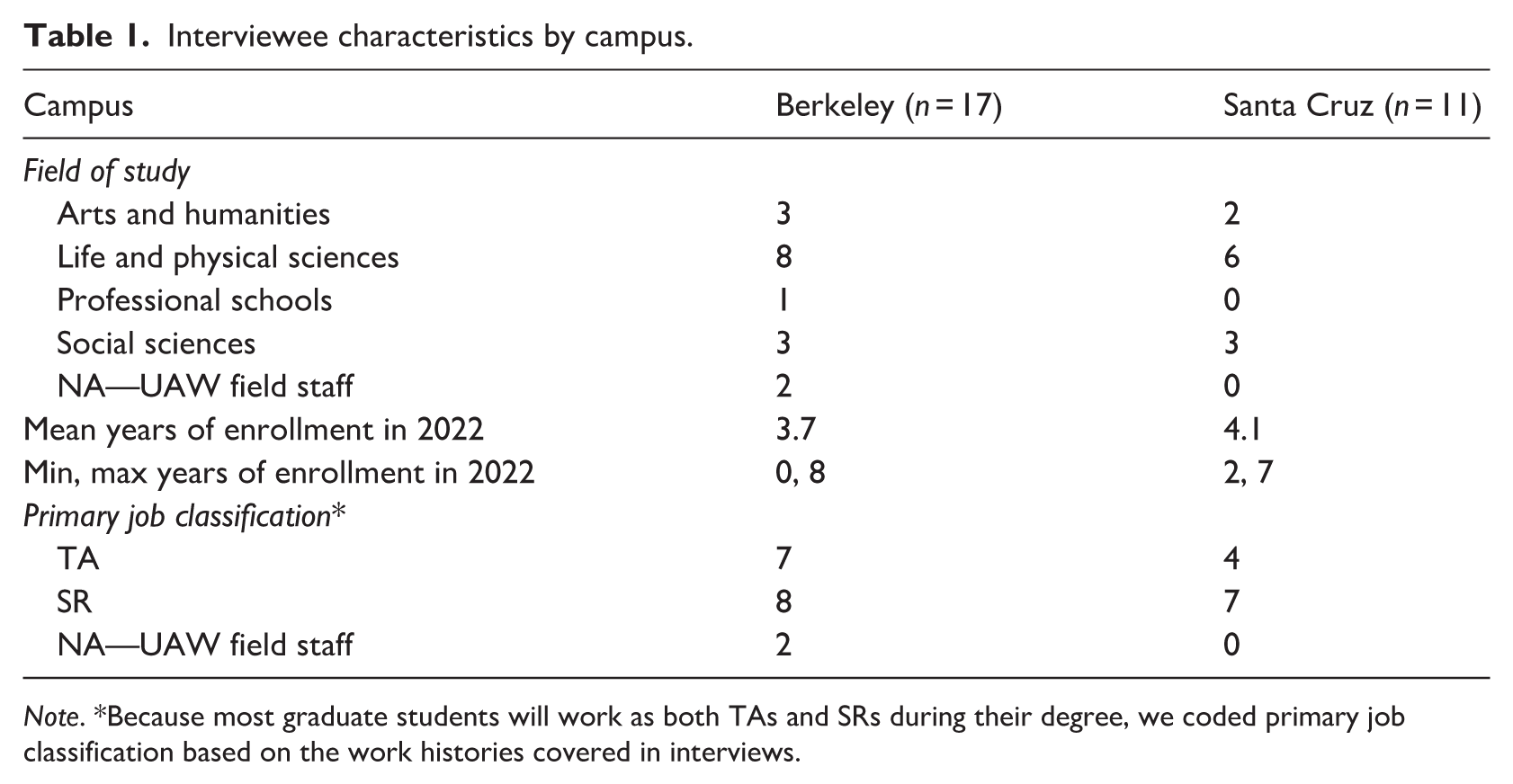
Note. *Because most graduate students will work as both TAs and SRs during their degree, we coded primary job classification based on the work histories covered in interviews.
We reviewed interview transcripts as a group, writing analytic memos assessing the chronology of the interviewee’s experience, the roles they played during the strike, and recurrent themes in their account. We used these memos to generate a codebook of concepts, terms, and histories that emerged consistently over the corpus. The codebook included categories on labor process themes such as managerial relationships, career pressures, and autonomy; strategic themes like organizing tactics and strike power analyses; and experiential themes relating to worker consciousness and understandings of the strike. With this inductively developed codebook, we returned to the analytic memos and interview transcripts to reconstruct a comparative explanation of the strike’s differing trajectories at Berkeley and Santa Cruz. The ratification vote functioned as a heuristic device in our comparison, orienting our analysis towards factors that might explain how workers at our two cases came to such different positions on the question of whether to continue the strike. Given our concern with the practices and logics emergent in workers’ political action, we focused on how organizers described their understanding of the strike as a whole, its key component moments and debates, and how they distinguished these views from competing ideas, using these moments of organic differentiation as guides for staking out our comparative framework.
We also analyzed organizing materials and strike ephemera, including all official union communications beginning with the announcement of initial bargaining proposals (February 2022) through the duration of the strike, as well as unofficial media produced by strikers (n = 131 documents). We included unofficial documents on the basis of our observant participation, selecting materials that had circulated widely on the picket line and digital spaces like group chats and social media, and which spoke most directly to our questions about strategy and tactics. This resulted in a selection of the complete issues of three unofficial strategic newsletters (Berkeley—STRIKE! and solidarity., Santa Cruz—UAW on Strike Daily Sheets). 5 These materials augmented the interview data by providing contemporaneous articulations of strike strategy, which we used to both substantiate and interpret retrospective interview accounts.
Our comparative approach—juxtaposing two geographic units of the same union local—is well suited to investigating how differences in organizing approach and strategy shape associational power. By holding constant organizational characteristics of the local and the employer, we instead focus on how leaders strategized and organized. Our analysis focuses on the mechanics of strike strategy immediately before and during the 2022 strike. While our data do not allow us to analyze the genealogical differences between the strike strategies in our two cases, locally specific political histories, leadership biographies, and campus structures surely influenced why our cases proceeded differently. Organizers’ strategic predispositions were shaped, as we note in our findings, by differing political histories, like the 2019–2020 wildcat strike at Santa Cruz. Structural differences between Berkeley and Santa Cruz as universities (Supplemental Appendix Table A2) may also influence the organizational form and culture of both the workplace and the union. While a full accounting of the history of labor politics at UC, and of the sociological dynamics of movement strategy and organizing, requires dedicated analysis of these antecedent or preconditioning factors, this article takes the task of analyzing the workings of these strategies in one episode of contention.
The context and chronology of the 2022 strike
Much has been written about the neoliberalization and financialization of US higher education (Burawoy et al., 2024; Giroux, 2019 ; Marginson, 2016; Newfield, 2008; Slaughter and Rhoades, 2004), interrogating the turn away from public funding toward investment strategies and rising tuitions, the proliferation of precarious labor like adjunct instructors, and the bloating growth of senior administrators connected to revenue generation rather than instruction or research. Landmark struggles, like the anti-austerity movement that burst across UC in the early 2010s (Levenson, 2011), attest to the contradiction these changes have produced between the university’s constituency and its distanced administrative class. While mobilization is never reducible to deprivation or dissatisfaction, the 21st century has indeed brought an efflorescence of labor activism to higher education, especially among graduate student workers.
Graduate student worker unionization is at an unprecedented moment. Since 2012, union representation among these workers has grown 133%, with 38% of graduate student workers in the United States now unionized (Herbert et al., 2024). In 2016 the NLRB rendered a decision permitting unionization of graduate student workers in private universities nationwide. In California, the passage of Senate Bill 201 in 2017 legalized collective bargaining for SRs, who had previously only enjoyed union representation while working as ASEs. This set the stage for the formation of Student Researchers United (SRU) at UC. While these significant legal victories have accelerated membership growth, it has also been a time of expansive labor action (Eidlin, 2023). Authorized strikes, but also non-authorized actions like the 2019–2020 COLA wildcat epicentered at UC Santa Cruz, have contributed to a strike wave in US higher education.
Our strike began on 14 November 2022 (Figure 1). The largest strike in the history of US higher education (Langin, 2023), it took hold of all 10 campuses of the University of California and embraced up to 48,000 academic workers across three locals—ASEs like TAs and graders (UAW 2865), postdoctoral scholars and academic researchers (UAW 5810), and a nascent bargaining unit of SRs negotiating their first contract (SRU-UAW).
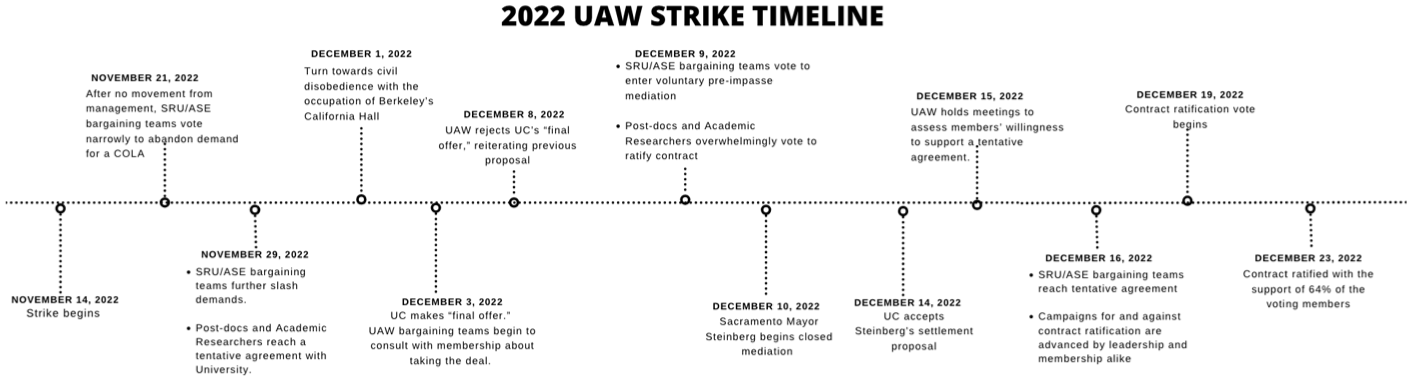
A timeline charting key events of the 6-week strike.
The strike was years in preparation. Following a contentious contract ratification that concluded bargaining in 2018, a core group of UAW staff-organizers and officers at UC set their sights on a multi-unit strike in 2022 as the best path forward to securing more substantial victories (Jaime and Li, 2023). To do this, organizers needed to coordinate the bargaining cycles of 2865 and 5810 while simultaneously organizing student researchers in time for a first contract to be negotiated in 2022. This same period was also marked by fits and starts of rank-and-file self-activity, including a many-months-long wildcat strike at UCSC that came to shape the 2022 contract campaign in key ways (Davies and Mason, 2023). For example, the campaign’s marquee demand for a cost-of-living adjustment and base salary indexed to local rental markets was imported directly from the unauthorized labor action.
By December of 2021, an intensive organizing campaign won union recognition for SRs. In October 2022, 36,558 members cast ballots in a strike authorization vote, representing a 75% turnout, with 97% percent voting to authorize the strike. Graduate workers had a wide and ambitious set of demands, including free public transit passes, bolstered protections against harassment and bullying, expanded parental leave, and an end to supplementary fees charged to international students. However, compensation was the headline demand, with the union calling for a base salary of $54,000 annually, plus a COLA pegged to local rental prices (the lowest paid graduate workers made about $24,000 at the time) (Rodriguez, 2022). Increasing pay commensurately to housing costs was an urgent demand because of the cost of living in UC communities. 6
Some 2 weeks after the conclusion of the strike authorization vote, picket lines were robust and vibrant. However, progress at the negotiations table was stalled, with the University refusing to budge on pre-strike proposals and unwilling to schedule a meeting to negotiate with ASEs. As the University’s intransigence continued into the second week, bargaining team (BT) members and rank-and-file workers tried to make sense of management’s refusal to move or even meet. Two distinct explanations emerged.
The first explanation was that the strike had already surpassed its moment of “peak power” (described further in Section “Differences in organizing orientation”) and therefore, the BT was in an increasingly weaker position to extract anything further. To prompt movement from the University, it followed, demands needed to be slashed. The view that the strike was weakening found affirmation not only in the University’s refusal to budge, but also in the dwindling numbers of workers on the picket in the lead up to and after the Thanksgiving break. The second explanation was that the University would only be forced to make concessions through a protracted “long-haul” strike, given its ability to cope with short-term disruption by shifting work around, adjusting syllabi, extending deadlines, and altering requirements (Davies and Mason, 2023). From this perspective, management’s lack of movement at the table so early on in the strike was unsurprising and gave no indication that the BT ought to do anything differently.
However, by 21 November, the “peak power” explanation seemed to prevail among members of the BTs, as a UAW email reported that a slim majority had narrowly voted to abandon the demand for a COLA. Then, on 29 November, the ASE and SR BTs moved to reduce the base salary demand from $54,000 to $43,000 and the childcare reimbursement demand by half, and to drop dependent healthcare coverage. These cuts passed by a close 10-9 vote on the ASE team and set the stage for an intense polarization that imbued the remainder of the labor action. At the same time, UAW 5810 reached a tentative agreement with the University, effectively ending their participation in the multi-unit strike.
In early December, those who subscribed to the “peak power” perspective had shifted their strategy towards acts of civil disobedience such as the overnight occupation of Berkeley’s California Hall, a sit-in at Sacramento’s UC Office of the President (UCOP), a large march through downtown Oakland to UCOP headquarters, and disrupting a dinner party at UC President Michael Drake’s residence. Meanwhile, those who adhered to the “long-haul” perspective worked to fortify the labor action by mapping labs and courses in order to reup commitments from workers to keep going (Davies and Mason, 2023). On 3 December, the University made its “final” proposal. Members of the BT were divided on whether to accept, pass back their prior offer, or counter-propose with a lesser offer. This question was put to an email ballot and on 8 December, UAW resubmitted their prior proposal. 7 The University promptly called the move a set back for all parties and demanded the union agree to voluntary pre-impasse mediation by the next morning. With both sides firmly dug in, the union agreed.
The mediator, Sacramento Mayor Darrell Steinberg, met with UAW and the university in closed session between 10 and 12 December. On 14 December, the University accepted Steinberg’s proposed settlement deal and the UAW BTs began to consult membership on whether to do the same. On 16 December, the UAW BTs approved the tentative agreement, which was then put to a week-long vote, during which workers remained on strike. Membership ratified the contract with the support of 64% of the voting members on 23 December 2022. However, voting at the campus level revealed pronounced differences in support for the agreement (Supplemental Appendix Table A1). At different campuses, organizers conceived of, planned for, and executed the strike in different ways, but in reference to a shared labor terrain.
The terrain of strike action—The labor process
To understand how union organizers strategically constructed the strike, we must first broach the labor process of the striking workers. The web of workplace relations in which TAs and SRs are embedded defines these workers’ interests, motives, and concerns, which, as we will show, organizers at the two campuses articulated into differing analyses of the strike’s power.
The TA labor process
TAs possess significant discretion in how they perform their tasks but do so within relational constraints, defined by their professor, their students, and their career aspirations. Typically, a TA is attached to an instructor and responsible for engaging the material presented in the instructor’s lectures in smaller class “sections.” However, particularly in composition and foreign language courses, TAs may be the sole instructor for the course. TAs hold office hours and grade all assignments and examinations. Even while the professor sets the overall course requirements, TAs control the content and pacing of each class section (Gepts, 2024; Germain, 2024). This decision-making leeway imbues TA work with responsible autonomy (Friedman, 1977), in which labor process autonomy encourages greater subjective investment in work, effectively internalizing discipline. Still, TAs’ status as students reliant on faculty support for advancement through graduate training and into a permanent academic position enforces a degree of compliance with the direction of professors managing TAs (Pasquinelli, 2024). This is particularly acute when a TA teaches under their academic advisor, a scenario that did emerge during the strike. TAs’ ties to students also impose responsibilities that often come to exceed the job description. Because they are often a student’s primary interface with their university education, TAs hold not only teaching and administrative duties, but also manage individual needs and perform more interpersonal and affective care work (Torres Carpio, 2024). Together with professorial relationships, this further responsibilizes TAs, in a manner resembling service triangle relations (Lopez, 2010).
Still, the labor one performs as a TA is not intimately linked to their overall academic trajectory, which may facilitate going on strike. TAs feel responsible to themselves and their career trajectories. They face a “time bind” between their roles as teachers and as researchers (Gepts, 2024), and striking their teaching labor in fact provided TAs with an opportunity to refocus on research milestones like theses and qualifying exams. TAs’ substantial autonomy, and the disarticulation of their teaching duties from their degree progression and research, grants them a freedom they may wield in support of collective action but which also supports self-sustained commitment to one’s work and one’s students (Eby, 2024).
The SR labor process
For SRs, emblematized by researchers in lab sciences, pressures like apprenticeship dependency and the accountability to one’s career are intensified. This results in a more direct and “despotic” form of labor control, where coercion is an important mechanism through which effort and obedience are extracted (Hatton, 2020; Mason, 2023). This control is exercised by Principal Investigators, who interviewed researchers sometimes described as “domineering” or as “petty tyrants.”
Where TAs are able to separate their paid employment from their dissertations and academic careers, this is not true of SRs. Work for themselves is also work for their supervisor—work their supervisor relies on to publish and obtain research grants. When an SR strikes, their supervisor might subject them to informal sanctions. Recounting her experience working in a Chemistry laboratory at UC Berkeley, one SR said: When I joined my lab, my boss told me– he was a new professor, so trying to get tenure. He said, “My expectation is 12 hours a day, five days a week, and then six to 12 hours on the weekend. Are you okay with that? If not, don’t join my lab.” . . . There were professors in my department who wouldn’t let people take vacations, and it was really, they could be quite strict with that. Maybe they can’t fire you, but they can make your life hell. They have power over you. They’re going to write your rec [sic] letters. You just have to listen to whatever they say.
Fear of retaliation was a real deterrent to striking; a longtime organizer in Berkeley’s Physics department reported that fear of sanctions from PIs dissuaded many Physics SRs from striking. Moreover, the intense demands of PIs also inculcate an individualized and responsibilizing work ethic among SRs, cutting across the collectivist thrust of strike action. The aforementioned Chemistry SR understood this ethic as connected to the intense professional accountability of SRs to their PI: I think doing something where our power comes from us together as workers goes against everything that you experience day-to-day, where everything about your success is dependent on these one or two people. Trying to get scientists to think of themselves as workers who deserve a union and deserve a good contract is really hard.
The rhythm and division of SR labor also contrasts with that of TAs. Individual SRs hold different responsibilities, at different times. For example, one researcher alone may be responsible for collecting and submitting data to a funder during a given time, exposing them to greater pressure from above. This is unlike instructional labor, where TAs all begin the term and cross the grading deadline together. Labs do not share the same deadlines and research timelines usually stretch over months to years rather than days to weeks.
SRs’ intense professional dependency on their advisors, the entanglement of their paid work with their academic progress, and the variable rhythm and division of labor present significant challenges to striking. But this account also reveals the significant structural power of SR labor. Their central role in the highly capitalized research arm of the university positions them to effect massive disruption by withholding their labor and leveraging their specialized knowledge to disrupt lab operations. 8 In the coming section, we illustrate how strike organizers at Berkeley and Santa Cruz understood these hurdles and devised strategies to overcome them.
Differences in organizing orientation
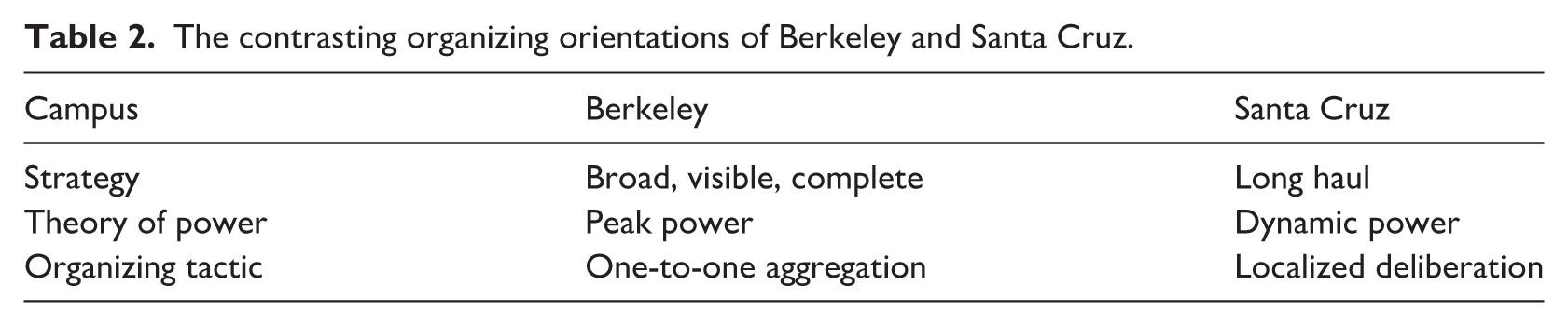
Though the labor process forms a terrain of labor and struggle shared at Berkeley and Santa Cruz, we must turn to organizers’ strategic approaches to explain the divergence in their understanding of the possibilities of the strike. In this section, we examine the differing strategies and organizing tactics at Berkeley and Santa Cruz (Table 2). Borrowing organizers’ own terminology, we label these strategies “broad, visible, and complete” (Berkeley) and “long haul” (Santa Cruz) and explain how these divergences produced different forms of associational power.
The contrasting organizing orientations of Berkeley and Santa Cruz.
Organizing at Berkeley: Broad, visible, complete
Encapsulating the dominant organizing orientation at Berkeley, a slogan often deployed by union officers and their allies was the call for the strike to be “broad, visible, and complete:” broad, meaning the widest possible representation of different university departments and job types; visible, meaning that workers not only withheld their labor, but also made the strike visible to the university and the public, especially by participating in picket lines; and complete, meaning that the labor withholding was total, as opposed to striking only some parts of one’s academic activities.
The broad, visible, complete (BVC) strategy reflected an assessment of graduate workers’ structural power and labor process conditions. BT representatives characterized strike strategy as a balance between the personal costs of a work stoppage and the possibility of winning more: People were thinking about that, thinking about their own research, their own students. I think you can’t kind of distinguish between those two pieces. ‘Can I and can we continue to strike? Can we build enough power to get something better?’ Then also, ‘how do I feel about the agreement that is on the table?’ (Berkeley ASE BT representative)
One essential conclusion was that academic workers on strike not only forego wages, but SRs in particular also risk professional development and academic capital: In my mind, complete means complete. That’s the thing about the strike. The strike is the last weapon of labor because it comes with costs for everyone. The reason you don’t just go on strike willy-nilly without a real justification or without real organization is because there are real costs associated with it for the people who are going on strike. In a traditional context, it might just mean that you’re not getting your wages. In our context, especially as researchers, it means that a lot of the work that you’ve been doing and building on for a long time, you might have to put that on hold. (Berkeley/LBNL
9
SR BT representative)
Because of the dual risks to monetary compensation and academic capital, strike strategy could either seek to minimize the duration of the strike or to minimize the strike’s professional costs by selectively continuing work that was crucial to individual academic progress. Proponents of the BVC strategy held that the latter strategy, besides undercutting the strike’s power, was simply unworkable: the idea that if you were only striking some of your work that you decided was the most impactful to the university and continuing to do the things that were most beneficial to you was more powerful than striking all of your labor was absurd . . . if you’re in the lab or participating in your work at all, but you’re doing less than usual . . . your supervisor’s not going to be like, ‘Oh, I’m glad you’re doing something,’ as opposed to being like, ‘Get in the lab every day.’ (Berkeley/LBNL SR BT representative)
Thus, the BVC strategy insisted on a uniform, complete labor withholding. The tenets of breadth, visibility, and completeness were understood as the preconditions for a brief, but powerful, strike. An organizer in Vision Science recalled, “I maybe somewhat naively thought like, ‘Oh wow, with this many people showing up we’re going to have a deal soon, a good deal soon.’ That turned out not to be the case.” Indeed, anecdotes circulated around Berkeley picket lines about campus union leaders suggesting that the strike would be brief. As one striker in biological sciences recollected, “the buzz was that the strike was only going to last no more than a week.”
Related to this homogenizing strategy, BVC downplayed the power of particular moments of leverage, instead understanding each unit of time as more fungible. As the BT representatives who adhered to BVC wrote in a statewide statement explaining their vote to drop the COLA demand, Broad, visible, and complete withdrawal of our research and teaching labor, in combination, is what gives the bargaining teams leverage at the table. Outsized focus on specific deadlines or ‘tipping points’ that only apply to one unit, such as a grading deadline for TAs or a grant review for researchers, ignores the fundamental root of our power: the combined threat of lost teaching and research labor. (“Our vision for a COLA and a fair contract,” undated)
From a BVC standpoint, then, the key to the strike’s victory lay in a widespread and total labor withholding, which would mitigate the salience of leverage points like grading deadlines and shorten the time in which workers sacrificed their own academic progress.
Another plank of the BVC strategy was its theory of peak power, which understood the union’s leverage as derived only from the next threatened disruption, such that peak power occurs in the instant before the threat is actualized. To use a pugilistic metaphor, the peak power theory imagines that a fighter, by only cocking their fist back, can provoke their opponent to preemptively concede to avoid the coming blow. This theory discounts preceding disruptions as sunk costs for the employer. In solidarity., a picket line newsletter cosigned by a large cast of “long-time, rank-and-file organizers” at Berkeley, a segment emphasized “seizing on the power of grading deadlines” weeks before that deadline: The leverage of a grading strike derives from the UC’s incentive to reach an agreement while grading can still be completed. Once the labor can’t be completed, it becomes a sunk cost to UC and no longer a point of leverage. UC must leave time for us to ratify a contract and finish grading before Fall ASE contracts end on December 31st, so peak grade leverage is now! (solidarity, 6 December 2022)
This analysis set expiration dates on the strike’s power and, if the strike was expected to be brief, then how workers organized themselves to halt their work would differ compared to an anticipated, protracted stoppage. By way of a counterexample, one experienced researcher in biological sciences recalled regretfully the lack of systematic preparation for the practicalities of labor withholding: I wasn’t getting information about how to strike, there was no week before the strike, like, make sure you have all of your experiments closed down, or how to close your labor up . . . From the get I was like, ‘This needs to be talked about in the same way that my lab talked about the [COVID-19] lockdowns coming.’ We had a few days before the lockdown came, where we’re like, ‘Okay, we might lock down. What are we going to do to close the lab?’
While this researcher initiated collective preparation in their lab, they suspected that elsewhere, “I don’t think people were communicated anything more than ‘no work at all.’” This approach aligned with BVC’s completeness criterion and offered simplicity and consistency, but it also brought workers together within an inflexible model of strike action.
At Berkeley, organizers spread the BVC strategy through one-to-one, or one-to-few, organizing conversations, which leaders then aggregated into a synthetic assessment of the strike’s current participation and power. The one-to-one conversation is a widely taught and indispensable tool for organizers of all kinds (McAlevey, 2016), but what is crucial to note about its implementation around the strike at Berkeley was how these conversations were chained together and aggregated upward. Carrying forward practices learned during the SRU recognition campaign, which relied on a very wide network of individuals collecting signed authorization cards from coworkers,
10
Berkeley organizers used one-to-ones to diffuse knowledge of and buy-in to the strike through existing social and workplace relationships. The objective was to establish or revive department organizing committees, which could then carry forward the one-to-ones into a self-extending chain of organizing conversations. As a UAW staffer explained, The organizing theory was that it’s going to take a group of leaders in the department working together to mobilize the majority of the department in order to have a credible strike threat. If you don’t have that, many people will choose to sit out a potential strike.
This tactic succeeded in activating organizing committees in many departments, but as the strike continued, it struggled to generate a shared understanding of the action’s stamina and power. Chaining one-to-ones rendered officers into aggregators, responsible for synthesizing many discrete conversations into an overall assessment of strikers’ desire to carry on. These assessments were opaque to most members. An SR BT representative reflected on this shortcoming: “it does work well if you have a bottom-up structure, but then all the feedback comes up here [to the officers]. Then if you’re down somewhere lower in the structure, you’re not getting that cross-feedback.”
In response, beginning in the fourth week of the strike, the Berkeley unit held a number of “campus congresses,” where department representatives would, in 1–2 minutes, summarize their department’s stance on bargaining and strategy questions identified in advance by elected leadership. This format nevertheless preserved the aggregating role of BT representatives. As a Berkeley ASE BT representative recollected, “the gigantic number of departments that are there means that there’s very little time for any discussion of quality,” leaving elected leaders with the difficult task of integrating wide-ranging perspectives into a single conclusion. This representative went on: “Then you decide based on all these departments on whether the campus as a whole has enough energy to move on . . . how you aggregate that for multiple campuses, it’s not obvious to me.”
These campus-level fora, attempting to distill deliberation from department-level networks and committees, illuminate an elemental challenge of democratic collective action, namely, how to integrate mass participation with robust collective decision-making. These practices of stitching together fellow workers (or tenants, students, etc.) into a solidary whole is the essential task of organizing associational power. The prevailing organizing orientation at Berkeley attempted this associative process through a large network of one-to-one organizing and a broad-based model of strike action, which expressed workers’ collective power as a function of their capacity to sustain an overwhelmingly majoritarian and visible strike that would quickly force the university’s hand. This model, which succeeded in mobilizing widespread participation and establishing departmental organizing committees, organized workers under a strategy that understood the strike as having reached its necessary conclusion in mid-December.
Organizing at Santa Cruz: Preparing for the long haul
The prevailing organizing orientation at Santa Cruz was captured by a term that became ubiquitous in department meetings, stewards’ chats, and on the picket line: workers were organizing for the “long haul.” In this section, we demonstrate how this organizing orientation grounded associational power in a different understanding of the strike’s power, one that envisioned a more uneven, protracted struggle, and in different, more localized organizing tactics.
Like Berkeley’s BVC strategy, the long haul (LH) strategy emerged from the labor process of instructional and research work—namely, the synchronized grading deadlines enjoyed by TAs and the entanglement of researchers’ individual careers and professional relationships. But it appraised the strategic significance of these features differently. The LH strategy reflected an understanding of the university as a peculiar kind of workplace, one that was unlike an industrial factory in key ways. Organizers argued that, in the university, points of leverage are various and uneven and pressure takes a great deal of time to accumulate (Davies and Mason, 2023; Dinnen and Eastwood, 2022). This is because tasks can be shifted around, syllabi can be altered, deadlines can be extended (or discarded altogether), and requirements can be adjusted. So, organizers at Santa Cruz reasoned that, to win their most ambitious demands, their strike would need to go long.
In a leaflet produced during the first week of the strike, workers at Santa Cruz shrugged at the University’s unwillingness to come to the bargaining table, writing: “Those who thought that the first day or two of the strike would bring Labor Relations to the table with their tail between their legs were mistaken. Our power lies not in the threat of the strike, but in the strike itself, as it unfolds over time.” The leaflet provides early indications of a divergence in strategy among the campuses. As a steward in the Politics department said: I would say the first difference [between UCSC and other campuses] was selling the strike as massive first-day participation. The stronger we come out and look, the UC will settle quickly, where we were just like, ‘This is going to be like a long fight. It’s going to be weeks.’ And like, mentally preparing people for what to deal with . . . [Other campuses] think it’s about a show, it’s about how big you look, what message you send, and we were saying, like, ‘Uh, no. Every day it’s a loss to the university. Every day is accumulated loss to the university.
But long strikes are hard strikes and their open-endedness lends itself to feelings of uncertainty and doubt, so, as the worker quoted above acknowledged, unionists at Santa Cruz had to organize themselves in a way that would strategically and emotionally prepare workers accordingly. This started with an analysis of the strike’s power. At Santa Cruz, organizers developed a theory of dynamic power that eschewed any “peak” moment and instead saw each party as continuously striving to outmaneuver the other and gain the upper hand. Returning to our pugilistic metaphor, this theory of dynamic power imagines the fighters actually trading blows, each intended to bring the other fighter closer to defeat. To endure this kind of long and unpredictable fight, strikers needed to be able to continuously assess their power, steady their resolve, and persist until they could deliver the next punch.
Understanding the unfolding of a strike in these terms engendered a certain type of organizing, which we term localized deliberation. These were communicative and decision-making practices in which the most immediate units of workers’ association (i.e., labs, teaching teams, departments) debated strike strategy and how to most feasibly implement it in their specific work context. To give an example, workers at Santa Cruz were discouraged from filling out their individual strike authorization ballots until after a department-wide meeting had been held to come to a collective decision. Departments, not individuals, were asked by the campus organizing committee to decide whether or not to strike. Therefore, decisions could only be reached after workers had the opportunity to share with their most immediate coworkers their enthusiasm for the labor action as well as any hesitations. Would the strike hurt undergraduate students? Will I be fired? Uttering these worries in a collective space, rather than to an individual organizer or staff person, meant that it was the responsibility of the collective to address such questions. These deliberative techniques mitigated the opacity born of one-to-one aggregation. When an issue arose or an assessment needed to be made, workers were habituated to turn towards one another rather than to look upward to staff, officers, or legal counsel. A striker from the social sciences contrasted this approach taken at Santa Cruz with the one taken at Berkeley: If you have this strike captain model where it’s very vertical [aggregated upwards], the strike captains can say, “Okay. We’re losing.” And workers don’t automatically have another source or way to look and say, “Are we actually losing? I feel like we’re not losing. I feel pretty good. We’re still on strike.”
Localized deliberation organized associational power in a less homogenizing and more contextualized way. Its application to two issues—the problem of the researcher strike and the challenge of collectively and continuously assessing the strength of the strike—demonstrate how this approach, while running its own risks, organized the capacity to act in a way that favored extending the strike.
First, for researchers who felt like completely striking all work only sabotaged themselves, localized deliberation was key in sustaining their strike action. In laboratories at UCSC workers openly debated the question of what labor was of most value to the University. Workers then collectively agreed upon what work to refuse, strategizing what labor refusals would maximize their leverage yet minimize disruption to their academic progress. A researcher in the life sciences described it like this: It became pretty clear that this question of how to do a researcher strike is not an easy one to answer . . . it shouldn’t be treated lightly and there is no one set answer that is going to apply to all people. I think one of the things that our campus did was we didn’t try and have these very rigid enforcements of ‘your research is your work, is the work you’re going to strike’ because that just became clear that it was untenable. We were trying to think through ways of actually affecting the university and specifically their operations or trying to think through ways you could affect their bottom line and as workers, what could we do in those different capacities? If maybe you’re on a fellowship and you’re writing your dissertation or whatever, not writing your dissertation is not going to be pressure on the university who does not care . . . My lab is small and we did this in my lab and then we also had a meeting where we did this at the department level too, but where we just like, ‘Well, what are the things that we’re not going to do?’ We just listed them out loud.
While this approach risked weakening the strike’s disruption by muddying what was expected of strikers, cleaving off parts of the labor withholding, and sending mixed signals to PIs, vulnerabilities that Berkeley organizers spoke to above, Santa Cruz organizers understood the benefits to outweigh these risks. For them, the collective thinking-through of leverage and of producing a shared commitment to strike certain labor based on that analysis instilled a confidence and resoluteness in the researcher strike that led to very different results in long-term strike participation and the contract ratification vote.
Second, to gauge strike participation, departments and labs implemented a practice of “power-mapping,” granularly detailing the division of labor and work timelines for every lab and, for every course offering in a given department, identifying teaching teams, number of enrollments and grades withheld, and highlighting classes that, when struck, would inflict the most pain on our employer (striking prerequisite courses or core courses, for example). Departments engaged in this task collectively, maintaining a spreadsheet that could be consulted in real-time. This collective project provided an ongoing occasion to think about and assess power, concretely. Department stewards could then aggregate departmental power-maps to produce a comprehensive overview of the strength of the strike across campus. Speaking to the utility of the power map, a bargaining team member from the Humanities offered the following reflection: I think the fact that we did the wildcat as a grading strike [in 2019] made us so cognizant about our numbers and how much leverage we had. We had started with approximately 230-ish people who we know, for sure, received discipline for withholding grades. I don’t think we were organized enough to actually know on the first day of finals week, how many people were actually participating. We only have that estimate from the discipline in January. We saw that 230 number go down over the course of two months to more like 90. Collectively, it was like we were having less and less of a hand on the throat of the boss. I think that really woke us up to something. If we’re going to strike, we learned that there needs to be a structure for it and a way to keep track. There needs to be a way to know and communicate how strong we are moment to moment. I think that really informed the approach to power mapping in our departments.
This quote not only reveals how lessons drawn from the 2019–2020 wildcat strike informed strategy in 2022, but also underscores how, in contrast to the one-to-one aggregation that characterized organizing at Berkeley, workers at Santa Cruz developed organic nodes of collective decision making, problem-solving, and power assessment that bolstered their willingness to reject the tentative agreement and prolong strike action in hopes of securing more than what was on offer in mid-December. This bottom-up decision-making and flexibility represented a different basis of associational power, in which the collective’s strength rested in their ability to strategically maneuver through variable pressures and points of leverage.
The LH and BVC strategies at Santa Cruz and Berkeley, respectively, propounded different understandings of the nature of the strike’s power and deployed different organizing tactics to implement those strategies. How workers were organized into an associational whole to exercise their structural power informed the trajectories of the strike on each campus. The contrast underscores that organizing tactics are a pivotal component of strategy and require more dedicated consideration in studies of movement dynamics, especially in our consideration of tactical repertoires (Taylor and Van Dyke, 2004; Tilly, 1978, 1993). As the PRA moves towards an understanding of power resources and the ability to leverage them as dynamic and constructed through strategic projects (Wolf, 2024), it offers tools for enriching our understanding of movement tactics.
Conclusion: Organizing in the trenches of the academy
This multi-unit strike of academic workers was a remarkable achievement. However, the battle for adequate pay, expanded parental leave, and an end to fees levied against international students (to name only a few issues) is ongoing. This is true at the University of California and for a rapidly growing roster of academic workers’ unions around the country (Herbert et al., 2024). Therefore, it is imperative that workers and unions learn from the strategic and tactical questions raised by the organization of the 2022 strike.
Indeed, university administrators are already learning from and adapting to the maneuvers of strikers. Immediately following the ratification of our contract, for example, the UC announced that it would not centrally fund increases to wages and benefits (Langin, 2023). Instead, individual campuses and departments were left within already strapped budgets to pick up the tab. Berkeley responded by misclassifying TAs to lower wage scales and excluding some research fellows from the bargaining unit. Simultaneously, UC has become more repressive. In summer 2023, three UC San Diego academic workers were arrested on felony vandalism charges for writing in sidewalk chalk on campus buildings (Jaime, 2023). In 2024, when UAW 4811 went on strike again, this time in response to UCLA’s authorization of a multi-agency law enforcement assault on the campus’ Palestinian solidarity student encampment, UC forced the strike to end with a restraining order granted by an Orange County Superior Court judge after the correct jurisdictional body (California’s Public Employment Relations Board) had twice refused to enjoin the strike (Crosnoe, 2024). At other universities, decisions to curtail graduate programs or admissions are explicitly framed as a result of strike actions (Quinn, 2024). In addition to using budgetary rationalizations and legalistic repression to dampen militancy, administrators are experimenting with other ways to blunt the impacts of work stoppages. At the University of Michigan, administrators required departments to submit falsified “A” grades for students whose striking TAs had not filed final grades (Quinn, 2023). When the next round of strikes erupt, how will we gain the upper hand?
Associational power, we argue, must be organized. Recent contributions to the PRA reckon with how collective actors actively and oppositionally construct power resources in the flow of struggle (Wolf, 2024) and how leadership decisions underpin strategy (Milkman, 2024). Understanding associational power as an enabling factor for exercising leverage (Rhomberg and Lopez, 2021), we show how union organizers cultivated associational power by articulating an analysis of the strike’s power, especially the structural power of the labor disruption. The strike followed different trajectories in our cases, culminating in different prevailing beliefs about whether to conclude the strike or hold out for more, as a result of these different strategies for organizing associational power.
The 2022 strike offers a number of lessons that may be useful to workers and organizers elsewhere, but we conclude with one. Because the terrain of labor struggle is always shifting, we should not expect to definitively resolve strategic dilemmas from 2022: how can we best organize a research strike that accounts for the professionalization costs of interrupting one’s dissertation work? If universities are willing to submit falsified grades, what meaningful pressure points can workers activate by withholding instructional labor? Our ability to collectively respond to these challenges and questions as they emerge, both during a strike and over successive conflicts, is critical to sustaining collective action. This is indeed “contested terrain” (Edwards, 1979), defined by how capital, labor, and, with particular menace now, the state, strategically reposition themselves through conflicts.
The need for strategic reflection and innovation is all the more urgent as the political terrain of higher education is increasingly fraught. Facing grave threats to their finances and academic freedom, universities may buckle to the pressure and find it easier to comply with governmental extortion than to resist and protect their workers and students (and their own institutional futures), as those who have settled on fines and surrenders of institutional independence to restore federal funding have shown (Speri, 2025). Moreover, given the invigoration of campus unionization in the last decade, universities may use these austere, authoritarian times to retrench our gains and further the trends of privatization and casualization. In this perilous terrain, the task is to rebalance the calculation, exerting our own pressure on universities that steers them away from acquiescing to federal intervention and towards our interests and collective vision of the university. As a labor union, our distinctive and ultimate power rests in our role as labor in the scholarly and instructional apparatuses of society. We return, then, to the necessity of organizing our collective power from the starting point of the workplace, both as a means of moving universities to serve our interests and as a way of building political capacity that can spill out beyond the workplace.
Grievances emerge out of the workplace; opportunities for disruption emerge out of the workplace; and, venues for building relationships of solidarity emerge out of the workplace. We argue, then, that for the academic labor movement to effectively adapt to shifts in the terrain of struggle, it requires organizing rooted in the social and technical relations of the labor process. These types of organizing techniques, which elevate workers’ strategic analyses of their own labor processes, share an elemental affinity with the tradition of workers’ inquiry. The promise of inquiry lies not just in tailoring strategy to workers’ experiences, but also in how reflection paired with action cultivates a “culture of solidarity” (Fantasia, 1988). We understand the extraordinary mobilization of 2022 as an early stage of something bigger, not a single battle but a succession of battles in the trenches of the academy. But such a war of position requires an insistent yet adaptable confrontation with the strategic dilemmas raised by an actively shifting terrain of struggle. By thinking about the labor movement and the labor process together, we cannot escape the conclusion that we must organize for associational power from the workplace.
Supplemental Material
sj-docx-1-crs-10.1177_08969205261425273 – Supplemental material for Organizing associational power: A strikers’ inquiry into the 2022 UAW strike against the University of California
Supplemental material, sj-docx-1-crs-10.1177_08969205261425273 for Organizing associational power: A strikers’ inquiry into the 2022 UAW strike against the University of California by Thomas Gepts, Sarah Mason, Margaret Eby and Elizabeth Emmott-Torres in Critical Sociology
Footnotes
Acknowledgements
The authors thank the participants and organizers of the Fair UC Now! Strike Archive project. In particular, we thank Andy Haas for his contributions to the Berkeley data collection as a Strike Archive researcher. We thank all the strikers and all those who offered their time to speak with us. Finally, we wish to thank our Extractive University Project collaborators, Natalie Pasquinelli and Justin Germain. Onwards and upwards.

Ethical considerations
Research reported here received ethical approvals/exemptions from the UC Los Angeles (07/27/23) and UC Santa Cruz (08/16/23) review boards.
Consent to participate
Written consent to participate was obtained.
Consent for publication
Written consent for publication was obtained. No identifiable information is published.
Author contributions
Conception/argumentation (all), data collection (Gepts, Mason), data analysis (all), writing (all).
Funding
The authors disclosed receipt of the following financial support for the research, authorship, and/or publication of this article: This material is based upon work supported by the National Science Foundation Graduate Research Fellowship Program under Grant Nos. DGE 1752814 and DGE 2146752. Any opinions, findings, and conclusions or recommendations expressed in this material are those of the author and do not necessarily reflect the views of the National Science Foundation.
Declaration of conflicting interests
The authors declared no potential conflicts of interest with respect to the research, authorship, and/or publication of this article.
Data availability statement
Interview data and ephemera collected as part of the Fair UC Now! Strike Archive are to be transferred to the collection of the Walter Reuther Library at Wayne State University. Some interview data are withheld by participant request.
Supplemental material
Supplemental material for this article is available online.