




Abstract
This article offers a critical reflection on The Good Jobs Project: a multi-phase qualitative project and an attempt at fostering symbiotic transformation (a ‘win-win’ for employers and workers) via emancipatory sociology from within a business school. The project attempted to involve workers and employers in improving the experience of work for low-paid public-facing workers (in retail, hospitality and care). In attempting emancipatory research in an engagement space heavily characterized by contemporary capitalist norms such as transactional and individualized interaction, we identified and reflected on dilemmas around ‘securing access’ to research with employers and workers, ‘value proposition framing’ to motivate stakeholder involvement and the importance of ‘prompting judgement’ as part of the emancipatory intent of the work. Our discussion draws on concepts of utopian sociology (Wright, Levitas) to explore strategies addressing the necessary ‘mess’ of a research practice attempting to resist reproducing transactional norms for knowledge exchange between academia and business.
Keywords
Introduction
Utopian envisioning has been argued to be at the heart of the sociological project by Burawoy (2021), Wright (2021), and Levitas (2013b). The claim (Wright, 2013) is that while critical sociology identifies ways in which social structures may be detrimental to human flourishing, an emancipatory sociology must in addition include utopian envisioning of alternatives informed by and moving forwards from that critique – the contemporary exhortation to critical sociologists is to both ‘critique and construct!’ (McCarthy, 2025). This has been with the understanding that such envisioning must be ‘provisional, reflexive and dialogic’ (Levitas, 2013b: 218) to make it a legitimate and plausible alternative to historical expectations that utopian thinking is impractical, domineering and / or naïve (Box, 2012). In attempting to identify and learn from ‘real utopias’ (examples of practice that are transforming capitalism now), Wright cautioned an investigative, collaborative and iterative process ‘in which we continually test and retest the limits of possibility’ (Wright, 2010: 366), precisely to avoid the hubris of thinking we could alter complex societal systems without encountering unexpected and potentially unwanted consequences.
Wright (2010) suggested that the tasks of an emancipatory sociology are to move through the processes of (1) diagnosis and critique, (2) formulating alternatives and (3) elaborating strategies of transformation with the relevant parties. The core of taking this emancipatory work beyond the critique phase is therefore stakeholder involvement in utopian envisioning. However, operationalising the expectation of meaningful dialogue and collaboration inherent in utopian envisioning into real life sociological projects can be a challenge, not just because of the well-explored barriers that exist in academia to crossing the line into any of the many types of publicly engaged sociologies (Smith, 2022), but because of the specific limits of fostering engagement where interaction norms are heavily influenced by neoliberal capitalist modes of thinking that promote transaction over relationship-building and collective solidarities (Caruso and Cini, 2020; Fine & Saad-Filho, 2017). There is a fear that in market-based universities, research evidence becomes a ‘product’ shaped by the demands of government and industry (Letherby et al., 2013) and that this problem may be exacerbated in business schools due to their funding sources, key clients and mix of disciplinary preoccupations (Parker, 2015). To overcome this concern and to undertake emancipatory research in this setting, careful positioning is required to enter into the dialogue with stakeholders that is required for utopian envisioning with integrity. There are real life limits and possibilities of tackling these environmental and internal challenges (Parker, 2021) and these need to be explored as a precursor to being able to successfully hear and act on the exhortation to ‘construct’ (McCarthy, 2025).
One way of doing this may be for a critical researcher to explicitly identify within which of Wright’s (2010) three models for the transformation of capitalism they find it possible and preferable to act. This involves accepting that proponents of other models will always have grounds to critique the choice as each of the three models has its own practical and conceptual problems (Wright, 2010). The models are ruptural (revolutionary attack), interstitial (anarchist alternatives) and symbiotic (democratic collaboration) (Wright, 2010: 304). The third model – symbiotic strategies of transformation of capitalism – is described as ‘collaborative problem-solving involving empowering stakeholders in civil society [so they] can create “win-win” solutions in everyone’s advantage’ (Wright, 2010: 362). While this type of transformation may involve surfacing perceptions of conflicts in interests between employer and employed in a capitalist system, it then prioritizes facilitating a journey to find the common ground of mutual benefit. It can be acknowledged as ‘having a contradictory character’ in that the social empowerment of this type of action has been proven real and effective in addressing social and employment problems over the history of liberal democracy, but also bolsters and maintains part of the existing system in the process (Wright, 2010: 305). Working towards symbiotic metamorphosis allows a space of possibility for work that walks a line of acceptability as a researcher within a business school but also has the potential for meaningful transformation.
This paper identifies and considers strategies to overcome some of the dilemmas prompted by attempting to work in this way. This is achieved via offering a critical reflection on an iterative, multi-phase programme of integrated qualitative research, engagement and knowledge exchange with workers and managers in retail, hospitality and care businesses – The Good Jobs Project – developed as an attempt at fostering symbiotic transformation via emancipatory sociology from within a business school. The project aimed to find evidence-based ways to improve the collective experience of work for frontline workers in conventional commercial businesses driven by the profit motive and develop them with employers, employees and business membership organizations for action.
The critical reflection presented in this article sets out ways in which the researchers negotiated dilemmas created by operating within an environment rich with expressions of current capitalist modes and structures. The team encountered dilemmas of: securing access, value proposition framing and prompting judgement. The critical reflection highlights the tensions that those engendered, then sets out a contribution in the elaboration of strategies grown by the team over the course of the multi-phase project to be able to engage constructively in the ongoing project of symbiotic transformation, one where the difficulties of operationalising utopian envisioning in the face of capitalist practice were acknowledged but not seen as precluding critical action retaining emancipatory integrity in this space.
The use of critical reflection follows our belief that it is important to make plain the necessary ‘mess’ of research that researches ‘with’ (rather than ‘for’ or ‘at’) its participants and to share encountered tensions with other researchers for mutual learning (Thomas-Hughes, 2018).
Attempting Involvement and Impact
The act of involving the multiple stakeholders of research in shaping and influencing the real life impact of research practices is of course not limited to emancipatory sociology but as an activity has proliferated across many academic disciplines under labels such as knowledge exchange (Contandriopoulos et al., 2010), knowledge mobilisation (Levin, 2013), engaged scholarship (Beaulieu et al., 2018), knowledge co-production (Cherney, 2015), citizen science (Heigl et al., 2019) and under the more generic title of knowledge use (Rickinson et al., 2021). In the UK, a knowledge exchange framework (KEF) is used by the government research funding body to judge university progress on creating research impact (UKRI, 2023), lending institutional weight behind the idea, but also raising dilemmas over ‘whose interests are really being served?’ (Letherby et al., 2013: 142). More specifically within sociology, Burawoy’s campaign (Fairbairn, 2019) towards public sociology (Burawoy, 2005a, 2005b, 2008, 2021) shifted attention towards the real-life impact of sociological work and gave a new label (if researchers chose to take it) to a wide range of existing community, public and engaged scholarship practices (Smith, 2022). In parallel, critical sociologists have taken issue with the perceived emphasis in public sociology on instrumentality – an instrumentality claimed (as in the wider debate) to serve existing structures of power and modes of knowledge (Horák, 2017; Mahadeo, 2024).
However, even the critical responses that debate definitions, purpose and form do not contest that a constructive, society-enhancing, engaging sociology could exist, but instead remind us again of the need for dialogue to shape the sociological endeavour (Horák, 2017) and to respect and be clear that there are justifiably different ways of approaching transformation (Wright, 2010) beyond ruptural breaks (e.g. with the university as an institution – Mahadeo, 2024).
If we are not to be put off the constructive, society-enhancing project that the utopian turn in sociology prioritizes, we need a way of addressing concerns over slipping into a one-sided instrumentality when attempting wider stakeholder involvement and impact. Levitas (2013b) offers us ‘utopia as method’ and Wright (2010) ‘real utopias’. These approaches differ in that as sources of alternatives to the capitalist status quo the former prioritizes imaginaries and the latter the identification of instances of prefiguration (Levitas, 2013a), but which both place heavy weight on dialogue and wide stakeholder engagement. Dialogue and engagement can help to situate and contextualize the resulting evaluative and normative elements of the work in the ‘world of concern’ where it is acknowledged that the things that matter to people are rarely presented to us in the clean silos of knowledge that are reproduced as an academic or disciplinary parochialism (Sayer, 2011). This strengthens the possibility of reaching a symbiotic transformation (the ‘win-win’) and encourages a reflexivity that at the very least keeps critical challenges over business school instrumentality to the fore and open to all involved to discuss. Yet it is not just the academic environment that requires reflexivity – the wider economic narrative plays a potentially even more constraining part.
Challenges for Operationalising Utopian Envisioning
In a society where the neoliberal capitalist narrative is the hegemonic norm, any attempts towards dialogue and collaboration – by innovators, educators or researchers – are often judged from an instrumentally-rational point of view which focuses on the time input and the narrowly defined short-term benefit output of any kind of interaction (Olssen and Peters, 2005). If the default normative space of society is colonized by the logic of market relations (Caruso and Cini, 2020) rather than manifested as exploratory, participatory or dialogic, then making engaging with projects of utopian envisioning an attractive enough prospect to engage any partners in the first place becomes a major barrier to the success of embarking on acts of symbiotic transformation as discussed above. Challenging the primacy of the private profit motive is even harder. Stakeholders may superficially engage, but not want to work ‘with’ the sociologist, preferring and insisting upon academic input as discrete consumable products or ‘safe’-seeming bounded value propositions. The idea of research ‘usefulness’ and evidence-based practice is fraught with complicated power dynamics of who gets to define what is useful and to whom (Letherby et al., 2013). Commodification has been identified in educational settings (Kauppinen, 2014) and linked to attempts to minimize the managerial and consumer ‘risk’ of embarking on more open-ended, participatory, emancipatory education (Hardy, 2015). This presents barriers to transformative learning via dialogic processes of utopian envisioning. For instance, the justification of time use for this type of practice in and around conventional commercial businesses has been suggested to rely on the ‘functional-context’ approach – that is, it might be valuable if only it serves the company values and managerial vision for the worker (Nash, 2009).
Alongside the preference for ‘safe commodities’ as the product and goal of business-related education, there is also the issue of who to engage with to ensure the integrity of the emancipatory work. Where previously the ready interlocuters of sociological engagement on work and business might have been organized labour and/or the working class (Caruso and Cini, 2020), now there is increasing resistance to self-identification in or resonance of these labels, with preference for terms like ‘precarious workers’, ‘service workers’ or more intersectional groupings (Scandrett, 2022). Without self-identification based on existing shared language and critiques, acknowledged needs and goals and / or bonds or a pre-existing impetus for working together, it is unlikely that ‘benefit of the doubt’ may be offered when encountering a new team of researchers – however keen the researchers themselves are to engage and spend time building relationships.
In an academic context, this may mean producing a knowledge exchange ‘product’ in the first instance, as a prompt for discussion, building trust and relationships that then should allow for a greater move from a transactional to a participatory educational space. In a sense the participatory space is unusual and the benefits unknown, so it becomes important to ‘ease people in’. Although uncomfortable axiologically, the strategic use of dominant discourses simply does play a part in critically engaged research (Rast, 2022). From an immovable base of core values, a more catholic approach can be taken to achieving related ends. Negotiating this tension between instrumentality and values-driven action seems to be an acknowledged feature of public intellectual work where ‘intellectual life is the very struggle over the definition of what “gain” itself consists of, over what should be considered worthy and hence what has worth’ (Brahimi et al., 2020).
The article offered here provides insight into how our group of researchers reflectively reviewed decisions to negotiate this instrumental / values-driven tension. These issues have been explored via researcher reflection in other topic spaces (e.g. refugee research in Rast, 2022), however the aim is to expand this contribution by informing how emancipatory sociology may operate even within the deeply hegemonic action space of the conventional commercial business sector – tackling embedded neoliberal expectations and existing power dynamics. This is necessary as a way to resist the suggestion that sociological projects located in business schools run the risk of ‘losing the possibility of critical understanding’ (Parker, 2015) by the very nature of the business school as a work organization, but also to build researcher solidarity and shared understanding on the thoughtfulness and vigilance that are required to take the utopian turn in sociology.
The Good Jobs Project
Planning for The Good Jobs Project (GJP) started as early as 2017 within the overall development of a job quality strand for The Norwich Good Economy Commission. The team has long-standing expertise in workplace wellbeing research and the collaboration grew from contact between the team lead and the Commission. However, work on the GJP workstream was delayed by the COVID-19 pandemic, which also ultimately had an impact on the research approach – as will be explained below.
The original idea was to scope and co-produce a participatory approach to improving job quality for those in low-paid employment. This would involve researchers engaging with local employers in vulnerable areas (retail, hospitality, care), local infrastructure organizations (City Council, Local Enterprise Partnership) and local workers to clarify current barriers to building better quality jobs in those areas. This was planned to include town halls, workshops and open space events (alongside interviews and desk study) to bring people into dialogue. Our values as researchers decided that one key function of the project would be to understand what people in low-paid employment themselves thought would be useful by way of support and learning, and to identify trusted intermediaries to deliver it within their organizations:
The project has been designed with the long-term aim that Norwich managers and employees in conditions of low-paid work are more able to influence their own and others’ job quality for the better. The vehicle for this will be the co-production of a light-touch participatory intervention facilitated by an evidence-based resource designed between the University of East Anglia, local community partners and those in low-paid employment themselves. – Norwich Good Economy Commission Project Application Form (Fitzhugh and Daniels, 2020, unpublished)
The work would involve the ‘three tasks of emancipatory social science’: diagnosis and critique; formulating alternatives; and elaborating locally appropriate strategies of transformation (Wright, 2010). We briefly describe each phase of the project below as context for the critical reflection that follows, not as the main point of the article. We tried to prompt critical reflection in our participants about their working lives and we reflect below on how that went for us as researchers. These two layers of reflection form the strength of this project as a contribution towards understanding the constraints and facilitators of an emancipatory sociology aiming to provoke symbiotic transformation.
The project unfolded as follows:
Phase 1 (April–December 2021): Working on the project for the Norwich Good Economy Commission, the authors embarked on what became a series of 36 semi-structured interviews, almost equally split between business infrastructure representatives (network and membership organizations, as well as local authority and other governance organizations); employers in the space of retail, hospitality and care; and public-facing workers in those same sectors. These were volunteers, self-selecting in response to local media and university calls for participants. Due to the Covid-19 situation, these were all carried out online. We also attempted public events online – yet despite widespread coverage (local news and radio), the group online sessions received very few participants and the decision was taken to interview the attendees separately to keep research integrity of the single method we used.
The participants were not only asked what they thought a good frontline experience of work could, would or should look like, but also asked detailed questions on how they would like us to work with them to produce a resource or next phase of the project on the theme of improving work in Norwich. The qualitative analysis followed an extended editing style of inductive analysis (Crabtree & Miller, 1999) which was carried out in phases: first, each author identified emerging themes individually, then a discursive comparison and distillation process took place between the three authors, facilitated by the lead author, to arrive at a potential set of codes to check against the transcripts. The lead author then coded on NVivo to check original assumptions, identify any material not highlighted by the discursive process and refine the thematic content to the point that the final codes systematically presented the evidence for ‘4 boosts for frontline workers’. These were framed in the words of the workers, from their perspective. The insight into format and presentation provided by the participants during the interviews showed: 1) there were no consistent ‘trusted intermediaries’ (as hoped in the project plan) for sharing materials on improving job quality – some workers trusted managers or unions, some employers trusted infrastructure organizations, but ultimately, direct interaction from the university seemed most helpful, 2) because of this people wanted an easy-to-use and plain English ‘product’ provided to them, and 3) different people wanted different levels of detail about the confirmational evidence.
We therefore designed a 1-page infographic, a video, an 8-page handbook and an evidence supplement. These resources were distributed to all project participants with a request for feedback, which was then used to refine the materials iteratively until no more feedback was forthcoming. The resources were published on knowledge exchange websites (propelhub.org and evolveworkplacewellbeing.org) and the funder’s own website at the time.
Phase 2 (January–July 2022): In this second phase, funded by the Pro-vice Chancellor’s Impact Fund of the University of East Anglia, the first two authors started disseminating the resources across Norfolk, UK (a wider geographical area) with the ‘4 boosts’ being well-received. While part of this process included events for the first time as pandemic restrictions eased (online and in-person), they were generally small (<10 participants except for the voluntary sector online event). For this reason, we also interviewed 24 people one-to-one (again, across the groups: infrastructure representatives, employers, workers) soliciting reaction to the ‘4 boosts’ resources. While we expected to receive feedback that would lead to a new version of the ‘4 boosts’, the reaction was confirmatory of the original analysis. As a result of inductive thematic analysis, we identified points of resistance to the first model and wrote a frequently asked question document (FAQ) on how to overcome them, based on the wider research carried out by the workplace wellbeing research team based at Norwich Business School (University of East Anglia) and the other resources on the evolveworkplacewellbeing.org website. This was again checked and distributed to all previous participants and made publicly available.
Phase 3 (April–December 2022): Norwich City Council asked us to carry out a hyperlocal version of GJP, in the Mile Cross ward of Norwich. This is known as a deprived ward of the city. This was seen as an opportunity to deepen engagement with workers at the local level. The process involved scoping, extensive local relationship-building and in-person visits to Mile Cross businesses and community centres, carried out largely by the second author. For consistency, in addition we carried out the phase 2 version of the interviews with 12 further local stakeholders (mostly employees and workers) to check whether they found the 4 boosts relevant to the local situation. Participants were keen, but potentially more pessimistic about the potential for managerial change in their area. To try to move more towards the participatory intention of the project – we then attempted to run an ‘open space’ event (where people put forward topics of interest and co-create the agenda and a discussion outcome ‘book’ together) on the question: ‘What could good jobs look like in Mile Cross?’. The turnout was again small (<10). While the output ‘book’ from the discussion between participants who attended is still rich and interesting – it essentially gives extra flavour to the ‘4 boosts’ model without shifting any content. Although the existing participants seemed to enjoy the session, we were advised by local contacts that it was likely no one else came because the ‘openness’ of open space meant the ‘benefit’ of coming was not clear enough against the time it would take, which probably put people off. During that time, local contacts also commented on the ‘radical’ nature of the 4th boost, which asks employers to ‘make [workers] part of the conversation’ concerning decisions that affect their lives. A critical reflection process on working as researchers in this context, and the context of the preceding phases, is presented in the article below.
Methodology
This article presents a critical reflection (Fook and Askeland, 2007; Fook and Gardner, 2007) on the GJP as a research case encompassing emancipatory sociology intentions (to diagnose and critique, formulate alternatives, elaborate with stakeholders – Wright, 2010) and knowledge exchange outcomes. We acknowledge that there are doubts as to whether critical reflection can be considered a qualitative methodology in its own right (McDonald, 2013), however we justify this contribution as a case commentary in reaction to the call for more ‘messiness’ in presentations of research – especially research which is attempting ambitious participatory elements in the face of the challenges described above – as a contribution to the narrative around research methodology of this kind (Thomas-Hughes, 2018).
We approached the critical reflection process inductively, identifying strategies via discussion and then reflective writing and revision, rather than following any specific prior framework. This act of reflection was not formalized from the start of the project – but grew out of the weekly project meetings and necessary reflection involved in attempting to retain emancipatory integrity for the project when encountering the conditions of the field we were working in. Despite these informal beginnings the process followed the broad shape of known critical reflection practice by first ‘unsettling assumptions’ about our own intentions and the ways these are perceived by others then allowing us to consider the application of key aspects of the social world such as power, knowledge, emotions, identity, discourse and meaning to our discussed findings (Fook & Gardner, 2007: 18). The researchers are all trained in qualitative research, so the growth of the reflective programme was informed by that training, the reflections were workshopped with colleagues and other stakeholders after each phase of the project and informed the following phases.
Our critical reflection process responded to the ‘craft-as-research’ idea which ‘directs attention to how struggles with indeterminacy required to produce scientific knowledge are animated by (contingent) ethical commitments and political forces’ (Bell and Willmott, 2020). In brief – we have been attempting to involve the public in disrupting and evolving the knowledge exchange resources we produce (the product of our research activities) from a praxeological standpoint hovering between mainstream and critical interpretivism (Nicotera, 2020). However, this meets hegemonic challenges along the way. These challenges are the subject of the article and may help other researchers to reflect upon their own attempts at emancipatory sociology and fostering utopian envisioning. We offer positionality statements to support this process.
Researcher Reflexivity
Helen Fitzhugh – I am a white, middle class, early middle-aged southern British woman. I have a PhD from a business school. My research topics of interest all relate to understanding the organizational creation of social change. I find meaning in ensuring these findings have an impact on real-life practice. I have been employed in the workplace wellbeing research team in research and impact-related roles at Norwich Business School since 2017. The main output of my impact work for that team has been the evolveworkplacewellbeing.org website – a suite of knowledge exchange resources for senior and line managers on wellbeing and productivity – the focus on productivity reflects the preoccupations of government and employers (even if the content is more challenging).
Within this knowledge exchange role, I have often tailored my activities with an explicit outcomes-focus based on beliefs and learning about effective knowledge mobilisation and communication. However, I also act on job quality from the point of view of someone with a commitment to progressive politics and life experience of having been precariously employed, as well as at points in my life having been restricted in how much work I can do due to an energy-limiting invisible condition.
My visible identity markers can position me as an influential agent in some research-related discussions with participants. To ensure I work ‘with’ participants, I take this into account in my interactions and have studied active listening and other aspects of communication to support better dialogue.
As project lead, my research interests and approach have influenced the framing and delivery of this project. For example: the impetus for framing the ‘4 boosts’ using the words of the workers came from my preference, as did the visual design of the resources due to my belief in the value of visual communication for learning.
Ritchie Woodard
I am born and raised in Norwich and have first-hand experience of frontline work in the area. I have worked as a retail assistant in a large supermarket part-time and occasionally full-time around my studies. I also helped open and manage a charity shop. I live close to the area on which the hyperlocal version of the GJP focusses. The GJP was of particular interest to me, as it allowed me to contribute my skills and expertise for the benefit of my local area.
Andrea James – My background is in political and cultural theory, gender studies, and sociology, and I am currently completing my PhD part-time by self-funding. This has involved one-to-one interviews and focus groups and is attentive to the dynamics of power inherent in organizations and institutions. I have been employed in a variety of precarious roles since I started my PhD at University of East Anglia in 2016, including pastoral student support which led me to being trained in active listening and Mental Health First Aid. This has in turn helped shape my interview practice and feminist ethics of engagement with research participants. This feminist research ethic centres the participants contribution to, and co-production of, knowledge and research outcomes.
I am the first person in my immediate family to attend university. As a white, southern British woman attached to a university I benefit from markers of middle-classness and professionalism and as someone who presents as femme, I am both cis- and straight-passing. My non-normative characteristics (queerness, mental ill-health, chronic pain) are largely unseen and so I am accepted into many spaces by remaining largely invisible.
Critical Reflection
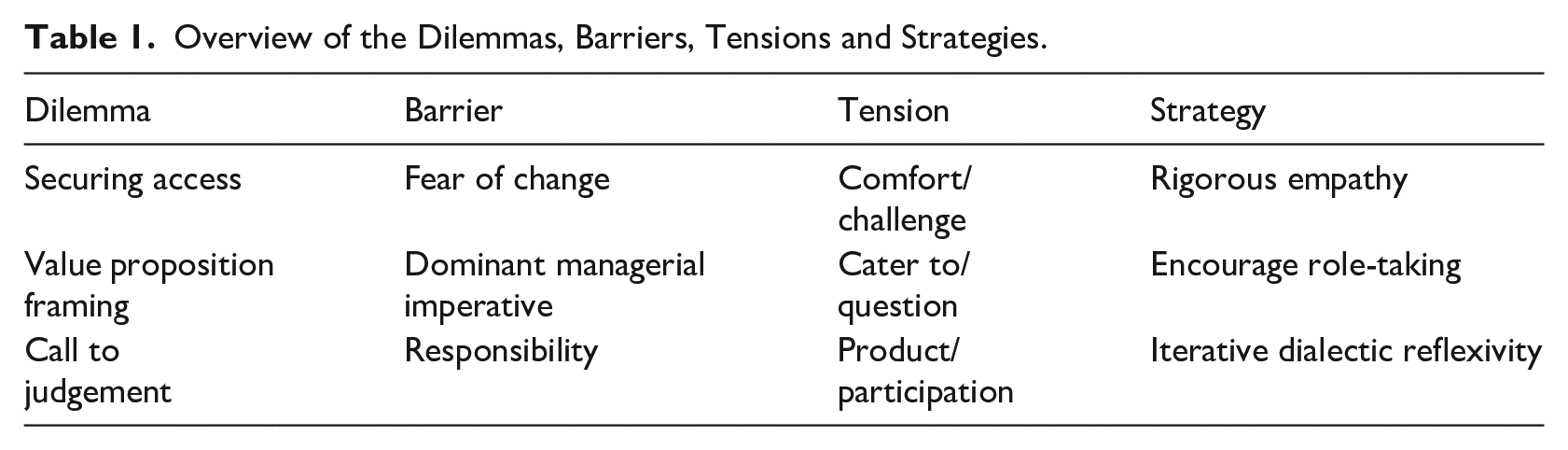
We offer insight into three dilemmas that we encountered during GJP and discuss the barriers and tensions we perceived in encountering these as engaged scholars, reflecting on our intentions and the ways the context challenged us to examine our values, articulate the boundaries of action and learn as we encountered normative situations with the potential to force reductions in radical intent. We suggest and reflect upon strategies based on our own evolving insight and experience during GJP, and on our wider reading. Learning and employing these strategies moved the project some way towards tackling existing critiques of attempts towards social impact via sociological means as discussed earlier. We then conclude the discussion by bringing these strategies together as features of research acting towards symbiotic transformation (Wright, 2010). An overview of the dilemmas, barriers, tensions and strategies can be found in Table 1 and they are then discussed in turn.
Overview of the Dilemmas, Barriers, Tensions and Strategies.
The Dilemma of Securing Access
Our project took place at a time of great uncertainty for the business sectors we were targeting – hospitality, retail, care and other public-facing low-paid sectors. The COVID-19 pandemic removed revenue streams from some businesses overnight, closed some and put unprecedented pressures on others to perform – but also shifted what workers expected and thought was acceptable or required in terms of working conditions (e.g. Adekoya et al., 2022; Loustaunau et al., 2021). In this context of uncertainty and change, where there were recruitment and retention issues facing frontline work, approaching businesses and employees to talk about job quality was a complicated ask – participating managers and infrastructure organizations saw the importance of wellbeing at work in the contemporary climate, but were also sometimes fatigued by the pace of decision-making and adaptation in unstable times. In this context, we perceived that exhortations to action on worker wellbeing could provoke fear of (further) change in potential participants. One of the initial researchers intended to work on the project even dropped out, citing as part-reasoning an informal discussion with a friend, who was a senior manager in a local organization, suggesting it was not the right time to be ‘pushing’ the worker voice and challenging already over-stretched managers. This has echoes of ‘crisis regimes of permanent exception’ where the primacy of the neoliberal business agenda is treated as unquestionable, but the dignity and justice agendas of the people who have to deliver the work are treated as pausable, ignorable or sadly just ‘not quite do-able’ if business is facing a time of crisis (Davidson, 2017).
Within this context, our challenge as engaged scholars was whether to heed this warning and avoid discomforting managers or continue to explore (phase 1) and challenge myths and assumptions (phases 2 and 3) about the value of workplace wellbeing improvements to their businesses and to workers. We chose a path forward that can be described as rigorous empathy – not dismissing these fears because they were voiced by the more powerful stakeholders in our sample (understanding that they may be less powerful in other contexts), but instead actively listening to and empathising with current difficulties, whilst also embarking on potentially challenging discussions about the ways frontline worker experiences could be different.
The concept of rigorous empathy as enacted here can be discussed in the sociological context of a drive towards ‘sociological mindfulness’ where ‘the conceptual and methodological tools of the discipline are more effectively deployed in the service of compassionate action and positive social change’ (Lee, 2015). Employing rigorous empathy helps avoid what Buddhists describe as ‘idiot compassion’ – or accepting exploitation or manipulation due to believing that being supportive and kind never involves provocation, conflict or challenge (Goodman, 2017). As Wright (2010) suggests – just because it may be possible to arrive at a ‘win-win’ situation for employers and employers, does not mean that there is not an inherent conflict of interests or struggle in elements of their power dynamic that can be exposed.
As researchers, learning and accepting the need for rigorous empathy helped to ensure that we still worked to listen to and include all relevant voices. We recognized that certain stakeholders might be dominant in one context but subordinated or exploited in another. We did not shy away from potentially ‘discomforting’ challenge – but approached the project with a spirit of sociological mindfulness showing curiosity, empathy and respect for all involved.
The Dilemma of Value Proposition Framing
While the first barrier pertained to the realm of emotions, the second pertains to the realm of rationality or logic. In the preparatory relationship-building with project partners and the initial interviews with infrastructure organizations, stakeholders suggested that – just as described in the introductory remarks on ‘safe commodities’– few people would take part in the research if there was no clear short-term financial or productivity benefit to managers and employers of doing so. Infrastructure and membership organizations were strongest in their warnings of this – acting as gatekeepers for the business sector and absorbing their justifications and concerns as advocates for the dominant (some might say clichéd – because not all managers act like this) managerial imperative of the replacement of curiosity, education and exploration with strategic instrumentality.
The tension underlying our approaches as engaged scholars, was that business access is only provided to those who present as ‘realistic’ and ‘professional’ in their approach to business interaction (i.e. they accept the primacy of the productivity and private profit motives). For any engagement to occur, we had to offer something in the way of a ‘value proposition’ in the interests of the managers / business. A test of instrumentality must be passed to enter into any level of meaningful communication. One example of this was in Phase 2, when our proposed workshops introducing the ‘4 boosts for frontline workers’ were retitled by our infrastructure partners as: ‘Retaining Staff and Increasing Productivity’ sessions. This title foregrounded the dominant managerial imperative and it was only on delivery of the workshops that the participants realized that the resource presented an evidence-base and set of resources that equally valued the worker story.
It is in this area that the pragmatism of a project of symbiotic transformation came to the fore and we acknowledge often making recourse to cost and productivity arguments, not only in the various 4 boosts resources and evidence supplement, but in the media and radio publicity for the project. These arguments were our entrance tickets to the conversation space and echo the decisions made by the researchers quoted by Rast (2022), making strategic use of dominant discourses. However, when in the conversation space the strategy that grew and evolved to support the emancipatory intention was to use this access to strongly encourage role-taking (specifically as defined by Davis and Love (2017) via both how we a) framed and asked our questions to focus on the experience of the frontline worker and b) framed and presented our resources.
Role-taking can be defined as:
the practice of placing the self in another’s or others’ positions. This includes discerning what others think and how they feel (perspective taking) and sharing in others’ affective states (empathy). (Davis and Love, 2017)
Greater role-taking activity and its components (perspective-taking and empathy) have been robustly linked with the improvement of interpersonal relationships and many other prosocial effects (Davis and Love, 2017). So, although this project took a ‘win-win’ approach to business and worker benefit and did ‘cater to’ the managerial imperative, it also had a strong thread encouraging role-taking throughout. Within the resources and at events we recounted stories of how workers reacted to poor management in the COVID-19 crisis, putting human faces on the concepts at hand. Encouraging role-taking provided us with a way to subtly question the balance of interests and help cognitively and affectively shift managerial understanding towards the importance of creating greater mutual benefit ‘with’ workers themselves. By asking workers to share their stories with us and allow us the privilege of using our professional access to bring their stories to other stakeholders – local infrastructure and employers – we were moving towards co-production and working ‘with’ workers. However, we acknowledge that encouraging role-taking and acting as researcher intermediaries for worker stories is not co-production or facilitating direct dialogue. While there was intention of this (and an attempt in phase 3), the restrictions of working during the COVID-19 pandemic were as much to blame for our lack of progress in this area as other considerations. However, the fact that the workers responses themselves underpinned the researcher-led formulation of the resource for managers should not be underestimated. This fact made the resources a powerful draw for, for instance local politicians and commission members who included our work prominently to inform their ‘Norwich Good Economy Pledge’ as anchor institutions in Norwich (Norwich Good Economy Commission, 2022).
Also, in phase 3, we engaged with organized labour (unions and local union councils) to share these stories and offer the ‘4 boosts’ resource as a complement that they could refer to in the context of existing drives towards pay and conditions campaigns. These aspects went some way towards introducing a dialogue of ideas and an acceptable shared analysis that nevertheless challenged traditional power structures (e.g. who has a voice in decision-making in the boost ‘make me part of the conversation’; asking all stakeholders to see the working experience from the point of view of the worker) – part-fulfilling emancipatory intentions behind the project.
The Dilemma of Call to Judgement
The inductive analysis underpinning our ‘4 boosts resources’ was not difficult because of the clarity of focus in the data on the interpersonal and respectful aspects of managerial interaction with workers and the availability of good practice examples. This emergent clarity was another step in the argument against what our lead researcher has come to call ‘the spangle trap’, that is, the understanding that many things managers institute to try to improve wellbeing are ‘shiny’ but superficial. They may briefly distract attention from poor underlying work conditions but not improve them. Following this ‘commodity’ approach to wellbeing is a trap that obscures the evidenced need for businesses to work towards a long-term sustainable approach to embedding workplace wellbeing with authenticity, consistency and coherence throughout (Nayani et al., 2022). In our project, the managers generally agreed workers needed to feel valued (for moral reasons, as well as for performance and retention) but there was a slight mismatch between the more ‘aspirational’ and ‘material’ focus of employers (e.g. expecting workers to look for routes to advancement; offering gifts acknowledging good performance) compared to the ‘relational’ and ‘practical’ focus from frontline workers and the managers who were already working strongly on boosting wellbeing (e.g. preferring better communication and understanding between managers and staff; working on greater flexibility or better conditions).
However, this clarity of focus excluded any utopian envisioning of very different work futures. There were no worker requests for more equitable profit-sharing or co-operative practices, for instance. This bounded imagination is perhaps not surprising. Indeed, (Levitas, 2017) warned that the articulation and dissemination of a positive alternative vision of any kind is required to open up the possibilities of imagination and action – one reason why sociology could adopt utopia-as-method to support the imaginary reconstitution of society (Levitas, 2013b). Yet this kind of method requires that not just the researcher, but also engaged stakeholders take responsibility in bringing imagined futures to fruition (Levitas, 2013b). Crucially, utopian envisioning, ‘involves a call to judgement’ . . . ‘rather than simply the presentation of a judgement in itself’ (Levitas, 2013b: 219).
In our project, we encountered a strong tension pertaining to making a call to judgement. Fulfilling our knowledge exchange remit and responding to what the funders expect, we offered what looked like ‘products’ (‘safe commodities’ distilling academically-reached knowledge) in the form of our branded and visually attractive ‘4 boosts’ infographic, handbook and video. This was also what the stakeholders requested, and we responded to their input in a way that was designed to be more inclusive and informed by their wishes than many other academic dissemination strategies. However, we also did not want to create so-called ‘fetishized nuggets of knowledge’ (Bell and Willmott, 2020) that happen when reflexivity and dialogue is not employed in research application. Knowledge mobilisation products of this kind look safe because they accord with a wider culture of marketisation of wellbeing solutions. So, we tried to walk the fluid border of D- and R-reflexivity (explained below) to continually disrupt this sense of closure and bring stakeholders back into the project process in the position of judges and ultimate actors in the success or otherwise of the principles set out in the resources.
Alvesson and Sköldberg (2018) offer insight into how to conduct research with ‘reflexive rigour’. They suggest adopting a dialectic between D-reflexivity (‘deconstruction, defensive, destabilising’) and R-reflexivity (‘reconstruction, representation, rethinking’) (Alvesson and Sköldberg, 2018). Our multi-phase unfolding project employed just this type of thinking as we moved from a position of asking participants to interact with us on deconstructing and destabilising arguments over what workplace wellbeing could and should look like, then produced ‘products’ based on reconstructive broad principles, only to, in the next phase, elicit and engage with explicit critique on those products. Our attempts to engage participants in richer multi-level dialogue (such as an Open Space event – where participants set the agenda in response to a broad question about what good jobs could look like in the future) were largely resisted or disappointingly achieved low participation. Instead, we were shifted towards being intermediaries in the dialogue between worker and employer to continue an iterative process of production and reflection. The organic development of this shift enacted several of the key principles of ‘extending social research’ (Letherby and Bywaters, 2007) in expanding the research process to include greater researcher involvement with the implementation of findings, the negotiation of relationships and the prompting of change.
The barriers raised by some managers and infrastructure organizations in phase 2, when asked if they would be able to successfully implement the ‘4 boosts’ in their organization, suggested that some had felt destabilized in their assumptions about good management practice and that others did not yet trust themselves to enter into meaningful dialogue with workers for lack of confidence. Our FAQ document in response concludes by highlighting the ethical nature of choices on workplace wellbeing and therefore our team’s inability to guarantee perfect outcomes with one simple set of actions. The document foregrounds that there always needs to be an element of participant responsibility, action choice and ethical judgement involved. We also stressed this in our in-person workshops.
What we were able to provide to support managers with this tough ethical work were reconstructive principles (the ‘4 boosts’). These could inform and direct action in ways we knew were valued by the public with whom we were working (low-paid frontline workers) and which were consistent with a large range of business outcomes-focused studies on the benefits of acting according to these principles. These could provide confidence, whilst the broad articulation of the boosts left much room for ethical judgement and contextual responsibility. This lack of closure has sometimes been resisted by stakeholders who expressed a desire for more direction – either workers asking us to find a way to enforce the 4 boosts or managers wanting a more specific checklist of actions (rather than principles). Instead, we have committed to continue iterative work to offer reconstructive principles, drawn from stakeholder input and attempted utopian envisioning, given credibility via academic evidence, but consistently destabilized and iteratively expanded in dialogue to keep the project fresh and relevant.
Conclusion
The above critical reflection sets out ways in which the researchers negotiated dilemmas created by the expression of current capitalist modes and structures, highlights the tensions that those engendered, and then offers the strategies grown by the team over the course of the multi-phase project to try to ensure at least some of the original intent – an emancipatory sociology for symbiotic transformation, involving utopian envisioning – was enacted. We do not offer this case study as a perfect example, but we particularly recommend the attempt to prompt critical reflection in business-based participants about their working lives as a stepping-stone to more dialogic, empowering action on job quality going forwards.
The three strategies we offer – rigorous empathy, encouraging role-taking, and iterative dialectic reflexivity – are grounded in principles of sociological mindfulness, of working ‘with’ the cognitive and affective space of the participants to allow imaginary reconstitution of current norms, and of patiently employing multiple project phases and activities to achieve dialectic critique and alternative-formulation if it cannot be achieved (due to access norms) through one phase of utopian envisioning. They show one way it is possible to achieve greater appeal and take-up of sociologically-influenced resources in a neoliberal market context while still resisting the capitalist hegemony of what is useful and acceptable knowledge to exchange. Parker suggested that radical academic ‘utopias can be isolated places that need defending’ (Parker, 2021: 1121) when offering a case study at the level of the business school which highlighted ways in which a commitment to radical change was limited but not erased by the extant ‘conditions of possibility’. This paper’s contribution is a constructive case study at the level of the project that offers similar insight – an insight into how to start addressing the ‘conditions of possibility’ via being aware of the cultural norms that influence (and could easily constrain) the implementation of emancipatory sociology.
Above all, we hope that insight into our messy but fulfilling process with businesses can promote the idea that despite concerns over compromise and appropriation, this type of work can be a genuine and valued part of an approach to engaged sociology that remains critical, but is also emancipatory, regardless of the tensions we must negotiate to take this journey.
Footnotes
Acknowledgements
We acknowledge Prof Kevin Daniels, University of East Anglia (UK) co-conceived the original bid to the Norwich Good Economy Commission and acted as supervisor and institutional fund holder for the original project.
Funding
The author(s) disclosed receipt of the following financial support for the research, authorship, and/or publication of this article: We acknowledge the financial support for this research provided by The Norwich Good Economy Commission, the University of East Anglia Pro-Vice Chancellor’s Impact Fund and Norwich City Council.
