




Abstract
With worker shortages and the need for care workers projected to grow, personal care work through digital labour platforms (DLPs) is important to understand. This paper considers DLPs used by gig care workers providing personal care in Ontario, Canada. We recruited 20 women gig care workers for interviews. We examined socio-technical processes such as signing up on platforms, creating profiles, and searching for jobs. We draw on Institutional Ethnography to study the actual work on the following two DLP models: marketplace and on-demand. Marcusean theory provides a lens for the critical examination of DLP care work. We found job inequity between DLPs operating in the homecare sector, compared to DPs used in institutional settings. Jobs had disparate quality between the two platform types. Workers on both DLP types remained vulnerable to fluctuations in demand and had limited social security protections, and both models of DLP institutionalised precarity.
Introduction
Digital Labour Platforms (DLPs) have technological functions and parameters that affect worker choice and control, shaping their gig work. How this technology affects unregulated care work is important to understand considering the vulnerable workforce and issues with healthcare workforce shortages. DLPs for care work can lower the value of gendered social care work, and fragment care labour by breaking down time and activities and downplaying the merits of relational care (Macdonald, 2021a). Risk in gig care work also includes other elements; for instance, an absence of organisational support in managing care (Macdonald, 2021a) or taking on ‘unpaid labour’ in the form of continual efforts to obtain more paid work on a DLP (Pulignano et al., 2023). Scams such as fake jobs, and job offers with requests for workers to wear bikinis or provide massages are additional risks for workers (Ticona, 2022).
Already precarious – with low pay, often part-time positions and zero-hour contracts, and risk of injury and violence (O’Sullivan et al., 2019; Sayin et al., 2021) – unregulated care work becomes even more problematic when workers using DLPs are classified as independent contractors (gig workers) instead of employees or temporary agency employees. Given these concerns, it is important to understand how DLPs embed social conditions of gig care work through technological functions such as socially influential algorithms, and constrain what care workers can see, know and do.
The literature about traditional healthcare employment offers relevant insights not yet closely examined in DLP gig care work. Most gig care studies focus on nurses (Lien, 2023) or individuals hiring personal care workers (Dowling, 2022; Macdonald, 2021b; McDonald et al., 2021; Ticona and Mateescu, 2018). Healthcare employee job conditions have direct implications for the quality and safety of patient and client care (Hignett et al., 2016; Shaw et al., 2020), yet little is known about how gig personal care workers affects the quality and safety of client care. Even less is known how supplementing employee workforces in Long-Term Care (LTC) and hospital settings with unregulated gig workers affects care.
Since platform care work poses concerns for both workers and care recipients (Dowling, 2022; Macdonald, 2021b; Ticona, 2022), critical examination of the expansion of DLP care in any healthcare setting is critical. In Ontario, the use of on-demand workers in hospitals and LTC is a financial concern (Smith Cross, 2023; Welsh, 2023). Examination of gig workers in formal institutions has received coverage by media (Mojtehedzadeh, 2021) but to our awareness, has not yet been examined in scientific literature. An additional gap in literature is research about how DLPs differ from temporary help agencies (also called temporary employment agencies). We found only one study that compares differences such as platform matchmaking versus human matchmaking, instant or rapid matchmaking versus variable time matchmaking, and worker status as an independent contractor (‘freelancer’) versus an employee of a temporary agency (Meijerink and Arets, 2021).
In this paper, we illustrate how technological functions of DLPs shape work conditions and disentangle how technological parameters affect worker choice and control. We first outline the theoretical framing for our analysis followed by a review of the gig care work literature that contains information relevant to socio-technical functions. Next, we describe two models of DLP care work, according to characteristics identified by Ticona et al. (2018). We then discuss the healthcare environment of Ontario, Canada as context that contributes to shape gig care work. Socio-technical functions and the healthcare environment together set the stage for gig care work to be stratified into the two described models of DLP: on-demand and marketplace DLPs.
Theoretical Framing
We draw on methods from Institutional Ethnography (IE) to examine specific DLP functions that workers describe engaging with on platforms, which highlight features embedded within DLPs. Having illuminated these technological elements as socio-technical factors that influence work, we borrow from Herbert Marcuse to contribute an understanding of how technological rationality entrenches workers’ positions of disempowerment in a capitalist system (Marcuse, 1964; Marcuse and Kellner, 2001) through DLPs.
Herbert Marcuse’s concept of technological rationality, which entrenches workers’ positions in a class system (Marcuse, 1964; Marcuse and Kellner, 2001), sheds light on how relations of domination associated with Western capitalism manifest in the DPs used by gig care workers. This view begins to illuminate how socio-technical functions affect DLP workers.
For Marcuse (1964), scientific rationality shapes people’s understanding of the world and minimises their potential to conceive of alternatives to the way things are perceived; this is a precursor to technology as a means of control. He identifies scientific rationality as contributing to ‘ . . . technology as form of social control and domination’ (Marcuse, 1964: 174–175).
While Marcuse suggests that neither scientific rationality nor technological rationality themselves are capable of reproducing capitalist ruling relations, they do tend to reproduce societal norms; in this instance, a capitalist system. In positioning humans as labour power and time as quantifiable assets, people experience a prioritisation of that which is quantifiable (Marcuse, 1964: 174). We relate this theory to DLP technologies that exemplify quantifiable aspects of labour and thus (de)value people as a countable labour force, with value attached only to the ‘gigs’ performed. The technology rewards that which is counted, doling out petty compensation for countable gigs and lining the pockets of DLP companies with dollars – and a possibly even more valued asset: data (Zuboff, 2019).
Literature Review
Within the large body of gig work literature, we pay special attention to DLPs for the provision of care work which combines domestic work, such as cleaning, with personal care work. While the consequences of DLP care work are critical factors in work conditions, we focus primarily on the technologies that constrain the activity of DLP workers to illustrate how technological rationality actively shapes work conditions and reproduces job disparity between healthcare sectors.
Socio-Technical Functions
A wide range of gig work literature focuses on socio-technical phenomena in DLP work, wherein workers experience digital functions that exert control or otherwise constrain potential actions. In the language of Marcuse, DLP functions can be termed as technologies. These technologies act in a dominating manner that IE would refer to as governing texts that organise people’s activities (Smith and Turner, 2014). In shaping worker actions in DLP care work, governing texts are power-exuding forces or structures that encourage or even require certain actions from platform users. The lived experiences of workers illustrate how DLP texts order or shape the actions of workers. This is sometimes framed as algorithmic management, which can have negative consequences for workers on DLPs and in other forms of work (Vignola et al., 2023). One DLP technique that acts as a governing text is the use of gamified systems to reward some workers and penalise others (Maffie, 2024). Reviews and ratings also act as governing texts, with the threat or promise of negative or positive feedback in a public forum influencing workers’ behaviour (Wood and Lehdonvirta, 2022). A further action that engenders worker action is urging workers to self-promote, such as care apps pushing women to make themselves visible (Mateescu and Ticona, 2020) and present themselves in an appealing way (Kalemba et al., 2024). Yet another example of governing text in gig work literature is surge pricing, which provides financial incentives for workers during times of peak demand to encourage workers to accept jobs (Chen and Sheldon, 2016; Guda and Subramanian, 2019).
Workers’ Identity and Employment Status
DLPs tend to institutionalise informal labour as opposed to facilitating formal employment. Workers’ identities including gender and race, and immigration status, and the devaluation of care work are intersecting factors, important for understanding the arena of informal DLP care work and work conditions. DLP care work can involve the further degradation of an occupation with already low wages for a workforce consisting of primarily women (Rodríguez-Modroño et al., 2022). Immigrants who frequently possess skills unrecognised by formal institutions (Lam and Triandafyllidou, 2024) are often unable to move out of informalised private care work (Scott and Rye, 2023). Indeed, migrant workers performing DLP care work may feel they have no choice other than gig work (Van Doorn, 2022).
In parallel literature, DLPs for housecleaning in Denmark have been shown to institutionalise precarious work for migrant domestic workers (Floros and Jørgensen, 2023). Women engaged in care work often demonstrate compassion for care recipients, and may also feel obligated to perform the relational work of providing care, potentially tolerating poor work conditions in order to complete their work (Dowling, 2022). Gendered-work and intersectional issues for domestic gig workers who are female exist in examples globally, such as Europe (Pulignano et al., 2023; Rodríguez-Modroño et al., 2022) and Australia (Macdonald et al., 2018). Despite the pervasiveness of DLPs reproducing gendered care work inequities, there are instances (e.g. Argentina) where the kind of ‘platformisation’ of domestic care has instead been implemented in a manner that encourages formal employment through routes of regulation and enforcement (Pereyra et al., 2022).
There are several risks associated with gig work including a lack of social benefits, such as employment insurance and workers’ compensation, which negatively affects workers’ overall occupational conditions (MacEachen et al., 2022; Muntaner, 2018). Financial security, social risks, physical and psychological health and safety risks, and risks related to inequality are additional problems associated with gig work (Murray et al., 2023). A financial risk for independent contractors in many jurisdictions is failing to comply with tax regulation. In Ontario, not declaring self-employment income also decreases retirement pension entitlement. Remitting taxes for self-employment affects workers’ future because the Canadian Pension Plan is contribution-based and the payout hinges on what workers put into the plan (El-Attar and Fonseca, 2023). An estimated one in four gig workers in Canada do not understand the tax-related implications of additional income, while 44% plan not to report income (H&R Block Canada Inc., 2023).
Marketplace and On-Demand Platforms
The technical features and structure of DLPs shape workers’ choices and available actions on DLPs. Ticona et al. (2018) describe two models of DLP: marketplace and on-demand. Authors describe that while there are two main designs, some DLPs comprise a hybrid with aspects of both models. Key differences are that marketplace DLPs utilise sorting to display workers for hire, and encourage workers to promote themselves, while on-demand DLPs manage the hiring process including hiring and assignments or dispatch, as well as worker remuneration and potentially surveillance (Ticona et al., 2018). Marketplace and on-demand forms of DLP care work are both location-based. There is little literature focused directly on the comparison of DLP type, although different platform types can be observed in studies that sufficiently describe DLPs. For example, gig care workers specifically on marketplace DLPs have been found to experience some autonomy akin to self-employment, in the opportunity to negotiate wages and weigh the pros and cons of accepting jobs (Khan et al., 2024).
Other research has examined global labour markets, finding the online model reflects supply and demand imbalances and presents challenges for collective action (Graham et al., 2017). In DLP care work specifically, Pulignano et al. (2023) investigate the informalisation of care work as it disrupts two established care markets (Belgium and France) and consider there are several costs associated with DLP work, such as lower wages, lack of social benefits and unpaid labour.
Context: Healthcare Settings in Ontario
The activities of workers using DLPs to find care work take place in a particular context. DLP care work involves the expansion of the gig economy into the field of healthcare (Seibt, 2024) with direct care offered as an ‘uberised’ service (Glaser, 2021). Informal care provided by gig workers is evident in several jurisdictions around the world (Fudge and Hobden, 2018; Seiffarth et al., 2023), but remains underexplored in the Canadian context with a few exceptions (Lam and Triandafyllidou, 2024).
In Ontario, Canada, homecare services are regularly publicly funded and delivered by employees of service providers. Government austerity measures place limitations on the amount of publicly funded homecare available (Daly and Armstrong, 2016) which may push clients to private care. Another push factor is that insufficient government funding affects the availability of LTC home beds (Daly and Armstrong, 2016), causing a bottle-neck accessing LTC homes. Multi-year waiting lists are the norm in Ontario, where 70,000 new beds are needed at an estimated cost of US$20 billion (Roblin et al., 2022). When individuals privately hire care workers, the employment relationship is a critical consideration.
With Canada’s publicly funded healthcare, those hiring private homecare workers are more likely to be individuals with higher incomes (Allin et al., 2020). Marketplace DLP workers’ opportunity to access publicly funded jobs may be inhibited by lack of access to publicly funded homecare funding (Government of Canada, 2024). In some situations, public funding for hiring care workers may be used by clients eligible for special programmes (Jamieson et al., 2021); however, there is a deficit in what is known about these often small-scale and diverse programmes in the Canadian context (Kelly et al., 2021). In traditional work organisation, homecare employees experience unequal work conditions compared to hospital and LTC employees, such as lower pay (Zagrodney et al., 2022). As such, the division of DLP marketplaces and on-demand DLPs may reflect discrepancies between healthcare sectors. DLPs in the homecare sector are examined in many studies; however, DLP use in institutional settings is not often explored. We found one US-based paper that referred to temporary workers using digital platforms in any institutional setting as ‘gig’ workers; these temporary workers were not employees of the LTC homes (Lien, 2023).
Although domestic and personal care workers are not regulated in the same way other professional workers are, such as nurses, they are both legally entitled to protections under employment standards such as minimum wage and notice of termination (Government of Ontario, 2023). Personal Support Workers (PSWs) in Ontario are not regulated at the time this paper is being written, despite attempts at obtaining regulated status (Kelly and Bourgeault, 2015) and 2021 provincial legislation promising regulation for PSWs (Government of Ontario, 2021). The lack of regulation for personal care workers introduces potential risk for clients regarding the safety and value of care work (Hopwood and MacEachen, 2022).
The aim of this study was to shed light on DLP technology that shapes work for unregulated gig care workers in the specific socio-political context of Ontario, Canada. This research contributes to the literature in two primary ways. First, our paper provides insight into the state of unregulated gig care work in the context of Ontario, Canada, which is largely unexplored in the gig care work literature. Our recruitment experience and findings shed light on the apparent limitations of this market and discuss potential challenges for the emergence of gig care in this jurisdiction. Furthermore, to our awareness, little is known about on-demand DLPs in the hospital and LTC context; therefore, we provide a modest contribution to this area. Second, we build on the typology between marketplace and on-demand platforms described by Ticona et al. (2018) to demonstrate how DLP technology can replicate differences between healthcare sectors, disproportionately disempowering private homecare gig workers compared to gig workers in hospital and LTC, and increasing inequity, while elevating risk for clients or patients in all settings.
We parse the technical mechanisms by which a worker interacts with and through a DLP to examine the socio-technological functions of DLPs for workers. This demonstrates how technological rationality creates the parameters in which DLP care work can occur. Examining two types of DLP care model – marketplace and on-demand platforms (Ticona et al., 2018) – operational in Ontario over the course of this study, allowed us to compare and contrast socio-technological functions on each model. This contrast highlighted distinctions between marketplace and on-demand DLP designs and emphasised that the two models are used in different healthcare settings. Our analysis reveals an existing disparity between homecare and hospital or LTC work was reproduced through the DLP model. Our findings thus revealed a reproduction of job inequities hinged on DLP model, contributing examples of how Marcusean technological rationality applies to DLPs for care work.
Methods
This study draws on methods from IE developed by Dorothy Smith (2005, 2006) to critically examine digital care work within the social, legal, economic and political context of Ontario, Canada, and illuminate how two models of platform affect workers and subvert their social power. The lead author conducted 20 in-depth interviews with personal care workers. This analysis focuses on the evidence of actual experiences of care workers using DLPs and the socio-technical functions of DLPs.
Ethical Considerations
This study received ethics approval from a Human Research Ethics Board at the University of Waterloo. All participants provided informed consent. None of the DLPs used by participants are named, to prevent identification. Instead, we provide examples of DLPs that appeared to be operating in the industry over the duration of the research study.
Data Collection and Inclusion Criteria
Worker participants were required to have used a DLP as independent contractors seeking work as unregulated care providers in Ontario, Canada within the previous 2 years. By unregulated, we refer to care workers who do not belong to a recognised profession or lack membership in organisational bodies such as a professional college. By gig care worker, we refer to care workers who are classified as independent contractors and not as employees. Workers must have had a profile or account on a platform where the client or end-user provided job information. To be eligible, DLPs had to have some level of technologically mediated interaction. This could be in the form of on-platform communication between workers and clients, platforms pre-vetting workers or providing skill or certification verification, platforms involved in matching worker and job by various parameters such as geography or skills, as well as technological interactions such as ‘clicking’ to ‘apply’ or rating workers.
To keep abreast of potentially eligible platforms, an industry scan was conducted at several points between December 2022 and January 2024 through Internet search using terms such as ‘PSW, caregiver, care jobs, independent contractor, on-demand, shifts, work, hire, and private care’. DLPs that appeared to be in operation in Ontario, Canada at some point during the progression of this research reflected the dichotomy between marketplace and on-demand models. On-demand DLPs included BookJane (CareNetwork 1 ), Hero Care, and Staffy, which provided workers for hospital and/or LTC. Marketplace DLPs included Bark.com, CanadianNanny.ca, care.com, CareHubble, 2 eldercare.com, MyCareBase, NannyServices, and Seniorcareconnect.
Participants were recruited between April 2023 and January 2024 using various social media platforms (e.g. Facebook care worker groups, LinkedIn messages), through recruitment posters sent out through organisations that included PSWs (e.g. homecare employers, associations), and flyers posted in densely populated urban locations near healthcare facilities known to use DLPs. We also used paid, targeted Facebook ads aimed at female PSWs and care workers, and snowball referrals. Eight workers were recruited directly from the DLP where they had an account, in an ethics-board approved process involving deception and disclosure prior to obtaining consent. 3 Challenges recruiting this workforce may reflect the market, and potentially a small gig care workforce in Ontario, Canada. The apparent scarcity of gig care workers may relate to several factors like limited gig care job opportunities, hesitancy of workers with certain demographic characteristics (i.e. engaged in under-the-table work or not legally allowed to work) to respond to research requests, or the frequent multiple-job-holding status of unregulated care workers and scheduling availability or job burnout.
We exhausted several means of recruitment, yet we managed to obtain a final sample of participants similar to the sample of other purposively recruited DLP workers in qualitative research utilising in-depth interviews (Orth, 2024). Key for this type of research is obtaining rich information (Malterud et al., 2016; Patton, 1990) and drawing on experiences as opposed to representative breadth or quantity (Crouch and McKenzie, 2006). It is important that sample selection is appropriate for the study scope and methods (Sandelowski, 1995) and our focus on depth resonates with IE’s detailed attention to workers’ lived experiences as an approach to understanding institutionalised processes (Smith, 2020; Smith and Griffith, 2022).
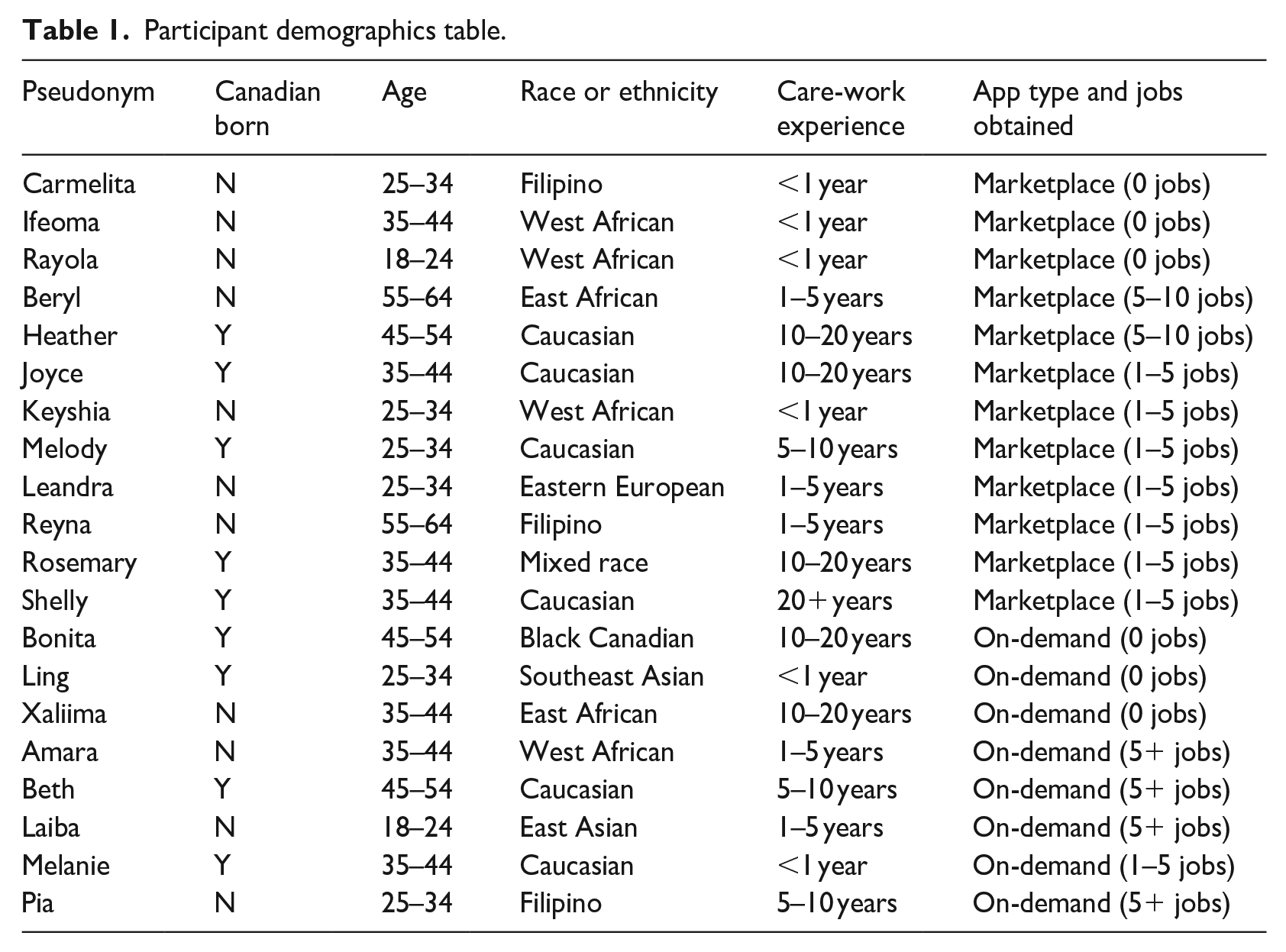
Semi-structured, online interviews were conducted with 20 gig care workers (Table 1). The lead author conducted all in-depth interviews through videoconferencing (e.g. Teams, Zoom). Interviews lasted between 27 minutes to 1 hour and 21 minutes (average 48 minutes) and focused on workers’ expectations of working through the platforms and how their day-to-day experiences unfolded. Interview questions targeted the direct use of platforms including processes of signing up on platforms, creating profiles, seeking work opportunities, navigating schedules, and receiving remuneration.
Participant demographics table.
Analysis
We examined the ways that technology influences DLP gig care work. Our analysis included mapping the social actors involved (Campbell and Gregor, 2002). The lead author engaged in mapping processes by drawing a visual representation of the actors involved in the technologically mediated DLP environment, making note of the roles actors played, and connecting the actors with lines, arrows and labels to represent relationships and processes. In this brainstorming-style exercise, we included consideration of the relations of power between DLPs and other social actors. This IE method is well-suited for examining the experiences of participants and the situations of their work because it contributes to explicate how social relations unfold (Smith, 2005). We utilised this approach to study a work environment where social relations occur through digital exchanges and technological functions. A pragmatic focus on actual events and actions, key to IE, allowed us to home in on specific and tangible socio-technical functions of DLPs. We used Marcusean theory as a lens to understand the implications of these technologies for workers.
Each interview transcript was transcribed verbatim and independently coded by the lead author (PH). A second coding was conducted by a graduate student researcher (AD) and compared with the lead author’s coding to ensure reliability. Based on our interview guide and research focus – how the technological functions of DLPs shape work – we had some a-priori codes (e.g. ‘App sign-up’ and ‘App punishments’). We also identified codes inductively (e.g. ‘No jobs on app’ and ‘Shift details’) through an iterative process involving re-reading and familiarisation with transcripts, resulting in hybrid approach with both a-priori and inductive code development (Fereday and Muir-Cochrane, 2006).
PH, EM, IB, CM and BY all discussed how interviews about using the DLPs represented participant roles and the interactions between social actors. From our data about tangible, platform-based activities reported by participants, we had information about the specific technological ways DLPs influenced the actions workers and clients could perform on different platforms.
For this paper, we draw on codes focused on workers’ experiences using DLPs and their activities (e.g. sign-up, searching, negotiating, applying and accepting jobs.) In these codes, the socio-technological role of DLPs shaping work can be observed. This highlighted DLP functions and enabled the lead author PH to identify key activities and points of platform-worker interaction with and via the DLPs. These data were shared with all authors, who identified further patterns and discussed interactions and meanings. PH was primarily responsible for analysis while EM, IB, CM and BY contributed further analytic insights to situate findings in a wider social context.
Processes identified as part of each type of DLP surfaced some nuanced aspects of the DLP setting which shaped the social position of workers. Turning back to workers’ experiences as evidence of these procedural and structural DLP aspects contributed to explicating how social relations unfolded (Smith, 2005) while Marcusean theory (Marcuse, 1964; Marcuse and Kellner, 2001) provided a way to understand the implications in a work environment where social relations are constructed through digital exchanges and functions. This paper compares DLP functions between two care-work platform types: marketplace and on-demand. Each has unique socio-technological functions that contribute to shape work conditions; however, each platform type also aligns with a particular healthcare setting.
Findings
Utilising Marcusean theory led us to findings about how technological rationality resulted in two types of DLPs, with distinct characteristics for homecare versus institutional care settings. Each type of DLP deployed technological rationality to reproduce domination over workers to different degrees. Marketplace models – used to match care workers with private homecare clients who had their own platform accounts – provided information about the care required in the job. On-Demand models – used by publicly funded organisations seeking to hire independent contractors for a one-time job – posted shifts on behalf of organisations and conveyed applicant information back to the organisations. Workers experienced challenges on both marketplace DLPs and on-demand DLPs; however, marketplaces ultimately had worse work conditions. Comparison of institutional settings using on-demand DLPs and homecare settings using marketplace DLPs illustrated how technology indeed replicated existing organisation of work (Marcuse and Kellner, 2001: 46–47).
Marketplace DLPs
A key aspect across all participant experiences was the uncertainty about access to jobs. Marketplace gig care worker Rayola had been unable to find work through DLP, saying,
I think it’s not easy, self-employed. . . . And you know, for some self-employed you’re not sure, even if you get a job today, you’re gonna get another one tomorrow. (Rayola, Marketplace)
Her comment reflects the transience of work, in that a current or even repeat job opportunity has no certain permanence. Our workers also spoke about having limited options in terms of platform work choice, and some workers rarely saw jobs in their geographic area.
Marketplace DLP workers worked exclusively for individuals seeking private homecare. Workers spoke about using profiles to indicate the type of work they were willing to perform, their desired wage, hours of availability, and preferences for work, such as location. Beryl experienced filling out her profile as involving making selections:
. . . you sort of – sort of tick the boxes accordingly . . . . (Beryl, Marketplace)
Joyce described the marketplace DLP she used as having options for verifications, although the verification was basic identity information and not related to workers’ competence or skill:
. . . so here it says there’s a checkmark, and it says, ‘“this has been verified”. So my driver’s license and my phone number has been verified’. (Joyce, Marketplace)
In Joyce’s case, the platform indicated on her profile that her driver’s licence (which in Ontario includes address) and her phone number were verified. There was no means of verifying additional information such as training or certifications.
Marketplace DLPs and Money
Pay was an important consideration for most workers; however, they had little control over their pay rate. Theoretically, workers could set their DLP pay rates as high as they liked. For instance, one marketplace worker said, ‘ . . . you actually get to create your – to pick your pay wage’ (Ifeoma, Marketplace). However, marketplace workers regularly experienced that – despite being able to set their asking wage on the marketplace DLPs – jobs paying at high rates were not available. However, the same job would be posted at varying pay rates:
So I put the price range, let’s say minimum, I would see this post from a specific person. And then when I will change the range to a higher payment, I will still see the same. The same posting from the same person with a different price . . . . In the beginning, I just put close to minimum pay. And then when I noticed what is actually happened, then I put a higher rate and then because I would still get the same postings, – not 100%, but some of them, like a few out of out of 50 postings that would appear in my in my search, I would find a few, maybe three to five, postings that were the same. (Leandra, Marketplace)
Leandra encountered some of the same jobs when searching for jobs while setting different wage rates. It is possible the DLP included one job in search results for a range of wage brackets to ensure the job appeared in more searches, but this would disadvantage workers who found jobs searching at lower rates when the potential employer was willing to pay more.
With Carmelita, even when she met one client for an interview, the wage remained unspecified:
He told me that I gonna stay – live in there 24 hours, but they – will gonna pay me only for 40 hours. . . . Yeah, but I got to stay there 24 hours. Five days. I don’t want that. He cannot tell me what he is gonna pay me for that. For the hours – he asked me what I’m gonna expect as my salary there. (Carmelita, Marketplace)
Marketplace DLP workers’ experienced that they could indicate the wage they sought, yet opportunities that met those criteria were limited or not available at all. Wages were a strong motivator for workers’ approaches to job seeking. Competition was a passive factor on marketplace DLPs, because the rate set by workers affected what jobs would show up in their searches.
Finding cash-paying jobs was the reason for using the marketplace DLP for some workers. Among marketplace workers, several spoke about seeking cash jobs or ‘under the table’ (Reyna, Marketplace) work, describing that they did not declare the income. Rosemary spoke about how declaring additional income would be detrimental as it would reduce her income-based social benefits. Experiencing her low income as insufficient to keep up with the cost of living led her to seek cash jobs in addition to her regular employment:
So, I like a cash job because then that’s mine, and I don’t have to claim it basically. I know that sounds so bad, but I’m struggling. (Rosemary, Marketplace)
Several marketplace gig care workers described working ‘under the table’. Some of the marketplace workers were aware there was a US$30,000 earnings threshold before they were required to charge and remit General Sales Tax or Harmonized Sales Tax; however, they identified that this was not applicable in their experience, given the income they earned was below the threshold for charging sales or service taxes.
Marketplace DLPs and Location
Geographic location was another important determinant of work availability. Marketplace worker Joyce used the DLP to demonstrate to the researcher (PH) the experience an employer would have searching for a worker using a postal code. She entered her own postal code and searched for workers within 50 km to show that her own profile was listed at the top based on nearest location:
I’ll show you on the app, how you can kind of change your postal code . . . . Put in (own postal code) when I go to (own location), I want to look – so you can look within these kilometers. Do you see that? (Interviewer: Okay, yep.) Yeah, we’ll keep it at 50. And then yeah – I’m right at the top here. (Joyce, Marketplace)
Joyce’s experience was that the DLP was able to search for workers based on location. Workers were also able to search for jobs based on geographic location and postal code; however, some experienced that if there were no jobs within that area the platform would show jobs outside of range. Workers often considered distance as a factor when deciding whether to apply for jobs.
On-Demand DLPS
On-Demand models involved publicly funded organisations seeking to hire independent contractors for a one-time job. Workers experienced challenges finding jobs. For instance, Ling spoke about being uncertain what – if any – opportunities would arise for her:
Oh, if I have a lot of jobs, as like, PSW, maybe, I can, like, continue using this as a nurse and keep these because everyone’s like ‘Oh agency nursing, [the nurses] make so much money’. And if I can show them, I started from the bottom and made my way up. Yeah, but that’s what I plan to do. But since I’m getting nothing on the app, then I don’t know if that’s possible at all. (Ling, On-demand)
Ling was not keen on gig work but felt that taking shifts as a PSW while training to be a nurse might garner some sense of recognition and lead to better work opportunities in the future. Although she envisioned potential for furthering her career through DLP work, she had not obtained any shifts on the DLP.
On-demand platform sign-up required documentation and sign up for prospective workers was a process most considered somewhat arduous. Laiba’s experience was that the process took 2–3 hours, not accounting for time and money to acquire or gather the proper documents:
It’s quite a lot of work. So that’s why people may choose not to do it, because they – you have to give an assessment, you have to upload so many documents, you have to do your own taxes. . . . Otherwise, I think it’s pretty good. It’s just the onboarding process that takes – that’s a little lengthy. . . . So they have to, if they need a criminal record check, they need to get it, they need to go to the police. They need to get it – it takes like two three weeks; sometimes in (location), it takes even longer. (Laiba, On-demand)
Police record checks were a barrier in a different way for Shelly, who noted that the platform she was using only considered police checks as ‘up-to-date’ for the most recent 6 months:
I tried to accept a shift. And it kept denying me. . . . Why all of a sudden, today am I not being able to accept a shift? . . . .It ended up being that my police check was now out of date. And by out of date, I mean, more than six months old. Which is just- it’s disheartening. . . . It just so frustrating. It’s frustrating. It’s frustrating even talking about it. (Shelly, On-demand)
On-demand platforms allowed for unregulated care workers to register and be pre-vetted as ‘qualified’ workers. These DLPs provided the worker participants with job postings for which workers would apply through ‘clicking’. Subsequently, the organisation (e.g. hospital or LTC home) would select a worker.
On-Demand DLPs and Money
On-demand DLP workers could set the rate of pay they wanted, although they experienced that this limited what positions appeared on the DLPs as available:
I don’t see anything for tomorrow, or anything. If anything comes up. It’s like for tonight for the next hour. But I set my rate on (DLP) . . . you could say like, which minimum rate do you want to be sent jobs for? I put $22. And I get very little. Part of me thinks maybe I should go back down, to like maybe like $18. But for $22 not a lot comes up, except for emergency shifts. Like if it’s 6pm, those are like, ‘Shift needed for 7:30’. (Ling, On-demand)
Ling showed the researcher (PH) how a live search produced no work opportunities, and she considered that she was limiting what she would see based on her wage rate. She found it was most often last-minute ‘emergency’ shifts (posted close to the time of the shift beginning) that offered the wage she wanted.
In the category of on-demand work, pay was generally clearly stated. However, some on-demand workers faced a lack of transparency about how they would be renumerated. In the case of on-demand worker Ling, being paid through gift card was a confusing form of payment:
Before when I signed up, they said they give you Visa debit gift card, and then they put your pay on like a Visa gift card . . . I was super confused about it. . . . they changed it recently to an e-transfer. (Ling, On-demand)
Shelly, another on-demand worker, experienced a requirement to have a Visa debit card to receive payment for shifts. For her, this was one of a few issues she faced using one DLP and contributed to frustration with the platform.
Competition was an important issue for on-demand DLP workers. Amara discussed multiple people attempting to apply for the shift at the same:
. . . there are a number of PSWs who are applying for that same shift, right. Because it pops up on everybody’s phone. Right? So the fastest finger gets it. (Amara, On-demand)
Laiba’s experience on a DLP was similar. Her experience illustrated how relatively higher pay rates and co-worker interaction, management and duties made some jobs more desirable and thus more competitive. She and her friends experienced not being able to get a shift at a desirable location because other people got the opportunity first:
. . . . so that’s why you have to be on your phone all the time, especially during – oh my god while working at the vaccination clinic. Everyone knew they were getting paid so good. So everyone is applying right? And they do really. Sometimes they – all my friends were like, they didn’t get any shifts. It’s because it’s already gone. . . . when we’re at work. . . . And everyone’s like ‘SHIFT!’. So everyone – no one’s listening to the huddle – And everyone’s like, on their phones applying for the shift. Those days it was fun. (Laiba, On-demand)
Over a period of a couple years (after COVID-19 created higher paying DLP jobs), decreasing remuneration rates for DLP jobs also contributed to why Laiba no longer used the app:
Also the regular job and the job at (the DLP) now, they pay the same rate. So I’m like, I don’t really go for (the DLP). Because before (the DLP) used to pay like so much more. So that’s when I chose (the DLP) over my regular job. But now like, I don’t think (the DLP) is for me. So I haven’t really been picking up shifts from (the DLP) right now. (Laiba, On-demand)
For on-demand DLP workers, only the first person to apply would be considered for the job. Even at this point, the worker did not control if they were selected for the job: the information would be sent to the potential job site, where a manual decision was made whether to offer the worker the shift or not.
At this stage, there were several unknowns for workers. What information could the potential employer see? Some workers suggested that the job site would be able to see any previous reviews or ratings, qualifications, documentation (e.g. certificates, proof of vaccine), and past shifts worked. However, they were not in control of what information in the DLP was shown to the potential employer.
On-demand DLP workers usually identified themselves as independent contractors and described paying income taxes and saving for income taxes:
. . . it pays me right away after a shift, then I get paid right away, which is amazing. Um, the only thing that you have to think about is to set aside money for tax, because they don’t deduct tax. (Pia, On-demand)
One on-demand DLP worker said that she declared DLP income; she noted that the app kept a record of her earnings as an independent contractor:
You have to pay your tax because it’s independent . . . You pay your tax by yourself. And, like, you know, people that does taxes, right, during tax season, you have to declare, because on your phone, you see how much you’ve made. (Amara, On-demand)
Within the on-demand sphere, one DLP indicated the platform had some capacity to calculate workers’ tax payments. Laiba described that although there was an option to ‘enable taxes’, it was not clear what it meant. She demonstrated that a button appeared as a choice for workers in the app:
. . . I think now they changed it. They actually- there is an option where you can like include your tax with it. . . . . So here, there is an option where it says tax. And then it says enable tax, right. So now you can enable your own taxes. . . . . (Laiba, On-demand)
Laiba was unsure of what would happen if she selected the option to enable taxes. It was unclear if the DLP company would remit taxes to the government, hold them back to pay out to the worker at a later date, or provide a calculation for workers to guide them on how much to save for paying taxes:
‘I’m not so sure about that, because I never enabled taxes myself’, she said.
Most on-demand DLP workers said they declared their income, which would ensure they paid pension plan contributions. As well, on-demand platforms appear to sometimes provide information or tools to facilitate declaring taxable income.
On-Demand DLPs and the Work Site
The work site was an important factor in applying for on-demand shifts. Among the on-demand DLP workers, several spoke about returning to jobs at the same institution repeatedly. Some looked for postings at specific sites based on their preference for the job due to good experiences, the wage or a supportive workplace environment. The opposite was also true – workers who had bad experiences would not consider jobs at those sites.
For Beth, looking at job details to decide if it was a site she wanted to go to was important. She had some experience with an on-demand DLP that provided details about the work location:
. . . they want people to actually go to (name of LTC home). Because nobody wants to go there. And so they’ll put the name of the unit as well . . . which I think is a good idea, because I will not go back to certain units. I might go to a different unit because they’re not all run the same. Because I’ve had two different experiences there. But I won’t go knowing I might get stuck on the one where I’m standing there waiting for somebody else all night. The other one was fine. (Beth, On-demand)
Jobs appeared and disappeared quickly from platforms. Unfortunately, looking at more information about the site sometimes led to the opportunity passing before Beth could apply to the job:
So I would poke it – or like press it . . . to read it and find out exactly what I’m signing up for. And by the time I read it and press it, it was already gone. That was a little frustrating. . . . So sometimes I would miss out because I’m not quick enough. Because they just want to work and I’m picky. It’s held against me in a sense, because, yeah, it takes me a minute to read it and think ‘Okay, that shift Is there at this ward and – Yes, I do want it’. (Beth, On-demand)
This fast-paced environment pitted more desperate workers against more selective ones. Multiple people were attempting to apply for shifts at the same time. If workers applied for a shift and then it was confirmed, they were expected to take the job or risk having it count as a cancellation.
Workers described procedures similar to each other and used some of the same words for processes on DLPs. Amara described the process of the DLP she used step-by-step, speaking about ‘applying’ for ‘shifts’ and companies ‘confirming’ the shift:
I just go to my app, then I’ll search for notifications. Because when there are shifts, it just shows up on the phone. It gives a location, the time of the, of the shift, and all of that. So if it’s something I want to do, then I’ll apply for the shift, I’ll apply for it and wait for confirmation. . . . when it’s confirmed, then I’ll have to accept it . . . That way the app knows that ‘Okay, fine’. So, this job, it is taken by me. (Amara, On-demand)
Most workers experienced a waiting period between ‘applying’ for a shift and having the shift ‘confirmed’ or ‘awarded’. A couple workers had worked in scheduling or were familiar with how the process was handled by the work location; however, they were not certain if the DLP did anything or just passed their information directly to the organisation when they applied to a job:
I think it goes to the hospital because they get to pick which PSW they will pick for the shift. Yeah. Because it – when you apply for a shift, it’s going to go to whoever is requesting the shift, which is for example, the hospital or the unit. And then they would see your picture, your experience, if you’ve worked in the unit before. . . . they will also see like, if you have a lot of cancellation, if you . . .‘no show’. (Pia, On-demand)
In all, on-demand workers experiences included that sign-up was labour intensive and verification involved waiting for manual document review, the expectations and operations of the DLPs were at times opaque and subject to frequent change, and information about jobs and payment was not always evident.
Comparative Findings
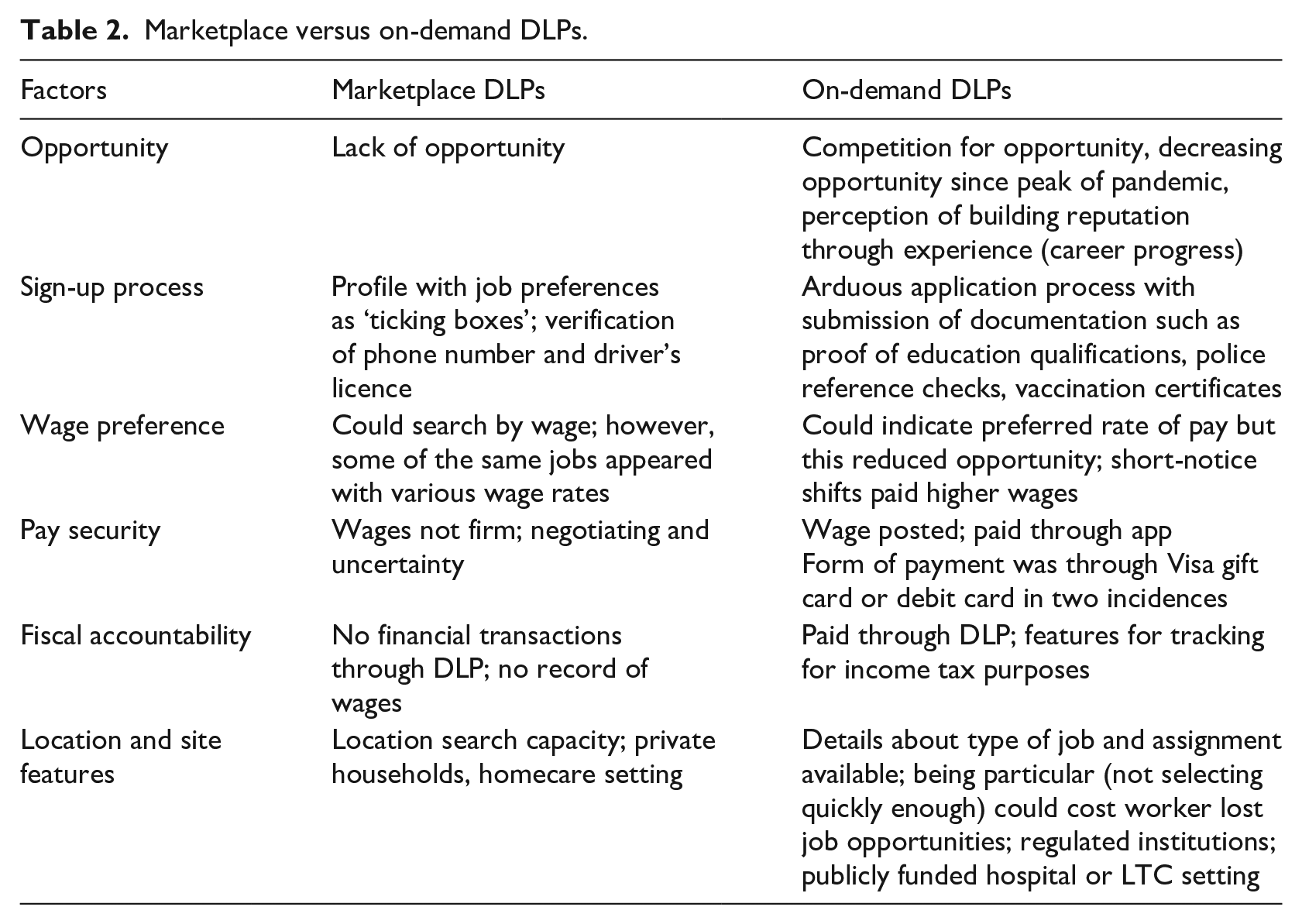
We found several disadvantages of marketplace DLPs compared with on-demand DLPs. Notably, while marketplace DLPs relied almost exclusively on workers’ honesty, on-demand DLPs had more stringent requirements for verification of workers qualifications. Marketplace DLP workers saw misleading information when they searched by wage, while on-demand DLP workers knew the fixed rate of pay with certainty. Geographic search parameters were comparable, although marketplace users sometimes experienced their search restrictions were ignored or overridden by the DLP. In terms of site, marketplace workers went to private homes without knowing what they might encounter, while on-demand workers were provided with a reasonable amount of detail about the site. We present key differences between marketplace and on-demand platforms in tabularised form to facilitate comparison (Table 2).
Marketplace versus on-demand DLPs.
Discussion
Our analysis considers how the structure and functions of two types of DLPs – the marketplace DLP model and the on-demand DLP model (Ticona et al., 2018) – exert socio-technical control over workers, or constrain workers capabilities. Approaching this with a Marcusean lens that views DLP technology as the extension of existing social relations that disadvantage workers in capitalist society helps to unveil how DLP functions rule workers and allow companies to maintain domination of the workforce. Marcuse (1964) notes that through technology, people become objects that are commodified, and the technologies ‘ . . . under which they are subsumed veil the particular interests that organize the apparatus. In other words, technology has become the great vehicle of reification . . . ’ (p. 184) and in this case reifies job disparity between homecare settings and institutional care settings.
Limited Opportunity
Workers on both marketplace and on-demand DLPs experienced less than their ideal opportunity. While on-demand workers had observed a decline since the peak of the COVID-19 pandemic, they generally had more job opportunities. It is important to note that the lack of jobs is a labour market issue distinct from platform control (Wood, 2019); however, we suggest it is misleading for platforms to promote flexibility when there is a lack of opportunity. The availability of workers compared to the sparsity of jobs points to a potential oversupply of on-location DLP workers, like that observed by Wood (2019) among online DLPs. This abundance of labourers in a competitive market is a distinct disadvantage for workers, and has been noted in the global supply of online workers (Graham et al., 2017).
The individual implications for care workers using DLPs to look for work are both economic and social, as Pulignano et al. (2023) so aptly illustrate, and yet DLPs also exert pressures on the labour market and formal employment. It is not so much the technology itself that is problematic, but the systemic change to the organisation of work relations and the stripping of hard-won employment rights and protections through its use. Marcuse described that although technology itself can be utilised for different purposes, when something is so pervasive it is embedded in culture or ‘universal’ it makes it seem as though that is the natural or only course for technology to follow:
An electronic computer can serve equally a capitalist or socialist administration [ . . . ] when technics becomes the universal form of material production, it circumscribes an entire culture; it projects a historical totality – a ‘world’. (Marcuse, 1964: 171)
The technology deployed by DLPs in capitalism reduce labour to the completion of gigs, scaling up structure that positions workers as independent contractors and disempowering care workers. A concern is the spread in healthcare, as well as with the adoption of the on-demand model by publicly funded institutions such as hospitals and LTC homes. This elicits the question of how neoliberal governments may utilise DLPs to informalise work in any field.
In the context of Ontario, there are indications that other factors may have contributed to the reduced job opportunities experienced by participants. The time of declining opportunity coincided with public awareness about exorbitant fees charged by staffing agencies to publicly funded LTC and hospitals, which resulted in pressure for hospitals and LTC homes to spend less for on-demand workers (Smith Cross, 2023; Welsh, 2023). Pending legislation – requiring staffing agencies and recruiters to be registered with the government (Government of Ontario, 2024) – may also contribute to the reduced on-demand work in these institutions. Other opportunities such as vaccination clinic jobs may have also declined.
Verification and Vetting: Is This Arrangement Safe for DLP Users?
We found that marketplace DLPs used in homecare offered minimal checks of workers, consisting at most of a phone number and a licence (address) verification. Workers felt they were at risk from sharing personal contact information with strangers, and particularly vulnerable when meeting potential clients in person. This aligns with other research demonstrating gig workers may be exposed to scams (Ticona, 2022). Comparing this with on-demand platforms – which had more thorough vetting of workers and required documentation – we question why marketplace platforms would not implement a mechanism for ensuring the legitimate identity of clients and potentially, credentials of workers, to improve safety and security for all parties. Rather, they seem content to allow full responsibility to rest on workers and clients.
On-demand platforms are not completely in the clear, despite their comparatively more diligent vetting. Workers were not required to provide references from previous employers, which has been identified as an important issue given that not all acts of negligence or wrongdoing are captured by police record checks for unregulated care workers (Hopwood et al., 2022). Future research could examine if DLP practices for vetting workers are adequate given that publicly funded institutions are bringing DLP workers in to care for people.
Money Matters
Marketplace workers in our study experienced seeing the same job at different wage rates, demonstrating what appears to be a deliberate effort to obtain workers for the lowest cost. While a benefit to clients, this reveals a lack of upfront transparency for job seekers who already face negotiating for pay. In contrast, on-demand workers knew exactly how much a job would pay when they signed up, although the form of pay was problematic for two users who had earlier experienced that wages would be paid through a gift card or Visa debit card. Posting jobs with a pay range or a firm wage may improve marketplace workers’ circumstances; however, as homecare work is notably lower paid than hospital or LTC work in Ontario (Zagrodney et al., 2022) marketplace workers are likely to continue to face pay inequity as long as the sector discrepancy persists. In other words, conditions created by brick-and-mortar companies in the healthcare labour market are replicated by the DLPs.
Similarly, the potential for homecare work to be set up as a cash job and not declared employment income transfers directly to marketplace DLPs. Marketplace DLP workers in our study were largely not aware that under Ontario government’s specific regulation for domestic workers they are legally entitled to minimum wage, notice of termination, sick days and various other protections under employment standards legislation (Government of Ontario, 2023). In addition, workers were unaware that failing to pay income tax could adversely affect them in the years when they would be eligible to start receiving retirement pension (El-Attar and Fonseca, 2023). We argue that the technology could be deployed to inform workers of their rights and responsibilities. In Ontario, domestic workers are entitled to be employees, paid at least a minimum wage with employment standards and social benefits such as employment insurance (Government of Ontario, 2023). Furthermore, marketplace DLPs could implement technology solutions for tracking hours and reporting income to ensure that the worker–client employment relationship, much the way on-demand platforms did.
Our findings that on-demand workers were offered higher wages for short-notice shifts is reminiscent of ‘surge pricing’ in other gig work (Chen and Sheldon, 2016; Guda and Subramanian, 2019).
When is a Platform Worker Not an Independent Contractor?
While marketplace workers theoretically had the ability to search by location, to negotiate and accept or refuse jobs on their own terms, platforms exerted some controls in that they sometimes gave an illusion of choice. For instance, workers could set up profiles with preferred wages even though the platforms would show the same job at different wage rates. Workers could also identify geographic areas in their searches, but marketplace platforms would sometimes override the distance workers inputted to feature further jobs. However, these are perhaps moot points given Ontario’s regulation for domestic workers to be entitled to work as employees. By not introducing information about employment rights and facilitating weak or meaningless forms of ‘verification’, marketplace DLPs’ infrastructure contributed to institutionalise the precarious positions of workers (Murray et al., 2023). Furthermore, by overriding workers’ ability to search according to desired parameters or manipulating the apparent wages for jobs displayed to workers, platforms disempowered marketplace workers’ agency.
The experiences of workers who used on-demand DLPs to find jobs revealed some illuminating issues related to the DLP classifying workers as independent contractors – an active area of debate surrounding gig workers’ employment status (Halliday, 2021; Van Doorn, 2022). A key issue in Ontario, Canada is that temporary agency workers are covered by employment standards legislation while gig workers are not (MacEachen et al., 2022). The DLPs used by gig workers in our study described workers as independent contractors on their company websites, and workers were aware that they were classified as independent contractors. However, how the technology functioned calls into question if some companies acting as DLPs are just temporary help agencies using technology: on-demand DLPs manually reviewed worker documentation, workers manually applied for jobs by clicking, and although the DLPs ‘automatically’ sent the applicant to the client–employer (hospital or LTC), the workers had to be manually approved for positions. In these ways, on-demand ‘DLPs’ lack defining characteristics of platforms and only in (arbitrarily?) labelling workers as independent contractors do they seem to meet any DLP criteria (Meijerink and Arets, 2021). It is important to discern when gig workers are independent contractors and distinguish this from temporary employment agencies – a grey area in the sole study we found about ‘gig’ work in LTC in the United States (Lien, 2023). We found that some on-demand DLPs appear to operate much more like temporary employment agencies than DLPs and suggest this area needs further investigation given the blurriness between agency and DLP and the importance of worker classification for worker social protections.
Strengths and Limitations
This paper contributes to the literature about care work platforms in the Canadian context by comparing marketplace DLP and on-demand DLP functions and highlighting that DLP models are stratified by healthcare setting in Ontario, Canada. If this stratification occurs in other jurisdictions may warrant further investigation. Our data were rich because we drew on methods from IE (Smith, 2005) to examine workers’ direct experiences and elucidate platform functions in two settings through two DLP models. Marcuse’s theory of technological rationality allowed us to analyse how these different technological functions in different healthcare settings reified power relations, positioning our findings to have broader implications and shed light on worker domination through DLPs.
Consideration of how immigration policy and legal work status may constrain work options (Orth, 2024), and examination of under employment or deskilling for immigrant care workers (Walton-Roberts, 2020) would enhance future gig care work research in Canada. In addition, quantitative assessments of this unregulated population of informal workforce are important because comprehensive data about the immigrant health care work force in Canada is vital for sustainable and ethical immigration and workforce development policy (Bourgeault et al., 2023). We did not look at ratings because these derive from input by a client, although they are deployed by platforms for things like ranking workers (Wood and Lehdonvirta, 2022).
Conclusion
This research illustrates how two DLP models further embed work inequalities between homecare compared with LTC or hospital work, and ‘platformise’ unregulated care workers who work through DLPs. The reproduction of inequities in homecare compared with LTC or hospital care are reflected in worse job conditions on marketplace DLPs in comparison to on-demand DLPs. Our study contributes to a small body of literature differentiating these two platform types and provides evidence of how healthcare structures are related to the use of different gig platform models. By linking platform type to care sector and identifying the inequity in both, we add to the platform typology literature about on-demand and marketplace DLPs, and consideration of what makes jobs better or worse in gig care work. To borrow from the work of Marcuse (1964: 175–176), DLPs normalise capitalism to such an extent that their dominance over workers in terms of limited functions and technological constraints becomes a foregone conclusion – a technological rationality effectively constraining worker autonomy. In all, DLPs maintained the locus of control; they owned the means of ‘production’ which was technology for using worker and client data to match (over)supply of labour to demand for care in ways that benefitted the platforms but had costs for workers as well as clients.
Footnotes
Acknowledgements
The author(s) thank you to the gig care workers and industry informants who shared their experiences for this research. They extend their thanks to the Human Research Ethics Board at the University of Waterloo that provided guidance on the ethical conduct of this study. They also acknowledge the helpful suggestions of two anonymous peer reviewers who provided feedback for this manuscript. The lead author additionally thanks the organisations that provided financial assistance over the course of this doctoral research.
Funding
The author(s) disclosed receipt of the following financial support for the research, authorship, and/or publication of this article: Pamela Hopwood was supported in part by funding from the Social Sciences and Humanities Research Council (Canadian Graduate Scholarship – Doctoral program), the Ontario Graduate Scholarship program, the Institute for Work and Health, and Saint Elizabeth Health Research.
