




Abstract
This article addresses one of the oldest, most fundamental questions: how social order comes about. Many established conceptions of social order either tend to overemphasize one specific form of social order such as institutions or networks thereby losing sight of others, or subscribe to a single binary definition often distinguishing between spontaneous and organized social order. Although we do not deny the analytical fruitfulness of these approaches, we argue that they fall short when it comes to fully grasping certain social phenomena. Against this backdrop, we expand existing approaches by accounting for the multi-dimensionality of social order. Drawing on decisional organization theory, we present a theorization of social order that outlines four properties: ontology (system or structure), determination (decided or non-decided), changeability (decidable or non-decidable), and acceptance (accepted or contested). As we will show, this framework offers a fine-grained understanding of social order on a more generalized level, accounting for the complex, relational, and processual nature of social order. This approach allows us to move beyond established categorizations of social phenomena into, for example, institutions or networks, and to put the emphasis on properties of social order, the identification of tipping points, the unpacking of complexity, and the analysis of potential incompatibilities.
Keywords
Introduction
The question of what social order is and how it comes about has been an integral part of sociological research since the classic works by Comte, Marx, Durkheim, and Weber (Turner, 2013). Sociologists have investigated how social order is possible, in works ranging from the micro- to the macro-level—from Goffman’s (1966) studies of interaction orders to Parsons’ (1951) and Luhmann’s (2012, 2013) studies of societal macro-orders—covering theoretical frameworks as diverse as systems theory (Morgner, 2014), institutional theory (Drori, 2020), ethnomethodology (Garfinkel, 1967; Hilbert, 1990), identity theory (Mead, 2015), actor-network theory (Law, 1992), and more (Hechter and Horne, 2003). Studying social order means studying the fundamental building blocks of our society, the ‘cement of society’ as Elster (1989) called it. Hence, generally, social order pertains to some kind of ‘ordering’ of the social world:
‘Without social order, there can be no agriculture, no industry, no trade, no economic investment, no technological development, no justice, no art, no science, and no human advancement’. (Hechter and Horne, 2003: xiii)
Trying to define social order is challenging, considering that social order is often seen as ‘synonymous with both society and social science’ (Dandaneau, 2015). Hence, one might indeed argue that social order cannot be an object of observation in its own right. However, in this article, we follow a long tradition of works that have explicitly done so, for we will illustrate that it is both reasonably possible and sensible to do so. Following existing approaches, on a highly abstract level, social order can be defined as the temporarily fixed meanings that lend the social world a degree of expectability (see Elster, 1989; Hechter and Horne, 2003; Luban, 2020; Luhmann, 2022) or as ‘fixing one certain meaning beyond a single event’ (Grothe-Hammer et al., 2022: 35; see also Morgner, 2014).
When it comes to further unpacking the systematic characteristics, peculiarities, and diversities of social order, many works provide detailed descriptions and theorizations of highly specific forms of social order. These specific forms may be conceptualized as systems, structures, norms, identities, institutions, network, logics or other. While such works undoubtedly offer a wealth of insights into the functioning of our social world, they often fall short of offering a comprehensive theorization of social orders themselves. They study systems or norms or institutions or the like as specific aspects of social order, rather than presenting a comprehensive theoretical framework that addresses social order as a whole. In the absence of a comprehensive theorization of social order, many such theories tend to overemphasize a certain understanding, thereby remaining fragmented and context-specific, limiting our understanding of the broader dynamics and interconnections that shape social order in its entirety.
For example, institutionalist works often tend to treat almost any kind of social order as institutions (Alvesson et al., 2019; Buchanan, 2020; Hall and Taylor, 1996), even though not all are. (Ocasio and Gai, 2020). Network research, on the contrary, often tends to treat almost everything in terms of networks (Borgatti and Halgin, 2011), although not everything can be reduced to networks. Moreover, even with the grand theories of sociology with all their complexity and their wide range of concepts, there seems to be a tendency to overemphasize certain concepts. Bourdieu’s approach, for example, often involves interpreting various social phenomena as forms of capital, subsequently engaged in competition within social fields, which are often essentially depicted as markets (Bourdieu, 2018). As a result, even the concept of social classes often appears to be reduced to the distribution and accumulation of different forms of capital (Bourdieu, 2002). Luhmann (1990), on the contrary, tends to treat everything as systems. It then becomes difficult to address fields, networks, and issues such as racism and sexism, which are challenging to grasp in the social systems terminology. We acknowledge that this is an oversimplification since the complexity of these theories goes well beyond these singular emphases. These theories would not claim that everything is capital or systems—they are well aware of other materializations of social order. But we contend that there is a discernible inclination in these theories to place excessive emphasis on particular concepts. 1 We suspect that this tendency may be attributed, in part, to the lack of a broader, all-encompassing theory of social order.
Conversely, works that do attempt to theorize social order comprehensively often employ a dichotomous conception of social order. There is a widely accepted assertion that it is possible to distinguish between two fundamental forms of social order, although arguably many theories and debates then tend to emphasize one side (Hechter, 2018: 14). However, the particular definitions of these two forms vary. Spencer, for instance, focused crucially on what he called ‘spontaneous order’ while repeatedly distinguishing it from forms of order that are coercive (as cited in Offer, 2015). Parsons (1949) distinguished normative order from factual order. And in ethnomethodology, it is common to distinguish between hidden and witnessable social order (Livingston, 2016), or alternatively between stable and constitutive order (Korbut, 2014; Rawls, 1989).
Another popular and widely accepted understanding in which we are particularly interested, is to distinguish between one form of order that is more or less purposefully constructed, and another form of social order that emerges unintentionally or by itself (Ahrne and Brunsson, 2011; Elster, 1989; Hechter, 2018; Luhmann, 1964; von Hayek, 1991; Williamson, 1975). This definition of social order is employed by several influential scholars. Von Hayek (1991) famously distinguished between ‘spontaneous (“grown”) order and organized (“made”) order’ thereby becoming a crucial inspiration for Williamson’s transaction-cost approach (see Williamson, 1991b). In the said approach, Williamson (1975) originally distinguished between two fundamental forms of ordering transactions in relationships, that is, spontaneously evolving order in the form of markets on one hand, and organization defined as hierarchies on the other. In his early works, Luhmann (1964) similarly distinguished ‘elementary social orders’ based on tacit norms from ‘formalized systems’ based on decisions. Drawing on Luhmann, Ahrne and Brunsson (2011) distinguish decided social order from emergent social order, thereby laying the ground for the so-called partial organization theory. Elster (1989: 1) distinguished between ‘stable, regular, predictable patterns of behaviour’ as one form of social order and ‘cooperative behavior’ as the other form. And in a recent review, Hechter (2018) concluded that, in the existing literature, one can generally identify a distinction between social order that ‘emerges spontaneously and unintentionally’, and social order that ‘is produced by establishing a collective enforcement mechanism’ (p. 24).
While the explanatory potential of these perspectives is undoubtedly high—as clearly evidenced by the vast number of studies working with these concepts—it is also limited by the single binaries at their cores. In transaction-cost economics, this issue has, for example, led to the definition of an intermediary ‘hybrid’ category located between the social orders of the market and the organization (Williamson, 1991a). Similarly, in partial organization theory, Laamanen et al. (2020) have introduced the concept of ‘blended’ social order, which combines decided and emergent forms of social order. Apparently, the single dichotomous distinction between only two general forms of social order fails to grasp certain social phenomena—which led these scholars to add a mixed category in the middle.
These theory extensions can be perceived as ad hoc solutions addressing an inherent issue within many social order perspectives. We suspect that the problem lies in their proclivity to adopt a binary framework that often overlooks the dynamic nature of social order (cf. Giddens, 1979). Social order is usually presented as a state of affairs or as the outcome of a foregoing process: for example, a hierarchy that is the outcome of a decision, or a market that is a spontaneous order. It is noteworthy that some of these conceptions of social order are theoretically grounded in a process-oriented framework (Ahrne et al., 2016; Luhmann, 2018). However, even within these process-oriented frameworks, scholars have occasionally resorted to a rather static approach, utilizing them as a checklist to ascertain whether a particular order conforms to an organized or non-organized order. For instance, corresponding works may assess whether a platform should be categorized as organization, thereby perpetuating a static, either-or paradigm (see, for example, Kirchner and Schüßler, 2019).
Against this backdrop, we see the need for a more fine-grained yet comprehensive theorization of social order on a generalized level. While we obviously cannot argue that such theorizations do not exist yet—it is simply impossible to grasp the entirety of conceptualizations of social order in today’s vast social science landscape—we nevertheless see the need for such an enterprise against the background of the outlined prominent debates.
To do so, we pick up the aforementioned concept of social order by Ahrne and Brunsson (2011) and expand it into several other dimensions. Ahrne and Brunsson’s framework offers two combined advantages. First, building on March and Simon (1993) as well as on Luhmann (2018)—who in turn built on Giddens (1984)—they ground their concept of social order in a processual framework. Although, in our view, Ahrne and Brunsson have not utilized this aspect enough, their concept nevertheless comprehends social order principally as processual. Second, Ahrne and Brunsson have introduced the question of decidedness as a boundary condition for distinguishing between the two forms of social order. As Berkowitz and Grothe-Hammer (2022) argue:
One of Ahrne and Brunsson’s main contributions to sociological theory has been not only to outline and describe these two fundamentally different forms of social order, but moreover to offer a novel and innovative meta-theoretical foundation for the classic binary distinction. (pp. 118–119)
In the following pages, we will build on these two aspects—processuality and decisions—to develop a more fine-grained understanding of social order. We will thereby embrace the epistemology of the binary constitution of social order that underlies the aforementioned frameworks. However, we argue that, for an adequate understanding of social order, we need a multi-dimensional conception that entails and combines multiple binaries instead of only one. Specifically, we will outline an understanding of social order as having four properties: ontology, determination, changeability, and acceptance. These four properties refer to the question of what an order is (ontology), how it was produced (determination), how it can potentially change in process (changeability), and if it is accepted or contested (acceptance). On this basis, we outline an analytical framework that enables researchers to study all social phenomena in a nuanced, multi-dimensional manner. Our main contribution lies in going beyond the employment of single binary distinctions such as spontaneous/made and singular concepts such as institutions or networks.
The Constructedness, Processuality, and Relationality of Social Order
Before proceeding any further, we see it as necessary to outline some basic characteristics of what social order is and how it comes about. Drawing mainly on Ahrne and Brunsson and the works that they build on (especially Luhmann), we identify the following main characteristics of social order.
First, social order is socially constructed. We draw on a social constructivist understanding of social reality assuming that the social world is an accomplishment constituted and maintained through social processes. Social processes create the social world and give meaning to it. Hence, social order represents those social constructions that maintain meaning beyond a single event (Grothe-Hammer et al., 2022; Hechter and Horne, 2003; Luhmann, 2022; Morgner, 2014). This understanding of social order thereby does not preclude the potential existence and relevance of biological, chemical, psychological, or otherwise material order—on the contrary, these forms of order might be seen as a necessary precondition for sociality and social order to happen. However, following our admittedly rather Luhmann-inspired constructivist epistemology, we argue that these forms of order have no meaning. As Grothe-Hammer (2022) puts it:
‘They simply exist, and as such they can only be observed – and ultimately given meaning – in social processes. The social reality is understood as a distinct level of reality that emerges out of the relation between human beings’ (Grothe-Hammer, 2022: 80; see also Luhmann, 1995b).
Second, social order is processual. Following the assertion that the world is socially constructed, we argue that meaning and the social world itself can exist only in the process. If nothing would happen, nothing would be there—but if something happens ‘in-between’ at least two human beings, then it means something (Luhmann, 1996b). One might argue that meaning can exist in the mind of a person alone, but this meaning remains entrapped in the mind and does not gain any social relevance or meaning if this person does not interact with anyone else. One might also argue that material objects can be constructed and that these exist independently of a social process—a house, a drawing, or a monument, for example. But while these objects might have a physically ‘real’ existence, they would still have a social existence only as long as people infuse them with meaning through words and actions (Luhmann, 1995b). Thus, the social world exists only in the process, whereas this process is at the same time somehow stabilized through what we call social order—which brings us to our next assertion.
Third, social order is relational (Grothe-Hammer, 2022; Guy, 2018). Ahrne and Brunsson (2019) draw on Max Weber’s (1922: 13–14) concept of social relationships, and define social order as the stabilization of social relations over time. Hence, when we understand social processes as the activities that happen in-between human beings, social order can be understood as the forms of relationships between those human beings. One important implication of this Weberian theorization is that the meaning of a social relation is dependent on the standpoint of the actor (Weber, 1922: 13–14), and a relation can, therefore, appear as ordered even on only one end of said relation. Depending on who might, where, and when perceive a certain social order, this order might take different shapes. What is an obligatory rule for one actor, might be a loose recommendation for another (or for the same actor at another time or in another place).
The Ahrne and Brunsson Definition of Social Order: Decisions at the Core
Building on these premises, Ahrne and Brunsson (2019) furthermore draw on Ostrom’s (1990) ‘design principles’ and argue that social relations feature five different forms of how they are ordered: affiliation, expectations, visibility, consequences, and power (or perhaps better: authority; Ahrne, 2015, 2021: 24–25). They argue that it makes a fundamental difference whether these forms of relations are a product of decisions or not. Mirroring the aforementioned similar binary distinctions between purposefully made and self-emergent order, they suggest that we should understand purposefully constructed social orders as decided order and other non-decided forms of social order as emergent order.
Decisions are seen to make a fundamental difference, because they represent a unique type of social event. Decisions can be understood as a special form of communication that has peculiar effects. On the one hand, decisions offer immediateness, accountability, and specificity—something that no other forms of social order or event can provide in that magnitude (Ahrne and Brunsson, 2019; Grothe-Hammer et al., 2022). Decisions are immediate because they can change something in the instant. Decisions produce accountability, because someone (even if unknown) is always assumed to be the decision-maker and, hence, responsible for selecting one option over others. Moreover, decisions are specific and can become extremely detailed. On the other hand though, decisions are inherently paradoxical, because they constitute an attempt to fix and select a certain meaning while at the same time always communicating other, non-selected options (Luhmann, 2005, 2018). Decisions can therefore be understood as inherently undecidable: they can never achieve what they aim to achieve (Andersen, 2003; Derrida, 2002; von Foerster, 2003). Decisions simultaneously fix and open up meaning, which has led Ahrne & Brunsson to argue that decisions ‘dramatize’ uncertainty (Ahrne and Brunsson, 2011). As a consequence, decisions inherently provoke contestation, because the selected option can always be questioned in the light of the non-selected options (Luhmann, 2005; Seidl, 2005). Hence, they often remain mere ‘attempts’ (Ahrne and Brunsson, 2011).
Decided social orders are accordingly temporally stabilized decisions about social relations. When decided, the five forms of social order correspondingly take the form of membership (affiliation), rules and goals (expectations), monitoring instruments (visibility), sanctioning mechanisms (consequences), and vertical and horizontal hierarchies (power). The peculiarities and paradoxicality of decisions are baked into these forms of social order, which makes them very different from forms of social order that do not appear as decided. Ahrne and Brunsson specifically identify institutionalized forms of social order (such as taken-for-granted norms, fashions, prejudices, and respect) and forms of reciprocity (such as friendships, gossip, and interactional turn-taking) as cases of emergent social order—which are usually not immediate, not very specific, not producing accountabilities, and are not questioned on a regular basis (see Ahrne, 2021: 24).
While the distinction between decided and emergent order by Ahrne and Brunsson offers great analytical potential for understanding the workings of our social world, it is, as aforementioned, often treated in a rather static manner. This understanding of social order refers only to a certain state, that is, something is decided or not. This is despite the fact that Ahrne and Brunsson embed their theory in a process-theoretical framework. Building on Luhmann (2018), on one hand, and March and Simon (1993), on the other, they acknowledge that social order is processual, meaning that, in their view, social order is a precarious phenomenon that is produced, reproduced, maintained, adjusted, potentially torn down, or simply ignored in social processes. Hence, considering the underlying processual framework, social order must be understood as a precarious and constantly shape-shifting phenomenon.
Expanding the Binary
In the following, we shall embrace the relationality and processuality of social order in a manner that goes beyond a static binary understanding. However, we do not intend to abandon binary distinctions as a suitable means to grasp social order. On the contrary, we agree with the underlying social constructivist assumption that meaning is constituted through drawing distinctions (Besio and Pronzini, 2011; Buchinger, 2012; Luhmann, 1990). However, as Luhmann (1995a: 59–102) among others pointed out, meaning is constituted in several dimensions. Therefore, we assert that in order to get a better understanding of social order, we need to combine several binary distinctions with each other to accommodate the multi-dimensionality of meaning. This assertion resonates with previous works by Ahrne and Brunsson (2019) on the ‘institutionalization’ of social orders, Grothe-Hammer et al. (2022) on the ontology of social order, and Berkowitz and Grothe-Hammer (2022) on the importance of the decidability of social order, all of which indicate that social order has more traits than just the single binary distinction decided/emergent. Hence, we propose to treat the distinction decided/emergent—which we will in the following relabel into decided/non-decided for reasons of clarity (Berkowitz and Grothe-Hammer, 2022)—as only one out of several dimensions of social order.
According to Luhmann (1995a), meaning can be understood as the difference between actuality and potentiality. The actual is thereby defined against a horizon of other possibilities. Meaning-making is, therefore, the process of selecting one certain meaning (actualizing) in reference to other unactualized possibilities (potentialities). Seidl (2005) illustrates this using the example of a knife:
The meaning of ‘knife’ . . . is its reference to actions and experiences like cutting, stabbing, eating, operating, cooking etc. Thus, the knife is not only ‘knife’ as such but ‘knife’ with regard to something beyond the knife . . . A knife is a knife and not a spoon, or fork. (Seidl, 2005: 16–18)
Luhmann (1995a: 59–102) asserted that meaning is constituted in three dimensions, that is, the fact, time, and social dimensions. The fact dimension ( ‘Sachdimension’ in German) is the thematic property of meaning—the ‘what’ aspect of meaning. This dimension is constituted based on the distinction this/something else. Hence, something has this specific meaning in distinction to something else. In the time dimension, meaning is constituted against the horizons of the past and the future. Thus, the present meaning of something is crucially shaped by its relevant history and its potential futures. The social dimension finally indicates that the constituted meaning is dependent on the people involved—the ‘who’ aspect so to say—thereby thoroughly acknowledging the relationality of meaning.
These three dimensions can also be used to explore how generalizable certain meanings, and hence, social orders are (Luhmann, 1964). In the fact dimension, meaning is generalized to the extent to which something is determined as this and not something else. In other words, in this dimension, generalizability refers to the question of how broadly defined a certain social order such as a rule, a status order, or a role is. For example, the meaning of the role of a member of an organization is considerably broader than the meaning of the role of being a car door assembler on position two in the assembly line. In the time dimension, meaning is generalized to the degree that it is stable through time, that is, expectable to be this and not something else in the future. And in the social dimension, meaning is generalized to the degree that an ego can expect that an alter will accept the same determination of something as this and not something else—and to the degree that ego can expect that alters have the same expectation in return (expectations of expectations).
To pick up the example of the knife again. We can reasonably expect that everyone else (and not just a certain group of people) understands roughly the same thing under the term ‘knife’ and that all of them expect us also to understand the meaning of a knife in roughly the same way; and we can also reasonably expect that tomorrow a knife will still be a knife. Coming back to social order, we can then, as already mentioned, understand social order as the stabilization of meaning that goes beyond a single instance.
Using these elaborations on meaning, its stabilization and generalization, and combining these with Ahrne and Brunsson’s claim that decisions make a fundamental difference for what social orders are, we derive four properties of social order in the following. In the fact dimension, it is determined what a social order is, that is, this and not something else. In this respect, we identify two properties of social order, that is, the ontology of social order and the determination of social order. We identify the ontology of social order by referring to the stabilization of meaning in the form of social systems and social structures. As Grothe-Hammer et al. (2022) argue, social order can generally take one of these two forms. It appears either as a system (that in turn always has structures) or as a structure (that in turn is always the structure of a system). The distinction is important, we argue, because both have fundamentally different qualities. It makes a difference if one, for example, contests a single structure (e.g. a rule) of a social system (e.g. an organization), or if one contests the social system as such. Or in other words, we see it as a relevant difference if protesters demand reforms in the police or the disbanding of the police as such (see Searcey, 2020). In addition, we identify the determination of social order as the property of a social order that is about how a social order was established, that is, how it was determined that it is this and not something else. Here, we argue that the existing distinction decided/non-decided comes into play. Is ‘this’ what it is because it was decided, or did it emerge by its own?
In the time dimension, meaning is furthermore generalized in terms of how temporally stable a social order is perceived. We propose the property of changeability of social order to describe the potential to reshape and adapt social orders. This property translates into the question of whether a social order appears to be decidable or non-decidable.
Finally, the social dimension revolves around the diverse perspectives and viewpoints, which perceive and receive a social order, all of which actively partake in producing, reproducing, and transforming it. The social dimension also pertains to the extent to which a given social order garners acceptance and is thus anticipated to be valid within specific sets of people, as well as the degree to which it is contested. Consequently, we introduce the property of acceptance of social order as the last central component of our framework.
Figure 1 provides a synthesis of the four properties of social order that emerge from our theoretical exploration. It clarifies how stabilized meaning can manifest itself and highlights the dimensions in which meaning is constituted.
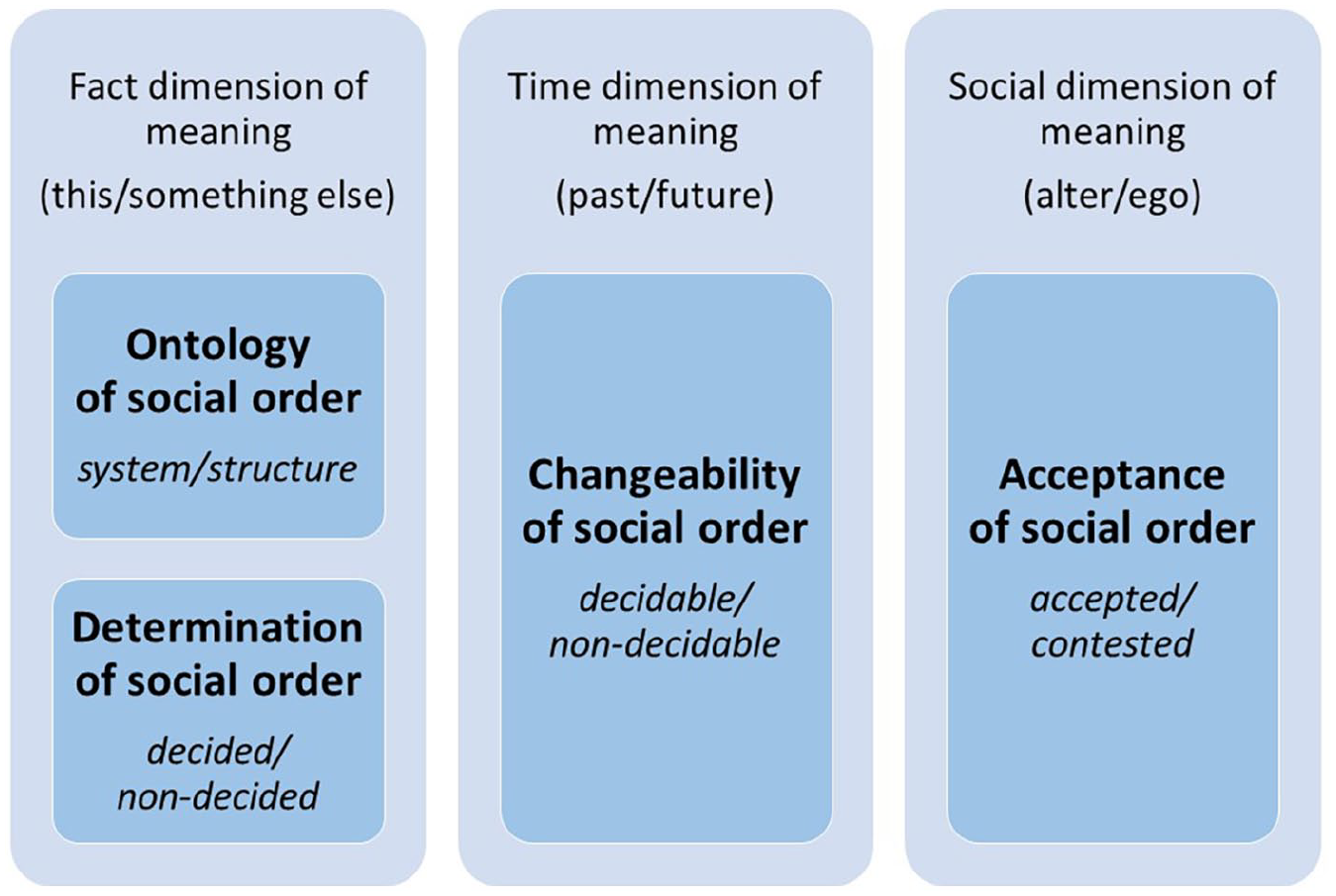
Framework of properties of social order.
Ontology of Social Order
As Grothe-Hammer et al. (2022) have pointed out, one crucial issue with existing concepts of social order is that they often do not (or not explicitly) distinguish between structure and system. If we understand the social world as processual, then meaning can be fixed in two forms: as a structure of and for the processes, and as processual systems (or entities). Structures are stabilized social relations, and hence, temporarily stable expectations that guide social processes. As a structure, social order takes the form of hierarchies, rules, norms, and so on, which guide social processes and are at the same time only produced and reproduced within those processes (Giddens, 1984; Ortmann et al., 2023). However, it is also possible to identify nexuses of interrelated social processes. Whether one theorizes said processes as actions, activities, or communications does not matter at this level of generalization. In any case, it is possible to identify unique nexuses of social processes that are distinguishable from their social environments (Grothe-Hammer, 2022; Luhmann, 1964). This might be a single conversation that is clearly distinguishable from other conversations and has its own meaning. One can also think of a group of friends that builds its own identity and communicative history, or of a corporation that has its own distinctive processes and a nametag over the door. One can understand these nexuses of interrelated processes as social systems or social entities, which fix meaning over time in the sense that they are identifiable as distinctive from the rest, and hence, meaningfully different (see Grothe-Hammer et al., 2022).
On a basic level, all social systems are processual entities in the sense that they consist of interconnected social processes that are distinguishable from their environments. However, as Dobusch and Schoeneborn (2015) remind us, such systems can also gain actorhood in the sense that they can be perceived socially as collective actors and as capable of acting. This is perhaps best visible with corporations that are commonly depicted as actors with wants and needs and which can act, communicate, and be addressed by others (see Grothe-Hammer, 2019). This can also be the case of so-called ‘meta-organizations’, that is, organizations of organizations, which can be recognized as social actors and be held accountable for collective decisions as well (Berkowitz et al., 2020). Moreover, social systems provide collective identities to which individuals or member-organizations can belong or not belong (cf. Cunliffe and Karunanayake, 2023; Laviolette et al., 2022).
We argue that the question of whether a social order is a structure or a system is crucial, for both types of social order have fundamentally different implications. Whereas structures guide and are produced in social processes, systems are processes that take a perceivable form. Drawing from Luhmann’s perspective, one might argue that all social structures are, in essence, components of social systems. This notion implies that any social order is fundamentally a facet of a broader social system (see Guy, 2018). We recognize this viewpoint, but we contend that structures remain distinct from systems in both empirical and theoretical terms. To illustrate, consider the Coca-Cola company: it represents a social system, while its hierarchies and rules represent structures within it. These hierarchies and rules, that is, the structures, are discernible from the overarching system of Coca-Cola. Consequently, we maintain that systems and structures can be differentiated. Systems have structures, but structures do not constitute systems—although they are always the structures of a system (i.e. at least the system of society) and can potentially give rise to new systems or dismantle existing ones.
We contend that the lack of distinction between structure and system explains some of the aforementioned issues with existing frameworks. One might, for example, argue that the aforementioned necessity in transaction-cost economics to define a ‘hybrid’ category between the market order on one hand and the organization order on the other (Williamson, 1991a), is partly a result of an inability to distinguish systems from structures. In transaction-cost economics, organizations are defined as hierarchies. Applying the system/structure distinction makes it possible to see that the one notion—organization—denominates a system, that is, a nexus of interrelated processes, while the other notion—hierarchy—denominates a structure, that is, expectations. As soon as an organization then turns out to be not only a hierarchy, it deviates from the ideal type of organized order. The conscious distinction between system and structure though allows for conceiving of an organization as one type of social order that can incorporate structures as another type of social order, for example, hierarchies.
Determination of Social Order
The determination of social order concerns the existing distinction between decided social order and non-decided order (Ahrne and Brunsson, 2011; Berkowitz and Grothe-Hammer, 2022). The decided/non-decided distinction addresses the question of how the current state of a certain social order was determined. Did it come into existence through a decision or not, or was an existing social order reshaped by an act of decision and thereby turned into decided order? The above-outlined characteristics of decisions—immediateness, specificity, attribution of accountability, paradoxicality—are thereby built into a social order when it has been decided.
It is important to note that this dimension is not about asserting that one could determine what ‘actually’ happened. Instead, the determination of social order is a retrospective attribution. Acknowledging the underlying process-theoretical framework, a social order can be understood only as existing in the process and being dependent on the viewpoint of the actors perceiving a certain social order. This means that certain social orders might be understood as decided or non-decided depending on who is involved and when.
As an example, one might think of a certain set of rules that a new employee learns about on their first day at work from an older colleague. The new employee might then understand and treat these rules as a decided order thinking these are officially created and formalized, while other and more experienced employees might be aware that said rules are rather norms that have evolved over time as a product of a decade-long culture (and are hence not decided). However, when the rules are understood as decided order, the employee will assume that someone was responsible for making them and can hence be addressed or held accountable. The employee might also think these rules are specific in the way they have been explained to them, while experienced colleagues might consider them unclear and ambiguous.
That the decidedness of a social order is a retrospective attribution might also very well lead to cases in which social order has been decided unintentionally—‘a decision of omission’ (Grothe-Hammer et al., 2022: 33; see also Luhmann, 2005). An actor might have said something that is understood by others as a decision about a certain rule—even if this was not the intention of the original actor. However, the said actor might nevertheless be held accountable as the decision-maker.
On a more generalized level, the distinction decided/non-decided marks an important difference in terms of how specific it is understood, as how immediately created it is perceived, if someone is assumed to be responsible, and if it is paradoxical and therefore by default questionable and opposable.
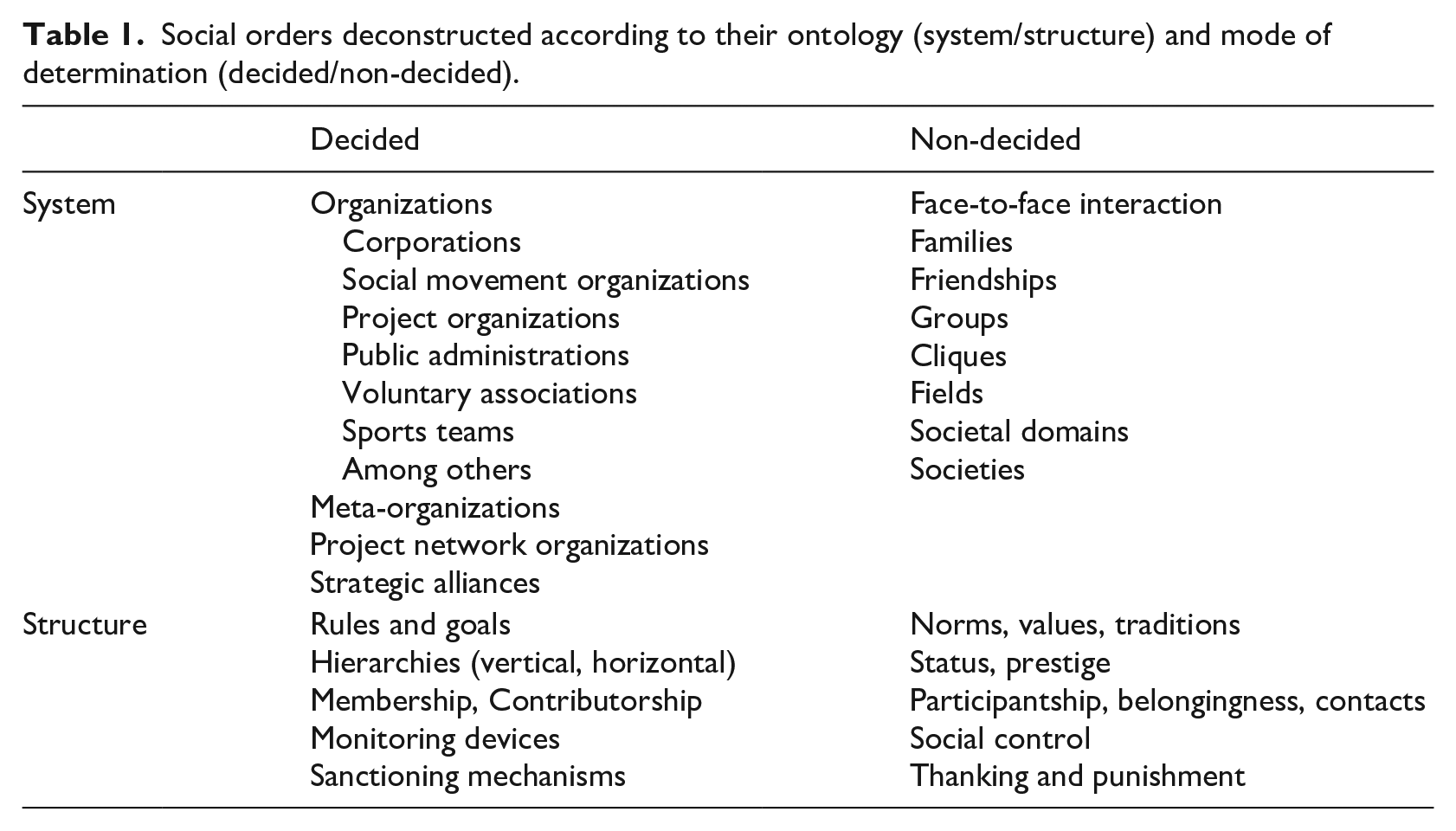
In combination with the structure/system distinction, it is possible to break down complexes of social order into its basic elements (i.e. the singular social orders). One system (e.g. an organization), or one structure (e.g. a rule) can then be treated as singular social orders that in combination make up complexes and layers of social order (Grothe-Hammer et al., 2022). Table 1 illustrates the different kinds of social orders deconstructed according to their ontology (system/structure) and mode of determination (decided/non-decided). Decided systems can be organizations and meta-organizations, which are organizations that have organizations as their members (Ahrne and Brunsson, 2005), some of which are also denominated project network organizations, strategic alliances, or similar. Non-decided systems can be all kinds of nexuses of distinctive interrelated processes including face-to-face interactions, social movements, societal domains, and societies (Luhmann, 2012, 2013); friendships, groups, cliques, and families (Kühl, 2020); as well as fields (Windeler and Jungmann, 2022). And as outlined by Ahrne and Brunsson (2019; see also Ahrne, 2021), decided structures can be adequately described as rules and goals, hierarchies, memberships, monitoring devices, and sanctioning mechanisms—whereas non-decided structures encompass all kinds of expectations.
Social orders deconstructed according to their ontology (system/structure) and mode of determination (decided/non-decided).
Changeability of Social Order
The determination of a social order is about the question whether a social order—a structure or a system—is treated as something that has been decided or not—with the outlined implications. However, if we consider social orders as processual and hence as constantly being reshaped through time, it becomes another question how a social order can potentially change in the future, that is, if a certain order is decidable or not (see crucially Berkowitz and Grothe-Hammer, 2022). We use the term ‘non-decidable’ in distinction to ‘undecidable’ to signify that we do not mean the underlying paradox of undecidability that is inherent in any decision (see above). By ‘non-decidable’, we instead mean ‘the absence of the possibility to reach . . . decisions about changing a social order’ (Berkowitz and Grothe-Hammer, 2022) or about establishing a novel one.
Thus, a social order that has been formed by decision—for example, a status order or a corporation—might have become non-decidable over time. For example, a once decided status order in a company might have become taken for granted over time, and certain organizations once founded by decision might have become so inveterate that it is practically unthinkable that they would not exist. Good examples are certain globally established corporations such as Coca-Cola or certain long-established universities such as Uppsala University in Sweden. With these organizations, it is currently simply unthinkable—presumably for most people—that someone would decide to disband them. Indeed, Coca-Cola and Uppsala University were founded by decisions at some point. Both are decided orders in that sense—very complex and specific, more or less immediately brought into existence (with much preparation of course) through decisions by identifiable founders, and paradoxical in the sense that many would be opposed to drinking Coca-Cola and select Pepsi or tap water instead. But they are there and virtually no one would expect them to be decided ‘away’.
On the other hand, some social orders might be decidable although they have not been decided so far. One might think of certain non-decided norms that have developed over time in an organization and which the organization could principally decide on. If, for example, there is a non-decided rule that all colleagues go together for lunch at 11:30 a.m., the organization could in principle decide to make this an official rule; or it could decide that no one is allowed to go to lunch before 12:00 p.m. At the same time, there is a plethora of norms, values, and biases that cannot be meaningfully decided (Kühl, 2021: 119). For example, in an organization in which certain decisions might be guided by racist, sexist, ageist, or ableist biases, one cannot simply decide that the organization will not be sexist, ageist, ableist, or racist anymore (Smith-Doerr et al., 2023). However, there are many possibilities of creating decided orders that counteract the non-decided norms (Piggott et al., forthcoming).
We assert that the decidability of a social order has important implications. Non-decidable orders might collide in certain settings thereby creating an unsolvable problem. However, acknowledging the relationality of social order, this property is, again, dependent on who observes it. Depending on the standpoints of involved actors, one might perceive an order as decidable and therefore changeable, while for another, the order might be unquestionable. Conflicts might be the result. On a generalized level, the changeability of a social order indicates the agency of involved actors. Decidability implies agency (Blaschke, 2015) and revisability (Shanahan, 2023), whereas non-decidability implies the absence of agency and revisability. When a certain order is decidable, this begs the question: who has the right to make that choice? Hence, inquiring into the decidability of social order also means inquiring into power relations.
Acceptance of Social Order
Changeability, that is, not only the potential for change of social orders, but also agency and the power to effect change, implies our last property, acceptance. The property of ‘acceptance’ of social order delves into a fundamental inquiry: for whom is a particular social order valid, and how is it perceived and received? Some social orders achieve global recognition and applicability, such as universally recognized symbols such as traffic lights, or iconic brands such as Coca-Cola. However, the validity of most social orders appears to be limited to certain sets of people. For example, legal frameworks typically apply only within the borders of a given country, whereas the conventions of how to write a research article pertain exclusively to the realm of science.
Those who are affected by a certain social order can accept it or contest it. For not everyone who is subject to a social order accepts it as a premise for their behavior. For example, criminals can usually be assumed to contest certain laws, and some scientists might reject writing conventions and instead write in different formats. Hence, we argue that it is important to comprehend the reach of a social order and whether those affected accept or challenge it. Notably, those affected may even exhibit varying treatments of social order in different situations. For example, one might publicly endorse a social order while clandestinely plotting against it. Similarly, within organizations, individuals may officially acknowledge certain rules while informally devising workarounds (Luhmann, 1964).
Structures and systems that are perceived as decided, inherently provoke contestation and bring up the question of how they achieve acceptance nevertheless, thus avoiding remaining mere ‘attempts’ (Ahrne and Brunsson, 2011). For structures and systems to become contested, usually the opposite is needed, that is, processes that actively question such an order and make it contestable. Organizations, in the form of systems, however, often attain a high degree of acceptance for their decided structures through (decided) membership. The underlying assumption is that if a member rejects the system’s order, they can simply decide to disengage or leave the organization (Luhmann, 1996a).
Structures and systems that are perceived as established usually imply a certain degree of acceptance and existing identity. Consequently, acceptance of a social order may appear to correlate with its historical longevity. Indeed, social orders perceived as established over an extended period naturally acquire acceptance by virtue of their age. Sheer longevity often serves as a justification for the acceptance and continuation of such orders. It is not uncommon for organizations to rely on the saying: ‘We’ve always done it this way’, to legitimate their practices (Zimmerman, 2019). Similarly, many organizations like to emphasize their longevity by adding an ‘established’ along with their founding year into their logo, exemplified by examples like ‘City, University of London’, which displays ‘est 1894’ in its logo. 2
The acceptance property delves into the dynamics of how social orders are received and interpreted by various actors, considering the relational and subjective aspects of their acceptance or contestation. An accepted social order is perceived as valid and applicable, and therefore can be perpetuated. A contested social order is one that faces challenges or opposition—even if hidden—from individuals or groups who do not fully accept or support it. Contestation can lead to a reevaluation of social orders, their modification, or even their eventual transformation or replacement if the contestation is widespread and persistent. Acceptance, therefore, strongly relates to changeability.
An Analytical Framework of Multi-Dimensional Social Orders
Based on our elaborations, we derive the following list of core questions and main distinctions for each of the four properties of social order (see Table 2):
Properties of social order with corresponding core questions and main distinctions.
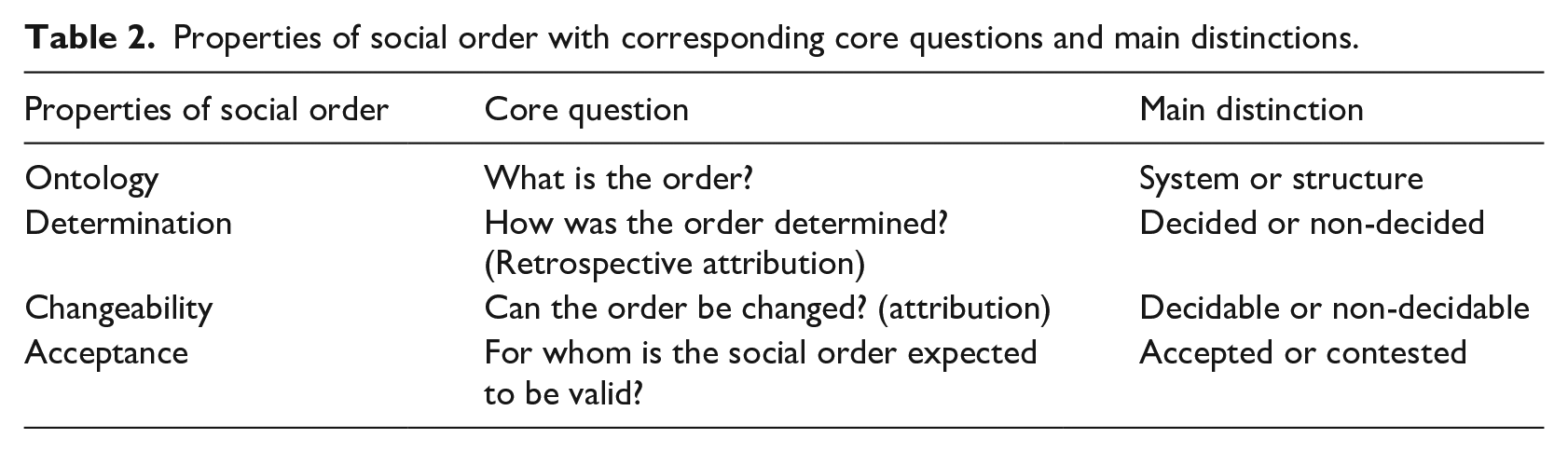
These questions can guide analyses of social orders in all kinds of settings. Thereby, we believe that our framework offers at least three analytical possibilities—multi-dimensional and multi-angle analysis, evolutionary analysis, comparative and multi-level analysis—which we will unpack in the following.
Multi-Dimensional and Multi-Angle Analysis
First, we contend that our framework allows for a fine-grained exploration and understanding of the core characteristics of a social order. The combination of different dimensions of social order thereby provides in-depth information on the combined characteristics of the social order. For example, if a certain observer determines a social order as a structure that is newly formed, and decided but non-decidable, we can immediately assume that the observer might perceive this social order as hollow, meaning that it will not actually guide their behavior. A concrete example could be an organizational rule that the employee must have fun at work. In many, if not most, situations, the affected members will not adhere to the idea that one can simply decide to have fun and, hence, such a rule cannot achieve this by simply stating it. In such cases, we can assume that this order will probably remain an attempt.
Another (oversimplified) example in which the consequences would look a bit different can be a decided organizational rule that employees must not be sexist. Obviously, many will see such a rule as factually non-decidable since many would probably agree that it is not possible to simply decide away sexist biases. However, such a social order can still have useful consequences, for example, as a general orientational value or as a symbolic structure for addressing external demands.
Furthermore, in the description of a social order, we can also take different vantage points into consideration. As outlined above, the concrete meaning of a social order is dependent on the standpoints of the actors observing the order. The different vantage points can add more analytical depth. If we pick up the two examples of organizational rules for having fun and against sexism, different vantage points could offer different insights. It might, for example, be that from the vantage point of the regular employee the rule mandating that employees should have fun might seem obviously non-decidable, while from the vantage point of a manager this rule might be intended to be serious. In such a case, we could deduce that tensions or conflicts would be likely and that the social order would have a chance of getting accepted as a behavioral premise only if it is changed into something that can be perceived as meaningfully decidable.
Evolutionary Analysis and the Identification of Tipping Points
Second, the framework allows for tracing changes of social order through time and, hence, account for the processuality of order, that is, how it moves through time. Ahrne and Brunsson (2019) have already pointed out that social order changes over time, often becoming taken for granted and unquestioned at some point. We follow this line of thinking but would add that social orders are able to change in the other direction as well. For example, an initially decidable and decided order might lose its decidability but not its perceived decidedness over time (or not). Berkowitz and Grothe-Hammer (2022) demonstrated this in the case of the International Whaling Commission (IWC), where the moratorium on whaling was once a decided and decidable order but was at some point rendered not decidable anymore by a change of the organization’s main goals (in turn a decision on a decidable social order) that prevents any future revoking of said moratorium. Hence, the order in question remained decided but was turned into a non-decidable one.
Social orders switch their states in respect to the outlined properties with the exception of ontology. We do not see it as possible that a structure like a rule can be turned into a system like a face-to-face interaction or an organization. Indeed, systems always have structures, and structures are always structures of a system and might even spawn systems or end them. But a social order cannot develop into another ontological state. However, regarding the other three properties—determination (decided or non-decided), changeability (decidable or non-decidable), acceptance (accepted or contested)—we assert that social order can switch back and forth between properties.
At times, different sets of people may hold significantly contrasting perspectives regarding a particular social order. These differences become particularly apparent when disputes and negotiations arise. Take, for example, the current production of the TV show ‘Daredevil: Born Again’. The production has been accused of being in fact a continuation of an earlier TV show that was called simply ‘Daredevil’, but pretending to be an original production, allegedly to break contractual obligations with the former employees and business partners involved in the prior production (Sharf, 2023). As a result, the claim that ‘Daredevil: Born Again’ represents a new production and, by extension, a new system, rather than a continuation of an established one, has generated significant controversy. We assume that this dispute likely arises, at least partly, from the fact that the previous production had provided an identity that is reactualized in the new production.
Overall, an evolutionary analysis allows to inquire into ‘how’-questions, that is, questions of how social orders and the perceptions thereof change, and how these changes interact. This analysis might in turn enable researchers to identify tipping points as to when a social order switches the binary in one or more dimensions, for example, from decidable to non-decidable. This would moreover call for a further analysis of why and how such tipping points are reached, and what the consequences of such a tipping event are. This is, of course, always a retrospective attribution. However, as researchers, we can still explore how this attribution changed, or has changed, over time by, for example, retracing how a certain social order was treated as decided at one point and then later came to be treated as non-decided. Figure 2 synthesizes our framework and identifies places for tipping points, within one property, and across properties.
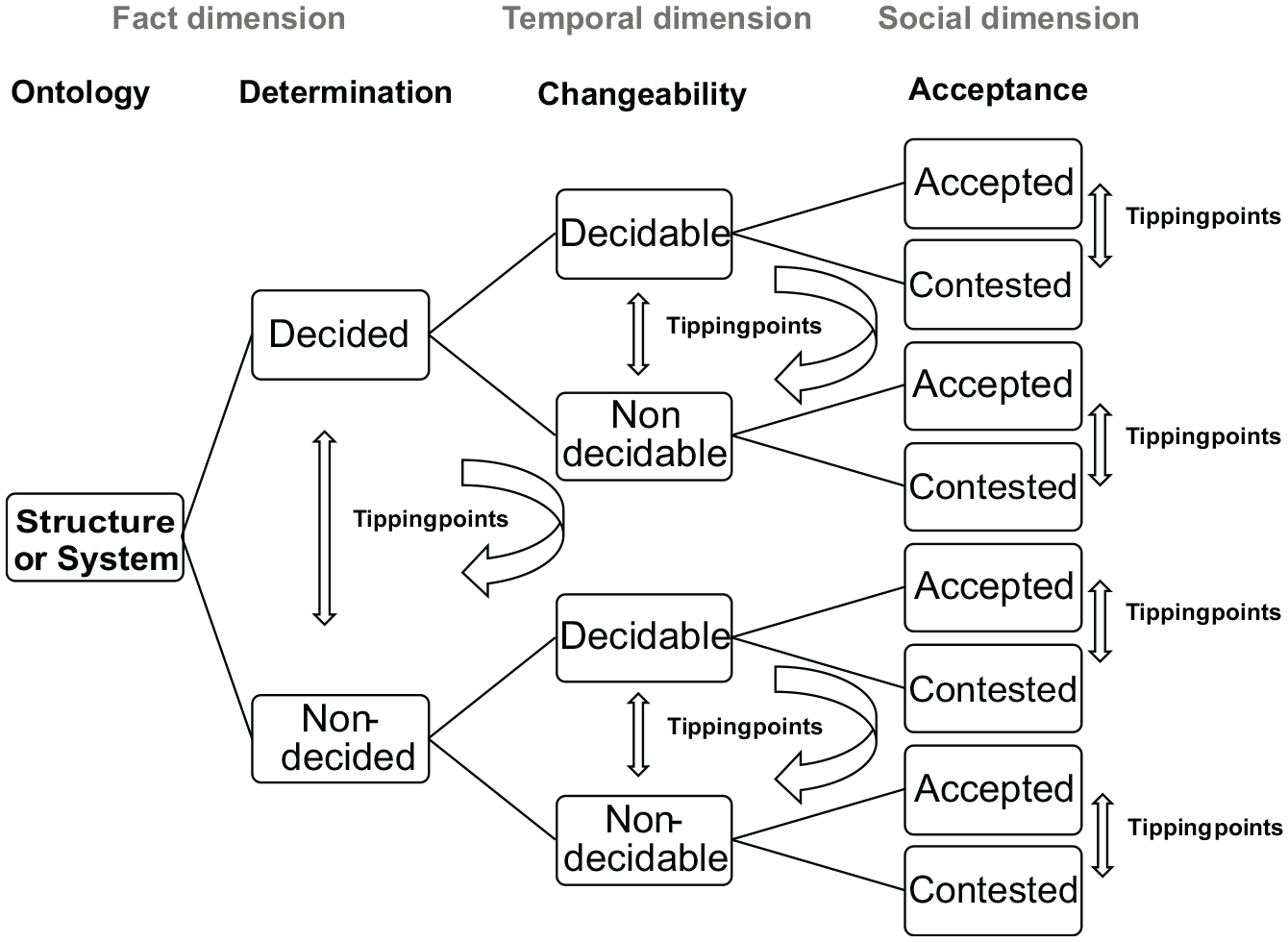
Framework for understanding social orders as an articulation of properties and binaries.
Comparative and Multi-Level Analysis
Third, our framework allows for comparing different social orders in order to explore how they differ or resemble each other, and how certain orders interact and interfere with each other. On a basic level, this dimension concerns relatively simple comparisons, for example, between the position structures or rule complexes of different settings. However, social orders never come alone; they are always embedded in and nested into a complex mesh of other social orders. Rules and hierarchies are, for example, embedded in organizations, which are in turn embedded in larger contexts of standards, controls, and (often) meta-organizations (Brunsson et al., 2022), and all of these are always embedded in complexes of social norms and values and status orders (Grothe-Hammer et al., 2022).
In this respect, we can draw again on the previously mentioned study by Berkowitz and Grothe-Hammer (2022), in which they try to explain why Japan left the IWC in 2018. The IWC can be described as a complex meta-organization with hierarchies, rules, and goals, decided memberships, and monitoring systems. Hence, we find a system (i.e. the IWC) that is perceived as decided and which has a long history as a decided system, which moreover has decided and decidable structures, many of which also have a perceived history. The political members are nation states, which are, on one hand, state organizations with their own rules and goals, hierarchies, members (state employees) and so on, but which are, on the other hand, embedded in their own national cultures with a myriad of non-decided values, norms, purposes, status orders, and so on. Comparing the pro-whaling member states and anti-whaling member states, Berkowitz and Grothe-Hammer (2022) first show that these feature strong and incompatible, non-decided and non-decidable norms about whaling—with Japan having norms that find whaling an acceptable practice, and anti-whaling nations having norms that find whaling morally wrong and that it must be prohibited for everyone. On the meta-organizational level of the IWC though, there had been a moratorium on whaling for decades. Berkowitz and Grothe-Hammer (2022) then, second, find that said moratorium had until 2018 always been perceived as a decided but yet decidable rule—meaning that although the rule was not in line with the non-decided cultural contexts of all members, especially Japan, it at least appeared to be changeable. However, in 2018, the anti-whaling members then successfully implemented a change of the overall goals of the IWC, which now define whale conservation and the restoration of whale stocks to pre-industrial levels as primary. According to Berkowitz and Grothe-Hammer (2022), this, third, turned the moratorium effectively and indefinitely from a decidable into a non-decidable rule. For in order to lift the moratorium, one would now need to change the overall goals first. In our opinion, this represents what we call a tipping point. As a result, Berkowitz and Grothe-Hammer (2022) conclude that Japan saw that it had no chance of changing the organizational rules at any point to match their own cultural norms again, and hence left.
In our view, this example illustrates how a comparative, multi-level analysis of social orders, allows for analyzing the interconnectedness of social orders in combination with their inherent differences with respect to the four properties. This makes it possible to uncover fundamental and potentially incommensurable differences as well as their possible compatibilities.
Discussion
The question of social order and how it comes about has been a major focus in sociological research, covering a wide range of perspectives and theories from the micro to the macro level. As we pointed out, many concepts of social order feature either singular notions—such as an institution or network—or binary notions that usually distinguish between two forms of social order—one that is consciously constructed (often termed ‘organization’) and one that emerges unintentionally. We have argued that these existing works fall short when it comes to accounting for the empirical complexity and manifoldness of social order, and proposed a framework of social order that expands the gaze of existing works.
To do so, we picked up one of the existing binary concepts of social order, that is, the distinction between decided and non-decided social order (Ahrne and Brunsson, 2011), and its underlying assumptions of the constructedness, processuality, and relationality of social order. By drawing on a number of seminal predecessor works (especially Ahrne and Brunsson, 2019; Berkowitz and Grothe-Hammer, 2022; Grothe-Hammer et al., 2022), we developed a framework in which we expanded the existing binary and offered four properties of social order that are themselves binaries: ontology, determination, changeability, and acceptance. These four properties refer to the question of what an order is (ontology), how it was established (determination), how it can potentially change in process (changeability), and how accepted and contested it is (or was) from various perspectives (acceptance). By taking seriously the relationality and processuality of social order, we seek to account for the observer-dependent meaning of social orders, and the importance of temporal dynamics, that is, past, present, and future, in understanding social orders.
In terms of existing singular notions of social order, we would like to highlight the following implications for the notions of organization, institution, and network. The notion of organization, in our opinion, still remains a meaningful concept intricately connected to decisions. Indeed, we argue that our framework adequately captures all of the common, yet often competing, conceptions of organization in the existing literature where organization is depicted either as a system (or actor) of interconnected elements, as structure, or as process (Schoeneborn et al., 2019). Mirroring this triad, a decided system can be called an organization, a decided structure might be called an organized state or an organizational element (or ‘organization’ without an article), and a decidable order might be called organizable (in process).
The term ‘institution’ on the other hand becomes inapplicable. While many have argued that institutions are orders that are ‘taken for granted’ (Jepperson, 1991), in our framework it becomes apparent that taken-for-grantedness can take many shapes with significantly differing effects. Indeed, an institution could mean any social order that has become non-decidable over time and remains accepted, as Ahrne and Brunsson (2019) have argued. However, many institutionalists would call any order that has become generally taken for granted, an institution (Hall and Taylor, 1996), although this order might very well be decidable and/or contested. With these considerations, we are immediately touching on a sore spot of institutional and neo-institutional debates, that is, the concept is blurry, and anything tends to become an institution under this gaze (Alvesson et al., 2019; Buchanan, 2020; Hall and Taylor, 1996). Our proposed framework, however, offers a far more fine-grained and concise understanding of social order, especially of the inherent differences between different kinds of social orders that are usually all lumped together under the term ‘institution’.
Furthermore, a similar criticism can be applied to network as a concept. Social network analysis constitute a specific and rich methodological approach that can be used to study flows, proximities, and distances among nodes and ties. Conceptually, however, the term ‘network’ has been used to denominate all kinds of social order (Borgatti and Halgin, 2011). Accordingly, Ahrne and Brunsson (2011) suggested using the term ‘network’ only in a narrow understanding for non-decided order. Building on this suggestion, we believe that ‘network’ might be an adequate description for social orders that are non-decided systems. We contend that determination is the most important property here to define networks. In this meaning, the concept of network would stand for a distinctive set of interconnected elements, whose interconnections would not be attributed to a decision. We believe that this represents a meaningful and reasonably narrow definition of a network as a set of connections that just happen to be connected.
Against this backdrop, we believe that our framework enables scholars to analyze the nature, layering, intertwining, and transformation of various types of social orders, including those that have been studied previously under the concepts of organization, network, and institution. We believe that our framework and the four properties of social order (ontology, determination, changeability, and acceptance) can be applied to broad historical transformations such as industrial or ecological transitions, as well as social revolutions. In the case of historical social revolutions, for instance, using our social orders framework would involve exploring changes in the properties of the social orders brought about by the revolution. It would involve looking at the creation of new structures and systems, examining the events, actors, collectives, and decisions that led to the determination of the new social orders after the revolution and identifying whether this was perceived as decided or non-decided. Analyzing changeability would, furthermore, mean asking whether actors perceived old and new social orders as decidable and if so how. This might be where a dynamic analysis in terms of tipping points, that is, conditions bringing forth binary changes in the dimensions of social order, might be useful and interesting. This could potentially shed new light on the disruptions of social orders and the underlying mechanisms driving those changes.
Our framework makes three contributions to the analysis of social orders. First, our framework allows for examining tipping points. This means investigating the conditions that might lead to a shift in the characteristics and perception of a social order. The focus on tipping points puts the emphasis on the distinction between two sides of a binary, such as decided and non-decided, decidable and non-decidable, accepted and contested. It encourages one to investigate what determines these perceptions and when a social order switches between them. Second, our framework makes it possible to unpack complexity in a novel manner by analyzing social orders in a multi-dimensional perspective. It challenges existing theoretical approaches that oversimplify social orders by featuring a single binary or core concept. Instead, the proposed framework allows for a fine-grained examination of different properties of social order, their intertwining and evolutions. Third, the framework allows for the identification of incompatibilities and, hence, revealing conflicts or contradictions between different social orders. It suggests that, when diverse social orders converge in a structured space, incompatibilities are likely to arise (cf. Berkowitz and Grothe-Hammer, 2022; Laamanen et al., 2020). Furthermore, the framework offers a way to unpack organizational cultures into various dimensions of social order and investigate which aspects are perceived as decidable or decided. We are aware that emphasizing particular conceptual tools, in our case social order, poses certain challenges. We encourage future research to explore the articulation between our framework and other concepts, beyond that of institution and networks. In particular, we see promising venues in analyzing how social orders are articulated with, evolve in or around fields, ecosystems, domains, and other related concepts.
Overall, the framework provides a comprehensive approach to understanding social phenomena by considering tipping points, unpacking complexity, and identifying incompatibilities in social orders. This could be applied to a variety of social phenomena, traditional ones such as states or international organizations, but also newer ones such as projects, social movements, fluid organizations, meta-organizations, alternative organizations, collectives with or without actorhood, among others. Phenomena and practices at different levels could also be analyzed through our framework, from micro levels, delving into organizational phenomena such as organizational hypocrisy and decoupling, organizational deviance, workplace bullying or effects of diversity policies as decided tools for change, to macro levels such as socio-ecological crises and transformations, beyond single units of organizations. A lot of work needs to be done to fully understand the ramifications of this framework.
Footnotes
Acknowledgements
This manuscript was handled by the Editor in Chief of this journal, David Fasenfest, and assessed by two anonymous reviewers. We wish to thank the reviewers and Robert Jungmann for their invaluable comments and suggestions. This article also benefited from helpful feedback from participants at the International Conference on Organizational Sociology (ICOS) on ‘Organizations in a Plural Society’ in Trondheim, Norway, the Score Conference on ‘Organizing the World 2.0’ in Stockholm, Sweden, and the session on ‘Aktuelle Forschungen der Organisationssoziologie’ [Current research on organizational sociology] at the 41st Congress of the German Sociological Association in Bielefeld, Germany. Last but not least, we wish to thank the ÅSGARD Research Mobility Program for facilitating Héloïse Berkowitz’s research stay at NTNU in Trondheim in 2022.
Funding
The author(s) disclosed receipt of the following financial support for the research, authorship, and/or publication of this article: This work received support from the French government under the France 2030 investment plan, as part of the Initiative d’Excellence d’Aix-Marseille Université – AMIDEX AMX-21-PEP-036.
