




Abstract
Ibn Khaldûn (1332–1406) was a philosopher, historian and sociologist. This paper asks: What elements of the Political Economy of Communication are there in Ibn Khaldûn’s work and how do they matter in digital capitalism? It presents relevant passages from Khaldûn’s main work Muqaddimah and points out parallels between the Muqaddimah and works in Political Economy, especially Karl Marx’s approach of the Critique of Political Economy. The comparison of Khaldûn to Marx is not an arbitrary choice. Several scholars have pointed out parallels between the two’s works with respect to general Political Economy. It, therefore, makes sense to, also, compare Khaldûn and Marx in the context of the Political Economy of Communication. The paper analyses the relevance of Khaldûn’s ideas in digital capitalism. Khaldûn’s works are situated in the context of media and communication theory, digital automation, Facebook, Google, labour in informational and digital capitalism, Amazon, the tabloid press, fake news and post-truth culture. The analysis shows that Khaldûn’s Muqaddimah is an early work in Political Economy that can and should inform our contemporary critical analysis of communication in society, communication in capitalism and class society, ideology and digital capitalism. What connects Marx and Khaldûn is that they were critical scholars who although living at different times in different parts of the world saw the importance of the analysis of class and communication. Their works can and should inform the Political Economy of Communication and the analysis of digital capitalism.
Keywords
Introduction
This paper asks: What elements of the Political Economy of Communication are there in Ibn Khaldûn’s work and how do they matter in digital capitalism? It aims to show that the Political Economy of Communication is not a purely Western intellectual project, but also has foundations outside of the Western world. Scholars in different part of the world who thought critically about society, class society and communication have come to comparable conclusions.
The Political Economy of Communication is an approach to the study of communication that has become established in the form of actual research conducted and published in books (Birkinbine et al., 2017; Chakravartty and Zhao, 2008; Dyer-Witheford, 1999; Fuchs, 2020a, 2020b, 2021, 2024; Golding and Murdock, 1997; Hardy, 2014; Huws, 2003; Mattelart and Siegelaub, 1979, 1983; Meehan and Riordan, 2002; Mosco, 2009; Mosco and Wasko, 1988; Wasko et al., 2011; Winseck and Jin, 2011) 1 and journals (tripleC: Communication, Capitalism & Critique, The Political Economy of Communication), networks of researchers such as the IAMCR’s Political Economy Section, modules taught at universities and research projects.
The Political Economy of Communication is an approach to the analysis of the roles of media and communication in society. It utilises social theory, empirical social research and moral philosophy. It studies how the interaction of politics and the economy influences the roles of media and communication in society. It sees the dialectic relationship between the economy and politics as the most important factor shaping media and communication in society. An important focus is the analysis of the production, distribution and consumption of information and the media in the context of society. The Political Economy of Communication is often a critical analysis of how communication works in capitalist society, how the media are organised in capitalism, and how communication and media in the context of capitalism make an impact on society and the lives of humans in society.
The task of Critical Sociology is that it analyses society’s power structures, which means the interaction of class relations and domination, and illuminates ways of how society’s problems can be overcome. The task of a Critical Sociology of Media and Communication, therefore, is that it analyses media and communication in the context of society’s power structures and illuminates ways of how democratic communications can be established as part of advancing justice, equality, solidarity and fairness. Such an analysis needs to ask what the relation is of economic phenomena such as classes as well as non-economic phenomena. A Critical Sociology of Media and Communication therefore is confronted with the problem of how to think of the relationship of the economy and society. Critical Political Economy is one way of approaching this issue. It argues that the economic and therefore classes in class societies are a key feature of societal analysis, that the non-economic is based on but cannot be reduced to the economic, that classes are key foundational features of all phenomena in class societies such as capitalism but that one cannot reduce social phenomena to class as there are emergent properties. Class analysis therefore is a necessary although not sufficient feature of critical sociology and the Critical Sociology of Media and Communication. The task of this paper is to engage with the philosophical foundations of the Critical Sociology of Media and Communication, particularly the works of Ibn Khaldûn and Karl Marx. Both were representatives of Political Economy, and, as I will argue, are representatives of Critical Political Economy of the Media and Communication.
In the book Mediated Society: A Critical Sociology of Media, Jackson et al. (2011) argue for understanding the Critical Sociology of the Media as a sociology of the mediated society. They argue that Critical Sociology ‘puts into question dominant social practices’ and ‘serves the principle that a better world is possible’. They say that Marx was the ‘first and most important critical sociologist’ but give equal importance to many other approaches from ‘interactionist and structuralist sociology’, ‘communications literature’, ‘dialogical, deconstructive, and poststructural theories’. In contrast, the approach the present author has advanced holds that Marx and the tradition building on him have a special and the most important role in the Critical Sociology of the Media and Communication. This does not imply that we cannot learn anything from other approaches. Rather, taking Marx as starting point opens up a critical position that allows critical and constructive interaction with other approaches by drawing from the rich wealth of materialist, dialectical, humanist and praxis-oriented theory.
Ibn Khaldûn (1332–1406) was a philosopher, historian and sociologist. He was born and lived in Tunis which was part of Ifriqiya which was ruled by the Hafsid dynasty. Ifriqiya comprised contemporary Tunisia, the East of Algeria and the West of Libya. During Ibn Khaldûn’s life, the Hafsid Empire was in crisis. The Marinids, the dynasty that ruled contemporary Morocco, conquered Ifriqiya twice. The Hafsids regained power. There were also plague epidemics. Some in Khaldûn’s family were politically influential, which enabled his privileged position and access to education so that he studied the Quran, philosophy, mathematics, and logic. Khaldûn worked as a writer, diplomat, politician, teacher, and judge for various rulers.
He is considered a founder of ‘economics, anthropology, political science and historical geography’ (Deen, 2010: 157) and ‘one of the great founders of the modern social sciences’ (Santos, 2017: 279). Khaldûn’s ‘advances in the direction of a scientific social thought are unequalled before him and unsurpassed until the eighteenth and nineteenth centuries’ (Amin, 2009: 133).
Written in 1377, the Muqaddimah (‘Introduction’, ‘Prolegomena’) is Khaldûn’s main work. It analyses the history and constitution of society and the sciences. The context of Khaldûn’s academic work was religious and feudal empires. Khaldûn ‘gave a perfect analysis of the nature’ of the
social formations of the medieval Maghreb. With an intelligence and exactitude that might be envied by many historians and sociologists of the Arab world today, he analysed these formations as being based not on a surplus levied from the peasants of the region but on the profits of large-scale trade. It was in this way that all the great states of the Maghreb were founded upon the trade in gold, the gold in question coming from West Africa. (Amin, 1976: 43).
Ayubi (2008) analyses Khaldûn’s class analysis as well as approaches that have built on Khaldûn and introduces the notion of the nomadic kin-ordered mode of production that he also characterises as conquestal mode of production and military mode of production where there is a conflict between nomadism (badawa) and urbanity (hadara) and that later turned into what Amin (1976, 2009) terms the tributary mode of production. In this mode of production,
political power is not derived from the relations of production but from a sense of group solidarity leading to domination and to the acquisition of privilege and ready wealth. [. . .] monies are collected to be distributed among the fighters and the officials for consumption but not for investment. The ‘conquestal’ economy in short is based on ‘wealth accruing to the state, via statist methods, to be spent by the statesmen’ [. . .] In such a kind of political economy, the ‘booty’ (al-ghanima) takes pride of place: it is the source of income (which may by extension be tributary), it reflects itself on distribution (which is based on donation), and it promotes a certain ‘rentier mentality’ [. . .] Conquests and wars are common among nomads, not only over immediate water and pasture resources, but by way of establishing a certain ranking order among the tribes and, of course, over the settled communities, whereby the stronger tribes would collect a khuwwa (a ‘status’ tax enforced on the militarily weaker units). [. . .] the characteristics of the lineage mode of production coloured the early experience of the Arabo-Islamic state. As we have already seen, the lineage mode of production is transformed via two possible mechanisms. Historically, Arab nomadism (and other Middle Eastern nomadisms such as that of the Berbers, Turks, Mongols, etc.) was weakened through a process of urbanisation (e.g. as with the first Islamic state; the North African states of Ibn Khaldun; the Saudi state, etc.). Nomadism can also be weakened, as we shall see later, through a process of ‘pinning down’ to agricultural land (e.g. the late Abbasid, the late Ottoman, and the Colonial eras). These are also precisely the processes that transform tribe into state, because they divide the population into a class of surplus producers and a class of surplus takers. Such a transformation requires mechanisms of domination to ensure that surpluses are transferred on a predictable basis from one class to another. This cannot be secured without the development of an apparatus of coercion to maintain the basic division into classes and to defend the resulting structure against external attack: namely the state. (Ayubi, 2008: 50, 52, 60–61)
For answering the question this essay poses, I searched for passages in Khaldûn’s (2015) Muqaddimah 2 that are relevant for understanding (a) communication in society, (b) communication in capitalism and class societies, and (c) ideology. I will, in this paper, point out parallels between the Muqaddimah and works in Political Economy, especially Karl Marx’s approach of the Critique of Political Economy, and analyse the relevance of Khaldûn’s ideas in digital capitalism. Khaldûn’s works are situated in the context of media and communication theory, digital automation, Facebook, Google, labour in informational and digital capitalism, Amazon, the tabloid press, fake news and post-truth culture.
The comparison of Khaldûn to Marx is not an arbitrary choice. Several scholars have pointed out parallels between the two’s works with respect to general Political Economy (Gellner, 1961; Hasan, 2007; Hopkins, 1990; Mouhammed, 2007; Muheramtohadi, 2018; Santos, 2017; Soofi, 1995). It, therefore, makes sense to also compare Khaldûn and Marx in the context of the Political Economy of Communication. Some scholars have acknowledged Khaldûn’s contributions to the study of language and communication (Abdussalam, 1995; Cooke, 1983; Mowlana, 2003; Osman, 2003), but have not specifically addressed the Political Economy of Communication.
The second section focuses on communication in society. The section that follows discusses communication in capitalism and class societies. Then follows a section that focuses on ideology. These are dimensions of the Political Economy of Communication to which Khaldûn’s work contribute. The final section presents conclusions.
Communication in Society
Khaldûn (2015: 45) argues that humans are by nature political, which means they depend on decision-making in social organisations, and that they are social, co-operative beings who only together can produce a sufficient amount of food and other goods they require to live. ‘Through co-operation, the needs of a number of persons, many times greater than their own, can be satisfied’ (Khaldûn, 2015: 45). ‘It is absolutely necessary for man to have the co-operation of his fellow men’ (Khaldûn, 2015: 46). A ‘single human being cannot live by himself, and his existence can materialize only in association with his fellow men’ (Khaldûn, 2015: 336).
Khaldûn argues that the political nature of humans not just means that they, due to the complexity of society, have to engage in collective decision-making, but that they are political economic beings who are social and co-operative. Comparatively, Marx (1857, 1858, 1993) argues:
The human being is in the most literal sense a ζϖου πολιτιχσυ [a political animal], not merely a gregarious animal, but an animal which can individuate itself only in the midst of society. Production by an isolated individual outside society – a rare exception which may well occur when a civilized person in whom the social forces are already dynamically present is cast by accident into the wilderness – is as much of an absurdity as is the development of language without individuals living together and talking to each other. (p. 84)
Both Khaldûn and Marx stress that the human being is a social being. They point out that the social constitution of humans means that they have to work and produce together for them and society to exist. Marx also hints at the fact that the social nature of humans implies that they are communicative beings. Humans have to talk to each other to organise their lives and society. Social production is the basic constitutions of humans. They produce and reproduce their lives and society and can only do so in and through social relations. Production involves not just the production of physical goods, but also the production of ‘conceptions, ideas, etc’. (Marx and Engels, 1846 [1845]: 36)
Khaldûn and Marx are political economists, which includes that they stress the importance of the economy and therefore of work and production in society. They conceive of the human being as producing being. Communication and language are not separate from production, but specific forms of production and products. Marx (1857, 1858, 1993) points out that language is the product of communities and society:
As regards the individual, it is clear e.g. that he relates even to language itself as his own only as the natural member of a human community. Language as the product of an individual is an impossibility. But the same holds for property. Language itself is the product of a community, just as it is in another respect itself the presence [Dasein] of the community, a presence which goes without saying. (p. 490)
We can add that there is a dialectic of communication and production (Fuchs, 2020a: Section 4.2): As it is a social relation, production requires communication; communication is a particular type of production: it (re)produces social relations, sociality and society. There is the communicative character of production and the productive character of communication.
Khaldûn (2015) stresses that the ‘power of thinking’ is a ‘rational power’ (p. 76). ‘The crafts and sciences are the result of man’s ability to think, through which he is distinguished from the animals’ (Khaldûn, 2015: 314, see also 333, 335). Just like animals, humans perceive the world. Unlike animals, humans can go beyond their senses and abstract from sensibilia (Khaldûn, 2015: 333). Humans have a discerning intellect in perception, an experimental intellect that enables apperception, experience and social relations, and a speculative intellect by which they create knowledge ‘of an object beyond sense perception without any practical activity’ (Khaldûn, 2015: 334). Khaldûn (2015: 335) argues that there is a human dialectic of thinking and action: Humans have ‘the ability to think, and the hand. With the help of the ability to think, the hand can prepare the ground for the crafts’ (p. 46). There is a dialectic of consciousness and production. Marx stresses in this context that consciousness is a ‘social product’ (Marx and Engels, 1846 [1845]: 44) that just like language arises ‘from the need, the necessity, of intercourse with other’ humans (Marx and Engels, 1846 [1845]: 44).
The dialectic of thinking and action and the dialectic of consciousness and production, that Khaldûn and Marx stress, also mean that conscious production enables humans to anticipate the results of production, that is, they are able to reflect on the consequences and results of their actions before producing differences in the world. A further consequence is that humans are moral beings who think about what actions and results are good or bad. Marx (1990 [1867]) pinpoints the anticipatory reflection of humans in the following manner:
A spider conducts operations which resemble those of the weaver, and a bee would put many a human architect to shame by the construction of its honeycomb cells. But what distinguishes the worst architect from the best of bees is that the architect builds the cell in his mind before he constructs it in wax. At the end of every labour process, a result emerges which had already been conceived by the worker at the beginning, hence already existed ideally. Man not only effects a change of form in the materials of nature; he also realizes [verwirklicht] his own purpose in those materials. And this is a purpose he is conscious of, it determines the mode of his activity with the rigidity of a law, and he must subordinate his will to it. (p. 253)
Khaldûn argues that work requires skills, which he reflects in the notion of crafts. ‘The crafts require teachers’ (Khaldûn, 2015: 314). The crafts are ‘scientific. Thinking and speculation are applied to them’ (Khaldûn, 2015: 300). ‘Crafts become excessive when civilization develops excessively’ (Khaldûn, 2015: 315). For Khaldûn (2015: 319–332), the crafts include agriculture, architecture, tailoring, carpentry, weaving, midwifery, writing, book production, singing, and medicine. Crafts for Khaldûn do not just involve physical production, that is, work that produces tangible products, but also the production of knowledge, namely, the writing-up of ideas and the creation of entertainment. Khaldûn sees writing as a particularly important craft. Writing externalises ‘what is in the soul’ in the form of letters (Khaldûn, 2015: 327). It ‘comes second after oral expression’ (Khaldûn, 2015: 327) and is one of the features that make humans different from animals (Khaldûn, 2015: 327). Writing reveals ‘what is in the mind’ and to learn about ‘distant places’, science and the past (Khaldûn, 2015: 327). Transporting ideas in space and time requires the craft of book production (Khaldûn, 2015: 328). Khaldûn stresses the productive, creative, skilful character of writing. He also points out that science and scientific education are crafts that need in addition to research skills, also the skills of discussion and disputation (Khaldûn, 2015: 341, 348).
Khaldûn (2015) argues there is a dialectic of thinking and communication so that thoughts are ‘communicated to someone else’ (p. 411). One version of communication is ‘verbal expression’, communication in speech (Khaldûn, 2015: 411). Another one ‘is the communication of one’s thoughts to persons who are out of sight, or bodily far away, or to persons who live later and whom one has not met, since they are not contemporaries. This is written communication’ (Khaldûn, 2015: 411). Languages are ‘habits similar to crafts’ that humans use for ‘the purpose of expressing ideas’ (Khaldûn, 2015: 438).
Khaldûn created an understanding of media and communication. He distinguishes between face-to-face communication by speech and mediated communication. At the time he lived, verbal communication in the form of speaking, singing, and music as well as writing and reading printed materials were the two dominant forms of communication. Therefore, he had to limit mediated communication to writing. History saw the emergence of further forms of mediated communication, including telegraphy and telephony, audio and audio-visual recordings, radio, television and digital communication. The basic distinction between direct, face-to-face communication and mediated communication is also still valid and important today. It can be found in contemporary theories of media and communication (Fuchs, 2020a: 156–160; Hepp, 2013: 64–68; McQuail and Deuze, 2020: Chapter 6; Thompson, 1995: 85; Williams, 2005 [1980]: 53–63).
Besides contributions to the analysis of communication in society, Khaldûn also created knowledge that helps us today better understand communication in capitalism. The next section will look at such aspects of his work.
Communication in Capitalism and Class Societies
We will discuss three specific political economy aspects in this section: the Labour Theory of Value; labour, class and exploitation; merchant’s capital.
The Labour Theory of Value
Khaldûn advanced the foundations of a Labour Theory of Value. The basic idea of the Labour Theory of Value is that labour is the source of value in the economy and value is measured by (average) labour-time. It stresses the central role of work and working time in the economy. A consequence of this theory is the argument that the more time it takes on average to produce a good, the higher its value. It is disputed and depends on the concrete approach if value exists in all economies, or all market-based economies, or just capitalist economies. What Labour Theories of Value have in common is the argument that in market economies, commodities containing more labour-time than others tend to be sold at higher prices.
Khaldûn (2015) argues that surplus and the reproduction of society and humans are based on labour and the value labour creates: ‘[g]ain and sustenance represent the value realized from labour among civilized people’ (p. 241). There is also a basic understanding in Khaldûn’s (2015) work that a good is economically more valuable when it contains more labour-time: ‘When there is more labour, the value realized from it increases among the (people). Thus, their profit of necessity increases’ (p. 273). Khaldûn’s distinction between sustenance and capital accumulation resonates with Marx’s (1990 [1867]: Chapter 9, 10) concepts of necessary labour and surplus-labour in capitalism.
The classical political economists Adam Smith and David Ricardo just like Marx and Khaldûn assume that labour is the source of the commodity’s value and labour-time is the measure of this value. Smith (1976 [1776]) argues that labour ‘is the real measure of the exchangeable value of all commodities’ (p. 47). Ricardo (1821) stresses that things become ‘more or less valuable in proportion as more or less labour’ is ‘bestowed on their production’ and that things are ‘more or less valuable, in proportion as they will exchange for more or less of this standard measure’ (p. 5). Marx (1990 [1867]) argues:
The value of a commodity, therefore, varies directly as the quantity, and inversely as the productivity, of the labour which finds its realization within the commodity. (Now we know the substance of value. It is labour. We know the measure of its magnitude. It is labour-time. (p. 131)
Mainstream economics tends to mostly ignore the Labour Theory of Value. For example, widely used Economics textbooks such as Blanchard et al.’s (2017) Macroeconomics, Mankiw’s (2018) Principles of Macroeconomics or Williamson’s (2018) Macroeconomics do not mention Marx, define money as the measure of economic value (Mankiw, 2018: 321), and disregard the role of the working class and its labour in capitalism. 3 Although the Labour Theory of Value plays no role in contemporary mainstream Eeconomics, it continues to be of relevance in the age of digital capitalism. For example, struggles for or against automation and its impacts on society are struggles over value and labour-time (Fuchs, 2019: Chapter 4). Capital tries to use digital and nowadays AI-based automation to increase the productivity of labour so that more value can be produced in less time, which requires hiring and paying fewer workers and promises more profit. Representatives of working-class interests in contrast fear and stress that automation in capitalism can increase unemployment, poverty and inequality.
Some of the world’s largest transnational corporations are digital platforms such as Facebook and Google which make money by selling targeted advertisements. They try to attract as many users as possible to their platforms and programme their algorithms in ways that try to increase the time users spend on the platform, the number of likes they make, the number of items they interact with and so on. Time spent on digital platforms is attention time resulting in potential attention to ads and potential clicks on ads, by which ad-based digital platforms accumulate capital. Ad-based platforms earn money either when ads are viewed or when users click on ads. On Facebook, Instagram, Google and YouTube, the time users spend on the platform is labour-time that creates attention, content, social relations, likes, data and meta-data that together allow targeting ads according to interests (Fuchs, 2021). The more time a specific user-group, such as teenagers whose favourite beverages are soft drinks, spends on the platform and the more users belonging to this group are on the platform, the more valuable this audience group is for the platform. Usage time is labour-time creating the audience commodity (Fuchs, 2012; Smythe, 1977). A highly valuable usage group spends lots of time on Facebook, which allows the company to target lots of ads at it and derive more profit from this group than from a small interest group that spends little time on Facebook. Capitalism is an economy where time is a key resource that capital operates with in order to advance accumulation (Fuchs, 2014).
The Labour Theory of Value to which Khaldûn contributed in the 14th century remains of key importance in digital capitalism because capitalism means a struggle over value, that is, interest conflicts between capital and labour about the ownership of the wealth created by labour during labour-time. The usage of platforms creates and sustains social wealth such as friendships, contacts, information, entertainment and so on. Digital capital reaps profit from the labour that creates this wealth. It exploits users’ unpaid digital labour.
The next section focuses on Khaldûn’s work in the context of labour, class, and exploitation.
Labour, Class, and Exploitation
The working class, the proletariat, and exploitation are absent as key categories in Classical Political Economy (Ricardo, 1821; Smith, 1976 [1776]). It was Marx (1990 [1867]) who introduced a class-based analysis of capitalism: ‘The labour process is subsumed under capital (it is its own process) and the capitalist intervenes in the process as its director, manager. For him it also represents the direct exploitation of the labour of others’ (p. 1019). Capitalism reduces the ordinary human to ‘the proletarian’ who ‘is merely a machine for the production of surplus-value’ and stands in a class relation to ‘the capitalist’ who is ‘a machine for the transformation of this surplus-value into surplus capital’ (Marx, 1990 [1867]: 742).
Marx (1990 [1867]) defines profit as ‘the excess’ of the sold commodity ‘over its cost price’ (p. 127). The cost price consists of the investment costs into labour-power and means of production that the capitalist needs to make to produce a commodity. Profit is the realisation of surplus-value, which means that the sale of the commodity on the market allows the capitalist to achieve a higher sum of money than they invested into the production of the commodity. The capitalist mode of production is based on the imperative that capitalists need to accumulate ever more capital. Surplus-value is one of Marx’s key categories. Marx asks where profit comes from and what its source is. He argues that workers’ production of surplus-value is the riddle of capital accumulation. Capital and profit do not come from the activities of capitalists, managers, or technology, but from the unpaid part of workers’ labour conducted in class relations. Marx uses the notion of profit as a monetary increment/surplus ΔM over the invested sum of money M in the capital accumulation process: M’ = M + ΔM. Profit is measured in monetary units of a specific currency. Surplus-value also refers to the amount of unpaid labour-time that workers perform:
The matter can also be expressed in this way: if the worker needs only half a working day in order to live a whole day, then, in order to keep alive as a worker, he needs to work only half a day. The second half of the day is forced labour; surplus labour. What appears as surplus value on capital’s side appears identically on the worker’s side as surplus labour in excess of his requirements as worker, hence in excess of his immediate requirements for keeping himself alive. (Marx, 1857, 1858, 1993: 324–325)
Khaldûn argues that forced labour is unjust and stands in a class conflict with the class of people who use it to create profit. For Khaldûn (2015: 240), injustice includes forced labour, unjustified taxes, property infringement, taking away property, denial of rights and taking property by force.
One of the greatest injustices and one contributing most to the destruction of civilization is the unjustified imposition of tasks and the use of the subjects for forced labour. This is so because labour belongs to the things that constitute capital. (Khaldûn, 2015: 241)
Khaldûn (2015: 297) says that some profit is the result of ‘no efforts’ of individuals who own that profit. He writes that profit can be obtained through taxation, craft, merchandise, or agriculture. Wage-labour is one source of profit. Khaldûn writes that the rich ‘are too proud to take care of their own personal needs or are unable to do so’, which is why ‘they employ people who will take charge of such things for them. They give these people wages’ (Khaldûn, 2015: 300). He here speaks of servants, so has personal services in mind. Rulers ‘make servants of their fellows and contemporaries and use them to further the various interests and enterprises of the dynasty’ (Khaldûn, 2015: 114). In feudalism, there was an identity of political and economic power, so Khaldûn did not and could not distinguish between economic class power and governmental power. In a fully developed capitalist society, there is the modern form of wage-labour where the capitalist class owns the means of production, and the organisation of society by capital and commodity markets. Private property forces humans to become wage-workers in order to survive. Capitalism is based on the large-scale commodification of society, which includes the commodification of labour-power and the commodification of the vast amount of use-values required for the sustenance of human life.
In his class analysis, Khaldûn (2015) argues that the dominant class consists of fortunate, esteemed, highly ranked, wealthy persons who are ‘served by the labour (of others)’ (p. 304). ‘The value realised from all such labour becomes part of his profit’ (Khaldûn, 2015: 304). A member of the ruling class
employs people without giving anything in return. He realizes a very high value from their labour. It is (the difference) between the value he realizes from the (free) labour (products) and the prices he must pay for things he needs. He thus makes a very great (profit). (Khaldûn, 2015: 304)
Classes also involve ‘forced superiority’ (Khaldûn, 2015: 306).
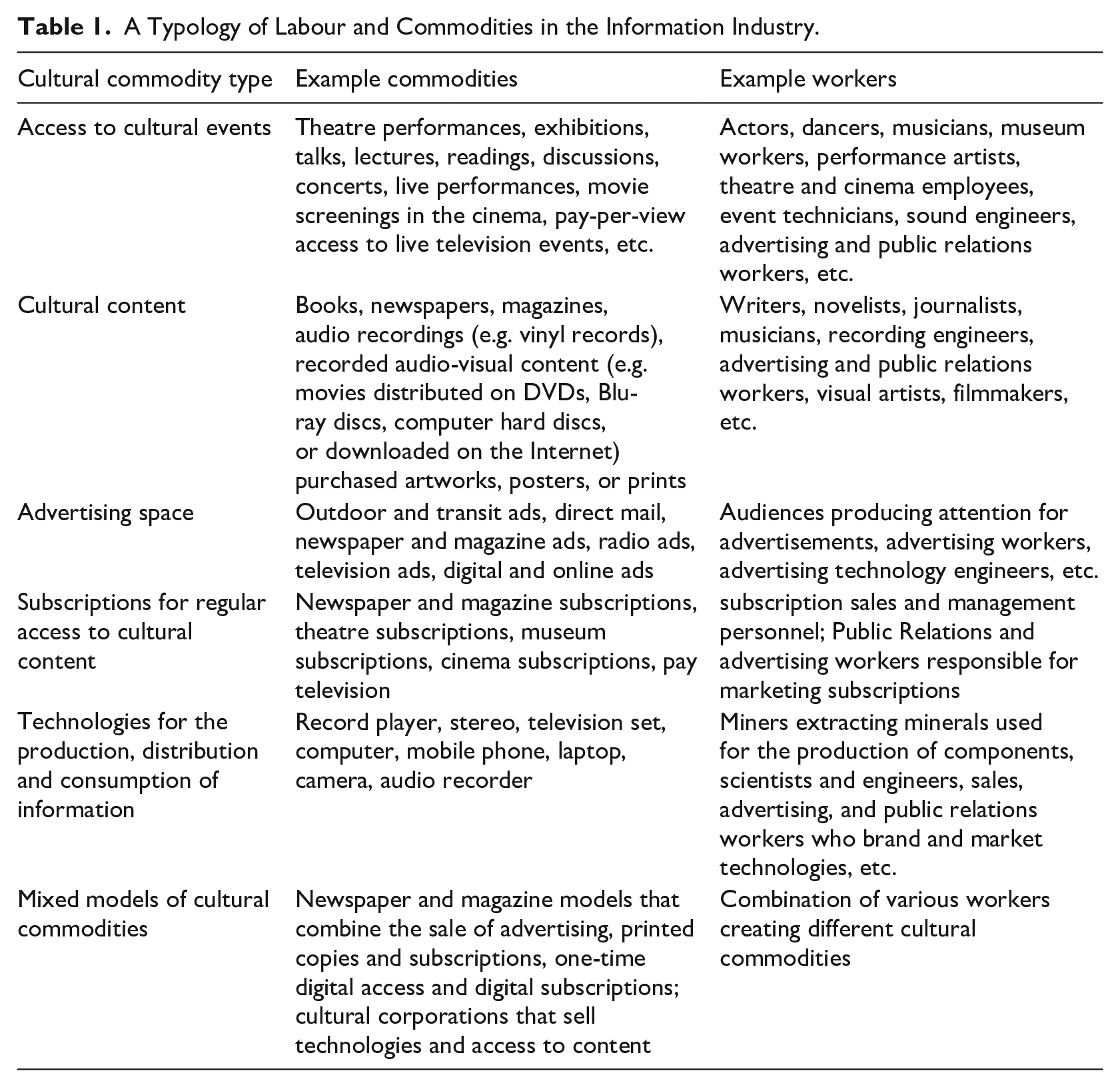
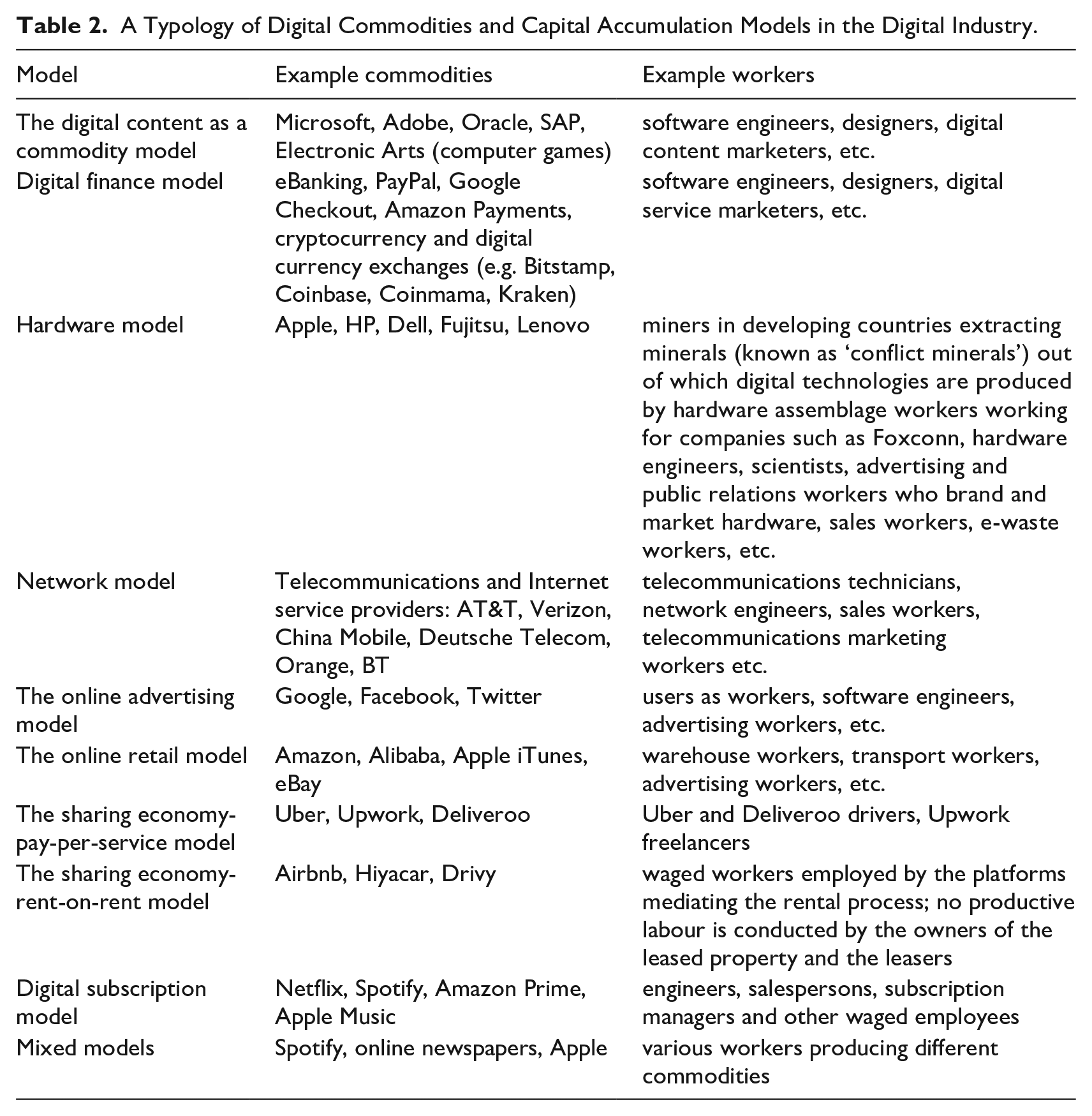
Khaldûn contributed to the foundations of a class-based political economy analysis that stresses that the dominant class exploits the labour of workers to become rich. Media and digital corporations are among the world’s most profitable companies. In 2021, there were 22 such companies among the world’s largest transnational corporations (data source: https://www.forbes.com/lists/global2000, accessed on 16 October 2021): Apple (#6), Amazon (#10), Alphabet/Google (#13), Microsoft (#15), Verizon Communications (#20), Alibaba (#23), Comcast (#25), Softbank (#27), Tencent (#29), China Mobile (#32), Facebook (#33), Sony (#35), Intel (#36), Nippon (#43), Deutsche Telekom (#44), IBM (#59), Taiwan Semiconductor (#66), Oracle (#71), Cisco Systems (#75), Charter Communications (#90), Dell (#92), Hon Hai Precision (#94). These companies sell different commodities such as software, hardware, different commodities ordered online (e-commerce), digital advertisements, or access to communications networks. Workers produce capital, commodities, and profits. We, therefore, find a range of workers in the contemporary media and digital industries who are exploited by media and digital capital.
Tables 1 and 2 outline typologies of workers and commodities in (a) the information industries and (b) the digital industries. They outline six capital accumulation models in the information industry and ten capital accumulation models in the digital industry. Class and the exploitation of labour that Khaldûn and Marx outlined as important principles of Political Economy in class-based societies remain the key feature of 21st-century societies where informational capitalism and digital capitalism play important roles.
A Typology of Labour and Commodities in the Information Industry.
A Typology of Digital Commodities and Capital Accumulation Models in the Digital Industry.
In the next section, we discuss merchant’s capital in the works of Khaldûn and Marx as well as in contemporary digital capitalism.
Merchant’s Capital
Khaldûn (2015) argues: ‘Commerce means the attempt to make a profit by increasing capital, through buying goods at a low price and selling them at a high price’ (p. 309). The result is commercial profit. Merchandise was dominant where Khaldûn lived, especially the trade in gold (Amin, 1976; Santos, 2017: Chapter 5). This is why Khaldûn sees merchandise as the original source of profit. For Marx, profit is part of an economy that is based on exchange-value, money, commodities and class. Khaldûn (2015) analysed precursors of capitalism where merchandise was the main form of commodity circulation and appeared to him as ‘a natural way of making profits’ (p. 449).
Fernand Braudel (1972) describes merchant capitalism at the time of Ibn Khaldûn in the following manner:
North Africa with its supply of gold gradually became the driving force of the entire Mediterranean. In the fifteenth century it was invaded by Christian merchants who settled without difficulty in Ceuta, Tangier, Fez, Oran, Tlemcen, Bougie, Constantine, and Tunis. [. . .] In the fifteenth century it was the tum of the merchant: from now on, history records only commercial treaties, privileges, purchases, and exchanges. Handicapped in the East by the Turkish advance, Christian merchants found some compensation in North Africa. The Maghreb had the advantage of being accessible not only to Catalonia but also to Marseilles and Provence, Ragusa, and Sicily as well as to Venice, whose galleys regularly put in at Tripoli, Tunis, Algiers, Bone, and Oran; accessible too to the Genoese [. . .] With the help of the gold and slave trade, commercial penetration of the continent was far-reaching, extending south as far as the Tuat and the Niger. All the merchandise of Christendom on sale in the commercial quarters of North Africa (textiles, kerseys, hardware, and trinkets), crossed the Sahara, the Maghreb lending itself the more easily to this invasion since it lacked political cohesion. In theory it was divided into three zones (the three geographical, cultural, and political zones of its history): Morocco under the Merinids, TIemcenia under the abd al-Wadids, and Ifriqya (Tunisia) under the Hafsids. [. . .] It is an error (sometimes committed by the most knowledgeable) to consider North Africa as a rural complex. In the fourteenth and fifteenth centuries towns grew up sometimes out of all proportion to the surrounding countryside. [. . .] Five commodities dominated the trade routes: gold dust (tibar), black slaves, copper, salt, and textiles. The black Africans possessed the first two. Goods were exchanged at the point where the camel caravans from the North met the processions of bearers or the canoes of the South. On the whole the North, that is Islam, and behind Islam the western merchant, gained most from this trade. (pp. 467–469)
Samir Amin (1976) argues that in Morocco and Tunisia, at the time of Khaldûn
the level of development of the local productive forces did not make possible the extraction of a surplus adequate to support a class that might undertake the constituting of a nation. The destiny of that class depended upon its capacity to acquire through large-scale trade a surplus of external origin – hence upon circumstances outside the given society. (p. 29)
The Arab world was
a great zone of passage, a sort of turntable between the major areas of civilization in the Old World. This semiarid zone separates three zones of agrarian civilization; Europe, Black Africa, Monsoon Asia. It has therefore always fulfilled a commercial function, bringing into contact, through its role as the only middleman, agricultural communities that had no direct awareness of each other. The social formations on the basis of which the Arab world’s civilizations were erected were always commercial in character. This means that the surplus on which the cities lived was drawn in the main not from exploitation of the area’s own rural inhabitants but from the profits of the long-distance trading activity that its monopoly role as intermediary ensured to it – that is, an income derived in the last analysis from the surpluses extracted from their peasantries by the ruling classes of the other civilizations. (Amin, 1976: 38)
The society that Khaldûn lived in was, according to Amin (1976), characterised by a peripheral capitalism that was shaped by unequal exchange, ‘the exchange of products whose prices of production, in the Marxist sense, are unequal’ (p. 187).
Amin and Braudel stress the role of merchant’s capital in 14th-century Arab societies. According to Amin, these were semi-peripheral societies where merchants became rich by selling goods produced by agricultural workers controlled by the ‘slave-owner, the feudal lord and the state’ (Marx, 1981 [1894]: 448) to Europeans who reaped large profits. Merchant’s capital was the dominant form of capital in the society Khaldûn lived in. ‘In the stages that preceded capitalist society, it was trade that prevailed over industry; in modern society it is the reverse’ (Marx, 1981 [1894]: 448). Marx (1990 [1867]) argues that merchant’s capital ‘provides the soil from which modern capitalism has grown’ (p. 1023) and that in modes of production preceding fully developed capitalism, ‘commercial capital’ appears ‘as the function of capital par excellence’ (Marx, 1981 [1894]: 444).
Merchant’s capital has the form M-C-M’: ‘buying in order to sell dearer’ (Marx, 1990 [1867]: 256). ‘The form M-C-M’, buying in order to sell dearer, is at its purest in genuine merchants’ capital’ (Marx, 1990 [1867]: 266). ‘In the context of capitalist production, commercial capital is demoted from its earlier separate existence’ and it is ‘the agent of productive capital’ (Marx, 1981 [1894]: 444).
Merchant capital also plays an important role in digital capitalism. Today, Amazon is the world’s biggest merchant capitalist corporation. In 2021, it was the world’s tenth largest transnational corporation (https://www.forbes.com/lists/global2000, accessed on 16 October 2021). In 2020, Amazon made profits of US$ 21.3 billion. In 2021, the best-selling commodities on Amazon were gift cards, electronics, cameras and camera equipment, video games, books, clothing, shoes, jewellery, beauty and personal care products, home and kitchen supplies, pet supplies, sport and outdoor equipment (data source: https://www.sellerapp.com/blog/best-selling-products-on-amazon/, accessed on 16 October 2021). This means that Amazon as a merchant capitalist makes profits from taking a share of the (large) profits of companies whose workers are artists, manufacturing workers and assemblers, engineers, writers, designers, and food workers. Amazon enables and contributes to the exploitation of these workers. In 2020, Amazon had 1,298,000 employees (Amazon, 2020).
In 2020, Amazon made 88.2% of its revenues from online and physical shops and 11.8% from web services (Amazon, 2020). The latter is dominated by the sale of cloud storage services. To a large degree, Amazon is a merchant capitalist company, which shows that merchant capitalism exists within and is digitally mediated by digital capitalism. Cloud storage services mean the renting out of server space, which makes Amazon also a digital rentier business. Amazon is the world’s largest digital merchant capitalist and digital rentier capitalist.
Amazon has become so dominant in e-commerce that its massive revenues and profits allow it to undercut the prices of competitors, which has had negative impacts on parts of the economy such as local bookshops and has undercut book prices and thereby also negatively impacted publishers (Brevini and Swiatek, 2021: 52).
But Amazon’s business model is even more complex than rentier and merchant’s capital. Amazon is ‘a supermarket of everything’ (Brevini and Swiatek, 2021: 65; Calabrese and Rollins, 2017) – and more than that. In one particular form of merchant’s capital, the merchant was ‘simply someone who “transferred” commodities’ from owners to buyers (Marx, 1981 [1894]: 454). In other forms, the industrialist becomes a merchant too or the merchant becomes an industrialist too (Marx, 1981 [1894]: 452–455). Amazon also makes money from online payments (Amazon Pay), so it is also active in the finance capital sector. Amazon is also an industrial producer, namely, of hardware (Kindle e-readers, Fire tablets, Amazon Alexa virtual assistants), household and office equipment (Amazon Pinzon, Amazon Basics, Amazon Elements), and snack food. It is a media producer of content (television content produced by Amazon Studios and distributed via Amazon Prime) and computer games (Amazon Games), as well as a publishing house (Amazon Publishing), and a provider of Internet platforms (such as Internet Movie Database, alexa.com, Twitch, Audible, Amazon Mechanical Turk, Amazon Marketplace). Amazon also sells audiences: According to projections, it will in 2023 control 7.1% of the world’s digital ad revenues and will thereby after Google, Facebook, and Alibaba be the world’s fourth largest digital advertiser (Cramer-Flood, 2021). Amazon-CEO Jeff Bezos is also the Washington Post’s largest shareholder.
Amazon’s diversified sale of commodities means that it exploits workers such as engineers, manufacturing and assemblage workers, food workers, writers, actors, designers, artists, and audience members. Amazon’s online shop not just organises the sale of commodities, for which it requires software engineers and marketers, but also the transport of physical commodities, which requires a massive amount of labour-time, workers who pack things into boxes, and other workers who transport them to the customers. Marx (1992 [1885]) argues that the transport industry is ‘productive capital’ that engages in the ‘additional production process’ of changing the location of commodities (p. 226). ‘The productive capital invested in this industry thus adds value to the products transported, partly through the value carried over from the means of transport, partly through the value added by the work of transport’ (Marx, 1992 [1885]: 226–227). In 2021, Amazon gave subcontracts to companies that employed around 160,000 drivers (Harrington, 2021). A large share of Amazon’s 1.3 million workers is warehouse workers who pack commodities into boxes. Amazon’s warehouse, logistics and transport workers add value to the transported commodities so that the labour-time needed for packing and transport needs to be figured into the commodity price. That the Law of Value operates in Amazon’s warehouses and transport operations is evident in Amazon’s attempts to introduce delivery drones and packaging robots (Dastin, 2019; Hamilton, 2019). Delivery drones and packaging robots are mechanisms for automating transport and packaging labour that Amazon wants to use in order to decrease its labour costs and increase its profits. Automation is a way of decreasing the value of commodities and producing and transporting more commodities in less time, which helps save costs and increase profits. Amazon combines merchant’s capital, rentier capital, digital capital, finance capital and industrial capital that exploits a range of workers.
Amazon has treated its workers badly:
Amazon’s treatment of its employees has been a focus of intense scrutiny for many years. [. . .] Amazon’s U.S. warehouse employees have repeatedly voiced complaints about overly short on-shift breaks, injury rates that are higher than the national average, unaddressed safety concerns, stress-inducing unreasonable work targets that are closely monitored electronically, an exhausting pace of work (due to these targets), and work-induced chronic physical pains. Reports from other countries have portrayed a similar negative picture of harsh frontline working conditions. (Brevini and Swiatek, 2021: 38)
Jeff Bezos’ immense wealth that makes him one of the world’s richest individuals (see https://www.forbes.com/real-time-billionaires) has been built on ‘enormous costs for workers, communities, and the environment’ (Alimahomed-Wilson and Reese, 2020) and ‘old-style labor exploitation’ that is ‘intensified by high-tech worker surveillance, algorithmic management, gamification, and automation’ (Milkman, 2020). There have been initiatives by Amazon workers to form a union (Amazon Workers and Supporters, 2018).
In the society Ibn Khaldûn lived in, merchant’s capital was dominant and mediated the relation between European capital and the exploitation of slaves and serfs. Merchant’s capital not just preceded industrial capital, but continues to exist in and is mediated with industrial and digital capital. The notion of merchant’s capital continues to be relevant today. A contemporary example is Amazon which merges digital capital, industrial capital, merchant’s capital, finance capital and rentier capital.
In the next section, we will discuss Khaldûn’s notion of ideology.
Ideology
Khaldûn (2015) describes that the powerful ‘succumb to the temptation of sensationalism’ and lack ‘self-criticism’ and ‘moderation and fairness in reporting’ (p. 13). Such information is ‘remote from the truth. It is rooted in baseless and erroneous assumptions. It is more like the fiction of storytellers’ (Khaldûn, 2015: 15); it is ‘silly and fictitious’ information (Khaldûn, 2015: 16). He mentions as examples exaggerated claims about the size and conquests of armies and the wealth of the rich. Khaldun argues that the powerful often want to present themselves as more powerful than they actually are. He shows the connection between power and falsity, how ‘[u]ntruth [. . .] afflicts historical information’ (Khaldûn, 2015: 35). ‘Prejudice and partisanship obscure the critical faculty and preclude critical investigation’ (Khaldûn, 2015: 35). Khaldûn (2015) says that every phenomenon has an essence and that the critical investigator distinguishes ‘truth from untruth’ (p. 36). Khaldûn (2015) also outlines aspects of hegemony, saying that the dominated often falsely assume that their subservience is due to their own (assumed) inferiority and not due to ‘the nature of defeat’ in power conflicts (p. 116).
Spreading false information such as exaggerated positive claims about those in power or negative information about the powerful’s enemies is an ideological strategy that aims at legitimating, justifying and securing domination. Marx argues that in all ideology, humans ‘and their relations appear upside-down as in a camera obscura’ (Marx and Engels, 1846 [1845]: 36). Ideologies are ‘phantoms formed in the brains’. Just like Khaldûn, Marx sees ideology as the attempt of the powerful to present reality in twisted, distorted, manipulated ways. Both argue that there are essences of the world, that ideology tries to hide these essences (how the world really looks like), and that ideology critique is the uncovering and presentation of truth. Both Marx and Khaldûn conducted ideology critique in the context of the political economy of their time. Whereas Khaldûn shows how the history of feudal empires was falsified, Marx focuses on the critique of ideology in 19th-century capitalism that was advanced by the capitalist class, bourgeois politicians, theorists, religion and journalists. Marx makes clear that ideology serves the role of trying to justify, legitimate and secure class-based domination: ideologues are ‘thinkers of the [ruling] class (its active, conceptive ideologists, who make the formation of the illusions of the class about itself their chief source of livelihood). (Marx and Engels, 1846 [1845]: 60)
In contemporary capitalism, mediated ideology plays an important role in the tabloid press that often is shamelessly politically partial, scapegoats certain groups and individuals, sensationalises events and fully or partly invents stories in order to attract audiences, sell more ads and more expensive ads based on high audience rates.
In a seven-country study on ideology in the press conducted in Denmark, Finland, France, Germany, Norway, Sweden, and the United Kingdom, an average of 55% of the respondents said that the national press reports inaccurately on refugees and asylum seekers. The same average was found with respect to the reporting on immigrants (YouGov, 2016). In many countries, the tabloid press is predominantly right-wing and dominates public attention, which means that it has a lot of cultural power. For example, in 2020, the two right-wing tabloids The Sun and Daily Mail had the highest daily reach of UK newspapers. Out of a total daily reach of individuals via phone, tablet, desktop, and print of 53.2 million, The Sun had a reach of 9.3 million (18%) and the Daily Mail of 8.3 million (15.9%) (data source: PAMCo 1/2021: Individual Brand Reach Tables – Newsbrands, https://pamco.co.uk/pamco-data/data-archive/, accessed on 14 October 2021). In Germany, the right-wing tabloid Bild is by far the newspaper with the largest audience. According to data, it in 2021 had a reach of 7.8 million daily readers, which is about two-thirds of all readers of transregional newspapers in Germany (data source: MA Presse Reichweitenübersicht 2021/II, https://www.ma-reichweiten.de/reach, accessed on 14 October 2021).
The commercial Internet has facilitated the phenomena of post-truth culture and ‘fake news’: A significant share of Internet users believes that what corresponds to their worldview is true. Online culture has increasingly become based on emotions rather than facts and arguments. The Cambridge Analytica Scandal has shown how capitalist Internet platforms such as Facebook play a role in the spread of ideologically driven false news where far-right ideologues make use of surveillance and targeted ads to try to manipulate elections. In 2019, a global survey conducted in 25 countries (N = 25,000) reported that 86% of Internet users had encountered false news online and 86% reported that they at least once ‘initially believed that the [false] news was real’ (IPSOS, 2019). 67% of the respondents said they had encountered false news on Facebook and 56% on YouTube.
Ibn Khaldûn outlined a basic concept of ideology that resonates with Marx’s ideology critique and remains highly relevant in 21st-century digital capitalism.
Conclusion
This paper asked: What elements of the Political Economy of Communication are there in Ibn Khaldûn’s work and how do they matter in digital capitalism? The analysis showed that Khaldûn’s Muqaddimah is an early work in Political Economy that can and should inform our contemporary critical analysis of communication in society, communication in capitalism and class society, ideology, and digital capitalism.
In this paper, we have engaged with one important approach to the Critical Sociology of the Media and Communication, namely, the Critical Political Economy of Media and Communication, and have analysed the importance of Ibn Khaldûn‘s and Karl Marx’s works for this approach.
We can summarise the main findings as follows:
Both Khaldûn and Marx stress that the human being is a social being. They point out that the social constitution of humans means that they have to work and produce together for them and society to exist. Based on such a materialist understanding, we can say that there is a dialectic of communication and production in society: Communication is productive just like production is communicative.
Both Khaldûn and Marx stress that there is a dialectic of thinking and action and a dialectic of consciousness and production. As a consequence, humans produce consciously, which means they are able to reflect on the consequences and results of their actions before producing differences in the world.
Khaldûn created an understanding of media and communication. He stresses that cultural work is a craft, productive, creative and skilful. His basic distinction between face-to-face communication by speech and mediated communication is still valid and important today, as can be seen in contemporary theories of media and communication.
Khaldûn contributed to the foundations of the Labour Theory of Value that was later popularised by Adam Smith, David Ricardo and Karl Marx. Although nowadays ignored in mainstream Economics, the Labour Theory of Value remains of key importance in digital capitalism where AI-based and digital automation results in struggles over value and where digital capital exploits digital labour.
Khaldûn contributed to the foundations of a class-based Political Economy analysis that stresses that the dominant class exploits the labour of workers in order to become rich. Class and the exploitation of labour that Khaldûn and Marx outlined as important principles of Political Economy in class-based societies remain the key feature of 21st-century societies where informational capitalism and digital capitalism play important roles.
In the society Ibn Khaldûn lived in, merchant’s capital was dominant and mediated the relation between European capital and the exploitation of slaves and serfs. Merchant’s capital not just preceded industrial capital, but continues to exist in and is mediated with industrial and digital capital. The notion of merchant’s capital continues to be relevant today. A contemporary example is Amazon which merges digital capital, industrial capital, merchant’s capital, finance capital, and rentier capital.
Khaldûn also contributed to the foundations of ideology critique. Today, in the age of the Internet and mass media, ideology takes on the form of, for example, false news and post-truth politics on the Internet as well as the right-wing tabloid press.
The Political Economy of Communication is not a purely Western intellectual project, but also has foundations outside of the Western world. Scholars in different part of the world who thought critically about society, class society and communication have come to comparable conclusions. Marx and Khaldûn lived at different times in different parts of the world. They have independently come to comparable conclusion. What connects Marx and Khaldûn is that they were critical scholars who although living at different times in different parts of the world saw the importance of the analysis of class and communication.
A Critical Sociology of the Media and Communication should operate as a Critical Sociology of Critique that combines a critical theory of society and critical empirical sociology for studying media and communication in society. It requires a philosophically grounded normative critical theory, as well as based on such theoretical foundations empirical social research of how humans experience mediated and communicative inequalities and struggles for equality (Fuchs, 2016).
