




Abstract
In an economic environment defined by precarious and gig-based labour contracts, academic research has been reimagined as a source of income for research participants. In addition, with the rise of online labour platforms, researchers have turned to online labour platforms as a solution to the increasing difficulty in recruitment of participants in research. This present context makes explicit the hidden labour that research participants have always done in the production of research outputs within academia. This paper develops a Marxist lens through which we can understand the material conditions of the circulation of capital through academia and the role of research participants in this mode of production. By developing this broad analytical framework for the academic mode of production, this paper further argues that our present economic epoch of the gig economy and specifically the use of digital labour platforms for academic research, has accelerated the subsumption of research participation as a source of income through the fragmentation of work and the gigification of everyday life.
Introduction
In an increasingly fragmented and gigified labour environment, the voluntary research participant has become a rare figure in social science research. Like the increasing scarcity of peer-reviewers for academic journals, research participation also suffers from the effects of insecure labour contracts, the rising cost of living and the erosion of an individual’s disposable time. More specifically, work within contemporary capitalism has become structured through the logic of the ‘gig’. As a short, one-off bout of labour, gig-based labour contracts push workers to reframe their working lives as a constellation of projects that combine to form an income (Davis, 2016; Scholz, 2017). Described as the gig economy, this current iteration of capitalism is the pinnacle of the flexible, project-based vision for labour established at the end of the 20th century (Boltanski and Chiapello, 2007; Feher, 2018). This modern fragmentation of work into piecemeal tasks has reframed all activity through the value it contributes to the individual’s life (Adkins, 2020; Gregg, 2018; Wajcman, 2014). The gig economy positions not only activities for which the individual typically conceives as work, but hobbies and spare assets (i.e. cars, houses) as sources of income to supplement stagnating wages and disintegrating full-time work contracts (Konings et al., 2022; Prassl, 2018; Ravenelle, 2019). The gig as a labour relation is made possible by digital platforms acting as the middleman between individuals willing to sell their labour power or access to their assets and interested buyers (see Prassl, 2018; Ravenelle, 2019; Rosenblat, 2018; Scholz, 2017). The growth of these digital platforms has come to define and disrupt all forms of labour, including couriering (DoorDash, PostMates), transportation (Uber, Lyft), manual labour (TaskRabbit), software development (TopTal), graphic design (Squadhelp, 99designs) and all types of immaterial and cognitive labour (Upwork, Fivver, Freelancer). As argued by Trebor Scholz (2017), it is not just labour that has been subsumed by digital platforms, but all types of informal exchanges between friends, families and neighbours, such as crashing on a friend’s couch (Couchsurfing), picking up family from the airport (Uber) and assembling flat-pack furniture (TaskRabbit). In this gigification of everyday life, it is unsurprising that research participation has increasingly come to be seen as a source of income.
Recently, many researchers have turned to these digital labour platforms as a tool to assist in recruiting participants for their projects. These platforms achieve two things for researchers – access to a pool of potential participants and a system of providing monetary compensation for participation. The most common platforms include Amazon Mechanical Turk, Appen and Prolific. However, except for Prolific – a platform designed for market research, recruitment for research projects is not the intended use of these platforms. These platforms were initially designed to facilitate low-cost and quick access to an army of labour ready to complete short-term tasks at a moment’s notice. For example, platforms such as Amazon Mechanical Turk and Appen were designed to provide human workers to train algorithms and data sets for software developers. In this paper, I argue that in adapting these platforms for academic research, the act of participating in research has been reframed as a source of income rather than a voluntary act donated for the betterment of society. Furthermore, in choosing to recruit participants in this way, academics tacitly recognise that participation in research is a form of labour.
This framing of academic research participation as another gig opportunity does not just exist in an abstract sense, but is actively voiced by gig economy workers online and in collective action campaigns for improved working conditions. In my research, gig economy workers critiqued my initial recruitment for volunteers in my research on the platform economy. Workers critiqued my methodology as disregarding their position as workers on these platforms who complete research projects for remuneration. As workers whose income depended on accepting fragmented, short-term gigs on these platforms, time was a precious resource that could not be altruistically donated to a researcher with curiosity in their working lives. These critiques are again reflected in the worker collective Turkopticon’s (2014) published guidelines for academic research, which implore researchers to understand them as ‘a workforce, not a volunteer study population’ that depends on income from these platforms as ‘critical income’. These critiques reveal that digital labourers understand their research participation as labour that requires payment for their contribution, regardless of the theoretical and ethical debates within the academic field.
Compensating research participants with monetary rewards is not uncommon in social science research. Yet, the payment for participation has been widely debated regarding coercion, exploitation and commodification of research participants (Belfrage, 2016; Gelinas et al., 2018; Lamkin and Elliott, 2018; Largent et al., 2019; Largent and Lynch, 2017; McNeill, 1997). This paper synthesises these academic debates and the recent transformation of research participation as an income-generating ‘gig’ through a Marxist lens that situates research participants as labourers within the academic mode of production. Through this lens, we can understand research participation as a form of labour within the circulation of knowledge capital where researchers and their institutions extract value from the contributions of research participants (Connell, 2019; Stanley, 1990). Specifically, I argue that the data created from the research process, such as interviews, survey answers and stimuli reactions, act as a raw material in producing the research-output commodity (books, journal articles, patents). In conceiving data and research outputs through this lens, the research participant becomes a labourer alongside the researcher during the fieldwork process, as they co-create the data by shaping their experiences, emotions and reactions to respond to the prompts of the researcher. Through this framework, this paper makes sense of the growing professionalisation of research participation in the gig economy which by nature is labour relation.
The argument in this paper is twofold, the first being the Marxist reimagining of research participation as labour, particularly in light of the growing commercialisation of the academic space. Second, I will argue that our current economic epoch of the gig economy has accelerated the subsumption of research participation into the labour market through the dual processes of fragmented working lives and the gigification of everyday life. In making these arguments, this paper is structured into three parts – the capitalist university (Connell, 2019; Slaughter and Leslie, 1997), the precarious and productive participant, and the gigification of research participation. The first section explores the academic mode of production that produces and circulates knowledge capital that contributes to the accumulation of value for the individual, the university and other affiliated industries such as academic publishing. In putting forward this framework, I sketch out a Marxist framework that conceives participants as labourers that are intrinsic to the production of the research outputs circulated within the academic mode of production. The second section then focuses on the research participant who is increasingly constrained by pressures of precarity and productivity within the gig economy. This section provides important context as to why research participants expect to be compensated for their time, not only in an abstract sense that they are contributing to knowledge production, but defined by the reality of the constraints of economic uncertainty that push individuals to extract income from all aspects of daily life. Finally, the institutional and individual interrogations culminate in the case study of online labour platforms use in academic research. In using platforms that facilitate labour relationships, academic researchers are making explicit the labour involved in research participation. This section argues that academics also contribute to reframing research participation as an income-paying gig. These arguments in this paper may be criticised as playing into the structures of capitalism rather than challenging the system and preserving research outside of capitalist accumulation. However, not acknowledging the profit-generating activities of contemporary universities and the current precarious economic environment ignores the lived reality of our participants’ lives within a capitalist society (Hall, 2017; Warnock et al., 2022).
The Academic Mode of Production
Academic research does not exist outside of the capitalist realm; instead, it is embroiled in the production and circulation of capital. The subsumption of academic research to capital has been rapidly accelerated in the neoliberal era, as the erosion of public funding for universities has forced researchers to confront the private market to fund the production of knowledge (Delanty, 2001; Münch, 2014; Slaughter and Leslie, 1997). This market orientation is referred to by Slaughter and Leslie (1997: 9) as ‘academic capitalism’, which is used to describe the ‘reality of the nascent environment of public research universities, as environments full of contradictions, in which faculty and professional staff expend their human capital stocks increasingly in competitive situations’. Liz Stanley (1990) categorises this capital-driven research environment as the ‘academic mode of production’, referring to how knowledge is controlled, distributed and exchanged within the walls of academia and out into the public sphere. The movements of capital define the production of knowledge in academic spaces (see Figure 1). Starting as a research grant, capital moves through the circuit first to purchase research materials and labourers (researchers, research assistants, technicians and research participants) who produce research outputs sold in the private sphere as commodities (often re-sold back to universities as books, journal articles and research equipment). However, applying the framework of the circuit of capital in a purely Marxist sense is complicated, because often these research outputs can be uncompensated or paid a symbolic amount – particularly within the social sciences and humanities. However, the increasing reliance on competitive and external funding sources for academic research has meant that researchers increasingly have to present themselves and their projects as attractive sources for investment (see Feher, 2018). Looking through the lens of financialised subjectivities, research outputs can be conceived as assets in an academic’s portfolio, decreasing their risk profile and increasing their attractiveness for investment (Feher, 2018; Lazzarato, 2012). In this way, all research outputs create use-value as reputational capital that, in the academic mode of production, enables the acquisition of research grants, thus ultimately becoming money capital again. By locating academic research within a Marxist analytical framework that tracks the circulation of both money and reputational capital, we can better understand the contribution that research participants make in the production of the research-output commodity as a form of labour.
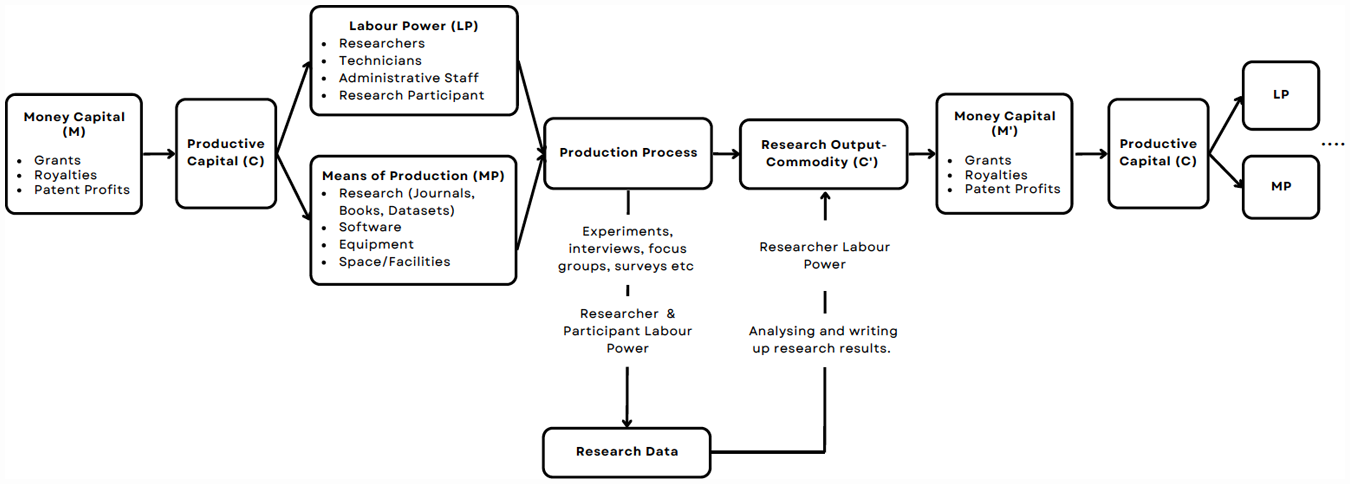
The circulation of capital in the academic mode of production.
The research participant comes into the academic circulation of capital during the production process (Figure 1). Within this stage, research participants could be characterised as a means of production, that being sources of data that are extracted from them through surveys, interviews and experiments. The classification of this research stage as ‘data collection’ points to this inherent view of the passive role that research participants play in producing knowledge. However, as argued in critical feminist scholarship (Maynard, 2013; Ramazanoğlu and Holland, 2002; Stanley, 1990), research participants are not passive but rather co-create knowledge with researchers in which they transform their experiences, opinions and reactions into data through their responses to stimuli as designed by the researcher. This data is then converted into research outputs by researchers later in the production process. It is the use of the research participants’ mental capacities, which are otherwise used for private, internal processing of human experience, in the production of research data that characterises their participation as labour (see Marx, 1976, 2005). In other words, human experience can exist without being made relative to a commodity, but it is through the circulation of capital in the academic mode of production that it is made relative to research output.
Defining research participation as labour is not an entirely new contention, particularly in clinical trials whereby participants are often well compensated and thus have attracted a class of self-categorised ‘professional guinea pigs’ (Cooper and Waldby, 2014; Monahan and Fisher, 2015). Melinda Cooper and Catherine Waldby (2014: 8) argue that participation in clinical trials where the ‘activity is intrinsic to the process of valorisation of a particular bioeconomic sector and when therapeutic benefits to the participants and their communities are absent or incidental’ should be regarded as labour. Furthermore, they argue that clinical trial participation should be understood as a form of labour due to its relationship to risk, as ‘much clinical labour consists precisely in the endurance of risk and exposure to non-predictable experimental effects that may be actively harmful, rather than therapeutic’ (Cooper and Waldby, 2014: 8). Although participants in social science research are not likely to experience the same levels of risk as participants in clinical trials, their participation remains intrinsic to the process of creating the research output commodity, and the benefits to themselves or their communities may also be absent or incidental. Therefore, I argue that it is not the research participant’s relationship to risk but its relationship to capital that makes it a form of labour.
The transformation of the research output commodity into money capital occurs in the private sphere of academic publishing – not only in the form of monetary subscriptions paid to the journals for access to publications but also in allocating research funding based on these publications. The academic publishing industry is a core channel through which capital circulates in the academic mode of production, acting as the conduit of research from the public sphere into the private sphere (and often back into the public sphere). For Raewyn Connell (2019: 124), these publishers have performed a ‘dazzling feat’ by turning universities into customers for their own research. This feat has led to global revenues of £19 bn in 2017 and profit margins of 40% (Buranyi, 2017). This surplus value is achieved through extraordinary exploitation, whereby researchers receive no compensation for their labour in producing the publication as the author, peer reviewer or editor (see Buranyi, 2017; Monbiot, 2018). The pervasive exploitation of researchers by the academic publishing industry is enabled through the centrality of publications for success within the academic mode of production (Monbiot, 2018). Although not paid for their contributions to publications, researchers are imbued with the reputational capital of that publication through which their qualification for research funding and promotions is judged (Buranyi, 2017; Monbiot, 2018). Therefore, in the circulation of capital, the researcher’s outputs go through two stages of transformation into money capital – first, by being sold by academic publishers to audiences and, second, through converting the reputational capital of the research publication into research funds. This analysis of the valorisation of research outputs warrants further research, but for the purposes of this paper, it is central to understanding how academic research is not an altruistic mode of production but embedded in the circulation of capital that extracts surplus from the labour of researchers, technicians, librarians, administrators and research participants.
This use of human data in the production of academic research embeds the participant in the circulation of knowledge capital, which is exchanged for both monetary and symbolic rewards for researchers, publishers and universities; however, in their framing as altruistic donors to human knowledge, the research participant is excluded from the returns on the data they have contributed. Using this Marxist lens, we can see how the research participant contributes their life (data) to research, but after signing a consent form that data no longer belong to them but to the research output (Marx, 2005: 42). Therefore, research participants offer their bodies and minds to be valorised for research, but may never be directly rewarded for the gains that derive from those research outputs.
The current form of neoliberal capitalism has furthered this entrenchment of academic research into the circulation of capital, leading researchers to constantly produce outputs to secure future grants and, in doing so, their future within the academic mode of production. This capitalist context also defines the contours of the everyday lives of our participants, who confront a fragmenting wage relation, growing precarity and demands for productivity. It is from within this insecure economic setting that research participation has increasingly become seen as a source of income.
The Precarious and Productive Participant
It is not just in the abstract, theoretical sense that we need to consider research participation as labour, but also in a concrete sense that acknowledges the erosion of a stable wage relation and its replacement as a constellation of income sources in the gig economy. Considering this condition – precarity and productivity are inherent aspects of most of our participants’ lives, with previously informal, altruistic acts such as research participation being reframed as an income opportunity. Therefore, my contention that we must treat participants as labourers also speaks of the financial constraints placed on research participants in an increasingly gigified labour market.
Today’s capitalist condition is defined by a fragmented and speculative labour relation, where income is no longer tied to a wage–labour relation but rather short-term contracts that workers jump between, often balancing them simultaneously (Adkins, 2020; Boltanski and Chiapello, 2007; Standing, 2011). Gerald Davis (2016: 140) characterises this current stage of capitalism as a ‘chutes-and-ladders economy in which a few gain riches through a seemingly random process, while others muddle through’. Recently, the labour relationship through which one mobilises themselves in the ‘chutes and ladders economy’ (Davis, 2016) has taken the form of the gig. The gig can be understood as a temporary contract work that can be called upon and activated at any time (Friedman, 2014). For Gerald Friedman (2014: 172), the gig is distinct not in the work activity, as often workers hired for gigs are doing the same work they previously did for companies as employees, but in the labour contract that no longer promises ‘future employment, legacy pay or deferred compensation’. The instability of the gig means that a liveable income is no longer attached to a single labour contract but comes in piece-by-piece from a patchwork of fragmented labour activities. For Alexandra Ravenelle (2019: 6), the promise of gig-based work of flexibility and the liberation of workers from reporting to a single employer hides the true reality where workers are increasingly tethered to their work – ‘constantly on call, hustling to make money’. In this way, the fragmentation of work causes workers to live in a constant state of anticipation – coordinating and curating their access to future gigs to fashion a continuous source of income (Boltanski and Chiapello, 2007; Standing, 2011).
This constant state of anticipation conditions individuals to pursue productivity so that any unproductive moment is demonised. Time is enmeshed with the logic of precarity. Isabell Lorey (in Puar et al., 2012: 172) suggests that there is not only a precarity of work time but all time. As a result, we are tasked with dealing with the ‘exploitation and occupation of every timeslot and thus of the person’s every moment’ (Lorey in Puar et al., 2012: 172). The gig economy has only accelerated the taming of time in our current condition leading to a fixation on productivity, pushing the individual to optimise every moment of time as proof of our value in society (Boltanski and Chiapello, 2007; Gregg, 2018). For Mel Gregg (2018), productivity is an inward-focused goal of the individual worker obsessed with efficiency and output to prove one’s worth to an employer or project. Primarily, the purpose of productivity is to do away with any activity that stands in the way of advancing the individual’s goals (Gregg, 2018). It is a project of personal enhancement rather than collective excellence, meaning that altruistic tasks towards social good, such as academic research, are seen as drags on an individual’s productivity (Gregg, 2018).
In addition, productivity pressures come not only from inside the labour environment but also from leisure, social and care demands which are increasingly intertwined and encroached on by labour time (Wajcman, 2014). Judy Wajcman (2014) argues that time scarcity is not created from the conditions of increased work hours but rather the coordinating problems of scheduling personal, domestic and work activities in a context where each activity’s boundaries are increasingly eroding and blurring into each other. Therefore, it may not be that all time is used for monetary gain, but rather one’s perception of time as scarce leaves little room for altruistic acts such as research participation. The projective individual is also conditioned to be made productive during unemployment (Adkins, 2020; Cooper, 2012; Standing, 2011). Policies of ‘activation’ or ‘workfare’ demand unemployed individuals engage in a perpetual state of job readiness – available to jump to any employment opportunity as a condition of their welfare payments (Adkins, 2020; Cooper, 2012). These policies require searching for employment as well as a range of activation activities such as training, job placement programmes, job coaching and counselling (Adkins, 2020). This politics of activation means that even traditionally conceived ‘dead time’ must be optimised and made productive, preparing the worker to re-enter the workforce at any moment (Adkins, 2020). Looking more specifically at time in the gig economy, the commercial success of these labour platforms lies in the ability for individuals to access labourers ‘on-demand’ (Prassl, 2018; Ravenelle, 2019; Scholz, 2017). This immediate access to labour means that the labourers on the other side of the platform are disciplined to be constantly on-call for requests for work (D’Cruz, 2017; Lehdonvirta, 2016; Ravenelle, 2019; Wood et al., 2019). On TaskRabbit, workers were penalised if they took longer than 30 minutes to respond to a request for work (Ravenelle, 2019). Ravenelle (2019: 83) argues that although white-collar workers are expected to reply to work communications, ‘even the strictest of bosses generally allows at least an hour for a reply, and taking a few hours to respond is unlikely to cost someone her job’. For Trebor Scholz (2017: 24), on-demand labour has led to time becoming ‘even more central as an instrument of oppression’. Therefore, time in the neoliberal gig economy is a speculative resource oriented towards production or the appreciation of one’s economic position, leaving little room to allocate time to one’s own personal life and, even less so, to voluntary projects for social good.
Reflecting on this current capitalist condition, it is unsurprising that research participants expect compensation for their time, as each moment in time can be activated for income-generating purposes (Fisher et al., 2021; Warnock et al., 2022). When time becomes speculative (Adkins, 2020), each period given to an activity simultaneously prevents more lucrative activities from occurring. Therefore, time becomes a calculative asset to the individual who must determine which opportunity best contributes to their livelihood. This speculative time is no more apparent than in the case of clinical trial participation discussed earlier, where self-proclaimed ‘professional guinea pigs’ optimise their time to access the most lucrative trials, often turning down lower-paying trials speculating on the potential of a better trial becoming available (Fisher et al., 2021). Fisher et al. (2021: 470) argue that this speculation is often based on the fiction that they can predict whether a new clinical trial might come up, but in reality, these participants operate within a ‘field of unknowns’. Beyond deciding to forgo one trial for another, some participants will disregard mandatory washout periods between trials to make themselves available for new trial openings (Monahan and Fisher, 2015). The mandatory washout period acts as a compulsory mode of inactivity, acting in opposition to the logic of productivity and project-based earning; in subverting this period of inactivity, the clinical trial participant is making a calculative judgement between the risks to their safety and the risk of missing out on the chance at another clinical trial. This subversion of a compulsory period of inactivity highlights the pressures of the productive and precarious participant, where the participant is compelled to risk their personal safety for the option of access to a new income-generating opportunity. Clinical trials, however, are not the only channels through which income can be generated through research participation. Increasingly, digital platforms offering the facilitation of labour relationships are being used by researchers to host data-collecting experiments and surveys. As examined in the following section, the use of online labour platforms for academic research further reshapes research participation as a source of income, bringing to light the previously opaque position of the participant as a labourer that produces research outputs alongside researchers.
The Gigification of Research Participation
The increasing commercialisation of academic research and individual precarity intersect behind the log-in screens of online labour platforms. Online labour platforms have contributed further to the fragmentation and gigification of the labour contract – enabling a side-hustle culture where individuals can bolster their income to compensate for stagnating wages and the rising cost of living. However, these side hustles can become so numerous that one cannot distinguish which hustle is the side. Driving for Uber, delivering food for DoorDash or completing tasks on Amazon Mechanical Turk have all become significant sources of subsistence for users of these platforms and are clearly conceived as forms of labour, even when the platforms deny their workers the employee classification (Ravenelle, 2019; Rosenblat, 2018). Platformed labour has grown to include platforms that market themselves as a low-cost and efficient solution for digitally recruiting participants and hosting research experiments and surveys. Labour platforms, including Amazon Mechanical Turk and Appen (who absorbed the popular platform Crowdflower/Figure-8), were designed to link software developers with human workers that provided what Jeff Bezos refers to as ‘artificial artificial intelligence’, where a computer that needs a task completed that ‘is easy for a human but extraordinarily hard for the computer’ can call a human on a crowdsourcing platform to complete the task instead (Pontin, 2007). The primary purpose of these platforms is to supply employers with a diverse digital labour force and potential workers with a source of income by completing various digital tasks. Comparatively, the platform Prolific is specifically designed to join research participants with researchers for paid participation. Prolific is still not oriented towards academic researchers but instead towards private individuals, businesses and governments willing to pay for research participation. This platform is simply the digitised version of professional clinical trial agencies that act as intermediaries between the researcher and the participant, placing trials in private clinics and sourcing patient recruits (Cooper and Waldby, 2014: 151–152). Again, Prolific’s main purpose is to supply their private researchers with a diverse digital workforce, as well as their workforce with a source of income by completing various digital tasks. These platforms, among others, have increasingly been co-opted by academic researchers, attracted to the low cost and instantaneous recruitment of research participants. These platforms have become increasingly popular with researchers. Recently, a search for the phrase ‘recruited on Amazon Mechanical Turk’ on Google Scholar retrieved 817 results spanning a range of disciplines from computer sciences to childhood development. Using these labour platforms for academic research blurs the researcher/employer binary, making the subjectivity of the research participant as a worker explicit.
Within academic circles, the methodological considerations of using crowdsourcing platforms for academic research have not been about the subjectivity of research participants as workers, but instead centred on the rate of payment for participation on these crowdsourced websites, specifically whether compensation rates affect data quantity and quality (Aker et al., 2012; Buhrmester et al., 2011; Litman et al., 2015; Mason and Watts, 2009). Broadly, these studies reveal that compensation rates do not impact the quality of work; therefore, low payment rates are sufficient for a successful research project (Buhrmester et al., 2011; Mason and Watts, 2009). Ethically, researchers also justify their low rates of payment by arguing that users on these platforms are not entirely driven by money but instead for fun or entertainment in their free time, rather than making up a part of their income (Paolacci et al., 2010; Woo et al., 2015). And perhaps more significantly, researchers have employed post-Fordist logic in their justifications for low compensation rates, arguing that because platform workers are classified as independent contractors, researchers are not obliged to comply with minimum wage requirements and participants additionally have the autonomy not to participate in the project (Mason and Suri, 2012). These arguments for the low payment of research participants reflect the growing market orientation of academic research with a concern for maximising output by reducing the overhead costs of paying minimum wages.
Researchers studying online labour platforms widely dispute this conception of platformed research participation as a fun side hustle rather than a core part of a worker’s income (Ravenelle, 2019; Rosenblat, 2018; Schor et al., 2020). They argue that platform workers’ dependency on the platform for income is highly diverse, ranging from those who use the platform for fun or interest to workers whose entire livelihoods depend on the platform (Ravenelle, 2019; Rosenblat, 2018; Schor et al., 2020). The level of dependency on the platform determines the worker’s autonomy, perceptions of control and experience of the platform’s working conditions (Schor et al., 2020). Specifically, research on Amazon Mechanical Turk for recruitment found that these workers identified monetary compensation as the primary reason for working on the platform (Behrend et al., 2011; Litman et al., 2015). This financial dependency on the platform complicates Mason and Suri’s (2012) argument that the mere existence of choice absolves any issues of coercion. Platform workers themselves also contest the culture of low payment for research work they complete on the platform. The worker collective Turkopticon (2014) has published guidelines for academic researchers that set a minimum rate of US$0.10/minute and considers payment below this rate unethical as lowly paid tasks are likely to attract more vulnerable workers. Therefore, for Amazon Mechanical Turk workers, low compensation constitutes coercion (Turkopticon, 2014). This view is held not only by research participants on online labour platforms but is part of broader ethical considerations in academic research where low rates of payment are seen to be ‘coercive in nature just because they are small enough to be exploitative yet large enough to be irresistible to those in need’ (Belfrage, 2016: 77).
These ethical considerations regarding payment on the platform stem from the conflicting subjectivities of both the researcher as employer and participant as a worker, arising from the use of platforms designed for the facilitation of labour for a traditionally altruistic research relationship (Antin and Shaw, 2012; Behrend et al., 2011). For Antin and Shaw (2012), these subjectivities result in an added dimension of inequality between the researcher and the participant, as ‘researchers surveying workers in the context of a paid crowdsourcing platform are, if only briefly, their subjects’ employers’ (Antin and Shaw, 2012: 2928). This inequality is not just present in the rate of payment but also in the management of research participants on the platforms, particularly in the case of rejecting a participant’s task for poor performance or not following the task instructions. Online labour platforms employ managerial infrastructures such as reputation scores that reward good user behaviour through increased access to tasks and other benefits and punish poor-performing users through exclusion from tasks and even the platform itself (see McKenzie, 2022). Having a task rejected by the requester or not finishing a task devalues the worker’s reputation statistics, putting the worker’s future success on the platform at risk. By imposing these performance evaluations on research participants, the researcher is engaged in an employment relationship, even if it is as fleeting as a couple of minutes, deepening the inequalities already present in a researcher/participant relationship.
The platform economy is the current stage of an increasingly precarious existence, transforming all aspects of human activity, from assembling flat-pack furniture to crashing on a friend’s couch, into a source of income. Academic researchers’ use of these platforms for research participation has authorised platform workers to include this activity as a source of income. In doing so, the abstract conception of the research participant as a labourer is made concrete through the interactions between the researcher and the research participant on these labour platforms.
Conclusion
At its core, no human activity can be intrinsically conceived as a labour relation, but when subsumed in the circulation of capital, it is transformed as such (Marx, 1976). This is true of the academic mode of production whereby those research participants who come to us with the bodies, the experiences and the knowledge we desire for our intellectual pursuits offer their mental and physical capabilities for the transformation of human experience into research data. In a historical context where academic research was publicly available, this activity can be conceived simply as co-creating knowledge for the betterment of society. However, our current capitalist condition structures their offering as a market relation due to the dual processes of capital accumulation through the academic publishing industry and research grants and the subsumption of previously altruistic human activity into income-producing ‘gigs’.
As discussed in this paper, research, though often conducted with the belief in its role as a public good, circulates in a capitalist mode of production. In sketching out the circulation of capital within academia, this paper has provided a framework that illustrates the various forms of labour that are employed in the production of the research output commodity. Specifically, this paper reintroduces research participation as a form of labour contributing to the production of the research output as a commodity. This framework can be deployed in future interrogations into the dynamics of contemporary academia, especially in uncovering the undercurrents of capital accumulation that rely on often uncompensated labour. This paper speaks of a particular moment in the academic mode of production where the broader economic structure has pulled previously altruistic activities into the space of gigified and digitally mediated labour. The advent of platform capitalism which has made labour instantaneous and short-lived has transformed the lived experience of work into a constellation of income sources collected across various contracts in both the on and off-platform environment. As made salient in this paper, the current stage of capitalism has pulled research participation into the labour market – accelerated by digital platforms that enable researchers to complete recruitment and management of data production with the click of a button.
In writing this paper, I am not suggesting that the commodification of research participation is an advantageous development of academic research. However, the concrete reality of our research participants has become defined by a gigified working life that repositions research participation as a source of income. In this way, I resonate with Sarah Hall (2017: 306) when she questions that in ‘a time of economic uncertainty, it is reasonable to expect participants not to be enticed by monetary benefits?’ Therefore, the dual considerations made in this paper of the material conditions of our research participants and their contribution to the valorisation of research demands an ethics of care in our research design that prioritises the subjectivity of research participants as labourers, providing provisions for fair compensation and safe working conditions for the work they contribute to our research.
