




Abstract
Recent gentrification policies from the municipality of Rotterdam have involved the demolition of social housing, resulting in the displacement of migrant communities. These developments have been criticised by several United Nations Special Rapporteurs as violating the human right to adequate housing. Through qualitative content analysis of municipal policy documents and expert interviews, this article examines how whiteness is preserved in Rotterdam municipal housing policies between the years 2006 and 2022. Using critical race theory, this study identifies three key stages through which whiteness is preserved: in the conceptualisation of theories underpinning policies; the language codified in policy documents, and the implementation of the policy. This research offers a clear example of systemic racism today; how it operates through policies that villainize low-income migrants and justifies the maintenance of the status quo of racial hierarchy in Rotterdam.
Introduction
The Netherlands is celebrated globally for its tolerance and progressiveness. Yet, this study suggests that the inequalities suffered by low-income, migrants of colour in Rotterdam are palliated. Inequalities are most palpable in the escalating ‘housing crisis,’ wherein there is a felt shortage of housing across the city allowing ‘social’ (subsidised) housing to be demolished and replaced by market-value housing. One current example finds the municipality, together with the housing association Vestia, demolishing 535 social housing units in the majority migrant neighbourhood of Tweebosbuurt in Rotterdam South; 137 of the demolished units are being rebuilt as social housing, the rest rented at market value, thereby expelling current residents. The Dutch constitution explicitly states that the provision of ‘sufficient living accommodation’ shall be the concern of the authorities (Rijksoverheid, 2008). Despite this, the municipality of Rotterdam (Gemeente Rotterdam) continues its history of discriminatory housing policies (Heilbron, 2017). These policies have been criticised by several United Nations Special Rapporteurs as violating the human right to adequate housing (Rajagopal et al., 2021).
Rotterdam contends with complex issues of race and class, relating to its colonial past and being a port city (Van Meeteren, 2015). A ‘superdiverse’ city, with 50.3% of Rotterdam’s inhabitants not of Dutch origin, Rotterdam is also the poorest city in the Netherlands, with more than 15% of its residents living below the poverty line (Rajagopal et al., 2021). Seeking to transform and financialise the housing stock, the municipality has attempted to create ethno-territorial homogeneity in the city (Mutsaers and Siebers, 2012), pushing low-income and non-Dutch inhabitants to the outskirts through aggressive gentrification policies. These policies are branded as ‘urban renewal’ and a key element in ‘re-balancing’ the city’s superdiverse population. They are offered as a partial solution to the housing crisis by deregulating the market to increase rental investment and, therefore, overall housing supply (Hochstenbach, 2022). This is evident in the controversial ‘Rotterdam Act’ (Rotterdamwet), enacted in 2006, and its subsequent policies and initiatives. The Act eroded tenants’ rights by empowering the municipality to refuse housing based on one’s socioeconomic status and origin (Van Gent et al., 2018). The ‘crisis’ narrative is thus presented opportunistically to enforce housing reforms that ultimately benefit those in power, veil the normalisation of this crisis over several decades, and most significantly, absolve the municipality of responsibility in bringing about this ‘regime-made disaster’ (Azoulay, 2012; Hochstenbach, 2022).
To date, research into integration and housing allocation issues associated with Rotterdam’s segregated, low-income neighbourhoods have problematised the racialised ‘Other,’ that is, the ‘allochthonen’ (Essed and Trienekens, 2007). While outdated, the term ‘allochthonen’ remains in use, labelling those of non-Dutch origin. This study, by contrast, shifts the critical gaze and onus onto white, native-Dutch ‘autochtoonen’. Employing ‘whiteness as property’ (Harris, 1993) and critical race theory (CRT) more generally, we investigate the language used and ideas espoused by the municipality in policy. Examining the views of actors in the Rotterdam housing space, the following research question is addressed: How is whiteness perpetuated in Rotterdam municipal housing policy between the years 2006 and 2022?
This study intersects existing research on Rotterdam’s gentrification and housing policy, and the growing body of literature contextualising race and discrimination in the Netherlands, informed by its colonial history. The theoretical framework builds on work that exposes gentrification as a racist project (Boston, 2021; Montalva Barba, 2020), within which whiteness plays a key role (Beeman et al., 2010). Departing from existing literature, this study focuses on the preservation and privileging of whiteness in Dutch housing policy, situating its tangible effects on the marginalised communities of Rotterdam. Rotterdam is an example of the term ‘superdiversity’, what Scholten et al. (2018) define as ‘when diversity itself has become so ‘diverse’ that one can no longer speak of clear majorities or minorities’ (p. 2). In this way, Rotterdam proves an interesting case study; examining whiteness in this city, where the neoliberal, marketable ideal of ‘diversity’ (Rabii, 2023) has been reached, further contextualises issues of race and racism in the modern world.
Theoretical framework
CRT
CRT first gained momentum in the legal sector in the United States in the 1970s, following the consensus that much of the progress made towards racial equity during the civil rights movement was being actively ‘rolled back’ (Delgado and Stefancic, 1993). While originally influenced by critical legal studies and radical feminism, CRT departs from other academic disciplines in that its aims continue to be rooted in activism. Reaching far beyond its US origins, CRT has been applied around the globe to question the presumed neutrality of societies’ legal structures and racial hierarchies, with a view to radically transform. CRT is shaped by several central tenets including (but not limited to): the perpetrator perspective, structural determinism, differential racialisation, and the understanding that racism is normal and not ‘aberrational’ (Bell, 1980; Freeman, 1978). We highlight these tenets because of their relevance to our work. The perpetrator perspective illustrates how those in power can be indifferent to the condition of the victim and to existent larger structural racisms in the absence of a clear perpetrator (Freeman, 1978). The theory of structural determinism, that is, how culture can influence legal thought and thereby work to maintain the status quo (Delgado et al., 2017), and the movement’s critique of the equally homeostatic nature of neoliberalism are key to the framing of our research question. Both the perpetrator perspective and structural determinism are evident across policy documentation that erases the tenuous condition of Dutch people of colour from consideration and from Dutch ‘culture’ more broadly. Utilising CRT allows for an examination of the various infrastructures that work in tandem with legislature in the pervasive replication of racial inequality across the allocation of housing and the preservation of the ‘autochtoon’ neighbourhood and group identity. Our research analyses the epistemological basis of the language of power that becomes codified in policy by Rotterdam municipality. The concept of ‘different racialisation’, whereby the hegemonic society shifts in its racialisation of different minority groups at different times, is particularly applicable in the context of the Netherlands, as we will detail in the next section (Delgado et al., 2017).
Dutch whiteness and whiteness as property
The definition(s) of race throughout history have been nebulous, particularly between countries, and the Netherlands is no exception. The Dutch have historically taken great pride in the notion that racism, as it appears in the United States, does not exist in the Netherlands (Weiner, 2014). As such, research on Dutch racism and whiteness is a relatively recent phenomenon and has often been controversially received (Wekker, 2016). The use of the term ‘race’, by extension, is similarly elusive, with policymakers and native-Dutch alike preferring some variation of ethnicity, or migration background as a formal identity marker (Essed and Trienekens, 2007). The Dutch colonial legacy has shaped inward migration and contributed to high ethnic/racial diversity within the Dutch population. Despite this, the claim to membership in the national Dutch community is (among white native-Dutch) only applicable to ‘white Europeans born in the Netherlands’, that is, ‘autochtoonen’ (Weiner, 2014: 733); ‘Dutchness’ is ‘whiteness’. Yet, Dutch colour-blindness erases the experience of institutional racism by migrant communities and ignores the racialisation of those outside the white Dutch-native cohort, whose ‘autochtoon’ status comes with protection and privilege. Essed (1991) tracks the biologically deterministic definition of racism of the last several centuries to the more recent culturalization of racism: ‘a set of real and attributed ethnic differences representing the dominant culture as the norm and other cultures as “different”, “problematic” and usually also as “backward”’ (p. 203). This definition, coupled with Wekker’s (2016) concept of ‘white innocence’, which she describes as ‘strongly connected to privilege, entitlement, and violence that are deeply disavowed’, are foundational in understanding the complexity and hegemony of whiteness in the Netherlands (p. 18).
Harris’ (1993) pioneering work ‘Whiteness as property’, also a founding concept in CRT, is particularly relevant to our research. Tracing the physical racialisation of property, Harris offers a view that whiteness itself is a form of property and by extension, permits the right to own and control property. Harris notes that a key commonality between the concepts of whiteness and property throughout history has been the ‘right to exclude’. This connects directly to the displacement of low-income, migrant communities in the neighbourhoods of Rotterdam South and how the protection of whiteness is central to this displacement. Harris’ (1993) thesis gives gentrification’s principles of social mixing and ‘urban renewal’ a historical grounding, drawing similarities between them and stealing land for white ‘development’.
Gentrification
Gentrification and the various theories that underpin its implementation have been widely used in urban policy in Rotterdam to attract workers in the knowledge and service industries and create a thriving post-industrial city (Doucet et al., 2011). Its implementation can be seen as a modern iteration of Harris’ concept of ‘whiteness as property’, in that as gentrification strategies increasingly influence the price point and population composition of certain neighbourhoods, they in turn determine who can live where, and who is excluded.
One key element of modern gentrification – that is, ‘the production of urban space for progressively more affluent users’ (Hackworth, 2002: 815) – has been the paternalistic concept of ‘social mixing’ (Fraser, 2004; Silverman et al., 2019). This neoliberal strategy has been reified as a successful tool in ‘trickle-down gentrification’ to promote social cohesion and combat segregation in housing restructuring. An integral part of this is the introduction of middle- and higher-income households to lower-income neighbourhoods as ‘role models in behaviours and aspirations’ for the latter group (Kleinhans et al., 2007: 1072). Despite its lofty claims, there is little evidence that mixing policies improve the life-chances of the lower-income group (Lees, 2008). The tokenistic manner in which these policies manipulate demographics to fashion an outward image of diversity and progressiveness constructs a rigid dichotomy of the successful, ‘natural’ middle class, versus the demonised ‘Other’, migrant, working class. This results in deepening social divisions and a disregard for the complexity of the social, economic and cultural issues in these neighbourhoods (Kleinhans et al., 2007; Lees, 2008).
Prior research has demonstrated persistent racial segregation and racialised removal of communities as a result of housing policy in the United States (Chronopoulos, 2020; Kirkland, 2008; Sutton, 2020) and in urban spaces globally (Danewid, 2020). Our research responds to the prompt to understand gentrification as a state-led project (Lees, 2016). We further add to existing scholarship that examines racialised and racist outcomes of housing policy by examining how whiteness structures, develops and sustains gentrification (and itself) in the ‘superdiverse’ city of Rotterdam.
Methods and research design
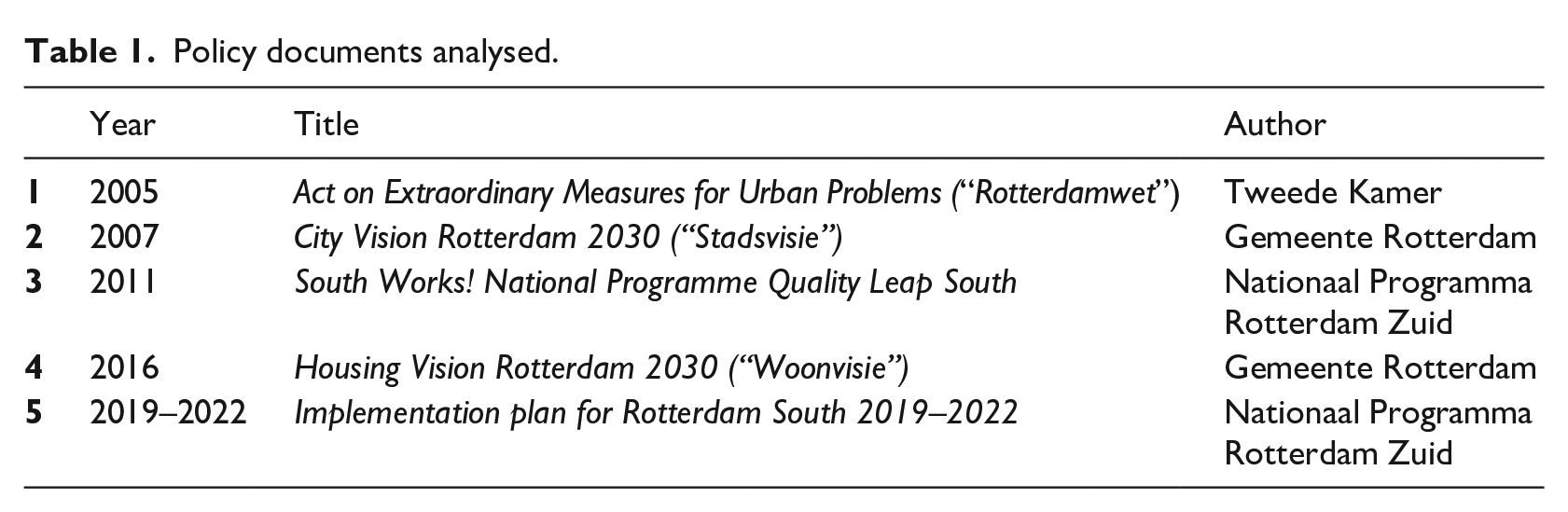
This study, epistemologically rooted in constructivism, consisted of a qualitative content analysis of five policy documents from 2006 to 2022 from both Rotterdam municipality and National Programme Rotterdam South (NPRZ) and six semi-structured ‘theory-generating’ expert interviews with high-profile actors in the Rotterdam housing space (Littig and Pöchhacker, 2014). NPRZ was included because the programme works with the municipality in managing housing in neighbourhoods in Rotterdam South. The turn of the century marked a notable change in attitudes towards non-Western migrants in Rotterdam. It was also around this time when more hostile housing policy was introduced following the successful election of the anti-immigrant right-wing party Leefbaar Rotterdam and the subsequent murder of party leader, Pim Fortuyn (Bolt et al., 2008; Scholten et al., 2018). The years 2000–2006 saw an increase in policies dominated by discontent around the migrant population and debate concerning their ‘integration’, particularly regarding the Muslim community. After the publication of a 2003 report projecting that the native-Dutch would be a minority in the city come 2017 (Ergun and Bik, 2003), these sentiments grew in popularity. The 2003 policy ‘Rotterdam Perseveres’ (Gemeente Rotterdam, 2003) majorly influenced the later legislation of the Rotterdamwet (Ouwehand and Doff, 2013). Keeping these links in mind and in the interest of theoretical saturation, we chose 2006 as the starting point for our data collection as it marked the official implementation of the milestone Rotterdamwet, the culmination of previous policies, government lobbying, and public discourse at that time. The first author implemented theoretical sampling and collected Rotterdam municipal policy documents with specific reference to housing, gentrification, or neighbourhood ‘mixing’ through government databases, the Dutch Senate website, and academic journals (see Table 1). These policies are described in detail below. We adopted a more interpretive approach to policy analysis in order to understand the assumptions that underpin the framing of the housing problem, and not merely how the problem can be solved (Browne et al., 2019).
Policy documents analysed.
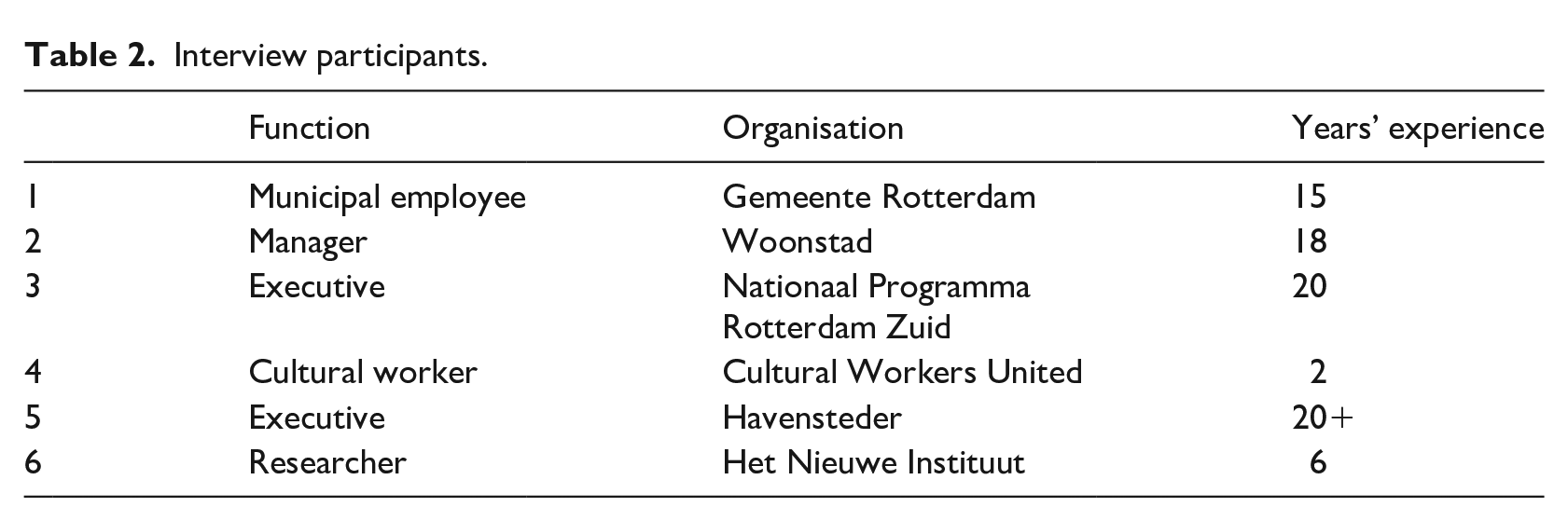
Interview participants were recruited by the first author via convenience sampling using existing contacts, followed by snowball sampling to access Rotterdam housing experts. Participants included one researcher, one municipal employee, one executive from NPRZ, two social housing employees (one executive from Havensteder and one manager from Woonstad), and one cultural worker (see Table 2). Each interviewee gave informed consent to participate; all names and identifiable details were anonymised. Four participants were white, native-Dutch men, one participant was a black native-Dutch woman, and the final participant was a white Greek woman. These experts had between 2 and 20 years of experience in housing, some with extensive ‘professional knowledge’ in their field, and others who were ‘active participants’ in their community, having acquired special knowledge and privileged access to information through their activity, rather than through training (Meuser and Nagel, 2009).
Interview participants.
Interviews took place online via MS Teams or in person depending on the availability and preference of the participant. Topics discussed included gentrification, segregation, city branding, and tension between policymakers and housing corporations, although the content of each interview varied depending on the role and experience of the participant. Interviews, bar one, were audio-recorded with participant consent, transcribed and coded using thematic analysis (Clark et al., 2021), using an iterative and inductive approach to allow general themes to emerge from participants’ reflections. This dynamic process of continuous data review and conceptualisation allowed for flexibility in understanding the links between emergent themes and enabled us to be responsive to any new information that emerged from the interviews (Clark et al., 2021).
In terms of our positionalities as researchers of this topic, we work from the advice Walter Mignolo gave to decoloniality scholars in a 2017 interview: ‘First, know your place in the colonial matrix of power, where you have been located and classified. Second, remember that the colonial matrix of power cannot be “observed” from the outside because there is no outside’ (Hoffmann, 2017: 5). We therefore noted our potential biases as white, Western-European/American women, researching in the Netherlands. The first author took particular care with her own subjectivity during the interview portions of this research. Together, both authors worked with accountability partners representing a wide variety of ethnic and racial identities during research group meetings with other scholars.
Policy background
Below, we offer a brief overview of the five policy documents included as data.
1. Act on Extraordinary Measures for Urban Problems or ‘Rotterdamwet’. Developed in Rotterdam following the election of Leefbaar Rotterdam, the Dutch Senate adopted this bill on December 20, 2005. It was enacted in 2006, intending to address the influx of low-income groups in the neighbourhoods of Rotterdam South. The Act allows municipal governments to deny housing permits to those who have lived in Rotterdam for less than 6 years and who do not receive an income from employment, a student loan, disability grant, or pension (Tweede Kamer, 2005, Art. 8). Moreover, it enables municipalities to deny someone a housing permit if there is a ‘well-founded suspicion that [a person’s] accommodation will lead to an increase in nuisance or crime in that complex, street, or area’ (Tweede Kamer, 2005, Art. 5).
2. Stadsvisie. Introduced in 2007, Stadsvisie proposed detailed gentrification and restructuring plans for the city with the goal of achieving the following three objectives by 2030: ‘attracting more middle and high-income groups to the city; attracting more highly educated people to the city; and improving the living environment for all Rotterdammers’ (Gemeente Rotterdam, 2007: 61).
3. South Works! The National Programme’s Quality Leap for the South. In 2010 Eberhard Van der Laan (Minister for Housing, Neighbourhoods and Integration) commissioned the report ‘Kwaliteitssprong Zuid, ontwikkeling vanuit Kracht’ on how to tackle social problems in the South of Rotterdam (NPRZ, n.d.). Following the report’s recommendations, the National Programme of Rotterdam South (NPRZ) launched in 2011, in partnership with local government, housing associations, schools, and employers, to improve the quality of life for residents in the South through the areas of employment, education, and housing from 2011 to 2031 (Rijksoverheid, 2021). ‘South Works’ was NPRZ’s first policy paper and details the plans to continue reducing affordable housing in order to diversify housing stock and attract more affluent residents to the South (NPRZ, 2011).
4. Woonvisie. Building on the aims of Stadsvisie the municipality launched Woonvisie in 2016, to set goals for housing and living conditions in Rotterdam to achieve by 2030. The priorities regarding housing were ‘accommodating the increasing housing demand of middle-income and higher income households, social climbers and young potentials; ensuring a more differentiated housing stock in areas that are currently one-sided and quality of living is under pressure; and strengthening of residential environments’ (Gemeente Rotterdam, 2016: 13). Woonvisie focused on the removal of ‘low-cost’ housing stock, that is, social housing properties below the rental cap of €629/month, or private rental and owner-occupied houses with a WOZ value below €122,000 in areas within Rotterdam South (Gemeente Rotterdam, 2016: 70). Although residents were given relocation assistance if their homes were affected by this ‘restructuring’, they were not granted a ‘right to return’ to their neighbourhood (Rajagopal et al., 2021).
5. Implementation plan for Rotterdam South 2019–2022. This implementation plan from NPRZ details the progress of the programme so far and plans for redirection in the last 4 years. Therein, they make clear that the ‘desired target groups’ they wish to attract to Rotterdam South are ‘social climbers and people from outside the area’ (NPRZ, 2019: 62). They also plan for one third of the housing stock in the South to be renewed through renovation, merging, or demolition-new construction during the period of the programme (NPRZ, 2019: 56).
Findings and analysis
From our policy analysis and coding of interviews, we identified three distinct stages through which the preservation of whiteness takes place in Rotterdam municipal housing policy:
Preserving the ideals of whiteness in the conceptualisation of policy theories: for example, in ‘future-proofing’ neighbourhoods via gentrification, social mixing, and neoliberal ideals of participation.
Enshrining whiteness in the language of the policy document: through the erasure of race and the privileging of class, and the erasure of people in lieu of ‘objective’ criteria.
Maintaining whiteness in the implementation of the policy: through state-led segregation in the North, and the aggressive displacement of low-income, migrant communities in the South.
In the sections that follow, we offer our findings and analysis contextualised by relevant quotes from the policy documents in our research. These quotes serve to orient the reader, like epigraphs, as we dive separately into each of the themes that emerged from the data.
Conceptualisation of policy theories
Future-proofing
Future value is always central: how does innovation or experimentation contribute to the living and housing needs of tomorrow’s Rotterdammer? (Woonvisie: 24). The new homes and residential environments will suit the future residents of the South. The residents are developing, and the composition of the population will change (Zuid Werkt: 17). It is desirable to temporarily withdraw the South from the housing distribution system in order to give priority to housing people who make a meaningful contribution to the South (Zuid Werkt: 20).
The concept of ‘future-proofing’ neighbourhoods and the emphasis on the future value of homes was present throughout policy. Little was mentioned about the needs of current residents. Future-proofing is connected to the notion that improving the housing stock would attract affluent, higher-educated, and middle-income residents to certain neighbourhoods with an ‘unbalanced’ housing composition. As evidenced in the quote from Zuid Werkt above, residents are appraised similarly to prospective property in terms of their intrinsic value and what ‘contribution’ they could make. By this logic, current residents of the South are seen as incapable of making a ‘meaningful contribution’ to the area, hence why newcomers should replace them. In her interview, the researcher noted that Rotterdam only became ‘polished’ in the early 2000s following gentrification policy and that ‘from that point onwards in different policy documents it’s spoken about which areas need improvement, and also which people would contribute to that improvement’. This aspect of ‘future-proofing’ was largely opposed by interview participants. The Woonstad manager lamented the exclusion of current residents in social housing: ‘Why can’t you invest in a neighbourhood when there’s poor social housing? You can still regenerate neighbourhoods with the same people living there’. While the Havensteder executive echoed this sentiment saying: ‘You also have to look at the qualities of the people who are already there [in a neighbourhood] and how you can make them more prosperous.’
Despite this emphasis on future residents in policy documents, several participants mentioned the appropriation of the working poor in city branding. The following quote from the cultural worker regarding the city slogan ‘Rotterdam: Make it Happen’ demonstrates this: Since Rotterdam is bent on marketing itself as a city of people doing things, a city of entrepreneurs, it also tries to relate back to a working class that’s actually now being transplanted out of the city more and more.
In Woonvisie, it is argued that housing stock must be flexible and ‘offer space for temporariness’ in order to be ‘future-proof’ and respond to changing needs (Gemeente Rotterdam, 2016: 24). In this same document, this transience of housing is termed negatively as a ‘high-turnover rate’ in poorer migrant neighbourhoods but is celebrated as innovative and creative when used as a method to attract wealthier, whiter residents. This language of ‘future-proofing’ the city reveals a municipal sentiment that is anti-poor, anti-migrant, and one that aspires to attract and affiliate with middle- and upper-class whiteness. Here, diversity and the rose-tinted image of the gritty, resilient, working-class residents are weaponised in city branding in order to set Rotterdam apart and to compete with other cities – both nationally against Amsterdam, and globally – for talent and investment. The disregard for the needs and desires of current residents of neighbourhoods in the South shows the value, or lack thereof, that the municipality places in their economic contribution. Here, the ‘reputational value’ of whiteness is prioritised (Harris, 1993).
Social mixing
One of the main goals of our development strategy is to achieve a balanced population (Stadsvisie: 63). Residents who are rising on the social ladder are the most important target group for housing construction. [. . .] They set an example (Stadsvisie: 127). Investing in private ownership leads to broader social benefits at the neighbourhood level, since the differentiation in home ownership makes it more likely that socially advantaged people will continue to live in the neighbourhoods (Woonvisie: 18).
The paternalistic principle of the ‘wijkonbalans’ (neighbourhood imbalance) is key to the policy of social mixing that the municipality and NPRZ have enforced in recent years. Central to this principle is the idea of middle- and higher-income residents setting an example for their lower-income peers. The executive and manager of the two housing associations said they agreed in general with ‘mixed’ or more balanced neighbourhoods but did not agree with the way in which the municipality set out to achieve it, that is, through displacement. The NPRZ executive was the sole participant who wholly agreed with social mixing, stating: If you do not have a good mix of lower, middle, and higher income, then the lower income class in particular becomes the ‘victim’ if they are concentrated in neighbourhoods. So, in order to give people with lower income, lower education the possibility to lead a good life, it is absolutely necessary to also have room for the middle-class incomes in that same area.
In contrast, the Woonstad manager argued that ‘the wijkonbalans’ was based on a principle from 10 years ago: ‘The policy of the city hasn’t adapted fast enough, nowadays we need a totally different solution’. He concluded this from his own research studying the effect of social mixing in a gentrification project in Rotterdam where he found that, ‘the mixing didn’t work at the neighbourhood level [. . .] because [the gentrifiers] were in different groups [to those that originally lived there], used different schools, different shops etc’. Somewhat hidden in the words of the Woonstad manager are racialised associations with Dutch schooling and daily life. ‘Different schools, different shops’, in a city whose schools are racially and ethnically segregated (Boterman, 2019) clearly racialises the whiteness of the gentrifiers in contrast to the ‘other’ groups. The cultural worker also criticised social mixing and more directly identified its targeted implementation in communities of colour in Rotterdam South, as opposed to wealthier, whiter neighbourhoods in the North, stating: The way it’s been used is not referring to neighbourhoods that are already, for example, a monoculture of middle-class or upper-class white people. [The policy] is only being pushed to neighbourhoods that have migrants or people of colour, or in general people from the lower economic class.
The lack of application of this social mixing rhetoric in the white, homogeneous neighbourhoods in the North of Rotterdam speaks volumes about the intent of the municipality and undermines the credibility of its implementation. The paternalism evoked in social mixing and neighbourhood restructuring policies shares ties to the colonial notion that ‘land requires improvement because its inhabitants are also in need of civilization up-lift’ (Bhandar, 2018: 7).
In Woonvisie, as quoted above, the stability of home ownership is offered as an important element of gentrification to prevent the selective migration of ‘social climbers’ in the neighbourhood. The supremacy of private home ownership, and the superiority of white, middle-class owner-occupiers in neighbourhoods experiencing gentrification aligns with Harris’ (1993) ‘Whiteness as Property’ thesis; how being included in, or ‘owning’ whiteness has more to do with the right to exclude others from the benefits of this belonging. The concept of ownership, moreover, has been an integral part of liberal individualism since the 17th century, where in Lockean rationale, an individual was free inasmuch as he was the ‘proprietor of his person and capacities’ (Macpherson, 1962: 4). Today, whiteness and its historical relationship to property still hold vestiges of this ‘possessive individualism’ and the capacity to appropriate, a literal version of Harris’ imagined belonging (Bhandar, 2018).
Neoliberal participation
In Rotterdam South, not participating is not an option. The South is strict with those who fail to develop their talents sufficiently (Zuid Werkt: 7).
This paternalism towards the migrant population of the South evident in the views espoused by NPRZ illustrates the settler-native power dynamic felt by the white Dutch. The concept of citizen ‘participation’ naturally came up in every interview and each participant had a different view. Three participants gave particular focus to the importance of allowing everyone equal opportunity to ‘participate’ in Dutch society. The researcher offered an interesting counter to this notion: Active citizenship is the core of neoliberal citizenship and it’s also the fundament of how we see people with a migration background settling in the Netherlands and adopting the culture. [. . .] Active participation is something that inherently cannot be measured. It can only be measured up to [policymakers’] subjective standards which ultimately means that people need to be displaced because they are not valuable contributors to the neighbourhoods where they have lived for decades.
This signals the value placed in whiteness and wealthy gentrifiers over current non-white residents and the unattainable standards the latter are held to in order to ‘participate’ in a society that excludes them.
Language of the document
The erasure of race/privileging of class
[Ambition for 2030]: The almost natural diversity of the population can also be recognised at lunchtime, when a colourful business crowd strolls along the quays (Stadsvisie: 14). Rotterdam South is struggling with problems that are un-Dutch (Zuid Werkt: 1). By realising housing for students, expats, small households [. . .] and for urban families, a larger and more varied supply of housing is created in the centre (Woonvisie: 20).
What we found striking, both in the analysis of policy and during interviews, was the absence of race from the discussion. There was never a mention of how race figured in the residents of the neighbourhoods targeted by gentrification policy, despite them having 10%–35% more of a share of residents of ‘non-western migrant background’ than the city’s average (39%) (Gemeente Rotterdam, 2022). Tracing the language use, the municipality favoured proxy language such as ‘expats’, and ‘un-Dutch’, and only in NPRZ’s case explicitly mentioning ethnicity via the currently preferred term ‘non-Western migrants’, meaning those from Africa, Latin America, or Asia (excluding Japan and Indonesia) (Gemeente Rotterdam, 2022). The topic of race was also not immediately brought up by most interviewees, and if the topic of exclusion or discrimination came up, class issues were prioritised over racial ones. For example, the Havensteder executive claimed that social mixing policies ‘excluded lower-income people, people who are dependent on social housing and also the lower-middle income families.’ The Woonstad manager agreed that the gentrification policies are discriminatory, but in ‘fallibility’, stating it was an issue of losing highly educated people because ‘the city does not have affordable homes for them’. The cultural worker acknowledged there was a ‘racial aspect’ to housing policy in Rotterdam but said that in her own experience in searching for housing as a white, Greek woman, ‘it’s mainly economic discrimination and xenophobia’. She further clarifies: What the municipality care about is whether you are ‘productive’ which comes from a very colonial line of thought which has embedded racial elements. But ultimately, if you are rich, therefore not on benefits, with a university degree, then you won’t face as many structural obstacles when it comes to housing.
This turn of attention from structural whiteness and coloniality in policy development to the possible success of an individual, highly educated, wealthy person of colour is a classic pattern, and one heavily scrutinised by CRT. By highlighting the exception to the rule, we negate and excuse the overwhelming patterns of structural racism and its impact on the largest swaths of the population (Freeman, 1978). By highlighting the importance of class over the importance of race, we buy into the logic of whiteness that believes in the separability of these two constructions (French, 2018).
In her interview, the researcher identified the phenomenon of avoiding the topic of race saying, ‘in the Netherlands, white Dutch citizens are afraid to be called racists despite forwarding the same racialised structures’. These data confirm the identity of white, Dutch people not only as colour-blind (Wekker, 2016), but further as colour-mute (Pollock, 2004). In fact, the municipal employee was the only male participant who openly discussed race in the interview – most likely as his role deals directly with racism. Although he did not think ill of the intention of policymakers, he questioned the possibility of success, given the difference in demographics between citizens and those in office: ‘How can you service a superdiverse city when the make-up of your own organisation (Gemeente Rotterdam) is to a large extent (and especially in the higher ranks) homogeneous?’
Across the data, this absence of explicit mention of race is emblematic of the ‘wilful ignorance’ of Dutch racism (Wekker, 2016). The ‘invisibility’ of this racialised structure to the white population is intrinsic to its success and proliferation of racial inequality. Proxy language about class and income is wielded instead, with the assumption that ‘ethnic segregation is merely a reflection of socioeconomic segregation’ and that by controlling for, or indeed eliminating one, the other will follow suit (Bolt et al., 2008: 1360). This ignores prolific work that exposes the interrelated nature of race and class (see: Fraser, 2016; Melamed, 2015; Robinson, 1983). This simplistic logic of ‘rich people in, poor people out’, shows the bidirectional thought of policymakers. Here, concentrations of affordable housing associated with (non-Western) migrants are thus considered synonymous with unsafety, societal regression, and contagion of a neighbourhood. This absence of race in policy is also demonstrative of CRT’s ‘perpetrator perspective’, in that it ignores the objective conditions of the lack of housing for low-income communities of colour in Rotterdam South. Simultaneously however, policymakers view this group as the ‘perpetrator’, blaming them for their own exclusion, a swapping of cause and effect (Bolt et al., 2010; Freeman, 1978; Richardson, 2015). By associating ‘un-Dutch problems’ such as unemployment, homelessness, unsafety, and so on, with the migrant population of Rotterdam South, NPRZ simultaneously links Dutch whiteness to safety, purity, and ‘naturalness’. According to Hartman (1997), such rhetoric endorses a politics of contagion that ‘eventually serves to justify segregation and license the racist strategies of the state in securing the health of the social body’ (p. 159). The erasure of race is also apparent in the Dutch government’s response to UN criticism, and their refusal to acknowledge the inherent racism involved in the displacing of Tweebosbuurt residents, stating, ‘the fact that residents of Tweebosbuurt of immigrant background are having to be rehoused is simply because the Afrikaanderwijk district [. . .] has a diverse population drawn from all kinds of cultures and backgrounds’ (Rijksoverheid, 2021). This theme of erasure also applies to the next finding.
The erasure of people
The ideas [for solving housing issues] must reinforce the desired development of the living environment and can focus on the “what” (the product) or the “how” (the living, the development, the organisation) (Woonvisie: 24). This excess of cheap houses attracts households in the primary target group from elsewhere. Supply creates demand (Woonvisie: 14). In the South, the neighbourhoods are not sufficiently distinctive: they lack identity (Stadsvisie: 126).
Separate to the erasure of race is the absence of people from policy documents, that is, the erasure of the residents, their experiences, and their humanity in lieu of statistical data. This too was highlighted as a flaw by several interview participants, particularly regarding the Rotterdamwet. The first author asked participants why (in their opinion) these specific neighbourhoods were selected for this policy implementation. The Woonstad manager responded: They were selected on the basis of statistics about the amount of social housing per neighbourhood, but there were also statistics about safety in neighbourhoods or people who haven’t got a job. In the statistics, you see a clear relationship between social housing and unsafety. [. . .] You can’t solve all the problems by moving demographics in the city, because people still live, so you change the statistics, you don’t change the people.
Here, supposedly ‘neutral’ econometrics form a more valued epistemology. The Havensteder executive shared a similar view regarding the erasure of the people, claiming: [The Rotterdamwet] focuses on people and not on the problem. It gives the council an excuse not to invest in education or all the other kinds of things that could help. It tells people, ‘We [the municipality] aren’t the problem, you’re the problem’.
Despite this word choice of ‘focussing on people’, the participant illustrates the same sentiment – that the poor ‘un-Dutch’ migrants are villainized as a ‘problem’, rather than people, disregarding the complexity of their humanity. The NPRZ executive, on the contrary, was a proponent of the Rotterdamwet and said Article 8 of the Act (regarding the income requirement) was introduced to control private landlords and limit their choice of tenants, ‘and for that, we had to find objective criteria, and that was, “how do they get their money?”’ The online interface tool ‘Leefbarometer’ is informed by national statistics data deemed objective and used by many architectural firms to determine the liveability of a neighbourhood as either a ‘green’ area or ‘red area in need of change’. The researcher elaborated: Often areas like Tweebosbuurt are red areas by default [. . .] the data [Leefbarometer] uses includes a data set ‘how many people with a migration background live [in the area]?’ Architects look at this tool and constitute that a neighbourhood is in need of change because it’s a red area. Then they propose new plans, bringing in new people – usually middle–class or upper–class citizens or young professionals or whatever – definitely not the people who live there already. And then the process of gentrification ensues.
The neoliberal policies and redlining tools as the researcher described above support the increasing financialisation of the housing stock and facilitate the displacement of people of colour. The erasure of people and the focus on demographics and data is again an example of neoliberal bureaucracy, where residents are categorised, classified, and their contribution to society quantified. The neutrality of the supposed ‘objective’ criteria of one’s employment and length of residence in the exclusionary policy of the Rotterdamwet, as echoed by the NPRZ executive, is an example of Wekker’s ‘white innocence’ and Bonilla-Silva’s (2018) colour-blind frame, the ‘minimisation of racism’. This neutrality is an artifice of white supremacy that seeks to create whiteness as the referential, ‘natural’ baseline, to which all else is subordinate. The privileged white, Dutch body politic are largely unaffected by the demolition planned by these gentrification policies, yet the experience of the immigrant, low-income population is one of great housing precarity, scarcity, and displacement.
Policy implementation
State-led segregation
In Rotterdam North, there are many old districts where the value of homes is rising. This development is positive and is taking place autonomously; we will not actively intervene here. The market is doing its job, we are mainly facilitating (Woonvisie: 24).
The differential treatment of neighbourhoods in the North versus the South of Rotterdam was evident in interviews. The municipal employee recalled an enlightening conversation he had about this with a Tweebosbuurt resident and activist where the resident posed the following: ‘I can agree with diversifying the housing stock in principle, but do you think they diversify housing in the same way in North or East Rotterdam?’ Other participants offered insight into the deals between social housing associations and the municipality, whereby the former were promised new locations in the North in return for reducing their housing stock in the South. The Woonstad manager illustrates this dilemma thusly: ‘At the moment we are in a struggle with the city because we did what we promised [. . .] but we didn’t get the new locations.’ This further affects the segregation in the city whereby the North is primarily white native-Dutch, and the South more non-white, migrant groups. The Havensteder executive confirmed: Not only the local policy, but the wider policy in the Netherlands regarding social housing and the distribution of houses has a strong influence on segregation because we have to house low-income people in the cheapest housing, and those houses are concentrated in certain areas.
Whiteness in neighbourhoods in the North of Rotterdam is protected by the municipality, both in their inaction in the creation of new social housing units in the area, and in the lack of intervention applying the same ‘re-balancing’ theory to those areas. Although policy tackles ethnic segregation by targeting communities of colour in the South, it conveniently does not address, and cannot compensate for, the demonstrated self-segregation of the native population (Bolt et al., 2008, 2010). This is an interesting paradox in the case of the Netherlands, Wekker (2016) asserts, in that ‘the Dutch do not wish to be identified with migrants, although one in every six Dutch people has migrant ancestry’ (p. 6). The concentrations of ethnic populations are created in part by policy (in the case of social housing allocation) but also by the restriction of choice opportunities for low-income groups due to the reduction of affordable housing and the lack of investment in majority migrant neighbourhoods, leading to decay (Doucet and Koenders, 2018). The policies in Rotterdam tackle the perceived issue of housing composition, yet fail to remedy the inequities in power, resources, and education that continue to be the by-product of the current segregation.
Displacement
Now that the housing market is good, there are opportunities for the South. It is precisely in this period that the focus neighbourhoods must be sped up as much as possible (NPRZ Implementation plan 2019–2022: 60).
We chose the above quote from NPRZ to illustrate the disparity in views between the municipality, NPRZ and the expert interviewees. The Woonstad manager specifically mentioned the ‘aggressive’ ask of Woonvisie to reduce social housing to the ‘55% max threshold by 2030’ and how ‘that forced change damages people’s pride and happiness’. All participants bar one mentioned the negative effects of these housing policies including displacement, exclusion, and stigmatisation. The following quote from the researcher provides a concise example: You could also see this in the Tweebosbuurt but also in Charlois, Feyenoord and so on: when people with a bi-cultural background, for instance, Moroccan-Dutch or Antillean-Dutch etc. really directly ask ‘are we not allowed to live here?’ because they are made to feel that way. There’s a lot of circumventing this question. But even the fact that this question appears shows me that structures are still in place in terms of city planning and architecture that make people feel unwelcome.
The exclusionary nature of the Rotterdamwet and the expulsive effects of Woonvisie and Stadsvisie align with a commonality between whiteness and property: the right to exclude. Bhandar (2018) posited, ‘if the possession of land was (and remains) the ultimate objective of colonial power, then property law is the primary means of realizing this desire’ (p. 2). Housing policy by association is equally ensconced in colonialism and white supremacy, and as such, should be wielded with a decolonial purpose of wealth redistribution as opposed to wealth creation. It is evident from the quote above that this exclusion and racial discrimination is felt by the migrant population of the South despite the ‘colour blindness’ professed in policy. This reflects what Wekker (2016) describes as the juxtaposition between the 400 years of Dutch imperial presence in the world, and its absence from Dutch self-image and identity discourse.
Discussion and conclusion
This research has highlighted how whiteness is preserved in a three-stage manner in Rotterdam municipal neoliberal housing policy. This is done first in the conceptualisation of paternalistic policy theories, such as the social mixing and future-proofing of neighbourhoods through gentrification. Next, whiteness is enshrined in the language of the policy through the erasure of race and the erasure of current residents and their needs. Finally, whiteness is maintained in the implementation of the policy through social division, state-led segregation in the North of Rotterdam, and the displacement of communities of colour in the South. These findings highlight the myriad ‘invisible barriers’ that work to separate those with a migration background in Rotterdam from the ‘autochtoon’, and how policy legitimates this separation (Schinkel, 2017). By using the grand theories of CRT and ‘whiteness as property’, this research offers a clear example of the current iteration of systemic racism today; how it operates through anaemic policies that villainize low-income migrants and justifies the maintenance of the status quo of racial hierarchy in the ‘colour-blind’ nation of the Netherlands. Property, ownership, and housing are intrinsically linked to whiteness. As such, an interrogation of housing policy with this critical framing is crucial in making visible the systems that thwart justice (Silverman, 2015) and prompting consideration of ‘how the built environment is always shaping the conditions through which race is made material’ (Brown in Van Hoek, 2022). Similar housing ‘crises’ that privilege affluent newcomers over current residents are happening throughout Europe (Cities for Rent, 2022). By applying a CRT lens, one can understand how these housing policies serve to both reflect dominant societal moral positions and crystallise these positions in legal thought (Freeman, 1978). The result is housing policy that largely maintains the racialised status quo, which is a foundational element of whiteness itself (Bell, 1980). Our findings confirm what has been shown repeatedly of the ways in which systemic racism operates through institutions. Moreover, this research expands upon this relationship, by personalising the actor’s role in maintaining whiteness in policy and identifying the stages of policy formulation and implementation where they exert most influence.
Discontent at the stagnancy of current progress against the urgency of this issue was voiced by our participants, who offered both novel and demonstrable directions for tackling inequity in housing, for example, further municipal investment in housing co-operatives, and the redistribution or absorption of commercial real estate back into the residential housing stock. There is optimism in these imagined futures of housing. However, our interview base is not representative of those who are most affected by these policies (low-income, ‘non-Western’, non-white migrants). We, therefore, think it important to note that though we reference the violent displacement these policies sanction, one can assume that the effects may be even more damaging than what is stated here. The impetus of the Rotterdamwet was predicated upon a projected population increase of non-white migrants in 2003, and the later neighbourhoods included in the piloting of the act were selected in part, due to their ‘ethnic’ composition (Ouwehand and Doff, 2013). Rotterdam municipality has wielded this economic cypher in housing policy for an issue deeply intertwined with race and discrimination for 20 years. They are now at the unique choice point of addressing international criticism of the crisis with a change in policy direction, one that reifies the human right to housing and acknowledges the influence of the Dutch colonial past. Not doing so risks clinging on to a semblance of white, Dutch, colonial identity in the hopes of constructing a palatable albeit superficial national past, one that is incongruous with the vibrant superdiversity of the current population.
Footnotes
Acknowledgements
The authors express their sincere gratitude to their interview participants for generously sharing their thoughts and expertise. They also thank Willem Schinkel for his thoughtful feedback and comments during the initial writing process. This article also benefitted from the insightful comments and considered editing from Catherine Hearn and Niamh Carruthers. Finally, they thank the anonymous reviewers for their guidance.
Funding
The author(s) received no financial support for the research, authorship, and/or publication of this article.
