




Abstract
The state murder of Jîna Amini, a 22-year-old Kurdish woman in Tehran on 16 September 2022, while in custody of the Islamic Republic’s morality police, prompted a widespread uprising across Iran unprecedented in scale since the popular 1979 revolution. Adopting the Kurdish catchphrase ‘Jin, Jîyan, Azadî’ (Woman, Life, Freedom), this movement was largely centered in Kurdistan (known as Rojhelat) and Balochistan, two ethnically minoritized and economically de-developed regions, where the state deployed deadly violence and brutality to crush the protests. This article juxtaposes two competing narratives of this uprising. The first insists on branding the movement as a singular ‘national’ uprising of ‘Iranian women’. The second recognizes a plurality of women, particularly those from marginalized nations, such as Kurdish and Balochi women, and underlines the structural national, ethnoreligious, and linguistic oppression elided in the narrative of undifferentiated Iranian womanhood. Drawing on the notion of intersectionality, I argue that the elite nationalist discourse of Iranian womanhood reproduces the state’s ethnoreligious and linguistic suppression of non-Persian-speaking marginalized communities. Moreover, such a selective reading of gender inequality in Iran is unable and/or unwilling to embrace the intersectionality and multiplicity of women’s life experiences in Iran, particularly in its ethnic peripheries. This article offers a critical reassessment of Iranian feminism and its methodology of privilege, proposing instead a decolonized approach that invites nationalist Persian/Iranian activists to interrogate Persianness as a marker of official national identity and institutionalized supremacy.
Keywords
‘Jîna, my soul. You shall not die. Your name will become a symbol’. (Kurdish words engraved on Jîna Amini’s gravestone by her family) ‘You are dead, I snatch the world from you. I take your breath away. It’s over. Done for you. Finished. Says Mortality.—No! I cry. I do not capitulate. What is finished is not finished. What is done and cannot be undone can be undone. I take the word néant, Nothingness, and I turn it into its opposite: Né en: born in’
Introduction
The torture and murder of Jîna 1 (Mahsa) Amini, a 22-year-old Kurdish woman from the Kurdish city of Saqez–Rojhelat 2 while in custody of Iranian regime forces on 16 September 2022, became a turning point in Iran’s anti-compulsory hijab movement. As with all other non-Persian names, the Islamic Republic of Iran (henceforth ‘IRI’) had forced Jîna’s parents to choose an official Persian name (Mahsa) for their daughter. Jîna’s death provoked a countrywide wave of anti-regime protests with hundreds of thousands storming the streets for nearly 3 months. Centered around the Kurdish slogan, 3 ‘Jin, Jîyan, Azadî’ (Woman, Life, Freedom), the protests constitute the most widespread and sustained wave of contestation in Iran since the country’s 1979 revolution (see Hassaniyan, 2021).
Chronicling this revolutionary movement and the roles of Iran’s various ethnolinguistic and religious communities is beyond the scope of this article. However, it should be mentioned that this countywide movement spanned numerous geographical and cultural domains ranging from the north (Gilaks and Mazanderanis) to central cities (Tehran and Karaj) to Ahvaz, each with its specificities. While the movement was more secular, organized, and gender diverse in Rojhelat, largely due to the area’s history of modern political parties and activism, in Balochistan it was mainly held during Friday prayers 4 and mostly by men. Balochistan and Rojhelat witnessed excessive use of state violence in which protesters were met with live ammunition and heavy weaponry.
In less than 2 days, the hashtag #MahsaAmini surpassed 200 million retweets. Several women and celebrities cut off their hair and burned their scarves in protest. In Kurdish regions, the anti-compulsory hijab protest swiftly transformed into public uprisings calling for the recognition of ethnic and linguistic rights. A day after Jîna’s death, the regime unleashed a massive deployment of security forces, such as riot police and Basij militias, to crush the protesters. To shift focus from the unified public protest, the IRI resorted to the conspiratorial justification that ‘enemies of the system’, particularly ‘Kurdish separatist groups’, 5 incited the uprising, and it launched three deadly cross-border airstrikes on Kurdish opposition exile groups in northern Iraq (on 28 September, 13 November, and 20 November 2022) which resulted in 13 deaths and 58 injuries. The regime also launched 5 weeks of assault on such major Kurdish cities as Sanandaj, Mahabad, Sardasht, and Jawanrood, using weapons of war that led to the death of 122 civilians, including 14 children and 7 women. 6
Resistance against compulsory veiling has been evident since the birth of the IRI and has largely been based in Persian-majority cities, led by women of the center. Such resistance was by and large geographically and intellectually unconcerned about the demands of marginalized communities such as Kurds, Baloch, Arabs, and Turks. The Jîna movement shifted the frontlines of this struggle to Iran’s periphery and set the scene for de-provincializing and de-centralizing women’s fight for fundamental rights ranging from the hijab to cultural and political representation in Iran.
Reactions to Jîna’s death were varied (see Thangaraj, 2022; Matin-Asgari, 2022). Nationalist elite women, mostly Persian-speaking, attempted to symbolize Jîna as a manifestation of four decades of the anti-compulsory hijab struggle led by archetypal ‘Iranian women’ resisting the IRI policy of control over women’s bodies through Islamic law and teachings
7
(see Bajoghli, 2022). While joining Persian/Iranian nationalist women in their fight against the repressive regime, many non-Persian women saw more than a gender element in Jîna’s case. As Farangis Ghaderi and Goner (2022) and Bradost (2022) argue, the nationalist framing of slogans in Persian cities dismissed the ethnolinguistic element of Jîna’s case. The movement resurfaced a foundational ethnocultural gap and resultant economic and political disparity in Iran in which the sovereign ethno-nation has monopolized all forms of power and means of production. Kurdish women (see Labady and Riani, 2022; Dirik, 2022) found this epistemological dismissal as the (re)appropriation of their unique experience of suppression by their sisters of the dominant ethnie in line with state discourse in an attempt to form a homogeneous Iranian identity, exploiting women’s ‘shared’ experience of oppression. According to Parya, a Kurdish woman activist, What the international community is unaware of is the divided nature of this movement, between Persian and non-Persian women. I am on the voiceless side, spoken for by those denying my ethnic and linguistic rights; look how Persian activists and celebrities stole Jîna’s name. I stand with non-Persians in fighting this colonial system that feeds from our denial and assimilation. The other side only seeks regime change while keeping the power hierarchy as it is, a soft move to secularism. My side is the Jîna revolution, Jîna from Rojhelat. The other side is the Mahsa revolution, Mahsa from Iran. The other side sings and dances. My side is silenced by the media. We have nothing in common.
This article draws on data from various sources. In addition to published sources, I interviewed eight Kurdish political activists, three of whom are based in Iran and five abroad. I selected the research participants based on their level and form of engagement in the Jîna movement, ranging from organizing street protests and rallies to leading public debates on the subject in media platforms such as Clubhouse and Twitter Spaces. I asked my participants to share their lived experiences of direct involvement in the uprising and their observations on the ground. I also participated in some of their meetings and shared drafts of this article with them for comments. In addition, I incorporated data from other social media such as Facebook and YouTube.
In my attempt to critique the ethnic supremacist character of Iranian-Persian feminism 8 (see Kurt, 2021), I focus on the Kurdish case and Kurdish women’s critiques of mainstream Iranian feminism, 9 with the acknowledgment that further research and multiple articles would be required to account for all non-Persian-speaking marginalized communities in Iran.
I use the term ‘Iranian/Persian women activists and women scholars’—some of whom are self-proclaimed feminist activists—for women activists who echo a state-centric discourse premised on the notion of Persian language and culture as the pillar of national identity. Despite divergent voices and backgrounds, these activists are in line with the state’s discourse of a singular national identity, opposing the idea of Iran as a multinational country. Furthermore, I define center-periphery as a ‘spatial metaphor’ to address the unequal structural relationship between the Persian-inhabited region, which is more developed economically, with the economically and culturally marginalized non-Persian geographies in Iran such as Rojhelat, Balochistan, and Ahvaz.
This article’s main objective is to problematize the epistemic premises of dominant feminist thought, which is primarily (but not exclusively) represented and voiced by Persian-speaking women, and the ways it addresses and articulates the voices and experiences of the women of marginalized communities in Iran. I begin with a brief overview of Iranian nationalist discourse to provide a historical context for understanding the multifaceted nature of gender oppression in Iran. The second section puts Iranian nationalist feminist thought in dialogue with the notion of ‘intersectionality’, which refers to the interconnected nature of social categorizations (such as gender, race, class, and other forms of discrimination) and how they ‘intersect’ to create unique dynamics and effects (Collins and Bilge, 2020; Romero, 2017). The article concludes that nationalist accounts of gender inequality in Iran are reductionist in nature and therefore unable and/or unwilling to embrace the intersectionality and multiplicity of women’s experiences in Iran’s ethnic periphery, hence functioning as an axillary of state homogenizing discourse (See Figure 1).
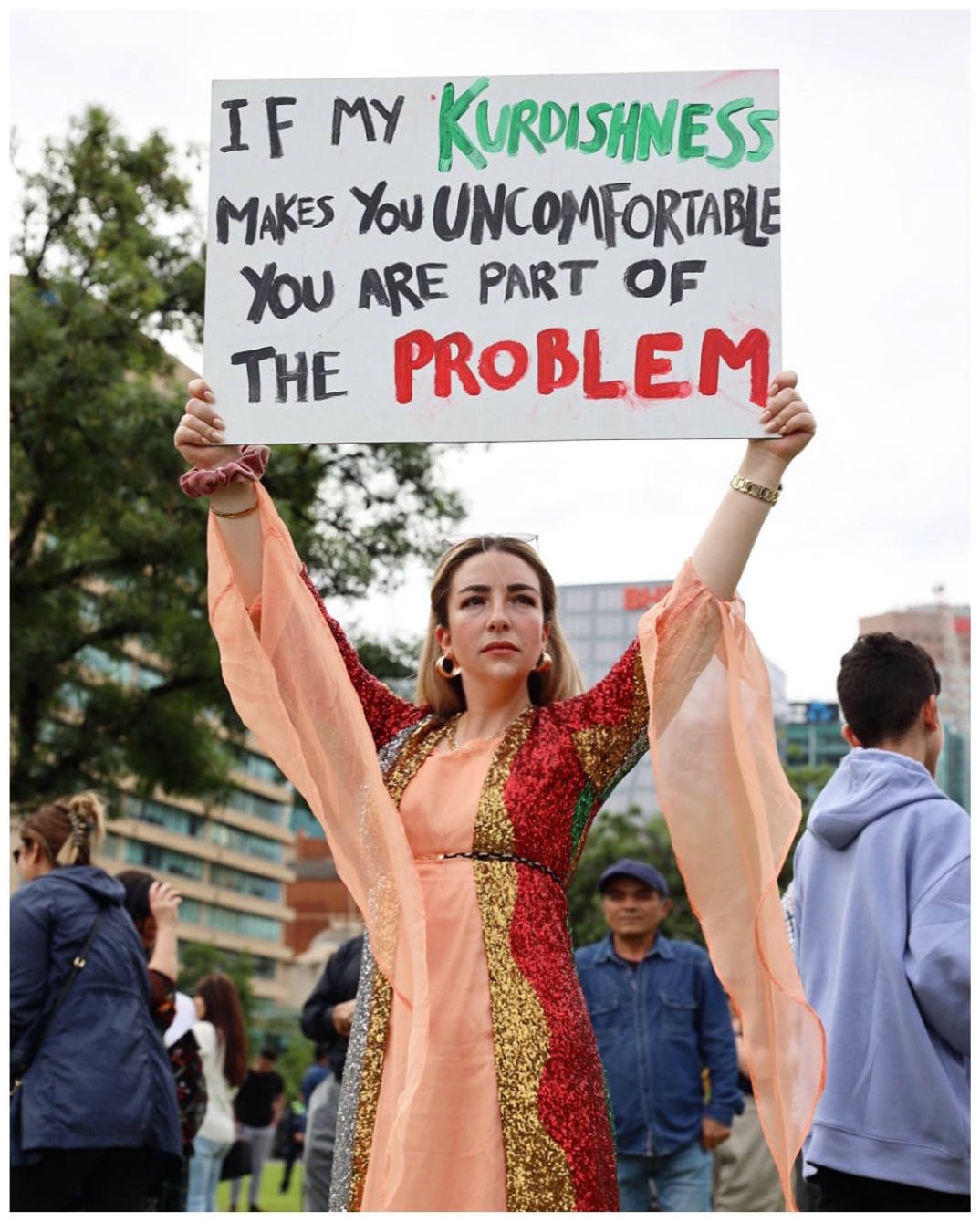
Kurdish diaspora protest in Adelaide, Australia (22 October 2022). The person in photo: Tara Fatehi, A Kurdish Rights Activist.
The birth of ‘Iranian women’
This section articulates the notion of ‘Iranian woman’ as a singular reference used by Persian/Iranian women elites and women scholars. The emergence of Iranian nationalist discourse can be traced back to developments in the Qajar state in the late 19th century (Abrahamian, 2008; Ansari, 2019; Cronin, 2003). Inspired by European intellectuals and territorial expansion, the Iranian nationalist intelligentsia sought to emulate the Western model of modernity and governance (see Matin-Asgari, 2018; Vaziri, 1993; Zia-Ebrahimi, 2016). In the early 20th century, Persian historians and intellectuals began to construct a historical primordial narrative of the Iranian nation that underpinned the Pahlavi dynasty’s project of state-building (see Jahanbegloo, 2021). With the rise of Reza Shah Pahlavi, the primary concern became turning Iran into a ‘modern’ country (Abrahamian, 2008; Cronin, 2003).
Reza Shah founded a monarchy centered on a racist model of the superiority of ‘the Aryan race’, a race whose point of origin, according to statist accounts of Iranian history, was rooted in Iran and whose unquestionable descendants were none other than Persians (Zia-Ebrahimi, 2016: 12). Inspired by the Eurocentric model of modernization, Reza Shah and his son, Mohammad Reza Shah, sought to westernize ‘Iranian culture’ and considered manifestations of non-Persian cultural diversity as a sign of backwardness and primitivity that needed to be forcibly civilized and assimilated. The Pahlavi Dynasty circulated the notion of racial unity and denied existing linguistic and ethnic differences in favor of the noble ‘Aryan race’ as the foundation of the state’s racial nationalism (Matin-Asgari, 2018).
The Pahlavi state chose a double-edged strategy of assimilation and violent measures to fashion a unified and homogeneous polity, namely ‘one country, one nation, and one state’ (Soleimani and Mohammadpour, 2019). A key element of this policy was the pursuit of uniformity in and standardization of what was to be known as ‘Iranian’ language, culture, and identity. Soon after, the terms ‘Persian’ and ‘Iranian’ were used interchangeably and served the essentially racist Indo-Europeanist project of nation-building in Iran (Asgharzadeh, 2007; Saleh, 2013). Reza Shah declared illegal the usage of all non-Persian languages in any written form and enforced his statist ultranationalist ideology through the support of the military and intelligentsia (Elling, 2013: 94). Other languages spoken in Iran were characterized as imperfect dialects of Farsi (e.g. Kurdish and Luri) or as alien, non-Indo-European languages (e.g. Turkish and Arabic) (Elling, 2013: 87).
Unlike the Pahlavi dynasty, which was marked by secular nationalism, the IRI advanced a religious nationalism, an ideology whose roots go back to the Safavid Dynasty’s 16th-century forcible imposition of Shiism as the state religion (see Amanat, 2017). Through the establishment of new religious institutions, the IRI began to nationalize Shiism as the religion of the state, and Ayatollah Khomeini occupied the new position of Velayat-e Motlaghe Faqih—the Absolute Guardianship of the Jurist. This shift, however, did not lead to reframing of ethnocultural and political hierarchies in Iran, nor did it acknowledge minorities’ rights to their language, representation, and identity (see Boroujerdi, 1998).
The Kurds’ rejection of the constitutional denial of Iran’s ethnic and linguistic diversity in the aftermath of the Islamic Revolution spurred Ayatollah Khomeini to issue a fatwa declaring Holy War against Kurds on 17 August 1979. In 1979–1980, the army and the newly established Revolutionary Guards launched a military campaign in Rojhelat, laying siege to main Kurdish cities and committing mass murders and extrajudicial executions. The IRI was successful in its military campaign and took total control over the Kurdish area and deployed a comprehensive set of assimilatory strategies regarding almost every aspect of Kurdish socio-political and economic life (Mohammadpour and Soleimani, 2020).
While mainstream scholarly studies of Iran have largely ignored the detrimental effects of modern nation-state building on the country’s multinational and multilingual composition, recent works by scholars of minoritized communities and several revisionist historians are beginning to re-evaluate the state-building project in Iran in light of the literature on subaltern studies and internal colonialism. Afshin Matin-Asgari, a leading historian on Iran, suggests that ‘to understand how the Pahlavi regime acted like a “colonial state”, we must shift to the perspective of “minority” or “subaltern” groups at the receiving end of its forced nation-building imperative’. Other Iranian historians such as Zia-Ebrahimi (2016), Katouzian (2003), Cronin (2003), Marashi (2008), and Ansari (2012, 2019) have also acknowledged how Iran’s subaltern cultures and communities resisted top-down nation-building as it was ‘accomplished according to a blueprint put forward by nationalist intellectuals in the post-World War I era’ (Matin-Asgari, 2021: 205).
In tandem with such revisionist efforts, Kurdish scholars have produced a burgeoning body of scholarship on the colonial dynamics and mechanics of the Iranian state’s assimilatory policy against non-Persian communities (Hassaniyan, 2021; Mohammadpour and Soleimani, 2022; Moradi, 2023). This scholarship demonstrates how the Iranian state since its establishment in 1925 has exhibited many of the key characteristics of internal colonialism such as the construction of national culture (see Weitz, 2015; Holliday, 2016; Wimmer, 2020) through the medium of Persian language, forced assimilation, and the ‘annihilation of difference’, to use Hinton’s (2002) words. As will be shown in this article, it is precisely through the imposition of this version of methodological nationalism on Iran’s ethnically and linguistically diverse population that the universal notion of ‘Iranian woman’ appeared and became normalized.
An innovative contribution to contemporary feminist thought is the notion of ‘intersectionality’, a concept introduced to the field of legal studies by the black feminist scholar Kimberlé Crenshaw to underscore the articulation of the relationship between racism and sexism and, more specifically, to offer a different understanding of the oppression of women of color. She defines intersectionality ‘as a lens through which you can see where power comes and collides, where it interlocks and intersects’. 10 Crenshaw argues if one (in this case, women) stands in the path of multiple forms of exclusion or vulnerable positionalities, one is likely to be affected by all of them at once. Patricia Hill Collins put intersectionality in dialogue with decolonial feminism (see Collins, 2019; Meghji, 2021). Aimed at destabilizing White/Western feminism for its color blindness, Collins emphasized the epistemic rejection of universal whiteness (see Shor, 2020) in an attempt to include the experiences of ‘colonized and stateless women’ (see Damsa and Franko, 2022; Rodó-Zárate, 2019; Rodríguez, 2020). I argue that there is a similar problem in gender studies on women of subaltern communities within Iran, which disregards or discards the particularity of their circumstances in favor of the universality of the notion of ‘Iranian woman’.
The vast literature on women, gender, and violence in Iran tends to focus on the stereotype of ‘Iranian women’, a singular notion that blurs the boundaries of ethnicity, gender, and religion. In so doing, this literature institutionalizes the Perso-Shiʿi woman with ‘unmarked’ signifiers that naturalize their singular entity (see Afkhami, 2022; Alikarami, 2019; Ansari, 2012; Ansari and Martin, 2001; Ansary, 2012; Bahramitash and Esfahani, 2011; Ghoreishi, 2021; Honarbin-Holliday, 2009; Hosseini, 2021; Kashani-Sabet, 2015; Kousha, 2002; Maranlou, 2015; Moghissi, 1996; Omid, 2012; Osanloo, 2009; Paidar, 1996; Sarfaraz, 2017; Sedghi, 2007; Shahrokni, 2020; Torab, 2006; Vakil, 2011) While the role of Sharia in imposing compulsory hijab and women’s suppression is rightly highlighted in this scholarship, the intersection of gender oppression with ethnolinguistic forms of violence, except for a few mentions in passing, is consistently ignored. For instance, Bahramitash and Esfahani (2011: 69) point only once to ‘the Baluchi, Kurdish, and Turkmen areas’. Kashani-Sabet’s (2015) sole reference to non-Persian women is incorrectly written as ‘Persian Kurdistan’ (p. 38). Similarly, Haideh Moghissi’s (1996) acknowledgment of the non-Persian is confined to re-citing a mention of the ‘suppression of Kurds, Torkamans, and Iranian Arabs’ (p. 124). Another example is Parvin Paidar (1996: 30), who refers to half of Iran’s population as the ‘minority Sunni Muslims composed of tribal, nomadic and ethnic minorities such as the Kurds, Torkamans, Arabs and Baluchis’. This dismissal can also be seen in Arzoo Osanloo’s book, The Politics of Women’s Rights in Iran (2009), which gives no indication of the sufferings of Turkish, Arab, Kurdish, and Balochi women.
The sovereign metrics of sisterhood
The statist account of women’s activism in Iran has subjected non-Perso-Shi’i women to what Petersen and Rutherford (1986) term ‘double colonization’. The state and nationalist women elites share responsibility for this ‘epistemic’ and political violence against ethnically marginalized women by rendering them ‘other’ (see Crépon, 2019) and ignoring the fact that non-Persian women’s experiences and voices are always intertwined with their ethnolinguistic demands. One example of such a selective treatment is the attribution of a large number of female suicides in the underdeveloped region of Rojhelat, Sistan and Balochistan, and Ahvaz (Khuzestan) to patriarchal structures. While patriarchy plays a crucial role in gender oppression, statist women elites have failed to systematically address the state’s role in the impoverishment of the region. Taking another example, the daily killing of cross-border laborers (known as kolbers 11 in Kurdish), including women and youth, by the regime’s border patrol has yet to become a cause of protest in Persian-majority cities or the Persian-dominated public sphere (see Javaheri, 2023).
The nationalist mode of gender activism in Iran advocates for the existing ‘order of things’, and in this vein, the struggle of non-Persians is perceived as a separatist attempt to undermine the national and territorial integrity of the ‘nation’. Nooshin Ahmadi-Khorasani’s observation (2012) provides an example of this centrist and statist approach: . . . but the problem is that the women’s egalitarian movement in contemporary Iran, in addition to ethnic and religious egalitarian and civil movements, grapples with another type of ethnic movement which defines itself [as] ‘separatist’. What the ethnic separatist movements seek is not to ‘promote equity and eliminate the discrimination in the law’ but to establish an independent state centered on a single ethnic group.
In a similar way to Western (white) feminism that obfuscates the differences between Western and non-Western women’s experiences (see Chaddock and Hinderliter, 2019; Govan and Smith, 2021), the Iranian counterpart conflates Kurdish women’s experiences within the experience of the women of the dominant discourse. For instance, the news of Zara Mohammadi’s placement (along with three other Kurdish women) on the BBC 100 Women 2022 list
12
was neither recognized by Persian media outlets nor nationalist women activists. Audre Lorde’s (2018) metaphor of ‘the master’s tools’ and ‘the master’s house’ can explain how mainstream women’s activism in Iran has fallen short of speaking for women of minoritized ethno-nations by utilizing the same tools that the patriarchy uses to oppress women, as Kajal, a Kurdish activist abroad asserts: The Women, Life, Freedom movement in Rojhelat does not define itself only by opposing Islamic Sharia law; we stood with Tehrani women in their struggle for the right of dressing and freedom. But when it comes to our demands for language rights, for our right to self-determination, for a federal Iran, they call us separatist, traitor, and tribal. We are attacked from all sides, not just by the state, but by Persian elites too. They are with us so long as we identify with Iranian identity and deny our national identity as Kurds. We did not pay this price only for the hijab. We can talk about Iran’s future only and only when I, as a Kurdish woman, enjoys the same position, the same privilege that a Persian woman has in Tehran and Esfahan. Without that, it is just about regime change.
The sovereign narration of Iranian identity equating Iranianness with Persianness has established a creeping racialized hierarchy of domination and a resultant privileged citizenry that is reinforced by de-ethnicizing the language, culture, and identity of the sovereign ethno-nation (see Hill, 2011; Rawls and Duck, 2020; Fradera, 2021). This system of ‘racism without racists’ (see Bonilla-Silva, 2006) operates by monopolizing the political apparatus of power-sharing and the economic means of production.
While the Jîna movement united the people of Iran against the IRI regime, it also displayed some of the structurally ingrained divides in the ‘nation’. This is evident in a declaration delivered by a group of Balochi women in solidarity with the Jîna movement: We, Baloch women, live facing myriad forms of oppression in the geography of Iran: suffering, poverty, discrimination, unemployment, insecurity, labor exploitation, and plunder of our resources have become normalized. We, Baloch women, along with our brothers, have suffered from national/ethnic and class/religious oppressions.
13
The Society for Fighting Racism and Anti-Arabism in Iran took a similar stance: ‘The Iranian despotic regime has underpinned its existence on three foundations of ethnic discrimination, gender discrimination, and class discrimination’. 14
Tragic examples from the last few years demonstrate these dynamics. Eight teenage Balochi girls have drowned in water ditches while collecting water for their households, and a deadly fire that burned a village girls’ school in Rojhelat due to the school’s hazardous heating system badly injured 29 students and killed one. 15 These deaths captured no attention from the center nor among nationalist women activists, and neither were the victims, or their families provided with medical treatment and support. The state’s rendering of non-Persian nations as securitized subjects and their regions as security zones has further added to the injury. These constitutionally backed and institutionally entrenched inequalities are maintained through the imposition of sovereign cultural markers on non-sovereign Others (see Roudinesco, 2022), which have rarely—if at all—been addressed in civil protests of the center, including those led by nationalist women elites and scholars.
Furthermore, nationalist women’s activism in Iran is patriarchal and supremacist when it comes to the ethnic Other. This is evidenced in its allegiance to the state and intelligentsia in sexualizing and exoticizing ethnic others (Toloui, 2013). Mansoureh Shojaei (2013), for example, exoticizes Kurdish women fighters who bravely fought the Islamic State (ISIL/Daesh) by equating them with their ISIL counterparts, claiming that Kurdish women have reproduced violence and masculinity. She furthermore denounces Kurdish women taking up arms despite their need for self-defense, describing their use of arms as hostile to feminist principles and women’s commitment to world peace. Shojaei’s denigration of women Kurdish fighters is shared by Azadeh Dawachi (2013), who seems concerned with Kurdish women being ‘misused’ by Kurdish men for militarist actions: What is important is to focus on the women’s role in promoting peaceful patterns and behaviors and organized confrontation with war and violence. . . yet the women taking up arms in these wars only adds to prevalence of act of violence. Such a struggle can also play an additional or equal role in the armed and bloody war for millions of people in the region and the world.
In line with Dawachi, Fahimeh Tafsiri (2014) terms Kurdish women fighters liberating Kobani from ISIL as instigators of violence and aggression in the Middle East. Tafsiri (2011) also attacked the Iranian Kurdish struggle for rights: Kurdish women, if they think about separating from Iran. . . will regret it later, because the experience of many countries has shown these extremist ethnic identities can easily dominate women’s bodies and reproduce discriminatory measures against women worse than before. . . they make women despise anything associated with the ‘ethnic identity’ and ‘national identity’.
Tafsiri, however, does not explain how women activists like her have never despised their own ‘ethnic or national identity’ despite decades of oppression of marginalized nations in Iran. In response to these claims, Kurdish women scholars such as Hatami (2020, 2022), Toloui (2013), and Rostampour (2021) have argued that Iranian/Persian feminists are profoundly disturbed by a delusion of separatist and violent Kurd and demonize their stateless and oppressed Kurdish sisters in their alleged cosmopolitan feminism.
(Re)claiming a name: Jîna versus Mahsa
Decolonizing approaches tell us that names and renaming have been a critical strategy employed by settler colonialism designed to and predicated on the erasure of indigenous peoples, including their languages, cultures, and social structures (see Boucher, 2022; Smith, 2021). The colonial process of renaming exhibits a range of meanings for settlers, the first of which is to strip the colonized of memories and histories and (re)construct colonial stories about the colonized culture, land, and inhabitants (see Mohammadpour and Soleimani, 2022). Therefore, naming serves as a powerful vehicle for (re)narrating history and inscribing cultural and natural landscapes with desired meanings and reminders (see Ashcroft et al., 2002; Beck, 2021). Indigenous/colonized nations have resisted such colonial constructs by reverting the imposed names to set a boundary between their home and the world of outsiders/colonizers (see Young, 2016). Although the Iranian state has not entirely banned the use of Kurdish names, 16 it has placed various bureaucratic restrictions on their use as a strategy to assimilate non-sovereign communities. For example, in Rojhelat, the Iranian Census Bureau provides a list of acceptable names from which people must choose (see Soleimani and Mohammadpour, 2019). Mahsa’s second (Kurdish) name testifies to the fact that the Persian intelligentsia and the dominant community more broadly have never advocated for the retention of Kurdish names.
Despite the opportunity to join Jîna’s emancipatory movement in a meaningful way, Iranian nationalist women elites and activists are using Jîna’s murder to promote their brand of Iranian feminism (see Azeez, 2022; Ghaderi and Goner, 2022). Kurdish women, having loudly expressed their support for the protests, have been dismayed by the center’s appropriation of Jîna’s murder and its incorporation into the rhetoric of ‘Iranian women’. Mahsa’s Kurdish (second) name, ‘Jîna’, provides a portal to understand how her arrest and death are being contested. In Rojhelat’s context, Mahsa’s Kurdish name flagged a fundamental epistemic diagnosis stemming from the very definition of Iranianness and how the notion of the sovereign and sovereignty have been constructed, construed, and imposed. In my interview with Golaleh Kamangar, a Kurdish woman activist, she drew a distinction between Mahsa and Jîna, two names for one woman, namely ‘a Mahsa, a Persianized and Iranianized Kurdish woman, and a Jîna, a genuinely Kurdish woman, the one who represents us’. She added, Jîna’s case reminded us again that for the minoritized nation to be seen or counted in the existing dominant discourse, they must be identified or identify themselves as Iranian; it is only through this signifier that one is worthy of recognition and inclusion.
To underline Jîna’s Kurdish identity, Kurdish protesters and activists insisted on using her Kurdish name in slogans such as ‘Say her name, Jîna Amini’. In a letter to Amnesty International, a group of Swedish Kurdish women requested the organization to substitute the name Mahsa with Jîna on its website as an act of honor and respect for her ethnolinguistic identity. The movement’s leading catchphrase ‘Jîn, Jîyan, and Azadi’ was swiftly adopted by the protesters in the center, translated into Persian by nationalist elites as ‘Zan, Zendegi, Azadi’ and introduced as a mantra of the women’s struggle in Iran. The name Jîna in almost all slogans written in Persian is absent or parenthesized to emphasize her Persian name—Mahsa. An example of this distortion is a recent article penned by Nahid Siamdoust (2022) titled ‘Women, Life, Freedom: A Slogan One Hundred Years in the Making’ in which the author attempts to link the movement to Iranian women’s activism in the last 100 years. As Hawzhin Azeez (2022), a Kurdish woman scholar, puts it, Siamdoust does not once mention Kurds, Kurdistan or that Amini was Kurdish nor the intersecting ways in which ethnoreligious minorities have suffered disproportionally more from oppressive state polices in Iran; nor that the majority murdered during the protests come from the Baloch and Kurdish communities.
Bafrin, a Kurdish woman activist, sheds further light on this distortion: From the moment Jîna’s revolution became Mahsa’s, it went to the service of Iran’s central colonialism, it became devoid of what it intended to be; it became meaningless, not ours anymore. The women of the center, the Persian women are hypocritical. They indulge in chanting ‘woman, life, freedom’ abroad, they want to play hero before the international eyes, but here, when it comes to our rights, our language, our identity, they act like fascists and colonialists; they call us local, tribal, and separatist.
Kurdish women, therefore, articulated the name Mahsa as a colonial name for Jîna and Rojhelat as a colonized and occupied land (see Figure 2). As Bafrin remarked, the dominant elites’ stress on Persian names, symbols, and icons resonated with the idea of a singular nation, as essentially an invocation of the stable and continuous past and present. Such anxieties about the continuity and coherence of the past-present continuum inform the construction of identities, providing the impetus for nationalist agents to negotiate their similarities and differences. In other words, it ‘is in the emergence of the interstices—the overlap and displacement of domains of difference—that the intersubjective and collective experiences of nations, community interest, or cultural value are negotiated’ (Bhabha, 1994: 2).
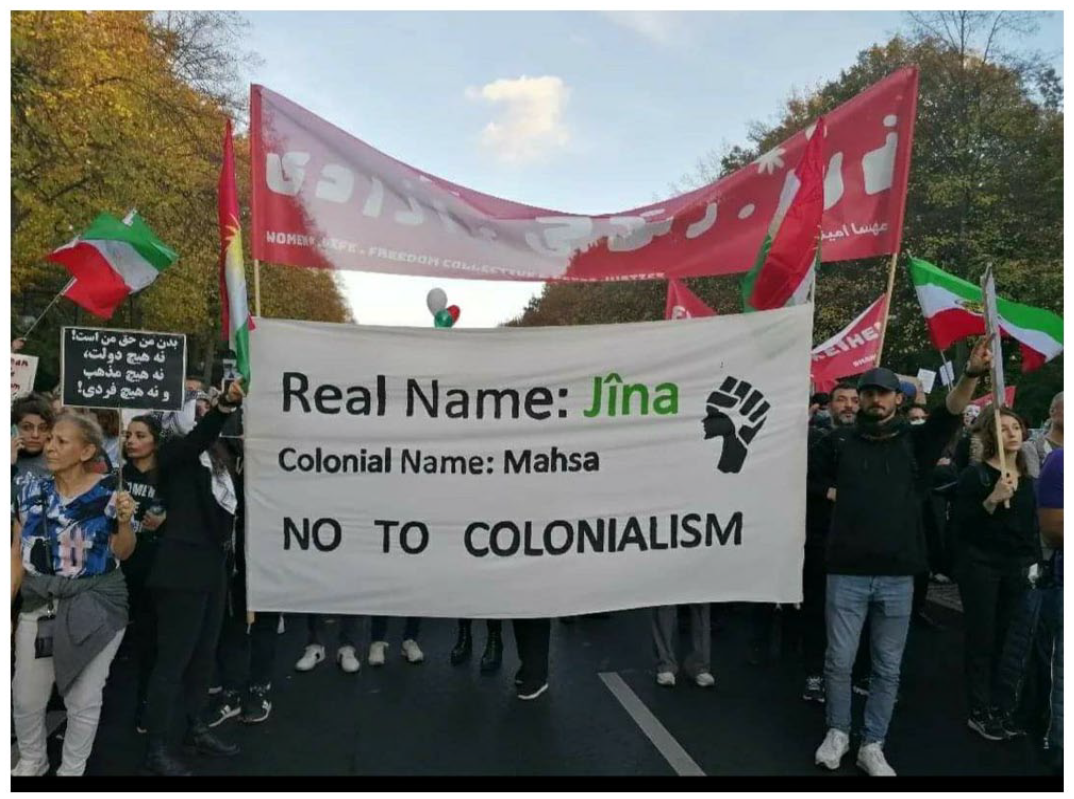
A protest in Berlin, Germany, 22 October 2022. Photo courtesy, Shahab Sheikhi, a Kurdish journalist and activist.
In Persian/Iranian women elites’ political stances, the voices and experiences of non-Persian women are habitually obscured, distorted, or engineered to fit the experience of the singular nation, since any coherent presentation of a singular Iranian identity is rendered otherwise impossible. For example, TIME magazine designated the Women of Iran as its Heroes of the Year, showing three female figures dressed in clothes typical of urban Persian women (see Figure 3). The magazine assigned Azadeh Moaveni (2022), a Persian woman activist, to pen an article on Iranian women and Forough Alaei, another Persian woman, to design the cover photograph. Moaveni’s article and the magazine cover image ignore and thus do an injustice to Kurdish, Balochi, Arab, Turks, Luri, Gilaki, and Mazani women who have been at the forefront of the protest movement. Nor does the issue bother to include a photo of Jîna, whose death became a marker of the movement. As such, giving voice to non-Persians is pursued only to the extent that it conforms with how ‘the nation’ is being sung, to borrow Butler and Spivak’s (2007) suggestive phrase. Masih Alinejad, a vocal and self-proclaimed nationalist woman activist, also describes Jîna’s death as ‘the result of forty years of women fighting back, pushing back the boundaries’. 17 While acknowledging the various forms of state oppression against the ‘people of Iran’, Alinejad hesitates to pronounce the existence of ‘ethnolinguistic’ oppression in Iran. It is thus unsurprising that Alinejad played a key role in publicizing Jîna’s murder vis-à-vis the hijab but remained silent on the arrests and execution sentences of Kurdish women activists such as Zeinab Jalalian, Zara Mohammadi, and Mojgan Kavoosi. These examples illuminate how the experiences and voices of Kurdish women are rendered invisible in the dominant account of ‘Iranian womanhood’.
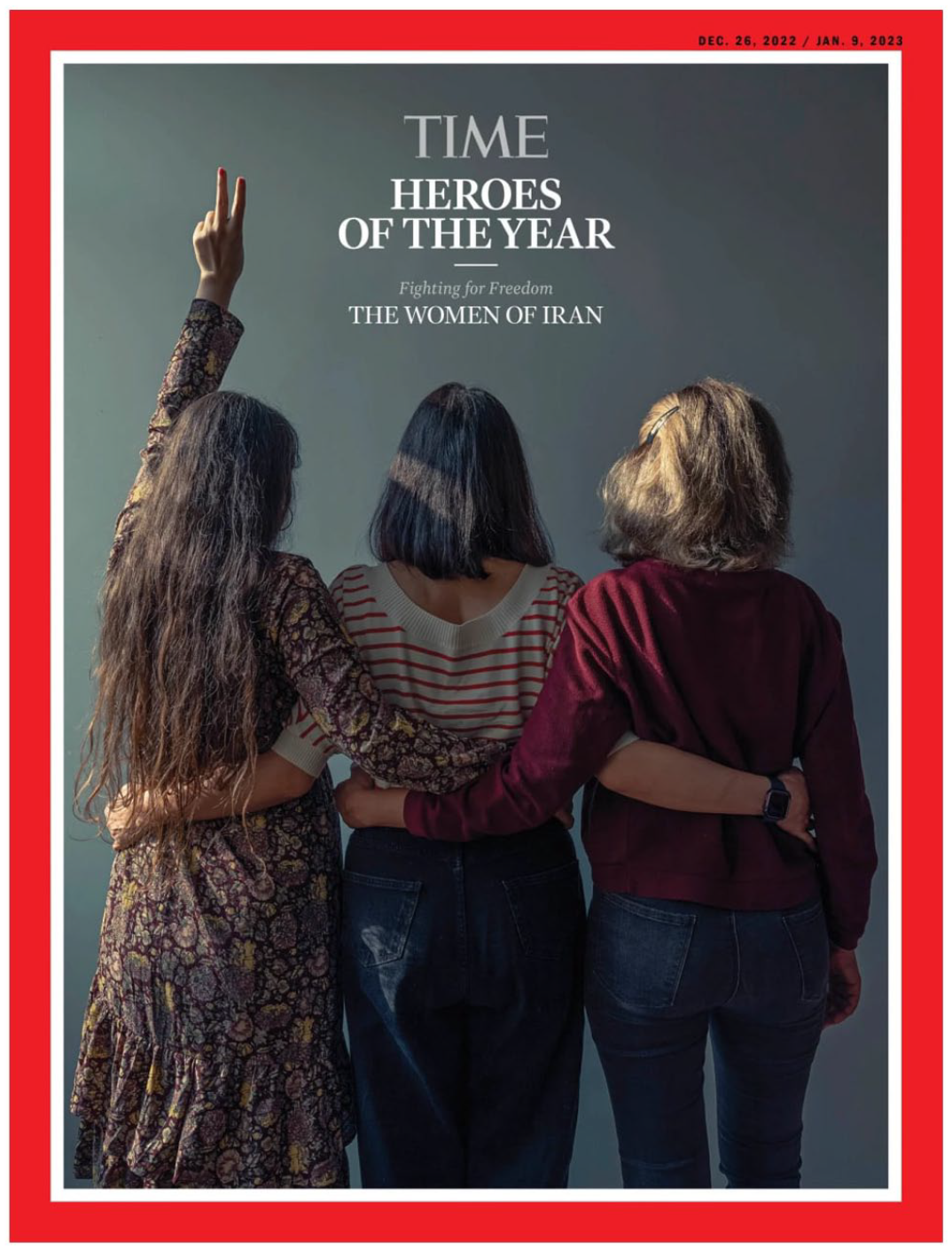
TIME Magazine, 2022; The erasure of non-Persian women.
Kurdish women activists, from left-wing to nationalist, emphasize that projects of gender equality and social justice are inseparable from each other and that gender oppression constitutes only one facet of the multiple and systematic suppression facing Kurds and the minoritized nations of Iran. Nahyah Khoshkalam, a Kurdish woman activist, contends that Jîna’s case deprovincialized the women’s movement in Iran: Persian women have by far branded the anti-hijab struggle as if exclusively represented by Persian women. Now, the banner of women’s freedom is hoisted by a Kurdish woman. The women’s movement in Iran once spoken for by Persian women is now inspired and led by Kurdish women.
She also argues that Rojhelat now exemplifies a genuine struggle in the region, undertaken by a nation that is stateless, silenced, and marginalized and that has suffered decades of denial and assimilation. Khoshkalam recalls a moment when a Kurdish woman at Jîna’s funeral shouted, ‘This will be our fate until we have a state [of our own]’.
Iranian/Persian women activists’ control of the experiences and histories of non-Persian women limits the notion of sisterhood and its degree of intersection with other cultural categories such as race, language, and ethnicity when applied to non-Persians. Nazanin Boniadi, a nationalist advocate and actress, comments, ‘To be clear, this Iranian movement did not happen overnight, and the plight of the “Iranian woman” runs far deeper than challenging compulsory clothing regulations’.
18
What is left unsaid in Boniadi’s observation is the existence and persistence of ethnoreligious and linguistic oppression of non-Persian nations (Bordbar, 2022). Despite pointing to ‘far deeper challenges’, she conceals the plight of her Kurdish sisters and brands the Jîna movement ‘Iranian’. Boniadi’s observation is shared by Roya Hakakian, who in her response to MSNBC asserts, Let me give you some good news; I have never seen such solidarity across Iran, between different ethnicities; you know you are from the region, Kurds, Azeris, and Balochis are united; for the past many years, everybody has been worried about you know the ‘separatist movements’ within the state, not anymore, at this moment, everybody is chanting the same slogan, women, life, liberty, that’s all are united in the same cause, that’s something we had not seen before, all young across social classes . . . .
Hakakian similarly assigns no ethnic component to Persians. By de-ethnicizing the sovereign ethno-nation, she grants a supra-cultural positionality to Persians, or the Fars, reducing the cultural intricacies of the Jîna movement to issues of class and demographics. Narges Bajoghli describes the anti-regime protest as a ‘national movement’, a ‘social revolution’ led by ‘Iranian woman’. She is cautious to acknowledge the revolutionary nature of the countrywide movement when she states, ‘. . . but it is not about the death and destruction of current political leaders, it is about the possibility of thinking about life and having women at the center of that’.
19
Azadeh Moaveni goes further, reducing the movement to a ‘feminist revolt of #Iran’s women & girls, demanding freedom for their bodies one scene, one street, at a time.’
20
Such a preoccupation with the ascription of ‘feminist’ or ‘Iranian’ to Jîna’s movement resulted in a fundamental divide between the women of the center and the women on the margins. Shehla Baran, a Kurdish writer and activist, elaborates on this divide: The Jîna Movement for which we paid with hundreds of martyrs and wounded was not aimed only at liberating our bodies, our body is not just a site for Sharia law or masculinity, it is also a colonized site for decades of Persian racism. We, the marginalized, share gender and religious oppression with the Persians. But we are being suppressed on every side, from Shiite Sharia law, from the patriarchal system, from the Iranian colonial system that oppresses Kurds, men, and women. Women like Masih Alinejad and Nazanin Boniadi fail to understand Kurdish, Arab, and Balochi women; they tie our fight to democracy and secularism, but a democracy that keeps Shia-Persian in power.
Persian media and platforms such as Iran International, BBC, and Manoto TV also often overlook or underestimate the presence and significance of the ethnolinguistic element in the success and prevalence of the Jîna movement. Their utilitarianist stance when they need wider legitimacy and solidarity, however, is striking. While not completely excluding the Kurds, they dexterously include them with an exclusive tone. The exercise of collective agency by Kurdish people, including many men, was critical to Jîna becoming the symbol of a cause well beyond Rojhelat. David Romano, a historian and scholar, reflects on the importance of the movement’s ethnic component, an element also frequently neglected in Western mainstream social media and platforms: I noticed very few Western reports thought it important enough to mention that she’s from Iranian Rojhelat, from Saqez, I believe. We know that roughly half the political prisoners and executions in Iran are Iranian Kurds while they are less than 10% of the population. Most of them are Sunni as well. So, they’re double minorities in a sense from the regime’s perspective. . . I think that the international media should recognize that her being Kurdish is relevant and they make a mistake not to.
21
Impossible sisters
The Iranian state has long violated human rights in Rojhelat. For example, Kurdish provinces (along with Balochistan province) have the highest unemployment and poverty rates and account for half of the political prisoners and executions countrywide according to Javaid Rehman, 22 the UN special rapporteur for human rights in Iran. Therefore, Jîna is not the only one who has fallen victim to IRI policies, nor is she the only symbol to represent the Kurdish women’s movement in Rojhelat or the Kurdish region of Iran. As Jîna’s movement demonstrated, the blanket notion of ‘Iranian woman’ imposed by women elites of the dominant ethnie functions as an ideal type whose intellectual properties are characterized and applied selectively to include only those experiences and practices compatible with the desired nationalist discourse.
For instance, three other Kurdish women activists, Zara Mohammadi, 23 an imprisoned teacher of the Kurdish language, Zeinab Jalalian, 24 a political activist sentenced to life, and Mojgan Kavousi, a Kurdish teacher accused of ‘spreading corruption on earth’, never received support or recognition by Iranian nationalist women activists. Zara is a board member of the Kurdish NGO Nojin and a volunteer Kurdish teacher who was arrested by the Iranian intelligence agency Ettelaat and was sentenced to 5 years imprisonment. Her arrest reveals foundational contradictions inherent in the IRI constitution. 25 Article 19 specifies that ‘the people of Iran enjoy equal rights, regardless of the tribe or ethnic group. . . race, language, and other such considerations shall not be grounds for special privileges’. At the same time, Article 15 declares Farsi ‘the official and common language and script of the people of Iran’ and despite Article 19 teaching and learning in the Kurdish language are not tolerated. The regime and the sovereign community naturalize the privilege of Persian language and culture, designating non-Persian languages as qowmi (ethnic), boomi, or mahali (local) and consider non-Persians’ cultural and linguistic self-assertions as separatist (tajziyeh–talab) and hence worthy of the state’s punitive measures, typically execution.
The intellectual discourse of nationalist women activists in Iran can only be understood in relation to how sovereignty is defined and enacted. Despite their anti-veiling struggle, the women elites of the dominant ethnie—in line with the state apparatus—have constantly reasserted the position of the Farsi language as the reservoir of Iranian thought and a fundamental pillar of Iran’s ‘imagined nation’. In February 2022, in advance of the United Nations’ World Mother Language Day, close to a thousand Iranians who grew up speaking a minority language took to Twitter with the #Manofarsi (Me and Farsi) hashtag to express their sense of loss and frustration at the marginalization of their mother tongue. The hashtag campaign was initiated by Sevil Sulaimani, a Turkish-Azerbaijani civil rights woman activist and co-founder of the End of Monolingualism campaign.
The hashtag spread widely and met with harsh responses from the dominant ethnie. Persian users called the Persian language the most important cultural and civilizational heritage of Iran, ‘a national medium’, and a ‘mediating language’ that should continue to be Iran’s official language. Women elites of the dominant community univocally disparaged the campaign and denounced it as a conspiracy orchestrated by foreign powers and anti-Iran separatists. Elahe Boghrat, a nationalist activist and the head editor of London Keyhan remarked, ‘But can the dividers [the non-Persian campaigners] tell us which language they will use to speak with our Turk, Kurd, Baloch, Gilak . . . ’ Boghrat (2018) described the campaign for promoting non-Persian languages as a malicious act committed by separatists that would only serve the enemies of ‘the great people of Iran’ by trying to dismember the ‘border provinces’ from the country. By changing the ManoFarsi to Mano Ghande Farsi (I and Persian Sugar), Persian activists began to glorify the Persian language as a thread that has tied the ethnic groups and tribes of Iran together for millennia. The elites of the dominant community, ranging from IRI proponents to royalists, unanimously denounced the campaign as inherently anti-Iranian and devised to undermine ‘a language that is shared among us and links us together’, to use the words of Reza Pahlavi, the son of the previous monarch.
Another example of the double standards of women activists of the dominant ethnie occurred when an Iranian court sentenced Kurdish activist Zeinab Jalalian to death on charges of taking up arms against the ‘sacred Islamic system’ and ‘warring against God’ (moharabeh) in 2008 in a sham trial that lasted only a few minutes. Her death sentence was reduced to life imprisonment in 2011. Zeinab had been helping women in Rojhelat and elsewhere since 2000. Despite suffering from various illnesses, she has been deprived of medical treatment and has not been granted a day away from prison in the 14 years she has spent incarcerated.
To better understand the term moharabeh, as well as the state’s treatment of Kurds due to their religious identity as Sunni Muslims, the theocratic basis of IRI is illuminating. The IRI constitution is drafted to promote and ensure the dominance of a specific interpretation of Shia Islam, called the Velayat-e-Faqih, or the absolute authority of the jurist. By declaring and imposing Shiism (Article 110) as the official religion, the IRI constitutionally restricts and constrains the non-Shia populace’s access to political power and economic means of production. The IRI constitution clarifies that all policies and decisions are to comply with the manawayate (innates) of the Supreme Leader, approved by the Council of Guardians and conformed to the principles of Fiqh. The document therefore leaves the door open to arbitrary interpretations depending on the discretion of the sovereign power and its constituents. As a result, the laws have a divine status, acquiring their legitimacy from Shi’ism, and thus cannot be contested by people. Zeinab’s moharabeh by the IRI was not taken up by Persian women elites and her name was never mentioned as an ‘Iranian woman’ fighting anti-woman Sharia law and a totalitarian theocratic regime. This case suggests that the current women’s movement in Iran is not as radical, transformative, and subversive toward the existing oppressive and unequal order as it might appear. Rather, it by and large follows the nationalist discourse and helps ensure that it remains intact.
Yet another example is the arrest and imprisonment of Mojgan Kavousi, 26 a teacher of the Kurdish language who was accused of ‘spreading corruption on earth’. Mojgan’s arrest substantiates that in this discourse teaching the Kurdish language or a language other than the ‘national language’ amounts to ‘spreading corruption on earth’ and is therefore punishable by death. Mojgan’s arrest was never highlighted or condemned by nationalist women activists and elites. This statist, centralist perception of gender identity makes inclusion in the circle of sisterhood subject to commitment to the singularity of the nation; as long as non-sovereign communities, regardless of gender, class, and other social affiliations, reassert their identities they are collectively conceived of and treated as Other by both the state and the sovereign ethnie (see Mamdani, 2018). Although the mainstream women’s movement in Iran takes issue with the IRI and its desired interpretation of Shia Islam, it is cautious not to push its demands for equality to a point that would jeopardize the national and territorial integrity of the nation. The cases of Zeinab and Mojgan illustrate that the women’s civil movement of the dominant ethnie is limited in its radical and transformative character. Instead, it tries to ensure that the premises of Iranian nationalist discourse remain intact and eternal.
The song ‘Baraye’ (meaning ‘for/because’, in Persian) by Shervin Hajipour, 27 a Persian singer, best illustrates this underlying discursive divide. The song, which was inspired by tweets about Jîna’s death, is described by Persians as the anthem of the protests and has received a Grammy award. 28 It starts with ‘for dancing in the street, for being afraid to dance’ and continues ‘for my mother, my sister, your sister, our sister; for changing the rotten brains; for shame, for lack of money; for a child looking for food in the garbage, and his dreams’. The song goes on: ‘for the polluted air and ‘Pirouz’’, an endangered Iranian cheetah, ‘for the innocent prohibited dogs’, ‘for children of Afghanistan’ and ‘for the government’s empty promises’. Nowhere in his song does Hajipour give any indication of ethnic and linguistic oppression.
Inspired by Hajipour’s song, Fataneh Farahani (2022), who is Persian, published an article titled ‘70 Feminist Reasons Why Women Protest in Iran Today’. Each reason starts with a ‘Baraye’ (because of/for), featuring a dozen Persian activists such as ‘for the first Iranian feminist, Tahirih Qorratol’Ayn’, ‘for Nasrin Sotoudeh, Narges Mohammadi, Shiva Nazar Ahari, Sepideh Gholian, [and] Mahvash Sabet’. Although the article mentions the word Kurds twice—once as an ethnic group along with Balochis and Arabs, and the second in reference to a Kurdish queer activist—Farahani’s list of ‘Iranian women activists’ offers no indication of Kurdish women such as Zara Mohammadi, Zeinab Jalalian, or Mojgan Kavousi. This selective list again indicates that women elites either dismiss or incorporate the experiences of subaltern women into their desired nationalist feminist account. Nayereh Tohidi, a Persian scholar sets a record in forging a Persian/Iranian history for Jîna’s uprising and its catchphrase where she claims, ‘Iran’s recent protest movement, which some have called it the women’s revolution, has roots of almost 116 years in Iran’s contemporary history with a very simple manifesto “the song of Shervin Hajipoure”’. 29
Chia Madani, 30 a Kurdish musician and songwriter, in turn, responded with a song of exact equivalence, ‘Bo’ (meaning for/because of, in Kurdish). He starts by reminding Hajipour that ‘our wounds are older and deeper than yours, there are thousands of “for” in my heart’. He uses ‘for Jîna’, a name banned by the IRI regime, and continues ‘for’ the sufferings of the oppressed people of the margins, ‘for’ the arrested and executed teachers of the Kurdish language, and ‘for’ the fathers who had to pay for the bullets that were fired at their children by state forces.
Furthermore, Kurdish women activists launched their ‘Baraye’ campaign on Twitter, expressing their aspirations, and criticized the restrictions imposed on them due to the intersecting axes of ethnic, gender, and class discrimination they had sustained throughout their lives. Their version of ‘Baraye’ aimed to expose the particular conditions of oppression that women on the ethnic periphery of the country had experienced and which had been excluded from Hajipour’s Baraye song, despite its claims, and mainstream celebration, for having voiced the universal Iranian lived experience. Parya, a Kurdish woman activist, wrote, [Hajipour’s] Baraye cries for dancing in the streets, while I [as a Kurd] get shot dead on the same streets. Baraye sings for fear when kissing, I sing for the fear of speaking, reading, and writing in my mother tongue. Baraye yearns for a normal life, while I am struggling to survive. Baraye sings for Valiasr Street and its worn-out trees [in Tehran], and I sing for my oak forests [in Rojhelat] burnt in the fire. Baraye sings for the extinction of ‘Pirooz’ [an Asiatic cheetah], I sing for the extinction of my identity and culture. The Fars-Shi’i-Aryan nationalism changes its faces but to us, they are the same colonizers, no matter if they wear a crown, turban, or a tie, they are all the same.
Conclusion: debunking the singularity of experience
Through untangling the epistemic paradoxes and ambiguities inherent in the discourse of women activists and the mainstream women’s movement in Iran, this article sheds light on the genealogy of Iranian/Persian women’s activism in Iran and the way it interacts with, treats, and silences the feminism(s) of the periphery.
The rise of the ‘Jîna movement’ marked not only a new era in the Kurdish struggle for fundamental rights but also presented a modality of non-Persian resistance in which the fusion of subaltern justice-seeking ethno-nationalist movements, feminism(s), and decolonizing process(es) are palpable. Although triggered—and largely led—by women, this unprecedented socio-political movement also poses an ontological and epistemic challenge to the feminism of the center (see, Käser, 2021; Mahmoud, 2021; Al-Ali and Käser, 2022), which can be explained by the fact that for marginalized and minoritized ethnic-nations in Iran gender oppression always intersects with ethnoreligious and linguistic forms of suppression.
The frequency and consistency of the dismissal or selective use of non-Persian women’s voices in the dominant account of Iranian/Persian nationalism suggest that dominant women activists and elites are not inclined to make a radical change in political discourse and the Iran-centered ‘regime of truth’, but aim to either reform it from within or replace it with a system in which only civil freedoms are protected. Such a change or replacement, according to the feminism(s) of the periphery, will not necessarily result in an ethnoreligious and linguistically egalitarian and democratic model of governance. Non-Persian women activists contest the feminism of the center for benefiting from Persian privilege in the taking of political appointments and the enjoyment of socio-economic mobility, educational progress, cultural representation, and more. By centering feminism on gender alone and sidelining the impact of Persianness, identity, culture, and sovereignty in favor of gender parity, Persian women co-opt feminist space. They claim to carry the mantle of gender equality but fail to reconcile gender with intersectionality and multi-dimensionality. It is only through advancing a critique of Persian national identity and Persian privilege that a new mode of perception can become possible in Iran and result in emancipation.
The relationship between women’s activism of the center with the women’s movement (s) of the periphery (in its ethnoreligious and linguistic sense) metaphorically resembles the relationship of white feminism to its black counterpart in places such as the United States. In his critique of white feminism, sociologist Eduardo Bonilla-Silva (2006) has developed the term ‘color blindness’ and defines it as a ‘means of maintaining racial inequality without appearing racist’. This concept can be extended to the way in which the sovereign ethnie in Iran has been ‘Other-blinded’ toward non-Persians (cf. Burke, 2018). The Other-blinded discourse portrays Iran as an ancient and unified nation with a singular history, culture, and literary language (Kia, 1998: 9–10). Such a portrayal of ‘the nation’, in the words of Iranian scholar Mehrdad Kia, becomes possible only ‘by denying the existence of non-Persian identities’ (pp. 9–10). It is this mentality that defines all non-Persians anthropologically through the paradigm of romantic historicism and culturalism, a paradigm based on the myth of the oneness of the nation (see Ahmed, 2023). This view assumes the non-Persian world inside ‘Iran’ as inherently masculine, local, tribal, folkloric, and culturally backward (see Mohammadpour and Soleimani, 2019).
As with black feminists in the United States, the Kurdish feminist critique is predicated on the failure of mainstream feminism to come to terms with the fact that its version of feminism conceals ethnic supremacy (see Rostampour, 2021). This centralist and statist approach to women’s activism takes the status quo for granted. When we look at this allegedly non-Western, liberatory form of feminism (see Crowley, 1991), it usually rests on Persian women’s experience as normative and fails to include and acknowledge the ordeals of Kurdish, Balochi, Arab, Turkish, Mazani, Gilaki, and Turkman women, among others. By excluding women of non-Persian backgrounds, it has directly or indirectly intensified the erasure of their individual experiences. Iranian/Persian women’s activism as a worldview, therefore, speaks to a set of entrenched assumptions and practices that centers Persianness and naturalizes the Persian identity and value system as superior. This universalization of nationalist feminism has been exported globally, and the consequences have been particularly devastating for women of subaltern nations in Iran.
Finally, this article invites a critical reassessment of dominant feminism through what Adale Sholock (2012) has termed the ‘methodology of the privileged’. To this end, it proposes a multinational and multicultural approach to gender equality that can be drawn upon to encourage Iranian/Persian women elites to interrogate Persianness and Persian privilege. For this critical approach to succeed, it must adopt an inclusive and transformative approach that equally confronts nationalist feminism’s racialized view of Iran, the implicit and explicit racism ingrained within it, and its discursive hegemony, as it does the male-centered societal system. It is only through taking such a radical framework that true feminist solidarity and mobilization across the polity can be materialized.
Footnotes
Acknowledgements
I am most thankful for the constructive and insightful comments offered by the anonymous reviewers and Professor David Fasenfest. Their incredibly helpful suggestions contributed tremendously to further strengthening my arguments. Mohamad Salih, Mimi Kirk, Mashuq Kurt, Afshin Matin-Asgari, and Marouf Cabi have read the earlier version of the article and shared their valuable feedback for which I am very thankful. I am immensely grateful to Mimi Kirk and Mohamad Salih for reading and commenting on the last version of this article.
Funding
The author(s) received no financial support for the research, authorship, and/or publication of this article.
