




Abstract
Recent post-capitalist theorizing, particularly Winant, revives the question of service sector growth. At stake is whether an economic system built on the extraction of surplus value can continue to function when ever-larger shares of workers do not produce this; also, whether their growing predominance prefigures post-capitalist relations of production. Most contributions offer imprecise concepts of service work and capitalist productivity, however. This article sharpens these with Marxian theoretical tools and assesses them using 2016–2020 US Census data, finding that less than one-fifth of service employees produce surplus value, while nearly half of non-service employees do. The majority of service and all formal US employees create important use values outside of direct capitalist exploitation. They thus pose a potentially post-capitalist constituency that is heavily—and non-randomly—female and Black, Indigenous, and people of color (BIPOC). The implications of this for the transition away from capitalism, as well as for the transition debate itself, are then considered.
Keywords
Introduction
Capitalism has some basic features most critical observers agree on: production for profit using private property and wage labor. Unpaid labor is the source of that profit, composing the system’s exploitative core. What has become increasingly obvious, thanks to social reproduction and racial capitalism theory, is that the rise and continuation of this dynamic is predicated on multiple supporting extractions: unpaid care work (typically gendered), coerced, non-waged labor (typically raced), and dispossession of natural resources or ‘commons’ (Bhattacharya, 2017; Federici, 1975; Munro, 2019, 2021; Robinson, 2000 [1983]; Vogel, 1983). As a mode of production dependent on these processes, capitalism has been remarkably successful at accumulating profit and transforming the creation of material goods—grain, textiles, cars, smartphones—while degrading the Earth’s biosphere (Huber, 2022). What is less obvious is how successful this regime is or can be when applied to nonmaterial goods—things such as healthcare, childcare, advising, and analysis we typically call ‘services’. Although examples abound of all these being commodified and organized capitalistically, a very large share are carried out either unproductively within capitalist firms or by non-capitalist (state or nonprofit) institutions. Their inputs and outputs frequently display only partial, that is, ‘formal’ or ‘fictitious’, commodification (Hermann, 2021: 29). And waged employment is concentrating in these sectors.
This long-term trend has spawned a perennial cottage industry in post-industrial and post-capitalist theorizing. From the work of Clark (1940) and Fourastié (1949), through Touraine (1971), Gorz (1967), Bell (1973) and Drucker (1993), the idea that gradual shifts in employment lead toward wholesale undermining or reinvention of capitalism (variously understood) has been widespread. Rifkin (2014), Mason (2015), Streeck (2016), and Wark (2019) renew this debate, positing ‘the eclipse of capitalism’ (Rifkin) as ‘a failing system’ (Streeck) or even a ‘dead’ one (Wark). Srnicek and Williams (2015) and Bastani (2019) offer hopeful if top-down left manifestos on this front, while Hermann (2021) provides tools for understanding commodification and its converse. Yet Winant (2021) concretizes these claims more than others by training them on measurable employment sectors and simultaneously accounting for race, gender, and political economy. His social history of Pittsburgh argues that the city’s shift from for-profit steel to nonprofit healthcare encapsulates broader patterns that prefigure ‘a more democratic and equal society, [where] we would all be cared for, and . . . participate in caring for others’ (Winant, 2021: 23). He does not, however, unpack these trends at an abstract, theoretical level.
This study aims to do that, testing Winant’s and other recent claims about the immanence of decommodified social relations. Aided by Marxian economic theory (Kliman, 2012; Moseley, 1991; Roberts, 2016; Shaikh, 2016; Shaikh and Tonak, 1994; Smith, 1993), the sociology of service work (Bélanger and Edwards, 2013; Bolton, 2005; Hochschild, 1983; Leidner, 1993; Lopez, 2006), and social reproduction theory (Bhattacharya, 2017; Fraser, 2013; Munro, 2021; Vogel, 1983; Williams, 2005), I offer updated concepts of productive versus unproductive labor and service versus non-service work. I then apply these to carefully re-sorted US employment data (2016–2020 merged ACS) and find a marked gap in capitalist productivity between services (18.8%) and non-services (46.7%) consistent with Winant’s proposal. Analysis of race and gender also yields weaker but non-negligible support for his intersectional correspondence thesis. I conclude by considering the implications for post-capitalist transition and transition theories in general, noting greater consonance with productive-forces models over purely social–relational ones.
This article, it should be said, has a wide scope. It aims for a synthetic reconception of the dynamics of post-capitalist transition in a concise, journal-ready framework. To do so, it draws on multiple literatures that cannot be fully explicated here and deploys an unconventional structure. Its goal, I offer, merits such unorthodoxy.
Post-Capitalism and Marxist Theory
Post-capitalism’s resurgence has largely been separate from advances in Marxian economics. The former’s proponents hail from myriad theoretical traditions and can be situated along the broad center-left of a similarly renewed ‘automation discourse’ (Benanav, 2020: 1). Rifkin (2014) seems to channel Marx’s falling profit theory by arguing for the progressive obsolescence of wage labor due to ‘the internet of things’ enabling automated production by ‘prosumers’ in a ‘collaborative commons’. Yet he writes from a non-Marxian, capital-advising standpoint. Mason (2015) similarly concludes that peer-to-peer production by ‘networked individuals’ offers a post-capitalist release valve for a stalled Kondratieff ‘fourth wave’. He gets there from explicitly Marxian precepts such as the labor theory of value and rising organic composition of capital that are nonetheless detached from their recent parallel applications. Srnicek and Williams (2015) and Bastani (2019) call for an embrace of automation-enabling technology to reduce necessary labor time and create post-capitalist ‘abundance’ that can supersede capitalist-imposed ‘scarcity’. But they differ from Rifkin and Mason in proposing top–down, state-, or think-tank-led realization and neither engage significantly with recent Marxian thought. Streeck (2016) stands out by insisting that ‘capitalism is vanishing on its own, collapsing from internal contradictions’, but perceives neither ‘socialism [n]or some other defined social order’ as the end result (p. 13). Making eclectic use of ‘concepts from the Marxian tradition’ to trace the causes of endemic crisis, he disagrees with Collins (2013) and others who perceive a new social order in the making (2014: xvi). Wark (2019) offers a darker interpretation that mirrors Rifkin, Mason, and Bastani’s optimism—that a crisis-prone capitalism has already been replaced by a post-capitalist information oligarchy—while Benanav (2020) simply observes the current conjuncture of ‘crumbling infrastructures, deindustrialized cities, harried nurses, and underpaid salespeople, as well as a massive stock of financial capital with dwindling places to invest itself’ (p. xi).
The common thread among these is the idea that capitalism is undermining the basis of its own profitable future. Although only Mason (2015) does so explicitly, all arrive at this self-destructive conclusion through some version, or close imitation, of Marx’s core theory that (1) productive labor is the source of capitalist profit, (2) competition pushes firms to automate and reduce this share internally, and (3) when generalized, this reduces the source of profit and threatens capitalism’s existence. Yet none engage substantively with the chorus of Marxist economists who, in recent decades, have both revived and refined these fundamental insights, demonstrating declining profit rates (Basu et al. 2022; Kliman, 2012; Moseley, 1991; Roberts, 2016; Shaikh, 2016: 729–735; Yu, 2016), clarifying what labor is and is not productive for capital (Moseley, 1991; Shaikh and Tonak, 1994; Smith, 1993: 123–151) and, in the case of Basu and Foley (2013), finding that service industries contribute significantly to a sectoral ‘weakening of the relationship between . . . GDP growth and employment’ (p. 1079, 1078; see also Petit, 2013 [1986]). Because of this, recent post-capitalist proposals (as well as older ones) operate at a level of empirical indeterminacy, failing to concretize the dynamics they outline in ways that allow for fine-grained assessment.
Two authors take us closer. Winant (2021) charts Pittsburgh’s transformation from steel to healthcare mecca and with it, the idea that low or no-profit services constitute a latent antithesis to capital. His point is not that nonprofit hospitals already model egalitarian, proto-socialist work relations, but simply that ‘profits accrue increasingly to firms that do not generate mass employment, while labor simultaneously accumulates in low-margin industries far from profits’ (Winant, 2021: 2). Winant also centers race and gender, not just in terms of who held or lost manufacturing jobs or was filtered into healthcare, but in the masculine and largely White construction of late-industrial ‘citizenship’. He thus offers an intersectional correspondence thesis: that the emergent caring workforce consists disproportionately of those groups—women, people of color—previously marginalized from industrial capitalist wage work. ‘Since the health care industry had subsumed care functions and labor supply from the postwar family’, he argues, ‘care work appeared on a continuum with unwaged domestic work’ (Winant, 2021: 223) with the ‘stages’ of this transformation ‘racialized . . . starting with Black workers’ (p. 134).
Hermann (2021) offers a theory of commodification that helps assess the capitalist capture or loss of specific products and activities. Conceiving it as a process in which these receive marketable exchange values (prices), he distinguishes between formal, real, and fictitious commodification (Hermann, 2021: 29–34), then identifies four key limits—social, political, systemic, and ecological (pp. 100–118)—that imply both the necessity of, and salient mechanisms for, decommodification (pp. 135–139). Actualizing these would engender what Hermann (2021) calls a ‘use-value society’ that would be ‘a first step . . . in the long journey to an ecologically sustainable socialism’ (p. 152, 157).
While diverse and eclectic, recent post-capitalist theory thus offers a common theme: that capitalism, based on commodified labor and products, is approaching or has already reached the limits of profitable growth. With the exception of Streeck, all posit decommodified versions as replacements, but only Winant turns our attention to large and measureable sections of the contemporary workforce. In so doing, he paves the way for more systematic analysis and exposes lacunae in existing post-capitalist contributions—namely, the sociology of service work and social reproduction theory. These will be integrated in the analysis to follow which is structured by Marxian value theory to distinguish (A) services from non-services, (B) capitalist from non-capitalist sectors, and (C) productive from unproductive labor. The results of these distinctions plus analysis of race and gender allow for speculation on the macro-social question of transition. I turn to this with insight from the transition to capitalism debate (e.g. Anderson, 1974; Brenner, 1976; Harman, 2004; Wood, 2002).
What Are ‘Services’?
According to official counts, the vast majority of advanced-capitalist workforces are ‘tertiary’—that is to say, in the ‘service sector’ (OECD, 2023; US Bureau of Labor Statistics, 2022a). But service employers are loosely conceptualized as any and all outside farming, fishing, and resource extraction (‘primary’) and manufacturing and construction (‘secondary’). This alleged service supersector includes industries as diverse as transportation, healthcare, finance, retail and utilities, and many workers in these and other industries who perform tasks different from their industrial namesake: electricians employed by colleges, lawyers employed by auto producers, accountants employed by logistics firms, and so on. When speaking of ‘services’ then as a specific set of tasks we need greater precision.
Some Marxists emphasize continuity over difference. Tasks commonly called services clearly produce use values (Shaikh and Tonak, 1994: 24) and many produce surplus value (Tregenna, 2011; Walker, 1985); they are performed with labor that is often waged; and many services feed into or directly aid material production (Mandel, 1975: 377–407), which is neither as absent nor as diminutive as some post-industrialists claim (Moody, 2007: 38–41). One study (Ikeler and Crocker, 2021) finds class consciousness broadly continuous across service and non-service workers. Yet concrete forms of labor and output differ.
Sociologists explore these using Hochschild’s (1983) concept of ‘emotional labor’. Posed as the primary modality of interactive work and defined as ‘labor requir[ing] one to induce or suppress feelings in order to sustain the outward countenance that produces the proper state of mind in others’ (Hochschild, 1983: 7), many apply, critique, or extend this notion (Bélanger and Edwards, 2013; Bolton, 2005; Brook, 2009; Leidner, 1993; Lopez, 2006). None, however, argue against its fundamental utility. Marxists Bélanger and Edwards, while arguing for the structural continuity of employment across sectors, acknowledge that the contribution of the front-line [service] employee to the labour process and the creation of use value appear at the same time . . . [which] shows a contrast with manufacturing, where these two stages are seen as distinct because the product only finds its use value through the broader circuit of capital. (2013: 441)
Emotional labor thus stands as the unique element of working on people (customers, clients, patients, students, etc.) rather than things. Manual labor predominates in the latter while intellectual labor predominates in fields such as composition, data analysis, and design.
Most jobs require a mix of all three, if not in equal quantities. Assembly-line workers interpret changes in line speed, material and machinery flow, and directives from supervisors; they also have to communicate effectively with co-workers and supervisors, which involves emotional labor. But their primary task is manual: physically manipulating and transforming materials. Similarly, public relations managers or research scientists mainly tasked with intellectual effort also deploy emotional labor to cultivate relationships, motivate subordinates and (light) physical abilities to attend meetings, give presentations, and so forth. The same can be said for school teachers and medical care workers whose emotional abilities are heavily called upon, but whose jobs also demand interpretation and creativity as well as considerable physicality (Lopez, 2006). Most jobs, however, center a primary type of effort. Those requiring employees to primarily interface with other non-employees (clients, students, patients, customers) to produce interpersonal outputs are emotional; those requiring employees to primarily interface with ideas or data to produce ideological or cognitive outputs are intellectual, approximating Jones’s (1982) ‘quaternary sector’; and those requiring employees to primarily interface with physical objects or machines to produce material outputs are manual. These criteria and divisions are broadly embedded in Census occupational categories with exceptions as noted below. The first two, emotional and intellectual, compose a more accurate conception of ‘services’ (Figure 1).
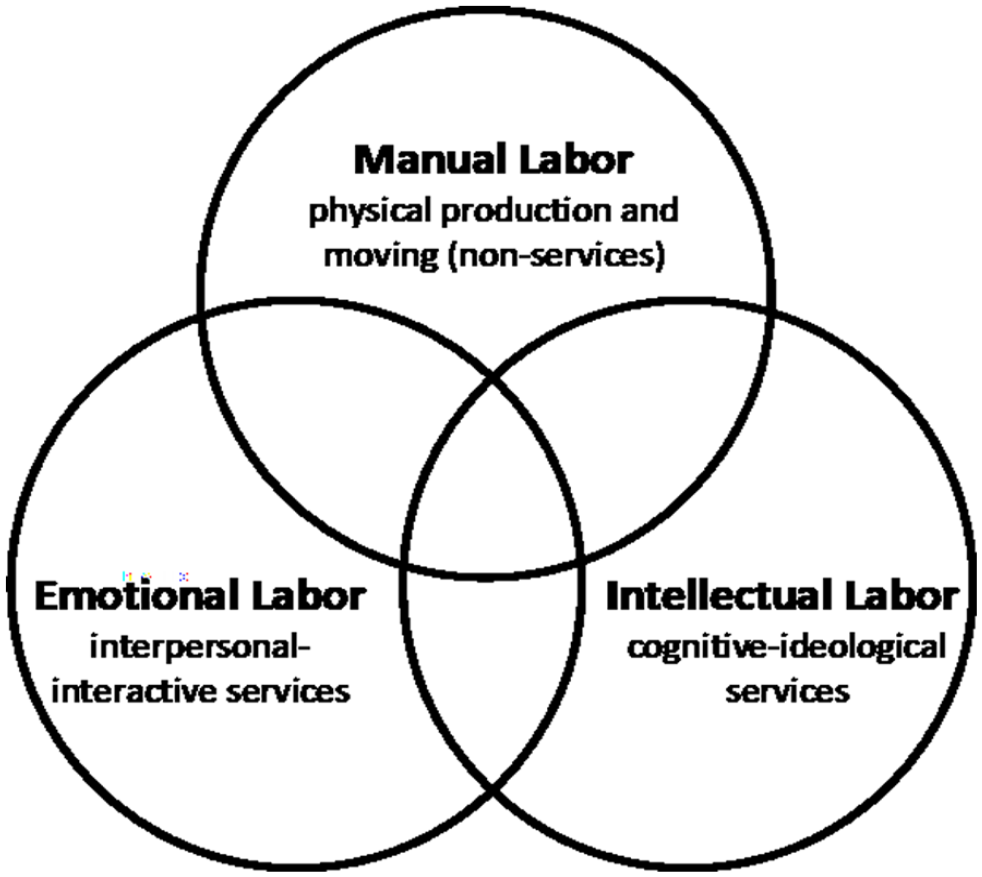
Modalities of labor.
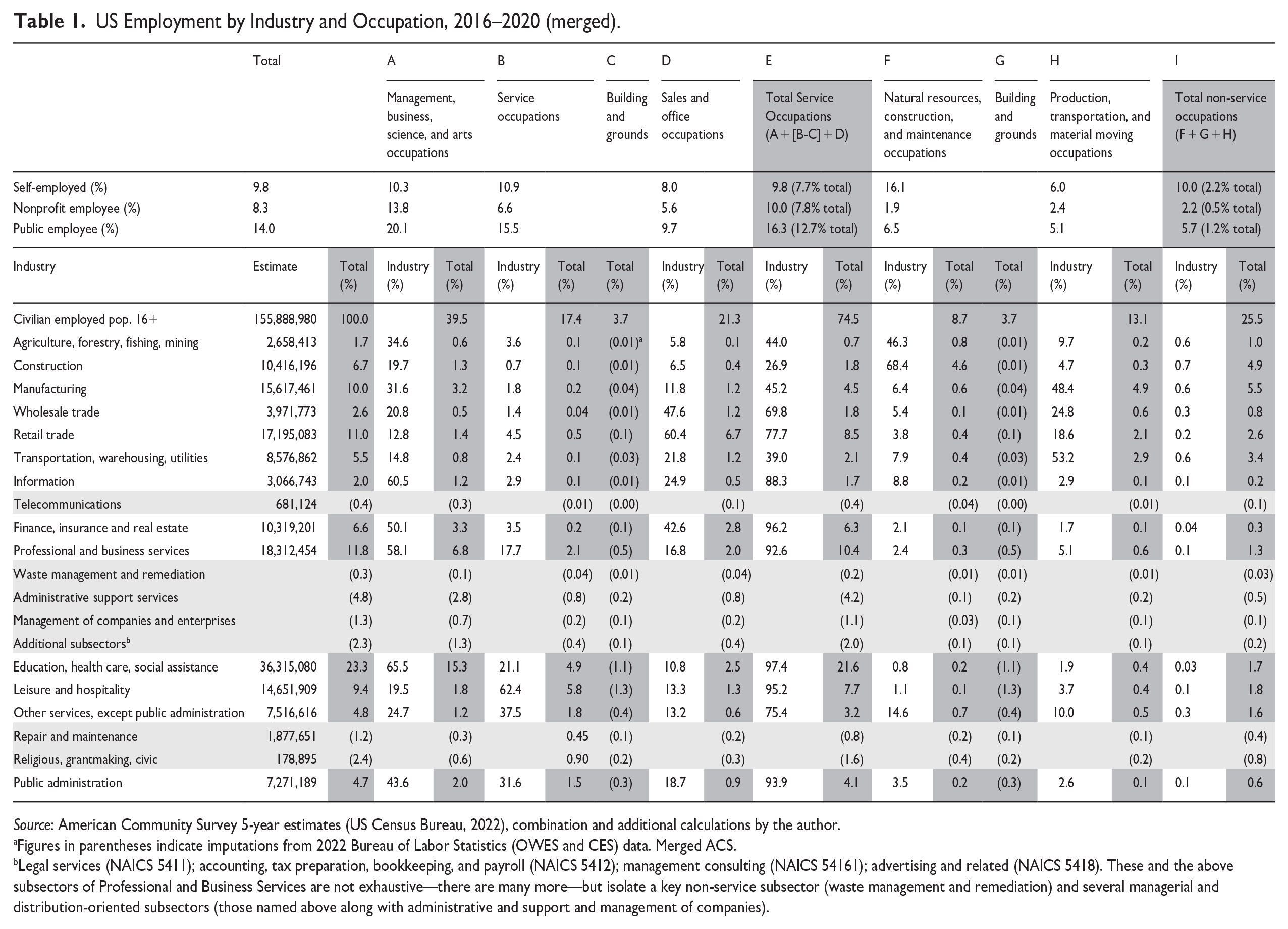
How can we apply these categories at the industrial, that is, employer level in terms of output? And how can we apply them at the individual, that is, occupational level in terms of process? The North American Industry Classification System (NAICS), used by the US Bureau of Labor Statistics (BLS) and Census Bureau, defines 3 ‘goods-producing’ and 10 ‘service-providing’ industries. The former includes agriculture, forestry, fishing, and mining along with construction and manufacturing; the latter includes wholesale trade, retail trade, transportation, warehousing and utilities, information, financial activities, professional and business services, education, healthcare and social assistance, leisure and hospitality, other services, and public administration (US Bureau of Labor Statistics, 2022b; see also Table 1). But this fails to distinguish enterprises producing ideological or interpersonal outputs from those producing physical ones. Transportation, warehousing and utilities, as well as the telecommunications subsector of information, the waste management subsector of professional and business services, and the repair and maintenance subsector of other services all produce physical goods. Transportation physically moves goods or people, providing ‘change of place’ as its main output; utilities writ large (including telecom) provide physical, infrastructural goods; waste management physically removes trash and waste; and repair and maintenance transform and repair physical things. Enterprises in these industries, as well as manufacturing, construction, and resource extraction, are thus outside of services; the remainder constitute true service industries.
US Employment by Industry and Occupation, 2016–2020 (merged).
Source: American Community Survey 5-year estimates (US Census Bureau, 2022), combination and additional calculations by the author.
Figures in parentheses indicate imputations from 2022 Bureau of Labor Statistics (OWES and CES) data. Merged ACS.
Legal services (NAICS 5411); accounting, tax preparation, bookkeeping, and payroll (NAICS 5412); management consulting (NAICS 54161); advertising and related (NAICS 5418). These and the above subsectors of Professional and Business Services are not exhaustive—there are many more—but isolate a key non-service subsector (waste management and remediation) and several managerial and distribution-oriented subsectors (those named above along with administrative and support and management of companies).
Wholesale and retail trade, while also true services, deserve a special note. Although such enterprises provide physical commodities, their role is transactional and distributional, involving interpersonal advising and transfer of ownership after those commodities have been materially produced and transported (see Shaikh and Tonak, 1994: 22–25; also Marx, 1981: 380, 406). Important here is that BLS industry categories are measured at the establishment rather than company or enterprise level. Thus Walmart’s warehouses, for example, are assigned to transportation and warehousing while its stores are assigned to retail.
At the occupational level, which pertains to the concrete roles employees fill rather than the products their establishments make, the US BLS defines 22 general (two-digit) categories which they aggregate into five broad groups: (1) management, business, science, and arts, (2) ‘service’, (3) sales and office, (4) natural resources, construction, and maintenance, and (5) production, transportation, and material moving. The first identifies those primarily engaged in intellectual labor, the second and third those primarily engaged in emotional. The last two identify those primarily engaged in manual labor, with one exception: building and grounds cleaning and maintenance grouped among ‘service’. These consist of janitors, groundskeepers, housecleaners, pest control workers, and others whose main tasks are manual. We thus reassign them to the manual, non-service category (columns C and G of Table 1).
Applying these considerations to the tallies in Table 1 shows that about three-quarters (74.5%) of the US civilian employed population are in service occupations, both emotional and intellectual. About a quarter (25.5%) are employed in non-service manual occupations. Closely, 74.3% of civilian workers are employed in service industries, with the remaining 25.7% employed in non-service industries.
What Is ‘Capitalist’?
The next question is, to what extent are service jobs and industries run on a capitalist basis? Enterprises can be understood as capitalist if they are privately owned, pursue profit as their main objective, and employ workers whose labor is the source of that profit. Those employed by such enterprises can be said to be ‘capitalistically organized’.
The first criterion excludes all public sector enterprises. These are owned by and receive substantial if not complete funding from municipal, regional, national, or supranational (e.g. E.U.) governments which, in turn, derive their funding from taxation and, ultimately, coercive power. The outputs of public enterprises may be ‘formally’ commodified (given a price) and their internal processes ‘fictitiously’ commodified (measured and assessed through quantitative, pseudo-competitive metrics), but neither are ‘really’ commodified in the vast majority of cases, that is, market-dependent for both inputs and outputs (Hermann, 2021).
The second criterion excludes nonprofit enterprises, which compose a substantial sector in the United States and peer countries (Frumkin, 2002; Salamon and Newhouse, 2020). While these are privately held and controlled, almost always exploit wage workers, and may accumulate surplus in ways that mimic for-profit companies (Abzug, 1999), they do not constitute reliable sites of valorization and may frequently run at cost (Rose-Ackerman, 1986). In the United States, they cannot distribute any surplus they accrue (DiMaggio and Anheier, 1990) and are heavily regulated and often subsidized by state and local governments, filling gaps in a diminished public sector (Wolch, 1990). These features place nonprofits and their employees outside the truly capitalist sphere. This does not imply, however, that they are internally egalitarian or wholly disconnected from capitalist accumulation.
The third criterion excludes the self-employed or petite bourgeois. These individuals own their own businesses, pursue profit by marketing goods or services, and about a quarter employ some workers (Kochhar, 2015). But they do not augment capital by producing surplus value, which is then alienated from them through a wage relationship. Some may become or are on the verge of being capitalists, yet the vast majority are not. Some wage workers are also misclassified as self-employed. One expert’s ‘best guess is that [this is] perhaps 1–2 percent of the [US] workforce’ (Bernhardt, 2014: 7). Reducing the self-employed share by 1.5% and distributing this hidden wage employment proportionally to the service (1.1%) and non-service (0.4%) sectors seems plausible.
Applying these exclusions to the figures in Table 1 has the following results. Subtracting 6.6% (self-employed), 7.8% (nonprofit), and 12.7% (public) from the total service jobholders (74.5%) yields 47.4% of the workforce in services and directly employed by capital. The parallel calculation for non-service jobholders yields 22%, while the total share of all employees directly employed by capital is 69.4%
What Is ‘Productive’?
Deeper than these considerations is one that has vexed Marxists for over a century: that of productive versus unproductive labor. The question is what share of service workers—and of all workers—are productive of marketable surplus value and hence capital? Let us first dispel some misconceptions. To say a given worker or job is ‘productive’ is not to judge whether either is ‘good’ or ‘bad’ nor whether the tasks they perform are socially necessary—either counterfactually, as in alternate socio-economic paradigms (Baran and Sweezy, 1966), or for capitalist accumulation itself which has long benefited from, indeed depended upon, the unpaid reproductive labor of women, as well as on surplus extracted through racialized coercion (Bhattacharya, 2017; Du Bois, 1998 [1935]; Federici, 1975; Fraser, 2013; Robinson, 2000 [1983]; Vogel, 1983; Williams, 2005). Nor does (un)productivity determine social class, as Poulantzas (1975) once claimed (see Meiksins, 1981; Munro, 2021; Skotnes, 1979). It simply indicates whether a given worker or job produces surplus value that is directly appropriable by capital.
To do so, labor processes must first ‘involve[. . . ] the creation or transformation of. . . a material thing or effect, some of whose properties satisfy human wants’ (Shaikh and Tonak, 1994: 22–23; see also Tregenna, 2011). Second, those things or effects must be commodified and sold by a capitalist organization that employs direct producers as wage workers. Third, ‘direct producers’ only include those concretely creating such commodified use values. Toyota assembly workers produce the cars and trucks Toyota sells; so, to a certain extent, do Toyota engineers. Stylists at Supercuts and instructors at the for-profit University of Phoenix produce the haircuts and education sold by their respective employers. But accountants, secretaries, and supervisors at any of these do not. Their roles are best understood as ‘socially necessary unproductive labor’ (Smith, 1993) or in a smaller set of cases as ‘indirectly productive labor’ (Walker, 1985).
The first criterion excludes entire processes and industries whose values are wholly derivative. Thus finance, insurance, and trade, in their pure forms not involving transport, only transfer value and are hence unproductive. They constitute circuits of capital outside of production proper (Marx, 1978: 109–143, 167–179). Retail, wholesale, and advertising are also part of trade which Shaikh and Tonak (1994) term ‘distribution’: ‘the labor involved . . . brings about the circulation or distribution of pre-existing use-values by changing their possession’ (p. 26). Employees in these fields are unproductive, as are those in purely managerial or administrative enterprises. Commodifying, selling, and thus making productive most forms of such intra-systemic communication have proven extremely difficult (Quiggin, 2014). It is important to stress, however, that capitalist productivity is not wholly dependent on the concrete form of labor. All three modalities—manual, emotional, and intellectual—crisscross the productive/unproductive boundary depending on which sectors and organizations, that is, institutional relations, they take place under.
These points allow us to make a final round of exclusions. From both the service and non-service groups we can deduct those employed in productive industries of the opposite type. Why? Because most emotional and intellectual employees of materially productive enterprises do not produce their core outputs but manage, account, or perform sales and clerical support. Architects, engineers, computer programmers, and applied scientists are excepted, however, due to their intrinsic role in production processes. The same applies to manual employees of productive service enterprises, with the exception of building and grounds workers in leisure and hospitality. Next, we deduct all those employed in non-productive industries—wholesale, retail, finance, administrative support, management, and select subsectors of professional and business services (see note to Table 1).
Table 2 summarizes these exclusions as well as the public, nonprofit, and self-employed ones already made, and yields the following result: only 18.8% of service employees (14% of the total US workforce) are productive for capital, while 46.7% of non-service employees (11.9% of the total) are.
Calculations for capitalist productivity among service and non-service employees (using data in Table 1).
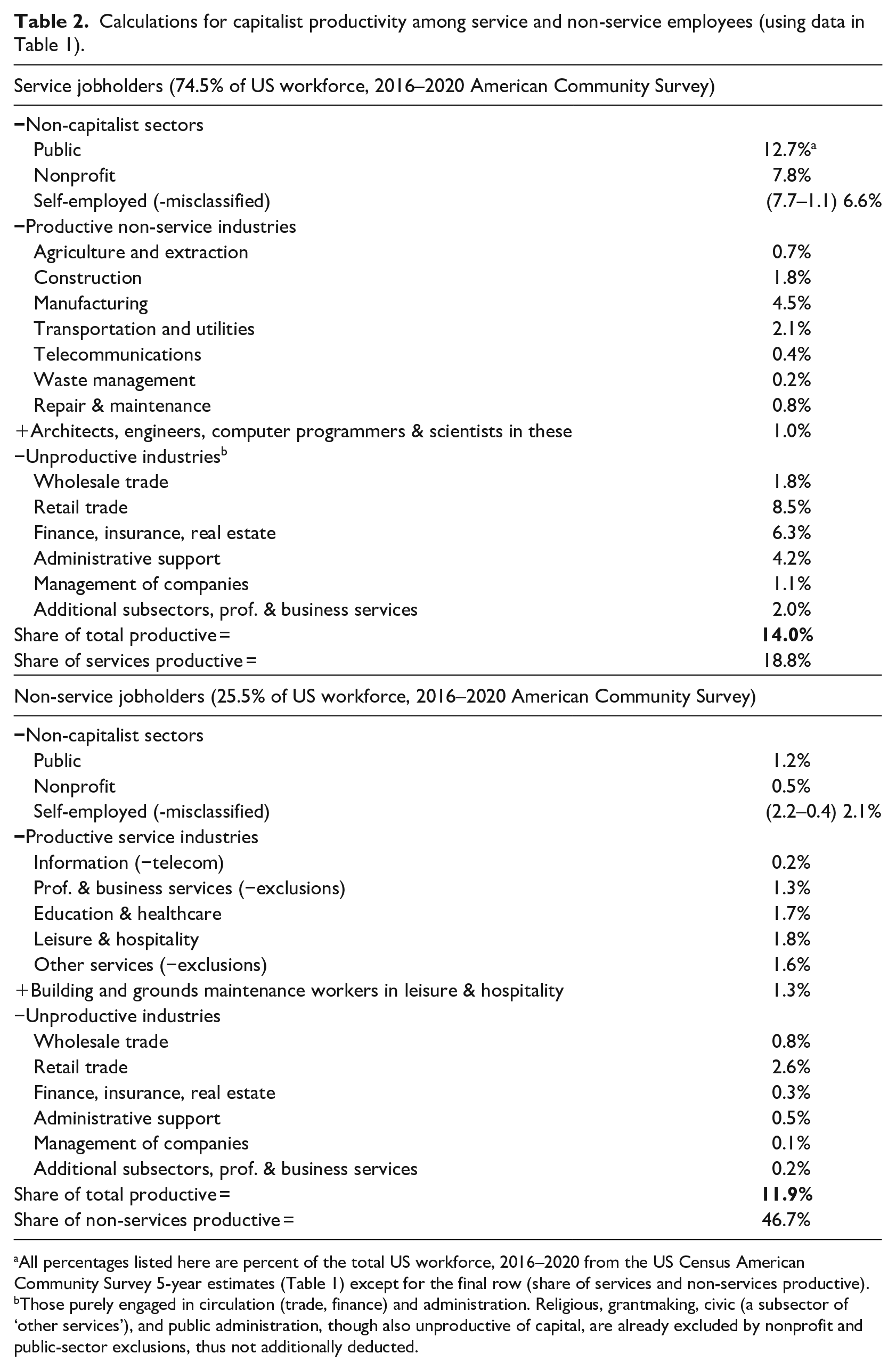
All percentages listed here are percent of the total US workforce, 2016–2020 from the US Census American Community Survey 5-year estimates (Table 1) except for the final row (share of services and non-services productive).
Those purely engaged in circulation (trade, finance) and administration. Religious, grantmaking, civic (a subsector of ‘other services’), and public administration, though also unproductive of capital, are already excluded by nonprofit and public-sector exclusions, thus not additionally deducted.
A Growing Mismatch
Let us first acknowledge this finding before considering its implications and further dimensions. Only about a quarter of all US workers are productive for capital. Nearly half of those tasked with manual labor are, while less than a fifth of those tasked with emotional and intellectual labor are. By almost any metric, these are significant discrepancies. That between services and non-services is relatively novel, while that between total and productive workers has long been noted (Braverman, 1998 [1974]; Moseley, 1991; Smith, 1993). The thrust of the latter is contained in Marx’s general law of accumulation, which predicts ‘relative diminution of the variable part of capital’ (labor) and ‘progressive production of a relative surplus population’ (Marx, 1976: 772, 781). Capital’s ‘surplus population’ appears, in the United States at least, mostly redeployed to administrative, circulatory, and social-reproductive employment rather than abject redundancy, though some of that as well (Case and Deaton, 2020; Ikeler, 2021; Wacquant, 2009). Indeed, the proportional growth of services is dependent upon previous and ongoing increases in the productivity (i.e. declines in labor requirements) of non-services (Baumol, 1967; Benanav, 2020: 56–64).
But the service productivity gap suggests something deeper: that such activities are less suitable to capitalist exploitation than non-services; that they function better in non-capitalist institutions (state and nonprofit); and, if they continue to grow, call into question the continued viability of capitalist organization. This is the productive forces explanation for the service deficit. Much like Mann and Dickinson (1978) found that the intrinsic nature of agriculture creates ‘obstacles’ to capitalist development, emotional and intellectual labor may also do so. Why? Capitalist production works best when labor power is collectivized, subordinated, and routinized. Capitalist circulation works best when commodities are standardized, transportable, and objectified—the central insight of Wertkritik theorists (Postone, 1993). Emotional labor can be subordinated and routinized, as myriad examples show (Hochschild, 1983; Ikeler, 2016; Leidner, 1993; Lopez, 2006). Its practitioners can also be aggregated in large establishments or networks, but its performance is difficult to collectivize. Intellectual labor also evades collectivization and routinization in ways popularized by Newton (2016). A sizable share is directed toward the management and supervision of others, rather than externally sold commodities, constituting what some term a ‘professional-managerial class’ (Ehrenreich and Ehrenreich, 1979; Ikeler and Limonic, 2018). And while both interactive and intellectual outputs can be standardized (e.g. fast food service or tax advising), most have little to no shelf life—effectively being consumed as they are produced, and often by those (children, the sick, elderly) unable to purchase or price-shop in standard market fashion. These factors create difficulty in ‘real[ly]’ rather than ‘formal[ly]’ or ‘fictitious[ly]’ commodifying services (Hermann, 2021: 29) and likely contribute to their muted productivity growth vis-a-vis industry (Benanav, 2020: 58). None of this implies services cannot be but are simply harder to exploit capitalistically.
The alternate explanation for the service productivity gap is social-relational. In its strong form, it would argue that our found discrepancy is not inherent to services as such but an artifact of their conjunctural organization. For several reasons, this strong form is unconvincing. While the bloated managerial stratum (Gordon, 1996) of the United States or its ‘social structure of accumulation’ (Gordon et al., 1982: 25) could be invoked, these would not square with the state’s notably stingy welfare provisions (Esping-Anderson, 1990) and thoroughgoing privatization processes (Cooper, 2017; Harvey, 2005). If service activities could be made profitable, they would most likely be made so in the United States, begging explanation as to why the United States continues to host most service workers outside the productive realm. A second consideration involves the global dimensions of economic activity. Here the objection would be that productive labor, both service and non-service, has been disproportionately outsourced to lower-wage countries and thus nationally found discrepancies are not really indicative of overall capitalist tendencies. Such offshoring has indeed been a prominent feature of neoliberal globalization (Roberts, 2016: 245–250; Sallaz, 2019; Silver, 2003). But even at the global level, relative employment in industry has been falling for over a decade (World Bank, 2023a) while that in services, slightly differently defined, has grown inexorably (World Bank, 2023b). Benanav (2020) in fact documents an entire era of ‘labor’s global deindustrialization’ (p. 15–28) and Muro (2016) how automation, rather than low-wage labor replacement, is the prime reason for manufacturing job loss. It is thus hard to see how expanding analysis to the global level—far more methodologically challenging—could definitively contradict the US-found discrepancy between productive and unproductive labor, both overall and within services.
All of this lends credence to Winant’s (2021) central post-capitalist thesis. But what about his secondary thesis of intersectional correspondence? Winant documents the growth of healthcare employment in Pittsburgh as an overwhelmingly feminine and Black phenomenon. The emergent ‘regime’, he argues, ‘gendered workers as caring subjects with various degrees of racial subordination—akin to wives or domestic servants’ (Winant, 2021: 15). The implication of this ‘reorganization of the [postindustrial] working class around caregiving’ is a return of the historically marginalized to form a prime constituency for post-capitalist transition (Winant, 2021: 23). Is this borne out beyond Pittsburgh?
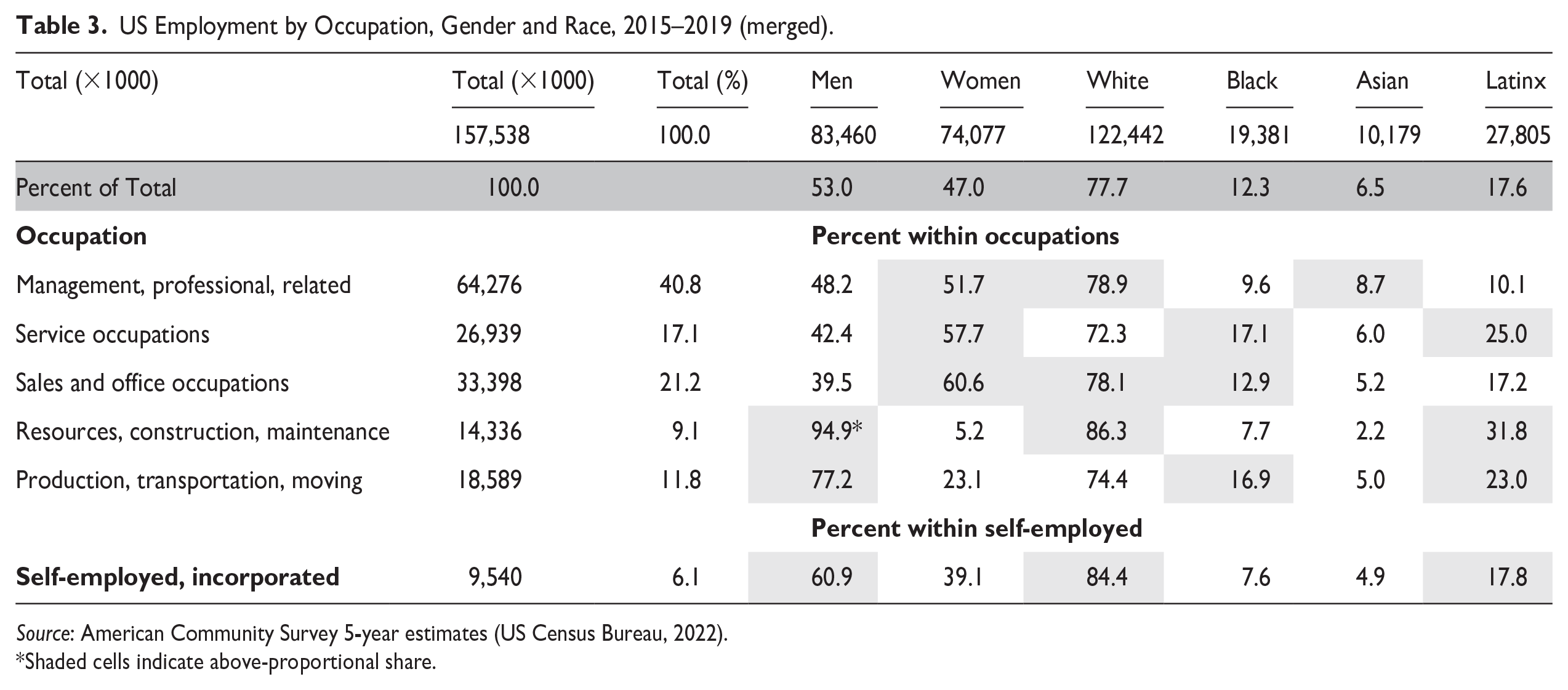
Table 3 examines this using merged Census data for major occupations cross-tallied by race and gender. Here we are unable to reassign the small share of ‘service’ workers in building and grounds maintenance (3.7% of all) to the non-service column nor to conduct the same occupation-by-industry sorting as in Table 1. But we gain a useful overview of service versus non-service demographics. Relative to their share of the formal workforce (47%), women are overrepresented in all three service categories—slightly in ‘management, professional and scientific’ occupations and significantly in the ‘service’ and ‘sales and office’ occupations. Women are drastically underrepresented in the two non-service categories, as well as among the self-employed, with the reverse obtaining for men. The racial picture is less definitive. Black workers are overrepresented in the ‘service’ and ‘sales and office’ categories but also in ‘production, transportation and material moving’; Asian workers are only overrepresented in ‘management, professional and scientific’; and Latinx workers, though overrepresented in ‘services’, which here include building and grounds maintenance, are also over-concentrated in the two non-service groups and proportionally found among the self-employed.
US Employment by Occupation, Gender and Race, 2015–2019 (merged).
Source: American Community Survey 5
Shaded cells indicate above-proportional share.
Some of these patterns are consistent with Winant’s extrapolations from Pittsburgh. The predominantly emotional service sector, composed of those in ‘service’ and ‘sales and office’ occupations, is majority female, disproportionately Black, and somewhat disproportionately Latinx. The predominantly intellectual service sector, composed of those in ‘management, professional and scientific’ occupations is also (barely) majority female and disproportionately white and Asian. Yet the predominantly manual non-service sector, while overwhelmingly male and somewhat disproportionately white, also has sizable shares of Black and Latinx workers, often in lower-wage and more precarious tiers. Such disparity is consistent with Botwinick’s (2018 [1993]) theory of competitive wage determination.
Here we have unpacked and further analyzed the service productivity gap, deducing the unlikelihood of its being purely socially contingent. Rather, it appears at least partly due to the intrinsic (un)suitability of service processes and products for commodification, with suitability conceived as a continuum rather than a dichotomy. We also found concentrations of women and people of color in the predominantly emotional service sector, reflecting a possible rechanneling of those marginalized by capitalist industrial labor into formal, social-reproductive employment. This majority of the US workforce (62%) employed in non-productive services and disproportionately female and Black, Indigenous, and people of color (BIPOC) is arguably a non-capitalist constituency, even if its labor supports systemic accumulation. Could it be a post-capitalist one?
Transitional Implications
The essence of post-capitalism is the idea that our currently dominant socio-economic system is being undermined by a successor. It consists in simultaneous analysis and prediction, or what Bell (1973) called ‘social forecasting’. Winant (2021) offers the most concrete recent proposal for how interpersonal labor performed in non-capitalist sectors—public and nonprofit hospitals—might prefigure a new care-based mode, echoing Karatani’s (2014) ‘reciprocal exchange’ as the key social relation of both pre-state and post-capitalist societies (p. 231). His work builds on a recent surge in post-capitalist theorizing (Bastani, 2019; Hermann, 2021; Mason, 2015; Rifkin, 2014; Srnicek and Williams, 2015; Wark, 2019) and it has been the central task of this study to combine and assess their claims empirically, while deploying relevant insights from Marxian political economy and service work sociology.
The problem with most of these contributions, however, as well as their postindustrial forbearers, is their authors’ reluctance to grapple with the thorny question of transition. Historians, philosophers, and social scientists have hotly debated this, focusing on the transition to capitalism, which post-capitalist theorists broadly ignore (Anderson, 1974; Althusser, 2006 [1963]; Brenner, 1976; Harman, 2004; Heller, 2011; Post, 2011; Wood, 2002; Karatani, 2014). The core insights of this contentious body of work, largely divided between ‘political Marxists’ and those (also mostly Marxists) who disagree with them, are the following. First, dominant social systems rarely collapse without a material crisis, either internal (geographic, ecological or demographic) or external (hostile invasion or encroachment). Second, social struggle is decisive for initiating transition and consolidating new paradigms. Third, emergent social systems usually exhibit precursors: subordinate or proto forms prior to their becoming dominant. Fourth, actual human societies are more complex than a unitary ‘mode of production’ (or Karatani’s ‘mode of exchange’) can fully capture. Althusser’s (2014 [1995])‘concrete social formations’ (p. 19)—multiple sets of social relations coexisting under the hegemony of one—provides a more accurate, if not always acknowledged, framework.
Armed with these lessons, let us consider what we found. A sizable majority of the formal US workforce (74.1%) and the overwhelming majority of service workers (81.2%) are not productive for capital. The latter group is predominantly female and disproportionately BIPOC. At two-and-a-half times that of non-services, the service productivity gap is too large to be wholly random and requires structural explanation. This is offered in the negative by Marx’s general law of accumulation and falling profit theories and in the positive by Winant (2021), Mason (2015), and Rifkin (2014). Indeed, this large-and-growing non-productive service sector supports Winant’s hypothesis of a burgeoning non-capitalist realm centered on interpersonal care. To a lesser extent, it supports Mason and Rifkin’s visions of less-exploitable intellectual production, though we cannot test their ‘peer-to-peer’ and ‘prosumer’ claims about non-waged activity.
But this potentially post-capitalist constituency is highly heterogeneous. A third (20.5% of all) are in public and nonprofit enterprises while a smaller portion (6.6% of all) are self-employed, leaving slightly more than half (33.4% of all) in the capitalist sector proper. In class terms, this group consists not only of the ‘emotional proletariat’ (Macdonald and Merrill, 2009) but also of professional-managers and a large share of the petty bourgeois (Ikeler and Limonic, 2018; Wright, 1997). The frequently divergent interests and outlooks of these fractions, including those based on race, gender, and nationality, pose significant hurdles to actionable solidarity. We should also note that their employing organizations—capitalist, state, and nonprofit—are thoroughly hierarchical, increasingly suffused with formal and fictitious commodification and hardly representing robust arenas of reciprocal exchange (Shirmer et al. 2021; Winant, 2021: 218–258). At a deeper level, as Munro (2021: 623) points out, socially reproductive employees are tasked not just with “the production of…any life but that of a docile, exploitable worker.” Thus if this group or some section of it, alone or in concert with those outside non-productive services, are to become agents of change for a truly post-capitalist transition, several subjective factors not currently in evidence (though not entirely absent either—Blanc, 2019; McCallum, 2022) would need to develop. There is also a deeper question as to whether we should expect capitalism’s successor to be inherently horizontal and democratic (Shachtman, 1957; Touraine, 1971; Wark, 2019), but that is beyond the present scope.
Another implication pertains to the transition debate itself, specifically whether productive forces or social relations are more decisive in epochal shifts. Those favoring the former emphasize incremental increases in productive technique; those favoring the latter emphasize the contours of historical struggle and ‘social property relations’ (Brenner, 1976). In the case of post-capitalism, we are not dealing with a completed transition, only the suggestive outlines of a future one. Yet our result that particular labor processes and products—emotional and intellectual services—are less suitable to capitalist exploitation supports the idea of a significant role for productive forces, thus undermining reductive versions of ‘political Marxism’.
In sum, while advanced capitalist social formations may or may not be ‘pregnant’ with alternatives, they are clearly complex: internalizing multiple modes of organization only some of which are capitalist and only a minority of which are productive. Services—already the vast majority and poised to grow further—are preponderantly outside both domains, begging the question of their ‘proto’ status embodied in this paper’s title. We cannot answer that question definitively. It depends on the outcome of social movements beyond the purview of structural prediction (McCarthy, 2019). What we can say, however, is that declining profits, shares of productive workers both in and out of services, and capitalist-driven climate change will likely yield deepening crises and social contestation. If and when those reach revolutionary heights, service workers will be a likely constituency and service industries a likely arena for the reorganization of economic life. Thus while Winant’s prognosis of a care-based ‘democratic and equal society’ remains speculative, it may provide a mobilizing framework for contemporary struggles.
Footnotes
Acknowledgements
This article is greatly indebted to guidance and inspiration from Ruth Milkman and the Ruth Milkman study group, Katja Ikeler, Anwar Shaikh, Rose Brewer, Michael McCarthy, Charles Post, Jack Metzgar, Zachary Levenson, David Fasenfest, and the anonymous reviewers at Critical Sociology. Any remaining faults are my own.
Funding
The author(s) received no financial support for the research, authorship, and/or publication of this article.
