




Abstract
Class struggle is a necessary aspect of society. While ordinary people engage in struggles to improve their conditions, economically powerful people engage in struggles to defend their privileges. Thus, class struggle is from below and from above. And, class struggle occurs over interests and over ideas. To reproduce capitalism, it is not enough that resources be in the hands of the top 1%–10% thus economically forcing the vast majority to rely on wage work, or that police be used against their picket lines. It is also necessary that a large number of common people must possess ideas that make them accept the existing mechanisms of society as natural or as inherently good for all. But, these ideas are challenged too, which is how ideological class struggle from below happens. Academia is a major site of ideological struggle. Generally, professors propagate ideas that justify the reproduction of capitalism as it is or in slightly modified forms. These ideas can be challenged by students. The main aim of this article is to briefly discuss the nature of ideological class struggle in academia and to present a series of questions from the standpoint of the students who can oppose many of the ideas circulating in academia.
Introduction
Resolving humanity’s major problems requires an adequate intellectual understanding of why the problems exist and what can be done about these problems. According to Rosengarten (2014), the author of Revolutionary Marxism of Antonio Gramsci, intellectuals ‘examine, clarify, argue, advocate and theorise points of view related to areas of broad general interest’ (p. 135). Unfortunately, the author skips the work of asking questions, or critique, more broadly. 1 An intellectual understanding that prompts critique (or questioning) reveals the objective reasons for the problems with the current social order and the inadequacy of the ideas being propagated about the current order and its future.
Struggle against the world requires questioning: questioning the world and questioning the ideas about it are central to intellectual work. Questioning is clarificatory as it is a medium through which we enhance our own thinking as well as others’. Questioning is practical because it is a medium through which we oppose: we oppose not only the objective processes that create our major problems, but also the ideas that the system inculcates in us that weaken our ability to fight it. When fascistic tendencies are showing their ugly head everywhere, with the curtailment of academic and other forms of freedom, with the ascendancy of post-truth politics where facts and falsehood are routinely conflated for the purpose of ideological and political domination (Das, 2023a; 2023b), it is very important that the culture of questioning be widely practiced as a part of ideological class struggle by common people against the system.
An important space for questioning is academia. The latter is a vital part of the intellectual arena which, as Gramsci (1971) would say, is like a machine-producing machine (p. 15). After all, as they train their students, university teachers (i.e. the people who think) help produce thinking-people. Students asking questions to their educators is a form of their active participation in their learning process, which is a metabolic process of collaboration between them. It is a necessary part of their self-education. Besides, the vast majority of students are also future workers; many of them are already workers as they need to earn money to fund their education. So, developing a critical perspective on society is important for their working lives too. When students politely ask questions to their educators, this might also contribute to the re-education of their educators. After all, educators may benefit from being (re)educated.
The remainder of the article is split into seven sections. In I provide some brief clarification about the nature of class society and of ideological class struggle. In section 2, I discuss two forms of ideological class struggle in academia. In the next section, I present some broad criticisms of academia. Section 4 presents a series of questions from the standpoint of the students who can oppose the ideas circulating in academia. These questions concern professors’ philosophical worldviews as well as their views on the nature of modern society, including the role of social sciences and humanities education in it, and their (implicit) proposals for change. Mere questioning is not enough. The penultimate section discusses how students can make a series of demands on the academic system and on society at large to improve the quality of their education and their working lives. The final section summarizes the article.
Class Relations, Capitalism and Forms of Class Struggle
Academia, like everything else, can only be understood when it is seen in relation to other parts of society and to society as a whole. And the most important attribute of the current society is that it is a class society. So, one must begin with class theory. 2 Classes exist when one group (which is a small minority) effectively controls society’s productive resources and by virtue of that control appropriates the surplus labour (or surplus product) from the majority who do not have effective control over these resources. Relations between classes are consequently antagonistic relations, whereby the ruling class benefits from the labour of, and therefore, at the expense of the well-being of, the exploited classes. Given this objective antagonism, class struggle is always a possibility. this is concretely expressed from time to time, covertly or otherwise, and it occurs more in some places than in other places at a given point in time.
For the last 10,000 years or so, society has remained class-divided. Modern society – capitalism – is the most developed form of class society. Capitalism is a society where: means of subsistence (e.g. food, shelter) and means of production (e.g. land, mines, factories, machines, software, etc.), are bought and sold; wage workers are separated from the control over capitalist property and from the surplus value they produce; and they are alienated from the process of production itself. They also do not control state power. For their continuation, class relations require – and reinforce – the oppression of people based on gender, race, religion and other such identities and relations of difference. Given capitalism’s objective internal class antagonism, class struggle is always immanent in capitalism (Das, 2022b).
Class struggle takes material and ideological forms. That is, class struggle occurs over interests and ideas, respectively. Class struggle takes a material from (or economic–political form) when there is a fight over the opposed class interests, which are both economic and political. The material form of struggle occurs in the workplaces (e.g. fight over working conditions or over the length of the working day) and in the markets (e.g. fight over wages and against inflation). The material form of struggle occurs also in the wider political sphere (e.g. struggles over the defence of democratic rights or over the allocation of resources for public services; the struggle over the minimum wage legislation). Class struggle takes an ideological form when it happens in the realm of ideas, which, ultimately, concern opposed class interests. Corresponding to every instance of class struggle over an objective interest, there is class struggle over a set of ideas related to that interest. Ideas are system-opposing and system-supporting.
The term, class struggle, is often used to mean the struggle of the exploited or the masses (workers and small-scale producers). This is an un-dialectical and mistaken view. (Another mistaken view is that there is no class structure and there are no classes, if exploited classes do not engage in an overt struggle.) Class struggle, material and ideological, is both from below and above (Table 1). 3
Forms of class struggle.
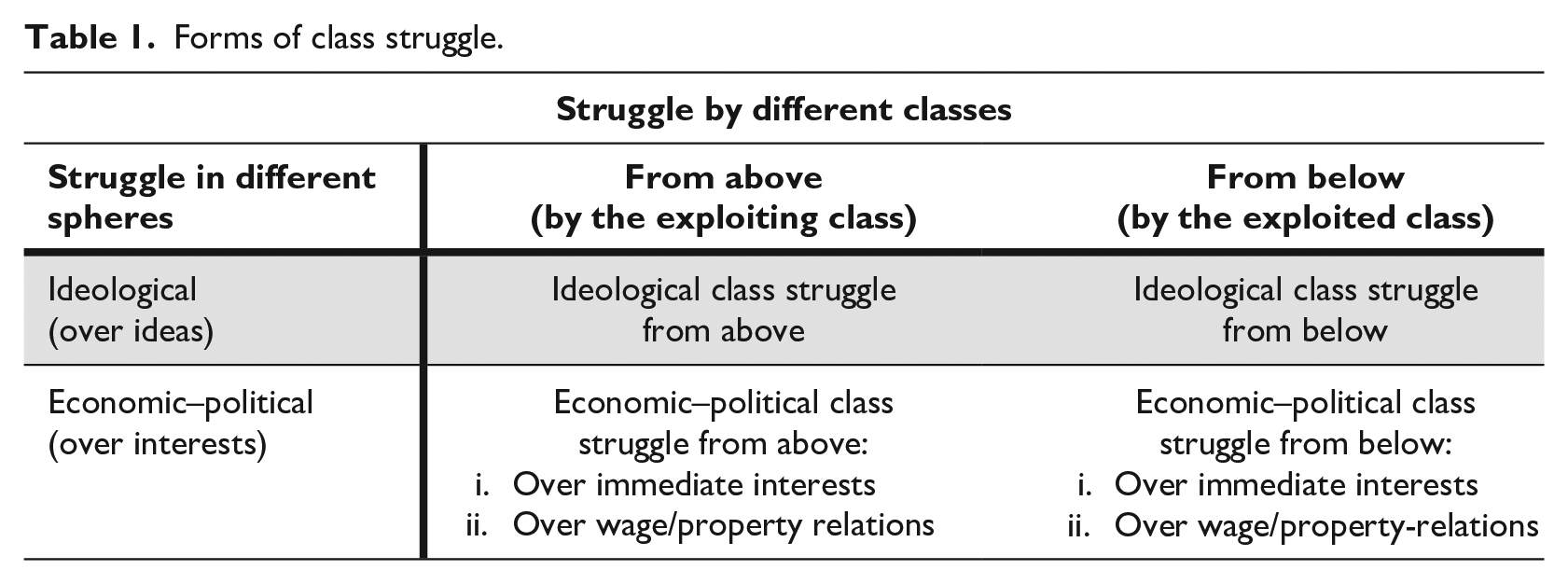
Class struggle from below is when the exploited class fights in its material and ideological interests. In its material form, class struggle from below occurs when ordinary people engage in struggles in defence of their economic and political interests. Given the ontological stratification of capitalist society, whereby there are surface appearances (or immediate interests) behind which there are structural social relations (wage/property relations), class struggle from below over interests takes two main forms: fight against the symptoms of the system for temporary economic and political reforms (trade union struggle, or a lower stage of class struggle, over immediate interests), and fight against the existence of wage-slavery and against capitalist state power as such (a higher stage of class struggle, which includes the lower stage of struggle over the very existence of wage/property relations). In other words, lower-class opposition to capitalism takes the forms of opposition to the capitalist relations of market, private property, exploitation of labour and dispossession of small-scale producers and imperialist subjugation of the South as well as the opposition to the concrete effects of all these capitalist relations (these effects include poverty, inequality, low wages and attacks on union rights). The exploited classes and/or their ideological representatives also engage in struggle against the ideas of the ruling/exploiting class, the ideas that concern the capitalist relations and the effects of these relations.
Class struggle from above is when the ruling class engages in its struggles to counter all these different forms of struggle of the exploited masses and to defend and expand its class power to continue to monopolize society’s productive resources and use them to make profit at the expense of the masses, and to politically subjugate them using state power that fundamentally belongs to the ruling class (Das, 2022a). In fact, the actions of the class state on behalf of the ruling class are a form of class struggle from above.
Marx’s Capital volume 1 provides a theory of objective class relations and subjective class struggle (Das, 2017). Ideological struggle is a necessary condition for a successful struggle over economic interests. If it is true that ‘Without revolutionary [ideas] . . . there can be no revolutionary movement’ (Lenin, 1902: 12), it is also true that without ideas in support of bourgeois society, the latter cannot be reproduced by the ruling class and its state. Unsurprisingly, Marx’s (1859) social theory focusses not only on the economic interests of different classes and class fractions. It also deals with the ‘ideological forms in which’ common people ‘become conscious of [the] conflict’ over their economic interests ‘and fight it out’ (italics added). Marx’s political economy illustrates this historical materialist principle.
In capitalism, productive resources (means of production) are controlled by the top 1%–10%, so that, the vast majority are economically forced to rely on wage work and thus experience ‘dull economic compulsion’ (Marx, 1887: 523). It is not enough for the minority class to control/monopolize resources (or money capital), however. To serve as capital, money has to be a part of a circuit, M–C–M/: capitalists invest money to make more money by buying labour power and productive resources and by appropriating surplus value from workers. This is the economic aspect of the capital circuit. The latter has a political aspect too. For capitalism to be reproduced, it is not enough that capitalists control capital and invest it to appropriate surplus value which they reinvest in successive cycles of accumulation. The potential lower-class opposition, including opposition to surplus value production and to private property, must be averted too. Doing so requires potential and/or actual use of coercive state power (e.g. police against workers on the picket lines) as well as providing some concessions that are relatively cheap and generally revocable. But neither (dull) economic compulsion nor (brutal) extra-economic compulsion nor (cheap) concessions is enough: in addition, the capitalist class and its state must ensure that common people possess ideas that make them freely/voluntarily accept the existing relations and mechanisms of society as natural or as, more or less, inherently good for all. Disarming common people of the control over society’s resources and political power (i.e. the state) and ‘arming’ them with system-supporting ideas are two sides of the same coin.
People have to believe that even if the current world has some problems, a world beyond capitalist production and exchange is not possible, for the latter is seen as the final destination of human history. There is a need to naturalize capitalism and neutralize the potential for class struggle from below against capitalism. In short, for the reproduction of capitalism, it is necessary that there be a ‘working class, which by education, tradition, habit, looks upon the conditions of that mode of production as self-evident laws of Nature’ (Marx, 1887: 523; italics mine). Capital not only manufactures commodities for profit. It also manufactures consent of common people for the voluntary acceptance of the system of capitalist commodity production, by utilizing various institutions (e.g. the state apparatus).
Ideological Class Struggle in Academia
Ideological Class Struggle from Above in Academia
Marx forgot to say that much of this education and habit formation happens in the academic sphere. Indeed, ‘The structure of social relations in education develops the types of personal demeanour, modes of self-presentation, self-image and social-class identifications which are the crucial ingredients of job adequacy’ (Hill, 2017: 44). Thus, academia serves as a space for disseminating the ideas that are necessary to reproduce a working class that more or less accepts capitalism.
The ideological struggle from above is launched through a set of ‘ideological state apparatuses’ or ISAs (Althusser, 2001). The education system is ‘the dominant ideological State apparatus in capitalist social formations’ (Althusser, 2001: 104). This is where students learn the knowledges that not only help them become workers engaged in the capitalist commodity exchange and in the production (and distribution) of surplus value but also willingly accept capitalist production and exchange as the normal state of affairs.
According to Lewontin (1979), ‘The university is a factory that makes weapons – ideological weapons – for class struggle, for class warfare, and trains people in their use’ (p. 25). He adds: ‘The university is the source of creation of ideology; it is the source of legitimation of ideology; it is the source of propaganda for ideology. Creation, legitimation, and propaganda are the three functions of bourgeois universities’ (Lewontin, 1979).
Generally, professors propagate this ideology – a combination of truths, half-truths and lies – that more or less justify the reproduction of capitalism as it is or as it is slightly modified (Eagleton, 2007). That professors do so is partly evident from, and expressed as, a very strong linkage between the academia on one hand, and the capitalist class and the capitalist state on the other hand. This is a linkage that has shaped the theoretical and methodological developments of the social sciences and humanities (Heller, 2016), and one could say, natural sciences too to some extent. For example, economics departments have naturalized capitalism, idealized its so-called free market and reduced their research to quantitative analyses of a system they presume is the best humanity could achieve (Heller, 2016). Similarly, in emphasizing the role of distance (spatial/geographical forms of human activities) and natural environment, the discipline of geography has tended to under-emphasize the role of exploitative and oppressive processes across societies. Geography is often obsessed with emphasizing how space and place matter, as if class relations are just a secondary and contingent concern. Sociology, perhaps the most theoretically conscious of all social science disciplines, rights puts the emphasis on social relations, but considers class and non-class relations of race, gender, sexuality, etc. as if class relations have no causal primacy. Political science, as Ollman (2015) says, creates the false illusions that it studies politics, that it is scientific, that one can study politics in isolation from the other social sciences and history, that the state is neutral; and that the bulk of political science as a discipline furthers the cause of democracy.
Consider Biology as a field within STEM (Science, Technology, Engineering and Math). ‘[M]ore than other natural sciences’, Biology ‘is an extremely important source of ideological weaponry for class struggle’, says the Marxist biologist, Lewontin (1979: 26). Widely prevalent in Biology as a STEM discipline is biological determinism. This is the idea ‘that everything is in our genes, that differences in status, wealth and power are inevitable, that the bourgeois revolutions of the eighteenth century did everything possible to destroy artificial inequalities and only the natural inequalities remain’ (Lewontin, 1979: 26). According to a Harvard biologist, writes Lewontin (1979): ‘In the eighteenth century there was no biological difference between classes, so revolutions could succeed; but now the ruling class is biologically superior to the working class so revolutionary success is impossible’ (p. 27). Biological determinism offers a reason why it is impossible to build a society, a communist society, ‘in which, despite the [biological] differences, everyone would get the same psychic and material benefits from society’ (Lewontin, 1979). All this implies that humanity’s progress towards egalitarianism has already reached its highest stage. The version of biological determinism mentioned above is akin to Fukuyama’s (1989) the end of history thesis.
Capitalist society’s structural need, or the need of the economically powerful people and their political backers, to ideologically subjugate common people is not met automatically. Certain strategies are implemented. Indeed, the ruling class, along with its state, utilizes several strategies of ideological class struggle in academia. One is a more general strategy: it directly or indirectly controls, to a large extent, the material basis of the university (i.e. funding for the university). This allows the ruling class to, more or less, control the production and dissemination of ideas about the natural and social worlds. After all, The class which has the means of material production at its disposal, has control at the same time over the means of mental production, so that thereby, generally speaking, the ideas of those who lack the means of mental production are subject to it. (Marx and Engels, 1845)
Priority is given to technical and business-related education aimed at improving productive forces, through technical and organizational changes, thus increasing the rate of surplus value relative to what labour receives for every hour of work for its reproduction. Priority is also given to an education (e.g. social sciences and humanities) that provides ideological support for capitalist values/practices. 4 The tendency for academia to directly meet the needs of capitalists and the state has become particularly strong since the turn to neoliberal form of capitalism in the post-1970s world. ‘Today the university explicitly models itself on the corporation, with the logic of the market driving all decisions’ (Clawson and Leiblum, 2008: 16).
Second, the ruling class appropriates the best brains of the exploited classes (and not just from its own ranks). As Marx says ‘The more a dominant class is able to absorb the best people from the dominated classes, the more solid and dangerous its rule’ (quoted in the work of Moufawad-Paul, 2018). Various material inducements (e.g. scholarships based on need and merit) partly serve this need to recruit talented men and women from poorer and socially oppressed backgrounds. Indeed, ‘academia does function to capture potential intellectuals and redirect their energy in ways that either directly benefit the ruling classes or misdirect them down ineffectual and individualistic routes of academic debate largely divorced from the broad masses’ (Moufawad-Paul, 2018).
Given that it takes years of training to be a professor and that education is an expensive affair, professors generally come from relatively affluent backgrounds (business, landlord and petty-bourgeois or small-scale capitalist families, which also happen to be from culturally dominant status). What the professors, both men and women, teach and research, to a large extent, reflect their class or class fractional positions. ‘[S]ocial being’ sets limits on one’s ‘consciousness’ (including one’s conception of one’s self and others) (Marx, 1859). The courses they teach about society generally do not deal with the lives of common men and women – that is, those who depend on the sale of their labour power or small amounts of goods/services they produce. These are the people whose basic needs more or less remain unmet, who are often subjected to police brutalities and racial and gender and other forms of oppression, and who suffer the most because of environmental damages caused by the profit-driven society. When academics do talk about women and minorities, they often talk about the relatively better-off non-Whites or relatively better-off women (e.g. relatively well-off academics and other middle class people, city mayors, top political leaders or government officials) rather than about those non-Whites and those women who must go to work every day for a meagre wage on a precarious basis or who are petty commodity sellers and who struggle to meet their basic needs (Das, 2022d).
Third, serving the university on behalf of the ruling class, and aware of the possibility of class struggle in academia, conservative professors and administrators, ‘speak in the class-free, technocratic language of professional competence’, while they ‘have no particular difficulty judging Marxism and Marxists in class terms’ (Horton, 1977: 79). In other words, they can easily see that certain ideas explain the world from the standpoint of the masses, and that ideas have a class character and can be dangerous (ibid.:79). Indeed, the most serious target of ideological class struggle from above is Marxism. The university, like the system of schools and colleges, is fundamentally an anti-Marxist place, although most academics would say it is, more or less, an ideologically neutral place. The university is a permanent site of McCarthyism, which is the practice of making accusations against Marxists of subversion and treason, and which weeds them out of academia through covert and/or overt strategies. This practice is sometimes more blatant than at other times. ‘There is a well-known saying that if geometrical axioms affected human interests, attempts would certainly be made to refute them’ (Lenin, 1908). This applies to Marxism, which is the most robust set of scientific ideas that explain and critique capitalism and which is a class-focussed theory of the need for, and obstacles to, the struggle for a class-less society. Marxism ‘directly serves to enlighten and organise the advanced class [i.e. the working class] in modern society’, and it ‘indicates the tasks facing this class and demonstrates the inevitable [need for the] replacement . . . of the present system by a new order’, that is, communism, which is why ‘this doctrine has had to fight for every step forward in the course of its life’ (Lenin, 1908). 5 A result of all the ruling class struggle in academia against communism is the fact that students receive an education that fails to help them understand the world objectively and critically, that is, to understand the world in a manner that grasps the root of social–ecological problems of humanity.
How important threats from Marxist ideas are to academia can be seen in the fact that the Central Intelligence Agency (CIA), that bipartisan state institution in defence of the long-term ruling-class interests globally, has had to work hard to push post-modernism over Marxism within academia. This is because post-modernism promotes idealistic obfuscation of the reality (Moufawad-Paul, 2018), and is focussed on non-threatening individual action and politically correct linguistic struggle against anti-minorities discrimination. Clearly, in academia, radical or system-opposing ideas are discouraged. And, if they exist in some islands, they are at best tolerated, while system-supporting ideas are actively promoted. At the same time, as a mark of tokenism, a few radicals or Marxist professors are employed to create some semblance of balance, an appearance that university knowledge is an outcome of free discussions and debates and that it is free from biases.
The university is not just a place of pro-capitalist and anti-communist ideology but also a workplace, a site of production and exchange of knowledge (and other commodities, such as those needed for the university to operate, including machines and a built environment that absorb a lot of capital). So, it has been subjected to non-ideological class struggle from above too in the following sense. The ruling class has ‘reshaped the capitalist university, imposing the neoliberal features’ that include: ‘huge cuts in state funding; bloated, overpaid administrations; increased reliance on contract and adjunct faculty; high tuition paid for by students through massive loans; [and] securing profits by patenting intellectual property’ (Sexton, 2016–2017). The majority of workers in the university – teachers and students-as-part-time-workers work under conditions that are economically alienating and emotionally stressful. So, the class struggle from above in academia is not merely ideological. It is economic–political, which is expressed in the form of adverse working conditions of academic workers, and which prompts economic–political struggle from below in the academia, as discussed below.
Ideological Struggle from Below in Academia
The sites of ideological production are sites of class struggle from below too, just as the sites of material production are. Academia is one of these sites. The ideas that are propagated in the education system in support of the capitalist class and/or its state, can be, and are, challenged by students. Clawson and Leiblum (2008: 26) says that the American university as a site of struggle has developed in response to popular pressures and political fears from its elite roots. Then, the question for progressive and Marxist academics is: ‘what is the role of our workplace in the class struggle and how can we enter into the class struggle through the place in which we work?’, as Lewontin (1979: 25) asks. His answer is that: as workers in the university, which is ‘a weapons factory’, one that is ‘engaged in the manufacture of instruments of class domination’, the disruption of that production must be ‘our chief task’. That is, ‘We must make its weapons useless, prevent their use on the battlefield of class warfare, and at the same time, attempt to create other weapons – counter weapons – that can be put into the hands of people on the other side of the class struggle’ (p. 26).
The political purpose of an academic worker, say, as a biological scientist or a social scientist within the university, wishing to engage in class struggle from below is to provide students and those outside the university ‘the weapons that they know they want but do not yet possess or know how to use’ (p. 27). Just as the ruling class and its intellectuals have different strategies to fight its ideological class struggle, progressive/Marxist educators can, and sometimes do, pursue specific strategies too.
First, progressives and Marxists ‘must demystify and destroy the obfuscation which is part of the ruling class ideological weaponry’. This act of demystification must reveal the natural and the social world ‘as it really is’ (p. 27). A great deal of what we do in the university as Marxists, a great deal of our time and energy, must be spent in that truth-telling operation’ through teaching activities (Lewontin, 1979: 27). This is especially important given the turn to post-truth fascistic politics. The latter is informed by post-modernism which is popular among professors as a basically anti-Marxist ideology (Brass, 2021; Das, 2023a; 2023b).
Second, given that ‘Marxist scholarship cannot substantially reform and improve the situation in the bourgeois sciences, because for the most part what is missing or corrupt in those sciences stems from an ideological basis so deep that only a revolutionary alteration can cleanse or fulfill them’ (p. 28), there is a need to create ‘alternatives that cannot be used by the weapon-makers of the university’ and thus ‘to create [intellectual] weapons that can be used by our side in the class struggle’ (p. 27). Doing this is the primary function of a Marxist academic (i.e. someone who is a Marxist first and an academic second).
Third, given that capital draws on the legitimacy of academic institutions to justify the current system of exploitation and oppression, Marxists and all those who engage in class struggle from below must engage in the act of delegitimation of the ideas coming out of academia. There is a need to unpack how academic knowledge tends to hide the reality from people. ‘Delegitimation involves explaining’ not only ‘what the real facts of the world are’ but also ‘why respected academics are dishonest and sometimes downright fraudulent in what they tell people about the world’ (Lewontin, 1979: 28). ‘Delegitimation of the authority of bourgeois ideologues and their ideology’ requires writing as well as using media – ‘speaking on radio, on television, in schools, in newspapers and magazines’ (Lewontin, 1979). Going beyond ‘the simple revelation of academic fraudulence’, progressives and Marxists must ‘show publicly how such frauds are generated by the system of creation and propagation of knowledge called the bourgeois university’ (p. 29).
Fourth, there is a need for progressives and Marxists in academia to turn to ‘political practice in our own [everyday] work relations’, that is, to ‘create, in our workplaces, a situation that intensifies contradiction (and the university is filled with contradictions as a workplace)’ (Lewontin, 1979: 29). Such a political practice is facilitated by what the capitalist class itself does to university: as a part of its class struggle above, the ruling class commodifies education, and it fills the university with proletarianized education workers. Marxists who happen to ‘have power in the university’, must not ‘have a false consciousness of identification with the university’. And they must not be ‘confused between the ideal of an institution of scholarship and of truth, and the reality of the university as a political institution, as a weapons foundry in class war’ (Lewontin, 1979).
Ideological class struggle can happen both inside academic world and at the interface between it and the wider society. The latter interface points to the possibility that there are ways in which students can and should take responsibility for their own education. They could, for example, form reading groups and read certain books/articles/blogs and discuss certain topics on their own and outside of the classroom (Das, 2011). The rationale for this would be that such readings and topics are excluded or are given only lip service in academia. It is possible, and indeed necessary, for students to educate themselves partly outside of the normal classroom, conferences and consultation sessions with supervisors, and to connect the usual academic environment to the extra-academic intellectual fora, including those to which activist-scholars contribute. Often the best of academic ideas are originally from non-academic scholars who produce ideas as a part of their effort to radically change the world, as the power of Marxist ideas, the founders of which were scholar-activists, demonstrates. 6
In the next section, I turn to the question of how to implement these strategies. While I make some brief comments on the practical or economic aspect of class struggle (i.e. the last strategy that is about the work relations in the university as a workplace), I will mainly focus on the first and to a certain extent on the second (which are more inter-connected than Lewontin appears to think). In terms of what these strategies actually mean, I will critique the class and capitalist character of academia in the section that follows. In the succeeding section, I discuss how students (and, by implications, the organic intellectuals of the masses, including Marxist and radical professors) can engage in ideological class struggle from below by questioning the mainstream professoriate about their philosophical and scientific views.
Problems of Academia from the Perspective of Class Struggle from Below
Ideological class struggle from below must unpack how academia has been a site of class struggle from above. It must reveal the fundamental problems with academia. These problems produce an unsatisfactory education for the students (Das, 2021).
Philosophical Inadequacies in Academia
To be able to truthfully describe the world as it is and to explain the world, one has to agree on certain philosophical principles concerning the world (reality) and ideas about it. An important epistemological principle is the theory-ladenness of facts or of empirical observations. To understand anything properly, one has to have a theory, a theory that says, among other things, that an object, X, by virtue of its internal structure and by virtue of its relations to other objects within the overall system of which X is a part, causes Y (or is a necessary condition for Y), other things constant. It is theory that helps one connect the different parts of society one to another. Theory – the production of which requires not only a massive mastery over existing ideas but also a critique of these ideas, with the empirical facts in the background – helps us derive generalized lessons from historical experiences (good and bad), and to produce a coherent picture of society. And, one has to be committed to the idea that scientifically produced knowledge is superior to claims based on superstition, personal belief, feeling, intuition, personal/group identity and so on. 7
However, a large number of educators do not believe in the need for theoretical work. There are many educators, in STEM and outside STEM, who are simply keen on their students to go and see the world for themselves, either in the laboratory or in the field (e.g. a city, a forest, etc.). Alas, without a theory, one will see many things without really seeing anything (much). Without theory, research and teaching cannot unpack the nature of social relations, attendant mechanisms and consequent empirical outcomes. And commitment to the scientific character of knowledge has become very weak with the post-modernist turn.
Theory – or, broadly speaking, intellectual thinking, including method of thought – is linked to political action (Das, 2022c). However, professors are hardly explicit about their political stance (i.e. their views on what needs to be done about the things we study, i.e. humanity’s social–ecological problems). To the extent that they talk about theory, they are often silent about the practical implications of their theoretical stance. But, as mentioned, there is a connection between one’s theoretical stance and one’s political stance. After all, If it is possible to place a given person’s general type of thought on the basis of his [or her] relation to concrete practical problems, it is also possible to predict approximately, knowing his [her] general type of thought, how a given individual will approach one or another practical question. That is the incomparable educational value of the dialectical method of thought. (Trotsky, 1942: 49)
To adequately explain the world, one has to agree on certain other principles too. These include the idea that: (a) there are objectively existing structures of relations and processes, whose contingent reproduction is then influenced by how people think and act, and (b) things in our life are not creations of thought, although ideas can play important role in social change. Indeed, to explain anything in the world, one has to begin with objective material conditions under which people live which are dominantly social in character 8 : contradiction-ridden social relations exist independent of, and have primacy over, individual action/thought which in turn exerts some influence on the social relations. Based on such a perspective that puts the accent on the materiality – objectivity – of life and its contradictory character, one will be compelled to examine the class character of society and the state, that is, to examine the issues surrounding the control over property, nature of the state, people’s collective agency as it is rooted in relations of production and exchange, and so on (Das, 2017, 2022a). Armed with such a perspective, one will also be compelled to examine how it is that capitalist relations of production and exchange lead not only to imperialism and war but also to a whole host of other major problems mentioned earlier. So, the dominant emphasis in the academic courses should be on the class character, and more specifically, the capitalist character, of society.
But this does not generally happen in academia: as a site of class struggle from above, the university has been dominantly a place of what Gramsci called ‘traditional intellectuals’ who falsely consider their intellectual pursuit as independent from any social class, while producing ideas that help the reproduction of capitalist society. 9 ‘Scholarly work has been, and is still often, understood as “objective,” “detached,” and “disinterested”’ (Hosseini, 2021). While the class war is moving ever so irrefutably inside the walls of academia, the managerial elite of the neoliberal university, as well as academics complicit with them, continue to hide behind a liberal-humanist façade (Hosseini, 2021).
Academia and extra-academic opinion makers indeed often see the university as a class neutral place. As a part of class struggle from below, it is important to critique such an idea of the university. To deny the reality that the university is a space of the production of pro-capitalist ideas is ‘to adopt the liberal Enlightenment fantasy of the university as a free space beyond the workings of power’, and that ‘educational institutions play no part in economic exploitation and state domination’ (Mills, 2014). Such a view is ‘the utterly non-Marxist and non-dialectical view that exploitation happens only in the factory, and that the state functions only through its police forces’ (Mills, 2014). The ideological class struggle from below, in which students have a crucial role to play, must reveal the class character of academia and delegitimize it as a site of production of pro-capitalist ideas or ideas that appear to support all classes.
The general absence of commitment to a theoretical understanding and without an emphasis on the materialist, contradictory, and social character of reality, research and teaching (truth-telling) suffer. Indeed, academic courses often deal with purely environmental or biological issues in isolation from social-class issues. Or, academic courses often focus on the individual human being (or culturally defined groups of individuals) abstracted from their contradictory social-material relations (i.e. class relations). Academic courses often focus on the intricate empirical complexity of a place (e.g. a particular city) or a part of society (e.g. a particular economic activity) or world region, without saying anything (much) about society as a whole. So, academic courses fail to help students to critically theorize the totality of capitalist society – in terms of its major substantive dimensions (which are economic, political, cultural and ecological) at a general level and in terms of how they vary historically and geographically – and to empirically study that totality, both from the standpoint of (a) describing and explaining the totality and thus finding an order in society that stems from objective material-social conditions and (b) radically transcending the current society.
Academia is full of critical approaches as evident from such terms as critical sociology, critical human geography, critical management studies and so on, but what does being critical mean, and what are the philosophical and social-theoretical reasons for critique (Das, 2014)? University education must make people be critical of the world and of the ideas about the world, but any critique that is offered in academia is often confined to the critique of, for example, subjective aspects of special oppression rather than of the total society or social totality – capitalism, a society that thrives on special oppression of certain groups, an oppression that is both discursive/subjective and material/objective. And when there is any critique of capitalism, it is often confined to the (rather mild) critique of a specific form of capitalism (e.g. neoliberalism) or of specific excesses of capitalism (e.g. very low wages here, extreme form of ecological degradation there), rather than capitalism as such. One wonders whether the scope of professoriate’s critique is deliberately confined to the critique of those aspects of society which can be regulated and changed (a little).
As mentioned earlier, a class view is generally missing in most university curriculum concerning society. To the extent that class is ever discussed, it is always in terms of unequal distribution which presupposes the idea of equality. But in a fundamental sense, ‘class equality’ is a contradiction: how can the relations between capitalists and workers be more equal (except in a superficial sense of who earns how much) within capitalism? And as long as there is a class society, or as long as there is capitalism, which is a form of class-society, how can the ideas about capitalist society that are discussed in academia (and outside) remain class neutral? Lenin makes two inter-related points on this. ‘[I]n a society torn by class antagonisms there can never be a non-class or an above-class ideology’, so that, ideas in the modern society, are, ultimately, socialist or bourgeois (Lenin, 1902: 23). In addition, indifference [towards class struggles] is not equivalent to neutrality . . . [In] practice, indifference to the struggle does not at all mean standing aloof from the struggle, abstaining from it, or being neutral. Indifference is tacit support of the strong, of those who rule. (Lenin, 1905)
Academia produces/disseminates ideas that are blatantly pro-capitalist, or when they feign neutrality, they are complicit in the reproduction of capitalism.
‘Small Group’/‘Fragmented’ or Parochial/Sectoral Mentality
Often society is divided by professors into numerous groups (e.g. women, refugees, mentally ill people, indigenous peoples, people in jail, heterosexual people). These divisions are important as they point to the oppression and subjugation of large segments of humanity. However, such an approach to society, including in its inter-sectionalist form, is problematic because it largely fails to recognize that the conditions of the marginalized groups are inter-related and that each of these groups is connected to the overall social-material (class) character of society of which they are a part. In other words, there is little recognition of the fact that by studying a given group (or indeed a given place or a given problem), one can say something about the totality of which the group (or the place or a problem) is a part. Perhaps, underlying the sectoral and parochial pedagogical/intellectual approach that many academics take and pass on to their students is the political principle that society as a whole cannot be changed and that only small parts of it (e.g. some of the conditions of women or of the mentally ill or of people in jail) can be changed and, that too, only in relatively small, ameliorative ways.
In terms of the sectoral academic thinking, consider the following example. In Canada, professors often begin an academic event with an indigenous land acknowledgement, the recognition that an academic institution is situated on the land taken away from indigenous peoples by European settlers. Such recognition is important as are showing respect and asking for forgiveness for past misdeeds. But such a discursive practice means relatively little for the oppressed if it is isolated from, and if it is perhaps meant to serve as a replacement for, the actual political action that is necessary to improve the material lives of indigenous men, women and children. Such a discursive practice conflates political action with discursive/linguistic utterances. It valorizes and encourages the abstraction from the world of work and production and from the lives of workers, an abstraction that is typical of the academic world (Das, 2021, 2022d).
Consider this: if educational buildings – just like places of worship, parliament buildings, factories and so on – have been established on the land taken away from the original occupiers, 10 all this has also happened on the back of men and women as workers. If we need to start an academic event with gratitude, we should show our gratitude towards the men and women whose labour was exploited as well as towards the men and women whose land was taken away. In other words, if ‘land acknowledgement’, why not ‘labor acknowledgement’? Indeed, it is important to consistently acknowledge that academic work itself is fundamentally based on the work of, and the social surplus produced by, ordinary men and women. These are the people who work, and who experience injuries and sometimes even die, in the workplaces, such as mines, farms, factories, call centres, labs, warehouses and superstores. And, it is important to reflect on the implications for teaching and learning, of labour acknowledgement, and to bear in mind that such acknowledgement must then be connected to the need for wider political action (e.g. legislation for inflation-adjusted living wage; free housing, education and health care for all) that is necessary to durably and significantly improve the conditions of working men and women, including those from indigenous backgrounds. But engaging in a labour acknowledgement would take academia towards the form of politics that is informed by the reality of class relations (which thrive on, and reinforce, the oppression of minorities) and away from not only extremely ameliorative material reform-oriented politics but also recognition-driven identity politics. 11
Narrow View of Education
The ideological class struggle from below in academia cannot accept the idea that the education system’s main, or only, roles are to: (a) provide technical and organizational skills to students so they can increase production and surplus (profit, interest, rent, etc.) for the property-owning exploiting class and (b) provide ideas that dissuade the majority from demanding control over production and the surplus as well as control over the common affairs of society (which are currently managed by politicians and officers wedded to the interest of moneybags). Education about the content of education must be an important part of education.
‘[T]he significance of science lies precisely in this: to know in order to foresee’ (Trotsky, 1973: 219). More precisely, the basic purpose of knowing is to know what is happening and why, and what is stopping human beings from becoming what they can, so that, it can take action to create a different future than the one that exists now. Technical and other such skills are important. After all, all forms of society need to expand production and productivity. But production happens, and can only happen, within certain historically specific relations. These relations are currently exploitative, oppressive, and environmentally and bodily harmful. So, there is a need to critically explore the character of these relations and innovatively examine the possibility of alternative ways of production that are democratic, healthy (both physically and mentally), and environmentally sustainable. The education system must make this happen. But it does not.
What Kind of Questions for What Kind of Society and Education?
As we have seen, an important strategy of ideological class struggle from below in academia is the act of demystification which must reveal the natural and the social world ‘as it really is’, in other words, truth-telling (Lewontin, 1979: 27). Truth-telling about the world presupposes adequate ideas about being (ontology) and adequate idea about the nature of truth and of ideas (epistemology).
Truth-telling also involves telling the truth itself: to tell the truth. To state what is involves saying, for example, what are the main divisions in society, objectively speaking? Since a lot of lies and half-truths are constantly told in academia, students must ask questions about these.
In the light of the foregoing discussion on the problems with academia, I will now provide some examples of questions that students themselves might consider asking their educators. Asking these questions is a part of students’ own ideological class struggle. With some justification, it can be said that: educators as a group (and especially, those with tenure) must be (re)educated too. Marx (1845) indeed said as much: ‘it is essential to educate the educator himself’. Educators must be humble enough to listen to students’ questions and be prepared to be educated by them. Students – as learners and as future workers – must be courageous enough to assume the role of educators. To ask the kinds of questions I suggest that the students ask, I invite them to consider assuming the role of what Gramsci calls organic intellectuals of the working men, women and children, that is, the masses.
Philosophical Questions
Given that our philosophical views have some influence on our thinking about what happens in the world and our knowledge about it, what sorts of philosophical views do you hold? More specifically: do you think that there are things in the social world (e.g. stock market, built environment, forests, factories, need to go to work for a wage, etc.) that are, more or less, independent of how we think about them right now, or do they exist, more or less, as social-mental constructions? Is it possible to assess a society merely based on how people think about themselves and about the society as a whole; in other words, is it possible to combat ‘the real existing world when one is ‘merely combating the phrases of this world’ (Marx and Engels, 1845)?
What do you make of the idea that men and women must first of all eat, drink, have shelter and clothing and health care, and so on, before they can engage in politics, science, art, religion and watch movies on Netflix and give Zoom lectures? In other words, are material conditions, existing under objective social relations, the primary explanation of things happening in our lives, even while material conditions are affected by discursive aspects of society? Do you believe in the doctrine of equal validity, that all ideas about a given object or process are equally valid? 12 To what extent is adequate knowledge based on reason and evidence as opposed to mere intuition, feelings and beliefs? Is scientific knowledge superior to other ways of knowing?
Do you think that the nature of a thing/process depends on – reflects – its relations to other things/processes, that the relations in the world form totalities, which change over time, and that major societal changes are driven by their internal contradictions in society?
While we hear of change, do you recognize that change is both gradual change, and change-by-leap, and that the latter happens when quantitative change gets transformed into qualitative change? What do you make of the idea that at this current stage of human society, changing the parts of society requires changing the whole and that there are severe limits to quantitative, that is, gradual, change?
How correct is it to assume that social processes happen on the head of a pin? 13 Why indeed is university instruction often so geographically parochial? Why are social processes in Western Europe and North America often taken as the norm, and that ideas that explain what happens in these regions at a rather concrete level remain the main academic focus. Why is it not adequately recognized that what happens in the ‘Western societies’ is deeply connected to what happens in the Global periphery (where most people of the world live), and vice versa. Conversely, why is it that an idea developed in Europe must necessarily be seen as having limited relevance to the less developed world? Isn’t there a distinction between a) relatively abstract ideas, whether they happen to have been developed in the United Kingdom or India, that have wider social-geographical applicability and b) relatively concrete concepts that do not?
Questions about the Science of Society
What is the main (major) social division – cleavage – in the current society? 14 Is the major contradiction in society between the two major classes – that is, between the vast majority of men and women who have little/no control over the means of production (such as land, mines, factories, department stores and research labs), and a small minority, which do? Or is it between: men and women, non-Whites and Whites, foreign- and native-born, indigenous communities and their settler colonizers, and so on? If one of these latter divisions is the primary one, what is the objective social origin of that division? The oppression of certain groups does adversely affect their lives causally and is worth fighting against politically, but what about class and its primacy over other relations?
Does the wealth of those who control society’s productive resources (say, top 1%–10% of wealth owners) come basically from the fruits of the labour of common people, that is, from the fact that the men and women who do the work receive in the form of wages/salary only a part of the value they produce, and also, secondarily, the fact that small-scale producers do not obtain a remunerative price for the fruits of their labour? Are poverty and inequality and severe environmental damage just unfortunate by-products of capitalism? Or, are they inherent to capitalism? Is there still something called imperialism? Or, is imperialism an outdated concept, because there are increasing geographical flows of commodities and capital between the East and the West and across the entire world-market? Does monopoly capitalism of technologically and economically advanced capitalist countries develop into imperialism which appropriates surplus from less developed countries? If you agree with this view, do you think that Russia and China are imperialist countries? If they are not, in any real or proxy war by the United States now (against Russia) or in future (say, against China), on whose side would you be, and why? Do the Western powers fight wars in support of human rights, national sovereignty, and democracy? If not, what is the reason for endless wars launched by these powers?
What is the state’s fundamental role in society? Is the state’s main role to preserve the existing property relations on the basis of the actual use and/or the threat to use force, and by means of cheap and limited material concessions and ideological interventions, to make common people actively or passively accept the current social arrangements? Or is the state above, and neutral towards, the conflicts between the exploited and exploiting classes?
Will society’s major problems be solved if common people work harder and have better moral values and help each other based on norms of trust and reciprocity? Do genetic or neural differences explain inequality in people’s achievements? Will humanity’s major problems be solved by unfettered market mechanisms which allow private property owners to do business as they like? Or, do you believe that while the socio-economic conditions under which people live should be, more or less, left to the market, the state should intervene only when market failures occur? Should the state look after the poor and the marginalized who are excluded from the benefits that the market provides? And, if the state should intervene in the economic sphere, what is the outer limit of such intervention beyond which it cannot go? Will a degree of regulation from the top, that is, regulation by the state, along with some action from below by common people, such as setting up coops, trade union activity and so on, fundamentally take us beyond the current society to one where everyone’s needs are met sustainably and equitably? More specifically, can the state, including in its liberal-democratic forms, workers’ unions, non-governmental organizations (NGOs) and local community organizations durably and significantly resolve society’s major problems? Why is it that the critique of society by most professors almost always either a critique of how specific groups do not get recognition or a critique of the excesses of capitalism (e.g. too much poverty) or of neoliberalism, rather than of capitalist production and exchange and capitalist private property?
What is your conception of a good society that informs your classroom lectures and writings? Do you imagine a future society that is a slightly better form of capitalism, that is, a capitalism, with slightly less economic inequality, less environmental damage, less oppression of women and racialized minorities, and less imbalance in development between cities and villages and among them? Or do you imagine a future society that is fundamentally different from the existing one, that is, a society beyond the imperative of profit-making (on the part of big corporations/banks), where there is economic and political democracy, and where major productive resources are democratically and collectively controlled by men and women of different races and nationalities to directly meet human needs in an egalitarian, peaceful, ecologically sane and geographically equitable manner and where the distinction between manual and mental labour and between rural and urban areas is gradually abolished? In other words, do you imagine the future of humankind as communism, a proletarian-democratic society of universal cooperation? And, if society has to change in fundamental ways, which group of people – students, women, progressive capitalists, government officials, peasants, people of the Global South, racially oppressed groups or the (multi-racial) working class men/women – is the most important agent in such a project, and why, and how exactly can they replace the current social order?
And, if society has to change in fundamental ways, would it be a gradualist electoral method helped by non-electoral pressure, or a revolutionary overthrow of the social order executed by the masses committed to democracy from below in all spheres of life? Or do you think that capitalism is simply too big to fail and that if we seek to replace it with a new society, there will be so much chaos that we might even starve? Would it be possible to create a new society within the boundaries of one nation isolated from the rest – or most parts of – the world? Or, does the process have to be a global process, however, geographically uneven? How is the masses’ fight against anti-democratic character of society and against national oppression to be linked up to their fight against the system of production for profit based on the ownership of resources in the hands of large-scale private enterprises and on wage-slavery?
Students’ Demand for an Alternative Education and an Alternative Society
I have emphasized the importance of theory in education, and have said that to develop a theoretical understanding, one needs to develop a culture of questioning. But mere critique of the professors – asking them questions – is not enough. The foregoing discussion indeed implies that students should also consider making a series of demands on academia and on society to improve their education and their lives. As Althusser (1970) said: ‘It is essential to learn with theory – but at the same time and crucially, it is essential to learn with the masses’ (p. 9). Students, as future workers (and many are already workers), have much in common with working people outside of the university. These people – their suffering and their struggles – are an immense source of learning. When students and workers fight for their rights together, that fight benefits both, and that fight, when interpreted on the basis of rigorous theory, can become a source of socially engaged, evidence-based education for students. Indeed, the intent of students (the students as young intellectuals and as future workers) to change the society in which they live and receive education, and, where possible, their actual participation in the process of change (both on campus and off-campus) can be a major source of their education.
Students should demand that they be taught scientific theory and philosophy. They should demand a curriculum that includes courses on a) rigorous scientific theory of society as a whole and of specific parts of society (e.g. child poverty, women’s oppression, environmental damage, etc.) and b) the theory of theorizing society and its relationship with nature. 15 Such a curriculum would arm the students with adequate philosophical and scientific-theoretical tools to enable them to ask interesting questions about society and about ideas about it. They must demand that their education must train them in the philosophical frameworks of materialism and dialectics, the nature of scientific knowledge, and so on.
The professoriate should be drawn from different social backgrounds in terms of race, gender, and sexual orientation. A campus dominated by, for example, White (male) educators is not a good thing. If the future society has to be one where men and women and people of different colour and nationalities will work together, we would better try to put that vision into practice now to the extent possible. So, students (and their educators) must engage in a fight against the institutional biases against under-represented groups in academia. But this raises a general question for them to consider: is a society where capitalists and army/police officers are increasingly women and racialized minorities a necessarily better society? Or, more pertinent to the task at hand: to the extent that a non-White professor or a female professor emphasizes racial or gender inequality, respectively, as the dominant form of inequality, is it not objectively true (irrespective of their subjective intentions) that their crucial ideological contribution is towards the continued existence of the current class order which is, however, the main cause of racial and gender inequality.
Students must demand diversity. But, they must demand that the scope of pedagogical/academic diversity be expanded beyond identity politics, which in some places (e.g. the United Kingdom) include curricular de-colonization (Arshad, 2021; Magnolol, 2017; Mintz, 2021). The curriculum must provide an opportunity to understand (a) the enormous suffering caused by special oppression based on race, gender, caste, nationality, religion and so on, and (b) people’s struggles against oppression. The scope of the courses and the readings, lectures and class room discussions must be widened, so that, the kind of questions that are posed in the last section can be addressed in a collegial, respectful and collaborative atmosphere. Students must get an opportunity to read the material produced by scholars from around the world and learn from the personal experiences of their educators from diverse social-cultural and geographical backgrounds. Reflections on one’s personal experience of social processes, if informed by an adequate theory, can fruitfully contribute to one’s thinking. In this sense, the de-colonization movement may have a progressive element. However, that does not mean that students should not read the work of White professors about, say, the Global South or about racism. Nor should anyone think that because a professor is a White living in a developed country, they are necessarily racist or that they necessarily fail to understand the South or racism and imperialism, even if it is the case that one’s personal experience of social processes can contribute to one’s thinking. Human beings possess the ability to connect to the lives of others that they may not directly experience, and this ability can be enhanced by theoretical awareness.
Students’ most important demand should therefore be for de-bourgeois-ification of the curriculum. The existing curriculum everywhere treats the current society as eternal and natural. This must be challenged. If the curriculum treats divisions based on capitalism and class as eternal, then a structural space is created for the middle-class educators with bourgeois and petty-bourgeois ideas, to eternally emphasize to their ‘captive audience’ (students) these cleavages, including in the name of being progressive and critical. Ideas and interests are closely related. Curriculum must reflect the interests of the majority (the masses), that is, the men and women of different races and nationalities who must work for a wage or who must sell small amounts of goods/services to feed themselves and who are being brutalized by police and who are subjected to all kinds of social–cultural discrimination. Students must demand people-oriented critical theoretical infrastructure. They must demand radical pedagogy, or ‘the construction of concrete pedagogical spaces – in schools, university seminar rooms, cultural centres, unions, social movements, popular forums for political activism, etc. – for the fostering and fomenting of revolutionary praxis’ (McLaren, 2005: 15).
Education as a human need must be met without the mediation of the invisible hands of the corporates-dominated market or the highly visible hands of the undue government interference and undue influence of academic bureaucracy. Students must demand an immediate stop to the commodification and creeping corporate control over education and its bureaucratization as well as mixing of religion and education whereby in the name of education, pseudo-scientific and religious-based ideas are being taught (the latter process is happening on a massive scale in countries, such as India). Obstacles that the students face when they make this demand will be an enormous source of their education: they will understand the social relations and mechanisms behind the kind of education they receive now.
After years of education, students accumulate a huge amount of debt. 16 It is also the case that the majority of the students will remain un- or under-employed or employed without a living wage or job security. These material facts cannot but adversely impact their education. How attentive can a student be during a lecture on poverty today if they and/or their family members have skipped lunch or dinner yesterday because they cannot afford to buy enough food? After all, one has to eat and have shelter, clothing, medicine and access to transportation, and so on, before one can fruitfully engage in the learning process. An important part of student politics (including by student unions) must therefore be a demand that all able-bodied men and woman obtain secure employment with an adequate and inflation-adjusted compensation for their work and without any gender or racial or any other discrimination. The demand for a satisfactory education and the demand for satisfactory material conditions of living are internally related. Students cannot receive a good education if it is delivered by men and women who are insecurely employed on meagre wages which do not allow them to meet their basic needs and which do not cover the value of their decades-long training. So, students must also demand that their teachers have a secure job and adequate compensation; they thus must act as political allies of their educators. Student demonstrations against neoliberal education cuts (and fee increase) in many parts of the world is an encouraging sign of sentiments of legitimate class anger brewing among students. What is required is that student politics must be a part of a broader alliance of forces, including workers, farmers, educators and all those who fight against attacks on democratic rights, under the democratic leadership of class conscious workers.
Conclusion
Class struggle is a necessary aspect of class-divided society, including capitalism. While ordinary people engage in struggles to improve their conditions, the ruling class that controls society’s productive resources as well as state power engage in struggles to defend the ruling class privileges. Thus, class struggle is from below and from above. And, class struggle occurs over the opposed class interests, and in the sphere of ideas which concern the interests of opposed classes.
The need for ideological class struggle from above arises from the fact that the reproduction of capitalism is not guaranteed when resources are in the hands of the top 1%–10%, thus economically forcing the vast majority to rely on wage work or when police are used against them when they fight for their rights. In addition, it is necessary that common people more or less voluntarily possess ideas which make them accept the existing conditions as natural or as inherently good for all. But, these ideas are challenged too, which is how ideological class struggle happens. Academia is a major site of ideological struggle, from above and from below. Generally, professors propagate ideas that, more or less, justify the reproduction of capitalism as it is or in slightly modified forms. Theygive the impression that academia is class neutral. Some of the ideas that the professors teach (e.g. post-modernism as well as free-market economics) have also been precursors of fascistic post-truth politics which has launched an attack on universities and on experts (Das, 2023a; 2023b). The ideas that academic educators produce and disseminate can be challenged, from a progressive standpoint, which is opposite to the Far Right standpoint, by students, who are not only students but also ‘future workers’ (and indeed by those few professors who are the organic intellectuals of ordinary people). Given the fascistic threat, and massive inequality, professors and students cannot assume the role of neutral observers of the conflicts between the basic classes and between the forces of democracy and the forces of authoritarianism. Without class struggle from below, whatever little legitimacy academia has in the eyes of the masses will be risked. As a part of class struggle from below, it is important to critique the idea of the university as a class neutral place.
The space of capitalist production and exchange is a space of exploitation as well as an arena of class struggle. Similarly, within limits, the state is an arena of class struggle. ISAs, such as universities do ‘produce subjects that can act against ruling-class ideology, and without their emergence “neither revolt nor the acquisition of revolutionary consciousness nor revolution would be possible”’ (Althusser quoted in the work of Mills, 2014). To some extent, ‘Struggles within individual ISAs are “‘antecedents” of any social revolution’, destabilizing state ideology so as to prepare the way for the proletariat’s seizure of the state’ with the purpose of creating a communist society (Althusser quoted in the work of Mills, 2014).
Economic–political struggle in academia from above includes neo-liberalization of the university which results in unsatisfactory educational experience of students, and which produces unsatisfactory working/living conditions of academic workers, including educators as well as students as part-time workers. Because of this, ‘campuses are set to become even more important battlegrounds between the left and the right as well as between workers and their neoliberal university bosses over the nature and function of higher education’ than they have been before (Sexton, 2016–2017). ‘As working-class academics are becoming the new faculty majority’, thanks to neoliberal-capitalist attacks on education, the university . . . can for the first time be conquered by ‘organic intellectuals’ of the working class. If this happens, the university can play a key role in the next larger social movement for economic and social justice – not as a leader, however, but by joining the rest of the working class. (Mills, 2014)
I have stressed the need for theoretical education, including theoretical criticisms of society. But theory and criticisms are not enough to change society. 17 Questioning of the ideas of professors in academia is not enough. Nor is mere educational change involving the introduction of more progressive curriculum enough: ‘educational change cannot overthrow capitalism (Hill, 2017: 47). But without the presence of change-enabling ideas that are critical of the world and of the ideas about it, and without these ideas being widely shared with/by the masses, change is not possible either. The weapon of criticism’, to paraphrase Marx (1843), that progressive students/educators (and others) may wield ‘cannot . . . replace criticism by weapons’ in the hands of the masses, for the material force of the capitalist structure must be overthrown by material force of the political power of class-conscious organized masses. For example, students and their progressive educators must engage in a militant defense of academic freedom against Far Right’s authoritarian ‘cancel culture’, and in particular they must defend their freedom to speak the truth about ruling class attacks on common people’s livelihood and their political rights. But that does not mean that the weapon of revolutionary theory, to which progressive elements in academia can make some contribution as a part of their ideological class struggle from below, is impotent: indeed, ‘theory . . . becomes a material force as soon as it has gripped the [minds of the] masses’ and it grasps the masses when it grasps ‘the root of the matter’, that is, root of their problems which ultimately stem from the class relations of society and from the political obstacles to the fight for, and the construction of, a much better society, a society that is genuinely democratic and that is ecologically sustainable global society beyond the rule of capital. The university generally does not teach ideas that grasp the root of the matter, so that, an ideological transitional demand 18 must be made by students and progressive educators that the university do this.
When students succeed in their demand that professors teach them ideas that help them understand the world at its root – that is, understand how it is that the root of society’s problems, including poverty, police brutality, racism and inequality, ultimately is in the class relations and in the political obstacles to the fight for a society without class divisions – and when those ideas from the classroom slowly cross the boundaries of the classroom to grip the minds of the masses, then those ideas from the classroom can become ‘a material force’. Attempts must also be made by students towards their self-education in those ideas, through their study groups independent of the bourgeois professoriate and when possible through collaboration with socialist and radical activist-scholars, within and outside the university boundary. If it is true that ‘the emancipation of the working classes must be conquered by the working classes themselves’ (International Workingmen’s Association, 1864), then it is also true that the emancipation of the students and the youth (‘the future workers’) from the capitalist form of education, including capitalist ideology offered in academia must be an act of their self-education. Such self-education must be a part of ideological and political class struggle from below within academia and outside.
