




Abstract
This research challenges the growing theoretical Global North–South divide and refines an ‘ex-centric’ theorisation of creative labour in the context of the increasingly monopolising but competitive capitalism in Asia. While it argues that job insecurity is not just a universal, objective condition, but varying, subjective experiences of anxiety and dissatisfaction for creative workers, we adopt a pluralist epistemological approach and identify the nuanced intersections among key global, local, and sectoral trends – increased use of digital technology, an Indigenous and outdated work ethic, and a devaluation of creativity both in industry and society – that co-configure Hong Kong creative workers’ divergent perceptions of and responses to job insecurities. Rather than merely focusing on job tenure insecurity and employment insecurity, we classify and highlight the conceptual distinctions among eight types of job insecurity for Hong Kong creative workers, some of which enable creative worker-actor’s response, resilience, and resistance to the exploitative creative labour process.
Keywords
Introduction
Against the discourse of increasing structural insecurity in the global labour market, today’s workers feel increasingly vulnerable, and consider their careers have become ‘more precarious, itinerant, flexible, transactional and mobile’ (McDonald, 2018: 24). However, job insecurity is not just an objective condition for all workers (Gallie et al., 2017). It also represents subjective experiences in different contexts and sectors in the increasingly monopolising global capitalism (Alberti et al., 2018; Thompson et al., 2015). Although there is a large and growing body of research on precarious work (e.g. Deuze et al., 2020; Gill and Pratt, 2008; Standing, 2016; Swider, 2015; Umney, 2015; Vallas and Schor, 2020), the manifold precarisation as a process (Alberti et al., 2018) and the varying socioeconomic and sociocultural factors (Gallie et al., 2017; Green et al., 2000) constituting workers’ perceptions of, and responses to insecurity, are not always qualitatively investigated, categorised and contextualised around the world (Gottschall and Wolf, 2007; Green, 2009). This means we need to go beyond a narrow focus on job tenure insecurity (Gallie et al., 2017: 37) and employment insecurity (Dickerson and Green, 2012). A more nuanced and ‘re-contextualised’ understanding of the drivers and patterns of job insecurity is needed before we can strategise how to improve the quality of work and employee wellbeing effectively and comprehensively.
Responding to calls for an ‘ex-centric’ theorisation of creative labour outside of the Anglo-American orbit (Alacovska and Gill, 2019; De Kloet et al., 2020), this article focuses on creative work in a particular non-Western context, offering nuanced theoretical and empirical significance. Hesmondhalgh and Baker (2011) published a seminal investigation into the conditions of pay, working hours, unionisation, networking, socialising, insecurity and uncertainty in three specific creative industries in Britain: television, magazines and music. Their study focused on the cultural sector’s ‘symbolic, expressive and journalistic work characteristic’ and it stressed that interviewees’ perceptions of job insecurity and experiences of work-related anxiety are also highly ambivalent, complex and mixed (Hesmondhalgh and Baker, 2011: 160, 121–122). Although creative work has always been demanding, it is ‘socially recognised as interesting, even glamorous’ (Hesmondhalgh and Baker, 2011: 137–138), and even ‘lead[s] to friendships that can enable workers to cope with the insecurity and precariousness of creative work’ (Hesmondhalgh and Baker, 2010: 15–16).
Hesmondhalgh and Baker’s study has provided valuable insights into the complex determinants, perceptions and experiences of job insecurity in a specific (creative) sector. However, one should not unthinkingly take these claims about creative work as ‘general truths and universal principles’ (Alacovska and Gill, 2019: 195–196) across contexts. To what extent are their findings different from Hong Kong’s creative industries today? Following the British colonial legacy, Hong Kong policymakers apparently regard creativity as an innovative attribute subject to economic planning and development. However, under the globalising reach of neoliberal creative industries policies and the ‘worlding of informality and precarity’ (Alacovska and Gill, 2019: 198), the Hong Kong creative sector has arguably become more insecure for its workers, with the enforcement of long working hours and pressing deadlines (Chan et al., 2015). These conflicting features have made it more puzzling for policymakers, academics, and creative professionals to determine whether Hong Kong’s creative sector has become increasingly promising or precarious for its workers.
This article asks two questions: (1) Is creative work becoming more insecure in Hong Kong? (2) What factors constitute these creative workers’ subjective perceptions of job (in)security? In our study, the professional and social lives of Hong Kong creative workers were selected as an ideal situated field for theorising how divergent external structural and contextual factors (e.g. Alberti et al., 2018; Gallie et al., 2017; Kofman et al., 2021; Tomlinson et al., 2018) intersect and co-configure their varying insecurity perceptions, experiences, responses and coping mechanisms. It was designed to challenge ‘the current epistemological ethnocentrism of creative labour studies’ (Alacovska and Gill, 2019: 205), refine overgeneralised ‘Northern’ theoretical claims about how work insecurities in the creative industries are generated and experienced (Gill and Pratt, 2008; Hesmondhalgh and Baker, 2010, 2011) ‘ground a more realistic and complex understanding of creative labour within the political economy of particular creative industries’ (Thompson et al., 2015: 327), and yield a pluralistic epistemology of the ‘concrete struggles fighting precarity inside and outside the workplace’ (Alberti et al., 2018: 454).
Precarity, Precariousness and Insecurity
In 1963, Bourdieu first used the French term précarité to ‘ . . . differentiate between workers with permanent jobs and those with casual ones’ (Alberti et al., 2018: 448). The English neologism precarity describes the unprotected and disadvantaged working conditions of informal, non-standard workers who have no fixed employment contract or full-time status. It is generally understood to be a consequence of structural economic shifts and the breakdown of the post-war economic order (Umney, 2015). However, Hesmondhalgh and Baker (2011) argued that the term précarité should be translated into the perfectly good existing word ‘precariousness’ as it is ‘essentially a synonym for the insecurity and exploitation recognised and analysed in other theoretical and activist traditions’ (p. 161). They disregarded its exaggerated conceptual value, as it overstates and distorts the nature and scope of transformation in the contemporary labour market.
Job insecurity research by Dickerson and Green (2012) also helps us better capture other factors eliciting varying subjective insecurities and provides a probable model of insecurity expectations formation. They studied employment insecurity that encompassed uncertainty over ‘the continuity of the current job [probability of job loss], uncertainty over the work itself [changing work characteristics; fear of transfer to another set of tasks], and uncertainty over future labour market prospects [finding another equally good job]’ (Dickerson and Green, 2012: 198). They underlined the importance of studying expectations over the uncertainties surrounding employment, and predicted the probability of subsequent job loss, thereby valuable in analysing a wide range of labour market behaviour that goes beyond the actual precariousness of jobs.
Green (2008) also dispelled the assumption that temporary workers are forced into working harder than permanent workers, as they are more likely to ‘submit to processes of work intensification, by the threat of insecurity which they face’ (pp. 151–152). It is also argued that there is no worldwide trend towards greater employment insecurity. Instead, there are variations in insecurity perceptions associated with a wide range of factors, including (1) age (Green, 2009: 360), (2) gender (Green, 2009: 357), (3) education (Green, 2009: 358), (4) access to training (Green, 2008: 152) and (5) personality differences and traits (Dickerson and Green, 2012: 203). In Green’s view, the discursive characterisation of job insecurity as a defining feature in modern capitalist economies has been subject to ‘considerable conceptual and empirical confusion’. The indicators adopted for empirical investigations do not always closely correspond to the specific aspects of job insecurity, and this also leads to problematic findings (Green, 2009: 359).
‘Northern’ Creative Labour Studies and Their Limits
Fundamental changes within the sphere of cultural production (Hesmondhalgh, 2013) have occasioned unprecedented and challenging creative labour conditions. Creative workers increasingly ‘ . . . encounter highly heterogeneous labour markets’ and ‘a shifting array of employers and collaborators’, while dealing with ‘conflicting identities and motivations’ (Umney, 2015: 711). They must adopt new techniques for gaining and maintaining employment in the increasingly competitive, flexible and insecure creative sector (Banks and Hesmondhalgh, 2009; Hesmondhalgh and Baker, 2011). These dynamic creative labour conditions generate or reinforce specific aspects of job insecurity among workers. For entry-level creative workers, pay is notoriously poor. ‘Starving in a garret’ as a result of low income and monetary insecurity is often regarded as a mythical rite of passage for artists across time (Wilson, 2003). This is made possible by an oversupply of junior workers seeking a foothold in such sectors such as the media, advertising and public relations (PR). Creative workers also increasingly face ‘networked sociality’, where work is secured based on the active development of personal contacts and useful connections (Ursell, 2000). The flexibility and cachet of creative work are sufficient to induce aspirants to accommodate irregular work, unsocial hours, short-term contracts, a freelance status and general job insecurity (Gill and Pratt, 2008; Umney, 2015).
Many of these claims about creative work are ‘abstracted from the specificity of particular contexts . . . [and are derived] largely from research . . . in Western Europe, Australia and North America’ (Alacovska and Gill, 2019: 197), without taking into account the diversity of sociocultural settings. Growing insecurity and excessive work pressures are trends, not universals, but they manifest themselves and shape workers’ different subjective perceptions, experiences and responses through different mechanisms (Findlay and Thompson, 2017). These manifestations encompass anxiety about loss of employment and chance of finding another ‘equally good’ job (employment insecurity), uncertain career advancement (job tenure insecurity), changing valued job features (job status insecurity), diminishing social and collegial support, work encroaching on non-work spheres and many more (Gallie et al., 2017: 36).
Importantly, previous major scholarly contributions have mainly used the ‘what’ question to elicit creative workers’ subjective work experiences and insecurities, and their diverse emotional and psychological impacts (Hesmondhalgh and Baker, 2011; Ursell, 2000). Yet, why and how these workers have actively built the link between their internal psychological factors and the wider external structures have not yet been fully considered and categorised empirically. These external structures include the environmental context (namely global competition, marketisation and digitisation; Hassard and Morris, 2018; McDonald, 2018); institutional and organisational characteristics (such as management efficiency, permeable hierarchies and organisational culture; Alberti et al., 2018; Tse and Li, 2022); modes of creative production and consumption (Campbell et al., 2019); sociocultural factors (Alacovska and Gill, 2019); employment relationships and the roles and impacts of multiple actors (Tomlinson et al., 2018) within specific sectors. Taking these ideas to their logical conclusion would also imply that each site of investigation represents both universal etic behaviours and culture-and-context-dependent emic features. How global trends, local conditions and sectoral features together co-configure impressions of insecurity across various social and cultural settings remains ill-defined (Banks et al., 2017; Findlay and Thompson, 2017; Thompson et al., 2015).
Re-Contextualising Creative Labour in Hong Kong
The Hong Kong Government (2016) Policy Address noted that educated youths in Hong Kong, in line with global trends, were increasingly drawn to creative professions because of their perceived economic potential 1 and favourable working conditions (Hong Kong Government, 2016). Meanwhile, Hong Kong’s full-time workers endure some of the longest working hours globally, spending, on average, 50.11 hours working per week (UBS, 2015), which has induced feelings of insecurity and perceptions of lack of autonomy among Hong Kong’s creative workers (Chan et al., 2015). Those with a contract and defined employment conditions should generally consider themselves more secure and less precarious than freelance cultural workers without those advantages. However, this situation might be expected to result in downplaying labour-management relations, nuanced forms of subjective insecurity at work, status discord, work identity crises and could account for the unique history of Hong Kong and its cultural and creative industries.
Since its inception in 1957, the peculiar development of Hong Kong’s television industry was a result of its British colonial history (Hampton, 2011); drastic population growth due to waves of Chinese emigration, the sojourn movements between Hong Kong and Guangdong province, and a post-war baby boom (Chik, 2010); socioeconomic upgrading derived from modernisation and industrialisation in the 1960s and 1970s (Jarvie, 1977); and the upsurge of consumerism and cultural globalisation (Ng, 2003). All these led to a considerable growth in the TV audience and an increasing demand for mass entertainment and advertising channels (Ma, 1999). In the 1960s, an increase in factories and foreign companies created economic and employment opportunities across sectors 2 (Lui et al., 2018). Local youths were quickly absorbed by mushrooming factories and offices, where they were confronted by competitive and highly individualistic social relations in the commercialised setting of Hong Kong (Ma, 1999).
Amid Hong Kong’s accelerated economic development, a ‘Lion Rock spirit’ meme was first articulated in the media, and came to be espoused by significant sections of the population. For generations of Hong Kongers, this ideological representation of the spirited city has forged a strong linkage to the ‘unique characteristics of its people’, in which their identities are discursively constructed as ‘tough, possessing a formidable survival spirit, and capable of turning curses into blessings’, or as ‘go-getting and highly competitive, tough for survival, quick-thinking and flexible’ (Ma, 1999: 77). Regardless of age, gender, educational level or work experience, many Hong Kong residents chased their dreams by capitalising on these entrepreneurial opportunities, earning their fortunes, achieving social mobility and enjoying a relatively prosperous life. However, such ‘aspirational’ discourses on the self-reliance, diligent work culture and collective personality of the Hong Kong working classes, which arguably contribute to Hong Kong’s ‘economic miracle’ (Wong, 1986), were largely constructed and promoted by both Hong Kong’s colonial and postcolonial governments, and served as a discursive tactic in discouraging workers from relying on government welfare even when they were un(der)employed (Pun et al., 2022).
In 1977, the per capita income in Hong Kong was HK$12,100 per year, which was the highest in South-East Asia, and second only to Japan in Asia (Wong and Yu, 1978: 2). As more products were imported into Hong Kong, with most of the marketing done through local import companies and distributors, more advertising expenditure was generated by the booming advertising industry, which also supported the commercial television stations. In 1977, the total advertising expenditure for all products and services amounted to HK$298.5 million, the largest share of which went to television stations (Wu and Ng, 2011). During the 1980s and 1990s, against the background of the city’s broader economic ascendancy, Hong Kong’s advertising and PR, television, motion picture, as well as print media industries grew continuously and rapidly (Ma, 1999).
Since the 1990s, however, new generations of Hong Kong creative workers started facing an unstable socioeconomic transition and shifting career perceptions, followed by an influx of mainland capital and the growing impact of the mainland market after Hong Kong’s 1997 handover to China, intensifying market competition. Increasingly, digitalised production, circulation and consumption of culture, new modes of operation and collaboration among cultural workers, and an increased demand for technological knowledge and digital skills emerged as factors that had an impact on the workplace and workforce (Chen and Lee, 2014). In particular, Chan (2017) has highlighted the continuing erosion and renewal of Hong Kong advertising workers’ creative and work identities. This is attributed to the marginalisation of the local advertising market and its dwindling prestige amid a boom in the mainland media and advertising industries. However, counterevidence suggests it is debatable whether instability across different creative fields in Hong Kong can be attributed entirely to a dwindling local market or structural economic shifts. Statistically, Hong Kong’s advertising market was robust. It grew almost continuously between 2006 and 2016, except for a slight dip in 2015. Meanwhile, the value added by the cultural and creative industries increased 126.5% from HK$4056 million to HK$9187 million over that period (Hong Kong Census and Statistics Department, 2017).
Methodology
Between 2016 and 2017, semi-structured interviews were conducted with 52 Hong Kong creative workers (see Table 1 for a summary of respondents’ profiles) over a 9-month period using professional networks as a snowball sampling method. As I, coupled with a co-researcher and three research assistants, possess a diverse array of prior working experience in advertising, PR, print media and television, it was only logical for us to initially exploit our own networks to seek out informants located in the aforementioned creative fields. In the subsequent round of snowball sampling, we relied on the recruited informants to introduce other potential interviewees working in these industries. The sample contained a mix of seniorities, ranging from new entrants to executives with over 20 years of experience in both local (n = 36) and international (n = 16) companies, situated in occupations within the four creative industries: advertising, PR, television and print media. These four industries were selected based on, first, their diverse ‘logics’ evidenced in the processes of cultural production (Miége, 1989; as cited in Hesmondhalgh and Baker, 2011: 6); second, their economic prominence in Hong Kong’s creative sector (HK$28.1 billion, equivalent to 28.1% of the total value added in the sector) and high overall employment rate of 34.1% (HKU Centre for Cultural Policy Research, 2003); and third, their shared experiences regarding the growing influences of digitisation in shifting modes of production and consumption.
Interview Respondents: Summary of Pseudonyms and Occupations.
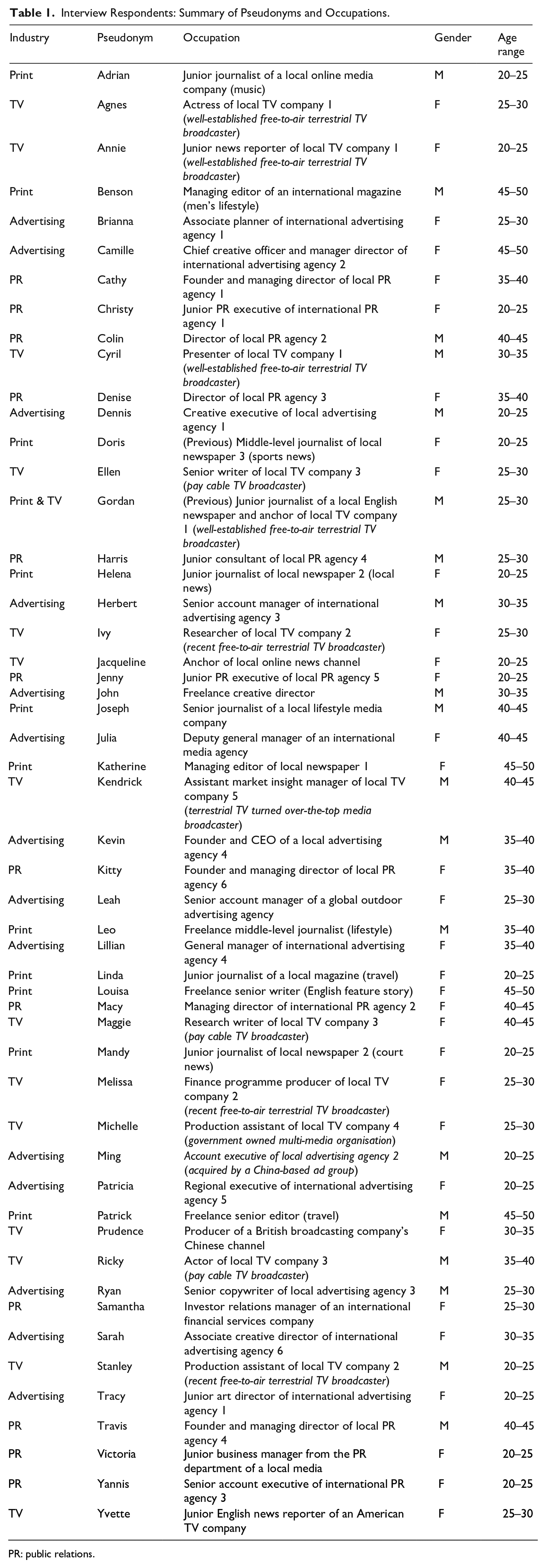
PR: public relations.
An interview guide (see Appendix 1) was developed based on government reports (Hong Kong Census and Statistics Department, 2017), articles from local and international mainstream media sources, and the CCI literature. During interviews, the primary focus was to document and dissect creative labourers’ perceptions of their daily work experiences and social lives, creative achievements and social communications with co-workers. The questions covered personal, organisational, sector-related, local, global and other external factors, such as socioeconomic and sociocultural factors, in addition to views about work-related government policies. All interviews (in Cantonese) were recorded, fully transcribed and translated into English. The responses were then coded using a constant comparison method (Strauss, 1987), which identified meaningful and recurring codes. Two research teams (one focusing on advertising and PR, and the other focusing on TV and print media) identified, discussed and agreed on a list of recurring themes and factors that the interviewees perceived as routinely shaping different aspects of their perceived job insecurities. 3
Three salient themes emerged and were selected to be discussed: (1) how the globally increased use of technology shaped varied perceptions of insecurity at creative work; (2) how Indigenous sociocultural discourses about career success and the diligent, self-reliant work ethic in Hong Kong are derived from mixed influences; and (3) how the meaning of creativity had changed and was losing its value among workers with specific job functions in the investigated creative sub-sectors.
Global, Local and Sectoral Co-Configurations of Hong Kong Creators’ Subjective Insecurities
Global Configuration of Work Insecurities – Work Faster?
I’m working every single minute . . . you switch your phone on 24/7, though it’s an unofficial regulation . . . sometimes I worry my phone will explode into fire. (Annie, Junior News Reporter, local TV company 1)
Most interviewees consistently mentioned technology as a globalising force contributing to their insecurity perceptions surrounding work speed. It seems apparent that technology speeds up physical, emotional and immaterial labour processes, or extraction of value from creative workers. They spoke of specific aspects of job insecurities, which we categorised into (1) work capacity insecurity, (2) job tenure insecurity, (3) job status insecurity and (4) employment insecurity (see Table 2).
Eight Types of Subjective Job Insecurities.
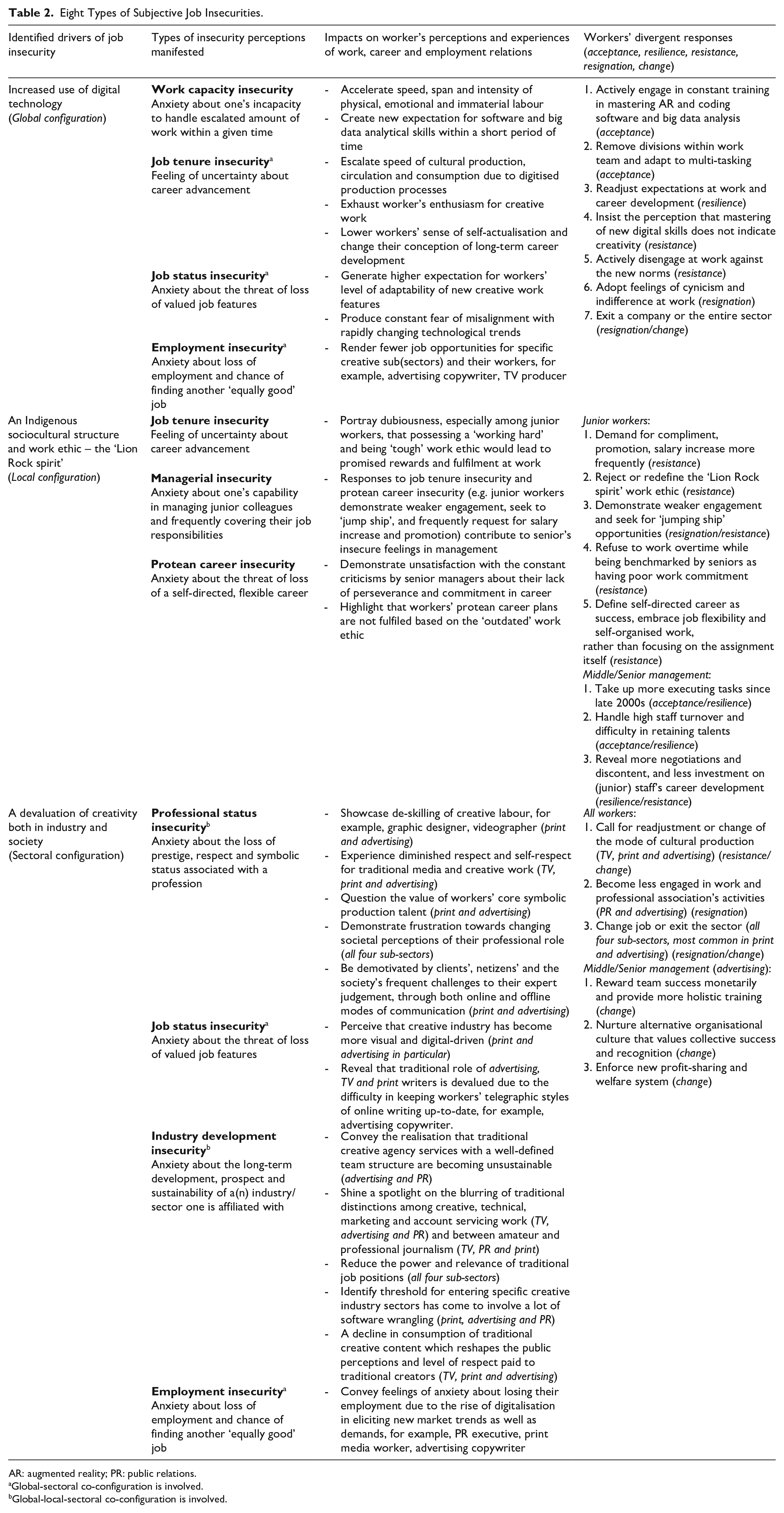
AR: augmented reality; PR: public relations.
Global-sectoral co-configuration is involved.
Global-local-sectoral co-configuration is involved.
While the ‘worlding’ of technology and software development have greatly enhanced work efficiency, the average working hours of Hong Kong creative employees have further expanded from 50 to 60 hours per week, according to most interviewees. Creative work is now de-centred from being located in a single physical site, to any space where information and communication technologies (ICT) are available (Gandini, 2018: 6). This has reduced the time and space constraints on value extraction, and physically exhausts workers into the bargain. The digital panopticon also brings new forms of control and surveillance of work speed, duration and productivity (Gandini, 2018: 11), which have pushed the creative workers to their limits, with many of them saying they found it harder to control the speed, span and intensity of their work: Managers and above have their own laptops with the company’s drive which allows them to work anytime, anywhere [. . .] We need to work during weekends if there are events. (Christy, Junior PR Executive, international PR agency 1)
Meanwhile, engagement in emotional labour also stretched from face-to-face encounters to other public and private realms. They felt that phone calls, emails and social media communications demanded their immediate response, and trapped them in never-ending emotional work modes. This elicited a sense of work capacity insecurity (anxiety about one’s inability to handle an escalating amount of work within a given time).
Specifically, the opening-up of the work environment by ICT has escalated the speed of cultural production, circulation and consumption, enhancing client and consumer demands for a fast response time, and increasing the psychological stress among creative workers. Creative workers must now rely on technological support, such as acquiring ‘big data’ analytical skills, to interpret vast amounts of consumer-based market intelligence, contextualise their creative output, and satisfy unachievable client and consumer needs. Advertising creativity is now evaluated less by aesthetic standards and more by the ability to rapidly and adeptly produce a proactive response and solution: It’s about being nimble when it comes to digital, the aesthetics only come second. (Ming, Account Executive, local advertising agency 2)
Many interviewees questioned their aptitude for a creative career in this increasingly competitive and demanding industry. Workers have to embrace exceedingly fast digitised production processes, at the cost of exhausting their enthusiasm for the aesthetic aspect of creative work and eroding their sense of self-actualisation. Here, we present how a global technologising force is intersected with sector-dependent features. Quality is compromised and there is no time for self-development during the initial stages of a project. Anxieties triggered by this new ‘technologic’ are manifested as job tenure insecurity (feelings of uncertainty about career advancement). At the same time, a cynical, indifferent or even actively disengaged sentiment was prevalent among the junior creative workers, as they perceived themselves as being at ‘the bottom of the food chain’ and lacking the opportunity for creative fulfilment or future career progression. This emerging psychological reaction and work disengagement can be understood as a coping strategy to accommodate the accelerated pace of work.
The local creative workforce, including junior employees, is apparently in constant fear of misalignment with rapidly changing technological trends and job features in the creative industry. Creative employers appear to expect a high level of adaptability and re-skilling, thereby causing further pressure and creating an unmet need for concrete social and institutional support for more education and training. In this case, levels of education become an insignificant factor in ensuring job security. ‘They just have to run faster’, was a typical comment made by Lillian, senior general manager of an international advertising agency, encapsulating the unrealistic expectations imposed upon young creatives, while acknowledging the persistent structural acceleration of work speed as the universal ‘new normal’.
Interestingly, many interviewees argued that being able to master new digital skills does not necessarily indicate creativity. In their viewpoint, advertising and PR are premised on providing creative solutions. Incessant technological penetration and de-skilling produce a problematic creative or uncreative divide, depositing creative workers in a digitised world with no respect for contemplation and in a persistently anxious state due to the perception that skill sets become rapidly outmoded. In conjunction with the ability to deliver rapidly, digital knowledge and ability in new media have become the yardsticks by which to measure advertising and PR workers’ creative abilities and potential. Many junior interviewees in both industries noted that the current outmoded organisational structures and operating styles are often painfully slow to adapt. Others were concerned about on-the-job skillsets being replaced as digitisation advances, contributing to a specific sense of job status insecurity (anxiety about the threat of loss of valued job features). Consequently, with little sense of control in a supposedly stable job, and with the diminished belief in adaptability, some workers choose to exit a company or the entire sector: Initially Twitter, they have to live tweet . . . And when Facebook did Facebook live, they started doing it. It’s just whatever new thing comes along, they just go with it . . . [journalism] should be about good quality articles . . . not some sort of, you know, reactionary, instant sort of eye-catching things you just read on Facebook or on apps. (Gordan, Junior English News Reporter, local newspaper)
Although most junior interviewees said they found it increasingly difficult to cope, many developed more resilient attitudes and mental capabilities. Conversely, some senior workers overtly embraced the ‘working faster’ motto and expressed a positive outlook by turning these anxieties into their perceived work agency. Forming a new psychological contract, these senior workers upheld the ‘aspirational spirit’ as a Hong Konger (this will be further discussed in the next sub-section), and viewed the new burdens as rightful obligations to their employers and insecure feelings as opportunities for personal development and self-actualisation: With new technologies, say AR [augmented reality] and coding and such, they’re also very fun. It comes down to how you use it. It’s like getting more tools in my [creative] kit. (Sarah, Associate Creative Director, international advertising agency 6)
All interviewees acknowledged that communication in these industries had changed radically in the digital era. Some resiliently saw this as an everyday workplace reality. Others recognised inherent challenges in stimulating competition from other creative sectors using specialist social/digital marketing agencies. This was particularly evident among PR and print media workers who expressed their concerns about the future of work regarding social and digital media dominance in terms of staff training, competition and profitability, reflecting their feelings of employment insecurity (anxiety about loss of employment and chance of finding another ‘equally good’ job): PR mainly relies on media to promote a corporate image, but now there are fewer media, they’re closing down. [. . .] There’s so much social media going on all of a sudden now. There’s no need for PR to do media relations. Instead, it’s now ‘digital’ agencies. (Jenny, Junior PR Executive, local PR agency 5)
Local Configuration of Work Insecurities – Work Harder?
Hong Kong people in the past expected salaries to be higher and higher based on their visible performances . . . [Today junior workers] would directly tell you that, I want your compliments . . . I want promotion . . . I want a higher salary . . . other employers want me now . . . and it all depends on whether or not you want to try everything to keep me here. (Julia, Deputy General Manager, international media agency)
As an Indigenous sociocultural factor, the aspirational ‘Lion Rock spirit’ continuously intensifies the physical and emotional aspects of creative work in Hong Kong, under which we elucidated how it differently reinforces and reshapes three aspects of job insecurity among workers of different levels of seniority: (1) job tenure insecurity, (2) managerial insecurity and (3) protean career insecurity. Most senior workers felt that working hard and being ‘tough’ were the simplest ways to economic success, and they deeply cherished that work ethic. However, junior workers were more dubious that perseverance would lead to promised rewards and fulfilment. They no longer felt the promise of the sense of achievement and career progression to be very satisfying compensation. We argue that this ‘Lion Rock spirit’, although unique to Hong Kong, is not natural but a discursive construct propagated by both the government and the creative sector, as a controlling mechanism subjecting workers to the worsening working conditions of the contemporary creative industry. We also recognise how these intertwined perceptions of job insecurity concerning work intensity have rendered divergent responses and forms of resistance, including weaker engagement, ‘jumping ship’ and more frequent requests for salary increases and promotion, especially among junior workers.
Most senior workers still expressed an appreciation of the ‘Lion Rock spirit’ in word and deed. Apparently, this sociocultural determinant, discursively constructed by the government, failed to reshape contemporary junior workers’ ‘aspirational’ work subjectivity, as it did for the senior workers in the past (Pun et al., 2022). Rather, it tended to perpetuate their anxiety and dissatisfaction in the form of job tenure insecurity. The accommodation of processes of work intensification, long working hours and low payment to show work commitment – which senior workers once experienced and accepted as the essential trade-off for long-term job tenure, improved welfare and better career prospects – no longer exists. If anything, junior workers’ resisting values, attitudes and behaviour also contribute to seniors’ feelings of managerial insecurity (anxiety about one’s capability to manage junior colleagues, and more frequently, to cover for their job) as a knock-on effect. While most interviewees reflected on the evolving generational differences in work attitudes between senior managers (post-1960s and 1970s generation) and junior workers (post-1980s and 1990s generation), the two generations expressed rather different views, partly due to the declining impact of the government’s hegemonic discourse. For instance, a new understanding of career progression being integral to Hong Kong’s socioeconomic development is manifested in some junior workers’ active refusal to work overtime. It is, however, subjectively interpreted by senior workers as ‘poor work commitment’ as they judge newer creative workers against the standards they were trained to observe. And it pressurises middle and senior managers to cover for their work: The kids now . . . don’t expect they’d stay to do OT, to work to the bone for you . . . So this means mid-management are burdened . . . And the juniors may think that ‘the work now is meaningless’. (Samantha, Investor Relations Manager, international financial services company)
As such, senior workers criticised the newcomers’ negative attitudes, their poor levels of attentiveness and endurance, their ‘shallow’ understanding of career development and their lack of professional wisdom or respect for labour.
Both senior and junior creative workers acknowledged, however, that promotion is not as rapid as it was ‘in the past’ – the golden era of Hong Kong’s creative industries. In general, pay and career prospects within a single organisation were considered as being lower and slower than in previous decades when a high turnover was prevalent because the best workers were often poached. The senior employees of advertising and PR agencies found a high staff turnover and ‘chasing the dollar’ to be a source of stress and managerial insecurity, given the significant time, monetary and emotional investments involved in training new employees, and the difficulty in retaining talented ones. Although many of those senior workers still occupied more privileged positions that promised continuous and well-rewarded employment, they too experienced job insecurity, but in a way that was different from that of their juniors. These senior workers also rarely attributed the structural–technological intensification of work or the increasingly outdated ‘Lion Rock spirit’ (which they were aware of) as the key drivers of their feelings of managerial insecurity.
The younger generation, by contrast, viewed the managers’ expectations and values as being outmoded in the contemporary work environment in Hong Kong, an unpredictable economic landscape with frequent layoffs, blocked career progression, constant pressure to gain creative awards and high staff turnover (Chan et al., 2015). The new entrants shared the feeling that job tenure insecurity was having an emotional impact on their career development and induced a greater sense of uncertainty as well as pressure in the workplace. As Brianna noted, [A]dvertising was very profitable in the past, you could spend big money. But now it feels like we are being ‘squeezed’ . . . [E]veryone’s quite stressed. But you should be relaxed to do creative work. (Brianna, Associate Planner, international advertising agency 1)
Frustrations were expressed at all levels concerning career management as a source of anxiety. The junior interviewees had the impression that company loyalty no longer assured career advancement, resulting in the high staff turnover in PR and advertising industries (Council of Public Relations Firms of Hong Kong, 2015). They felt increasingly stressed, and resisted more frequently when senior workers imposed benchmarks that they felt were passé in judging them. They considered that career success today needed to be self-directed and proactive, and that embracing job flexibility and self-organised work was more meaningful than fulfilling assignments. Their visions echoed, to some extent, the idealistic notion of a ‘protean’ career (Gubler et al., 2014; Tomlinson et al., 2018: 9): That junior workers are less hardworking [than the previous generation] is a hasty generalisation. [. . .] Now it’s me who wants to know how my career path will go. I think that both parties need to think ahead to know whether one should stay or leave [the company]. (Patricia, Regional Executive, international advertising agency 5) ‘It’s good already to have a job’. My parents have this concept . . . But I mean, I’m being exploited now. And they’d think it’s just a bit of hard work, but it’s not just a bit! . . . And they’d think it’s ok to work a little harder, because you can have advancement within this company . . . But I think I can seek good advancement elsewhere . . . For me, I like to keep learning. If you reach a point at this company . . . you can try to go to other companies . . . to climb up. So you can’t just stay here to wait for promotions, you can be proactive . . . [you] can move on. (Victoria, Junior Business Manager, PR department of a local media)
Underlying all of these complaints resulting from protean career insecurity (anxiety about the threat of loss of a self-directed, flexible career), we discerned, among the new generation of creative workers, a feeling that they were trapped, with a little hope of a promising career in media, PR or advertising, no matter how they might persevere; yet many also resisted the ‘Lion Rock spirit’ in advancing their career and crafted their own work ethics. We discerned how these junior workers exercised their mobility power to resist the worsening working conditions and career prospects in the creative sector. The unique spatial proximity of most PR and advertising agencies in two Hong Kong districts – Central and Quarry Bay – was regarded as an empowering factor. It facilitated these workers’ networking and cultivation of social capital during ‘happy hours’ or late dinners; sharing insider information on management styles and job openings across agencies; or even attending job interviews during lunch hours. Therefore, taken together, the declining impact of the ‘Lion Rock spirit’ as the government’s discursive tactic, intergenerational differences and the employer-employee daily interactions, co-constitute different perceptions and responses to insecurities on both sides.
Sectoral Configuration of Work Insecurities – Work Cheaper?
Design and creativity are abstract [. . . ] So they’re often undervalued. One time my little cousin said to me, ‘I can take photos [with my Smartphone] similar to yours, and you’re even charging people for that’. (Tracy, Junior Art Director, international advertising agency 1)
The abstract, intangible nature of creative production and the accessibility of its abstract products on universally available digital devices, have contributed to the devaluation of creativity and the de-skilling of creative labour in the case of Hong Kong, contributing to the following four aspects of job insecurity: (1) professional status insecurity, (2) job status insecurity, (3) industry development insecurity and (4) employment insecurity. While many of these insecurity perceptions overlap across all four subsectors, we also discern specific subsectoral differences, as indicated in the following sections. Concerning work (symbolic) value, the majority of interviewees expressed their impression that creative labour was being significantly devalued. These workers feared being deprived of the ability to participate and create. They said that they found it increasingly difficult to apply their professional abilities due to both global shifts in new technology and also in unique sociocultural conditions. These industry-specific changes are reorganising the modes of cultural production/circulation and value extraction, blurring the traditional distinctions between creative, technical, marketing and account servicing work (in television, advertising and PR) and between professional and amateur journalism (in television, print media and PR). For instance, TV personalities and advertising copywriters are more frequently called upon to use social media to drive consumers. Professional PR writers and magazine journalists also engage in constant competition with amateur ‘aspirational workers’ who work for free as ‘influencers’ in the hope that they can later monetise their ‘service’ and content from their clients directly, bypassing PR agencies and print media.
Above all, interviewees of all ages, genders, levels of education and job functions were worried that workplace technology would 1 day supplant creativity as the de-skilling process unfolds (Harari, 2018: 25–28). They felt that the unique manifestations of human creativity – in art, design, music and literature – would inevitably be improvised by machines replacing creative labour (Chui et al., 2016). Interestingly, many interviewees perceived that technology, as a global force, was making human creativity and cognitive ability less important in value creation, including in graphic design, video shooting, journalism, photography and editing (Harari, 2018: 19–20). With these traditional professional skillsets becoming more accessible to non-professionals, human creativity is gradually being superseded rather than augmented by technology. This co-configured global and sectoral force undermined creative workers’ feelings of professional competence and blurred the boundaries between creative design and technical services, further increasing what we termed professional status insecurity (anxiety about the loss of prestige, respect and symbolic status associated with a profession): I see in this digital age . . . in front of us that is moving so rapidly towards bots and everything and AI, and it freaks me out obviously . . . we are constantly adapting to different platforms to make our life easier, that I can just see the PR industry disappearing in 10 years. (Denise, Director, local PR agency 3)
Predominantly in the advertising industry, advertisers seeking creative productivity and flexibility now prefer to work directly with online media platforms or less expensive, small-scale digital agencies. Traditional creative agency services in Hong Kong with well-defined team structures are now becoming unsustainable. Competition has accelerated because now ‘everyone can be a videographer’. Many creative workers insisted that their core talent was improvising creative solutions (symbolic labour), rather than functionally operating design and editing software. Yet, the threshold for entering advertising, PR and print media industry sectors now involves considerable technical ability with software. Consequently, creative workers are beginning to question the value of their core symbolic production talents, and are becoming increasingly frustrated by societal perceptions of their professional role: What’s behind a photograph? Was it made with systematic thinking? That’s what a creative professional should do. Just looking pretty is not enough. [. . .] But now I can’t think of any professional accreditation. (Dennis, Creative Executive, local advertising agency 1)
Interviewees highlighted a changing perception of creativity within the creative sector under both the influence of new technology and a resulting sectoral-cultural shift. Originally, creative workers were valued and respected for their unique talent in generating innovative symbolic ideas. As technology has entered the process, and traditional creative processes and communication channels have come to be deemed outmoded in the highly digitised arena of Hong Kong, that respect is fading. The ‘democratising’ force of social media has not helped, and this has led to the further decline in the consumption of traditional creative content on television and in newspapers and magazines (Hesmondhalgh, 2013), reshaping public perceptions and the level of respect paid to traditional creators. Mid-level and senior workers reported that their creative judgement was being challenged more frequently. Rather than being seen as a creative helmsman ‘endowed with a rare talent, a vision, and expert knowledge’ as one informant (John) put it, they feel they are coming to be perceived as service providers who merely operate design software. Feelings of professional status insecurity, job status insecurity and industry development insecurity (anxiety about the long-term development, prospects and sustainability of a(n) industry/sector one is affiliated with) were all intersected and repeatedly stated.
Chief Creative Officer Camille nostalgically reflected on the ‘glamorous days’ of the advertising industry in the British colonial era: [In the 1990s] we were flamboyant and received utmost respect [from clients and the public]. And it [our creative work] used to be mainly concerned about quality, that was why they wanted to work with 4As . . . to be meticulously crafted before publicising it for the world to see.
Tight production schedules and smaller teams are now the workplace norm, multiplying stress levels. The industry is now more visual and more digital, marginalising, for example, the traditional role of advertising copywriters as well as print media writers who often experience the industry-specific job status insecurity and employment insecurity. Professional copywriting in Hong Kong is now perceived as not so ‘cool’ or attention-grabbing as the telegraphic style of online writing (on Facebook and Instagram), according to the interviewees. Many senior interviewees also found it difficult to keep their digital style up-to-date, especially in fierce competition with the rapidly rising television and advertising industries in mainland China, with its ever-expanding consumer market, which whole world is coveting: I think it’s getting more ‘niche’ to be a copywriter in HK or even around the world. People look at visuals more than words. [. . .] There isn’t an attitude that words are important. [. . .] Not many understand copywriting is a profession. [. . .] People will increasingly think that we don’t need people who work with words. (Ryan, Senior Copywriter, local advertising agency 3)
Technology enables advertisers/clients to participate in the creative production process more often, and enables netizens to comment publicly on results. This further undermines the professional value of a creative agency, having a negative impact on workplace culture: Many people now [have become] ‘internet warriors’. [. . .] just endlessly criticising [Hong Kong ads]. This makes everyone think that ‘yes, HK ads are so weak!’ (Sarah, Associate Creative Director, international advertising agency 6)
However, a few interviewees indicated that the situation in PR is even worse than in other creative sectors. Unlike ‘above the line’ advertising, PR is ‘below the line’, undervalued, anonymous and the first thing to be cut in the marketing budget, resulting in negative professional morale: During my time in PR I saw budgets allocated for PR were shrinking, so this made PR more difficult. When newspapers are closing down, which PR depends on, it’s even more difficult. (Yannis, Senior Account Executive, international PR agency 3)
In both PR and advertising, many workers now believe that ‘4As’ status (the industry-recognised professional association of advertising agencies) is no longer as prestigious as it once was. Both junior and senior employees of 4As advertising firms still complained equally about the existence of a hierarchical structure with limited creative flexibility. Many believed that professional associations (e.g. HKPRPA, HK4As) should be responsible for professional validation, but others felt that professional association membership was often not worth the fee considering the unquantifiable returns. The interviewees also acknowledged that they increasingly lacked the professional recognition accorded to sectors such as law and medicine. Nonetheless, alternative approaches to employee training and retention were evident in small, independent creative agencies in Hong Kong, which provide us with new insights into how divergent corporate culture and organisational characteristics contribute to the lessening of insecurity perceptions, particularly professional status insecurity, job tenure insecurity, protean career insecurity and industry development insecurity. A number of local advertising companies invest in and incentivise creative workers by monetarily rewarding team success. Local creative agencies (2As) increasingly provide greater flexibility aligned with growth, in contrast to the hierarchical structure, low salaries and harsh working conditions often experienced in multinational creative agencies (4As). One 2As firm, founded by a former 4As agency CEO (Kevin), introduced an exceptional profit-sharing and welfare system acknowledging creative talent, allowing workers to experience more diverse roles and nurture a sense of self-respect and solidarity as creative professionals.
As Kevin noted, the more strategic pecuniary incentives were successful in motivating both junior and senior workers. They also demonstrated his care for his fellow industry workers, and helped restore their ‘creative dignity’ beyond a capitalist, neoliberal and self-reliant logic, advocating a sense of ‘creative justice’ (Banks et al., 2017) in order to enhance their sense of professionalism, mutual-support and hope for self-directed career development, and to boost sectoral growth.
Discussion
This study’s empirical data provide new and concrete evidence about how workers in Hong Kong’s creative industries perceive, experience and respond to distinctive aspects of job insecurity. Rather than merely focusing on job tenure insecurity (Gallie et al., 2017) and employment insecurity (Dickerson and Green, 2012) that lead to a neglect of other facets of job insecurity as well as the misinforming discourse of the worldwide trend towards greater employment insecurity, we highlight the conceptual distinctions among eight types of job insecurity, and we argue that workers’ feelings of job insecurity emerge in an intersectional nature and cannot be simply resolved individually. Such a premise is integral in explaining how workers’ experiences of job insecurity are reinforced, multiplied or offset due to the co-configurations of global trends (increased usage of digital technology), local conditions (distinct sociocultural discourse of the ‘Lion Rock spirit’ work ethic) and/or sectoral traits (devaluation of creativity). The amalgamation of global, local and sectoral forces, and particularly the extent and degree of each, in influencing workers’ job insecurity, are never the same in different contexts, which highlights how job insecurity can only be understood as intersectional.
As in Britain’s case, creative workers in Hong Kong are affected psychologically and emotionally by ‘pressure cooker’ working conditions, yet the determinants and derivatives of their insecurities and anxieties are quite different. In Hesmondhalgh and Baker’s (2011) case, British creative workers accepted this situation as an industry norm, recognising it to be a form of self-exploitation and, paradoxically, a sign of prestige associated with symbolic content production. However, the ex-centric, re-contextualised Hong Kong study identifies the intersectional impacts of globalising digitalisation, sociocultural specificity and sectoral features in the creative industries (Alacovska and Gill, 2019) offering a more realistic and contextualised understanding of varying creative labour practices.
Global technological change, sociohistorical specificity and sociocultural discourse, and a devaluing of creativity, were identified as the three most important forces in co-configuring insecurity and anxiety within this updated study of creative workers.
First, the interviewees across four creative subsectors all acknowledged technological advances as a globalising source of anxiety. While this affects those not only in the creative sector but across many social and business settings, the increasing digitisation of workplace communication and work process in Hong Kong creates specific pressure on creative workers to re-skill and cope with an increasing volume and speed of work. It leaves them with less control over their physical, emotional and immaterial labour, and blurs the boundaries between work and leisure, engendering various forms of insecurity. Besides, under such structural-technological impact, Hong Kong’s creative personnel of different ages and levels of work experience, and at different life stages, clearly viewed and reacted to work security differently (Tomlinson et al., 2018). Senior workers tended to perceive professional status insecurity, job status insecurity and employment insecurity, whereas junior workers more often experienced job tenure insecurity and industry development insecurity. Both groups perceived work capacity insecurity in their daily work. Demonstrating their intersectionality, the aforementioned types of insecurity involve global-sectoral (job status insecurity, employment insecurity, job tenure insecurity, and work capacity insecurity) as well as global-local-sectoral (professional status insecurity and industry development insecurity) co-configurations (see Table 2). Such intertwining trends are increasingly defining a ‘new normal’ in terms of creators’ self-perceptions, perceived career prospects, their notions of time, space and belonging, and the meanings of creative work. However, we discerned how creative workers achieve self-fulfilment and resiliency by re-crafting their work identities and practices that allow them to better manage and live with insecurity in their career paths.
Second, Indigenous cultural discourses, sociohistorical shaping and generational changes within the workforce are manifested in different attitudes towards the work ethic and career success. While more senior colleagues (mis)recognised the lack of an aspirational, diligent work ethic among junior workers as instigating their managerial insecurity, junior interviewees indicated the ‘Lion Rock spirit’, a discursive work ethic uniquely derived from Hong Kong’s sociocultural and economic history as well as its (post)colonial government’s discursive tactics, as the genuine source of both managerial insecurity and job tenure insecurity in their local context. The youngest generation of creative workers resisted being misunderstood as lazy and unambitious or tolerating the increasing intensity of work, and they appeared less inclined to support a culture requiring ‘overwork’ or valuing measured career advancement within traditional organisational bureaucracy, which led to less organisational loyalty with many junior staff ‘jumping ship’. Increased worker mobility is motivated by the search for self-actualisation in the neo-bureaucratic workplace and is realised in the form of independence from traditional modes of career progression (Gubler et al., 2014), and under the unique spatial proximity of most PR and advertising agencies in Hong Kong, is manifested as a form of worker-actor agency. While younger respondents blamed these outmoded cultural expectations for some of their discontent and anxiety, they also reinvented and acted on their own version of a work ethic to cope with protean career insecurity.
Third, the devaluation of creativity is contributed to by both technological and cultural changes, but it is also brought forth by sectoral-specific forms of anxiety. An evolving and relational understanding of creativity among both Hong Kong’s workers and consumers appears to be changing modes of operation for the selected industries. Creative workers and their work outputs increasingly lack symbolic value, prestige and respect from society. This impacts on their self-esteem and feelings of dignity, and also induces professional status, job status and industry development insecurity for most, but employment insecurity especially for creative writers and videographers. Nonetheless, such industrial and social devaluations of creativity also lead to new individual and collective coping mechanisms to restore creative dignity and warrant creative justice.
Conclusion
Our case study of cultural and creative industries in Hong Kong dislodges creative work theories from their moorings anchored in the global North (e.g. Gill and Pratt, 2008; Hesmondhalgh and Baker, 2011; Umney, 2015; Vallas and Schor, 2020). Rather than giving a crude answer to the question of whether creative work in Hong Kong has become more insecure ‘just like everywhere else’(Gallie et al., 2017), we seek to understand and categorise different aspects of job insecurity operating within the intersections of the global, local and sectoral forces affecting Hong Kong’s creative workers. By bridging the macro-meso-micro levels of analysis, and framing the empirical data as perceptions of how creative workers view and react to their asymmetrical relationships with employers, we are able to better understand and elucidate the workers’ individualistic and (inter)subjective concerns that are overlooked by institutional norms and rules governed by collective representation. Our unique theorisation of the relationship between global, local and sectoral forces (the ‘global-local-sectoral co-configurations’) complements existing literature on creative labour studies and work precarity, which often fail to consider both the overlapping and uneven effects within and across regions and subsectors. Rather than simply focusing on their detrimental effects for creative workers, we also discuss how these co-configurative drivers enable creative worker-actor’s resilience, resistance and reaction to the exploitative creative labour process, offering theoretical and empirical insights for the improvement of creative work in specific subsectors.
Furthermore, this article offers a useful analytical lens to revaluate the validity of the glibly binary frameworks of Global North and South in grounded empirical analyses of the practices of workers-actors across different sectors and contexts. While this study benefits from using an ‘ex-centric’ approach (Alacovska and Gill, 2019), we contend that an overemphasis of the Global North–South divides (Connell, 2007) in creative labour studies may result in a categorical neglect of the notable influence of and reaction to global structural forces, as shown in Hong Kong’s case. Although useful as a conceptual starting point, one major weakness of the ‘ex-centric’ approach is its ‘antagonistic’, and somewhat ‘parochial’ theoretical viewpoint (Chow and De Kloet, 2014). Hong Kong displays etic aspects of work life that reflect its world connections as a global financial and trading hub, yet at the same time, it exhibits local emic differences that signify its historical, institutional and sociocultural uniqueness. It provides a distinctive empirical case of CCI ‘straddling both the Western and Eastern worlds’ and exemplifies an ‘unfinished experiment and a laboratory of globalisation’ (Leung, 2019: 6), complementing both the Western-centric and ‘ex-centric’ theorisations of creative work and job insecurity.
To conclude, our empirics decouple ‘creative precarity’ from the hype of its allegedly unanimous sectoral features, illuminating a more holistic conceptual framing of aspects of job insecurity in creative work and their double-edged nature, and identifying different drivers of and responses to insecurity perceptions across times and places, sectors and contexts. The interwoven global, local and sectoral forces are altering the speed, intensity and symbolic value of creative work in Hong Kong’s creative industries. Value extraction is accelerated, and those involved are expected to ‘work faster, harder, and cheaper’. But not all creative workers passively accept this. The data show why and how Hong Kong creators actively revise their values, attitudes and behaviours to cope with various insecurities, and locate a self-actualising career and meaningful work.
Due to the limited scope of this paper, other structural (e.g. Hong Kong’s employment protection legislation, global financial position and political environment) and sociodemographic factors (e.g. age, gender, education, access to training, and personality differences and traits) associated with varying job insecurity perceptions (Coles and MacNeill, 2017; Green, 2009), could be more elaborately discussed in future studies. Also, further qualitative and quantitative investigations could explore the more recent and complex interplay between the other emerging global (e.g. pandemic outbreak, a worldwide ‘work-from-home experiment’ and the emerging risk of youth poverty, see Pun et al., 2022), local (e.g. heightened political censorship and politicised cultural consumption that diminish the meaning of creative work as well as enhance perceived personal risks) and sectoral factors (e.g. further precarisation of project-based TV workers due to the ‘worlding’ of Netflix; or the most recent social distancing policy-inspired implications, which discourage publicity initiatives and general consumption within the PR and advertising industry) that co-configure new types of job insecurity and workers’ nuanced responses in Hong Kong’s creative sector. Equally importantly, additional research on effective solutions for alleviating and resolving the often neglected aspects of creative workers’ job insecurity (e.g. external support in terms of policy advancement from government or relevant professional associations; internal support within organisations that cater to some aspects of workers’ self-actualisation and stress relief) will also provide a holistic and realistic perspective for enhancing their quality of work and wellbeing.
Footnotes
Appendix 1
Acknowledgements
The author would like to express his gratitude to David Fasenfest, Heidi Gottfried, Shuheng Jin, Ngai Pun and Kaxton Siu for their time and effort in providing detailed and constructive comments throughout the revision process. He is also thankful to Anne-Peirson Smith, Maggy Lee and Chris Smith for their critical comments and suggestions throughout the writing process; to David Hesmondhalgh, Anthony Fung, Yiu-Fai Chow and Sylvia Martin for providing him with further insights in understanding British and Hong Kong creative work conditions at the HKU Faculty of Social Science Public Policy Forum (Mar 2017); to Mark Banks, Yimei Zhu, David Wright, Lee Martin and Lynne Pettinger for their insightful questions and feedback when an earlier version of this article was presented at the University of Leicester (Oct 2018) and University of Warwick (Nov 2018); to Joey Chan, Grey Liu, Holy Shum, Emily Wong and Alan Yau for their great assistance through the research process.
Funding
The author(s) disclosed receipt of the following financial support for the research, authorship and/or publication of this article: This study was funded by the Public Policy Research Funding Scheme (Project Number: 2015.A8.035.16A) from the Central Policy Unit of the Hong Kong Special Administrative Region Government. It was also, in part, supported by the Seed Funding for Basic Research programme (Project Number: 201511159032) from the University of Hong Kong.
