



Abstract
We know a great deal about global capital mobility in traditional industries, such as manufacturing, but very little about emerging capital mobility in the gig economy. Using the case of Canadian Foodora, a multinational platform that left Canada in 2020, I situate global capital mobility in the local labour market. Drawing upon interview data with former Foodora couriers and ethnographic data collected from a gig workers’ union, I investigate the social, economic and political subjectivities of gig workers activated by a global platform’s capital mobility. My findings reveal unexpected parallel effects caused by capital mobility in the gig economy and traditional industries. My research highlights how heterogeneity is salient for understanding divergent worker subjectivities. The economic and social impacts upon financially dependent gig workers and the emotional connections of devoted and organized gig workers challenge the dominant discourse that gig workers are simply part-timers and hence free from work commitments.
Introduction
In April 2020, the COVID-19 pandemic was sweeping the world. Gig workers were suddenly reclassified as ‘essential workers’, delivering food to customers’ front doors during lockdown. When the demand for food delivery services had increased to a level never seen before, Foodora, a food delivery platform in Canada, decided to exit the country. In this article, I analyse the case of displaced Canadian Foodora workers to provide insight into the impact of capital mobility in the gig economy on worker subjectivities. Scholars argue that capital mobility takes various forms, including closing factories completely, gradually switching operations and profits among facilities, and exiting one location and relocating to another (Bluestone and Harrison, 1980; Zipp and Lane, 1987). In my research, capital mobility refers to a global platform ending operations in a local market completely.
Capital has always migrated to maximize and accumulate profit, searching for cheaper labour markets. While Silver (2003) argues that capital mobility is leading to a new wave of working-class labour movements in the Global South, plant closures have been an effective tool to control workers and organized labour in the Global North (Bronfenbrenner, 1997). The literature on capital mobility has focused on traditional industries, workers’ job displacement (Brand, 2006; D’Cruz and Noronha, 2012; Perrucci et al., 1997) and changes in workers’ political perceptions because of displacement (Mhaskar, 2013). However, although the gig economy is emerging as a site where the quintessence of capital mobility takes place, we know little about gig workers’ experiences with capital mobility. When global capital seeks to free itself from the constraints of its responsibilities to local labour forces and maximize profitability by relocating, how do workers react?
Foodora had unique characteristics, which made it particularly appealing to local workers. It employed human dispatchers in a downtown Toronto office to address delivery issues, not standardized overseas workers using only artificial intelligence (AI)-based information like most other platforms. Couriers could drop by the office and get snacks or use the bathroom. Instead of carrying out each order individually, as with other platforms, they could sign up for shifts lasting several hours. Foodora couriers therefore had relatively stable schedules and incomes, especially outside downtown where the company provided fixed payments. Moreover, as the only platform that did not require background checks, Foodora provided a rare opportunity for those with criminal records, who often have difficulty finding work. Because of these characteristics, many people chose to work as couriers for the company, but they were displaced after Foodora left.
Drawing upon an ethnography of the Foodora couriers’ union and interviews with former Foodora couriers, I trace the impacts of capital mobility in the gig economy on local gig workers, paying particular attention to their heterogeneity. I build upon insights from Schor et al., (2020) about heterogeneous groups of gig workers and their varied experiences with gig platforms. How are social, economic and political subjectivities across the divergent experiences of gig workers activated by capital mobility? Specifically, how does a platform’s exit affect workers’ social and economic lives and their political views on organized labour?
Capital Mobility in the Gig Economy
Capital Mobility in a Traditional Context
Research on capital mobility has primarily focused on manufacturing sites (Bronfenbrenner, 1997; Silver, 2003). A great deal of the literature on displaced workers examines personal costs, such as unemployment, wage loss, and mental health problems (Brand, 2006; Browning and Heinesen, 2012; D’Cruz and Noronha, 2012; Perrucci et al., 1997). Displaced workers have difficulty finding equivalent jobs within a reasonable time when strongly attached to the sector in which they were employed (Fallick, 1996), their skills are limited, or the industry is declining (Anderson, 1980). Even when workers find new employment relatively quickly, these jobs are often ‘less secure and/or less well rewarded’ ones (Tomaney et al., 1999: 408). Some workers become permanently displaced and fall into structural unemployment (Brand, 2006; Seitchik, 1991). The social location of workers also shapes their labour mobility. Those from minority groups, women, older people, the lower-skilled, and the less-educated suffer disproportionate economic hardship (Mick, 1975; Perrucci et al., 1997).
Beyond the impact of personal costs, capital mobility shapes the social and political subjectivities of workers, but there is disagreement in the literature about how it affects them. Some scholars suggest that the departure of their workplaces develops workers’ class consciousness and promotes political movements (Mhaskar, 2013; Perrucci et al., 2020) and solidifies their support for unions as it sparks critical attitudes towards corporations and government (Knapp and Harms, 2002). However, scholars such as Gooptu (2007) have found that workplace shutdowns lead to a condition in which a ‘sense of fear and loss of ability to fight accompanies the sense of powerlessness’ among workers (Gooptu, 2007). Lopez (2004) also concluded that workers’ previous experience with deindustrialization and their perception that unions played a crucial role in it deeply influence their scepticism and hostility towards unions. The literature suggests that understanding the political reactions of workers to capital mobility requires observation of the circumstances and contexts of their responses.
Platforms: A New Location for Global Capital Mobility
Two conditions help to facilitate a platform’s exit from a market. First, a platform’s ‘quasi-employer’ status, including its online presence, with no social and legal responsibility (Scholz, 2017), provides the basis for it to enjoy great mobility in its local operations. Platforms are ‘digital bridge builders’ (Scholz, 2017), connecting two or more mutually dependent groups through technology such as smartphones and apps. For instance, food delivery platforms connect restaurant owners, couriers, and customers, receiving commissions from both customers and restaurant owners and subcontracting labour at a significantly lower cost (Scheiber, 2015). These mediators earn more profits than the physically present parties supplying the actual labour (delivery) and service (food). This uneven structure has been criticized by numerous scholars (Scholz, 2017; Schor et al., 2020; Srnicek, 2016) for creating the resulting asymmetric economic advantages and power relations.
Second, as the ‘quasi-employer’ issue suggests, a flexible labour regime is a key component of the gig economy. Eliminating formal employment relations between workers and employers to accumulate more capital is by no means new. Scholars argue that standard employment relations (SER), constructed in the postwar era, have not been a ‘standard’ form of employment for everyone. Rather, they have been applied only to a specific class and gendered group, based upon the male breadwinner norm (Cobble and Vosko, 2000; Fudge and Vosko, 200l; Hatton, 2011). As SER declined after the mid-1970s, increasing polarization between standard and non-standard workers followed (Fudge and Vosko, 2001). As such, the history of the development of a precarious labour force is long, persistent, and extends to contemporary gig workers. The labour market has become so segmented and ‘fissured’ that there is ‘no longer the clear relationship between a well-defined employer and a worker’ (Weil, 2014). This structural change has led to externalization of responsibilities and disruption of labour relations. The overdue need for a discussion about the inadequacy of SER, which no longer apply to an increasing number of workers, such as ‘independent contractors’ (Chun, 2011; Cranford, 2005; Fudge, 2005), has been heightened in the gig economy, which exhibits an ultimate form of the flexible labour regime (Aloisi, 2019; Cherry, 2016). Also, various characteristics of gig work facilitate the capital mobility of platforms: short-term and task-based contracts, the absence of binding spatial and temporal dimensions in the workplace, and algorithmic management. Accordingly, although capital mobility has been discussed in conventional contexts such as factories, platforms are currently emerging as a new site of capital mobility.
Subjectivities of Gig Workers
Growing studies identify competing subjectivities among gig workers. Some ride-hailing workers describe themselves as ‘independent entrepreneurs’ and emphasize their sense of control (Malin and Chandler, 2017; Peticca-Harris et al., 2020), as platforms urge workers to be ‘working-class entrepreneurs’ or ‘customers’ (Rosenblat, 2018). However, Ravenelle (2017) points out that gig workers do not respond to such discourses and instead consider themselves to be workers, and Milkman et al. (2020) argue that working-class female delivery gig workers display gendered subjectivity with ‘class-specific female consciousness’. These various subjectivities indicate the importance of understanding heterogeneous perceptions of work experience in studying gig workers.
Although empirical studies have effectively demonstrated gig workers’ precarity (Graham et al., 2017; Wood and Lehdonvirta, 2021), differences among gig workers have been relatively overlooked. Yet, growing evidence suggests that the degree of precarity among gig workers depends on their economic dependence on platforms (Peticca-Harris et al., 2020; Ravenelle, 2019; Rosenblat, 2018; Schor et al., 2020; Vallas and Schor 2020) where supplemental earners enjoy more autonomy, flexibility, and even higher wages than full-time earners (Schor et al., 2020). This line of literature illuminates divergent worker subjectivities in the gig economy, suggesting the possibility that workers have varied reactions to platforms’ capital mobility. My study develops the framework of platform dependence among gig workers suggested by Schor et al. (2020) and Vallas and Schor (2020). By linking workers displaced by a global platform’s market exit to gig worker heterogeneity, I highlight distinct worker subjectivities, which are shaped by the divergent experiences of displaced workers based on their income dependence on platforms. Worker subjectivity in this study represents how individual workers experience, interpret and make sense of their economic, social and political situations concerning Foodora’s exit, both before and after the withdrawal. Specifically, how workers experience a job loss with Foodora, and its economic impact displays economic subjectivity; workers’ experience in a union community through the local gig workers’ union and work experience with Foodora exhibit social subjectivity; and how workers interpret and make sense of Foodora’s exit relative to gig workers’ organizing demonstrates the workers’ political subjectivity. Particularly, my intersectional analysis of economic and social location moves away from a sole focus on personal costs. In other words, this study investigates worker subjectivity both at the individual level and the collective level. As my findings will show, the economic and social subjectivity and political subjectivity are closely intertwined.
While we know a great deal about the impact of capital mobility in established industries, little is known about the emerging capital mobility of platform capitalism. Also, although research on the outcome of capital mobility predominantly focuses on personal costs, there has been a lack of attention given to workers’ subjectivities and the impact on workers as a collective. My article contributes to the literature on capital mobility by highlighting the commonalities and specificities between capital mobility’s emerging and traditional forms. In doing so, it enriches the literature on gig work by illuminating an unexamined realm, namely workers’ divergent subjectivities in relation to capital mobility.
Methods and Data Collection
This paper is a part of an 11-month ethnography of the Foodora workers’ union (hereafter FU) in the Greater Toronto Area, Canada. I began my participatory observation of the FU as a volunteer member of a co-op committee in May 2020, immediately after Foodora left Canada, when members decided to form a worker-owned co-op. Because of the COVID-19 pandemic, my interactions in the field site were online, mainly via regular video meetings and interactions on the union’s social network. I also conducted discourse analysis based on online communities of local couriers and delivery platforms’ corporate statements as a part of my ethnography.
Foodora was one of the main food delivery service platforms in Canada in terms of both its employee and customer numbers (Patal, 2021). Foodora is owned by Delivery Hero, an international corporation headquartered in Germany, which offers delivery services in over 500 cities worldwide. In April 2020, Foodora abruptly filed an insolvency proceeding and announced it would leave Canada within 2 weeks (Toronto Star, 2020). 1 Two months prior, in February, the Ontario Labour Relations Board (OLRB) had ruled that Foodora couriers were dependent contractors. This was a historic decision, as it was the first to recognize gig workers’ rights in Canada (The Canadian Press, 2020).
I primarily draw on interviews with former Foodora couriers to illuminate their varying subjectivities in response to the platform’s departure. I conducted a total of 35 in-depth interviews between July 2020 and May 2021, which included former Foodora couriers and union organizers who had been Foodora couriers themselves. I started by interviewing union members I worked with closely and those with whom I had interacted during my fieldwork. I recruited other rank-and-file members via the union’s communication platforms and group chats. I publicly recruited former Foodora couriers outside the FU through open recruitment postings on local social media sites, such as Reddit. Some of the interviewees introduced me to others. Interviews followed an interview guide and ranged from 1 to 4 hours. Because of the pandemic, all the interviews were conducted remotely in such forms as Skype video meetings and phone calls, based on the interviewees’ preferences. One interview was conducted via email. I offered participants a Can$30 e-gift card to compensate for their time. For the interviews, I asked a series of open-ended questions that focused on work history in and beyond the gig economy. Although all the interviews were conducted after Foodora ceased its Canadian operations, I analysed the interviewees’ subjectivities tied to Foodora’s exit by asking about their experiences both when the company was operating and after its withdrawal. I devoted substantial attention to understanding how the workers interpreted Foodora’s exit.
The research sample was diverse in terms of age, marital status, and race. Interviewees ranged from 20 to 60 years old: 11 were women, 24 were men, 19 were white, and 16 were people of colour (see Table 1). The interviewees were overall highly educated: 16 had bachelor’s degrees, 5 had master’s degrees, and 4 had associate degrees.
Characteristics of the interviewees.
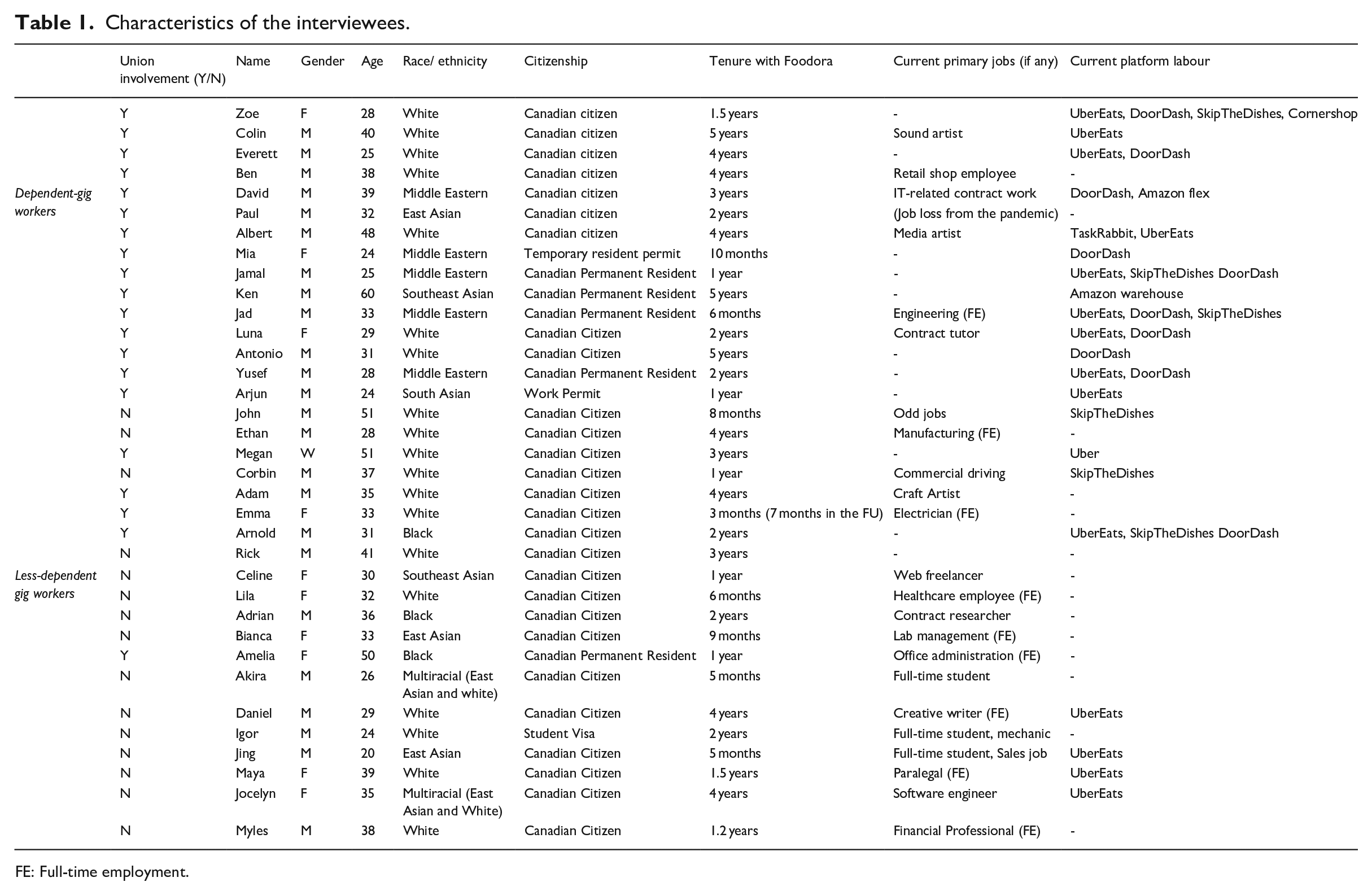
FE: Full-time employment.
During their time with Foodora, 23 interviewees relied economically on one or more additional platforms, in some cases combined with other kinds of part-time jobs, which means that food delivery work was one of their primary income sources, 7 were employed full-time somewhere else while they worked for Foodora, and 5 were full-time students. At least 14 interviewees were receiving government relief funds (the Canada Emergency Response Benefit) because of the pandemic. However, this is not a precise number because the subject was not part of the interview guide but instead came up incidentally during interviews. Some of the beneficiaries reduced their work hours or temporarily stopped working during the pandemic.
All audio or video interviews were recorded with the interviewees’ consent. After completing each interview, I wrote a memo containing a brief profile and the distinctive characteristics of each interviewee. I transcribed the interviews verbatim and coded them using NVivo according to the main concepts in the interview guide, memos, and emerging themes (Corbin and Strauss, 1990), such as ‘dependence’, ‘union involvement’, ‘job mobility’, ‘the idea of union’, and ‘feelings when Foodora left’ (like anger, frustration, shock, or worry). All the interviewees were based in the Greater Toronto Area (GTA), and their names are pseudonyms.
After a Platform Leaves: Divergent Pathways, Divergent Subjectivities
My research sample shows divergent pathways between highly dependent and less dependent gig workers. The term ‘dependence’ in my study refers to worker’s economic dependence on platform labour at large, not exclusively on Foodora. Being active on multiple platforms simultaneously is a natural part of gig work, especially when workers’ earnings from them make up most of their income (Rosenblat, 2018). Even so, Foodora by itself provided a significant portion of dependent gig workers’ total pay.
Dependent gig workers include full-time gig workers and those with otherwise full-time permanent employment, which they combine with gig work. Both groups of workers exhibit precarious characteristics. Many full-time permanent jobs have also become precarious, so workers in these jobs are greatly dependent on gig work. This is especially true regarding people of colour and immigrants, for whom gig work is a significant source of income. A considerable number of dependent gig workers in my sample were visa holders or had temporary work permits, while most were recent immigrants with permanent residency. Those with visas (n = 6) were all people of colour who were already disadvantaged because of structural discrimination in the labour market.
Studies show that highly skilled racial minority immigrants exhibit particularly weak economic integration in Canada compared to white, native-born Canadians and white immigrants (Banerjee et al., 2018). The routine demand for ‘Canadian experience’, 2 work experience in a ‘skilled’ occupation in Canada as a prerequisite to be employed, is a mechanism to exclude immigrants and people of colour in the labour market (Creese and Wiebe, 2012; Ku et al., 2019). Despite their higher education and professional experience in their home countries, the interviewees were unable to obtain equivalent employment in Canada or earned much less than Canadians with similar credentials and experience. For them, delivering was a ‘survival job’ that they were forced to undertake (Creese and Wiebe, 2012). Indeed, gig work has been understood as part of the Canadian settlement experience (Lam, 2020), although it is unlikely immigrants’ involvement with gig work would be recognized as ‘Canadian experience’.
Less dependent gig workers do not live off platform labour and do not need to rely on platform work for their livelihood for various reasons. Many of those in my study had full-time employment that was stable and with work-related benefits, freelance work associated with their identity, or multiple income sources beyond gig work such as web design or contract jobs. All but two of the less dependent participants were Canadian citizens. This reflects the hierarchical dimension of citizenship status and race across the two groups.
After Foodora’s exit, most of the less dependent gig workers had stopped working for platforms, and the platform dependence of the four who still did was low. In contrast, dependent workers still worked for platforms, including food delivery services such as UberEats and SkipTheDishes, grocery delivery platforms like Instacart and Cornershop, parcel delivery services, and in an Amazon warehouse.
‘I Had a Good Time with Them’: Less Dependent Gig Workers
After Foodora left the Canadian market, less dependent workers did not seriously seek other gig jobs like the dependent gig workers did, which indicates that their economic and social subjectivity were much less affected by Foodora’s exit. They considered gig work as a sideline for non-essential income or a temporary remedy while between jobs. Myles was employed full-time as a financial professional and had worked as a part-time courier for 4 years. For a combination of reasons – a bike accident, a new and safer part-time job, and a substantial salary increase from his full-time employment – he was no longer working as a courier at the time of the interview.
Daniel was 29 years old and in the entertainment industry. He had started delivery work when he was a graduate student. He emphasized that he ‘never needed the money’ from delivery and said, ‘If I’m being honest, especially during the pandemic, it is purely just to get out of the house, like physical activity’. Sharing a similar love of biking, Bianca was a 33-year-old lab facility manager. She worked for Foodora as a side gig until it left, working from 2 to 4 hours a week. It was ‘the most fun’, and even a lucrative side job, allowing her to earn C$23 an hour. Because her earnings from Foodora were high, she thought the platform’s state of insolvency when it left was understandable. She enjoyed working for the platform: I feel like this job was probably the most fun I’ve ever had than other [part-time] job. I’m not gonna say like, it’s the best job ever or anything, definitely. It’s to me, it was a great side gig. I had a good time with them, so they’re leaving, and I wasn’t able to do that anymore. That definitely made me sad.
Bianca remembered travelling around the city making deliveries, thinking ‘I can’t believe I’m getting paid’ because it felt ‘just like cycling around’. When she heard that Foodora was leaving, she was ‘surprised’ and ‘sad’, but to a different degree than dependent gig workers like Jamal, who also expressed his ‘sadness’, except that his was due to the economic difficulties he anticipated. For Bianca, her loss was that of a productive hobby, not a job. Although she might have lost some additional income, she still had full-time employment with benefits.
Less-dependent workers are those whose subjectivities are in line with the dominant platform ideology: side-hustlers who enjoy supplemental incomes and flexible schedules. From the perspective of platforms, these workers are easier to convince to apply and easier to let go since the weight that they carry is lighter than dependent gig workers who cannot simply forget and move on.
‘They Fired You When You Didn’t Do Anything Wrong’: Dependent Gig Workers
For dependent gig workers, the news of Foodora’s exit was shocking and worrying. Its first result was an emergency search for a substitute source of income, since Foodora represented a significant part of such workers’ earnings and was a relatively good employer.
Jad, a 33-year-old car courier and recent immigrant from a Middle Eastern country, vividly displayed both characteristics of the dependent group, being a recent and racialized immigrant with precarious full-time employment who was therefore dependent on Foodora. Having a master’s degree from Europe, he was highly educated. Although he was employed full-time as an engineer, he had been working for multiple platforms because his full-time employment income was not enough to maintain his livelihood and support his child. Sometimes he worked more hours and earned more as a courier than at his full-time job. In his first 3 years in Canada, Jad applied for many kinds of minimum wage jobs, but his overqualified education and age prevented him from easily obtaining such jobs, which was why he entered the gig economy. When I asked him what he thought about alternative jobs he could do, he corrected my question stating, ‘It’s not what I can, it’s what’s available’. He recalled the moment when Foodora left by saying that he felt like ‘they fired you when you didn’t do anything wrong’ and being ‘left out without any compensation’. For 28-year-old Yusef, another recent immigrant from a Middle Eastern country, Foodora’s exit was not just part of his continuing experience of precarity but also a moment of clarity telling him, ‘nobody should work as a full-time courier’ considering the ongoing uncertainty he faced as a gig worker.
Couriers who lost their jobs with Foodora tried to find other gigs to replace their lost income. However, contrary to the public impression, and the platforms’ self-promotion, that obtaining work with platforms is easy and simple, it was not necessarily either easy or immediate. In large cities like Toronto, where many platforms operate in the same area, there is already a high supply, which means that the number of couriers available exceeds the number required. When interviewees signed up for other platforms such as DoorDash or SkipTheDishes, they were placed on a waitlist and told to stand by until they were contacted. Jamal, who worked for four delivery platforms, including Foodora, to support himself and his wife, who was only allowed to work limited hours due to her immigrant status, came up with a solution to navigate this situation. He sent a desperate email to the platforms in which he told a very personal and moving story about his hardships as a newcomer in Canada. Thanks to this, he believes he was able to start working earlier than he expected.
Antonio, a full-time courier, appeared to be the only lucky case in my sample in that he applied to DoorDash as soon as he learned of Foodora’s exit and was hired within a week. It turned out this quick approval was critical for his livelihood because he was deactivated by UberEats shortly after without justification. UberEats is the only one among the leading platforms in the GTA that does not have a waitlist. Couriers simply register and start working after a background check and legal paperwork are completed. Interviewees described UberEats as particularly notorious for deactivations and payment delays. Even before Foodora left, UberEats provided a competitive income for couriers to compete with other platforms, and many interviewees also worked for them. In early 2021, however, couriers began to notice UberEats had cut their pay during the pandemic. Today, the majority of dependent gig workers’ livelihoods depend on this much more capricious platform.
The spread of COVID-19 brought mixed outcomes for couriers. As the pandemic increased demand for online food delivery (Durbin, 2020; Schalk, 2020), it actually increased some couriers’ incomes, including Jad’s, at least in its first months. However, another interviewee named Luna said that the poor working conditions faced by couriers were exacerbated during the pandemic, from the lack of public bathrooms and resting places that couriers could use for sanitation and safety to the enhanced risk of exposure to the coronavirus. Moreover, the waitlists remained despite the soaring demand caused by the pandemic. Discussions related to the delivery platforms’ waitlists are frequently found in the online communities for local couriers both before and after the pandemic. 3
The work trajectories of these interviewees and subjectivities tied to them challenge the common notion generated by platforms that gig workers can find jobs with them as quickly and easily as they want. Although the barriers to apply and the skills required are low, the interviewees and their waitlist stories reminded me that these jobs exist ‘at the whim of the market’, in the words of an organizer for the FU, Everett. Such jobs depend heavily on market conditions, corporate policy, and competition. The platforms even control the number of couriers, and they are rarely transparent about their practices. Jad’s earnings fluctuated during the pandemic, from ‘six and a half thousand in a month’ to a decline in the summer. He mentioned this to describe the degree to which gig work is affected by the economic and social environment.
It is misleading to describe gig workers as homogeneous ‘side hustlers’ who only do gig work for supplemental income, as suggested by the dominant platform ideology, because this implies they would simply move on to another sideline with few economic or social consequences if a company leaves. Many interviewees expressed feelings of sadness, grief, and betrayal, not to mention shock, when they learned about Foodora’s decision to leave. Ken, a 60-year-old courier who had worked for Foodora for 5 years, showed a deep emotional attachment to the company, telling me that he loved working for Foodora and its dispatchers. He therefore did not want to join any other food delivery platform, so instead he began working in an Amazon warehouse located far from his home.
Some interviewees chose to work for Foodora because they had no better alternative. An example was Megan, a 51-year-old single mom with three children. With a lack of work experience for many years in addition to poor credit, working for Foodora was one of her only options after ending a long legal battle to divorce her ex-husband: I started working in November for Foodora because I just wanted to look up online, like I knew I had already applied for over 300 jobs. So, when I was [staying] at my cousin’s house, I thought, ‘Okay, I have almost no resume, my reputation’s probably already been destroyed with all the companies that are in my field of study that I’ve been trained in and studied’. So, I just got to find a job that doesn’t do like interviews, stringent background checks and interviews and all that jazz.
Since Foodora exited, Megan has worked at various delivery companies as a gig worker and sub-contract courier, with even worse working conditions and lower wages.
For dependent gig workers, gig work itself is real work that their economic and social lives depend on, and they cannot simply move on without some feeling of bitterness. Despite the distinct characteristics of manufacturing and the gig economy, my findings demonstrate the unexpected commonalities of dependent workers’ subjectivities in both contexts, manifested by the economic and social subjectivities of workers since a company’s departure. Thus, the invisibility of dependent gig workers after Foodora’s exit is a constructed product of the platform ideology, which only spotlights independent individuals.
Indifferent, Resentful, or Organizing: Divergent Political Subjectivities
The ways that the two groups of workers experienced Foodora’s exit suggest different political subjectivities according to platform dependence. Although their platform dependence largely accorded with their political subjectivities, a clearer way to identify these workers is by their union engagement. In approaching them this way, my analysis sheds light on the political subjectivities tied to participation in unions.
In my sample, union involvement was noticeably associated with participants’ platform dependence. Only four of the dependent gig workers (n = 23) were never members of the FU (see Table 1). Among the less-dependent interviewees (n = 12), only one participated in the union’s activities. This correlation in my sample provides an opportunity to analyse how platform dependence and unionization together help to understand the political subjectivities that emerge from a platform’s market exit. Foodora’s departure did not significantly change the opinions of the unionized, dependent interviewees about gig workers acting collectively. However, the less dependent, non-unionized group expressed ambiguous or hostile opinions about the union and gig workers’ collective action. They were either indifferent or hostile and resentful towards the FU, which they viewed as a critical factor in Foodora’s exit. Lopez (2004) also illustrates how workers’ negative perception of union’s organizing is deeply shaped by their past experience with a union as well as the job loss resulting from the company leaving a market.
Those participants who were both non-unionized and less dependent clearly demonstrated how capital mobility affects these workers’ political subjectivity. They believed that Foodora’s withdrawal was an obvious or inevitable consequence of its workers’ unionizing on top of its unsustainability. Foodora’s low profitability was a relatively well-known fact among both unionized and non-unionized workers, as their competitors were getting stronger and a delivery service business model itself is not sustainable as recent news coverage has addressed (Barro 2020; Liu 2020; Ovide 2020). However, the non-organized interviewees strongly associated unions with ‘costs’ from the company’s perspective. For instance, Bianca firmly agreed with the opinion that the union caused Foodora to leave because ‘the union will cost them’. In her narrative, unions are a financial burden on companies, which in part comes from her preconceived ideas about unions as self-interest groups that always ‘want more’. Jocelyn, a 35-year-old software engineer and part-time courier, was ‘angry’ at the union, which she felt made her lose a lucrative part-time job. She did not have any hard feelings towards Foodora. In fact, Jocelyn and other less-dependent, non-unionized workers said they understood Foodora’s decision. They identified with the company and thought that it made a sensible choice by ceasing operations and leaving all of its workers behind. There was indeed a tendency among this group to sympathize with Foodora over its workers, despite being workers themselves.
Unsurprisingly, when asked about actions that couriers could do to improve their labour conditions, these interviewees focused on individualized strategies, such as ‘being safe and being well equipped’ (Bianca) and needing to ‘be courteous to other drivers and be aware of everything around you’ (Lila). Some interviewees were indifferent or ambiguous about gig workers’ unionization and collective action. Although Adrian had a generally pro-union attitude, he felt that the FU ‘should have negotiated with Foodora better’ and not pushed too much. Maya, a full-time paralegal and part-time courier, had never heard of the FU despite the significant media coverage of Foodora workers’ legal success at the OLRB: ‘I don’t care [about the union] because it’s not relevant to me’. Further, she believed that individual methods such as hiring a lawyer are better for solving problems than unions, which she viewed as an ‘old day thing’.
The interviewees involved in the union maintained generally strong support for gig workers’ collective action even after Foodora left, either through unionizing or other forms of action, such as pressuring a company by changing their Facebook profiles. They did not agree that unionizing was a bad idea simply because Foodora ultimately decided to exit. Unionized workers also told me that they strongly suspected the platform of attempted union-busting with its departure. This is therefore another piece of evidence indicating unionized gig workers still feel they need unions to protect them from such exploitation. Luna and Emma associated Foodora’s exit with Amazon or other ‘capitalist’ corporations, thus interpreting it as an exploitative anti-union act. Ben, a former organizer, and Antonio stated that unionizing is important but incredibly difficult given the nature of gig work, the scattered and segmented work force, and therefore industry-based organizing is the best way forward.
After Foodora left, the FU organizers faced some challenges stemming from their tremendous efforts and devotion to the union drive. Everett described the moment when he learned about Foodora’s exit as something ‘you can’t really prepare for’, and the worst part was the constant messages from other couriers blaming him, saying ‘this is your fault’. All this led Everett to step back for a while from being an active organizer to adjust and think about the future. Similarly, when asked if Foodora’s exit had changed his opinion about unionizing, Ben responded that it had not, but he might not want to take the lead again: I’m maybe a little less willing to take on a project as big as this. Again, I spent a lot of, a lot of time, a lot of unpaid hours – a lot of energy on this. And to have it fall apart is pretty bitter. And I haven’t changed my opinion on unions. I think everybody should be unionized. Organizing your workplace is one of the best things you can do to make the world a better place.
The organizers expressed disappointment and regret about what they did not get to achieve because of Foodora’s market exit. However, they also demonstrate that the platform’s withdrawal from Canada did not change the fact that a union is ‘one of the best things’.
Conclusion
This analysis illustrates the unexpected parallels between displaced workers in factories and a global gig work platform. It shows that displacement affects workers significantly when they depend on the companies for which they work. There are parallels between the gig economy and the larger labour market because both groups of workers reflect intersecting hierarchies of race, citizenship and dependence.
Analysing workers’ post-Foodora experiences through heterogeneity in terms of platform dependence is particularly useful to highlight the varied consequences of capital mobility stemming from workers’ divergent subjectivities. While the platform’s exit did not affect less-dependent gig workers significantly, the economic and political subjectivities and social subjectivity represented by the emotional attachments of dependent gig workers challenge the dominant platform discourse that gig workers are simply uncommitted part-timers. Gig work’s weak legal boundedness and the platform ideology that overemphasizes the side-hustle might provide favourable conditions to make a platforms’ exit less visible. Yet, this invisibility ignores the presence of local workers and the inexpungible local embeddedness of the gig economy. My analysis challenges the notion that multinational platforms can simply depart without leaving any trace, despite the platforms’ desire to be free from local markets.
This study contributes to the literature about global capital’s effects on displaced labour by focusing on the emerging site of capital strategies, the gig economy. It enriches the literature on platform capitalism by revealing the unexplored realm of workers’ encounters with a global platform, examining local workers’ intersecting experiences between precarity and the platform’s unfettered global capital accumulation. Furthermore, by building upon the analytical tool of platform dependence (Schor et al., 2020), my article contributes to the literature on divergent subjectivity of gig workers. The heterogeneity of gig workers is exposed sharply in the locus of capital mobility. My findings challenge the tendency to perceive gig workers as a homogeneous group sharing the same interests, either independent part-timers or a dependent precariat.
My findings suggest two implications. First, they call for the protection of local gig workers at the governmental level by acknowledging the changing environment of work. Scholars argue for the importance of a local economic context where a strong local economy, effective policies, and government support help cushion the aftermath of a company’s exit (D’Cruz and Noronha, 2012; Perrucci et al., 1997). Ontario politicians asked food delivery platforms to temporarily cap commissions to protect local businesses during the pandemic (Draaisma, 2020). While Foodora abruptly left Canada in the middle of the pandemic, its couriers were not given enough attention from the government, which calls on us to revisit our understandings of labour and take action by challenging the conventional conceptualization of workers based on traditional employment relations. The current legal framework and social understanding fail to account for the increasing number of workers in the fast-growing gig economy. Second, my analysis suggests the need for future research about the impact of capital mobility on gig workers’ resistance. Heterogeneous political subjectivities among gig workers involve the competing ideas of gig workers’ political action, which implies the need for changes in union organizing. Thus, subsequent studies could examine whether the gig workers’ union changed its organizing strategies post-Foodora to respond the competing subjectivities among gig workers, and if so, how their new forms of organizing reflect the heterogeneity.
Footnotes
Acknowledgements
I would like to thank Cynthia Cranford, Hae Yeon Choo, Yoonkyung Lee, Markus Schafer, Josée Johnston, Pamela Tsui, Yannick Michelin, my colleagues from The University of Toronto Sociology Department’s Doctoral Practicum course in 2020–2021, and the anonymous reviewers for their constructive and fruitful feedback. Also, I would like to thank all the gig workers who participated in my study for their contributions.
Funding
The author(s) received no financial support for the research, authorship, and/or publication of this article.
