




Abstract
In the standard formulation, the Marxist theory of the state implies that socialism requires revolution: Reformist social policy generates capital flight and capital flight undermines reform. I show that this mechanism, while plausible, turns out to have little empirical merit. State theory correctly points to an “accumulation” function whereby capitalist states depend on revenue and must therefore worry about the reforms that undermine profitability. But this accumulation function has been overwhelmed, historically, by a more powerful “legitimation” function: Popular social expenditures in rich capitalist democracies tend to grow and only rarely decline, even during the so-called neoliberal period. This article considers both sides of this debate. First, I propose (and predict) a path to socialism by way of mushrooming social policy. And second, I argue that if revolution is the only hope for socialism, then socialism is off the table; the revolution must be betrayed.
The State and Revolution: A Bourgeois Critique
Is the incremental road to socialism doomed? Are reforms self-undermining? Does the possibility-obliterating “totality of the state” leave revolution as the only serious option for movement in the direction of a more equitable and just society (Lukács, 1997)? These are the core questions animating the Marxist theory of the state, and what I will refer to as the strong version of the Marxist theory of the state answers all three questions in the affirmative. (For an overview of these debates, see Manza and McCarthy, 2011; see also Block, 1987 for an influential formulation, Chibber, 2018, and Wright, 2017 for recent ones, and Thomas, 2002 for a clear instantiation of the “strong version.”) 1 In the midst of a newly energized movement for democratic socialism in the Anglosphere, it is worth revisiting what Marxist theoretician Georg Lukács (1997: 24) called “the impossibility of the economic evolution of capitalism into socialism.”
The strong version hypothesis cannot be dismissed: A robust reformist agenda is certain to be costly. And those costs will not go unnoticed by employers who will directly and indirectly be impacted by them. It is then an easy step to imagine investors deciding to shift investments away from those countries and contexts where major reformist agendas are underway. Finally, as this disinvestment process hurts employment and income, the tax base to fund the reforms will ebb. Although this chain of reasoning is plausible, theorizing about the state in Marxist sociology is remarkable for its dearth of empirical analysis (for a rare exception, see Przeworski and Wallerstein, 1988). The debates rest entirely on empirical questions, and they are almost never evaluated in light of the empirical evidence.
More often, interventions in Marxian state theory entail arbitration between social theorists of different persuasions. Who is more persuasive, who is subtler: Ralph Miliband (1970, 1973a, 1973b) or Nicos Poulantzas (1969, 1978)? How should we interpret Lenin’s (1921) famous notion that democracy is “the best possible shell” for the capitalist state? Was Kautsky “right,” and if so, which Kautsky prevails—is it his “catechism of Social Democracy” in The Class Struggle (1971), or can we revivify his mature writings in The Dictatorship of the Proletariat (1981)? How ought we adjudicate the famous controversy between Rosa Luxemburg and Eduard Bernstein? Perhaps gaining any traction on these disputes about the state and revolution requires a close reading of Marx, or even Hegel.
This intellectual history and the debates therein, I believe, were highly productive. Nonetheless, close readings and exegetical analyses of the various positions taken and their theoretical pedigree yield diminishing returns. The questions posed about the nature of the capitalist state in the Marxian tradition are decisively important if we wish to understand social change and its impediments, but further returns to the classic theoretical literature will reap few rewards.
I will argue that the core questions borne from Marxian state theory can be summarized in a few simple premises. Vulgar empiricists such as myself believe that the answers to these questions are unlikely to be hidden deep inside the gloomy notebooks of 19th-century writers, however visionary they were. Instead, we ought to consider the evidence.
Parliamentary Cretinism Gets the Goods
If you adhered to the strong version of the Marxist theory of the state—emphasizing the “totality”—in, say, the year 1900, what kind of empirical predictions would you make about the world?
The basic empirical hypothesis is that all social policies inside capitalism must respect and protect sustained profitability—political scientist Adam Przeworski (1990: 65) calls this the “central and only distinctive claim of Marxist political theory.” The reasoning is that if your state policies reduce profits, you will trigger capital flight.
The theory, restated, goes as follows: Were socialists ever to win parliamentary power, their policies would depress profits and damage “business confidence.” These policies, after all, are meant to redistribute income downward and enhance worker bargaining power. Weakened profits would mean disinvestment, thereby weakening employment and incomes; this would in turn drain the tax revenue our socialist government requires to make good on its promises. The consequences for the parliamentary path to social change are grim: Either the electorate abandons the socialists or the socialists abandon their socialism.
The argument furnishes a structural theory of betrayal (Moene and Wallerstein, 1995; Offe and Wiesenthal, 1980; Przeworski, 1985). Whatever transpires, policies that strengthen workers will be eroded and all socialist politicians will disappoint. So our Marxist theorist in 1900—armed with the same theory she would arm herself with today—should predict that a massive expansion of the welfare state would simply not come to pass. Indeed, Rosa Luxembourg did make this claim in 1900, arguing that the “progressively socializing” expansion of reforms was “purely imaginary” (2008: 67). 2
An expansion of that sort, after all, would (1) improve workers’ ability to push up wages through decommodification and non-market income transfers like Social Security and unemployment (making it easier to exit the labor market and improving worker bargaining power), and (2) increase the state’s tax revenues, much of which eats into profitability.
The prediction therefore reckons that the welfare state would not develop and expand. It likewise conjectures that were social protections to expand through some contingent event they would rapidly reverse course. In the words of Leo Panitch, paraphrasing and affirming the insights of Poulantzas (2002): the “reforms were always reversible” (2002). 3 This is a key claim. Benefit schemes should not ratchet up; they should each time shrink back down. They are self-undermining because they fit awkwardly within the reform-devouring “totality”; the system has a built-in tendency to spit out all alien forces. Capital flight is the mechanism, and totality is the metaphor. It envisions a capitalist economy where each part is functionally suited to serve the whole, much like the immune system serves the whole organism. 4
What kind of evidence will adjudicate these questions? In Figure 1, I present social protections as a percent of the economy in OECD countries since 1880.
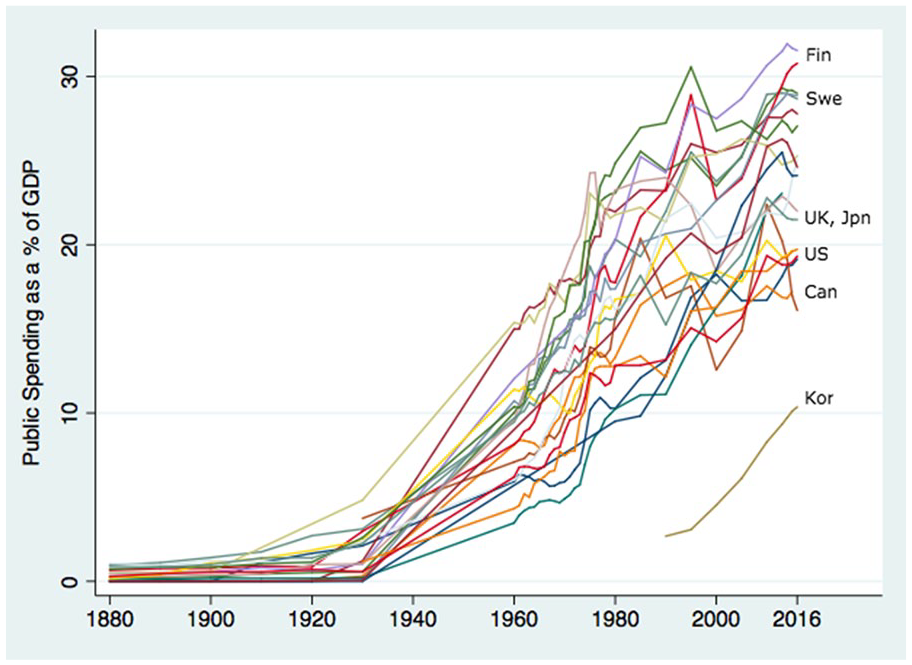
Public social expenditures as a percent of GDP, OECD countries 1880–2016.
Capitalists opposed it, but we have nonetheless directed a growing share of our surplus to collective ends rather than private appropriation over the long sweep of capitalist history. This is not a picture of a self-cleaning oven.
Consider the universality of the dynamic: It holds across very different historical and geographic contexts. Late developers like Korea enjoy the same trend, but in an Asian context rather than a European or North American one, and in the neoliberal 1990s and 2000s rather than the postwar boom. Japan also sees a secular increase in social spending over its entire history, and remarkably, the sharpest moments of growth occur over the past three decades. Finally, although it is not the focus of this paper, in Figure 2, one can observe similar trends in middle-income countries in Latin America and the Caribbean from 1990 forward. 5
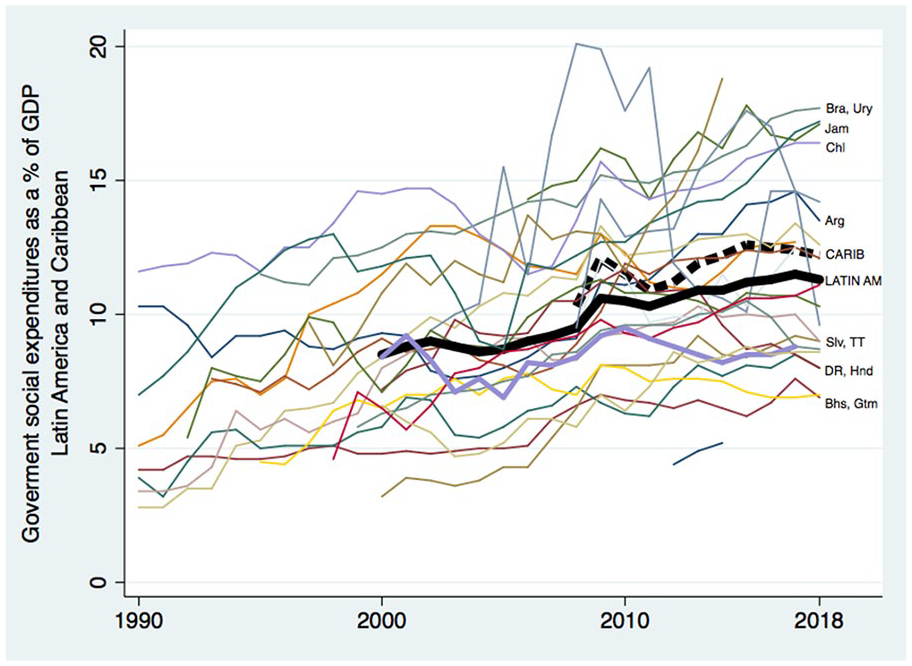
Social expenditures as a percent of GDP, Latin America and the Caribbean 1990–2018.
It is important to underscore that these are public social expenditures that frequently decommodify labor: Public spending makes it easier to escape the labor market as items in an average consumption bundle, like health care and public services, become freely available. More straightforwardly, income maintenance systems—from social security and disability to parental leave and cash welfare—directly facilitate labor market exit. This increases the reservation wage and makes workers less economically dependent on capitalists (Calnitsky, 2020; Esping-Anderson, 1985). For Brenner (1986), it is the background condition of generalized market dependence that defines capitalist relations of production, and social spending in myriad ways loosens this dependence. In states with the most advanced social spending regimes, capitalist compulsion is the weakest. Public social expenditures are therefore not simply desirable from a moral viewpoint; they render productive agents less dependent on the market for survival, and in so doing they augment the power of labor.
Returning to the trends in Figure 1, the counterargument to the hypothesis above that I am proposing is not that states will in all times and places increase the share of the surplus product devoted toward social purposes—I will clarify the claims at the end of this section. But the mere fact that these long-term trends are possible and that capitalist democracies seem capable of absorbing them ought to be seen as surprising from a straightforward interpretation of the Marxist theory of the state. 6
Moreover, these social expenditures are very tightly correlated with strong traditions of parliamentary activity. In a paper coauthored with Ella Wind (forthcoming), I show that the cumulative parliamentary success of leftwing parties predicts spending on poor and working people across 22 OECD countries, and this relationship is not itself explained by other variables. Parliamentary cretinism gets the goods. Figure 3 illustrates this dynamic. 7
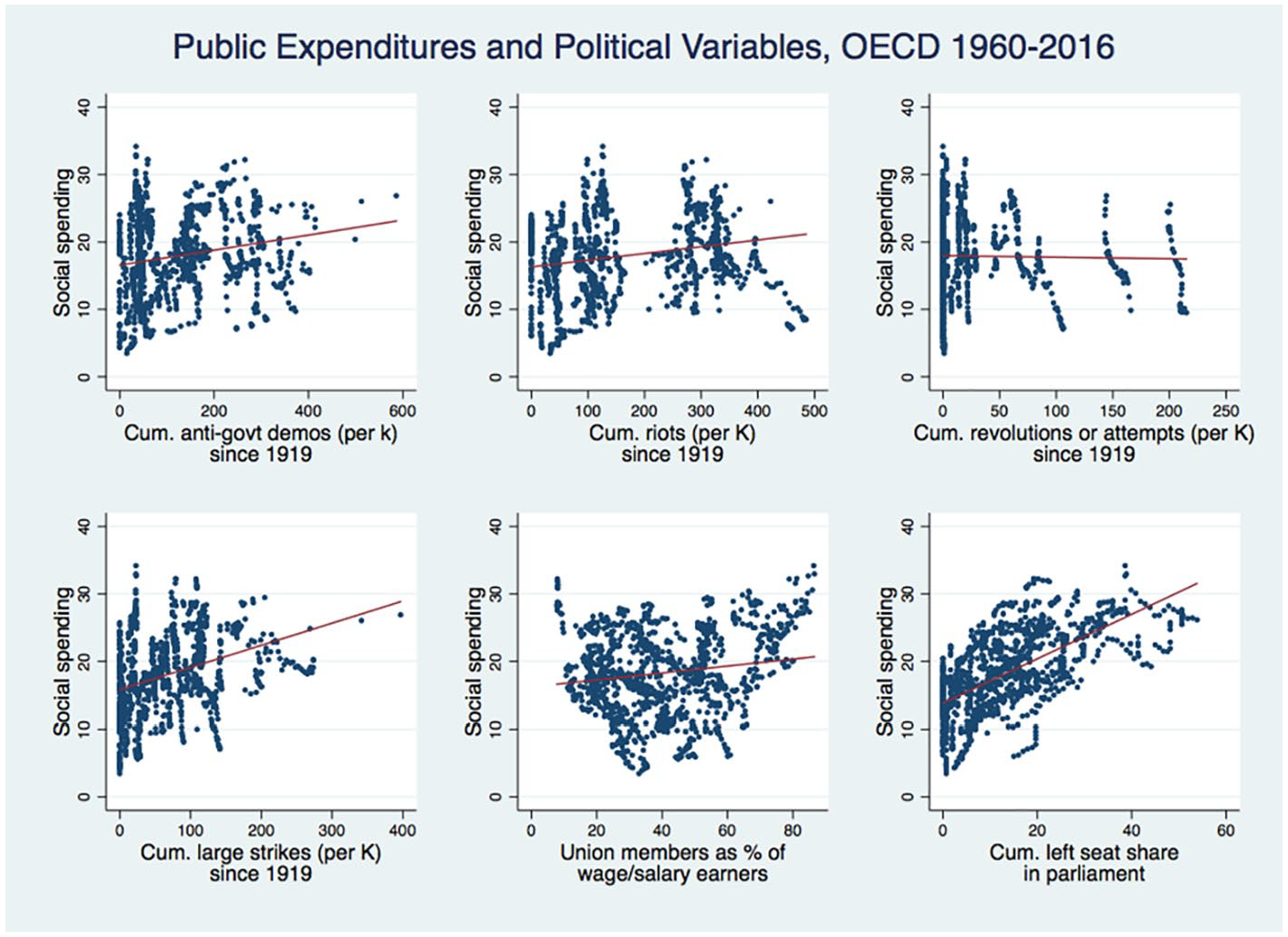
Bivariate relationship between social spending and political variables for 22 OECD countries over 56 years.
Consider now the pattern inside the US, the country with perhaps the highest prima facie plausibility to disconfirm the thesis. As Figure 1 shows, social spending does not fall off, even in the neoliberal period. There are, of course, some prominent moments of rollback in particular domains. Welfare, then called Aid to Families with Dependent Children, was scaled back dramatically in the 1990s (Danziger, 2010; Gilens, 2009; Tach and Edin, 2017). Just as important, but less well known, the inflation-adjusted value of welfare benefits has been falling since the 1970s. There have been other cuts, reductions, or tightening of program eligibility in the 1980s and 1990s, including in disability assistance, employment assistance, and in immigrant access to food stamps and disability benefits. Moreover, in the early 1980s, there were modifications to Social Security, including an increase in the retirement age and the taxation of benefits. But on the other side of the ledger, the period saw spending increases in a number of spheres: childcare; elementary and college education; state-level paid parental leave; disability eligibility; healthcare (Medicaid benefit increases and access improvements); state-level unemployment eligibility; Earned Income Tax Credit (EITC) benefits and Child Tax Credits; low-income housing subsidies; and energy assistance (for overviews, see Blank, 2000; Danziger and Moffitt, 2013; Garfinkel and Smeeding, 2010; Kenworthy, 2011, 2019).
The left panel of Figure 4 zeroes in on Social Security, the single largest budget item in the country, and presents trends in average benefit levels for Social Security recipients. Because this program takes whole swaths of potentially capable workers out of the market, the strong version of the Marxist theory of the state would posit that either (1) the benefits should be meager, or (2) they should ultimately wither away. Instead, however, as the left panel in Figure 4 shows, the average benefit value of Social Security has sustained uniform increases over its long history. 8 And while, the portion of Americans receiving these benefits has also increased since its inception, an aging cohort does not explain per person growth. One might worry that these benefits do not keep pace with the labor market, and so an alternative measure of pension generosity examines “replacement rates” (Birnbaum et al., 2017). These measure how effectively pension systems provide retirement incomes that replace prior earnings. The right panel of Figure 4 shows an upward trend on this measure too.
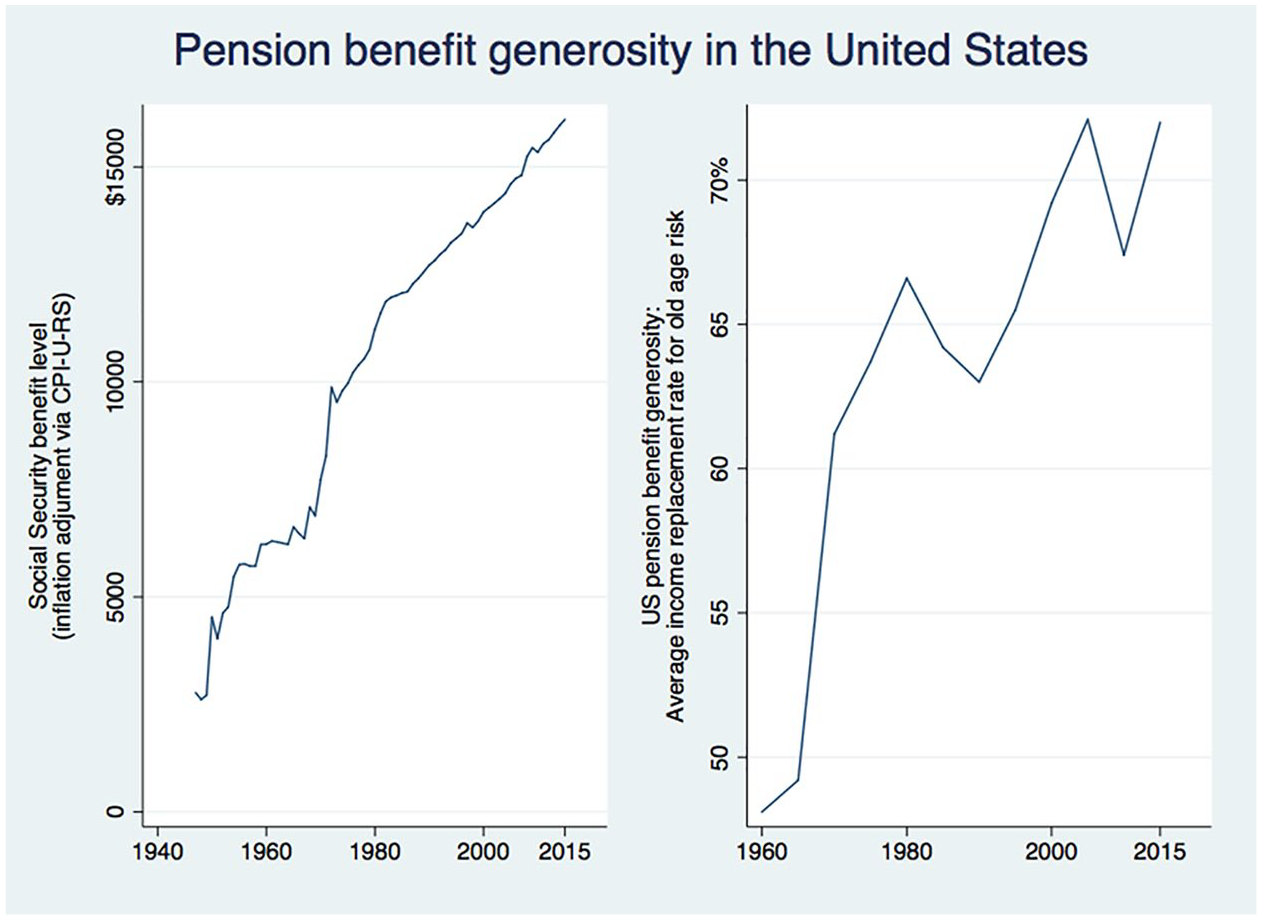
Social Security annual benefit level per person (left panel) and average replacement rate for old age pensions (right panel).
There have, of course, been qualitative changes to the welfare state; the expansion of EITC-type programs is one, and there are reasonable concerns associated with this shift (Sykes, 2015; Tach and Edin, 2017). “Welfare,” as Richard Titmuss (1964: 28) put it, “can serve different masters.” In addition to cash benefits provided to the working poor, the EITC may serve low-end employers (Rothstein, 2010). This worry is real, but I believe, overdrawn. The principle qualitative shift was not so much toward means-testing in service of employers, as much as it was a replacement of one type of means-test with another; transfers to the working poor (in the EITC) replaced those to the very poor (in traditional welfare).
Altogether, however, the US government social expenditures (excluding military and other “non-social” spending) grew by 6 percentage points between 1980 and 2016, from 13% to 19% of GDP. And inflation-adjusted net-transfers directed exclusively to the bottom quintile of households in the US income distribution grew too, by almost 30% over this period (Kenworthy, 2019).
There are other ways to measure these trends. Following the work of Korpi (1989) and Esping-Andersen (1990), researchers Simon Birnbaum, Tommy Ferrarini, Kenneth Nelson, and Joakim Palme (2017) built a new measure of social policy generosity, aimed specifically at measuring old age, working age, and childhood-related social risks. In the main, these authors prefer their measure because it better captures the generational dynamics they are analyzing than do the expenditure data above. They find that across 18 OECD countries, average social policy generosity grew between 1980 and 2010, albeit not as quickly as growth between 1960 and 1980. Much of this expansion in the neoliberal period is attributable to family policy and programs covering childhood-related risk, in particular advances in paid parental leave and child benefits. And this same trend holds true when the authors focus more narrowly on the US.
Other scholars have compiled data more narrowly focused on public pensions, unemployment, and sickness compensation in the OECD (Scruggs, Jahn and Kuitto, 2014). This measure shows that program generosity in these areas was mostly flat since 1980. It is remarkable that none of the measures discussed above, no close examination, identifies an actual rollback in average social expenditures in the neoliberal period.
It is worth lingering on the neoliberal period because one would expect it to present the most forceful challenge to the argument I am advancing. The best and most encompassing public spending data for this period come from OECD Social Expenditures database, which includes public services and benefits linked to old age, unemployment, health, disability, family policy, housing, and other related programs (but excludes education). While it may not capture the generational structure of the welfare state, these data are probably more comprehensive than the alternative measures. An OECD summary reports that over the last 50 years “welfare states often have more than doubled in size.” 9 Since 1980, they have grown more slowly, but these data show no decline, and more likely, some growth on average. Figure 5 presents these data again, fixing on the neoliberal period for selected OECD countries alongside the OECD average in bold.
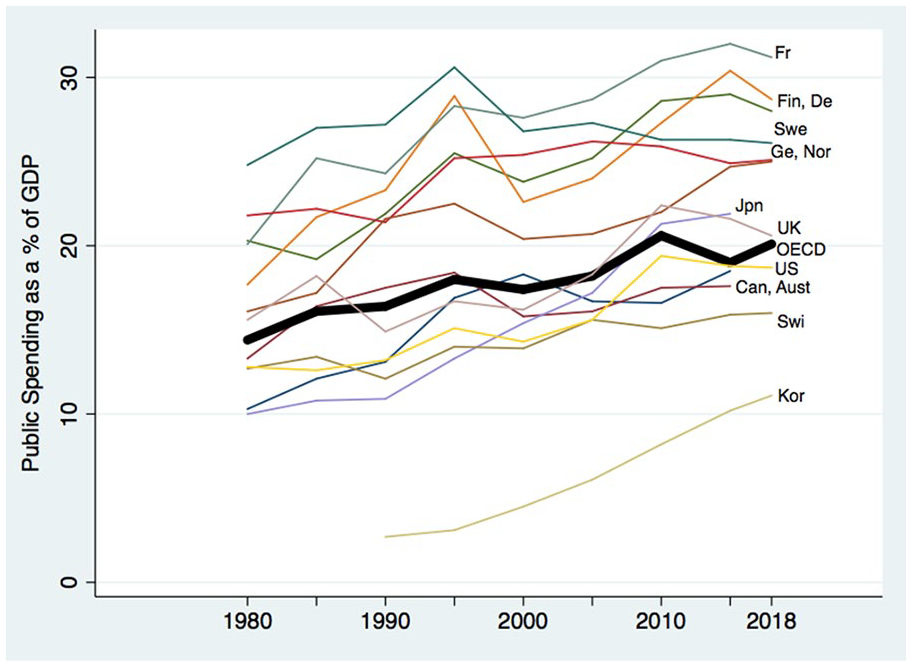
Public social expenditures as a percent of GDP in the neoliberal era.
Because we have hitherto excluded education, we might worry that rollback is shunted onto schooling, and it is worth considering public spending, by local, regional, and central governments on education during the neoliberal period. While there is variation in the time series for different states, if we focus on the aggregate measures shown in Figure 6—the 19 countries of the Euro Area and the 36 OECD member countries—no clear regression emerges from the data. Education spending as a portion of all national income remained constant; if anything, one can observe modest expenditure growth.
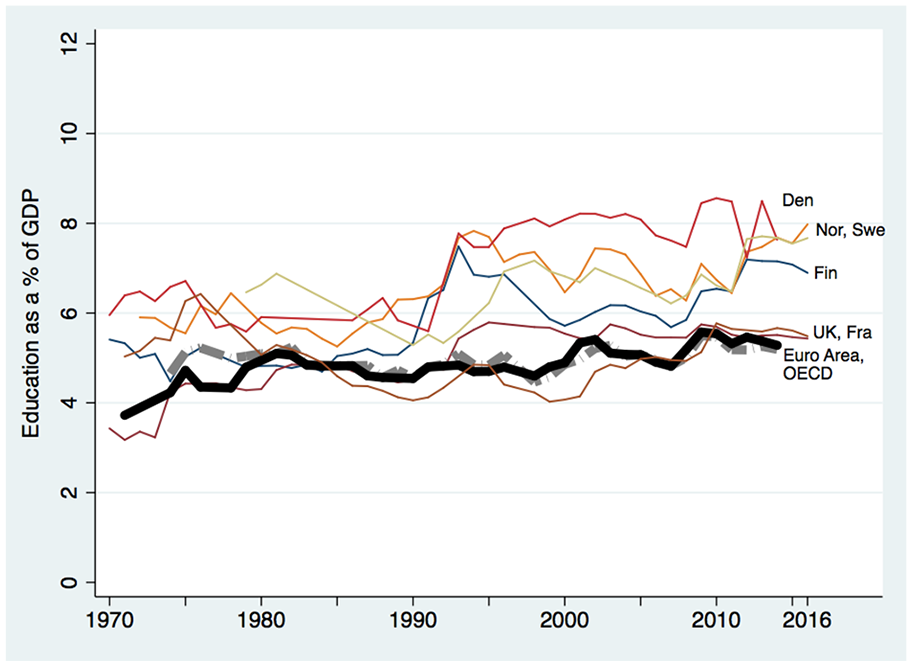
Government expenditure on education as a percent of GDP.
A final time series worth considering is (non-military) public employment, shown in Figure 7. Civilian public employment on average over the past 60 years has shown no clear signs of retrenchment, and instead, has tended to expand with only one or two exceptions. Data in Figure 7 end in 2010, but separate data from the OECD are available between 2007 and 2018, and the OECD average in those years shows no trend at all. 10
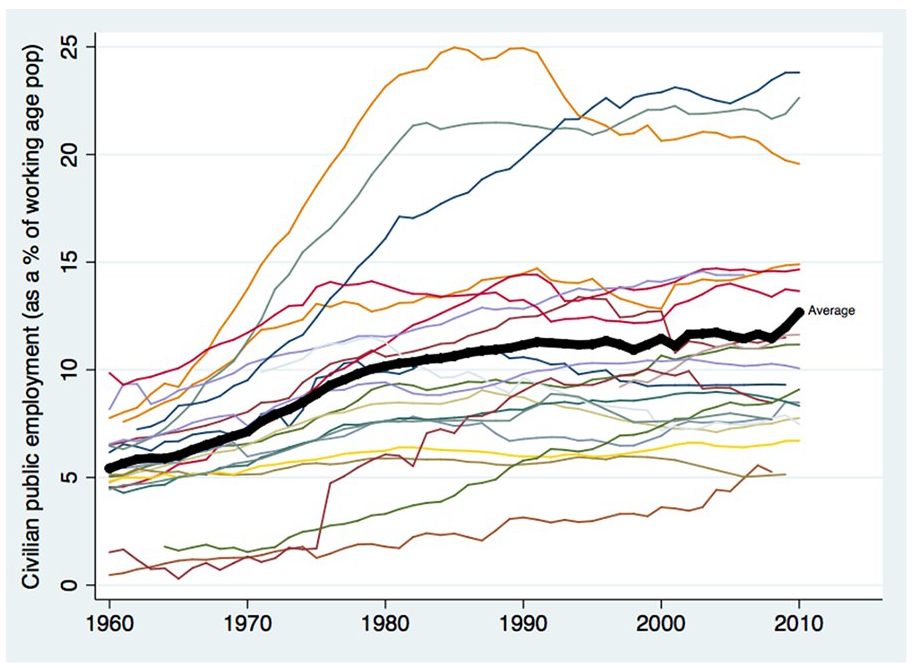
Public employment as a percent of working age population (15–64).
It must be acknowledged: The developments in public social expenditures tracked above are at odds with Marxian state theory. They are outcomes the strong version of the theory would fail to foresee, and they emerge nonetheless, all inside the totalizing birdcage of the capitalist state.
There might be creative ways to rehabilitate the hypothesis, but not without reducing its power. I retain a strong belief in a weak version. 11 One way to frame my hypothesis, which I develop in greater detail in the next section, corresponds to Wright, Levine, and Sober’s (1992) reconstruction of Cohen’s (2000) claim that the forces of production have a uniform tendency to grow over the whole sweep of human history. The reconstructed, and softest, version of Cohen’s argument proposes that the long-term probability of the development of productive forces is both greater than zero and greater than the probability of their regression, even if it is not greater than the probability of stagnation.
Like Cohen’s theory of history, the story told here is not a “process without a subject” (Althusser, 2003: 239). It does not ignore human agency; it operates through human agency. People, by their nature, happen to be loss averse (Tversky and Kahneman, 1991) and on materialist grounds tend to dislike giving up the gains they have made. The macro process is inexorable teleology but the motor is ordinary human agency.
I elaborate on the argument below, but the minimalist version of my claim—analogous to Cohen’s reconstructed argument—states that as long as the probability of social spending growth is greater than the probability of regression and greater than zero, then irrespective of claims about stagnation, we will enjoy welfare state growth in the long run. On this view, America will eventually be Sweden, and Sweden will never be America. This is the social policy road to socialism, and more or less consistent with what we have seen. In the next section, I clarify why I believe the claim to be true, and describe the mechanisms that support it.
At any rate, the evidence above makes our capitalist social world look like less of a totality and more of a mess. The alien forces do perfectly fine and the totality does not annihilate all resistance. On empirical grounds, different kinds of outcomes seem possible inside the capitalist state—early 19th-century British capitalism and Nordic social democracy really do differ in their impacts on human welfare. And we do not see fluctuations between the two social formations every few years. This is why Wright (2011) preferred to describe capitalism as an “ecology” of loosely connected subsystems rather than an “organism” with tightly intertwined functional parts. 12 An organism has parts that fit with the whole in functional equilibrium; if those dysfunctional parts are not expelled, they kill the organism. An ecology, by contrast, can absorb different, seemingly contradictory parts; and it can even adjust to those parts over time. The latter seems to better capture the historical record.
Legitimation over Accumulation
In the wide variety of actually observed capitalisms across time and place, there are cases where capitalists concede nothing at all, and others where they are forced to live in a world less hospitable to their interests. The latter do a far better job of undermining alienation, improving worker power, and expanding people’s material welfare—and crucially, when attained they do not snap back to their old equilibrium like an elastic band. Much more common, perhaps even universal, is a roughly teleological pattern, which suggests there are pathways to study between the worst cases and the better ones.
What explains this dynamic of development? In terms of the social expenditures shown above, the most important point to register is their broad popularity. General Social Survey data show that even in America large majorities like and favor “improving and protecting” Social Security, education, and the public healthcare programs. In addition to support for Social Security, since the 1970s, around 90% of Americans say that current spending is too little or about right on “assistance to the poor,” on “improving and protecting the nation’s health,” and on “improving the nation’s education system” (Kenworthy, 2019). Apart from the highly visible but numerically trivial exception of welfare, this is true across the board (Gilens, 1999).
These convictions hold true for all of the rich democracies. Overwhelming majorities across the world support the programs of the welfare state; as a result, they provide capitalist democracies with some public legitimacy (Brooks and Manza, 2008; Manza and Brooks, 2012). There is, therefore, likely a mechanism pushing against the Marxian hypothesis above, one I will call the “legitimation” mechanism (for the roots of this literature, see Habermas, 1975, 1976; O’Connor, 1973; Offe, 1975; Wolfe, 1974). As it turns out, capitalist democracies are both capitalistic and democratic. And it is the latter that entrenches public spending. It may also be the case, as I have argued elsewhere, that in democratic contexts an expansion of the welfare state can empower people to make further demands (Calnitsky, 2017, 2018). Policies that confer power onto people strengthen the constituencies that support those policies. This kind of empowerment generates a snowball effect to counter the unraveling effect predicted by state theory.
To reformulate the arguments, the strong Marxist claim proposes a mechanism that ensures policies are consistent with sustainable profitability—that mechanism is fundamentally rooted in capital flight, be it real or expected. This I believe is the core proposition that can be extracted from the work of Poulantzas and theorists of the capitalist totality (see Thomas, 2002). But from the perspective of the vulgar empiricist the crucial point is this: The capital flight mechanism should be understood as a mechanism and nothing more. There is no good reason to think it is the only mechanism in operation in capitalist democracies. If it were, the last 100 years of steady welfare-state expansion would be baffling. Something else is happening to grow social protections and block retrenchment with ubiquitous regularity.
Legitimation ought to be understood as another, countervailing, mechanism. The claim goes as follows: People push for material gains and social protections through various channels; sometimes they are successful, and when they are, the popularity of those protections locks them in place. This is not always the case, but entrenchment is the rule and retrenchment the exception (see also Pierson, 1996; Stephens, 1996; Stephens, Huber and Ray, 1999; Ragusa and Birkhead, 2020). The former is an artifact of democracy, the latter of capitalism. 13 Across long stretches of history, the expansionary push of the legitimation mechanism swamps the contractionary pull of the profitability mechanism. Welfare state expansion can happen through a range of channels—on this, I believe there is good reason to be ecumenical—class struggle, electoral projects, or purely accidental consequences of other events such as war; occasionally, they will succeed in passing universalistic programs and when they do their popularity fetters their removal.
It is important to note that the legitimation mechanism operates through the crucial feature of program universality. Policies that are “comprehensive in scope, universal in membership” will be popular; when popular, democratic channels make them irreversible (Titmuss, 1964 p. 34; for arguments and evidence on the robustness of broad-based social policies, see Calnitsky, 2016; Korpi and Palme, 1998; for a unique gloss on this thesis, see Marx, Salanauskaite, and Verbist, 2016; for evidence that all social policy is robust, see Ragusa and Birkhead, 2020).
The Marxist literature on these questions tends to focus on specific cases of blocked reforms such as the Mitterand presidency (Kesselman, 1982), instead of looking to the long view, which demonstrates a slow but steady and cumulative expansion of the sphere of socialism. Failures happen, but so do successes, and the latter stick. The most comprehensive quantitative study of repeals in the US from Reconstruction to present finds that retrenchment in general is a distinctly difficult enterprise—and relative to the durability of laws in other realms (say, military laws), the social policy sphere is among the sturdiest (Ragusa and Birkhead, 2020).
One instructive example is public health systems: They are introduced and never repealed. They are often difficult to achieve, and require immense social momentum, but once achieved they become the permanent furniture of the welfare state; indeed, more often than not they grow. The same is true for social security around the world. Most every universalistic social policy that significantly improves the lives of large majorities tends to be sticky-downwards. Their trendline plots a unidirectional—indeed, teleological—curve. When we zoom out of the case studies to the broader pattern, we can observe a ratchet effect that bolsters the case for an incremental path to socialism. 14
There are, nevertheless, limits to empirical analysis: We have not actually seen, in a full and robust way, countries move into socialism. Here the strong version would argue that, like Sweden’s failed Meidner plan to gradually move capital ownership to workers, reforms at a certain point will be reversed (Meidner, 1992; Pontusson, 1992; Silverman, 1998). Giving specificity to this argument is challenging; that “point” can be a non-falsifiable moving target. When passed it is said to be further out still. This hypothesis might suggest that growing social expenditures would begin to generate political chaos; however, both government expenditures and social spending are actually negatively correlated with “government crises” across a wide range of countries over time. 15
Nonetheless, the claim suggests there is some threshold where capitalist resistance cranks up dramatically. And yet, we do not actually see this violent recoil in those few famous moments of failure. The Meidner plan did not prompt employers to summon the tanks. It was repealed not with some capitalist coup: The social democrats simply lost an election. The outcome was not preordained. Employers would not have called in the military; they would have been paid off, which is exactly what was happening in the years before the election. 16 Inside rich democracies, employers have not, historically, orchestrated coups because as long as revolution is off the table there are always better and less risky ways to realize their interests.
It is also worth noting that, as suggested above, a version of the Meidner plan was in fact enacted; it ran for 7 years and amassed 7% of Swedish corporate stock (Bruenig, 2018). The counterfactual suggested by my theory is that if the plan had enough time or support to noticeably improve people’s standards of life the policy would have locked into place.
What about very high levels of social spending? Perhaps capital flight eventually kicks in to reroute the policy road to socialism. Perhaps we save the strong version of the Marxian theory in ad hoc fashion by saying that although the welfare state was possible, starting now, further expansions are impossible. First, it must be said that from the ecological view, the Nordics really are already more socialistic than other rich, developed countries. 17 And second, do we really believe that socialist expansion will be easier today in the US than in Sweden and Norway?
Nonetheless, because the evidence on social spending beyond that of Scandinavia does not exist, one must go out on a limb. Of course, any argument about the achievability of socialism is speculative. Nonetheless, the reasoning at this point is the same as above: Legitimation will continue, as before, to trump accumulation. The overwhelming popularity of universalistic social programs will require democratic governments to find creative ways to retain them. Parties that defend social programs will outcompete those advocating their dissolution. Defending these programs might involve instituting capital controls; it might involve nationalizations or new approaches to taxation and corporate decision-making; and it might involve the creation of new public agencies. 18
Consider the following, highly schematic, scenario: The state hits those very high levels of social spending and that spending is popular but capital begins to disinvest. As a solution to the crisis, those employers in the industries at highest risk of exit are nationalized (or perhaps big chunks are purchased through some mechanism). 19 As nationalization proceeds, two crucial effects follow. First, the public ownership of capital—much like the Norwegian public wealth funds—generates dividends that can help fund those higher levels of social spending. And second, now that assets are in public hands the ever-present threat of capital flight is diffused.
Nonetheless, the objection to my argument is not unreasonable: Perhaps capitalist opposition does increase at a certain point, even if we cannot identify the point in advance. Indeed, this is perhaps one way to understand the neoliberal period and associated slow-down in welfare state growth. But this objection suggests just that welfare state growth will slow. Returning to the reconstructed version of Cohen’s argument, if we accept the premise that welfare growth is greater than decline (and zero) we will arrive, eventually, in a socialist economy.
As long as the efforts to expand social spending have the effect of funding broad-based policies that improve people’s lives and problem-solve, they will stabilize as they have in the past. They will frustrate would-be repealers as they have in the past. A grand hitherto-unseen reversal, I believe, is less likely than a simple linear extrapolation into the future. If the neoliberal onslaught could not achieve that reversal, it seems reasonable to expect future attempts to be equally unsuccessful.
Over the next 50 years, in response to a range of crises there is good reason to believe many countries will grow the portion of their income devoted to public purposes. Capitalists may mobilize to block those efforts in advance, but when they are unable to do so, their retroactive maneuvers to reverse them will fail.
The “ecology” framework advanced here suggests there is no good reason to believe that the strong Marxian theory will ultimately prevail; legitimation may very well pave the policy road to socialism. There is simply no good reason to claim, as an a priori statement, that there is only one contractionary mechanism in play, or, as the saying goes, that it is “dominant in the last instance” (Poulantzas, 1967: 60). In the last instance we’re all dead.
Secondary Propositions
There are additional hypotheses in the state theory tradition in Marxian sociology that are less central, in my judgment, but are worth considering nonetheless—these emerge from a large and somewhat opaque literature on alienation (for the strongest contributions to this literature, see Elster, 1985; Ollman, 1976; Wood, 2004). With respect to the state, a simplified version of these arguments would suggest that welfare states are demobilizing, demoralizing, and anti-democratic. I discuss each of these in turn.
Does social democracy demobilize popular forces? When we look at social expenditures above, a key object of mobilizations, increases in spending beget more increases. We do not see hill-shaped trend lines. Moreover, in OECD countries between 1960 and today, social spending (lagged by 1 year) tends to correlate positively with large strikes. 20 So at least measured in terms of “getting the goods,” there seems to be no casually observable demobilization effect. However, it is possible, indeed likely, that these victories, such as wage growth, are in fact demobilizing for revolutionary ends. But the data provide prima facie evidence that they are not demobilizing for further efforts to obtain greater social benefits. More consistent with the data is the interpretation that gains snowball rather than demobilize.
There are other respects in which they are not demobilizing: The more surplus product we devote toward broad social purposes, the more people seem to participate in democratic life. I merged OECD social expenditures with voter turnout, and in terms of a simple scatterplot shown in the left panel in Figure 8, the two variables turn out to be positively correlated. The evidence here is cursory, but even if we are insufficiently confident in the positive correlation, it suggests against the negative hypothesis—namely, that people become passive, contented, and ultimately less interested in political participation when the welfare state is more expansive.
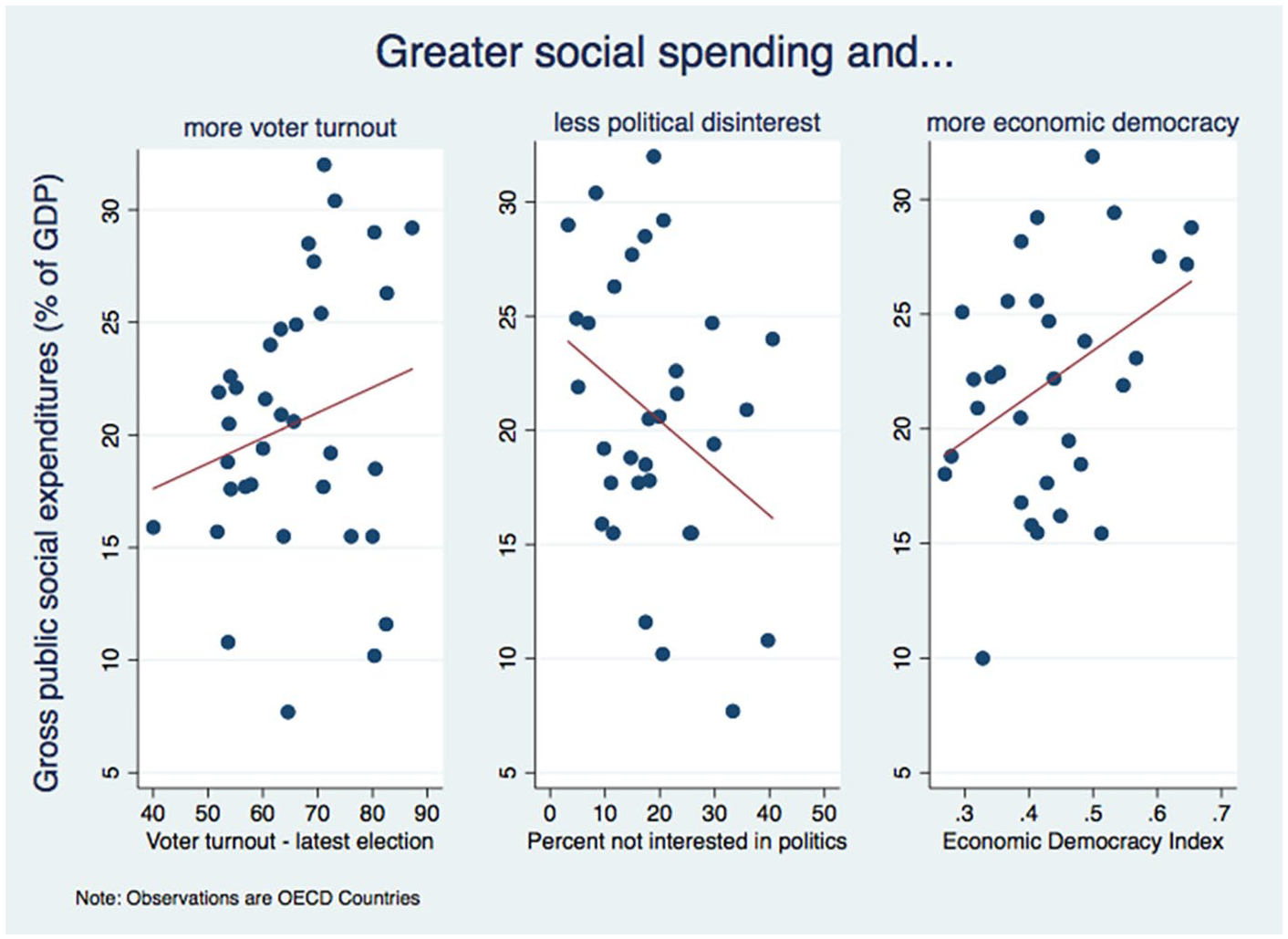
Public social expenditures and indicators of “alienation.”
But are these welfare states alienating in other respects? Marxist political scientist David McNally (2019) has drawn attention to the “alienated character” of welfare states: Ah, but what of all the public works undertaken by this state—from schools and universities to bridges and publicly owned railways? Surely Marx saw these as progressive? [. . .]. On the contrary. [. . .] Rather than romanticize these “public” services and enterprises, Marx is scathing about their alienated form.
21
The term “alienation” is soapy enough to squeak out of any operational definition a vulgar empiricist might burden it with, but if disinterest in political life is a reasonable proxy, then this hypothesis again turns out to be unsustainable. I merged OECD social expenditures with survey data on political disinterest, and the middle panel of Figure 8 indicates that people are more likely to have “no interest in politics” when welfare states are weak, not when they are strong. If anything it is weaker welfare states that risk demobilization and alienation. It is also worth mentioning that the Nordics seem to have fewer “bullshit jobs” (Graeber, 2018) than elsewhere; only 3% report they “rarely” or “never” have the feeling of doing useful work (Soffia, Wood and Burchell, 2021).
Perhaps the best way to consider the question is with respect to economic democracy. We might be skeptical of turnout in bourgeois elections or subjective interest in politics; it can be argued that the real Marxist hypothesis on alienation instead comes down to control, power, and decision-making. For Marcuse (1964), the capitalist state was a system of total administration, where workers were demoralized and controlled. For Piven and Cloward (1971), the welfare state was a machine for regulating the poor. This theory of alienation says that the welfare state operates as an alien force to control and dominate the workers inside it; economic democracy would on these grounds be the obverse of alienation. In the right panel of Figure 8, I merge social spending with the Economic Democracy Index (Cumbers, 2016; Winters, 2019), a measure capturing workplace and individual economic rights (e.g. levels of co-determination), associational economic democracy (e.g. extent of cooperatives, role of labor in economic policy), the distribution of economic decision-making powers (e.g. ownership structure), and transparency and democratic engagement in macroeconomic decision-making. Robust welfare states appear to bring with them deeper democratic participation in economic life. By contrast, alienation in the sense of a lack of control over economic decisions is most strongly linked to contexts where the welfare state is most absent. One likely explanation for this positive correlation between social spending and economic democracy is that the welfare state reduces workers’ dependence on the market, thereby improving their power vis-a-vis employers.
The best way to preserve the claims discussed in this section—welfare states are alienating, demoralizing, anti-democratic, and reform sabotaging—is to ignore history. Perhaps another way is to ground the evaluation of the claims in pure theory or textual exegesis. The fact that a strong version of the Marxist theory of the state would lead us to woefully mistaken prognoses about the world looking forward from the year 1900 should give us pause before we hew narrowly to the possibility-obliterating totality.
The Revolution Must Be Betrayed
Suppose now that all of the above is wrong and that we do believe, categorically, in the strong version of the Marxist theory of the state. There is no room to wiggle, reforms are self-undermining, and all social relations bow down before the “single, unified” totality (Lukács, 1972).
The consequence of this belief, motivated or not, is that revolution has now increased its relative viability. If the system cannot bend, it must break. Closing off the road of steadily growing “non-reformist reforms” leaves the revolutionary road as the only way forward for social change (Gorz, 1968). History has no anesthetic and birth pangs must accompany the delivery of the new order; as Hegel declared, “gangrene cannot be cured with lavender water” (cited in Gay, 1952, p. 223). And yet, when theorists argue for revolutionary strategies, instead of making the positive case they often spend their time arguing for the implausibility of the path to socialism paved with reforms (for interesting accounts, see Van den Berg, 2003; and Stephens, 1979). 22
But even if we grant the premise of this argument—that the road of non-reformist reform is an illusion—the revolutionary conclusion is a non-sequitur. It may very well be true that the reformist road I am endorsing is implausible. And the Marxist theory of the state is a big reason for that implausibility. But accepting the implausibility of the reformist road does not make the revolutionary road any more plausible. The points scored against the plausibility of reform are not tallied on the side of revolution. The negative case against one is not the positive case for the other because they could be both utterly implausible.
I do not, however, think that the revolutionary road is implausible. Rather, it is impossible, at least inside the rich capitalist democracies. And between the implausible and the impossible the choice is clear.
Again, this can be framed as an empirical hypothesis: You do not see revolutions in developed capitalist democracies. As Przeworski and Limongi (1997) have written, there has never been a revolution in a moderately middle-class democracy (see also Przeworski, 2019). Drawing on a thousand years of data, cumulatively collected across 37 democratic countries, they show that not one had collapsed with a per-capita GDP higher than that of Argentina in 1976. Among countries with half that figure, collapse was exceedingly rare. Even a modest GDP brings with it an enormous amount of regime stability. These data in fact include any kind of regime collapse; narrowing the data to socialist revolution makes the empirical case against it even more impressive. Any case for revolution must begin by acknowledging rather than ignoring this evidence.
To look at this question in a different way, I draw on the Cross-National Time-Series Data Archive, which contains information on revolutions (rather than government collapse) for over 200 countries since 1919. Their definition of revolution is very broad (see footnote 7) and includes “attempts” to overthrow government as well as “unsuccessful” rebellions. The data were compiled from newspaper sources and warrants caution, but nonetheless constitutes the most systematic evidence available for these questions. In Figure 9, I present the GNP per capita distribution of revolutions, from 1919, where GNP is first available, to the present. By considering only those country-years with revolutions I reduce the observation count from 17,520 to 184. Unlike Przeworski, I do not further restrict the data to democracies. The graph displays an extreme skew: The vast, overwhelming majority of cases of revolutionary threat occur in countries with a per capita GNP below $5,000 USD. For reference, the figure for the US in the data is about $65,850 in 2019. The hypothesis above—that we do not see revolutions in developed democracies—seems borne out by the evidence.
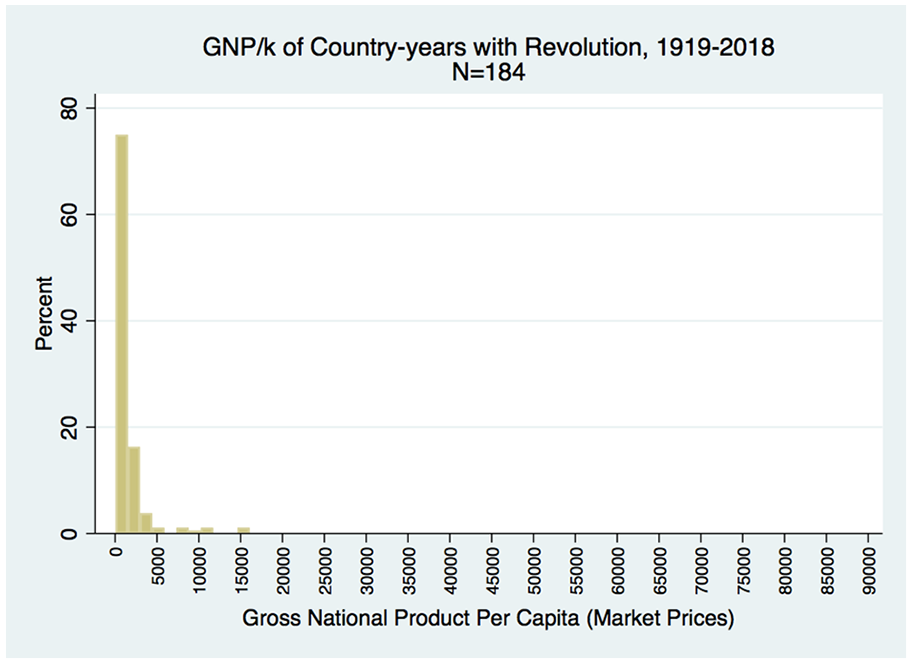
Histogram of country-years with revolutions.
Why exactly is this true and what are the mechanisms to explain it? Why is the revolutionary strategy impossible for a country like the US? There are, at bottom, three reasons, each of which stands alone as a sufficient condition to snap the last threads of one’s revolutionary faith. 23 The first two suggest that revolution is unachievable, and the last suggests that even if it is achievable, socialism by revolutionary means is unachievable. The revolutionary road is closed on the following grounds:
(1) Workers do not want it
(2) Capitalists would sooner grant reforms
(3) A smashed state is more likely to result in tyranny than deep democracy
Not only has there never been a successful revolution in a developed democracy, there has never been a working class that has wanted one (e.g. Erikson and Tedin, 2015; Sassoon, 1996). 24 There are no clear cases where the dominant inclination of the working class in a developed democracy was revolutionary. Recall that the above graph also includes attempts and unsuccessful cases. It is self-evident that workers have not joined revolutionary groups en masse at any point in the context of a rich democracy. Nor were their aspirations to join such groups thwarted by violence or ideology. When gains inside a capitalist democracy are available—either individual or collective ones, and this has been true even through the neoliberal period, where median living standards have continued to (slowly) go up and not down—it is not worth risking everything for an uncertain future (Thewissen et al., 2015). 25 More important than the dynamic point is the static one: When standards of living are moderately high, as shown in Figure 9, the modal worker has more to lose than her chains. This is not an argument against socialism; but to revise Werner Sombart, the life raft of revolution really was shipwrecked on shoals of roast beef and apple pie.
Therefore, the reasons workers are not revolutionary are materialist in character. Explaining their reformist politics does not require appeal to venal trade union leaders or false consciousness. Most people wish to minimize risk in their lives, and revolution involves taking on colossal risks. For example, home-ownership in the developed world hovers around 70%; this means that a lot of people have a lot to lose.
By contrast, the materialist case for revolution proposes that people favor it when their expected post-revolutionary standards of living are greater than their current standard (Roemer, 1985). But when we add moderate risk- and loss-aversion the calculation changes (Kahneman and Tversky, 1991). Say you have a low income, but own a few assets, maybe a house, a car, and perhaps you also have a child; what risk profile would you require to gamble your modest holdings for an uncertain future which might be better but might be worse? Even if you are certain that the probability of better is greater than the probability of worse, you have to envision workers as a class of inveterate gamblers to take the bet. Moderately cautious people who prefer a bird in the hand will still view the downside risk as too great. Equal gains and losses are not experienced equally. This is the loss aversion phenomenon. But the assumption of a population confident about improved standards of living—and a willingness to take risky strategies to achieve them—is itself unwarranted. This is the risk aversion phenomenon. The modal worker is of course correct to suspect that her post-revolutionary welfare is uncertain; socialists after all do not have satisfactory answers to the problems of coordination, motivation, and innovation under socialism (for attempted answers that are provocative and oftentimes brilliant, see Albert, 2004; Cottrell and Cockshott, 1992; Corneo, 2017; Roemer, 1994; and Wright and Hahnel, 2016). When one compares the status quo to a future where both heaven and hell are seemingly plausible, it is perfectly rational that people everywhere would abandon the barricades. And abandon them they did.
Now perhaps the revolutionaries have persuaded us that negative outcomes are far-fetched, that we are very confident that revolution will usher in, eventually, the land of milk and honey. It is still the case that in this model the promised land will only be reached after a social breakdown of unknown duration: A complete overhaul in the organization of production will lead to some middle period of deteriorating material welfare as capitalists rapidly exit the economy. This means chaos and uncertainty, but it could also mean war. The interregnum could last a year, but it might last two decades, and however optimistic we are about the end point, we cannot in advance know how long this interim phase will persist. In the meantime, revolutionary enthusiasm will wane, erstwhile supporters will decamp, a “stay-the-course” electoral strategy will be outflanked by competitor parties promising a return to normalcy, and the desire to consolidate gains will make the authoritarian impulse greater. From a materialist perspective, the uncertain passage through what Przeworski (1986) calls the “transition trough” makes the journey less appealing. 26
To my mind, these factors explain why all working classes in all developed democracies have been decidedly reformist in orientation. The reason why revolutionary socialism has always been marginal in rich capitalist economies—and will always be outflanked by reform-oriented socialism—is that only the latter consistently deliver high (and usually increasing) standards of living and low (and usually decreasing) levels of risk. As long as the Mad Max world of catastrophic collapse can be avoided, reform-oriented parties will always better capture the enthusiasm of poor and working people.
Thus, when we try to explain the non-revolutionary attitudes of our working-class friends and family, we do not need to lean on the false consciousness account, for there is a more parsimonious materialist explanation. As such, any case for revolution must be non-materialist in character: You can be a materialist or a revolutionary, but not both.
This is the dilemma the revolutionaries must consider: Revolution is only possible when the forces of production are underdeveloped, but it can only be successful when they are sufficiently developed to make socialism (or communism) objectively viable. 27 As Elster (1986) has argued, the circumstances under which revolutions spark and succeed never coincide.
What about the capitalists? Under these circumstances, it is reasonable to expect that they will fight far harder against a revolution than they would against reformist drives. Indeed, ignoring the response from capitalists violates Elster’s first law of political rationality: Never assume your opponent is less rational than you. If revolution were the alternative, employers would grant every imaginable reform, from far higher taxes to the rejiggering of power relations in the workplace. In a mugging, most people will surrender their wallet before their life.
Actors in the state ought to respond in more or less the same way—that is, as long as you admit your adversary the competence to read the situation as well as you. If our theory of the state suggests that it acts on behalf of the capitalist class, its apparatchiks would anticipate and preempt any revolutionary crusade with a cocktail of concession and repression. And while it will certainly contest reforms, it will devote all of its resources to break the revolution. Nonetheless, this means that revolutionaries can play a crucial role, even if it is not to foment revolution. Militancy is a powerful strategy to foment reform (for an argument about the history of social democracy along these lines, see Piketty, 2014).
Thus far, the main reason revolution is off the table is because no one wants it—not workers, nor employers, nor the state.
The third point above asks us to imagine the prospects for revolutionary success even if we ignore the wrinkle that workers have neither an interest nor capacity to make it. But let us pretend they did: Why then would we imagine that total social breakdown would prompt a deepening of democracy rather than authoritarian entrenchment? This happy outcome has never before emerged in the wake of social collapse, and there is little reason why the final showdown with the American military ought to produce fertile ground for deepening democracy in all spheres of life. In fact, evidence from the General Social Survey suggests that in response to recession and economic downturn people tend to become less altruistic and less concerned with questions of fairness. 28 After situations of economic crisis, voters tend to shift to the right (Lindvall, 2014). The old union song cries out that “we can bring to birth a new world from the ashes of the old,” but life is not birthed on ash. None of the historical case studies track this narrative, and indeed everything we know about human psychology suggests that social devastation makes people more, not less, prone to demagoguery. This means that even if a revolution were achievable, it is probably undesirable.
The argument I have thus far laid out against revolution contends only that it is off the table in middle-class democracies. I have in mind social dynamics within developed capitalist democracies, countries “like the US,” but the premise no longer holds true if we imagine a society that has already suffered some sort of catastrophic societal disintegration—at that point all bets are off. We are of course now talking about a world we are not living in, but it is worth considering the thought experiment nonetheless.
It is possible that America, after some world-historic environmental or economic collapse, begins to look something more like Russian feudalism than contemporary developed capitalism. Revolution then might again be on the table, but the context of desperation and scarcity in this scenario gives little reason to expect it would incubate an egalitarian democratic society. The historical evidence is unambiguous: None of the communist revolutions of the 20th century ushered in deeply democratic egalitarian social structures. Not only are there no examples, but there are also no clear mechanisms on offer.
The fact that this scenario generates an interest in bringing about an egalitarian society by means of revolution does not mean there will be a capacity to do so. The theory is little more than “where there is a will there is a way.” But, as Elster (1980: 124) argues, the general interests of society do not secrete the conditions for their fulfillment. Interests and capacities need not overlap.
There is a final reason to be skeptical of non-evolutionary strategies: The highly dubious premise that the system we erect the morning after will actually work. A socialist economy, if plopped down tomorrow, would be so rife with unintended consequences and pathologies that it is easy to imagine a democracy voting its way back into capitalism. This is true even if we believe (mistakenly, in my view) that the socialist calculation debate is solvable in the age of big data (Morozov, 2019). Interlocutors in the calculation debate have had very little to say about the politics of transition. Indeed, it is hard to imagine success of any kind without a slow and incremental transformation, experimenting with bits and pieces along the way—as we have been doing for the past century. An experimental approach is likely the only way to avoid devastating blunders that undermine the whole project. Moments of institutional upheaval and big change may at times be necessary, but to be successful they will have to rest on a foundation of smaller changes that have been tested.
Apart from the politics of transition, the static questions of socialist institutions are themselves unresolved (see Corneo, 2017, for the best recent analysis of socialist institutions). Not only do we need more socialist blueprints, we need whole technical fields of Blueprint Studies, complete with their own academic programs, journals, and conferences. We still have only rudimentary answers to the complex and numerous problems of coordination, motivation, and innovation. Imagining that all of the problems are political and not technical, that these problems would all be more or less easily solved with some newly implemented social technology, is wishful thinking. The literature on socialist models referenced above is promising, but transparently underdeveloped. These facts similarly point us toward an iterative and incremental process of trial and error.
To be clear, my position on revolution is not that the ends cannot justify the means. Of course they can. If the means are justifiable, the only thing that would ever justify them would be the ends. It is merely that revolutionary means will never produce its ends. It is incumbent on revolutionaries to produce positive arguments for revolution rather than negative arguments against other strategies. Alas, the former are absent. I believe that the critics are sensible to suggest that the road to socialism by means of “non-reformist” reform is shaky. But there is no alternative.
The Ratchet Theory of Socialism
Abandoning the dream of revolution has therapeutic benefits. One can avoid bearing the guilt of torturing the evidence. And it is an invitation to recognize the real achievements of socialism over the past century. One image of the past century depicts socialist parties and platforms in the West that were co-opted at every turn; but we could just as reasonably have it the other way around. Socialists and popular forces have had substantial success in colonizing the state; workers have made historic gains in political power (Sassoon, 1996; Usmani, 2018). The Nordic model in particular has produced some of the most egalitarian economies the world has ever seen. Socialists have struggled to mold societies with living standards that are unmatched in human history. Some of these have a good amount of capital in public hands, some have effective state-owned enterprises, and all have made progress by slowly decommodifying large swaths of economic life (Bruenig, 2018). Expanding on these victories is the only road to freedom.
Naturally, there is a long pedigree of socialist skepticism of these points, some of which we have mentioned above. As an example, McNally (2019) believes it is “absurd” to regard these policies as “socialist achievements” and that “we steer clear of such confusion by insisting on the inherently anti-democratic form of the modern state.”
This argument is rooted in an analysis of the world pitched exclusively at the highest level of abstraction, where societies are characterized by strongly equilibrating modes of production. Society allows for tightly integrated systems called capitalism or socialism, with no space for hybrids in between the two; these systems, after all, expel contradictory internal elements. This, however, is an unargued premise, and in fact just an old habit of mind—it is the gospel of totality all over again and a garden-variety case of assuming the conclusion. Regarding these policies as socialist achievements is only absurd if totality is an inviolable dogma. Denying the democratic character of modern states (and the socialist incursions they allow) helps to protect the conceptual premise of binary totalities. But insisting on the state’s inherently anti-democratic character just replaces one unsupported premise with another.
If, however, you have little empirical confidence in the strong version of the Marxist theory of the state, as I do, then you need not insist that the highest level of abstraction is always the relevant one. It is reasonable instead to envision the world in the continuous terms of hybrid states rather than as binary modes of production (Wright, 2011).
Accordingly, it is appropriate to maintain that these policies are socialist achievements—insofar it counts as an achievement (1) to make people’s daily lives vastly better; (2) to realize that by directing an increasing share of private incomes to public purposes; and (3) to do so under circumstances characterized by greater political and economic democracy. That increasing share is not merely redistribution; it is a process that makes market provisioning redundant and decommodifies labor. And indeed, it has been achieved through democratic class struggles. 29 Instead of denying the democratic character of the state, the evidence instead suggests we can reverse Lenin’s dictum: A democratic republic is the best possible political shell for socialism.
Democracy is thin, but it is not fake. Over capitalism’s history social life has democratized dramatically, and as Usmani (2018) has empirically shown, it was the disruptive capacity of workers that is largely responsible. In turn, the democratic revolution has been instrumental in expanding and entrenching the sphere of socialism. We can reasonably regard this sphere, these programs and institutions, as socialistic because they were created through democratic channels, they are causally linked to greater worker power, and they take vast slabs of economic life out of capitalist control. Socialist parties and political movements won them and ought to own them.
Hybrid states begin to emerge when we study the data rather than the dialecticians. One reason we see recurring evidence for material progress in the data is that people do not easily give up the gains they make. The power of loss aversion inside democratic polities cannot be overestimated. Legitimation is a lever, robust even to neoliberal assault. Neoliberalism presents the strongest counter-hypothesis to my claim, and yet nowhere did it unravel the welfare state. The end of neoliberalism may provide the ground for new areas of expansion.
Allowing for moments of temporary retrenchment, the social surplus we devote to public purposes is about as high as it has ever been. The great reversals are absent. And the evidence gives us no reason to believe there is a ceiling on the gains that can be achieved—those who prophesized the impossibility of the welfare state avant la lettre were embarrassed by reality. There is no regression to the bygone world of the capitalist past, but the opportunities for advance are reachable; occasionally they will be grasped—and when they are they will leverage our societies further into a socialist future.
Footnotes
Acknowledgements
I would like to thank Ella Wind, Eric Blanc, Michael Billeaux-Martinez, Michael McCarthy, Adaner Usmani, Paul Heideman, Asher Dupuy-Spencer, Jeffrey Malecki, John Hodgins Niko Block, and Vivek Chibber for helpful feedback on earlier drafts.
Funding
The author disclosed receipt of the following financial support for the research, authorship, and/or publication of this article: This work was supported by the Social Sciences and Humanities Research Council of Canada (SSHRC Insight Development Grant no. 430-2020-00660).
