




Abstract
This article develops a conceptualisation of transversal solidarity in relation to migration and migrants. It reflects different ways of practicing, organising and articulating solidarity. We proceed through a conceptualisation of solidarity in terms of ‘transversal solidarity’ relating to three dimensions involved in solidarity practices from below and discuss how to bridge their respective dichotomies: identity and the related in-group and out-group dichotomy; space, in terms of the separation of the local from the national and international; organisation, related to the incompatibility of the social and the institutional. We link this conceptualisation to a typology of solidarity working on three different scales (autonomous solidarity, civic solidarity and institutional solidarity), which reflects these dynamics of solidarity as well as the degree of institutionalisation. We use different examples to illustrate various types of transversal solidarity.
Introduction
The fire in Moria refugee camp, the largest one in Europe, in September 2020 was both a tragic human incident and a dramatic episode of the failing European Union refugee policy. The camp, sited in Lesvos (Greece), was known as a ’living hell’ due to the scarcity of water, food and electricity, the cases of sexual violence, and the image of children playing amid rubbish (Hitchings-Hales, 2020a). Although the camp was originally intended to accommodate 3,000 people, nearly 13,000, including 4,000 children, were left without shelter when it burned down. Besides, the camp was locked down due to a COVID-19 outbreak, which made conditions even worse and 35 were already tested positive before the fires. Greece, due to its location as the European Union (EU) border, has become an increasingly toxic point of contention. On the other hand, the emphasis on speeding up the asylum process does not contribute to a safe, fair and just system in which the right to asylum is guaranteed (Bird, 2020). The Moria refugee camp was a testimony to the failure of this policy model; a reality of border containment through overcrowded camps and refoulement, but also a humanitarian failure since 7,500 people who were not relocated or moved to other camps were compelled to live in ‘Moira 2.0’, a temporary field of tents with limited access to water and sanitation (Hitchings-Hales, 2000b). The political leaders quickly adopted a rhetoric of ‘solidarity’ in response to the humanitarian crisis, like Greek Prime Minister Kyriakos Mitsotakis claiming that ‘Europe must move from words of solidarity to acts of solidarity. We must place the migration crisis at the heart of our discussions and be much more concrete’ (Tidey, 2020). Germany and France encouraged other European countries to take responsibility and host unaccompanied minors who lived in the Moria camp. However, the measure was limited to children and not extended to all the refugees, and the number of relocated children is far from impressive, as some countries refused to provide shelter. As an alternative response, protestors in many cities demanded a more just refugee system and some municipalities offered to receive more refugees. These actions which expressed what we consider real acts of solidarity show the necessity of changing the approach to a solidary refugee policy which was already promoted by civil society in 2015.
The European Commission reacted promptly to the Morio case by announcing the New Pact on Asylum and Migration. The impetus on ‘solidarity and responsibility’, already drawn up in the Commission’s response in 2015, should be concretised through specific mechanisms of solidarity. It implies an acknowledgement to search for a model not based on imposing quotas on member states (Chadwick and Monella, 2020) and a critique of ‘solidarity à-la-carte’, as labelled by former European Commission President Jean-Claude Juncker instead of solidarity as a two-way street. ‘There are times in which member states may expect to receive support, and times in which they, in turn, should stand ready to contribute’ (Juncker in Heath, 2017). Despite the intentions, the Pact entails a continuity with the previous EU strategy by maintaining the focus on border externalisation, detention and deportation. What is new then? The ‘mandatory solidarity’, meaning the ‘balance between solidarity and responsibility’, implies that Member States have to show solidarity but not through quotas. Yet, the notion of ‘mandatory’ can be confusing here since the states are not obliged to relocate asylum seekers from the first country refugees reach. Solidarity can be shown by ‘sponsoring returns’ (JRS, 2020). This mechanism was against the very idea of solidarity since it replaces relocation with sponsoring returns and thus leave the ‘burden’ of enforcing returns to the countries at the external borders. In addition, it is barely ‘mandatory’ because state members are not obliged to receive refugees and can opt for financing returns. It is difficult not to interpret the Pact as reinforcing ‘solidarity à-la-carte dish’ when states can decide if deporting, hosting, relocating or sponsoring returns. Rather than a balance between solidarity and responsibility, we are witnessing how the distribution of responsibility blurs any possibility of building migration and asylum politics grounded on the principle of solidarity. Not least, it can be argued that the new Pact could contribute to the uneven geographical development within the EU. Member States are expected to contribute according to GDP and population rather than their spending power. As a consequence, ‘if richer EU states do not act with the solidarity on which the pact relies, this flexibility will create a prisoner’s dilemma that shifts responsibility for hosting migrants from the geographically disadvantaged to the economically disadvantaged’, argues Kollek (2020). The economic divide is going to deepen existing uneven geographical divides regarding migration and asylum by privileging the capabilities of the richest countries and reducing only in part the pressure on frontline EU states.
Under these circumstances, the questions are: How to imagine an alternative European geography based on the principle of solidarity? And how to conceptualise solidarity to grasp the variety of existing solidarity practices which contribute to shape such an imagination? Our proposal consists of adopting a conceptualisation of solidarity, which reflects the wave of solidarity from civil society as contesting the migration and asylum policies carried out by the EU and its Member States since 2015. The objective is consequently to offer a framework to analyse diverse forms of solidarity and their contribution to the relation between civil society and refugees. We define solidarity practices emerging from 2015 onwards in terms of ‘transversal solidarity’ in order to reflect their plurality and avoid dichotomies between in-group/out-group, national/international or society/institutions. We are not arguing that there are good or bad forms of solidarity but different manifestations which contribute (differently) to enable and connect geographies of solidarity within (and beyond) Europe. Together with a conceptualisation of transversal solidarity, a typology of different models for organising transversal solidarity is presented.
Transversal Solidarity
Solidarity is, without any doubt, a major force in transforming society and challenging migration and asylum policies from below. It is important, at the same time, to stress that solidarity can be promoted from different positions, like, for example, state or transnational corporations, but what is unique about solidarity from below is that it is produced through alternative and inclusive social and spatial practices and has the capability of generating new social bonds and expanding the space for participation. Furthermore, these forms of solidarity emerge in situations of contestation, as opposition to systems of domination and exclusion. We proceed in the following from a conceptualisation of solidarity in terms of ‘transversal solidarity’ relating to three dimensions involved in solidarity practices from below and discuss how to bridge their respective dichotomies: identity and the related in-group and out-group dichotomy; space, in terms of the separation of the local from the national and international; organisation, related to the incompatibility of the social and the institutional. We discuss how, by implementing the idea of ‘transversal solidarity’, it is possible to integrate these three dimensions without reproducing their inherent dichotomies.
The notion of transversal politics, as developed by Nira Yuval-Davis (1999), is framed as an alternative to cosmopolitan universalism, often exclusionary, and politics of identity, often suffering from ‘essentialism’. From this perspective notions of solidarity as universalism or solidarity as based on sameness are problematic. The relevance of transversal politics consists of the encompassment of difference through equality. Referring to transversal feminist political movements, Yuval-Davis claims:
The participants, while being engaged with ‘others’ belonging to different collectivities across borders and boundaries, act not as representatives of identity categories or groupings but rather as advocates, how they are reflectively engaged in ‘rooting’ and ‘shifting’ and how their strength lies in the construction of common epistemological understandings of particular political situations rather than of common political action (2011: 12).
Thinking of solidarity as relational, transversalism implies an openness beyond two or more groups (or individuals) which challenges pre-existing collective identities, but where the encounter (or dialogue) does not necessarily lead to a third collective identity. In other words, it allows social formations which are not limited to the divide between in-group and out-group inasmuch as identities can coexist as different and, at the same time, claim equality. The participants can maintain their identities while moving to other positions and forging a common ground. Thus, from this perspective, commonalities do not necessarily imply diminishing differences. Moreover, it does not imply that transversal solidarity is exempt from tensions as far as equal recognition and respect prevail. What maintains solidarity as transversal is the openness, the dialogue and the collective forging of commonalities without excluding differences. What is at stake here is not whether the voices of refugees are the ones to be listened to or if locals and nationals try to impose their views or idealise refugees. Solidarity as transversal openness shifts the focus to how activists, participants and refugees forge a common ground which is in opposition to or in conflict with exclusionary positions; whether derived from migration and asylum policies, or policies by local authorities, national governments or the EU. Hence, despite the importance of dialogue in shaping transversal solidarity, it is compatible with a contentious approach towards advocates and institutions considered responsible for devising exclusionary policies.
The application of transversalism to spatial relations aims to overcome the distinction and borders between local and transnational spaces, aiming to imagine commonalities in traversing and connecting different geographies. Schwiertz and Schwenken (2020: 414) highlight ‘how solidarity practices cross borders, boundaries and frontiers of supposedly well-defined social units’. Although solidarity relations may be rooted in local practices, they can entail a transnational dimension, just as transnational practices are likewise rooted in diverse local practices. Featherstone (2013: 1408) refers to this idea in terms ‘transnational solidarities’, seen as ‘forms of connectivity that are forged through encounters that can exceed and refuse the obviousness of national spaces’. Similarly, we conceive of transversal solidarities as multi-scalar connections between the local and the transnational. Transversality transgresses the dichotomy between local and transnational and adds new dynamics, which are not trapped by the predominant focus on national practices.
One important historical example of problems related to thinking solidarity is the defence of internationalism by the working class. As pointed out by Gago (2019), the leading principle of the First International (1864–76), The International Workingmen’s Association was solidarity to counteract divisions of the working class manipulated by capital and state. Thus, solidarity meant unity of an international working class, blocking potential antagonisms based on difference. Besides assuming a homogenous working men’s community, however, the First International neglected an actual plurality of spatial practices and struggles, opposing the power of capital. The point is, reflecting on dilemmas of solidarity making today, not to prevent national unity by claiming international unity or universalism but rather to encompass ‘what produces connection between trajectories, experiences and struggles which happen in diverse spaces’ (Gago, 2019: 206). Thus, to avoid homogenising identities or abstractions which eradicate the importance of spaces and connecting geographies, transversal solidarity shifts the scope from achieving unity and universality to respect differences and advance the formation of commonalities; a cardinal principle in contending exclusionary politics, accounting for the emerging socio-spatial bonds developed by a plurality of activists in civil society, including migrants.
The third dichotomy we wish to overcome through implementing the notion of transversal solidarity is the one between social and institutional realms. Posing such a dichotomy requires a clarification. Also institutions are constituted by the social, however, we make a distinction between the formalised and regularised realm set up by institutions established on the basis of political norms and guidelines and what we understand as the social realm. The latter here involves the possibility of an expansion and embedding of informal practices and solutions that can have a more inclusive nature than the pre-existing institutions. The social in this sense denotes the possibility for democratic transformation. The discussion on the institutional derives from the need for organisations, which guarantee stability and continuity to ongoing social struggles. The risk is quite clear: Pre-existing institutions can dismantle the potential of those social struggles and eliminate their emancipatory potential. The tension is accordingly derived from this dual need for change and continuity. We argue that transversalism is helpful in promoting an alternative understanding of ‘institutions’, when civil society generates its own institutions, on one hand, and, on the other hand, in how existing institutions can be opened to changes or influences by civil society. Despite their history and constraints, existing institutions (and the importance of not reducing institutions to only state institutions) may show openness and receptiveness in response to crises and particular conjunctures, while everyday solidarity practices may, in turn, shape new institutions from below. Both ways may inhabit a transversal dimension in which the social and the institutional are intertwined since institutions ‘are produced to constitute processes of recognition and collective acceptance, but also processes of creating social meaning in which those institutions make sense and can be accepted as having done so’ (Agustín, 2015: 9–10). Transversal solidarities, besides connecting difference identities and scales, connect institutions and social imaginaries. Thus, social struggles gain organisational continuity and possibly impact on existing institutions; and the latter may be activated in new ways in confronting social and spatial struggles (see Figure 1).
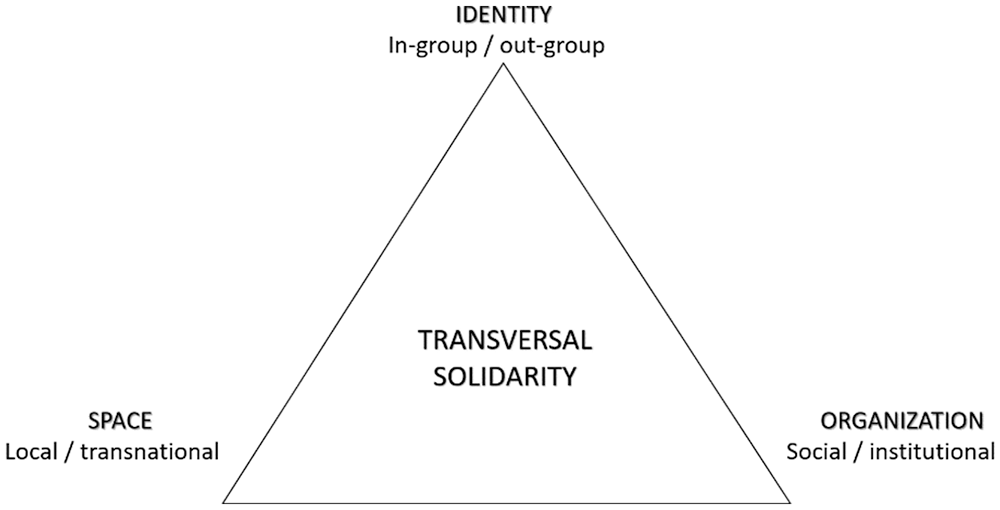
Conceptualising transversal solidarity.
In our previous work, the book Solidarity and the ‘the Refugee Crisis’ in Europe (Agustín and Jørgensen, 2019), we have argued that solidarity, in the conjuncture of the economic crisis and the long summer of migration, can contribute to developing the political opportunities available into alternatives. Based on Massey’s idea of articulating conjunctures in distinctive and productive ways, Featherstone and Karaliotas (2017) highlight the importance of acknowledging the logics of the Great Financial Crisis of 2008 as well as its impact on different groups to ‘envision articulations of solidarities/alternatives across differences in the context of the European crisis’ (Featherstone and Karaliotas, 2018: 294). The challenges posed are enormous: From the return of nationalism and xenophobia to the production and fragmentation of a multifarious precariat (Jørgensen, 2016). However, the articulation of alternatives is already present in many of the responses to the crisis of CSOs movements, by self-organisation, the shaping of new and the potential renewal of existing institutions. This solidarity is inventive in creating imaginaries, practices and institutions.
This is not withstanding pessimistic interpretations of the dynamics and outcome of crises. For example, Harvey argues that ‘crises are essential to the reproduction of capitalism. It is in the course of crises that the instabilities of capitalism are confronted, reshaped and re-engineered to create a new version of what capitalism is about’ (Harvey, 2014: ix). The so-called ‘refugee crisis’ is in truth entangled with the political economy of neoliberal globalisation. Thus the ‘refugee crisis’ is not just about human flows, humanitarian concerns and securitisation but part of a global economy where the migrant precariat is very functional in producing cheap exploitable labor. However, as we have seen in terms of responses to the financial crisis (to put it in short), we also see how a crisis can actually spur the development of new relations and solutions. Thus, by acknowledging that solidarities are ‘inventive’, that they produce new configurations of political relations, political subjectivities and spaces, we focus on the potentially transformative imaginations and practices they may produce.
Hence, solidarity is not a given; a position that opens up the possibility for reading the diversity of struggles and for analysing the formation of alliances in civil society as constitutive, productive and basically political (Agustín and Jørgensen, 2016). Solidarity is, thus conceived, contentious and as such a counter-hegemonic social and political mode of action which can unify diverse actors to come together to challenge existing institutions and governmental authorities ‘in order to promote and enact alternative imaginaries’ (following Leitner et al., 2008: 157). The potential and capacity to not only envision but to truly enact alternative imaginaries is another important aspect of solidarity and one, which is decisive for analysing how solidarity actually responds to the European asylum and migration political geography.
All in all, transversal solidarity, understood as laid out above, will expand the sense of community (not restricting it to pre-existing ‘chosen’ ones), move beyond borders (without reproducing the logics of national borders), be produced from below (from understandings mostly at odds with that of mainstream politics or discursive abstractions by mainstream media). It is an understanding of solidarity straddling social and institutional arenas (without rejecting the impetus to transform institutions from within as well as from the ‘outside’).
Typology of Transversal Solidarities
In our earlier work (Agustín and Jørgensen, 2019), we introduced a typology of solidarity of autonomous solidarity, civic solidarity and institutional solidarity, which reflects different ways of practicing, organising and articulating solidarity. Through this typology we showed how the ‘crisis of solidarity’ was rather a crisis of states or, in other terms, of institutionalised solidarity; that is, the incapability of existing institutions to develop or support forms of solidarity, as demonstrated by the New Pact on Asylum and Migration. We do not see the categories in this typology as fixed or completely coherent. They are fluent and can be open to changes and even contradictions. In any case, they must not be seen as idealised forms of solidarity but rather as rooted in practices and the conjuncture provoked by the economic and ‘refugee’ crises. Taking a spatial approach, we consider the spaces of solidarity and the resulting ways of organising, the (re)shaping of communities, relating to the state (and other institutions), and the kind of alternatives they produce. As argued above, solidarities are spatially produced. Thus, Arampatzi (2017: 2156) speaks of ‘urban solidarity spaces’ in terms of ‘spatial practices of solidarity and struggle that unfold at the territorial, social and economy levels, and aims to further understandings of how people and communities contest crises’. Consequently, space represents one dimension of transversal solidarity. In line with this, Featherstone uses, critically, the term ‘nationed geographies of crisis’ to ‘suggest ways in which the nation is reasserted as the primary locus through which grievances are articulated and envisioned’ (Featherstone, 2015: 21). It is an articulation apt to generate exclusionary articulations of the nation; for example, neoconservative alliances as supposed alternatives to neoliberalism. Seen from this perspective, trans-local solidarity networks, connecting local with regional or global geographies, involve encounters transcending national borders (Agustín, 2017). They are essential in redrawing progressive cartographies, relating ‘to diverse internationalist trajectories and connections’ (Featherstone and Karaliotas, 2018: 299).
The follow-up question is to ask how these different manifestations of transversal solidarity can, in a variety of ways, contribute to enable and connect geographies of solidarity within (and beyond) Europe. Departing from there we develop, in the following our typology to investigate and analyse various types of transversal solidarity (Figure 2). First, we discuss transversal solidarity as manifested through practices of autonomous solidarity exemplified by the case of City Plaza Refugee Accommodation Center in Athens and the Reclaim the Power organisation in the UK. Second, we discuss transversal solidarity as manifested through practices of civic solidarity by looking at Venligboerne, the welcome refugees movement in Denmark. Third, we focus on ‘institutional solidarity’ exemplified by transversal practices of municipal solidarity.
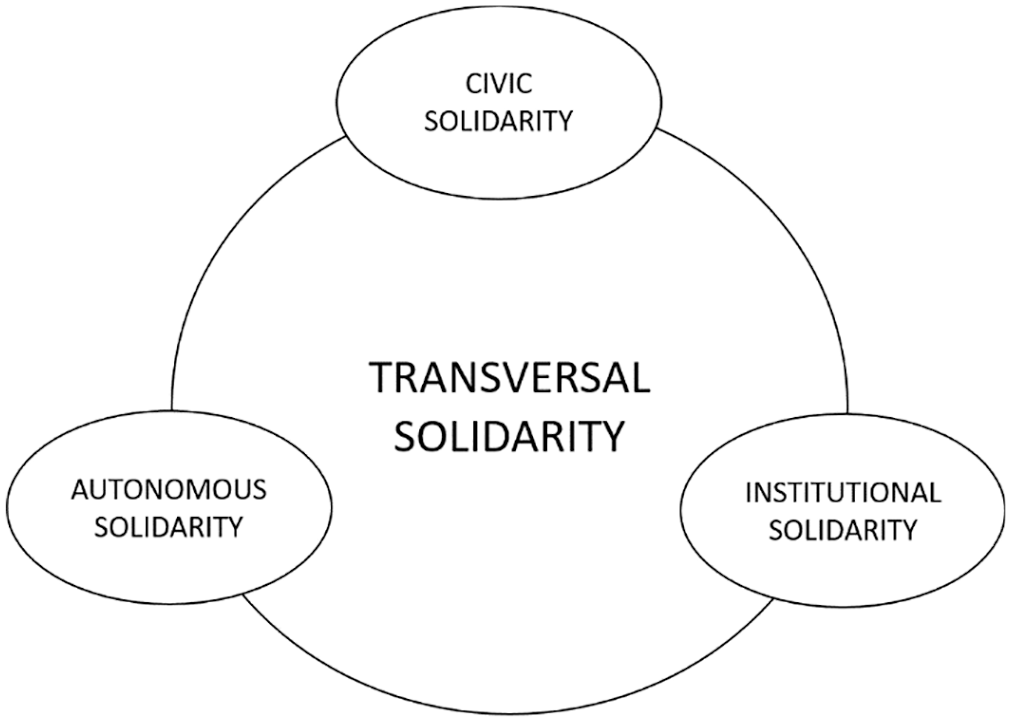
Typology of transversal forms of solidarity.
Autonomous Solidarity
Autonomous solidarity implies relations and practices that are produced in self-organised (mainly urban) spaces. Based on our earlier work we investigate how autonomous solidarity can represent a particular way of organising transversal solidarity. It is about solidarity based on horizontal participation such as direct democracy and assemblies, emphasising equality if participation and influence among their members. Collaboration with state institutions and their so-called ‘securitized humanism’ (Mudu and Chattopadhyay, 2017) is rejected, as well as the idea of supporting ‘anyone in need’ professed by many NGOs and other civil society actors (Dicker, 2017). The principle of equality, which underlies this horizontal and participatory approach to solidarity, aims at undoing dichotomous categorisations and to define their members by ‘doing’, like encapsulated in the idea of ‘activist citizens’ (Isin, 2009). The focus on self-organisation moves beyond specific moments of mobilisation in developing other forms of institutions, understood as the infrastructures through which autonomous solidarity materialises. Therefore, the principle of rejecting institutions, here refers to established institutions, since there is indeed a need for alternative institutions or ‘social institutions’. The autonomous solidarity responds to what Graeber (2004) calls a ‘theory of exodus’, perceived as the most effective way of opposing capitalism and the liberal state (see further, Agustín and Jørgensen, 2019). It implicates that instead of taking on or challenging power, new forms of communities are created as a strategy to ‘slip away from’ power. Although autonomous solidarity is produced locally in the urban spaces, it can also ‘scale up’ (Kurasawa, 2014) by connecting different anti-governmental modes of transnational politics and thus connect different political geographies. In concrete manifestations of autonomous solidarity, we also find the mentioned dimensions of transversalism; that is, in terms of identity, space and organisation.
One example of autonomous solidarity is the City Plaza Refugee Accommodation Center in Athens. The City Plaza Hotel was a self-organised housing project for homeless refugees in the center of Athens, which accommodated 400 people. This accommodation center evolved as a concrete practical response to the conditions of asylum seekers in Greece and to a perceive lack of responsibility by both the Greek state and the international community in a situation of escalating emergency in April 2016. Describing itself as ‘the best hotel in Europe’, the space was occupied as a direct response to the EU–Turkey deal at that time, with the goal of providing safe accommodation to transiting migrants trapped in Greece (European Council, 2016). City Plaza became known for fostering an egalitarian environment of mutuality between migrants and Greek and international volunteers. At the same time, the project articulated a multi-scalar critique – against the European border regime, against the fascist encroachments on the Athenian center, and against the transformation of Syriza into both a manager of austerity and an organiser of a problematic NGOised and securitised response to refugees stranded in Greece (Refugee Accommodation and Solidarity Space City Plaza, 2016; 2019).
The occupation of the hotel was not seen by the activists as the only solution to the ‘refugee crisis’ but as exemplary case demonstrating how solidarity work can provide alternatives; a ‘micro-utopia’ showing how the crisis could be dealt with. It offered a lived example that could be replicated elsewhere in Europe. The City Plaza Hotel case is thus an example of how a local initiative, involving a single urban site, can articulate the crisis of failed management, while presenting a new imaginary and a practical alternative. City Plaza can thus be read as example of one type of organising transversal solidarity. In terms of identity the people who constituted the residents of City Plaza transgress the dichotomy of in-group and out-group. City Plaza used the notion of ‘co-habitants’ emphasising even more than ‘inhabitant’ the collective solidarity creating its principled position. Solidarity is thus generative of the shared identity ‘co-habitant’ (Agustín and Jørgensen, 2019). Stressing the commonalities constituting City Plaza is also what made it so strong.
City Plaza sees itself as part of a multitude of different solidarity practices and struggles that emerged since last year, which constitute a specific demand to the Greek state, against the detention of refugees in despicable detention centers as well as against their isolation in monstrous camps; for the decent housing of refugees in the cities, ensuring their access to health care, education and all social services. On the other side City Plaza sees itself as part of the European and international solidarity movement which challenges the militarization of borders and the externalization of asylum policies and which claims the freedom of movement and the right to stay (Refugee Accommodation and Solidarity Space City Plaza, 2016).
The statement above by the Refugee Accommodation and Solidarity Space of City Plaza is, as well, an illustration of transversal solidarity’s spatial dimension. Although City Plaza was a very locally anchored and contextualised experience it transgresses the separation of the local and the international. It is both at the same time. The struggles that took place within a particular neighbourhood of Athens, is also a struggle opposing the exclusionary European asylum system.
Finally, City Plaza provided an example on how social structures can be built from below. The center was shaped according to principles of self-organisation and autonomy, depending entirely on the voluntary political support and practical solidarity from within Greece and abroad (Refugee Accommodation and Solidarity Space City Plaza, 2016a). City Plaza organised, without implicating any irony, an online support campaign describing the hotel in terms of: ‘No pool, no minibar, no room service, and nonetheless: The Best Hotel in Europe’. In a two-year period, 385,000 warm meals were served by the kitchen group, 35,000 hours spent on security posts at the entrance and balconies of the hotel, there were 13,560 hours of shifts at the reception and 18 tons of heating oil was used in the boilers and radiators (Refugee Accommodation and Solidarity Space City Plaza, 2017), all depending on solidarity support, from the ground up, and did not received any funding from NGOs, the state or the EU.
City Plaza was a reaction to the dramatic border spectacle of 2016 and the stalemate of the EU asylum regime, including individual member states’ reluctance to receive and accommodate, with the upshot of inhospitable detention centers the conditions of which seemed to be devised to deter refugees from crossing the borders. It is history that will most likely come to be replicated, given the actual character of the EU’s New Pact on Asylum and Migration and the dubious ‘solidarity à-la-carte dish’ it offers. City Plaza did not provide the solution to the exclusionary policies of the EU border regime, as such, but it is an example on how transversal solidarity can be articulated and point at alternatives. As stated by the organising group of City Plaza:
We do not, of course, believe that the problem can only be solved through squatting, as the provision of shelter is a fundamental obligation of the state and the local authorities; we do, however, believe that squats can act not only as a means for claiming rights but also as a factual exercising of rights precisely by those who are deprived of rights: the illegalized and excluded economic and political refugees (Refugee Accommodation and Solidarity Space City Plaza, 2016a).
Another text launched by City Plaza and the solidarity network Welcome to Europe repeated this argument, claiming: ‘The squat cannot be the solution for all of this but a vivid example of how things can be better if each of us tries. It will not solve the European shame, but it can be an outcry of solidarity’. It goes on arguing that it is not a solution for the ones remaining outside the walls of ‘Fortress Europe’, the ones stuck on the islands, in the so-called hot spots – but even for them ‘City Plaza is a symbol that it can be possible: Another, a welcoming Europe’ (Welcome to Europe, 2016). When those accommodated in City Plaza and other self-organised spaces risked being evicted in 2019, as a consequence of a new government coming into power, the organising group decided to close down the space; a decision taken facing an intensified crackdown on self-organised spaces by the new conservative government (Nashed, 2019), as well as the politically unacceptable alternative of institutionalisation through NGOisation, City Plaza decided not to accept any new guests (see Fischer and Jørgensen, forthcoming).
Our second example is Reclaim the Power, a UK-based direct action network fighting for social, environmental and economic justice. It aims at building ‘a broad-based movement, working in solidarity with frontline communities to effectively confront environmentally destructive industries and the social and economic forces driving climate change’ (Reclaim the Power, 2019). In June 2019 it organised an action camp called ‘Power Beyond Borders: against new gas and the hostile environment’. The action camp expands the struggle against the destruction of the environment with pro-migrant and anti-racist struggles. The camp took, symbolically, place in the shadow of Rye House power station in Hoddesdon, UK, where participants wanted to live as a community, to learn from each other and take action. The 500 participants later rallied under the slogan, ‘No borders, no nations, no gas power stations!’. The analysis of Reclaim the Power reads it is no coincidence that a climate action network is embarking on solidarity work with migrants and racialised groups. Here the focus is on commonalities and to establish an inclusive identity. Doing so, entails not to eradicate group identities but to create a space for transversal solidarity politics. Dealing with the climate crisis and its consequences implies a fair treatment of people who cross borders. There is no climate justice without justice for migrants, it is argued. Migrant collectives as All African Women’s Group, Anti-Raids Network, End Deportations, Resist + Renew, North East London Migrant Action and more were part of the camp. The group claims that ‘Bringing together activists to learn and skill up on climate and migrant justice was every bit as important as the actions that we took. With this camp, we have begun to take steps so that we can take effective action, in solidarity with activists on the sharpest end of the UK’s racist treatment of migrants’ (ibid.). This statement again reflects a transversal politics, which combines different geographies.
Civic Solidarity
Civic solidarity indicates ways of organising produced as civil society initiatives to include refugees. It counts a vast number of manifestations and actors, such as NGOs, local communities and individuals. It is practiced by non-state civil society actors, but the degree of contention varies depending on the claims and strategies of each organisation. Connected to our conceptualisation of transversal solidarity, it relates first to identity and transgressing the construction of in-group and out-groups by emphasising commonalities. Civic solidarity is ‘the sphere of fellow feeling, the we-ness that makes society into society’ (Alexander, 2006: 53). It is wider than the state as vehicle of protection of citizens (Scholz, 2008: 27), and at the same time receptive to the idea that the vulnerabilities, which prevent people from participating in society on equal terms, must be eliminated. Thus, practices of civic solidarity combine the expansion of rights with the shaping of we-ness or sustaining ‘collaborative relations within and between different social groups, inasmuch as it [civic solidarity] represents individuals’ interests’ (Sammut, 2011: 416).
In terms of space, the ‘long summer of migration’ saw forms of civic solidarity multiply, in a situation when states were not capable of managing the crisis and offer refugees and asylum seekers means to become part of the national communities. Together with attempts to expand rights, the we-ness also is reshaped and expanded. In opposition to movements for fragmentation, that is, exclusion of refugees, as those that are aimed exclusively towards nationals, civic solidarity also contributes to forging new alliances and collective identities in different kinds of spaces, from community kitchens to those who provide legal assistance. This opposition to state practices does not imply, as mentioned before, that civic solidarity is ‘against the state’ since there are different kinds of positions on it, from critical to trying to gain influence in policy-making. Different scales are combined from local communities to national (to have more visibility and influence) and transnational (to achieve global awareness and exchange practices). Likewise, this type of organising points to attempts to combine the social and institutional – or to install the social in a reconfiguration of institutions. We will refer to the Danish welcome refugees movement Venligboerne as a case in point.
At the end of 2017, more than 100,000 people were active in refugee solidarity groups in Denmark (Toubøl, 2019: 1203). Many if not most of these people joined local groups of the movement Venligboerne (literally ‘friendly neighbours’). The Venligbo movement started up already in April 2013, with a local initiative to improve the well-being of residents in the small town of Hjørring in northern Jutland. During the ‘refugee crisis’, the movement grew as it switched its focus to welcoming the refugees arriving in Denmark. Initially the members of the loosely organised welcome refugees movement engaged in exactly welcoming arriving refugees. This kind of action illustrate, in various ways, forms of transversal solidarity. A statement of a central organiser of the solidarity network working from the central train station in Copenhagen published in a letter to The Washington Post, is indicative (see also, Agustín and Jørgensen, 2019): ‘It was a political cause where we felt we for once could contribute. A cause where we could make a difference. We will never do something which goes against our conscience – even if the state demands it’ (Samir in Róin, 2016; our translation and our italics). The we here is important as it illustrates the emerging tranversal solidarity across ethnic and social divisions. Here Samir is also speaking as an post-immigrant coming from the Nørrebro area of Copenhagen, habitually stigmatised in terms of being an immigrant ‘ghetto’ (Agustín and Jørgensen, 2019). At one and the same time a sense of we-ness is established (identity), which is anchored in a local community contesting what was considered inadequate actions by the Danish authorities (space), and new civil alliances are forged (organisation). After the Danish authorities introduced legal restrictions for entering Denmark and de facto closed the border, the Venligbo movement started developing into a humanitarian service provider. The movement has a number of characteristics, which still exist. This includes providing various forms of practical assistance, such as legal aid, medical support, language training, job-seeking assistance, transportation and to make available everyday donations. It creates broad alliances that include both experienced activist and people new to solidarity work. It makes visible the problems of the asylum process and integration into Danish society, insisting on a humanitarian approach, different from the exclusivist approach taken by the state (Agustín and Jørgensen, 2019). Overall, the movement advocates for inclusive democracy, shaped through and by actors in civil society. The movement also highlights the commonalities between refugees and Danes, thus subverting a hegemonic discourse on refugees as dangerous, uncooperative, subversive or worse. It challenges the common-sense idea that ‘we cannot learn something from them’ (Jørgensen and Olsen, 2020). From the beginning, the movement regarded itself as ‘non-political’, not only as an attempt to separate the movement from any party–political affiliation, but also to signify that the movement would not criticise government policies but rather provide practical solutions to problems. This position caused an internal conflict, as a growing number of local groups – especially in Copenhagen - wanted to take and overtly political stance vis-a-vis the state with less of a focus on humanitarianism. The ‘political’ fraction did not want to become service providers but rather to spur political change through political actions. This position leans towards a more autonomous form of solidarity. However, we also see a turn towards deepening institutional solidarity from below. Perhaps the opening of a political or politicised space has also spurred the development of a new phase of transnational engagement. It is an engagement that does not ignore the role and importance of the local but which connects different geographies in an attempt to influence and change the European border regime. Like in other European countries, the conditions in Greek hotspots, such as the Moria camp, has long been a focus for the Danish solidarity movement. As stated in the introduction, the lockdown caused by the COVID-19 pandemic in combination with the devastating fires in the Moria camp worsened conditions refugees, trapped there, even more. The situation caused individual members of the solidarity movement of Venligboerne to initiate various initiatives in the Danish context, such as raising money for necessities, but also long-term projects like establishing educational and cultural facilities for migrants in Greece. Spurred by initiatives in other European cities that jointly offered to give unaccompanied minors from the camps asylum –thus circumventing the Dublin regulations – the Venligbo members started forging alliances with local city council members. The Danish government has repeatedly stated its opposition to receiving refugees from these camps. However, because of ongoing solidarity work by Venligboerne on the local level, at least seven Danish city councils have now joined the cities of Amersfoort, Amsterdam, Barcelona, Ghent, Groningen, Leipzig, Nuremberg, Tilburg and Utrecht, in a claim for being allowed to bring in children from Moria (Wandrup, 2020). Although perhaps more a political posturing than of an action of substance by these cities – as they will require the formal approval of the Minister of Immigration and Integration to actually receive refugees – their hope is that bringing the issue to the European scale will create pressure on the national scale, and by this facilitate practical solidarity on the local scale. In this way, different geographies are connected in a transversal struggle. Here practices of civic solidarity intersect with practices of institutional solidarity.
Institutional Solidarity
Institutional solidarity represents the formalisation of different degrees of solidarity, which connects the civil society arena with institutional policy-arenas. Institutional solidarity is usually related to how ‘members contribute both because they are obliged to do so according to institutional arrangement and because they expect to get something back if they are in a situation of need’ (Fenger and van Paridon, 2012: 51). This conception of institutional solidarity as rights and obligations or as systems based on anonymous or contractual forms of solidarity (Arts et al., 2001: 476) tends to refer specifically to the welfare state as a form of mechanical solidarity. However, we prefer to use the term ‘institutionalised solidarity’ and maintain an open definition of ‘institutional’ in which informal social relations and institutional norms can converge (Agustín and Jørgensen, 2019).
Conceiving, as argued above, institutional solidarity a produced by formalisation of solidarity relations, implicates that there will be a constant tension between potential political actions of solidarity and their regularisation by institutions. The key for defining institutional solidarity - in contrast with institutionalised solidarity - is the capacity of enabling (infra)structures to solidify solidarity and maintain, reproduce and foster connections civil society, including migrant and refugee organisations. This emphasises an understanding of transversality rejecting the incompatibility of the social and the institutional. It appears logical to see the local or the city as pivotal for the shaping of institutional solidarity; that is, a scale where the relations (and also the tensions) between institutions and civil society are tighter and less distanced. The relation to the nation-state (and its form of institutionalised solidarity) is often conflictual since the aims and realities dealt with are different. At the same time instances of conflict between the local and the national scales appears to explain, why and how the international scale is promoted in order to retrieve transnational alternatives going beyond the opposition and restrictions of states. The most prominent cases of institutional solidarity are ‘sanctuary cities’, mainly in the United States and Canada but also in the UK, and the re-municipalisation or ‘new municipalism’ in Europe. To illustrate this type of organising practices we use the case on how municipalities within Europe has challenged the European border and asylum regime and on how new municipalism is promoting politics of solidarity at the local urban and the transnational scale.
The number of migrants dying in attempts to cross the Mediterranean Sea reached a peak in 2015, when 5,143 people were registered as drowned (Statista, 2020). Numbers show a decline since 2015 but still counts 1,885 people dying in the attempt to reach Europe in 2019. European activists have sought to help migrants with safe crossing. Organisations like Sea-Watch, Jugend Rettet, SOS Mediterranée, Mission Lifeline and others began chartering boats and small planes in an effort to rescue shipwrecked migrants and activist collectives as Alarm-Phone seeks to assist migrants with info and routes while at sea. The EU’s increasing militarisation of its maritime missions and the criminalisation campaigns of European governments (especially receiving countries in Southern Europe) has intensified the activism and civic responses. At the same time – or very likely as a direct consequence of this development – we see some cities developing accommodating policies and offering protection in solidarity with the refugees. Palermo is one such example. ‘We cannot say today that Palermo respects the rights of migrants. Because we have no migrants in Palermo. If you ask how many migrants are in Palermo, then I do not answer 100,000 or 120,000, but none. If you are in Palermo, you are a Palermitan’, exclaimed the Mayor of Palermo, Leoluca Orlando (quoted by Bauder, 2019) in the aftermath of the European ‘refugee crisis’. When Italy’s interior minister, Matteo Salvini, got the parliament’s support of his anti-immigrant decree in 2018 intended to make Italy more unwelcoming to migrants, Orlando refused to apply the decree in a stand that has become a prominent example of a widening grassroots and urban resistance to the hard line on immigration (Horowitz, 2019).
Although cities are not progressive per default, challenges faced by cities in accommodating newcomers (migrants and refugees) require them to find ways to secure access to legal residency, social protection, cultural belonging and to accept the presence of illegalised migrants. This is a difficult task, as national governments hold the right to issue visas, permits, residence etc. – however, the new municipalist surge demonstrates that the municipality is a crucial site for the organisation of transformative social change (Roth and Rusell, 2018). This kind of solidarity is produced both spatially and organisationally. Indeed, a new municipalism emerged in the case of Spain from the attempt to strengthen hybrid (including political parties, social movements and activists) and local organisations responses to the crisis of legitimacy of traditional state parties. Promoting progressive localism, the new municipalism has faced two challenges: the politicisation of the local level, affecting the redefinition of community and the relationship between the public and the private, and the enablement of new social imaginations capable of connecting alternative geographies (Agustín, 2020). The city emerges as the pivotal space of transversal solidarities in addressing this dual challenge. On one hand, communities of solidarity are based on everyday socio-spatial practices and avoid consciously to reproduce the divide between nationals and outsiders, while idea of the ‘commons’ emerge strongly as a project to re-municipalise public services. On the other hand, municipal initiatives are pursued in order to prove that real change emerges from cities (and not only from the nation-state) and that a new social imagination is resulting from connecting the cities’ democratic practices at different scales.
Taking the case of Barcelona, which is emblematic in this context, two trajectories in developing institutional solidarity are important: the Barcelona’s Refuge City Plan and the Fearless Cities initiative. The former was launched by the City Council in 2015 to give institutional form to already existing solidarity relations as response to the so-called ‘refugee crisis’ and to facilitate the arrival and accommodation of refugees. The city was presented as the place to deal with global issues and the City Council aimed to expand the institutional scope of action, including civil society groups and activities, and to enhance spaces of convergence between the local and the transnational. The goal of the Plan was to create ‘a citizen space to channel urban solidarity and to set up coordinated ways of participating in its application’ (Barcelona Ciutat Refugi, n.d.). The mere idea of a city of refuge generates the imaginary of the city as space of solidarity, in strong contrast to the position of the European Union and its Member States. Although the original idea was to be prepared for a humanitarian situation of emergence, the Plan was transforming itself due to the existing realities faced by migrants and refugees as well as the changes in the place of origin of the refugees. At the transnational scale, the launch of Fearless Cities in June in 2017 represented an ambitious project to reclaim the city as space of global politics of solidarity. The initiative of Fearless Cities sustains that localism is necessary to promote transformative politics of scale (Russell, 2019). Ada Colau, major of Barcelona, framed new municipalism as the main opposition to neoliberalism: ‘municipalism is a rising force that seeks to transform fear into hope from the bottom up, and build that hope together’ (Colau, 2018: 194). The idea of upscaling municipalism and moving towards a global municipalism entails a clear transversal component since it seeks to overcome dichotomist divisions between winners and losers, us versus them, and propose the creation of an international network to promote human rights, environmental justice and feminism. One of the specific projects, The Fearless Cities map, elaborated by Barcelona en Comú in collaboration with other municipalities, represents visually the international scope of municipalism as an alternative way of acting locally (through cooperation between civil society and institutions) and translocally (through the connection between municipalist practices).
At the Fearless Cities gathering, Debbie Bookchin stated,
Conclusion
Our intention with this article has been to develop a conceptualisation of transversal solidarity, which we initiated in our previous work to grasp the solidarity practices and dynamics, particularly after the humanitarian crisis of 2015 in Europe. The idea of conceptualising solidarity as transversal aims to overcome some of the problems related to solidarity and to elaborate a complex definition based on three dimensions (identity, space and organisation). Importantly, this acknowledges that not all forms of solidarity are the same and it implies different actors, goals and practices. Therefore, we work on a typology of forms of solidarity, autonomous, civic and institutional, which are transversal, although in different ways. Some examples were discussed relating to each category in order to illustrate how transversal solidarity works within each type, by focusing on their achievements as well as innate tensions and potential shortcomings. In Table 1 we present this comprehensive conceptualisation of transversal solidarity, attending to variable types and dimensions.
Types and dimensions of transversal solidarity.
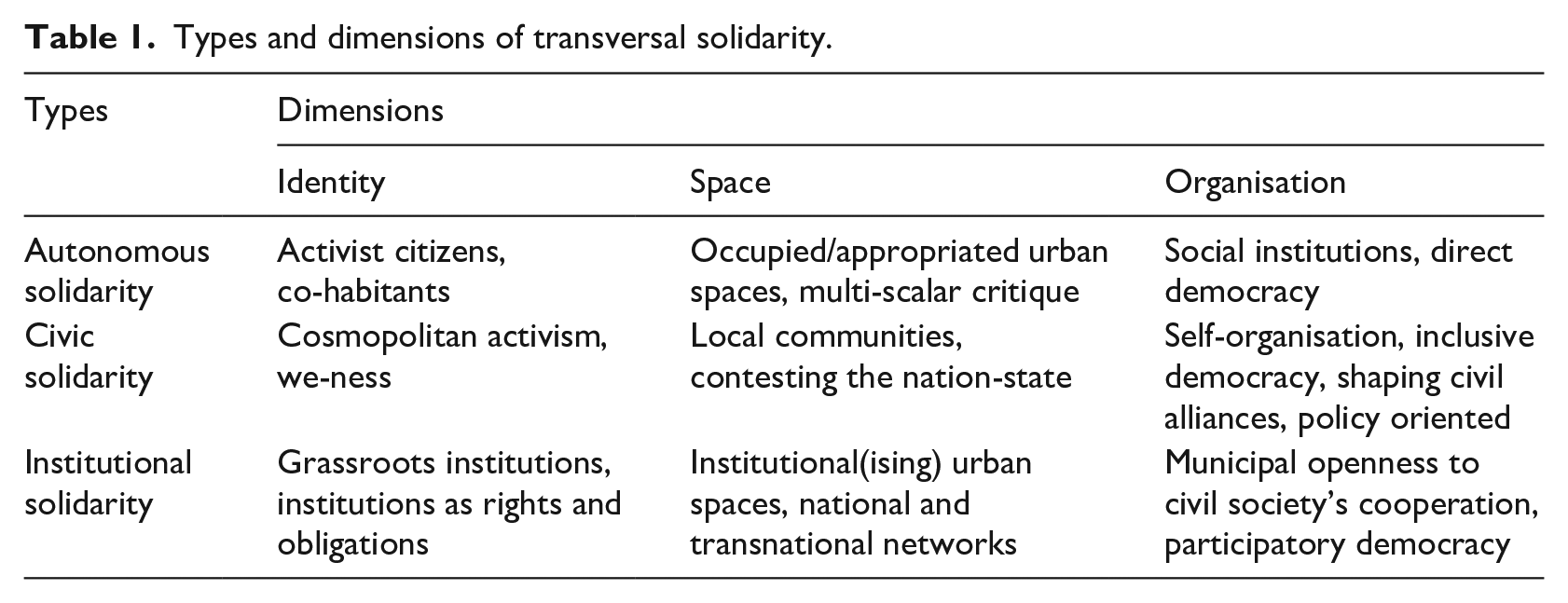
As reflected in Table 1, the different types of transversal solidarity differ in terms of identity, space and organisation. This stands out, for instance, in the naming of their identity (activist citizens, cosmopolitan activism, grassroots institutions) as well as in the type of transversal identity (or common positioning) resulting from encounters and acting together (co-habitants, we-ness, institutions as rights and obligations). None of these identities pre-existed solidarity relations and they are the consequence of finding a common ground where the plurality of identities coexists with the claim for equality. Regarding space, it remains clear that transversal solidarity is rooted locally and promotes a form of progressive localism. However, local relations and practices are different as are their way to connect other geographies and to promote politics of scale. The question of organisation is controversial since it is connected with conventional modes of understanding democracy. While principles of autonomous solidarity rely on direct democracy and the formation of social institutions in confrontation with existing local and national institutions, civic solidarity is oriented towards developing civic practices and influencing policies through an inclusionary approach to democracy. Institutional solidarity is different, since it is not implying the way in which civil society influences institutions but rather how institutions can cooperate and include civil society in policy-making. Here, democracy is conceived mainly as being participatory and not limited to institutional or political actors.
In conclusion, our hope is that this model can be useful for exploring recent and future experiences of solidarity. Complex conceptualisations of solidarity are needed to account for the manifestations coming from below to challenge a migration and asylum system, which so far has proved to be unjust and exclusionary. Transversal solidarities will continue to emerge in opposition to this.
