




Abstract
Organized persuasive communication is essential to the exercise of power at national and global levels. It has been studied extensively by scholars of public relations, promotional culture and propaganda. There exists, however, considerable confusion and conceptual limitations across these fields: scholars of PR largely focus on what they perceive to be non-manipulative forms of organized persuasive communication; scholars of propaganda focus on manipulative forms but tend either to examine historical cases or non-democratic states; scholars of promotional culture focus on ‘salesmanship’ in public life. All approaches show minimal conceptual development concerning manipulative organized persuasive communication involving deception, incentivization and coercion. As a consequence, manipulative, propagandistic organized persuasive communication within liberal democracies is a blind spot; it is rarely recognized let alone researched with the result that our understanding and grasp of these activities is stunted. To overcome these limitations, we propose a new conceptual framework that theorizes precisely manipulative forms of persuasion, as well as demarcating what might count as non-manipulative or consensual forms of persuasion. This framework advances PR and propaganda scholarship by clarifying our understanding of manipulative and propagandistic forms of organized persuasive communication and by providing a starting point for more fully evaluating the role of deception, incentivization and coercion, within contemporary liberal democracies.
Keywords
Introduction
Research in the fields of propaganda and persuasion studies has proliferated since the early 20th century when the rise of mass communication and literacy focused attention on how organized communication is used in pursuit of influence. Indeed, what we label as organized persuasive communication (OPC), a generic short-hand term used in this article to refer to all organized persuasion activities (including advertising and marketing, propaganda, public relations, organizational communication, information/influence campaigns, psychological operations, strategic communication and a whole host of other overlapping terms), is central to the exercise of power across all social spheres. In the new internet-based media environment, new forms of persuasion and influence are manifesting themselves through mechanisms of surveillance, micro-targeting and digital propaganda (González, 2017). However, there exist considerable terminological confusion and significant conceptual limitations across these fields. Scholars of PR (and related fields), as well as promotional culture, focus on what they perceive to be non-manipulative forms of OPC occurring within contemporary liberal democracies, while scholars of propaganda focus on its manipulative forms and on either historical cases or non-democratic societies. Across these fields, there is minimal conceptual development with regard to manipulative modes of OPC involving deception, incentivization and coercion. As a consequence, manipulative OPC within liberal democracies is a blind spot, rarely recognized let alone researched, and with the result that our understanding and grasp of these activities is profoundly curtailed.
In order to move research in these fields forward, we resolve these problems through the development of a new conceptual framework that draws upon sociology, political science, communication studies, philosophy, persuasion, rhetoric and behavioural economics, and that theorizes precisely manipulative forms of OPC. The framework also demarcates what counts as non-manipulative, or what we call consensual, forms of persuasion. Our main focus in this article is on the manipulative and propagandistic modes of OPC, primarily because it is these that have been paid the least attention across the literature (as we will show), but we do also conceptualize non-manipulative OPC: we devise a continuum of OPC ranging from the most consensual (Habermasian dialogical communication) to the least consensual (outright coercion). In presenting non-consensual OPC, we explicate propagandistic forms of persuasion involving deception, incentivization and coercion, delineating core features and highlighting its operation through researched and documented examples. The framework is a significant conceptual advance. While some aspects of the strategy of deception are well documented, other techniques by which it operates are poorly understood. Meanwhile, strategies of incentivization and coercion are rarely addressed, thus neglecting an important dimension of OPC that operates in relation to physical, socio-political and economic contexts where incentives and threats are part of persuasive communication activities. Most importantly, the conceptual framework provides a starting point for scholars of PR, propaganda and promotional culture to explore more fully the issue of manipulative and propagandistic OPC in contemporary democracies: in doing so, our understanding of how power is exercised in society, across political, economic and military spheres is advanced.
The article proceeds in three sections. Section one provides some illustrations of well-documented examples of the use of deception, incentivization and coercion as persuasive strategies across major political, social and military contexts within liberal democracies. Section two considers three broad categories of scholarship examining OPC (PR [and related fields], propaganda and promotional culture) and shows they do not fully attend to its incentivizing, deceptive and coercive dimensions. Section three develops the conceptual framework. Drawing upon the concept of consent (freely chosen and informed agreement), the framework distinguishes OPC that is consensual and therefore non-manipulative, from that which is non-consensual (propagandistic) and manipulates via deception, incentivization and/or coercion. The article concludes by summarizing the utility of this framework for advancing our theoretical and empirical grasp of OPC and notes the importance of further critical evaluation of OPC activities and their impact on democracy.
Deception, Incentivization and Coercion
Deception, incentivization and coercion occur across democratic and non-democratic states. Deception is a perennial concern dating back at least to Ancient Greece including in Plato’s The Republic and Aristotle’s On Rhetoric (Corner, 2007). Documented and widely accepted examples of political deception in democratic states include the Watergate and Iran-Contra scandals. In Watergate, President Nixon lied about his attempts to subvert the democratic process (Sheehan, 1971); in Iran-Contra, US officials lied about arms sales to Iran and supporting the Contras, who were attempting to overthrow the Nicaraguan Sandinista Government. In Watergate, proof of Nixon’s guilt emerged with taped meetings detailing the cover-up strategy: Nixon’s claim that he was unaware of a cover-up was revealed as a lie. In the case of Iran-Contra, although President Reagan’s awareness of what was going on is disputed, senior officials clearly lied (Wroe, 1992). More recently, regarding the 2003 invasion of Iraq, Mearsheimer (2011) argues that the US Administration lied in its claims that it knew for certain Iraq possessed Weapons of Mass Destruction (WMD). Moreover, the contemporary internet environment is particularly vulnerable to deception strategies. For example during the 2016 US presidential election campaign battle between Donald Trump and Hillary Clinton, fake news stories, ranging from outright lies to those embracing more subtle deceptive forms (omission, distortion and misdirection) spread across the internet. Bakir and McStay (2018) explore how such deception is spread online via the economics of emotion: fake news providers create deceptive and outrageous stories and headlines (clickbait) to generate user attention and viewing time, which converts to digital advertising revenue for fake news providers. Also, the rise of the political bot (Woolley and Howard, 2017) highlights the sophistication of deception tools available in the online environment. During the 2010 US midterm elections and Massachusetts special election, social bots were reportedly used to support some candidates and smear their opponents, by creating thousands of tweets pointing to websites with fake news (Metaxas and Mustafaraj, 2012; Ratkiewicz et al., 2011).
Beyond deception, incentivization (offering or providing benefits) and coercion (threatening or actually inflicting costs) are also features of both democratic and non-democratic states. Incentives and coercion, we argue, are important elements of many OPC strategies, yet are rarely mentioned in the literature. Indeed, regarding coercion, a small literature on rhetoric and persuasion from the 1960s and 1970s (Andrews, 1969; Simon, 1972) highlights the inadequacy of a simplistic persuasion-coercion dichotomy. Interestingly, this literature focuses only on coercion emerging from non-elite challenges from the political left rather than the far more frequent and vastly better resourced manipulative OPC employed by powerful state and corporate interests. Writing in the context of the civil disruption experienced throughout 1960s America, Professor of Speech Herbert Simon (1972: 231) argued that scholars, when examining social conflict, had ‘failed to distinguish between cases of “pure” persuasion and cases involving combinations of persuasive and coercive elements’. They were clinging, he wrote, ‘to an antiquated “persuasion-coercion” dichotomy’. He argued that the study of rhetoric and social control needed to move beyond focusing on ‘speakers and speeches’ to explore physical threats (e.g. during militant protests) and also ‘institutions and structures’ as influencing conduct via ‘coercive persuasion’ (Simon, 1972: 242). Similarly, James R. Andrews suggested that persuasion and coercion were part of the overall rhetorical process. To demonstrate, he explored examples of how riots were integral to the persuasion process that led to a 19th century Reform Bill (Andrews, 1970: 187) and also the persuasion-coercion interface during 1968 Vietnam War student protests (Andrews, 1969; see also Artz and Pollack, 1997; Manheim, 2011: 103, 323). We draw upon these ideas when defining coercive OPC later in the article, while also noting the importance of expanding attention to include the routine use of coercive persuasion by powerful political and economic actors.
Examples of both incentivization and coercion can be readily identified across democratic states. Regarding incentivization, for example, during elections promised tax cuts are frequently used as a method of securing votes by persuading people who otherwise would not be inclined to vote for that candidate. Incentivization can also work more indirectly. For instance, cultural and educational exchange programmes associated with public diplomacy involve provision of benefits that encourage recipients to be favourably disposed toward the country/state providing them. Also, incentivization can have a coercive dimension. An example of this was the US message to Nicaraguans during their 1990 elections which, according to Chomsky (1990) was to vote for the US-backed candidate or face continuing US economic warfare; here the potential lifting of the sanctions was incentivization and the threat of their continuation was coercive. Regarding coercion, these strategies are integral to military ‘information operations’ where, for instance, ‘hearts and minds’ operations frequently involve the integration of OPC with military force: here officials recognize ‘that the success of non-kinetic effect is amplified by threats of kinetic activity’ (where ‘kinetic’ means military force) (Miller, 2015). A clear example of coercive OPC can be seen with the use of radio broadcasts and air-dropped leaflets aimed at encouraging enemy combatants to surrender during the 1991 Gulf War and the 2001 war in Afghanistan (Jowett and O’Donnell, 2012: 12; Taylor, 2002: 21‒22). Here, the persuasive effect of these propaganda leaflets revolved around the implicit threat: surrender or die. Coercive OPC is not the sole preserve of military operations, however, and, as we shall see later in the article, it also occurs in many political-economic realms.
In sum, strategies of deception, incentivization and coercion are recognizable persuasion strategies, and they occur across political, social and economic events within democracies. However, existing literatures only minimally engage with these forms of persuasion, as we will now show.
PR, Propaganda Studies and Promotional Culture: Failing to Get to Grips with Deception, Incentivization and Coercion
We divide existing scholarship on OPC into three groups: PR (and related subfields), propaganda studies and work under the heading of ‘promotional culture’. Under the label of PR (and related subfields) we include the range of persuasive communication activities captured in labels such as advertising and marketing, public relations, organizational communication, influence/information operations, psychological operations and strategic communication. Although some object to using PR as a group label, most scholarship in these areas owes a considerable debt to PR as a developing set of doctrines (Carey, 1997), and PR represents the most established academic field other than that of propaganda. Propaganda studies can be traced to early 20th century analysts such as the political scientist and sociologist Harold Lasswell (1935), the sociologists Paul Lazarsfeld and Robert Merton (1943), and the journalist and commentator Walter Lippman (1922) who sometimes saw organized manipulation of the masses as an unfortunate necessity in a democracy (Simpson 1994). Today, the term propaganda is usually associated with nefarious communication and most current definitions include the notion of manipulation (Corner, 2007; Lasswell et al., 1935; Lippman, 1922: 43‒44; Marlin, 2013: 7‒10): As Marlin (2013: 12) puts it: ‘At some point in a chain of reasoning a hidden, misleading, or otherwise unexamined presupposition will affect the outcome in a way not assessed by the propagandee.’ Finally, work on promotional culture represents a third, and most recently developed, strand of relevant literature. Building upon an understanding of promotion and persuasion in the commercial realm, promotional culture has sought to understand all OPC activities through the lens of commercial advertising and promotional activities.
We now discuss these three groupings of scholarship in detail: we show that they do not pay sufficient attention to conceptualizing manipulative persuasion involving deception, incentivization and coercion.
Public Relations and Related Fields: You do Propaganda, We do PR
Scholars of PR and related subfields eschew the term propaganda; most argue that the OPC activities they study, mainly in western liberal democracies, are largely non-manipulative and non-propagandistic. For these scholars, highly manipulative OPC (i.e. propaganda), occurs rarely in contemporary liberal democracies and belongs either to authoritarian states, the early 20th century or the ‘enemy’. Few engage with manipulation via deception, incentivization or coercion. One exception here is Manheim’s (2011) account of Information and Influence Campaigns (IICs), which he labels as part of manipulative strategic political communication. However, while recognizing incentivization as part of mobilizing coalitions, he only briefly refers to coercion (in the form of violent acts and protest) in the appendix (2011: 323) and an example box (2011: 103) and does not discuss deception. Moreover, similar to the small literature on rhetoric and persuasion from the 1960s and 1970s (Andrew, 1969; Simon, 1972), Manheim (2011: 126) discusses incentivizing activities as strategies pursued by ‘the weaker party in an asymmetric power relationship’, thereby sidestepping examination of their routine use by powerful actors.
Two reasons why PR scholarship tends to ignore deception, incentivization and coercion concern (a) deliberate attempts to distance PR from propaganda and (b) a tendency among some to conflate all persuasion with manipulation. We discuss each in turn.
First, there has been a drive to distance contemporary persuasion activities from manipulative propaganda. In the early 20th century the term propaganda carried few negative connotations (Simpson, 1994). However, its extensive use during the First World War led to its rebranding. Edward Bernays, recollected that: ‘propaganda got to be a bad word because of the Germans … using it [during WW1]. So what I did was to … find some other words. So we found the words Counsel on Public Relations’ (Bernays cited in Miller and Dinan, 2008: 5). This led to the renaming of various forms of OPC (with some exceptions, such as enemy war-time propaganda) as PR, thereby disguising OPC involving manipulation. A contemporary expression of this approach in PR scholarship is Grunig and Hunt’s (1984) influential four models of PR. As Moloney (2006: xiii) notes, they set out four categories of PR, three of which involve propagandistic or manipulative communication. The fourth category ‒ non-propagandistic symmetrical two-way communication ‒ ‘has taken hold’ as a concept ‘in many universities … to over-emphasise PR as a practice of virtuous messaging, known as two-way communications between equal, listening, negotiating, mutually respectful message senders and receivers’. Moloney (2006: xiiii) scathingly writes that it takes ‘the PR academy into a neverland of perfection’.
Second, the effort to distance PR (and related fields) from propaganda by some scholars has occurred alongside the argument by others that all persuasion equates to manipulation: this has served as a reason to avoid theorizing manipulative strategies such as deception and coercion. Part of the backdrop to this position lies in postmodern argument positing that all communication is a ‘language game’ (Lyotard, 1979: 9) involving power and attempts at legitimation. Truth claims must, it is argued, appeal to meta-narratives where the postmodern condition is ‘incredulity toward meta-narratives’ (Lyotard, 1979: xxiv). From this standpoint it is near impossible to distinguish between non-manipulative and manipulative communication because one cannot delineate between true (non-deceptive) and untrue (deceptive) statements while all communication is reduced to a play of power within a ‘language game’. This problem has been compounded by some scholars, such as Taylor, defining propaganda as ‘a practical process of persuasion’ involving ‘attempts to influence our opinions’ (1992 cited in Corner, 2007: 671), thus treating propaganda, persuasion and manipulation as synonymous. Counter to this position, we argue that persuasion and manipulation are not synonymous. Manipulation works against autonomy by enabling some people to obtain power over others. This can be distinct from persuading someone through non-manipulative (or consensual) argumentation. Also, we do not follow Van Dijk’s (2006) separation of persuasion and manipulation as distinct activities but rather understand manipulation as a subset of persuasion in line with Jowett and O’Donnell (2012). In short, for our purposes, not all persuasion involves manipulation although it sometimes does and, by distinguishing consensual from non-consensual persuasion, our conceptual framework will further clarify this distinction, as we shall see later.
Both of these arguments (PR and propaganda are distinct, persuasion and manipulation are synonymous) divert scholarship away from studying manipulative forms of OPC. For instance, in a recent special issue on PR and democracy (Taylor, 2013), only three articles out of 23 offer criticisms of ‘PR’, while the rest either explain its role in a democracy or advocate its benefits without ever discussing deception, incentivization or coercion. Regarding the military sphere, where one might expect to find greater discussion of deception and coercion, a similar pattern emerges. For example, Cioppa (2009) evaluated strategic communication operations in Iraq, while Ringsmose and Borgesen (2011) assessed the effectiveness of NATO’s ‘strategic narratives’ at maintaining support for war in Afghanistan. In both articles, Coalition communication strategies are assumed to be non-manipulative. Across much of this literature, manipulation/propaganda is raised only in relation to the enemy, as in Smith and Walsh’s (2013) assessment of whether drone strikes degrade Al Qaeda’s ‘propaganda’ output. Another example is Dearth’s (2002: 10) assertion that democracies ‘rarely’ engage in deception and that, ‘overwhelmingly’, democracies employ non-deceptive strategies. Regarding coercion, Dearth states: ‘Perception Management mechanisms will most often be employed in conjunction with the physical elements (active or deterrent) … to form a synergistic whole’ (2002: 2), but says nothing more about this evidently coercive dimension. Incentivization is also not discussed. Similar patterns are discernible across the political science literature on political marketing/communication (e.g. Kavanagh, 1995). Here spin is thought by many, though certainly not all, to be largely unproblematic for democracy, and questions of deception, incentivization and coercion receive little attention.
Propaganda Studies: Propaganda is All Around
Where PR scholars see ‘two-way consensual communication’, propaganda scholars see manipulative OPC. Indeed, propaganda scholars (e.g. Jowett and O’Donnell, 2012; Moloney, 2006) frequently argue that many of the activities described by scholars of PR (and related fields) involve manipulation consistent with the propaganda described by early theorists (such as Lasswell and Lippman). Some criticize what they see as the obfuscating and euphemism-laden nature of PR (and related fields), arguing that such language deflects ‘attention away from the realities of what they [democracies] do’ when ‘conducting propaganda’ (Taylor, 2002: 20). As a field, propaganda studies (e.g. Briant, 2015; Carey, 1997; Ellul, 1965; Jowett and O’Donnell, 2012; Miller and Dinan, 2008) focuses largely on historical examples including the 1914‒1918 and 1939‒1945 wars and Cold War, or otherwise attends to propaganda in non-democratic states. Only a handful of scholars focus on negative consequences of propaganda in contemporary liberal democracies. For example, Carey (1997) explores corporate OPC subversion of democracy while Morrison (2015) highlights deception during the 2003 Iraq invasion. This scholarship offers some, albeit limited, treatment of deception, incentivization and coercion.
Deception: Black and White Propaganda
Regarding deception, propaganda scholars often invoke the black-white dichotomy. This dichotomy has evolved from an initial distinction used to describe black propaganda, where the ‘source is concealed’ (Doob, 1950: 433), and white propaganda, where the source is undisguised. For the propagandist, greater persuasiveness can sometimes be attained by disguising the source (e.g. when knowledge of the message’s true source may damage message credibility). In some treatments, however, the issue of honesty over source is associated with honesty of message content: Jowett and O’Donnell (2012) combine source and message in their definition of black and white propaganda plus add the category of grey propaganda; for them, white propaganda involves dissemination of truthful information from an undisguised source. It is: what one hears on Radio Moscow and VOA during peacetime. Although what listeners hear is … close to the truth, it … attempts to convince the audience that the sender is the ‘good guy’ with the best ideas … National celebrations, with their overt patriotism … can usually be classified as white propaganda. (Jowett and O’Donnell, 2012: 17)
In contrast, ‘black propaganda’ is when the source is concealed or credited to a false authority and spreads lies, fabrications and deceptions. Black propaganda is the ‘big lie’ (Jowett and O’Donnell, 2012: 17). Grey propaganda is anything in between.
While the engagement with deception is welcome, the black-grey-white conceptualization does require development. The original version, relating to whether the source is disguised, only partially addresses the question of deceptive messaging a truthful message might be from a disguised source while an untruthful message may come from an undisguised source. Moreover, the distinction between truthful white propaganda and untruthful black propaganda is unproductive because it implies that absence of falsehoods and an undisguised source equals truthfulness. However, deception can be achieved through half-truths or omissions. For instance, during war, OPC frequently involves highlighting real military successes but downplaying failures thereby deceiving people about actual military progress (Arendt, 1972). Regarding the examples of white propaganda provided by Jowett and O’Donnell, it is not clear why these are truthful; the white propaganda witnessed during national celebrations is replete with distorted, emotive, national myths often amounting to or involving deception (Mearsheimer, 2011: 80). In short, deception is achievable without resort to lying, which Jowett and O’Donnell associate with black propaganda. We develop this point more fully later in our typology of deception.
Incentivization and Coercion in Propaganda Studies
Across the field of propaganda studies there is only very limited engagement with incentivization and coercion (e.g. Jowett and O’Donnell, 2012: 12; Taylor, 2002: 21‒22) and, at best, only a handful of propaganda studies explicitly explore incentivizing and coercive OPC in contemporary liberal democracies (Miller and Dinan, 2008; Rushkoff, 1999; Simpson, 1994). For example, Simpson documents coercive Cold War US psychological warfare. He argues that propaganda is central to psychological warfare, which ‘is the application of mass communication to modern social conflict: it focuses on the combined use of violence and more conventional forms of communication’ (Simpson, 1994: 11). In recognizing coercive OPC, these accounts reflect early 20th century propaganda writers such as Laswell who wrote: ‘successful social and political management often depends on proper coordination of propaganda with coercion, violent or non-violent; economic inducement (including bribery)’ (cited in Simpson, 1994: 18).
Promotional Culture: An Advertising, Marketing and Branding Saturated World?
A more recent approach to OPC which pays rather more attention to marketing, advertising and branding than the previous two areas of work is that associated with the term ‘promotional culture’, coined by Andrew Wernick (1988). Though he subsequently wrote about other issues such as ‘branding’ and ‘marketing’ (Wernick, 2006), Wernick was chiefly concerned with advertising, having written on the topic for some years prior to his 1991 book Promotional Culture. There is much to be said for this approach to the seemingly all encompassing nature of promotional culture. It has been useful to the extent that it accepts that strategy and interests are involved and to the extent that it sees advertising, PR and propaganda as parts of a continuum.
Wernick (1988: 182) draws attention to the fact that the term ‘promotion’ is more expansive than alternatives such as advertising or publicity in particular. Modern usage has ‘stretched’ promotion to ‘cover not just ads as such but the whole field of public relations, including religious and political propaganda’. In an analysis ‘concerned with stressing the growth of salesmanship not just within but beyond the strictly commercial sphere, this greater generality’ is an important reason to use the term, he suggests. Aeron Davis (2013) has further developed the notion of promotion in his book Promotional Cultures. He applies promotion in a sociologically informed way ranging over commodities, celebrity, politics, civil society and the economy in a productive fashion. The analysis is cogent, and shows, we suggest, the deep penetration of marketing and promotional rationalities even in areas traditionally outside the reach of the market.
While a useful approach, promotional culture does leave out key aspects of what we see as the wider term of OPC. Because of its focus on market processes, commercialization and ‘salesmanship’, promotional culture underplays the importance of the state and its role in the opposite of ‘promotion’, perhaps we can call it ‘minimization’. As a result, manipulative and deceptive practices, such as secrecy, misdirection and silence (which are frequently adopted by states and indeed by corporations) are paid little attention. The literature on promotional culture also pays scant attention to coercive OPC. In addition, the idea of promotional culture can make the mistake of thinking that the problem of manipulative OPC is largely one of the ‘salesmanship’, when both corporate and especially state OPC strategies are only partially captured by that dynamic.
Moving the Field Forward
Deception, incentivization and coercion are facts of the political, social and economic world, even in democracies. They are recognizable in war, class conflict, political campaigning and many issues such as manipulative OPC by the tobacco industry regarding smoking risks, causing 100 million deaths in the 20th century (Michaels, 2008), or attempts by the fossil fuel industry to obfuscate climate change understanding (Oreskes and Conway, 2011). However, across the literature, these manipulative forms of OPC are inadequately researched and conceptualized. In part this is because the majority of scholarship on PR (and related fields) focuses on activities involving largely consensual persuasion and not persuasion through deception, incentivization and coercion. The limited work there is (e.g. Manheim, 2011) focuses on the use of manipulative strategies by only subaltern groups in society. For these scholars, OPC approximating to propaganda is associated only with authoritarian states, enemies, history or left-wing activists. The literature on propaganda, while arguing that manipulative OPC is integral to the contemporary world, including liberal democracies, makes marginal progress on conceptualizing deception via the problematic black-grey-white typology while OPC involving incentivization or coercion is considered briefly at best. The field of promotional culture shares a similar neglect of manipulative forms of persuasive communication.
Of course, these lacunae are, potentially, of great significance. If we neither conceptualize nor pay attention to manipulative and propagandistic forms of OPC, scholars may well be significantly under-measuring and under-estimating their occurrence within democratic states. This is important, both for the adequacy of scholarship and any assessment of the democratic health of contemporary democracies. Furthermore, remaining unaware of how manipulation and propaganda function, through strategies of deception, incentivization and coercion, inhibits our ability to critically examine persuasive strategies and to develop better, less manipulative, modes of persuasion more suitable to democratic politics.
To move forward, an essential first step is to fully define and conceptualize deceptive OPC and incentivizing and coercive OPC in which persuasion operates through physical, socio-political and economic contexts as well as via communication and discourse. This task also involves defining and conceptualizing fully non-manipulative persuasion. Drawing upon sociology, international relations, political science, communications, philosophy, persuasion and rhetoric, it is to this task we now turn.
The Conceptual Framework
Our new conceptual framework (see Figure 1) is presented according to consensual (italics) and non-consensual (
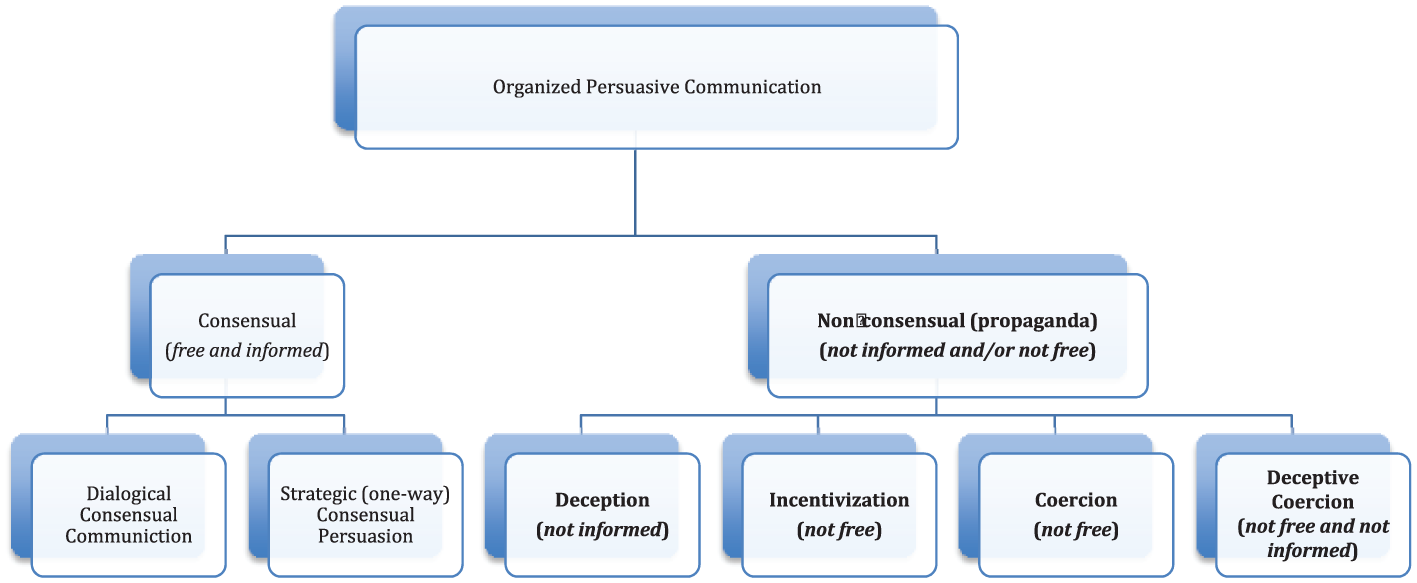
Organized persuasive communication.
Consensual Organized Persuasive Communication
Our conceptualization of consensual OPC rests upon the idea of consent. We define consent as informed and freely given agreement with something, be it a view or an action by that person or someone else. We follow Wertheimer’s (1987: 4) ‘voluntariness principle’, which states that moral and legal positions in relation to the legitimacy of actions rest upon whether an individual is acting freely or is, alternatively, coerced. When someone is persuaded under false pretences, incentivized via promise or providing of benefits, or coerced through threats or actual infliction of costs (including withdrawal of benefits), consent is not freely given. For scholars of argumentation, incentivization and coercion are problematic because desire to obtain reward or avoid punishment or ‘fear of force [causes] acceptance of a conclusion’ (Carney and Sheer, 1980: 390). Equally, consent is violated when someone is persuaded through deception as consent is not ‘fully informed’. Although the terms ‘coerced consent’ (Kaplan and Dixon, 1996/97) and ‘manufacture of consent’ (Herman and Chomsky, 1988; Lippman, 1922) are common, we prefer the term non-consensual persuasive communication to emphasize that in neither case is the person truly consenting. Consensual OPC must meet two requirements: first, absence of deception; and second, absence of incentivization and coercion, therefore, consent is given freely.
Building upon the work of Habermas, we can identify two forms of consensual OPC: dialogical consensual communication and strategic (one-way) consensual persuasion. We discuss each in turn.
Dialogical Consensual Communication
Habermas’ ‘communicative action’ involves two-way dialogical communication aimed at consensus/mutual understanding whereby actors ‘seek to reach an understanding … in order to coordinate their actions by way of agreement’ (Habermas, 1984). As Bohman and Rehg (2014) summarize, Habermas identifies four essential ideal speech conditions for ‘communicative action’ to occur: (i) no one capable of making a relevant contribution is excluded, (ii) participants have equal voice, (iii) they are free to speak their honest opinion without deception or self-deception, and (iv) there are no sources of coercion. As such, ‘communicative action’ does not involve one-way persuading others of one’s own views, which Habermas labels ‘teleological action’, but rather two-way consensus building toward cooperative goals. Also, although Habermas originally conceived of ‘communicative action’ as distinct from persuasion, subsequent discussion, with which we concur, suggests that persuasion is a part of ‘communicative action’ (Bohmann and Rehg, 2017).
By definition, then, ‘communicative action’ is genuinely two-way and does not involve deception, incentivization or coercion. In Figure 1, this is represented by our category dialogical consensual communication. Examples of dialogical OPC might include citizen juries that enable citizens to reach informed consensus on issues with the intent to influence policymaking (Coote and Lenaghan, 1997).
Strategic (One-Way) Consensual Persuasion
For Habermas, ‘teleological action’, involving strategic attempts to persuade, is not consensual because it violates the ‘ideal speech’ conditions, principally because it involves strategic (one-way) persuasion thus violating the condition that ‘participants have equal voice’. However, we argue that this places too high a benchmark (i.e. dialogical consensual communication) for consensual persuasion. Specifically, it is difficult to conceive how ideal speech conditions necessary for dialogical consensual communication can easily and routinely be realized in contemporary mass democracies: one-way teleological or strategic attempts to persuade are seemingly unavoidable. However, contrary to Habermas, we argue that persuasion through ‘teleological action’ can be consensual providing it is free from deception, incentivization and coercion. In Figure 1, this is represented by the category strategic (one-way) consensual persuasion. It is not as consensual as dialogical consensual communication, but it has enough consensual elements to classify it as consensual (i.e. it is free and informed).
For example, anti-smoking campaigns are in some respects strategic consensual persuasion. They are not deceptive (smoking is harmful), and frequently involve both reasoned and emotional arguments regarding smoking risks. Importantly, just because an anti-smoking campaign invokes fear, this does not necessarily make it coercive: coercion involves forcing someone through issuing credible threats such as ‘Unless you do what I want you to, I will harm you.’ This is different from providing information on harms to health. At the same time, mildly coercive strategies are also employed as a part of drives to cut harms from smoking (e.g. smoking bans). But, at least in principle, these campaigns can operate within the realm of strategic consensual persuasion. OPC aimed at mobilizing a population for war can also be consensual: if a country faces real threat, then a campaign for military action to defend it could in principle be non-deceptive and non-coercive. In an election campaign, if democracy is to be realized, OPC should be non-deceptive, non-coercive and avoid incentivization.
We should state our view on whether consensual OPC is ever fully achievable and on the ‘emotive’ and ‘irrational’ dimensions of persuasion. To be achievable, in terms of providing sufficient information, any successful OPC campaign needs to be concise. It is not possible to include all information. Yet, we posit that, for the information to be consensual it must contain the relevant information that can allow a rational and informed decision to be made. This means that critical information should not be omitted or distorted in a way that leads an individual to be persuaded when otherwise, with the included or undistorted information, they would not be (we discuss key forms of deception including distortion and omission shortly). So, for example, an OPC campaign seeking to challenge human causes of climate change, perhaps funded by the fossil fuel industry, would be deceptive if it over-represented the views of the small minority of scientists who question the overwhelming scientific evidence that fossil fuel combustion is the key source of climate change and ignored scientists who accept the state of the evidence. This OPC campaign would be non-consensual because it would be deceptive about the scientific evidence and thus those who accepted it would have come to believe something under false pretences.
With respect to emotive and irrational persuasive appeals, many elements of OPC, especially in advertising/marketing, involve provoking involuntary, affective and visceral feelings (McStay, 2013). While these may breach strict Habermasian-style rationality requirements, there is no intrinsic reason why they should be understood as necessarily deceptive, coercive or, with respect to emotions, irrational. As others have argued, back to Aristotle’s Art of Rhetoric, emotions are intrinsic to the process of reasoning (Sokolon, 2006). For example, depictions of distraught children mourning the absence of a father who died from smoking makes an emotive, but accurate, point that smoking increases risks of premature death, which impacts upon loved ones. Whatever else might be said about this persuasive technique, it is not deceptive. By contrast, using images of young, healthy, active people in tobacco adverts is deceptive. As such, according to our framework, irrational/emotional appeals need to be understood in the context of whether or not they contribute to the deceptive or coercive nature of the OPC event in question.
Non-Consensual Organized Persuasive Communication (Propaganda)
We divide non-consensual OPC (propaganda) into the categories of deception, incentivization, coercion and deceptive coercion.
Deception
Drawing on research on lying in politics (Cliffe et al., 2000; Corner, 2007; Mearsheimer, 2011) and philosophical scholarship on deception and lying (Carson, 2012), we define deceptive information management as persuasion via lying, distortion, omission or misdirection. There may be other types of deception, but these are the types found frequently in our review of the field. Deceptive information management is non-consensual because it violates the requirement of informed consent; the target of persuasion is unable to reach an informed decision because of inadequate information.
Deception through lying is defined as making a statement that is known or suspected to be untrue in order to mislead. The Watergate and Iran-Contra cases noted earlier are confirmed cases of this form of deception. To support lies, disinformation may also be used, whereby forgeries and staged events are used (Martin, 1982): in the internet environment, the phenomenon known as the ‘sock puppet’ involves the use of fake online identities and has been used, for example, by the makers of the beer brand Stella Artois (Watson, 2012) and the US military’s Special Operations Command (Fielding and Cobain, 2011). However, communicators know that, when exposed, lies can damage credibility and so tend to be motivated to mislead in other ways. Accordingly, lying has traditionally been seen as a last resort: ‘Every propagandist worth his mettle will use the truth in preference to lies whenever he can; even Dr. Goebbels … “Lies have short legs,”’ (Friedrich, 1943). Approaches to deception which are often seen as more subtle, and therefore more effective than lying, involve omission, distortion and misdirection.
Deception through omission involves withholding information to make the promoted viewpoint more persuasive. It is deceptive because those involved know people would be less likely to be persuaded if they knew the full picture. As noted before, apparently truthful white propaganda can be deceptive due to omission. Deception through omission can also occur through disguising the source’s identity. Miller (1994) researched and documented the case of the London Radio Service (LRS) set up by the British Foreign Office to provide media outlets with information conducive to British Government objectives. The deception involved here was that many media outlets picking up the LRS reports were either unaware the information was government sourced, or failed to clearly identify the stories as such. This deception through omission (that LRS was a government source) was intentional on the part of the British Government. Deception over sources has become easier in the internet environment: for example, the use of techniques such as the ‘front group’, where vested interests are disguised by ostensibly independent groups, has become common in the internet age and a term has been coined to describe fake online identities – the ‘sock puppet’ (Solorio et al., 2013).
Deception through distortion involves presenting a statement in a deliberately misleading way to support a viewpoint. One form of distortion is exaggeration but it can also involve de-emphasizing information, for instance by releasing controversial information on busy news days. Herring and Robinson (2014, 2014‒15) documented how the UK Government engaged in these types of deception before the 2003 Iraq War: using techniques of distortions of available intelligence and omissions, the British Government drafted a dossier presenting a picture of high confidence that Iraq posed a large WMD threat, while the intelligence only indicated weak evidence of a much smaller WMD threat. The pattern of exaggerations and distortions was also reflected among US officials in sound bites such as ‘we don’t want the smoking gun to be a mushroom cloud’ (National Security Adviser Condoleeza Rice – see CNN 2002), evoking the nightmare of a terrorist nuclear attack. These messages were deceptive as they involved distortion and exaggeration of intelligence assessments, but avoided outright lying.
Deception through misdirection entails producing and disseminating true information intended to direct attention away from problematic issues (political campaign advisors have coined the term ‘pivot’ to describes this and journalists have taken it up in their reporting of campaigns). For example, Bakir (2013) analysed British and US management of the public revelation of the Bush Administration’s secret torture-intelligence policy and British complicity. This entailed instigating numerous investigations and inquiries across the USA and UK. These were utilized to misdirect attention to a narrow part of policy failure (e.g. inadequate military training on how to handle detainees) and away from deeper issues. The deeper issues included the existence of a secret torture-intelligence policy, torture through ‘Enhanced Interrogation Techniques’, the fact that the CIA was central to this policy, and the complicity of other nations.
Finally, although lying is commonly perceived as the most serious mode of deception, omissions, distortions and misdirections can be as serious as lying. For example, as highlighted in the literature on propaganda and war, populations can be galvanized by campaigns emphasizing enemy atrocities. Although such stories can be true, they may also involve the omission of atrocities committed by one’s own side or distorting victim counts. Outright lying, then, is not required to mobilize support for (or undermine opposition to) a war. Furthermore, deceiving without lying facilitates avoiding accountability should deception be discovered. For instance, deceivers can claim forgetfulness (for omissions); they may claim distortion imposed by media formats (such as tabloid news or online fake news formats); and they may claim that ‘necessary’ information is already publicly available.
Incentivization
We define incentivization as a process of persuasion that involves promising or providing benefits. Broadly, this involves creating a benefit (an extrinsic motivation) aimed at overcoming an individual’s actual desire/belief (their intrinsic motivation). Of course, not all acts of incentivization are non-consensual. The provision of a bike-and-ride scheme, whereby people are incentivized to ride bikes, is broadly consensual as here the incentive (the extrinsic motivation) is both positive and if taken up, aligned with the individual’s intrinsic motivation (i.e. the individual actually wants to ride the bike). Incentivization can, however, be far less consensual.
For example, incentivization becomes manipulative when the extrinsic motivation conflicts with an individual’s intrinsic motivation. In the example mentioned earlier regarding elections and tax cuts, promising tax cuts (an extrinsic motivation) is a way of garnering votes by persuading people who otherwise would not be inclined (i.e. had no intrinsic motivation) to vote for that candidate; this is not consensual because the individual is induced to do something he or she would otherwise not want to do. Also, regarding the earlier example regarding public diplomacy and exchange programmes, these cultural and educational programmes involve provision of benefits that encourage recipients to be favourably disposed toward the country/state providing them. Here the process is not consensual because positive feelings toward the provider are based not on an intrinsic belief, but are the result (perhaps in part) of the benefits (extrinsic motivations) received. A documented example of incentivizing OPC is that of the provision of housing and childcare in Vanport, Oregon, during the 1940s. This was part of a propaganda campaign aimed at persuading women to adopt new work roles and increase their productivity (Jowett and O’Donnell, 2012: 309‒318). Of course, the provision of housing and healthcare is not in itself non-consensual because there is an intrinsic desirability for such things; the non-consensual aspect is that the outcomes of new work roles and greater productivity were extrinsic to the motivations of those being incentivized. Also, the offering of childcare/housing in exchange for work might be seen as relatively consensual under certain conditions, such as adequate existing material conditions in which there is a trade-off between new housing and increased productivity. In the case of Vanport, however, the persuasive force is more, rather than less, non-consensual because the material circumstances of the women was relatively poor: that is to say, they were potentially persuaded (incentivized) via promises of childcare and housing largely because of their relative deprivation rather than via a more consensual trade-off.
Coercion
OPC becomes most forceful when it develops coercive dimensions that work through exploiting the actual or threatened inflict of costs, including such things as economic sanctions, use of physical force and withdrawal of benefits. As discussed earlier, among scholars of persuasion and rhetoric a small number have explored the relationship between coercion and persuasion (Andrews, 1969; Simon, 1972). These accounts, analysing protest movements from the 1960s and 1970s, emphasize how ‘coercive persuasion’ can work via social and economic contexts where individuals are subjected to duress in situations of structural and relational disadvantage, such as physical vulnerability, that influences them to act or think in particular ways. Here persuasive force is attained via communicative contexts in which threats and intimidation are in play. In view of these studies, we argue it is crucial to understand that communicated threats acquire force from physical, social and economic contexts. Following this work, we define coercion as an act of persuasion that compels an individual to act against their will through the threat or infliction of costs including, but not limited to, physical force.
Coercive OPC operates in a number of ways. Commonly it can involve integration of physical actions and threats into the overall persuasion strategy. As noted earlier, one example from the military sphere concerns ‘psychological operations’ designed to persuade an enemy to surrender. Working through similar mechanisms is the ‘propaganda of the deed’ (Jowett and O’Donnell, 2012: 301) whereby a violent act is performed at least partly for propagandistic purposes, as with 9/11 (Louw, 2003) or US ‘Shock and Awe’ strategy during the 2003 Iraq invasion. But coercive OPC is not the sole preserve of the military sphere; it also occurs in the commercial realm. The ‘Mohawk Valley Formula’ for union busting used by the Remington Rand Company during the 1930s utilized propaganda narratives entwined with coercion: The formula included discrediting union leaders by calling them ‘agitators’, threatening to move the plant, raising the banner of ‘law and order’ to mobilize the community against the union, and engaging police in strike-breaking activity, then organizing a back-to-work movement of … employees. (US Department of Labor cited in Miller and Dinan, 2008: 52)
These techniques were used to great effect 50 years later to break British trade union power during the 1984/85 miners’ strike. Here, coercion was part of an overall strategy that included many elements as OPC strategists recognized that winning opinion and arguments was not necessarily central. Describing the media strategy of the Government and National Coal Board (for which he was an adviser), Tim (now Lord) Bell said: The strategy wasn’t about winning public opinion. It wasn’t about persuading the media. It was about getting the miners … back to work. To give in on their strike and to drift back to work with their tails between their legs, heads hung low, having failed. (Interview on Channel 4 TV, 2004)
Deceptive Coercion
Finally, coercion also works through other means. For example, coercion can interweave with deception (deceptive coercion in Figure 1) via manipulation of fear. Here, people are deceived about their understanding of the overall danger. For example, if a government warns of a non-existent threat, people may be scared into supporting its abuses of civil liberties: people are literally deceived into thinking that their lives are in danger and that supporting their government is essential. We define deceptive coercion as persuasion through deceptive manipulation of fear of costs. Returning to the 2003 Iraq War example, while messages promoted by the UK government were deceptive, in that they involved distortion and exaggeration of intelligence, they also had a coercive dimension working through promoting public fears (with little factual basis) regarding chemical, biological or nuclear attacks.
Overall, these examples show that, whether utilizing incentivization or coercion, OPC can involve strategies aimed at organizing conduct in a way not generally conceived of in the existing literature, which has a weak understanding of persuasion that works via socio-political, economic and physical mechanisms.
Conclusion
To date, study of what we call OPC has been divided largely between scholars of PR (and related fields) who mostly perceive their object of study as largely non-manipulative, scholars of propaganda who concern themselves only with manipulative persuasion, and scholars of promotional culture who examine OPC through the lens of commercial advertising and ‘salemanship’. Across these bodies of scholarship, the grasp of OPC involving deception, incentivization and coercion has been limited and, as a result, conceptual and empirical grasp of these activities within contemporary democracy has remained weak. Our conceptual framework presents a significant step forward toward resolving this shortcoming. The framework explicates all forms of persuasive activity, ranging from consensual through to non-consensual, and incorporates both non-manipulative and manipulative persuasive communication. Most importantly, it provides a systematic conceptualization of different forms of persuasive communication including categories of dialogical, non-deceptive and deceptive OPC as well as persuasion working in relation to socio-political, economic and physical contexts via incentivization and coercion. By adopting this framework, scholars of PR (and related fields) and promotional culture can avoid inaccurately presenting all activities they study as distinct from propaganda. At the same time, the framework provides propaganda scholars with a clear and precise typology of manipulative/propagandistic communication.
The framework set out here can be used to explore the extent to which deception, incentivization and coercion form important parts of OPC strategies within contemporary democracies. To the extent that these non-consensual persuasive strategies may be in play, serious questions are raised regarding whether liberal democracies do, in fact, function properly: a society where citizens are routinely incentivized, deceived and coerced by powerful actors is not one that approximates to democratic ideals. The framework can be used to analyse more critically supposedly benign and consensual PR activities but it should also be applied in order to provide a more thorough-going analysis of all OPC activities, especially with an eye toward those that exploit physical, socio-political and economic contexts to incentivize or coerce. In particular, it should be used to examine the use of manipulative OPC not only by non-elite groups, but also by more powerful actors, such as corporations and states, who possess preponderant resources in society. To do so will enable a more comprehensive understanding of the ways in which communicative power works across political, economic and military realms and society at large. Overall, the framework provides a starting point for evaluating and integrating empirical cases across environmental, economic, military, political and cultural spheres and analysing the emerging forms of internet-based OPC including digital propaganda. It thereby provides a coherent approach to evaluating the health of key aspects of contemporary democracy.
It could be that, having rectified the scholarly blind spot toward manipulative OPC through extensive application of this framework and empirical research, we find that OPC in contemporary democracy is largely consensual and non-manipulative and thus approximating well to democratic ideals. All well and good. Or it might be that our conceptual blind spot regarding deception, incentivization and coercion has left us oblivious to the levels of manipulation at play in contemporary society. The current crisis over fake news and propaganda, which is prominent in political debate throughout the West, at least offers a prima facie case that the latter might indeed be the case. It is important that conceptually grounded and rigorous research is conducted into these activities; our conceptual framework provides a basis for such work.
Footnotes
Acknowledgements
Thanks to the anonymous reviewers and editor, David Fasenfest, for feedback on earlier drafts; to Stefanie Haueis for both critical evaluation and important contributions to the development of the conceptual framework; to Tom Mills and Narzanin Massoumi for advice and discussions.
Funding
DM: This work was partially supported by a grant from the Economic and Social Research Council (grant number ES/K000292/1). This award, RCUK Global Uncertainties Leadership Fellow (2013–2016), was for a project titled ‘Understanding and explaining terrorism: Expertise in practice’. It provided support for some aspects of the work on this article. This included two writing workshops in Bath and the Understanding Conflict conference in Bath in June 2015 at which an earlier version of this article was given.
VB, EH, PR: This research received no specific grant from any funding agency in the public, commercial, or not-for-profit sectors.
