




Abstract
Background
Peritoneal dialysis (PD) offers comparable survival for acute kidney injury (AKI) as other kidney replacement therapies, but concerns about rigid catheter complications like peritonitis persist. This study evaluated outcomes of acute PD using rigid catheters in critically ill children, including peritonitis rates and mechanical complications.
Methods
This retrospective study analyzed data from consecutive pediatric patients (aged <18 years) admitted to our tertiary-level pediatric intensive care unit, who underwent acute PD using either rigid or improvised catheters, with each PD session limited to 72 h followed by re-insertion after 24 h if indicated. Data on primary diagnosis, PD indication, and laboratory parameters were collected from patient records and dialysis registers. Outcome measures, such as peritonitis rates and mechanical complications, were assessed.
Results
Over a 10-year span (January 2014–September 2023), 202 children, 57% males, with a median age of 11 (3.6, 30) months, underwent PD. PD was initiated for fluid overload in 65 (32%), persistent anuria in 51 (25.2%), and refractory hyperkalemia in 47 (23.3%). In 13 (6.4%) patients, PD was initiated for metabolic crisis in the absence of AKI. The median estimated glomerular filtration rate at PD initiation was 21.4 (13.2, 46.5) mL/1.73m2/min. A total of 250 PD sessions/catheter insertions were performed on 202 children, for a median duration of 72 (24, 72) hours. Fourteen (6.9%) children developed peritonitis. Among children who received PD for ≤ 72 h (n = 164), peritonitis frequency was 3%, while it was 15.7% in those with one catheter re-insertion (n = 19) and 31.5% in >1 catheter reinsertion (n = 19). The peritonitis rate-per-catheter was 3% in children with single catheter insertion (n = 164), and 10.4% in children with ≥ 1 catheter re-insertions (n = 38). Among six children, who had extended PD sessions (single PD session duration, irrespective of it being the first or subsequent catheter) of 84 [84,100] (median [IQR]) hours, 3 (50%) developed peritonitis. Mechanical complications included peritubal-leak 28 (13.8%), hemorrhagic effluent in 8 (3%), catheter dislodgement in 3 (1.5%), and PD catheter block in 13 (6.4%). One child (0.49%) developed intestinal perforation.
Conclusions
Acute PD with a rigid catheter limited to 72 h appears safe and feasible in resource-constrained settings where soft Tenckhoff PD catheters are not easily available, though peritonitis rates increase with increasing cumulative duration on PD.
This is a visual representation of the abstract.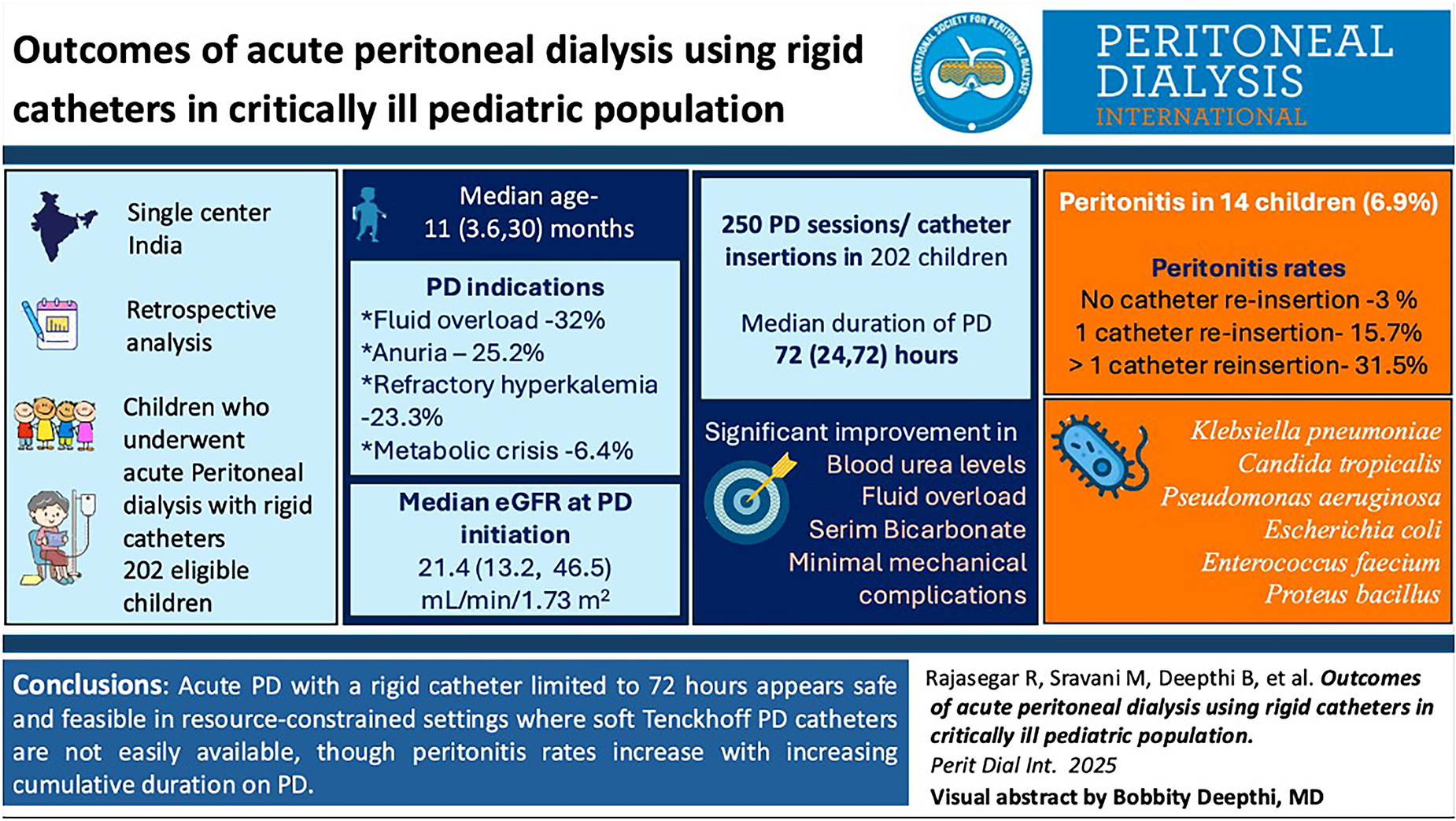
Get full access to this article
View all access options for this article.
References
Supplementary Material
Please find the following supplemental material available below.
For Open Access articles published under a Creative Commons License, all supplemental material carries the same license as the article it is associated with.
For non-Open Access articles published, all supplemental material carries a non-exclusive license, and permission requests for re-use of supplemental material or any part of supplemental material shall be sent directly to the copyright owner as specified in the copyright notice associated with the article.
