




Abstract
Background:
Incremental peritoneal dialysis (PD), defined as less than Full-dose PD prescription, has several possible merits, including better preservation of residual kidney function (RKF), lower peritoneal glucose exposure and reduced risk of peritonitis. The aims of this study were to analyse the association of Incremental and Full-dose PD strategy with RKF and urine volume (UV) decline in patients commencing PD.
Methods:
Incident PD patients who participated in the balANZ randomised controlled trial (RCT) (2004–2010) and had at least one post-baseline RKF and UV measurement was included in this study. Patients receiving <56 L/week and ≥56 L/week of PD fluid at PD commencement were classified as Incremental and Full-dose PD, respectively. An alternative cut-point of 42 L/week was used in a sensitivity analysis. The primary and secondary outcomes were changes in measured RKF and daily UV, respectively.
Results:
The study included 154 patients (mean age 57.9 ± 14.1 years, 44% female, 34% diabetic, mean follow-up 19.5 ± 6.6 months). Incremental and Full-dose PD was commenced by 45 (29.2%) and 109 (70.8%) participants, respectively. RKF declined in the Incremental group from 7.9 ± 3.2 mL/min/1.73 m2 at baseline to 3.2 ± 2.9 mL/min/1.73 m2 at 24 months (p < 0.001), and in the Full-dose PD group from 7.3 ± 2.7 mL/min/1.73 m2 at baseline to 3.4 ± 2.8 mL/min/1.73 m2 at 24 months (p < 0.001). There was no difference in the slope of RKF decline between Incremental and Full-dose PD (p = 0.78). UV declined from 1.81 ± 0.73 L/day at baseline to 0.64 ± 0.63 L/day at 24 months in the Incremental PD group (p < 0.001) and from 1.38 ± 0.61 L/day to 0.71 ± 0.46 L/day in the Full-dose PD group (p < 0.001). There was no difference in the slope of UV decline between Incremental and Full-dose PD (p = 0.18).
Conclusions:
Compared with Full-dose PD start, Incremental PD start is associated with similar declines in RKF and UV.
This is a visual representation of the abstract.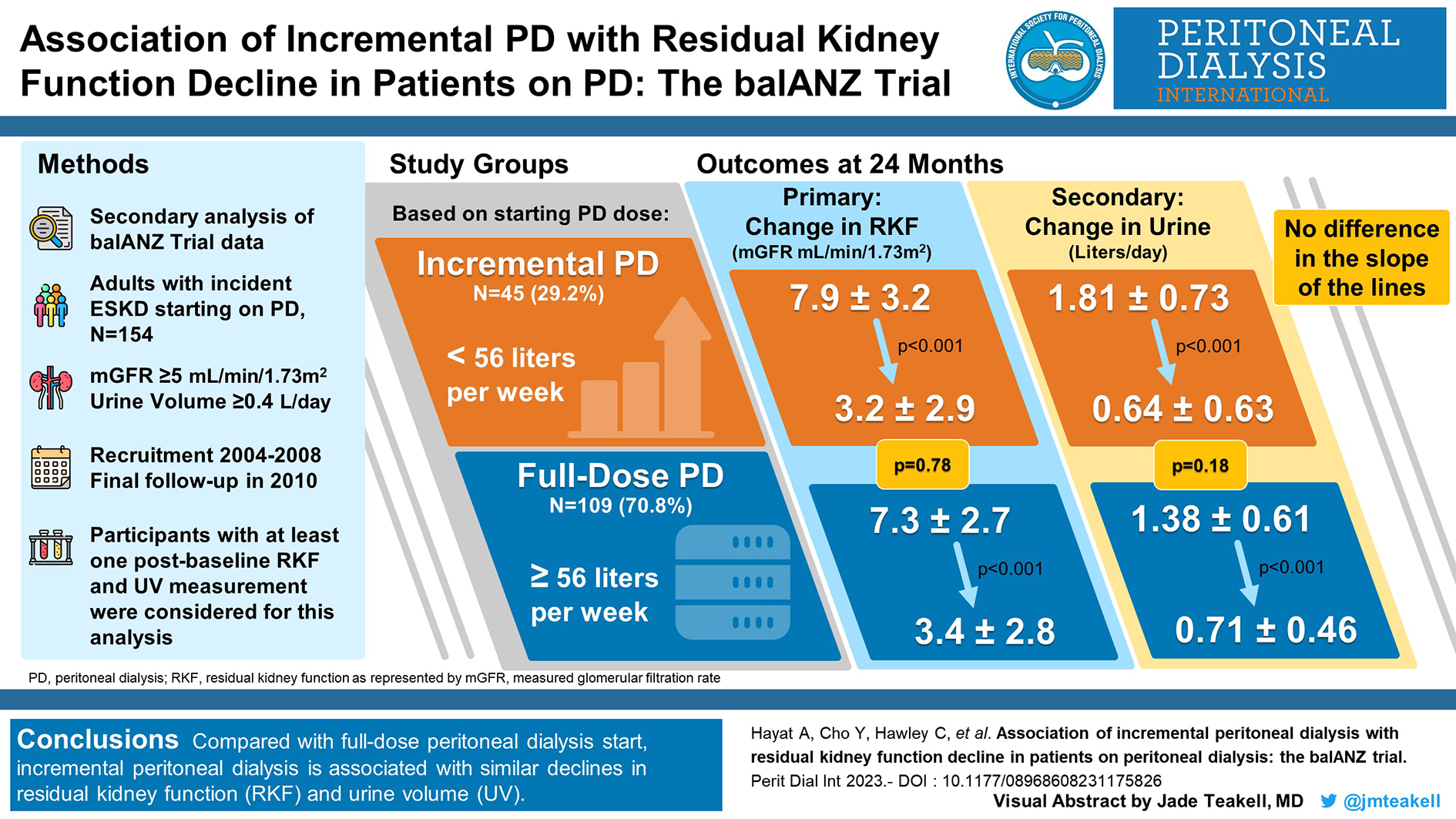
Keywords
Get full access to this article
View all access options for this article.
References
Supplementary Material
Please find the following supplemental material available below.
For Open Access articles published under a Creative Commons License, all supplemental material carries the same license as the article it is associated with.
For non-Open Access articles published, all supplemental material carries a non-exclusive license, and permission requests for re-use of supplemental material or any part of supplemental material shall be sent directly to the copyright owner as specified in the copyright notice associated with the article.
