




Abstract
Background:
The high incidence of acute kidney injury (AKI) requiring dialysis associated with COVID-19 led to the use of peritoneal dialysis (PD) for the treatment of AKI. This study aims to compare in-hospital all-cause mortality and kidney recovery between patients with AKI who received acute PD versus extracorporeal dialysis (intermittent haemodialysis and continuous kidney replacement therapy).
Methods:
In a retrospective observational study of 259 patients with AKI requiring dialysis during the COVID-19 surge during Spring 2020 in New York City, we compared 30-day all-cause mortality and kidney recovery between 93 patients who received acute PD at any time point and 166 patients who only received extracorporeal dialysis. Kaplan–Meier curves, log-rank test and Cox regression were used to compare survival and logistic regression was used to compare kidney recovery.
Results:
The mean age was 61 ± 11 years; 31% were women; 96% had confirmed COVID-19 with median follow-up of 21 days. After adjusting for demographics, comorbidities, oxygenation and laboratory values prior to starting dialysis, the use of PD was associated with a lower mortality rate compared to extracorporeal dialysis with a hazard ratio of 0.48 (95% confidence interval: 0.27–0.82, p = 0.008). At discharge or on day 30 of hospitalisation, there was no association between dialysis modality and kidney recovery (p = 0.48).
Conclusions:
The use of PD for the treatment of AKI was not associated with worse clinical outcomes when compared to extracorporeal dialysis during the height of the COVID-19 pandemic in New York City. Given the inherent selection biases and residual confounding in our observational study, research with a larger cohort of patients in a more controlled setting is needed to confirm our findings.
This is a visual representation of the abstract.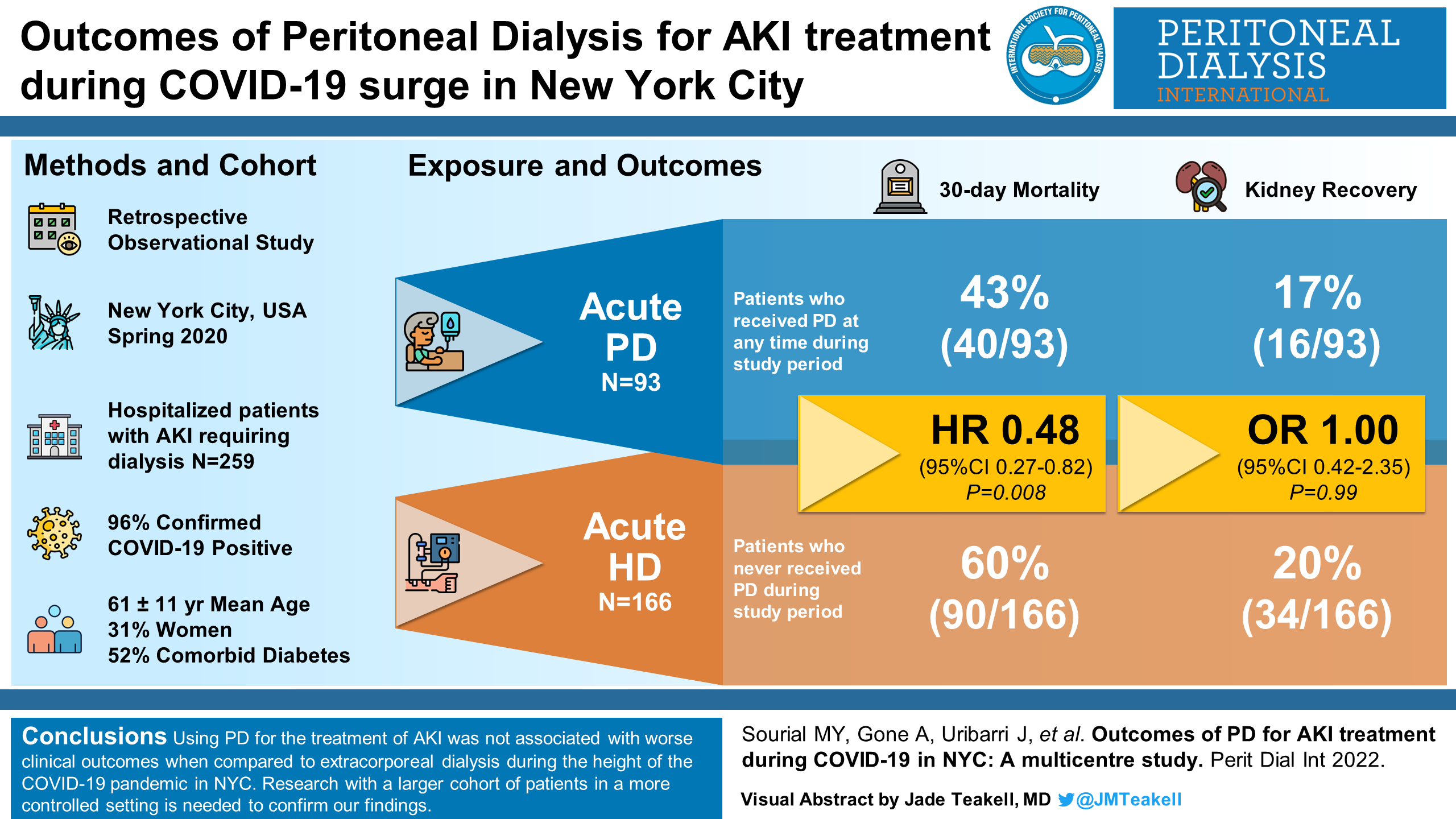
Keywords
Get full access to this article
View all access options for this article.
References
Supplementary Material
Please find the following supplemental material available below.
For Open Access articles published under a Creative Commons License, all supplemental material carries the same license as the article it is associated with.
For non-Open Access articles published, all supplemental material carries a non-exclusive license, and permission requests for re-use of supplemental material or any part of supplemental material shall be sent directly to the copyright owner as specified in the copyright notice associated with the article.
