




Abstract
Background:
Cross-sectional studies showed that fluid overload (FO) measured by bioimpedance spectroscopy (BIS) predicted adverse outcomes in patients on peritoneal dialysis (PD). We aimed to describe the longitudinal change in volume status in Chinese PD patients and determine its relation with clinical outcomes.
Methods:
We performed a single-centre, retrospective analysis of all PD patients who underwent repeated BIS from 2010 to 2015. FO was defined by relative hydration index (RHI; volume of overhydration adjusted by extracellular water >7%). Variability of volume status (VVS) was denoted by the standard deviation of all RHI. The association of time-averaged RHI and VVS on patient and technique survival was explored by a competing risk model.
Results:
A total of 269 patients were followed for a median of 47.1 months. Mean time-averaged RHI was 17.6 ± 10.2%. Multivariable mixed linear regression revealed that RHI was significantly associated with diabetes, time-varying systolic blood pressure, and inversely with time-varying albumin level, lean tissue index and fat tissue index (p <0.0001 for all). Time-averaged RHI independently predicted patient survival (subdistribution hazard ratio (SHR) 1.05, 95% CI 1.03–1.07, p <0.0001) and technique survival (SHR 1.04, 95% CI 1.02–1.06, p <0.0001), whereas VVS did not. The mortality risk for patients with persistent FO was consistently higher than the corresponding risk estimated from baseline FO of the same extent.
Conclusions:
Persistent FO was a strong predictor of patient and technique failure. Repeated bioimpedance measurements to monitor volume status may provide additional prognostic information in PD patients.
This is a visual representation of the abstract.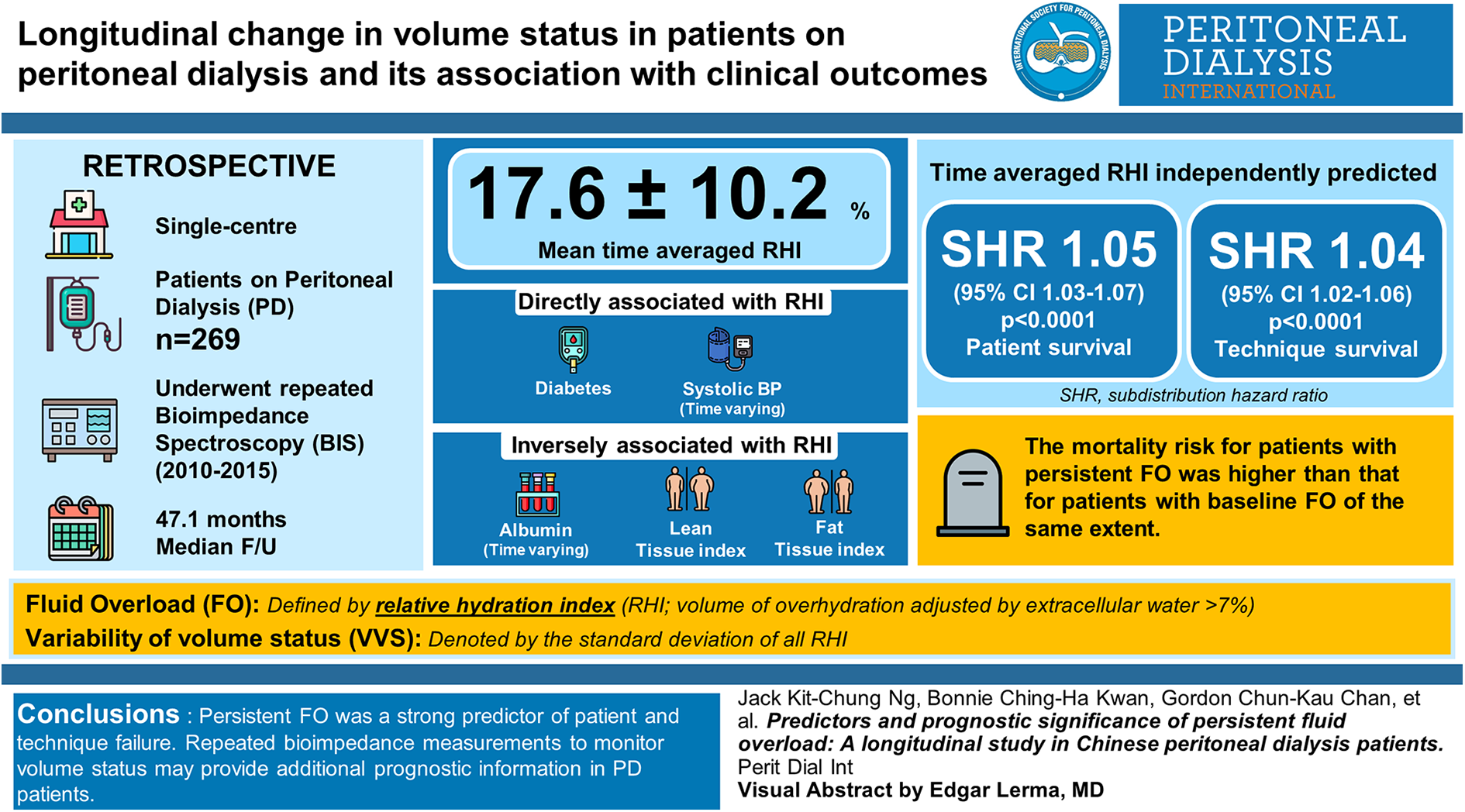
Get full access to this article
View all access options for this article.
References
Supplementary Material
Please find the following supplemental material available below.
For Open Access articles published under a Creative Commons License, all supplemental material carries the same license as the article it is associated with.
For non-Open Access articles published, all supplemental material carries a non-exclusive license, and permission requests for re-use of supplemental material or any part of supplemental material shall be sent directly to the copyright owner as specified in the copyright notice associated with the article.
