



Abstract
Generative artificial intelligence has forced school systems to rapidly pivot from reactive bans to proactive management. Yet, research on local policy responses remains scarce. This study analyzes how the twelve largest US school districts have responded to the introduction of GenAI. Through document and policy analyses, we identify three interrelated policy moves: redefinition of foundational concepts like academic integrity; regulation by creating standards for both users and vendors; and innovation through intentional experimentation. We offer a typology for district-level AI governance, highlight domains of regulatory changes, and suggest a baseline for future causal, evaluative, and implementation research.
Introduction
“NYC education department blocks ChatGPT on school devices” announced a Chalkbeat headline on January 3, 2023 (Elsen-Rooney, 2023). The timing was striking: ChatGPT—a generative artificial intelligence (GenAI) system built on large language models—had been released just a month earlier in late November 2022. In that short window, the tool had already sparked intense public debate about academic integrity, student learning, and the future of teaching. The New York City Public Schools acted swiftly by regulating the technology, noting its potential negative effects on student learning. However, in just five months, the district backtracked on this initial response and encouraged GenAI’s use among students and teachers alike. This story underscores how GenAI has forced school systems to confront this new technology and has compelled them to set up new rules, regulations, policies, and solutions.
As GenAI tools have moved from experimental curiosities to taken-for-granted instruments for writing, tutoring, translation, and decision support, scholars have noted their varied risks and possibilities. On one end are those who note that GenAI tools are “adopted to innovate teaching and improve learning outcomes, increase productivity and efficiency, and prepare students for the future of work with AI” (Bilal et al., 2025, p. 1). On the other end are those who suggest potential risks regarding academic integrity, overdependence, digital divides, and privacy and security concerns (Wang et al., 2024). Despite intense debates, we still know very little about how large school districts—responsible for educating millions of students, shaping national policy conversations, and possessing the capacity to negotiate with large companies—are responding to GenAI. Much of the existing discussion has focused on abstract principles and national strategies (UNESCO, 2024; U.S. Department of Education, Office of Educational Technology, 2023). Yet the most consequential decisions are being made locally as districts balance opportunities and risks, innovation and equity, experimentation and legal compliance. Thus, the present article asks: How do the twelve largest US school districts respond to GenAI’s risks and possibilities?
Through the analysis of policy documents, AI guidebooks, public statements, and news articles published between December 2022 and November 2025, we identify three interrelated policy moves that constitute this governance of GenAI. First, districts are redefining foundational educational concepts on what counts as cheating, what constitutes personalized learning, and what it means to provide AI-augmented instruction. Second, districts are regulating GenAI by establishing new rules for privacy, access, authorization, and transparency. Here, regulations extend beyond users like students and staff to also encompass standards for suppliers and technology vendors. Third, districts are enabling innovation by encouraging active experimentation with GenAI through subject integration, interactive tutoring, and administrative support, indicating a shift from reactive prohibition to proactive governance. At times, these distinct policy domains were all used together by large districts to shape what is possible, permissible, and/or desirable in the current education landscape.
Our study makes several contributions to the literature on education policy and technology. To our knowledge, it provides the first comparative typology of district-level AI governance strategies in the US—suggesting an important baseline of AI policies and their differences with each other. Next, we offer a conceptual vocabulary for understanding district responses to emerging technologies. By identifying three policy/governance domains (redefinition, regulation, innovation) and specifying their dimensions, we offer a framework that helps clarify what scholars and practitioners mean when they refer to GenAI or technology governance in education. Although our study is descriptive and does not examine the predictors or consequences of these policies, we provide a foundation on which future causal or evaluative work can build on. Third, our paper offers an empirical record for researchers, policymakers, and district leaders of the strategies large districts have employed in the early phases of GenAI. As the landscape evolves, future research can explore how policies and strategies change, how they differ in small or rural school districts, and how new regulations and structures matter for implementation, instruction, and student outcomes. Finally, we discuss policy implications for how the redefinition of cheating might shift students’ behaviors and teachers’ work, how the regulation of technology companies might transform their products, and how the integration of AI into courses might have implications for district budgets, staffing, and programs.
Literature Review
Various educational technologies have been introduced to US schools with claims of their transformative change, and GenAI represents the latest iteration of this enduring pattern. Historical research has demonstrated that earlier technologies—from textbooks in the 19th century to radio and film in the early 20th century to computers in the late 20th century—were similarly celebrated as a “powerful force for change” in American education (Cohen, 1987, p. 154). But these claims often overstated the instructional impact of technologies and underestimated the institutional constraints of education, where practices on the ground are often decoupled from lofty visions of change and improvement (Fusarelli, 2002; Meyer & Rowan, 1977; Weick, 1976). This history suggests that technological novelty and promise are insufficient to bring about change, and highlights the importance of examining how public institutions govern these new technologies entering schools, classrooms, and personal devices.
Much of the literature on GenAI and governance has focused on the normative debates about its benefits and risks, and about whether to foster or prohibit its use in schools. Advocates emphasize GenAI’s potential to personalize instruction through virtual assistants, generate new materials and assessments, individualize content, enhance feedback, and reduce administrative burdens (El Fathi et al., 2025; Lo, 2023; Mallory, 2024). However, critics also raise concerns about academic integrity, algorithmic bias, surveillance, data privacy, and GenAI’s financial and environmental costs (Berthelot et al., 2025; Chinedu et al., 2024; Lee et al., 2024; Wang et al., 2024). These debates are typically framed around classroom use, positioning teachers and students as the primary decision-makers. As a result, GenAI is often treated as a pedagogical tool or an ethical dilemma rather than as a policy and structural problem confronting educational organizations.
Nonetheless, previous studies—not primarily focused on GenAI—have highlighted the role of policies in governing new technologies as they are adopted in schools (Chiu, 2024; Selwyn, 2018, 2024; Williamson, 2014, 2016, 2017). Selwyn (2018) identifies several key ways in which government policies and regulations shape educational technology use through: (1) policies governing the resourcing, funding, and procurement of technologies, such as the large-scale provision of devices to students and teachers; (2) curricular policies that establish technology as a topic and subject of study within schools, such as through computer programming, coding, and digital literacy initiatives; and (3) policies that embed technology into the governance and administration of school systems, including student data systems, accountability dashboards, and information software. Through these mechanisms and policies, governments actively seek to manage both the opportunities and risks posed by new technologies, responding to concerns about access, effectiveness, and control.
Yet, in the process of creating and implementing such policies, government officials—such as education bureaucrats, elected legislators, and municipal executives—are not the sole decision-makers. Instead, policies are increasingly supported by networks of mediators and brokers from think-tanks, non-profit organizations, foundations, social enterprises, and community-based organizations that provide guidance on tools and technologies, and how they can be adopted in schools (Trinidad, 2025; Williamson, 2014). Such individuals can privilege technological and technocratic solutions focused on efficiency and personalization rather than purely pedagogical and instructional effectiveness (Trujillo, 2014; Williamson, 2014). From a critical perspective, this highlights how policies directed at educational technologies are not just aimed at regulating or limiting technologies but also at expanding and fostering their use (Roberts-Mahoney et al., 2016).
Taken together, scholars have noted the importance of education policies in governing, regulating, using, and fostering educational technologies. In the case of GenAI, some studies have shown the specific domains where policies are being and can be directed at: (1) student learning and skill development, (2) teaching and classroom facilitation, (3) assessments and examinations, and (4) administration and efficiency (Chiu, 2024; Selwyn, 2024). Beyond schools and districts, many international organizations and national education ministries have also issued guidance, frameworks, and normative principles for the responsible use of GenAI in education, emphasizing issues such as equity, transparency, human oversight, and pedagogical support (UNESCO, 2024; U.S. Department of Education, Office of Educational Technology, 2023). One conference proceeding noted how international policy documents on GenAI focused on topics such as securing equitable AI access, ensuring student wellbeing, and focusing on human-centered approaches for GenAI to augment rather than displace human work (Hidalgo & Halim, 2025). Another study highlights the challenges in regulating GenAI, in defining ethical frameworks for its use, and in designing tools that reflect human and educational values (García-López & Trujillo-Liñán, 2025). These documents articulate aspirational goals and normative commitments for the use of GenAI in education, but they offer limited guidance on how such principles are being translated into organizational routines, professional practice, and educational guidelines.
Despite the presence of normative frameworks and studies, there remains limited empirical evidence on how K-12 schools are actually responding to GenAI through formal policies and regulations. Such limited studies are influenced by the relatively recent advent of the technology and the greater focus on GenAI in higher education (Hidalgo & Halim, 2025; Law, 2024). To understand policies directed at GenAI, K-12 school districts are particularly consequential actors as they translate abstract concerns about GenAI into enforceable rules, operational guidance, and organizational routines for schools under their jurisdiction. This study addresses this gap by systematically examining GenAI policies across the largest US school districts and developing a typology of district-level governance responses. In doing so, it provides one of the first empirical maps of how GenAI is being governed at scale in K–12 education.
Data and Methods
This study uses qualitative document analysis to examine how large school districts responded to GenAI tools, programs, and applications. We chose the twelve largest US school districts—with enrollment between 180,000 and 845,000 students in 2024—because the size, resources, and public visibility of these districts make them more likely to: (1) be early sites of formal policy formation to GenAI, (2) develop publicly accessible documents and guides, and (3) exert influence over the policies and practices in other US school districts (Bryk et al., 2023; Trinidad, 2025). Table 1 lists these districts and their characteristics. We collected documents published in a three-year period between December 1, 2022 and November 30, 2025—a period of varied policies and changes in how districts were responding to GenAI because of ChatGPT’s introduction on November 30, 2022 (Lo, 2023). Because our sample is defined by district size, our resulting set includes both large US cities (New York City, LA, Chicago) and large counties (five of the 12 districts are in Florida). Thus, we narrow the scope of our interpretation as being focused on large, high-capacity districts rather than a general account of district AI policy nationwide.
Twelve Largest US School Districts.

Note. The 2024 Population came statistics from the National Center for Education Statistics, accessed through the EdSurge website: https://www.edsurge.com/news/2025-01-23-how-enrollment-in-the-100-largest-school-districts-has-changed-since-the-pandemic.
The corpus assembled 62 documents, including 17 official district technology and AI policies in varied policy bulletins; 17 district “guidebooks” and frameworks that document how teachers and students can use GenAI; six district press releases; five pertinent state, county, and city laws related to GenAI for public servants; and 17 local and national news articles as well as education features in websites like Chalkbeat and the 74 Million. We mainly analyze district-issued policy documents, guidebooks, and official public statements as primary evidence of district governance. We use news coverage as supplementary materials and, when possible, this was cross-checked against district-issued materials rather than treated as equivalent policy evidence. We created a repository of available data for each school district to provide a holistic understanding of how each one responded to GenAI. A master codebook was then compiled, summarizing the documents, how they related to policies for students, teachers and administrators, as well as the permissible uses of GenAI tools and the consequences for failure to use them properly.
After creating a narrative memo with the summary of each district’s GenAI policies, we performed two rounds of systematic coding. First, we thematically and inductively coded the documents, focusing on themes that emerged from our summaries and personal reading of the documents. We noted specific themes that repeated across various districts with codes like “reactive prevention,” “proactive integration,” “student use,” “teacher use,” “programs for AI literacy,” “AI guardrails,” and “AI best practices.” Through our preliminary analysis, three main domains emerged: shifting definitions, AI regulations, and AI innovations. Thus, our second round of coding was more deductive, focusing on specific themes within each domain through document excerpts in order to triangulate evidence for each district. For example, under the shifting definition domain, we had codes for “shifting definition of cheating,” “. . .of personalized learning,” and “. . .of teaching.” We also examined disconfirming evidence, such as conflicting documents, and assessed whether patterns were general across districts or specific to individual cases.
As with any research, our document analysis is not without limitations. In particular, we do not capture the frontline implementation and the consequences of the policies enacted by school districts. In fact, the public documents we analyzed may be performative, aspirational, or decoupled from everyday practices in schools (Meyer & Rowan, 1977). They represent materials that made it into the public discourse. Nonetheless, these policy texts, press releases, and guidebooks remain critical artifacts: they reveal what districts choose to define, value, regulate, and promote. In doing so, they offer a window into how large districts attempt to “govern” new technologies—i.e., how they articulate problems, set boundaries, and authorize particular uses of GenAI. While these files cannot ascertain whether policies take root in classrooms—an important caveat and tradeoff—they provide essential insights for an initial descriptive study of how large school districts formulate their policy responses to GenAI.
Findings
We identify three interrelated policy moves in the large school districts we studied. First, districts are redefining key educational concepts—standards for academic honesty, approaches to personalized learning, and the evolving role of teachers in classrooms augmented by GenAI. Second, districts are also regulating GenAI through new safeguards around privacy, authorization, and transparency—setting the institutional parameters for their responsible use. Third, districts are enabling innovation by encouraging creative applications of GenAI for subject integration, tutoring, and administrative efficiency.
Redefinition
Across the twelve school districts in our sample, we found evidence of redefinition in at least seven of them, with the strongest patterns focused on the redefinition of academic integrity (4 of 12), personalized learning (2 of 12), and instruction (3 of 12). At the student level, schools are revisiting what counts as cheating and what constitutes personalized learning. At the teacher level, districts are reconsidering what it means to provide instruction in an AI-rich environment. These shifts suggest that GenAI is not simply an instructional tool but a catalyst for rethinking foundational assumptions about academic integrity, learning, and teaching. Figure 1 presents a visual summary of the most salient shifts we noted.
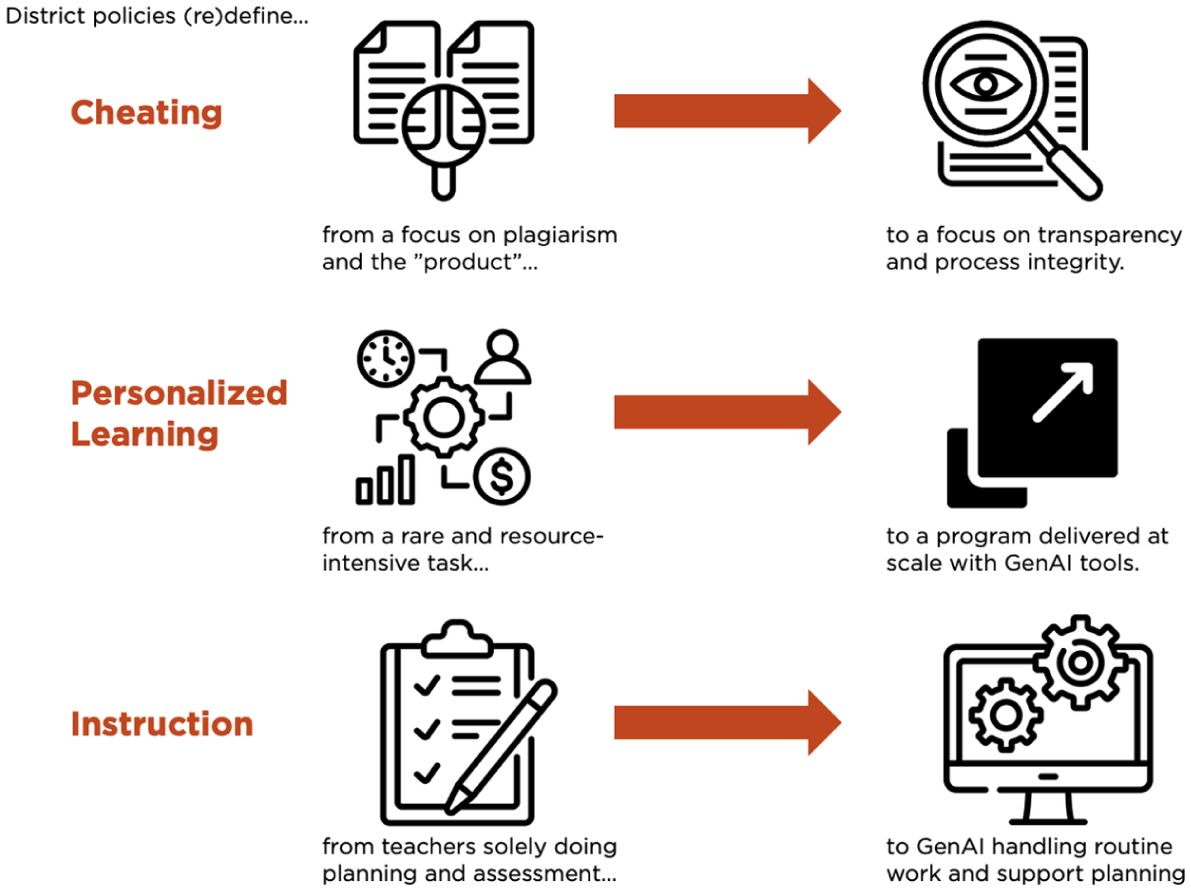
Redefinition of educational concepts with the advent of Generative AI.
First, districts had to expand their definition of academic integrity in the age of GenAI to not just focus on the plagiarized product but also on the integrity of the process. Traditionally, cheating referred to overt acts like copying answers, submitting another person’s work, or plagiarizing from written sources—which were relatively easy to identify because they involved a clear transfer of authored content into a specific written product. However, the advent of GenAI tools could let students generate text that appears original but was authored completely or partially by a large language model. As a result, districts are redefining cheating to encompass not only the final product students submit but also the processes and tools they use to produce it. For example, four districts including Nevada’s Clark County School District (CCSD), the Los Angeles Unified School District (LAUSD), Hillsborough County Public Schools (HCPS), and New York City Public Schools (NYCPS) have explicitly expanded their rules and policies regarding academic integrity. In a document titled “Acceptable Use Policy” released on April 14, 2025, CCSD created a rule that prohibited students from using AI to create “deceptive, misleading, or falsified content, including deepfakes, plagiarism, unauthorized automation of District operations, or any content that violates ethical or legal standards.” Here, integrity did not just mean copying content but focused on the problem of generating content like fabricated videos and deceptive information. An even expanded definition is proffered by LAUSD as its April 8, 2024 policy bulletin noted, “District Users should cite the particular AI Tool(s) used. . . and provide disclaimers if content cannot be verified, or potentially express bias.” This indicates a shift away from purely product-based judgment (i.e., Is the text original?) toward process-based integrity (i.e., Did the student openly disclose and verify the AI-generated work?). As GenAI progresses in its sophistication, districts will continue to grapple with how the definition and scope of academic integrity will change.
Second, two districts have noted a shift in thinking about personalized learning from what has been traditionally seen as a resource-intensive endeavor to a program that can be delivered at scale with new technological tools. Both districts with explicit personalized learning redefinition policies are located in Florida, which may reflect the state’s distinct policy environment and the capacity of its large county-based systems to broker partnerships with technology vendors. Traditionally, personalized learning required extensive human resources with teachers differentiating instruction, tutoring students one-on-one, or designing individualized plans—with districts limited by staffing, time, and budget constraints. However, the rapid adoption of GenAI in schools is driving a reconsideration of what personalized learning entails and what GenAI makes possible. Florida’s School District of Palm Beach County offers one of the clearest examples with its adoption of Khanmigo, the AI tutor developed by Khan Academy. Its 2023–24 Superintendent Annual Report noted, In January 2024, the District embarked on an innovative journey by introducing Khanmigo, a new AI-powered tutor for students and an assistant for teachers. . . Khan Academy provides a personalized learning platform with practice exercises, instructional videos, and content across subjects. . .. (emphasis added).
The report goes on to talk about Khanmigo serving as a virtual tutor, practice partner, debate coach, and writing assistant for students (see more in “Innovation” section). Its mention in the district’s Annual Report signals the way the district is rethinking its approach to personalized learning. A similar approach has been noted in another Florida school district, the Broward County Public Schools (BCPS). In a press release dated June 2, 2025, BCPS described its adoption of Microsoft 365 Copilot, where “AI is used to support individualized learning and engagement, with real-time feedback including translation and language support.” Although these public statements reflect an aspirational vision of personalization, they may not capture the practical challenges teachers face when integrating such tools into their everyday instruction. Nonetheless, these statements provide a glimpse of how personalized learning is being redefined by the introduction of these new tools.
Third, three districts noted how instruction is also changing from a wholly teacher-centered endeavor to a partnership between humans and artificial intelligence. Traditionally, teaching was defined by a set of teacher-led tasks: designing lessons, grading student work, planning units, writing rubrics, and delivering instruction. But GenAI has opened the door to a more “collaborative” model in which technology assists with planning, assessment, and content creation. For example, in its AI Guidebook published in July 2024 and updated in August 2025, the Chicago Public Schools (CPS) stated that “Faculty are encouraged to actively engage with AI tools as a means of uncovering new ways of teaching.” It goes on to outline specific applications for teachers across grade levels. Elementary school math teachers, for instance, can use GenAI to create “customized word problems tailored to the current unit of study and individual students’ unique needs.” Similar examples were provided for middle and high school teachers and in subject areas such as literacy, science, and social studies. Other districts offer comparable encouragement: BCPS highlights how GenAI supports the “creation of classroom efficiencies,” while Orange County Public Schools in Florida notes the benefits of real-time feedback and improved instructional strategies. These instructional shifts, however, are capacity-mediated: the districts producing the most detailed guidance documents (CPS, BCPS, OCPS) are among the largest and best-resourced in the sample. The commendation of these tools notes a shift in how instructional labor is reimagined and redistributed, reflecting an emerging belief that teaching increasingly involves using and supervising AI-generated materials rather than producing every component by hand. These series of transformations and redefinitions offer insights into ways districts respond to new technology.
Regulation
Aside from redefining concepts, districts have also created new rules and regulations not just for students and teachers (i.e., the users of GenAI tools), but also for technology companies (i.e., the suppliers of these tools). Across these eight districts, new regulations and policies were instituted to provide safeguards to anticipate potential harms, abuses, and legal complications. By providing clear guidelines on the use of and criteria for GenAI tools, districts are asserting greater oversight over the AI ecosystem—setting boundaries on data privacy, security, authorization, and transparency.
The first regulatory focus concerns data privacy and security, especially as GenAI tools rely on large volumes of user-provided information. On one end, all twelve districts have issued rules directed at the users of these systems. For example, NYCPS prohibits students and staff from inputting personal, confidential, or identifiable information into external AI tools. The district explicitly references compliance with New York State’s Education Law 2-d and the Family Educational Rights and Privacy Act (FERPA), both of which protect the personally identifiable information of students and staff. A similar regulation appears in LAUSD’s April 2024 policy bulletin, which states that “District users shall not share any confidential, sensitive, privileged or private information when using, prompting, or communicating with any AI tools.” These guidelines specifically restrict the inclusion of pupil records, employee personnel files, and health-related information in GenAI prompts or systems. Such regulations are directed not only at ensuring safe user behavior but also at establishing a clear boundary between district-protected data and the data practices of external AI platforms.
On the other end, policies have also been directed at technology companies for how data are being used. Eight districts created regulations not just for teachers and students but for vendors as well. LAUSD and CPS provide some examples. LAUSD has a Unified Digital Instructional Procurement Plan, which vendors submit for review so that tools may be used in district schools and classrooms. Chicago also has a similar process where all educational technology (EdTech) tools have to undergo vetting and approval by the CPS through its EdTech Request for Qualifications. The CPS website notes that vendors sign up for this once-a-year process where they “provide comprehensive documentation regarding their tool’s data privacy practices, including how data is collected, stored, used, and protected.” These vendor-directed district policies establish clear contractual obligations that extend beyond general user guidelines, placing legal and technical responsibilities directly on technology companies, not just on students, teachers, and staff in the district.
Another space for regulation is the authorization for the use of GenAI tools—both in terms of who can use them and who are able to provide them. At the side of users, two of the twelve districts (LAUSD and Houston Independent School District or HISD) have guidelines and training before individuals could use these tools. In Los Angeles, students are required to finish a mandatory Digital Citizenship instruction, which for secondary school students is called, “Digital Citizenship in the Age of AI.” In Houston, the district has created a guidebook dated November 2024, with the following rules on access and authorization: Students under the age of 14 (Below 8th grade) are prohibited from accessing generative AI tools on school devices and networks, with the exception of district approved educational tools that incorporate artificial intelligence technology (i.e., Amira Learning). Students above the age of 14 (8th grade) may access generative AI tools for approved educational purposes under the following conditions: Parental Consent. . .. Teacher Permission. . .. Responsible and Ethical Use. . ..
Beyond regulating who can use the tools, some districts also regulate who can supply them. For example, Chicago teachers may only use GenAI tools approved in the district’s Ed Tech Catalog, which undergoes continuous review for privacy, security, data retention, instructional alignment, and equity considerations. Documents also note that the CPS approval process is paired with active monitoring of AI activity on district devices to ensure that unvetted or unapproved tools do not enter classrooms or shape instructional content. Taken together, these policies reflect districts’ efforts to govern an emerging AI ecosystem by controlling both the demand side (users and usage conditions) and the supply side (vendors and tool authorization), positioning the district as an authorizing figure for GenAI use.
Finally, districts are regulating and promoting the transparent use of GenAI tools. Nine districts have provided guidelines where individuals are required to disclose whether and how they used GenAI, and to differentiate between AI-generated content and their own work. For example, Houston’s AI Guidebook requires students to provide proper attribution for a range of AI-assisted activities, including paraphrasing AI-generated text, incorporating AI-created images, or receiving indirect support such as brainstorming and editing. Figure 2 provides an example from the Houston ISD AI Guidebook illustrating how students are required to attribute GenAI usage, whether through a formal citation or a simple disclosure statement. Other districts, including New York City, Chicago, and Clark County, have adopted similar guidelines requiring users to explain how GenAI tools contributed to their work. These policies signal a shift toward “disclosure-based regulation,” where GenAI is not prohibited but must be used ethically, transparently, and with clear acknowledgment of its role. However, this model is difficult to enforce in practice, as AI use can be subtle, dispersed across tasks, and not always visible in the final product. Nonetheless, the move toward mandatory transparency reflects an emerging consensus, where the responsible use of GenAI depends not on banning the technology but on forming ethical and transparent practices.

Example of how to attribute GenAI usage.
These policies and regulations demonstrate how the twelve largest districts are not simply reacting to the emergence of GenAI but are actively shaping the conditions under which it enters their districts, schools, and classrooms. Policies on privacy, security, authorization, and transparency are attempts to protect student data, promote ethical use, and create guardrails that define the appropriate uses of GenAI. Rather than allowing commercial tools to diffuse unchecked, districts are asserting their regulatory authority. While these regulations are no assurance that they will be followed, they mark a shift toward anticipatory governance, which suggests that districts recognize the need to shape GenAI’s trajectory even if full compliance remains difficult to guarantee.
Innovation
As district policies expand definitions and introduce new rules and regulation, many have simultaneously developed new strategies for enabling GenAI tools—i.e., actively fostering and deepening their use. A consistent theme across the districts we examined is a shift from reactive bans to proactive support and structured innovation. For example, New York City Public Schools initially blocked access to tools like ChatGPT in January 2023 due to concerns about the “negative impacts on student learning, and concerns regarding the safety and accuracy of content.” Yet by May 2023, Chancellor David C. Banks wrote, “While initial caution was justified, it has now evolved into an exploration and careful examination of this new technology’s power and risks. . .. New York City Public Schools will encourage and support our educators and students as they learn about and explore this game-changing technology” (emphasis added). A few months later in September 2023, the district launched its AI Policy Lab—an initiative convening districts and states to jointly develop approaches for integrating AI into K–12 education. Similar reversals took shape elsewhere. In Broward County, Florida, district leaders moved from blocking ChatGPT to adopting what they described as a “thoughtful, strategic approach to integrating AI into education,” These examples illustrate how districts are not only regulating GenAI but also creating conditions that support its use. In this section, we underscore district innovations directed at integrating AI into school subjects, as interactive tutors, and to accomplish administrative tasks. These innovations were uneven across the sample and were most visible in large, high-capacity systems with the staffing, partnerships, and resources to pilot tools, issue guidebooks, or publicly support initiatives.
First, subject-matter integration was documented in eight of the twelve districts, particularly on teacher-facing guidance on using GenAI in classroom instruction. One of the clearest examples is Chicago Public Schools’ AI Guidebook, which offers concrete, grade- and subject-specific applications. Elementary teachers are encouraged to generate interactive character personas for literacy lessons and differentiated word problems in math. Middle school teachers can deploy supervised AI tutors or run virtual science experiments. High school students can receive instant formative feedback on writing, explore advanced math concepts through dialogue with an AI chatbot, simulate research workflows in science, and use generative search tools to synthesize multiple perspectives in social science. Figure 3 shows a page from the CPS Guidebook illustrating these recommendations. In other districts, AI is not only being used to augment learning but is emerging as academic content in its own right. Orange County Public Schools, for example, developed a statewide high school AI curriculum with the University of Florida, including courses such as “Artificial Intelligence in the World” and “Foundations of Machine Learning.” NYCPS has similarly introduced GenAI concepts within its Computer Science for All (CS4All) sequence while HISD has a “Foundations of AI” elective for high school students. Together, these examples highlight how districts are moving beyond bans and restrictions toward actively curating, recommending, and even teaching GenAI.

Example of guidance for AI subject integration in elementary classes.
Another application of GenAI’s innovative potential is through its use as an interactive tutor, which were documented in only two districts. In Palm Beach County, the integration of Khanmigo has become a leading example of how GenAI can function as an interactive learning partner rather than a replacement for teachers. With the help of this artificial intelligence tool, students have received more one-on-one tutoring time. According to a local news report, the district first launched Khanmigo in a few high schools in January 2024 before expanding to all the district’s middle and high schools at the beginning of Fall 2024. Another report also noted how the district is actively encouraging and supporting this use: “Each teacher was told to have their students interact with Khanmigo at least 10 times each month, a metric that is monitored by the district.” The $2.5 million investment, partly funded by the Stiles-Nicholson Foundation, underscores how districts are mobilizing new resources to enable GenAI experimentation. Moreover, the program is not limited to providing access to the tool; it is paired with teacher training, data support, and structured classroom routines. In this example, GenAI is serving as a catalyst for process innovation as districts redesign instruction, and create new expectations for teaching and learning.
A third area for innovative change lies not in instruction but in the administrative backbone of school systems. Six districts documented GenAI use in administrative work or administrator-facing professional support. For example, Miami-Dade County Public Schools has adopted a resolution allowing county employees to utilize tools like ChatGPT to increase efficiency in areas such as procurement, customer service, and data entry. Similarly, NYCPS policies outline how GenAI can automate complex operational routines, from transportation planning and budgeting projections to résumé screening for hiring, as long as “every decision impacting students. . . is reviewed by a human.” Districts are also pairing this expansion of technological capacity with parallel investments in human capacity. Many districts like Gwinnett County Public Schools in Georgia and HCPS in Florida also require administrators to participate in professional development focused on critically evaluating and contextualizing AI-generated content rather than treating AI outputs as authoritative. These developments illustrate how districts are integrating GenAI across both instructional and administrative contexts.
The development of these district-level policies and guidelines demonstrates an emerging shift from restriction to proactive implementation. Early bans, which were grounded in concerns over academic integrity and data privacy, have increasingly given way to guided adoption. Instead of viewing GenAI as a disruption to manage, some large districts are beginning to frame it as an opportunity to expand access, personalize learning, and modernize public education infrastructure.
Discussion and Conclusions
Amid the extensive public debate and personal integration of GenAI, this study set out to examine how the twelve largest US school districts are responding to the technology’s rapid emergence, influence, and usage. Although initial responses to tools like ChatGPT were characterized by reactive prohibitions and concerns over academic integrity, our analysis reveals that district policies have evolved into more sophisticated proactive forms of governance that integrate expanding definitions, creating new regulations for both users and suppliers, and fostering experimentation and innovation. Figure 4 provides a visual overview of the three distinct domains for the governance of GenAI in large school districts as well as the aspects that are redefined, regulated, and innovated. To complement this, Table 2 presents a summary of the responses of districts to GenAI, and specific examples across the various districts. We note a number of the implications of this research on the study of GenAI, education policy, and school districts.

Three domains for governing GenAI.
Summary of Policy Responses to GenAI.

First, the framework advances the education literature by providing one of the first comparative, district-level typology of AI governance in K-12 education. Much of the previous literature on policies for education technologies have focused on the initial enthusiasm for these technologies, the tendency for new tools to be decoupled from classroom practice, and the critiques about their risks and shortcomings (Cohen, 1987; Selwyn, 2018; Weick, 1976; Williamson, 2017). However, we focus on a systematic empirical investigation of policy documents and news articles to show how large districts are responding with new policies and regulations for emerging technologies. By comparing policies across the twelve largest US school districts, we aim to establish an empirical baseline for understanding the grounded dynamics of AI governance at scale.
Second, the proposed framework offers a conceptual vocabulary that clarifies what is meant by “GenAI governance.” Debates around GenAI in education tend to be framed normatively—emphasizing benefits versus risks—or pedagogically, centering on teacher and student use (Berthelot et al., 2025; El Fathi et al., 2025; Lo, 2023). In contrast, our framework conceptualizes governance as a set of organizational guidelines that extend beyond the classroom. In distinguishing between redefinition, regulation, and innovation, we highlight how these three dimensions respectively apply to the symbolic, bureaucratic, and infrastructural domains of policy responses by school districts. This aligns with and extends work by Selwyn (2018, 2024) and Williamson (2014, 2016), who both emphasize educational technologies as governed not only through formal rules but also through discourses, administrative systems, and organizational routines.
Third, the framework challenges traditional ways of thinking about education technology policy as simply reactive regulation and top-down control. Much of the ed-tech policy literature implicitly treats governance as a binary choice between prohibition and adoption, or as a question of whether policies enable or constrain technology use. Instead, our findings suggest that districts are simultaneously regulating and fostering GenAI, particularly salient in large districts that have the capacity and political ability to enforce these changes. It challenges conventional literature that focuses on simply the benefits or harms of new technologies (Law, 2024; Lee et al., 2024; Steele, 2023), and instead highlights the importance of understanding how policies actively shape the practical use of technologies, and vice versa. By conceptualizing governance as a combination of redefining norms, formalizing rules, and enabling experimentation, our framework reconceptualizes GenAI policy as an active process of organizational design rather than a narrow form of bureaucratic compliance.
Finally, our framework suggests specific places to interrogate policy implications. At the level of students, demands for academic integrity could lead them to new behaviors focused on proving authorship and returning to in-person assessments. At the level of teachers, the same demands could lead to additional work to redesign assignments, detect plagiarism, and offer guidance to students. At the level of technology companies, the regulatory oversight and needed district permission could transform these products. At the district level, the integration of GenAI into schools could strain the budgets of already struggling school districts. However, if districts attempt to use it as a substitute for certain services (i.e., tutors, administrative staff), the “savings” and “efficiencies” may come at the cost of fewer adults in schools. This highlights that districts need to constantly and consciously weigh how these new tools affect their budgets, staffing, and instructional goals.
More broadly, our study underscores the importance of large school districts as consequential actors in the governance of emerging technologies. While international organizations and national agencies have issued principles and guidance for “responsible AI” in education, these frameworks remain abstract until translated into enforceable rules and practices. Districts occupy a crucial position in this translation process, converting broad ethical concerns—such as equity, transparency, academic integrity, and human oversight—into operational guidance shaping everyday practices within schools.
Although we note this paper’s contributions, we also underscore some limitations that point to important directions for future research. From a conceptual standpoint, we acknowledge that the analysis is descriptive and does not examine the political, organizational, or contextual factors that shape why districts adopt particular governance strategies. Future work could explore how variation in district capacity, leadership, legal environments, or vendor relationships influences GenAI policies. From a methodological standpoint, we are limited by our focus on the largest US school districts and formal policy documents. The focus on large districts with greater administrative resources and visibility may not fully capture the governance strategies in less-resourced settings. Moreover, the focus on policy documents rather than implementation and practice raises questions about how these are enacted, interpreted, and resisted in school settings. Nonetheless, we do aim for our study to encourage future studies to explore how these policies are adapted in smaller districts and in schools themselves.
Taken altogether, our study provides a conceptual map of how GenAI is being governed in US K-12 education. As GenAI tools evolve and increasingly integrate into educational practices, the framework developed here can support longitudinal analyses of policy changes, comparative studies across institutional contexts, and evaluative research on how different governance configurations shape educational practice and outcomes. It invites scholars to rethink education technology policy not as a response to tools alone, but as a process through which educational organizations negotiate values, authority, and control in the face of technological change.
Footnotes

Funding
The authors received no financial support for the research, authorship, and/or publication of this article.
Declaration of Conflicting Interests
The authors declared no potential conflicts of interest with respect to the research, authorship, and/or publication of this article.