



Abstract
The article advances an emergent framework for conceptualizing the relationship between principal leadership and education policy implementation. Based on a qualitative study of school principals and policy implementation in Region X of the Philippines, findings suggested that the way in which policies were interpreted and implemented at the school level was influenced by a variety of intrinsic and extrinsic dynamics and these were shaped in situ by individual, school and community inhibitors and facilitators. These motivations and localized contexts were critical to implementation, and compelled principals to ignore, monitor, or implement education policies as a priority.
In 1964, University of Toronto professor Marshall McLuhan’s book Understanding Media: Extensions of Man was published. The book was an unexpected sensation, generating dialogue and debate in academic and popular communities (see Rosenthal, 1967; Stearn, 1967). In Understanding Media, McLuhan raised a number of issues and articulated observations related to the ways people engage with television, print media, and radio (McLuhan, 1964). At the heart of his argument is the notion that certain media like television shows are “hot,” as they construct meaning and messages fully for the consumer—the plot, characters, dialogue, themes, etc. are fashioned in a manner that encourage passive engagement, as everything is already done for the consumer. Other media, such as newspaper articles, are “cool” in that they demand active engagement and co-construction to make meaning and receive information—with a print newspaper article, readers have to imagine certain details of the story, such as the way a person described only through text looks or sounds. In a sense, the reader is required to fill in information from their own experience and infer meaning and messages that might only be implied or assumed. Put simply, consumers take in fully formed hot media in a passive manner and less constructed cool media actively to make meaning of them. In many ways, educators approach leadership in the same way. Their leadership is at times highly active, perhaps directive, prescriptive, supportive, and monitored, leaving little room for follower interpretation (Bell & Stevenson, 2006). At other times, leadership is practiced in a way that local school leaders, teachers, students, and communities are left with room to actively interpret and enact (or ignore) issues due to limited information and scant guidance (Rizvi & Lingard, 2009; Sinclair & Brooks, 2020).
The purpose of this study was to explore how school leaders interpret and implement education policy. We were particularly interested in understanding which policies they implemented with active (hot) leadership and which policies they engaged with passive (cool) leadership. A corollary aim was to explore the intrinsic and extrinsic dynamics that influenced leaders to adopt a given approach to leading policy implementation. As this purpose demands both a deep and nuanced appreciation of the ways that policies are implemented at the school level and consideration of the ways that such work varies across schools, we designed a qualitative case study with multiple school sites that shared the same policy context (Honig, 2006). This context was government schools of Region X of the Philippines, the School Division in Mindanao that governs the Cagayan de Oro metropolitan area and surrounding rural and remote areas. Data collection took place over the course of a year and included interviews and focus groups with 93 of the 99 school principals in Region X, in addition to interviews with school division administrators.
The subsequent section of this article is a literature review focused on the role of school leadership in education policy implementation. We organized this literature into four sets of dynamics that facilitate and/or inhibit policy implementation: policy dynamics, external dynamics, school dynamics, and personal dynamics. Drawing from key concepts in this literature, we developed an exploratory “hot leadership, cool leadership” conceptual framework that guided the empirical phase of the study. We then explain the methodology, before presenting findings which suggest that certain dynamics facilitated an active approach to implementation while others encouraged passivity. The article then advances a hot policy, cool policy theoretical framework and considers implications for further research and improved practice.
School Principals and Education Policy Implementation
Education policies can be developed at any level of a school or school system (Brooks & Normore, 2017). An education policy can be conceptualized as any formalized and institutionalized practice that guides, constrains, or encourages individual and organizational behavior (Young & Diem, 2017). Considered as such, education policies might be in the form of legislation, codes of conduct, charters, instructional strategies, communications plans, or any number of other artefacts (Sinclair & Brooks, 2022). Policies can be developed organically out of local needs or be mandated from the apex of an organizational structure, depending on the limits of the agency people throughout the system are afforded (Wirt & Kirst, 1997). Policies are then interpreted at each level of the system and institutionalized, with attendant guidance, support, incentives, sanctions, and monitoring determining the way a policy is operationalized in various levels of the school system (Dumas & Anyon, 2006). However, for the purposes of this study we are focused primarily on education policy that is developed at the national level and is intended to be implemented at the school level with fidelity (Odden, 1991).
When national education policies are conceived, they are typically intended to encourage whole system improvement in a top-down manner rather than considering the intricacies and idiosyncrasies that manifest in individual communities or schools (Brooks et al., 2007). While ostensibly designed to benefit all schools and students, national education policies can be ineffective, political, and inequitable. They are often driven by the concerns of politically-connected education advocates, political party ideologies or a commitment to a particular curricular or pedagogical approach that privileges some while disadvantaging others (Savage & O’Connor, 2014). While these failures are at times due to high-level factors, the inequity can also be structural in that several organizational layers of the system will interpret and provide guidance in a way that facilitates and inhibits certain ways of thinking about and acting on a policy by the time it reaches the school or classroom level (Spillane, 2009). The stratified and contested journey that a national education policy takes from being announced to actually making changes in the way a school works is fraught, but typically arrives in the form of directions for the school’s principal about what they are meant to do, the timeline for implementation, support and/or guidance related to the initiative, and the consequences of not achieving what is expected (Printy & Williams, 2015). Thus, the ways that the principal interprets, implements, and makes decisions day-to-day in relation to a policy are among the most critical issues that determine the success or failure of an initiative (Ganon-Shilon & Schechter, 2019).
Principal Interpretation, Implementation, and Leadership
The way that a principal interprets, implements, and supports or ignores an educational policy are critical if the initiative is to make meaningful change in the school (Brooks et al., 2004; Cohen et al., 2020). When national policies are released, guidance for educators working in the school system is explained through primary policy documents, typically the law or report that lays out the rationale for change and expectations for people, units, and processes in the system (Rizvi & Lingard, 2009). As these documents move through levels of the school system—say, from Education Minister to Division Leaders to School networks and finally to school principals, guidance typically becomes increasingly narrow and actionable (Brooks & Normore, 2017). Still, even though policies have gone through this process, it is common for a certain amount of discretion, and indeed interpretation, of the policy remain in the principal’s purview. As Yanow (1995) explained, interpretation has to do with translating a policy from abstract intention to practices and processes in a school: Policy interpretations ask not only what a policy means, but also how a policy means. Interpreters often discover that for both questions, the answer is plural: a policy means more than one thing, and those meanings are conveyed in more than one way. (111)
Indeed, recognizing the ambiguity of the policy making process and the sensemaking that needs to take place at the school level is key to understanding how a policy is implemented, which is crucial to its relative success or failure (Cohen-Vogel, 2005). Depending on the nature of the policy, principals will have more or less agency for interpretation (Gu et al., 2018). Principals are uniquely positioned to consider and then influence how the intent of the policy complements or challenges what the school is already doing and put a plan in place to encourage the changes required by the policy (Shaked & Schechter, 2017). This may done via a democratic process, a limited consultation process or by fiat depending on the principal’s approach to leadership and school dynamics (Dimmock, 2018). Once they have interpreted what the policy means in the context of their school and how the aims of the changes might best be achieved in situ, the principal can move the school from interpretation to implementation.
Policy implementation is the shift from interpretation to action. At this point, principals seek, provide, or co-create clarity around how changed performance will be measured, monitored, supported, and institutionalized in the school (Brooks & Normore, 2017). Principals will draw on their understanding of the school and community context, staff and student capacity, and available resources to determine the processes that will be changing to achieve the policy’s intended outcomes (Binkley, 1997).
Dynamics That Facilitate or Inhibit Principals from Implementing Education Policy
Despite careful development and design, education policies are not always successful when implemented (Brooks, 2006a). Indeed, they commonly fail to achieve intended changes in processes and outcomes, particularly at the school level (Datnow, 2020; Tyack, 1974; Tyack & Hansot, 1980), which is arguably the most critical level of education policy implementation (Honig, 2006). Principal leadership in particular plays a key role in the success or failure of a policy, and that certain dynamics facilitate or inhibit principals’ leadership in relation to policy implementation (Brooks, 2006b). During our systematic literature review (Petticrew & Roberts, 2008) on the topic, we identified four sets of dynamics: policy dynamics, external dynamics, school dynamics, and personal dynamics.
Policy Dynamics
Policy dynamics have to do with the way that a policy is designed, and the guidance and support that a principal receives at the school level. Such dynamics often arrive in the form of: rationales and/or mandates for change; support and/or guidance; monitoring and/or reporting schedules; and attendant sanctions and/or incentives. Rationales and mandates for change should be research-based, practice-based, or a combination of the two but they are commonly political and based on insubstantial assumptions (Stovall, 2020). Over the past 50 years, many countries’ national education strategies have been driven by rationales and mandates grounded in deficit-oriented international comparisons of standardized test outcomes with other countries rather than assessing and building on system, student, educator, or community strengths (Rizvi & Lingard, 2009). This creates the sense that there is an education crisis (Berliner & Biddle, 1996), with the operating assumption being that the nation’s children, economy, and future prospects are falling behind the competition and not realizing their potential. Rationales and mandates can of course be research-driven, drawing on education research and work from adjacent fields to suggest promising new direction (Darling-Hammond, 2004). They can also be practice-based, where effective strategies are shared across and between systems and schools.
The levels and forms of support and guidance offered by the system to a school seeking to implement a policy are crucial. Typically, these will include an information component intended to educate school-level personnel and accompanying training to translate abstract ideas into day-to-day practice. Support might come in the form of increased budget, availability of expertise, or time for educators to learn, practice, analyze data, and share experiences through various phases of implementation (Desimone, 2002). Guidance will be communicated to principals regarding anticipated changed processes and outcomes, with a timeline for implementation and expectations around seeing improved results in some aspect of practice. This timeline will include discussion of monitoring and reporting schedules, which are commonly externally imposed, but which may be subject to negotiation depending on a variety of circumstances. Guidance will also include articulation of attendant sanctions should the policy fail, or incentives if the policy is successful. While incentives are usually clear, sanctions are often “soft” due to a recognition that change is not always a simple process (Guhn, 2009).
External Dynamics
Principals are influenced by a variety of external dynamics when they seek to implement policies in their schools. Principals operate within nested systems of cultural norms, societal expectations, and professional and community values which in turn shape educational goals, policies, and practices (Khalifa et al., 2016). Society, through government and departments of education, set the overarching legal and policy frameworks within which schools and school leaders operate. Principals must work within local, state, and national regulations, which are often reflective of societal priorities and concerns (Theoharis, 2024). Schools are integral parts of communities, and principals are often seen as community leaders (Khalifa, 2020), meaning that communities and principals can have strong reciprocal influence with one another. Accordingly, principals’ practice is influenced by community expectations regarding education, including desired outcomes, curriculum content, and extracurricular activities (Green, 2018). Economic conditions impact education funding, resource allocation, and access to education and employment opportunities. Principals must adapt to economic realities within their schools and communities, which can affect staffing, programming, and facilities (Ingle et al., 2011). In addition to facilities, technological advancements influence principal leadership in numerous ways, including classroom technology, administrative systems, and access to information. Principals must stay abreast of technological trends and integrate them effectively into their schools, particularly when implementing education policies that are forward-looking (Yap & Brooks, 2022). Societal movements and debates surrounding social justice and equity have a profound impact on education in general, and on principal leadership in particular (Brooks et al., 2007). Principals are increasingly tasked with promoting inclusivity, diversity, and equity in their schools and addressing systemic inequalities (Horsford et al., 2011). Contemporary principals must also lead in an era of unprecedented scrutiny and media attention (Fullan, 2023). Media portrayal and public perception of education influence how principals are perceived and evaluated (Cox & McLeod, 2014). They must manage public relations and communication strategies to maintain positive relationships with stakeholders.
School Dynamics
Principal leadership in relation to policy implementation is also influenced by relational, technical, and cultural school-level dynamics (Kalkan et al., 2020). Among these are the culture and climate of a school, which shapes the way principals co-construct their leadership on a daily basis with colleagues and other stakeholders (Brooks & Miles, 2006). A positive, supportive culture can foster collaboration and innovation, while a negative or toxic culture may engender a sense of alienation (Brooks et al., 2008) and present challenges for authentic leadership. The composition, morale, and relationships among staff members greatly affect how principals lead (Moolenaar & Sleegers, 2015), and while these are protean it is important that the principal support the conditions and opportunities for relationships to flourish. Principals must establish, maintain, and nurture relationships with teachers, professional staff, and other administrators to foster a sense of the school’s collective coherence, even if individuals are quite diverse in terms of their commitment, motivation, expertise, and dispositions (Stosich, 2018). The demographic makeup, needs, and behaviors of students shape the practice of leadership in relation to policy implementation, and it is critical for principals to interpret, implement, and monitor the intended and unintended impact of policies on majority and minoritized groups in their school (Theoharis, 2007). This means that principals must address diverse student needs, including academic, socio-emotional, and behavioral needs, with a sensitivity to the notion that every staff member and student has unique individual needs that make an additional depth of differentiation necessary (Gauld, 1996). The level and nature of community involvement and support principals receive influences how they lead their schools (Green, 2018; Irby, 2022). Principals may collaborate with parents, community organizations, and local businesses or they be quite removed from them—the strength and integration of these school-community networks and relationships are often crucial and neglected aspects of policy implementation (Stefanski et al., 2016). In addition to relationships, principals must manage resources effectively to support the implementation of education policies. Budgetary constraints, staffing levels, training, access to facilities and technology can determine whether a policy achieves fidelity on implementation (Desimone, 2002). Principals play a key role as instructional leaders in shaping curriculum, assessment, and data use practices within their schools. They support and guide teachers in implementing effective operational aspects of an education policy. Principals also lead the short and longer-term strategic aspects of school improvement, and therefore need to establish a climate of continual improvement in the school (Hallinger & Heck, 2002) that is aligned with vision and goals.
Personal Dynamics
Each principal brings a unique configuration of knowledge, skills, ethical orientations, and dispositions to the role that influence their approach to policy implementation (Stronge & Xu, 2021). Principals may be introverted or extraverted, outgoing or reserved, conservative or progressive, impulsive or calculating, and of course most exhibit a variety of these traits in discrete circumstances or situations (Atasoy, 2020). These traits shape their communication style, decision-making approaches, emphasis on certain aspects of the role, and ability to build relationships with people inside and outside of the school. Principals may exhibit various leadership styles, including distributed (Spillane, 2005), authoritative, democratic (Kensler & Brooks, 2012, transformational (Leithwood & Jantzi, 2005), transactional (Friedman, 2004), or laissez-faire (Northouse, 2021). Their leadership style influences how they motivate staff, manage conflict, and promote organizational change related to education policy. Principals’ personal values and beliefs deeply influence their priorities, principles and practices as educational leaders. Their commitment to equity, social justice, student-centeredness, and lifelong learning is the foundation of an operational philosophy that defines and characterizes their leadership (Brooks & Normore, 2017). Principals’ educational background, including their experience in the classroom, academic qualifications, and understanding of staff and students’ lives inside and outside of the school shapes their understanding of pedagogy, curriculum development, assessment practices, and helps them make judgements about introducing new approaches into the context of the school. Principals with high emotional intelligence are adept at understanding and managing their own emotions and those of others (Chen & Guo, 2020). Principals who demonstrate empathy, self-awareness, social skills, and self-regulation are more likely to lead in a manner that is sensitive both to policy imperatives and the needs of the staff and students whose routines they seek to change (Singh & Dali, 2013). Principals with strong communication skills can articulate the need for implementation, illicit (and provide) feedback through formal and informal means, and facilitate difficult dialogues that are sometimes necessary when implementing new processes (Ärlestig, 2007). It is also important to recognize that leading policy implementation can bring stress to the principal that demands resilience and self-care. Principals encounter various challenges and setbacks along the path of implementing policy, requiring resilience, and adaptability to navigate complex situations (Ray et al., 2020).
Exploratory Conceptual Framework
The central purpose of the study was to explore how school leaders interpret and implement education policy. Our review of the literature suggested four sets of dynamics shaped this: policy dynamics, external dynamics, school dynamics, and personal dynamics. Further, within each of these there are a variety of factors that influence the ways that principals interpret and implement education policy. Figure 1 illustrates the initial conceptual framework we developed to explore the relationship between the key concepts in the study.
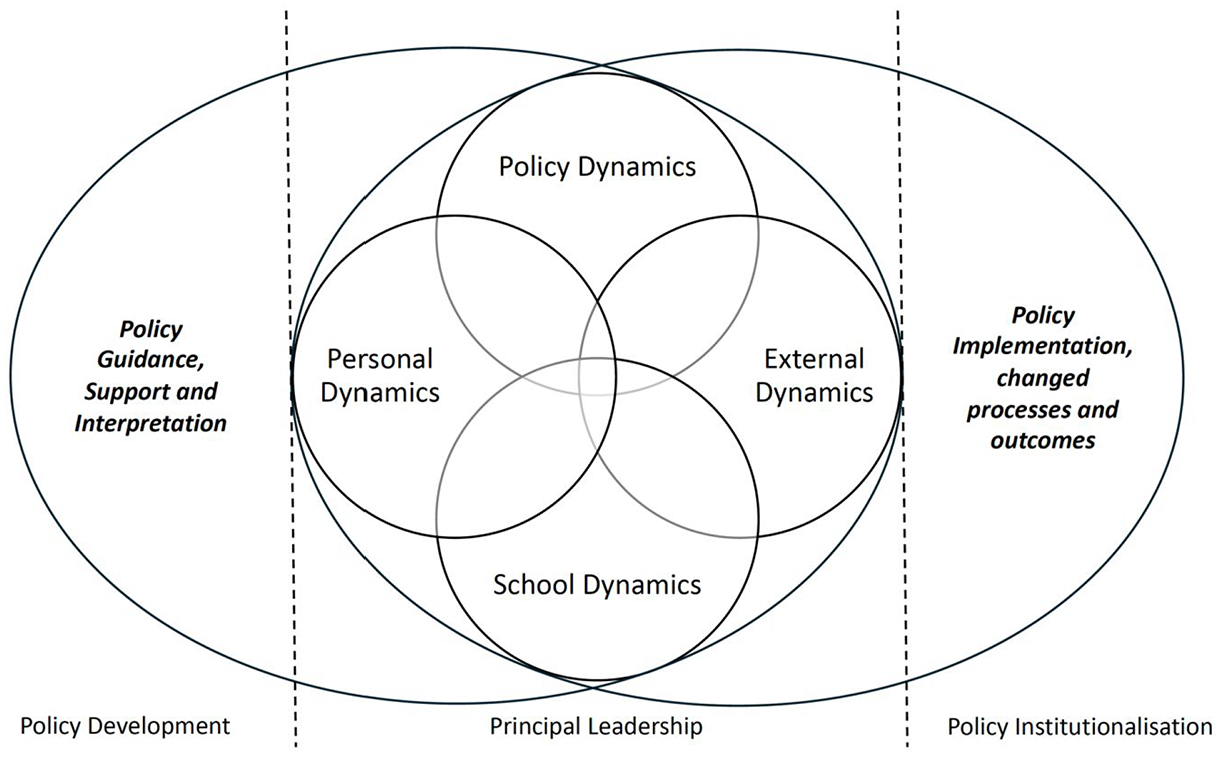
Exploratory conceptual framework for researching principal leadership and policy implementation.
This framework reflects the assumptions that when policies are introduced to a school, the interpretation of these policies are shaped by the ways that the policy, personal, external, and school dynamics influence principal leadership. Policy development and interpretation is an initial phase, which is then influenced by principal leadership. This leadership, and the dynamics which influence it, leads to policy implementation and institutionalization. Our contention is that these four interrelated sets of dynamics shape the duration of the policy process from interpretation to implementation, and will ultimately impact whether or not the policy was (a) implemented with fidelity and (b) a success or failure, given its espoused aims.
Methodology
This project was conducted using a qualitative methodology consistent with case study research (Merriam, 1998). The study took place in Cagayan de Oro City in the Southern island of Mindanao in the Philippines. As such, the case was bounded geographically, and participants shared a common education policy context (Bartlett & Vavrus, 2014). Data were collected during an initial six-month period and then follow up interviews and observations helped clarify certain concepts; 93 of the 99 principals in Region X took part in the study, an area that effectively included the geographically diverse metropolitan region including and surrounding the City of Cagayan de Oro. The majority of participants in the study identified as women (65), with the remaining 28 identifying as men; 15 of the 28 men were principals at secondary schools, while only 6 women were secondary school principals. Aside from gender, there was also great diversity in terms of years of experience (1–41) and school size (14–5,000). Approximately half of the schools in Region X are considered urban, with the others being regional and remote schools.
Data Collection
Data collection included 43 semi-structured interviews (Seidman, 2006) with primary and secondary school principals, each of which lasted between 45 minutes and 2 hours. Additionally, we conducted 13 focus group interviews. The average length of each focus group interview was approximately 1 hour and 15 minutes. Interview prompts centered around leadership and policy implementation in schools, but also included questions about each interviewee’s values, experience, aspirations, and approach to leadership. Focus group prompts were designed to illicit responses about similarities and differences in leadership practice across schools. The lead author conducted all interviews and focus groups, most of which were completed in English. An interpreter accompanied the lead author and occasionally translated questions and answers into (or from) Tagalog, Cebuano, or English as required (Temple & Young, 2004).
Data were also generated via 194 hours of observation, which included school leadership meetings, Parent Teacher Association meetings, classroom sessions, and Region X Management Communication (MANCOM) meetings; 42 technical documents (Cardno, 2018) such as School Improvement Plans, a regional accreditation report, discipline plans, meeting agendas, and DepEd memos were also collected.
Data Analysis
Data were first coded into four a priori categories: Policy Dynamics, External Dynamics, School Dynamics, and Personal Dynamics (Saldaña, 2015). Within each of these we engaged in open coding and then axial coding (Corbin & Strauss, 2014), which led to the emergence of certain facilitators and inhibitors within each category. Upon identifying facilitators and inhibitors within each category, we employed the constant comparative method (Bogdan & Biklen, 1997) and then subsequently returning to the field to pose targeted inquiries and gather supplementary data. This inductive and iterative approach facilitated the progression of our analytical process toward theoretically saturated themes (Strauss & Corbin, 2008). These themes are presented and explored in the Findings section below.
Rigour
We employed participant member checks throughout the duration of the study and triangulated data from all sources (Cresswell, 2013). Transcripts from interviews and focus groups were shared with participants to verify accuracy and to garner insights into both descriptive and interpretive aspects of the research. The lead author also debriefed with participants about observation notes to ask clarifying and probing questions (Seidman, 2006). Preliminary and in-depth analyses were shared with participants for their feedback and comments. Respondents affirmed that the analytical categories, and ultimately themes, aligned with their viewpoints, thereby enhancing the study’s trustworthiness (Seale & Silverman, 1997).
Findings
Initial findings indicated that indeed, principal leadership of education policy implementation was influenced by personal, school, policy, and external dynamics. However, as we began axial coding to identify issues that were common across participants, patters emerged that helped us understand specific issues which principals indicated compelled them to prioritize, lead and champion certain policies while letting others fade into the background of the school’s work. The subsequent findings are focused around issues that influenced principals to practice hot leadership, an active and engaged leadership and those that influenced them to practice cool leadership, a passive and even intentionally neglectful approach.
Hot Leadership
Principals explained that a variety of factors motivated them to prioritize or put high levels of leadership practice toward the implementation of certain policies. Some of these “facilitators” were: Mandates and Sanctions; Alignment of Policy with Practice: The Best Interests of the Students; Moral Purpose and Religiosity; School-Community-System Micropolitics; and Contextual and Professional Commitments.
Mandates and Sanctions
As one Secondary Principal explained, There are certain things that you just have to do if you want to stay in the job. If I am told that a new policy is now the top priority, then I have to take that seriously. If I am honest, I hear that quite a lot—that this new thing is the most important thing—so you wait and see how important it really is. If we are having many meetings, if we are constantly reporting, if I am told my annual review depends on improvement then I know I must take it seriously and I put in the effort.
Most mandates and sanctions were the result of strong power dynamics in the flow of authority of the education system. That is, if a policy is important at the top, it is then made a Key Performance Indicator (KPI) to the leader at the next level, which cascades down to each subsequent level of the system. As a Primary Principal explained: You hear a speech from a politician and it is about education, about what is going to change in education. Sometimes they are just talking, but if something is serious we will hear about it at the next MANCOM (monthly Management Communications meetings) and they will tell us what we must change. It’s like that—the policies are made very far from the school, they go through our superiors and then we make it happen in the school.
Other principal responses further suggested that while every policy was presented as being important, certain policies were going to be closely monitored. Further, some policies were accompanied by serious consequences for the school and the principal. The following responses were typical illustrations of this: [The Division] introduced a new way to teach reading a few years ago. Some of the principals were unsure, especially those who had high performance already. We were all told that we would lose capital funding if we did not start teaching reading in the new way. It was a real shock because no one expected a funding connection. . .that meant everyone did what they were told, even if they were not so sure. At first I was reluctant to change our mathematics instruction to align with the new policy. I am a former math teacher and thought we were doing well. I feel like we taught it well. My supervisor told me I would lose my job if I did not comply, so we started doing it the new way. If your supervisor tells you to take a policy seriously, you have to. My friend was principal and they fired her on the spot because she thought it might not be good for her school. That morning she was a principal, by lunchtime she was back in the classroom as a teacher and someone else was in charge.
Not all sanctions were so dramatic, but all came with implied or actual consequences for non-implementation. This in turn meant that principals made implementation of certain policies seriously and made them a priority in their leadership practice at the school level.
Alignment of Policy with Practice
Principals explained that they were much more likely to lead implementation when a policy was aligned with the school’s existing practices rather than one that demanded a radical shift. This is not to say that they were reluctant to change, but that if the policy asked for a change that was an adjustment, extension or refinement of current practice it was easier to implement. As one Primary Principal explained, . . .some of the policies we are asked to do came from other schools where they have a good idea. It might just be a small change in process or a new way to monitor or report on things we are already doing, or that we already wanted to do.
Another Primary Principal suggested that when policies are about making small changes such as shifting terminology, providing greater structure to tasks or changing an approval system, it was important to adopt such practices: You have to shift with the times. A lot of what we principals do is about being responsive to small changes. I always try and take up these policies as they typically align with something that has changed at the Division level. Small changes in the school can help us be in line with what is happening elsewhere and mostly, the staff are fine with little changes.
Nearly all principals agreed that subtle policies which called for relatively small changes were (as a Secondary Principal exclaimed in a Focus Group, “part and parcel of working in Philippine schools. We like to tinker!”
“What is Best for the kids?”
A great many principals in the study explained that they were more likely to be fully committed to a new policy if it was in the best interests of the students, either academically or in terms of their wellbeing. Though issues were somewhat different, Primary Principals and Secondary Principals explained the importance of implementing such initiatives with high fidelity. The following exchange from a focus group illustrates this facilitator: Primary Principal 1 (PP1): “I always ask if a policy is good for students. And I don’t mean just for their learning, but for their life. I want them to be happy, safe and smart.” Secondary Principal 1 (SP1): “Completely agree. If I can see that something will improve their conditions I am fully in support. For example, we had students who could speak English and Tagalog but were weak and reading and writing in both languages. When the DepEd started the dual language program I was fully on board as I knew it was a problem. It meant a lot of work uplifting teachers, and even parents, but I knew it would help them be successful. I saw that it was very important.” SP2: “I remember! I agree! That program was one of the best changes, and you could see it making a difference almost immediately. Now the students are so much stronger with their reading, and it has even now meant that parents can get language instruction because it went so well.” PP2: “It’s a great example. It is also why we support the feeding program in our school. There are many poor students. We have to make sure their bellies are full before we fill their heads—you have to know the students’ lives before you know what policies are good for them. If you know their lives—in academics and in the home—you know how to lead.”
Moral Purpose and Religiosity
Though working in public schools, a significant number of principals explained that their work was guided by religious values and this in turn influenced the way they implemented policy. For a great majority of principals, this meant Catholic or non-denominational Christian, but there were also a small minority of Muslim school leaders. One secondary principal explained: I want the children to learn, sigue, but it is more important that they know God. They must have also their religion. The policies we support and what we do in the building everyday must move the children closer to God, first and foremost. I begin every address to the school with scripture, every day. When a policy comes to the school or when I am doing my work, I ask if it helps the mind and the soul. When [we] do something good [as principals], you should not say “I have done my job well,” you should give all glory to God. We have to be strong enough to do our duty as principals, for our children because it is our duty to them to help them grow in their mind but also in their heart.
Several principals suggested that it was important for them to publicly practice their leadership in keeping with religious doctrine, as it was what the community expected. One secondary principal said, “The people need to know that I am a man of God. If I cannot show this they will not follow me and I cannot lead any change.” This sentiment was strong among many principals, who indicated that they needed to be seen as a religious person to give community, staff, and students reassurance that they had moral purpose and would lead in a compassionate manner: When I talk to students, I talk about God. When I talk to teachers and students it is the same. This assures them that they can count on me. . .that I stand for something and that I will do what is good, because they know that God is watching me. In terms of policies, it is important that I can connect them to scripture—so when I know a policy is important I make sure I can speak about it being part of the calling. . .not just the curriculum.
Agency: Navigating School-Community Micropolitics and School Division Macropolitics
One dynamic that principals mentioned often was their agency to ignore, support, or mandate changed practices in their school and their relative lack of agency to influence policies beyond the schoolhouse. This was particularly pronounced among principals who led schools in remote or “far flung” schools, but was represented in suburban and urban schools as well. One principal explained: In my school, I can make a policy happen or let it fail. I am principal in a remote school. I have not seen a Division administrator in my school for 8 months. I try to implement changes as they ask, but I am only by myself—I have to pick and choose what gets attention and what does not. . .In my school, it is my decision. I am always interested in what is happening at central, but I cannot change them and they let me decide what I can and cannot do.
In contrast, there was a common perception that politically-influential or connected principals—mainly those from larger inner-city schools—had more influence in shaping the ways that policies were conceptualized and implemented in the Division. Quotes typical of this dynamic included: Big [school] principals are near to the heart and others are far from the heart. Policies seem to be mainly about what they need, while the rest of us are left to cope with what something means in a smaller school. The Division administrators do not know my name. When we go to MANCOM meetings I can see they know the inner-city principals very well. One time, I heard a famous principal and an administrator talking about the dinner they had together that weekend. I think this is how some [education policies] come to pass. Policies are written for the big schools. I don’t have any say in terms of policy, but I’m sure that principals in the city do.
Interestingly, not all principals who were “near to the heart” saw their proximity as an advantage: I am principal of one of the largest primary schools, and I do have a good relationship with administrators in the Division. I can actually walk to the headquarters from my school. It is good because if I have issues and concerns I can raise them, but it is also a challenge because they are watching—when policies are made, I have to implement them. I have to champion them, even if I am not so sure. In any event, I work hard to make sure that every policy that happens can be seen in the school.
Whether or not they felt they benefited or were disadvantaged by their relationships with central administration, principals agreed that being able to navigate complicated politics, both at the school and system levels, was key to success.
I have to know the Barangay captain, the PTA President, the local priests and business owners so I have community buy-in. I have to know my students and their families or they will complain and I may get in trouble. They may also just not support initiatives. So, I need to not only know them, but know how to work with them. I need to know what they want and how I can help them. I need to understand little things that will make things run smoothly and potential areas of concern. . .I am like a politician in the school, in the community and in the Division.
Another principal summarized the need to navigate politics succinctly by suggesting that “you need to know how to do business on top of the table and underneath the table or you will not have the resources to put any policy into practice. You need good relationships and connections with people you can help, and who can help you.”
Cool Leadership
While the dynamics above facilitated, encouraged and guided action, other dynamics compelled principals to be indifferent toward, neglect or ignore certain policies. Among these were: non-supported and non-monitored policies; policies outside of personal subject area expertise; not wanting to suffer professional embarrassment; and personal aspirations.
Non-Supported and Non-Monitored Policies
Principals explained that they were unlikely to support policies that lacked resources or monitoring. They reported that upon implementation, policies tended to be either well developed and comprehensive or quite vague, leaving high levels of interpretation to school-based staff. As one secondary principal explained: You can see if a policy is a “big” policy or a “little” policy from the way they talk about it. Is there a report? Are they showing you data? Have they shown the rewards for doing well? The big ones have a budget, at least a central budget and some personnel administering and monitoring the policy. If it’s a little policy, it is something they are asking you to do on top of the other things you are doing. Normally, you must work hard [to implement] a big policy as everyone is watching for outcomes. If it is a little policy, you have to see how much the Region office is talking about it. If we just get a memo and there is no follow up, we know we don’t have to put it in place.
Other principals supported this assertion: If a policy has no funding, it will not have life in the school. We get many memos calling for changes to policies. Most of them do not keep related data and so there is no [accountability]. I cannot do everything that is asked of me, so when there is a new policy and it is a minor change, I will sometimes not introduce it to my school. . .in a given year there are two to four policies that need support and action, there are maybe 30 others, and we will do a few because there are some [good] ideas. . .but most of those are not having much attention, funding or measuring.
In addition to resourcing, a majority of principals suggested that they often found it a challenge to implement policies due to a lack of time and space. As one primary principal explained, “I do not have the room to devote to the reading centre I am supposed to offer. The building where I would do that has had no roof for two years.” Another principal explained they were unable to implement a policy in their school that put microscopes into science classrooms. “I have some microscopes but they are in boxes in the hallway next to my office. I have no space for them that is secure.”
As for lacking time, one principal spoke for many when she said, “there are many good policies, good ideas and things that will help our children. But there are too many! I have to pick and choose what we do so some [policies] never have their day.” According to principals at larger schools, the structure of the school day made too many changes difficult: “We run two shifts at the school. From 6:00 am to 11:00 am we have one set of full classrooms. Then from 12:00 pm–5:00 pm a second set of students arrives and we must teach them. The schedule makes changes difficult.” Moreover, as another principal suggested, “the days have not much time. They are very fast. And then the Term is gone and we are onto the next. I have little time so many [policies] get pushed back and pushed back.”
Policies Outside of Personal Subject Area Expertise
Every principal has a unique pathway to their role and particular areas or expertise and experience that distinguish their leadership. Interestingly, secondary principals often asserted that they felt most comfortable and most willing to support policies that related to their area of expertise. That is, if a principal had been a science teacher, they were often quite enthusiastic and knowledgeable about science-related initiatives, but less comfortable supporting policies that related to literacy of physical education: I am a [former] physical education teacher, so when the DEPED announced a policy that related to feeding students, I was happy. I knew all about taking biometric data from my teaching. . .but I am not so sure about the recent mathematics changes—these relate to the way you calculate division and multiplication. I know they are important, but I cannot lead on this topic.
Another secondary principal remarked, “I was an ICT teacher, what do I know about reading? I do not feel comfortable or have much knowledge in relation [to this] so I do not attend the training. I send others.”
We wondered whether this lack of knowledge meant lack of support when implementing a policy—it seems reasonable that a principal might still empower and encourage staff to implement a policy, even if they did not have direct expertise. However, secondary principals suggested that it was more the case that their individual expertise shaped the education delivered in the school, and more specifically the adoption of new policies and practices. Responses typical of this dynamic included: I am an English teacher at heart. My school will always be first about good reading and writing. I think this is really why they hired me! Sadly, I am not mathematics. I [teach] Makabayan.
1
I do not want to know about mathematics education or policies. I let those teachers think about what the DEPED says. My school is not strong with mathematics. I am an old history teacher and do not get involved with that one. I will report our outputs and let the teachers teach, as I cannot give them guidance.
Not Wanting to be Embarrassed
Closely related to the preceding theme was a suggestion that principals did not actively support the implement of policies that exposed them in area where their skills were weak. Most common among these were principals who suggested that they lacked professional learning necessary to properly analyze and interpret student achievement data. Responses typical of this included: I have not received training to know how to work with test scores. I can see if a score is up or down from last year but [understanding] trends and figures at classroom or school level is very tough. I wish I was better but I do not know. . .this makes me quiet about our data. . . .data analysis is lacking. I cannot do some of the [policies] that the DEPED wants because my staff and myself do not know the statistics. I want to help the teachers but do not understand myself. . .it is embarrassing, but if you do not know, you do not know. Year one I presented about student performance to the Parent Teacher Association. They asked me questions I. could not answer because I did not know. I wanted to crawl in a hole. I have not [done] this again.
In addition to data analysis, principals more broadly expressed that they did not want to lose face in front of their students, staff, peers or the community. Avoiding embarrassment or shame was important, and influenced their support for new initiatives. Data illustrative of this included: I do not always attend professional learning or parent meetings. I have been asked questions I cannot answer in the past and this was very hurtful. I felt shame. I do not want to be embarrassed in front of the other principals. Some of them know a lot about [aspects of the job] where I am weak. I do not want to look foolish so I pretend to know what they are talking about sometimes. I have to be seen as knowledgeable to be the principal. If I do not know I will look bad, and I do not want to look bad. . .we do not always put policy [sic] in place if I do not know much about it.
Personal Aspirations
Another dynamic that impeded policy implementation had to do with the personal aspirations of the principal. If they aspired to ascend through the hierarchy of Region X, they would focus their efforts on implementing policies that were a priority for their immediate supervisor and/or fit in with the local political agenda. As one primary principal explained, “when I receive a new policy I must discuss [it] with both my supervisor and the Barangay Captain to make sure it pleases my superiors and the LGU [local government unit]. If they support, I can move ahead.” Several principals also explained that the Parent Teacher Association President was often quite influential. One principal explained “I must run things past the PTA and I work closely with the President. If she disapproves it is very difficult to get the parents on board with any change.”
Principals also explained that it was important that they understood the priorities of their immediate supervisor. Responses typical of this dynamic included: We go to the MANCOM and hear about new policies. Then I have a second meeting where my supervisor tells me which ones are important. I want to follow her for the good of my career. You must [check with] supervisor before you start any policy change in school. They may support something else. . .I want to keep my job and move ahead one day! I work closely with my supervisor. I follow her lead. I want a good review and one day I want to move closer [to the city.]
Discussion
As in most contexts, policy implementation in the Philippines is impacted by a variety of formal and informal factors (Brooks & Normore, 2017) at all levels of the education system (Honig, 2006). Formal factors include hierarchical flows of authority, mandates, sanctions, laws, organizational structures, accountability regimes, etc. (Young & Lewis, 2015). Informal factors have to do with interpersonal relationships, micropolitics, local cultural expectations and norms, and individual capability and motivation (Saltman, 2018). These formal and informal factors interact with the various dynamics we explained in our review of literature: policy dynamics, external dynamics, school dynamics, and personal dynamics. Research suggests that at the school level, the principal’s influence shapes the interpretation and implementation of policies (Shaked & Schechter, 2017), and so it was for the participants of this study.
Hot Leadership, Cool Leadership, and Policy Implementation
One of the contributions of this study is identification and exploration of two overarching constructs, Hot Leadership and Cool Leadership, and a consideration of how they influence policy implementation at the school level. Hot Leadership is a highly engaged and active leadership whereby policies are implemented with support, guidance and resources. Our analysis identified a number of facilitators that encouraged Hot Leadership: Mandates and Sanctions; Alignment of Policy with Practice: The Best Interests of the Students; Moral Purpose and Religiosity; School-Community-System Micropolitics; and Contextual and Professional Commitments. Principals explained that these facilitators compelled them to commit energy, attention and resources to policy implementation. Many of these facilitators are related to leadership identity (Cruz-Gonzalez, Domingo Segovia & Lucena Rodriguez, 2019), values (Brooks & Mutohar, 2018), and personal beliefs (Allen et al., 2017). This suggests that principals’ leadership in relation to policy implementation is neither linear nor a purely technical exercise, but is instead a complicated set of fluid dynamics that are influenced locally by facilitators such as those listed above and also co-constructed by individual principals’ affective proclivities, professional capabilities, and cognitive profile (Honig, 2006).
Cool Leadership on the other hand, is characterized by a passive or even willfully neglectful approach to policy implementation. Inhibitors that compelled principals to practice cool leadership in relation to policy implementation included: non-supported and non-monitored policies; policies outside of personal subject area expertise; not wanting to suffer professional embarrassment, and personal aspirations. These inhibitors often meant that policies approved above the school level were not implemented with fidelity or support, due to a variety of personal, interpersonal, logistic, and resource issues (Desimone, 2002).
The concepts of hot leadership and cool leadership and their attendant facilitators and inhibitors offer insight into why reforms fail and succeed on implementation. Further, as these vary from school to school, the concepts and dynamics also offer insight into why the same policy might successfully take hold and improve practice in one school but fail in another.
An Emergent Framework for Conceptualizing Leadership and Policy Implementation
Our analysis led us to develop an emergent model for conceptualizing the relationship between principal leadership and policy implementation.
At the center of Figure 2 are two continua, one from Hot Leadership to Cold Leadership, and another intersecting that with Low Priority Implementation and High Priority Implementation. We use the term priority as a broad way of suggesting the relative importance a policy has in a school, which we recognize as a co-constructed phenomena that is shaped by, but not exclusively influenced by the principal. The framework suggests leadership and policy implementation generally fall into one of four indicative quadrants: Creative Implementation, Transformational Implementation, Neglected Implementation, and Compliance Implementation.
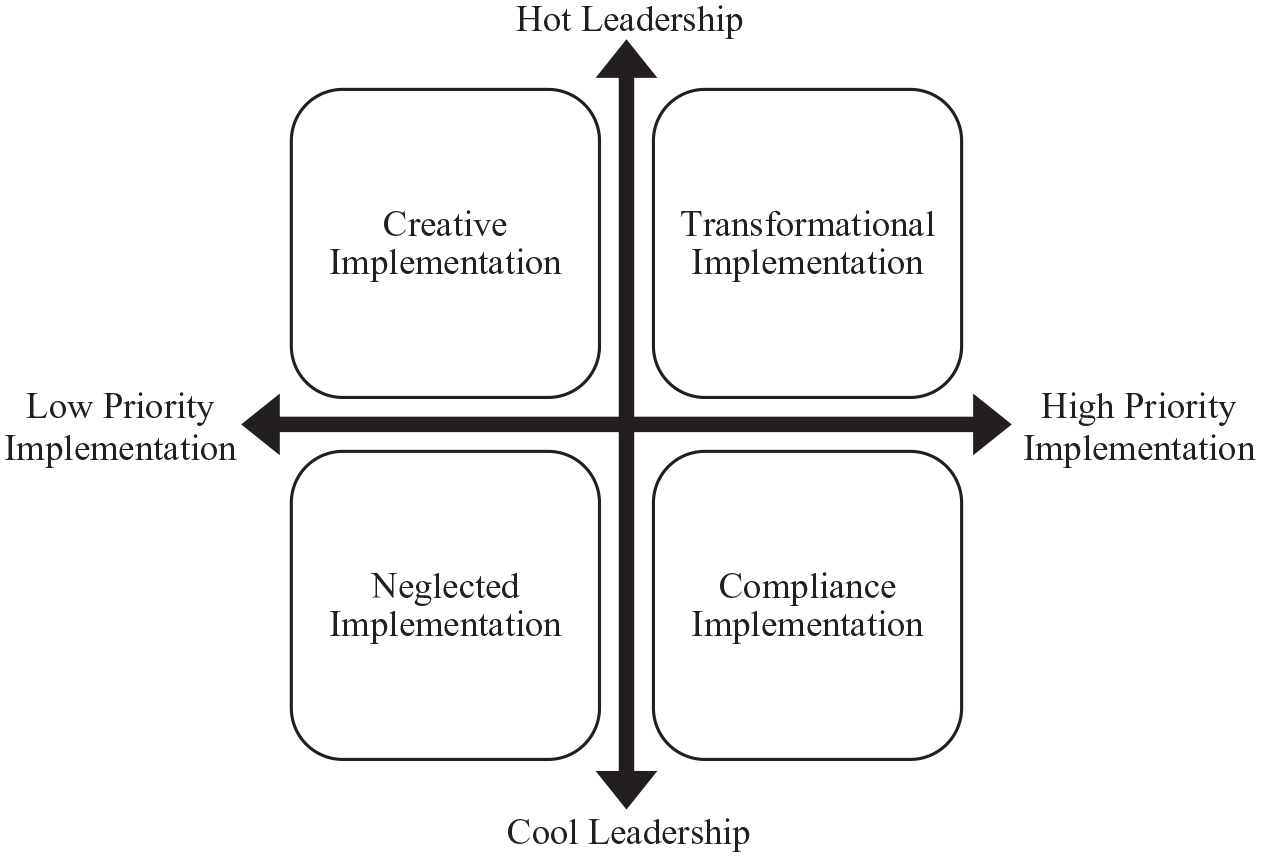
An emergent framework for conceptualizing leadership and policy implementation.
Creative Implementation
When Hot Leadership is practiced in relation to an education policy but it is implemented with a Low Priority Implementation, we suggest that this is creative implementation. Leadership in this case is strong, engaged and enthusiastic, but the fidelity of implementation is low, meaning that the processes and outcomes the policy meant to address have not been followed or attained. Note that we do not use the term “creative” in a wholly positive sense—what we suggest is that policies that fall into this quadrant were engaged with in an idiosyncratic manner that may or may not have achieved intended goals, but that were shaped by local context in a manner that was highly engaged, thereby shaping practice in the school. This could mean that the policy was not well understood, but it could also mean that the policy upon implementation was shaped by local context and leadership to the degree that it was more relevant to the school (Brooks et al., 2004). Thus, the leadership enabled a kind of co-construction and contextually relevant change in processes (and perhaps outcomes) while deviating from the original intent of the policy. Again, it is possible that this intersection of priority and leadership led to improved, neutral or negative changes in processes and/or outcomes rather than assigning a necessary value judgement.
Transformational Implementation
Transformational implementation occurs when Hot Leadership intersects with High Priorities. In certain traditions of education policy analysis, this is the only acceptable way for a policy to be seen as successful (Tyack, 1974). Indeed, we use the word transformation here not as something wholly negative or positive, but rather as an indication that a change has occurred that is in line with the original policy design (Spillane, 2009). This may (or may not) have produced positive outcomes, but the policy was implemented as intended and with strong support from school leadership. Our research suggests that this means that leadership facilitators were relatively stronger than inhibitors, and that the priorities of the principal and the imitative aligned to a certain degree.
Neglected Implementation
Neglected implementation is when Cool Leadership intersects with Low Priority Implementation. Basically, this is when a policy has little to no impact in a school. The principal has not engaged with or led implementation, and the policy is not engaged by the school in a manner that makes a meaningful change in day-to-day practice. Our research suggests that this occurs when inhibitors are relatively stronger than facilitators in the school context.
Compliance Implementation
Compliance implementation is when Cool Leadership and Low Priority Implementation occur. Principals do not actively work toward leading implementation, but nonetheless the policy is implemented with fidelity. This might be a quite important policy, such as one to do with security or student data, but that does not require or attract strong leadership or engagement by the principal. In these cases, the inhibitors outweigh facilitators, but the accountability or support overall for the policy may be high.
Implications and Conclusion
Further studies are required to investigate and refine the related concepts of hot leadership and cool leadership, and to identify and explore facilitators and inhibitors in more depth and in multiple contexts. We suggest that there is potential for such concepts to eventually develop into a useful heuristic for principals and policy makers, and that by exploring various facilitators and inhibitors we may move closer to understanding policy implementation and principal leadership in a more nuanced manner. In any case, this research suggests that leadership and policy implementation have reciprocal influence toward one another and may be highly contextualized, perhaps helping explain why certain education policies transform certain schools and have almost no impact in others. It is our hope that subsequent research will help us develop a systematic way of thinking about leadership and policy implementation in a way that helps practitioners and scholars deepen their understanding of the relationship between these two influential and interrelated aspects of education.
Footnotes
Declaration of Conflicting Interests
The author(s) declared no potential conflicts of interest with respect to the research, authorship, and/or publication of this article.
Funding
The author(s) disclosed receipt of the following financial support for the research, authorship, and/or publication of this article: This research was funded by a J. William Fulbright Senior Scholar Research/Lecture Grant, awarded by the J. William Fulbright Foundation, Council for International Exchange of Scholars & United States Department of State. Philippines: Education (Award #7162).
