



Abstract
The success and failure of education reform policies often depend on the strategies of reformers. This article suggests a framework to understand the positionality of reformers, as they vary in their strategy (i.e., technical vs. relational) and focus for change (i.e., process- vs. outcomes-focused). Using the case of individuals who initiated new data systems in Chicago, Philadelphia, and New York City, the study discusses four groups of reformers: Engineers privilege efficient technical fixes that may be resisted by people on the ground. Capacity-builders focus on empowering schools but may lead to variable successes. Framers research and disseminate ideas to reframe policy and political discourses. Table-setters leverage their social networks and financial resources but may challenge democratic decision-making. As schools continue to be sites of political debates and challenges, the concept of positionality can clarify how reformers promote particular changes and can suggest possibilities for positions to constructively complement each other.
Introduction
Schools in the United States have had a long history of reforms, particularly those that apply scientific management, rational administration, and market principles (Mehta, 2013). In the current political climate in the US, various groups are attempting to influence education by restricting access to ideas and materials related to race, racism, gender, and sexuality (López et al., 2021; Mayo, 2022). Internationally, education reforms have been instituted to improve accountability, evidence use, and access for disadvantaged students (Sahlberg, 2010; Verger et al., 2018). While many studies have focused on the outcomes of reforms like test-based accountability (Figlio & Loeb, 2011; Horsford et al., 2018), fewer have interrogated the actors responsible for these reforms, or what the present study collectively refers to as “reformers.” However, if researchers and practitioners are to understand the success or failure of these reforms, they need to understand reformers, particularly their strategies and constraints (Burch, 2009; Mintrom, 1997). The present research proposes that a key concept in understanding reformers is to recognize their “positionality,” or the vantage point by which they view the world, influenced by their characteristics like gender, race, and class as well as their relationship to powerful and privileged actors (Qin, 2016). Applied to education reformers, this study conceptualizes positionality as the reformer’s viewpoint that influences their conceptualization of reform and their strategy for change. Positionality is about using one’s perspective to make meaning and form solutions in education. Similar to other research, I sometimes refer to positionality with the shorthand, “position” (Warf, 2010).
The present research answers two questions: What strategies do education reformers employ, and what are their constraints? Drawing on interviews with 70 reformers in research, philanthropic, nonprofit, and government organizations in three large urban school districts, I suggest that reformers employed different technical and relational strategies to initiate education reforms even as reformers in the three districts had similar goals of addressing the high school dropout problem. In particular, I find that these reformers fell under one or a combination of the following four positions: engineers, capacity-builders, framers, and table-setters. The study proposes a framework to understand how these positions are intersections of reformers’ primary strategy (technical vs. relational) and focus for change (process vs. outcomes-focused). Education scholars, political scientists, and sociologists can use this framework to characterize a variety of stakeholders in education reform, and to view their conflicts and complementarities. As schools have to deal with various influences on issues ranging from school closure and anti-critical race theory organizing to demands from teachers unions and parent associations (Ewing, 2018; Kim, 2021; Murray et al., 2019), understanding the positionality of various reformers is crucially important and potent to provide constructive ways forward.
This research contributes in at least three ways to the study of education politics and policy. First, it clarifies the different reformer positions crucial in initiating, implementing, and institutionalizing reforms. As qualitative sociological studies rigorously investigate processes in schools (Calarco, 2011; Hallett, 2010; Khan, 2012), it is incumbent to have similar studies of reformers like researchers and philanthropists, who often work outside schools but are highly consequential in them. Second, the research provides heuristic categories to understand reformers, applicable to initiatives and contexts beyond the present case and beyond education. The concept of positionality can help illustrate why local school policies look the way they do (which reformers’ ideas were taken up?) or why certain policies failed to be implemented (which reformers were not engaged?). Moreover, this research challenges the view of reformers sharing similar perspectives that simply privilege managerial strategies and technocratic solutions to advance reforms (Trujillo et al., 2017). Third, the research suggests important caveats for the positions taken by individuals to bring about school reform, and how the variety of positions may lead to constructive changes. Taken altogether, it highlights the variations in the positionality of actors in the politics of education and the consequences of these positions.
Theoretical Context
Education Reform and Reformers
Education reform refers to systematic revisions to change education legislation, processes, systems, and policies (Vasquez-Martinez et al., 2013). Across history, examples of reforms included the mass enrolled public elementary and secondary school systems, age grading, standardized testing, and progressive schools (Cohen & Mehta, 2017). More recently, reforms came in the form of school accountability score cards, school choice, market-based competition, and efforts at curricular standardization (Renzulli, 2014). Such efforts at reform can be motivated by changing societal needs, redressing social inequalities, correcting ineffectiveness in the wider educational system, or improving educational outcomes (Ball, 1994; Bullough, 2021; Slater, 2015). More recently, such reforms have also been motivated by political competition over the aims of, and practices in, education (Horsford et al., 2018).
Social scientists have often investigated the role, consequences, and predictors of education reform efforts, such as charter schools and test-based accountability (Berends, 2015; Hanushek, 2019; Jennings & Bearak, 2014; Renzulli, 2005). In investigating charter schools that receive government funding but operate independently, scholars have often focused on its mixed results for student test score achievement and generally positive outcomes for graduation attainment (Berends, 2015; Hofflinger & von Hippel, 2020). Other studies focus on what contributes to reforms emerging, particularly factors in the local environment such as legislation, other nonreligious private schools, and institutional context (King et al., 2011; Renzulli, 2005). In studying test-based school accountability, social scientists have also focused on its consequences, mainly in terms of student test scores (Figlio & Loeb, 2011; Hanushek, 2019). However, researchers have also investigated unintended consequences in terms of schools cheating, gaming the accountability system, and reproducing the inequalities accountability was initially intended to solve (Diamond & Spillane, 2004; Hibel & Penn, 2020; Jennings, 2005). In many of these examples, the focus had often been on reforms and their implementation rather than the individuals who brought about these reforms in the first place.
Before any reforms come about, however, they were first suggested, initiated, negotiated, and implemented by “education reformers.” Since the term reformer may be ambiguous, Hess (2017) made the distinction between what he termed a reformer and a big-R Reformer, where the earlier is a general category for individuals implementing school change while the latter refers to those promoting sweeping plans and policies often resisted and in conflict with teachers and staff on the ground. In this study, I use the earlier and more general definition of reformer as one intending to initiate and institute changes in schools—spanning venture philanthropists and large educational management organizations on one end, and researchers and instructional coaches on the other (Au & Ferrare, 2015; Coburn et al., 2021). Implicit in this more expansive definition of reformer is the idea that not all reformers intend to promote market-oriented, accountability-focused, and decentralized education systems (Slater, 2015). Given that many reforms can arise from different areas inside and outside the education system (Farrell et al., 2021; Honig, 2004), scholars must understand the genesis of reforms by looking at the work and meaning-making of those who initiate them.
An understanding of reformers’ positionality can help researchers (1) uncover differences, conflicts, and complementarities of various positions, (2) adjudicate the intended and unintended consequences of specific reforms, and (3) open conversations about the constraints or threats of particular reform strategies. This concept suggests that not all reformers use similar principles and not everyone values the same aspects of reform. By creating a heuristic to understand such variations, this study aims to promote nuance when thinking about reformers’ actions, strategies, and constraints.
Understanding Reformers as Institutional Entrepreneurs
Organizational scholars have suggested the important role of “institutional entrepreneurs” in changing institutions like education, religion, and the state (Battilana et al., 2009; DiMaggio, 1988). These are actors interested in particular institutional changes and mobilize resources to create new, or transform existing, institutions (DiMaggio, 1988). A crucial aspect of this conceptualization is the contest for power between incumbents and challengers (Tracey et al., 2011), particularly how institutional entrepreneurs create change by drawing on their “social skill,” or their ability to draw on cooperation from others (Fligstein, 2001). Another aspect emphasized in the literature is in terms of how institutional entrepreneurs draw on their professional and personal affiliations—that is, their “social position”—to leverage strategies that bring about changes (Battilana, 2006). These strategies may arise from their formal position in an organization or their informal position in a network with other individuals, such as the position of district coaches in relation to teachers, or of technologically savvy teachers with their colleagues (Battilana, 2006; Coburn et al., 2013; Frank et al., 2004; Honig, 2004).
Applying these ideas about “social skill” and “social position” to the study of education reformers, I conceive of a framework that uses these concepts as axes to create a two-dimensional matrix. In terms of social skill, reformers draw on various strategies for change to be instituted. For example, in a study of philanthropies as institutional entrepreneurs, Quinn et al. (2014) noted how the formation of charter management organizations came as a result of philanthropic strategies to technically integrate different organizational forms (e.g., flat vs. hierarchical) and to relationally build networks privileging the new form. Thus, I suggest this axis of social skill to be a technical-relational axis, as reformers employ variable strategies to bring about change.
In terms of social position, reformers can have differing focus for change. For example, Tompkins-Stange (2016) has noted how some philanthropies like the Gates Foundation and Broad Foundation emphasize achieving set outcomes while others like the Ford Foundation and Kellogg Foundation are more oriented toward supporting processes in the field. In this way, I suggest this second axis of reformer’s social position as constituting a process-outcome axis, where reformers vary in their conception of where change should happen.
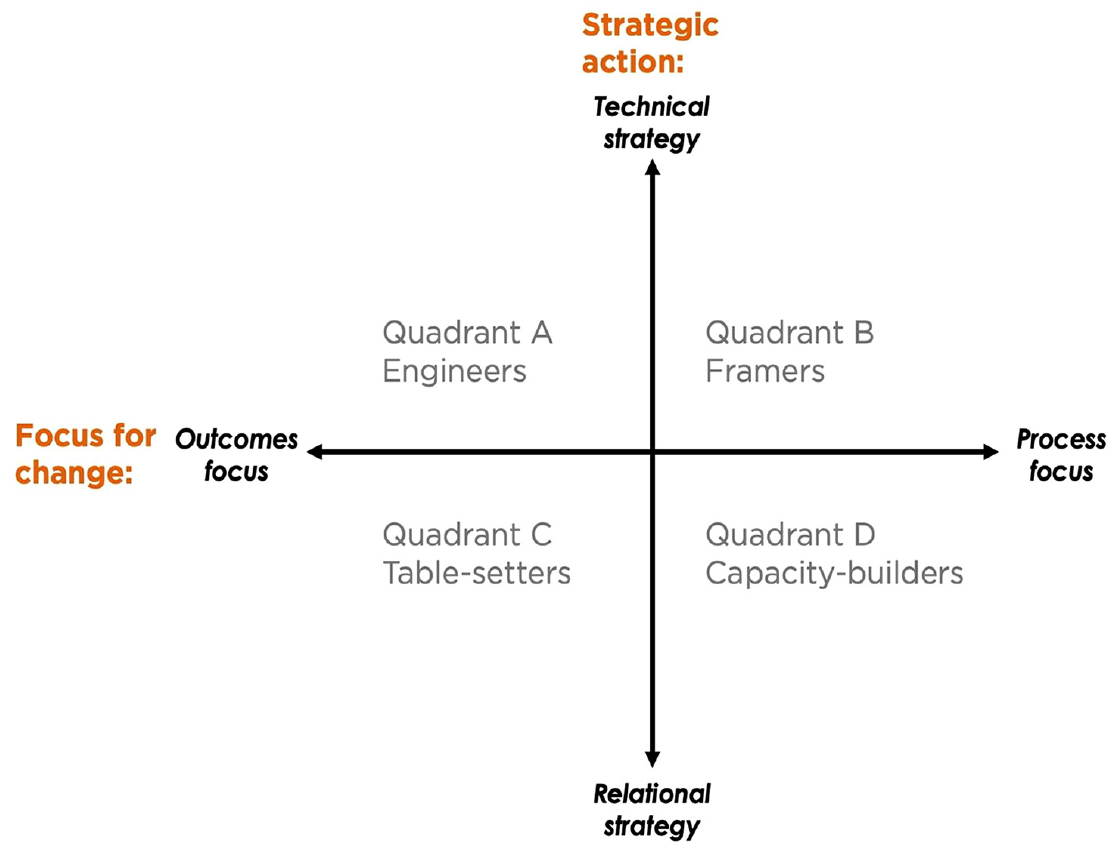
Figure 1 provides an illustration of this framework that emerged in the iterative process of abductive analysis as I refined theory with evidence (Tavory & Timmermans, 2014). While I had initially set out the two dimensions of technical-relational and process-outcome axes, the particular names and characterization of the “positions” were developed from the interviews. I provide more details in the Data and Methods section of this paper.
Framework.
I first take inspiration from organizational and educational literatures regarding how reformers’ strategies may focus on intentionally changing systems and processes on one side (Abdelnour et al., 2017; Munir & Phillips, 2005), or on leveraging one’s social networks and relationships on the other (DeJordy et al., 2020; Fligstein, 2001; Maguire et al., 2004). This dimension suggests the vertical technical-relational axis of strategic action. Moreover, individuals also differ in conceiving how their actions influence change, whether more directed toward processes or outcomes (Coburn & Penuel, 2016; Tompkins-Stange, 2016). I use this for the current research to suggest the horizontal process-outcome axis for the focus of change.
By combining these two axes into one matrix, I explore how each of the quadrants is populated by institutional entrepreneurs that draw on unique ideas to motivate their actions. Those in Quadrants A and B tend to use technical strategies, highlighting their being willful actors who view technical strategies like data systems and research studies as critical in shaping institutions (Abdelnour et al., 2017). The distinction, however, is that those in Quadrant A tend to use technical strategies to directly change outcomes (Battilana, 2006) while those in Quadrant B tend to use technical strategies to frame institutional changes (Munir & Phillips, 2005). Reformers in Quadrant A are akin to “engineers” who view reform as improving technical efficiency while those in Quadrant B take on the position of “framers” who try to legitimize the process of making institutional changes.
Those in Quadrants C and D tend to focus on taking advantage of their social networks and personal relations. The distinction, however, is that those in Quadrant C leverage relationships to bridge diverse stakeholders to change whole systems (Maguire et al., 2004) while those in Quadrant D use their position to foster relationships among individuals on the ground like teachers and school staff (DeJordy et al., 2020). I suggest that reformers in Quadrant C take on the position of “table-setters” as they focus on coordinated efforts for systems-level changes while those in Quadrant D are like “capacity-builders” who emphasize their role in promoting trust on the ground.
Using this framework with respect to education reformers, this research explores whether these different quadrants (which I will refer to as “positions”) hold in an empirical setting, and what these positions mean for reformers’ strategic actions.
Empirical Context: High School Data Systems in Three Cities
Dropping out of high school is an important problem that education reformers have tried to address (Balfanz et al., 2007; Lee & Burkam, 2003). One way to address dropping out that has gained prominence in the past 15 years is the use of early warning indicators and data systems to identify students at risk of dropping out and provide timely interventions (Wentworth & Nagaoka, 2020). In particular, research has found ninth-grade performance to be predictive of eventual graduation, suggesting the importance of a successful developmental and educational transition to high school (Allensworth & Easton, 2005; Neild et al., 2008). Urban locations have been at the forefront of this change for a number of reasons: First, dropping out is an important problem in urban school districts, particularly as cities in the early 2000s had significant numbers of high schools that graduated fewer than half of their freshman class (Balfanz & Legters, 2004; E. K. Phillips, 2019). Second, research organizations and universities in urban locations have started working with school districts to address this problem (Eddy-Spicer et al., 2020). Third, cities have a density of nonprofit and philanthropic organizations that test, support, and research these initiatives (Bulkley & Burch, 2011). The choice of focusing on Chicago, Philadelphia, and New York City in the present research was motivated by their pioneering work in creating early warning indicators (EWIs), and how these reform initiatives had been a collaborative enterprise between individuals inside and outside the school district.
In the early 2000s, Chicago’s Freshman OnTrack started with research from the University of Chicago Consortium on School Research. Given their findings about the predictiveness of ninth-grade performance, the district used this yearly measure in their school accountability score card and subsequently created data systems that showed students’ performance every 5 weeks. District coaches and a nonprofit group called Network for College Success also worked with schools to introduce data systems and create programs for mentoring, teacher team meetings, and summer transition programs (Allensworth, 2013).
Around the same time in Philadelphia, researchers from Johns Hopkins University worked with the district to understand similar dynamics of dropping out although their work focused on middle school rather than high school predictors (Balfanz et al., 2007). While these researchers helped create EWI systems in some schools with continued support from United Way, it was not until 2017 that the whole district had an EWI system, partly pushed by a philanthropic foundation that brought a team from Chicago. This team and other local organizations worked with the district to institute data systems like Chicago, provide coaching and professional development for teachers, and conduct research to increase high school graduation rates (School District of Philadelphia, 2021).
Knowing about the research that came from Chicago, a nonprofit organization in New York City also created similar high school data systems (Pinkus, 2008). New Visions for Public Schools worked as a partner to 71 public high schools, managed 10 charter schools, and used a data system developed in-house to produce color-coded rosters of students who were “on track” to graduate. A decade later and having gone through different iterations, this data system had become accessible to all district schools in the city (New Visions for Public Schools, 2019), providing educators with both individual and school-level data on students’ course performance, passing, attendance, and state standardized tests.
In these three cities as in many others like Los Angeles and New Orleans, organizations outside the school system have initiated education reform (Marsh et al., 2021; M. Phillips et al., 2015). However, while researchers and these nonprofit organizations had similar goals of improving high school graduation, their intentions and strategies were markedly different from each other. I document and theorize the variation in these strategies of education reformers to better understand the different ways people conceive of, and help institute, education reform.
Data and Methods
The present research used three case studies of cities to understand the role of research, philanthropic, and nonprofit organizations in the initiation and spread of early warning indicators (EWIs) in three urban school districts in the US. Although the research was initially interested in variation across the three districts (see Marsh et al., 2021 for similar comparative case study design), commonalities among these districts emerged regarding the variety of reformers and the distinct strategies these reformers used to initiate and spread EWIs. Attending to these variations, I conducted semi-structured interviews with 70 leaders and staff of organizations and district offices connected to EWIs (see Table 1 for breakdown of groups interviewed). Spanning researchers, philanthropists, instructional coaches, district officials, and nonprofit leaders in the three districts, the interviews ranged between 30 and 90 minutes long, happened over Zoom because of COVID-19 protocols, were recorded, and transcribed. On two occasions, two informants were interviewed together for scheduling efficiency, while three informants were interviewed more than once.
Stakeholders Interviewed.
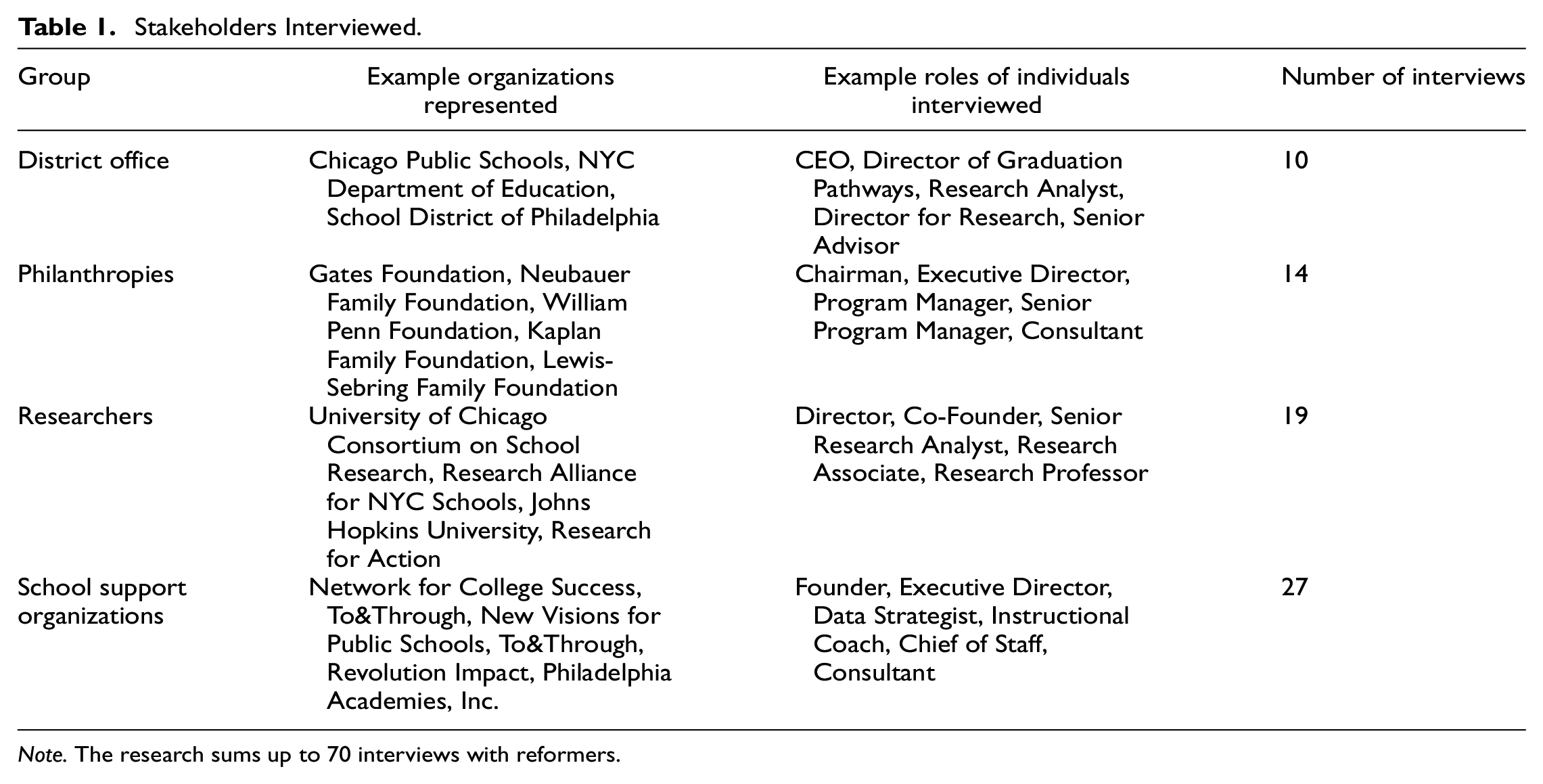
Note. The research sums up to 70 interviews with reformers.
I interviewed these reformers for several reasons: First, the reformers from these organizations worked with each other and each one drew on their specific positionality even as they all had similar goals of improving high school graduation outcomes. Second, interviewing them helped answer questions regarding strategies reformers employed. Third, having differing sets of actors in the three cities provided a way of triangulating if strategies or problems were unique to a district or shared across districts.
This study employed a combination of purposive and snowball sampling (Robinson, 2014)—first intentionally reaching out to organizations that initiated and spread EWIs, and subsequently asking to be referred to other organizations and individuals who were part of this reform in the three cities. I recruited informants by contacting directors of five organizations that had significantly contributed to the initiation of EWI in the three cities: three were research organizations that worked with those cities, one was a nonprofit in New York City, and another was a data organization that worked in Chicago and Philadelphia. 1 After gaining permission to interview these directors, I asked them for referral to other individuals that worked on EWIs. They provided introductions or names of individuals in their organization or in other organizations. I then interviewed these individuals and asked for other referrals. I interviewed as many people as possible, confirming with previous individuals if I had interviewed the people instrumental for the initiation and spread of EWIs. While there were three who did not reply to emails and follow-ups, most spoke with me. Moreover, because of the difficulty of anonymizing organizations and their staff, participants were asked if they would be willing for quotes to be attributed to them, and only one person asked to remain anonymous. I took these steps as detailed and approved by the Institutional Review Board of the University o Chicago.
During the interviews, I asked informants about their role in their organizations, how they supported the EWI/data work, what strategies they used, and what consequences they had seen coming from the work. I employed abductive analysis, an approach to generate theory by using existing theories or frameworks, and searching for surprising or anomalous observations (Tavory & Timmermans, 2014; Timmermans & Tavory, 2022). For this research, I started with the framework detailed earlier (i.e., technical-relational and process-outcome axes) and refined the concepts of this framework as I proceeded through data collection and analysis. For coding, I read transcripts and created a codebook for the strategies reformers used and the challenges they encountered, with thematic codes like “framing,”“data use,”“coordination,” and “resistance to data.” I then assigned certain codes along the four quadrants in the framework. After creating the codebook, I trained four research assistants to code the 70 interviews and we refined the codebook as we developed new themes. We individually coded the interviews and discussed the coding weekly to make sure that we reliably coded similar parts of the transcripts. After grouping codes according to like strategies, I used these codes to find suitable names for the quadrants: engineer, table-setter, framer, and capacity-builder.
My background as an outsider to these organizations and as a then-graduate student had its advantages and disadvantages, and I was particularly sensitive to how my position influenced my participants’ answers or my analysis of those answers. One may argue that the lack of anonymity may prevent participants from expressing negative experiences with EWIs, but many were forthcoming about the resistance they got and their uncertainties for the EWI data system. Thus, there is little evidence to assume that participants withheld essential information for this research, even as bias in self-reported accounts is unlikely to be removed (Small & Calarco, 2022). To help reduce potential biases, details were all fact-checked either with documentary evidence (books, journal articles, and annual reports) 2 or with other informants. Finally, I checked my analysis by sharing preliminary findings with my informants, through individual follow-up interviews or group discussion of preliminary findings like those done by other research (Jack, 2016).
Strategies and Failures of Education Reformers
This research suggests the presence of four positions taken by education reformers: engineers, capacity-builders, framers, and table-setters (see Figure 1 for the positions laid out in four quadrants). Table 2 summarizes the unique sets of values each group of reformers employed, the strategies they used, and the constraints they experienced. Although all reformers used both technical and relational strategies, their particular emphasis differed depending on their position. By technical strategy, I refer to organizations’ efforts to improve systems and processes while by relational strategy, I refer to organizations’ efforts to leverage social networks and personal relations. I note how different positions have their unique ways of leveraging technical and relational strategies.
Positionality of Education Reformers.
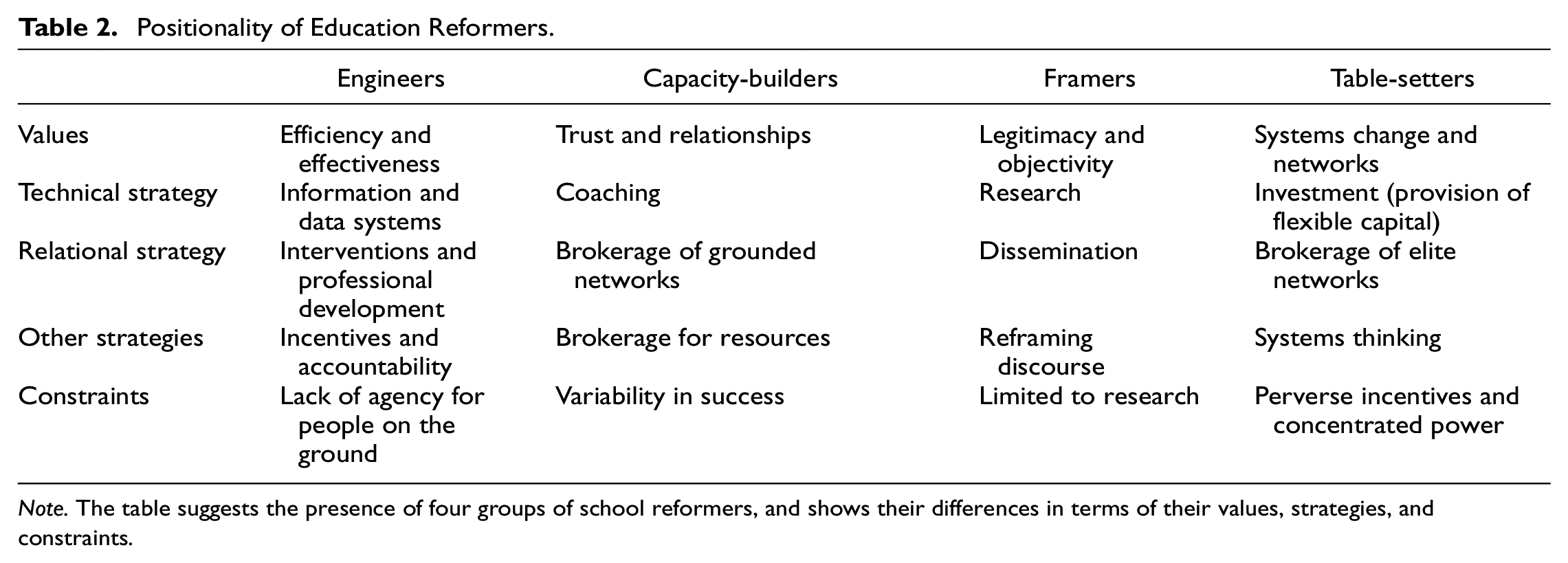
Note. The table suggests the presence of four groups of school reformers, and shows their differences in terms of their values, strategies, and constraints.
Engineers
Studies on education reforms are often focused on their technical aspect, such as the adoption of a new curriculum, the creation of teacher evaluation systems, or the setting up of school accountability (Coburn et al., 2013; Cohen & Mehta, 2017; Figlio & Loeb, 2011). These reforms are often implemented and facilitated by actors invested in the technical adoption of reforms, what I term as engineers. Findings from the interviews suggest that important concepts related to this position include their valuing efficiency and effectiveness as well as their strategies of using information, incentives, and interventions.
In the case of EWIs, engineers thought that their work consisted in creating data and accountability systems, and providing professional services to schools. Similar to actual engineers, they were focused on systems and processes designed to improve school and student outcomes, particularly those that increase on-track graduation rates. For example, Corrin et al. (2016) at MDRC evaluated a program that used EWIs, which found positive effects for sixth graders but no effects for ninth-graders. In our interview, Corrin proposed a more technical theory for EWIs, which involved first identifying students at risk and subsequently intervening through mentoring or tutoring, saying: If you use these indicators, you can know more quickly or more regularly, and you can understand where kids are, so that you can intervene promptly. And then by intervening promptly, [you] sort of stop the challenge or the problem quickly so that the kid then is back on-track and can keep going. I think that’s the theory.
For reformers with an engineer’s position, schools have technical problems with technical fixes. In the case of dropping out, the problem was the inability to identify students at risk, and the solution was to have a data system that helped with identification and intervention. Engineers addressed dropping out with three broad strategies.
First, they used information not only to know what was happening but also to change how things happened. In the case of Chicago, the district tried to create a data system that provided data on ninth-grade attendance and course performance every 5 weeks. Steve Gering was the district’s chief leadership development officer, and remembered how in 2008 “it became a monumental effort to actually get the data systems to work.” He detailed how he camped out of the offices of the “data people” to ask them when the new system was going to come out because it took them so long. In his work and from his vantage point, the data system was so important that he said, “Freshman OnTrack could’ve just fallen off the rails ‘cause we couldn’t produce data.” For Gering and other engineers, data were crucial because it pushed schools to take action in terms of learning which students to intervene with.
A second strategy was using incentives. For Chicago, this came through Freshman OnTrack data being used for the district’s school accountability system. Paige Ponder was the district’s director of graduation pathways during its early start, between 2008 and 2011. Similar to Gering, she also emphasized the importance of technical fixes. For her, however, having data was not enough as she mentioned, “it was so critical for [EWIs] to be in the accountability system because that was the only chance it had to cut through that fatigue and the cynicism.” Five points of the school’s accountability score evaluated the proportion of freshman students on-track, and Ponder thought that this was a key technical fix in schools as data systems and information can easily be ignored with the lack of incentives.
A third strategy beyond information and incentives was the employment of interventions for ninth-graders in general and those at risk of falling off-track in particular. To help institute these interventions, Ponder led the creation of Freshman OnTrack Labs that put in six high schools “a coordinator and a facilitator, to observe and assess what was happening and to catalyze change as needed” (Chicago Public Schools, 2010, p. 1). Ponder said that these coordinators helped schools create “peer mentoring programs…, parent outreach… [and] freshman teacher teams.” Their goal was to support and document best practices to help freshman stay on-track, working with schools for a year before they wrote up a report of promising practices that can be adapted by other schools.
In these examples, engineers valued technical changes that focus on specific systems and processes. Such focus on technical changes, however, can be critiqued for the lack of agency it affords schools. Gering acknowledged early problems with this emphasis on information and incentives. He said, “The [teachers] union got very upset saying that principals are pressuring teachers to give grades and the grades are meaningless, and so, it’s gonna screw up the on-track metric.” This example provides a caution for engineers to be more attentive to incorporating voices from the people who will use or implement these technical changes.
This group of reformers thus drew from an engineer’s position, conceiving of the technical problem in education and suggesting technical solutions in the form of information, incentives, and interventions. Although I focused on reformers in Chicago, the two other cities also had engineers in the form of individuals primarily supporting data structures, dashboards, and tiered interventions.
Capacity-Builders
In contrast to engineers who saw themselves as changing systems and technologies over schools, capacity-builders saw their work as empowering and supporting schools on the ground. Many of these individuals were in intermediary organizations that helped schools through coaching, professional development, design implementation, and change management (Honig, 2004; Peurach & Neumerski, 2015). Interview findings suggest that core to their position was their valuing of community through getting school buy-in, coaching, and being an accessible resource for research and information.
These individuals valued trust and relationships with the school and its leaders, teachers, staff, and community. The focus for change was not on the outcomes but in the processes individuals went through. In Chicago, the Network for College Success (NCS) was a school support organization that helped school staff to create and sustain teams of freshman teachers working with each other. Its co-founder Sarah Duncan remembered how the organization started with an insight from the other founder, Melissa Roderick, To her credit, in my opinion, [Roderick] said, “The answers are in the field. Let’s get some principals together and talk about what’s working.” So, I think this is in contrast to what a lot of professors would do, which would be to diagnose [the problem], to create a program, to sell it to the district, and then have the district try to implement it with fidelity. (emphasis added)
And this was why it was called the Network for College Success because it originally started as a collective of school principals who learned from each other. Duncan added, “We’re not doing something to the school; the school is learning to build its capacity to implement change or improvement.” These two founders, and many other capacity-builders, believed that change had to happen on the ground and should not be imposed from above. Thus, even as they worked with engineers, they adapted their strategies to reflect these values that privileged relationships with schools.
One strategy they employed was creating social networks. Between 2005 and 2010, EWIs in Chicago met a lot of resistance from different teachers and school leaders, similar to many urban school initiatives (Payne, 2008). One NCS coach remembered “meeting cancellations” and “[teachers] challeng[ing] the accuracy of the data.” In our interview, she kept on emphasizing the importance of building relationships by being in the schools. However, she also highlighted one other strategy, In these scenarios where we were experiencing some or a lot of opposition…, we leveraged our principal community so that we weren’t the only messengers for the work…. If they went into this principal network and heard other principals talk about experiencing the same thing, what they did, what the results and the impacts were, what were the pitfalls, what wisdom they shared, then we had principals collaborate around this idea.
This example illustrates the importance of the network of principals working through similar problems. NCS co-founder Sarah Duncan was particularly proud of the network as their alumni principals had gone on to leadership positions in the district: Janice Jackson was the previous CEO of the Chicago Public Schools, and four of the five network chiefs were principals with whom they worked.
Aside from the relational strategy of creating social networks, capacity-builders also used technical strategies like coaching. 3 In Philadelphia as in the two other cities, coaches worked with a set of high schools to create school-wide supports, and more targeted supports for our struggling students. A Philadelphia coach talked about her work with ninth-grade assistant principals, where she had weekly coaching, visits to the ninth-grade team meetings, and debriefs. Although capacity-builders emphasized their relational work, this did not preclude using technical strategies such as coaching and training schools to create tiered strategies and interventions. However, unlike engineers, capacity-builders’ point of entry into schools was not by introducing new systems but by first creating relationships with teachers and principals.
A cross between the technical and relational strategies happened when capacity-builders introduced or brokered resources. In New York City, New Visions for Public Schools was a nonprofit organization where one of its coaches said that her work entailed more than just technical coaching, If a school asks, “Jamie, we need science instructional support,” I’m going be the person that connects the school with the science instructional specialist at the network office …. I’m the point person who has the deepest relationship with the school, understands the context of their community and systems. At the network level, I know the school best, and so I serve as the conduit that examines our resources and connects them with the school appropriately.
This depth of relationship with the school has led this capacity-builder to see the intersection of her relational and technical expertise. In Chicago, coaches likewise mentioned how schools looked to them as resources for research because of how the original EWI program was research-driven.
One constraint, however, with these capacity-builders is the variability in success with working with schools. For example, the NCS coach from Chicago experienced a lot of resistance because schools were not required to take any advice from coaches. Similarly, the coach from Philadelphia shared that “people are still used to like ‘compliance’… like ‘what do I have to do?’.” Because of this, capacity-builders had to invest a lot of time and effort to create relationships before even introducing new processes.
In sum, the position of capacity-builders was one that highlighted trust and relationships because the problem was not necessarily just a technical one. For these individuals, the problem of dropping out was a relational problem, which needed to be addressed by getting people on the ground invested in EWIs. Being focused on relationships, however, did not prevent them from employing technical strategies. The distinctive feature of capacity-builders is that they started with building relationships before introducing new systems and processes. Such grounded relationships, however, were not always successful since they ultimately depended on the reception of teachers and leaders on the ground.
Framers
As engineers focused on technical systems and capacity-builders focused on grounded relationships, a third more distal group was crucial in legitimating the efforts of both groups. Framers were ones that valued legitimacy and objectivity, and used strategies of research and dissemination. Despite their distance from what was happening on the ground in schools, they were crucial in setting the discourse regarding the problem of dropping out, which engineers drew on to create technical fixes and capacity-builders seized upon to inform their work in schools.
In the case of EWIs, framers were the original actors that discovered EWIs’ relevance and advocated their use. In Chicago, Allensworth and Easton (2005) found that students who were on-track at ninth-grade were four times more likely to graduate high school than those off-track, that is, those that had more than one semester F and did not take five full-year course credits. About the same time in Philadelphia, Balfanz et al. (2007) also found out the predictive power of poor attendance, misbehavior, and course failure in sixth grade. These studies informed just-in-time data systems and foot-in-the-door interventions, which built the right skills to reduce risks during sensitive periods of development (Bailey et al., 2017). Thus, these individuals drew on their position as framers and used strategies consistent with this position.
First, the key strategy for framers was their research. Both Allensworth and Balfanz were part of different research organizations, and did not originally intend to study dropping out. In an interview, Allensworth highlighted how the work of Freshman OnTrack started with collaborations among Chicago researchers interested in a metric that showed elementary schools the number of alumni “on track” and they found “a strong correlation between [being] on-track and high school graduation.” In a different interview, Balfanz also mentioned that his work on Philadelphia high school dropouts started with a different research on the school-to-prison pipeline, where they found that, Students that were arrested in the ninth-grade only had about a seven percent graduation rate… We also noticed that there was actually a larger group of kids who in the eighth grade were only going to school two-thirds of the time, were failing half their classes, their friends were not asking them to be involved in illegal activities, and they did not get arrested in ninth-grade, but they still had essentially a seven percent graduation rate. (emphasis added)
Through more research that validated and refined their insight, they found certain factors such as passing courses and consistent attendance at ninth-grade that were predictive of eventual graduation in school.
But while research can provide legitimacy, it was not immune to resistance. For Allensworth, two of the most frequent forms of resistance from teachers were about their beliefs that factors outside school were more predictive of dropping out, and failure is good to teach students how to act “in the real world.” Experiencing resistance led to another strategy of reframing the discourse around dropping out and helping students succeed in school. My interview with Elaine Allensworth highlighted how their work and research of Freshman OnTrack challenged certain assumptions and resistances that teachers had. Table 3 details how teachers and schools originally thought about dropping out, and how the Freshman OnTrack challenged previous assumptions regarding the problem of, and solutions to, dropping out. For example, if schools from before conceived of dropping out as mainly affected by outside factors that schools had no control over, the finding that ninth-grade course performance was predictive of eventual graduation, suggested that schools could do something about it. Similar reframing happened in challenging beliefs about failure as a “lesson” for students and about course grades being subjective. This showed that research cannot just speak for itself since it had to be in conversation with individuals’ resistance and skepticism.
Reframing Discourse of Freshman OnTrack.
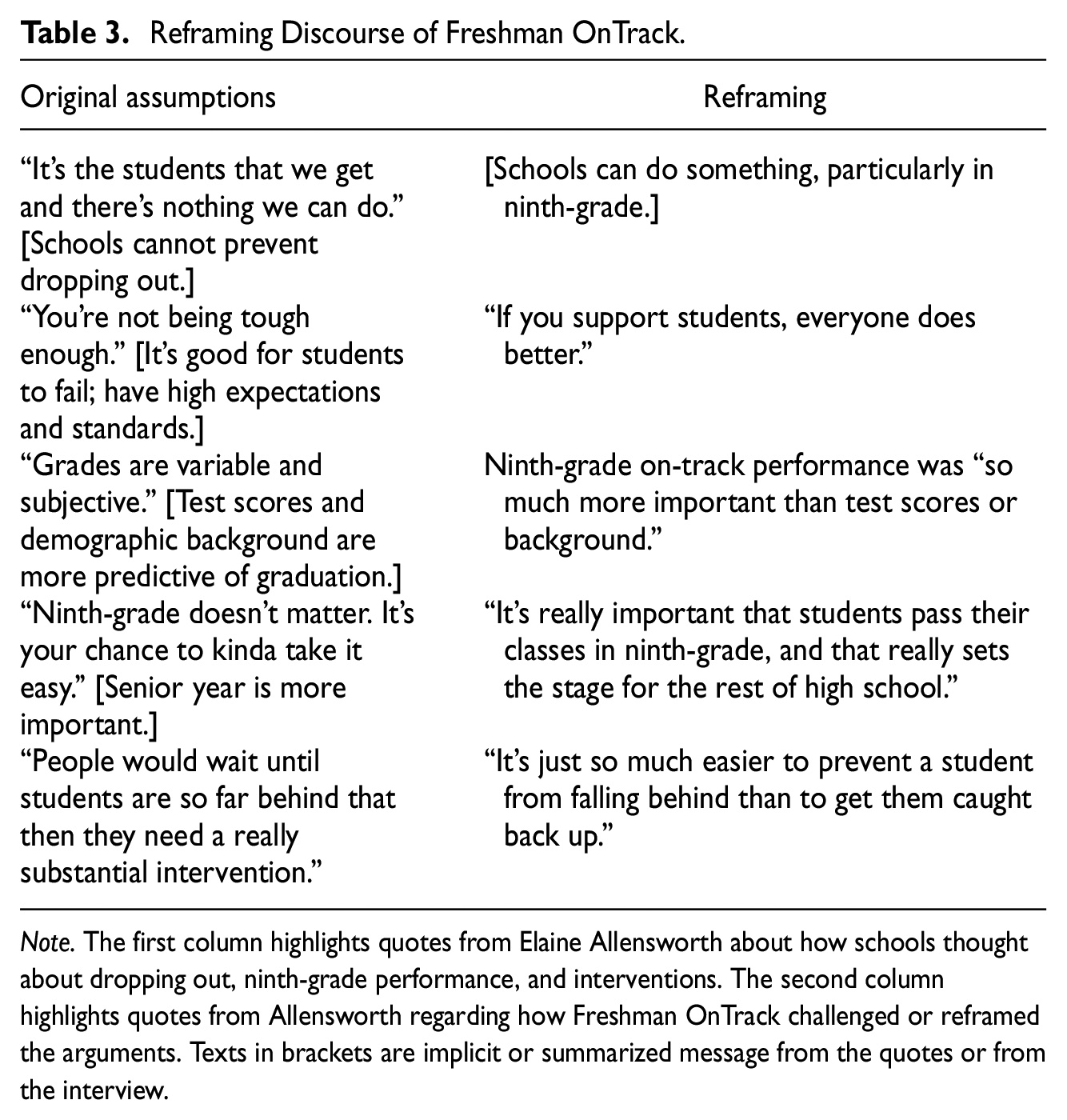
Note. The first column highlights quotes from Elaine Allensworth about how schools thought about dropping out, ninth-grade performance, and interventions. The second column highlights quotes from Allensworth regarding how Freshman OnTrack challenged or reframed the arguments. Texts in brackets are implicit or summarized message from the quotes or from the interview.
A third strategy these framers used was dissemination, where they employed different channels and engaged different audiences with their findings. Allensworth’s co-author John Easton contrasted their work with academic research that is considered done once published. He said, “When we finish a report, that’s just the beginning. Because if you wanted to have it influence, you have to really be out, out talking to people about it.” Allensworth detailed how they “went on a road tour, we went all over the city talking about this research.” As of 2022, Allensworth and Easton’s (2005, 2007) reports had been collectively cited more than 1,500 times. Dissemination of similar reports had similarly been widespread with Balfanz et al.’s (2007) paper on preventing dropouts being cited close to 1,400 times. While I am circumspect with equating citations to influence, these citations indicate some success in their effort to widely disseminate findings from their EWI research.
Such framers, however, can limit themselves to research to promote a sense of objectivity such that they do not participate in creating new systems and processes. For example, a philanthropic manager in Chicago highlighted how they needed to create a different organization devoted to public data reporting because the research organization that worked on EWIs “felt like […] their job was not regular data reporting.” This provides caution to how different organizations have their own goals to meet and are incentivized to concentrate on meeting those goals. While there was other tangential work that could be done, reformers can often be dissuaded from pursuing these because of the lack of incentives.
In sum, these researchers drew on a framer’s position, highlighting that the dropout problem was about lack of information. Their main role was not necessarily to be on the ground or create new systems, but to provide legitimacy and support to policymakers’ and coaches’ work, particularly as these other reformers benefit from the insights obtained by these framers. Their main role or goal was to set the tenor and discourse for how dropping out and EWIs would be discussed.
Table-Setters
The last group of reformers were individuals who funded, partnered, and championed the work of district and systems reformers (i.e., engineers), school support organizations (capacity-builders), and research firms (framers). Interviews with different funders in the three cities showed similarities in their metaphors and conceptualization of their work. It was captured most visually by Dan Berkowitz, the chief strategy officer of the Neubauer Family Foundation that funded the EWI work in Philadelphia, I think philanthropy does play an important role in setting the table and pulling together, whether it’s these major decision-makers in the city, influencers around the city that might be able to move things faster—whether that’s from a civic perspective or a private sector perspective, and also those who are implementing on-the-ground. (emphasis added)
In the case of EWIs, these table-setters did not just fund efforts by nonprofit organizations and research groups. They were crucial in advocating for the programs, and using their networks to facilitate them. These table-setters valued and drew on their resources for investment, brokerage, and systems perspective. More than philanthropists, nonprofit leaders may also be considered table-setters—particularly those that broker and connect organizations with each other.
Aside from the Neubauer Foundation, the work in Philadelphia's EWIs had also been funded by the William Penn Foundation. Its program director for education Elliot Weinbaum summarized three key roles that philanthropy played, One is to provide flexible capital to try things out that schools wouldn’t otherwise have money to experiment with, right? Budgets being what they are…. I think our second role related to that is asking really hard questions. Everyone needs a critical friend on the outside who tries to understand the overall design or strategy that’s in place to pursue an improvement goal… [The third] is making connections among efforts, in our case, in the city that share similar goals.
Their first and most apparent strategy was the allocation and disbursement of investments. Almost every conversation I had with philanthropic managers touched on the concept of their investing in EWIs. However, two puzzles arise. If large urban school districts have billions in funding every year, why was there a need for philanthropic investment? In my interview, former Chicago Public Schools CEO Arne Duncan highlighted the role of “flexible dollars” in trying “things that are unproven but have potential real merit.” Thus, philanthropic support was important not because the district lacked resources but because philanthropy provided schools and organizations the flexibility in funding new programs.
Second, if philanthropists could have easily invested more money into the public school district, why did they prefer supporting outside organizations? The program officer of a small family foundation in Chicago
4
provided an account of how small philanthropies thought through this question, There’s been weariness over the years about directly putting money in the CPS [Chicago Public Schools] because of continuously changing leaderships or thinking of it as like the black hole of where funds end up. And so, foundations have found alternate paths for supporting CPS students through nonprofits.
Given their budget of a few hundred thousand dollars every year, they thought that their investment would have a larger impact in supporting the expenses of nonprofit organizations in the city. 5
Even as this foundation did not give more than a hundred thousand dollars per organization, they took pride in their brokerage of philanthropic and nonprofit relationships. Like Berkowitz in Philadelphia, this Chicago foundation also used the metaphor of setting the table. Its executive director talked about how she and another director from another local foundation brought together nonprofits and funders “to talk about what they’re seeing or what they’re hearing from one another.” But these table-setters did not just connect people, they sometimes set the agenda. In the case of EWIs, the agenda was to promote the use of dropout prediction systems in an effort to increase graduation rates. One director shared, some foundations were “not just sitting on the sideline and supporting initiatives that are happening; they’re talking to leaders and making some of these initiatives happen through planting a seed or suggesting things.” She was referring to philanthropies that were bringing together civic organizations and government officials in an effort to create solutions to school problems.
A third strategy used by table-setters was related to systems thinking. A clear example of this was Judith Lorimer, the director of #DegreesNYC, a collective impact movement aiming to improve New York City students’ postsecondary attainment. Lorimer detailed her work in bringing together the Data Co-Op, “a group of fourteen community-based organizations that were joining their data… with the Research Alliance’s longitudinal educational database.” While their goal was to support what happened to youths, they viewed their work as about connecting people and systems. In her work of connecting different organizations, she emphasized how actions are moved forward by “direct service staff who think systemically and systems folk who think very programmatically.”
Some individuals from the philanthropic community acknowledged potentials for perverse incentives and concentrated power with the work of table-setting. For example, Dave Ferrero, who was previously associated with the Gates Foundation, documented such problems by saying, “Anything that an organization with a brand name and the resources [like the Gates Foundation] was inevitably going to shift the center of gravity.” He described their work of funding the small schools initiative and how this “had other nonprofits, other philanthropies, and government all of a sudden redirecting resources toward that” because of the support of such a large philanthropy. He also spoke about the risk of with having “a lot of power… concentrate[d] in such few hands” that can threaten the democratic work in schools as ideas can come from philanthropic interests rather than the local community.
In sum, philanthropists and nonprofit leaders often drew on their position as table-setter, working in the background to keep the initiative running. This position centered on thinking about the problem as stemming from uncoordinated and uninvested systems, and so their strategies tried to address this by investing, coordinating, and systematically thinking about solutions.
Discussion and Conclusions
Understanding reformers is crucial to understand reforms, particularly as reformers can conflict with each other as they draw on differing visions of public education or can complement each other despite differing values and strategies. While a particular neoliberal, accountability-focused, data-driven reform agenda has come to dominate the United States and globally (Mehta, 2013; Verger et al., 2018), this research suggests that even the same ends can be pursued with varying strategies and values. Drawing on interviews among education reformers initiating similar work in three different cities, I found that reformers employed one or a combination of four different positions toward reform—each position with its own values, strategies, and constraints. By studying three school districts, I show that these positions were not unique to any one location.
This research makes a number of important contributions. First, it shifts the focus from reforms to reformers. Research on education reforms often focuses too heavily on the content of reform rather than specific reformers (Cohen & Mehta, 2017; Payne, 2008). But such reforms were made and negotiated by individuals with unique and at times conflicting perspectives. More importantly, the success and failure of reforms often depend on the actions of reformers and their relationship with the ones ultimately enacting and implementing these reforms: district officials, school leaders, and teachers on the ground (Coburn et al., 2013; Trinidad, 2023b). While reforms are the factors that change school processes, sociological attention should also be directed to the reformers whose meaning-making, negotiation, and social skill were necessary to bring it about (Fligstein, 2001). However, rather than focus on the personality of reformers, I emphasize their positionality and how it matters for the strategies they use. In the present context of intense political challenges happening in schools such as anti-CRT and anti-LGBT organizing (Kim, 2021; Mayo, 2022), a focus on reformers and their positions can help clarify the conflicts and disagreements in terms of differences in values, strategies, and constraints.
Second, I suggest that these education reformers are not one monolithic group, even if some reforms share similar ideological bases. The present research suggests four groups of reform actors—engineers, capacity-builders, framers, and table-setters—with their own positionality, that is, their own perspective for making meaning and forming solutions for education reform. While the focus of this research is on high school data systems in urban school districts, the positions may be applied and refined to other settings. For example, the charter school movement employed different actors to create technical changes, work with school staff, legitimate their organizational model, and connect charter schools to key philanthropic and political allies (Oberfield, 2017). School districts and local philanthropies also needed similar actors to address the disruption of the COVID-19 pandemic. For example, Chicago Connected was a technical fix of providing Internet connectivity, working with nonprofits on the ground to research community needs, all funded by a network of the city’s philanthropists (Kids First Chicago, 2021). By developing this concept of reformer positionality, I suggest that future studies may investigate how the positions complement and conflict one another, which positions are taken up most strongly if there are conflicts, and why individuals and groups choose a particular position for education reform over another.
Third, I offer caveats for potential constraints with each set of reformers. The reliance on technical strategies by engineers may obscure the many contributions and the agency of the people on the ground while the reliance on relational strategies by capacity-builders may lead to variable success as no unifying systematic changes are created. Such understanding of the potential problems with education reformers may provide a means for understanding why some reforms lead to bad outcomes. For example, if a wholly technical accountability system is not paired with capacity-building on the ground, the efforts may lead to cheating and systems gaming (Hibel & Penn, 2020; Trinidad, 2023a). Similarly, scholars have documented how philanthropies and nonprofits—that is, table-setters and framers—promote particular reforms that can sideline community voices (DeBray et al., 2020; Reckhow & Tompkins-Stange, 2018). This research makes explicit these constraints in the hopes of nonprofits being able to address them beforehand (e.g., integrating community voices in table-setting). By understanding potential constraints of various reformers, nonprofit organizations can understand how they may balance and complement each other’s contributions.
A more practical contribution of this research is its being a reflexive tool for reformers to clarify their positionality in their work of initiating reform. It provides leaders a way of interrogating their own reasons for changing school processes, the strategies they employ, and the problems to which they may be contributing. Reformers may reflect on their positionality in their work, research, or activism: Is one more like an engineer who comes in with interventions, or more like a capacity-builder who works with people on the ground? Is one a framer that is more distant but impacts the discourse, or more of a table-setter connecting different stakeholders? More than just clarifying their positions, reformers must also recognize how they can complement other reformers and how their work can threaten schools. Another practical way to use this research is for leadership preparation programs to help school and district leaders identify the various organizations that can influence reforms. By helping these leaders become more attentive to these reformers, they can be critical about how to proceed with working alongside them or resisting their influence.
Despite the contributions, I acknowledge a number of limitations. The research does not draw on a random sample of education reformers but on a purposive and snowball sample of those that worked with a particular reform in three urban school districts. Although it is possible that some types of individuals may not have been represented in the present framework, this research provides a starting place to investigate the positions of education reformers. Another limitation is that the concept of “reformer” itself is open to debate. While I defined reformers as organizations and individuals that attempt to change education legislation, processes, systems, and policies, others may define reformers (or themselves) differently. Finally, this research is a first step to identify the positions of reformers and what brought about these positions. Subsequent studies may investigate the antecedents and consequences of these positions, the interactions among people with varying positions in reform contexts, and the outcomes of certain positions being taken up.
As education seems to be perennially under reform from the Progressive Era schools of the 1900s to the more recent accountability and school choice movement, scholars often study the impact of such structural changes (Cohen & Mehta, 2017; Hess, 2011). The present research furthers this by interrogating the individuals and interactions implicated in such reforms. By drawing on interviews with reformers, I advance the concept of reformer positionality, the values they hold, the strategies they employ, and the potential constraints of their position. The findings and framework encourage attention to how the collective work of these various reformers can lead to successful or failed educational reforms.
Footnotes
Declaration of Conflicting Interests
The author declared no potential conflicts of interest with respect to the research, authorship, and/or publication of this article.
Funding
The author disclosed receipt of the following financial support for the research, authorship, and/or publication of this article: This work is supported by the American Sociological Association’s Doctoral Dissertation Research Improvement Grant, the Charles Henderson Fund, and the National Academy of Education/ Spencer Foundation’s Dissertation Fellowship.
