



Abstract
For decades, policymakers in the U.S. have leveraged accountability policy as a governing tool to lift school performance and close the achievement gap. Accountability become so widespread that it arguably became a “policy paradigm” with the passage of the federal No Child Left Behind (NCLB) Act in 2002. Yet after just 13 years of implementation, policymakers replaced NCLB with the Every Student Succeeds Act (ESSA), which gave states more control over the policy tools and mechanisms to regulate school improvement. This qualitative project captured the evolution of the accountability paradigm by studying the policy ideas and moral narratives of policy elites in California and Tennessee during the transition period between NCLB and ESSA. The study finds that interview participants legitimized the core design features of ESSA, but attached their underlying worldviews and beliefs to the flexible design features, which created unique accountability models with different institutional arrangements.
Keywords
For decades, influential state and federal policymakers along with civil rights groups, business leaders, and other persuasive policy actors have acknowledged a policy problem with public schools, in that they are presumably unequal, underperforming, inefficient, and in need of reform (DeBray-Pelot & McGuinn, 2009; Mehta, 2013). To address this problem, both state and federal policymakers experimented with accountability policy in an attempt to lift school performance and close the academic achievement gap (Mathis & Trujillo, 2016). Accountability has become so widespread that some claim that it has become a “policy paradigm” (Mehta, 2013), providing policymakers with a framework of ideas and standards deemed to be functionally and morally appropriate to guide the policy approach (Campbell, 2002; Hall, 1993).
Arguably, accountability reached paradigmatic status in U.S. education with the culmination of the federal No Child Left Behind (NCLB) Act in 2002, which thrust the regulatory force of the federal government on individual states and their respective school systems. From its inception, NCLB had inherent design flaws with consequences for schools and students that ultimately led lawmakers to rethink the contours of the design after just 13 short years of implementation (Portz & Beauchamp, 2022). In December 2015, Congress and President Obama passed the Every Student Succeeds Act (ESSA), a law that retreated from centralized federal regulation of schools but did not abandon accountability as a solution to solve education inequalities. ESSA shifted many of the goal setting and accountability functions back to states, giving states autonomy to select their own accountability designs and tools to improve school and student performance (U.S. Department of Education, 2023).
The goal of this study was to gauge the strength or brittleness of the accountability policy paradigm in education; this was accomplished by interviewing state-level policy elites and capturing their preferred policy ideas and the underlying moral narratives supporting those ideas during the transition period between NCLB and ESSA. Interviews were held with 65 policy elites across California and Tennessee to uncover a spectrum of thinking about the problem of the achievement gap and school inequalities, and to understand how policy elites were rethinking accountability policy design, if they were rethinking the design at all.
Interviews were sought with individuals who were outspoken leaders in public debates who shaped mainstream discourses about accountability, and who would not predictably comply with federal guidelines and mandates. By studying policy elites, the study tested the stability of the paradigm after the demise of NCLB. If the elites still firmly believed that accountability as a governing tool could solve the problem of educational inequality that would indicate the paradigm was still intact. However, if the influencers doubted the power of accountability’s design elements such as goal setting, student testing, data analysis and reporting, pressure and monitoring, and consequences—or if they turned to alternative policy ideas altogether—that could signal that the paradigm was brittle or in danger of collapse.
The core research question guiding the study asked: Did the collapse of NCLB weaken the accountability paradigm and leave room for policy elites to generate alternative ideas to solve the problem of education inequality? This question was explored within the changing landscape of state-level policy during the fall of 2016 and spring of 2017 during the transition period between NCLB and ESSA using a qualitative multiple case study research design. Interviews were held with policy elites across California and Tennessee—two states that overall, showed early indication of taking starkly different approaches to the redesign of accountability. Leveraging theory from the policy paradigms literature (Daigneault, 2014, 2015; Hall, 1993; Hogan & Howlett, 2015), ideation scholarship (Béland & Cox, 2010; Campbell, 2002), and the psychology of worldviews (Koltko-Rivera, 2004), respondents’ ideas were analyzed along a policy and moral dimension to determine the status of the paradigm.
The Evolution of the Accountability Paradigm
While calls for greater accountability in US education to improve schools were present as early as the 1960s and 1970s (Leithwood et al., 1999), accountability as a formal policy tool was first introduced into education policymaking in the U.S. during the 1980s and 90s at a time when a fundamental transformation of the public sector was taking place. Governments around the world were transitioning to a new way to manage public services known as “New Public Management,” “Managerialism,” “Neoliberal Public Governance” or the “New Public Governance” (Pollitt & Bouckaert, 2011; Tolofari, 2005). Policymakers in the U.S. and internationally began to leverage new policy ideas from this framework to transform the delivery of public services, such as contracting out public services through third party vendors and expanding the range of consumer options through market deregulation and choice.
Accountability as a policy paradigm in education was an outgrowth of managerialism that leveraged the technical, rationale tools it provides to create a mode of governance to improve the responsiveness and performance of public school systems around the world (Grek et al., 2021). With the introduction of new data collection and storage capacities, governments began using performance measurement and assessments in the design of accountability policy to hold schools accountable to centralized goals, often with the use of sanctions or rewards to motivate behavioral changes (Aucoin, 1990; Hood, 1991). In countries like England, New Zealand, Germany, Chile, and the United States, governments began to use large-scale assessments and top-down accountability policies in the education sector to improve school quality and student performance (Verger et al., 2019). Accountability policies are very much in play today in countries across the globe, despite decades of evidence revealing uneven results and unintended consequences for schools and students across different institutional and cultural contexts (for examples, see Grek et al., 2021).
In a study of the origins of accountability as a paradigm of education policymaking in the U.S., Mehta (2013) contends that the release of the federal Nation at Risk report in 1983 powerfully reframed the problem definition of schooling by tying concerns about economic growth and global competitiveness to the low achievement of American students on international exams. The report assigned blame for the problem to school leaders and teachers, purporting that it was schools that were responsible for the academic outcomes of students rather than social forces such as poverty, a narrative that dominated throughout much of the mid-20th century. Mehta found that such reframing was successful at laying the groundwork for a nationwide school reform movement that led states to experiment with state standards and testing regimes to lift student and school performance, and the movement grew throughout the 1980s. As early as the 1990s, individual states began to enact first generation accountability systems for schools (McDermott, 2003; Mintrop & Papazian, 2003), and by the mid-1990s, the federal government further encouraged states to develop accountability models by providing seed money for learning standards aligned to student standardized tests and evaluation systems, which would lay the foundation for NCLB (Forte, 2010; Mehta, 2013).
With this cultural shift sweeping across policymaking circles, in 2001, federal lawmakers from across the ideological spectrum, civil rights groups, members of the business community, and other powerful interest groups successfully cemented accountability as a policy paradigm in education with the passage of the federal No Child Left Behind Act (DeBray-Pelot & McGuinn, 2009; Mehta, 2013; Rhodes, 2011). With NCLB, the design of accountability coalesced into a centralized model governed by the federal government and extended to all public schools, with national mandates for standards, testing, sanctions, incentives, and school choice (Figlio & Loeb, 2011). NCLB established accountability as a paradigm in education policymaking that continues to maintain its foothold in the U.S. and internationally (Mehta, 2013; Verger et al., 2019).
When NCLB became law in 2002, it was the seventh reauthorization of the Elementary and Secondary Education Act (ESEA), the primary law guiding federal policy and resource distribution for the nation’s K-12 schools (Klein, 2015). NCLB fundamentally redefined the federal government’s solutions to educational justice that were prevalent during the Great Society—under NCLB, the federal government radically shifted its focus on the resource inputs of schooling to a focus on outputs, or rather, student test scores (Kantor & Lowe, 2006). With this switch in logic, the federal government no longer simply played a distributive role for schools, but it became a watchful regulator and disciplinarian of the nation’s school system and put the federal government front and center in the local affairs of schools and districts.
A Nation at Risk may have laid the early groundwork for reframing the policy problem, but NCLB embedded the new framing into law: NCLB cast teachers and other school professionals as the cause of the academic achievement gap (Goldstein & Beutel, 2009; McDermott, 2007; Rhodes, 2011). By placing blame for low academic achievement within the school walls, the law reframed school professionals as responsible for racial and economic disparities among students and severed any broader connections to structural inequality from the policy problem. This was a divergent swing from the problem definition that characterized education policy during the mid-20th century, which defined educational inequality as a result of structural constraints that produced racial segregation and poverty (Kantor & Lowe, 2006).
The framing of the problem definition and its cause set the stage for the policy design of NCLB. Among the design features, the law included mandates that all states receiving federal Title I funding from the ESEA were required to test students in reading and mathematics in grades 3 to 8 and once in high school and bring all students up to proficiency on state exams by the 2013–14 academic school year. It also required states to focus on student equity by disaggregating student test score data by subgroup including English-learners, special education students, racial minorities, and children from low-income families (Klein, 2015). Schools that failed to meet “annual yearly progress” for two or more consecutive years were exposed to a tiered system of consequences (Mintrop & Sunderman, 2009). Despite these strict design principles, states had considerable autonomy to determine their own learning standards, to set proficiency levels for student performance, and to design statewide tests (Figlio & Loeb, 2011).
Consequences of NCLB—Shortly after NCLB was implemented, consequences of the policy began to surface in schools across the U.S. Among the major shortcomings, the former law had gross design flaws, such as a lack of funding and mechanisms that would trigger capacity building, especially for low-income schools that needed more direct technical assistance and financial resources to improve achievement for disadvantaged students (Forte, 2010; Fusarelli, 2004; Sunderman et al., 2005). The law over-classified schools in need of improvement and led to pervasive classroom distortions such as “teaching to the test,” narrowing school curriculum to just the testable subject, and other “gaming” strategies that had detrimental implications for low-income and minority students that the law ironically intended to serve (Au, 2007; Darling-Hammond, 2007). Pressure to reach state performance goals became so distorted that teachers and school leaders across entire cities like Atlanta were found to collude to help students cheat on performance exams to avoid potential sanctions (Strauss, 2015). Whether the law was able to improve student academic achievement at all—the primary goal of NCLB—was also debatable (Lee, 2008; Lee & Orfield, 2006).
Evolution of the accountability paradigm with the Every Student Succeeds Act—In light of the mounting empirical evidence of such consequences, at first glance, NCLB looked like a policy failure (Dunlop, 2017; Guisbond et al., 2013). Ambitious goals were shattered in the face of a faulty policy design, and assumptions that high-stakes testing coupled with sanctions would improve student outcomes were put into question as academic achievement gaps stagnated. Within the first few years of the law’s passage, the U.S. Department of Education was forced to address shortcomings of the law and negotiate with state lawmakers to make “exceptions” about the applicability of NCLB’s requirements to certain states; moreover, state legislatures began to override compliance with the federal law’s mandates altogether (Sunderman, 2006). Dissent over the law was expressed at the national level and after just a decade of the law’s implementation, the federal Department of Education granted more than 30 states multi-year waivers that exempted them from participating in the law’s mandates (U.S. Department of Education, 2013).
In reaction to the overwhelming rejection of NCLB, in December 2015, former President Obama signed the Every Student Succeeds Act (ESSA), a law that retreated from NCLB’s centralized federal regulation of schools but that did not completely abandon accountability as a solution to solve education inequalities. Under ESSA, the federal government established some core features of the policy’s design that would remain consistent from state to state. For example, ESSA requires states to set centralized goals for student achievement, intervene in the lowest performing schools, establish rigorous learning standards, and requires the continuation of student testing, measurement, and public reporting to identify schools in need of improvement. ESSA goes beyond NCLB in its reporting requirements of student data by also requiring states to use other academic factors—such as English language proficiency, high school graduation rates, and other measures of school quality or student success—to evaluate school performance and identify schools in need of improvement (Portz & Beauchamp, 2022). Despite these core requirements, the federal government also built several flexible features into ESSA’s design, shifting many of the specific design features back to the states. For example, while the federal government required goal setting, states had the autonomy to define their own student achievement goals; states also had discretion to determine how certain accountability measures were calculated and how many measures would be included in an accountability model to evaluate school performance. States also had the ability to determine what tools would be used to improve school and student performance and what consequences, if any, there would be for low-performing schools (U.S. Department of Education, 2023). Some federal control of these flexible features remained since states were required to have their plans approved by the federal Department of Education, with states held in compliance in return for federal funds (U.S. Department of Education, 2023). While ESSA represents a loose federal commitment to accountability structures, critical scholars argue that the law is a continuation of neoliberal management in education (Hastings, 2019; Ramlackhan, 2020). This study asked what happened to the policy paradigm in the aftermath of NCLB. Given new flexibility under ESSA, did the core and flexible design elements of the accountability paradigm remain firmly entrenched in the minds of policy elites, or did NCLB’s collapse leave room for new ideas to evolve?
Conceptual Framework
To answer this question, the conceptual framework of this study builds on advances in the study of policy paradigms (Daigneault, 2014, 2015; Hall, 1993; Hogan & Howlett, 2015). A policy paradigm is a framework of ideas and standards that shape the way individuals think about how to define a policy problem, how to set goals, the instruments they rely on to solve the policy problem, and how they think about the expected results (Hall, 1993). As noted by Hall (1993), a policy paradigm “is influential precisely because so much of it is taken-for-granted and unamenable to scrutiny as a whole” (p. 279). In other words, policy paradigms become so widespread that the core ideas become normalized among lawmakers and simply taken-for-granted as the way to go about solving policy problems. In the case of the accountability policy paradigm in education, what is arguably taken-for-granted is that accountability is believed to be a governing mechanism that will improve school performance and bring greater transparency and openness to education inequalities (Mehta, 2013). This is typically accomplished by evaluating school performance on the basis of student performance measures, such as test scores, making that information public, and using that information to intervene in the lowest performing schools or pressuring schools to improve if they do not meet performance goals (Figlio & Loeb, 2011). This paper considers student testing, reporting and transparency, pressure and monitoring, consequences, and goal setting to be the foundational features of the accountability paradigm in education.
To study the accountability paradigm at the level of the individual, this conceptual framework builds on advances in the study of policy paradigms by focusing on ideas. The study of policy paradigms often focuses on the design of policy instruments, policy dynamics, or the process of policy change but existing literature overlooks the fundamental ideas that either maintain the status quo or make paradigmatic shifts possible (Baumgartner, 2013). Therefore, the study of how ideas influence the creation of new public policies or lead to policy change is under-theorized in research on policy paradigms (Daigneault, 2014). In recent years, several researchers have suggested using ideation scholarship in the study of policy paradigms to explain policy change, including how policy actors define problems, shift goals, or use different policy instruments (Béland & Cox, 2010; Daigneault, 2014; Mehta, 2010). Within the ideation literature, policy ideas include both a moral or “normative” component that usually remains in the background of policy discourses as well as a “cognitive” component that is in the foreground (Béland & Cox, 2010; Campbell, 2002). To breakdown the study of policy ideas within paradigms, the framework separates the study of policy ideas into a “policy dimension” and a “moral dimension” of analysis.
Policy dimension—The policy dimension leverages elements of a traditional policy analysis framework (Peters, 2013) to understand how elite actors think about the main components of accountability policy. Specifically, this includes the way policy actors defined the policy problem and the cause of the policy problem, how they use policy feedback to reconceptualize new iterations of accountability, and their preferred policy instruments. In particular, the problem definition is used to understand how different policy elites “frame” the policy problem and who or what institution they turn to blame for the problem, and who or what institution they expect to solve the problem (Rein & Schön, 1996). Attention is paid to how different elite actors frame the problem, its causes, and its solutions. Given that this study took place during the transition period from NCLB to ESSA, the framework also focuses on policy feedback from NCLB to understand how policy elites thought about redesigning accountability policy for schools after the collapse of NCLB. Lastly, the policy dimension includes the instruments elites prefer to use to solve the policy problem. In accountability policy, typical tools inherent in the design include data collection and measurement (i.e., student testing), data reporting and transparency, monitoring, pressure, and consequences (Figlio & Loeb, 2011). The policy dimension focuses on whether policy elites continue to leverage the common tools endemic to NCLB-era accountability or whether they begin to turn to new policy tools and ideas to solve the policy problem.
Moral dimension—The moral dimension of the paradigm focuses on the “moral narratives” (Jones & McBeth, 2010) underlying the elements of the policy dimension. In the research available, moral narratives have been found to include a constellation of worldviews that shape value and belief systems (Koltko-Rivera, 2004; Nilsson, 2007). At the level of the individual, worldviews encompass assumptions individuals make about a wide range of topics, such as the nature and meaning of life, the origins of the universe, the meaning of truth, or the nature and behavior experienced in social relationships. Worldviews are intertwined with values and beliefs, but the assumptions underlying worldviews are superordinate, in that they provide the epistemic and ontological foundations for values and beliefs (Koltko-Rivera, 2004). The worldviews, values, and beliefs held by individuals can be interrelated and create narratives about an individual’s reality that help organize and interpret ideas about the self and others, semantic knowledge, and the surrounding physical world (Nilsson, 2007). It is common for moral narratives to be shared by members of a group, whose worldviews, values, and beliefs become a culture that may be shaped by race, class, and other power relationships of inequality and conflict; such narratives or cultures may then translate into the social practice of policy design (Douglas, 1999; Padamsee, 2009).
To define the moral dimension of the policy paradigm, the framework draws on beliefs about distributive justice (Rawls, 2009; Young, 2011), and worldviews of interpersonal group relationships and human nature (Nilsson, 2007). These concepts are foundational moral philosophies that have been integral to the federal education debate since the passage of the Elementary and Secondary Education Act in 1965 and embedded within the modern day accountability movement (Kantor & Lowe, 2006). The intention of focusing on these concepts is to narrow-in on the moral arguments most closely associated with the accountability debate to understand how individuals attach their worldviews and beliefs to public policy designs through the articulation of their ideas.
The concept of distributive justice addresses the distribution of resources in society and may structure what individuals or groups in society receive resources, rewards, or sanctions along the lines of equality, equity, or need (Deutsch, 1975). This conceptual framework narrows in on distributive justice and equity since modern education debates center on the issue of student equity and how to improve low-performing schools by investing in the inputs of education systems with more funding or by focusing on the outputs of schools with student test scores (Kantor & Lowe, 2006). Yet there are different ways equity can be interpreted that may influence policy preferences. A “Rawlsian approach” to equity may be perceived in an economic or utilitarian sense to address the inequities of how resources and opportunities are allocated in a market system (Rawls, 2009). Alternatively, equity may be expressed from a social justice perspective, which takes as its starting point concepts of domination and oppression of social groups in society that receive inequitable distribution of resources and opportunities (Troyna & Vincent, 1995; Young, 2011).
Worldviews of interpersonal group relationships refer to how people see themselves in relationship to other people, institutions, and other social structures. The concept of “locus of responsibility” is particularly useful for this study (Sue, 1978). Sue (1978) argues that people with a high degree of internal locus of responsibility believe that individuals possess agency, and success or failure can be attributed to a person’s skills or inadequacies. On the other hand, those with high external local of responsibility believe that the sociocultural environment influences an individual’s behavior. These contrasting worldviews can play out in how individuals perceive problems in the social world and determine whether they take a “systems blame” or person-centered approach to identify the root and cause of problems.
Views of human nature refer to perceptions of the basic moral orientation of human beings, for example, whether human nature is trustworthy versus untrustworthy (Koltko-Rivera, 2004). Beliefs about human nature extend to perceptions about the “mutability” of human behavior and whether human beings can be motivated with incentives or sanctions to change their behavior (Koltko-Rivera, 2004; Le Grand, 2003). Each of the concepts contribute to the construction of a moral narrative embodied by an individual that may influence their preferred policy design (Jones & McBeth, 2010).
Methods
This study used a qualitative case study research design with in-depth interviews (Creswell, 2013; Stake, 1995; Yin, 2009) to understand how policy elites conceptualized the redesign of accountability policy in the post-NCLB era. The study focused directly on policy elites as opposed to a sample of only lawmakers. Unlike lawmakers who may have predictably complied with the legal mandates of federal policy (such as ESSA), policy elites were free to question and think critically about past policy reforms and had potential to generate new policy ideas and move them into the public discourse.
In-depth interviews were held in Fall 2016 and Spring 2017, during the 1-year time period following the revision of NCLB but before states were required to put in place new accountability plans under ESSA. The study took both a deductive, theory driven approach using the constructs described in the conceptual framework, but also allowed for an inductive, grounded approach when anomalies arose in the data (Creswell, 2013; Miles et al., 2014). The deductive and inductive approach supported theory building of how a policy paradigm is reproduced at the level of the individual.
Given that several of the study participants were high-profile policy elites in their respective state, interview techniques for elite actors were leveraged to ensure the quality of the responses (Aberbach & Rockman, 2002; Lilleker, 2003). Participants were given and signed an informed consent document; the subjects were protected via approval of this study from UC Berkeley’s Institutional Review Board (IRB). As with any study involving human subjects, there were risks for participants to consider, such as the breach of confidentiality. This risk was heightened at the time of data collection since a breach of data or confidentiality could have charged an already intense debate about the future of accountability policy and possibly harmed the high-status reputation of the participants. To minimize risk, all ethical procedures outlined by the IRB were followed; for example, participants were given a unique identification number that was used across all recordings and transcripts and all electronic files were kept on a secure computer while paper files were kept in a locked file cabinet. Findings from the study are also being published several years after the final design of ESSA was implemented in each state, preventing the interview data from influencing the debate.
About the cases—Two U.S. states or “cases” were selected to capture a wide cross-section of policy elites with differing worldviews and exposure to differing cultural norms and traditions. In other words, sampling policy elites across two states ensured that enough participants would be recruited into the study to show the multi-faceted perspectives competing to shape ESSA’s policy design. California and Tennessee were purposefully selected because of their contrasting political cultures and approaches to statewide education policy (Elazar, 1994; Morgan & Watson, 1991). Political traditions were important to consider when selecting cases since they can indicate the dominant culture of a given state and the type of individuals competing in the mainstream policy arena to influence education decision-making.
In recent decades, researchers studying state political culture have found variation in who participates in state government and the activities or aims of state government. In the latest research available, California’s state government has been found to have a predominantly “individualistic” political culture, where the political system is seen as a marketplace of individuals and groups competing independently to advance their self-interest through political action, and government actors provide limited intervention into local affairs (Morgan & Watson, 1991). The individualistic political culture arguably plays out in the type of education policy embraced in California. For example, leading up to the passage of ESSA, California had moved to a more decentralized education decision-making model in 2013 by passing the state’s Local Control Funding Formula (LCFF), a landmark equity-based formula that allocated additional revenue to school districts serving disadvantaged students while also giving local actors more autonomy over how to spend resources with community-based accountability (Cabral & Chu, 2013). Through the LCFF, the state’s top policy actors laid the groundwork for a more decentralized, professional model of schooling, which following suit with the state’s long tradition of direct democracy (The Economist, 2011) and former Governor Jerry Brown’s call for “subsidiarity” (Freedberg, 2014). The state’s political culture also influences the main actors vying for power and influence—despite the call for decentralization from the state’s top policy actors, there is an ongoing tension between the state’s school professionals and political leaders who supported decentralization and the state’s civil rights and advocacy groups who desired the state to become more involved in the local affairs of schools and districts (Fensterwald, 2017).
Tennessee, on the other hand, has a predominantly “traditionalistic” political culture, meaning that elites typically govern society and use public policy to maintain existing social and economic hierarchies while taking a laisse-faire approach to the marketplace (Elazar, 1994; Morgan & Watson, 1991). Again, this culture is arguably reflected in Tennessee’s education policy, which follows a more centralized decision-making model for schools. Beginning in 2010, when state lawmakers alongside the state’s teacher unions applied for and won a federal Race to the Top grant (U.S. Department of Education, 2010) several new state-orchestrated education reforms launched, including the state’s Achievement School District (ASD). The ASD was a vehicle for the state’s Department of Education to intervene in low-performing traditional schools and implement market-based “turnaround strategies” to improve performance, such as charter conversions, firing the school principal and teachers and replacing them with new staff, or simply closing schools (Tatter, 2015). While centralized reforms that enforced market-based solutions like the ASD were initially enacted in 2010 by a Democratic governor and supported by the state’s teachers’ unions, teacher’s voices have since been weakened. Conservatives in the state—led by billionaire and former Governor Bill Haslam—limited the collective bargaining power of teachers’ unions in 2011 and weakened their political power and influence (Ghianni, 2011). Therefore, those vying for policy influence in the ESSA debate were from education nonprofits such as charter management organizations or education advocacy groups, conservative think tanks, members of the business community, and to a lesser extent school professional organizations.
Within case sampling—The study used a purposeful sampling technique (Creswell, 2013) to intentionally select policy elites that influenced education policy discourse and decisions in their respective state. The participants were identified in major news sources and state websites as outspoken participants in the ESSA debate, meaning they participated in statewide conferences, radio and television interviews, wrote published opinion pieces or blogs, or were active in state board of education meetings. The participants were identified for their efforts to shape elements of ESSA’s policy design; in other words, they were not simply complying with federal mandates but were thinking through how to influence the flexible pieces of ESSA such as the tools used to regulate school and student performance or the type of incentives or sanctions to reach statewide goals. The targeted participants frequently had their names published in the state’s leading newspapers in association with the accountability debate and were at the center of statewide conversations about school accountability. If they led an organization, their respective organization was actively working to shape ESSA’s policy design with advocacy and networking efforts. Targeted individuals included influential journalists and bloggers, leading academics, members of the business community, outspoken public officials, leaders of nonprofits and civil rights organizations, and leaders of think tanks who were heavily involved with the accountability debate in their respective state. These individuals were often the people with the sway to shape the contours of public debate and the power to influence policy designs.
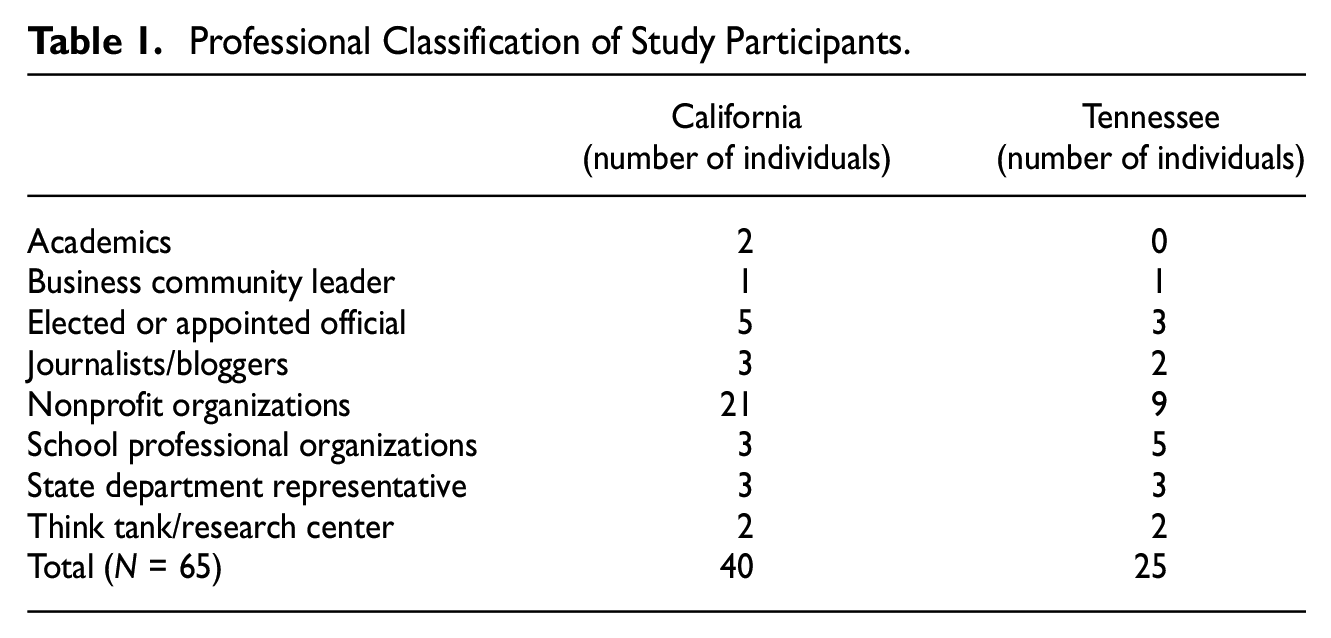
Recruiting participants—After creating the initial sample list, I attended state Board of Education meetings and major statewide education conferences to distribute study flyers and my business card to the targeted sample (often, high-profile individuals would be in attendance, especially during public conversations about state ESSA plans). About one-third of the California sample was recruited this way, and about one-fifth of the Tennessee sample. Other participants were recruited via email or phone call invitation. In general, email was the most effective way to recruit participants. The sample includes 65 high-ranking members of the professional class vying for influence of the design of ESSA across California and Tennessee. Table 1 summarized the professional classifications of the individuals interviewed. After agreeing to participate, one interview was scheduled with the individual at a location of their choosing, with interviews lasting from 90 min to 3 hr. Most interviews took place either in the participant’s workspace or at a local cafe. All interviews were recorded with a wireless recording devise and transcribed.
Professional Classification of Study Participants.
Results
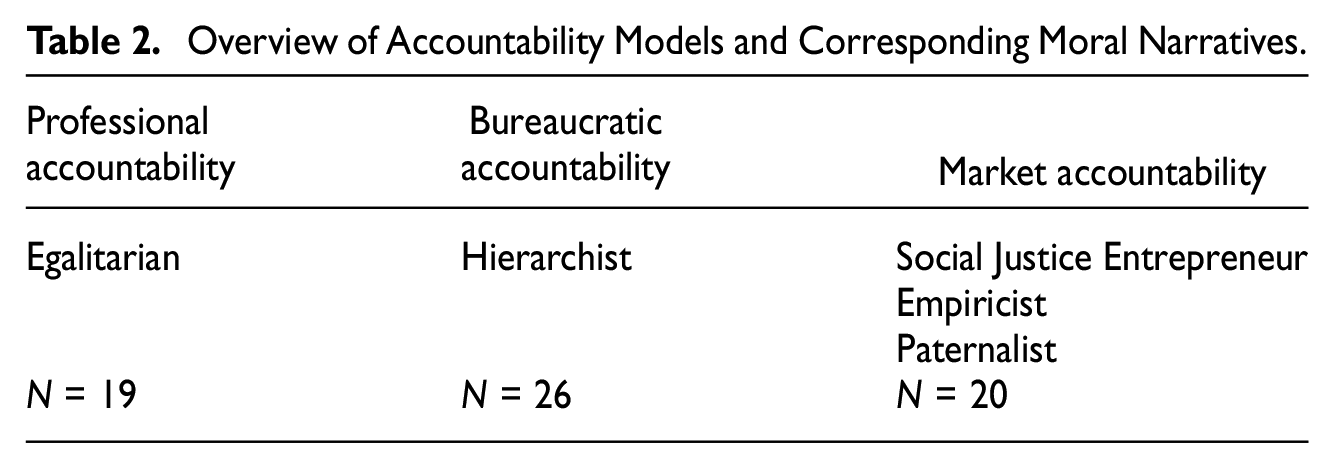
Despite the widely known shortcomings of NCLB, interviews confirmed that the core and flexible design components of the accountability paradigm remained intact. Interview participants did not doubt that the core features of ESSA such as goal setting, student testing, and data reporting could improve school performance and bring greater transparency to education inequalities. In fact, these core design elements remained taken-for-granted features of ESSA’s design, and participants did not question these elements during the interviews; these elements largely remained in the background of conversations with the policy elites. Nor did the participants deny that the flexible design features—such as monitoring, pressure, consequences, or intervening in the lowest performing schools—should be part of their state’s accountability design. However, the participants mainly focused the conversation on these flexible design features, attaching their personal moral narratives onto different policy ideas that resulted in support for three distinct accountability models. Simply put, the evidence pointed to the ways that these flexible design features of ESSA were molded into accountability models embedded in different institutional arrangements—a professional model, a bureaucratic model, and a market model (Bovens, 2007)—that were supported by five different moral narratives. The three accountability models and the corresponding moral narratives are summarized in Table 2, and are the focus of the findings.
Overview of Accountability Models and Corresponding Moral Narratives.
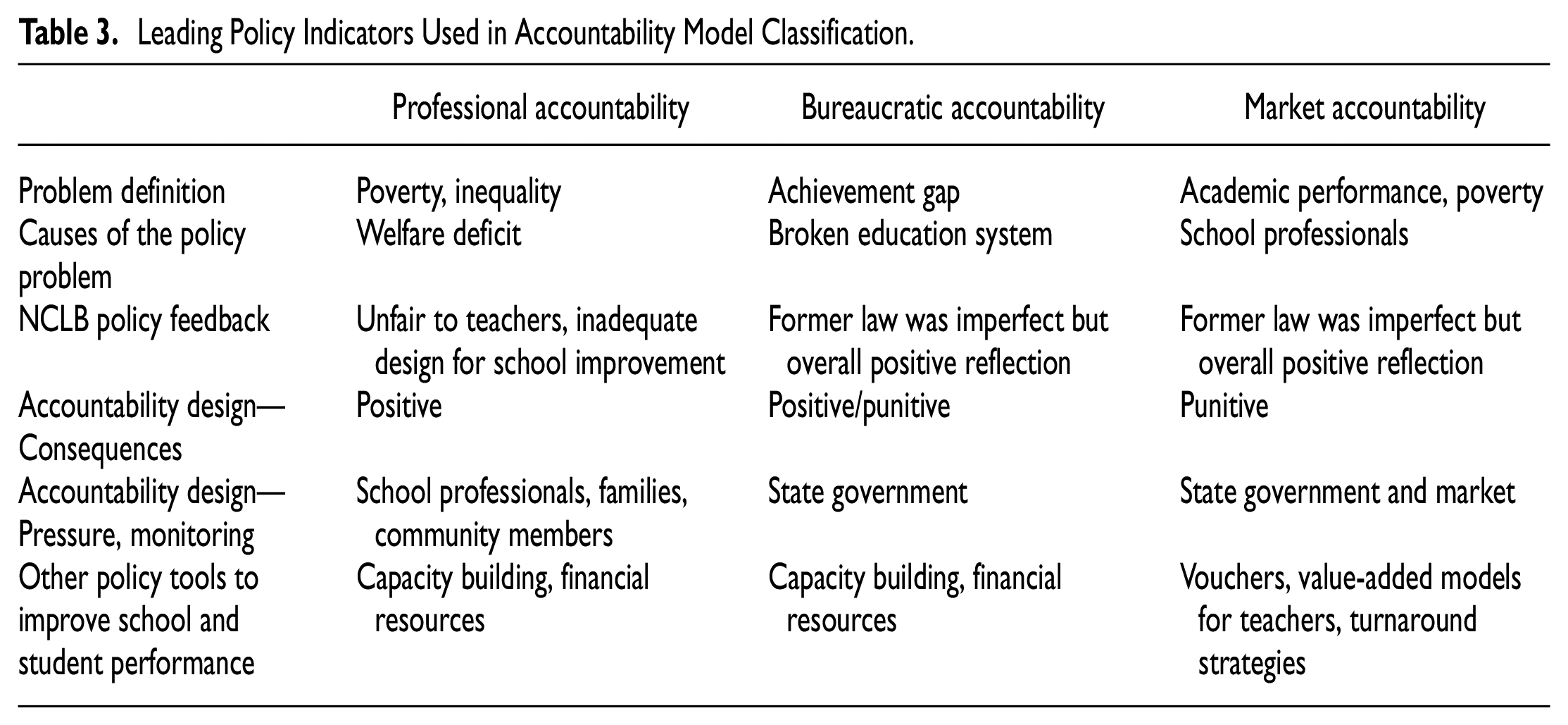
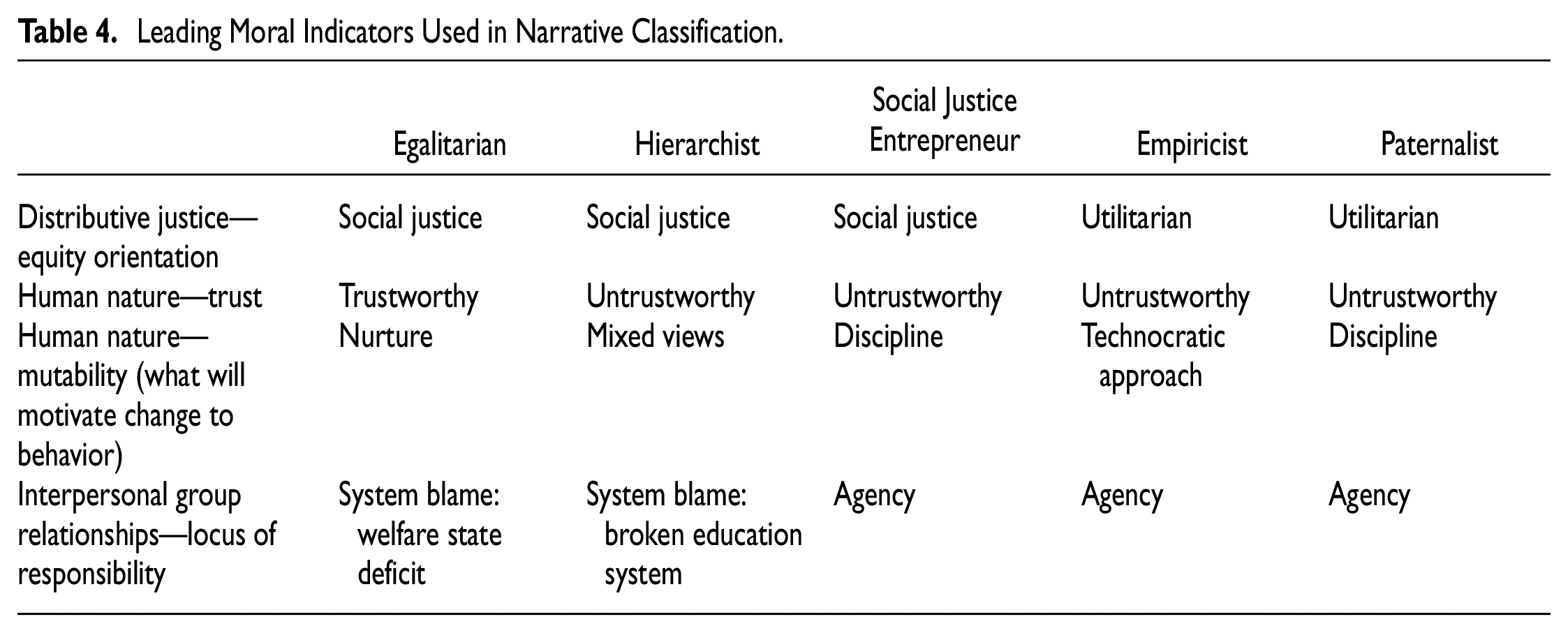
The process to determine which individual belonged in each accountability model and moral narrative began by first analyzing interviews according to the theoretical concepts described in the conceptual framework. The theoretical coding revealed key policy and moral indicators in the analysis that were used to develop categories of respondents. The leading policy indicators that were used to categorize the type of preferred accountability model included the respondents’ understanding of the policy problem and the causes of the policy problem, policy feedback from NCLB, the preferred consequences to be used in the design of accountability, the preferred institution that would pressure and monitor schools, and other policy tools to improve school and student performance. The most salient moral indicators used in the analysis included distributive justice perceptions of equity as either utilitarian or motivated by a social justice orientation; whether an individual views human nature as trustworthy or untrustworthy; perceptions of how best to motivate changes to human behavior, and whether an individual places locus of responsibility on individuals versus systems. See Tables 3 and 4 and for a breakdown of the leading policy and moral indicators that distinguish the different accountability models.
Leading Policy Indicators Used in Accountability Model Classification.
Leading Moral Indicators Used in Narrative Classification.
These indicators were used because they had high frequency occurrences in the coding scheme, and during the analysis phase, provided explanatory power for the differences and similarities between participants’ views. In other words, when looking across interviews there was substantial and consistent evidence among these indicators that revealed patterns in both the policy and moral dimension of the conceptual framework that could explain why participants looked to different institutions (the profession, state government, or market) to coordinate accountability policy. The policy indicators provided evidence of the accountability policy design individuals supported (by institutional type) while the moral indicators captured the nuanced moral narratives underlying policy ideas that justified preferences for different models.
The evidence in this findings section presents the “through line” of the policy ideas and moral narratives supported by the individuals clustered into each model. It is important to keep in mind that while there was consistency in responses among the policy indicators within each model, there was some variation in the associated moral narratives among the participants. Not every individual who was interviewed fit the moral classification scheme perfectly; some expressed worldviews and beliefs that were outside of the scope of this study while others were anomalies. The evidence presented here is derived from participants who provided the most consistent and clear evidence that aligned with the policy and moral indicators shown in Tables 3 and 4, and their interviews could contribute to theory building about the accountability paradigm.
In the sections below, each accountability model is reviewed in turn by presenting the policy ideas and evidence of the moral narratives that justified each model along the indicators identified in Tables 3 and 4. Importantly, the evidence below is organized by accountability types rather than the two state cases. Analysis of the interviews revealed that each state or case included individuals that supported each of the three accountability models; therefore, the evidence is presented by accountability model to streamline the findings.
Professional accountability model—There were 19 individuals in the sample who expressed support to reconceptualize accountability in terms of professional and local control rather than a model of accountability tightly regulated by state or federal government. The individuals identified in this cluster tended to be leaders of organizations representing school professionals as well as state school board members or other statewide education leaders. Several of the participants categorized in this model were either former school professionals or had some experience engaging in district politics (e.g., by serving on local school boards).
The policy elites in this cluster conceptualized the policy problem as poverty and they took a “systems-blame” approach to describing the causes of poverty, turning to a welfare state deficit and a lack of adequate social services for poor communities. They pointed to the deficit of the social safety net while cautiously defending schools, arguing that schools had limited control over student success in conditions of poverty. For example, an outspoken defender of the public school system argued that out-of-school factors and a lack of social services were more significant causes of the achievement gap than within-school factors: There’s research that says school performance is primarily influenced by outside of school factors by about two-thirds, and one-third in-school factors. Teachers themselves are responsible for only about somewhere between 7 and 15 percent variance in test scores. We know that teachers are the most important in-school factor for increasing test scores, but their overall impact is much smaller than environmental and socioeconomic factors. If we want to craft a solution, the best solution is to try to meet the needs of the children that are coming into schools with basic needs unmet, needing therapy or healthcare or those types of interventions. (Representative of a nonprofit)
While they acknowledged that schools were just one piece of the larger social safety net, when discussing the causes of low-performing schools, this group would commonly make a social justice argument about school funding, acknowledging that low-performing schools were inadequately funded, or not funded at the same level as schools in wealthier communities, which they thought made it difficult to attract and retain school professionals to adequately serve both the basic and academic needs of disadvantaged students. Without adequate resources, they posited that schools could not create the necessary conditions to attract good teachers, nor provide students with much needed social services. In the words of a prominent representative of public school teachers: I have yet to see a school where they find enough resources…Because I’ll bet you, if you look at a lot of the issues dealing with those schools, that’ll be related to hearing, vision care, dental care. We’re actually looking at the other programs around those issues but mental health care services, school safety, teacher training, the school facility itself you know. I mean if you think about a school environment where adults leave the minute they have a chance to, and we expect students to learn in that environment? And then you put all of the newest teachers there because they’re the ones that don’t have a choice, right, so why would we send children there? Why would we do that? (Representative of a professional teacher’s organization)
Interwoven into the conversation with those who supported the professional accountability model was a trusting belief in teachers and the work of school professionals. When discussing whether teachers were to blame for low academic achievement among disadvantaged students—which was the dominant narrative under NCLB—many of the participants immediately defended teachers with moral arguments about the “good will” teachers expressed toward students or how all teachers went out of their way to provide basic welfare services to students. Two leaders from teacher’s organizations provide examples: I’ve spent plenty of time in “priority” schools, which is our word for bottom five percent. Spent lots of time talking to those teachers and I have yet to find one that says, “You know, I really like my job and I don’t want to get fired, but I just don’t care about the kids I’m teaching, and I don’t want to try hard to get them to improve.” I mean, that has never been an observation of mine and I’m not–I’ve never met anyone who’s made a similar observation. (Representative of a professional teacher’s organization) …And there’s not a teacher that hasn’t bought food for students in their classroom. We know they –or a kitchen lady that doesn’t sometimes, for some students, actually provide them with food for the weekend ‘cause they won’t get it at home or they can’t get it at home. (Representative of a professional teacher’s organization)
For many, the moral defense of teachers stemmed from their own experience in the teaching profession, as several within this cluster had experienced first-hand the consequences of NCLB. Many had seen how NCLB narrowed school curriculum, lacked resources for capacity building, and incentivized teachers to teach to the test. They also experienced how sanctions influenced their own motivation as classroom teachers, which they argued led to a culture of punishment and apathy. In the words of an outspoken defender of teachers and public schools, NCLB punished teachers for many uncontrollable outside factors: So, it’s discouraging for teachers because they’re not being fairly evaluated on their work. I think we’ve created a culture where we’re losing teachers because they feel they’re being punished for factors outside of their control. Particularly when they’re working with challenging populations that have a lot of needs and who aren’t going to perform as well. (Representative of a professional school organization)
Despite the strong critiques of NCLB accountability, they still believed in the power of accountability as a solution to education inequalities. However, they wanted to create a “paradigm shift” in the way policymakers and the general public thought about accountability’s design features. Among their vision for a paradigm shift was the desire to collect more data and to create more metrics to have a fine-grained understanding of the inner workings of individual schools. They wanted to broaden measurement and data collection to other measures of school success beyond just test scores or what was required under ESSA, and wanted to include indicators such as school climate, parent engagement, and suspension rates, alongside student test scores. More data and measurement meant that schools could have access to detailed information about the performance of a given school and professionals could better diagnose the problem to design appropriate interventions. They also wanted to transform the concept of consequences from a punitive connotation to a positive one and argued that in lieu of harsh sanctions, a consequence could include more capacity building and more technical assistance to support school professionals in low-performing schools. In the words of a leading academic: So I think, number one…it’s a paradigm shift for state leaders and for general public and parents to think about accountability without a negative connotation embedded in that word. So for so long in our recent history, that word has a very negative, you know, piece to it. When you say accountability, it’s like, “Uh, oh. I’m in trouble!” As opposed to accountability meaning, “oh, great. Someone else is seeing a thing that I had a hunch was there. Now I can get some support and some help to address this thing and there will be resources and support attached to me, working through, and crafting a plan with my educating my co-workers, my fellow educators, district leaders, school leaders to figure out how to address this thing that isn’t working, that we’re struggling with, that we need help. So, really shifting that definition of accountability I think is number one. (Academic)
Importantly, individuals with this mindset deeply believed that the sanctions regime that “shamed and blamed” teachers for student performance needed to radically transform. This perspective came both from their experience as teachers or school professionals under the regime of NCLB, as well as their embodied nurturing worldview of human nature. An influential representative of a statewide agency described that it was “common sense” to expect behavior to change with nourishment and caretaking rather than discipline, going as far as to translate this belief into the care and treatment of animals. To egalitarians like this individual, their worldview included an important nurturing outlook that translated into their opposition to sanctions and discipline as a motivating force for school improvement in an accountability system: “And really those, think about just how do people improve performance in kind of a fear and threat-based way? How do you like, I mean—I have dogs, they’re very ill-behaved right now, not getting enough attention, but you know, do you like—is it about fear and threats or is it about positive supports? That just seems so common sense to me as a teacher and I think it seems common sense to our education leadership right now. Where it’s like, “We’re going to help you to be better at what you do. We’re not going to scare you or threaten you into doing a better job because we all know, nothing learns as well as it could from a place of fear.” You know, systems based on fear are not good. (Representative of a state department)
To move away from punitive sanctions that were part of NCLB, professional accountability thinkers wanted their respective state government to play a limited and supportive role in school reform, and desired school professionals, families, school board members, district actors, and local community members to take control of monitoring, pressuring, and regulating school quality. In other words, they wanted to shift the control of accountability away from the state government and place it in the hands of local actors. They made the argument that parents and school professionals knew better how to improve the conditions of schools, rather than an overly bureaucratic, compliance-driven state government. Imbedded in this argument was their trusting outlook toward human nature and the belief that teachers and local communities could be trusted to monitor, pressure, and improve schools without NCLB-era sanctions and strong regulation from state government.
One final defining feature of the professional accountability model was the importance of resources to support their primary goal: To build supports for the teaching profession by bolstering technical assistance and capacity building for schools. The argument followed that recruiting high quality teachers to the profession was an essential component to serving students in poverty, but they wanted to create the conditions necessary for good teachers to be attracted to high-need schools. In the words of a leader of an influential teacher organization, investment in the teaching profession was in service of student learning: But you’re assuming that they [teachers] want to be there and want to do their job, that’s why you go into to teaching. And I know very little, very few teachers that don’t wanna see what’s best for their student. It is everything we do…but when we focus, even on things like bargaining better salaries or good retirement, a stable retirement, or better health benefits or something, it’s about attracting and retaining the best and the brightest in the profession. How are you gonna get the best and the brightest if they can’t afford to feed their families while they’re there, or give them healthcare or help them buy a house? It’s all tied to student learning, to improving student learning. That’s why I’m saying if you have a school that is so bad– that the facilities are so bad or so unsafe that an adult, the minute they get the opportunity of seniority to leave–what does it say about that school? And we’re sending children there, and then wondering why it’s not working? (Representative of a teacher’s organization)
However, when asked about a plan for acquiring more resources from the state or federal government to attract and retain higher quality teachers, many of the participants did not have one. Instead, many of the elites across both states pointed to the new federal ESSA funding as a source of new revenue that they thought would be adequate to fund their new vision to solve the policy problem, and quietly dismissed acquiring more state or federal government funding as an impossible political task.
Bureaucratic accountability model—This section describes the thinking of 26 policy elites who put state government front and center of their preferred accountability model. Many within this cluster were grassroots organizers or leaders of civil rights and advocacy organizations. There were a few journalists and academics as well as representatives from state institutions. About a quarter of participants had spent time as classroom teachers or served in schools in another capacity. Many were seasoned veterans of state-level politics and had engaged with education policy for several years, and in some cases, several decades.
To the bureaucratic accountability thinkers, the policy problem was pinpointed as the academic achievement gap between students of different socioeconomic backgrounds. Like those in the professional accountability model, those who supported the bureaucratic accountability model also took a “systems blame” approach to identifying the cause of the policy problem. However, instead of identifying a welfare deficit as the primary cause, bureaucratic accountability thinkers identified the deficits of the education system as the cause of the achievement gap and argued that there was a broken system that existed between schools, districts, and state and federal government that was associated with the achievement gap. Several participants pointed to inequalities in school funding, teacher salaries, teacher quality, and administrative capacity as just some of the broken issues inherent in the education system that were causes of the policy problem. For example, this leader of a community-based advocacy group makes a systemic argument about improving teacher quality (underline added to emphasize the education-system deficit argument): So the real work of education is figuring out
When it came to feedback about NCLB, many of the elites in this cluster recognized that the design of the former law was imperfect, but they generally embraced the design, arguing that the technical aspects of the former law served social justice ends. For example, they especially liked the federal requirements for all states to focus on data and disaggregation of student data by race, ethnicity, and income level, making the point that prior to NCLB, these students were invisible in policy discussions. A representative of an influential advocacy organization emphasized the importance NCLB had for student equity: …what I would say is that NCLB wasn’t a perfect law, and there were a lot of things we were learning from, but there were a lot of really important things that it did. It required that we disaggregate data by subgroup, and tied identification of schools, and assistance, and intervention for those schools to the performance of individual groups of students. That meant that students of color, English learners, special education students couldn’t be invisible in the system, and we had to finally acknowledge that there are schools that on the surface are good schools, but that under the surface have big achievement gaps, and that wasn’t something that was really part of the conversation before NCLB. For that reason alone, it was really important, and I’d say effective law. (Representative of a nonprofit organization)
Importantly, several thinkers defended the federal government’s role in designing policy for the nation’s schools and argued that their respective state government should become the centralizing institution to pressure and monitor schools and districts going forward under ESSA. To this end, many of the bureaucratic accountability thinkers argued that federal and state government—governing bodies that represent collective societal interests empowered with legal authority to monitor local actors—have an important role to play in protecting students from the “dangers of localism.” Throughout many of the interviews, there was overwhelming distrust in human nature that played out in perspectives of local school boards, local politicians, and districts with complete local control. The policy elites in this cluster were very concerned about biases and discrimination that they thought would take root in communities if the federal or individual state governments did not monitor and intervene in local decision-making. In this vein, the participants saw discrimination as an inherent component of the human condition. This worldview was directly tied to their thinking about the role of government. In the words of an influential leader of a nonprofit organization: And I also think that we’re hardwired as human beings to have a certain amount of mistrust for– based on difference. Even fear based on difference. It’s like it’s really wired. It’s like you’re from that cave on the other side of the hill. “I can’t trust you, you’re not part of my clan. I’m worried about you, you’re other.” That’s hardwired and at different moments in history, at different places, we seize on different forms of difference as the key issue… But local control is fine for affluent suburbs, and indeed doing something to limit local control triggers ire from affluent suburbs, whereas poor communities are likely not to have much political voice when these big decisions are made. And that’s why I think a lesson of the Civil Rights movement, from my perspective, a lesson is, that the state and local dynamics around equity have been, in a long-run sense, unreliable in the absence of a strong federal backstop. And that’s why Jim Crow was doing so well until Brown v. Board for such a long time. (Representative of a nonprofit organization)
To this end, this group of policy elites were strongly in favor of an accountability model still tightly regulated by a centralizing governing body such as state government, which had legal authority to provide transparency and protection to students that may otherwise be subject to the discrimination of local control. They did, however, want some modification to the design of accountability under NCLB. They wanted state government to collect more data from schools and districts and move away from the narrow focus on student test scores alone. To them, broadening the accountability system to multiple measures provided nuanced information that state government actors could use to intervene in low-performing schools in areas ranging from student achievement to school climate and attendance or graduation rates.
Bureaucratic accountability thinkers still strongly believed in consequences for schools as a component of accountability’s design, but the participants varied to the degree that they thought punitive consequences were necessary to motivate changes to human behavior. Here are two examples that reveal the range of views toward human nature and motivation within this cluster. In the first excerpt, a leader of a public school reform organization agreed that pressure and consequences were necessary to motivate changes to human behavior but thought that the NCLB era consequences went too far. In the second expert, the participant strongly prefers to continue using “sticks” to motivate change.
…I agree that outside pressure can help but the problem with NCLB, it wasn’t so much as the outside pressure but the outside pressure then led to…led to actions that were not effective. So, it led to this notion we’re going to bus kids to other schools, that doesn’t work. We’re going to bring outside service providers in and do tutoring, it doesn’t work…and what you need to do is improve the system from within, right? You need to build capacity of the teachers that are there. (Representative of a nonprofit organization, positive consequences) Race and difference almost always get in the way of rational behavior. That’s part of the definition of prejudice. So from my point of view, some forms of compulsion had to be a part of the formula. That’s why so many religions have a version of hell, because just exhorting a better form of humanity without any sticks, often fails. (Representative of a nonprofit organization, punitive consequences)
Like those in the professional accountability model, additional resources were also at the forefront of the minds of bureaucratic accountability thinkers when discussing policy solutions. This group of elites were more than willing to talk at length about the inadequate financing of the education system and the associated inequalities for poor communities. They believed that more funding was necessary for school improvement and that state governments should reallocate more resources to low-income schools. However, while several pointed to the problem of inadequate school funding, none had a plan for garnering new revenue for public schools from the state legislature in either state, and were quick to name political reasons why more money for low-income schools was impossible.
Market accountability model—The market accountability model includes interviews from 20 individuals who were united in their faith of the marketplace to solve the policy problem. Some were leaders of charter management organizations or school choice education advocacy organizations while others were leaders of conservative think tanks, members of the business community, or statewide officials. Just a handful had taught or worked within a school at some point during their careers.
Across the board, this cluster of thinkers described the policy problem in terms of low academic performance. When asked about the problems or challenges facing their given state, participants within this cluster quickly cited low scores on the given state’s academic achievement tests or the respective state’s low U.S. ranking on the National Assessment of Educational Progress (NAEP) in comparison to the rest of the international community. Their perception of low academic achievement as the policy problem was tied to the broader problem of poverty in society. On the whole, this cluster of thinkers believed that schools were the central institution for social mobility in society and that success in school was students’ ticket out of poverty. However, they argued that within low-performing schools there were “bad teachers” who created a “culture of low expectations” that prohibited students from advancing in the system and therefore contributed to their inability to escape poverty.
When asked to reflect on NCLB, policy elites who supported the market accountability model could admit that the former law was imperfect, but they generally thought that the design of NCLB was a step in the right direction. Several participants noted there were consequences such as too much testing and narrowing of the curriculum, but they merely acknowledged these drawbacks, and overall, showed strong support for the former law. The thinkers in this cluster liked the focus on data, testing and analysis by student subgroups, and these were components they wanted to keep front and center in the redesign of accountability under ESSA. However, to this group of elites, one feature of NCLB that did not go far enough was its use of sanctions. Across the board, this group of policy elites revealed a striking support for their respective state government to monitor and pressure schools, and to use punitive sanctions as part of the design of their state’s ESSA accountability policy. Specifically, they wanted the state government to double down on its use of sanctions to push low-performing schools to the marketplace. For example, a popular policy idea among this group of thinkers were “school turnaround strategies” the state government could leverage for persistently low-performing schools (Mathis & Trujillo, 2016). If a school was a low performer, they wanted state government actors to fire the school principal or the teaching staff, convert low-performing schools to charters, or simply close the school. Participants within this cluster also wanted their respective state government to continue implementing school choice policies.
More so than any other participants in this study, individuals who supported market accountability were more willing to reach inside classrooms with policy instruments that could target individual teachers and hold them accountable for their performance. In this vein, this cluster of thinkers strongly supported using teacher evaluations and value-added models to monitor the work of teachers in their ESSA accountability framework. They wanted to use results to make decisions about whether to keep or fire a given teacher, or to assign high quality teachers (as determined by value-added models) to low-performing students. Lastly, a defining feature of the market accountability model is that individuals within this cluster did not think that schools needed more financial resources for improvement. Some acknowledged that giving more money to low-performing schools could be helpful to a point, but they argued that after many years of being a low-performing school, the best course of action was to use a turnaround strategy or give students and families the choice of higher quality schools to attend.
There were three groups of elites with distinct moral narratives that justified the problem definition, its causes, and the different policy ideas supported in the market accountability model. To some, who are labeled “social justice entrepreneurs,” the problem definition was supported by a social justice view of equity that directly acknowledged that historic inequalities and racial biases have played out in the education system and caused not only poverty, but intergenerational poverty. Social justice entrepreneurs consistently argued that the education system was stratified by race and class, and that the public school system “failed” poor and minority students and limited not only their life opportunities, but the opportunities of their parents and grandparents who attended the same schools. The social justice entrepreneurs also uniquely claimed that poor performing public schools were sites of oppression that held people of color back from opportunity. A strident leader of a school choice organization gave a poignant example from the Civil Rights movement of African Americans enduring violence to gain access to better schools: When you think about integration, it was Black people who were willing to send their children to schools where they would be attacked by dogs and assaulted by adults and children for the promise of a great education, because we are– I think Black and Brown communities realize, we need to get our education at all costs. Like, we need what–if this isn’t working for us, we need to try something different. (Representative of a nonprofit organization)
Because social justice entrepreneurs perceived schools as the institution that would allow individuals to overcome poverty and oppression, they channeled their focus on schools and school professionals as the cause of the achievement gap. They believed disadvantaged students needed access to the highest quality teachers who were willing to help poor and minority students overcome systemic oppression and historic inequality and excel in the education system. However, they showed a strong distrust toward teachers and school leaders, who they held accountable for the problem of low academic performance and poverty. In the words of a nonprofit leader supporting the school choice movement: There’s an argument that teachers come in and say, “oh, we’re teachers. We care about education. Trust us to deliver education,” and there’s an extent to that which is like, I don’t know if I’m that trusting…like, we didn’t just get to where we are in terms of kids not being able to read and having the challenge of achieving academically… we know based on our current community that this has been happening for 20 or 30 years…I mean, we’ve got too high an illiteracy rate to have said that our system has been working for a long time, or we’ve got too high of a jobless rate or a poverty rate to be able to say that our school has been servicing folks well. So, this is not something that just happened. (Representative of a nonprofit organization)
To this end, they supported a role for the state government to enact punitive policies for schools and teachers that “failed” to make progress for students, policy ideas that were supported by the worldview that discipline could motivate changes to human behavior. Without the threat of discipline, many thought the school professionals employed at the schools would not motivate to improve the learning environment. A leader of a school choice organization exemplifies this point: …the truth is there are some toxic school environments out there where you have a ton of inertia around failure. What shakes that up? How far can you get in just like demanding, like observing people, or trying to do better work and replacing retiring staff and transferring staff…the threat of the school being shut down and people’s whole routine to be totally disrupted is also a motivating force. (Leader of school choice organization)
On the other hand, social justice entrepreneurs also greatly valued individual agency and attached this outlook to many of the policy ideas they supported, such as school choice, turnaround strategies, or school vouchers. They believed that access to the best schools and success in the education system could lead to liberation from oppression alongside social mobility for students of color. A social justice entrepreneur argued that families should be given vouchers to choose the best school for their children, and that sizeable vouchers would allow poor African American children to access higher quality private schools and escape poverty: Oh, I’m a big fan [of vouchers]…I just don’t need kids to go to private schools for the sake of going to private schools, I need kids to go to high performing private schools where they’re gonna have to build a level of social capital that their wealthy, White counterparts are going to have…like, I’m all in because my thing is, I need poor families to have all the options that rich families have, right? So, that’s my—yes, I support it, I want kids to have a bunch of opportunities, but what I want is I want kids to have vouchers that are $20,000. That’s what I want. I want vouchers to be high! I want them to be a lot of money. Right? So, I don’t need 5,000–I don’t want 5,000 vouchers for $6,000. Get me 2,000 vouchers for $20,000 because that will change the game for poor Black children. (Representative of a nonprofit organization)
To other elites, the “paternalists,” their conceptualization of the policy problem was devoid of racial or social justice arguments. Instead, they expressed a utilitarian view of equity and used “colorblind” language (Bonilla-Silva, 2002) to frame the policy problem of “failing schools” and “underperforming subgroups” without delving into issues of racial and economic inequality. Like the social justice entrepreneurs, the paternalists did not trust school professionals outright and pinpointed them as the cause of low academic achievement and poverty. However, they described their distrust of teachers in a unique way, using colorblind language to discuss the problem while emphasizing that many teachers often lacked the discipline that they thought were essential for educational success. For example, a statewide official described what characteristics a “good” teacher should have by referencing the movie, Lean on Me, emphasizing the values of discipline and high expectations: The other movie [Lean on Me] the guy in New Jersey, he says we are gonna be tougher on you. I don’t care if you’re black, white, rich or poor in this school were gonna be tougher, we gonna expect more out of you… you’re gonna say “yes sir, no sir, yes ma’am, no ma’am.” He got a little bull horn and some people were not his supporters. He ultimately had issues with one thing or another but the reality of it was that the African-American—can’t think of his name [Morgan Freeman]. It’s another example of– he deliberately said it, “We are gonna be tougher.” And that the expectations were much higher with regard to behavior. And every kid in that school knew that, so but that’s the issue, in my opinion. (Statewide official)
Like the social justice entrepreneurs, paternalists also embraced individual agency, but it was for utilitarian rather than social justice reasons. To the paternalists, policy ideas like school choice or vouchers could embolden parents to make the best choices for their students and escape the given state’s “failing” schools. They embraced the competitive and disciplinary nature of the marketplace and believed that schools operating in that institutional environment could improve overall school quality. Therefore, they supported policy ideas like school turnaround strategies that would move low-performing schools to marketplace environments. Such policy ideas were supported with the worldview that discipline could motivate changes to human behavior. A paternalist, using the language of failure and emphasizing the strength of the state government as a reformer to takeover low-performing schools and implement turnaround strategies, made this point: …if you’ve got a child in a particular school building and that school building has a history of failure, and when that child–ultimately, that school reaches that proprietary list, then it basically says, “You failed for X number of years,” and…we’re [the state government] gonna come in. We’re gonna take it over. We’re gonna develop a plan of remediation. We’re gonna develop a program to give those children an opportunity to succeed. Whereas, in the past, they were guaranteed failure…(Statewide official)
A third set of participants, the “empiricists,” expressed yet another moral narrative to justify their perspective of the policy problem and causes. Like the paternalists, the empiricists also spoke with colorblind language to discuss the policy problem and shared a utilitarian orientation toward equity; they also shared a distrust of teachers alongside both the paternalists and social justice entrepreneurs. However, empiricists were distinct from the paternalists and social justice entrepreneurs in that discipline was not part of their worldview; instead, they relied on the technical aspects of the accountability paradigm, such as data collection and analysis, to justify their perception of the policy problem and its causes and possible remedies. For example, a leader from the business community discusses the cause of the academic achievement gap by turning to empirical survey data to justify why teacher’s low expectations were the source of the problem: …this is an urban district so a teacher that applies to this urban district, they’re coming in with the mindset of 80 percent our kids are in poverty, poor kids. They’re in poverty. So it’s really each individual’s mindset but districts have to do– and I think the new Director of school said, yesterday he said, they had a transition team of business leaders that did a study of a school district, there were several from this report. One of their findings was low expectations. Expectations were too low of educators. It was like, there was a survey. And so the district has to build a mindset of those that they hire that they have high expectations. No matter what you do everything you can to ensure this child learns. You don’t make an excuse and say, “Well it’s because they’re in Special Ed that they can’t learn.” That’s really just about a mindset. (Representative of the business community)
Likewise, empiricists would draw from their preferred empirical literature—often from conservative researchers or laizze-faire think tanks—to justify their support for market-based policy ideas. For example, a representative from a state department of education tried to justify consequences for low school performance such as charter school expansion and school turnaround strategies with technocratic language that loosely refers to evidence that suggests their effectiveness: So, I think that there is some evidence…this threat or sanction or takeover can have some positive consequences. We’ve seen this right—and I think that evidence might be a little bit mixed—but there is some evidence that suggests how we think about charter schools coming in an area and providing competition that, you know, there are—I think some evidence that says that schools have improved (Representative of a state department of education).
Discussion
Following the demise of NCLB, this study sought to understand how policy elites were thinking about accountability as a solution to solve education inequalities, and whether they were reaching for new policy ideas or constrained by the bounds of the existing paradigm. The findings suggest that across the interviews, participants still firmly believed in the idea of accountability as a governance tool to improve school performance and bring greater transparency to education inequalities. The findings also suggest that the core elements of ESSA, such as goal setting, student testing, and data reporting, remain taken-for-granted elements of the accountability paradigm. Moreover, the flexible design elements of the accountability paradigm—such as monitoring, pressure, consequences, and other preferred policy tools to improve school and student performance—remained intact, but the participants transformed these design elements into three district accountability models with different institutional arrangements, driven by their deeper worldviews, values, and beliefs.
Shifting accountability to different institutional arrangements is not a new phenomenon. Accountability in education beyond the U.S. has been tested in the domain of professionals (Fullan et al., 2015), the market (Parcerisa & Falabella, 2017), and there are examples of legal and political institutions regulating accountability in other policy areas (Bovens, 2007; Klingner et al., 2002; Romzek & Dubnick, 1987). However, this case study presents evidence of why, despite decades of evidence that questioned the effectiveness of accountability under NCLB (Au, 2007; Lee, 2008; Lee & Orfield, 2006), the accountability paradigm in education persisted in the U.S. Arguably, the resilience of the accountability paradigm as a governing tool for schools was due to ESSA’s malleable design. As found in this study, the flexibility gave policy elites the ability to reconsider the moral questions of who is accountable, to whom and for what, and to re-think what might motivate changes to school professionals’ behavior in low-performing schools. With flexibility, policy elites vying for power and influence over their state’s education policy could transform the functional components of accountability by drawing on their deeper moral narratives, which legitimized the paradigm through their eyes and resulted in conceptions of accountability that were under the control of the profession, state government, or the marketplace.
The policy elites interviewed for this study were selected because of their influence in public discourse, and their public dialog ultimately contributed to the power relationships and strategic action fields that were reflected in the design of accountability in their respective state (Fligstein & McAdam, 2012; Levinson et al., 2009). At the time of data collection, there was a lively debate in California between those who supported professional accountability versus those who preferred a bureaucratic model, whereas in Tennessee, the tension was between bureaucratic and market accountability. Interview from this study capture many of the leading voices of the debate in each state. The findings convey the worldviews, values, and beliefs in the participants’ preferred policy design that represent historical and social identity constructions that played out in the political debate and design of state policy (Padamsee, 2009). California ultimately adapted and implemented a professional model of accountability that increased local control and used state government to facilitate data collection and capacity building while shielding the profession from punitive sanctions that were endemic to the NCLB era (California State Board of Education, 2017). Tennessee moved forward with a market accountability model that leveraged state government to set standards, goals, and data collection, and gave authority for state government to use the state’s Achievement School District—a marketplace setting for charter school operators—to improve its lowest-performing schools (Tennessee Department of Education, 2018).
For those who supported bureaucratic accountability, many of the policy ideas they supported were similar to the initial design of NCLB; for participants who supported market accountability, they advocated for policy ideas that the federal government had tested in years prior, including school turnaround strategies and teacher evaluations (Mathis & Trujillo, 2016). In this vein, participants were engaging in what Hall (1993) calls “first-order” paradigmatic change, where modest changes are made to existing policy instruments within the existing paradigm. Those who supported the professional accountability model arguably went one-step further to create “second-order” change (Hall, 1993), which means that they introduced new policy instruments into the accountability paradigm; for example, by showing preference for capacity building and technical assistance that had largely been absent from previous federal policy. However, supporters of professional accountability stopped short of proposing new policy ideas that would redefine the goals of accountability, which Hall (1993) suggests is necessary to create a paradigm shift.
Notably, there were few ideas offered by any of the participants to move beyond accountability’s technical and rational approach to school improvement. Across the board, participants talked about wanting to advance the “datafication” of the paradigm (Grek et al., 2021) by collecting even more data on school performance, developing additional quantitative measures and new dashboards to monitor schools, or using new data collection instruments in the classroom. There was also a surprising dearth of ideas about how to redistribute more resources to schools, despite several participants mentioning the importance of school finance during the interviews. Moreover, even though several participants discussed the problem of poverty and inequality in society, there was little discussion about how to solve that problem with either education policy or other redistributive policy ideas. Instead, this study presented evidence that the interview participants legitimized the rationale and technical policy ideas inherent in the accountability paradigm as a way to improve schools, and shifted power arrangements among school professionals, state government, and the marketplace. The flexible design elements resonated with the participants who filtered the ideas through their unique epistemological perspectives, resulting in policy designs anchored in different institutional arrangements. And herein lies the power of the education accountability paradigm in the ESSA era: it allowed the paradigm to remain legitimate by giving individuals leeway to map the flexible design features onto their individual worldviews and belief systems, resulting in the continuation of a technocratic solution to the problem of education inequality.
This study makes a significant contribution to the study of the evolution of the accountability paradigm in education. The three accountability models identified—professional, bureaucratic, and market—may provide researchers and policymakers with a framework to continue to define patterns in the different types of accountability policies enacted across states (Portz & Beauchamp, 2022), and internationally (Verger et al., 2019). The five moral types developed in this study may provide scholars of education politics with insights into coalition building and may also lend explanatory power to ongoing tensions in education reform debates (DeBray-Pelot & McGuinn, 2009). This study also makes a theoretical contribution to the study of policy paradigms (Béland & Cox, 2010; Daigneault, 2014) by developing a framework for studying ideas at the level of the individual by uncovering the moral narratives underlying policy conceptions in the ESSA accountability debate.
Footnotes
Declaration of Conflicting Interests
The author declared no potential conflicts of interest with respect to the research, authorship, and/or publication of this article.
Funding
The author received no financial support for the research, authorship, and/or publication of this article.
