



Abstract
This article considers contested conceptions of community and trajectories toward full participation in research-practice partnerships (RPPs) as key analytical aspects for studying a productive politics of participation. RPPs, as methodology and infrastructure for community participation, frequently surface the character of participation in intersecting communities of practice—making them visible and actionable. I examine two youth-serving RPPs. This analysis considers youth digital media projects as strategies for increasing participation and renegotiating power relations. Findings signal RPPs can help discern the degree to which young people are held on the periphery in communities of practice where marginalizing relations can be reinforced.
Research-practice partnerships (RPPs) designed to address youth influence and learning provide an opportunity for understanding whether and how youth and families gain meaningful access to participation. Here, I focus on RPPs as a method for reckoning with intractable problems of inequity, inaccessibility, and precarity in educational research (see Farrell and colleagues, this issue, for a further discussion of RPPs addressing equity). I draw from hand-in-hand research designs where RPPs are mutual, syncretic, and oriented toward ethical relations (Bang & Vossoughi, 2016; Booker et al., 2017; Booker & Goldman, 2016; Coburn & Penuel, 2016; Gutiérrez & Jurow, 2016).
Some RPPs foreground everyday digital media tools, pressing them to deliver on their potential for supporting access to societal participation and influence (Garcia & Hunt, 2017). This is significant as digital tools increasingly operate (at least in everyday mythologies and imaginaries) as de facto mediators of access to public life (e.g., digital social networks and distance platforms like Zoom). There is a narrow understanding of conditions that promote young people’s places at the table in organizing the world into which they are emerging. A fixation on emerging digital media is one source of the narrowness—emergent technologies have persistently been a means by which sociopolitical, place-based relations are reproduced (Massey, 1991).
Communities contending with persistent marginalization find ways to disrupt hegemonic force in service of full participation. RPPs developed hand in hand with youth and families become accountable to changing the status quo of deprioritizing youth participation. Where young people can gain purchase on the character and disposition of a community of practice they also gain necessary knowledge for navigating from peripheral to fuller modes of participation (Lave & Wenger, 1991). RPPs can become a conduit for making a “productive politics of youth participation,” which I define as when the limits and possibilities for participation in communities are rendered visible and accessible to youth participants.
In this article, I start by addressing conceptions of community in tension. Next, I address forms of legitimate peripheral participation and full participation. A closer consideration is then given to RPPs and the methodological opportunity they offer for discerning possibilities for access to full participation depending on positionality. The discussion will resolve with an argument for treating technologies as legitimately peripheral to the development of sustained relationships, challenging an imaginary that casts everyday digital technologies as a panacea for increased youth civic and political influence. Trajectories toward a productive politics of youth participation will be considered through presentation of two cases. A description of the methodology for each study and my approach to a cross case analysis will be followed by the presentation of cases that distinguish how the RPPs functioned. I conclude with a discussion of implications for practices that aim to support the potentially disruptive work of RPPs and seek to address marginalizing, precarity-producing conditions.
Discerning Competing Notions of Community and Trajectories of Participation in RPPs
Young people are persistently positioned as learners, ostensibly making moves toward full participation. They are tasked with understanding the following: (a) the community, (b) its repertoires of practice (Gutiérrez & Rogoff, 2003), (c) its tools for engagement, (d) how it is organized per wider relations of power, and (e) whether they—youth— have freedom of movement within a community that allows for change. To conceptualize youth participation in terms of possibilities for their full participation and consequential influence in communities I consider Dewey’s (1916) conceptualization of learning, and I engage a conception of legitimate peripheral participation theorized by Lave and Wenger (1991).
Legitimate Peripheral Participation in Community Life
Communities, consistent with Dewey’s notion of learning through renewal in transmission, locate participants in relation to one another and in relation to the practices they share. Dewey (1916) described a pragmatic theory with a method of knowing that could renew and adapt through situation and experience: “Its essential feature is to maintain the continuity of knowing with an activity which purposely modifies the environment” (p. 344). In Dewey’s view, knowledge is conceived through conscious awareness, practices and dispositions, and actions aimed at establishing or re-establishing alignments between people, our lived experiences, and environments.
Dewey’s attention to learning led him to distinguish spectators from participators—those who observe indifferently and those whose lives are bound up in the potential outcomes of events. The importance of this distinction is further elaborated in studies of learning as a social practice. Lave and Wenger (1991) theorized learning as a process of shifting relations within a particular community of practice. They argued newcomers arrive at the periphery of relations and activities with the possibility to expand and grow their participation. This is important for theorizing learning as inseparable from social and cultural histories that give rise to it. However, there has been a prevalent tendency to favor a positive framing of communities of practice in research about young people’s learning that obscures ways communities can also function to legitimize and reinforce persistent marginality and uneven distributions of power. RPPs offer an important method for transforming spectatorship, particularly at institutional intersections, into collective participatory systems of engagement.
Youth Participation in Communities
As newcomers in a potential community of practice, youth must make sense of and learn how the community works and its parameters for participation. Likewise, mutual partners in an RPP must remain attentive to existing relations of power and varied, subtle ways in which standard imbalances, and at times harms, are reproduced. The concept of legitimate peripheral participation (LPP) helps trace learning as a participatory process of negotiating power (Lave & Wenger, 1991). Changes in participation are commonly referenced as shifts from periphery to center. However, Lave and Wenger (1991) cautioned, central participation was too limiting to address complex relational work of communities. They described full participation rather than central participation, as a better indicator of these diverse forms of relatedness. Likewise, not all conditions for LPP yield the possibility of change: As a place in which one moves toward more-intensive participation, peripherality is an empowering position. As a place in which one is kept from participating more fully—often legitimately, from the broader perspective of society at large—it is a disempowering position (p. 36).
Young people must learn to distinguish these contradictory conditions of peripherality. Figures 1 and 2 offer one way to visualize contrasting “empowering” and “disempowering” positions and their relative impact on movement toward full participation.
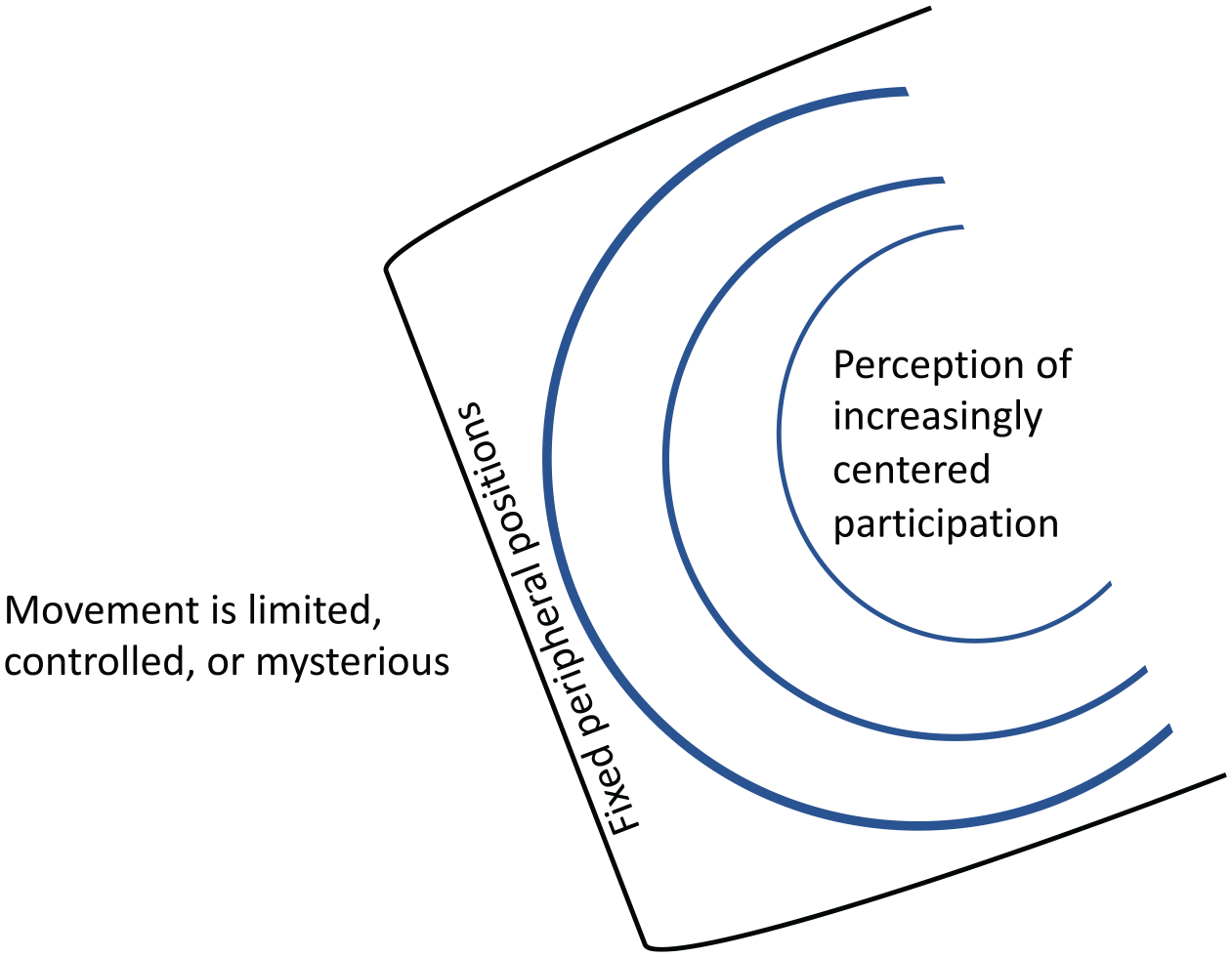
Legitimate peripheral participation (LPP) where marginal positions are fixed.
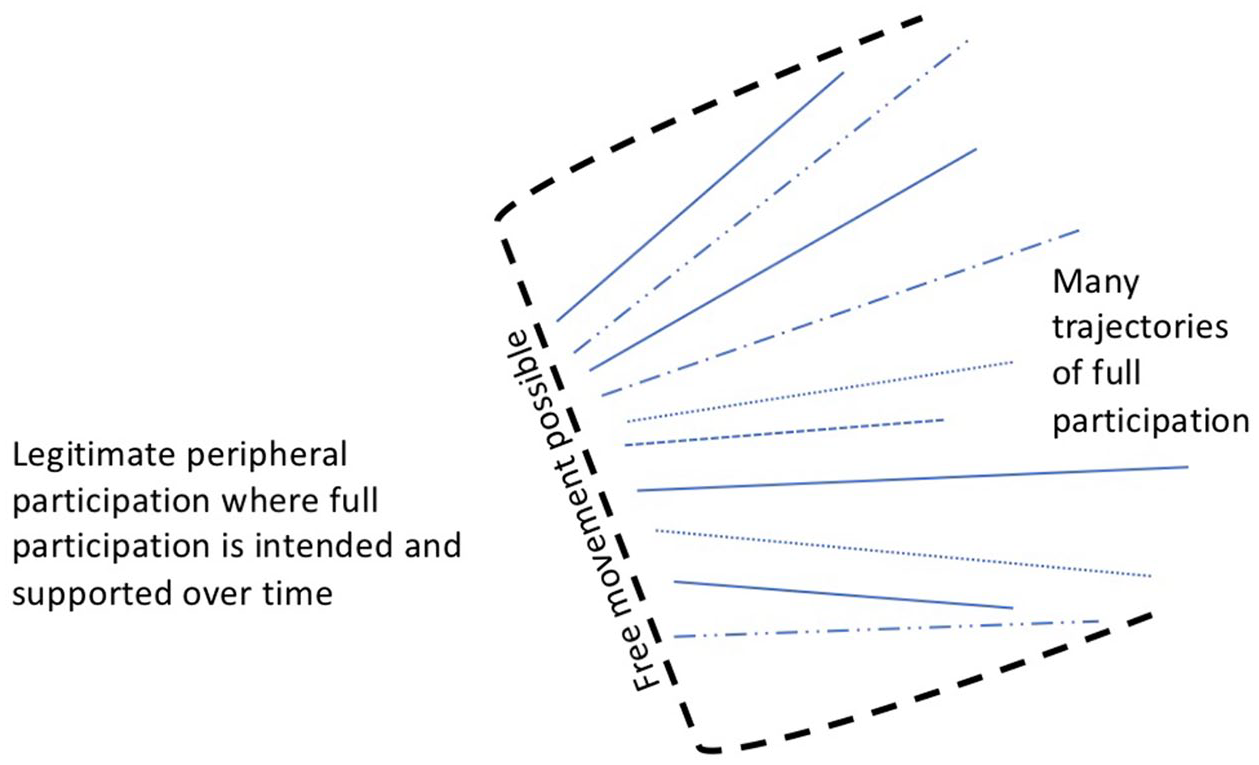
LPP where movement toward full participation is possible.
Scholars engaged in RPPs must study these conditions in their partnerships and communities to advance our understanding of the degree to which young people—among many groups occupying marginal spaces—are subject to the reproduction of relations of power. Without active effort to notice and respond to the reproduction of power relations (e.g., institutional power and expertise reinforced through social deference and access to funding), our efforts will surely be subject to the same reproducing outcomes that reinforce marginal positions rather than arcing toward liberation.
Discerning Conceptions of Community: From Peripheral to Potentially Full Participant
The degree to which a community is organized to allow for ‘more intensive’ participation is a key concern for RPPs. This analysis requires a closer look at varied modes of participation and the way those forms can coexist (passively or actively), collide (yielding disruption), create or transform (expanding scope, extending the scale or reach of a community’s activity), and communicate (generating coalitions and alliances).
In each case presented, youth provided the impetus for RPPs to form. Improving conditions for mobility, access, increased choices, success, and meaningful connection were the heart of each RPP. Yet, participants in the RPPs were positioned differently. Their concepts of community varied. For instance, in the first case to be shared—Summer and Social Justice (SSJ)—the program organizers in a school district’s youth development office and their after-school program partners agreed to develop summer programs together. They conceived community through familiar institutional intersections: schools, community centers, the immediately surrounding geographic areas of each site, and partners at the local university where I worked. As the researcher in the partnership, I asked under what conditions youth participants in the program aligned with these conceptions of community. Data analysis revealed youth held more personal definitions of community: (a) immediate family, (b) nearest neighbors (e.g., next door and across the street), (c) extended family and friends distributed across a wider framing of their city and region, (d) local sites for family convenings (e.g., parks), and (e) religious and cultural heritage communities. When conceptions of community are in tension, how will participants move toward full participation?
To address this question, let us return to forms of legitimate peripheral participation (LPP) and how changes in participation may occur. Some youth programs are designed with apprenticeship-like trajectories toward increased responsibility and leadership for a smaller group of deeply engaged participants. At the periphery, youth begin by gaining exposure to the general principles and practices of a community or discipline and then determine personal interest before proceeding (e.g., sports programs and media arts programs). Where relationships are primary and participation is intergenerational, participation opportunities can be made available to larger numbers of participants, becoming varied but still widely accessible as youth become adults and eventually elders in a given community (e.g., cultural and religious communities and extended families). Legitimate peripheral participation functions like an open door to tighter relational ties and future engagement driven by interest, proximity, and depth of network ties. Trajectories toward full participation yield access to more fluid and open networks of relationship as well as infrastructures for practice. As such, the potential to influence the nature, aims, practices and tools for participation becomes increasingly accessible. Community members can move flexibly between fuller and more peripheral positions and practices.
Alternatively, legitimate peripheral participation can become synonymous with marginalizing activity. The periphery can remain inflexible and closed through programs that deflect practice away from meaningful influence or that concentrate access to meaningful influence in places disconnected from the available activities for youth (e.g., tokenizing positions, mimic-based practices divorced from decision making and influence). In these cases, young people lack trajectories toward full participation even as they may be busy with practices that obscure this fact.
RPPs as Conduits for Changing Relationship and Practice
Research-practice partnerships (RPPs) foreground experiences and repertoires of practice among community partners. In convening organizations and people with varied forms of expertise and responsibility alongside related yet distinct priorities in their respective work, the formation of RPPs can also create pathways to meaningful decision making for participants. This, however, is not a forgone conclusion—it must be part of the design “under which labor may become intellectually fruitful and not merely externally productive” (Dewey, 1916, p. 275).
Where RPPs intend to make way for youth participation and learning, they pay persistent attention to relevant practices that can build and sustain meaningful relationships in accessible communities of practice. RPPs ask who has access to such practices and under what conditions. RPPs then become a method and an infrastructure to let all participants in their respective positions discern where intersecting communities of practice do their work, how their values are expressed, how movement can happen, and when movement is curtailed or contained.
RPPs have the potential to interrupt traditional relationships between researchers and community members by being long term in nature and interrupting traditional power structures instituted through hierarchies of the participating institutions and related social norms (Coburn & Penuel, 2016; Farrell et al., 2021). For young people, where “doing” is rooted in making, re-making, and re-directing “the social ties that bound [us] together in community life” (Dewey, 1916, p. 330), access to full participation will require awareness of where practice and relationship yield pathways for young people’s knowledge to grow in alignment with their goals for community connection and influence. This awareness is necessary but not sufficient. Full participation also means that youth practice increases their networks of relationship and, in turn, their ability to disrupt, change, and make space for reciprocal development across smaller and larger scales of everyday life (e.g., family, peers, schools, economy, policy, justice, and region). Some methodologies associated with RPPs that also favor youth organizing, like youth participatory action research (YPAR), have worked toward full participation by partnering with youth in research design and analysis (Cammarota & Fine, 2008).
Maintaining Technology’s Legitimately Peripheral Role as Youth Pursue Full Participation
RPPs foreground the relational work necessary to collectively design transformative work, especially when emerging technologies are involved. Emerging technologies are frequently touted to amplify the voices of people in peripheral or marginal positions (Caron et al., 2017). The assumption here is either power will become more distributed or more people will be able to influence decision makers with the advent of socially-networked technologies (Sefton-Green & Erstad, 2016). Notably, when relations among people are the focus of activity and analysis in RPPs, the ways young people gain access to influence and the ways they remain marginal, are rendered visible. This practice-rooted process, when supported, could provide the opportunity to yield what I describe here as a productive politics of participation.
Because program designs for youth participation so persistently integrate uses of technology, I interrogate the transformative potential of technology in communities of practice involving RPPs. In liberal democracies, youth are promised greater democratic participation in step with access to technological infrastructure and social media practices (Bennett, 2008; Bennett & Wells, 2009; Hawkins, 1991; Mehan, 1989; Soep, 2014). Technological advances operate as codes for improved democracies. When voice is designated as evidence of access to participation, technologies promising to amplify more voices can become centered as well. Yet, if community conditions remain invisible or inaccessible—that is, how the community is situated and how influence is negotiated—the power of voice is undercut, regardless of technological advances. Or rather, voice is drained of its power.
From the periphery, particularly where youth access is highly regulated, power can appear concentrated at an imagined center where adult authority has been emblazoned in a standard imaginary of youth-adult relationships. Realities of community practice are more intersectional and complex. Where communities of practice are negotiated through RPP design, meaningful trajectories of full participation have the potential—yet, notably, are not guaranteed—to extend beyond a singular linear relationship from peripheral to central, or disempowered to empowered.
Methods
This analysis draws from two RPP studies with young people between the ages of 6 and 17 as well as undergraduate students, adults, elders, graduate student researchers and faculty researchers to understand how they attempted to shape their schools and local communities while using digital technologies as a facilitating tool. Findings from this comparative analysis decenter persistent affirmation of the democratizing potential of technology for youth and communities contending with marginalizing conditions. Instead, they demonstrate a need for people to discover, through practice, the circulation of power and influence in the constitution of community—or more accurately, intersecting communities.
Case Selection
Each case is an expression of community-engaged research where the design drew on participant observation over time. As a researcher, I was positioned as a partner in either the conduct of activities, including at times their design, or as an analyst of activities designed to promote meaningful community participation. The selected cases are a convenience sample where each partnership includes at least one community organization, an institutional partner, youth participants, and a researcher or research team. Table 1 provides a summary comparison of the selected case site descriptions, data collection and analysis.
Two-Site Comparison.
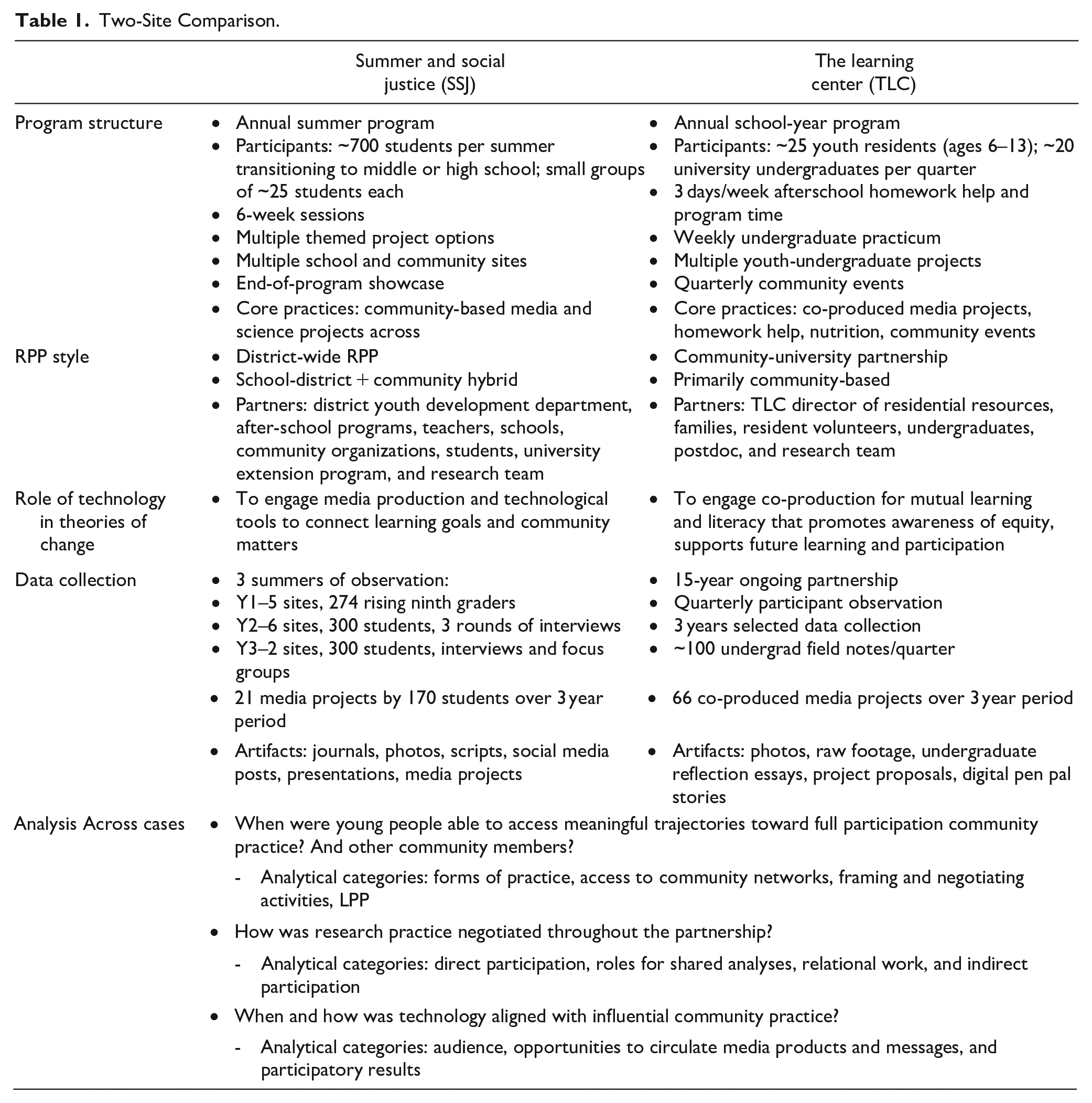
The first is a study of young people’s experiences in a summer bridge program called “Summer and Social Justice” (SSJ) 1 designed to support their transitions into middle and high school. A key goal of SSJ was helping students connect their community commitments and concerns with school activities. The second study is an ongoing 15-year community-university partnership occurring at The Learning Center (TLC) in an affordable housing apartment complex that runs as a practicum course convening young residents and undergraduate students interested in learning, communication, and media-making through participatory design. Each study asked questions about how young people learn about participation in community and collective decision making and prioritized youth voice as a strategy.
Each site functioned in similarly hybrid ways, drawing together a variety of communities in partnership. In each case, young people operated in their roles as students in schools while establishing their practice beyond typical boundaries of the classroom and the school day. Each study examined programs involving collaborative efforts to frame and address issues in socially situated ways. Each program was connected with a set of organizations and adult allies with whom to negotiate direction and support action. Young people in each program tried to mobilize community-based networks. Each RPP also intended to influence the day-to-day business of students’ academic lives. The programs supported long-term ambitions for a change in the arrangements of educational experience by prioritizing young people’s perspectives and goals. In sum, the programs were oriented toward a combination of learning and change-making processes encompassing educational institutions and organizations and their surrounding communities.
The programs differed in scope and focus of activity. SSJ ran each summer for 6-weeks. To serve nearly 700 students across 7 to 10 locations per summer, when registering for the program, students could select by type of activity (e.g., digital media, robotics, cultural heritage, and hands-on science). My research role was largely rooted with district and university extension partners organized as a more traditional observation and interview study. This analysis draws from weekly observations, 21 digital media projects and collected artifacts, and a series of three interviews conducted with 21 youth participants in Year 2 (12 middle schoolers and 9 high schoolers). Interviews occurred three times during the year: once at the end of the 6-week program, once mid-year, and once at the end of the school year. This analysis also focuses on observations of weekly RPP team meetings.
The second analysis comes from the practicum course run in partnership with TLC. In addition to homework help at the request of the Center Director, activities have included daily nutritional snack, gardening, event support, and a variety of technologically mediated projects. Over time, the persistent collaboration between the Center Director, myself as principal investigator, the team’s postdoc and seminar lecturer, graduate students, and continuing undergraduates have formed the basis of a second layer of practice and relationship with parents and resident volunteers extending beyond the scope of the practicum. As a researcher here, I work hand-in-hand with our partners in ways that merge participant observation, design research, and sustained mutual trust. In addition to over 60 media projects and program artifacts, analysis presented here comes from field notes generated weekly by undergraduates through participant observation during the past 3 years of the project. I begin by providing the findings from each case. Then, we will discuss themes from across the two cases.
Findings: Discerning Paths Toward Full Participation and their Limits
In the following analysis of each case, the data reveal what was required for young people to place themselves in a wider context of community participation within these RPPs.
Case 1: Youth in Search of a Community of Practice
The SSJ RPP was designed to organize a diverse set of partners to respond to data revealing that less than 10% of kids in the district experienced a connection between what they learned at school and what was meaningful in their daily lives. In response, and to increase kids’ likelihood of staying in school, they designed an integrated summer program model of service learning and social justice to serve transitioning students (rising sixth and ninth graders). They wanted to make the case to the district that this could become a school year program to connect classroom learning with what was meaningful and important to students in their daily lives and communities. The program was launched through a collaborative grant with the district’s after school program office and a university extension center’s school-community partnerships branch. What began as a federally-funded project with a three-year funding expectation—which was cut after one year due to Congressional politics—became a well-organized labor of local commitments to kids and community.
The RPP consisted of school district organizers, teachers and school-site staff, from schools throughout the district, community organizations that regularly provided after-school programming and their respective staff, program staff from local community centers, university extension-center program managers and technical assistance providers, student ambassadors hired by the district to support work at each site, myself as faculty research partner with a team of graduate and undergraduate research assistants (in years 2–4), and at the heart of the RPP’s goals, the kids and families who would participate in the SSJ program. Both the partnership structure and the program activities touched multiple aspects of community life: environment, health and nourishment, commerce, foster care, juvenile justice, and more. What was less visible—though clearly part of the program partners’ awareness and commitment—were the community-rooted relationships and networks of the youth, families, and caregivers who embodied the core goals of the partnership. In these early stages of the RPP, it was necessary for the program organizers to discern and develop opportunities for such connections to emerge.
Participation in an equity-oriented youth development community of practice
The Youth Development Director facilitated weekly team meetings where free and open dialogue were well supported. About 20 summer program leaders and university partners attended these meetings. In the field notes that follow, from a typical meeting at the midpoint in Year 2 (week 3), existing networks of camaraderie and expertise that defined the adults’ community of practice are evident. The Youth Development Director is identified as YDD alongside other Youth Development staff at the meeting who are referred to as YDx. Program leaders are denoted as PLx.
In the first phase of the meeting, people shared news of the week that demonstrated progress. University extension partners shared a set of video diaries from the sites that week. Program Leaders from each program site shared stories about how kids in their programs were doing. Having shared some good news, the group moved on to challenges, excerpted below:
So challenges. . .[Hand shoots up immediately]. Don’t rush. [Laughter throughout the room]
Students headed back to the group home were having an altercation. . .in the car. I’m wondering if I should get involved. A staff person was there, but she couldn’t stop it. . .I felt like I had to step in. . . Any of that can happen on any people’s campuses. [Nods from others].
To piggyback, challenges of open lunch times have caused a few issues with people coming onto campus. . .I don’t know who’s in charge of those kids once they come in off the street. We don’t have a whole lotta power other than you gotta go, but who are we? Maybe we need to look at bringing in some kind of campus monitor or budgeting for that. We do that already, but we can’t do that all at once. . .maybe they could be there for peak times? I’ve got the football team, the band, the basketball team. They’ve heard I have a summer program and lunch, and now they’re here. On the website it said it was an open site, but it’s not. Now we’re trying to work with it.
For us, the accessibility for computers. . .
Yeah, that’s an issue for us, too. So no log ins. So I have the kids in my office working on computers. . .
Note the sense of responsibility and attention to negotiating their collective agency when wondering when to “get involved” and how to serve all kids who come to campus—not only those in their summer programs. They were aware of how group homes and foster care and the staff with whom they might connect. They understood their respective budgets, the resource limits, and where the wiggle room might be. They also contended with when and how to engage other institutions and potential partners. This led to a discussion of School Resource Officers (SROs) and challenges of policing in schools (e.g., police presence, strategies for intervening so kids are treated “with dignity and respect” rather than as “hardened criminals”). As was consistent with their practice, they returned to a focus on youth and specific relationships they were building with kids in their programs:
. . .[L]et’s take it a step further to think about what we can do to help empower the students.
[YDj] brought up communication. When I first heard of that incident, I was like, not my boy! ‘Cause I had connected with him. I pulled him aside and said let’s have a conversation. Just, ‘hey, how you doin’?’ Well, I had a little incident that went into where he’s getting ready to transition back to his aunt’s house and how it’s not a good situation for him. . .I wasn’t concerned for my safety, but if I was a shy type of person, I might have been going, “What?”
Is there a point where they can’t come back?
I don’t want to kick these kids out because then what? Then what? [nods of agreement]. But I feel the challenges. . .We’ve talked with a focus group of foster youth. One kid said, “It takes me a while to trust. The one person I should be able to trust can’t deal. So, you can’t expect me to trust right away.” Ask yourself, then what? Because we want these kids, we want this opportunity. Now they may need to be removed from the situation for the moment, but then what does that look like?
She completed that segment of the meeting by asking the group to consider how they might adjust their operations to accommodate their commitment to keep kids present. This was a community of practice that understood intersecting systems in the lives of their students. Eventually, they circled back to programmatic challenges. The following example is similar to what other sites also faced at times: hindsight about people to be included in their shared practice:
[PLr] didn’t bring hers up because it is the funniest. . .and sad. Well, they had started on their garden, and the gardener came and mowed that mess down. [Laughs and gasps uttered throughout the room].
[Pretends to cry]. It’s cool, it’s cool. [smiles].
This is the thing about service learning. It’s a teaching opportunity, too. These things happen, and we still have to get it done. We need a Plan B. Can we go back to how we planned? Did we even have the gardener on our team?. . .When you guys have roadblocks, they’re for you and those kids.
Such roadblocks extended to vandalism and gatekeeping beyond their current spheres of influence. This RPP intended to convert challenges into learning and partnership growth (“Did we even have the gardener on our team?”). They recognized communities of practice were in persistent negotiations.
Where were youth communities of practice?
For the summer program, organizers and facilitators had framed community in terms of geographic proximity to the hosting school or community center, which, in turn, focused the media projects that organized youth practice the same way. Adjacent neighborhoods, businesses, and nearby organizations or institutions were sites for various forms of investigation, media production, and fundraising. Observations during program time as well as artifact-based interviews with SSJ youth participants during the following school year revealed divergence between notions of community among adults who designed the program and youth participants. The research team gave interviewees digital cameras and asked them to take pictures that gave a sense of their communities. We then interviewed them as they narrated their photos which emphasized home, immediate neighbors, extended families often living in other areas, and religious communities—spheres relevant to their personal experience. Consider the ways Gabriella shared her sense of community when walking us through her. She showed us her photo of a park near her home where she spent her weekends:
How are you involved in this picture? Why is it meaningful?
My family lives close to here. My grandma lives on the other side and we live around the corner. My uncles live in [a different part of town] but they come down here.
The park became meaningful by supporting regular family gatherings. She also shared images from her church, describing how she and her cousin worked with their peers, “Sometimes we help them read. It’s a youth leader that’s in charge. She is 16.” Photos and explanations like these were consistent across interviews. On the other hand, when asked about SSJ’s goals, students oriented toward the program’s definitions of community and their contact with educators and facilitators. When those staff did not remain on-site once school began, interviewees typically found it difficult to maintain connections beyond the school:
From a practice standpoint, for most projects, the most clearly defined community was the SSJ community—situated mostly on school campuses—consisting of kids positioned as change-makers and adults in roles like teacher, community partner, or facilitator. But the vast majority of SSJ’s youth participants were not direct members of the youth development community of practice that defined the RPP. The exceptions were a few students connected with those networks including Dana, who participated in SSJ for two summers: “[I am] working with [our group’s facilitator and her youth development organization]. . .We went to [City’s Public Access TV Network] where [we] talked to. . .the audience about what [we] did over the summer and how it turned out. I networked with a lot of people so I’m also a part of a youth steering committee. . .” (Dana, 3rd interview).
Did media and technology projects build networks toward full participation?
Because digital production was the central activity in these projects, young people developed ideas about sharing and circulating their work that went untested until they tried to get an audience. It became clear in these moments that leveraging such networks was non-trivial—whether trying to connect with other media makers, peers, or to influence political leaders or local business and community groups. The day before the final SSJ showcase I asked Ariana about her group’s project: “Can you imagine continuing to work on this project and if so, what would you do next?” Our conversation illustrates the challenge in increasing their sphere of influence, transforming what they had imagined into a trajectory toward full participation:
Yes, I could. I’d talk to bigger people. Now we’re just talking to the community. We should go to Sacramento and talk to the governor. . .
Did your project connect you with people outside of the school?
We haven’t really talked to anyone outside of [the school], except [guest workshop leader].
The next day, when I saw Ariana and the rest of her group at the showcase, they expressed frustration that no one was in the room to see their video when it was their turn to share it (Field Note, Week 6, Showcase, Year 2). Some groups posted to social media platforms but received little evidence of viewership.
The summer program provided a sort of trial run for young people to build a bridge between their lives in school and meaningful community contribution. Technology projects became tools for building skills and a portfolio but not for shifting toward full participation in a recognizable community of practice. While the RPP saw an increase in reported student connection to their new schools and better supported transitions, connection between classroom learning and what was meaningful to students in their daily lives remained difficult to sustain. Most program participants had an encouraging experience and talking points about community action by the end of the program, but few had a sense of what might be required to extend their participation in a community of practice within or beyond the school.
Case 2: Making and Re-Making Community as Practice With Youth as Participants
Unlike SSJ, the TLC partnership had quite loose ties among its related institutions. The program was established between the Center Director and the research team. That said, the institutions we each represented—the nonprofit organization contracted to staff TLC and the university hosting the practicum course—were aware of our partnership and had a stake in outcomes of our activities. Periodically, news of our work appears in an organizational or campus newsletter, signaling that our efforts align with broader initiatives in our respective institutional homes. The community of practice that shaped this RPP was built on a sense of extended family, and it aimed to support education, civic engagement, and economic mobility.
Participation in a community-rooted, multi-generational community of practice
While the Center Director and residents have been glad to be part of the research effort, they have tended to leave study design and development of research questions to the research team. Nonetheless, the Director consistently plays a significant role in whether new program activities will be offered in the Center. She has also attended the weekly undergraduate seminars by phone or videoconference for years to provide feedback and guidance. The Director clearly stated TLC’s partnership priorities in a letter of support for the research design written early on: We are very pleased with our collaboration. . .not only with the homework help and general mentorship, and healthy nutritional practices provided participants here at the Center by the undergraduates, who do an outstanding job, but by special “new media” programs that are. . .allowing our children and youth access to video recording and editing skills in conjunction with important academic content. . .The children love seeing the products of their own productions and showing off their accomplishments to their parents and the community at our quarterly block parties, which bring people from all over the Housing site to the Center.
The development of a local practice of co-production and community screenings grew from efforts by young participants and undergraduates to balance play (a.k.a. relationship building), academics, and project work while the Director organized dedicated residents, community networks, undergraduates, and the research team to contribute to annual traditions for every season.
Children and youth who participate at TLC are the experts in their intersecting communities of practice made up of resilient, reliable neighbors and “the buddies.” Undergraduates enrolled in the practicum were dubbed “buddies” long ago, and the quarterly announcements of their return to the Center are met with exuberance from the youth. Our post-doctoral scholar has been working in this community for years, and many kids grew up counting on her presence as a kind of “super-buddy.” Likewise, the Director dubbed me Dr. A on my first day to ensure youth and families connected with me as a black woman who represented educational excellence. The nickname stuck.
While most undergraduates participate at the center for only 10-weeks, the youth are residents who grow up in and around the Center. They provide introductory tours and orientations at the start of each quarter, letting new “buddies” know how things work and generally how to be part of the life of the community while they are present. Consider the following field note written by an undergraduate buddy after his first visit to TLC: Yesterday I was able to visit [TLC] for the first time. . .This community has been historically known to be a low income, underrepresented community that is primarily Black and Latinx. . .[the] complex seems to have its own social dynamics for how people communicate and associate with each other. . .Initial interactions seemed to be very welcoming in the way that the children surrounded our car as we were trying to find parking. One little girl seemed so happy that she hugged every single member of our team as we got there. When we got introduced to the actual physical Learning Center the children were very eager to show us around the space. . .They were detailed in their descriptions of every space and they were very aware of the rules of every single room as they showed us around the Learning Center. As the day went on we were able to interact with some of the children’s parents. . .The parents who were in the space around the time were not as eager to meet us as their children. . .They did not ask us any questions nor were they really concerned with who we were. It seemed as if our arrival was very normal and it was clear that they have experienced this program before [Undergraduate Field Note, Week 2].
This is a typical first field note and makes clear that buddies are the legitimate peripheral participants at TLC and also beloved by the kids. Adults take more time to form connections with the undergraduates.
Youth and community governing understandings of full participation
The RPP’s community of practice gave undergraduate buddies an invitation to legitimate peripheral participation in the TLC community where their participation was both practical and hopeful: practical in the sense that they embodied an educational trajectory the community wanted to model; hopeful in that the RPP carries a social justice commitment that aims to nourish mutual understanding and care across diverse experiences. Children and youth at TLC were moving along trajectories of full participation rooted in mutual care and relationship common among families and neighbors. Notably, this also included former residents who maintained social ties and visited regularly, much like an extended family.
The following series of excerpts are from field notes written later in the quarter by the same undergraduate buddy. They give an exemplary view of how legitimate peripheral participation for undergraduates proceeded over time and dovetailed with flows of full participation among residents as they nurtured their community’s youth.
Co-production as a negotiation: Making technology legitimately peripheral
During a visit in Week 7, buddies let the Director know they needed to complete some filming for media projects. However, the kids made play the priority.
We had a great plan set for activities and video footage but, we were unsuccessful. . . [One kid] . . . suggest[ed] that we try another activity because what we were trying to accomplish was “boring.”. . .I started incorporating “fun” into my instructions and got through the filming. [Two of the kids] were very different with me than their usual selves. . .They typically enjoy it when I offer suggestions. . .Today was different though. . .During the filming activity I had to ask [one of them] multiple times to stop interrupting me and would challenge me every time I would call him out. . .When I said, “I am not speaking to you right now. . .,” he would cut me off by saying “you are talking to me right now!” I later went to talk to [the Director] about how the children were not really paying attention to me that day and she responded by saying “[Ha!], they have finally showed you how they really are. I have to deal with them every day” (Undergraduate Field Note, Week 7).
This reality check from the kids was a source of good humor for the Director, putting the buddies at ease. They shifted gears to meet the kids’ need for play and direct connection. Did the media project ultimately get completed? Yes. Were the kids and the buddies proud to share their final work in community? Yes. Nonetheless, relationship and what was needed in the moment shaped practice rather than an external pressure to produce the media project.
With consistent presence and contribution over time, buddies gained opportunities to connect with adults and elders in the community as well. The following week, one of the elders who is a regular at TLC offered to help the buddy take down some cameras in preparation for a move to a new building: We had a nice conversation throughout our time helping each other. She asked me questions about what I was studying, where my parents were from, where I was from, and what I thought about some of the students. . .I could learn where she was from, and that before she got sick she was a very skilled sculptor. When she was younger she was offered a very nice position. . .as an art director in. . .[name of one large city] but she had to turn it down because of health reasons. . .She also shared with me that she really admires [the Director] for the type of work that she does for the community. She said that she would get frustrated with the kids. . .that her teaching. . .methods were a little bit more outdated and. . .not common or acceptable practice today (Undergraduate Field Note, Week 8).
While buddy and elder worked together in TLC’s common practice of contribution, they shared important stories in their lives. The elder made clear that community was crucial to her sense of well-being as was access to health care. Buddies have fewer opportunities to make these connections with adults and elders in the Center unless they become long-term participants, or they demonstrate their commitment to contributing persistently, which was the case here. The field note also signals how community practice with youth was modeled by the Director.
On the last day at TLC for the quarter, the buddy met someone he had not seen at the Center before, expanding his sense of what the scope and scale TLC’s community practice could yield. Curious, he struck up a conversation: I said something like “Wow, these kids are a handful, aren’t they?” He [said,] “yes they are, aren’t they? I am actually an alumnus from this place.” He then shared with me that he was a recent grad and. . .just began a teaching job at a charter school in [name of nearby large city]. At first our conversation was very surface level but the more we talked and the more we both shared about each other our conversations started to dig deeper and deeper. . .We shared back and forth our thoughts and opinions about public education and we discussed possible solutions to the problems teachers and students of marginalized communities were currently facing. . .Talking to the alumnus from the center was great. I could connect with this person through our experiences of being involved in academia despite being part of marginalized communities. [Undergraduate Field Note, Week 10].
As age-group peers, the TLC alum and the undergraduate buddy swiftly found common cause and connection that extended beyond the locale of TLC into the possibility of change for people managing marginalizing conditions. Like the kids, they also made sure to include some play, trading ideas for a great night out. In a sense, this RPP asked, how can a connection like this lead to broader influence in shaping our shared conditions?
What is the deeper goal of RPPS in the context of full participation?
. . .For our part, we take seriously our responsibility to assist our [university] partners in obtaining information about children’s academic success (which are part of our own, internal, accountability practices) and providing a liaison between the children and our parents who are under considerable economic and social pressure. . .[Letter of Support, TLC Director].
Some moments sit outside of our designed activities but have major impacts on our partnership. For example, our partnership continually encounters the pressures of institutionally produced forms of precarity, particularly in housing, which put our RPPs relational trust on full display. I close with a brief account of the large-scale responsibilities of RPP participation.
A series of housing-related conflicts and changes have placed significant burden on residents over the years. For example, a pair of feuding out-of-state investors jockeying for control of the Center property had its doors locked, with apparently little regard for the residents. They changed the security code and failed to notify the Director. Upon finding the Center inaccessible, the Director worked across partnerships to care for residents, running programs in the parking lot in front of TLC. The Director also asked that our research team write a formal letter of support where we provided a description of our partnership and ongoing community-rooted practicum written on university letterhead. After running the program in the parking lot for a couple of weeks, access to the Center was restored.
A few months later, the property was sold to a local housing agency seeking to renovate the property with funding from US Department of Housing and Urban Development. One evening shortly before Christmas, a postal delivery person came to the door of the Center with a piece of certified mail, a bag full of identical letters, and a look of exhaustion from door-to-door deliveries. Concern passed across the faces of the adults in the room. The letter indicated the new owners wanted to confirm residents qualified to live there through HUD standards and announced an upcoming extended period of renovation of each unit where residents would need to move elsewhere temporarily. The intent and the timing of the communication put many residents into a state of high stress and high alert. During this extended period of uncertainty and strain the Director invited our research team to be present at community meetings and available for support if requested. Simultaneously, she asked us to remain on the periphery, trusting residents to organize and communicate accordingly. Ultimately, our presence and a similar letter of support were all they asked of us.
Discussion and Implications
These analyses have attempted to make visible intersecting communities of practice and the ways RPPs can be designed to attend to multiple peripheries and trajectories toward full participation with the utmost attention to generating open rather than marginalizing conditions. This is particularly needed when considering how youth are frequently positioned as the subjects of institutional power.
Communities contending with marginalization have frequently responded to conditions that persistently limit their influence and legitimize disempowering positions, with disruption. A critical function of these disruptions is to rattle community members into discomfort with a status quo that concentrates power in an imagined center and to establish trajectories toward full participation. These disruptions present an important opportunity to theorize community and its disempowering functions alongside forms of legitimate peripheral participation that can support open trajectories toward full participation for a majority of participants. RPPs are well positioned to support this work through timely analytical attention and relational trust built in communities over time.
There are three themes I want to reiterate stemming from my thematic analysis across these two case studies. First, young people need ways to establish the room to inquire about the character and dispositions of communities. Second, scholarship on learning has been susceptible to framing an ideal type of community that makes it difficult to discern patterns where community functions to legitimize permanent peripheral positions for young people and those positioned with little or no authority. The politics of youth engagement in communities and associated RPPs presents a critical opportunity to study community as an analytic rather than descriptive concept that can, in turn, guide us to designs for full participation. Third, these case studies of two RPPs provide opportunities for a productive politics of participation for youth, undergraduates, community members, researchers, and program leaders. The analyses suggest a productive politics of participation happens when organizing supportive practices that help participants discern legitimate peripheral positions and where and when full participation is (or can be made) available, for whom, and under what conditions. If participation rights are part of the design goal, then our designs for learning must find ways to extend beyond tools and practices for a particular activity or discipline. The possibility of participation in community for youth as well as other potential community members in an RPP must be investigated rather than pre-determined and reckon with tensions between an ever-present tendency to reproduce marginalization and actionable opportunities for negotiating changes in relations of power.
Footnotes
Acknowledgements
I offer many thanks to the youth, families, and project teams who advanced this work, University-Community Links for funding and support, and the reviewers for helpful and rigorous feedback. I am indebted to Veverly Anderson, Camille Campion, Kindra Montgomery-Block, bel Reyes, and Zenae Scott for their partnership.
Declaration of Conflicting Interests
The author declared no potential conflicts of interest with respect to the research, authorship, and/or publication of this article.
Funding
The author received no financial support for the research, authorship, and/or publication of this article.
