




Abstract
Background
Commercial micro X-ray fluorescence (μXRF) systems often employ a tilted convergent beam, which can cause a misalignment between X-ray cartography and the corresponding visible images. This misalignment is typically considered a disadvantage, as it hinders the accurate spatial correlation of elemental information. However, this apparent drawback can be exploited to facilitate X-ray stereoscopy.
Objective
To demonstrate the use of unmodified commercial μXRF equipment to estimate the 3D configurations of metals and voids within a low-atomic-weight matrix, specifically polymethyl methacrylate, and to explore the implications for enhancing μXRF mapping techniques. This approach could have applications in materials science, archaeology, and other fields requiring non-destructive 3D chemical mapping.
Methods
Using unmodified commercial μXRF equipment, we leveraged both XRF and Compton scattering effects to quantitatively reconstruct the size, position, and depth of embedded tungsten, copper, and silver objects. The study specifically examines how beam divergence affects the acutance of objects located deeper within the sample.
Results
Our findings indicate a depth estimation bias ranging from 4% to 15% for depths between 24 mm, and a size estimation bias below 3.2%. These results validate the methodology and highlight the robustness of our approach under typical operational settings, suggesting that the technique could be applied to a wide range of samples with minimal modifications to existing μXRF systems.
Conclusions
The study confirms that the inclination-induced misalignment in μXRF systems can be harnessed to enhance three-dimensional imaging capabilities. Our work establishes a foundation for advancing current μXRF mapping techniques and interpretation strategies, potentially broadening the applications of μXRF in various scientific and industrial fields.
This is a visual representation of the abstract.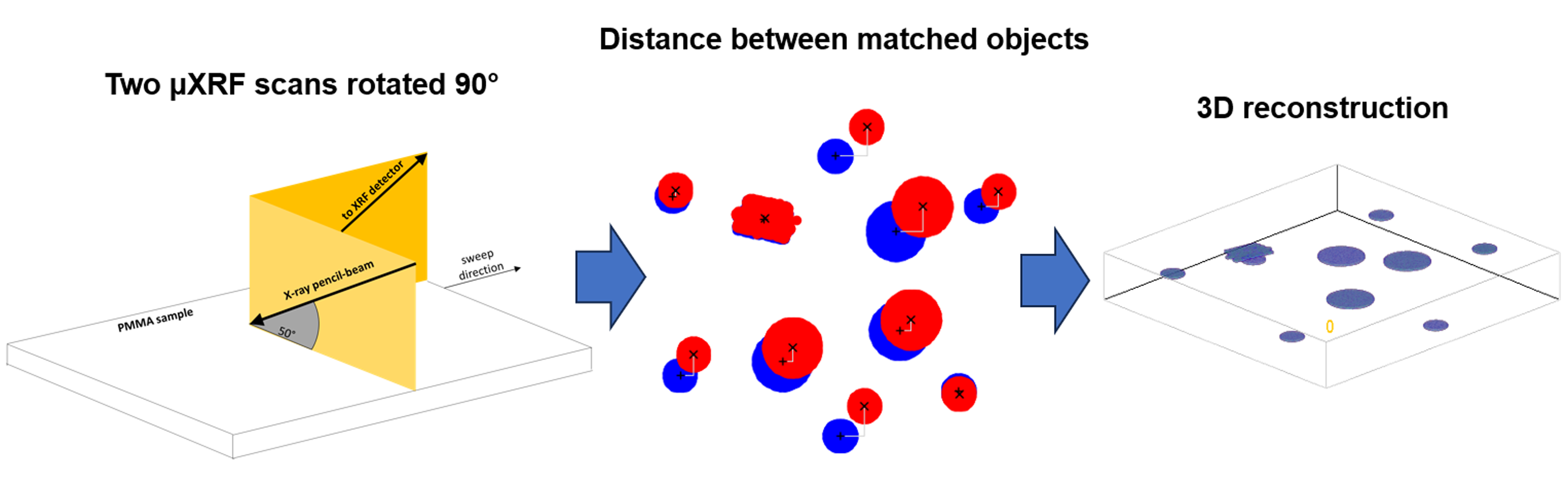
Keywords
Get full access to this article
View all access options for this article.
References
Supplementary Material
Please find the following supplemental material available below.
For Open Access articles published under a Creative Commons License, all supplemental material carries the same license as the article it is associated with.
For non-Open Access articles published, all supplemental material carries a non-exclusive license, and permission requests for re-use of supplemental material or any part of supplemental material shall be sent directly to the copyright owner as specified in the copyright notice associated with the article.

