



Abstract
While scholars have focused on exploring what predicts subjective career success (SCS), we built on conservation of resources theory to study SCS not only as the ultimate outcome but also as a resource for achieving further valued work outcomes. To this end, we analyzed the gain spiral between SCS, work engagement, and creativity (SCS → work engagement → creativity → SCS) in a four-wave longitudinal design (one-year intervals). Based on a sample of N = 1228 German academic scientists, we conducted a cross-lagged panel model analysis. As expected, SCS showed positive time-lagged effects on work engagement, and work engagement showed positive time-lagged effects on creativity. However, creativity showed no time-lagged effects on SCS. From a series of exploratory multigroup analyses, this pattern of results emerged as robust across sociodemographic and work-related variables. The results help to further our understanding of how SCS functions as a resource.
Introduction
In the context of self-directed careers (Briscoe et al., 2006; Hirschi & Koen, 2021) and uncertain career prospects (e.g., in academia, cf. Alisic & Wiese, 2020), subjective career success (SCS) is becoming increasingly important. SCS encompasses the individual perception of the own career and its progress (Turban & Dougherty, 1994). Concurrently, research on the resources that contribute to successful career development, based on theories such as the conservation of resources (COR) theory, is flourishing (Haenggli & Hirschi, 2020; Hobfoll et al., 2018). Combining these trends, recent studies have shifted their focus away from considering SCS as the sole ultimate career outcome to viewing SCS as a resource for further valuable career and work outcomes (see Spurk et al., 2019).
Although interest in SCS as a predictor of career and work outcomes has grown, an important but still emerging question is whether there are reciprocal causal relationships between SCS as a resource and its potential outcomes (e.g., Spurk & Abele, 2014). This is especially relevant from a career development perspective when considering positive constructs, which may depend on and also precede SCS, potentially creating a self-reinforcing cycle of increasing perceived career success over time. Career success typically unfolds over long-term periods (Spurk, 2021), yet theoretical models (e.g., social cognitive career theory; Lent et al., 1994) and empirical findings suggest that proximal, work-related behaviors such as high job performance can accumulate and contribute to long-term career development (Ng et al., 2005). Building on this, a promising approach to uncover positive reciprocal dynamics involving SCS is to connect the career and work domains (Halbesleben et al., 2014; Hall & Las Heras, 2010). These interconnected processes, where constructs mutually enhance one another over time, are described as gain spirals in COR theory (Hobfoll, 2001; Salanova et al., 2010). In the context of career development, individuals may invest their resources (SCS) in maintaining or improving their work performance, which, in turn, supports long-term career success (see Spurk et al., 2019; Van den Heuvel et al., 2020).
To date, behaviors such as work performance have primarily been studied as antecedents of SCS (Spurk et al., 2019). In this context, we aim to shed light on the positive reciprocal relationship of SCS and a vital facet of individual´s work performance: creative work performance (cf. Harari et al., 2016). Creative work performance encompasses creative behaviors and outcomes, for example, introducing new ideas into the work environment in a systematic way or generating original solutions for problems (Harari et al., 2016). We refer in the following to creative work performance when using creativity as a term. In light of the pivotal role of individual creativity in enhancing individual, team, and organizational outcomes (see Lua et al., 2023, for an overview), it is crucial to elucidate the reciprocal relationship between SCS and creativity, which has not been adequately addressed in previous studies (e.g., Chang & Chen, 2020; Fernández-Díaz et al., 2021).
In accordance with COR theory (Hobfoll et al., 2018), SCS may serve as both the origin (resource) and the outcome of a favorable dynamic involving creativity. However, it is also conceivable that other positive variables are included in this gain spiral process (compare Haenggli et al., 2021; Spurk & Abele, 2014). The positive effect from SCS as a resource might be transmitted by intrinsic motivation, for example, work engagement. Work engagement, as the fulfilling state of mind that is characterized by vigor, dedication and absorption (Schaufeli et al., 2006), is a typical mechanism for connecting personal resources with performance (Bakker & Demerouti, 2008; Hobfoll et al., 2018). Employees who perceive themselves as successful in their career life (SCS) may be further engaged in their work and express this engagement in the form of creativity. As creativity is a desirable work outcome, this could in turn have a reinforcing impact on further positive career self-evaluation (Chang & Chen, 2020). This suggests a potential indirect feedback loop that could positively impact an individual’s career trajectory and work results.
Based on COR theory, we aim to test the gain spiral involving SCS, work engagement and creativity among German academic scientists. We assume that SCS positively influences work engagement, which in turn enhances creativity, while creativity further strengthens SCS over time (SCS → work engagement → creativity → SCS). With our study, we contribute to the literature in several ways: the main contribution of this study is testing the causal relationships among SCS, work engagement, and creativity using a longitudinal design. Theoretically, we linked SCS to COR theory and empirically tested recent theoretical reflections about the role of SCS as a resource (Spurk et al., 2019). Additionally, our choice of study variables reflected an integrative approach to jointly investigate career- (SCS) and work-related (work engagement and creativity) constructs. Drawing on COR theory, this study conceptualizes the relationship between career and work variables as a reciprocal resource gain process (Halbesleben et al., 2014; Hall & Las Heras, 2010). By doing so, this study contributes to the understanding of dynamic, gain-spiral processes in career development by illustrating how SCS may reinforce itself through a gain spiral with positive work-related constructs (work engagement and creativity), thereby fostering long-term career development. Furthermore, we examined a set of potential sociodemographic (gender, university grade point average [GPA]) and work-related (PhD status, job tenure, and leadership status) moderating variables to shed exploratory light on the possible boundary conditions of the assumed gain spiral between SCS, work engagement, and creativity. Sociodemographic and work-related variables capture essential social and contextual distinctions between individuals that may impact career development (Spurk et al., 2019). Methodologically, we contribute by accounting for temporal succession over a four-year period with four measurement time points, since resource gains need time to establish (Hobfoll, 2001; Hobfoll et al., 2018).
The Context of Academia
Academia is often viewed as a prototype of self-directed careers (Baruch & Hall, 2004). Due to limited professorships and few long-term alternatives, SCS and fulfillment within the job become key success indicators for young researchers (Kauffeld et al., 2018; Zacher et al., 2019) and may predict career-related behaviors (Spurk & Abele, 2014). Academia is therefore a relevant context for studying career resources, especially SCS. Furthermore, the university environment is a fruitful setting for the generation of novel ideas (cf. Burk & Wiese, 2018; Vurgun, 2016). Hence, this sample is of particular importance regarding an understanding of the relationship between career development and creativity. Nevertheless, academics in Germany are suitable representatives of other high-potential individuals for any employer because they are typically employed as full-time staff and work under conditions similar to those of organizational employees (Zacher et al., 2019). While the proposed relationships may apply broadly, they are likely stronger in academia, where self-directedness and creativity are central. In contrast, careers shaped by structured paths and sponsored mobility—where support systems matter more—may show different patterns (Seibert et al., 2024).
Theoretical Background and Hypotheses Development
The Conservation of Resources (COR) theory (Hobfoll, 1989, 2001) is a motivational framework that explains human behavior through the evolutionary need to acquire, conserve, and invest resources in order to achieve goals (Halbesleben et al., 2014; Hobfoll et al., 2018). Resources are defined as anything perceived by the individual to help attain these goals (Halbesleben et al., 2014). In vocational behavior research, COR theory has been applied to understand career development and the attainment of favorable career outcomes. The underlying rationale is that possessing resources can substantially augment an individual’s ability to take the initiative, plan effectively, and respond successfully to the complexities of career management (e.g., Haenggli & Hirschi, 2020; Janssen et al., 2021).
A key premise of COR theory is the resource investment principle, which posits that individuals must invest resources to protect against resource loss, recover from losses, and gain resources (Hobfoll et al., 2018, p. 106). Halbesleben et al. (2014) describe the processes of resource investment as complex and driven by several psychological factors. As a result, it is challenging to predict whether these processes are useful for resource conservation or even for the gain of resources. Therefore, the investment of resources requires an appropriate temporal frame within which to evaluate the outcomes of such investment (Halbesleben et al., 2014). Both resource loss and gain have a spiraling nature. A gain spiral can be defined as an “amplifying loop in which cyclic relationships among constructs build on each other positively over time” (Salanova et al., 2010, p. 119). The development of resource gain spirals is typically gradual and weak (Hobfoll et al., 2018). However, gain cycles remain essential for individuals to counteract resource loss. In career development, which also unfolds over extended periods, builds incrementally, and often follows chains of positive events, gain spirals may offer a valuable lens for understanding long-term career progressions. Furthermore, it has been observed that resource gain spirals become particularly significant in contexts characterized by high stress, which is consistent with the academic career setting (Zacher et al., 2019).
Moreover, COR theory supports the notion that work- and career-related variables can be interconnected in a cyclic style (Halbesleben et al., 2014). Individuals typically have multiple work- and career-related goals in their working lives, which can be equally pursued by means of resource investment (multifinality; Kruglanski et al., 2013). In one’s career, this implies that individuals may direct their resources toward maintaining or enhancing their work performance (proximal goal; Van den Heuvel et al., 2020). The advancement of work performance, in turn, facilitates career development (distal goal; Spurk et al., 2019).
SCS as a Predictor of Work Engagement
The COR theory posits that personal resources are positive self-evaluations that are “linked to resiliency and refer to individuals’ sense of their ability to control and impact upon their environment successfully” (Xanthopoulou et al., 2007, pp. 123-124). Subjective career success (SCS) is defined as an individual’s self-assessment of their career progress. SCS, understood as self-perceived career success, encompasses the individual belief that one’s career advancement is under control, as evidenced by timely progress and comparison to significant others (Turban & Dougherty, 1994). Therefore, in addition to representing a favorable outcome in one’s professional sphere, SCS may serve as a comprehensive assessment of prior experience that integrates with an individual’s professional identity, in the sense of feeling capable of directing one’s career trajectory. It thereby becomes a personal resource that will positively influence future career and work outcomes (Spurk et al., 2019). Prior research has examined the notion of SCS as a resource, identifying its associations with various indicators of internal psychological functioning, such as occupational self-efficacy (Spurk & Abele, 2014), turnover intentions (Barthauer et al., 2020), and perceived employability (Bargsted et al., 2021). Among these indicators, work engagement stands out as a particularly critical aspect of psychological functioning in the workplace (Schaufeli et al., 2006).
Work engagement is defined as a positive, fulfilling, work-related state of mind characterized by vigor, dedication, and absorption (Schaufeli et al., 2006). Engaged employees possess the energy and enthusiasm necessary for high performance (Bakker & Demerouti, 2017) and can effectively adapt to their work environments (Van den Heuvel et al., 2020), which ultimately promotes career development and satisfaction (Jawahar & Liu, 2017; Ngo & Hui, 2018).
The COR theory postulates that employees will invest resources, which presumably entails engaging in behaviors that avoid resource losses and foster resource gain (Halbesleben et al., 2014). In this context, the function of work engagement is to reinforce the link between effort and performance level, thereby increasing intrinsic motivation and promoting goal alignment with values and interests (see Bakker & Van Wingerden, 2021 for similar reasoning). Therefore, personal resources directly impact work engagement, which functions as a mediator between resource and outcome. The perceived importance of the resource influences the individual’s motivation to engage in actions aimed at acquiring or preserving it.
This principle also applies to personal resources derived from the career domain. Research in career development has frequently positioned work engagement as a key mechanism linking career and work domains, demonstrating how career-related resources can enhance work engagement and, subsequently, lead to favorable outcomes. For instance, protean career orientation has been shown to positively influence work engagement (Ngo & Hui, 2018). Similarly, Lee et al. (2020) categorized career resources as a distinct group within a broader taxonomy of employee engagement predictors. Constructs like career planning, progression, adaptability, and identity have all been shown to enhance work engagement. These findings underscore the importance of career resources in fostering and maintaining engagement at work.
Under the assumption that SCS works as a personal resource (Spurk et al., 2019), a positive effect on work engagement should be evidenced. To our knowledge, no study has investigated work engagement as an outcome of SCS, despite a study of South African employees by Koekemoer et al. (2020), which showed that SCS was significantly positively related to work engagement (β = .52). However, the study is cross-sectional in nature and longitudinal evidence is lacking. In sum, by considering COR theory and the aforementioned findings, we expected a positive effect of SCS on work engagement:
Subjective career success has a positive effect on work engagement over time.
Work Engagement as a Predictor of Creativity
The concept of creativity has been defined in various ways (Amabile, 1983; Harari et al., 2016). While some scholars employ the delineation of innovation to define creativity as merely the generation of ideas (and define innovation as the implementation of those ideas), other definitions encompass creativity with the generation of novel and useful outcomes, including ideas, products, processes, practices, or solutions to problems (Amabile, 1983). In the present study, the term creativity is used to refer to creative work performance. This signifies that a more pragmatic or success-oriented definition of creativity is employed, which encompasses the outcome, for example, the creation of new procedures for work tasks (Tierney et al., 1999). Research on creativity has established that individual creativity is influenced not only by personal traits and situational factors but also by attitudinal factors like internal motivation (Amabile, 1983; van Knippenberg & Hirst, 2020). Drawing on the resource investment principle of COR theory (Hobfoll et al., 2018), creativity can be understood as an outcome of resource investment, where individuals allocate attention and focus—key components of work engagement. Accordingly, individuals who feel engaged due to their available resources are likely to channel this engagement into creativity at work. Support for a positive relationship between work engagement and creativity has been mostly found through cross-sectional studies (Bakker & Xanthopoulou, 2013), but studies with more than one measurement point have been conducted (e.g., Carmeli et al., 2013). Building on COR theory and the aforementioned empirical results, we expected to find positive relationships over time from work engagement to creativity:
Work engagement has a positive effect on creativity over time.
Creativity as a Predictor of SCS
Creativity, traditionally considered a form of extra-role performance (Demerouti et al., 2015), is increasingly recognized as a central component of adaptive performance (Pulakos et al., 2000). While much attention has been given to its role in fostering organizational innovation and growth in dynamic environments (Harari et al., 2016), creativity also benefits individual outcomes. Research has linked creativity to enhanced job performance, greater job satisfaction (Lua et al., 2023), and improved academic achievement (Gajda et al., 2017).
Given the gain spiral logic of COR theory connecting work and career domain (Halbesleben et al., 2014; Hall & Las Heras, 2010), advancements in work—such as generating ideas and solving problems—can foster career development (Spurk et al., 2019). It is therefore proposed that engaging in creative performance can be self-assessed as a valuable accomplishment. As a result, creativity may strengthen SCS as a resource by signaling to individuals that they can continue to manage their careers successfully through creative contributions.
Empirical research on the link between creativity and SCS has yielded mixed but generally supportive results. Chang and Chen (2020) showed that entrepreneurial creativity associated positively with SCS in Taiwan’s creative industries. In a general workforce sample, Kim et al. (2009) found a significant positive impact of creativity on newcomers’ career satisfaction (β = .41). In contrast, a recent study by Fernández-Díaz et al. (2021) showed no significant relationship between creativity and objective and subjective career success in a small but stratified sample with a wide age span. Notably, most studies are cross-sectional; an exception is Kim et al. (2009), who employed a longitudinal design with two measurement points. Taking together, existing research suggests that creativity may contribute to SCS, although the strength and nature of this relationship likely vary across contexts and populations. Furthermore, the limited availability of repeated-measures data highlights the need for longitudinal studies with multiple time points and sufficiently large samples to capture dynamic effects between creativity and SCS over time. Based on the above-mentioned theoretical assumptions and the empirical findings, we hypothesize that a positive effect of creativity on individual career development can be perceived and will, therefore, positively influence SCS over time.
Creativity has a positive effect on subjective career success over time.
Indirect Effects in a Gain Spiral
Hypotheses 1 to 3 propose direct relationships between two of the three variables within a gain spiral. We posit that SCS can function as both the starting and ending point of a gain spiral involving work engagement and creativity. Achieving a high level of SCS may act as feedback, signaling to individuals that they are progressing well and that their personal goals are attainable through engagement in creativity. In other words, SCS, the self-perception of I am successful, can serve as a motivational signal, encouraging individuals to invest in creativity (see Haenggli et al., 2021; Koekemoer et al., 2020 for similar perspectives). In turn, advancements in work—such as generating ideas and solving problems—can foster career development (Spurk et al., 2019). In essence, SCS indirectly enhances creativity through its relationship with work engagement and creativity influences SCS. Hence, for a comprehensive test of the postulated gain spiral, and as an extension of Hypotheses 1 to 3 we assume:
Within the gain spiral, there will be a serial indirect effect of present subjective career success on future subjective career success via work engagement and creativity.
This serial indirect effect hypothesis subsumes three separate indirect effect assumptions. First, SCS will indirectly affect creativity via work engagement. Second, work engagement will indirectly affect SCS via creativity. Third, creativity will indirectly affect work engagement via SCS. These three assumptions are in line with COR theory, which assumes the aforementioned gain spiral (Hobfoll et al., 2018; Salanova et al., 2010).
Exploratory Testing of Boundary Conditions for the Gain Spiral Between SCS, Work Engagement, and Creativity
SCS as well as work engagement and creativity are developed in sociocultural surroundings where individuals can be identified through a variety of sociodemographic and work-related differences. Sociodemographic and work-related variables do not just act as control variables, but rather, they determine individual between-person differences in career success (Ng & Feldman, 2014). This is in line with the principle of resource caravan passageways in COR theory (Hobfoll et al., 2018). The principle states that the environmental conditions in which individuals reside can either support or impede the creation and upkeep of resources that are available to them. These conditions are significantly influenced by organizations and the broader cultural context. Whether examining specific groups, such as women or those at different hierarchical levels, in terms of their resources, success, and productivity, or when considering these groups as a whole, the observed outcomes reflect the broader organizational and cultural context, including its structures, permissions, and support mechanisms.
Consequently, we considered the exploratory research question of whether sociodemographic and work-related differences may affect the assumed gain spiral between SCS, work engagement, and creativity. We included gender, university GPA, PhD status, job tenure, and leadership status as moderators; this was because these variables are linked to significant social and sociocultural categories, and therefore affect a varied structure of opportunities or obstacles in work domain that may weaken or reinforce the SCS, work engagement, and creativity relationship. If the gain spiral between SCS, work engagement, and creativity is robust across sociodemographic and work-related differences, this may point to the presence of “universal” processes (at least within academia). If such variables emerge as moderating conditions, this could indicate that between-person differences in social and occupational categories (e.g., gender, university GPA, and leadership status) shape the development of a gain spiral between positive career-related (SCS) and work-related (work engagement and creativity) outcomes over time. This leads to the following exploratory research question:
Exploratory Research Question: Do sociodemographic differences (gender, university GPA) and work-related differences (PhD status, job tenure, leadership status) serve as boundary conditions that affect the dynamic relationships between SCS, work engagement, and creativity?
Method
Sample and Procedure
The sample consisted of German academic scientists (PhD candidates and PhD holders), who took part in a time-lagged online survey as part of a funded research project. The project investigated different factors associated with the career development of young researchers. Therefore, the data presented in this article were part of a larger data collection effort, and other articles have been published using a different set of variables (a data transparency matrix has been provided to the editor).
For the present study, four measurement points were used from 2014 to 2017 (one-year intervals). Regarding the interval length, COR theory allows for the interpretation of the exact time gain spirals need to develop (Sonnentag & Meier, 2024). Hobfoll et al. (2018) provide only a vague indication that gain cycles are predicted to have less momentum (e.g., speed). Considering the specific sample conditions at hand, it is reasonable to take the different phases of the academic year into account. As the academic year differs in terms of tasks and focus (between lectures and lecture-free time), it is important to measure all constructs approximately at the same time point in the year. Consequently, we hypothesize that changes will be observed over a period of one year for direct effects and two years for indirect effects.
Initially, N = 1268 people completed the survey at Time 1 (T1) (46.92% men, 53.07% women; Mage = 33.37 years, SDage = 5.68 years), 902 participants at Time 2 (T2), 823 participants at Time (T3), and 701 participants at Time (T4). The final sample for the main analyses contained N = 1228 participants. Furthermore, we conducted a dropout analysis to test whether the study variables and central demographic characteristics predicted the dropout between T1 and T2. These results indicated that there was no causal relationship between the dropout and the studied variables.
The average grade for the variable highest university degree was 1.43 (SD = 0.39; the German system has grades 1 to 4, with 1 being the best). Within the sample, 56.29% had already finished their PhD at T1; at the last measurement point (T4), this was 83.12%. Regarding job tenure, the sample had worked an average of 6.19 years in the job of researcher (SD = 4.77 years), while at T1, 44.91% held a leadership position. The participants worked 43.96 hours a week on average (SD = 10.98 hours). Regarding the field of research, participants were divided almost equally among three categories: STEM (science, technology, engineering, and mathematics) fields accounted for 29.92% of the sample. Social and human sciences accounted for 38.17% of the sample and economics accounted for 31.91%.
Measures
We measured all the study variables on a six-point rating scale (with 1 = totally disagree and 6 = totally agree). We measured all the variables across four time points.
Subjective Career Success
To assess SCS, we used a four-item scale by Turban and Dougherty (1994) measuring perceived career success. The German version of the items was translated by the authors of this study. The items covered other-referent success evaluation and self-referent success evaluation (cf. Ng & Feldman, 2014). One item was a comparison judgment, in which participants compared their own career success with one from a reference group. We chose “colleagues” as significant others. The other items measured a subjective external assessment (“My close social environment ranks my career as successful”), a subjective overall assessment of their own career (“My career up to date was successful”), and a time-related self-assessment (“My career is on schedule considering my age”). In the original development, the scale had an internal consistency reliability of .87 (Turban & Dougherty, 1994). In this study, the average internal consistency reliability was ᾱ = .88.
Work Engagement
Work engagement was assessed using a German translation of the nine-item version of the Utrecht Work Engagement Scale (UWES-9; Schaufeli et al., 2006) that measures the three dimensions of work engagement: vigor (e.g. “At work, I feel like I am bursting with energy”), dedication (e.g. “I am enthusiastic about my job”), and absorption (e.g. “I am immersed in my work”). In this study, the scale had an average internal consistency reliability of ᾱ = .92.
Creativity
Creativity was assessed using a German translation of a nine-item scale by Tierney et al. (1999). The scale originally assessed supervisor-rated employee creativity. The items were rephrased by the authors to be used as a self-assessment. An example is “I develop new but feasible work-related ideas.” The average internal consistency reliability of the scale was ᾱ = .89 over all four measurement points in this study.
Moderation Variables
The grouping variables were gender (1 = male, 2 = female), grade point average of highest university degree (1 = grade < sample median, 2 = grade ≥ sample median), PhD status (1 = PhD candidate, 2 = PhD holder), job tenure (1 = tenure < sample median, 2 = tenure ≥ sample median), and being a leader (question: “Do you have professional authority over other employees? e.g., content management of a project”; 1 = no, 2 = yes). We decided to use a median split for some variables because multiple-group SEM (structural equation modeling) was the method of choice to test the moderation effects. We did not control for age because this variable was highly correlated with PhD status in our sample.
Control Variables
We also examined the moderation variables as controls in the overall model to investigate if the general hypotheses tests were robust even after controlling for the moderators. In this case, we did not use the median split but, if possible, used continuous variables. We further checked the total working hours (open answer).
Analytical Approach
Mplus version 8.4 (Muthén & Muthén, 1998-2017) was used to conduct confirmatory factor analyses (CFA). CFA was used to test for measurement invariance across measurement time points. Because the chi-square difference test is sensitive to sample size and violation of the normality assumption, alternative fit indices were used to assess model quality: that is, the comparative fit index (CFI), the Tucker–Lewis–Index (TLI), and the root mean square error of approximation (RMSEA). Changes of 0.01 in the CFI and TLI, and 0.015 in the RMSEA, were considered statistically significant and an indicator of noninvariance (Cheung & Rensvold, 2002).
To test our research hypotheses, we applied cross-lagged panel models (CLPMs, Zyphur et al., 2020) to our data. CLPMs investigate relationships using longitudinal data by modeling multiple waves so that associations between variables over time can be estimated simultaneously as predictors and outcomes. Unlike cross-sectional analyses, CLPMs control for the confounding influence among all variables, allowing specified cross-lagged paths to be interpreted, under certain assumptions, as causal effects, or as mediation in the case of at least three considered variables. Their flexible specification and modest data requirements make CLPMs attractive for longitudinal research. Our hypotheses focus on developmental resource processes between individuals (i.e., whether individuals with higher levels of construct X subsequently show higher levels of construct Y), which aligns with the between-person logic of COR theory and gain spirals. Because our constructs represent relatively stable career and work constructs measured across broad time intervals, and our questions do not involve short-term deviations from individuals’ trait levels, the CLPM is the most appropriate analytical approach. Robust maximum likelihood estimators (MLR) were used for all analyses. This estimator in Mplus applies full information maximum likelihood (FIML) to handle missing data under the missing at random assumption, thereby using all available observations and providing robust standard errors. In addition to the chi-square value, the goodness of model fit was also assessed using RMSEA, SRMR, TLI, and CFI. Values below .08 for RMSEA, below .10 for SRMR, and above .90 for CFI and TLI, indicated acceptable fit. Values below .06 for RMSEA, below .05 for SRMR, and above .95 for CFI, indicated a good fit between the hypothesized model and the observed data (Ximénez et al., 2022).
Finally, we conducted exploratory analyses to examine potential boundary conditions of our findings by comparing pairs of multigroup models. The sample was divided based on median splits for continuous variables and dichotomized categorical variables. The median grade point average (GPA) of the highest university degree was 1.3 (German grading system: 1 = best, 4 = worst), and the median job tenure was 5.08 years. Gender, PhD status, and leadership position were treated as dichotomous variables (male/female, PhD candidate/PhD holder, no leader/leader). To test for group differences, path coefficients were constrained to equality across groups in Mplus and evaluated using Wald tests.
Results
Descriptive Findings
Descriptive Statistics and Correlations Among Subjective Career Success, Work Engagement, and Creativity
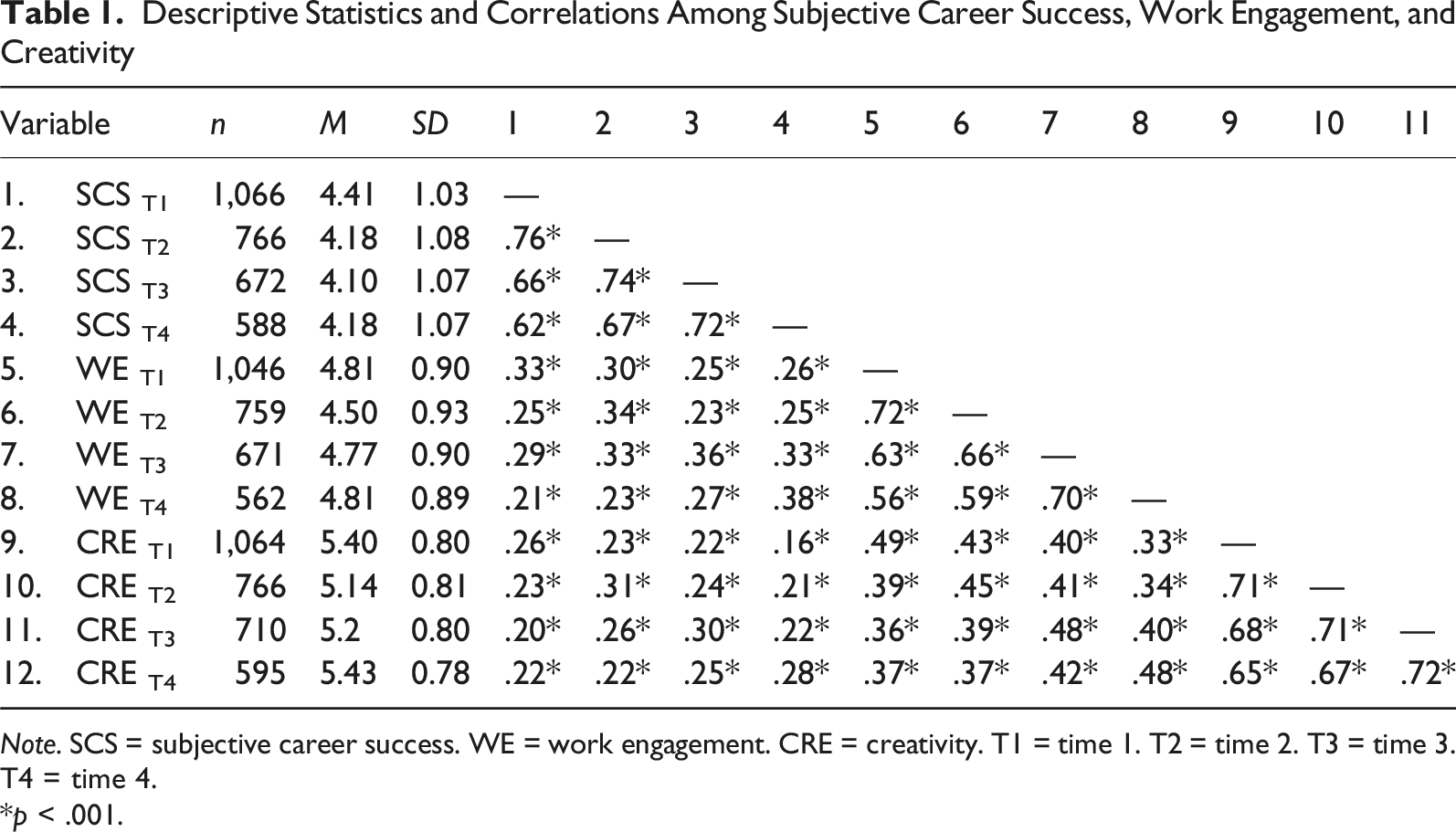
Note. SCS = subjective career success. WE = work engagement. CRE = creativity. T1 = time 1. T2 = time 2. T3 = time 3. T4 = time 4.
*p < .001.
Descriptive Statistics and Correlations Among Study Variables
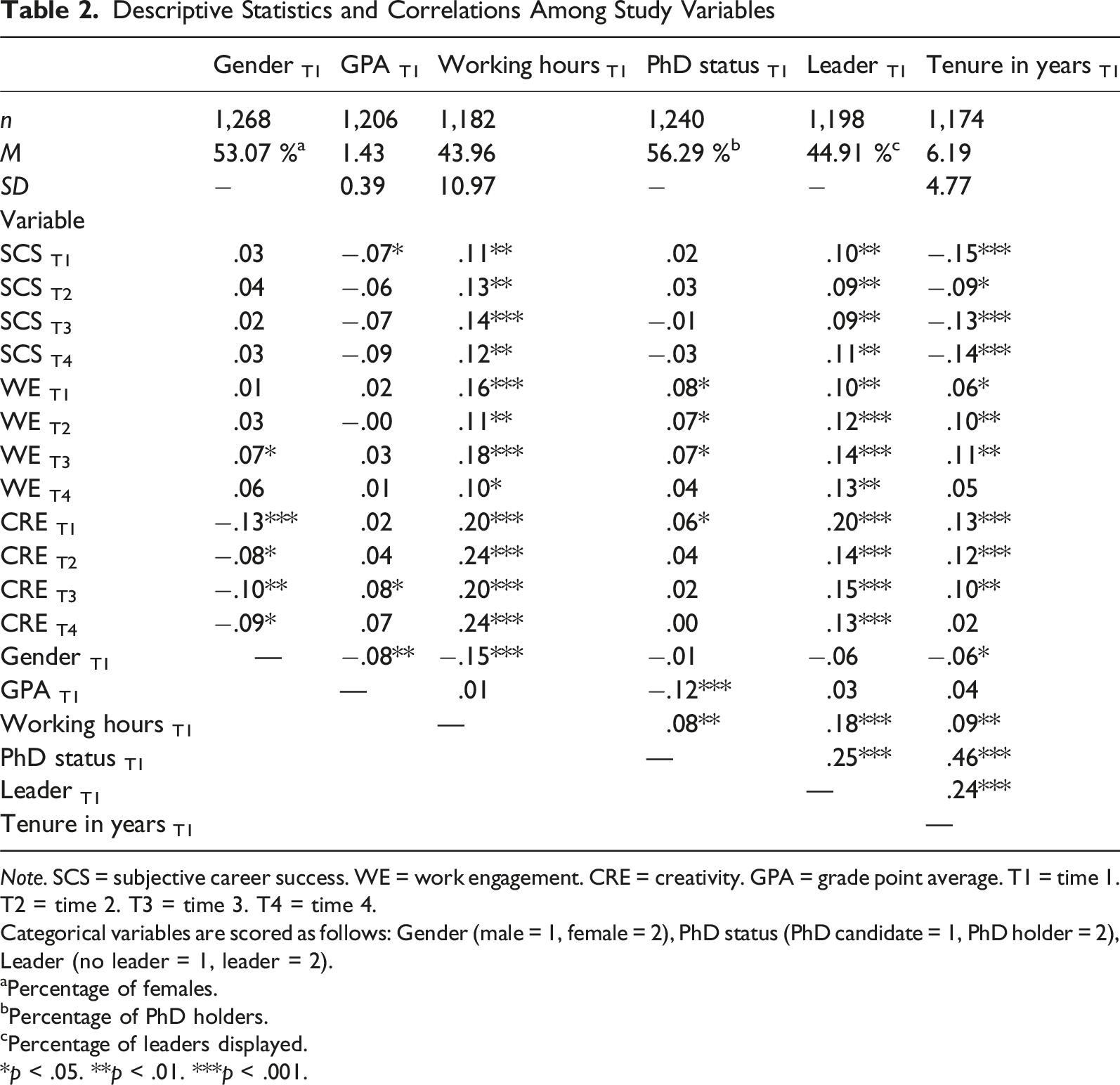
Note. SCS = subjective career success. WE = work engagement. CRE = creativity. GPA = grade point average. T1 = time 1. T2 = time 2. T3 = time 3. T4 = time 4.
Categorical variables are scored as follows: Gender (male = 1, female = 2), PhD status (PhD candidate = 1, PhD holder = 2), Leader (no leader = 1, leader = 2).
aPercentage of females.
bPercentage of PhD holders.
cPercentage of leaders displayed.
*p < .05. **p < .01. ***p < .001.
Measurement Invariance and Measurement Model
Summary of Measurement Invariance Test Results

Note. TLI = Tucker-Lewis index. CFI = comparative fit index. RMSEA = root mean square error of approximation. Δ symbolizes different scores between models.
Hypotheses Testing
Summary of model results: autoregressive, cross-lagged, and indirect paths

Note. Autoregressive and cross-lagged paths constrained to be equal from Time 1 to Time 4. Indirect effects were observable from Time 1 to Time 3 and from Time 2 to Time 4. SCS = Subjective career success. WE = Work engagement. CRE = Creativity.
*p < .05.

The Cross-Lagged Panel Model; Latent Variables are displayed. Note. N = 1228; RMSEA = 0.02; CFI = 0.96; TLI = 0.95; SRMR = 0.06. Directional arrows represent regressive paths. Bi-directional arrows represent correlations between the variables at the same timepoint. The small arrows, which appear in the top right of the latent variables, illustrate the standardized residual variances. The residual variance component is calculated as 1 minus the explained variance. For the sake of readability of the model, the non-significant crossed paths from creativity to subjective career success are omitted. *p < .05, **p < .01, ***p < .001
While for work engagement and creativity, the stabilities (autoregressive paths) ranged between .70 and .75, those for SCS ranged between .80 and .83. Since all the variables were used as outcomes in our model, the strong autoregressions indicated that small lagged effects were more likely to be expected (Orth et al., 2022). As expected, all lagged paths from SCS to subsequent work engagement reached significance (βs = .04 to .05, all p s < .05), thus supporting H1. That means that SCS had positive effects on work engagement over time (H1). Furthermore, all the lagged paths from work engagement to subsequent creativity reached significance (βs = .06, all p s < .01), supporting H2. Thus, work engagement had positive effects on creativity over time (H2). Against our expectations, all the lagged paths from creativity to subsequent SCS were not significant (βs = − .02, all p s = .33), so H3 was rejected. Creativity had no positive effects on SCS over time (H3). The explained variance across the four measurement waves was R 2 = 0.52 to 0.59 for work engagement and R 2 = 0.58 to 0.61 for creativity.
Tests of the proposed indirect effects are also embedded with the CLPM. Equality constraints on lagged paths imply identical indirect effects across adjacent wave pairs. As expected, SCS had significant indirect effects on creativity via work engagement over time (bsindirect = .002, p s = .04, 90% CI [.0001, .0038]). All the other involved indirect effects with one single intervening variable WE → CREA → SCS (bsindirect = −.001, p s = .18, 90% CI [−.0001, .0009]) and CREA → SCS → WE (bsindirect = −.001, p s = .18, 90% CI [−.0002, .0008]) did not reach a significance level of p < .10; thus, H4 was only partially supported. The unstandardized estimates for the hypothesized indirect effects are reported in Table 4. Finally, we estimated the model again controlling for gender, university GPA, PhD status, job tenure, leadership status, and total working hours at T1. The inclusion of these control variables did not change the overall pattern of results. Thus, the results were independent of the considered control variables.
Additional Analyses: Moderation Tests
Results of Moderation Analyses for Cross-Lagged Paths

Note. GPA = grade point average. Δβ = difference in cross-lagged coefficient between moderator groups (e.g., male vs. female). Δχ2 = difference in chi-square value between moderator groups.
aMedian grade point average = 1.3 (German grading system: 1 = best, 4 = worst).
bMedian job tenure = 5.08 years.
Discussion
The aim of this study was to examine whether SCS, work engagement, and creativity are dynamically related over time within a gain spiral (SCS → WE → CREA → SCS). Using a four-wave repeated-measures design with 12-month intervals, we tested this model while accounting for sociodemographic (gender, university GPA) and work-related (PhD status, job tenure, leadership status) factors among German academic scientists. First, the results confirm that SCS had positive time-lagged effects on work engagement. This suggests that SCS functions as a resource for further positive psychological processes (in our case work engagement). This supports reasoning that a high level of SCS provides feedback signaling progress toward personal goals and encourages continued effort (cf. Haenggli et al., 2021). Accordingly, our findings align with prior research showing that SCS positively influences internal processes like self-efficacy (Spurk & Abele, 2014). They also extend recent cross-sectional evidence by Koekemoer et al. (2020), confirming the positive link between SCS and work engagement. Second, we found that work engagement positively affected creativity over time, which aligns with prior findings (Bakker & Demerouti, 2017; Bakker & Xanthopoulou, 2013). More specifically, our findings indicate that motivation fosters creative performance in a sample of highly educated researchers, as it has in other sample groups (e.g., corporate employees: Carmeli et al., 2013; Demerouti et al., 2015). Third, we found no such time-lagged effects for creativity on SCS. Creativity is widely regarded as a valuable form of work behavior, particularly in academic settings (Burk & Wiese, 2018; Vurgun, 2016), and as an indicator of effective performance linked to career development across various occupational contexts (Chang & Chen, 2020; Kim et al., 2009). However, some studies report non-significant effects (Fernández-Díaz et al., 2021) or even suggest that creativity may be disadvantageous in certain organizational environments (Björklund et al., 2022; Dufour et al., 2020).
Hence, the non-significant effect of creativity on SCS may be explained by contextual factors not accounted for in this study. Creativity depends on organizational and cultural conditions, such as supervisor support and further contextual resource availability (Chang & Chen, 2020; Dufour et al., 2020). This explanation aligns with the career self-regulation framework (Hirschi & Koen, 2021) suggesting that context—not just human capital—matters for career success. In academia, contextual resources are often scarce, and early-career researchers face high insecurity and limited institutional support (Alisic & Wiese, 2020). Facing these conditions early career researchers may prioritize quick wins over creative exploration. High publication output is frequently seen as a prerequisite for academic advancement (Lutter & Schröder, 2016), potentially discouraging creative risk-taking despite its long-term value. This explanation may also apply to different organizational contexts. Early-career professionals often face an innovation paradox, where suggesting novel ideas can lead to social costs or negative evaluations, especially when lacking status, networks, or organizational experience (Björklund et al., 2022). This may weaken the relationship between creativity and perceived career success. At later career stages, with greater autonomy, creativity might play a stronger role for (perceived) career success, which is an aspect not captured in our current study.
Next, SCS had a positive indirect effect on creativity over time. This finding indicates that SCS functions not only as a resource for work engagement but also contributes to creativity. Accordingly, our result exemplifies how work engagement channels the energy from SCS, as a personal resource, into focused effort and dedication at work in the form of creativity (cf. Bakker & Demerouti, 2008). In contrast, all other indirect effects between the three model variables (work engagement via creativity on SCS; creativity via SCS on work engagement) were not significant. This suggests that creativity may not serve as a robust mediating mechanism in gain-spiral processes involving SCS and work engagement, possibly due to contextual constraints or the delayed manifestation of creativity’s benefits in career development. Finally, our findings were stable even after including several moderation variables (e.g., sociodemographic variables, holding a PhD or not, being a leader or not, and length of job tenure), suggesting that the identified relationships were not spuriously due to other variables that have been mentioned within prior research (cf. Alisic & Wiese, 2020; Spurk & Abele, 2014).
Theoretical Implications
Our study makes several contributions to the literature. First, in the context of self-directed careers (Briscoe et al., 2006; Hirschi & Koen, 2021) and uncertain career prospects (e.g., in academia; Alisic & Wiese, 2020), and drawing on Conservation of Resources (COR) theory, we support the view that subjective career success (SCS) functions as a personal resource that individuals seek to build, protect and invest (Bargsted et al., 2021; Haenggli et al., 2021; Janssen et al., 2021). Our findings contribute to the study of resource-based models on career development by showing that SCS can initiate further gains of valuable outcomes. Specifically, we extend previous research by identifying work engagement and creativity—two highly valued outcomes in today’s work environment—as consequences of SCS.
Second, this study advances theory by clarifying the directional relationships between career- and work-related constructs. COR theory highlights dynamic, reciprocal processes—such as gain spirals—between resources and outcomes across life, work, and career domains (e.g., Bargsted et al., 2021; Salanova et al., 2010). Building on this, we examined how SCS, as a career-related resource, might reinforce itself through a gain spiral with positive work-related constructs—specifically, work engagement and creativity—thus supporting long-term career development. Although we did not find evidence for a complete gain spiral spanning both domains, our results provide theoretical insight into how career-related resources like SCS positively influence work-related outcomes (Hall & Las Heras, 2010). Theoretical frameworks such as COR theory (Halbesleben et al., 2014) and social cognitive career theory (Lent et al., 1994) help explain the interrelation between career and work domains through the linkage of distal (career) and proximal (work) goals. Our findings add to this perspective by demonstrating that distal goals—such as striving for a satisfying career—can motivate proximal behaviors, such as creative work performance (e.g., generating research ideas or solving problems). In doing so, we contribute to a deeper understanding of the dynamic interplay between career development and work behavior, thereby extending COR theory’s notion of cross-domain resource investment (cf. Halbesleben et al., 2014). Third, we contribute to understanding the role of work engagement as a bridging mechanism between career and work outcomes. Drawing on the Job Demands-Resources Model (Bakker & Demerouti, 2017), which conceptualizes engagement as a pathway from personal resources to performance, we found that work engagement mediated the relationship between SCS and creativity over time (cf. Bakker & Van Wingerden, 2021; Xanthopoulou et al., 2007). To our knowledge, this is the first study to connect SCS as a career-related resource with creative performance as a desirable work outcome via work engagement. Finally, the four-wave longitudinal design allowed us to examine long-term processes and revealed that the effects occur over one-year (direct paths) to two-year (indirect paths) intervals. This implicates that utilizing personal resources by investing them into one’s work may be key to their long-term impact on work ability and performance (Hobfoll et al., 2018).
Practical Implications
Our findings indicate that perceiving one’s own career progress as successful (SCS) enhances work engagement and indirectly supports creativity over time. This has important practical implications: organizational practice, career programs, and counseling services should aim to promote positive self-reflections on career development and create conditions that enable employees to view their careers as successful. As a result, both organizations—including academic institutions—and individuals may benefit through increased motivation, reflected in higher engagement and creative performance (Bakker & Demerouti, 2008; Lua et al., 2023).
Based on our results, it may be beneficial for organizations to implement practices that support employees in recognizing and affirming their career progress. Strategies such as structured feedback, recognition rituals, and team-based reflection activities—such as “warm showers” (sessions focused on giving each other compliments)—can encourage employees to internalize their achievements and sustain motivation. Organizations (universities) can provide support by creating space and time for individual- and team-level reflections. Furthermore, they can offer organizational (university) programs and coachings. Career development programs provide a tangible opportunity to activate SCS as a personal resource. Embedding structured reflection exercises into these programs can support individuals in identifying sources of career satisfaction and transforming them into motivation for engaging in work behaviors that contribute to long-term career goal attainment. This approach is particularly valuable for early-career professionals, such as doctoral candidates, who often navigate multiple career paths while shaping their professional careers (Noppeney et al., 2021). From a counseling perspective, guided self-reflection on career progress and accomplishments can support clients in constructing coherent career narratives. A conceivable offer is coaching for career beginners (Ebner & Kauffeld, 2019). Career coaching supports reflection, planning concrete career steps, and building mastery (Spurk et al., 2015). These interventions may be particularly effective in resource-constrained settings like academia, where career advancement is often limited and motivation must be cultivated through alternative means (cf. Baruch & Hall, 2004).
Additionally, as our study revealed a non-significant effect of creativity on SCS, the role of context warrants attention in counseling and coaching. In early (academic) careers, creative work may not lead to immediate recognition or advancement. Counselors should therefore help clients critically assess when and how to pursue creative goals and how to strategically align them with organizational expectations.
Limitations and Future Research
This study has some limitations. First, although the longitudinal design helped counteract common method bias (Doty & Glick, 1998), using only self-report measures remains a limitation (Podsakoff et al., 2003). Using well-established self-report questionnaires for phenomena like SCS and work engagement is justified, as these psychological states are subjective and may not be accessible to other raters. For creativity, both self-ratings and observed ratings, such as those from supervisors, can be utilized (e.g., Demerouti et al., 2015). In our case, aligning all subjective variables was crucial to test whether individual perceptions of creativity affected their perceived career success.
Second, although we found support for positive time-lagged paths between SCS and work engagement, and between work engagement and creativity, as well as for the indirect path from SCS to creativity via work engagement, the non-experimental design prevents definitive causal claims. COR theory supports these directional assumptions (e.g., Haenggli & Hirschi, 2020), but contextual factors could still influence the observed effects (cf. Spurk, 2021). In the present study, creativity did not predict subsequent SCS, suggesting that contextual factors may play a crucial role. As Lua et al. (2023) emphasize, the effects of creativity can be either positive or negative, depending on the context. Job characteristics and the broader work environment should therefore be considered as potential influencing factors. While not exhaustive, we tested several moderators (e.g., gender, GPA, and PhD status), and results held consistently. Researchers are encouraged to closely examine the industry and occupational profiles of their employee samples when investigating the role of creativity.
Third, we investigated long-term developments over four years with a 12-month time lag. Yet, the optimal time span for gain spirals remains unclear (Sonnentag & Meier, 2024). However, more research is needed to reveal the real-time effects of the direct relationships. Future studies should assess whether our results remain stable or vary across shorter intervals—for example, days or weeks (Hobfoll et al., 2018; Spurk et al., 2019). Our study contributes a valuable long-term perspective, aligning with the idea that career success unfolds over extended periods (Spurk, 2021).
Conclusion
Vocational behavior research increasingly views SCS as a predictor of valuable career, work, and life outcomes. We added to this research by showing that over a four-year period (one-year intervals), SCS had positive lagged effects on work engagement, which in turn mediated the indirect effects of SCS on creativity. These effects persisted even after controlling for high stabilities and were independent of sociodemographic and work-related differences. Thus, our study contributes to theory by supporting SCS as a personal resource, advancing the set of studied outcomes of SCS to work engagement and creativity, and integrating career and work-related variables based on conservation of resources rationals (Halbesleben et al., 2014; Hobfoll, 1989, 2001).
Footnotes
Acknowledgments
We would like to thank the whole project team for their help in project work and data collection.

Ethical Considerations
This study was approved by the Ethics Committee of Faculty 2 TU Braunschweig (approval no. FV-2014-04) on February 24, 2014.
Funding
The authors disclosed receipt of the following financial support for the research, authorship, and/or publication of this article: This work was supported by a grant from the German Ministry of Education and Research (BMBF, Number: 16FWN005).
Declaration of Conflicting Interests
The authors declared no potential conflicts of interest with respect to the research, authorship, and/or publication of this article.
Data Availability Statement
Data will be made available on request.