



Abstract
The concept of ambivalence has received little attention within the field of vocational psychology. In this article, we distinguish between two types of ambivalence that may surface during the career counseling process: career decision ambivalence (i.e., ambivalence between career options) and career counseling change ambivalence (i.e., ambivalence about engaging in career counseling-related changes). Using a single case study design of a 3-session career counseling process over 2 months including a two-chair dialogue intervention, we examine how these two types of ambivalence occur and evolve. We use mixed method to analyze the case, including fine-grained coding of the sessions’ content, as well as pre-, post-, and follow-up measures. Results highlight career decision ambivalence and career counseling change ambivalence as distinct phenomena, occurring and evolving differently throughout the counseling sessions. The theoretical and practical implications of these findings are discussed.
Keywords
Introduction
In the current world of work where individuals are constantly exposed to endless yet uncertain career opportunities and information, the experience of ambivalence is a common thread in career paths (Kasperzack et al., 2014). Accordingly, a better understanding of clients’ career ambivalence is an important target for both research and career counseling interventions (Pittman, 2000). However, while the topic of ambivalence has been addressed in the wider field of psychology and management (see Rothman et al., 2017, for a review), it remains largely understudied in vocational psychology research—with only 12 studies on the subject we could locate over the last 20 years (Cardoso et al., 2014a, 2014b, 2016, 2019; Cardoso & Duarte, 2021; Kasperzack et al., 2014; Klonek et al., 2016; Li et al., 2022, 2023; Rochat & Rossier, 2016; Zheng et al., 2023; Zhou et al., 2020). This scholarship sheds light on two distinct types of career ambivalence that might occur throughout career counseling: (1) choosing between career options (i.e., career decision ambivalence) and (2) engaging in career counseling-related changes (i.e., career counseling change ambivalence).
Career Decision Ambivalence
Career decision ambivalence (or decisional ambivalence) denotes ambivalence between specific career options when making a career decision. It is defined as “the incidence of contradictory thoughts, feelings, and intentions [when] choosing a [career] path” (Kasperzack et al., 2014, p. 249). Career decision ambivalence is akin to Gati et al.’s (1996) concept of “internal conflicts” (i.e., conflicts within the individual such as incompatible preferences) that has been identified as one difficulty likely to impede the career decision-making process. Kasperzack et al. (2014) found that prior to applying to a postsecondary path, 30% of German high school graduates presented high levels of career decision ambivalence. More recently, a broader international study showed that career decision ambivalence (internal conflicts) was the fourth most prevalent type of reported career decision-making difficulties—after indecisiveness, lack of information about the career decision-making process, and lack of information about the options (Levin et al., 2020)—stressing the need for greater research efforts to understand this phenomenon.
Prior work has emphasized the maladaptive nature of career decision ambivalence, reporting negative associations with career decision-making self-efficacy (Kasperzack et al., 2014; Li et al., 2022, 2023), life satisfaction (Kasperzack et al., 2014), and career adaptability (Zheng et al., 2023; Zhou et al., 2020). Career decision ambivalence has also been rated as an extremely severe issue by career practitioners, who consider that it can result in a less than optimal career choice (Gati et al., 2010). This may be due to ambivalence reducing clients’ ability to decide, hence leading to a premature choice to quickly escape the distress and discomfort triggered by ambivalence (Rothman et al., 2017), as well as to the young age of the surveyed participants (M = 14.80, SD = 3.05) across these studies (Kasperzack et al., 2014; Li et al., 2022, 2023; Zheng et al., 2023; Zhou et al., 2020). In fact, the age of first career choices depends heavily on the school systems that are specific to each country (Germany and China in these cases). Additionally, two case studies observed the promising effects of specific interventions—a two-chair dialogue intervention (TCDI; Cardoso & Duarte, 2021) and motivational interviewing (MI; Rochat & Rossier, 2016)—to foster the resolution of career decision ambivalence during career counseling.
Career Counseling Change Ambivalence
In contrast to career decision ambivalence, career counseling change ambivalence denotes clients’ ambivalence regarding their engagement in career counseling-related change. Such changes represent clients’ objectives for attending counseling sessions, generally based on what they perceive as lacking and want to develop more in their lives. Examples include obtaining relevant career information, trusting their future career perspectives, and getting greater career goal clarity or career certainty (Toggweiler & Künzli, 2020). For example, Whiston and Rose (2015) highlighted that holding negative attitudes toward or negative expectations about the career counseling process might impede career clients’ commitment to participate in it. In contrast to career decision ambivalence, career counseling change ambivalence is not part of any existing typology of career decision-making difficulties (see Kulcsár et al., 2020) as it relates to the wider career counseling process (versus its decision-making aspect). Consistently, preliminary research on career counseling change ambivalence (Cardoso et al., 2014a, 2014b, 2016, 2019) is grounded in the concepts and methods of research on psychotherapeutic processes and outcomes.
In this context, ambivalence toward change is observed during counseling interventions in terms of clients oscillating between (a) adopting adaptive ways of feeling, thinking, and acting and (b) reverting to less adaptive forms of psychological functioning (Oliveira et al., 2016). This perspective further demonstrates that ambivalence is an inherent part of any change process, reflecting individuals’ inclination to maintain a sense of self-stability, especially when their established patterns of psychological functioning are being challenged by novel experiences through the career counseling process (Oliveira et al., 2016; Ribeiro et al., 2016). Several authors (Cardoso et al., 2014a, 2014b, 2016, 2019; Klonek et al., 2016) highlighted the presence of such counseling change ambivalence during career counseling interventions and supported the importance for career counselors to develop strategies to support clients presenting this issue. In fact, case studies in therapeutical contexts indicate that markers of increasing change ambivalence are negatively associated with the psychological interventions’ success (Ribeiro et al., 2016).
Purpose of the Present Study
While extant literature has investigated the respective occurrence and evolution of career decision ambivalence (Cardoso & Duarte, 2021; Rochat & Rossier, 2016) and of career counseling change ambivalence (Cardoso et al., 2014a, 2014b, 2016, 2019; Klonek et al., 2016) during career counseling sessions, it is incomplete in several ways. First, these two types of ambivalence were never studied jointly. In fact, the study of these two phenomena belongs to two distinct theoretical and research traditions. On the one hand, career decision ambivalence was mostly examined in the context of research on career indecision (Kasperzack et al., 2014; Li et al., 2022, 2023; Zheng et al., 2023; Zhou et al., 2020). On the other hand, career counseling change ambivalence was mainly studied through research on career counseling processes (Cardoso et al., 2014a, 2014b, 2016, 2019; Klonek et al., 2016). Notably, the two studies that investigated the impact of specific career interventions (i.e., the TCDI; Cardoso & Duarte, 2021; MI; Rochat & Rossier, 2016) for decreasing career decision ambivalence did not examine their effects on career counseling change ambivalence. Conversely, studies about career counseling change ambivalence during career counseling sessions (Cardoso et al., 2014a, 2014b, 2016, 2019; Klonek et al., 2016) did not assess its relationship with career decision ambivalence. Such fragmentation is unfortunate because it clouds how these phenomena are “potentially reciprocally and dynamically related” (Spurk, 2021, p. 4) throughout the career counseling process.
Second, and relatedly, previous studies lack a reliable way to assess career decision ambivalence within career counseling sessions. While Klonek et al. (2016) used the Motivational Interviewing Skills Code 2.1 (MISC 2.1; Miller et al., 2008) to assess career counseling change ambivalence, Rochat and Rossier (2016) emphasized that such an instrument should be further adapted to study career decision ambivalence. The lack of a relevant instrument to assess career decision ambivalence throughout career counseling sessions makes it difficult to provide meaningful comparisons between career decision and career counseling change ambivalences.
The current paper seeks to address these limitations. To do so, we investigate the joint occurrence and evolution of these two types of ambivalence throughout an in-depth case study of a career counseling process. Addressing Rochat and Rossier’s (2016) call, we adapted the MISC 2.1 (Miller et al., 2008) to obtain comparable, yet distinct, measures of career decision and career counseling change ambivalences. Given the explorative nature of such adaptation and the scarce research on both career decision and career counseling change ambivalences in career counseling sessions, we rely on a case study design (Stead et al., 2012). This method is also consistent with calls for research focusing on intraindividual variation and change in response to specific psychological interventions, over classical statistical methods implemented on large samples (e.g., Lundh & Falkenström, 2019). This study thus allows us to expand prior knowledge by providing a means to assess career decision ambivalence and showing the specific features and the relationships of career decision and career counseling change ambivalence during a career counseling intervention.
Theoretical Background and Hypotheses
In the literature, there is currently no theoretical framework that was suggested to encompass both career decision and career counseling change ambivalences. Accordingly, we rely on the broader psychology literature on change ambivalence (e.g., Miller & Rollnick, 2012) and goal conflicts (Kung & Scholer, 2021), to further hypothesize about the forms and evolution of career change and career decision ambivalences.
Forms of Career Decision and Career Counseling Change Ambivalences
Miller and Rollnick (2012) suggest that ambivalence can take four distinct forms: (1) “avoidance-avoidance” conflicts (where individuals must choose between two or several options that are just as repulsive to them); (2) “attraction-attraction” conflicts (when individuals are similarly attracted by two or more options); (3) “attraction-avoidance” conflicts (where the only reckoned option presents both positive and negative aspects); and (4) “double attraction-avoidance” conflicts (where individuals must choose between two or more alternatives that all include both positive and negative aspects). Given its characteristic of a single goal being considered (i.e., making a career change) that holds both advantages and disadvantages (Ribeiro et al., 2016), we argue that career counseling change ambivalence will be characterized by “attraction-avoidance” conflicts. In contrast, following Gati et al. (1996), we propose that career decision ambivalence may encompass a wider range of forms such as “attraction-attraction” (i.e., all career options are perceived as interesting), “avoidance-avoidance” (i.e., none of the career options seems interesting), “attraction-avoidance” (i.e., certain aspects of a single considered option are perceived as adequate but not others), and “double attraction-avoidance” conflicts (i.e., all considered career options present both advantages and disadvantages).
Career counseling change ambivalence occurs as attraction-avoidance conflict, while career decision ambivalence may occur as attraction-attraction, avoidance-avoidance, attraction-avoidance, or double attraction-avoidance conflicts.
Evolution of Career Decision and Career Counseling Change Ambivalences
Prior research on the interaction of multiple goals conflicts shows that the optimal choice of lower-level goals may contribute to the resolution of goal conflicts at a higher level (Kung & Scholer, 2021). This is notably the case when individuals can identify multifinal means—that is, paths that “advance all of the active goals at once” (Köpetz et al., 2011, p. 810). As career counseling change ambivalence concerns the broader career counseling process (i.e., higher-level conflict), while career decision ambivalence is focused on the career decision-making process, which is a part of the career counseling process (i.e., lower-level conflict), this may imply that solving career decision ambivalence (i.e., choosing a career option) may help foster the resolution of career counseling change ambivalence. Accordingly, we hypothesize that an intervention targeting career decision ambivalence may have a positive impact on career counseling change ambivalence.
An intervention targeting career decision ambivalence contributes to solving clients’ career counseling change ambivalence.
Method
Participants
Client
Joana (a pseudonym), a 17-year-old Portuguese woman in her senior year of high school, sought career counseling because she was unsure about the higher education path to pursue. In Portugal, where this study was conducted, students must enter a specific academic major immediately after finishing high school. Accordingly, Joana’s career situation was like those of many adolescents at the end of high school in this country, which favored the external validity in the study. Joana was chosen for this case study because she was highly ambivalent about which career path to pursue, and because she agreed to try the two-chair dialogue intervention (TCDI) to explore her ambivalence.
Counselor
The counselor is the third author of this paper, a Portuguese male, Associate Professor and researcher in the field of Vocational Psychology, with more than 30 years of experience as a career counselor. He developed his skills on the TCDI during 4 years of post-graduate studies at the Portuguese Association of Cognitive-Behavior Therapy.
Intervention and Procedure
Recruitment and Data Collection
Joana sought career counseling in a private practice setting, where she was invited to participate in a study on a voluntary basis. Information about the study’s goals, audio recording of the sessions, anonymity, and confidentiality was provided. Once the client and her parents signed the consent form, the career counseling sessions started. To warrant the internal validity in the study, all sessions were audio-recorded and transcribed verbatim by two research assistants. This transcription was read by the client to verify that anonymity was guaranteed and to ensure testimonial validity. As the third author of this paper was Joana’s counselor in this case, he was not involved in the coding process or in the data analysis.
Career Counseling Process
The career counseling process involved three face-to-face sessions. At the beginning of the first session (S1), Joana’s demand was to take tests to gain clarity about her upcoming educational choices in college. She defined her career problem as always having planned to go to medical school, but now wanting to explore other options. Eventually, she agreed with the counselor that discussing would be a better way to clarify her ideas than taking psychometric tests. Then, the origins of her project to attend medical school were reviewed. This exploration facilitated the emergence of her work values (helping people, making a difference), personal characteristics (e.g., being adaptable, loving to learn), interests (scientific class and arts), dislikes (literature and economics), capabilities (outstanding grades in every discipline), family members’ occupations (real estate and engineering), as well as envisioned career alternatives (architecture). The first session was concluded by a reformulation of Joana’s career decision difficulty as ambivalence between her “scientific side” and her “artistic side,” that is, a dilemma between pursuing medical school versus an architecture major.
The second session (S2) took place 1 week after the first one and started with Joana recalling the distinction that was established in the previous session between her two conflicting sides related to two distinct majors. The counselor then explained to her the goal of the TCDI (i.e., identifying two conflicting self-positions that are each represented by a different chair, and to engage in a dialogue between these by switching seats at each of the positions’ “speaking turn”; Greenberg et al., 1993) before proceeding with the exercise. Joana was thus invited to engage in a dialogue between her two conflicting self-positions. The first self-position (“Theoretical Joana”; TJ) corresponded to her intellectual side and the second (“Expressive Joana”; EJ) was relative to her creative facet. The dialogue unfolded along five speaking turns from one position to the other. During the first speaking turn, TJ evoked her long-term fascination for medicine and the efforts she invested in obtaining the required grades to be admitted in medical school. In the second speaking turn, EJ expressed her interest and family influences in favor of architecture, its room for creativity, and lower pressure major compared to medical school.
In a third speaking turn, TJ replied by saying that being a physician was a more secure profession, allowed helping people, and included possibilities for self-expression (i.e., on how she would approach the cases). In the fourth speaking turn, EJ responded that with pursuing architecture, her work would be a part of her life but not her entire life, while becoming a physician would require her to be fully dedicated to her work and no longer have time for herself. In the fifth speaking turn, TJ replied that she loved reasonable pressure and barriers and advocated on the possibility of going to medical school while keeping arts as a nonwork, side project. As she had had the time to explore sufficiently, the counselor stopped the exercise and summarized what Joana had expressed throughout the entire intervention. At the end of this TCDI session, Joana expressed still being confused about her career choice, but at least understanding why. She committed herself to explore career alternatives that would allow her to reconcile her conflicting sides. Eventually, she agreed to another meeting 2 months later, which would give her enough time to prepare for her final exams while exploring further possible career options.
The third session (S3) occurred 2 months later and started with Joana detailing the career exploration activities she conducted in the meantime (searching for online information, watching movies, discussing with professionals, and thinking about her decision). These activities helped her clarify that she identified more with the field of medicine and could keep her artsy side for her nonwork projects or hobbies. Joana also admitted that she was afraid of not being admitted in medical school due to its high competitiveness, which she posited as being the trigger of her initial career confusion. Eventually, she mentioned that the career counseling process helped her to know herself better and motivated her to collect more career information.
Coding Process
Content of the three sessions was fully transcribed on Word. The first author sequenced the transcripts into statements, and then the first and second authors independently coded these statements with the MISC 2.1. Both coders are white female Assistant Professors in the field of Vocational Psychology who have been extensively trained on the use of the MISC 2.1. Notably, they participated in previous research projects involving coding counseling interviews with this method (e.g., Daeppen et al., 2011; Gaume et al., 2013, 2014; Rochat, 2019; Rochat & Rossier, 2016). After coding the sessions, the inter-agreement reliability was calculated.
Instruments
We used the MISC 2.1 to analyze the content of the three career counseling sessions, as well as an online questionnaire to collect quantitative data on career decision-making difficulties at three moments: 2 days before the beginning of the career counseling process (T1), directly after the last session (T2), and 3 months after the last session (T3).
Motivational Interviewing Skills Code 2.1 (MISC 2.1; Miller et al., 2008)
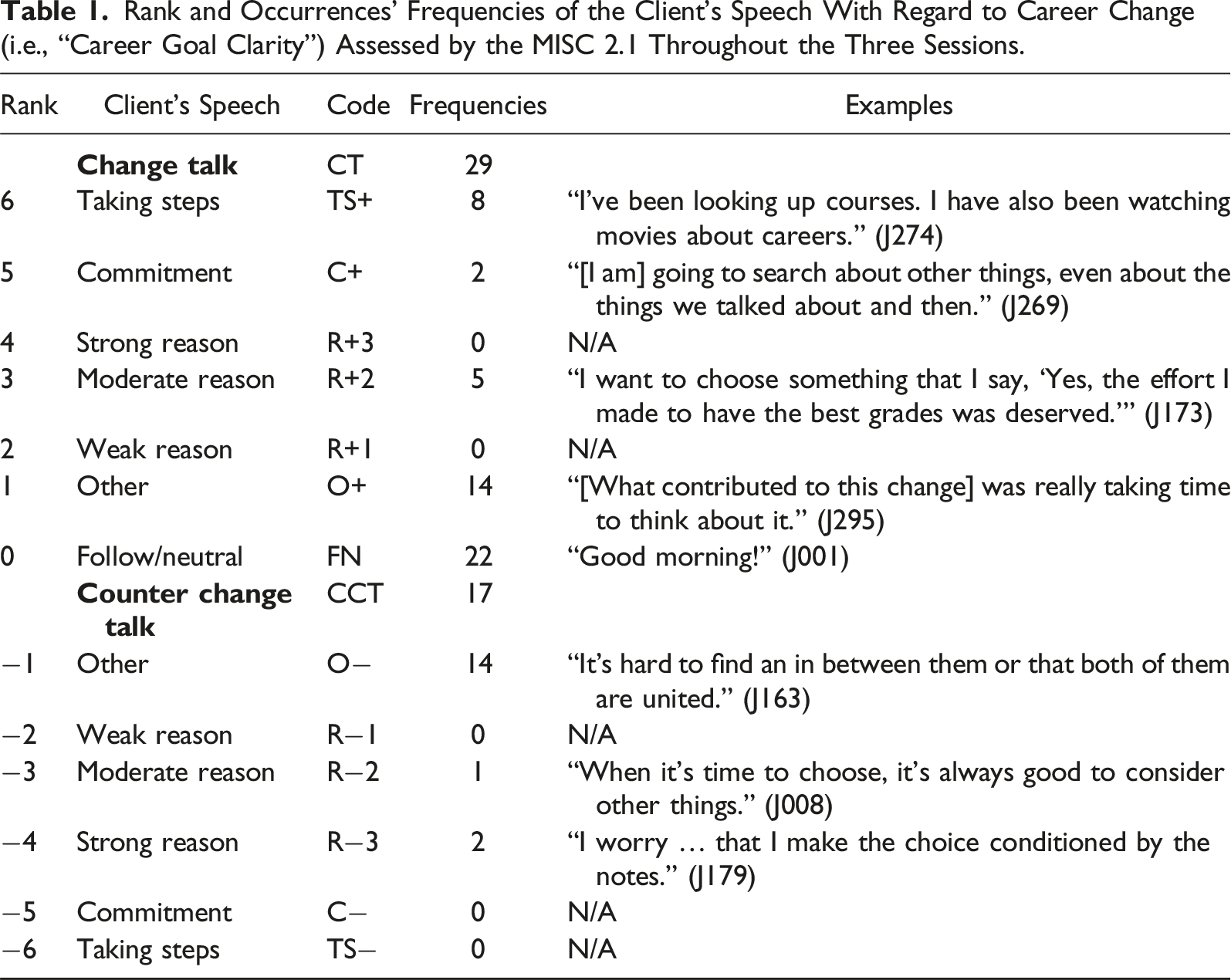
Rank and Occurrences’ Frequencies of the Client’s Speech With Regard to Career Change (i.e., “Career Goal Clarity”) Assessed by the MISC 2.1 Throughout the Three Sessions.
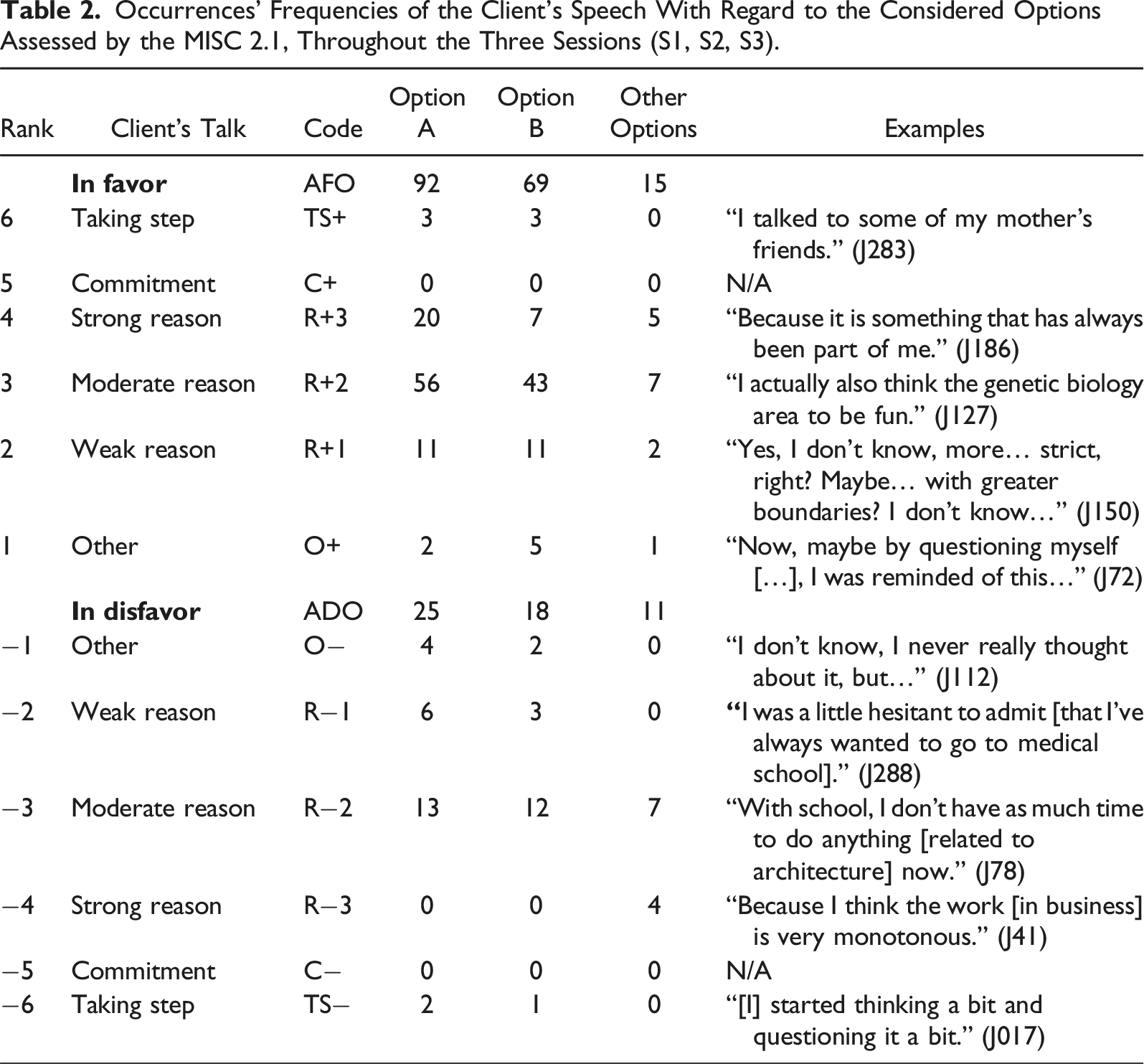
Occurrences’ Frequencies of the Client’s Speech With Regard to the Considered Options Assessed by the MISC 2.1, Throughout the Three Sessions (S1, S2, S3).
Career Decision Making Difficulties Questionnaire (CDDQ; Gati et al., 1996)
The Portuguese version (Silva & Ramos, 2008) of the CDDQ was used as an outcome measure to assess Joana’s career decision-making difficulties. The questionnaire contains 34 items, including two validity items, rated on a 9-point Likert-type scale ranging from 1 (does not apply to me) to 9 (fully applies to me), with higher scores suggesting greater difficulties. The CDDQ allows computing 10 scores corresponding to the types of career decision-making difficulties; three related to higher-order categories (i.e., Lack of motivation, Lack of information, and Inconsistent information); and one total score of indecision. The Portuguese version of the CDDQ revealed good internal consistency for the total score (Cronbach’s α = .93), and weak to good consistency for the three categories, namely, Lack of readiness (α = .64), Lack of information (α = .92), and Inconsistent information (α = .93). The questionnaire also revealed good indicators of convergent and concurrent validity (Silva & Ramos, 2008).
Analysis
Inter-Rater Reliability
Cohen’s kappa was used to assess the inter-rater agreement reliability between the two coders. In line with Landis and Koch’s (1977) benchmarks, inter-rater reliabilities were moderate without considering the strength of the reasons (κ = .47), or fair (κ = .25) when considering it. Both coders then agreed on a final consensus version for the three sessions coding, including the strengths of the reasons, which was used to pursue the analysis.
Analytical Strategy
To test Hypothesis 1 concerning the different forms of career decision and career counseling change ambivalences, we computed a composite measure (r-index) based on the MISC 2.1 coding to determine the degree of the client’s career change and career decision ambivalences during the sessions (see Klonek et al., 2016). Positive r-index values indicate that greater attraction (i.e., talk in favor of change/option) was present than avoidance (i.e., talk in disfavor of change/option) throughout the session, with negative values referring to the opposite situation. A value around zero denotes “attraction-avoidance” conflicts. Following the expansion of the MISC 2.1 coding, we specified that when options are considered, the presence of positive r-index values for two or more options indicates “attraction-attraction” conflicts. In contrast, negative r-index values for two or more options denote “avoidance-avoidance” conflicts. Eventually, two or more r-index values around zero indicate “double attraction-avoidance” conflicts.
To test Hypothesis 2 regarding the evolution of career decision and career counseling change ambivalences during the career counseling process, we plotted the occurrences of the client’s talk throughout the sessions (see Figure 1). Following Rochat and Rossier (2016), client talks about change and options were ranked on a continuum ranging from −6 (talk highly in disfavor of change/option) to 6 (talk highly in favor of change/option) with FN talk as the baseline (0), as reported in the first column of Table 1 and Table 2. Graphical Representations of Client’s Ambivalences Evolution Throughout the Three Sessions.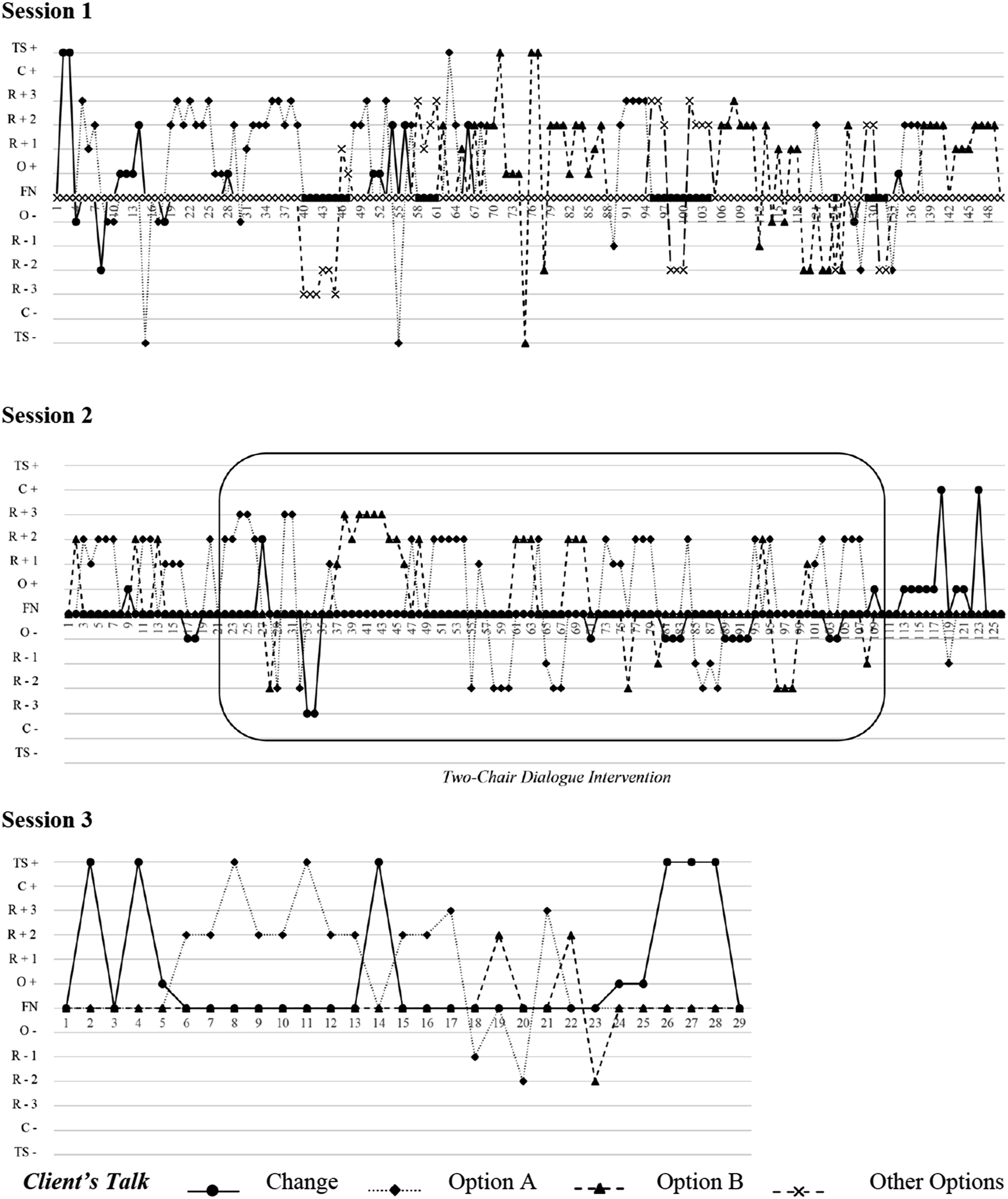
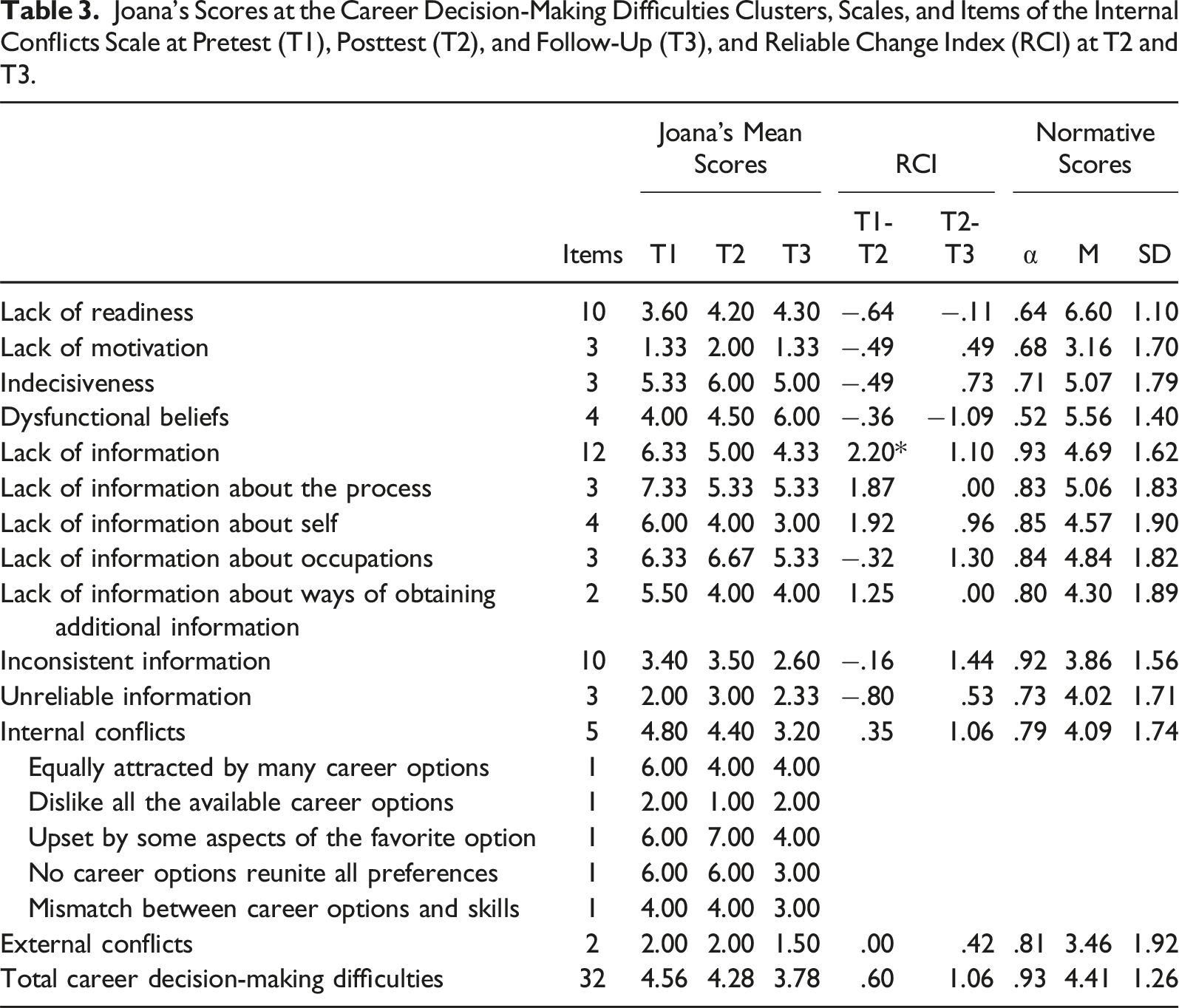
Joana’s Scores at the Career Decision-Making Difficulties Clusters, Scales, and Items of the Internal Conflicts Scale at Pretest (T1), Posttest (T2), and Follow-Up (T3), and Reliable Change Index (RCI) at T2 and T3.
Results
Forms of Career Decision and Career Counseling Change Ambivalences
During the first session (S1), Joana alternatively explored positive and negative sides of several career options (Option A = medical school; Option B = architecture; and Other Options = physics and chemistry, general investigative work, and business). The r-index scores of this session indicate that she mostly mentioned advantages of such options (r Option A = 33; r Option B = 31; r Other Options = 4). Moreover, career counseling change ambivalence was also present, as shown by the presence of both CT and CCT (r-index = 5). During the second session (S2), the r-index of career decision ambivalence indicates that Joana mainly argued in favor of Option A (r = 26) and Option B (r = 17), while the other options were not discussed anymore. Additionally, the r-index of career counseling change ambivalence highlights that she principally expressed CCT (r = −2.00) throughout this session. Finally, during the third session (S3), career decision ambivalence was still present, as demonstrated by the presence of both arguments in disfavor of option A (r-index = 10.00) and in favor of option B (r-index = 1.00). About career counseling change ambivalence, all of Joana’s statements were CT (i.e., no occurrence of CCT; r-index = 9.00).
Hence, Joana’s career decision ambivalence resembles more as an “attraction-attraction” conflict, showing similar attraction for options A and B (i.e., r-index is positive and far from zero throughout the three sessions). In contrast, her career counseling change ambivalence is akin to an “attraction-avoidance” conflict, as she perceived her targeted career change of “gaining career goal clarity” as presenting both positive and negative aspects (i.e., r-index alternates between attraction and avoidance during the three sessions). Hypothesis 1 is thus supported in this case—showing support for career decision ambivalence occurring as attraction-attraction conflict and for career counseling change ambivalence as attraction-avoidance conflict.
Evolution of Career Decision and Career Counseling Change Ambivalences
Figure 1 illustrates the evolution of Joana’s career ambivalences throughout the three career counseling sessions. Overall, Joana’s talk throughout the career counseling sessions shows that her career decision and career counseling change ambivalences evolved differently, and at a different pace, throughout the career counseling process. Career decision and career counseling change ambivalences occur at different moments of the career counseling process (i.e., respectively at the beginning and the end of the sessions for the former, and in the middle of them for the latter). More precisely, the analysis of S2 showed that the TCDI helped decrease career counseling change ambivalence, which supports Hypothesis 2 in this specific case. Interestingly, even though the TCDI targeted career decision ambivalence, it did not solve it—as demonstrated both by the remaining arguments in favor and in disfavor of options A and B until the end of S3.
This consideration is further confirmed by Joana’s scores at the CDDQ’s internal conflicts scale. In fact, Table 3 portrays Joana’s results at CDDQ as well as the significance of the changes (RCI) between T1 (i.e., before S1), T2 (i.e., just after S3), and T3 (3 months after S3). At T1, Joana’s scores highlighted Lack of Information as her core decision-making difficulty. Additionally, Joana’s displayed noticeable indecisiveness. In terms of Inconsistent Information, her mean level of internal conflict was considered low, though a deeper analysis conducted at the item level reveals that Joana rated three of the five items of the scale at six out of nine. At T2, Joana reported a significant decrease in her general level of Lack of Information from pretest to posttest (RCI = 2.20). No significant differences were found between T2 and T3.
Discussion
This pilot study aimed at exploring the forms and evolution of career decision and career counseling change ambivalences throughout an entire career counseling process. We analyzed Joana’s case with an adapted version of the MISC 2.1 to distinguish her talk related to career options (career decision ambivalence) from that related to change (career counseling change ambivalence). We found that career decision and career counseling change ambivalences differ in terms of their form (i.e., attraction-avoidance versus attraction-attraction goal conflicts). Moreover, the results showed that both ambivalences evolved in a distinct manner throughout the career counseling process.
Conceptual Implications
The first contribution of this paper is to clarify the differences between career decision ambivalence and career counseling change ambivalence. The literature review helped distinguish ambivalence that concerns the engagement in the career counseling process (i.e., career counseling change ambivalence) from the ambivalence that is specifically related to the decision-making part of it (i.e., career decision ambivalence). Additionally, the case study provided an illustration of the fact that although career counseling change ambivalence is best described by an attraction-avoidance conflict, career decision ambivalence can take other forms, such as attraction-attraction conflicts. The in-depth exploration of the process allowed by the case study design also shows that these two processes can occur in distinct times in the career counseling process (i.e., mostly in the beginning and in the end of the sessions for the career counseling change ambivalence versus in the middle of them for the career decision ambivalence), thus pleading in favor of their distinct nature. This is further evidenced by their distinct response to the TCDI, as this intervention helped solve career counseling change ambivalence but not career decision ambivalence.
Second, this paper nuances prior conceptualization of career decision-making ambivalence as a maladaptive process ultimately impeding the career decision-making process (Kasperzack et al., 2014; Li et al., 2022, 2023; Zheng et al., 2023; Zhou et al., 2020). In the case of Joana, markers of career decision ambivalence (i.e., her arguments for and against Options A and B, and scores at the CDDQ) still occurred at the end of the career counseling process, even though a career decision was made. This apparent inconsistency may be explained by the fact that Joana’s decision was not unilateral but balanced (i.e., choosing to go to medical school while keeping arts and architecture as nonwork side projects). In line with literature in the broader field of psychology suggesting that ambivalence may generate fortunate consequences (e.g., amplified creativity and open-mindedness; see Rothman et al., 2017), we expand the career-specific ambivalence literature by showing that career decision ambivalence is not necessarily maladaptive but can foster the discovery of creative and nuanced decisions that can be implemented in both one’s work and nonwork lives.
Finally, the third contribution of this study to the literature is the demonstration of the feasibility of adapting the MISC 2.1 to assess simultaneously career decision and career counseling change ambivalences. In fact, this tool was originally developed to assess change ambivalence in psychotherapy sessions (Miller et al., 2008). Its application to assess change ambivalence in career counseling, however, has been delicate due to the need to delineate change from the status quo (Klonek et al., 2016; Rochat & Rossier, 2016). An additional issue is that the binary distinction required by the tool does not allow coding more than two career options. Hence, Rochat and Rossier (2016) concluded that the MISC 2.1 would benefit from being adapted to account for clients’ ambivalence toward several career options. Expanding this literature, we demonstrated the feasibility and relevance of such adaptation to account for the occurrence and evolution of career decision ambivalence throughout the career counseling process.
Practical Implications
The major practical implication of our study is the demonstration that the TCDI is a useful intervention to help solve the client’s career counseling change ambivalence. Through the process, the participant was able to adopt adaptive changes in her ways of feeling (i.e., confidence and excitement), thinking (i.e., clarity), and acting (i.e., exploration and choice) regarding career counseling change, without reverting to less adaptive reactions (i.e., worry, confusion, and wavering). This finding endorses Cardoso and Duarte’s (2021) claim about the overall relevance of integrating the TCDI into career counseling. We show that assisting clients in discriminating the different facets of a conflict may foster self-acceptance and the integration of opposing self-positions (Greenberg et al., 1993). In doing so, we add concrete evidence to prior suggestions originating from the broader field of psychology (Rothman et al., 2017) and from career counseling (Pittman, 2000) which stressed that career counselors would benefit from encouraging individuals to embrace their ambivalence instead of trying to suppress it. Our results also indicate that although the TCDI may not help solve career decision ambivalence, it could be useful to foster clients’ self-knowledge. Accordingly, career practitioners may also use it to foster that purpose.
Additionally, in the present study, Joana did not display high levels of internal conflicts at the scale level of the CDDQ, even though this was identified as one of her core problems by the counselor. This inconsistency can be due to the composite nature of the CDDQ scales, as each item represents a different specific difficulty (Gati et al., 1996). In fact, a deeper analysis of Joana’s results at the item level showed that she did experience internal conflicts on three of the CDDQ five types of conflicts. Accordingly, practitioners who wish to use the CDDQ as a clinical tool for guiding the selection of relevant career intervention should avoid resorting to general patterning of career clients’ difficulties (Levin et al., 2023), but would instead benefit from conducting item-level analysis of the clients’ answers (Rochat, 2019).
Limitations and Directions for Future Research
Our study has several limitations. First, although the case study design allowed us to gain an in-depth understanding of the forms and evolution of career decision and career counseling change ambivalences, by nature this research design limits the generalization of the results (see Yin, 2009). This limitation is even truer considering that the participant’s European context required her to make a career choice at a younger age than in many other countries worldwide (e.g., the United States). Although large-scale research with averaged outcomes across individuals are of little use to further understand and generalize the mechanisms and processes of career counseling change ambivalence and career decision ambivalence (Lundh & Falkenström, 2019), other research may be used for this purpose. For example, changepoint analysis of single case design (Jacquin & Juhel, 2017) could contribute to providing solid and meaningful statistical information about the occurrence and evolution of these two phenomena throughout career counseling interventions. Furthermore, in this case study, we computed Jacobson and Truax’s (1991) RCI based on the normative scores of the Portuguese version of the CDDQ, while the authors recommend using the test–retest coefficient, which could lead to an overestimation of the reliability of the observed change. Therefore, future study should favor this formula when such coefficient is available.
A second limitation is that despite our promising results for the adaptation of the MISC 2.1 to account for both career decision and career counseling change ambivalences, the inter-rater reliability indices were only moderate. Informing future research, this shows that introducing clients’ arguments in favor and in disfavor of the options tends to complexify the coding process. In fact, arguments in favor of one option could simultaneously represent arguments in disfavor of another. Relatedly, our analysis showed that when too many career options are considered, the results of the coding process might lack clarity (hence the decision in this study to group the three marginal career options). Accordingly, we invite future studies to focus on the coding of a limited set of career options. Additionally, in this study, career counseling change ambivalence appeared as an attraction-avoidance conflict, and more research is needed to test whether it can also occur as avoidance-avoidance, attraction-attraction, or double attraction-avoidance conflicts.
Third, contrarily to what was expected, our results indicate that the TCDI did not solve career decision ambivalence (although it was targeting it) but did solve career counseling change ambivalence. Following this result, it is possible that solving higher-level goal conflicts might foster the resolution of lower-level goal conflicts. Future research might want to further explore if focusing on the resolution of career counseling change ambivalence (i.e., by fostering interpersonal dynamics between career clients and counselors, as well as efforts to clarify the goal and means of the career counseling process) is likely to foster the resolution of specific career decision ambivalence. This perspective would fit well with previous works that highlights the importance of developing the working alliance (i.e., developing an affective bond, and agreeing about the goals and tasks of the counseling process; Bordin, 1979) for solving career decision-making difficulties (see Milot-Lapointe et al., 2021).
The career counseling process is influenced by both career counselor’s and client’s factors. Accordingly, the evolution of career decision and career counseling change ambivalences is likely to be impacted by the counselor’s behaviors. While career counselors are expected to motivate clients to embrace a desired career change when addressing career counseling change ambivalence, they are prohibited from seeking to influence them to choose a career option over another (Klonek et al., 2016; Rochat & Rossier, 2016). Instead, career counselors should address career decision ambivalence with “equipoise”—that is, counseling “with neutrality in a way that consciously avoids guiding a client toward one particular choice (…) and instead explores the available options equally” (Miller & Rollnick, 2012, p. 408). Further studies may want to investigate if career counselors respond differently to occurrences of clients’ career decision versus career counseling change ambivalences.
Finally, and more broadly, we used additional quantitative measures to assess career decision ambivalence but not career counseling change ambivalence. This reflects a limitation of current literature that deserves future attention from scholars. Indeed, the two existing measures of ambivalence in the field of vocational psychology—that is, the “Internal conflicts” subscale of Gati et al.’s (1996) CDDQ, as well as the Kasperzack et al.’s (2014) four-item ambivalence scale—focus exclusively on career decision ambivalence. Accordingly, we encourage future studies to adapt instruments from other research fields to measure career counseling change ambivalence and examine its evolution throughout the career counseling process. For instance, Oliveira et al. (2020) developed a self-reported measure of ambivalence in psychotherapy (the Ambivalence in Psychotherapy Questionnaire; APQ), comprising two factors: demoralization (i.e., feeling unable to change) and wavering (i.e., oscillatory movement toward and away from change).
Conclusion
The present study has outlined the differences between career decision ambivalence and career counseling change ambivalence in terms of content, form, and evolution. First, this case study demonstrated the relevance of distinguishing these two phenomena. Second, our findings reveal that career decision and career counseling change ambivalences occur and evolve differently throughout the career counseling process. The TCDI appeared as a relevant intervention to foster the resolution of career counseling change ambivalence and self-knowledge. Finally, this study emphasized the relevance of adapting the MISC 2.1 to analyze these two types of ambivalence, but this endeavor may be especially complex when more than two career options are considered simultaneously.
Footnotes
Declaration of Conflicting Interests
The author(s) declared no potential conflicts of interest with respect to the research, authorship, and/or publication of this article.
Funding
The author(s) received no financial support for the research, authorship, and/or publication of this article.
Ethical Statement

Data Availability Statement
The data that support the findings of this study are available from the corresponding author, SR, upon reasonable request.