



Abstract
This article quantitatively assesses the magnitude of voluntary career changes through a conceptual typology based on a career and a work system theory, resulting in 68 distinct career change scenarios. Thirty professional Dutch career counselors participated in a Q-sorting study, with multidimensional scaling revealing two primary dimensions and four career change magnitude quadrants. The first dimension, termed “crossing of organizational social spaces,” shows that career change magnitude increases as an individual crosses boundaries beyond the current work organization. The second dimension, termed “work-related differences,” indicates increasing magnitude when changes relate more to work elements. The findings offer theoretical insights into conceptualizing and measuring career change magnitude and practical implications for career counselors supporting clients through transitions. Future research should explore the relationships between career change magnitude and the antecedents, process, and outcomes of career transitions.
Keywords
Career transitions have been pivotal research topics in vocational and organizational psychology since their establishment as a field a century ago (e.g., Wang & Wanberg, 2017). Over the past three decades however, there has been a significant increase in voluntary career transition research (e.g., De Vos et al., 2021). This surge in interest stems from profound transformations occurring in the nature of work and employment (e.g., Mussagulova et al., 2023). Workers globally are now faced with a plethora of challenges and opportunities, leading to more frequent shifts within or across various boundaries such as occupations and personal life (Amundson, 2005; Kornblum et al., 2018). To illustrate, figures over the past two decades indicate an upward trend in occupational and organizational change and part-time work in the Netherlands (CBS, 2020). Mobility has increased strongly in Denmark, and to some extent in the United States (Hougaard et al., 2017; Kim, 2013). Also, during the COVID-19 lockdowns, nearly half of all global workers considered a career transition (Serenko, 2022). Considering their impact on, for example, career sustainability, career success, and workforce supply, a comprehensive grasp of voluntarily career transitions is increasingly pertinent (De Vos et al., 2020; Spurk et al., 2019). Yet, the current understanding of these transitions is deeply fragmented due to varying definitions, idiosyncratic features, subjectivity, and disciplinary boundaries (Akkermans et al., 2024; Sullivan & Al Ariss, 2019).
A career is an individual’s work-related and other relevant experiences, within and beyond organizations, forming a unique pattern over the life course (Baruch & Sullivan, 2022). A voluntary career transition, as defined by Ibarra (2004), consists of a period and a process in which an individual willingly opts for a career change. A career change is the contrast between the old and new situation, such as a new job or employer. Despite idiosyncrasies, voluntary career transitions are likely to exhibit significant similarities (Akkermans et al., 2024; George et al., 2022). Research suggests that career change magnitude (from small to large) may help to uncover such commonalities, including antecedents, how they unfold, and the outcomes thereof (De Vos et al., 2021; Ibarra, 2004). For example, older workers seem less inclined to pursue larger magnitude career changes, which appear to take longer and to result in more pronounced outcomes such as more stress (e.g., Ebaugh, 1988; Kirschenbaum & Weisberg, 2003; Verbruggen et al., 2015). However, there is a dearth of knowledge regarding career change magnitude and how smaller versus larger career changes differentiate. This can be partly attributed to the absence of an authoritative career change typology (e.g., Mussagulova et al., 2023). Prevalent career change typologies also lack a solid theoretical foundation, leading to reductionism (Burns, 2015). Further, studies often focus on smaller career changes, and studies that focus on magnitude are scant (Ray, 2023; Slay, 2006). Also, magnitude has been operationalized diversely, from merely qualitative suggestions to subjective, context-specific, or outcome-based measures like stress (cf. Ashforth, 2000; Bruce & Scott, 1994; Slay, 2006). These approaches all suffer from insufficient validity, consensus, reliability and generalizability. Louis (1980) proposed that career change magnitude can be estimated based on differences in elements between the old and new role. As her work continues to be influential, this particular idea has remained unvalidated (e.g., Burns, 2015; Sullivan & Al Ariss, 2019). Therefore, a robust operationalization of magnitude, applicable across various career changes, could help researchers to integrate theories and synthesize findings, thereby addressing the need to study career transitions as a general phenomenon. Such understanding may also assist policymakers, counsellors, and individuals in fostering and navigating voluntary career transitions (Akkermans et al., 2024; Sullivan & Al Ariss, 2019). To this extent, this study aims to provide clarification of career changes along two objectives: (1) to develop a career change typology grounded in theory (conceptual objective) and (2) to assess the magnitude of a broad range of corresponding career changes (measurement objective). In the following, the vocational and organizational psychological career change literature is reviewed through two theoretical systems frameworks (see Fine & Cronshaw, 1999; Patton & McMahon, 2014), offering a broader contextual perspective often overlooked in career research (Akkermans et al., 2018). Subsequently, four conceptual career change domains and 68 career change scenarios are developed and validated against prevalent career change typologies and the literature (conceptual objective). Finally, multidimensional scaling and linear regression analyses are conducted on a Q-sorting study with 30 subject matter experts (e.g., Borg et al., 2013; Watts, 2015) (measurement objective).
Our contributions are fourfold. First, we offer a conceptual career change typology grounded in a career and a work system theory. Second, we assess career change magnitude with input from experienced, knowledgeable, and actively engaged career counselors, enhancing ecological validity. Third, we provide a contemporary quantitative assessment, and in that way validation, of career change magnitude based on differences in elements between roles. Fourth, we distinguish career change magnitude across two key dimensions.
Literature Review
The Vocational Psychological Perspective on Career Change and Magnitude
Career change from a vocational perspective is discussed below using Patton and McMahon’s (2014; 2006) career development systems framework, which serves as the first building block of our conceptual typology. Their framework arose from the awareness that career decision and change making is a highly complex process, influenced by chance and unexpected events, and thus difficult to predict (De Vos et al., 2021). This framework was developed for both theoretical and practical applications, including career counselling, which supports clients in transition to cope with potential fears and worries. In the following, career change is discussed along the three subsystems, that is, (1) the individual system, (2) the individual’s social system, and (3) the individual’s broader environmental/societal system.
The Individual System
The individual system consists of a range of intrapersonal influences on career development, such as personality, ability, interests, gender, and health (Patton & McMahon, 2006). Louis (1980) distinguished between inter-role and intra-role career changes. Inter-role refers to the process of assuming a different objective role (a social position with expected tasks and behaviors), for example, a new job or occupation. Intra-role refers to changing the orientation to a role that is already held by an individual. For example, in parallel careers, the primary career is reconfigured by the individual in order to commit to more than one career (Azevedo, 2014). Multi-jobbing involves performing the same work for multiple employers. In hybrid multi-jobbing, the individual is also self-employed (Bouwhuis et al., 2017). Finally, side activities can lead to a new main work activity (Ibarra, 2004).
The Individual’s Social System
The individual’s social system consists of context factors in the various life roles lives of individuals, for example, community, school, family, workplace, and media (Patton & McMahon, 2006). Dual-career couples must consider each other’s careers, including, for example, their respective job stressors (Chen & Ellis, 2021).
The Individual’s Broader Environmental/Societal System
The environmental and societal system includes broader contextual factors influencing career change, for example, the labor market, geography, and socio-economic status (Fasang et al., 2012; Kornblum et al., 2018).
The Vocational Psychological Perspective on Career Change Magnitude
Louis (1980) conceptualized career change magnitude as the differences between the new and old role, consisting of objective elements (i.e., publicly observable, and knowable in advance such as title, organizational affiliation, and supervisor) and subjective elements as perceived by the individual. Louis (1980) postulated that magnitude can be estimated generally from the type of career change, despite subjectivity. Magnitude is determined by both the number and extent of differences in elements, thus in both a quantitative and qualitative sense. Magnitude was alternatively conceptualized by Ashforth (2000) as the number of core and peripheral changes in role identity. For example, the stereotypical managerial role identity emphasizes self-reliance (core), while the family role might require vulnerability (peripheral). The greater this contrast, the greater the role change, suggesting that crossing intra- and inter-organizational, industry, region, country, and continent boundaries increases the magnitude, in that order (Ashforth, 2000). Magnitude was operationalized by Bruce and Scott (1994) as the perceived degree of change for an U.S. Navy officer to adjust to exit and intra-organizational transitions, which was positively associated with adjustment difficulty. Magnitude was alternatively operationalized by Slay (2006) as changes in level, function, organization, and occupation, increasing in that order, although without any substantiation. Slay’s (2006) findings suggest that identity change and social network responses (e.g., support) affect the magnitude of career change, which, in turn, impacts the transition process. Finally, Ebaugh’s (1988) study suggests that higher magnitude changes lead to a longer transition process, such as for occupational change due to the limited transferability of skills and experience.
The Organizational Psychological Perspective on Career Change and Magnitude
Career change from an organizational psychological perspective is discussed below using Fine and Cronshaw’s (1999) systems framework, developed for functional job analysis, which serves as the second building block of our conceptual typology. In this perspective, career change refers to any change in work context (e.g., functional area) or work-role requirements (e.g., tasks or skills) (Ibarra, 2004). In the following, career change is discussed along the three subsystems, that is, (1), the work organization, (2) work, and (3) worker.
The Work Organization System
Given the advantages of the division of labor, functions are typically organized horizontally within an organizational structure, such as functional areas like finance and sales (e.g., Mintzberg, 1979). Each organizational function involves specific tasks performed under distinct working conditions (Lopez, 1988). Alternatively, in a divisional structure, functions are segmented into divisions based on, for example, products or markets (Forrier et al., 2009). Labor division requires task coordination, often achieved through direct supervision in a vertical organizational structure (e.g., Mintzberg, 1979). Traditional career progression often involves climbing the managerial ladder, which may divert certain workers from the interesting aspects of their jobs. Dual-career ladders can then provide an alternative path for advancement, for example, in technology firms by promoting engineers in expert roles (Biron & Eshed, 2017).
In this stream of literature, researchers typically differentiate between horizontal changes, which involve a change in function, division, or department, and vertical changes, which relate to hierarchical level (e.g., promotion, lateral move, or demotion indicating advancement to higher, unchanged, or lower vertical levels, respectively), both within (intra-organizational change) and across employing organizations (turnover or inter-organizational change) (e.g., Feldman & Ng, 2007; Nicholson & West, 1988). In addition, between changes in product, process, industry, and location (including working abroad) (Forrier et al., 2009). Industry and sector are often used interchangeably, although the latter refers to one of the three job sectors: government, non-profit, and profit (Piatak, 2017). Research on intra-organizational mobility often draws on the concept of internal labor markets, which refers to the systems, rules, and procedures that organizations use to fill job vacancies (Ray, 2023).
The Work System
In the work system, tasks are considered the fundamental unit of work activity that produces output, rather than jobs. A job refers to a specific work position in a particular role or organization held over a certain period of time (Brown & Lent, 2020). Work change may involve adding a greater variety of tasks and skills to jobs to enhance job satisfaction, for example, by job crafting (Akkermans & Tims, 2017). Job rotation involves changes in assignment or department and may also impact career development in terms of promotion (Feldman & Ng, 2007). Finally, job enlargement is promoted as a means to reduce monotony and boredom (Hulin & Blood, 1968).
The Worker System
In the worker system, workers are presumed to have other life roles as well. Their interaction with work subsystems can potentially reveal career opportunities, although interactions with work organizations are increasingly marked by insecurities, such as temporary contracts, even in affluent countries (e.g., Fasang et al., 2012).
The Organizational Psychological Perspective on Career Change Magnitude
Hall (1979) suggested a career change matrix with magnitude related to the number and “intensity” of career changes, however without providing any substantiation (see also Latack, 1984). Magnitude was operationalized by Nicholson and West (1988) in terms of its impact on three types of job demands: (1) novelty in tasks, (2) the need to acquire new skills, and (3) the opportunity to apply existing skills. Each of twelve intra- and inter-organizational changes studied had varying effects on these job demands. For instance, employer and functional changes involving upward (“out-spiralling”) and downward status shifts (“drop-out shift”) were ranked third and first, first and seventh, and first and eleventh in terms of novelty, learning, and skill transfer, respectively. Magnitude was alternatively operationalized as differences in content, authority, responsibility, level, and work pressure by Verbruggen et al. (2015). Their findings showed that vertical changes were positively and negatively related to work engagement and turnover intentions, respectively, in contrast to horizontal changes, which were unrelated to both. In sum, the literature review illustrates the significant role of career change magnitude, as well as the varied and fragmented approaches to date. In the following, career change magnitude is assessed for a broad range of career change scenarios through a Q-sorting study.
Method
Procedure
For the conceptual objective of our study, we derived a conceptual career change typology from the integration of Patton and McMahon’s (2014; 2006) and Fine and Cronshaw’s (1999) systems frameworks. The four resulting domains are labelled as (1) “intra-organizational,” (2) “inter-organizational,” (3) “extra-organizational,” and (4) “intra-role.” The intra- and inter-organizational domain pertains to persons in the workers role and their current or new work organization and system, respectively. The extra-organizational domain concerns persons and their work role, such as occupational choice and employment type, beyond work organizations. The intra-role domain pertains to the workers role and non-work roles, such as spouse and parent. Related moves are career changes as well, as they can impact work outcomes (De Vos et al., 2021; George et al., 2022). This conceptual typology was compared to existing career change typologies (e.g., Ashforth, 2000; Feldman & Ng, 2007; Forrier et al., 2009; Louis, 1980; Nicholson & West, 1988; Slay, 2006), demonstrating cohesion. For instance, the first three domains correspond to Louis’ (1980) role dichotomy, that is, inter-role changes. The fourth domain corresponds to intra-role changes, specifically to extra-role adjustment which takes voluntariness and awareness into account.
For the measurement objective of our study, we conducted a Q-sorting study in Dutch using the online card sort software UXtweak. A Q-sorting study aims to uncover the primary viewpoints of a particular (expert) group consisting of 20 to 40 participants, by ranking and ordering a set of statements (the Q-set), which typically consists of 40 to 80 statements to achieve effectiveness (Watts, 2015). To ensure adequate coverage of the content domain, the Q-set, consisting of 68 career change scenarios, was developed based on the conceptual career change typology, existing typologies and the literature review, demonstrating subsumption. All 68 career change scenarios were assigned a unique code, for example, “a1213,” which corresponds to the intra-organizational domain (subtype “1.2.1 promotion”). All scenarios, together with their associated subtypes, codes, and labels, are available for reference in the Appendix. Development involved iterative refinement by the three researchers of this study, where tasks were selected as the smallest unit of change (see Fine & Cronshaw, 1999). Antecedents, processes or outcomes were not included, except for scenarios “a3321,” “a432,” and “a433” given the impact of having children on work outcomes (see e.g., George et al., 2022). A test run ensured the functionality of the online study, which included pre-study questions, consent, instructions, and post-study questions about experience, difficulty, and realism. Participants found the study demanding but recognized the scenarios from practice, without missing anything specific, indicating their realism and coverage of the content domain.
The welcome letter on the first page the Q-sorting study introduced participants to career change: a period where a hypothetical individual changes role in the context of his or her job. Participants were informed that the individual undergoing career change faced no restrictions or limitations in the labor market, that the change was voluntary, and that such changes are expected to vary from small to large. Participants were instructed to assess magnitude based on Louis (1980) and not by the impact of the change like stress or costs, founded on their broad professional experience with clients, thus in general. An example was provided showcasing the change from school to work, highlighting numerous differing elements between the old and new roles, for example, tasks, supervision, status, and income.
Participants were instructed as follows (translated to English): “You are expected to 1)
Participants/Subject Matter Experts
The Dutch national professional association for career counselors (Noloc) was approached to assist in participant recruitment through their newsletter. Their members, around 3000, are required to have at least 1200 hours of professional experience and a relevant bachelor’s degree. In addition, invitations were extended via LinkedIn, providing a brief overview of the Q-sorting study’s purpose and the importance of participation, along with the URL to access the study. A total of 74 individuals accessed the study and responded to some questions, with 40 of them proceeding to sort the cards. Among these, 31 participants completed the sorting of all cards. However, one participant who completed the study created 64 categories, suggesting either minimal similarity or a lack of serious effort. Consequently, this participant was excluded from subsequent analyses. The mean years of experience as a chartered career counsellor was 10.8 years with a standard deviation of 7.51 (n = 26).
Analyses
Both interpretational and statistical analyses were conducted, in the form of multidimensional scaling (MDS) and linear regression. MDS is a method to evaluate subjective impressions of similarity judgment of objects (in this study, career change scenarios) by subjects. These judgments are mapped onto a fictitious n-dimensional space to uncover underlying dimensions (e.g., Borg et al., 2013). Career change scenarios that are closer to each other are more similar in magnitude than those more distant (“relative magnitude”). In MDS, the badness-of-fit (or normalized raw stress) metric quantifies the disagreement between the estimated distances and the input proximities, which decreases as the number of dimensions increases. However, interpretability, which becomes challenging beyond three dimensions, is prioritized over stress (Hout et al., 2013).
In our study, similarity was calculated by tallying how often two cards were sorted into the same category by a specific participant, resulting in 30 similarity matrices. These were then summated to create a single aggregate similarity matrix, on which MDS analyses was conducted using the PROXSCAL algorithm in SPSS. The identification of an “elbow” in a scree plot is commonly used as an heuristic to decide on the appropriate dimensions from a badness-of-fit perspective (Jaworska & Chupetlovska-Anastasova, 2009). This signifies the point where adding more dimensions no longer improves the fit.
Predictors of raw magnitude.
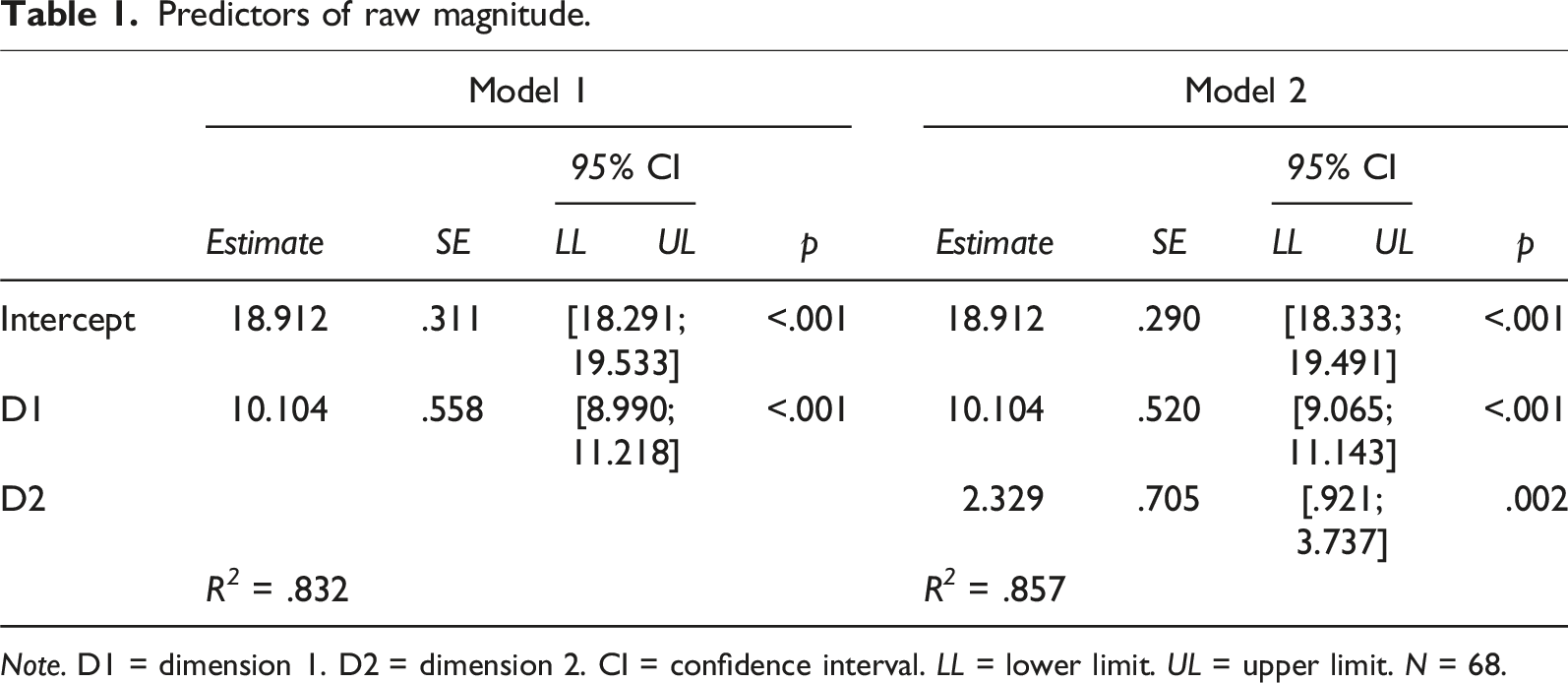
Note. D1 = dimension 1. D2 = dimension 2. CI = confidence interval. LL = lower limit. UL = upper limit. N = 68.
Results
As depicted in Figure 1, the scree plot indicates an elbow at dimension two, suggesting that our data can be effectively represented using two dimensions. The distribution of scenarios along two dimensions is depicted in Figure 2. The normalized raw stress was calculated to be .0256. Table 1 displays the linear regression of raw magnitude on both dimensions. With respect to the interpretation of the first dimension, observed horizontally in Figure 2, 23 of the 24 intra-organizational domain scenarios are positioned on the left side, with the exception of expatriation (“a133”). All 17 inter-organizational domain and all 14 extra-organizational domain scenarios are more to the right side. Intra-organizational career change is characterized by internal company decisions, in contrast to inter- and extra-organizational change (e.g., Ray, 2023). We thus interpret this dimension as the crossing of organizational social spaces. Therefore, a cut-off of −0.20 was applied to the first dimension, as illustrated in Figure 2. Moving from left to right along the horizontal axis in Figure 2 signifies career change beyond the current employing organization, and with increasing magnitude, indicated by the positive slope parameter estimate for this dimension. Scree Plot. Two-dimensional MDS Solution.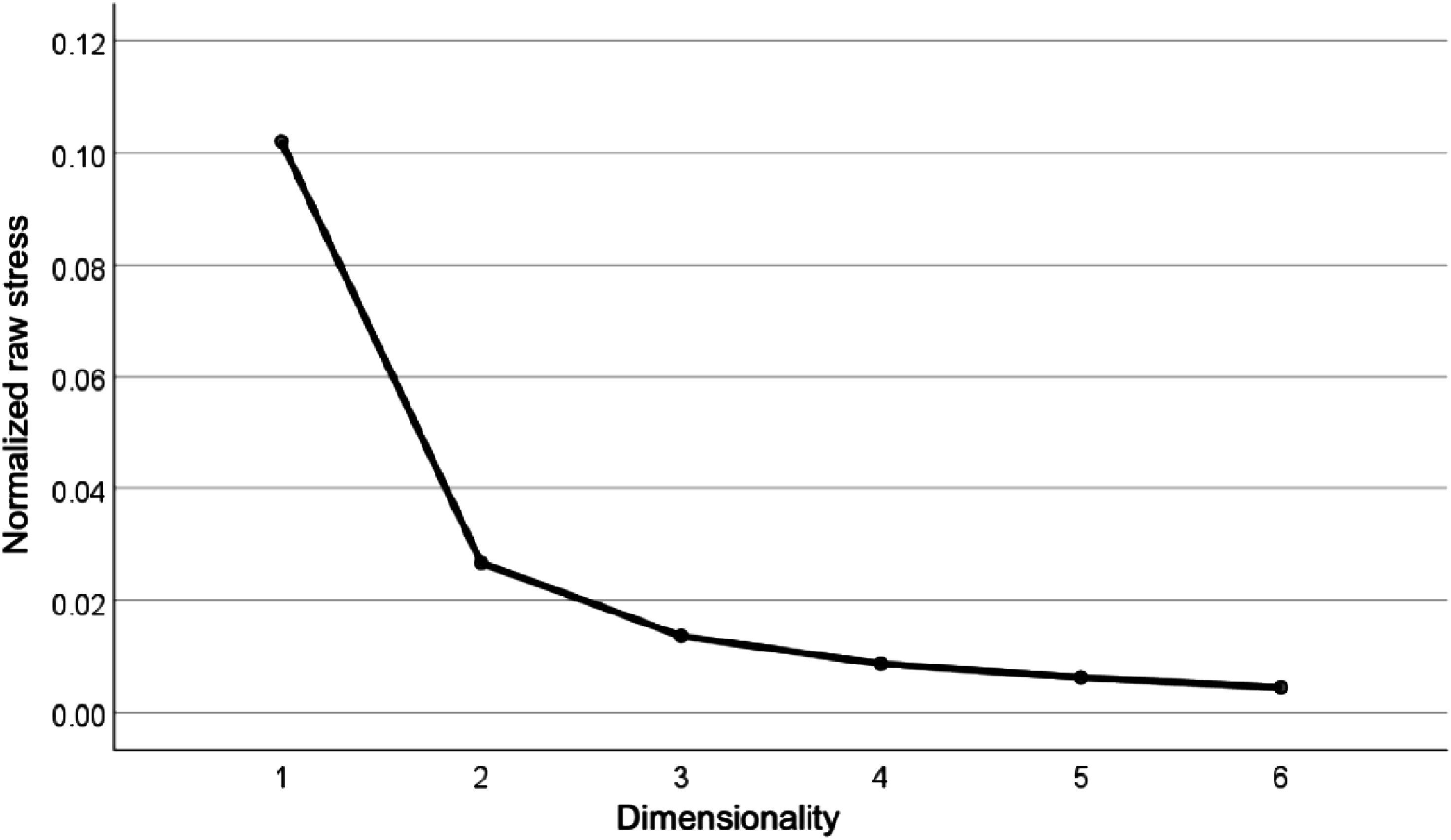
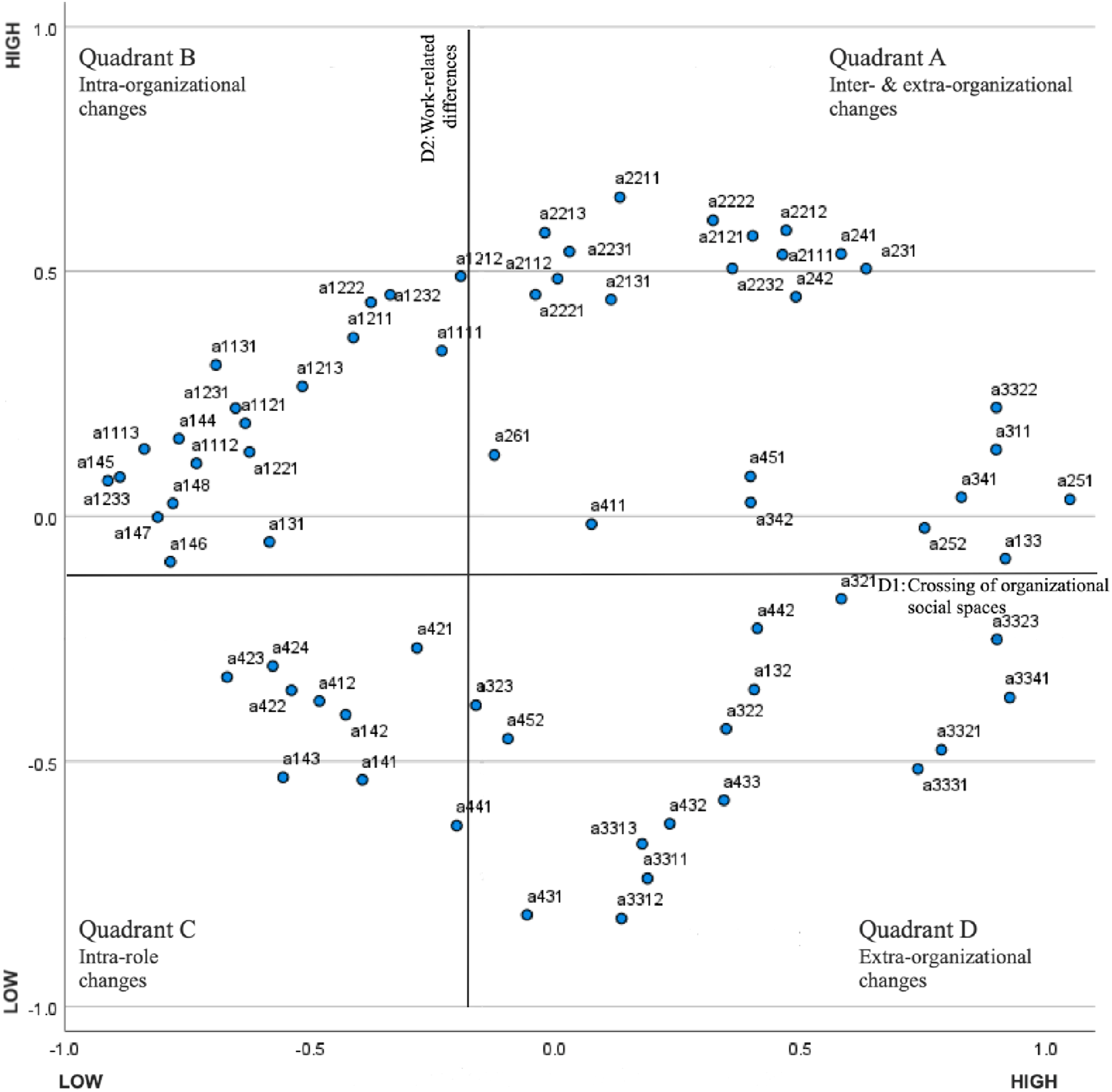
Regarding the interpretation of the second dimension, observed vertically in Figure 2, inter-organizational scenarios are generally located at the top (e.g., promotion with a new employer, “a2211”), followed by intra-organizational scenarios. Scenario “a2211” (“out-spiraling”) ranked third in novelty and first in both learning and transfer in Nicholson and West’s (1988) magnitude rankings. Many of their other eleven scenarios also rank high on the second dimension. As such, this dimension appears to reflect role-related or structural changes, for example, those involving work tasks and responsibilities, in contrast to scenarios located more at the bottom, for example, dual-career couple (“a431”) and advanced training (“a441”). We thus interpret this dimension as work-related differences. A cut-off of −0.10 was applied to the second dimension, as illustrated in Figure 2. Moving upward along the vertical axis signifies career change increasingly related to work elements and increasing in magnitude.
Four career change magnitude quadrants were identified in this way in Figure 2. The upper-right quadrant, labeled as Quadrant A (“inter- and extra-organizational change”), contains scenarios with the highest average calculated magnitude. Examples of changes involved in inter- and extra-organizational crossing include corporate policies and organizational culture, and professional identity, norms and code of ethics, respectively. The upper-left quadrant, labeled as Quadrant B (“intra-organizational change”), contains scenarios with the lowest average calculated magnitude. Involved changes for example include informal power networks, skills, and self-concept. The lower-left and lower-right quadrant are labeled Quadrant C (“intra-role change”) and Quadrant D (“extra-organizational change”), involving changes such as workload and personal time, and financial security and routine, respectively. In the Appendix, all scenarios are grouped by raw magnitude, quadrant and calculated magnitude from the two-variable linear regression model in Table 1.
The interpretation of quadrants B and C as “intra-organizational change” and “intra-role change”, respectively, requires clarification for some scenarios that are located in A and B. For the scenarios of expatriation (“a133”) and relocation (“a132”), this is perhaps explained by a change of workplace. Several explanations are possible for the scenarios of hybrid multi-jobbing (“a451” and “a452”), working parents (“a432” and “a433”), dual-career couples (“a431”), retraining (“a442”), and parallel careers (“a411”). First, their descriptions omit a current job, and hybrid multi-jobbing resembles self-employment (“a341 and a342”), possibly leading to measurement error (see Borg et al., 2013). Second, these scenarios may have been misclassified, despite Louis’ (1980) intra-role examples like dual-career couple. Third, intra-role scenarios may lie outside quadrant C, which should therefore perhaps be interpreted differently (e.g., “intra-organizational change with low work-related differences”).
Finally, the calculated magnitude of vertical demotion scenarios was lower compared to that of vertical promotions. The calculated magnitude of scenarios reflecting a decrease was generally lower compared to their increase counterparts, although the differences were relatively small, except in the cases of (hybrid) multi-jobbing and parallel careers.
Discussion
The objective of this study was to develop a conceptual career change typology, which took the shape of four conceptual domains derived from a synthesis of a career and work system theory. The other objective was to assess the magnitude of corresponding career changes. To this end, prevalent empirical career changes from the literature review were integrated with these conceptual domains, from which 68 voluntary career change scenarios were written. MDS analyses suggested that magnitude, in terms of differences in elements between roles, can be represented by two dimensions. The first and second dimension reflect the crossing of organizational social spaces and work-related differences, respectively. Our results represent the first quantified and substantiated measure of career change magnitude.
Until now, researchers have either suggested magnitude without providing any substantiation (e.g., Ashforth, 2000; Hall, 1979; Slay, 2006), or used subjective, context-specific or outcome-based measures such as stress or job demands (e.g., Bruce & Scott, 1994; Nicholson & West, 1988; Verbruggen et al., 2015). The uncovered crossing of organizational social spaces dimension is congruent with Ashforth’s (2000) magnitude suggestion for intra- and inter-organizational career changes, as with the suggestion that occupational change is of even larger magnitude (Blau, 2007; Hall, 1979; Slay, 2006). The uncovered work-related differences dimension aligns with the view that career change may encompass crossing other life roles alongside the worker role (De Vos et al., 2021; George et al., 2022).
Our findings are the first to validate Louis’ (1980) proposition that pre- to post-role differences can be estimated to provide a general indication of the magnitude of a specific career change, despite subjective elements. Another novelty is the “extra-organizational” domain in our conceptual career change typology. This improves the precision and clarity of categorizing corresponding career changes, such as occupational change.
Limitations
Although the conceptualization of career change magnitude proposed in this study appears to be more inclusive than in others, additional external validation is still required. A Q-sorting study cannot provide insight into the prevalence of the perspectives of the expert group in other populations, regardless of the number of participants involved. Also, our inventory of empirical career scenarios is neither complete nor exhaustive. First, while organizations remain the primary providers of jobs, alternative employment relationships such as freelance and gig work are on the rise (Scully-Russ & Torraco, 2020). Although we included entrepreneurship (“a3322”) and (partial) self-employment (“a341 and a451”) in our typology, questions about the meaning of career change in alternative contexts still need to be answered (Akkermans et al., 2021). Third, new career change types continue to emerge from technological and labor market innovations (e.g., digital platforms and remote working) (Scully-Russ & Torraco, 2020). Fourth, career scenarios can sometimes overlap. For example, retirees in the United States are increasingly pursuing bridge employment and encore careers (Boveda & Metz, 2016), which align with working less hours (“a141”), and re-entry (“a323”) and occupational change (“a311”), respectively. However, overlapping scenarios may differ in nuance or cultural significance, which might encourage distinct categorization. Further, although 30 participants are sufficient for the purpose of our study (Watts, 2015), only 8 participants provided sufficiently clear category descriptions to be usable for the calculation of magnitude and its direction. Even though this does not affect the MDS analyses and results (i.e., relative magnitude), the input of more participants was anticipated given the instructions. Such would have contributed to a more granular assessment of calculated magnitude. Finally, the partitioning of the MDS solution was performed in a simple (axial) manner, which is preferred due to robustness and replicability considerations (Borg et al., 2013). However, four quadrants may result in under-grouping, potentially overlooking important distinctions. Still, while a more granular partitioning could capture meaningful distinctions, for example, between smaller magnitudes, its reliance on interpretation may lead to overfitting to the data and its noise (Borg et al., 2013).
Implications for Theory and Practice and Avenues for Future Research
Recent studies have urged to seek out commonalities in career transitions in order to move the fragmented field forward (e.g., Akkermans et al., 2024; Sullivan & Al Ariss, 2019). Our results confirm Louis’ (1980) proposition that career change magnitude is a common feature of all career changes. Ashforth (2000) and Ebaugh (1988) have also proposed features of transitions, including career change magnitude, to investigate similarities and generalizability. In their review of role transitions, George et al. (2022) observe that these features are rarely operationalized as variables, which hinders the discovery of relationships with antecedents, processes and outcomes. Further, while career transition and career change are used synonymously, career transition involves broader psychological, physical, relational, and/or behavioral movement (George et al., 2022). For example, we took tasks as the smallest unit of differences, thereby identifying low-magnitude changes such as job crafting. Still, job crafting may result in notable outcomes, such as higher work engagement and job performance (Bakker, 2011). Future studies may benefit from utilizing our quantified measure of career change magnitude as a variable to integrate or control for, as well as from clearly distinguishing between career change and career transition.
Our results are also useful in practice. Feedback from a participant, a senior career professional, highlighted the abstract nature of our results, noting that many clients pursue career counseling with a desire for change, but without having specific scenarios in mind yet. Clients may therefore benefit from a simplified map for each quadrant, with examples of (salient) differences involved. These maps could potentially form part of a collage, aiding in the non-verbal exploration of the client’s narrative (e.g., Chant, 2020). In the next phase, career development professionals could utilize such maps to align the client’s preferences, interests, and skills with specific career change scenarios, assisting them in identifying options and understanding their implications. Such self-awareness is a powerful tool in career counselling (e.g., Schlossberg, 2011). For example, expatriation (“a133”) and a new employer abroad (“a251”) are two of the largest career changes, relating less to work elements than, for example, a vertical promotion, based on our study. Related changes arguably influence the loneliness, life disruptions, and relationship difficulties experienced by expatriate employees (see e.g., Chen et al., 2021).
We have six suggestions for future research. First, to study the relationship between career change magnitude and antecedents, process and outcomes of career transitions, for example, whether larger versus smaller magnitude career change invoke more versus less stress and have longer versus shorter process duration. Second, to examine the nature, number, and importance of role difference elements for the evaluation of magnitude. Third, to examine whether a more granular partitioning could capture meaningful magnitude distinctions, based on career theory. Fourth, to investigate possible discrepancies between the conceptual classification of scenarios, their location, and quadrant descriptions. Fifth, career assessment tools could be developed based on our results, in collaboration with researchers, clients and the professional field. Sixth, we encourage the use and expansion of our career change framework and typology through collaboration with professionals and individuals, including those from diverse backgrounds or alternative employment relationships, to enhance the relevance of future research.
Conclusion
We offer a conceptual typology of career changes grounded in theory, and the first quantitative and substantiated assessment of career change magnitude based on differences in elements between roles. We distinguish two key magnitude dimensions, that is, the crossing of organizational social spaces and work-related differences, reflected by four quadrants, which are relevant for researchers, practitioners and individuals in or considering a career transition.
Footnotes
Acknowledgments
We thank Dr. Frank Busing and Frank van der Mijn MSc for their support.
Declaration of Conflicting Interests
The author(s) declared no potential conflicts of interest with respect to the research, authorship, and/or publication of this article.
Funding
The author(s) received no financial support for the research, authorship, and/or publication of this article.

Appendix
Career change scenarios. Note. M = raw magnitude. Q = quadrant. C = calculated magnitude.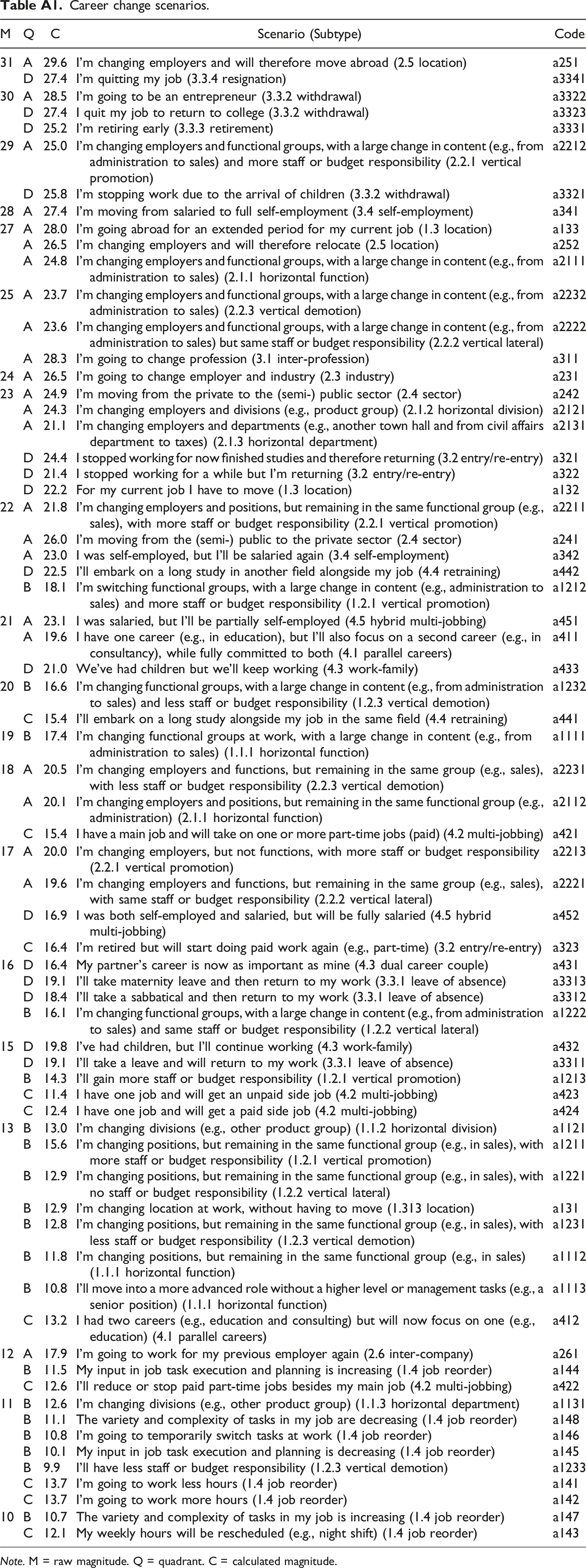
M
Q
C
Scenario (Subtype)
Code
31
A
29.6
I’m changing employers and will therefore move abroad (2.5 location)
a251
D
27.4
I’m quitting my job (3.3.4 resignation)
a3341
30
A
28.5
I’m going to be an entrepreneur (3.3.2 withdrawal)
a3322
D
27.4
I quit my job to return to college (3.3.2 withdrawal)
a3323
D
25.2
I’m retiring early (3.3.3 retirement)
a3331
29
A
25.0
I’m changing employers and functional groups, with a large change in content (e.g., from administration to sales) and more staff or budget responsibility (2.2.1 vertical promotion)
a2212
D
25.8
I’m stopping work due to the arrival of children (3.3.2 withdrawal)
a3321
28
A
27.4
I’m moving from salaried to full self-employment (3.4 self-employment)
a341
27
A
28.0
I’m going abroad for an extended period for my current job (1.3 location)
a133
A
26.5
I’m changing employers and will therefore relocate (2.5 location)
a252
A
24.8
I’m changing employers and functional groups, with a large change in content (e.g., from administration to sales) (2.1.1 horizontal function)
a2111
25
A
23.7
I’m changing employers and functional groups, with a large change in content (e.g., from administration to sales) (2.2.3 vertical demotion)
a2232
A
23.6
I’m changing employers and functional groups, with a large change in content (e.g., from administration to sales) but same staff or budget responsibility (2.2.2 vertical lateral)
a2222
A
28.3
I’m going to change profession (3.1 inter-profession)
a311
24
A
26.5
I’m going to change employer and industry (2.3 industry)
a231
23
A
24.9
I’m moving from the private to the (semi-) public sector (2.4 sector)
a242
A
24.3
I’m changing employers and divisions (e.g., product group) (2.1.2 horizontal division)
a2121
A
21.1
I’m changing employers and departments (e.g., another town hall and from civil affairs department to taxes) (2.1.3 horizontal department)
a2131
D
24.4
I stopped working for now finished studies and therefore returning (3.2 entry/re-entry)
a321
D
21.4
I stopped working for a while but I’m returning (3.2 entry/re-entry)
a322
D
22.2
For my current job I have to move (1.3 location)
a132
22
A
21.8
I’m changing employers and positions, but remaining in the same functional group (e.g., sales), with more staff or budget responsibility (2.2.1 vertical promotion)
a2211
A
26.0
I’m moving from the (semi-) public to the private sector (2.4 sector)
a241
A
23.0
I was self-employed, but I’ll be salaried again (3.4 self-employment)
a342
D
22.5
I’ll embark on a long study in another field alongside my job (4.4 retraining)
a442
B
18.1
I’m switching functional groups, with a large change in content (e.g., administration to sales) and more staff or budget responsibility (1.2.1 vertical promotion)
a1212
21
A
23.1
I was salaried, but I’ll be partially self-employed (4.5 hybrid multi-jobbing)
a451
A
19.6
I have one career (e.g., in education), but I’ll also focus on a second career (e.g., in consultancy), while fully committed to both (4.1 parallel careers)
a411
D
21.0
We’ve had children but we’ll keep working (4.3 work-family)
a433
20
B
16.6
I’m changing functional groups, with a large change in content (e.g., from administration to sales) and less staff or budget responsibility (1.2.3 vertical demotion)
a1232
C
15.4
I’ll embark on a long study alongside my job in the same field (4.4 retraining)
a441
19
B
17.4
I’m changing functional groups at work, with a large change in content (e.g., from administration to sales) (1.1.1 horizontal function)
a1111
18
A
20.5
I’m changing employers and functions, but remaining in the same group (e.g., sales), with less staff or budget responsibility (2.2.3 vertical demotion)
a2231
A
20.1
I’m changing employers and positions, but remaining in the same functional group (e.g., administration) (2.1.1 horizontal function)
a2112
C
15.4
I have a main job and will take on one or more part-time jobs (paid) (4.2 multi-jobbing)
a421
17
A
20.0
I’m changing employers, but not functions, with more staff or budget responsibility (2.2.1 vertical promotion)
a2213
A
19.6
I’m changing employers and functions, but remaining in the same group (e.g., sales), with same staff or budget responsibility (2.2.2 vertical lateral)
a2221
D
16.9
I was both self-employed and salaried, but will be fully salaried (4.5 hybrid multi-jobbing)
a452
C
16.4
I’m retired but will start doing paid work again (e.g., part-time) (3.2 entry/re-entry)
a323
16
D
16.4
My partner’s career is now as important as mine (4.3 dual career couple)
a431
D
19.1
I’ll take maternity leave and then return to my work (3.3.1 leave of absence)
a3313
D
18.4
I’ll take a sabbatical and then return to my work (3.3.1 leave of absence)
a3312
B
16.1
I’m changing functional groups, with a large change in content (e.g., from administration to sales) and same staff or budget responsibility (1.2.2 vertical lateral)
a1222
15
D
19.8
I’ve had children, but I’ll continue working (4.3 work-family)
a432
D
19.1
I’ll take a leave and will return to my work (3.3.1 leave of absence)
a3311
B
14.3
I’ll gain more staff or budget responsibility (1.2.1 vertical promotion)
a1213
C
11.4
I have one job and will get an unpaid side job (4.2 multi-jobbing)
a423
C
12.4
I have one job and will get a paid side job (4.2 multi-jobbing)
a424
13
B
13.0
I’m changing divisions (e.g., other product group) (1.1.2 horizontal division)
a1121
B
15.6
I’m changing positions, but remaining in the same functional group (e.g., in sales), with more staff or budget responsibility (1.2.1 vertical promotion)
a1211
B
12.9
I’m changing positions, but remaining in the same functional group (e.g., in sales), with no staff or budget responsibility (1.2.2 vertical lateral)
a1221
B
12.9
I’m changing location at work, without having to move (1.313 location)
a131
B
12.8
I’m changing positions, but remaining in the same functional group (e.g., in sales), with less staff or budget responsibility (1.2.3 vertical demotion)
a1231
B
11.8
I’m changing positions, but remaining in the same functional group (e.g., in sales) (1.1.1 horizontal function)
a1112
B
10.8
I’ll move into a more advanced role without a higher level or management tasks (e.g., a senior position) (1.1.1 horizontal function)
a1113
C
13.2
I had two careers (e.g., education and consulting) but will now focus on one (e.g., education) (4.1 parallel careers)
a412
12
A
17.9
I’m going to work for my previous employer again (2.6 inter-company)
a261
B
11.5
My input in job task execution and planning is increasing (1.4 job reorder)
a144
C
12.6
I’ll reduce or stop paid part-time jobs besides my main job (4.2 multi-jobbing)
a422
11
B
12.6
I’m changing divisions (e.g., other product group) (1.1.3 horizontal department)
a1131
B
11.1
The variety and complexity of tasks in my job are decreasing (1.4 job reorder)
a148
B
10.8
I’m going to temporarily switch tasks at work (1.4 job reorder)
a146
B
10.1
My input in job task execution and planning is decreasing (1.4 job reorder)
a145
B
9.9
I’ll have less staff or budget responsibility (1.2.3 vertical demotion)
a1233
C
13.7
I’m going to work less hours (1.4 job reorder)
a141
C
13.7
I’m going to work more hours (1.4 job reorder)
a142
10
B
10.7
The variety and complexity of tasks in my job is increasing (1.4 job reorder)
a147
C
12.1
My weekly hours will be rescheduled (e.g., night shift) (1.4 job reorder)
a143