




Abstract
This study aimed to analyze how career adaptability and job control can influence apprentices’ perceptions of their work as being decent and stressful. The participants included 530 Swiss apprentices enrolled in a three-year vocational education training (VET) program. Structural equation modeling showed a positive association between career adaptability and job control and a strong negative association between decent work perception and occupational stress. Career adaptability had a specific positive relationship with decent work perception, whereas job control had a significant relationship with both decent work and occupational stress. Finally, results indicate that decent work could be a possible mediator between career adaptability and occupational stress and between job control and occupational stress. The study suggests that some personal resources and specific work conditions, such as physical and psychological safety and working hours that allow leisure and rest, could help apprentices perceive their work environment as positive and manage occupational stress.
Keywords
Introduction
Several countries strongly promote the VET system because this type of education is known to facilitate the school-to-work transition (Findeisen et al., 2022). Students enrolled in such programs alternate days of work and days of school and must, for this reason, manage their work, education, and leisure time simultaneously. This implies the need to rely on their psychosocial resources to manage the specific challenges in the workplace, at school, and during their leisure time. The complexity of the role of apprentices makes the study of their well-being of special interest. However, very few studies have addressed this important issue. According to the Psychology of Working Theory (PWT; Duffy et al., 2016) the impact of marginalization factors on decent work is mediated by psychosocial resources such as career adaptability. In turn decent work is an antecedent of well-being at work. On the other hand, the Job-Demand-Control model (JDC; Karasek, 1979) states that perceived job control, that is a variable related to the context, is negatively associated to occupational stress and is an important resource for workers. The interactionist perspective of life design (Nota & Rossier, 2015) proposes that career development should be understood as an active interrelationship between a person and his or her external context. According to it, career adaptability and job control are therefore potentially important variables to analyze in relation to well-being outcomes. To our knowledge, however, there are no studies that have analyzed simultaneously the potential effect of these factors on apprentices’ occupational stress.
Work-based (dual) VET programs are the predominant form of upper secondary education in Switzerland, although differences exist depending on the language region under consideration. In the Italian-speaking part, about 50% of young people attend a full-time or a dual VET program after completing compulsory school (UOSP, 2024). In this part of Switzerland, the labor market is characterized by many small and medium-sized enterprises and salaries are lower than in the rest of the country (Bigotta & Giancone, 2022). As the environment in this region is more challenging, with fewer vacant positions and lower salaries, it could be assumed that people rely more on their psychosocial resources to maintain a good level of satisfaction towards their work and manage their occupational stress. This makes apprentices in a dual VET program in this region a particularly interesting population to examine.
Hence, with the more general goal of expanding knowledge about the potential resources enhancing apprentices’ well-being, inspired by the PWT and the JDC model, the present study, involving apprentices in the Italian-speaking part of Switzerland, pursued two specific goals. The first was to examine how career adaptability and job control could relate to both decent work and occupational stress and the second to assess whether it would be more parsimonious to consider decent work as a possible mediator, as suggested by the PWT. Additionally, the effect of gender, year of training and organizational size were also analyzed to eventually highlight differences in variables related to these other personal and contextual factors.
Decent Work as an Antecedent of Occupational Stress
The PWT states that a job, considered as “decent,” must provide physically and psychologically safe working conditions, working hours that allow leisure and rest, organizational values complementary to family and social values, an adequate compensation, and the access to health care (Duffy et al., 2016). These characteristics, when properly present, help to fulfill one’s survival, social connection, and self-determination needs and these positively affect one’s work fulfillment and well-being. Many studies have analyzed the link between decent work and positive and negative indicators of well-being such as job satisfaction and life satisfaction (see the meta-analysis by Su & Chan, 2023) and were also conducted with Swiss workers (e.g., Masdonati et al., 2019). In today’s ever-changing social, economic and political environment, the world of work is increasingly uncertain and, in some cases, precarious; therefore, benefiting from decent working conditions and maintaining adequate levels of well-being at work can become an increasingly critical challenge, including for apprentices who work in companies.
Occupational stress is a critical element to consider when studying well-being at work (McGowan et al., 2006; Quick & Henderson, 2016; Rothmann, 2008). In the past, numerous studies have shown an important relation between chronic stress at work and worker burnout (e.g., Milfont et al., 2008), which is a state of exhaustion (Kristensen et al., 2005) deriving from exposure to an exigent professional environment (Schaufeli & Greenglass, 2001). According to McGrath (1976), stress results from an imbalance between the requests of a specific condition and an individual’s capacity to deal with it and from an absence of congruence between an individual’s needs and the expectations, possibilities, opportunities, and difficulties of a particular situation.
Studies conducted during the COVID-19 pandemic (e.g., Hassnain & Omar, 2020) revealed that lockdowns had a negative impact on the mental and physical well-being of apprentices, as well as on perceived stress at work, making it even more important to study possible protective factors against stress for this population. So far, there are no studies that have considered the specific relationship between decent work and occupational stress of apprentices; however, we can hypothesize a negative relationship between these two variables in this population as well.
Career Adaptability as an Antecedent of Decent Work and Occupational Stress
Career adaptability is a combination of psychosocial skills that enable individuals to adapt and cope with a complex and constantly changing social and economic environment. These skills consist of concern, control, curiosity and confidence (Savickas, 2013). Concern relates to the ability to navigate the future, control refers to self-discipline in managing one’s career choices, curiosity is defined as the behavior of seeking information about career possibilities, and finally, confidence is related to the feeling of self-efficacy in constructing one’s career. Thus, the construct of career adaptability involves the abilities of making plans for the future, seeking information about oneself and the environment, and making informed career decisions (Gati et al., 2019). High career adaptability scores appear to be related to realism and stability of one’s aspirations (Hirschi, 2010), smoother career transitions (Germeijs & Verschueren, 2007), lower levels of unemployment and career indecision (Fouad, 2007), and higher levels of life satisfaction (Parola & Marcionetti, 2021; Santilli et al., 2017). Studies conducted with Swiss adults confirm that career adaptability is negatively related to occupational stress and positively with well-being. For example, in a sample of employed and unemployed adults, Maggiori et al. (2013) showed that job security is positively related to career adaptability and that adaptability resources are positively associated with well-being both at work and in life, regardless of work conditions. In another study with working adults, Fiori et al. (2015) found that career adaptability both directly and indirectly increases job satisfaction and reduces job stress.
The relationship between career adaptability and decent work suggested by the PWT has been confirmed by several empirical studies (e.g. Vilhjálmsdóttir, 2021). However, the relationship between career adaptability and, respectively, the perception of decent work and job stress has not been explored in apprentices. Based on the results obtained in the previously mentioned studies, we can hypothesize that career adaptability is also an important resource for fostering better perceptions of decent work and less job stress in apprentices.
Job Control as an Antecedent of Decent Work and Occupational Stress
As suggested by the JDC model (Karasek, 1979) job control is an important aspect to consider in the study of functioning and well-being at work. Job control can be defined as the ability each person has to influence how, by what means, and when to approach his or her work activities (Humphrey et al., 2007). Job control also allows one to modify the environment so that it is in line with one’s needs (Hackman & Oldham, 1980; Karasek & Theorell, 1990). In line with the Commission on the Social Determinants of Health (World Health Organization, 2007) and the results of different studies, the ability of employees to control their work schedule and environment appears to be a key aspect of promoting their health. For example, Fischer et al., (2021) considered the relationship between job control and decent work through work ability, which is a concept based on the perceived balance between individual resources and job demands and is also a valid indicator of career sustainability. According to these authors, job control can be considered an organizational determinant of work ability, which could lead to a better perception of having decent working conditions. Additionally, Martens et al. (1999) observed that job control and decent work are both antecedents of physical and mental health at work. In general, outcomes related to job control are varied, such as dispositions toward work, employee job performance, well-being (Bond & Flaxman, 2006), and job satisfaction (Scanlan & Still, 2019; Shimazu et al., 2004). However, studies that have examined the link between job control and decent work are few and none have been conducted with apprentices.
Studies suggest that there is also a relationship between job control and occupational stress. For example, Daniels and Guppy (1994) argued that control could have a positive effect on well-being, as it enables individuals to modify the environment to deal with stressors. Kälin (2000), in one of the few studies involving apprentices, found that task-related stressors remain stable when social recognition and job control increase. Considering job control in a sample of apprentices in training might be especially relevant, considering that gaining autonomy is one of the objectives of these trainings. Based on the aforementioned JDC model (Karasek, 1979) and studies’ results, it is therefore possible to assume that even in apprentices the perception of job control is associated with a better perception of decent work and less occupational stress.
Finally, there are also few studies that have examined the relationship between job control and career adaptability. For instance, Maggiori et al. (2013) analyzed the influence of career adaptability on work conditions and on employee well-being and found that low scores on job control or decision latitude are associated with less career adaptability. Thus, we assume that job control is positively correlated with career adaptability and that both variables are linked to decent work perception and occupational stress of apprentices.
Aims of the Present Study
Although the population of apprentices represent an important part of the population in training in some countries and factors influencing their well-being should be an important object of study, studies on this population are still limited (Duc & Lamamra, 2022). Research findings presented in the introduction suggest that career adaptability and job control, along with perceptions of decent work, are potential influencers of occupational stress that are also potentially important for apprentices (e.g., Duffy et al., 2019; Fiori et al., 2015; Kälin et al., 2000; Toscanelli et al., 2019; Vilhjálmsdóttir, 2021). Therefore, in order to expand knowledge about resources that could help reduce occupational stress and improve apprentices’ well-being, the present study aimed to examine the relationships between career adaptability, job control, decent work, and occupational stress, including testing decent work as a possible mediator between career adaptability and occupational stress and between job control and occupational stress. The effects of gender, year of training, and company size were also analyzed to possibly highlight differences in variables related to these factors.
Method
Participants and Procedure
The present study was performed in the Italian-speaking part of Switzerland. Participants were apprentices enrolled in a three-year VET program that combined 3–4 days of work in a company with 1–2 days at school. They were selected from five public VET schools and chosen so as to have a weighed representation in terms of professional sectors. The apprentices were administered the online questionnaire (using the software Qualtrics) in their school between March and May 2021. On this occasion, a researcher explained the topic of the study and how to open and complete the questionnaire. A group of apprentices were in the middle-end of their first year, whereas another group of apprentices were in the middle-end of their third and last year of apprenticeship. The apprentices decided whether to participate in the study by giving informed consent.
The sample included 530 apprentices, 244 women (46%) and 286 men (54%). In our sample, 298 were in their first year (56.2%), and 232 (43.8%) were in their last year; their average age was 19.46 years (SD = 3.54). The apprentices were trained in the following occupations: bricklayer (19.6%), plumber (10%), logistics employee (12.1%), office worker (9.4%), heating systems installer (2.3%), retail worker (8.3%), pharmacy assistant (11.5%), medical practice assistant (15.8%), hairdresser (7.9%), and veterinary practice assistant (3%). Concerning the sizes of companies, 27.9% (n = 148) of the participants worked at a microenterprise (1–9 employees), 31.1% (n = 165) worked at a small enterprise (10–49 employees), 28.9% (n = 153) worked at a medium-sized enterprise (50–249 employees), and 11.1% (n = 59) worked at a large enterprise (more than 250 employees). Five participants did not provide this information.
Measures
Career Adaptability
The validated Italian Career Adapt-Abilities Scale (Soresi et al., 2012) consists of 24 items measured through a 5-point Likert-type scale, with responses ranging from 1 (I have very little of this ability) to 5 (I have a lot of this ability). The scale is composed of five 4-item subscales: concern (e.g., “Realizing that the choices I make today will affect my future”), control (e.g., “Be consistent/tenacious”), curiosity (e.g., “Be curious and interested in what is happening around me”) and confidence (e.g., “Solving problems”). The English version has a Cronbach’s alpha value of .92 (Savickas & Porfeli, 2012), while the value for the Italian version is .79 (Soresi et al., 2012).
Job Control
To assess job control, we selected 3 items from the Short Questionnaire for Job Analysis (Prümper et al., 1995). The apprentices answered on a 5-point Likert-type scale ranging from 1 “never/very rarely” to 5 “often/very often.” An example item is “Can you choose which tasks to perform?” For this study, the chosen items were translated into Italian by the first and second authors and then verified by a professional translator. The English version has a Cronbach’s alpha value of .70 (Prümper et al., 1995).
Decent Work
We used the Italian version (Masdonati et al., 2019) of the Decent Work Scale (Duffy et al., 2017) to assess decent work. This scale includes 15 items. Participants answer using a 7-point Likert-type scale ranging from 1 “strongly disagree” to 7 “strongly agree.” The questionnaire includes the following 3-item subscales: safe working conditions (e.g., “I feel emotionally safe interacting with people at work”), access to health care (e.g., “Compulsory health insurance in Switzerland offers good health services”), adequate compensation (e.g., “I do not feel I am paid enough based on my qualifications and experience”), free time and rest (e.g., “I do not have enough time for non-work activities”), and complementary values (e.g., “My organization’s values align with my family values”). The Cronbach’s alpha value for both the English and Italian versions is .86.
Occupational Stress
The Italian version validated by Marcatto et al. (2022) of the Perceived Stress-at-Work Scale (De Bruin & Taylor, 2005) was used to measure occupational stress. The scale includes 4 items. Each participant answers on a 5-point Likert-type scale ranging from 1 “never/very rarely” to 5 “often/very often.” An example item is “My job is stressful.” The English scale (De Bruin & Taylor, 2005) has a Cronbach’s alpha value of .90, while the value for the Italian version is .80 (Marcatto et al., 2022).
Missing Data, Data Cleaning, and Data Analyses
The information collected with the survey was downloaded from Qualtrics into SPSS. An initial database cleaning phase involved the exclusion of information provided by participants who took an excessively short time to compile the questionnaire: considering that the average time to answer the questionnaire was 30 minutes, it was decided not to consider questionnaires with response times of less than 15 minutes. Subsequently, three more data cleaning procedures were applied. First, the total scores of participants who did not answer two items of a scale were not considered. Second, the outliers were discarded considering the Malhanobis distance. Finally, when a participant answered the same scale systematically using the neutral answer (e.g., “neither agree nor disagree”), the total score of that scale was not considered. Participants were not forced to respond to each question. In addition, some apprentice respondents did not close the questionnaire properly. Thus, for them, only partial data were saved. This procedure resulted in a valid sample of 530 participants.
After data cleaning, descriptive statistics and correlations were performed with SPSS software. T-tests or ANOVAs were used to analyze the impact of gender, the apprenticeship year and organization size on the different variables considered. After that, different Structural equation modeling (SEM) models were tested with AMOS software. Job control and occupational stress were set as latent variables and items were used as observed variables. Career adaptability and decent work were set also as latent variables, but items’ means of subdimensions were used as observed variables. To assess model fit, we used a series of fit indices. The comparative fit index (CFI) and Tucker‒Lewis’s index (TLI) indicate an appropriate fit when their values equal or exceed .90 (Medsker et al., 1994). The root mean square error of approximation (RMSEA) value is considered acceptable when it is equal to or below .08 (Byrne, 2010). Finally, we referred to the χ2 per degrees of freedom (χ2/df), which indicates a good fit when the value is equal to or below 3 (Kline, 2005). To test for significance of the indirect effects in the mediation model, we estimated the 95% bias-corrected confidence intervals (CI) using bootstrapping on 5000 samples. Indirect effect is considered significant when the lower (LL) and upper limits (UL) of the 95% bias-corrected CI do not include zero.
Results
Means, Standard Deviation, Skewness, Kurtosis, and Correlation Matrix.
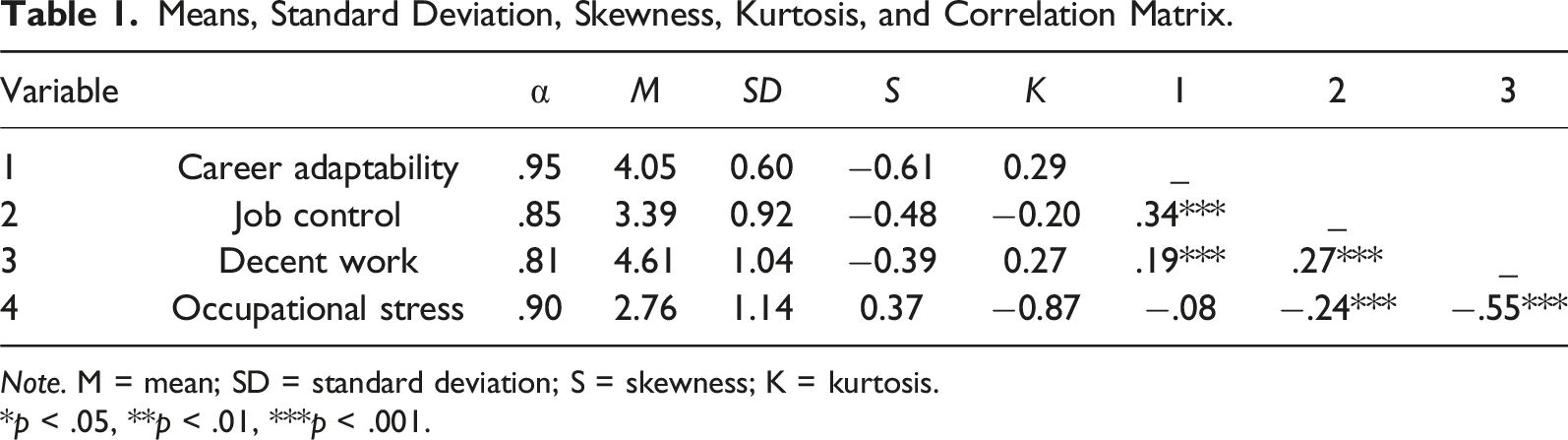
Note. M = mean; SD = standard deviation; S = skewness; K = kurtosis.
*p < .05, **p < .01, ***p < .001.
Means and Standard Deviations According to Gender, Year of Training, and Organization size.
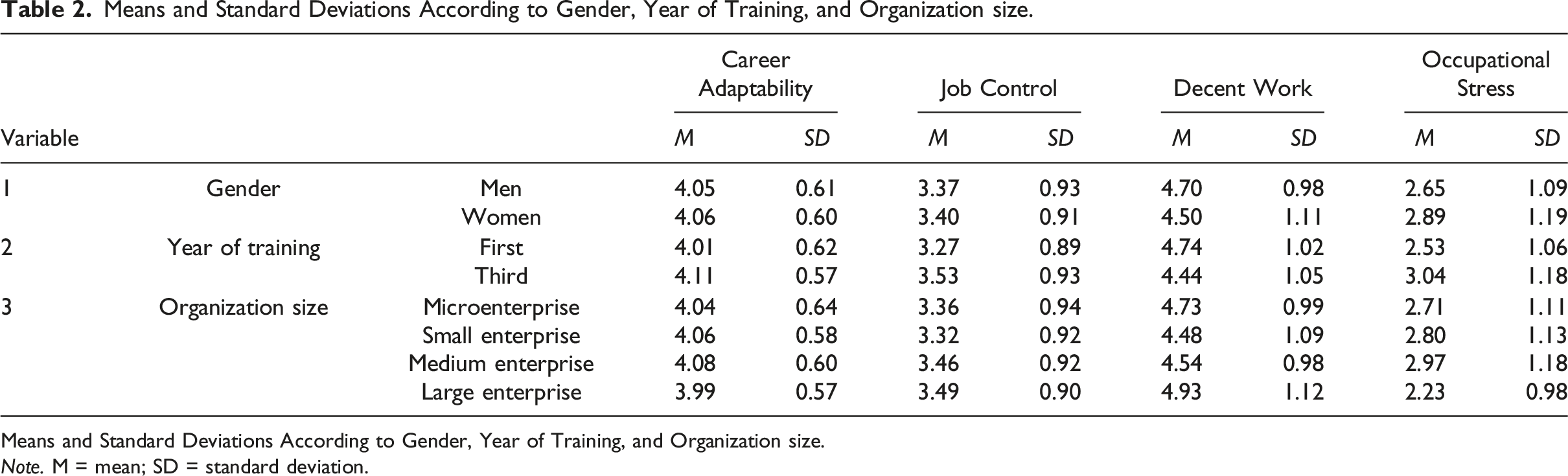
Means and Standard Deviations According to Gender, Year of Training, and Organization size.
Note. M = mean; SD = standard deviation.
Before setting up the SEM model, we tested the measurement model. The latter was associated with acceptable fit indices, χ2 (98) = 353.79, p < .001, TLI = .918, CFI = .933, and RMSEA = .074. Subsequently, a first SEM model (Model (1) where career adaptability and job control directly impact decent work and occupational stress was defined. This first SEM model was associated with fit indices that were slightly too low: χ2 (99) = 511.96, p < .001, TLI = .869, CFI = .892 and RMSEA = .094. Considering modification indices, a second adjusted model (Model (2) was computed that considered two correlations between errors of observed variables of the decent work scale. This adjusted model was associated with acceptable fit indices, χ2 (96) = 302.02, p < .000, TLI = .933, CFI = .946, and RMSEA = .067. In the second model, career adaptability directly influenced decent work, and job control directly impacted decent work and occupational stress. Career adaptability and job control were positively correlated, whereas decent work and occupational stress were strongly negatively correlated. The model was found to explain 23% and 7% of the variance in decent work and occupational stress, respectively. We then tested a third SEM model (Model (3) from which we removed the nonsignificant relation between career adaptability and occupational stress, that was also associated with acceptable fit indices, χ2 (97) = 302.02, p < .001, TLI = .934, CFI = .947 and RMSEA = .067. The standardized coefficients of Model 3 are presented in Figure 1. The model was found to explain 23% and 7% of the variance in decent work and occupational stress, respectively. Model with Career Adaptability and Job Control predicting Decent Work and Occupational Stress (Model 3). Note. *p < .05. **p < .01 ***p < .001.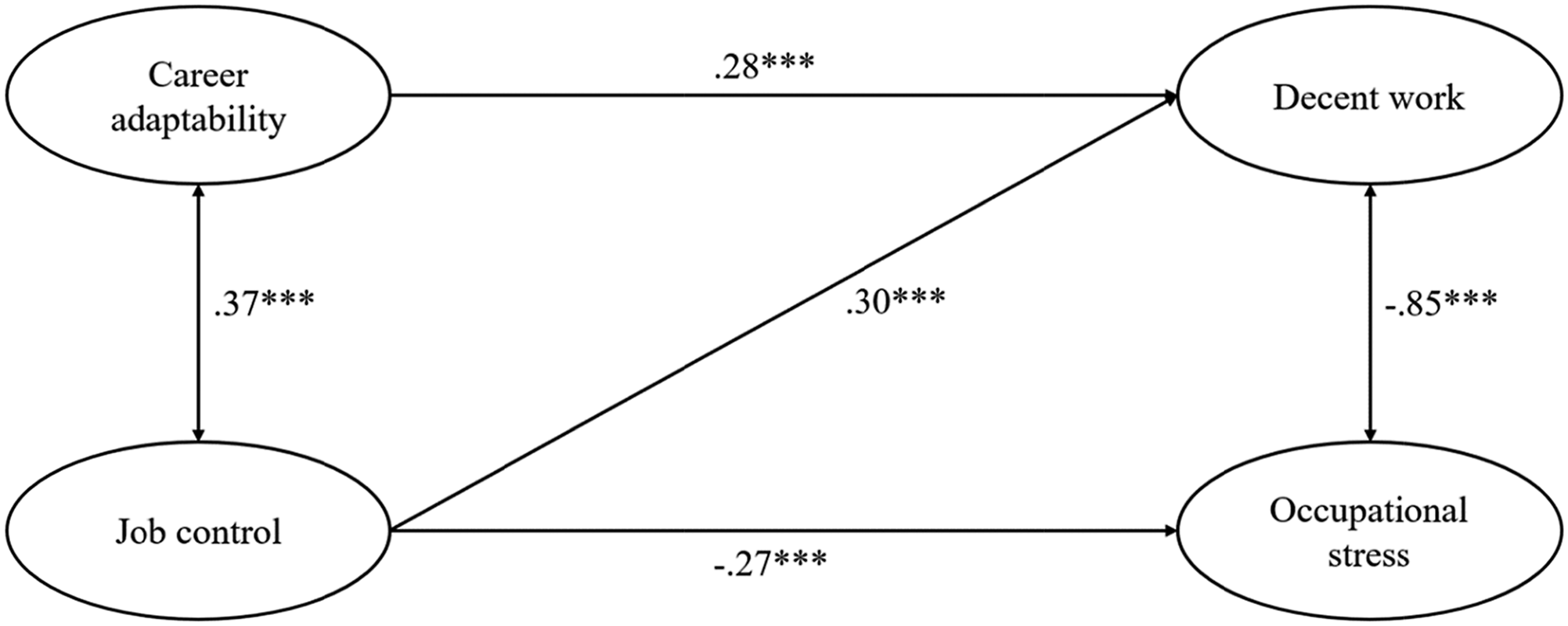
Finally, we tested a model considering decent work as a possible mediator between career adaptability and occupational stress and between job control and occupational stress (Model 4). The fit indices of this alternative model were found to be acceptable, χ2 (98) = 325.18, p < .001, TLI = .927, CFI = .941, and RMSEA = .070, and very similar to those of Model 3. Indices of fit of Model 4 were slightly worse than those of Model 3 but remained largely within the range of adequacy. Therefore, this study did not allow to determine which of the models is the most adequate. The standardized beta values of Model 4 are shown in Figure 2. The model was found to explain 15% and 64% of the variance in decent work and occupational stress, respectively. In Model 4, we observe that the link between job control and occupational stress, which was significant in Model 3, becomes statistically nonsignificant. In the last model, decent work could be considered a mediator of the impact of career adaptability and job control on occupational stress. To be sure of this, we performed bootstrapping on 5000 samples to obtain estimates and 95% bias-corrected CI of the indirect effects of career adaptability and job control, respectively, on occupational stress. The indirect effect of career adaptability on occupational stress through decent work was significant (standardized value = −.108; 95% bias-corrected CI: LL = −.199 and UL = −.011) as it was the indirect effect of job control on occupational stress (standardized value = −.251; 95% bias-corrected CI: LL = −.328 and UL = −.116). Thus, these analyses suggest that decent work could be a mediator of the effect of both career adaptability and job control on occupational stress. Model with Decent Work as Mediator (Model 4). Note. *p < .05. **p < .01 ***p < .001.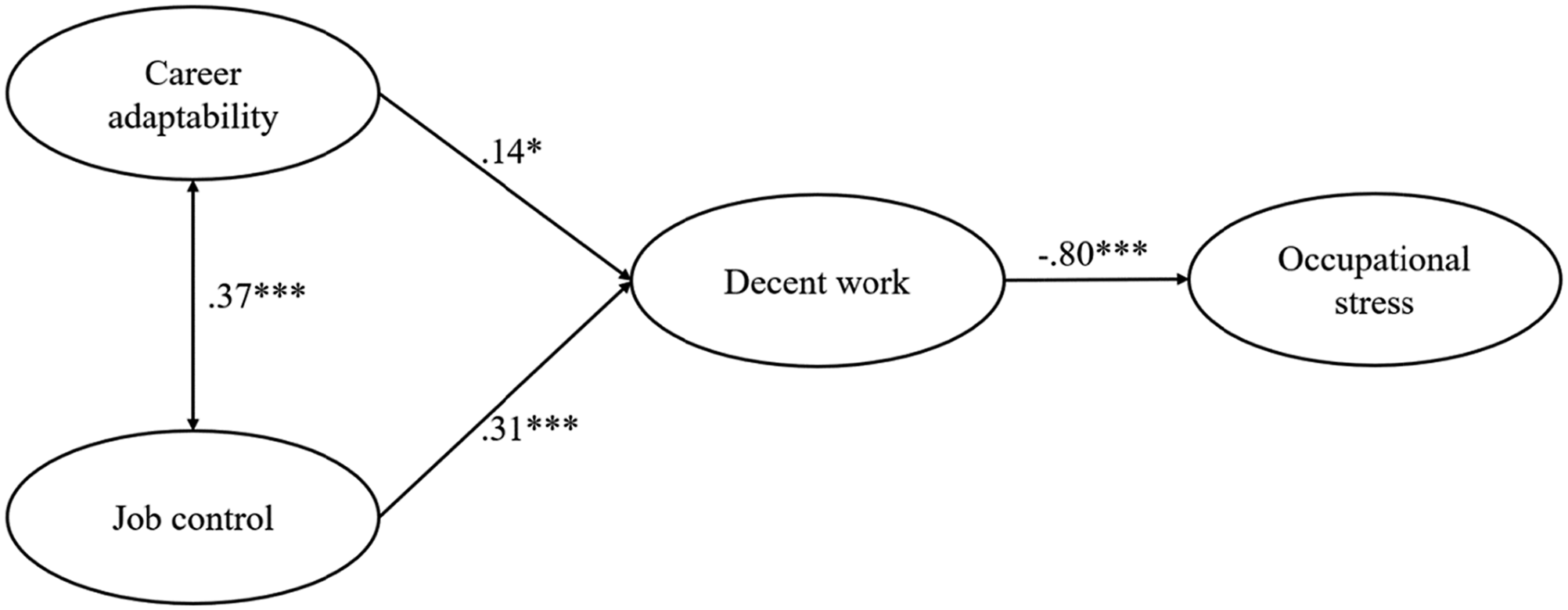
Discussion
With this study, we aimed first to investigate the relationships between apprentices’ career adaptability, job control, decent work, and occupational stress and second to test the mediator role of decent work between career adaptability and occupational stress and between job control and occupational stress. Additionally, we inspected possible differences in variables scores related to gender, year of apprenticeship and organizational size.
Decent Work as an Antecedent of Occupational Stress
As hypothesized, this study confirms a negative relationship between decent work and occupational stress. The final model tested in this study also suggests that the perception of decent work could be a particularly important factor in influencing the occupational stress experienced by apprentices. The association that has emerged is very high indeed. This means that for apprentices not to feel too stressed and benefit from good occupational health, physical and psychological working conditions must be safe, working hours must allow for leisure time and rest, organizational values must be consistent with family and social values, wages must be judged adequate, and the context must provide adequate health care when needed. These results are consistent with the PWT (Duffy et al., 2016) and with studies that linked decent working conditions with positive well-being indicators such as job satisfaction and life satisfaction and with negative well-being indicators such as stress, burnout or turnover intentions (Su & Chan, 2023) in populations of adult workers. As mentioned, it also seems that the perception of decent work is even more important in the specific population of apprentices to counteract occupational stress.
Career Adaptability as an Antecedent of Decent Work and Occupational Stress
The results of this study also suggest that career adaptability is linked to decent work in apprentices, as found in previous studies conducted with adult workers (Tokar & Kaut, 2018; Vilhjálmsdóttir, 2021). Specifically, the models tested indicate that career adaptability could influence the perception of decent work and thus indirectly affect the level of perceived occupational stress. In general, career adaptability was found to have positive associations with indicators of well-being and positive career development. For instance, the results of the study by Santilli et al., (2017) suggest a direct link of career adaptability with life satisfaction in Italian adolescents and a full mediation by the time perspective between the two variables in Swiss adolescents. According to Hirschi (2010), career adaptability skills are associated with career success. Fouad (2007) showed that career adaptability is correlated to a lower probability of experiencing prolonged unemployment and Parola and Marcionetti (2021) found that career adaptability scores are negatively linked to career indecision and positively linked with life satisfaction in Italian middle school, high school, and university students. In this study, career adaptability has a weak to moderate effect (depending on the model tested) in promoting the perception of decent work for apprentices enrolled in a dual VET course. Moreover, the direct relationship between career adaptability and occupational stress was nonsignificant in all models, this relationship being completely mediated by decent work. Thus, it seems that skills related to the concept of career adaptability are less important once a job is found, as it is the case for apprentices working in a company. Their effect is likely to change depending on the employment situation (Maggiori et al., 2013). This idea is supported considering that the level of career adaptability was higher in third-year apprentices, who will soon be confronted with the search for a new employment, compared to first-year apprentices.
Job Control as an Antecedent of Decent Work and Occupational Stress
In this study, we also analyzed the relationship between apprentices’ levels of job control and their perceptions of having a decent job. The results indicate the existence of a positive association between the two variables. Therefore, experienced control over one’s work activities could be an important factor in fostering a positive perception of working conditions in apprentices as well. According to the considerations of Fischer et al. (2021) as well as to the results of Bond and Flaxman (2006) in adults and those of Kälin et al. (2000) with apprentices, job control could help to positively deal with job demands and thus foster the perception of decent work.
In addition, and always in line with our hypotheses, the results show a negative association between job control and occupational stress, and the model tested suggests that the perception of having control at work could reduce occupational stress in apprentices, as already found in previous studies conducted with adult workers (Chiang et al., 2010; Daniels & Guppy, 1994; Duffy et al., 2019). For example, it has been shown that job control is a full mediator of the negative relationship between self-employment and occupational stress (Hessels et al., 2017). In an interesting study based on the JDC model (Karasek, 1979), conducted with newcomers, Taris and Feij (2004) highlighted that: with elevated scores of control and demands, stress decreases over time (perhaps because of learning); with low levels of demands and control, stress increases over time (perhaps due to a loss of knowledge); and with low demands and high control, learning increases over time (perhaps due to low stress levels). Expanding on the knowledge based on the JDC model (Karasek, 1979), Taris and Feij (2004) study and our study emphasize the need to let apprentices also have the opportunity to decide at least in part how and when to carry out their work tasks, without every detail of the activity being imposed by someone else. Having control and autonomy toward how to do working activities, more than on what working activities to do, is associated with workers self-efficacy (Marcionetti & Castelli, 2022).
Decent Work as a Mediator
Finally, decent work appears in this study as a possible mediator of the influence of career adaptability and job control on occupational stress. These results are partly congruent with what the original PWT model states (Duffy et al., 2016), that is, that career adaptability directly influence the perception of decent work, which in turn has well-being as an outcome. Similarly, the results of our study suggest that decent work could be a mediator of the effect of career adaptability on a negative indicator of well-being, that is, occupational stress. These results echo those found in other studies. Adding to those already cited, Zammitti et al. (2021) showed that a propensity to consider one’s work decent is present in people with a strong level of career adaptability. Ginevra et al. (2021) also observed a link between career adaptability and orientation toward decent work. On the other hand, as already said, few studies have been conducted on the role of decent work as a mediator of the relationship between job control and occupational stress. The relation found support the statement by Hackman and Oldham (1980) and Karasek and Theorell (1990) that job control allows one to modify the environment to be in line with one’s needs; this could indeed enhance perception of decent work and consequently lower job stress.
Practical Implications
In terms of practical implications, the results of this research indicate that apprentices’ career adaptability and even more job control could positively influence decent work perception which in turn could decrease their occupational stress.
First, concerning career adaptability, despite the small effect observed in this study on occupational stress of apprentices, it could still be important to foster the development of these skills, both at middle school to permit a smooth access to companies having working characteristics in line with personal needs, and during apprenticeship, to foster decent work perception and, at the end of the training, for a smoother transition to another company or to further training. Rossier (2015) suggest that career adaptability is a self-regulatory process that permits optimize person-environment fit, deal with external obstacles, and finally build a satisfying career path. Results show that in some way career adaptability skills seem to develop from first to third year, perhaps due to the need to practically manage the end of the apprenticeship period and the transition to what comes next. Further help could however enhance effectiveness of this transition for a larger percentage of people. Green et al. (2020), for instance, developed a method to increase career adaptability among future university students. The results showed a success of this intervention method and thus a real improvement in career adaptability. For the apprentices, it might be interesting to apply a similar method, especially for those that are close to finish their training and are in need to find a job.
Second, even if it is important to respect the time necessary for learning, this study, similar to others before it (Bond & Bunce, 2001; Gallie, 2013; Hessels et al., 2017), shows that having control at work allows a better management of stressful situations, probably because leaving some autonomy at work could allow apprentices to change in some ways the conditions on which they can act (i.e., influence decent work perception). Given the importance of job control for well-being, shown by the results, it might be considered to periodically monitor the degree of control perceived by apprentices, and particularly those being in their first year of training, who showed lower scores of job control compared to those at the third year. As a preventive measure, it could also be considered to assess the individual’s need for autonomy of action during interviews with the career counselor before choosing an apprenticeship. Understanding how much control at work is important to a person can enable the career counselor to direct them towards jobs where freedom of action is in line with their needs. In this regard, it is interesting to note that no difference emerged in job control related to gender and organizational size.
Third, decent work appears as a crucial factor in influencing apprentices’ occupational stress. Employers should in this sense be aware of the importance of working conditions not only for this population, but for this population in particular. Woman and third-year apprentices are even more at risk to experience a negative perception in this sense. Women are in fact less satisfied regarding the possibility to find time for leisure and rest and apprentices at third year seem to become less satisfied in regard of salary, access to health care, and organizational values. A particular attention should thus be given to these subgroups.
Limitations and Future Perspectives for Research
This study has some limitations. First of all, the cross-sectional design of the study does not permit to confirm directionality of the links between variables included in the models. Future longitudinal research would allow to perform more reliable analyses in this regard. In addition, the utilized sample did not permit to compare the different professional fields due to the small sample size. It would therefore be interesting to analyze these differences in a larger sample of apprentices in the future. Moreover, the sample was not representative of all dual VET programs in Switzerland, and the results might have been impacted by the professional fields considered. For example, differences in work contexts between health care professions and office work could cause differences in perceived decent work and occupational stress. Finally, it would have been interesting to include more variables related to the work contexts, such as workload or other job demands as done by Taris and Feij (2004), which could also explain why occupational stress is higher at the end of the apprenticeship and in micro- and medium-sized companies. Also, variables related to the other life contexts of the apprentices, such as school and family contexts, could add interesting information and permit to explain the differences highlighted between man and women. In this sense, further analyses should be done to understand why women perceive to have less time for leisure and rest and are more stressed at work than men. Women have always appeared in the literature as more stressed than men (Bartels et al., 2021; Baruch et al., 1987; Frankenhaeuser et al., 2012), both at work and in life. These results may be a sign of inequality of extra work roles for men and women. Moreover, horizontal segregation, that is, women’s and men’s choice of certain professions, could also influence the results found. Finally, some studies suggest that this might be related to the fact that women, compared to men, feel less legitimized and competent at work, are therefore more stressed and spend more time on work activities (Hall et al., 2015). Future studies could investigate these aspects further, focusing on the apprenticeship period, which could be a context in which gender inequalities are established or exacerbated. The results also show that third-year apprentices experience more control over work than first-year apprentices. This is probably due to the learning of work skills during training and thus the greater autonomy and responsibility assumed as time goes on. Future studies could evaluate these hypotheses.
Conclusions
In the context of dual VET courses, it is important that individuals have resources to maintain positive perceptions of decent working conditions and lower perceptions of job stress. This study highlights that a low perception of job control could be a risk factor; therefore, employers and corporate trainers should take this into account. In turn, career counselors could contribute to the development of career adaptability skills, another aspect associated with better perceptions of decent working conditions.
Footnotes
Declaration of conflicting interests
The author(s) declared no potential conflicts of interest with respect to the research, authorship, and/or publication of this article.
Funding
The author(s) disclosed receipt of the following financial support for the research, authorship, and/or publication of this article: This study is supported by government grants from DECS (Department of Education Culture and Sports, Cantone Ticino, Switzerland), but no funding was received to assist with the preparation of this manuscript.
