




Abstract
In a social cognitive framework, teacher feedback is a relational influence that is particularly significant in shaping learners’ vocational self-concept during childhood—a critical stage for career development. This study examines the relationships among perceived teacher feedback, children’s competence perceptions, interests, and achievement in two core curriculum subjects: native language (Portuguese) and mathematics. The sample comprises 409 fourth-grade students (51% male), aged between 9 and 13 years, who completed self-report questionnaires. Structural equation modeling analysis revealed that positive feedback in reading and mathematics is significantly associated with children’s perceived competencies in Portuguese language and mathematics, respectively. Furthermore, perceived competencies accounted for the indirect effects of feedback on both interests and grades. Conversely, negative feedback had a detrimental effect on all variables. Implications, limitations, and future directions for children’s career development will be discussed.
Introduction
The literature (e.g., Gottfredson, 2002; Seligman, 1994; Super, 1994; Watson & McMahon, 2017) highlights childhood as a critical stage in career development, during which the foundations of vocational self-concept are established through dimensions such as competencies, interests, values, and aspirations, later expressed in life and career projects. Therefore, it is essential to understand the specific factors influencing the development of these dimensions, which evolve progressively within the family, academic, and extracurricular environments in which children are embedded (Watson & McMahon, 2005). In examining social influences on career development, Gottfredson (2002) identifies gender and prestige as factors that limit possibilities that do not align with children’s self-concepts. Throughout this process, family and school play pivotal roles by providing learning experiences that encompass cognitive, emotional, social, and vocational components, thereby broadening opportunities and preventing the premature restriction of possibilities (Gottfredson, 2002; Seligman, 1994).
Despite the recognized theoretical and practical relevance of studying career developmental processes in childhood, research and interventions focused on children are limited (e.g., Ginevra et al., 2024). According to the guidelines from the Portuguese Ministry of Education (Breia et al., 2024), career education in Portugal is recommended for all educational levels, from pre-school to high school. However, most interventions are targeted at middle or high school students, particularly before key academic and career decision points (Taveira, 2017). National research involving younger students (e.g., David et al., 2015; Oliveira et al., 2020) is also scarce, especially studies examining the influence of academic and familial variables on children’s career development.
In the school context, the academic curriculum is one of the main factors influencing career development. It provides opportunities for acquiring knowledge and developing skills and interests, which are progressively incorporated into children’s vocational self-concept, either as opportunities or barriers (Seligman, 1994; Watson & McMahon, 2005). Elementary education in most countries (e.g., Portugal) follows a narrow curriculum, centered on core subjects such as native language and mathematics, which serve as the anchors for all learning. In this study, we will analyze perceived competencies, interests, and academic achievement in these two subjects: Portuguese language and mathematics.
Teachers are another significant factor in the school context that contributes to children’s career development (Lerkkanen et al., 2012). Teacher expectations, affective support, and feedback are influential determinants of student outcomes across domains such as self-efficacy, engagement, learning, interests, performance, and well-being (e.g., Quin, 2017; Sakiz et al., 2012; Tennant et al., 2015). Specifically, elementary school teachers play a crucial role in guiding children through their initial school experiences and fostering their adaptation and academic success (Tennant et al., 2015). Among classroom practices, this study specifically examines teacher feedback due to its systematic and recurrent nature in daily classroom interactions. Its influence is expected to be particularly pronounced in countries like Portugal, where elementary school teachers typically teach the same class of students for 4 years, from Grades 1 to 4.
Considering the complexity of all these factors that intervene in children’s career development, the Social Cognitive Career Theory (SCCT; Lent et al., 1994) offers a comprehensive perspective, framing academic and career development as two sides of the same coin. Building on this theoretical framework, the present study aims to clarify how teacher feedback is associated with elementary school students’ perceived competencies, interests, and academic achievement in Portuguese language and mathematics. Analyzing this topic could deepen our understanding of career development processes and inspire interventions in career education that equip children with positive attitudes and skills to effectively deal with future challenges.
Social Cognitive Career Theory
Based on Bandura’s Social Cognitive Theory (SCT; 1986), the SCCT explains the formation of perceived competencies, interests, choices, performance, and persistence in both academic and work-related settings (Lent et al., 1994). Subscribing to the principle of triadic reciprocity, the SCCT highlights the interplay among personal factors (e.g., gender), contextual influences (e.g., teacher practices, family socioeconomic status), and personal agency mechanisms, particularly self-efficacy beliefs. For social cognitive theories (Bandura, 1986; Lent et al., 1994), one key idea is that individuals exercise personal agency over both personal and environmental resources through self-regulatory and self-reflective mechanisms, such as self-efficacy, outcome expectations, and goals. Among these self-regulatory processes, our focus will be on self-efficacy, as it represents the central mechanism of personal agency influencing both outcome expectations and goals, and significantly shaping individuals’ career development. Self-efficacy refers to the belief in one’s capabilities to learn and execute tasks, fostering opportunities to connect competence with activities of interest (Bandura, 1997). According to the author, self-efficacy shapes individuals’ perspectives on themselves and the opportunities available to them. Within educational settings, self-efficacy plays a pivotal role in determining students’ choices of activities, level of effort, persistence, interest, and performance (Schunk & Pajares, 2009), and it also influences children’s career aspirations and trajectories (Bandura et al., 2001).
Self-efficacy beliefs are primarily shaped and modified by four sources of influence: mastery experiences, vicarious experiences, social persuasion, and physiological and emotional states (Bandura, 1997). These sources transmit information that is selected and incorporated into personal judgments of ability. Among these sources, social persuasion is particularly meaningful in early academic experiences (Usher & Pajares, 2008).
The social cognitive career models proposed by Lent et al. (1994) to explain interests, choices, and performance incorporate similar dimensions and processes as those mentioned above. For the purposes of this study, we will focus on models of interest development and performance.
Interest Development Model
This model represents a milestone in vocational psychology, marking a transition from descriptive approaches to interests to a focus on their developmental processes. In the interest development model (Lent et al., 1994), interests represent patterns of preferences and aversions towards activities and subjects, which are derived from self-efficacy beliefs acquired through direct or indirect learning experiences, such as those sources of self-efficacy previously mentioned (Bandura, 1997). Social environments expose children to a wide range of potential career-relevant activities. Engagement in these activities leads to experiences of mastery or failure, which, along with modeling and feedback from significant others, contribute to the ongoing revision of self-efficacy, outcome expectations, and ultimately, interests within a continuous feedback loop. Students are more likely to develop a lasting interest in activities in which they feel competent. Conversely, children are unlikely to develop an interest in activities in which they doubt their competence (Lent, 2004). When students engage in an activity they enjoy, they demonstrate higher levels of involvement, attention, and persistence, thus influencing academic learning, identity development, and well-being (Krapp, 2002). Additionally, in a study involving middle school students, interests were found to mediate the influence of self-efficacy on career intentions in the fields of mathematics and science (Fouad & Smith, 1996), highlighting the role of early beliefs in shaping academic and career paths.
In classroom settings, empirical evidence shows that teaching practices influence students’ interests (e.g., Lazarides et al., 2023). Therefore, it is crucial to deepen our understanding of the relational influences that contribute to the development of interests and perceptions of competence in childhood. Using this social cognitive model as a framework enables us to attend to the dynamic processes of interest development, ensuring that children have opportunities to cultivate diverse interests and avoid prematurely narrowing them. This model also has the potential to facilitate direct intervention with students and indirect support for educators.
Performance Model
According to the social cognitive model of performance, the interaction between skills, self-efficacy, outcome expectations, and goals will result in specific levels of achievement (Lent et al., 1994). Performance and achievement, though distinct, are interconnected concepts. Performance pertains to the behavior exhibited during the execution of a task, while achievement relates to the outcomes resulting from that behavior (Steinmayr et al., 2015).
Academic achievement is a multifaceted construct that encompasses various learning domains and is measured by several indicators, with school grades being the most typical measure (Steinmayr et al., 2015). It reflects the degree to which a student has successfully performed or attained specific goals in educational settings.
Among the cognitive, motivational, and contextual variables that explain school achievement, self-efficacy is one of the most relevant dimensions (Steinmayr & Spinath, 2009), as general intelligence can explain just roughly 25% of its variability (Kuncel et al., 2004). Self-efficacy directly and indirectly affects performance, enabling individuals to effectively organize their skills and motivating them to establish performance goals. In favorable situations, the consequences of performance lead to satisfaction with the results achieved and, through self-evaluation, individuals strengthen their confidence in their ability to succeed in future actions (Lent et al., 1994). Hence, achievement is both an outcome and a source of self-efficacy. Results from a meta-analysis confirm a moderate relationship between self-efficacy and achievement (Honicke & Broadbent, 2016). Moreover, academic achievement is one of the sources of information upon which learners develop their self-concepts (Wu et al., 2021). It also interacts with self-efficacy and vocational interests to predict career pathways (Patrick et al., 2011).
Among the contextual influences on academic achievement, teachers’ characteristics and the quality of their practices are unequivocally linked to students’ academic results (Toropova et al., 2019). For instance, when the teacher–student relationship is characterized by affection and support, students tend to achieve better grades (Hamre & Pianta, 2001). Moreover, when teachers create conditions that foster positive self-efficacy beliefs in students, they are more likely to set higher performance goals and consequently achieve greater academic success (Riconscente, 2014).
Teacher Feedback
Feedback corresponds to teachers’ responses to students’ performance or understanding, varying in specificity (general or task-specific) and emotional valence (positive or negative) (Hattie & Timperley, 2007). For children, feedback represents evaluation, approval, or disapproval by their teachers. Seligman (1994) notes that during elementary school, most children are highly concerned with receiving approval and rewards from significant adults, and they often conform to the standards set by those around them.
According to the SCT (Bandura, 1986, 1997), teacher feedback can either strengthen or undermine children’s beliefs in their capabilities in specific domains. This influence is particularly pronounced during the first years of schooling, as children tend to rely on their teachers’ assessments to gauge their own abilities (Usher & Pajares, 2008). When students assess their academic competence based on social persuasion, teachers are generally the most influential figures (Won et al., 2017). The credibility of teachers’ evaluations stems from children viewing them as the foremost experts in the areas they teach (Bandura, 1997). Teacher feedback is a powerful predictor of student learning and motivation in diverse educational contexts (Wisniewski et al., 2020). Nevertheless, during the formative years, social persuasion in the form of negative feedback can detrimentally affect self-confidence (Pajares, 2006), steering children away from certain subjects (e.g., mathematics) that may influence their career paths (e.g., STEM areas).
Teachers’ persuasive messages can be classified into different types, such as general feedback, which may take the form of praise (positive) or criticism (negative), as well as attributional feedback. Positive feedback from teachers has been linked to increased student engagement in classroom activities (Apter et al., 2010), while negative feedback has been found to decrease students’ motivation (Fong et al., 2019) and perceived competencies (Burnett, 2003).
In turn, research using the SCT as a framework often emphasizes attributional feedback, where students’ performance is linked to specific causes (Pintrich & Schunk, 2002). In this type of feedback, teachers typically attribute ability or effort as the primary reasons for students’ performance, directly influencing students’ self-efficacy, as both are personal factors (Schunk, 1983). Although the use of ability versus effort as explanations for performance is controversial—with some advocating for ability (Schunk, 2003) and others for effort (Pajares, 2006)—previous research indicates that elementary school children do not yet differentiate between these two attributions (Laranjeira & Teixeira, 2023). Therefore, both attributions could be beneficial when providing attributional feedback, which demonstrates positive effects on learning and career outcomes, including academic self-concept (Craven et al., 1991), achievement (Schunk, 1983), feelings of accomplishment (Schrader & Grassinger, 2021), and interests (Ziegler & Heller, 2000). In a cross-sectional study, Burnett (2003) found that positive attributional feedback leads to positive self-talk and self-concept in reading and mathematics. For instance, a child who receives positive reinforcement for arithmetic skills may develop a favorable self-evaluation of numerical ability and, consequently, an interest in tasks involving these skills. By engaging in the practice of such tasks, whether in curricular or extracurricular activities, the student improves their skills, achieves better results, and can develop aspirations in professional areas that involve numbers, such as scientific, technological, or business fields (Lent, 2004).
Although these studies have implications for the field of vocational psychology, additional research is needed. To our knowledge, no study has employed a social cognitive approach to explore models of interest development and performance in elementary school children while considering the effect of attributional and negative feedback.
The Present Study
This study aims to investigate the direct relationships between teacher feedback and fourth-grade students’ perceived competencies in Portuguese language and mathematics, as well as to explore the indirect associations of teacher feedback with interests and academic achievement. Regarding teacher feedback, we will specifically investigate positive attributional feedback in two domains (reading and mathematics) and general negative feedback. Figure 1 illustrates the proposed theoretical model, depicting the expected relationships among the variables. Proposed Theoretical Model Illustrating the Relationships Among Teacher Feedback, Children’s Perceived Competencies, Interests, and Achievement. Note. Directional signs (+ and −) represent the expected relationship direction. Bold indicates associations of reading feedback with study variables in Portuguese language, while italics indicate associations of mathematics feedback with study variables in mathematics. Negative feedback (bold and italics) is expected to have negative relationships with variables in both subjects.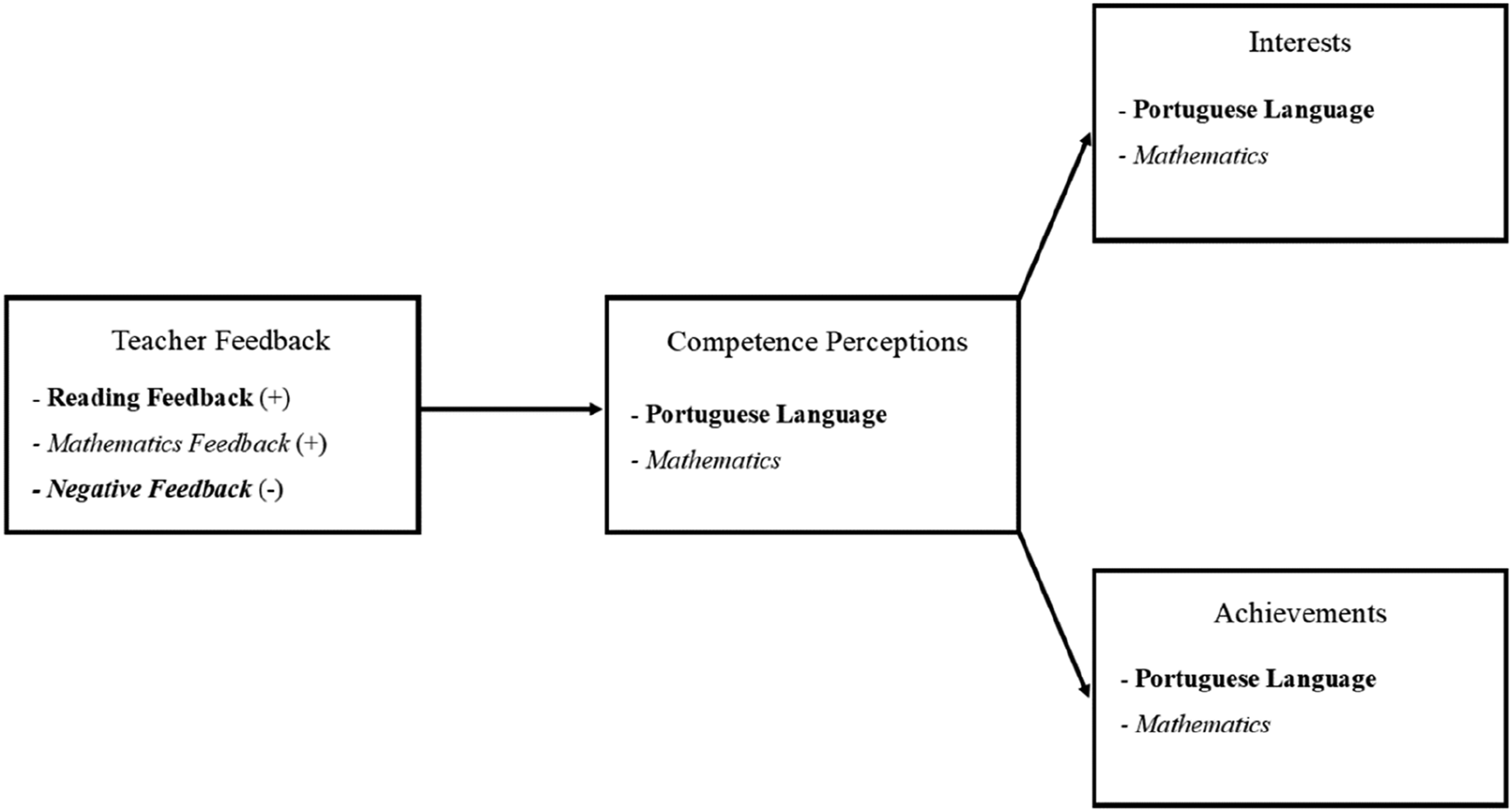
Drawing from the principles of the aforementioned social cognitive career models (Lent et al., 1994), we will test the following hypotheses:
Positive attributional feedback in reading will be positively associated with children’s perceived competence in Portuguese.
Positive attributional feedback in mathematics will be positively associated with children’s perceived competence in mathematics.
Negative feedback will be negatively associated with children’s perceived competencies in Portuguese and mathematics.
Perceived competence in Portuguese will be associated with children’s (a) interest and (b) achievement in Portuguese language.
Perceived competence in mathematics will be associated with children’s (a) interest and (b) achievement in mathematics.
Perceived competence in Portuguese will account for the relationship between positive attributional feedback in reading and children’s (a) interest and (b) achievement in Portuguese.
Perceived competence in mathematics will account for the relationship between positive attributional feedback in mathematics and children’s (a) interest and (b) achievement in mathematics.
Perceived competencies in Portuguese and mathematics will account for the relationship between negative feedback and children’s (a) interest and (b) achievement in Portuguese and mathematics.
Method
Participants
The sample consisted of 409 fourth-grade students (51% male), with ages ranging between 9 and 13 years (M = 9.41, SD = .58). In the Portuguese educational system, fourth-grade students typically range in age from 9 to 10 years. Within this sample, there were 12 students (2.8%) aged 11 to 13 due to grade retention. Most of the participants (84%) were of Portuguese origin. Among the 16% who were born in other countries, 52% were from Brazil, 23% from Portuguese-speaking African countries, and the remaining 25% from other countries. Based on the socioeconomic indicators retrieved from the schools’ websites (parental education levels and proportion of students benefiting from scholar social assistance), participants’ socioeconomic class was classified as 44% from middle-class backgrounds, 34% from upper-middle-class backgrounds, and 22% from lower-middle-class backgrounds.
Instruments
Teacher feedback
Children’s perceptions of teacher feedback were assessed through the Portuguese version of the Teacher Feedback Scale (P-TFS; Laranjeira & Teixeira, 2023; see Burnett, 2002 for the original version). For this study, we used 18 items from the scale, which form the subscales of positive attributional feedback in reading (six items; e.g., “You put a lot of effort in your reading”), positive attributional feedback in mathematics (eight items; e.g., “You have good ability in maths”), and general negative feedback (four items; e.g., “That’s very untidy work”). Children were asked to rate how often their teacher used each statement while talking to them, using a three-point scale (1 = Never, 2 = Sometimes, 3 = Often).
The P-TFS exhibited favorable indicators of validity and reliability in samples of Portuguese children (Laranjeira & Teixeira, 2023). For simplicity, the subscales of positive attributional feedback in reading and mathematics will be referred to as “reading feedback” and “mathematics feedback” from this point onwards. Similarly, the subscale of general negative feedback will be shortened to “negative feedback.”
Perceived Competencies
Students rated their perceived competencies in their native language (Portuguese) and mathematics using three items for each subject, adapted from Oppermann and collaborators’ work (2021). Originally, these items measured perceived competencies in mathematics, Finnish language, and science. For our study, they were translated and modified to the subjects investigated, as follows: “I am good in Portuguese/mathematics,” “I am good at schoolwork in Portuguese/mathematics,” and “The schoolwork in Portuguese/mathematics is easy for me.” Responses were recorded on a three-point scale (1 = Few, 2 = More or less, 3 = Very). Mean scores of students’ responses were calculated for each subject. In the original study with third-grade students, reliability scores exceeded .80 (Oppermann et al., 2021).
Interests
Interests in Portuguese language and mathematics were also assessed using three items for each subject adapted from Oppermann et al. (2021). These scales, initially developed for the aforementioned subjects, were adapted to include the subjects of our study, resulting in the following statements: “Learning Portuguese/mathematics is fun,” “I like to do schoolwork of Portuguese/mathematics,” and “I like Portuguese/mathematics.” Responses were given on a three-point scale (1 = Few, 2 = More or less, 3 = Very). For each subject, students’ responses were averaged to calculate mean scores. The original study reported reliability estimates above .80 (Oppermann et al., 2021).
Achievement
Achievement was assessed based on the grades obtained by students, collected through the sociodemographic and academic data questionnaire. Specifically, students were asked “What was your Portuguese grade in the last semester?” and “What was your mathematics grade in the last semester?”. Since the data were gathered at the beginning of the second semester (during February and March), the responses corresponded to the grades received at the end of the first semester (in January). Based on the Portuguese grading system, the responses could be “very insufficient,” “insufficient,” “sufficient,” “good,” or “very good,” which were converted into scores ranging from 1 (very insufficient) to 5 (very good).
Procedure
This project was approved by the Deontology Commission of the researchers’ affiliated institution. Schools were selected based on the professional network of the researchers, and collaboration in the study was requested from school principals via email. Twelve schools from the metropolitan area of Lisbon agreed to participate (eight public and four private), five did not respond to the request, and three declined. No incentives were provided for participation, and the only condition was to share the general results at the end of the research project.
Before application, written informed consent was sent to the children’s parents or guardians. Approximately 50 guardians declined participation for their children. For those children, an alternative task, consisting of a word search puzzle, was provided.
The questionnaires were administered in the classrooms during a single session by the principal researcher, with class teachers present. At the beginning of the session, the researcher informed the children about the research objectives and assured them of the anonymity and confidentiality of their data. The children were advised that they had the option to decline participation or withdraw from the study at any point. None of the children chose to refuse or discontinue their participation.
Verbal instructions were given for completing the questionnaires, after which students independently filled out the items. When students encountered difficulties reading the items, the researcher read the questions aloud to them individually. In a school located in an area of socioeconomic vulnerability, the presence of the school psychologist was requested to assist the researcher in reading the questionnaires for children in need of support. The completion of the questionnaires took about 20 minutes.
Data Analysis
The data were analyzed using IBM SPSS Statistics and R Studio. In R Studio, the packages lavaan (Rosseel, 2012) and semTools (Jorgensen et al., 2022) were used for the structural equation modeling (SEM) analysis. Initially, the data were checked for missing values, which ranged from 0.2% to 1%. According to Little’s MCAR test (Little, 1988), the missing data were found to be missing completely at random (χ2(86) = 70.28, p = .89). Subsequently, the expectation–maximization (EM) algorithm, known for its robustness, was used to estimate the missing data (Little & Rubin, 2019).
Descriptive Statistics
Multivariate descriptive statistics were computed to examine the central tendency of the data and the normality of its distributions. This analysis involved calculating means, standard deviations, skewness, and kurtosis. According to Byrne (2010), skewness scores should ideally fall within the range of −2 to +2, while kurtosis scores are expected to be between −7 and +7. Pearson’s correlations were calculated to estimate the direction and strength of the relationships among the study variables. Correlations are generally classified as weak or small with values between .10 and .30, moderate between .30 and .50, and strong above .50 (Cohen, 1988).
Structural Equation Modeling Analysis
SEM with latent variables was employed to analyze the proposed model. While our conceptual model anticipated that the effects of teacher feedback on interests and achievement would be fully explained by competence perceptions, the SEM analysis also considered the direct effects of teacher feedback on these outcomes.
First, a measurement model was tested to ensure the validity and reliability of our measurement instruments, using confirmatory factor analysis (CFA) with the maximum likelihood (ML) estimator. The measurement model included seven latent variables: perceived competence in Portuguese, perceived competence in mathematics, interest in Portuguese, interest in mathematics, positive feedback in reading, positive feedback in mathematics, and negative feedback. Each perceived competence and interest variable had three observed indicators. Reading feedback was measured with six indicators, mathematics feedback with eight, and negative feedback with four. Convergent validity was assessed using the average variance extracted (AVE), while internal consistency was evaluated using Cronbach’s alphas. AVE values exceeding 50% are considered acceptable indicators of convergent validity (Fornell & Larcker, 1981), and Cronbach’s alphas above .70 indicate good internal consistency (Nunnally & Bernstein, 1994).
For the structural model, ML estimator was employed, and 1000 bootstrap replication samples were used to calculate confidence intervals (CIs) for both direct and indirect effects.
The comparative fit index (CFI), the Tucker–Lewis index (TLI), the root mean square error of approximation (RMSEA) with a 90% confidence interval (CI), and the standardized root mean square residual (SRMR) were employed to assess the fit of both measurement and structural models. A model is deemed to have a satisfactory fit when the CFI and the TLI are both greater than .90, as suggested by Bentler and Dudgeon (1996). Additionally, the RMSEA should be less than .10, and the SRMR should be less than .08 (Hu & Bentler, 1999).
Results
Descriptive Statistics
Descriptive Statistics of the Variables in the Study.
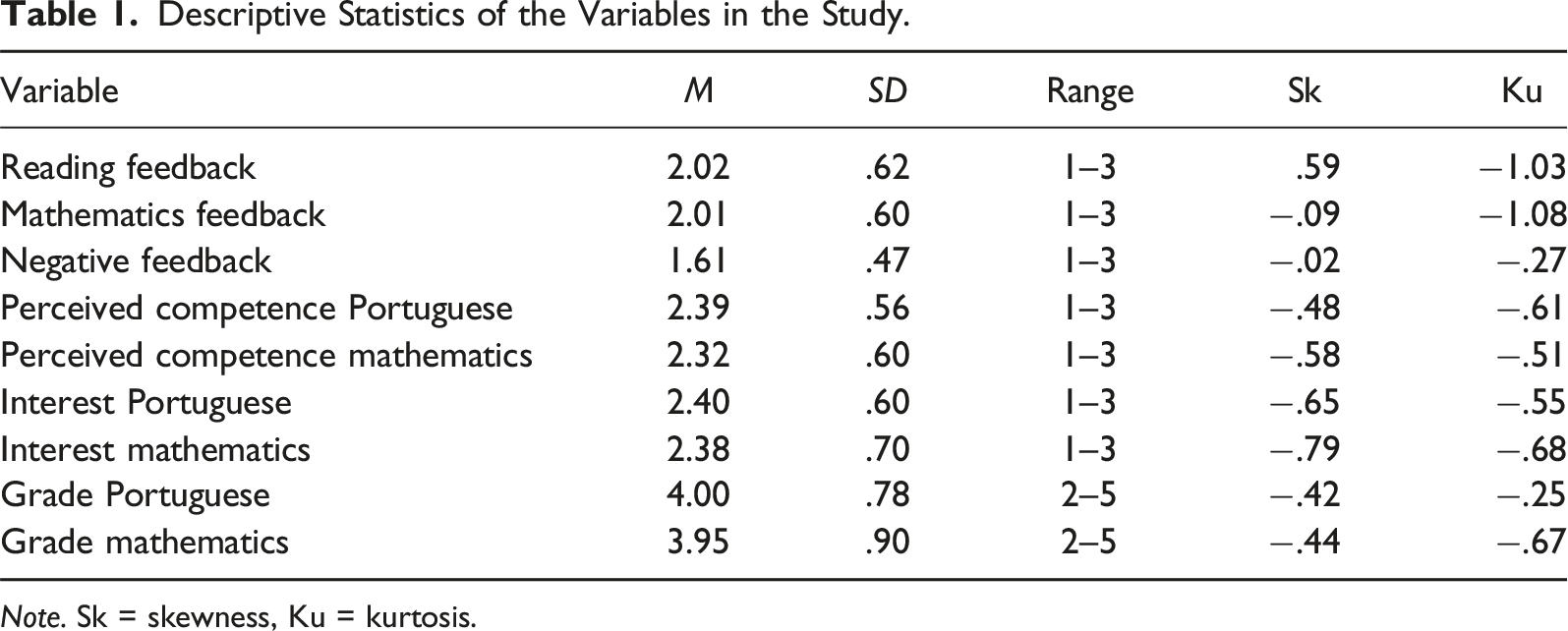
Note. Sk = skewness, Ku = kurtosis.
Bivariate Correlations Among Study Variables.
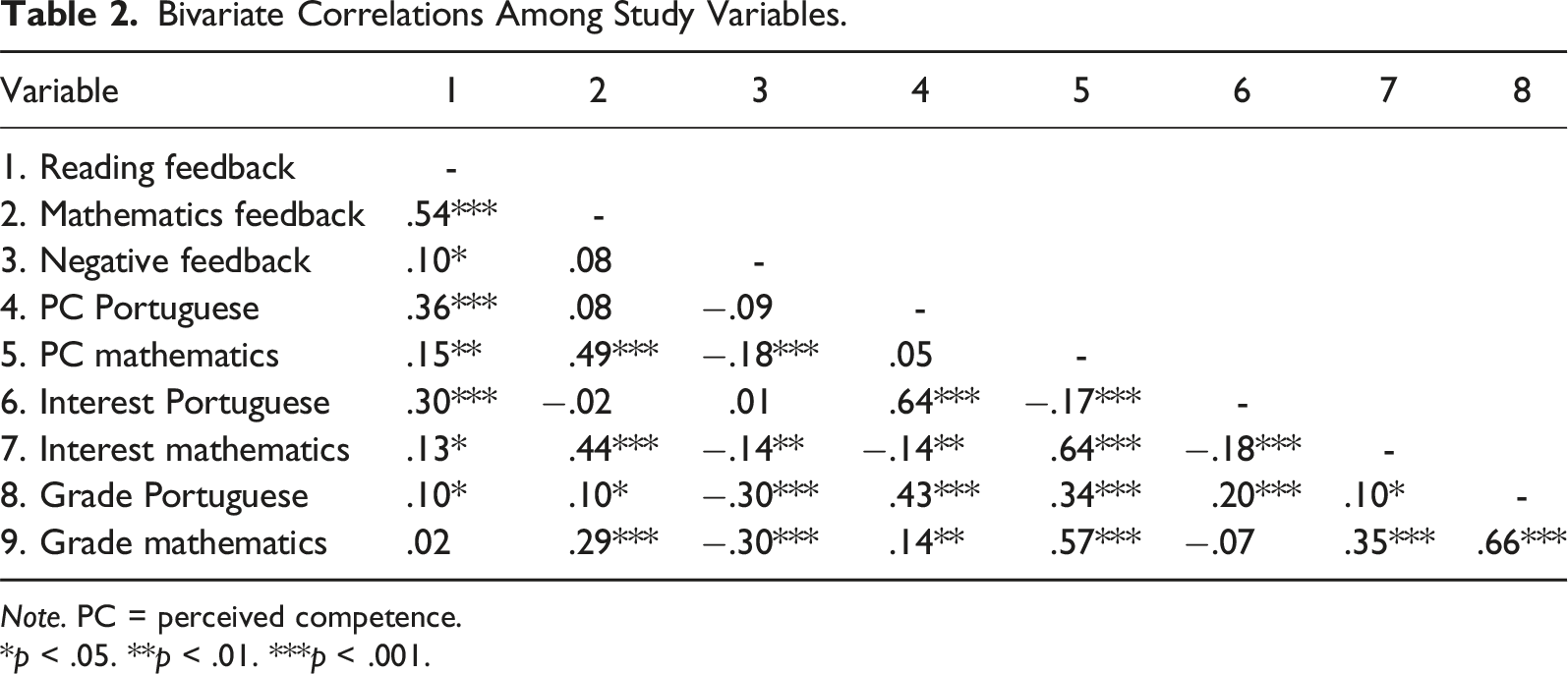
Note. PC = perceived competence.
*p < .05. **p < .01. ***p < .001.
Moderate correlations are also noteworthy. Reading feedback correlates moderately with perceived competence in Portuguese (r = .36, p < .001) and interest in Portuguese (r = .30, p < .001). Similarly, mathematics feedback correlates moderately with perceived competence in Mathematics (r = .49, p < .001), interest in mathematics (r = .44, p < .001), and mathematics grades (r = .29, p < .001). Furthermore, competence perceptions in Portuguese correlate with Portuguese grades (r = .34, p < .001), and interest in mathematics correlates with mathematics grades (r = .35, p < .001). Negative feedback is negatively associated with grades in both Portuguese and mathematics (r = −.30, p < .001).
Structural Equation Modeling Analysis
Summary of the Measurement Model.
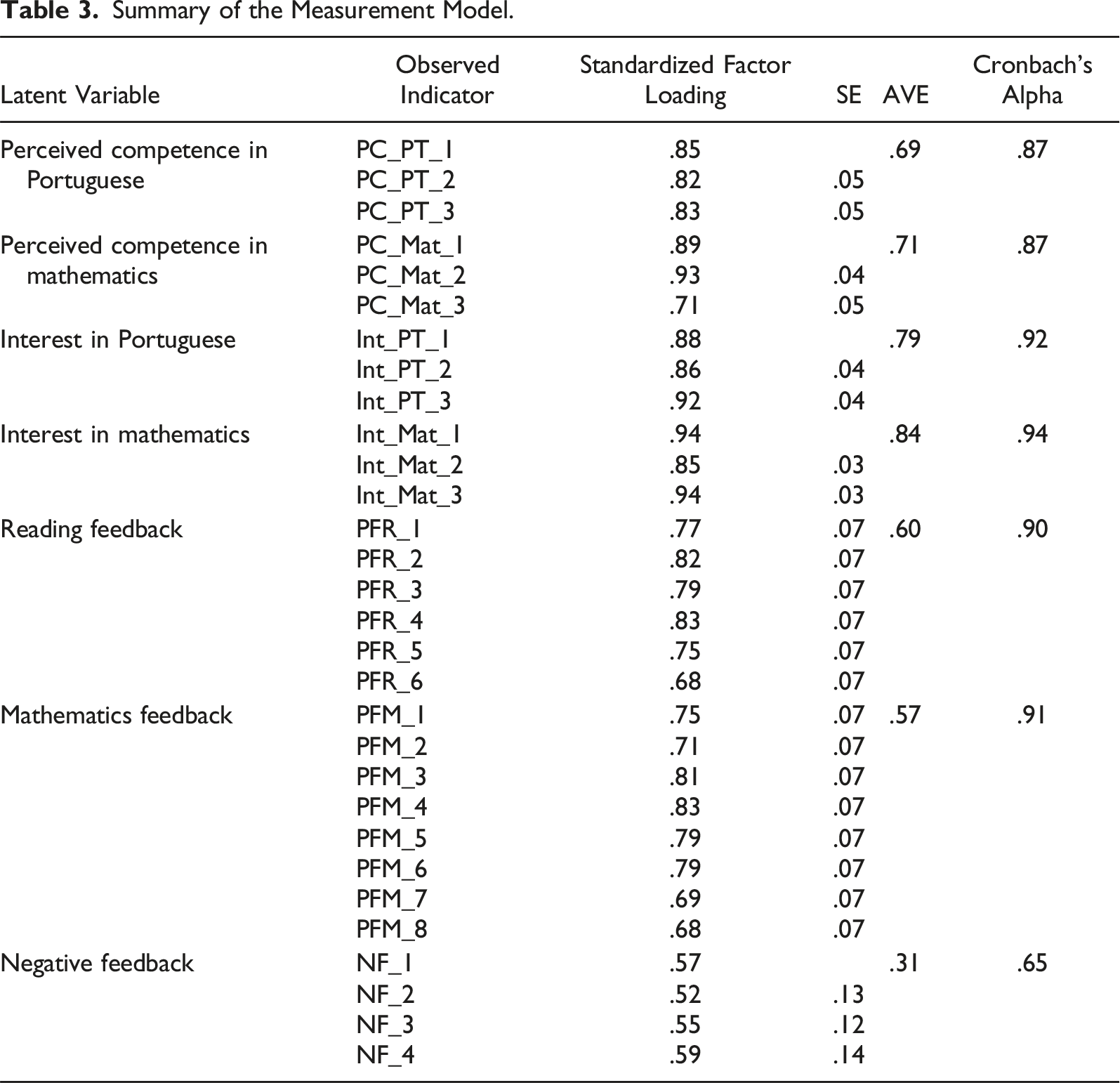
Next, to examine the proposed relationships among teacher feedback, perceived competencies, interests, and grades, a structural model was tested. The fit indices revealed that the proposed model fits adequately to the data (CFI = .92, TLI = .91, RMSEA = .06, 90% CI of RMSEA = .06 to .07, SRMR = .08).
Standardized Direct and Indirect Effects of the Variables in the Structural Model.
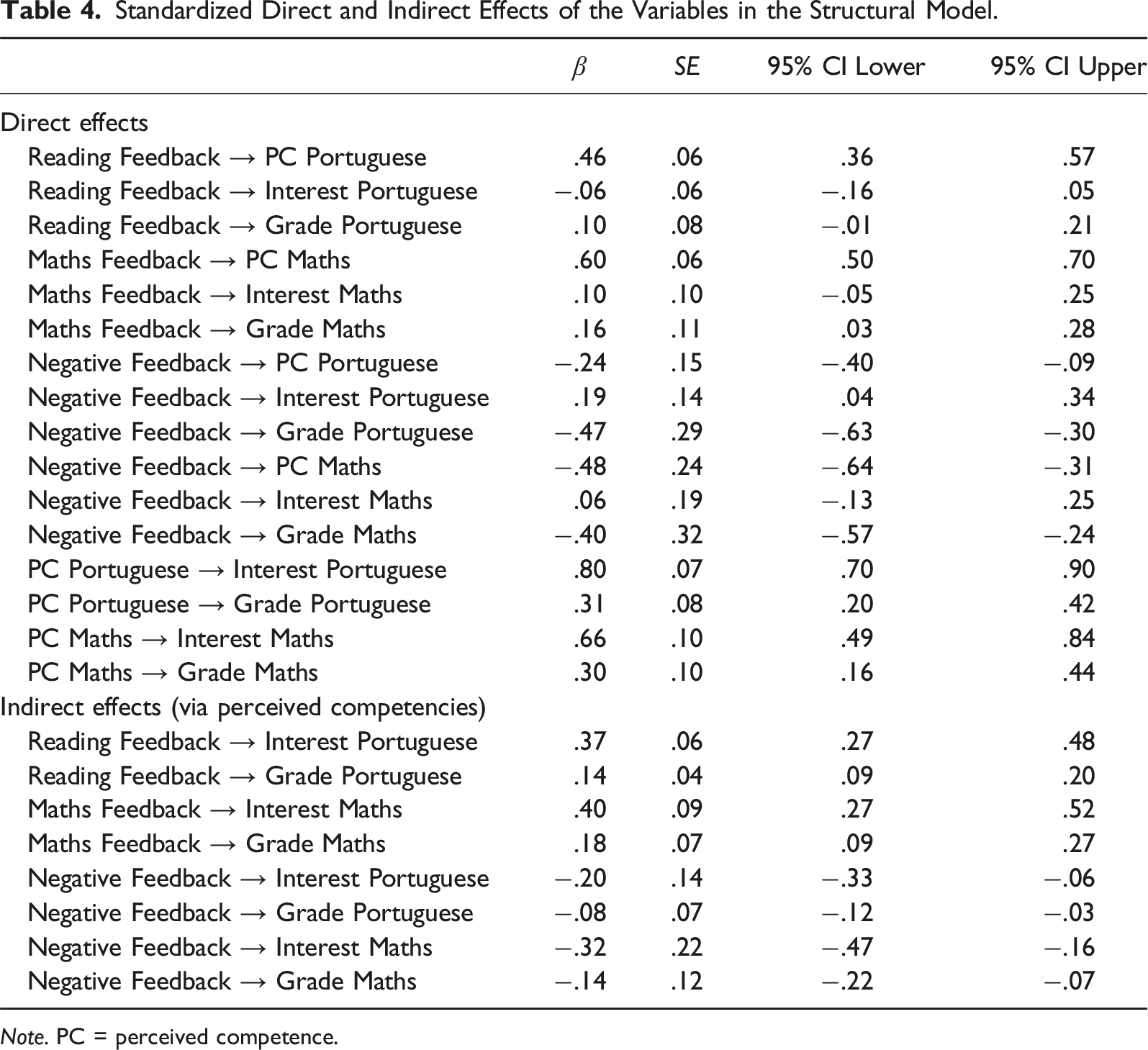
Note. PC = perceived competence.
The variance of interests in Portuguese and mathematics explained by feedback and competence perceptions was 60% and 50%, respectively. Interest in Portuguese was significantly predicted by perceived competence in Portuguese (B = .86, p < .001) and negative feedback (B = .30, p = .033), while interest in mathematics was found to be predicted only by perceived competence in mathematics (B = .78, p < .001).
Variables in the model explained 37% of the variance of grades in Portuguese and 41% of grades in mathematics. Portuguese grade was found to be predicted by perceived competence in Portuguese (B = .45, p < .001) and negative feedback (B = −1.01, p < .001). Additionally, the mathematics grade was predicted by perceived competence in mathematics (B = .43, p < .001), mathematics feedback (B = .26, p = .018), and negative feedback (B = −.99, p = .002).
Regarding indirect effects, the results showed that perceived competencies in Portuguese fully explained the relationship between reading feedback and interests in Portuguese (B = .39, p < .001). Similarly, the effect of reading feedback on Portuguese grades is also explained by competence perceptions (B = .20, p < .001).
For mathematics, the indirect effect of perceived competencies is also significant, both in the relationship between feedback and interests (B = .54, p < .001), and feedback and grades (B = .30, p < .001).
Additionally, significant indirect effects were observed between negative feedback and interests in Portuguese (B = −.31, p = .022) and mathematics (B = −.54, p < .001), and between negative feedback and grades in Portuguese (B = −.16, p = .015) and mathematics (B = −.36, p = .002).
Discussion
Drawing on the SCCT (Lent et al., 1994), this study aimed to analyze the associations between social persuasion, in the form of teacher feedback, and students’ perceived competencies, interests, and academic achievement among fourth-grade students. Employing structural equation modeling, we examined the associations of both attributional and negative teacher feedback with children’s competence perceptions, as well as their indirect effects on interests and grades in Portuguese language and mathematics. This study offers original insights by applying social cognitive career models to childhood and exploring how teacher feedback, as a source of self-efficacy, may contribute to students’ career development. Additionally, it addresses gaps in the literature by responding to the scarcity of studies examining the relationship between learning experiences and career development in childhood, particularly in Portugal.
Data supported the first hypothesis (H1). Reading feedback is positively associated with children’s perceived competence in Portuguese. This finding is consistent with our theoretical framework (Bandura, 1997; Lent et al., 1994), which posits that verbal persuasion is a source of self-efficacy particularly influential during the first years of schooling. Feedback is one of the most common strategies used in interventions designed to improve reading self-efficacy (Unrau et al., 2018). A previous study by Burnett (2003) demonstrated that children who received more positive feedback from teachers in reading exhibited more positive self-talk, which subsequently led to a greater perception of their abilities.
Similarly, the data also supported the second hypothesis (H2): mathematics feedback is positively associated with children’s perceived competence in this subject. Taken together, findings from these two hypotheses underscore the role of positive attributional feedback in strengthening students’ perceived competencies. Improving the quality of teacher feedback is one intervention strategy to enhance students’ mathematics self-efficacy (Siegle & McCoach, 2007). Moreover, in a study comparing social persuasion from various sources (family, peers, and teachers), feedback from teachers emerged as the most significant predictor of students’ mathematics self-efficacy (Ahn et al., 2017). These findings are particularly relevant considering the critical role of mathematics across various educational and professional domains, especially in STEM areas. Students’ proficiency in mathematics significantly influences the range of career options available to them (Lent et al., 2001).
Data also supported the third hypothesis (H3). In this study, negative feedback showed a detrimental relationship with students’ perceived competence in both Portuguese and mathematics. Negative feedback often conveys criticism, which students may interpret as a signal of incompetence, thereby undermining their competence beliefs (Fong et al., 2019; Hu et al., 2016). However, caution must be taken in interpreting the results of negative feedback. While this particular subscale showed acceptable internal consistency (Nunnally & Bernstein, 1994), its AVE was below the acceptable cut-off (Fornell & Larcker, 1981), suggesting a need to revise some of its items.
The findings were consistent with both the fourth and fifth hypotheses: perceived competencies in Portuguese and mathematics are strongly associated with students’ interests (H4a and H5a) and moderately associated with grades (H4b and H5b). Social cognitive career models (Lent et al., 1994) provide the theoretical background to explain these relationships, and the literature in both educational and vocational fields offers robust evidence of the dynamic relationships among these variables (e.g., Grigg et al., 2018; Schöber et al., 2018). The relationship between self-efficacy and interests, though reciprocal over time (Nauta et al., 2002), tends to be stronger from self-efficacy to interests than in the reverse direction (Lent et al., 2008). Concerning achievement, students who perceive themselves as more competent in a certain subject or domain typically attain better results. This relationship could be explained by cognitive mechanisms such as setting challenging goals for themselves, exerting more effort on difficult tasks, and demonstrating greater resilience when facing adversities (Schöber et al., 2018; Schunk & Pajares, 2009).
The data also supported the sixth and seventh hypotheses. Perceived competence in Portuguese accounts for the relationship between teacher reading feedback and children’s interest (H6a) and achievement (H6b) in Portuguese language. Similar effects were found for mathematics (H7a and H7b). These findings align with the propositions of social cognitive career models (Lent et al., 1994) and highlight the role of teacher feedback in motivating students and enhancing their achievement, contributing to a clearer understanding of the underlying processes in these relationships. In a study using data from PISA 2018, the association between teacher feedback and reading achievement was significantly mediated by reading self-concept (Ma et al., 2022). Moreover, positive teacher feedback in reading and mathematics appears to influence not only perceived competencies and interests in the related subjects but also extends to children’s school and out-of-school activities classified within RIASEC areas (Laranjeira & Teixeira, 2016), thereby reinforcing the role of teacher practices on career development.
The hypothesis that perceived competencies in both Portuguese language and mathematics explain the effect of negative teacher feedback on children’s interests (H8a) and grades (H8b) is also supported. Previous research confirms that criticism poses a threat to self-efficacy, resulting in decreased intrinsic motivation and performance (Weidinger et al., 2016). In the vocational field, this relationship can narrow future educational and professional choices based on a low perception of competence. However, the adverse effects of negative teacher feedback identified in this study should be understood within the cultural context. For instance, in a study comparing sensitivity to criticism among children from Western and Eastern cultures, Mizokawa and Lecce (2017) found that criticism appears to be a negative experience for Italian children but not necessarily for Japanese children.
Theoretical Implications
These data carry significant theoretical implications. First, they tend to validate teacher feedback as a form of social persuasion, a source of self-efficacy. Elementary school teachers emerge as pivotal figures in fostering positive career development among children. The content of their feedback can shape students’ motivational beliefs, influencing their self-perceptions as either a “language person” or a “math person” (Wan et al., 2021). These early influences on career development are crucial, as vocational interests established at a young age tend to remain relatively stable through late childhood and early adolescence (Gfrörer et al., 2022). Therefore, researchers studying career development should consider these early influences within the school environment and explore how they contribute to shaping individuals’ vocational self-concepts and career paths.
Second, the direct and indirect relationships among variables support the social cognitive career models of interest development and performance in childhood, thereby expanding the literature on career development during this critical stage of life. This study reinforces SCCT’s premise that self-efficacy beliefs play a crucial role in career development processes, potentially influencing the formation of interests and serving as an inherent factor in academic achievement. This confirms self-efficacy as a regulator of motivation that significantly contributes to individuals’ performance (Bandura, 1997).
Third, our data address gaps in research by emphasizing the close connection between academic and career dimensions and providing insights into the social learning processes that either promote or hinder career plans throughout life.
Practical Implications
The data highlight the importance of teachers’ positive communication strategies in career development. Throughout schooling, feedback from teachers should emphasize students’ strengths and effort while simultaneously encouraging them to believe in their ability to improve, given that attributional feedback has been demonstrated to influence students’ motivation and learning (e.g., Hau & Salili, 1996). Conversely, criticism can undermine children’s perceptions of competence, acting as a barrier to their development of interests and academic success. Together, these findings can inform practices in various educational contexts, including family (e.g., parenting styles) and extracurricular activities (e.g., music and sports).
These implications extend to the work of school counselors, who can actively contribute to creating enriching learning and social environments by collaborating with students and educators, including teachers, parents, and coaches. School counselors can promote positive feedback practices by conducting workshops to train educators on effective ways to deliver positive feedback and to raise awareness about the detrimental effects of negative feedback. Insights from this study can also help practitioners identify at-risk students, particularly those who may not be receiving sufficient positive feedback, and design counseling interventions that incorporate strategies to help these students internalize positive feedback and improve their self-perception.
Finally, the results of this study offer important insights for career education interventions. In elementary school, these interventions should involve students, teachers, and families (Knight, 2015) and focus on enhancing self-knowledge while offering students opportunities to succeed in various activities and subjects (Seligman, 1994). By providing positive attributional feedback and nurturing confidence in academic abilities, educators can help students develop interests, set performance goals, and achieve success, laying the foundation for their future career plans.
Limitations and Future Directions
Several limitations should be acknowledged in this study. First, despite employing mediation analysis, the cross-sectional nature of our study precludes us from drawing causal conclusions. Additionally, achievement was analyzed as a dependent variable but measured as past achievement, which could introduce a directional issue. Specifically, it is possible that students’ grades in the first semester influenced their perceptions of teacher feedback at the time of data collection and served as a source of self-efficacy (mastery experience) to predict their perceived competencies. While we recognize the reciprocal and dynamic influence among the variables that our statistical model does not account for, previous evidence shows that student reports of teacher practices are highly consistent across the school year, and single-point student reports have high predictive validity for both achievement and self-concept (Wagner et al., 2016). Similarly, students’ achievement also tends to be stable over the school year (Nuutila et al., 2018). This consistency suggests that perceptions of teacher feedback at the time of data collection would likely be similar to those from the first semester. Additionally, grades in the first semester typically align closely with those in the second. Nonetheless, this limitation should be addressed in future research, which should consider longitudinal designs to track the effects of teacher feedback over time, allowing for a more comprehensive understanding of these bidirectional influences.
Another limitation is the convenience sample, which was not representative of the entire population of fourth-grade students. Despite its size and social heterogeneity, our data collection was confined to the vicinity of the capital of Portugal, limiting the generalizability of our findings to a broader geographical context.
Third, the use of self-report measures may be susceptible to biases in information retrieval by children (Stone & Shiffman, 2002). This limitation is particularly significant in the case of achievement, which was assessed based on students’ reports of their grades rather than on official records. Additionally, variables that could potentially influence the perception of feedback, such as the duration or stability of the teacher–student relationship, were not controlled for in our study. To address potential biases and enhance the robustness of future investigations, researchers may consider implementing a triangulation approach, combining observation, children’s perceptions, and teachers’ perceptions as alternative data collection methods.
Fourth, the data analysis did not include the variable “gender,” which is one of the factors that circumscribe children’s vocational self-concept (Gottfredson, 2002). Gender differences in preferences for subjects and types of activities emerge as early as elementary school (Tracey, 2002). Boys typically show a higher interest in mathematics, whereas girls tend to prefer their native language (e.g., Oppermann & Lazarides, 2023). Moreover, boys and girls also differ in their susceptibility to social persuasion (Joët et al., 2011). Therefore, future research should explore the potential moderating effect of gender on the associations observed in this study.
Future studies have the potential to expand upon the present findings by introducing other subjects (e.g., sports and arts) and including students from various educational levels over the course of schooling. Additionally, we suggest a thorough investigation into how contextual conditions and early perceived competencies, interests, and achievements may shape educational and vocational paths. Testing the social cognitive career models longitudinally, starting from childhood, is a promising avenue for future research to clarify the influence of social persuasion on career paths.
Conclusion
In sum, this study provides cross-sectional data that support social cognitive career models in childhood, particularly the models of interest development and performance. It highlights the importance of teacher feedback as a source of self-efficacy in native language and mathematics—two central subjects for lifelong learning. The study also shed light on the relationships among teacher feedback, children’s perceived competencies, interests, and grades. Positive attributional feedback in reading and mathematics is positively associated with perceived competencies, interests, and grades in these subjects, while negative feedback shows a detrimental relationship with all of these variables. The findings underscore the importance of a holistic and integrated approach to academic and career developmental processes and highlight the crucial role of messages from significant adults in children’s career development. The data has significant implications for career education interventions aimed at both children and educators. Such interventions should aim to create favorable conditions for children’s capabilities to flourish, thereby expanding their opportunities and preventing the premature closure of future options due to social constraints.
Footnotes
Declaration of Conflicting Interests
The author(s) declared no potential conflicts of interest with respect to the research, authorship, and/or publication of this article.
Funding
The author(s) disclosed receipt of the following financial support for the research, authorship, and/or publication of this article: This work received Portuguese national funding from FCT—Fundação para a Ciência e a Tecnologia, I.P., through the Research Center for Psychological Science of the Faculty of Psychology, University of Lisbon (UIDB/04527/2020; UIDP/04527/2020). The work was also supported by the FCT—Fundação para a Ciência e a Tecnologia, I.P., under a PhD grant (2020.06562.BD) assigned to the first author. For the purpose of Open Access, the author has applied a CC-BY public copyright license to any Author’s Accepted Manuscript (AAM) version arising from this submission.
