




Abstract
Based on career construction theory, this study explored the relationship and mediating mechanisms between career adaptability and secondary school students’ academic engagement. Four hundred and eight secondary school students from three Chinese secondary schools were surveyed using a three-wave time-lag design. The study found that career adaptability positively predicted academic engagement. Parental support and career hope mediated the relationship between career adaptability and academic engagement. Additionally, parental support and career hope also played a series of mediating roles between career adaptability and academic engagement. The results of this study contribute to the fields of positive psychology and occupational psychology research, extend the application of career construction theory to secondary students, and provide practical insights into increasing academic engagement and interventions for secondary students. The implications of these findings for practice and future research are discussed.
Keywords
Introduction
Academic engagement is a positive, fulfilling, and sustained emotional and cognitive state associated with learning (Fang et al., 2008; Schaufeli et al., 2002), and it can predict students’ academic performance and their future development (Lei et al., 2018). It is the key to student’s academic success (Plasman, 2018) and the guarantee of high-quality school education (Vidić et al., 2022). Previous studies rarely look at adolescent learning from the perspective of career development (Paradnikė & Bandzevičienė, 2016). Especially in China, career education is only included in university courses, while career education in secondary schools is in its infancy and schools pay more attention to students’ academic performance (Xie et al., 2019). Career education is closely related to academic performance, and some researchers have found that various indicators of students’ career development are strongly associated with academic performance (Enrique et al., 2016; Paradnikė & Bandzevičienė, 2016), but there is little relevant literature in China. Therefore, it is important to focus on secondary school students’ learning from a career construction perspective in China.
Career development is a lifelong process, and in a world of rapid change, academics believe that career adaptability is becoming increasingly important for teenagers and young adults (Yuen & Yau, 2015). Secondary school is a crucial period for job preparation as well as career development and exploration. They will combine their career goals with their studies, as well as explore their life goals and personal development, and will play an important role in advancing them throughout their lives (Chen et al., 2022). Career adaptability and secondary students’ academic achievement should be mutually and positively linked throughout the secondary school years, so that their career aspirations can be closely linked to their educational goals, which can help secondary students better plan their future careers and complete their current studies (Negru-Subtirica & Pop, 2016). In order to better promote secondary school students’ academic engagement, this study will explore the relationship between career adaptability and secondary school students’ academic engagement from the perspective of career construction theory, combining personal factors such as career hope and relational factors such as parental support, and the underlying mechanisms of their interactions.
Theoretical Underpinnings
Career Construction Theory
Person-job fit has traditionally been regarded as a crucial precondition for a person’s career development (Edwards, 1991). Nowadays, it is no longer possible for a person’s career development to remain static due to the uncertainty and quick changes in modern society. Instead, it is a dynamic process, and career adaptability has emerged (Savickas, 1997). On this basis, Savickas (2002) proposed the Career Construction Theory. He believes that for everyone, the process of career construction is similar to how individuals interpret a personal life theme story with their own protagonist and career development as the clue (Savickas, 2002, 2013). This theory has been an eye-catching rookie in the research of vocational psychology in the last 20 years.
Career adaptability is a core element of career construction theory, which is a psychosocial construct and resource (Savickas, 2002, 2013; Savickas & Porfeli, 2012). It is defined as “an individual’s readiness and resources for coping with current and anticipated tasks of vocational development” (Savickas, 2002, p. 156). It consists of career concern, career control, career curiosity, and career confidence, which correspond to the questions “Do I have a future?”, “Who owns my future?”, “What do I want to do in the future?”, and “Can I do it?” (Hou et al., 2012; Savickas & Porfeli, 2012) list four important career development questions.
According to the theory of career construction, the essence of individual career development is a dynamic construction process of pursuing mutual adaptation between the subjective self and the external world. Internal needs and external opportunities influence the relationship between adaptability (career adaptability) and adaptation results (Savickas, 2013; Savickas & Porfeli, 2012). Indicators of adaptation results include satisfaction, engagement, and well-being (Rudolph, Lavigne, & Zacher, 2017). For secondary school students, academic engagement is an important indicator of adaptation results. They can achieve the dynamic construction of adaptation through internal needs, such as career hope, or external opportunities, such as social support. Of course, they can also achieve the dynamic construction of adaptation through both external opportunities and internal needs (Savickas, 2013).
Career Adaptability and Academic Engagement
Academic engagement is part of positive psychology, not as a transient and specific state, but as a more enduring and universal affective-cognitive state, “characterized by vigor, dedication, and absorption” (Schaufeli et al., 2002, p. 465). Vigor refers to a high level of energy and mental resilience in learning, as well as the willingness and ability to invest energy in learning. Dedication refers to a sense of meaning, enthusiasm, inspiration, pride, and challenge in the learning process. Absorption refers to the student’s total concentration in learning, close to what is known as flow, a state of the optimal learning experience (Fang et al., 2008; Schaufeli et al., 2002). Educators must strive to maintain and improve students’ academic engagement. It encourages positive academic outcomes while decreasing negative student behavior (Fredricks et al., 2019).
Career planning and career education were positively associated with secondary school students’ academic engagement, with those who have received career-related education being more engaged in their studies (e.g., Orthner et al., 2013; Plasman, 2018). Career adaptability as a part of career education, we predict that career adaptability will affect the academic engagement of secondary school students. Secondary school students’ primary responsibility is to learn, and those with high career adaptability connect their academics to their future, keep an eye on the future, and be ready for it (career concern) (Paradnikė & Bandzevičienė, 2016). They can think about themselves in learning contexts and investigate potential self and future occupations (career curiosity) (Savickas, 2002). This can make students more motivated and engaged in their learning. Students with high career adaptability have the confidence to pursue and construct their future (career confidence) (Paradnikė & Bandzevičienė, 2016). They are more self-disciplined, hard-working, and persistent in regulating their behaviors to take responsibility for their future during learning and exploration (career control) (Savickas, 2002; Savickas & Porfeli, 2012), which helps them to be more persistent and focused in their learning.
Some scholars have found that career adaptability plays an important role in university students’ academic engagement and can positively predict their academic engagement (Enrique et al., 2016; Paradnikė & Bandzevičienė, 2016). Although secondary school and university students have different learning styles and study schedules, their studies both require effort and engagement (van Rooij et al., 2017), and both need to start their careers before they engage in the actual act of working (Negru-Subtirica & Pop, 2016). So, we hypothesized that career adaptability would predict secondary students’ academic engagement.
Parental Support
According to career construction theory, students need to interact with others constantly during their personal growth and career construction, both at home and at school (Hou et al., 2012; Savickas, 2002). As we all know, the family is an important microsystem, and family members interact with each other every day. Parents’ support is the most common interaction for students, and it is also a vital support for students’ learning and growth (Wang & Eccles, 2012; Zhang et al., 2021). Parental support is “assistance provided by a primary caregiver to an individual” and the main supports are “parental provision of instrumental assistance, career-related modeling, verbal encouragement, and emotional support” (Guan et al., 2016, p. 7).
Previous research has shown a positive correlation between career adaptability and parental support (Zhang et al., 2021). Individuals with high career adaptability demonstrate low levels of indecision, actively seek outside assistance when they run into problems, and utilize social support to effectively solve problems (Hlad O et al., 2020; Savickas, 2013). For secondary school students, parental support remains the most crucial social support (Dietrich et al., 2011). Secondary school students with high career adaptability are more likely to adjust their behaviors and communicate with their parents, where their parents will know their needs and have the opportunity to provide more support (Savickas & Porfeli, 2012; Zhang et al., 2021). Furthermore, individuals with high career adaptability are better able to identify and integrate available resources, and parental support as a supportive resource is more likely to be perceived and utilized by high career-adaptive secondary students (Savickas, 2002, 2013). Therefore, secondary school students with high career adaptability may receive more parental support.
Parental support has the potential to increase secondary school students’ academic engagement. First, instrumental resource support from parents, such as financial help, can provide secondary school students with a wide range of educational opportunities (Hlad O et al., 2020), which is a material guarantee of their academic engagement. Second, parents’ career modeling is their main reference for deciding on their future career choices and setting goals and orientations for their engagement in learning (Tynkkynen et al., 2010). Finally, parents’ verbal encouragement and emotional support can maintain positive emotional interactions that help to increase secondary school student’s interest in learning and further promote engagement in learning (Guan et al., 2016).
Based on these analyses, we hypothesize that the relationship between career adaptability and academic engagement is mediated through parental support.
Career Hope
With the gradual development of positive psychology, there has been a growing body of research that combines positive psychology and career development (Santilli et al., 2017), with career hope being one of the key variables. Career hope is an individual’s sense of hope for their future career development, as well as the application of hope in the career field, which includes the three dimensions of career goal-certainty, career goal-pathway, and career goal-will (Huang et al., 2014). Career goal-certainty refers to the extent to which an individual has a clear or desired goal for their future career development, and it is only when the goal is clear that the individual is likely to make the relative effort. Career goal-pathways are individualized strategies for achieving career goals. Individuals with career goal-will can persist in choosing the road to attain their career goals, and when obstacles occur, they can overcome problems and find numerous alternative paths to reach their goals (Huang et al., 2014; Snyder et al., 2002).
Career construction theory claims that students with high career adaptability actively construct their careers by adapting to changing circumstances (Savickas, 2002). They are future-focused, future-exploring, future-responsible, and confident, which is a positive tendency to be hopeful and optimistic about the future (Savickas & Porfeli, 2012). It has been shown that career adaptability predicts hope (Di Maggio et al., 2020), so we hypothesize that career adaptability predicts career hope. Also, researchers have discovered a strong correlation between hope and learning engagement (Yoon et al., 2015), with higher hope associated with more learning engagement (Chen et al., 2020)). Individuals with career hope have clear learning goals, follow a path to achieve them, and are able to continuously improve their problem-solving skills, and expand the resources available to them to solve problems and achieve their goals. This increases students’ motivation to learn and encourages them to stay engaged in and sustain their learning (Huang et al., 2014; Snyder et al., 2002), so career hope contributes to learning engagement. Based on the above analysis, we infer that the relationship between career adaptability and academic engagement is mediated through career hope.
According to career construction theory, individuals can achieve a certain relative balance and development in the process of career construction by adjusting both their inner world and external environment (Savickas, 1997; Savickas & Porfeli, 2012). Individuals with high career adaptability seek more support from outside, and parental support is an important support for secondary school students (Dietrich et al., 2011; Zhang et al., 2021). Parents play a crucial role in fostering the inner hope of their children by serving as positive role models for how to communicate, set goals, handle challenges, and deal with issues (Marques & Lopez, 2018). Emotional support and verbal encouragement from parents provide a secure foundation for children’s growth. Children who are encouraged and praised by their parents for pursuing goals are more likely to have high hope, whereas children who are criticized and judged by their parents when they make mistakes are more likely to have low hope, and emotional support is the strongest predictor of hope in adolescents (Sui-chu Ho et al., 2021). Parental provision of instrumental assistance, such as financial support and the provision of a good educational environment, may make it easier for children to see hope (Dixson et al., 2018; Sui-chu Ho et al., 2021). Parental career-related modeling can help secondary school students understand careers and set career directions (Tynkkynen et al., 2010). Parental career modeling and career encouragement can positively predict young people’s hopes, allowing them to see future possibilities and career opportunities (Sui-chu Ho et al., 2021). In summary, we hypothesized that parental support and career hope would play a serial mediating role in the relationship between career adaptability and academic engagement.
Current Study
This study sought to explore the direct relationship and mechanisms between career adaptability and academic engagement of secondary school students based on career construction theory. In doing so, this study makes an effort to overcome the following limitations in the prior research literature. First, previous research has neglected to consider the enhancement of secondary students’ academic engagement from a career construction perspective in favor of examining secondary students’ academic engagement in the context of environmental circumstances. Second, career construction theory is more commonly applied to university students and the working population, while secondary students are underrepresented in career construction studies. Third, previous research has neglected the role of positive psychological factors in students’ academic engagement. In this study, we examine the relationship between career adaptability and academic engagement of secondary school students and the mediating role of parental support and career hope. The model is shown in Figure 1. Theoretical model.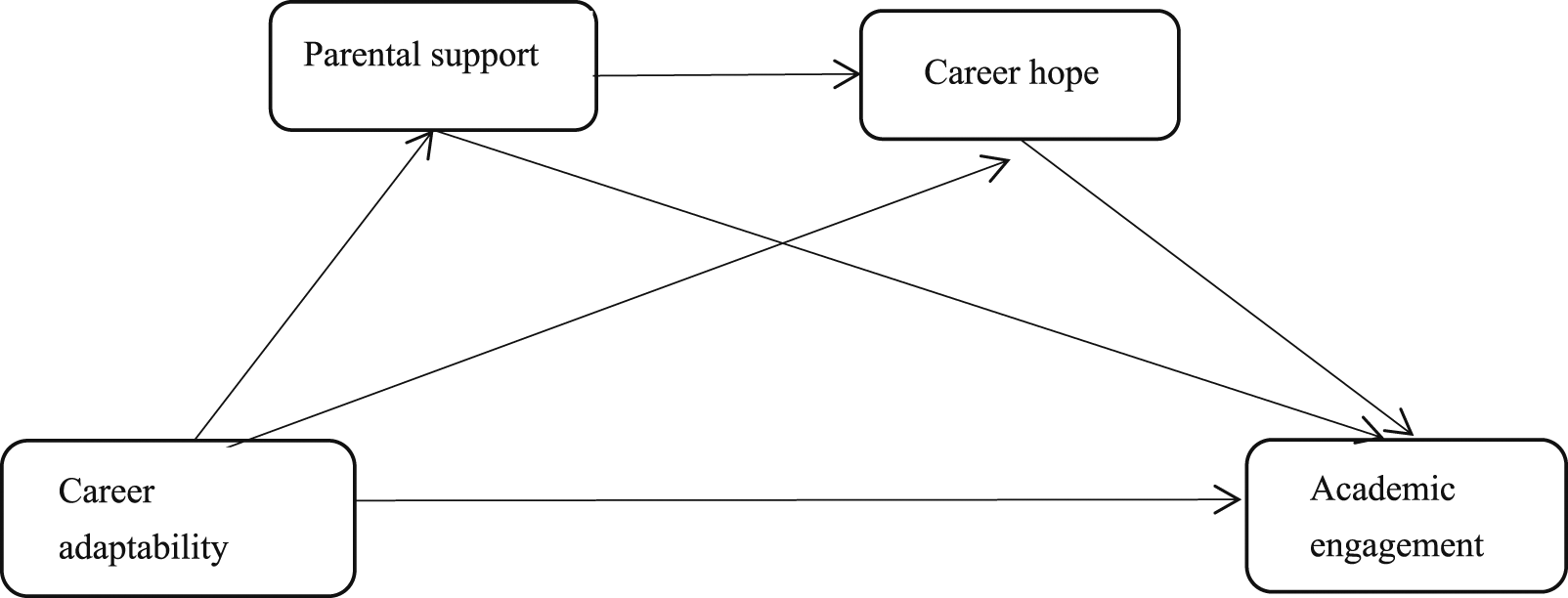
Method
Participants and Procedures
The Human Research Ethics Committee of the first author’s region approved the study before it began. Parents and teachers give their informed consent, and the results of the measurements are kept strictly confidential. Stratified whole-group random sampling was used to select participants in three secondary schools in China. First, three schools were randomly selected, then each school was divided into three strata according to grade levels, and one class was randomly selected from each stratum, making a total of nine classes, and finally the paper questionnaire was tested in these classes with the help of the classroom teachers. In order to reduce common method bias, there needs to be a time separation between the independent and mediating variables and the dependent variable, usually with an interval of up to 4 weeks between measurements (Cooper et al., 2020; Podsakoff et al., 2012). In this study, we arranged four time points to conduct the questionnaire survey. The first survey measured demographic characteristics variables and the Career Adaptability Scale. A second survey measuring the Parental Support Scale was carried out five weeks later. A third questionnaire was provided five weeks later to measure the Career Hope Scale. A fourth survey was conducted four weeks later to test the academic engagement of secondary school students. School numbers were used to match participants at different time points.
For the first time, we surveyed 441 secondary school students. After three surveys were matched by school number, 408 valid questionnaires (M = 16.10 years, SD = .85) were returned, for an effective rate of 92.51%. There were 146 students in Grade 9, 141 in Grade 10, and 121 in Grade 11. There are 223 boys and 185 girls, and their ages ranged from 15 to 19 years old (M = 16.10, SD = .85).
Measures
The four questionnaires used in this study are all Chinese versions revised by Chinese scholars. Responses to all items were scored on a 5-point Likert scale, except demographic variables (gender and grade) (1 for strongly disagree and 5 for strongly agree). We then calculated the means for each scale. The higher the score, the higher the corresponding psychological trait.
Career Adapt-Abilities Scale
We used the China form of the Career Adapt-Abilities Scale (CAAS) developed by Savickas and Porfeli (2012) and revised by Hou et al. (2012), which has 24 items and includes four dimensions: career concern, career control, career curiosity, and career confidence. A sample item was “Taking responsibility for my actions”. Most studies on career adaptability use a composite measure of career adaptability (Rudolph, Lavigne, Katz, & Zacher, 2017). Career adaptability can be studied using a composite measure of career adaptability that combines the four factors (Rudolph, Lavigne, Katz, & Zacher, 2017). This revised version, tested in China, was found to have good reliability, with alpha coefficients of .85, .75, .77, and .85 for the four dimensions of career concern, career control, career curiosity, and career confidence, respectively, and an overall alpha coefficient of .94 (Hou et al., 2012). The total alpha coefficient for this questionnaire in the survey was .93 and the alpha coefficients for each dimension were .82, .81, .82, and .86.
Network of Relationships Inventory
Parental support is measured using the Chinese version of the Network of Relationships Inventory (NRI) developed by Furman and Buhrmester (1985) and revised by Tian et al. (2012). The questionnaire consists of 15 items in 5 dimensions: companionship, instrumental aid, emotional support, intimacy, arguments, and conflict. For example, “You feel respected when you are with your parents.” The higher the score, the higher the level of parental support. Based on previous research, only the first four dimensions were combined into an overall mean score as the parental support score in this study (Rubin et al., 2004; Tian et al., 2012). The questionnaire has been used in both Eastern and Western countries (Furman & Buhrmester, 1992; Rubin et al., 2004). It also proved to have good reliability, with an alpha coefficient of .95 for the whole questionnaire and between .78 and .87 for each dimension (Tian et al., 2012). The total alpha coefficient for this questionnaire in the survey was .94 and the alpha coefficients for each dimension were .82, .86, .85, and .83.
Career Hope Scale
A 17-item Career Hope Scale (CHS) developed by Huang et al. (2014) was used, including 3 dimensions of career goal orientation, career goal path, and career goal persistence. A sample item was “I will adjust the pre-determined goals according to the actual situation.” According to Huang et al. (2014), the Career Hope Scale had good reliability in China, with an overall alpha coefficient of .91 and alpha coefficients of .86, .93, and .86 for each dimension. The total alpha coefficient for the questionnaire in this survey was .91, and the alpha coefficients for each dimension were .83, .84, and .81.
Utrecht Work Engagement Scale for Students
The 17-item Utrecht Work Engagement Scale for Students (UWES-S), developed by Schaufeli et al. (2002) and revised by Fang (2008), includes three dimensions: vigor, dedication, and absorption. A sample item was “I can continue for a very long time when I am studying.” The higher the score, the higher the level of academic engagement. The Chinese version of the Utrecht Work Engagement Scale for Students has good reliability and validity in China and can be used in pertinent studies. Its total alpha coefficient is .95, while its alpha coefficients for vigor, dedication, and absorption are .86, .91, and .90, respectively (Fang et al., 2008). The survey’s alpha coefficient for this questionnaire is .95, and the alpha coefficients for each dimension were .88, .90, and .88.
Control Variables
Controlling for variables that theoretically or empirically influence both the mediating variable (parental support and career hope) and the dependent variable (career adaptability) has been demonstrated by research. Variables such as age and gender were discovered to need to be controlled for in the literature on engagement in learning, parental support, and career hope. For example, research has shown that there are age and gender differences in parental support and hope (Furman & Buhrmester, 1992; Huang et al., 2014; Kemer & Atik, 2012), and there is also evidence that gender influences adolescent learning engagement (Milot & Ludden, 2009).
Results
Means, Standard Deviations, and Correlation Coefficients Between Variables (N = 408).
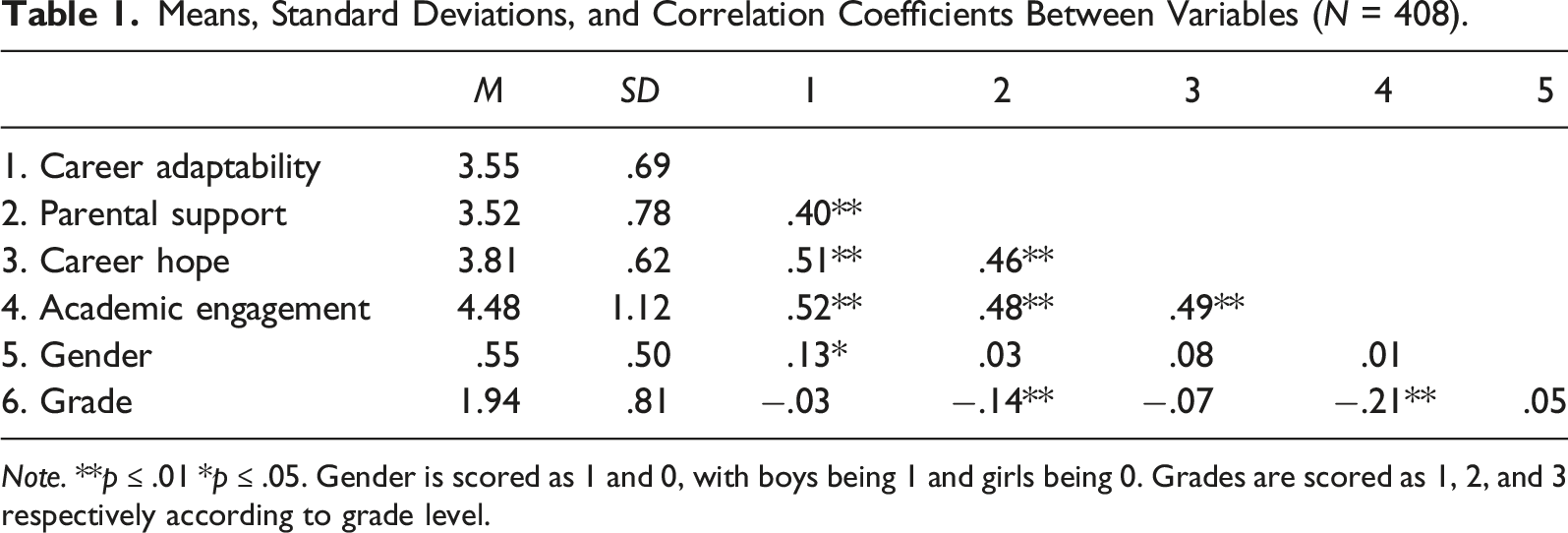
Note. **p ≤ .01 *p ≤ .05. Gender is scored as 1 and 0, with boys being 1 and girls being 0. Grades are scored as 1, 2, and 3 respectively according to grade level.
Results of Regression Tests for Mediation Effects.
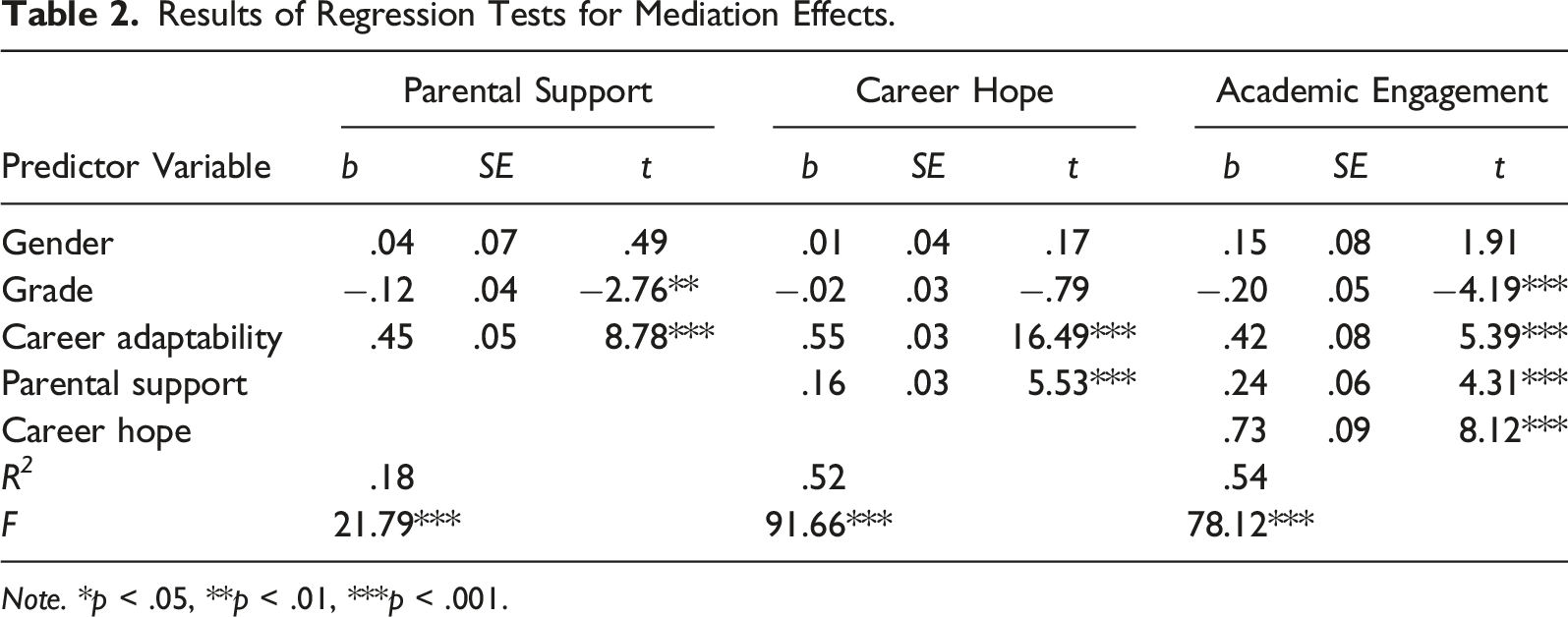
Note. *p < .05, **p < .01, ***p < .001.
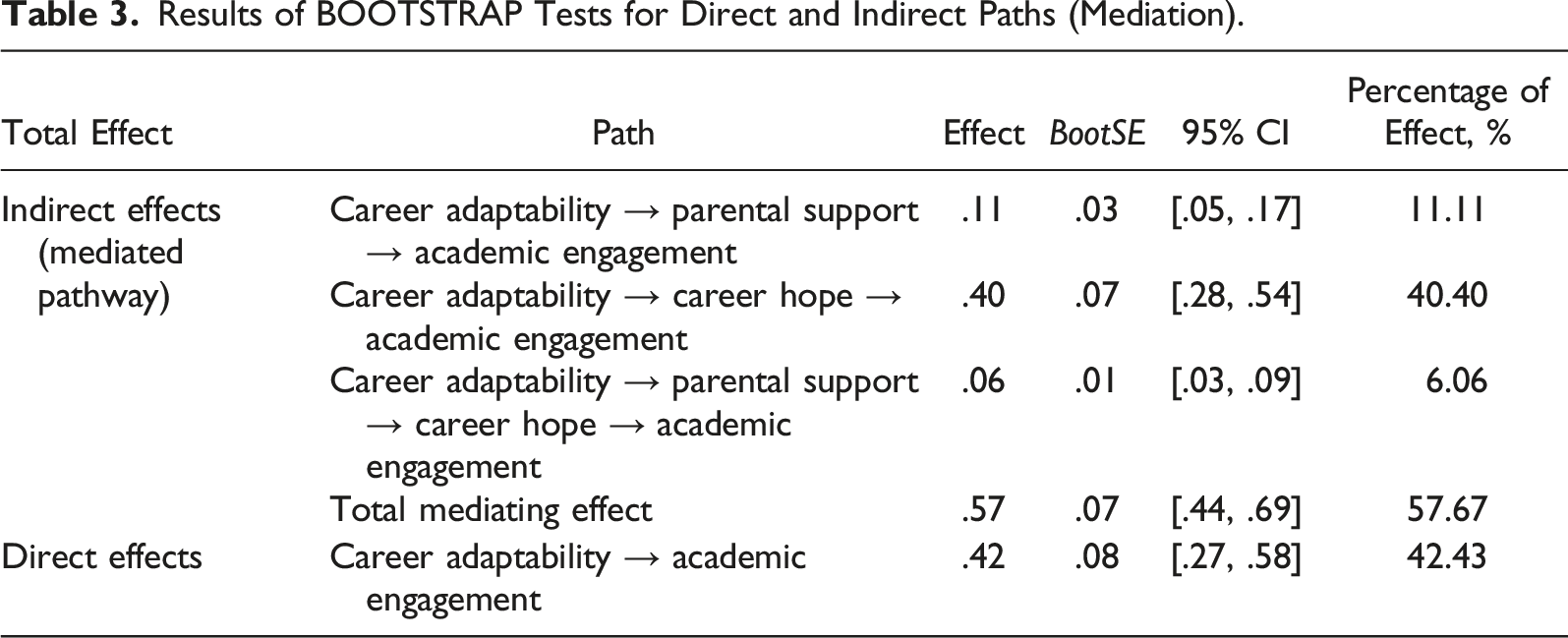
Results of BOOTSTRAP Tests for Direct and Indirect Paths (Mediation).
Discussion
This study examined the relationship between career adaptability and academic engagement of secondary school students based on career construction theory. The results showed that career adaptability positively predicted secondary students’ academic engagement. This finding supports previous research that career education can increase secondary school students’ engagement in learning (Orthner et al., 2013; Plasman, 2018). Career adaptability, which is a crucial component of career education, has an impact on secondary school students’ academic engagement and should be taken seriously by schools and educators. This finding enhances the theories of career construction, broadens the mechanisms of career adaptability, and increases the research topics for career adaptability. Career adaptability training in secondary schools enables students to concentrate on their careers, integrate their learning with their careers, define their learning goals, enhance their capacity to deal with changes in their learning and make a greater contribution to their positive and sustained behavior (Savickas & Porfeli, 2012).
The current study found that career adaptability predicts academic engagement indirectly through parental support, which is consistent with previous findings that higher levels of career adaptability are associated with more social support (Takawira, 2020) and that higher perceived parental support by students increases corresponding academic engagement of secondary school students (Sağkal & Sönmez, 2022). According to career construction theory (Savickas & Porfeli, 2012), secondary school students with high career adaptability find ways to cope with difficulties in their career construction and learning, such as asking for help, especially from their parents. Although the social world of secondary school students is expanding, parental support, such as the provision of school supplies, supervision in their studies, as well as emotional companionship and encouragement in their studies, remains an important support for them (Mahon & Yarcheski, 2017; Wang & Eccles, 2012). High career adaptability individuals are more likely to have parental support in their learning and career construction and are better able to use these support resources to cope with learning difficulties and changes in their environment (Savickas & Porfeli, 2012). Additionally, secondary school students who have more family support are more likely to engage in pro-social activities, be interested in learning, and actively participate in learning activities (Wang & Eccles, 2012).
Another result of this study found that career adaptability also indirectly predicts academic engagement through career hope, which is consistent with previous research that career adaptability positively predicts individual hope (Di Maggio et al., 2020), and that hope increases students’ academic engagement (Chen et al., 2020). Secondary students with high career adaptability are more future-oriented, need-oriented, optimistic about the future, and hopeful about their future careers (Santilli et al., 2020; Savickas & Porfeli, 2012). Secondary school students who see hope in their careers are more motivated to use multiple pathways to achieve desired outcomes, creating greater motivation to reach their goals. For example, students who experience hope are more motivated and engaged in their studies (Chen et al., 2020).
Furthermore, this study also found that parental support and career hope play a series of mediating roles between career adaptability and career engagement, which is consistent with previous research that has examined the significant positive effects of parental support on adolescent hope (Kemer & Atik, 2012; Sui-chu Ho et al., 2021). Secondary school students are inseparable from their families and the support of their parents in all aspects of their lives, and with the support of their parents they are more likely to plan for their future and to be hopeful about it (Sui-chu Ho et al., 2021). Parental support explained the lowest variance (6%) in this study, suggesting that parental support has a limited impact on career hope and academic engagement, possibly because parental support is general and not career-specific, and secondary students are reluctant to talk to their parents about career and academic issues. According to career construction theory, career adaptability plays a subjective role, and there are multiple ways in which career adaptability affects individual development (Savickas & Porfeli, 2012). The mediating process is one of how career adaptability is reflected in the subjective role of career adaptability. The findings of the mediating role in this study partially confirm the claim that career adaptability plays a subjective role.
Implications for Practice
The findings of this study enrich the outcomes of positive psychology and career psychology, as well as practical insights for increasing academic engagement and interventions for secondary school students. The results of this study suggest that there are three areas where we can begin to improve secondary school students’ academic engagement: training career adaptability, enlisting parental support, and cultivating career hope.
First, career adaptability training must be a concern for secondary educational institutions and their educators. Career education can be regularly conducted with a career construction in mind, or career adaptability training can permeate curriculum teaching and student class meetings. Additionally, career adaptability training can be provided in career education classrooms using particular intervention strategies based on the structure of career adaptability (Merino-Tejedor et al., 2018). For example, educators help students manage their career concerns by promoting self-awareness and encouraging them to make plans. They assist students with career control by encouraging them to consider their potential career options from now on. They satisfy students’ career curiosity by assisting them in finding and managing career information. And finally, they boost students’ career confidence by teaching them to remain open, positive, and flexible when solving problems and overcoming challenges.
Second, schools need to attract more effective support from parents so that students can feel supported by their parents, such as building a good platform for home-school coeducation to get timely parental support. Family and school are both involved in the process of a student’s personal development (Xue & Li, 2021). To enable two-way communication, there must first be an open communication channel between home and school. Through the internet, they can establish a productive and scientific joint home-school platform, where teachers can announce the latest learning goals and student activities, and parents can access information about school events and their children’s progress, so they can provide timely support and assistance. In addition, schools can invite parents to participate in school-related activities, such as the development of school-based curricula, which teachers can develop and complete with parents (Yu, 2021). This will gain more understanding and support from parents.
Third, educators should improve hope education and cultivate the quality of hope in secondary school students to evoke their hope for the future and hope for their careers. The main ways to increase hope are for educators to encourage and assist secondary school students in identifying goals that are appropriate for them, setting sub-goals, making clear to them the pursuit behaviors required to reach their goals, and strategies to achieve their desired goals (Chen et al., 2020). These strategies may include, for example, assisting in the development of realistic goals, implementing actionable methods to achieve goals, maintaining consistent motivation to achieve goals, utilizing available resources, and so on.
Limitations and Future Directions
There are some limitations even though this study has achieved some results. First, there are some limitations on how broadly the data can be applied. The fact that our sample came from secondary school students in China, and the current state of career education and student learning may differ from other countries, which to some extent affects the generalization of the findings and the external validity of this study. Therefore, it is important to proceed with caution when generalizing our results to other countries. Future research could broaden the sample by collecting data from secondary school students in other countries to test the robustness of the results. Second, our data is still derived from a single source of student self-reported information. Although we try to communicate before the questionnaire and ensure the quality of the questions, there are still some unavoidable factors, such as students’ attitudes and cooperation during the questionnaire, that potentially play an interfering influence. In order to conduct a more objective analysis of the relationship between career adaptability and secondary school students’ academic engagement, future research could gather information from a variety of sources, including teachers, students, and peers. Third, some studies have concluded that academic engagement predicts career adaptability in high school students (Datu & Buenconsejo, 2021) and parental support predicts career adaptability (e.g., Guan et al., 2016), which is contrary to the direction of prediction of our findings. This suggests that there is a bidirectional relationship between career adaptability and academic engagement, as well as parental support and career adaptability. Although we used four time periods to collect data, our study design was not cross-lagged, making it impossible to draw causal conclusions. Future research could use a cross-lagged design to analyze the bivariate relationships between career adaptability and academic engagement, and between career adaptability and parental support.
Footnotes
Acknowledgments
The authors appreciate the study participants and the funders of this project.
Declaration of Conflicting Interests
The author(s) declared no potential conflicts of interest with respect to the research, authorship, and/or publication of this article.
Funding
The author(s) disclosed receipt of the following financial support for the research, authorship, and/or publication of this article: This study was funded by the “Thirteenth Five-Year Plan” Discipline Co-Construction Project of Philosophy and Social Sciences Foundation of Guangdong Province (No.:GD20XJY13) and the Philosophy and Social Sciences Planning Foundation of Chaozhou City (2021-C-08). Additionally, it was supported by the Guangdong Provincial Education Science Planning Project (2022GXJK263) and the Projects of Hanshan Normal University (XY202104).
