




Abstract
The present study aims to translate the Family-Supportive Coworker Behavior (FSCB) Scale into Chinese version (FSCB-C) and examine its reliability and validity through two studies. In Study 1 (N = 392), the exploratory factor analysis was conducted, which confirmed that the two-factor structure was consistent with the original scale. In Study 2 (N = 374), two-wave data was collected for confirmatory factor analysis and the results showed that the two-factor model was a good fit. Furthermore, the measurement invariance results displayed that the FSCB-C was equivalent across gender, age, education level, and job tenure. Additionally, the convergent validity and predictive validity were also demonstrated. The results showed that the FSCB-C could significantly predict job satisfaction, altruism towards colleagues, job stress, work-family conflict, and turnover intention. These findings provide evidence that the Chinese version of the FSCB scale is a valuable instrument.
Keywords
Introduction
The effective management of work and family demands has been recognized as a crucial aspect of an employee’s career experience. When these competing demands are incompatible, work-family conflict occurs (Greenhaus & Beutell, 1985), which is considered a source of stress for individuals (Carlson et al., 2000). To alleviate this conflict, individuals may seek support from different sources, such as coworkers, supervisors, family members, organizations, or spouses (Ford et al., 2007), in the form of instrumental, emotional, or appraisal support (Cohen & Wills, 1985). Theoretically, those who gain more social support are less likely to experience work-family conflicts (French et al., 2018). Prior research has attended this issue and explored how supervisors, organizations, and family support can mitigate the problem.
Indeed, the role of coworkers, with whom employees spend the majority of their working time, was overlooked. Practically, coworkers can share work-related information when an employee is absent due to family-related issues, and perform work duties when the employee has to attend to family matters (Tortez & Mills, 2022). They can also be sympathetic listeners when employees have emotional concerns or family-related frustrations (Tortez & Mills, 2022). These behaviors may help balance the challenges of work and family. Tortez and Mills (2022) focused on these family-supportive behaviors, and developed a measure (Family-Supportive Coworker Behavior, FSCB) with strong reliability and validity. This scale was formed based on theoretical basis and scientific questionnaire development process, which is a psychometrically sound, uniquely valuable, and parsimonious measure that helps research to assess both emotional and instrumental coworker work-family support (Tortez & Mills, 2022).
However, in the Chinese context, there is no scale of family-supportive coworker behavior at present, and if other alternative scales are adopted, measurement errors may exist, which is not conducive to the development of the theory. Furthermore, direct application of the FSCB scale developed in Western culture may be problematic in China (Behling & Law, 2000), because Chinese culture is unique in terms of interpersonal relationships, family values, and collectivism. Accordingly, a validation of the FSCB scale among Chinese employees is significantly important in providing an optional tool, promoting empirical research and enriching the literature on work-family interface literature. The current study validates existing measures of FSCB in the Chinese context, which can provide reliable measures for further empirical study and is expected to lay the preliminary foundation to enrich the development of employees’ supportive behavior in organizational context. This research highlights the unique contribution of work-family supportive behavior from coworkers and explains the interpersonal relationships between employees, which contributes to the growing body of research on human resource management. In practice, the research may help organizations understand their employees, and improve the atmosphere to promote employees’ career development by providing them with coworkers’ family-related support. For employees, the study can help them balance work and family, get along better with their coworkers, and promote the career development in the long term.
Theoretical Foundation and Measurement of Family-Supportive Coworker Behavior
The theoretical foundations of the FSCB scale are Organizational Support Theory (Eisenberger et al., 1986) and Team-Member Exchange theory (Seers, 1989). Organizational Support Theory focuses on organization’s concern and appreciation for employees, which leads to an employee’s willingness to contribute to the organization, resulting in emotional satisfaction for the employees. Family-related support is a crucial form of emotional support organizations can provide. Although support from supervisors is a common resource, the role of peers should not be overlooked. Moreover, the Team-Member Exchange (TMX) theory is based on the mutually beneficial interaction between individuals and other team members. It was developed from the Leader-Member Exchange (LMX) theory. Seers et al. (1995) further defined TMX as the mutual relationship developed in the process of information delivery and feedback, aiding others, and information reception, getting assistance corresponded to that. Based on this theory, it is possible for employees to provide and receive family-related support.
The FSCB scale consists of eight items and measures two dimensions: emotional support and instrumental support. Emotional support focuses on addressing the recipient’s feelings and self-evaluations, while instrumental support provides tangible resources such as time or money (Cohen & Wills, 1985). Specifically, the emotional support dimension includes listening to coworkers' work-family problems, showing empathy or concern, and providing helpful advice to balance work and family demands (Tortez & Mills, 2022). The concept of instrumental support refers to more tangible assistance, such as covering a shift when needed (Mesmer-Magnus & Viswesvaran, 2009).
Family-Supportive Coworker Behavior in China
Family-supportive behavior is a popular issue and widely studied in China recently. However, research in this field mainly focused on the support from supervisors (Li et al., 2022) and relatively overlooked others (i.e., coworker) in the workplace. Indeed, the growing trend towards flatter organizations (Lee & Edmondson, 2017) and the increased need for teamwork (Kossek et al., 2011) have made coworker support an increasingly important issue. In practice, the impact of coworkers’ family-supportive behavior has not been thoroughly investigated in China. The lack of a useful and valuable tool to promote research on the FSCB is a realistic obstacle.
It is noteworthy that Chinese culture is unique as it is deeply influenced by Confucianism, which has shaped Chinese thoughts and behaviors. One core belief of Confucianism is filial piety, meaning devotion and loyalty to family. This can significantly impact an individual’s career decisions and result in a stronger desire to balance work and family relationships. As a result, Chinese employees may actively seek support to achieve this balance (Fouad et al., 2008). Furthermore, Chinese people have a sense of identity with each other, even in the workplace, which aligns with the concept of guanxi in China. Guanxi refers to the essential connections that influence interpersonal relationships in Chinese society (Chen et al., 2014). In the workplace, Chinese employees may follow the principle of “the benevolent loves others” and are more likely to show altruism towards their colleagues, be considerate, and help them when they face challenges, to develop good guanxi with their coworkers. Additionally, when employees receive kindness, sympathy, assistance from their coworkers, they tend to respond positively. These contextual factors have an impact on the behavior of employees and their coworkers, making accurate evidence on FSCB in the Chinese context significant.
For the influence of coworkers’ family-supportive behavior, Tortez and Mills (2022) has examined its positive correlations with job satisfaction and significantly negative correlations with turnover intentions and work-family conflict. Following original scale research, the current study attempts to test the predictive validity of these three related constructs. Besides, two new related variables, altruism towards colleagues and job stress, were examined additionally. Altruism towards colleagues is a sub-scale of organizational citizenship behavior, which has been verified a significant correlation with FSCB (Tortez & Mills, 2022). Studies have also revealed a correlation between support behaviors and strains (Barrera, 1986), and culture can affect the job stress in the workplace (Oyserman et al., 2002).
Based on the above argument, the study proposes the following hypotheses:
FSCB has a significant positive correlation with altruism toward colleagues.
FSCB has a significant positive correlation with job satisfaction.
FSCB has a significant negative correlation with job stress.
FSCB has a significant negative correlation with conflict.
FSCB has a significant negative correlation with turnover intention.
The Current Study
The purpose of this study is to validate the FSCB scale in the Chinese context. We conducted two studies and collected data from Chinese full-time employees. In Study 1, we translate the FSCB scale into a Chinese version (FSCB-C) and evaluate the reliability and construct validity of two dimensions using Exploratory Factor Analysis (EFA). In Study 2, we employ two-wave designs and demonstrate the validity of factor structure using Confirmatory Factor Analysis (CFA). Furthermore, we examine measurement invariance of FSCB-C and test its validity through assessing correlations with related constructs and performing regression analyses.
Study1: Validating the Chinese Version of the FSCB Scale
Method
Participants
In study1, the sample consists of 392 full-time employees, with 203 being male (51.9%) and 188 being female (48.1%). The participants have an average age of 38.38 years (SD = 7.28, ranging from 22 to 60 years) and an average job tenure of 15.09 years (SD = 8.06). The education levels are divided into high school/technical school or below (n = 7, 1.8%), two- or three-year college (n = 12, 3.1%), four-year bachelor’s degrees (n = 232, 59.3%), master’s degree (n = 117, 29.9%), and PhD degree (n = 23, 5.9%). The majority are married (n = 322, 82.4%) or have children (n = 307, 78.3%). 44% of the participants work with more than 20 coworkers (n = 172), followed by 6–10 coworkers (n = 83, 21.2%), 11–15 coworkers (n = 59, 15.1%), 1–5 coworkers (n = 56, 14.3%), and 16–20 coworkers (n = 21, 5.4%).
Procedure
The data of Chinese employees was collected through the Tencent online survey website in China, a widely-used social networking software with billions of active users. A total of 582 Chinese employees participated in this survey. The first part of the survey was an information page that provided details about the research content, academic research purpose, confidentiality, and anonymity. The survey consisted of FSCB scale and demographic information items, including gender, age, education, job tenure, marital status, and number of children. After completion of the survey, each participant received .42 USD (3 CNY). To ensure the effectiveness of online data collection, 392 participants were retained after excluding those who did not pass the attention and logic checks (Bain et al., 2021), which is the final sample for this study.
Scale Translation
The Family-Supportive Coworker Behavior scale developed by Tortez and Mills (2022) consists of eight items that are evenly divided into two factors. These two factors combined assess family-supportive coworker behavior, including emotional support (e.g., “My coworkers would be willing to listen to my family-related problems.”) and instrumental support (e.g., “My coworkers would be willing to perform my job duties so I can come in late/leave early to attend to a family matter”). Consistent with Tortez and Mills (2022)’s original study, we used 5-point Likert scale (1 = strongly disagree, 5 = strongly agree) to measure the items.
We followed the Brislin’s (1970) translation and back-translation method to translate the FSCB scale into Chinese. Initially, all items were translated into Chinese version independently by two authors. They then discussed and resolved any differences to achieve a consensus for the Chinese version. Next, the Chinese translation of FSCB scale was back-translated to English by two skilled translators independently (Lan et al., 2022). Importantly, to ensure reliability and validity, two experts in human resource management checked both the original scale and the back-translated version, comparing the meaning of the items based on Chinese cultural characteristics. No items were removed and the meanings remained consistent with the original scale, but some expressions were modified to make them more understandable and appropriate for the Chinese context. For example, the phrase “I believe that, in general, my coworkers would be willing to …” was integrated into each item to make the sentence completed and effective.
Results
Exploratory factor analyses in study 1.
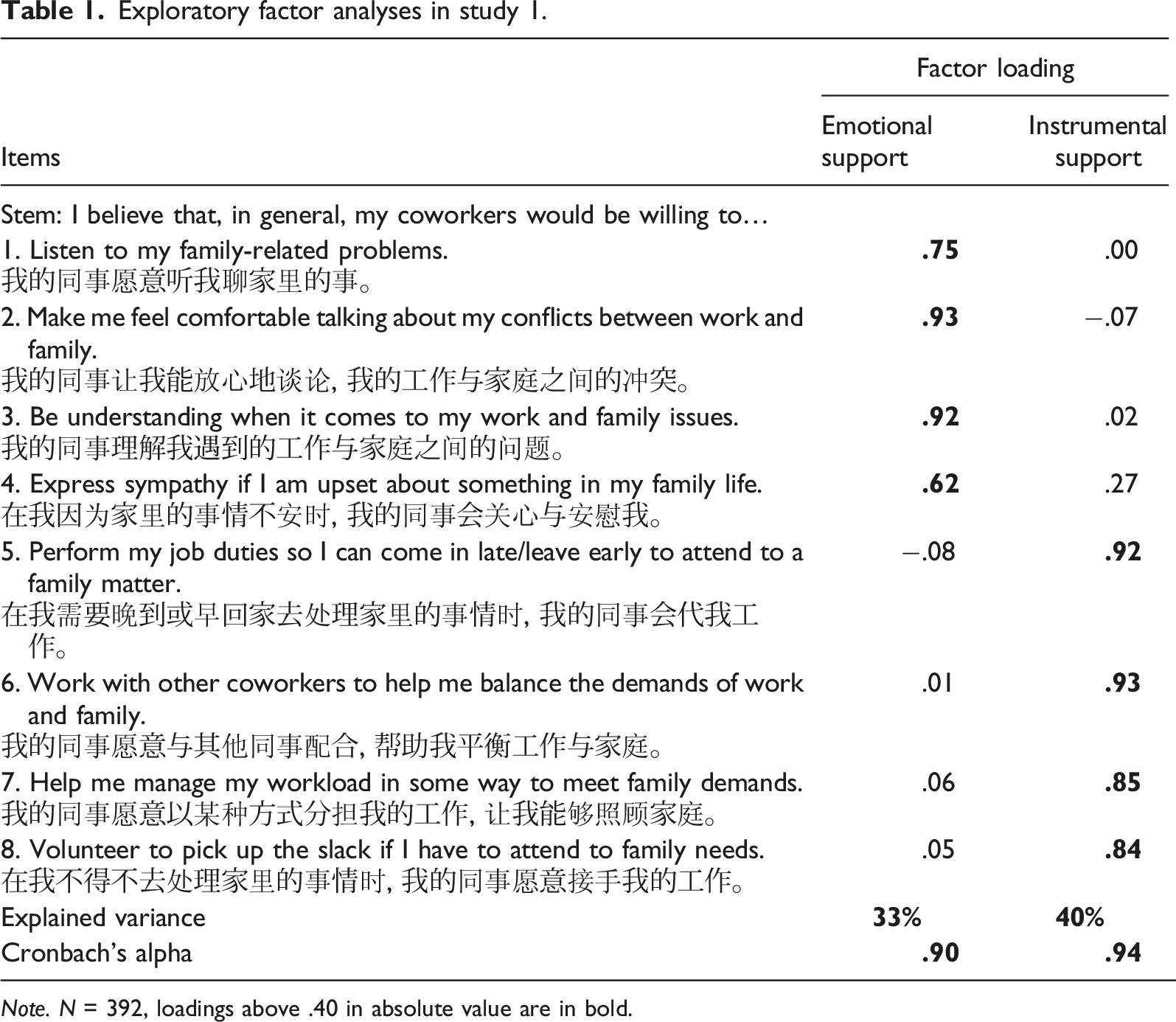
Note. N = 392, loadings above .40 in absolute value are in bold.
Study 2: Confirmatory Factor Analysis and Validation of FSCB
In Study 1, it has proved that FSCB-C has a good factor structure and internal consistency. To further examine its reliability and validity, we conducted a series analyses in Study 2. First, we conducted confirmatory factor analyses to test its reliability and validity. Then, we evaluated the measurement invariance of the FSCB-C to demonstrate whether this scale is equivalent across different demographic characteristics such as gender, age, education, and job tenure. Finally, we assessed the convergent validity and predictive validity of the scale by examining its correlations with other constructs and conducting regression analysis.
Method
Procedure
We collected a two-waves data collection study among Chinese employees through School alumni network in China. The two waves were separated by a 2-week interval (Qin et al., 2020; Tortez & Mills, 2022). At Time 1 (T1), participants completed the FSCB survey. At Time 2 (T2), participants completed surveys on altruism toward colleagues, job satisfaction, job stress, work-family conflict, and turnover intention. To maintain confidentiality, participants logged in using their account numbers and their responses were matched using unique identification codes. We invited 645 individuals to participate at Time 1, of which 484 (75.04%) participated in the survey. No missing responses due to the online volunteer questionnaire design. At Time 2, 374 (77.27%) participants retained after attention and logic check.
Participants
The final sample consists of 374 responses of Chinese full-time employees, with 165 being male (44.1%) and 209 being female (55.9%). Participants’ mean age is 33.3 years (SD = 7.36, ranging from 22 to 59 years) and the average position tenure is 10.16 years (SD = 7.82). The education levels are described through five options: high school/technical school or below (n = 2, .5%), two- or three-year college (n = 4, 1.1%), four-year bachelor’s degrees (n = 250, 66.8%), master’s degree (n = 110, 29.4%), and PhD degree (n = 8, 2.1%). The majority of the participants are married (n = 212, 56.7%) and 174 have children (46.5%). 34.2% work with more than 20 coworkers (n = 128), followed by 6–10 coworkers (n = 97, 25.9%), 1–5 coworkers (n = 66, 17.6%), 11–15 coworkers (n = 61, 16.3%), and 16–20 coworkers (n = 22, 5.9%).
Following the procedures of Matta et al. (2020), we further conducted a sample attrition analysis. The results indicate that there were no significant differences in FSCB (t (482) = −.95, p = .83), emotional support of FSCB (t (482) = −1.40, p = .70), instrumental support of FSCB (t (482) = −2.15, p = .92), gender (t (482) = −.92, p = .23), and education (t (482) = −1.81, p = .88), except for age (t (482) = 3.06, p = .01) and job tenure (t (482) = 2.64, p = .02) between the participants who had completed the Time 2 survey and those who had not. Those who participated only at Time 1 spent more time than those who participated at both measurement points, and the difference is significant (t (482) = .72, p < .01), which is considered as a natural attrition. Therefore, sampling bias was not a concern in this study.
Measures
The participants answered these items on a five-point Likert scale (1 = strongly disagree, 5 = strongly agree).
Family-Supportive Coworker Behavior Scale. The same eight-item scale is used to assess family-supportive coworker behavior, which has been validated in Study 1. In the present study, the estimated internal consistency reliability of the total FSCB scale score is .93, and internal consistency reliability for the two factors’ scale are as follows: emotional support (α = .90) and instrumental support (α = .94).
Altruism toward colleagues. The four-item scale to assess altruistic behavior towards colleagues was originally developed by Farh et al. (1997) as a sub-scale of the Chinese Organizational Citizenship Behavior (OCB). Liu et al. (2017) translated the scale into Chinese and tested the validity. In the current study, the Cronbach’s α is .92.
Job satisfaction. We measured job satisfaction using three items, with a sample item being “On the whole, I feel satisfied with my job.” The scale was developed by Liu et al. (2007). For the present study, the Cronbach’s α is .88.
Job stress. The job stress scale was developed by Lu et al. (2019), based on the version created by Motowidlo et al. (1986), and was tested among Chinese employees. The scale consists of four items, such as “I think I have a lot of pressure at work.” For the current study, the Cronbach’s α is .80.
Work-family conflict. The original scale consists of eight items, divided equally between two opposite-direction factors: work interference with family (WIF) and family interference with work (FIW; Liu et al., 2017), which references the scale developed by Carlson et al. (2000). The sample item is “It is difficult for me to relax when I am away from my work.” For the present study, the Crobach’s alpha of total WFC scale is .85, with WIF (α = .87) and FIW (α = .88).
Turnover intention. Turnover intention was measured using the Chinese version of a scale developed by Weng and Xi (2010), which referenced the scale created by Mobley et al. (1979). The scale consists of four items, such as “I will leave this organization in the coming year.” For the current study, the Crobach’s alpha is .86.
Results
Confirmatory Factor Analyses
To assess the discriminant validity of the emotional and instrumental support constructs in FSCB-C, we conducted Confirmatory Factor Analyses. We used the “lavaan” package within R 4.1.2 to examine the original two-factor model, higher-order model, and single-factor model. The results reported include the chi-square test (χ 2 ), the p-value, the comparative fit index (CFI), the Tucker-Lewis Index (TLI), and the standardized root-mean-residual (SRMR). The standard of a good fit includes CFI and TLI >.90, and SRMR <.08 (Hu & Bentler, 1999).
The results of CFA (two-factor) indicate a good fit of FSCB-C, χ2 (19) = 104.944, p < .001, CFI = .967, TLI = .951, and SRMR = .034. Next, the two factor were translated into high-order FSCB-C factors, the model of which indicated a slight fall in fit compared to the two-factor model, χ2 (18) = 104.944, p < .001, CFI = .967, TLI = .948, and SRMR = .034. Then, the single-factor model, which loaded all items onto one factor, showed a poor fit, χ2 (20) = 582.866, p < .001, CFI = .784, TLI = .697, and SRMR = .105. Therefore, the two-factor model (see Figure 1) had the best fit. This outcome is consistent with the original research. We demonstrated that the two-dimension FSCB-C has a good construct. Two-factor model of FSCB-C in Study 2.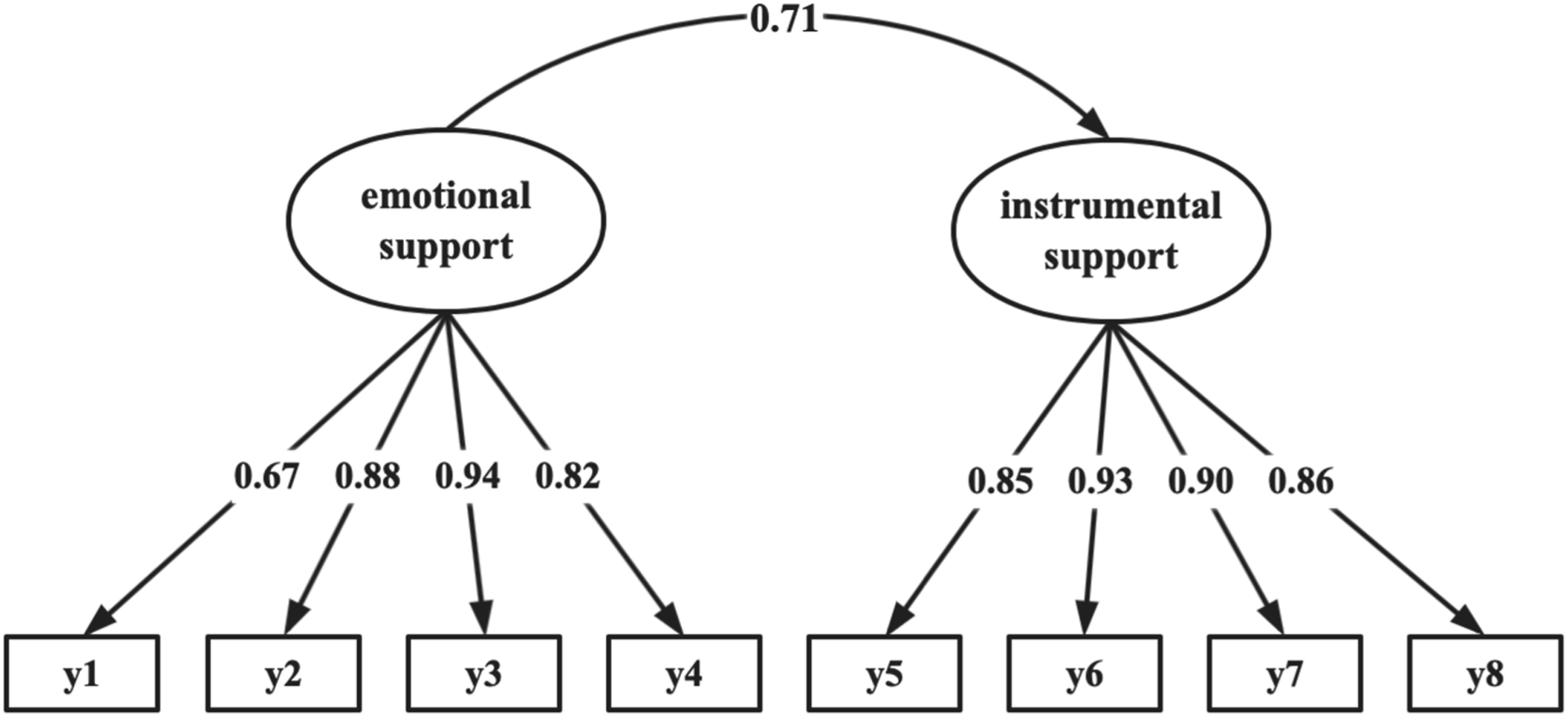
Measurement Invariance
The Chinese version of FSCB scale is a two-factor construct with eight items that has been shown to have good validity, which is consistent with the findings of Tortez and Mills (2022). The next step was to determine whether this scale is equivalent in assessing family-supportive behavior of Chinese employees across different demographic groups, such as gender, age, educational level, and job tenure. To answer this question, we performed measurement invariance tests. We divided each group into two categories. For gender, we compared male versus female. For age, we created two categories according to mean age (33.3 years). For education level, undergraduate degree or below was group 1, while master’s degree or above was group 2. For job tenure, the categories were divided based on mean years (10.16 years).
Test of Measurement Invariance of FSCB-C Across Gender, Age, Education level, Job Tenure in Study 2.
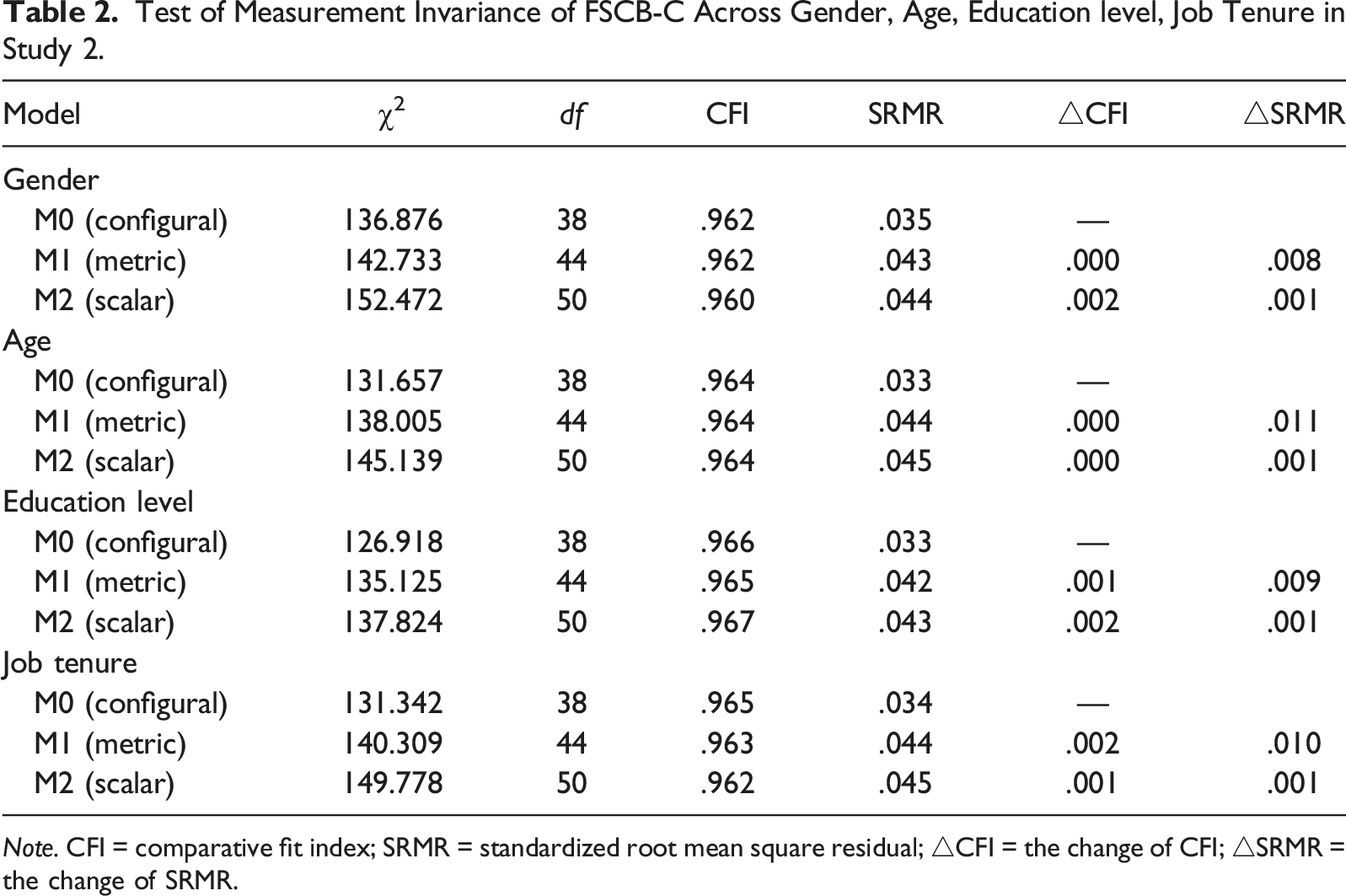
Note. CFI = comparative fit index; SRMR = standardized root mean square residual; △CFI = the change of CFI; △SRMR = the change of SRMR.
Table 2 shows that configural models (M0) for the distinct groups across gender, age, education level, and job tenure display a good fit. The fit indices for each groups are as follows: gender group, χ2 (38) = 136.876, p < .001, CFI = .962, SRMR = .035; age group, χ2 (38) = 131.657, p < .001, CFI = .964, SRMR = .033; educational level, χ2 (38) = 126.918, p < .001, CFI = .966, SRMR = .033; job tenure group, χ2 (38) = 131.342, p < .001, CFI = .965, SRMR = .034. These model fit indices demonstrate that the FSCB-C is configurally invariant.
Next, we tested whether the factors’ item loadings were equivalent through the metric models (M1). Compared with configural model, the changes of fit indices do not exceed the recommended threshold (△CFI <.01, △SRMR <.015). Similarly, we used scalar models (M2) to further test the invariance and the changes in fit indices do not exceed the threshold (△CFI <.01, △SRMR <.015), as shown in Table 2. These indicate that the factor structure is not significantly distinguished across different groups of gender, age, educational level, and job tenure.
Validity Estimates
Descriptive Statistics and Correlations in Study 2.
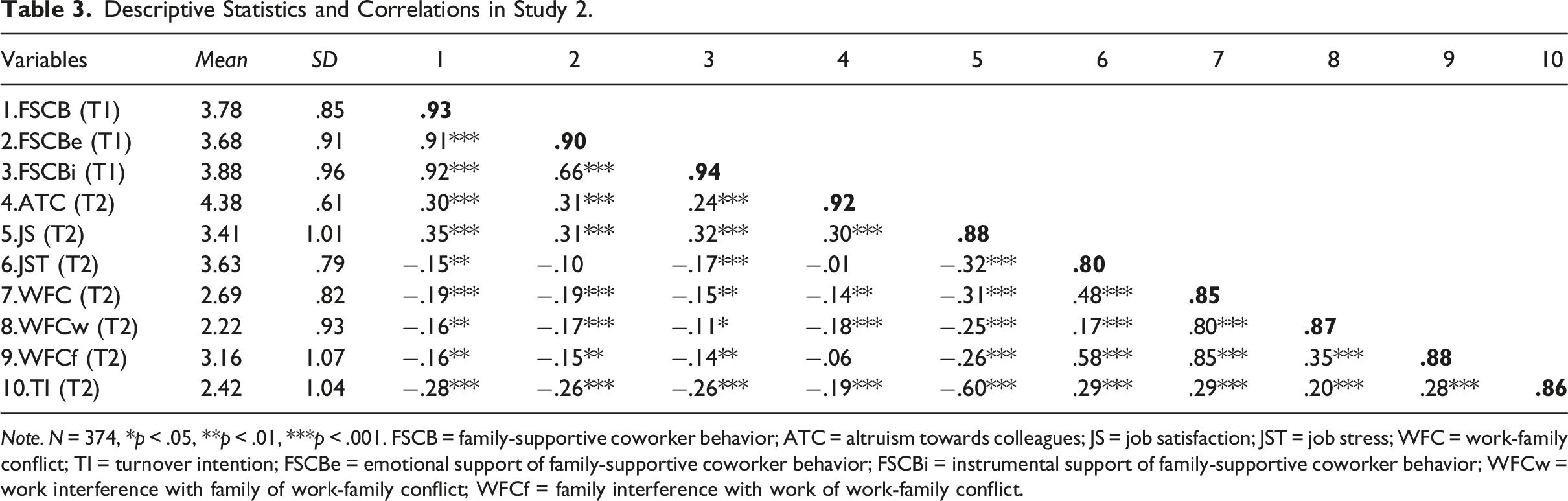
Note. N = 374, *p < .05, **p < .01, ***p < .001. FSCB = family-supportive coworker behavior; ATC = altruism towards colleagues; JS = job satisfaction; JST = job stress; WFC = work-family conflict; TI = turnover intention; FSCBe = emotional support of family-supportive coworker behavior; FSCBi = instrumental support of family-supportive coworker behavior; WFCw = work interference with family of work-family conflict; WFCf = family interference with work of work-family conflict.
To evaluate the predictive validity of FSCB-C scale and its two dimensions, we conducted correlation analysis with four outcome variables: altruism toward colleagues, job satisfaction, work-family conflict and turnover intention. As shown in Table 3, FSCB at Time 1 (T1) significantly predicted the five related variables, as Person’s correlations coefficients are all significant. FSCB has a significant positive correlation with altruism toward colleagues (r = .30) and job satisfaction (r = .35), thus H1 and H2 are supported. Further, both the emotional and instrumental dimensions also have significantly positive correlations with altruism toward colleagues (rs = .30, .24) and job satisfaction (rs = .31, .32). On the other hand, FSCB has significant negative correlations with job stress (r = −.15), work-family conflict (r = −.19), and turnover intention (r = −.28); thus, H3, H4, and H5 are supported. Moreover, the emotional dimension has significant negative correlations with work-family conflict (r = −.19), and turnover intention (r = −.26) and no significant correlation with job stress. The instrumental dimension has significant negative correlations with job stress (r = −.17), work-family conflict (r = −.15), and turnover intention (r = −.26). According to the results, employees who experience family-supportive behavior from their coworkers have higher levels of altruism and job satisfaction and lower levels of job stress, work-family conflict, and turnover intention.
Regression Analyses for FSCB at T1 by Outcome at T2.

Note. N = 374. Variable abbreviations are consistent with Table 3. *p < .05, **p < .01, ***p < .001.
Discussion
The current study translated and validated the Chinese version of FSCB scale among two samples of Chinese full-time employees. In Study 1, following translation, an EFA was conducted, and results showed that all eight items and each dimension had good internal consistency and reliability. In Study 2, a newly sample was used and a series of CFAs were performed to test the factor structure of the FSCB-C. The results indicated that a two-factor model was optimal. Measurement invariance was also tested and found to be equivalent across gender, age, education level, and job tenure. Through correlation analysis, the FSCB-C was verified to be significantly correlated with altruism toward colleagues, job satisfaction, work-family conflict and turnover intention, indicating that it is a predictive construct. All these results provide strong evidence that the FSCB-C is a valid and reliable measurement in the Chinese context.
Specially, the construct validity was examined through EFA and CFA, and the results suggest that the two-factor structure in China is consistent with the initial scale developed by Tortez and Mills (2022). The outcomes indicate that employees also receive family-related support from their coworkers, including both emotional and instrumental support in Chinese context.
Except for these constructs, the good convergent and discriminant validity suggests that FSCB-C is a reliable measure, and the predictive validity presents the relationships with related variables. We discovered that employees with higher FSCB are more likely to help their colleagues and have less job stress. These findings align with Chinese cultural values, as reflected in the proverb, “Every drop of water will be rewarded by the spring.” When Chinese receive emotional and instrumental support, they tend to return the favor or convey to others. Additionally, both dimensions of FSCB-C also showed predictive validity for altruism towards colleagues, job satisfaction, work-family conflict, and turnover intention. However, only the instrumental dimension was found to predict job stress (r = −.17), while the emotional dimension had no significant correlation with job stress. This result is consistent with the theory that support behaviors and perceptions have distinct mechanisms of influencing strains (French et al., 2018; Cohen & Wills, 1985). For instance, in the context of caring for a sick child, emotional support such as expressing sympathy or understanding may be less effective, while employees benefit from a supervisor who allows schedule adjustments or a temporary absence from work (French et al., 2018). These findings facilitate the understanding of FSCB in the Chinese context.
Furthermore, the FSCB-C scale is developed in China, and the study results are consistent with previous research conducted in Western culture. This finding means that the FSCB scale can be widely applied in different culture, since it has been validated in both individualism and collectivism culture. Researchers can also conduct studies deeply in different context and attempt to explore potential differences.
Implications for Practice
In summary, the current study provide a reliable and valid measure for future research of coworker support in China and expand the existing knowledge on coworkers’ family-supportive behavior in the workplace. Practically, the important implications of the present study reflect in three aspects. Firstly, we provide specific behaviors that may help employees find a tool to offer family support to their coworkers. For instance, they can listen to coworkers’ family-related problems to provide emotional support, or perform their duties temporarily to provide instrumental support. Furthermore, the FSCB-C has been verified predictive of altruism towards colleagues. Therefore, when employees are hoping for help from their coworkers, volunteering to provide them family-related support, whether emotional or instrumental support, is proven effective measure.
Secondly, the study has important implications for supervisors. Allowing employees task autonomy or schedule flexibility can help them obtain more opportunities and abilities to assist their coworkers. It is considered feasible to be tolerant for trading of shifts, sharing of tasks among employees within limits, which benefits for fostering family-supportive culture. Besides, when managers supervise or lead a team, they can conduct team-building events and improve employees’ teamwork ability through training with actionable behaviors developed in the scale for reference. These will play a role in human resource management.
The third implication of this study is for organizations. The FSCB-C has been evidenced to be a unique predictor of altruism towards colleagues, job satisfaction, job stress, work-family conflicts, turnover intention. These results can provide guidance for management practices. For instance, it benefits both employees and organizations when organizations adopt less work-centric initiatives and focus on more inclusive non-work commitments and relational mechanisms, known as guanxi in the Chinese context (Tortez & Mills, 2022; Chen et al., 2014).
Limitations and Future Directions
The current study has limitations worth noted, while indicating directions for future research. First, the current study only translated and validated this scale, and did not supplement new dimensions according to Chinese culture. In order to ensure that dimensions that are unique to Chinese employees are not being overlooked, it could be useful to conduct a study using a ground-up approach to further verify and supplement dimensions in this culture in future researches. Second, since limited similar measurement, we did not compare the scale with similar constructs; thus, we expect convergent validity and discriminant validity to be measured with similar constructs in future research. Finally, we only demonstrated that the FSCB-C significantly correlates with limited outcomes (i.e., altruism towards colleagues and work-family conflict). Future studies should examine additional variables, such as organizational commitment, group cohesion, and organizational citizenship behavior, to find deep mechanism, which can promote research and enhance the literature in this field.
Footnotes
Declaration of Conflicting Interests
The author(s) declared no potential conflicts of interest with respect to the research, authorship, and/or publication of this article.
Funding
The author(s) disclosed receipt of the following financial support for the research, authorship, and/or publication of this article: This work was supported by the National Natural Science Foundation of China (Grant no. 71772171), Public Computing Cloud, Renmin University of China and Scientific Research Foundation, School of Public Administration and Policy, Renmin University of China.
