




Abstract
The school-to-work transition can be extraordinarily challenging in the turbulent labor market, and the uncertainty about employment outlooks can cause intense anxiety for college students. Drawing from psychology of working theory (PWT), the current study examined the predictor section of the PWT model in relation to employment anxiety with a sample of impoverished undergraduates in China (N = 362). Findings suggest that (1) economic constraints were negatively associated with work volition and future decent work perceptions; (2) work volition mediated the relation between economic constraints and future decent work perceptions; (3) future decent work perceptions were negatively related to employment anxiety; and (4) proactive personality and social support attenuated the adverse influence of economic constraints on work volition. Overall, this study contributes to PWT by adding a new outcome (employment anxiety) and also providing evidence of moderation effects. Implications for universities and career counselors are discussed.
Keywords
Introduction
The expansion of tertiary education in China has given rise to an exponential increase in the number of college graduates over the past two decades. According to the Ministry of Chinese Education, roughly 11.58 million college students are estimated to graduate in 2023 (Ministry of Education, 2022), which has reached an all-time high and will inevitably lead to fierce competition in the labor market. Since the outbreak of the COVID-19 pandemic, the global economy has been confronted with tremendous challenges, making it more difficult for college graduates to seek employment (Autin et al., 2020; Zheng et al., 2022). The increasing pressure of eventual job search makes college students feel anxious about the possibility of being unemployed after graduation (Belle et al., 2021; Pisarik et al., 2017). Existing literature shows that employment anxiety can pose a threat to students’ mental health, thereby decreasing their overall well-being (Rith-Najarian et al., 2019). Hence, it is of great significance to understand the antecedents of college students’ employment anxiety and propose intervention strategies.
Psychology of Working Theory (PWT) attempts to document the career advancement of all individuals, but especially those with high levels of contextual and structural constraints (Duffy et al., 2016). Although studies have shown that decent work—the centerpiece of the PWT model—is predictive of various well-being outcomes, much of the extant literature is limited to employed adult samples (Duffy et al., 2019, 2021) as the theory was not developed to specifically address the needs of economically marginalized undergraduates. Moreover, research on the predictors and outcomes of future decent work perceptions is scarce, and no studies have so far examined the impact of future decent work perceptions on employment anxiety with a sample of low-income students.
The current study attempts to fill the above gaps by examining predictors of future decent work perceptions and employment anxiety within PWT, specifically sampling low-income Chinese college students. We hope the results of the current study will provide insights for scholars studying career decision-making of low-income students who will soon enter the labor market, along with vocational counselors working with these students.
Chinese Underprivileged Undergraduates’ Challenges in Career Development
Impoverished college students in China generally refer to those whose family annual income is less than 14,000 RMB (around $2,100) (Wei et al., 2021). Since they receive limited economic resources from their family, they have to depend on grants from the governments or universities to cover their tuition fees and living expenses. Due to economic constraints, impoverished college students in China are often confronted with numerous career barriers. First, low-income students are generally first-generation college students, which means they may receive limited career guidance from their parents (Roksa and Kinsley, 2019). Thus, they are more likely to become confused and insecure about their future than their counterparts who come from college-educated families (Ma, Huang, & Autin, 2020). Lack of financial resources also tends to result in lack of confidence or psychological capital which in turn puts impoverished graduates at a disadvantage when they seek employment (Wei et al., 2021).
Second, undergraduates from lower socioeconomic backgrounds in China generally carry high familial expectations, which to a certain extent aggravates their anxiety. This is because they are eager to release financial burden for their families, particularly when they have younger siblings at home. When poor college students become job applicants, they tend to accept a job offer once it arises without much consideration (Ji, 2020). The more desperate they are for a position which can get them out of poverty, the more likely they are to end up doing a job which may not fit their capabilities or specialties.
Third, being economically constrained also means being socially disadvantaged in China (Wei et al., 2021). Wealthy families can use their Guanxi, defined as connections to significant people (Ren and Chadee, 2017), to help their children find internship programs in top-notch companies where they can have access to occupational role models and acquire employability skills (Chen et al., 2013). For these rich students, a decent internship is not only an eye-opening experience but also a steppingstone to a decent job in the future (Belle et al., 2021). By contrast, those who come from less well-to-do backgrounds can only find less prestigious internships such as working in groceries or restaurants to earn pocket money. Upon graduation, impoverished students also face unfair competition from their wealthy peers who can rely on their parents’ nepotism to secure a decent position in large industrial enterprises, state-owned companies, or government departments (Bian and Huang, 2015). Working in these resource-rich organizations is considered holding an “iron rice bowl” (i.e., a lifelong job). Since the outbreak of the COVID-19 epidemic, most Chinese graduates desire to seek a stable job (Zheng et al., 2022), but poor students have no advantage when competing with students from wealthy families (Ren and Chadee, 2017). Thus, impoverished college students are likely to experience high levels of anxiety due to the risk of being underemployed or even unemployed after graduation (Belle et al., 2021).
Given that impoverished college students face more barriers in career development than their wealthy counterparts, it is a crucial scholarly and social justice question to understand their perceptions concerning future careers and well-being.
Theoretical Framework
The present study applies PWT to frame the primary hypotheses and research questions. PWT is a relatively new vocational theory that captures how contextual and psychological factors predict individuals’ access to decent work, which in turn affects their overall well-being via need satisfaction (Duffy et al., 2016). As the core construct within PWT, decent work is defined as quality jobs that provide individuals with a safe working environment, sufficient salary, medical security, enough rest time, and values that match family and societal values (Duffy et al., 2017). Within PWT, economic constraints and marginalization are proposed to hinder individuals from securing decent work, and these direct effects are believed to be mediated by work volition and career adaptability (Duffy et al., 2016). Specifically, individuals with greater lifetime experiences of economic constraints and marginalization are believed to be less likely to secure decent work due to less choice in their career decision-making (work volition) and less resources to cope with the unpredictable world of work (career adaptability). Additionally, it is hypothesized that the adverse impacts of the two primary contextual variables on psychological resources and access to decent work will be attenuated by proactive personality, critical consciousness, social support, and economic conditions (Duffy et al., 2016). In the current study, we measure proactive personal and social support as theoretical moderators.
Given that our sample is unemployed college students, we use future decent work perceptions as the centerpiece of our tested model. A handful of studies have previously demonstrated that perceptions of future decent work—believing one’s work in the future will meet the five components of decent work—predict academic satisfaction, academic engagement and career exploration among student populations (Ma et al., 2020a, 2020b). However, impoverished college students’ anxiety about their future employment is also worth exploring in this turbulent era and as such, we target this construct as an outcome of future decent work perceptions. Overall, the present study aims to contribute to PWT literature by providing evidence on the relations between economic constraints, work volition, and future decent work perceptions and by including employment anxiety as a new outcome of future decent work perceptions. Using PWT logic, we also examine proactive personality and social support as moderators linking economic constraints with work volition.
Economic Constraints, Work Volition, and Future Decent Work Perceptions
Economic constraints refers to one’s limited financial resources such as family wealth (Duffy et al., 2016). From a PWT perspective, individuals with economically underprivileged backgrounds generally go through greater barriers throughout their career development process (Blustein et al., 2019). For example, for instance, those who experience economic constraints during childhood are believed to have less access to decent education in high school (Duffy et al., 2022). When these individuals become adults, they may have little freedom or flexibility in choosing their ideal careers which in turn results in decreased access to decent work (Duffy et al., 2016). From a college students’ perspective, several studies have documented that economic constraints negatively relate to work volition and future decent work perceptions, and that work volition mediates the relation between economic constraints and future decent work perceptions (e.g., Ma, Huang, & Autin, 2020). As such, we propose the following hypotheses.
Economic constraints will negatively predict work volition and future decent work perceptions.
Work volition will significantly mediate the relation of economic constraints to future decent work perceptions.
The Moderating Effects of Proactive Personality and Social Support
In the current study, we position proactive personality and social support as moderator variables in the model. Proactive personality refers to one’s ability to actively initiate changes in their environment (Li et al., 2010). Students with proactive personality are prone to envision a clearer picture about future work (Joanne Chan & Chan, 2021), have higher career decision self-efficacy (Hsieh and Huang, 2014), are more likely to seek potential opportunities (Brown et al., 2006), and use more positive career coping styles (Major et al., 2012). Since proactive personality was proposed in PWT to buffer the negative effects of economic constraints (Duffy et al., 2016) and was found to facilitate one’s career development (Wang et al., 2019), we contend that impoverished students with strong proactive personalities may still feel volitional even though they are confronted with a variety of constraints. As such, we propose the following hypothesis.
The negative effect of economic constraints on work volition will be less pronounced when low-income students possess greater proactive personality.
In addition, social support can also help students deal with various difficulties (Zhao et al., 2022). As suggested by PWT, the adverse influence of economic constraints on individuals’ work volition may be moderated by social support (Duffy et al., 2016). According to Cohen and Wills (1985), support from family, friends, significant others, and broader community is of great importance for individuals to cope with the contextual stressors. Dozens of studies have found that social support can increase career self-efficacy (Lent et al., 2003) and decrease perceptions of career barriers (Raque-Bogdan et al., 2013) among student populations. More importantly, social support has been found to predict positive vocational outcomes among economically disadvantaged students (Garriott et al., 2013). Therefore, we propose the following hypothesis.
The negative effect of economic constraints on work volition will be less pronounced when low-income students receive social support.
Future Decent Work Perceptions and Employment Anxiety
Finally, the present study included employment anxiety as ultimate outcome of the model, which is defined as individuals’ uneasiness, nervousness, or fear when thinking about seeking employment (Belle et al., 2021). For most young students, making a career choice is likely to trigger anxiety as they desire to find a fulfilling and meaningful career (Miller and Rottinghaus, 2014). In this regard, it is possible for career-related anxiety to inform college students’ overall sense of well-being. PWT suggests that access to decent work predicts one’s well-being outcomes (Duffy et al., 2016), and studies have shown that securing decent work enhances one’s academic satisfaction (Ma, Huang, & Autin, 2020), life and job satisfaction (Buyukgoze-Kavas and Autin, 2019), and overall physical health (Duffy et al., 2021). Additionally, decent work has shown to predict one’s mental health via need satisfaction (Duffy et al., 2019). Though not directly mentioned in PWT, we hypothesize that employment anxiety is likely to arise when students fail to have positive perceptions about future work. Therefore, we propose the following hypothesis.
Future decent work perceptions will negatively predict employment anxiety.
Based on the above hypotheses, the research model of the current study is shown in Figure 1. Research model.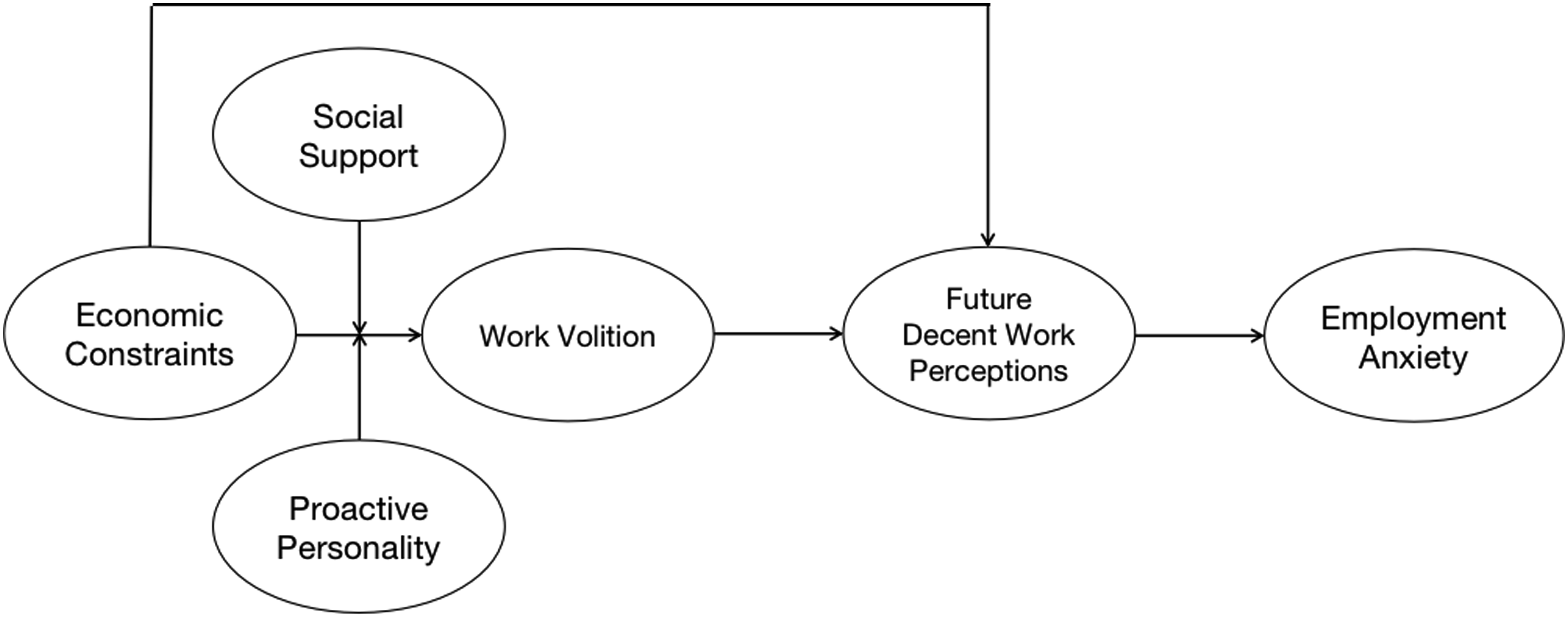
Method
Participants
This research consisted of 362 undergraduates enrolled in different levels of public universities in the south of China. Among them, 188 (51.9%) students were female, while 174 (48.1%) were male. Concerning registered residence, 87 (24%) students reported coming from cities, 41 (11.3%) reported towns, and 234 (64.6%) reported rural areas. Regarding the category of majors, 115 (31.8%) students reported majoring in science and engineering, 167 (46.1%) reported studying social sciences, and 80 (22.1%) reported specializing in humanities. Concerning grade, 78 (21.5%) students identified as freshmen, 85 (23.5%) identified as sophomores, 93 (25.7%) identified as juniors, and 106 (29.3%) identified as seniors. In terms of plans after graduation, 197 (54.4%) students selected pursuing postgraduate studies, 140 (38.7%) selected seeking employment, 6 (1.7%) selected starting their own businesses, and 19 (5.2%) selected “other.” Regarding the number of siblings, 57 (15.7%) students identified as single child of their family, 112 (30.9%) reported having one sibling, 116 (32%) reported having two siblings, 62 (17.1%) reported having three siblings, and 15 (4.1%) selected “four and above.” Finally, regarding the effect of the COVID-19 pandemic on their life, only 14 (3.9%) students selected “not much,” 218 (60.2%) selected “somewhat,” and 130 (35.9%) selected “much.”
Instruments
Economic Constraints
To measure students’ perception of economic constraints in their life, we used a Chinese version (Ma, Huang, & Autin, 2020a) of the 5-item Economic Constraints Scale (Duffy et al., 2019). Students were required to answer each item on a 7-point Likert scale (1 = strongly disagree and 7 = strongly agree). A sample item is “For as long as I can remember, I have had very limited economic or financial resources.” This scale has been evidenced with Chinese samples in previous PWT-related studies, showing adequate reliability and validity (Ma et al., 2020a, 2020b). In the present study, the Cronbach’s alpha for the scale was .89.
Work Volition
Students’ perceptions of their ability to make career decisions were measured by a Chinese version (Wei et al., 2021) of the volition subscale of Work Volition Scale-Student Version (Duffy et al., 2012). Students responded to five items on a 7-point Likert scale where 1 = strongly disagree and 7 = strongly agree. A sample item is “I feel total control over my future job choices.” Wei et al. (2021) reported that this scale was reliable and valid in the Chinese context. In the current study, the internal consistency was .88.
Future Decent Work Perceptions
To measure students’ future decent work perceptions, we adopted a Chinese version (Wei et al., 2021) of the 15-item Future Decent Work Scale (Kim et al., 2019). We asked students to rate the items on a 7-point Likert scale ranging from 1 (strongly disagree) to 7 (strongly agree). The scale consists of five subscales assessing workplace security, healthcare provision, free time and rest, adequate rewards, and congruent values. A sample item is “I will be rewarded adequately for my future work.” As mentioned in the results section, we were interested in future decent work perceptions as a higher order factor. Prior studies conducted in China have supported the reliability and validity of the total Future Decent Work Scale (e.g., Ma, Huang, & Autin, 2020a; Wei et al., 2021). In this study, its Cronbach’s alpha was .95.
Proactive Personality
Proactive personality was measured by a Chinese version of the 10-item Proactive Personality Scale (Wang et al., 2019), which was derived from the original 17-item version (Bateman and Crant, 1993). Students were required to answer the items on a 7-point Likert scale ranging from 1 (strongly disagree) to 7 (strongly agree). A sample item is “If I see something I don’t like, I fix it.” The shortened scale had adequate reliability and validity in studies with Chinese samples (e.g., Wang et al., 2019; Wei et al., 2021). The scale was also internally reliable in the present study (α = .92).
Social Support
We utilized a Chinese version (Zhao et al., 2022) of the 12-item Social Support Scale (Zimet et al., 1988) to measure students’ evaluation of social support. Students indicated their level of agreement with each item on a 7-point Likert scale ranging from 1 (strongly disagree) to 7 (strongly agree). The scale consists of three subscales assessing family support, friend support, and support from significant others. A sample item is “I can talk about my problems with my family.” The total scale was found to be reliable and valid among college students in China (Zhao et al., 2022). The Cronbach’s alpha for the total scale was .94.
Employment Anxiety
To measure students’ anxious feelings, we adopted the back-translation procedure (Brislin, 1970) to translate the 7-item anxiety subscale of the 21-item Depression, Anxiety, and Stress Scale (Lovibond and Lovibond, 1995) into Chinese. A sample item is “I experience trembling (e.g., in the hands).” In order to make this subscale more adaptable to college students’ employment anxiety, we put “When I think about getting employment after graduation” before each item, which is similar to the practice of Belle et al. (2021). Different from the adapted scale adopted by Belle et al. (2021), we used simple present tense to describe each item, which might be more appropriate to reflect the students’ current status. Students were asked to evaluate each item on a 7-point Likert scale ranging from 1 = strongly disagree to 7 = strongly agree. Belle et al. (2021) reported adequate reliability and validity for this scale in China. The Cronbach’s alpha for the scale was .91 in our study. The factor loadings of the Chinese version are shown in Appendix A.
Procedure
Ethical approval was granted by the first author’s university and data were collected from three universities located in Jiangxi province of China. After developing the electronic questionnaire via the WJX data collection platform (www.wjx.cn), we contacted counselors who managed student affairs and explained the purpose of our research project to them. After obtaining their agreement, we asked them to send the electronic survey to impoverished college students. The students were also informed that only those receiving financial aid either from governments or universities could participate in the survey, so qualified participants were selected by a screen question about their family annual income which should be below 14,000 RMB (around $2,100). All the eligible students completed the informed consent form indicating that they were about to participate in the study as volunteers. To reassure participants, we promised that the information would only be applied to academic projects and that their answers would be kept strictly confidential. Participants were also informed that they should answer all the items, otherwise they could not submit their questionnaires. This effectively allowed for minimal missing data. In return for their active participation, participants could receive a free career counseling service by contacting the first author. Along with items measuring core variables and personal information, we also designed two attention check items within the questionnaire (e.g., “Please choose slightly agree”). There were 400 students taking part in the survey, and 38 were removed for giving regular answers or failing one of the validity check items. Finally, we were left with 362 participants for the data analyses.
Statistical Analysis Plan
We used SPSS 26.0 and AMOS 24.0 to conduct statistical analyses. Before formal model testing, we conducted preliminary analyses including common method bias testing, descriptive statistics, and correlation analysis. Regarding primary analyses, the measurement model was tested via confirmatory factor analysis and the structural equation model was established to test direct effects. In addition, the mediation effect was tested via bootstrapping method, while the moderation effects were examined by PROCESS 2.13 macro and simple slope analyses.
Results
Common Method Bias Testing
Since all the items measuring the study variables were self-reported, we adopted Harman’s single-factor solution to check common method bias (Podsakoff et al., 2003). Specifically, we put all the items into an exploratory factor analysis, and the results showed that the first unrotated factor explained 23.845% of the total variance (<50%) (Tehseen et al., 2017). As such, our data were eliminated from serious common method bias and suitable for the subsequent data analyses.
Descriptive Statistics and Correlation Analysis
Descriptive Statistics and Correlations of Study Variables.
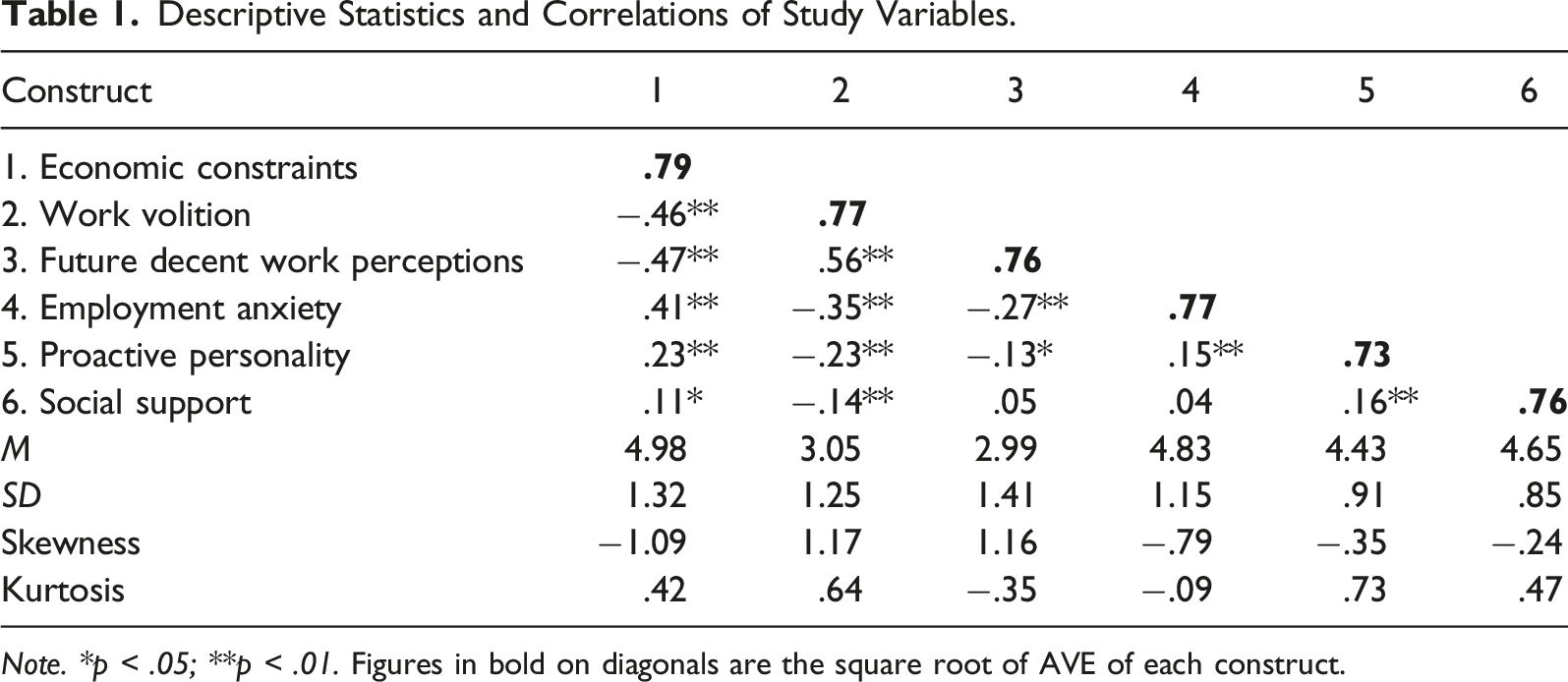
Note. *p < .05; **p < .01. Figures in bold on diagonals are the square root of AVE of each construct.
Measurement Model
We conducted confirmatory factor analysis to assess the measurement model by the following five fit indices: χ 2 /df, TLI, CFI, GFI, and RMSEA. A good model-data fit should present χ 2 /df value below 3, TLI and CFI values above .90, and RMSEA value below .08 (Hu and Bentler, 1999). To construct the latent variables, we used individual scale items for economic constraints, work volition, proactive personality, and employment anxiety. For future decent work perceptions, we used a higher order structure where individual scale items loaded onto their five respective subscales, which then loaded onto one future decent work perceptions construct. Similarly, for social support, we used a higher order structure where individual scale items loaded into their three respective subscales, which then loaded onto one social support construct. The measurement model was implemented to test the goodness of fit to the observed indicators on their respective latent constructs and to test the correlations among latent constructs. We found a good fit between the measurement model and the empirical data: χ 2 /df = 1.22, TLI = .97, CFI = .98, and RMSEA = .03). Regarding the convergent validity, all items loaded onto their respective factors at values of .69–.86, the composite reliability (CR) for all variables was above .70, and the average variance extracted (AVE) for all variables exceeded .50. Regarding the discriminant validity, the square roots of AVE were above the correlation coefficients between variables (see Table 1).
Direct Effects
Results of Direct Effects.
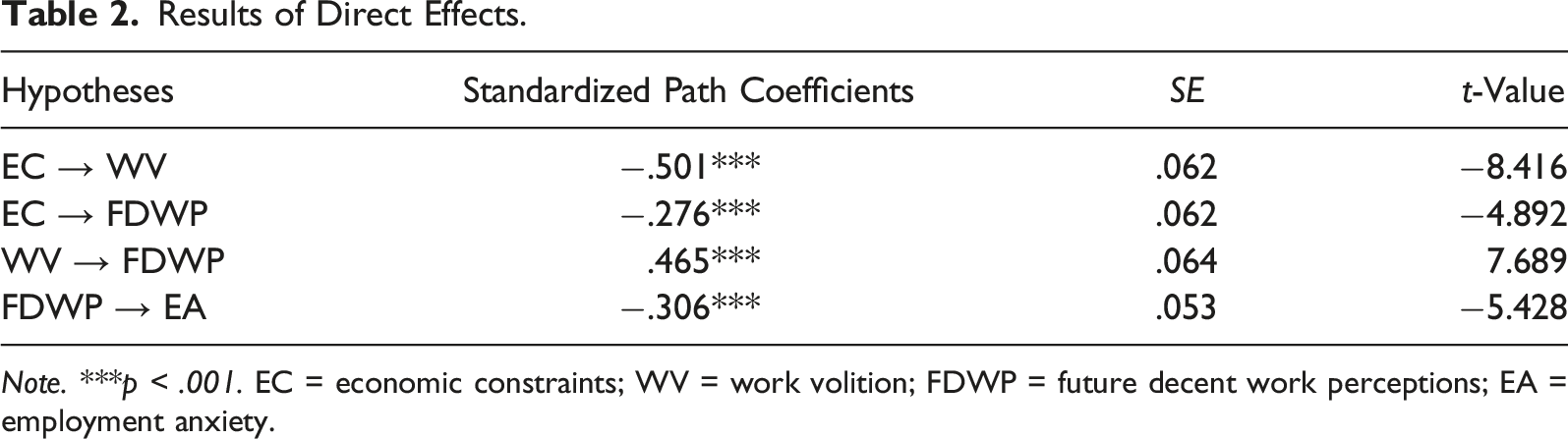
Note. ***p < .001. EC = economic constraints; WV = work volition; FDWP = future decent work perceptions; EA = employment anxiety.
Mediation Effect
Bootstrapping Analysis of Mediation Effect.
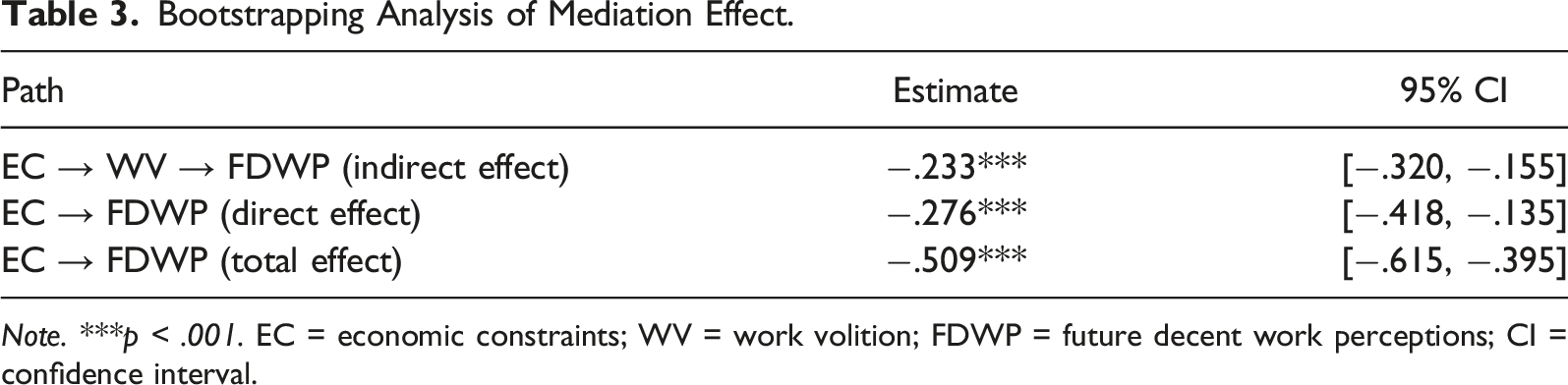
Note. ***p < .001. EC = economic constraints; WV = work volition; FDWP = future decent work perceptions; CI = confidence interval.
Moderation Effects
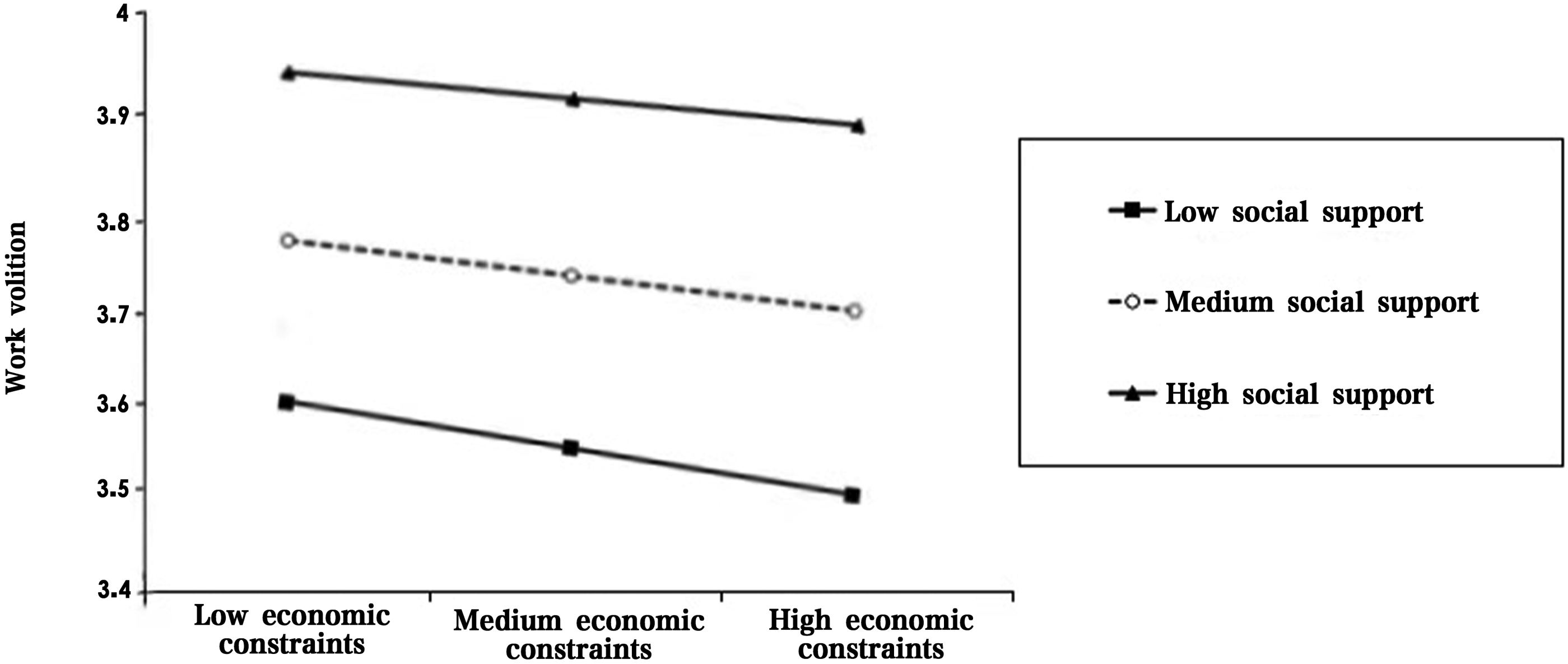
The moderation effects were tested by PROCESS 2.13 macro in SPSS 26.0 (Model 1) through 5,000 bootstrapping samples so as to counterbalance the relatively small sample size (Okay-Somerville and Scholarios, 2022). If the confidence interval does not include zero, then the moderation effect is considered significant (Hayes, 2017). We first examined the interaction effect of economic constraints and proactive personality on work volition and the interaction coefficient was −.17 (95% CI [−.10, −.25]). Then, we examined the interaction effect of economic constraints and social support on work volition and the interaction coefficient was −.18 (95% CI [−.10, −.26]). As such, the results of the current study supported the moderation effects of personal proactive and social support between economic constraints and work volition (H3 and H4). In order to visually show the moderating effects of proactive personality and social support, we followed recommendations of Lorah and Wong (2018) to plot slope diagrams which are presented Figures 2 and 3. It is clear that having higher levels of proactive personality and social support buffered the negative relations between economic constraints and work volition. The moderation effect of proactive personality. The moderation effect of social support.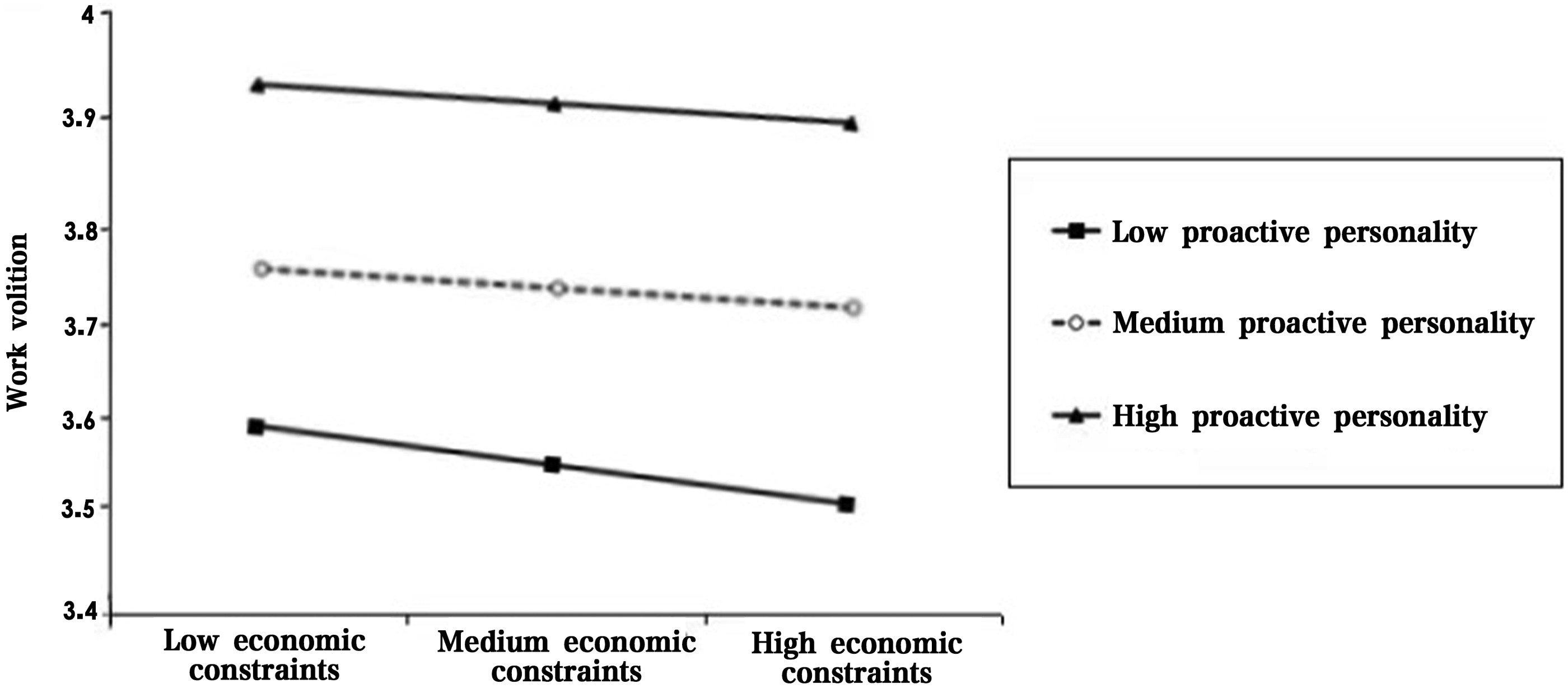
Discussion
To understand predictors of employment anxiety among low-income students in China, the current study tested an extended model based on the PWT framework. We examined both predictors and outcomes of future decent work perceptions as well as proactive personality and social support as potential moderators between economic constraints and work volition. In the following sections, we discuss the theoretical and practical implications based on the results of this study.
Theoretical Implications
First, our findings demonstrated that economic constraints had a negative effect on future decent work perceptions and that this effect was partially mediated by work volition. This finding is akin to that of Wei et al. (2021) who concluded that undergraduates from low social status perceived a slim chance of securing decent work in the future. Numerous other studies with working adults found that volition in part explained why economic constraints related to decent work (e.g., Duffy et al., 2018; Smith et al., 2020). Our study adds to the literature by demonstrating this effect with impoverished college students.
Second, we demonstrated several moderation effects. Although proactive personality as a moderator variable within PWT was not supported in previous studies (e.g., Wei et al., 2021), our study showed that proactive personality mitigated the negative influence of economic constraints on work volition. It may be that proactive students make every effort to change difficult situations and become masters of their own lives (Fuller and Marler, 2009). A similar finding existed with social support. Consistent with Wang et al.’s (2019) finding that the adverse effect of economic constraints on work volition was less pronounced when participants perceived greater social support, this also existed in the current study. Students who receive social support may have more psychological resources and career self-efficacy to buffer the effects of economic constraints, which will positively impact their career choices (Wang and Fu, 2015).
Third, we found that future decent work perceptions significantly related to employment anxiety. In other words, those who believe that they can secure a decent job after graduation exhibited less employment anxiety. Employment anxiety is regarded as an important well-being outcome in the career development literature (Chen et al., 2013). Although previous studies have linked decent work with well-being-related variables among employed adults (Duffy et al., 2019, 2021), our study offered initial evidence for this relation with student samples. Moreover, the extant literature shows that students’ employment anxiety can be attributed to psychological capital and coping styles (e.g., Belle et al., 2021), but we added a new predictor, namely, future decent work perceptions. This not only provides a new theoretical perspective for the study of the antecedents of employment anxiety, but also contributes to PWT by enriching outcome variables of future decent work perceptions.
Practical Implications
The findings of this study may have significant implications for university administrators and career counselors. First, considering the negative impact of economic constraints on work volition and future decent work perceptions—which in turn engender students’ employment anxiety—universities should seek to maximally support financial aid for poor students and provide them with interest-free loans to ease their financial pressure in universities. Meanwhile, universities can provide impoverished students with part-time positions on campus so that they can earn some living expenses in their spare time. It is also advisable for universities to provide job search allowances for those graduates with limited financial resources so that they can have access to decent clothes for interviews and pay for transportation fees between cities, potentially limiting employment anxiety.
Second, since low-income students are unlikely to gain much support from their families, universities should aim to provide maximal social support, potentially leading to a broader knowledge of career opportunities. On the one hand, universities can establish long-term partnerships with companies to provide internships targeted for poor students. On the other hand, universities could invite outstanding alumni, especially those who used to be economically constrained, to share their experience in career trajectories. These measures can allow impoverished students to get ready for their preferred jobs in both capacity and vision, thereby increasing their work volition.
Finally, the moderation effect of proactive personality might inform appropriate interventions since it was also found to attenuate the adverse influence of economic constraints on work volition in our study. Career counselors should strive to nurture impoverished students’ proactive personality with the purpose of helping them improve work volition. To achieve this, career counselors could encourage these students to attend several recruitment meetings before they become job-hunters. In this way, they could grow confidence in what this process might eventually look like. Career counselors could also guide low-income students to select appropriate internships or apprenticeships based on their specialties and passions, while also emphasizing the benefits of participating in extracurricular activities or voluntary work. These might help to sharpen their abilities and build their resumes, in turn helping them feel more empowered about their career planning.
Limitations and Future Directions
The results of the current study need to be considered in light of several limitations. First, we adopted a convenience sampling approach with the participants of the study mainly coming from Jiangxi Province of China, so the generalization of the results cannot be guaranteed. Meanwhile, the number of participants may have certain limitations, and the universities attended by the sample were four-year universities rather than three-year vocational colleges. Therefore, in order to improve the general applicability of research conclusions, future research should increase the number of participants, and collect data from diverse regions and different types of universities.
Second, we conducted the study by collecting data at a specific time point which may prevent us from disclosing causal relations among variables in the framework. Only following impoverished college students across an extended period could their dynamic career trajectories be revealed. Thus, future scholars should utilize longitudinal designs to offer a keener insight into the causality of the variables in the PWT model. It would also be important to better showcase how economic constraints and moderators interact and affect impoverished college students’ career choice, future decent work perceptions, and employment anxiety.
Third, although our analysis of variance on impact of COVID-19 found no significant differences in outcome variables, we did not disentangle whether some of the predicted relationships in the model might be affected by the global pandemic. Whether the results of the data collected during this time period will be the same in other periods is worth further investigation. As suggested by Wei et al. (2021), it might be interesting to compare impoverished students’ career-related variables before, during, and after the COVID-19 crisis in future studies.
Conclusion
The current study connects predictors of future decent work perceptions with employment anxiety among a sample of impoverished college students in China. The results show that economic constraints negatively impact future decent work perceptions via work volition and the adverse impact of economic constraints on work volition is buffered by proactive personality and social support. Future decent work perceptions also negatively impact employment anxiety. These results not only provide empirical support for the propositions of the predictor portion of PWT, but also contribute to PWT by including employment anxiety as a new outcome of future decent work perceptions. Although this study has several limitations, it has implications for career counselors and university personnel working with low-income students.
Footnotes
Acknowledgments
The authors would like to thank Dr. Rachel Navarro and anonymous reviewers for their comments on an earlier version of this manuscript.
Declaration of Conflicting Interests
The authors declared no potential conflicts of interest with respect to the research, authorship, and/or publication of this article.
Funding
The author(s) received no financial support for the research, authorship, and/or publication of this article.
Ethical Approval
This article received ethical approval from the first author’s university and was conducted according to the guidelines of the Declaration of Helsinki. All subjects were informed about the study and participation was fully on a voluntary basis. Participants were ensured of confidentiality and anonymity of the information associated with the surveys.
