



Abstract
In today’s dynamic work environments, individuals must manage their careers. Although research suggests that many individuals change jobs and organizations more frequently, they often pursue their careers within one occupation still. The current study addresses how such seemingly stable careers unfold in the face of societal, economic, and technological changes and explores the proactive and reactive strategies individuals use to sustain occupational stability throughout their careers. Applying qualitative content analysis to 32 semi-structured interviews, we revealed eight major strategies underlying the process of occupational stability maintenance. We discuss the identified strategies using control theory and job crafting as theoretical lenses and introduce the concept of occupational crafting for understanding stability maintenance in vocational careers. The study highlights occupations as meaningful reference points in contemporary careers and illustrates how proactive and reactive strategies lead to occupational stability.
Keywords
I’ve often changed jobs […], the first years I only stayed for two years in one place […]. So why I stayed in the occupation is because you have many possibilities within the occupation. Just thinking about what I did after the apprenticeship and what I do now, it is a big difference […] And that was probably the reason I stayed but transformed myself within the occupation and kept looking for new challenges. (Patricia, commercial clerk)
Contemporary careers are characterized by rapid social, economic, and technological changes (Greenhaus & Kossek, 2014), that impact the sustainability and applicability of established skills and lead to the need for personal development throughout the entire career (Van der Heijden et al., 2016). In addition, digitization and automation already have changed the world of work and will continue to have an enormous impact on individuals’ career development (Bessen, 2016). Individuals, thus, need to adapt to altering work environments throughout their careers (Jansen & Shipp, 2019). Research nevertheless suggests that careers still exhibit large degrees of stability for many employees, for example, when individuals stay in the same occupation, despite changing jobs and organizations (e.g., Zimmerman et al., 2020). As occupations are assumed to fill the void of destabilized organizational affiliations in boundaryless careers (Currie et al., 2006; Dierdorff, 2019), it is important to understand how stable occupational career trajectories unfold in the face of continuous changes in contemporary work environments. To date, we have little theoretical and empirical insight into these processes.
Because occupations that are based on vocational education and training (VET) consist of clearly defined skill bundles and produce occupation-specific human capital (Eggenberger et al., 2018) they are particularly vulnerable to changes in required tasks, and, thus, may suffer from reduced applicability of previously established skills, rendering OSM particularly demanding. Such specific human capital is at least partly lost when changing occupations, generating high costs for individuals, organizations, and the broader society (Becker, 1962). Individuals in VET occupations might therefore be particularly motivated to stay within the same occupation over the course of their careers. As apprenticeship systems enjoy increasing popularity across different countries and for multiple occupations (World Bank, 2019), it is time to develop a better understanding of how individuals maintain occupational stability and sustain their occupational identity in vocational careers. Thus, the main aim of our study was to explore the process of occupational stability maintenance (OSM) in VET occupations.
Because little is known about the specific processes of OSM, we applied a qualitative approach to develop a deeper understanding of strategies and behaviors individuals engage in to preserve and (re-)establish fit with their occupations throughout their careers. We conducted 32 interviews with employees who completed VET and stayed in the occupation they had been trained in. Participants reflected on their career trajectories and provided rich information on how they maintained engagement with their occupation. We used qualitative content analysis to analyze the processes involved in OSM. Our results suggest that OSM occurs through the combination of eight distinct strategies. These strategies are based on individuals’ efforts to continuously craft alignment with their occupations (Wrzesniewski & Dutton, 2001), either by adjusting to their work or by actively changing it, using both primary and secondary control strategies (Heckhausen et al., 2010).
Our study makes two important contributions. First, we propose the concept of occupational crafting to capture the proactive and reactive strategies individuals use to stay engaged with their occupations, thereby expanding existing models in the life-span theory of control and job crafting. Second, to the best of our knowledge, this is the first study examining strategies individuals use to maintain engagement with their occupations, sustain their occupational identity, and preserve their occupation-specific human capital while facing changing work requirements. By exploring the dynamics of stable vocational career trajectories, our study addresses recent calls for adopting an occupational lens in organizational psychology scholarship to address the role of occupations as anchors in increasingly volatile environments (Dierdorff, 2019).
Adopting an Occupational Lens in Understanding Career Trajectories
Occupations are fundamental reference points in career development and can consequently be considered as stabilizing elements in contemporary careers, which are characterized by more frequent changes of jobs and organizations (Anteby et al., 2016; Currie et al., 2006). The association with an occupation provides individuals with meaning and direction in their careers (Kreiner et al., 2006), and with a clear occupational identity (Hauschildt & Heinemann, 2013). The development of occupational identity, that is the occupation-specific “conscious awareness of oneself as a worker” (Skorikov & Vondracek, 2011, p. 693), is considered a critical developmental task in adolescence (Erikson, 1968). In apprenticeship-based occupations, occupational identity development already takes place during the years of VET, where apprentices explore their new social role in a real work context (Zimmer-Gembeck & Mortimer, 2006). Vocational education and training has recently been linked to occupational stability, highlighting the formative character of early vocational experiences and emphasizing their lasting impact on the commitment to one’s occupation (Medici et al., 2020). Occupational identity promotes career decision-making in line with personal strengths and values and supports problem-solving in challenging situations (Skorikov & Vondracek, 2011). Consequently, occupational stability is linked to numerous positive outcomes through strong occupational identities, such as effective performance and psychological well-being (Baruch & Cohen, 2007).
Additionally, occupational stability is also beneficial from an economic perspective. Occupations consist of collections of tasks and work role requirements that call for the application of specialized skills and knowledge to complete these tasks (Dierdorff et al., 2009). This is especially the case for apprenticeship-based occupations, where the educational content is tailored to comparatively narrow occupational demands and labor market needs (Eggenberger et al., 2018). In apprenticeship programs like the Swiss VET system, apprentices are trained in line with employer specifications, preventing possible skill gaps and unlocking the otherwise unrealized potential for the economy (Fuller & Sigelman, 2017). Thus, human capital investment can at least be partially lost for both employees and employers when entering a new occupational domain (Feldman & Ng, 2007; Kambourov & Manovskii, 2008), rendering occupational mobility a potentially costly, major career transition that often requires the development of fundamentally new skills (Blau, 2007).
Strategies for Maintaining Occupational Stability
Anteby and colleagues (2016) suggested that occupations can be understood through three different lenses. The first lens, “becoming,” focuses on how individuals become socialized into an occupation. The second lens, “doing,” focuses on how occupational members perform activities and highlights individual agency for career outcomes like occupational identity, or meaningfulness. The third lens, “relating,” focuses on relations between occupations and the surrounding environment. For the process of OSM, the “doing” lens seems particularly promising as it adopts an agency perspective, but also relates to how individuals have to adaptively respond to changes in their occupations and the wider environment and alter their occupational practices as a response (Nelson & Irwin, 2014). In line with this notion, we conceptualize OSM as an adaptive process that includes both proactive and reactive elements for stability maintenance.
The adaptive capacity to steer one’s development is highly relevant (Heckhausen et al., 2010), especially facing the turbulent work environment of today’s careers (Greenhaus & Kossek, 2014). Although not typically linked to the careers literature, the life-span theory of control (Heckhausen et al., 2010) describes how individuals use both primary and secondary control strategies to optimize their sense of control. Primary control refers to individuals’ attempt to change the environment in line with personal needs and desires, while secondary control refers to individuals’ attempt to change the self to better align with the environment. The need for asserting control is also addressed in the concept of job crafting, which is more specifically tailored to the context of work. Job crafting describes “the proactive steps that employees take to modify the cognitive, physical, and relational boundaries of their work” (Grant & Parker, 2009, p. 342). It is motivated by three basic needs, the need for control, a positive self-image, and connection with others (Wrzesniewski & Dutton, 2001). A job can be crafted through changing task boundaries by changing “the form or number of activities one engages in while doing the job” (Wrzesniewski & Dutton, 2001, p. 179), through changing cognitive task boundaries by changing the perception of the task itself, or through changing relational boundaries by shaping interpersonal interactions at work (Wrzesniewski & Dutton, 2001). To date, job crafting has been primarily studied in terms of person-job fit, specifically regarding job demands, job resources, and individuals’ abilities, preferences, and needs (Tims & Bakker, 2010). Yet, despite its rich theoretical foundation in well-established person-environment fit theories (Su et al., 2015; Van Vianen, 2018), job crafting has, to the best of the authors’ knowledge, never been applied to understand how individuals sustain fit to their occupations over their careers.
Informed by the theoretical assumptions from the life-span theory of control and job crafting, the present study aims to increase our understanding of how individuals’ “do” their occupations (Anteby et al., 2016) throughout their vocational career trajectories. To this aim, we explored how individuals maintain their occupational stability and sustain their occupational identity and human capital investments. In so doing, we also heed calls to examine processes involved in career agency through an occupational lens (Dierdorff, 2019; Richardson et al., 2022).
Method
To elaborate on the process of OSM, we performed an interview study using summarizing qualitative content analysis (Mayring, 2014). Applying a qualitative approach allows for a deeper understanding of how personal and social processes which are not yet well understood unfold over time (Bluhm et al., 2011). In summarizing qualitative content analysis, categories emerge in a rule-bound procedure directly from the data. The interpretation of these categories is theory-oriented, allowing researchers to include prior theoretical knowledge for interpretation. The analysis consists of several steps for data reduction and interpretation, which makes the analytical process comprehensible and contributes to transparency (Mayring, 2014). The distinct steps we followed are described in the data analysis section.
Research Context and Participants
Participant Characteristics.
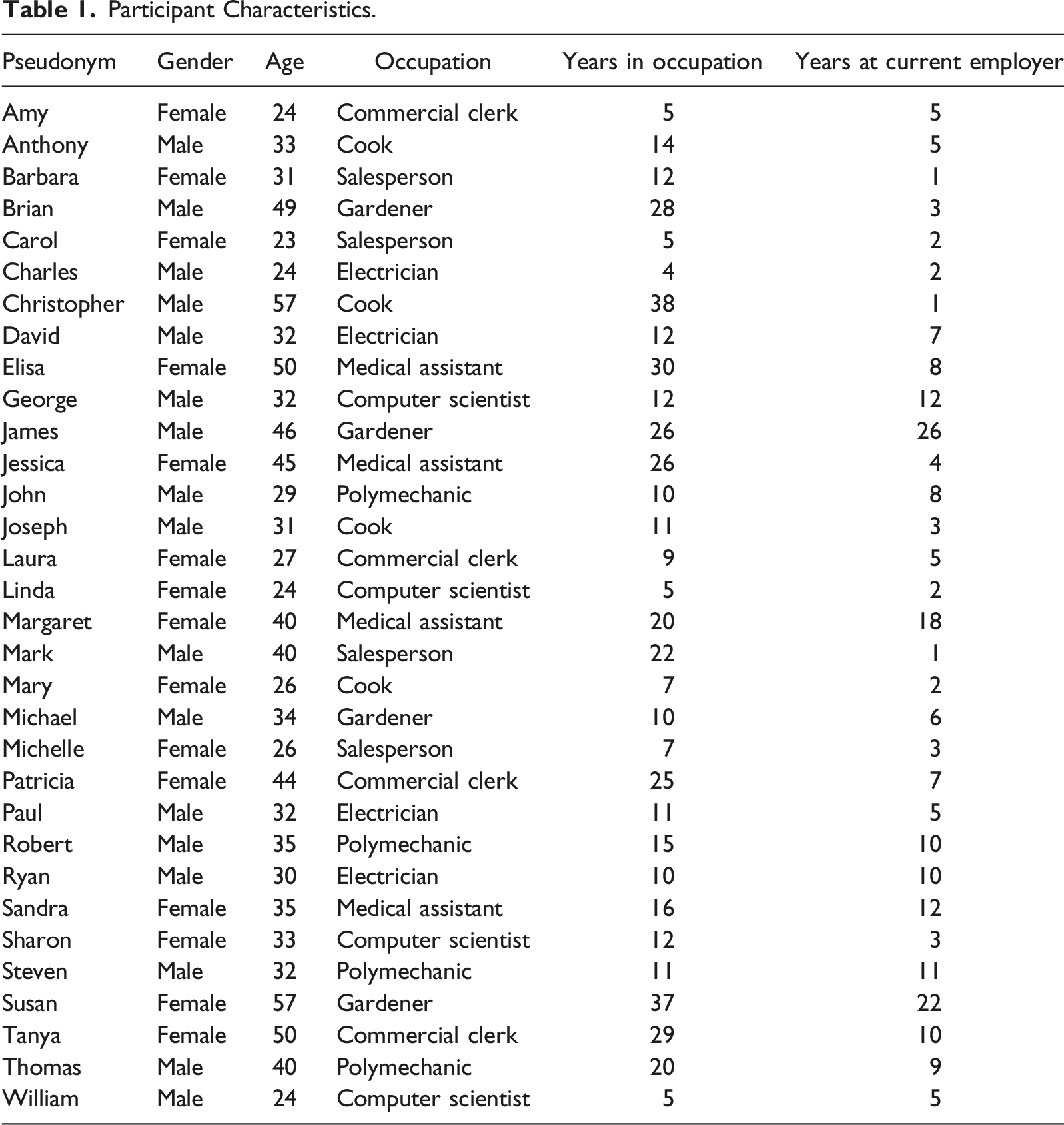
Participants were at different career stages and had all continued working in their initial occupational VET domain for at least 4 years after graduating from VET. They had been trained as computer specialists, gardeners, cooks, electricians, polymechanics, retail salespeople, commercial clerks, and medical assistants. All participants had completed their VET in Switzerland. Participants were between 23 and 57 years old and held between four and 38 years of total work experience in their occupational field. Organizational tenure at the current employer ranged from one to 26 years, with an average tenure of 7.1 years. 15 participants identified as female, and 17 as male.
Data Collection
To recruit suitable participants, we approached vocational associations and informed them about the purpose of the study. Representatives of these associations subsequently forwarded the contact information of interested individuals to us. When the participants fulfilled the selection criteria, we contacted them via mail or phone, explained the purpose of our study, and invited them to an interview. We conducted interviews in person in an office at the participant`s workplace or a meeting room at the researchers' university. The interviews typically lasted between 45 and 90 minutes. To gain a better understanding of the examined occupations and the information depicted in the interviews, certain interviews were accompanied by guided tours of the participants’ workplace. These observations were not part of the analysis but served the interviewers to familiarize themselves with the participants’ work situation. Among all study participants, a CHF 100.- voucher for an online purchase was raffled.
The interviews followed a semi-structured guideline covering key topics regarding working life and career development, starting with participants’ career choice, evaluation of work experiences, reasons for staying in the chosen occupation, and the interface of work and private life. The guideline ensured that several key topics regarding working life and career development were adequately covered, starting with participants’ career choice, evaluation of experienced work characteristics, reasons for staying in the same occupational field, and the interface of work and private life. We formulated questions, so they pointed to participants’ occupations as a reference and not to current jobs or specific employers (e.g., Why did you initially choose this occupation? Have your tasks changed since you entered the occupation?). Effects on career satisfaction, employability, the perceived attractiveness of the occupation, and the intention to stay were discussed. Because advances in digitization and automation are known to impact individuals’ work and career experiences (Hirschi, 2018; Parker & Grote, 2020), participants were also asked to reflect on how technological change had influenced their career development. All interviews were conducted in German by the first two authors and transcribed verbatim from audio tapes. Throughout the article, we use participants’ pseudonyms (see Table 1).
Data Analysis
Data analysis followed the systematic, rule-bound method of summarizing qualitative content analysis with a focus on inductive category development (Mayring, 2014). The objective of this method is the stepwise reduction of the material, preserving the essential contents, and creating a comprehensive overview through abstraction. In individually distinct steps, we developed inductive categories; that is, the categories originate from the material itself and are not based on and biased by detailed prior theoretical considerations or preconceptions of the researchers. Still, as recommended by Hill et al. (2005), the members of the research team discussed and reflected on their potential biases regularly to ensure trustworthiness throughout the whole research process.
As a first analytic step, content-bearing text passages, specifying anything participants do to maintain occupational stability were identified and, in a second step, paraphrased by the first two authors. We focused on text passages where participants talked about their personal experiences, strategies, and behaviors, not something a colleague or friend did or had experienced. To highlight the active character of the coded segments, we paraphrased them using the gerund verb form (-ing; Charmaz, 1996). In this manner, we processed 10% of the transcripts, leading to 140 paraphrases. We then merged semantically identical paraphrases and reduced them to a total number of 126 paraphrases as a third step. Then, all authors independently grouped the generalized paraphrases into higher-order categories, based on semantic similarities (Bechky & Okhuysen, 2011). The research team subsequently discussed these categories until consensus about the more generalizable concepts was established (Miles & Huberman, 1984). Through this analytical process of stepwise reduction, generalization, and consolidation of paraphrases (Mayring, 2014), we developed a category system consisting of 18 codes, subsumed under eight higher-order categories. In addition to the category system, we developed a coding manual where each code was provided with two to four labels (i.e., example paraphrases), representing the different possible angles or facets of a code.
Strategies of Occupational Stability Maintenance in Vocational Career Trajectories.
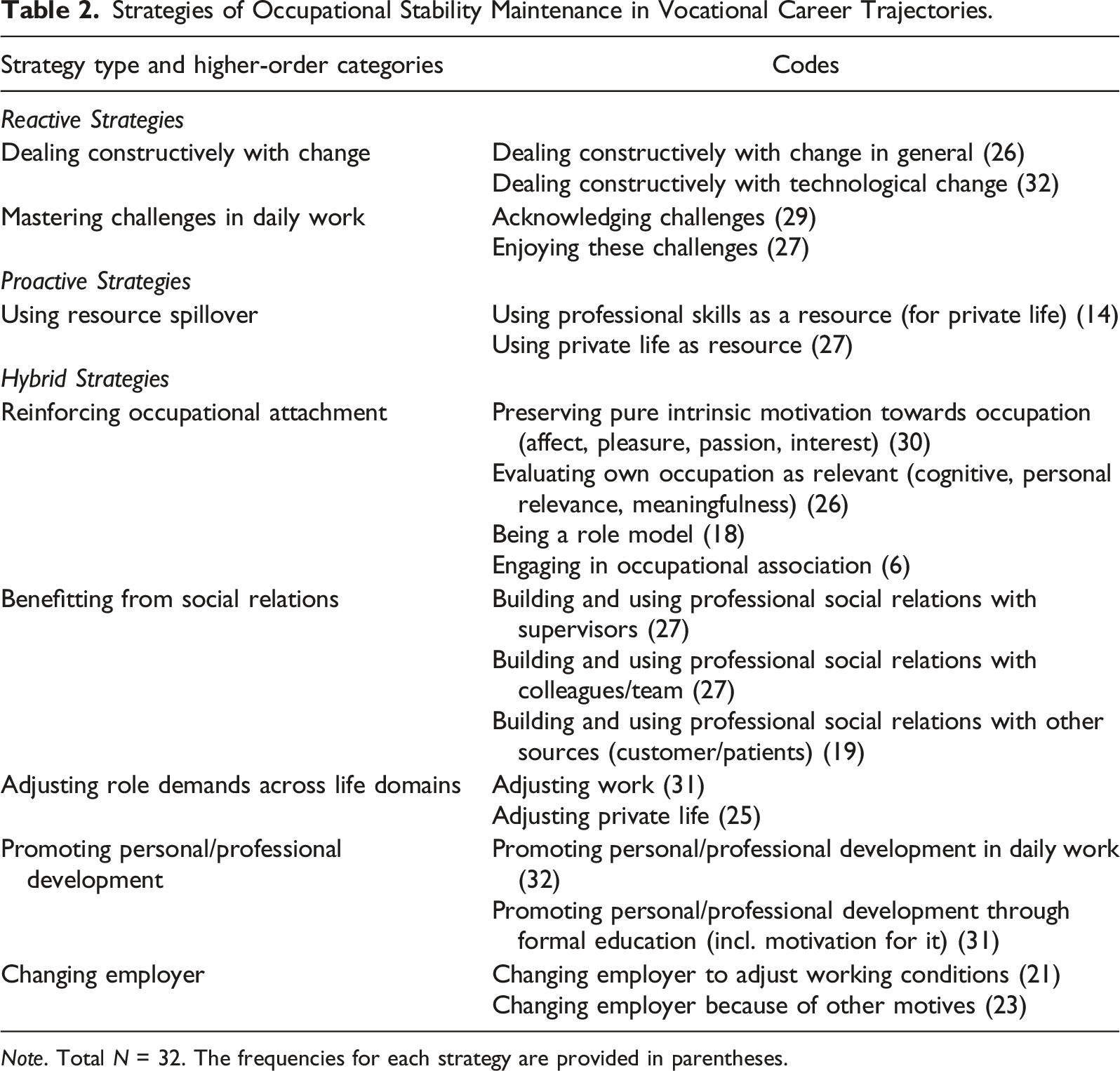
Note. Total N = 32. The frequencies for each strategy are provided in parentheses.
Findings
We describe the processes involved in OSM in terms of the identified proactive and reactive strategies individuals use to sustain alignment with their occupations and maintain stability throughout their vocational careers. Two strategies were used in a reactive mode only: mastering challenges in daily work, and dealing constructively with change. One strategy was only used in a proactive mode: using resource spillover. The remaining five strategies participants used both proactively and reactively: reinforcing occupational attachment, benefitting from social relations, adjusting role demands across life domains, promoting personal and professional development, and changing employer. These strategies of OSM are conceptualized as hybrid avenues to OSM.
Reactive Avenues to OSM
Most participants had experienced that new work tasks evolved, and new work methods or instruments emerged throughout their careers. The resulting work demands often required altered skill sets and were thus perceived as challenging. Participants vividly described mastering challenges in their daily work, such as high task-related responsibility or conflict-laden social interactions. Acknowledging that such challenges existed was important for coping and overcoming them was gratifying. By accomplishing challenging tasks or managing unpredictable and stressful situations at work, professional, and personal development was triggered. For example, Jessica, a medical assistant, described how being confronted with a difficult situation with an apprentice finally led to professional development in her role as a VET trainer and how she learned to set boundaries: Training an apprentice is strenuous. It is exciting […] yes, it was a challenge. Sometimes when I came home, I had no idea, what should I do next? What am I supposed to do with this young woman? She was so strong and challenged me. It was unbelievable. […] I wanted to show her everything, but she kept refusing to learn things that were not yet on her curriculum and was talking back at me a lot. Finally, I had to say, no, there are no ‘buts’, you’re here to learn and we’ll do it my way.
Experiencing growth through mastering challenges was also linked to perceptions of self-efficacy. To successfully overcome challenges, participants stated that it is important to be constructive, especially when confronted with a change that reshapes the occupation itself. By dealing constructively with change, participants successfully responded to such developments and remained employable, for example, through learning new skills. In some cases, maintaining a positive attitude towards change was facilitated by a promising outlook or already witnessed benefits. For instance, new safety regulations for handling chemicals or using new medical equipment had severely altered core tasks and procedures for medical assistants, however, the perceived positive implications, such as time savings or increased quality management, facilitated adaptation to the new situation. Many changes were linked to technological development and participants often described these changes as learning opportunities, as the example of Robert, a polymechanic, shows: I personally have the feeling that [technological] progress makes the occupation interesting. Well, for me personally. Because I want to progress and see something new, hence it would bore me if I had to work with the same machine for thirty years. Even though work might change a little bit, through technology, tools, or through progress as such, but I think that’s what makes the job also interesting.
Proactive Avenues to OSM
The only purely proactive strategy participants described was using resource spillover to enhance participants’ work-life balance, and consequently allowed for sustainable careers. Recognizing interdependencies between life domains, participants described how they proactively used professional skills as a resource in private life, as the example of Steven, a polymechanic, illustrates: I moved recently and assembled all my furniture myself. […] The screws in one of the chairs didn’t fit, so I just trimmed it a bit and now it fits. When I see people that aren’t even able to put up a picture on the wall, I’m glad I learned a manual occupation.
Participants further described how friends and family approached them in their occupational role, asking for specific advice. In these interactions, they were addressed as experts in their respective fields, and participants appreciated the associated feeling of competence. Being approached in one’s occupational role was also linked to the establishment and maintenance of a strong occupational identity. Elisa, a medical assistant, put it like this: “Friends and family come to you for advice if you have a medical background. It is gratifying to be there for someone and help with your knowledge. […] I identify strongly with my occupation, also in private life.” A positive spillover effect between life domains was even more often described in the other direction when private life was actively used as a resource for career-related development. One of the two paths of resource spillover from the private to the work domain was an overlap of activities and interests. Connected to occupational knowledge and skills, participants illustrated how their hobbies and occupations were aligned in a way that private activities fostered occupational skills. One example is Susan, a gardener, who tested new designs and arrangements in her private garden, to provide better customer service: “I can gain experience in my own garden, which I can then also pass on to my customers. Being able to pass on something from my own, practical experience, that’s really nice.” On the other path, participants described how they used their private domain as a resource to improve the balance between domains. Here, hobbies and leisure time were used to detach from work and recharge one’s batteries, which in turn positively affected their performance and motivation at work. Participants further described how a supportive spouse, family members, and friends were important, especially during further education.
Hybrid Proactive and Reactive Avenues to OSM
Participants used most strategies in a hybrid way, promoting occupational stability both proactively and reactively, depending on the specific context. The strategies involved actively changing task, cognitive, or relational boundaries within occupational roles, thereby crafting one’s work situation to foster the experience of meaning and relevance, as the following descriptions will show. One frequently mentioned strategy concerned the preservation of intrinsic motivation for one’s occupation by reinforcing one’s occupational attachment. Participants specifically emphasized that they still liked the occupation’s core tasks and activities and how reinforcing this joy and interest motivated them, too. Ryan, an electrician, described it like this: It’s a very interesting occupation, you have the technical knowledge or know-how but at the same time, you have the craftsmanship, so it is theoretical, sometimes you have to think pretty hard about how to solve something or complicated, complex cases but at the same time it is also the manual work, […] this combination always suited me pretty well. And we also have opportunities for further education, where you are able to connect the existing theoretical knowledge [with new knowledge] and educate yourself further. That’s why I stayed in the occupation.
By attaching meaning to the immediate relevance of their work, participants engaged in cognitive crafting and generated further motivation to stay in their occupations. For instance, Amy, a commercial clerk, emphasized the relevance of her occupation in terms of customer satisfaction:
Simply helping others, that’s very close to my heart, and not just doing one thing after another, not knowing what the result is. So, I think here, if you offer a product to a customer and they can use it and are satisfied, then I see ah, my work is meaningful.
Another way of reinforcing occupational attachment was engaging in occupational associations and training apprentices. Engaging in occupational associations was an avenue to actively promote the development of the occupation, targeting improvement in working conditions or opportunities for further education. Working as a vocational trainer was meaningful in two ways. Here, participants could position themselves as (occupational) role models and pass on their knowledge and skills. Interestingly, participants also valued the role as VET trainers as a source for their professional development, as new knowledge or techniques coming from vocational schools had to be mastered to provide up-to-date training, which was experienced as an enjoyable challenge, as the example from John, a polymechanic, illustrates:
They [the apprentices] come with questions and problems that I have never seen before. This pushes me to figure it out myself, ultimately, because I have to be able to explain it to them. And I think this is very fun and interesting.
Benefitting from social relations through interactions with supervisors, colleagues, or clients was a further hybrid strategy of OSM. Participants described how they engaged in relational crafting by proactively establishing a supportive work environment to keep themselves and others motivated in their occupation and prevent occupational mobility. Through supportive interactions with supervisors, participants experienced trust and encouragement to engage in learning opportunities which allowed them to deepen their professional knowledge. This was especially important for younger participants. For older employees, the establishment of trusting and meaningful relationships, resulting in the possibility to shape their work with their own ideas and gaining higher autonomy for conducting specific work tasks, was more important. Conversely, participants’ work experience was also influenced by colleagues, and experiencing supportive work relationships was personally valued. For instance, Michelle, a salesperson, described how former work relationships evolved into friendships, leading to higher team cohesion and a feeling of belonging, making work relationships personally meaningful: “We are such a small store with around ten employees. We get along great; we have built friendships. If you’re not doing well, the others will notice and will help each other. It’s really nice to work like that.”
Nourishing customer feedback and the experience of occupational self-efficacy in interactions with others supported particularly female participants in forming positive occupational self-evaluations. They were a relevant source for experiencing meaning. Receiving gratitude and appreciation in such interactions was motivating, rewarding, and compensating for negative work experiences. Sometimes, customer or patient interactions developed into long-lasting relationships, fulfilling the basic need for human connection at work. It was also in customer interactions, where participants experienced professional competence, as Ryan, an electrician, explained:
Also, when customers have a special request, where you sometimes have to think about it a little first or look for a solution that is specifically tailored to the customers’ needs. And when you are able to present your solution and the customer is really satisfied and says, yes, that’s what I imagined, that is a wonderful enrichment.
To promote sustainable career trajectories, participants adjusted role demands across life domains. For instance, participants proactively reduced their workload during career episodes characterized by further education. To create space for personal growth from further education, participants decided to cut back on working hours and gave up on a part of their salary. Social support from spouses additionally facilitated the establishment and maintenance of work–life balance. When occupational role demands became overwhelming and endangered continuance motivation, participants responded by managing their work in a way that allowed for better detachment after work, or by becoming more efficient at work by optimizing tasks and activities. One important component of this reactive adjustment process included the deliberate cognitive framing of work as one part of life only. This cognitive crafting is apparent in the account by James, a gardener, as he described his understanding of work as something he had only achieved through a learning process over time:
I also took the pressure home, which I do less nowadays. Today, I can say, “Now I’m at home, now is private life.” My mobile phone is put away, and I will not check my e-mails or anything. You have to be able to handle this, otherwise, you are not doing yourself a favor. Also health wise and so on. You really have to learn this, I really had to learn this, too.
Participants’ narratives also included adjustments of role demands in the private domain to compensate for a strong engagement at work. George, for example, a computer specialist, described how time spent with friends and family was scarce and how he was relying on everyone’s flexibility and understanding:
And that’s where I notice that I’m not flexible anymore. Sometimes I even have to cancel on short notice, which was extremely difficult for me in the beginning. I’m normally not the person who cancels spontaneously, but rather, when I’ve made plans, I stick to it, and I show up. But it has happened that I had to cancel last minute because something came up, something escalated or I received a notification in the middle of a dinner at a restaurant, and I had to leave.
Occasionally, participants actively allowed for unclear boundaries between life domains, as this was also linked to more flexibility. Here, continuing to work at home in the evenings or on weekends was one approach to reducing a high workload, and engaging in work-related hobbies was another. Christopher, a cook put it like this:
Being interested in what you do. For me, it’s not reading newspapers at home but having 300, 400 cookbooks. You live with it [the occupation] and collect. Someone else collects flags or something if he’s a car fan, and the cook collects books or knives. But that’s something you only do if you see yourself in what you do.
Another strategy apparent in participants’ narratives was promoting personal and professional development, either through further education or in daily work. Professional growth reflected a strong developmental motive and participants described different pathways leading to personal development while allowing for, or explicitly promoting occupational stability. Engaging in further education was used as a reactive strategy to keep up with occupational changes but was also proactively utilized as a signaling strategy towards employers, increasing perceived job security and employability, as this quote by Carol, a salesperson, illustrates: I think it’s very important […] to engage in further education to be attractive to the job market. Show, that you’re not just a normal worker, so to say. That you really have something to show for, so that you have it easier in the vocational world.
Promoting one’s development in daily work was seen as equally important as the attainment of formal degrees. Here, participants’ narratives include reactive responses to changing requests in occupation-specific skills (e.g., through the introduction of new technology) or proactively initiated behaviors promoting development opportunities. For example, James, a gardener, described how he wanted to learn about the company’s business processes, although they were not part of his occupational role. By demanding insights into these areas, he actively changed his occupational boundaries and added new work tasks to his role, which traditionally belong to another occupation. Thus, he engaged in job crafting, yet on an occupational level: I wanted to be able to understand, how does it work, from the first customer contact to accounting, all these processes, I always wanted to know how they work. That was my initiative. I always said to my supervisor ‘Hey, I also want to be able to bill accounts, I also want to be able to write an offer.’ In fact, I’ve always wanted this, no one told me to do so. […] Its’ funny how I never specialized in head gardener or landscape gardener but focused on the commercial courses.
Finally, participants stressed the importance of both the organizational and occupational context for dealing with change in their narratives. When employers provided appropriate learning environments, participants enjoyed the opportunity for professional and personal growth. However, if the opportunity for development was limited at the current organization, an employer change was a way to proactively create new opportunities to grow, while staying within the respective occupation. For some occupations (e.g., cooks), changing the employer was even described as a typical strategy for professional growth. Generally, changing employers allowed participants to enter new specialized fields (e.g., working for a dermatologist vs. a pediatrician), actively build their resumes to increase their attractiveness on the job market, and deepen knowledge and skills based on their interests and desired future perspectives in the occupation. Hence, change through organizational mobility served to maintain occupational stability, as illustrated by Linda, a computer scientist:
So, you can choose basically depending on the employer what you want to do. And if at some point I don’t like a part anymore, then I can just switch to a new part. So, I don’t have to look for something completely new, I have the training for everything, and I can just try out other things.
Sometimes, changing employers was not only linked to developmental goals but also a reaction to unsatisfactory working conditions. This dissatisfaction was the motivation to change employers and gain control over one’s professional development, as illustrated in this quote by Amy, a commercial clerk: I changed because I wanted something new, because, well, I knew how to do everything and, for instance, I didn’t have to make an effort to achieve a good performance assessment. So, I had to say, well, getting good grades is nice, but I want to be challenged, […] I want to perform, not just do some work, and go back home.
Discussion
Based on the argument that people need stable reference points to successfully navigate change, we investigated how individuals maintained their occupational stability facing changes in today’s dynamic world of work. We took occupations as such a reference point because the investment in education, training, and socialization into an occupation makes them valuable, and occupational change costly, while at the same time maintaining one’s occupation does not preclude job and organizational mobility (Dierdorff, 2019). We adopted an agency perspective as proposed by Anteby and colleagues (2016) to explore what individuals do to maintain their occupational stability. To better understand the dynamics involved in OSM, this study has drawn on qualitative content analysis of career narratives by individuals who remained in their initial occupations after graduating from VET. We found that eight different strategies support occupational stability. These strategies are closely linked and influence each other, for instance, when personal development through further education requires a shift in the balance of life domains, or when meaning is created through proactively crafting more demanding tasks, which also allows for personal and professional development.
Despite the continuance in one occupation, individuals’ narratives included both stability, for instance, when being satisfied at the current employer, and change, for instance, when adopting to technological developments through further education. In some situations, participants initiated change, altered the boundaries of their occupations, and engaged in occupational crafting. Although job crafting is beneficial for employees and organizations in multiple ways (Rudolph et al., 2017), we found that individuals use similar strategies to build vocational careers, and not only use job crafting to change the boundaries of their jobs within a given organization. Our findings indeed show that individuals engage in occupational crafting, conceptualized as the proactive use of strategies and behaviors to achieve and maintain occupational stability in a continuous adjustment process. For instance, one of the gardeners expanded his tasks over and above the typical occupational role and skill set by engaging in further education and taking over commercial responsibilities. He thereby not only crafted his current job but engaged in occupational task crafting, expanding his future career potential. With regards to cognitive crafting, we found that individuals strive to perceive their work as meaningful but also to demonstrate to others how their occupation instills meaning, for instance, as vocational trainers or as representatives of occupational associations. Finally, participants also engaged in relational crafting on an occupational level by actively creating supportive work environments to sustain their own and others’ occupational stability.
Individuals used occupational crafting as a primary control strategy to proactively shape their work according to their interests, skills, and abilities. Yet not only the proactive path of occupational crafting was important to sustain occupational stability, but being reactive and adapting to situational demands was also relevant to grow from experience. Such a reactive path was for instance taken by a polymechanic who took advantage of technological change as a learning opportunity, thereby promoting professional and personal growth. Heckhausen and colleagues (2010) postulate that primary and secondary control strategies are jointly used to maximize individual control capacity. Whenever primary control cannot be exerted, secondary control strategies, that is adapting own expectations, intentions, and behaviors to external demands, are used to stay engaged in one’s occupation. In such situations, participants reacted upon their environment, adapting to changes in their work context. Engaging in further education was for instance such a secondary control strategy participants used as a response to technological development, and subsequent changes in their occupational tasks.
Further education, as well as growing through mastering challenges in daily work leads to higher perceived employability (Van der Heijden et al., 2016). Recently, the agency perspective of employability has been challenged, though, and a more nuanced view that also emphasizes contextual dependencies in work arrangements has been proposed (Forrier et al., 2018). Our findings support this view as participants' adaptive reactions to situational demands (e.g., changes in occupational tasks due to technological advancement) also led to higher perceived employability and occupational self-efficacy. Yet, a recent study by Rigotti and colleagues (2020) has also found that demands which exceed personal coping capacities reduced career-related self-efficacy. Hence, it is likely that there is an upper limit to demands which can promote occupational self-efficacy and development.
The narratives further showed that participants aimed for a good balance between life domains throughout their careers. Sometimes, this balance was established through actively separating the domains, while the integration of both domains was actively pursued to profit from resource spillover in other situations. For instance, participants used resource spillover to enhance balance as a response to changing demands, ultimately leading to higher motivation and performance at work. One example is Carol, a salesperson, who utilized her private technological knowledge when facing challenging technological system changes at work, enabling her to work more productively. Furthermore, private life was also exploited as a resource to actively detach from work. This finding is in line with the work-home perspective on sustainable careers as introduced by Greenhaus and Kossek (2014). According to this perspective, individuals shift their energies across different roles and domains over time, acting in an agentic and self-regulatory way. Our results support this perspective as the proactive nature of the strategy illustrates.
Our findings make two important contributions. First, our findings connect job crafting theory and the life-span theory of control and demonstrate how the theories may be expanded into the realm of vocational careers. Connecting the theories allows to understand both individuals’ immediate interactions with their work environment as well as their attempts to balance life domains throughout their career trajectories to maintain their occupational stability. Occupational stability maintainance thus consists of a continuous process of realignment between the person and their occupation, attained through proactive and reactive strategies, and is characterized by an intimate interplay of stability and change.
Second, our study highlights the relevance of occupations for individual career management. The occupational stability this paper explored is based on a dynamic interplay of distinct strategies which allow for continuous transformation and development throughout the career. As assumed, participants’ narratives also included thick descriptions of occupational identity development and its preservation, which were also linked to the specifics of the VET system. For instance, engaging in vocational associations or training apprentices fostered participants’ occupational identity, and increased their human capital simultaneously. Our findings stress that both proactive and reactive strategies are needed to realize adaptive development within one occupation, demonstrating the relevance of the life-span theory of control for understanding specific career-related behaviors. Careers do not happen in a vacuum; hence a process-oriented approach is required to understand how individuals navigate their careers in interaction with different contexts, acknowledging that the strategies are influenced by both proximal (e.g., family) and distal (e.g., technology) factors and are not linked to one specific career or life stage only.
Limitations and Future Research
Despite the diverse sample in terms of age, occupational and organizational tenure, and industries, our study exhibits limitations. First, this research was conducted in the Swiss VET context, where individuals build human capital in one specific occupation. Educational systems which provide students with more general knowledge may prompt less OSM efforts as the education itself is not as closely linked to a specific occupation. It is thus possible that not all of the identified strategies are generalizable to other educational and cultural contexts. Future research could validate the strategies with a large, cross-cultural sample and examine how the strategies relate to sustainable career outcomes in more varied contexts. Second, our findings are based on the retrospective understanding of our participants’ careers and their subjective evaluation of events, decisions, and personal actions. Though appropriate for the purpose of this study, the method allows individuals to reevaluate, reformulate, and suggest alternative interpretations, favoring internal explanations of their behavior. Consequently, we encourage future studies to focus on contextual and personal boundary conditions leading individuals to use a strategy proactively or reactively.
Conclusion
Our study explored vocational career trajectories and emphasized the role of occupations as stabilizing elements in contemporary careers. The study highlights the need to understand vocational careers as a result of internal and external influences, which is captured in the finding that participants used many strategies for occupational stability maintenance both proactively and reactively. Our findings demonstrate that seemingly stable career trajectories within one occupation contain both stability and change. More specifically, our findings highlight avenues for expansion of job crafting theory and the life-span theory of control by introducing the concept of occupational crafting, and by identifying primary and secondary control strategies for (re)establishing alignment between person and occupation.
Footnotes
Declaration of Conflicting Interests
The author(s) declared no potential conflicts of interest with respect to the research, authorship, and/or publication of this article.
Funding
The author(s) disclosed receipt of the following financial support for the research, authorship, and/or publication of this article: This work was supported by the Staatssekretariat für Bildung, Forschung und Innovation (131 5000896).
