




Abstract
Previous research suggests that girls have higher occupational aspirations than boys before entering the labor market. We investigate whether this gender gap in occupational aspirations generalizes to secondary school students in Germany and illuminate the possible mechanisms behind these purported gender differences. For this purpose, we used a large and representative sample of ninth graders (N = 10,743) from the German National Educational Panel Study. Adolescents’ occupational aspirations were coded on the International Socio-Economic Index of Occupational Status (ISEI) according to the socioeconomic status of the aspired occupation. Results showed that girls’ occupational aspirations were 6.5 ISEI points higher than boys’ (Cohen’s d = .36). Mediation analyses further revealed that gender differences in vocational interest could explain one-half of the gender gap in occupational aspirations. This suggests that girls’ higher occupational aspirations reflect their specific vocational interests rather than a general striving for higher status and prestige compared to boys.
Keywords
If you were completely free to choose any job you wanted, what would it be? This is an interesting and important question to ask adolescents who are about to make the transition to the labor market and embark on a career path. Their answers to these questions are typically referred to as occupational aspirations, defined as one’s desired career goals or job wishes given ideal circumstances (Rojewski, 2005). The concept of aspiration originates in social psychology and Wisconsin school (Rojewski, 2005; Sewell et al., 1957, 1969, 1970). Occupational aspirations are considered to be one of the most powerful determinants of eventual occupational choices (Mau & Bikos, 2000). The occupations to which people aspire are often coded based on the socioeconomic status (SES) that these occupations confer in the total labor force (e.g., Blau & Duncan, 1967; Nakao & Treas, 1992; Stevens & Cho, 1985).
Several previous studies found girls to aspire to occupations that confer a higher SES than boys do before entering the labor market (e.g., Ashby & Schoon, 2010; Howard et al., 2011; Perry et al., 2009; Perry & Vance, 2010; Rani, 2018; Watts et al., 2015; Wicht, 2016). Given that adult women, on average, have a lower occupational status and lower income than men (e.g., Gutman & Akerman, 2008), such a gender gap in occupational aspirations would signal that women, despite having higher aspirations than boys, face occupational barriers that hinder them from realizing these aspirations. However, studies that reported a gender gap in occupational aspirations were often based on small and selective samples, leaving unanswered the question as to how large and robust the gender gap in occupational aspirations is. Moreover, although some of these studies included a range of covariates, we are not aware of any studies that illuminated the reasons (i.e., mechanisms, mediators) as to why girls might show higher occupational aspirations than boys. In search of an answer to these questions, our present study pursued two aims: first, to reveal whether and to what extent gender differences in the SES of occupational aspirations exist in a large and representative sample of ninth-grade students from the German National Educational Panel Study (NEPS) and, second, to illuminate the possible mechanisms behind the putative differences in the SES of boys’ and girls’ aspired occupations, namely, gender differences in vocational interests. Our study provides a contribution to the literature by answering the question of whether the results of prior studies from different countries can be generalized to the German context. Furthermore, it is one of the first to cast light on the origins of these potential gender differences in occupational aspirations.
Previous Research on Gender Differences in Occupational Aspirations
A number of previous studies suggest that girls tend to aspire to occupations that confer a higher SES compared to boys (e.g., Apostal & Bilden, 1991; Ashby & Schoon, 2010; Beicht & Walden, 2014; Dunne et al., 1981; Farris et al., 1985; Howard et al., 2011; Perry et al., 2009; Perry & Vance, 2010; Rani, 2018; Rojewski, 1995; Schoon & Polek, 2011; Watts et al., 2015). However, evidence on a gender gap in occupational aspirations remains inconclusive. First, most previous studies were based on small and selective samples (e.g., students only from rural areas) predominantly from the United States. Therefore, the extent to which previous findings on gender differences in occupational aspirations are robust and generalizable to other national contexts remains unclear. Second, some studies found no gender differences in occupational aspirations when taking into account other potential predictors such as parental SES, ethnic origin, and school environments (Chang et al., 2006; Cochran et al., 2011; Watson et al., 2002). Specifically, Cochran et al. (2011) found no gender gap in the SES of occupational aspirations while controlling for adolescents’ verbal and mathematical ability and SES in a sample of 15–17 years old students in the United States. Similarly, Chang et al. (2006) found no gender differences in the SES of occupational aspirations while also taking into account adolescents’ ethnicity and generational status among students in the United States aged 16–20 years. Finally, Watson et al. (2002) also found no gender differences in the SES of occupational aspirations when controlling for adolescents’ achievement levels, grade levels, and school environments using data from American students between 11 and 18 years of age.
Taken together, previous literature suggests that girls tend to aspire to occupations with higher SES than boys. At the same time, there is also conflicting evidence, especially from studies testing whether those gender differences exist while also taking into account other potential predictors of occupational aspirations. A potential explanation for why these studies did not find any gender differences might be their problematic use of covariates: At least some of the covariates included in these studies might act as mediators, rather than confounders, in the association between gender and aspirations. The inclusion of potential mediators in regression analyses may have led to an underestimation of the gender differences in occupational aspirations because only the direct effect is left. Moreover, none of those studies that found gender differences in occupational aspirations sufficiently discussed or explained the possible mechanisms behind the observed gender differences.
Theoretical Considerations on the Interrelation of Gender Differences in Occupational Aspirations and Vocational Interests
If girls indeed aspire to occupations with higher SES than boys do, why might this be the case? Pertinent theories of vocational development highlight that occupational aspirations are closely linked to vocational preferences or interests. The Circumscription and Compromise Theory (Gottfredson, 1981; Gottfredson & Lapan, 1997) considers career development in general and occupational aspirations, in particular, to reflect individuals preferred self-concepts. During childhood and adolescents, individuals develop cognitive maps of the occupational world and an image of where they fit into that world depending on their own social characteristics (their gender, social class, and abilities). Children are thought to progressively carve out a zone of acceptable occupational alternatives (i.e., occupational aspirations) along two major dimensions: the sex type of occupations (feminine vs. masculine) and the prestige level of occupations (high vs. low SES). Similarly, according to social cognitive career theory (Lent et al., 1994, 2000) which draws on Bandura’s (1986) general social cognitive theory, individuals’ occupational aspirations are strongly connected to their vocational interests, as adolescents tend to self-select themselves into situations and environments (i.e., occupations) in which they can fulfill their interests. Vocational interests are defined as “the expression of personality in work, hobbies, recreational activities, and preferences” (Holland, 1966, p. 3). Thus, whereas occupational aspirations refer to desired occupations (e.g., a nurse) that confer a certain social status, vocational interests refer to tasks or activities (e.g., working with tools) in which individuals can show more or less interest independent of specific jobs.
Holland’s (1959, 1997) theory of vocational interests and career choices is one of the most influential classifications of vocational interests and has received robust empirical support. The theory proposes six types of vocational interests (collectively referred to as RIASEC). Each type is differentiated based on specific interests, abilities, values, and life goals. Those are realistic interests (preferences for working with objects, tools, machines, and animals), investigative interests (preferences for investigating scientific or mathematical phenomena), artistic interests (preferences for expressing thoughts and ideas by writing or creating artistic products), social interests (preferences for working with people in social, educational, or therapeutic contexts), enterprising interests (preferences for leading, persuading, and manipulating others for economic gain), and conventional interests (preferences for working with structured written and numerical materials as well as operating data processing equipment).
Over the course of childhood and adolescence, vocational interests evolve through learning experiences, that is, individuals are exposed to several occupationally relevant activities at home, in school, and the broader social environment, which shape their vocational interests. However, the types of activities to which individuals are exposed to are contingent upon several personal characteristics, including gender (Lent et al., 2000). From this perspective, girls’ higher occupational aspirations may lie in gender differences in the types of jobs in which boys and girls find interesting, that is, their vocational interests.
Gender differences in vocational interests are among the most widely researched gender differences and are found to be relatively stable during adolescence and young adulthood (Bubany & Hansen, 2011). It is widely acknowledged that girls tend to show higher vocational interests in social and artistic tasks, while boys tend to show higher vocational interests in scientific, technical, and mechanical tasks (Betz & Fitzgerald, 1987). In addition, girls tend to prefer people-oriented jobs involving interpersonal tasks (e.g., teaching and helping with people) while boys tend to prefer things-oriented occupations involving impersonal tasks such as dealing with tools and machines (Lippa, 1998; Su et al., 2009). Based on their meta-analytic review, Su et al. (2009) found that girls tend to show significantly higher social, artistic, and conventional interests, whereas boys tend to show substantially higher realistic and investigative interests regardless of their age. Similarly, Lippa (1998) also found generally higher social interests for girls and higher realistic interests for boys. Another meta-analysis (Pässler et al., 2015) found that realistic interests were positively related to mechanical skills (i.e., ability to deal with tools and machines manually), whereas social and artistic interests were found to be negatively associated with mechanical skills.
Occupations that differ in the tasks they require—and hence the vocational interests to which they correspond—also tend to confer different levels of prestige or status. For example, occupations that require mechanical skills tend to often fall at the low end of the status hierarchy of occupations (e.g., automobile mechanic, electrician, carpenters, plumbers, and truck drivers). By contrast, occupations that require social skills (i.e., ability to work and communicate with people in a social context) are more often represented in the middle and upper-middle range of the SES (e.g., teachers, nurses, and doctors; Deming, 2017). In addition, more male gender-typed occupations requiring investigative and entrepreneurial skills are associated with higher SES levels (e.g., Gottfredson & Lapan, 1997). Because girls tend to show lower interest than boys in occupations involving mechanical skills (due to their lower realistic interest) but higher interest in occupations involving social skills (due to their higher social and artistic interests), it is plausible to assume that girls aspire to occupations that are linked to higher SES than boys do.
Present Study
The aim of our present study is to investigate (1) whether gender differences in the SES of occupational aspirations exist in a large-scale sample of German ninth graders shortly before the transition from school to the labor market. Even more importantly, our aim is (2) to examine vocational interests as a possible mechanism behind these purported gender differences in occupational aspirations.
We expect to generalize previous findings primarily from the United States to the German context, according to which girls aspire to higher SES occupations than boys do. Moreover, we expect that gender differences in vocational interests will partly be responsible for the assumed gender gap in occupational aspirations. Our specific hypotheses are as follows:
We do not formulate any specific hypotheses concerning investigative, enterprising, and conventional interests as potential mediators of the relationship between gender and occupational aspirations due to a lack of strong evidence on gender differences in those two types of vocational interests.
Method
Data
Data come from the German NEPS, Starting Cohort 4 (Blossfeld, 2011). 1 These data comprise a large and representative initial sample of 15,110 ninth-grade secondary school students in 540 regular schools (i.e., the sample of students without those who attend schools with special needs) and provide information on students’ occupational aspirations and other relevant variables. The survey was carried out in the classroom via paper and pencil interviews, starting in 2010. Occupational aspirations were measured in the second wave in 2011, and all predictors of occupational aspirations in our study were measured either in the first or in the second wave. In the second wave, students were at the end of Grade 9 and on average 15.7 years of age. In Grade 9, some of these students—especially those attending vocationally oriented tracks (i.e., lower secondary school, German Hauptschule)—are already on the verge of leaving the general school system and transitioning to vocational education or the labor market. Our analytical sample includes students with valid information on occupational aspirations, which left us with 10,743 cases; 48.66% were male students. Table 1 gives an overview of descriptive analyses and missing values of all variables that were used in our study.
Descriptive Statistics.
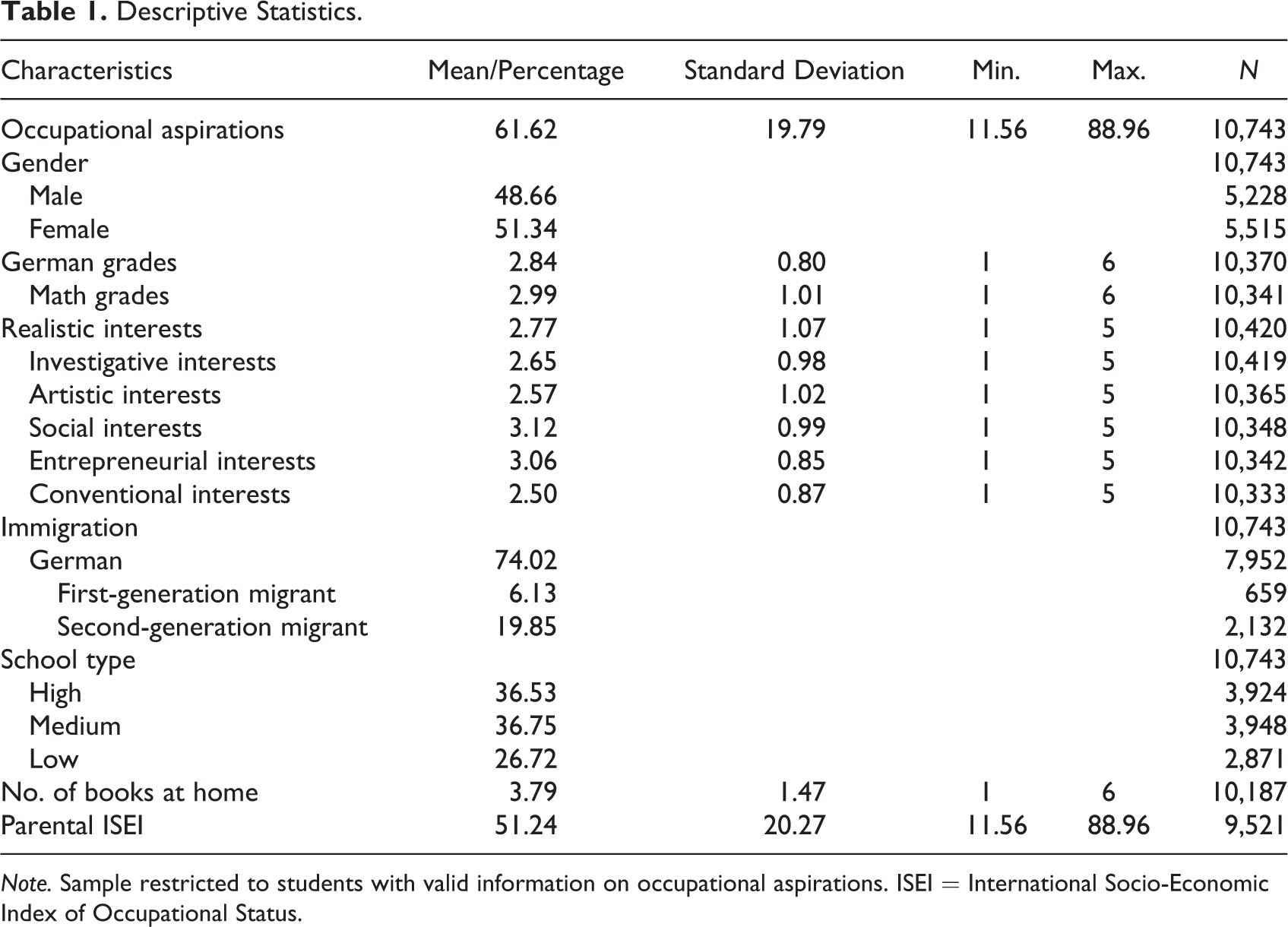
Note. Sample restricted to students with valid information on occupational aspirations. ISEI = International Socio-Economic Index of Occupational Status.
Focal Measures
Occupational aspirations
Occupational aspirations were measured in the second wave in 2011 with an open-ended question: “Imagine you had all the opportunities to become what you want. What would be your ideal occupation?” (NEPS, 2013a, p. 90). The survey of occupational aspirations in NEPS is based on the German instrument for the assessment of idealistic educational aspirations (Stocké, 2005); also see Haller (1968), who made the distinction between the concepts of aspirations and expectations (or idealistic and realistic aspirations) explicit for the first time.
The latest International Socio-Economic Index of Occupational Status (ISEI) from 2008 (Ganzeboom et al., 1992) was used to map the SES level associated with the respective occupations mentioned by the students. ISEI is an established continuous measure of occupational stratification based on information about required educational qualifications and expected income and is expressed in a 10–90 metric. The examples of occupations with low SES scores include a gardener (11.56) or a cleaner (14.20), while the examples of occupations with high SES scores include a doctor (88.7) or a lawyer (88.96). Unfortunately, as the construct of occupational aspirations was measured only once and with a single item, we could not calculate the reliability of this measure in the age cohort (NEPS Starting Cohort 4) we used in our study. However, the same item has been implemented in the survey of another age cohort (NEPS Starting Cohort 3) and has shown test–retest reliability of r = .62 from Grades 9 to 10. With regard to the validity of the measure, the item used to measure occupational aspirations in our study was highly correlated (r = .89, r = .88) with other single-item scales of occupational aspirations coded based on different SES scales, namely, the Standard International Occupational Prestige Scale (Ganzeboom & Treiman, 1996) and the Magnitude Prestige Scale (Wegener, 1985), respectively. As a robustness check of our findings, we also replicated all analyses with those two alternative measures and made sure that the results were similar across different measures of occupational aspirations.
Vocational interests
Vocational interests were assessed with the 18-item Interest Inventory Life Span (IILS) developed by NEPS (Wohlkinger et al., 2019). IILS is based on a German version (ICA-D; von Maurice, 2006; tested for elementary school age by von Maurice & Bäumer, 2014) of the (30 items) Inventory of Children’s Activities-Revised (ICA-R) from Tracy and Ward (1998) and the (60 items) General Interest Structure Test established in the German-speaking countries (Allgemeiner Interessen-Struktur-Test [AIST-R], Bergmann & Ederer, 2005; available for purchase). Both ICA-R and AIST-R are established, extensively validated, and widely used inventories for measuring vocational interests. In order to measure vocational interests in a large-scale survey and over the life course, those original scales have been modified to an 18-item short scale by the experts based on both theoretical considerations and plausibility checks (Wohlkinger et al., 2019).
The 18-item IILS measures each of the six types of vocational interests distinguished in Holland’s (1997) RIASEC model: realistic (R), investigative (I), artistic (A), social (S), enterprising (E), and conventional (C). Each type of vocational interest contained three items (one item from the ICA-R and two items from the AIST-R), and the average scores from those three items were computed for each interest type for the analyses. For each item, students were asked how much they are interested in particular tasks on a scale ranging from one to five, with 1 (I have very little interest in that; I do not like to do that at all), 2 (I have little interest in that), 3 (I am somewhat interested in that), 4 (I am rather interested in that), and 5 (I am very interested in that; I like to do that a lot). The tasks students were asked for to depict the six RIASEC vocational interest types are as follows (NEPS, 2013a, p. 103–104; the precise item formulations were censored by the NEPS due to copyrights): Realistic or practical-technical interests: Setting up or putting things together (ICA-D, item 1), building something according to a plan or sketch (AIST-R, Item 55), working with metal/wood, and making something out of metal/wood (AIST-R, Item 13). Investigative interests: Closely watching and analyzing something (AIST-R, Item 20), carrying out experiments in an experimental lab (AIST-R, Item 2), and looking at something through a microscope (ICA-D, Item 20). Artistic interests: Drawing pictures (ICA-D, Item 3), giving form to something based on artistic aspects (AIST-R, Item 3), and reading and interpreting poetry/literature (AIST-R, Item 15). Social interests: Supporting the matters of concern of others (AIST-R, Item 34), helping sick people (ICA-D, Item 22), and looking after children or adults in need of help (AIST-R, Item 46). Enterprising interests: Negotiating with other people (AIST-R, Item 53), appearing in public in support of a cause (AIST-R, Item 41), and telling others what to do (ICA-D, Item 17). Conventional interests: Keeping records or lists of something (AIST-R, Item 42), counting and sorting things (ICA-D, Item 18), and monitoring the compliance with the guidelines (AIST-R, Item 54).
In order to inspect the construct validity of the 18-item IILS, we ran a confirmatory factor analysis with all items. In line with the theoretical factor structure of Holland’s RIASEC model, our data fitted the best to the six-factor model in which the model fit was acceptable (χ2 = 3,193.30, df = 60, p < .001, comparative fit index = .933, root mean square error of approximation = .070, standardized root mean square residual = .024), following the guidelines provided by several experts (Hooper et al., 2008; Kline, 2011; McDonald & Ho, 2002). Furthermore, the internal consistency (Cronbach’s α) was sufficient for all types of vocational interests (for R, α = .72; for I, α = .69; for A, α = .68; for S, α = .77; for E α = .51; and for C, α = .58). Note, however, that vocational interests are formative, rather than reflective, constructs. As such, they do not assume the existence of a latent variable underlying the correlations among them and not require high internal consistency.
Gender
To test for gender differences in occupational aspirations, we coded gender such that men represented the reference group (1 = female; 0 = male; NEPS, 2013a, p. 4).
Control Variables
Besides the core constructs mentioned above, we controlled for family sociocultural background, immigration background, the type of school students attend, and school performance. We included these variables because they may confound the relationship between our mediators (vocational interests) and our outcome variable (occupational aspirations). Moreover, controlling for school type is essential to ensure that the assumption of “missing at random” is tenable because students attending the Gymnasium are more likely not to mention occupational aspirations.
Sociocultural background
We use parental SES and cultural capital to measure familial sociocultural backgrounds. In particular, we draw on the highest parental SES as measured by the highest ISEI (Ganzeboom et al., 1992) associated with the parents’ occupation (Schoon & Parsons, 2002; Schoon & Polek, 2011). Students were asked about their parents’ current professional activity; in case of unemployment, they were asked about the last professional activity of parents (NEPS, 2013a, p. 13). Moreover, we use the number of books available at home, the most frequently used measure of cultural capital (see Sieben & Lechner, 2019, for a validation study). The scale ranges from 1 (none or only very few books) to 6 (enough to fill shelf units); the questionnaire supports students’ assessments of the number of books by visual illustration (NEPS, 2013a, p. 64–65; 2013b, p. 29).
Immigration background
We distinguished between three categories: no immigration background (reference group), first-generation immigrants and second-generation immigrants (Kao & Tienda, 1998; Wicht, 2016). The variable is based on information on students’ country of birth (NEPS, 2013a, p. 4) as well as the country of birth of students’ parents and grandparents (NEPS, 2013a, p. 14–16).
Type of school
We categorize the type of school a student attends into three types, which mainly characterize the stratification of the German general school system: high (upper secondary school [German “Gymnasium”] or comprehensive schools with Gymnasium track, which offer the opportunity to obtain a university entrance certificate [the German “Abitur”]), intermediate (especially secondary school [German “Realschule”], but also comprehensive schools of the Realschule track), and low (lower secondary school [German “Hauptschule”], and comprehensive schools of the Hauptschule track; Wicht & Ludwig-Mayerhofer, 2014). Information on the type of school is available due to the survey design of the study, which is stratified by school.
School performance
We use students’ grades in math and German on their final report cards in Grade 9 to map their school performance (NEPS, 2013a, p. 33). The variable can take a value from 1 to 6. In German school systems, a value of 1 typically indicates an “excellent” grade, whereas a value of 6 indicates a “fail.” We inverted this scale to (1 = fail, 6 = excellent), so that higher values indicate higher achievement.
Statistical Analyses
We first conducted a linear regression model with gender as the only predictor of occupational aspirations in order to test whether gender differences in the SES of occupational aspirations exist and to quantify them. We then included the control variables into the model, namely, parental SES, cultural capital, immigration background, the types of school track, and grades in math and German. Finally, we included students’ six types of vocational interests as potential mediators in the model to examine whether gender differences in vocational interests can explain gender differences in the SES of occupational aspirations.
We estimated the direct, indirect, and total effects of gender on occupational aspirations. The direct effect corresponds to the effect of gender on occupational aspirations after controlling for vocational interests. The indirect effect is estimated as the effect of gender on occupational aspirations through the six types of vocational interests. The total effect corresponds to the effect of gender on occupational aspirations without controlling for types of vocational interests. It equates to the sum of the direct effect and indirect effects. We calculated the indirect effects by the product of coefficients method. The standard errors for all effects, total, direct, and indirect, were obtained via bias-corrected bootstrap with 10,000 replications because this procedure does not require assumptions about the sampling distribution of estimated effects (MacKinnon, 2008). To take into account the clustering of observations within schools, we made use of a Huber-White sandwich estimator to obtain cluster-robust standard errors (Williams, 2000). All analyses were conducted using Mplus Version 8.1 (Muthén & Muthén, 2017), and missing values of the independent variables were dealt with a full information maximum likelihood estimation method.
Results
Our descriptive analyses showed that girls (M = 64.7, standard deviation [SD] = 18.8), on average, aspired to occupations with 6.5 higher ISEI scores (SE = .40) than boys did (M = 58.2, SD = 20.2). This unadjusted mean difference of 6.5 points on the ISEI Scale was highly statistically significant, p < .001. With a Cohen’s d of .36, it corresponded to a “relatively large” effect according to recent guidelines (Gignac & Szodorai, 2016).
Figure 1 shows the results of full regression models; full results including the effects of control variables can be found in the Appendix (Table A1). We z-standardized all continuous independent variables to facilitate comparisons of effect sizes. The regression coefficients for the continuous variables expressed changes in SDs. Path c in Figure 1 indicates the association between gender and occupational aspirations while controlling for other potential predictors of occupational aspirations. Even when taking into account parental SES, cultural capital, and immigration background, the type of school track, and school grades, the adjusted gender gap in occupational aspirations remained considerable in size; with girls having 5.46 raw scale points (SE = .37, p < .001) higher on the ISEI Scale of occupational aspirations than boys while the observed values of ISEI ranged between 12 and 89.
Paths a and b in Figure 1 show potential mechanisms underlying the gender gap in occupational aspirations. Mediating effects of vocational interests on the relationship between gender and occupational aspirations are depicted as Paths a1–a6 and b1–b6 in Figure 1. Looking at Paths a1–a6, girls showed lower realistic, investigative, enterprising, and conventional interests and higher social and artistic interests than boys did. Gender differences in vocational interests were the most pronounced for realistic (a6: β = −0.85, SE = .02, p < .001), followed by social (a3: β = 0.79, SE = .02, p < .001), and artistic interests (a4: β = 0.66, SE = .02, p < .001). Moreover, Paths b1–b6 indicate that whereas realistic and conventional interests were negatively related to occupational aspirations, investigative, artistic, social, and enterprising interests were positively related to occupational aspirations. Investigative interests had the strongest association with occupational aspirations (b5: β = 2.7, SE = .19, p < .001), followed by realistic (b6: β = −2.6, SE = .23, p < .001), and artistic interests (b4: β = 1.21, SE = .20, p < .001).
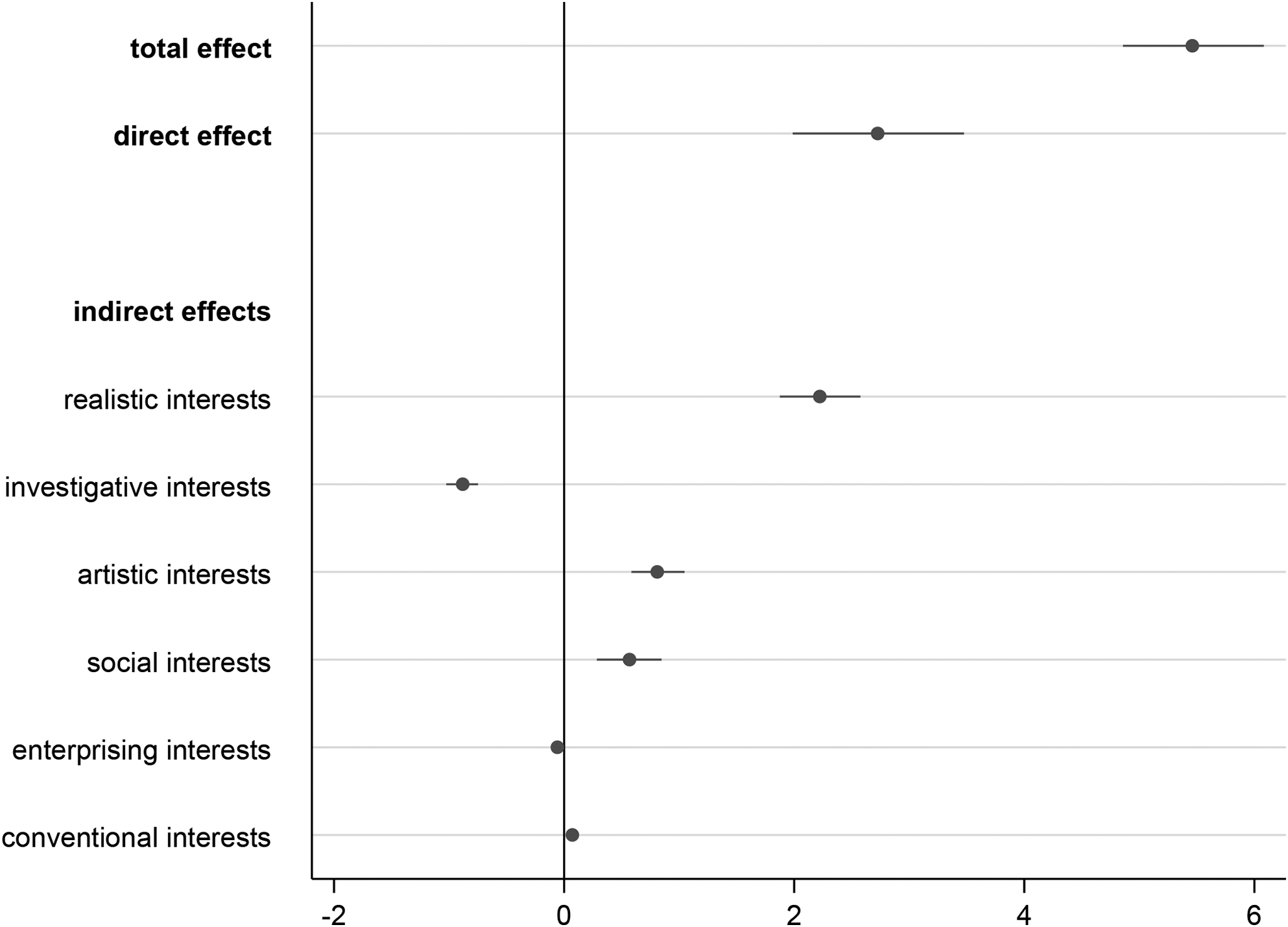
The mediating role of vocational interests in the relationship between gender and occupational aspirations. Note. Paths a1–a6 show the six types of vocational interests regressed on gender; Paths b1–b6 show aspirations regressed on the six types of vocational interests; Path c is the estimated total effect of gender on occupational aspirations; Path c′ is the estimated direct effect of gender on occupational aspirations (controlled for vocational interests); all path coefficients are significant at *p < .05, **p < .01, ***p < .001; parental socioeconomic status, cultural capital, immigration background type of school tracks, and grades are controlled in the models.
By comparing the direct path from gender to occupational aspirations from the model with vocational interests as mediators (c′) and without them (c), approximately half of the gender differences in occupational aspirations could be explained by vocational interests. However, even when vocational interests (and all control variables) were included as mediators in the model, there was still a substantial gap in occupational aspirations (i.e., a direct effect of gender unexplained by vocational interests), c′: β = 2.72, SE = .44, p < .001.
Figure 2 summarizes the total, direct, and indirect effects through mediators (i.e., the product of Paths a and b) of gender on occupational aspirations with corresponding 95% confidence intervals. Because all continuous predictors are z-standardized, the estimates can be directly compared. Among all mediating variables, we found pronounced and statistically significant indirect effects of gender on occupational aspirations through realistic, artistic, and social vocational interests. Moreover, investigative vocational interests were identified as a suppressor in the link between gender and occupational aspirations aspiration. That is, although girls had lower investigative vocational interests, they showed higher occupational aspirations. The indirect effects through other types of vocational interests (enterprising and conventional) were not found to be substantial. In other words, gender differences in occupational aspirations were found to be partly explained by gender differences in realistic, artistic, and social vocational interests. Moreover, the suppressor effect of investigative interests implies that the gender gap of occupational aspirations was further amplified by gender differences in investigative interests.
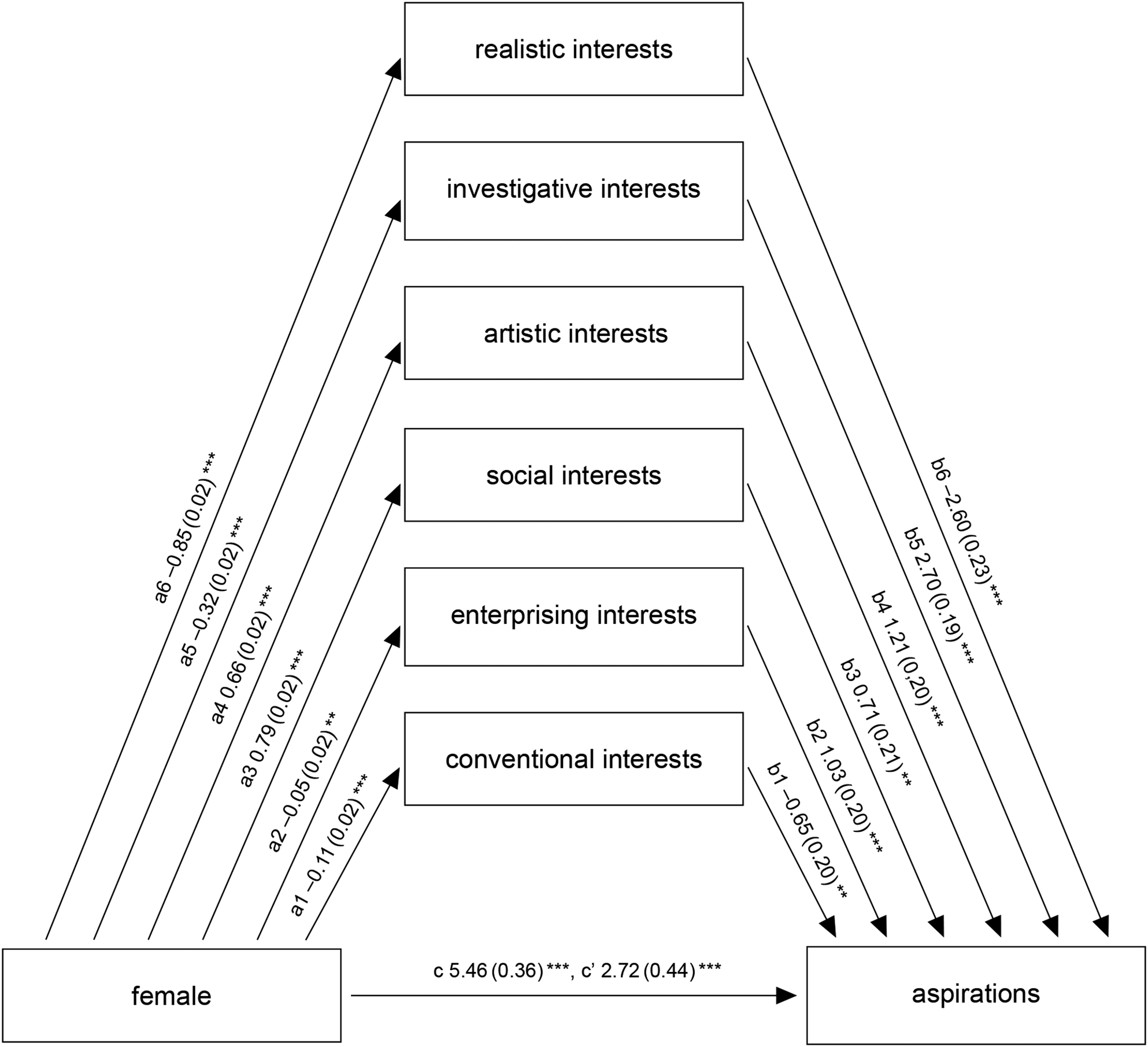
Total direct and indirect effects of gender differences in occupational aspirations. Note. The direct effect (c′) corresponds to the effect of gender (1 = female; 0 = male) on occupational aspirations after controlling for the different vocational interest types; the indirect effect is estimated as the effect of gender on occupational aspirations through vocational interests (the product of Paths a and b). The total effect (c) corresponds to the effect of gender on occupational aspirations without controlling for vocational interests (it is the sum of the direct effect and the indirect effects). Parental socioeconomic status, cultural capital, immigration background, type of school tracks, and grades are controlled. The effects are shown with a 95% confidence interval.
Discussion
The aim of the present study was to investigate (1) whether a gender gap in occupational aspirations exists and (2) whether gender differences in occupational aspirations can be explained by gender differences in vocational interests. For this purpose, we used a large and representative random sample of ninth-grade students in Germany. We hypothesized that girls aspire to higher SES occupations than boys do. Moreover, we hypothesized that girls’ higher occupational aspirations could be partly explained by girls’ higher social and artistic interests and lower realistic interest compared to those of boys.
Do Girls Aspire to Occupations That Confer a Higher SES Than Boys Do?
In line with our hypothesis, our results support a majority of previous findings that girls tend to aspire to occupations that confer a higher SES than boys do (e.g., Ashby & Schoon, 2010; Rojewski, 1995). This gender gap in occupational aspirations was large in size according to recent meta-analytically derived guidelines (Gignac & Szodorai, 2016), with a standardized effect size of d = .36. Our results contradict other previous studies that reported no gender differences in occupational aspirations (Chang et al., 2006; Cochran et al., 2011; Watson et al., 2002). The divergent findings between our study and some previous studies may be attributed to several factors. First, other previous studies used data from the United States, whereas we used data from Germany. Occupational aspirations are influenced by students’ perceptions of occupations about power differences, gender stereotypes, and social prestige levels (Gottfredson, 1981, 2002), which differ greatly from country to country due to different cultural norms and educational systems (e.g., Hofstede, 1983). Moreover, our study had a much larger sample size (N = 10,743) than other studies (N < 1,000), leading to more precise estimates of the gender differences and possibly leading to smaller standard errors. Finally, the influence of different birth cohorts may explain differential results as we used data with a fairly recent cohort of adolescents born in the mid-1990s, whereas others used much older cohorts of adolescents (e.g., birth cohort in the 1960s for Cochran et al., 2011).
What Explains Potential Gender Differences in the SES of Occupational Aspirations?
Our study provides the first evidence that gender differences in the SES of occupational aspirations can be partly explained by gender differences in vocational interests as conceived in Holland’s (1997) RIASEC model. Specifically, realistic interests (higher in boys), as well as artistic and social vocational interests (higher in girls), emerged as partial mediators in the link between gender and occupational aspirations, whereas investigative interests emerged as a suppressor.
Our findings indicate that girls tend to be more interested than boys in social and artistic tasks and activities which are linked to occupations that confer a higher social status; whereas boys are more interested in realistic activities which are linked to occupations that confer a lower social status. Typical occupations associated with the realistic interests preferred by boys are often located at the lower end of the occupational status hierarchy and include automobile mechanic, electrician, carpenters, plumbers, and truck drivers and typically involve mechanical skills or the ability to work with objects, tools, and machines. By contrast, typical occupations associated with the social interests preferred by girls are often represented in the middle to the upper-middle range of the occupational status hierarchy and include teachers, nurses, and doctors which require social skills or the ability to communicate and work with people in a social context. The one exception to this pattern was that boys had higher investigative interests, which are linked to occupations that confer a higher social status. Typical occupations associated with investigative interests include scientists, physicians, geologists, and pharmacists. Following social cognitive career theory (Lent et al., 1994), the divergent vocational interest profiles of boys and girls, which predict occupational aspirations, might be traced back to different self-efficacy beliefs resulting from different scholastic achievements.
Overall, this suggests that the gender gap in occupational aspirations should not be primarily interpreted as girls’ “ambition to aim higher,” that is, a striving for more prestigious, higher status occupations. Instead, the gender gap in occupational aspirations appears to be primarily the consequence of girls’ “aiming for something else than boys,” that is, a preference for a different occupation that is rooted in gender differences in vocational interests.
Implications
A key practical implication of our study concerns the paradox that girls show higher occupational aspirations than boys because of the sex-typed boundaries of their “zone of acceptable alternatives,” but at the same time often end up with lower occupational achievement than boys. The frustration of aspirations (maybe accompanied by a misfit of person and environment) may be considered a violation of expectations that causes affective arousal (e.g., Reynolds & Baird, 2010). Moreover, not realizing aspirations may result in a “loss of talent” (e.g., Sikora & Saha, 2011). Therefore, school professionals and career counselors may especially support girls to keep on holding on their aspirations and to develop the abilities needed to realize their aspirations (e.g., enhancing self-confidence) and to overcome given obstacles.
Limitations and Directions for Future Research
Despite the strengths of our contributions, there are still limitations that need to be addressed in future research. First, although we made sure that all predictors of occupational aspirations were measured either before or in the same wave as the wave in which occupational aspirations were measured, the present findings are still only correlational, and correlation does not necessarily imply causation (see Foster, 2010). Because our data did not allow us to investigate our research questions longitudinally, we are not able to draw a strict conclusion on the causal relationship between gender and the SES of occupational aspirations through vocational interests. Future research using repeated measures of occupational aspirations and possible mediators of the gender–aspirations link is needed in order to further clarify the causal mechanisms behind the gender differences in occupational aspirations.
Second, according to our results, gender differences in the SES of occupational aspirations remained even after the mediators were included in the model (i.e., there was still a direct effect of gender in addition to the indirect effects). This finding implies that in addition to vocational interests, there may be other potential factors that could additionally explain the relationship between gender and the SES of occupational aspirations. According to the Wisconsin model of socioeconomic attainment (Sewell et al., 1970), educational and occupational aspirations are related to each other. Therefore, gender differences in educational aspirations may underlie gender differences in occupational aspirations. Moreover, it would be valuable to use different constructs for measuring vocational interests to analyze the link between gender and occupational aspirations more in-depth, especially those inventories that explicitly take into account vocational interests related to prestige/SES (Tracey, 2010). Future research should explore such possibilities in order to better understand the possible explanations behind gender differences in occupational aspirations.
Finally, despite girls’ advantage of occupational aspirations compared to boys, paradoxically, women are still disadvantaged than men when it comes to occupational attainment. Women obtain lower occupational status, career advancement, and income than men (Gutman & Akerman, 2008). Although it is beyond the scope of the present study to explain the gender gap in occupational attainment during adulthood, the present findings may still give us some insights into how gender differences in occupational aspirations may be related to the gender gap in occupational attainment. For instance, girls may establish stronger occupational aspirations as they may need to use their aspirations as a buffer against the upcoming boundaries due to the gender inequality in the labor market (blocked opportunity hypothesis; Kao & Tienda, 1998). More investigation is needed in order to further explore gender differences in the transition from occupational aspirations to its attainment in the labor market. In the same vein, further research is needed on how different career constructs are related to each other, as, on first glance, our finding of girls’ higher occupational aspirations stands in contrast to the plethora of research on gender differences in work values, career motivations, and related constructs, which quite unanimously suggests that girls are less—not more—driven by status, prestige, material rewards, and professional advancements than boys are (e.g., Ferriman et al., 2009; Gino et al., 2015; Lechner et al., 2018).
Conclusion
Our study contributes to the literature on gender differences in occupational aspirations in several ways. First, we were able to replicate previous findings that girls aspire to higher SES occupations than boys and to generalize them to the German context. Second, we are among the first who were able to shed light on the possible origins of these gender differences. Our results demonstrate that girls strive for higher SES occupations partly because of their specific vocational interest profiles (as measured by Holland’s RIASEC model). Compared to boys, girls are less interested in realistic tasks that are often associated with blue-collar jobs, and they are more interested in social and artistic tasks that are often associated with more white-collar occupations. Put differently, girls aspire to higher SES occupations because they search for job environments that match their interests. What girls aim for is probably not the status of occupations per se, but the content of the jobs or the work itself which confer a higher SES. If understood as an expression of specific vocational interests, girls’ higher occupational aspirations are no longer at odds with the body of research showing that girls are almost invariably less motivated by status, power, and money than boys are when directly assessing these motivations. From a methodological perspective, future research on individual differences in occupational aspirations in general and gender differences in occupational aspirations, in particular, should assign a more central role to the interrelation of different constructs of career development in order to reveal the mechanisms behind differences in career choices and attainment.
Footnotes
Appendix
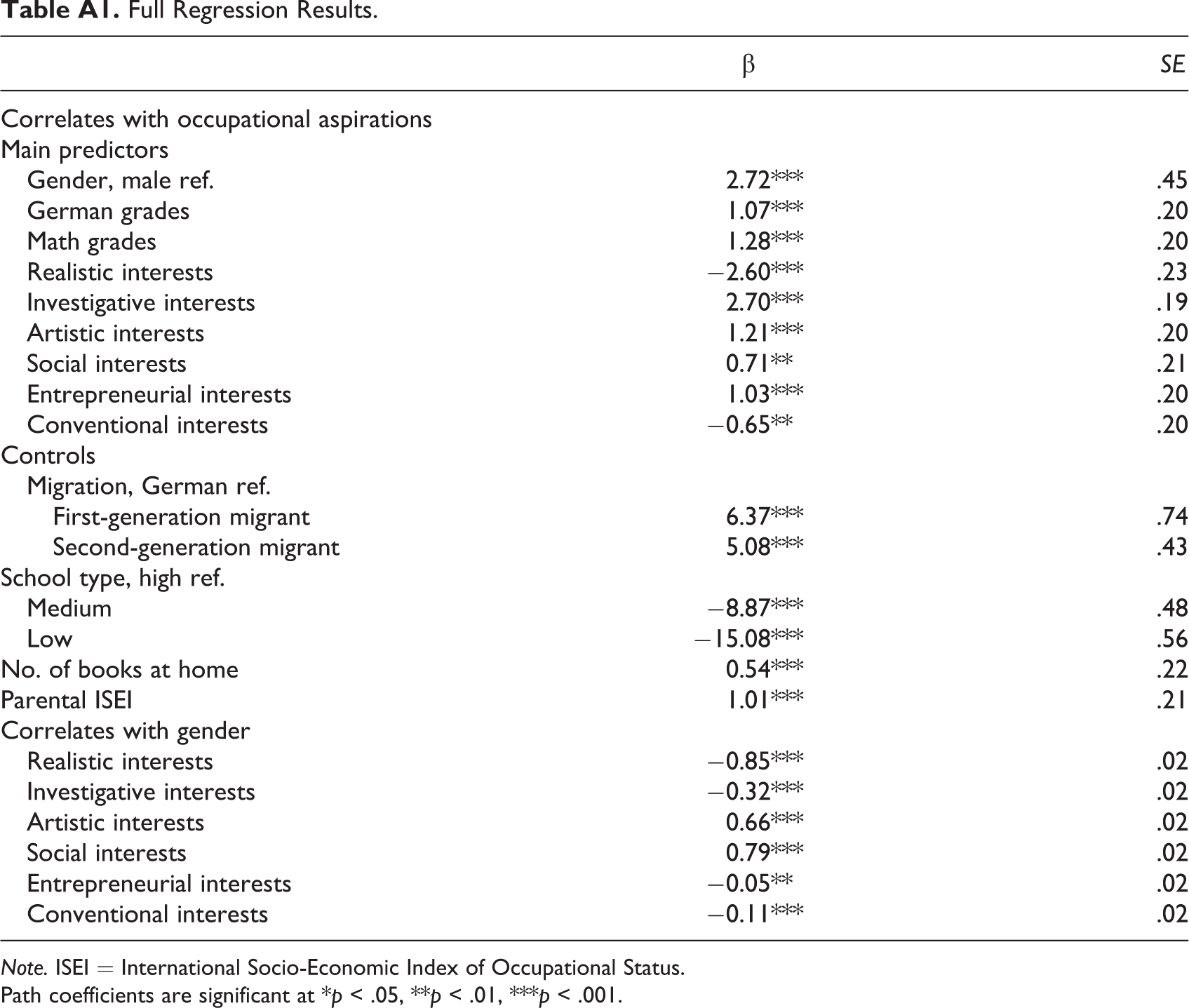
Full Regression Results.
| β | SE | |
|---|---|---|
| Correlates with occupational aspirations | ||
| Main predictors | ||
| Gender, male ref. | 2.72*** | .45 |
| German grades | 1.07*** | .20 |
| Math grades | 1.28*** | .20 |
| Realistic interests | −2.60*** | .23 |
| Investigative interests | 2.70*** | .19 |
| Artistic interests | 1.21*** | .20 |
| Social interests | 0.71** | .21 |
| Entrepreneurial interests | 1.03*** | .20 |
| Conventional interests | −0.65** | .20 |
| Controls | ||
| Migration, German ref. | ||
| First-generation migrant | 6.37*** | .74 |
| Second-generation migrant | 5.08*** | .43 |
| School type, high ref. | ||
| Medium | −8.87*** | .48 |
| Low | −15.08*** | .56 |
| No. of books at home | 0.54*** | .22 |
| Parental ISEI | 1.01*** | .21 |
| Correlates with gender | ||
| Realistic interests | −0.85*** | .02 |
| Investigative interests | −0.32*** | .02 |
| Artistic interests | 0.66*** | .02 |
| Social interests | 0.79*** | .02 |
| Entrepreneurial interests | −0.05** | .02 |
| Conventional interests | −0.11*** | .02 |
Note. ISEI = International Socio-Economic Index of Occupational Status.
Path coefficients are significant at *p < .05, **p < .01, ***p < .001.
Authors’ Note
Alexandra Wicht and Ai Miyamoto are first authors of this article.
Declaration of Conflicting Interests
The author(s) declared no potential conflicts of interest with respect to the research, authorship, and/or publication of this article.
Funding
The author(s) disclosed receipt of the following financial support for the research, authorship, and/or publication of this article: This work was supported by the “Federal Ministry of Education and Research,” under Grant No. W143700A, and by the Deutsche Forschungsgemeinschaft, under Grant No. LE4001/1-1).
