




Abstract
This study explores the meaning of work for 22 young refugees aged from 18 to 35 from Afghanistan, Eritrea, Iran, Somalia, Syria, Turkey, Ukraine, and Yemen through semistructured interviews. Using consensual qualitative research, we sought to understand the purposes work fulfills, their work expectations, and how purposes and expectations might have changed over time. Results showed that work fulfills many purposes found in the literature, (e.g., development, structure, health, identity, and material benefits) as well as purposes in relation with others and the larger society. Participants expect their work to correspond to their selves (e.g., interests and personality), offer decent working conditions, and allow meaningful relationships and opportunities to help others. Illustrations of two participants’ paths provided insights into a possible change of meaning of work. In addition to implications for practice, the influence of relational and contextual factors is discussed.
The United Nations Refugee Agency reported that 79, 500, 000 people were forced to flee their homes at the end of 2017 due to conflicts, violence, or persecution (The United Nations Refugee Agency (UNHCR), 2020). This number comprises 26,400,000 refugees; 45,700,000 internally displaced persons; and 4,200,000 million asylum seekers. To these people, integrating into a local community in a foreign country represents a viable solution for a better life. Integration also presents a “complex and gradual process,” with the goal being to “pursue sustainable livelihoods and contribute to the economic life … and live among the host population without discrimination or exploitation” (The United Nations Refugee Agency (UNHCR), 2018, p. 30). Employment stands out as a crucial factor of the integration process (Baran et al., 2018). At the same time, globalization and the rise of new technologies create expectations of increased flexibility for employees, often to the detriment of their personal lives, and an increase in new forms of work, such as part-time, temporary, or on-demand work (Toscanelli et al., 2019). Consequently, immigrants are overrepresented in the approximately 40% of workers worldwide who have precarious jobs (Mallett, 2018). Moreover, the Organisation for Economic Co-operation and Development (OECD) (2019) highlighted that for immigrants, especially those such as refugees who are coming from countries outside the European Union, the unemployment rate is higher than it is for their peers who are native to host countries. Indeed, after arriving in a host country, refugees face multiple challenges in social and professional integration. These challenges include precarious financial circumstances, the lack of a network and support, and traumatic experiences (Hynie, 2018).
Although career guidance could play a crucial supportive role in refugees’ resettlement process (Udayar et al., 2020; Yakushko et al., 2008) and help them obtain decent and dignified work (Guichard, 2016), research on refugees has largely neglected the field of vocational psychology (Massengale et al., 2020). Against this backdrop, we aimed to explore the experiences of young refugees in their host countries and develop an understanding of the meaning they ascribe to work. Ultimately, this study could contribute to reflections on how to support them in their professional integration.
Decent and Meaningful Work
Considered a fundamental right by the United Nations and the International Labour Organisation (ILO), decent work is defined as work that gives access to full and productive employment, respects employees’ rights, guarantees social protection, and promotes social dialogue (International Labour Organization (ILO), 2013). The ILO’s definition of decent work addresses only macroeconomic factors and focuses on labor market indicators (Kozan et al., 2019). In the field of guidance, several authors have called for this definition to integrate psychosocial components (e.g., Blustein et al., 2017; Guichard, 2016; Massoudi et al., 2018). Guichard (2016) and Blustein et al. (2017) invited researchers and policy makers to address and promote not only decent work (Blustein et al., 2016), but also dignified work (i.e., work that allows people to live, express themselves, contribute to their social and personal identity, grow, and find meaning and purpose in work and life). Accordingly, Blustein (2013) conceived decent work as responding to three fundamental needs: survival and power, social connections, and self-determination. More specifically, decent work should allow individuals to make material acquisitions and provide opportunities to obtain status and prestige, construct relationships with others, and engage in ideally meaningful activities.
Finding meaning in work can thus be considered a core component of decent work. Meaningful work is defined as “the subjective experience that one’s work has significance, facilitates personal growth and contributes to the greater good” (Allan et al., 2016, p. 1). A sense of meaning can act as a major protective psychological resource against negative outcomes in the workplace (Arnoux-Nicolas et al., 2016) and foster positive job markers, such as work behavior, engagement, job satisfaction, empowerment, career development, personal fulfillment, well-being, and a feeling of dignity (Codell et al., 2011; Rosso et al., 2010; Steger et al., 2012). Career paths and transitions influence individuals’ priorities and might therefore modify their expectations about work (Fournier et al., 2019). Among the existing conceptualizations of meaningful work, Rosso et al. (2010) offered a comprehensive, integrative model that extends the understanding of the meaning of work (MOW) beyond the self, encompassing relationships with others and work contexts. They stressed that the MOW has four main sources. The first source relates to the self and encompasses one’s values, motivations, and beliefs about work. The authors highlighted that the concept of the self is conceived as malleable regarding experiences and work contexts. The second source of meaning addresses the others and how interactions and relationships with coworkers, leaders, and community, and family influence the meaning of one’s work. The third source covers the work context in which work occurs and includes the design of job tasks, the organizational mission, the financial circumstances, the nonwork domains, and the national culture in which work is conducted. The fourth source concerns the spiritual life of individuals and encompasses spirituality and a calling to a particular vocation. Additionally, Rosso et al. posited that individuals who find meaning from more than one source experience more meaningfulness at work. With the same logic, they also offered an overview of the mechanisms at play in the construction of the MOW with both self-centered (e.g., self-efficacy and self-esteem) and externally oriented (e.g., belongingness and transcendence) mechanisms.
Refugees’ Access to Decent and Meaningful Work
Finding decent and meaningful work can be a major challenge for refugees. Indeed, the number of years spent as a refugee in a host country has a detrimental effect on the probability of finding a meaningful job (Codell et al., 2011). However, literature on refugees’ MOW remains scarce, and only a few studies have addressed this topic among the broader population of immigrants. One main contribution came from Stebleton (2012), who explored the MOW of seven adult sub-Saharan African immigrant students in the United States and highlighted the major effects that external factors, such as community influences or family responsibilities, had on their work decisions. Moreover, reciprocity toward the family and the community appears to be salient in many African societies and is often expressed through financial support, community service, and a strong sense of social utility through work, either paid or unpaid. Finally, changes in their perceptions of the MOW seem to have resulted in tensions between individualism (i.e., pursuing personal goals such as studying) and collectivism (i.e., family and community expectations). In a study investigating perceptions of work among immigrant workers in Finland, Välipakka et al. (2016) showed that immigrants consider work as a means of integrating into their host societies and feeling accepted and respected by their local communities. Therefore, working increases self-esteem and represents an important sphere in which to learn about and adopt cultural habits and customs and build relationships.
Concerning the population of refugees specifically, in a recent study involving refugees and asylum seekers, we identified the construction of career plans as a priority because work represented a first condition for the fulfillment of their needs and life plans, such as starting a family (Fedrigo et al., 2021). Ginevra et al. (2021) recently investigated the future goals of 75 refugee men in Italy and found most of their goals related to well-being and safety, affiliation (i.e., starting a family and meeting local people), and materialistic work (i.e., finding any job by which to eat and survive, obtaining a residence permit to access rights and services, and having good housing and financial resources). They also stressed that the participants mentioned self-fulfillment goals (i.e., self-realization and development at work, and having free time outside of work) less frequently, probably because work is above all perceived as a way to build their futures and meet vital needs. Moreover, the participants hardly mentioned goals regarding access to decent work, which might indicate that refugees are not aware of their rights as workers. Indeed, although the emphasis is on helping refugees integrate into the labor market, little information on workers’ rights, employers’ obligations, and safety at work is available (Kosny et al., 2020).
Current Study
A significant number of the people fleeing persecution in their countries of origin are particularly vulnerable in their host countries’ job markets, considering the long resettlement process and their often traumatic pasts (Hynie, 2018). At the same time, entering the labor market plays an important role in easing the resettlement process (Yakushko et al., 2008). In Switzerland, around 11,000 people, mostly coming from Eritrea, Afghanistan, Turkey, Algeria, and Syria, asked for asylum in 2020 (Secretary of State for Migration, 2021). Despite healthy economic indicators in terms of job quality and quantity, accessing decent work within the Swiss labor market remains restricted for foreign, low-qualified, and young adults (Masdonati et al., 2019). Vocational education and training (VET) programs are valuable options through which young refugees can obtain such access. However, the educational requirements are difficult to meet, especially because refugees often lack social support and knowledge of the local norms and language (Atitsogbe et al., 2020; Bolzman et al., 2018).
To our knowledge, refugees’ MOW has rarely been addressed in the literature. Thus, we carried out a study to improve the understanding of their integration experience within the Swiss labor market. Given that doing meaningful work is a key factor in the labor market integration process (Codell et al., 2011), we focused specifically on exploring the meaning young refugees ascribe to work. Conceived as an exploration of their experiences in their host country, our aims were (a) to gain a deeper understanding of refugees’ MOW in the light of Rosso et al.’s (2010) model by focusing on work purposes and expectations and (b) to explore how the MOW might evolve through the migration process.
Method
After obtaining the approval from the ethical committee of authors’ university (E_SSP_102019_00002), we adopted a qualitative approach with semistructured individual interviews to develop an in-depth understanding of the meaning refugees attach to work. Considering the exploratory nature of this study, we favored a qualitative design grounded in a postpositivist paradigm (Morrow, 2005; Ponterotto, 2005).
Participants and Procedure
Demographic Characteristics of Participants.
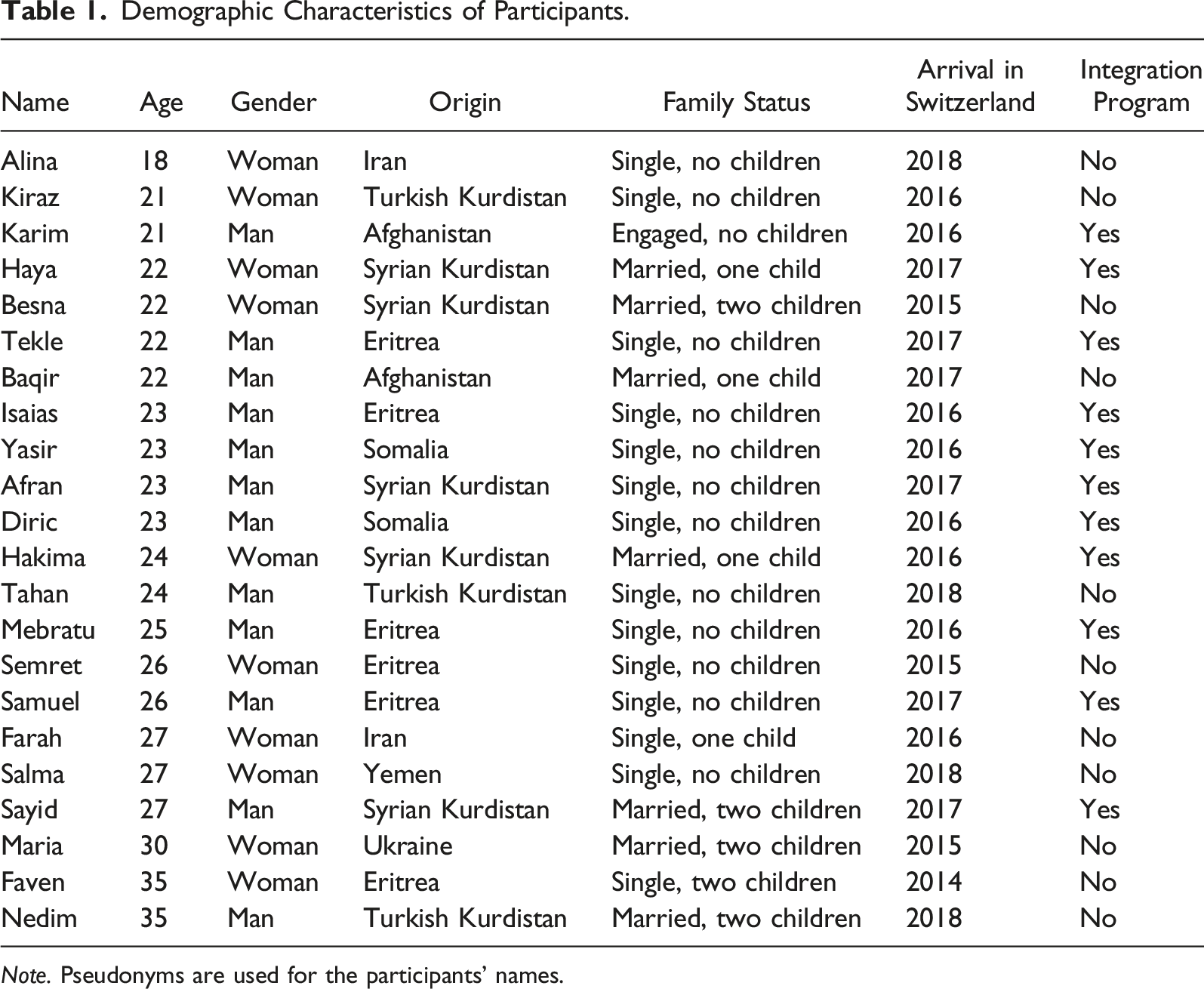
Note. Pseudonyms are used for the participants’ names.
Interview Guide
The interview guide was divided into four parts. The first part focused on the participants’ demographic information, such as age, country of origin, marital status, educational level, and family members present in the host country. The second part investigated the participants’ professional experiences in their countries of origin and during their migration journeys, the rationales behind their career choices, and their past representations of work and those of their families. We asked questions such as, “At that time, how did you choose this job?” and, “At that time, what did work mean to you?” The third part covered their current situations in their host countries regarding their local work experiences, current MOW, and expectations. We asked questions such as, “What is a good work for you?” and, “Has your representation of work changed since you arrived in Switzerland?” The fourth part addressed the participants’ future plans and goals and the factors they thought would help or hinder the achievement of these goals. We asked questions such as, “What would be your dream job, and why?” and, “What can help you realize these projects?” For the purpose of this study, we chose to focus mainly on Parts 2 and 3 of the interviews to assess their MOW.
Analyses
The interviews were analyzed following an adaptation of a consensual qualitative research procedure (CQR, Hill et al., 2005). Five members composed the research team, who were all Caucasians and aged between 27 and 45 years. Three female PhD students and a male master’s degree student, most of whom had experience conducting qualitative research, performed the coding. The fifth member, a male university professor who is an expert in qualitative research, was the auditor. The auditor and one of the coders, who were familiar with CQR, guided the team through the process.
Domains, categories, and frequencies.
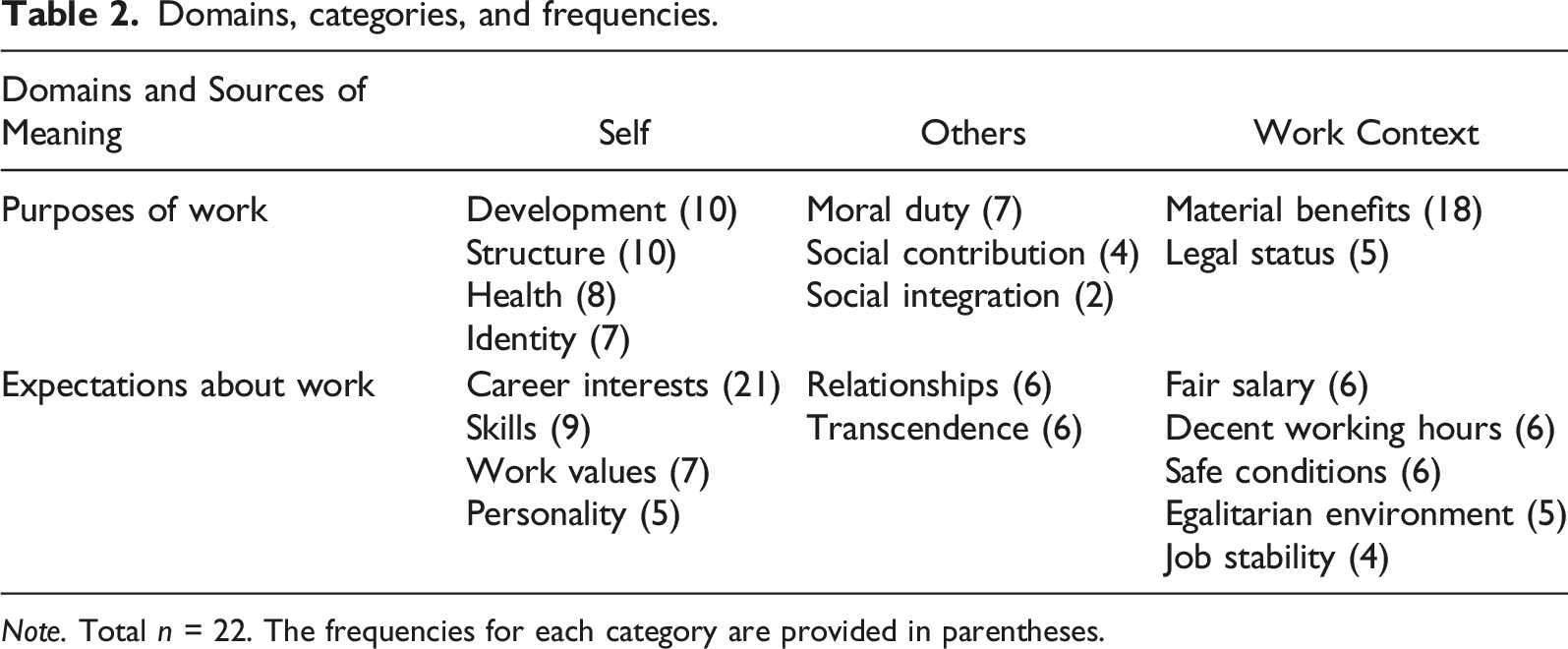
Note. Total n = 22. The frequencies for each category are provided in parentheses.
The second phase consisted of a vertical analysis (Gaudet & Robert, 2018) to address the second study aim, exploring a potential evolution of the MOW in the light of the participants’ unique trajectories. We collaborated to identify and analyzed the vignettes of the two participants who were best able to reflect and reconstruct their MOW before and after migration. As such, these vignettes are not representative of all the participants’ experiences, but instead refer to the two most elaborate narratives on the topic. They thus serve as insightful illustrations of how the MOW might evolve upon a refugee’s arrival in a host country. The first author synthesized these two paths, and the other team members edited and validated the work.
Trustworthiness
To ensure trustworthiness throughout the process, we followed the recommendations of Hill et al. (2005). First, each team members reflectively shared their possible biases by acknowledging (a) the differences in their experience with CQR, and the sample population; (b) the proximity between the undergraduate and postgraduate students and the participants in terms of age and the groups’ radically different life conditions and stories; and (c) the possible sensitivity to the participants’ narratives and the obstacles they have encountered, which might influence our analyses and interview conduct. Transparency of the data analysis was addressed by thoroughly describing the steps and the validation, using team rotation at every stage, and performing a stability check as a final verification. Regarding power issues, questions regarding residence status were addressed with caution because it is a sensitive issue that could affect the asylum procedure (Morrow et al., 2012).
Results
To address the first study aim, we organized the results into two main domains: purpose of work and expectations about work. For the first domain, we focused on the use of work and the goals the participants were trying to accomplish through work, and for the second domain, we focused on what they expected their work to offer them. Both domains were composed of categories that we organized around three of Rosso et al.’s (2010) four sources of meaning: self, others and work context (Table 2). Spirituality did not emerge from our analyses because questions of religion and faith were hardly addressed. In addition, we present two illustrations to address the second aim of the study and provide insights on a possible change in the meaning the participants attach to work.
Purposes of Work
The purpose of work domain referred to the goals and functions of work that individuals attach to work in their lives. The self source of meaning was composed of four categories: development, structure, health, and identity. The others source of meaning was composed of three categories: moral duty, social contribution, and social integration. The work context source of meaning was composed of two categories: material benefits and legal status.
Self
Four categories of work purposes were related to the participants’ self source of meaning. First, 10 participants mentioned development as a purpose. They reported that work should lead to a sense of personal success and accomplishment that would allow them to surpass themselves. For example, Kiraz stated “For a foreign woman, it’s better to work … in a good job and to say that I succeeded in something; I arrived late but I succeeded. I did something; now I'm in a good state.” In the same vein, Salma wanted a job that “takes you from your comfort zone … makes you the best of you, makes, like, you challenge yourself.” Structure was the second category of work purposes. In this case, 10 participants described work as bringing structure and rhythm to their daily lives through the organization and its demands. For example, Afran emphasized the importance of being active in life and stated, “Work, even physically it's good to—, it’s better [than] staying at home all day.” Eight participants reported the health purpose; for them, work contributed to feeling mentally and physically well through the daily physical activity it provided. This was the case for Karim, who felt physical pain manifest when he did not work. Similarly, Samuel stated, “Yes even for the—important health because if, if someone works … he does not think anything else.” Finally, work appeared to be a central part of the participants’ identities. They reported that work made them feel more complete as a person, or even helped them define themselves. For example, Baqir did not recognize himself when he stayed at home instead of working. Faven’s identification with work was so strong that it transcended societal expectations: Work was crucial even though in her home country, women traditionally take care of the household rather than having a paid job. Work would also allow many participants to be independent of welfare, which they associated with a feeling of shame. Hakima explained that work was important because “I have a daughter, after she's going to grow up, if I always ask for the social help, it's not good.”
Others
Within the others source of meaning, moral duty emerged for seven participants as the obligation to serve society through their work. Tahan explained, “[The duty arises] because we … we [are] like in a capitalist system … unfortunately.” For Baqir, this sense of duty was rooted in education or traditions because work was mostly about supporting the family. For Semret, work was a way of giving back to the host society, whereas Nedim and Sayid did not want to be social burdens. The social contribution category referred to a willingness to contribute to or improve the proper functioning of society through work. Nedim wished to contribute to society through politics and political activities, to “help humans … take precautions for dictators … Also, it's democracy for everybody. Uh, that's it; that's my goal.” Faven and Farah spoke about work as a way to help others and feel useful (e.g., by taking care of an animal or helping in a children’s shelter). Finally, Baqir identified work as a way to have a place in society. In the social integration category, Hakima wondered, “If there is no work, how do I speak with people? How do I learn French?” and saw work as a way to meet locals and improve her language skills. For Maria, work was a means to feel normal.
Work Context
First, the material benefits category encompassed 18 participants for whom work provided the financial means to be materially independent of others and society. For example, Maria explained that a salary would allow her to pay the rent and buy food and clothes. Tahan reported, “I’m going to earn money. After, uh, I’m going to have a, uh, the right to, uh, … to ask for my family to come here … as a tourist but to, uh, to visit me.” Five participants mentioned contextual purposes related to legal status. In Switzerland, having a job is a key factor in obtaining a residence permit, which translates to peace of mind because a refugee’s status is less provisional. A residence permit gives them the possibility of settling permanently, helps them in their family reunification, and relieves them from travel restrictions. On the subject of family reunification Faven said, “That’s the most important thing: It’s bringing my kids. That’s it.”
Expectations About Work
This domain groups the participants’ work expectations in terms of characteristics or values that they wished to fulfill through work. The self source of meaning was composed of four categories: career interests, skills, personality, and work values. The others source of meaning was composed of two categories—relationships and transcendence—and the work context source of meaning comprised five categories: fair salary, decent working hours, safe conditions, job stability, and an egalitarian environment.
Self
Most of the participants emphasized the importance of having a job that corresponded to their career interests. For example, although having never worked before, Besna and Haya already had ideas for occupations in mind that corresponded to activities they liked to do, such as designing clothes or nail prosthetics. Nine participants put forth the expectation that their work should fit their skills. For example, Diric explained that he wants to find a VET program as a logistician in Switzerland because he used to work in that field in Somalia, saying, “It is my skill.” As an illustration of the two previous categories, Sayid explained that in his view, a good job was directly linked to his profession as a painter in Syria because it corresponded to his interests and his skills: “It’s my job … For me, it’s easy.” Under the category work values, seven participants stressed the importance of having a job that corresponded to their values. For example, Tekle explained that he would love to work outside, because that is where he felt free, which seemed to represent a central value for him. Lastly, five participants expected their jobs to correspond to their personalities. For example, Farah explained that she preferred working in a quiet place, such as a bank, rather than in the social field because: “what is not good … with people (laughs) when they talk a lot.”
Others
Six participants reported the importance of working in a job where collegial relationships were encouraged and where coworkers were friendly, with those factors contributing to their job satisfaction. For example, speaking of his previous job in Somalia, Yasir stated, "It is important to me … because … working with the team or—and also I contact the clients like that.” Samuel added that having friendly coworkers made him happy to rise and go to work. The transcendence category referred to a willingness to care for and help others through work. Six participants, who mainly addressed the importance of helping others, reported transcendence as being important to them. More specifically, Isaias linked his willingness to care for the elderly to his family values, traditions, and religion: “Because my family, it is attentive, it is shy, it is always going to go in church … always contacting God … that’s why my idea is always to help, to help someone.” Nedim added that he used to identify himself as Kurdish and practice Islam, but over time, love became his new religion. He no longer gave much importance to his nationality and cared for all humans equally and as part of a whole.
Work Context
This source of meaning encompassed all the necessary working conditions that the participants expected from their work, which we divided into five categories. First, six participants expected a fair salary, namely, a salary that was commensurate with the efforts made and that allowed them to live properly. As an illustration, Farah explained what a bad job would mean—“You work a lot and earn nothing”—implying that she expected to receive an adequate salary for the hours worked. Alina, who worked in a restaurant during summer, felt she did not earn enough for the time she spent working: “And then you can’t say anything because they say, ‘No, that [the salary] is enough,’ and everything, and they’ll cut you off, you know … [because] someone else is going to do it.” Six participants also reported the importance of decent working hours, specifically, hours that offered a good work–life balance. For example, Karim stated, “[In an ideal job,] we have time … you have a life after 5:00 … we do picnics with families like that (laughs).” The safe conditions category concerned six participants who expected their work not to be dangerous nor physically strenuous and to provide a psychologically healthy climate (e.g., no harassment or bullying). Mebratu explained that he wanted to become a carpenter for many reasons, but he planned to move on to a more intellectual profession in few years because it would be less physically demanding: “If it’s a business … it’s with your head, you don’t have to work manually; you don't have to be strong.” Five participants expected an egalitarian environment, that is, an environment in which discrimination based on country of origin, gender, or social status did not exist. As Salma explained, “If I work well, I expect to have the same amount as others, or the same dignity or rights as others.” Finally, four participants expected job stability and wanted to have an adequate contract duration and percentage of work, as it was the case for Diric, who was on call and underemployed, and would have liked to work more hours. Stability was also associated with a fixed salary, as Farah explained about hairdressers’ working conditions: “It doesn't have a fixed salary ... that’s not good for someone who has children.”
Evolution of Meaning of Work
The meaning participants attached to work and the place it took in their lives had sometimes changed between their country of origin and the host country. The two following vignettes are provided as illustrations of the elements that might have led to a potential evolution in the MOW.
Farah
Farah is a 27-year-old Iranian woman who arrived in Switzerland in 2016. She was settled in a transit country, wishing to go to the United Kingdom, but decided to follow her boyfriend who was fleeing Iran to Switzerland. She became pregnant during the trip and is now the mother of a 4-year-old girl whom she takes care of alone. When she first arrived in Switzerland, she wanted to change and assimilate to the Swiss habits and mindset. Her social assistant suggested she enroll in professional integration measures, but they were not compatible with having a child, and she felt stuck as a single mother. Today, she does not feel comfortable in Switzerland, rejects the Swiss culture, and finds it more restful to accept whom she really is without trying to change. For example, she maintains a gendered representation of occupations and does not conceive that a woman can drive a truck. According to Farah, work is very important in Iran, but the labor market is not safe for women, who are therefore encouraged to study before getting married. Coming from a wealthy family, Farah did not need to work because her father provided for all her needs. Now that she is a mother, Farah feels pressure from her parents to work and provide for her daughter. In Iran, she used to volunteer in an animal shelter because she likes animals and wanted to feel socially useful. In Switzerland, she does not feel the need for volunteers exists, and she mainly sees work mainly as a means of financial remuneration.
Kiraz
Kiraz is a young Kurdish woman from Turkey. She arrived in Switzerland in 2016 with her parents and siblings and is now 21 years old. Her parents always emphasized the importance of education because in Turkey, studying and gaining a good social status are crucial for women to be financially independent. They also encouraged her to study and have a career in which she could grow and fulfill herself. Now that they all live in Switzerland, Kiraz feels less pressure from her parents because they are no longer worried and let her make her own choices. For Kiraz, having a job that allows her to be financially independent is still important, but less so than before, because in Switzerland, she feels as though living on her own as an independent woman is possible without her parents or a husband. Moreover, fleeing to Switzerland appears to have enhanced Kiraz’s motivation to work. She wants to show her host country that she has managed to be successful and obtain a good job despite all the difficulties she faced as a young foreign woman.
The illustration of Farah shows that the financial aspect of work was not an issue in Iran, and she did not need to work because her father was able to provide for her. Thus, her desire to be useful to society guided Farah to volunteer to help animals in a shelter. Today, as a refugee in Switzerland and the mother of a child, she has to work to provide for her daughter. In contrast, Kiraz’s gender-related work expectations appear to have changed between Turkey and Switzerland, which might have modified the meaning she attaches to work. In her country of origin, education was very important and work was seen mainly as a means of becoming a financially independent woman, whereas finding a job she likes and in which she can grow was also important. Today, the financial aspect has become less important, which has left greater room for other purposes of work, such as personal development and growth.
Discussion
In line with the first aim of our study—to explore the meaning refugees attach to work—our findings showed that work fulfills several purposes and that the participants have several expectations about it. Within Rosso et al.’s (2010) self source of meaning, work fulfills purposes of development, structure, health, and identity. In addition, the others source can serve to fulfill a moral duty, social contribution, or social integration. Work also brings material benefits and helps refugees obtain a legal status, which we consider as referring to the work context source of meaningful work. As for the expectations about work, the refugees in our study would like their work to match their vocational interests, skills, work values, and personalities. They also expect their work to allow them to have positive relationships with others and provide decent working conditions, such as fair salary and working hours, safe conditions, an egalitarian environment, and job stability. Finally, some expect work to allow them to express transcendence, guided by love, sharing, and caring for others. As for the second aim of the study—to explore possible changes in work purposes and expectations over time—the vignettes of Farah and Kiraz show that the meaning they attach to work and the importance work has in their lives have changed during the transition from their home countries to the host country. For Farah, work used to be a way of feeling useful through volunteering, but since she became a mother, work has become an obligation. Kiraz felt less pressure in the host country to have a well-paid and highly skilled job to be financially independent as a woman. Consequently, work for her can now better meet her personal aspirations. In the next sections, we discuss the results in light of the main findings of the literature and Rosso et al.’s (2010) model.
Restricted Access to Decent Work
The ILO’s (2013) criteria for decent work emerged in our results as expectations refugees have about work, such as job security, an egalitarian environment, and safe working conditions. Regarding this latter aspect, many participants reported better working conditions in Switzerland than in their home countries (i.e., more security and better wages and working hours). Nevertheless, several problems arose in accessing decent working conditions in the host country. We first argue that professional integration is more difficult because it depends on the possibility of obtaining a work or residence permit and on the recognition of qualifications. In addition, low-skilled jobs still offer poor working conditions. Consequently, most refugees reported having plans to enroll in VET programs. In addition, in contrast to Ginevra et al.’s (2021) findings, the participants often mentioned purposes and expectations of self-fulfillment and development at work. Some participants stated they would prefer to study and graduate to have an opportunity to develop and advance socioeconomically. Furthermore, most of the participants seek to enter the labor market in a sustainable way through a VET program. Although they have significant material constraints, their desire to enroll in a VET program suggests they want to integrate permanently, and being able to construct their careers remains salient and accounted for in their career plans. In addition, work, which they see as a means of achieving a more stable status and social integration, seems to persist over time because it remains an important concern for them, even up to 5 or 6 years after their arrival. However, VET programs have increasingly high requirements and are therefore difficult to access for non-native speakers (Atitsogbe et al., 2020; Bolzman et al., 2018). We believe that the paradox refugees experience in a skilled labor market—which offers good working conditions but to which their access is restricted—can negatively affect their well-being.
Beyond a Self-Oriented Conception of Work
Based on Rosso et al.’s (2010) model of meaningful work, our findings on purposes of and expectations about work are organized in a balanced way among the self, others and work context sources of meaning. This confirms, among other things, the existence of a relational and a social aspect within the MOW. Indeed, consistent with Vällipakka et al.’s (2016) findings, our results show that some refugees consider work a means of integrating into their host societies and building relationships with locals. Moreover, in line with Stebleton’s (2012) results, we found that family and community strongly influence the MOW. Indeed, half of the interviewed refugees mentioned their willingness to work to support or build a family, contribute to society to give back what they received, and help others in general. These results echo Ginevra et al.’s (2021) findings, which stressed that affiliation is an important future goal for refugees, and Blustein’s (2013) reflections claiming that social connection is one of the three basic needs that decent work fulfills.
Contextual and situational dimensions also seem to influence the refugees’ MOW, as the vignettes of Farah and Kiraz suggest. This confirms that some dimensions of the MOW might change and can be impacted by life transitions (Fournier et al., 2019). Farah transitioned from a comfortable life in her home country to a precarious situation as a young single mother and refugee in a foreign country. Although in Iran she would have opted for an unpaid job that allowed her to feel useful and contribute to society, the situation is quite different in Switzerland. She would like to have a job that pays well, is not demanding, and involves little contact with others. At the same time, she is the sole caregiver for a young child and does not have access to adequate daycare. For Kiraz, the change in gender-related work expectations between Turkey and Switzerland seems to have influenced her perceptions of work and prestige. To her, having a job in which she could grow and that corresponds to her interests has always been important. However, in the host country, she feels less pressure from her parents to have a prestigious job and has more motivation to achieve her goals. Lastly, our findings are a concrete illustration of the multiple transitions that refugees have to deal with in parallel. Aged between 18 and 35 years, some of them have or anticipate parenting concerns, which are coupled with issues such as learning a new language, trying to adapt to a new culture, dealing with financial constraints, meeting administrative requirements, and, for some of them, waiting for a residence permit and looking for a meaningful work. Not surprisingly then, in the European countries with labor markets characterized by strong demands, refugees are overrepresented in unemployment rates (OECD, 2019).
Implications for Practice
Our study stresses that the MOW can take multiple forms and can involve several domains. Some elements seem specific to the refugee population, such as work being seen as a means to obtain a legal status and to achieve social integration. This highlights the importance of career counselors who work with refugees taking into account the wide range of purposes and expectations they attach to work. For example, when working with a refugee such as Sayid, who sees work mainly as a moral duty and way of obtaining a stable status and expects a job that corresponds to his skills and interests, a career counselor will have to support him finding a job in his desired occupation. On the other hand, a good way to support a refugee such as Faven, who wants to grow at work and conceives of work as a part of her identity, would be to help her enroll in a training program that leads to a qualification. More generally, career counselors are also invited to acknowledge their culture’s role and drop Western presumptions (Stebleton, 2012) to grasp refugees’ true perceptions and adequately support them in their career development. Furthermore, the two vignettes we presented show that an additional component comes into play for women because they have to deal with gendered expectations. Career interventions that take into account intersectionality issues should then be conceived to support female refugees successfully. In the same vein, advocacy counseling—seen as the action and commitment of career counselors to improve their client’s opportunities and growth (Kozan & Blustein, 2018)—plays an important role in overcoming barriers and enhancing refugees’ access to education, VET programs and ultimately, decent and meaningful work. Finally, because refugees are a heterogeneous population facing many parallel challenges, conceiving interventions that imply multiple stakeholders appears crucial for career counselors, keeping in mind the multitude of factors at play in the professional integration process. Moreover, given that the amount of time spent as a refugee reduces the chances of obtaining meaningful work (Codell et al., 2011), these interventions must be carried out as early as possible after refugees’ arrival in the host country, as previous studies have suggested (Udayar et al., 2020).
Limitations and Future Direction
The main limitation of our study is related to the understanding of the questions, both due to language issues and the complexity of reflections on the MOW. For some interviewees, regardless of their country of origin, questions about the MOW seemed pointless because to them, work is primarily about making a living and is self-evident. We also recognize that power issues may have existed during the interviews, bringing an asymmetrical dimension to the relationship (Goodkind & Deacon, 2004). As mentioned above, we decided to avoid using interpreters because they can increase this distance (Block et al., 2012). In addition, we noticed that some refugees, especially Eritreans, were reluctant to share details about their personal lives out of fear that it would have negative effects on their asylum applications. This sensitive issue could also have created an atmosphere of distrust and hindered the relationship. Finally, Hill et al. (2005) recommended we shared our personal biases and expectations and acknowledged that our research team is not culturally diverse and that the coders are in the same age group as the interviewees, but with diametrically different daily situations and issues. We also recognized that even when asked cautiously, some questions related to gender can be inherently guided and confrontational. Despite our efforts, these misconceptions, possible power issues, and expectations of the research team might have biased our results, which must therefore be interpreted with caution. It also seems important to note that none of the refugees was working at the time of the interviews. The MOW was therefore based on perceptions or their actual experiences at previous jobs rather than on their current workplaces. Regarding spiritual life, integrating this source of meaning into our classification appeared difficult. A few refugees mentioned religion or faith, but they did not clearly identify them as sources of MOW. Future research should address the spiritual source of meaning and further explore the possible evolution of the MOW over time and across contexts. Indeed, as seen in the illustrations, multiple factors could affect the way refugees approach work and its changing importance in their lives, but further investigations are needed to better understand these processes.
Conclusion
This research sheds light on the meaning refugees ascribe to work and offers a first reflection on its potential evolution over time and context. Our results stress that refugees’ expectations cover the criteria for decent work and that refugees globally reported better working conditions in their host countries. However, several obstacles, such as not having a residence permit or their qualifications recognized, prevent their access to decent work. However, the experience of this injustice—the restricted access to the wealth and resources of their host countries because of their refugee status—could jeopardize their well-being. Organizing our results around three sources of MOW, we offered an overview of the meaning refugees attach to work that extends the understanding beyond the self, encompassing relationships with others and work contexts. In that sense, our results suggest that the MOW has an important relational component directed toward others and the larger society. Finally, by providing concrete illustrations, our article sheds light on the multiple transitions that refugees experience simultaneously and thus stresses the importance of early and comprehensive career counseling and counselors’ commitment to advocating for refugees to have better access to opportunities.
Footnotes
Acknowledgments
We would like to thank all participants, the coordinators of the integration program and the state organization for refugees for their precious collaboration. We also thank Romain Gaspoz for his valuable contribution during data collection and analysis. We are grateful to the editors and reviewers for their insightful suggestions.
Declaration of Conflicting Interests
The author(s) declared no potential conflicts of interest with respect to the research, authorship, and/or publication of this article.
Funding
The author(s) received no financial support for the research, authorship, and/or publication of this article.
