




Abstract
The purpose of this article is to investigate the relationship between career adaptability (CA) and organizational embeddedness (OE) and organizational and occupational turnover intention among employees in the Netherlands. Logistic regression analysis was utilized to examine survey data obtained from 173 employees with various occupations, who worked for (semi-)public and private organizations in the Netherlands. The variable measuring CA did not contribute to explaining organizational or occupational turnover intention. The variable measuring OE contributed to explaining organizational and, to a lesser extent, occupational turnover intention. In addition, for moderately to higher embedded workers, the odds of organizational turnover increased when they had higher CA. Our results suggest that the fostering of CA, in general, does not influence the likelihood of workers making transitions. Implications for practice and future research are discussed.
Keywords
Workers are increasingly making transitions, leaving their current jobs or occupations for new ones (organizational, respectively, occupational turnover) more frequently than ever before (Sullivan & Al Ariss, 2019). This trend is expected to continue as globalization and the automation of work accelerates (Hirschi, 2018). Work transitions are studied for different purposes (e.g., sustainable careers and workforce supply) and from a variety of perspectives (cf. Fenwick, 2013; Sullivan & Al Ariss, 2019). In response to the changing work environment, Savickas (2013) proposed career construction theory in the individual perspective, which focuses on adjustment. He defined the notion of career adaptability (CA) as the mobilization of psychosocial resources to perform adapting behaviors. CA is associated with more positive outcomes, such as more job satisfaction or work success (Rudolph et al., 2017), and it can be developed via training (e.g., van der Horst & Klehe, 2019) or career counseling (see, e.g., Hirschi, 2012). However, the role of CA for work transitions is not entirely clear, and it lacks sound theoretical explanation (Johnston, 2018). The few studies of CA and work transitions to date (all cross-sectional, survey based) have only focused on organizational turnover intention and for Chinese workers only (e.g., Haibo et al., 2017). In contrast with greater ability to change (see Savickas & Porfeli, 2012), all studies found negative associations between CA and organizational turnover intention, mostly explained via job satisfaction (Dong et al., 2020; Johnston, 2018).
In the organizational perspective, which focuses on the decision-making process (Sullivan & Al Ariss, 2019), job satisfaction is the main, negative, predictor of organizational and occupational turnover (Carless & Arnup, 2011; Griffeth et al., 2000). The costs of organizational turnover for organizations are high (e.g., Griffeth et al., 2000), yet organizational turnover models have limited explanatory power. Therefore, Mitchell et al. (2001) explored the reasons why workers stay in their jobs rather than leave, suggesting that multiple attachments to their organization and community may keep them in their current job (i.e., organizational embeddedness [OE]), even if they are dissatisfied (Ng & Feldman, 2007). Jiang et al. (2012), respectively, Haibo et al. (2017) argue that workers with higher CA and from more collectivist societies (e.g., China) are likely to be also more organizationally embedded. Therefore, the purpose of this study is to explore the role of CA and OE in relation to both organizational and occupational turnover, and in a different context, that is, a Western (Dutch) culture.
Our study extends research on transitions in several ways. First, we attempt to clarify the unsettled role of CA for turnover (Johnston, 2018). Second, occupational turnover is highly relevant due to the economic shocks of COVID-19, but such research is still scant with limited explanatory power. Third, our study answers the calls for (1) more research on the causes of transitions (McElroy & Weng, 2016), (2) the combining of perspectives (Sullivan & Al Ariss, 2019), and (3) the inclusion of the role of context in the shaping of worker’s careers (Akkermans et al., 2018).
Literature Review
Organizational and occupational turnover
The act of workers voluntarily leaving their organization in favor of a job in another organization is referred to as “organizational turnover.” In the late 1970s, a group of foundational turnover models incorporated an earlier idea that such turnover depends on a balance between the “perceived desirability of the job” and “perceived ease of movement.” The former is assumed to be primarily influenced by job satisfaction and the latter by available job opportunities. Despite a gradual expansion of predictors, explained variance in organizational turnover (ca. 5%) has hardly increased (Mitchell et al., 2001).
The general psychological occupational turnover model of Rhodes and Doering (1983) is based on these early organizational turnover models and addresses the switching to a (totally) different occupation. This is of a more complex nature than organizational turnover, implying multiple factors such as income loss and additional training and costs (Blau, 2007; Kambourov & Manovskii, 2008). In the model of Rhodes and Doering (1983), reduced job and career satisfaction trigger career change thoughts. If job change cannot provide desired outcomes, but occupational turnover can, then this could lead to occupational turnover intention and actual occupational turnover (Blau, 2007; McGinley et al., 2014). Tests of this model have confirmed that job search and occupational turnover intention are important predictors of occupational turnover (Carless & Arnup, 2011). However, because explained variance appears even lower than in organizational turnover models (Blau, 2007), other predictors and individual differences have been included (see, e.g., Carless & Arnup, 2011). More recently, CA has become a prominent individual difference in the career literature (Rudolph et al., 2017), addressed in the next section.
CA and turnover intentions
CA reflects the four dimensions of adaptability (concern, curiosity, control, and confidence), each consisting of distinct attitudes, beliefs, and competencies (Savickas & Porfeli, 2012). CA is less stable than a personality trait and may change over time due to learning and experience (e.g., van der Horst & Klehe, 2019; Zacher, 2014). Empirical research shows that CA is positively associated with adaptation results such as satisfaction, employability, engagement, and work performance (Johnston, 2018; Rudolph et al., 2017). In contrast, all available (Chinese) empirical organizational turnover studies have found negative associations between CA and organizational turnover intention (e.g., Chan et al., 2016; Haibo et al., 2017). A clear theoretical explanation accounting for these findings is not yet available (Johnston, 2018). Instead, these Chinese studies simply propose that workers with higher CA experience more job satisfaction (see also Dong et al., 2020), which is a negative predictor in organizational turnover models (e.g., Griffeth et al., 2000). However, in career construction theory, five types of adapting behaviors are assumed to operate between CA and adaptation results such as turnover and job satisfaction, namely: (1) orientation (preadolescence), (2) exploration, (3) establishment, (4) management, and (5) disengagement (Johnston, 2018; Savickas, 2013). Although scholars tend to focus on distinct adapting responses for each dimension of adaptability, for example, planning for concern (see Rudolph et al., 2017), this is not in accordance with career construction theory, which assumes that all four dimensions drive adapting behaviors (see Savickas et al., 2018). According to Savickas (2001), exploration entails choosing a job and occupation while the other adapting behaviors entail stabilizing and advancing in a congruent job or occupation and retirement. For workers, these specific adapting behaviors are more complicated to evaluate than for adolescents because workers may recycle through earlier adopting behaviors (e.g., Savickas et al., 2018; Super et al., 1988). Therefore, the adult career concerns inventory (ACCI) introduced by Super et al. (1988) only measures “concern” with respect to these adapting behaviors. Nevertheless, the studies of Hess et al. (2012) and Niles et al. (1998) suggest that only exploration is positively associated with organizational and occupational turnover intention, respectively, that exploration is, in addition to recycling into a new job, also used to cope with current organizational demands.
Workers with higher CA have more adaptability resources and are thus assumed to be more engaged in exploration, establishment, management, and disengagement (Savickas, 2013; Savickas & Porfeli, 2012). In all, as the majority of these behaviors seemingly imply staying, we expect that our Dutch workers with higher CA will also have lower organizational, respectively, occupational turnover intention.
Although CA resources are psychosocial resources (Savickas & Porfeli, 2012, p. 663), personal agency is emphasized in the shaping of worker’s careers, thereby neglecting the role of context (Akkermans et al., 2018). Recently, OE has emerged as an important contextual factor in organizational turnover research (see, e.g., Lee et al., 2014), and it will be addressed in the next section.
The role of OE in the relationship between CA and turnover intention
Mitchell et al. (2001) proposed the construct of job embeddedness to explain why workers stay in their jobs although triggers for leaving are present, such as a job offer from another company. According to the job embeddedness construct, workers stay in their job because they are entangled in a web of forces, both inside and outside of their organization. Job embeddedness can be thought of as a web of constraining forces, related to both work (internal job embeddedness) and nonwork domains (external job embeddedness). For both domains, there are three types of attachments as follows: (1) links, connections to people and institutions, such as nearby friends; (2) fit, between the worker and environment; and (3) sacrifice, experienced as the psychological and material costs when leaving, such as losing pension benefits. All in all, the reasons why workers stay are not simply the opposite of organizational turnover antecedents. High levels of OE force workers to stay in their organization, implying “a lower likelihood of discovering and taking advantage of other career opportunities” (Ng & Feldman, 2007, p. 338). OE is positively related to job performance and innovative behavior (e.g., Lee et al., 2014). More organizationally embedded workers tend to search less for work in other organizations (Crossley et al., 2007; Mitchell et al., 2001), which is an important predictor of both organizational and occupational turnover (Carless & Arnup, 2011; Griffeth et al., 2000). OE is indeed negatively related to organizational turnover, explaining additional variance beyond traditional organizational turnover models (e.g., Lee et al., 2014). Further, due to organizational downsizing and delayering, intraorganizational job opportunities have diminished, meaning that occupational turnover increasingly implies organizational turnover as well (Hassard et al., 2012). Therefore, we expect that our Dutch workers with higher levels of OE have lower organizational and occupational turnover intention.
Research to date shows that OE influences the relationship between antecedents of organizational turnover, for example, job search, and organizational turnover (intention; e.g., Lee et al., 2014). According to career construction theory, workers with higher CA are more engaged in adapting behaviors such as exploration. Exploration is used for entering into new organizations, respectively, occupations (Hess et al., 2012; Niles et al., 1997) and includes job search-related behaviors (Savickas et al., 2018; Super et al., 1988). Since more embedded workers tend to search less for other jobs (Crossley et al., 2007; Mitchell et al., 2001), we expect that OE interacts with and enhances the effect of CA on organizational, respectively, occupational turnover intention. Therefore, we hypothesize the following:
Method
Participants
One hundred seventy-three (173) employed participants completed an online survey, ranging from 20 to 64 years old with a mean age of 42.5 years and a standard deviation of 10.73. The response rate was 18.2%. Participants were mostly higher vocational educated (48%) and most indicated to work in the semipublic domain such as (mental) health care and social work (40%). Other represented organizations were from the private (25%) and public domain (35%), for example, secondary education, information technology, management consultancy, and insurance. Participants held jobs such as teacher, (psychiatric) nurse, software developer, manager, social worker, call center agent, client advisor, and front desk receptionist.
Operationalization and Measures
Occupational turnover intention
Occupational turnover intention was assessed using a single item based on Carless and Arnup (2011), with a dichotomous response scale (yes/no; e.g., Carless & Bernath, 2007): Do you intend to change your occupation in the coming 12 months? This question was introduced with the following text (translated to Dutch) based on the Career Stage Scale (Super et al., 1988): After having worked for a while, some persons shift to another organization, often for a variety of reasons: pay, satisfaction, opportunity for growth, shut-down, etc. When the shift is also a change in occupation, not just working for another employer or job in the same occupation, it is commonly called a “career switch.” Examples are an ICT specialist becoming a hairdresser, a train driver becoming a therapist or a physician becoming a teacher. Previous research has reported strong negative correlations of single-item occupational turnover intention measures with work- and career-related constructs, such as job satisfaction, career planning, career identity, and occupational commitment demonstrating convergent validity, and weak or nonsignificant correlations with stable personality factors demonstrating discriminant validity (Carless & Arnup, 2011; Carless & Bernath, 2007; Fernet et al., 2017).
Organizational turnover intention
If respondents did not intend to change their occupation, then they were asked if they intended to change their organization, and otherwise not. Organizational turnover intention was assessed using a single item, with a dichotomous response scale (yes/no; e.g., Kim & Fernandez, 2017): If you do not intend to change your occupation, do you then intend to change employer in the coming 12 months? Strong negative correlations of single-item organizational turnover intention measures have been reported with organizational commitment, employee empowerment and job satisfaction, and evidence for discriminant validity (Fernet et al., 2017; Kim & Fernandez, 2017).
CA
CA was assessed using the Dutch version of the Career Adapt Abilities Scale (CAAS; Van Vianen et al., 2012). This scale contains 24 items divided equally into four subscales that measure the adaptability resource dimension concern, control, curiosity, and confidence in Dutch. For each subscale, sum scores were calculated as well as a total score for all items, thus the total CAAS score. Each subscale consisted of six items on which respondents were asked on a 5-point Likert-type scale to which degree they agreed with the statement from not strong to very strong. For example, thinking about what my future will be like for concern, taking responsibility for my actions for control, becoming curious about new opportunities for curiosity, and learning new skills for confidence. Van Vianen et al. (2012) reported strong positive correlations between these measures and stable personality factors demonstrating convergent validity, and nonsignificant correlations with cognitive ability demonstrating discriminant validity. The authors reported the internal consistency of these measures with a Cronbach’s α of .72 for control, .84 for concern,.72 for curiosity,.75 for confidence, and .89 for CA. Cronbach’s α in the present study was .70 for control, .87 for concern, .71 for curiosity, .76 for confidence, and .88 for CA.
OE
OE was assessed using the 7-item Global Job Embeddedness measure from Crossley et al. (2007), which asks for factors that retain workers to their organization, including both internal (organizational) and external (community) aspects. The scale was translated into Dutch. A sum score was calculated (after reverse scoring one negatively worded item). The higher the sum score, the greater the worker’s embeddedness in their organization. Workers were asked on a 5-point Likert-type scale to which degree they agreed with the statement from strongly disagree to strongly agree. For example, It would be difficult for me to leave this organization. Previous research has reported strong positive correlations between this measure and work engagement, job performance, organization and community facets, job satisfaction and organizational commitment, and evidence for discriminant validity (Crossley et al., 2007; Karatepe & Ngeche, 2012). The internal consistency has previously been reported with a Cronbach’s α of .89 (Crossley et al., 2007), .84 (Nguyen, 2015), and .81 (Karatepe & Ngeche, 2012). In the present study, Cronbach’s α was .88.
Control variables
Research suggests that age and education correlate with dimensions of CAAS (Zacher, 2014), OE (Tanova & Holtom, 2008), and occupational and organizational turnover intention (Carless & Arnup, 2011; Griffeth et al., 2000). Organizational tenure affects organizational turnover intention (Griffeth et al., 2000), and together with occupational tenure affects actual occupational turnover (Blau, 2007; Carless & Arnup, 2011). Further, women and workers from public organizations are more organizationally embedded than men, respectively, workers from private organizations (Jiang et al., 2012). In line with the previous arguments, we included the following items in the questionnaire: age (participants’ age in years), highest level of education (from elementary to academic education), organizational tenure (number of months at current organization), occupational tenure (number of months active in current occupation), gender, and organization type (public, private, or other).
Procedure
A cross-sectional survey research design was used to collect the data, with an internet-based survey method. Individuals from our professional networks were approached and given an URL link to the survey. This initial sample consisted of a broad representation of occupations in both public and private organizations in the Netherlands. The target group for respondents was workers employed by an organization (employer). Therefore, we asked about the type of labor contract: permanent, temporary, self-employed, entrepreneur, or not working. Self-employed participants and entrepreneurs were excluded from the analysis. We asked participants to approach their colleagues for participation as well and in that case to report back the number of colleagues that were given the URL link by them. In the case of missing values in a participant’s response record, the nonmissing values were disregarded as well. In order to minimize the risk of common method bias (see Fuller et al., 2016), the criterion variable items were placed in between the predictor variable items in the survey. Respondents were also informed that (1) the purpose was to inquire about how they personally experience their work, (2) that their identity and responses were anonymous, and (3) that there were no right or wrong answers.
Data Analysis
Logistic regression analyses were performed using the PROCESS Version 2.16 syntax from Andrew Hayes (www.processmacro.org). The number of events per variable seems more important than the total sample size, although without consensus (see van Smeden et al., 2016). The control variables, which were all uncorrelated with the dependent variables, were for that reason excluded from the logistic regressions. Three models were tested for the logit of organizational and occupational turnover intention separately. Model 1 examined the effect of mean-centered CA only. Model 2 examined the additional effect of mean-centered OE. Model 3 examined the effects of both predictors and, additionally, their interaction (CA by OE).
Results
Table 1 presents descriptive statistics, Cronbach’s αs, and zero-order correlations for the variables measured in this study. On a total of 173 participants, 8.4% had positive organizational turnover and 7.5% had positive occupational turnover intention. OE was negatively correlated with organizational turnover intention (r = −.30, p < .001) and occupational turnover intention (r = −.15, p = .049) and was positively correlated with confidence (r = .17, p = .022). CA was not correlated to any of the variables, except with its first-order constructs.
Descriptives, Cronbach’s αs, and Zero-Order Correlations.
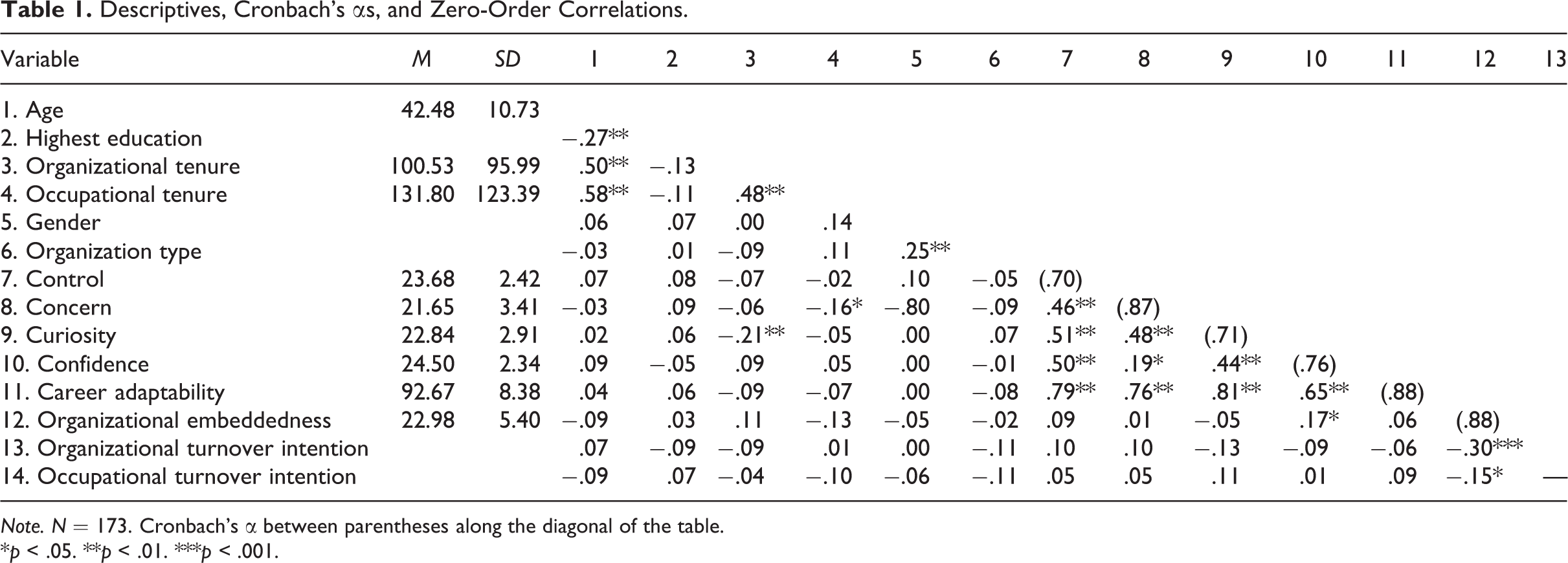
Note. N = 173. Cronbach’s α between parentheses along the diagonal of the table.
*p < .05. **p < .01. ***p < .001.
Logistic Regression Analyses
Table 2 presents the logistic regressions performed to ascertain the effects of mean-centered CA, OE, and their interaction (CA by OE) on the logit of organizational turnover intention. Model 1 did not support Hypothesis 1a, as CA was not a significant explanatory factor. Model 2 did support Hypothesis 2a, with OE (B = −.218, p < .001) as a significant explanatory factor for organizational turnover intention. Model 3 explained 27.7% (Nagelkerke R2) of the variance in organizational turnover intention, which was significant, χ2(2) = 20.05, p < .001. Both CA (B = .107, p = .037) and OE (B = −.280, p < .001) were significant predictors of organizational turnover intention.
Predictors of Organizational Turnover Intention.
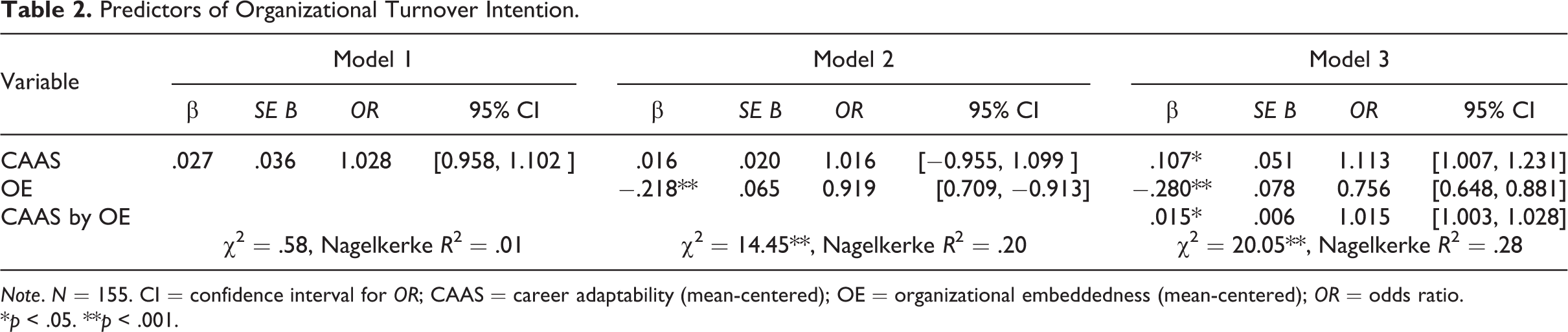
Note. N = 155. CI = confidence interval for OR; CAAS = career adaptability (mean-centered); OE = organizational embeddedness (mean-centered); OR = odds ratio.
*p < .05. **p < .001.
For every unit increase in the level of CA and OE the odds of organizational turnover intention increased by 11.3%, respectively, decreased by 24.4%. The interaction between CA and OE was significant as well (B = .015, p = .0184). The positive interaction term suggests that increases in OE and/or CA increased the odds for organizational turnover intention. However, for logistic regression, the size and specific nature of an interaction effect is not easily determined from the (sign of) the interaction term alone (Dawson, 2014). Therefore, regression Model 3 for organizational turnover intention from Table 2 was probed for different values of the moderator (OE; see Dawson, 2014). Figure 1 plots the resulting association between the probability of organizational turnover intention and (mean-centered) CA (CAAS) for different levels of (mean-centered) OE. For lower than moderate levels of OE, the associations were not significant. For moderate to high levels of OE, increasing CA levels were associated with increasing probability of organizational turnover intention, and at an increasing rate. Moreover, for higher levels of OE, the positive effect of CA on the probability of organizational turnover intention was weaker. Hypothesis 3a is thus not supported.
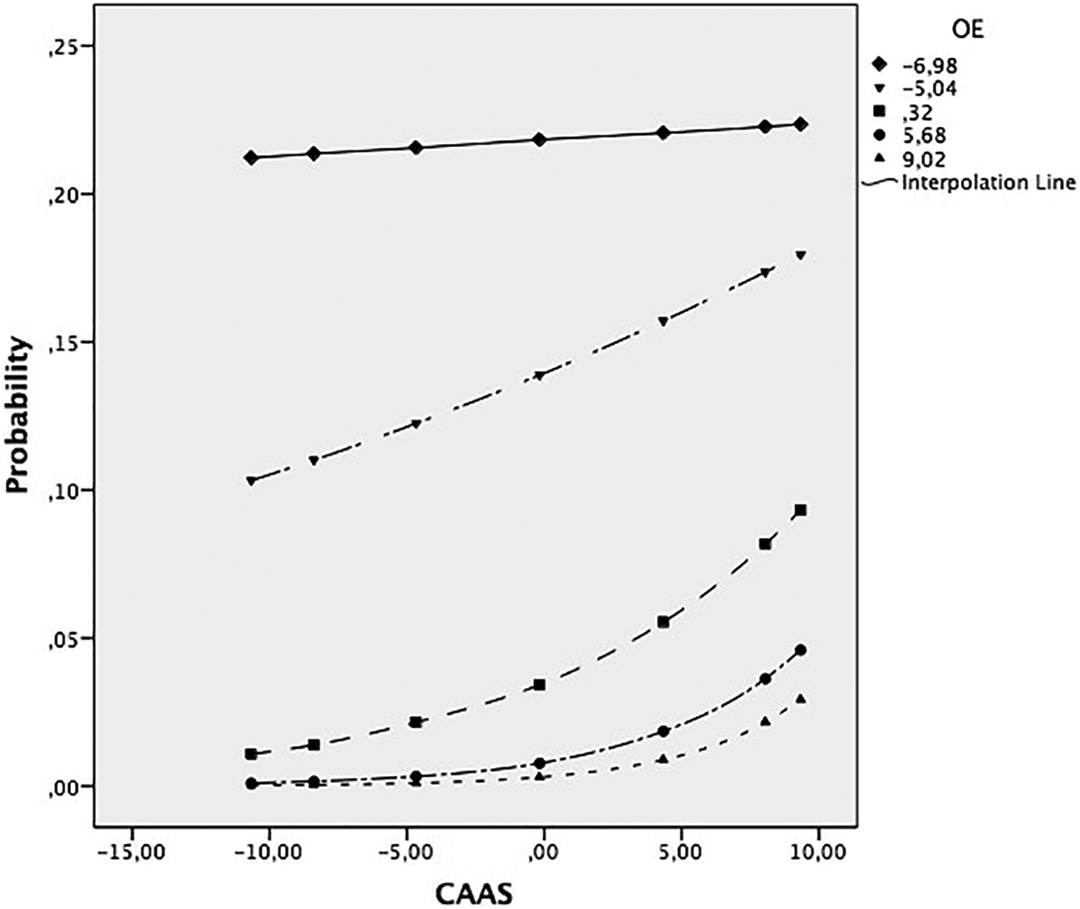
Moderator for the Career Adapt Abilities Scale–organizational turnover intention association.
Table 3 presents the logistic regressions performed to ascertain the effects of mean-centered CA, OE, and their interaction (CA by OE) on the logit of occupational turnover intention. CA was not a significant explanatory factor here either (B = .037, p = .110; Model 1). Hypothesis 1b is thus not supported. For every unit increase in OE (B = −.115, p = .028), the odds of occupational turnover intention decreased by 10.9%. The effect of OE was independent from CA (B = −.005, p = .291; Model 3). Hypothesis 2b is thus supported and Hypothesis 3b is not supported.
Predictors of Occupational Turnover Intention.
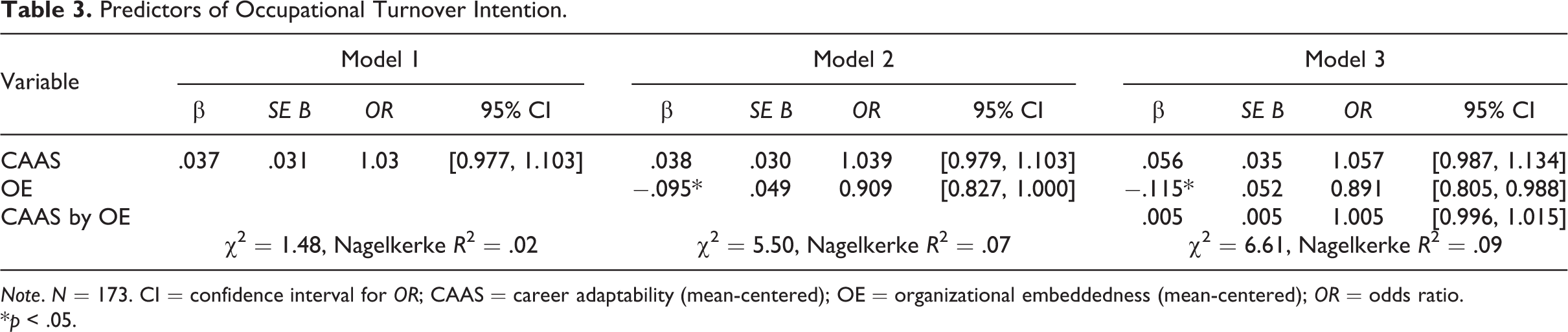
Note. N = 173. CI = confidence interval for OR; CAAS = career adaptability (mean-centered); OE = organizational embeddedness (mean-centered); OR = odds ratio.
*p < .05.
Discussion
The objective of this study was to investigate the main and interacting influence of CA and OE on organizational and occupational turnover intention. CA did not contribute to explaining organizational or occupational turnover intention, yet OE as such was negatively associated with organizational and occupational turnover intention. Finally, a positive interaction was found for embedded workers between CA and their OE for organizational turnover intention.
Our Dutch sample contained relatively many occupations with intense interpersonal interaction aspects in their work, for example, teachers, social workers, and nurses, which are known for higher turnover rates in general (e.g., Ducharme et al., 2007). In contrast to earlier findings for China (e.g., Haibo et al., 2017), CA in this study might therefore not add much to the explanation of organizational turnover intention. Another explanation might be cross-cultural differences with respect to turnover rates and antecedents thereof. For example, the study of Chudzikowski et al. (2009) suggests that in European cultures, both internal and external forces (e.g., desire for something new, respectively, labor market) induce transitions, unlike in the United States and China. Further, our results support the findings of earlier studies on OE and organizational turnover intention (e.g., Tanova & Holtom, 2008). As expected, OE also contributed to explaining occupational turnover intention. The effect size of OE for occupational turnover intention was lower than for organizational turnover intention. An explanation might be that occupational turnover is of a more complex nature than organizational turnover (e.g., Blau, 2007).
Finally, the interaction between CA and OE occurred only for moderately to higher embedded workers, for whom the effect of CA on organizational turnover intention was positive. In other words, such embedded workers with higher CA were more likely to intent to leave their organization than those with lower CA. An explanation might be that although more embedded workers search less for jobs (e.g., Lee et al., 2014), this may be offset by higher CA, as such workers search more for jobs (e.g., Johnston, 2018). Alternatively, since more embedded workers may have stronger ties to their (professional) community (e.g., Mitchell et al., 2001), and both embedded workers and those high on CA perform well in their jobs, such high-performing workers therefore perhaps receive job offers, also via networking (see Porter et al., 2016).
Limitations
Our study has several limitations. First, the design of our study is cross-sectional, known for concerns about common method variance, which might bias, that is, falsely inflate or deflate observed relationships among measures (common method bias), leading to Type I, respectively, Type II errors (Fuller et al., 2016; Spector, 2019). However, a cross-sectional design is not an inappropriate choice given the purpose of our study, that is, investigating less understood but important foundational relationships (Spector, 2019). Further, meta-analyses do not uniformly find larger correlations from cross-sectional designs compared to longitudinal designs (Spector, 2019). In addition, Siemsen et al. (2010) have analytically shown that common method variance can only deflate regression estimates of interaction effects. To minimize common method bias, we followed the recommendation of Fuller et al. (2016) to take a priori procedural steps (see the Method section). Although our measures are derived from a single data source, that is, self-reports, also known for common method bias concerns, the constructs in our study relate to internal states of workers, which are difficult to assess by other sources (Spector, 2019). Second, we studied turnover intention instead of actual turnover. Nevertheless, congruent with the theory of reasoned action (Fishbein & Ajzen, 1975), turnover intention is a key predictor of actual organizational and occupational turnover. In addition, we first asked about occupational turnover intention and if the response was negative, only then about organizational turnover intention. Unconditional asking may have led to different responses. However, such studies usually refer to a specific occupation, and in a single organization; occupational change then often implies organizational change as well (see, e.g., Fernet et al., 2017). We now forced a response, as occupational turnover is inherently different from organizational turnover (Blau, 2007). Third, testing with separate logistic regression models, although a valid and common approach in occupational and organizational turnover studies (Blau, 2007; Carless & Bernath, 2007), rather than simultaneously, in combination with a low event rate and sample size, might result in lack of statistical power. However, there is no consensus on sample size and events per variable required for inference (see, e.g., van Smeden et al., 2016). Still, our results have to be interpreted with caution. Fourth, we used single item measures for organizational and occupational turnover intention, which are subject to psychometric debate (e.g., Carless & Arnup, 2011; Carless & Bernath, 2007). However, Fishbein and Ajzen (1975) recommend the use of single items in the context of behavioral intentions. In addition, such items have been frequently used in organizational and occupational turnover intention research, also given advantages such as understandability and lower response fatigue (Carless & Arnup, 2011; Fernet et al., 2017).
Implications for Practice
The fostering of CA has been advocated in career counseling and guidance for both adolescents and adults instead of decision making (Hirschi, 2012; Van Vianen et al., 2009). Our results suggest that the development of CA itself does not influence the likelihood of workers making transitions. Career construction theory centralizes the role of adapting behaviors in the transition process, which is supported by some evidence for adolescents (see Savickas et al., 2018). However, without an adult version of the student career construction inventory, it is unclear how to include adapting behaviors in career counseling for workers. Alternatively, focusing on adaptation responses such as planning (for concern) and career exploration (for curiosity), often confusingly also referred to as adapting behaviors, is fraught with outcome ambiguity (cf. Hirschi et al., 2015; Savickas, 1984; Savickas et al., 2018). However, based on the interaction between CA and OE found in this study, developing CA to facilitate voluntary organizational turnover may be beneficial for working clients with moderate levels of OE. In addition, the client’s level of OE may be taken into account in career questions involving transition. Although possibly influencing different valued work behaviors along the road as well, our results suggest that lowering the client’s level of (internal and external) OE is beneficial for stimulating organizational and occupational turnover.
Suggestions for Future Research
Based on our findings, we have four suggestions for future research. First, adapting behaviors are an underdeveloped element in terms of their definition, measurement, and implication for workers, unlike for adolescents (cf. Savickas et al., 2018), warranting further study. Second, the development of an adult version of the student career construction inventory, together with research designs that allow for causal inference (see, e.g., Spector, 2019), can help with the interpretation of results. Third, future studies may examine other contextual factors that influence the relationship between CA and transitions for adults. Fourth, future studies may address the design of career counseling interventions to influence clients’ level of OE.
Conclusion
In sum, our results suggest that CA does not contribute to explaining organizational turnover intention, at least not for our Dutch workers. The careers of moderately to higher organizationally embedded workers might still include organizational turnover when they have higher CA, as the odds of organizational turnover intention then progressively increases. CA does not contribute to explaining occupational turnover intention. In contrast, OE predicts organizational turnover intention and, to a lesser extent, occupational turnover intention.
Footnotes
Acknowledgment
We thank dr. Anne Rongen and prof. dr. Petru Curseu for their comments that greatly improved this article.
Declaration of Conflicting Interests
The author(s) declared no potential conflicts of interest with respect to the research, authorship, and/or publication of this article.
Funding
The author(s) received no financial support for the research, authorship, and/or publication of this article.
