




Abstract
Mid-career is a time when work orientation (i.e., viewing ones’ work as a job, a career, or a calling) comes into sharper focus. Using Wrzeniewski et al.’s tripartite model, we conducted a discriminant function analysis to determine the combination of variables that best discriminates among people who are aligned with a job, a career, or a calling orientation in a sample of 251 full-time, North American mid-career employees. Compared to those who approach work as a job, those with a calling orientation were more engaged in work. The career-oriented stood apart from the others as a function of shorter job tenure, greater turnover intentions, work engagement, career satisfaction, and a tendency to engage in career self-comparisons. Work-orientation groups did not differ significantly in terms of family centrality, work–life balance, life satisfaction, or well-being. The results suggest that the work orientations represent distinct and equally valid ways to approach work.
At mid-career, a heightened potential for job ennui, increased responsibility and job demands, and work–life conflict can all contribute to how employees perceive and approach their work (Demerouti et al., 2012). An individual’s orientation toward their work (i.e., seeing it as a job, as a career, or as a calling) not only influences the way that work is experienced day-to-day but may also affect organizational commitment, organizational citizenship behaviors, turnover intentions, and performance (Willner et al., 2020). Still, very little is known about the factors that differentiate those who approach work as a job, as a career, or as a calling. In response to the call to delve deeper into the concept of work orientation (Rosso et al., 2010; Shea-Van Fossen & Vredenburgh, 2014), the purpose of the present study was to look more closely at some of the defining characteristics of mid-career employees with a job, a career, and a calling orientation. We asked whether work orientations are discreet categories as opposed to a continuum and which features of work and personal lives distinguish people with each orientation.
Of the three orientations to work, the calling orientation has been studied the most and evidence points to its association with positive individual and organizational outcomes (Duffy & Dik, 2013). Within many occupations, the proportion of job-oriented, career-oriented, and calling-oriented employees tends to be relatively equal (Lan et al., 2013; McKevitt et al., 2017; Wrzesniewski et al., 1997); therefore, the need to better understand how the full range of work orientations relates to personal and organizational outcomes seems obvious. Building on early classification work (Bellah et al., 1985; Wrzesniewski et al., 1997), we examine work-related and personal-life factors that may distinguish between job, career, and calling orientations at mid-career. A better understanding of work orientation in relation to factors such as age, career stage, well-being, life satisfaction, work engagement, and turnover intentions may help to build profiles of different types of employees and their approach to work.
The Tripartite Classification of Work Orientations
Inspired by the work of sociologists Bellah and colleagues (1985), Wrzesniewski and colleagues (1997) documented the existence of three distinct work orientations among a sample of nonfaculty university employees. The evidence showed that people generally tend to view their work either as a job, as a career, or as a calling, with each representing qualitative differences in the way that work is approached and experienced. According to Wrzesniewski et al. (1997), those with a job orientation view work primarily as a means to an end and approach work as a necessary part of life but not something that defines them as a person. For this group, work is primarily transactional—a means to earn money and resources necessary to live. People who have a career orientation seek out opportunities for advancement and tend to approach work as a means to achieve prestige and success. Those with a career orientation have a deeper personal investment in work and plan for career progression by seeking more challenging assignments. Individuals with a calling orientation strongly identify with the work they do and believe that work is central to who they are as a person. They derive personal meaning and a sense of identity from work and view work as an opportunity to positively contribute to society.
In the few studies that have explored the tripartite model in detail, work orientation is independent of job type (Lan et al., 2013; McKevitt et al., 2017; Wrzseniewski et al., 1997) but rather seems to be related to other work-related attitudes and behaviors. In a study of project managers (McKevitt et al., 2017), those with a job orientation reported the lowest career satisfaction and were looking to move into general management. Project managers with a career orientation were looking for larger and more visible projects to manage, and those with a calling orientation were looking for ways to craft their current jobs to highlight aspects of their projects to align with personal meaning. These findings suggest at least some personal and work factors are uniquely associated with different work orientations. In this research, we look to further examine defining features of the personal and work lives of job-, career-, and calling-oriented employees, with a focus on those at mid-career.
Work Orientation at Mid-Career: Unique Issues and Dynamics
Mid-career is an interesting period of career development (Wang et al., 2013) and one that is well-suited to an examination of work orientation. For many, mid-career comes at a time when employees are expected to increase productivity and take on leadership roles, often while juggling caregiving responsibilities for children, aging parents, and others (Carlson & Rotondo, 2001). Many mid-career employees also experience career plateaus (Ng & Feldman, 2007) or reinvention (Erdogan et al., 2011), which may impact their approach to work. For some who entered the workforce with a job or a career orientation, a personal crisis in mid-career (e.g., divorce, job loss) might serve as a catalyst to awaken a calling and the pursuit of greater meaning and purpose in work (Karpiak, 2000). Others may not find the power and prestige motive to be as strong at mid-career, shifting them from a career orientation to a more transactional job orientation (Wang et al., 2013). Whatever the origins, competing demands and shifting life priorities at mid-career may manifest themselves in people’s approach to work.
Correlates of Work Orientation
Research comparing the three work orientations lags behind that focused specifically on calling; as a result, the work orientation research remains exploratory rather than directed by theory. By returning to the descriptions of each orientation provided by Wrzesniewski et al. (1997) and Bellah et al. (1985), a framework begins to emerge from which we can extrapolate possible correlates that differentiate people with each work orientation. Additional potential correlates can be drawn from the callings literature to determine whether they discriminate calling from job and career orientations. It is important to consider correlates related to both work and personal life, as the cumulation of work-related and family-related attitudes is likely to contribute to work orientation (Buss & Craik, 1983).
Work-related correlates of work orientation
Given that work orientation is expected to vary by the reason for working (Wrzesniewski et al., 1997), it is likely that work engagement, career evaluations, turnover intentions, and particularly work centrality would differ as a function of job, career, and calling orientations at mid-career. Work centrality is the overall importance that work holds in an individual’s life (Paullay et al., 1994). Those with higher levels of work centrality tend to be more engaged at work, more committed to their jobs (Hirschfeld & Feild, 2000), and tend to work more (Ng & Feldman, 2007). Unlike work centrality, work engagement tends to be more dynamic and can fluctuate from day to day depending on the conditions of the specific job (Bakker & Albrecht, 2018). There is a demonstrated link between calling and greater work engagement (Gazica & Spector, 2015). Employees with a job orientation may prefer less challenging work, whereas those with a career orientation may look for more challenging work (Shea-Van Fossen & Vredenburgh, 2014).
Evidence points to positive associations between a calling orientation and career satisfaction (Duffy & Sedlacek, 2007), perceptions of career success (Chen et al., 2018), and career commitment (Gazica & Spector, 2015), whereas those with a job orientation tend to be less satisfied with their careers (McKevitt et al., 2017) and with work in general (Lan et al., 2013). Satisfaction with promotion is a predictor of the career orientation (Lan et al., 2013). Favorable career comparisons that result from evaluating oneself relative to less successful others have been linked to higher levels of career satisfaction and lower turnover intentions in general (Eddleston, 2009). Finally, calling is associated with weaker organizational withdrawal attitudes (Cardador et al., 2011; Chen et al., 2018), specifically, lower turnover intentions.
Personal-life correlates of work orientation
Work orientation is also theorized to vary on the basis of whether work is a priority in one’s life or it is simply a means to support personal and family life (Wrzesniewski et al., 1997). As such, in the current study, we assessed a set of personal-life variables as they may relate to work orientation, including work–family measures, life satisfaction, life meaning, and health indicators.
Family centrality is the overall degree of importance that family holds in an employee’s life (Carr et al., 2007), whereas work–life balance is the perceived equilibrium between the two domains: work and life outside of work (e.g., Fisher et al., 2016). People with a job orientation work primarily to earn money, so that time outside of work can be used to pursue other interests, including personal and family activities (Wrzesniewski et al., 1997). At the same time, the calling orientation has been linked with both work-to-family enrichment (Choi et al., 2018) and with outcomes with potentially negative impacts on work–life balance, such as workaholism and burnout (Cardador & Caza, 2012).
The calling-oriented pursue work for personal and societal significance and report high levels of meaning in work and life (Praskova et al., 2015). Closely related to the life-meaning concept is general life satisfaction. A calling is strongly associated with life satisfaction across age, life stage, and occupation (Choi et al., 2018; Duffy et al., 2013); however, we know nothing about job and career orientations in relation to these aspects of personal life. A calling orientation has been linked to better physical health (Duffy & Dik, 2013), mental health (Gazica & Spector, 2015), and enhanced overall well-being (Conway et al., 2015). How various measures of employee health relate to the full spectrum of work orientations is yet unknown. With respect to financial health, some have reported a negative association of calling with income (Bunderson & Thompson, 2009). Although those with a job orientation may be presumed to be “in it for the money” and career-oriented individuals are described as being motivated by pay raises and financial indicators of career success, these assumptions have not yet been tested.
The aim of this study was to empirically examine work-related and personal-life correlates of work orientations at mid-career. In particular, we sought to identify work and personal-life factors that best describe and distinguish between three groups of mid-career employees: job-oriented, career-oriented, and calling-oriented.
Method
Participants and Procedures
Mid-career was defined using both age—29 to 55 years old—and time in the workforce—at least 10 and no more than 20 years. An initial sample of 345 full-time, mid-career, North American employees was recruited through Qualtrics research panels for an online survey. The sample was 67% female, with a mean age of 37.21 years (SD = 6.2). All but one of our participants had at least a bachelor’s degree. More than half of the sample (70%) was in a committed relationship (dating, engaged, living together, or married), and 29% were single or divorced. More participants (58%) had children than did not (42%). Almost all (97%) worked 30 or more hours per week. The average time in the workforce was 17 years (SD = 4.76), and the average time in one’s current job was 8 years (SD = 5.61). Participants worked in a wide range of industries including education (23%), health care (12%), professional services (12%), government (7%) as well as agriculture, construction, manufacturing, or transportation (8.5%). In terms of annual household income, 8.5% indicated US$35,000 or less per year, 19.5% were between $36,000 and $50,000, 27.4% were between $51,000 and $75,000, 17.2% were between $76,000 and $90,000, and 27.4% were over $90,000.
Following the strategy pioneered by Wrzesniewski et al. (1997), our sample was categorized on the basis of primary work orientation. Of the initial 345 respondents, 94 (27%) failed to indicate a primary orientation (i.e., rated two or more orientations the same) and thus were excluded from subsequent analyses. The proportion of the sample who did not report a primary work orientation based on this method was similar to that reported by Wrzesniewski et al. (1997) but greater than the 7.2% reported by Shea-Van Fossen and Vredenburgh (2014) who used a multi-item scale. Of the final sample of 251 participants, 32% were primarily job oriented (n = 81), 28% aligned most strongly with a career orientation (n = 70), and the largest group (40%, n = 100) professed a calling for their work.
Measures
Work orientation
Work orientation was assessed using Wrzesniewski et al.’s (1997) original scenario format. Participants read a paragraph describing a job, a career, and a calling and indicated the extent to which the person depicted in the scenario is like them on a scale ranging from 0 (not at all like me) to 3 (very much like me). Respondents were categorized according to their primary work orientation (job, career, calling) based on their highest rated paragraph. This measure has been used effectively with samples of accountants (Lan et al., 2013) and project managers (McKevitt et al., 2017).
Work engagement
The short form of the Utrecht Work Engagement Scale was used to measure overall work engagement, which is a positive focus on the work itself (Schaufeli et al., 2006, p. 701). Responses to the nine items were made on scales ranging from 1 (never) to 7 (always). This measure is reliable over time (Seppälä et al., 2009) and continues to be the most commonly used assessment of work engagement (Kulikowski, 2017). The Cronbach’s alpha for the present research was .96.
Career satisfaction
Using a five-item measure of career satisfaction (Greenhaus et al., 1990), which is one of the most prominent assessments of subjective career success (Spurk et al., 2015), participants rated their satisfaction with their career success and career progress on a scale ranging from 1 (strongly agree) to 5 (strongly disagree). An example is “I am satisfied with the success I have achieved in my career.” Wolff and Moser (2009) report that this scale is a single factor. The Cronbach’s α for the career satisfaction scale in the present study was .92.
Career comparison
Individual’s perceptions of their career success and achievements compared to similar others was assessed using Eddleston’s (2009) five-item scale, which they reported as forming a reliable scale based on the fit indices of a confirmatory factor analysis. Rated on a 5-point scale with anchors of 1 (strongly disagree) and 5 (strongly agree), a sample item is “When comparing my career to others, I often notice that I have achieved more progress in my career than others in my organization.” The scale had strong internal consistency in the present study (α= .90). Unfavorable career comparison is associated with lower levels of career satisfaction and higher levels of occupational regret and turnover intention (Budjanovcanin et al., 2019).
Turnover intentions
The five-item Turnover Cognitions Scale (Bozeman & Perrewé, 2001) was used to capture the extent to which participants were considering leaving their current jobs. The fit indices for the confirmatory factor analysis conducted by Bozeman and Perrewé (2001) indicate that these items form a reliable scale that is different from organizational commitment. Items such as “I will probably look for a new job in the near future” were rated on scales ranging from 1 (strongly disagree) to 5 (strongly agree) and the alpha was .90.
Work and family
The constructs of work centrality, family centrality, and work–family balance were each assessed with a single-item from Fisher et al. (2016). Single-item measures have been found to be reliable (Gardner et al., 1998), efficient in limiting participant burden (Metz et al., 2007), and effective when assessing a construct with high homogeneity (Fuchs & Diamantopoulos, 2009). Fisher et al. (2016) report that these single items had high convergent and discriminant validity and strong test–retest correlations. Min et al. (2019) found sufficient overlap of these single items to multi-item scales. Responses were made on scales ranging from 1 (strongly disagree) to 7 (strongly agree). Higher scores indicated higher levels of work centrality (My work is one of the most important things in my life right now), family centrality (My family is one of the most important things in my life), and work–family balance (In general I feel that I have an adequate balance between my work and personal/family life).
Meaning in life
Responses to the 10-item Meaning in Life Questionnaire (Steger et al., 2006) with subscales for the search for meaning (I am seeking a purpose or mission for my life) and the presence of meaning (My life has a clear sense of purpose) were made on 7-point scales ranging from 1 (absolutely untrue) to 7 (absolutely true). Schulenberg et al. (2011) found the subscales to have good internal consistency and test–retest reliability. The subscales tend to be negatively correlated indicating that having the presence of meaning is associated with lower need to search for additional meaning. The α for the search for meaning scale was .90 and .88 for the presence of meaning scale in the present study; the subscales were correlated (r = −.38).
Life satisfaction
The five-item Satisfaction with Life Scale (Diener et al., 1985) is a widely used and well-validated assessment of the cognitive aspect of subjective well-being. Pavot and Diener (1993) report that this scale has demonstrated good reliability and convergent and discriminant validity. Responses to items such as “In most ways my life is close to my ideal” were made on 7-point scales anchored by 1 (strongly disagree) and 7 (strongly agree), with higher scores indicating a higher degree of overall life satisfaction. The Cronbach’s α for the present research was .93.
General mental health
The 12-item General Health Questionnaire Short Form (GHQ; Ware et al., 1996) is one of the most commonly used measures of psychological ill-being (Gill et al., 2007) including anxiety, depression, and social dysfunction. Gao et al. (2004) note that it is pragmatically acceptable to use this instrument as a single dimension measure. Higher scores on the GHQ-12 are related to less successful aging (Doyle et al., 2012), less satisfaction with life, and lower levels of career adaptability in working adults (Maggiori et al., 2013). Participants rated items such as “In the past month have you been feeling unhappy and/or depressed” on scales that ranged from 1 (not at all) to 7 (all of the time). Higher scores indicate worse mental health (Cronbach’s α = .90).
Income and financial strain
Annual household income was measured using ranges from less than $35,000 per year, $36,000–$50,000, $51,000–$75,000, $76,000–$90,000, $91,000–$120,000, and $120,000+. A three-item scale (Vinokur & Caplan, 1987) was used to measure financial strain. Vinokur et al. (1996) report α coefficients ranging from .86 to .88 for this scale. Items such as “How difficult is it for you to live on your total household income right now?” were rated on 5-point scales ranging from 1 (a little) to 5 (a lot), with a Cronbach’s α of .85 for the present research.
Demographics
Participants were asked to report the gender with which they identify (male, female, other), age, marital status (single, married, engaged, dating, living together, separated/divorced, other), number of children, and the highest level of education (high school, bachelor’s degree, graduate degree). They were asked how many years they had been in the paid workforce and in their current job and whether their current job was part-time or full-time.
Results
Demographic Characteristics and Work Orientation
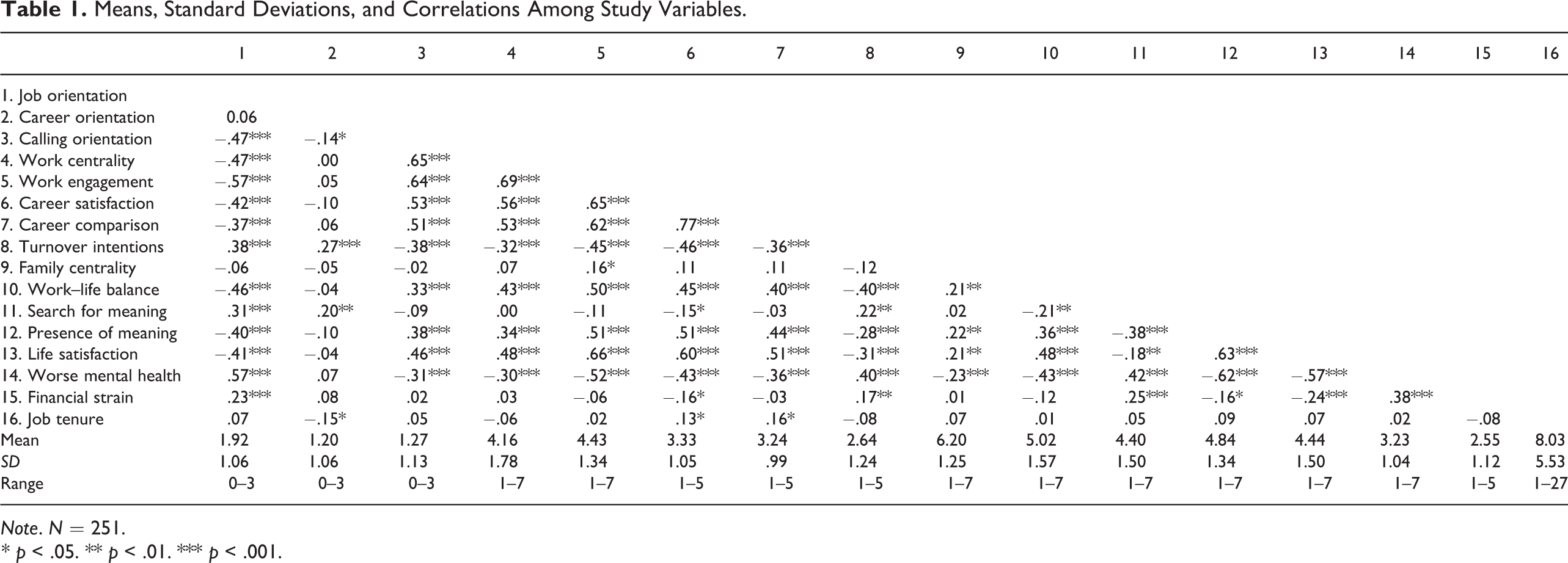
The means, standard deviations, and correlations of the measured variables can be found in Table 1. We conducted a series of preliminary analyses to explore demographic differences between work orientations that may play a role in discriminating between the categories. Categorization according to a job, career, or calling orientation did not differ as a function of gender, χ2(2) = 0.31, p = .86, age, F(2, 247) = 0.55, p = .58,
Means, Standard Deviations, and Correlations Among Study Variables.
Note. N = 251.
* p < .05. ** p < .01. *** p < .001.
Work Orientation at Mid-Career: A Discriminant Function Analysis
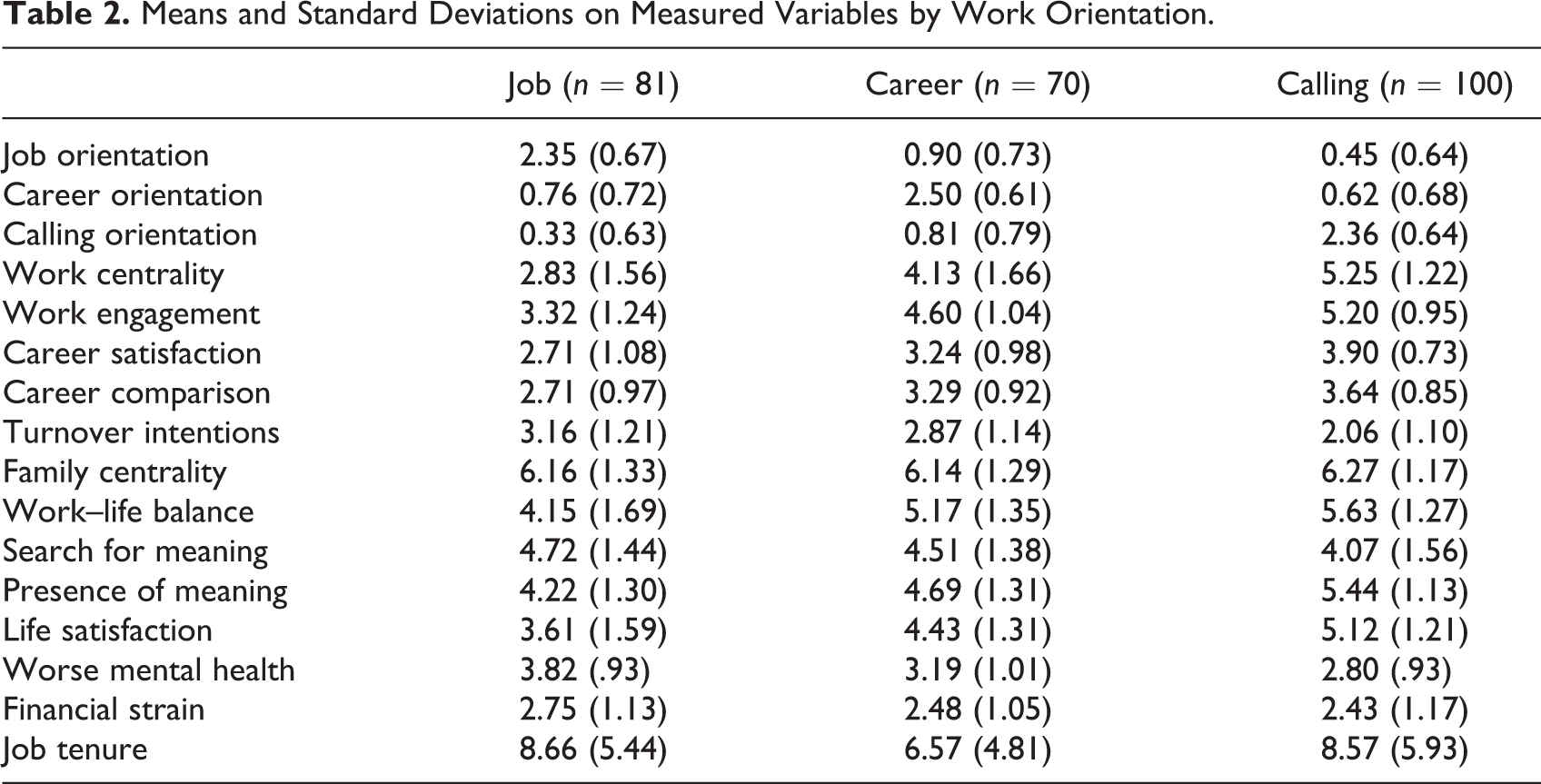
Table 2 provides the means and standard deviations of the measured variables by work orientation. These included the work-specific variables of work centrality, work engagement, career satisfaction, career comparison, turnover intention, job tenure, as well as personal and nonwork variables assessing family centrality, work/family balance, search for life meaning, presence of life meaning, life satisfaction, mental health, and financial strain.
Means and Standard Deviations on Measured Variables by Work Orientation.
We used the discriminant function technique to determine the combination of variables that best discriminated between people who are aligned with a job, a career, or a calling orientation. Discriminant function analysis builds a predictive model that assesses the combination of variables that maximally discriminates between naturally occurring groups. The analysis produces discriminant functions, which are latent variables consisting of linear combinations of discriminating predictors. Standardized canonical discriminant function coefficients, similar to betas in multiple regression, are used to assess the relative contribution of predictors; function loadings of .30 or greater are interpreted as discriminating variables—those that are best at highlighting the differences between particular categories.
After establishing that the data met relevant assumptions, we performed a discriminant function analysis with the work orientation groups of job, career, and calling. The analysis yielded two significant discriminant functions, Wilks’ λ = 0.489, χ2(26) = 168.22, p < .001; Wilks’ λ = 0.883, χ2(12) = 29.19, p < .01, respectively. The first function had an eigenvalue of .81 and explained 85.9% of the variance, with a canonical correlation of .67 and partial η
Function 1: (Calling vs career vs job)
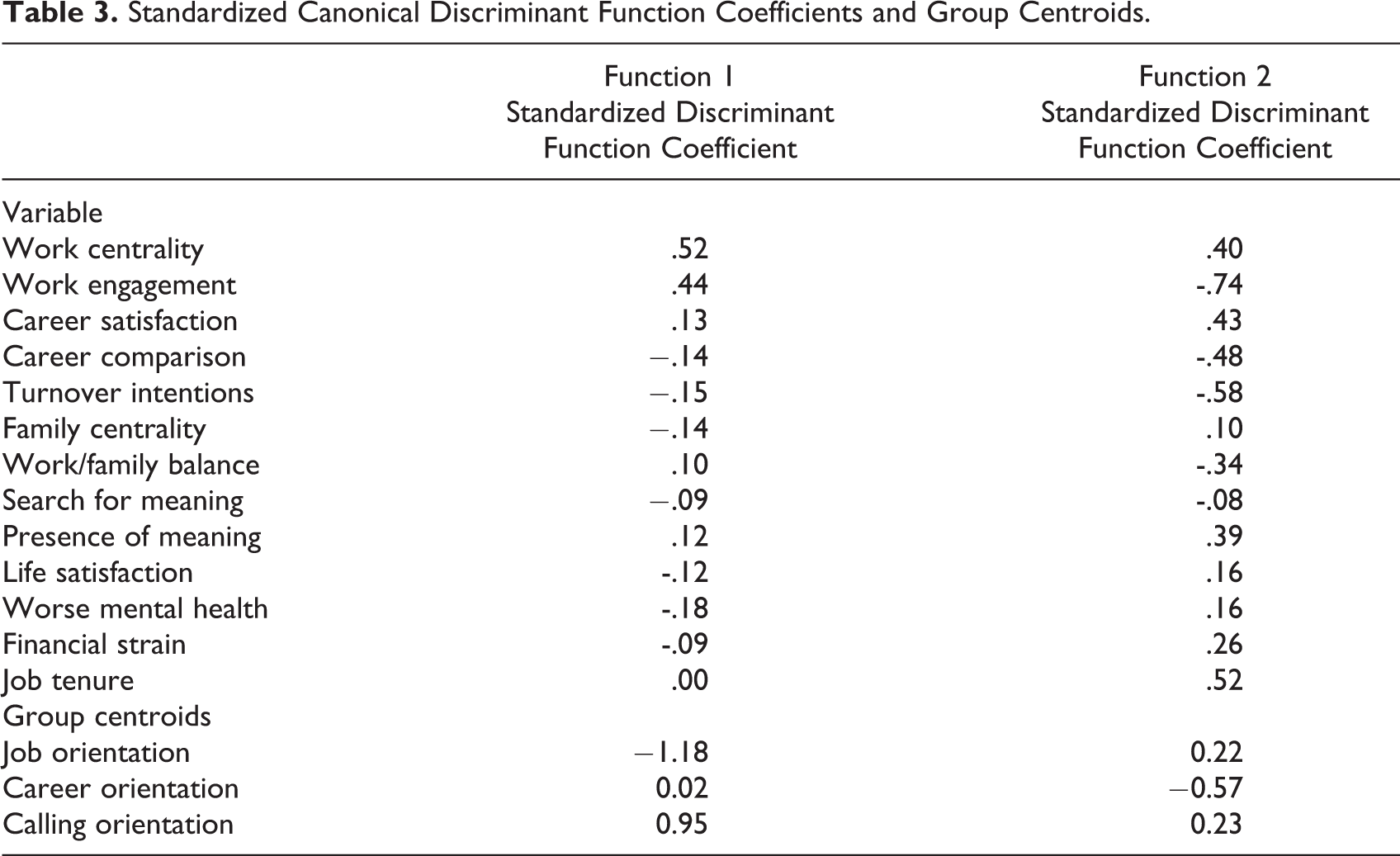
The group centroids, provided in the lower section of Table 3, indicate that the first function significantly discriminated all three work orientations. The pattern of loading scores reveals that work centrality and work engagement are the primary contributors to this differentiation. Perhaps not surprisingly, those with a job orientation reported the lowest levels of work centrality and work engagement of all three groups, whereas those with a calling orientation reported the highest levels of work centrality and work engagement relative to the others. Those with a career orientation reported relatively more moderate levels of work centrality and engagement and were significantly different from those with either a job or a calling.
Standardized Canonical Discriminant Function Coefficients and Group Centroids.
Function 2: (Career vs. calling, Job)
The second discriminant function maximally separated those with a career orientation from the other two work orientations (job and calling). Interpreting the standardized discriminant function coefficients (Table 3) in light of the group centroids, people with a career orientation differ from those with a calling or job orientation in that, in addition to their differences on work engagement and work centrality, they had shorter job tenure, stronger turnover intention, less career satisfaction, and more career comparison. Although the contribution to the discriminant function is not as strong, career orientation was also associated with greater work/family balance and less presence of life meaning relative to the calling and job orientations.
Discussion
The purpose of the present research was to identify work and personal-life factors that distinguish between three groups of mid-career employees: job-oriented, career-oriented, and calling-oriented (Wrzesniewski et al., 1997). Nearly equal numbers of participants in our sample of diverse occupations, consistent with other samples, such as accountants (Lan et al., 2013), project managers (McKevitt et al., 2017), and economics students (Gandal et al., 2005), approach work as a career, a job, or a calling. Calling is only part of the work orientation story; by examining three work orientation categories, we can have a full understanding of the potential implications involved for organizations and individual career development.
Not surprisingly, work centrality and work engagement played a significant role in discriminating between the three work orientation groups. Consistent with Cardador and colleagues (2011), work centrality and engagement were the strongest among employees with a calling orientation. The career-oriented may have been less invested in work for the sake of the work itself, and those with a job orientation were even less so. Feelings of energy, enthusiasm, and identification with the current work situation (Schaufeli et al., 2006) were the lowest among job-oriented employees, the highest for those with a calling, and in-between for the career-oriented. These findings may have particular relevance for understanding work orientation and motivation at mid-career. Perhaps having mastered their jobs and reached peak levels for earnings, promotions, and responsibility, many at mid-career experience boredom, declining organizational commitment, and lowered job satisfaction but feel trapped by salary and benefits (Wang et al., 2013). Motivation can be a problem at mid-career when people are struggling to find a way to keep the interest alive. Work centrality and engagement may represent elements of that mid-career “spark” that is missing for some.
Several aspects of the career orientation were distinct and notable in this study, suggesting that we cannot assume a neat and tidy continuum between job, career, and calling. With the second discriminant function, employees with a career orientation were set apart by shorter job tenure, higher turnover intentions, more career comparisons, and lower career satisfaction. Our results mirror Lan et al. (2013), who found that a career orientation was related to achievement values and shorter job tenure. Our results also suggest a pattern of career striving—a desire to accomplish more in one’s career and pursue increasing pay, power, or social standing. Those with a career orientation, although engaged in their work, may not yet be satisfied with their career success and are perhaps on the lookout for their next career advancement opportunity.
These findings are particularly relevant in the context of our mid-career sample. Organizations often fail to see the unique needs of mid-career employees, perhaps presuming high levels of loyalty and commitment among this group, which may not be the case. Career-oriented people are still actively engaged with their work and contribute to the organization; for them, turnover is possibly less about leaving an organization and more about finding new opportunities that will provide them with career progression. Organizations may wish to consider the kinds of development opportunities that could satisfy employees’ needs for career progression or perhaps risk losing valuable members of their workforce.
Just as useful for a more fulsome description of work orientations is an account of those variables that did not discriminate among the groups. Belah et al.’s (1985) theory that a job orientation would reflect concerns for finances, family centrality, and work–life balance, especially in mid-career in which family demands tend to be central (Demerouti et al., 2012) was not supported in our research. In fact, work orientation groups did not differ as a function of age, number of children, family centrality, work–life balance, income, or financial insecurity, suggesting that people of all work orientations are concerned with their family and home life and this has less of an influence on work orientation than expected. As Lan et al. (2013) also found, women and men did not differ on work orientation. Although past research has found positive links between calling and mental health (Gazica & Spector, 2015), health satisfaction (Wrzesniewski et al., 1997), and overall well-being (Conway et al., 2015), we found no contribution of mental health, life satisfaction, or search for life meaning in discriminating between the three work orientations. Our findings suggest that positive outcomes such as mental health and life satisfaction are not reserved only for those with a calling, but rather, that people with all orientations may be equally well-adjusted in their personal lives.
Limitations and Future Research
As the purpose of this research was to explore factors that discriminate between job, career, and calling work orientations, it was important to examine only those with a distinct work orientation. Following the lead of others using the same measure (Lan et al., 2013; Wrzesniewski et al., 1997), we excluded cases from our analysis that did not fit a single work orientation, which still left sufficient power for the discriminatory function analysis. However, the 27% of the sample that had an undifferentiated work orientation suggests that there are issues with how work orientation is conceptualized and measured. Although scores on the calling paragraph (Wrzesniewski et al., 1997) strongly correlate with the most commonly used scale measures of calling (Duffy et al., 2015), additional research is needed to validate that the scores on the paragraphs for the career and job orientations correlate with multi-item measures of work orientation, which is particularly important in light of new research proposing other work orientations. Willner et al. (2020) proposed that in addition to job, career, and calling, there are orientations of busyness (work to fill idle time) and social embeddedness (work to gain a sense of belonging). With changing demographics and attitudes in the workforce, and the challenge and opportunities of new technologies, we need to better understand the full spectrum of work orientations and their implications for careers and organizations.
It is also important to consider whether people have more than one work orientation, particularly during times of transition, by using multi-item measures that do not result in mutually exclusive categories. In our mid-career sample, people whose life situations were changing or reinventing themselves following a career plateau (Erdogan et al., 2011; Ng & Feldman, 2007) may have been moving between orientations (Praskova et al., 2015; Vianello et al., 2019). Without data from early or late career groups, we cannot be certain that our results uniquely describe the mid-career experience. Because our research was cross-sectional, we can only speculate about work orientation changes in mid-career (Wang et al., 2013). Future research should continue to explore how work orientations change over the career span or as a function of particular events. Just as a calling orientation develops and changes with time and events (Vianello et al., 2019), we expect the interaction of the individual and their environment to similarly impact career, job, and other work orientations. For instance, career orientation may be stronger when younger and calling stronger when older (Shea-Van Fossen & Vredenburgh, 2014), whereas the busyness career orientation may be more likely to coincide with postretirement (Willner et al., 2020). The results of the present study begin to round out the field’s understanding of the variety of ways in which employees approach the daily task of work and how work orientation relates to work and personal variables. Future research should focus on the development of an integrative theory of work orientations to better understand how these work attitudes influence other important individual and organizational outcomes.
African American and Latinx people are typically underrepresented in Qualtrics panels (Boas et al., 2018), which is also likely the case in the present study. Unfortunately, race was not assessed; thus, the influence of race could not be analyzed. Although there were no differences between men and women for work orientation in the present study, it is likely that intersectionality does play a role in work orientation. Race is a social construct that leads to discrimination through social norms and puts limits on what people believe is possible. Career psychology needs to pay more attention to the role that race plays not only in the job-seeking process but also in the development of personal attitudes and behaviors (Roberts & Rizzo, 2020) that can affect work orientation and job seeking.
Broader workforce and societal trends may similarly impact work orientation. Researchers should continue to explore factors such as socioeconomic status, access to education, and access to work options as predictors of work orientation. Work itself may be viewed as less important for Americans now than in the past (Highhouse et al., 2010). Downward trends in work centrality may certainly have implications for the ways in which people approach work.
In the present study, single-item measures were used to assess work orientation, work centrality, family centrality, and work–family balance so that the questionnaire would limit participant burden and increase participant response rates and accuracy (Metz et al., 2007). These items have been used frequently, and Fisher et al. (2016) report that the three work–family items have high convergent and discriminant validity; however, future research should replicate the current research with well-established multi-item scales to increase predictive validity.
Implications
Knowing the label that a person assigns to their work, be it as a job, a career, or a calling, is important in itself. But equally important is a broader understanding of what work means to individuals and the implications of this meaning for the organizations they inhabit and for their own personal well-being (Wrzesniewski & Dutton, 2001). Organizations may be able to enhance motivation by tailoring elements of the work experience to an employees’ work orientation (Thompson & Bunderson, 2019). Employees with a calling orientation are likely to be the most positively disposed to their organization and benefit from being able to focus more on work that allows them to contribute to the well-being of others. Organizations can consider the kinds of development opportunities that will satisfy those with a career orientation, taking into account transitions related to career stage and family needs, to retain valuable members of their workforce, otherwise they are likely to find career opportunities elsewhere as they look for their next advancement opportunity. Organizations should recognize that although those with a job orientation may have other priorities in life, they need to be recognized for the work they do and be rewarded with tangible forms of compensation. Job-oriented employees may not leave an organization, but it is important to keep them engaged to avoid negative retention. It may be more work for managers to consider what rewarding work is for people with different work orientations, but the outcome can be a better fit of personal mindset and work role, perhaps contributing to greater employee retention.
Employees themselves, once they become aware of their work orientation, may benefit from job crafting (Wrzesniewski & Dutton, 2001). Employees who are low in work centrality experience both positive and negative aspects of work more strongly (Jiang & Johnson, 2018). Job-oriented employees, in particular, may benefit from creating meaningful work experiences as a way to engage with work so that their job becomes more than a means to just a paycheck. Organizations can help these employees by highlighting the valuable service they provide and how it relates to the organization’s mission. Career-oriented employees may look for new opportunities to participate in contributing to the organization outside of the normal leadership roles so that they gain a greater understanding of the organization as a whole while finding new opportunities for personal challenge and career growth.
Conclusion
Most employees have a dominant orientation to work, approaching it as a job, a career, a calling, or perhaps a way to keep busy or a way to be connected to others. Work orientation is not a continuum from job to career to calling, with calling as the highest order; rather, each orientation is a unique perspective influenced by personal factors and work motives. The differentiating feature is how employees with each work orientation find work to be engaging and central to their lives. As such, career researchers and practitioners would be well-served to consider that all orientations have equal value and that work orientation is an important factor in what motivates employees.
Footnotes
Declaration of Conflicting Interests
The author(s) declared no potential conflicts of interest with respect to the research, authorship, and/or publication of this article.
Funding
The author(s) received no financial support for the research, authorship, and/or publication of this article.
