




Abstract
This article examines the role of student job search strategies that differ in goal-directedness (focused, exploratory, and haphazard) in achieving successful university-to-work transitions (i.e., employment in jobs with high skill use/development and qualification–job match). The relationship between job search and employment outcomes is considered in two labor market contexts—high or low ambiguity—which are represented by the comparison between arts, humanities, and social sciences (AHSS) and science, technology, engineering, and mathematics (STEM) graduates, respectively. Using two-wave survey data, we find that job search strategies during university do not explain, yet differentially impact, successful outcomes one year after graduation. Fully exploring opportunities was particularly beneficial for STEM graduates (low ambiguity context) and more focused job search was beneficial for AHSS graduates (high ambiguity context). Paradoxically, findings both question and reinforce the efficacy of career agency for overcoming barriers to labor market entry, depending on the job search context. The study contributes to the agency and context debates relevant for school-to-work transitions.
Keywords
The transition from education to work generally involves considerable ambiguity for university leavers. As new entrants to the labor market, they may have limited familiarity with the opportunities available to them (Turban et al., 2009). Many are at the early stages of forming career goals, particularly those who lack the clarity of a predefined career trajectory or strong socialization influences linked to their degree subject (Powers & Myers, 2017; Rummel et al., 2019). In these circumstances, effective job search involving important self-regulatory activities, such as goal-directed effort and appropriate information gathering, is argued to be crucial for securing meaningful employment (Kanfer et al., 2001; Van Hooft et al., 2020; Wanberg et al., 2020).
This article examines how job search strategies shape university-to-work transitions in terms of the quality of employment outcomes. We conceptualize job search strategies as self-regulatory activities that vary in goal-directedness. Haphazard strategies represent low or no goal-directedness, whereas exploratory and focused strategies both reflect higher levels of goal-directedness, although for different purposes (Crossley & Highhouse, 2005; Taggar & Kuron, 2016). We also challenge the preeminence of individual agency explanations of career development (Akkermans & Kubasch, 2017) by considering the influence of contextual barriers to labor market entry. This article examines the efficacy of job search strategies for successful university-to-work transitions within two graduate labor market contexts that differ with respect to the ambiguity of employment opportunities. For university leavers, this contrast is observed between arts, humanities, and social sciences (AHSS, high labor market ambiguity) graduates compared with science, technology, engineering, and mathematics (STEM, low labor market ambiguity) graduates. Evidence has shown that STEM graduates experience anticipatory socialization into relevant occupations (Kagaari, 2007) and develop a professional identity and career-specific trajectories during university (e.g., Simpson et al., 2020). In comparison with AHSS graduates, STEM graduates generally benefit from predefined career entry routes (Frenette, 2013) and more positive labor market outcomes (Abel & Deitz, 2017).
Our theorizing of the role of job search strategies on graduates’ employment outcomes draws on goal-setting theory (Locke & Latham, 1990) and specifically a resource allocation perspective (Kanfer & Ackerman, 1989). By conceptualizing job search as a resource allocation process, it is proposed that the success of job search strategies in university-to-work transitions may be based on labor market context and specifically the degree of ambiguity facing individual job seekers. This study examines the extent to which individual agency, in the form of job search strategies, can (1) explain successful university-to-work transitions and (2) overcome potential contextual constraints imposed by labor market ambiguity during the early stages of transition (see Figure 1). Successful university-to-work transition is conceptualized as the extent to which graduates have secured jobs that are commensurate with their higher education experience; that is, where they report high skill use, perceived job quality (i.e., intrinsic job features relevant for skill use and development at work), and perceived qualification match.
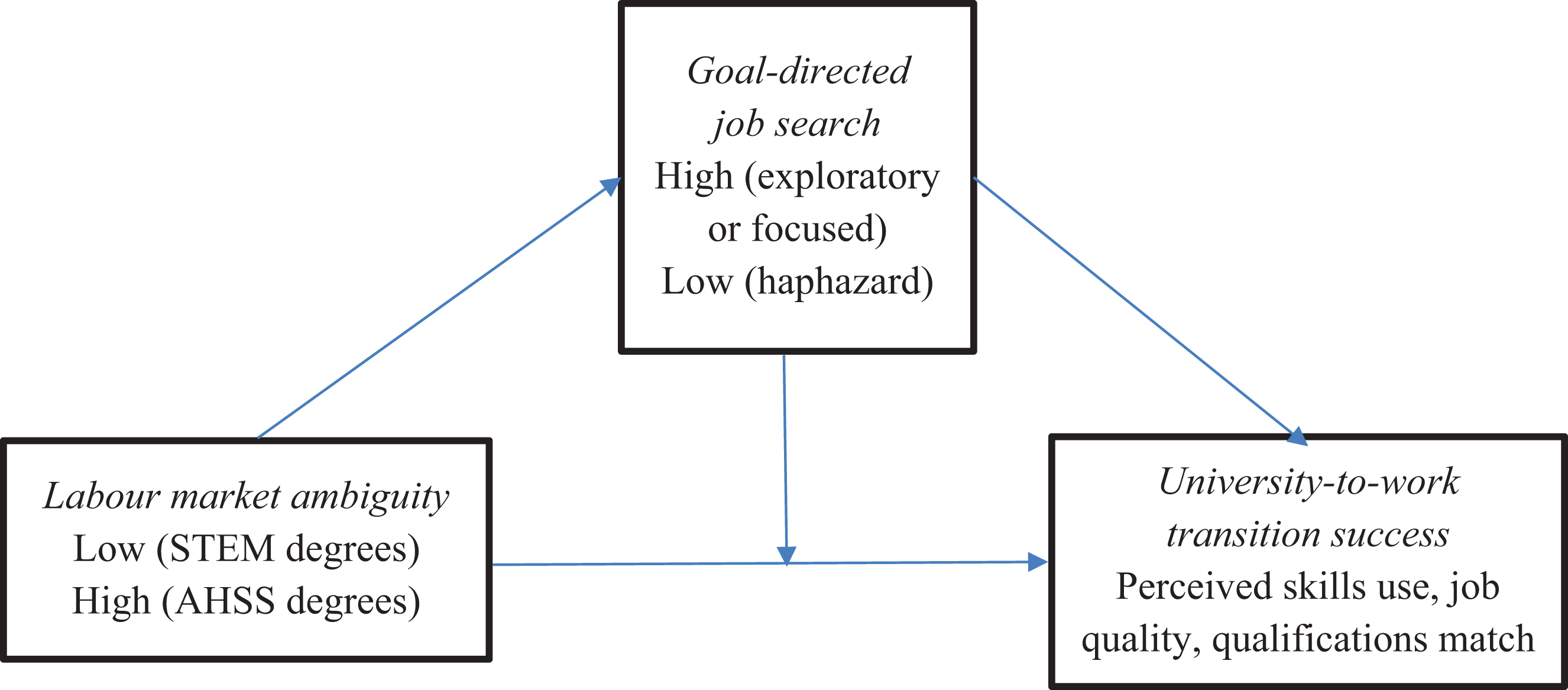
Research framework.
We contribute in two distinct ways to understanding university-to-work transitions. First, we consider the role of both agency and context in career transitions (Inkson et al., 2012). Crucially, we acknowledge the structural relationship that links educational credentials and ambiguity of labor market opportunities at the initial transition from education (Roksa & Levey, 2010). A second contribution of the study is to contextualize the scope of job search during university-to-work transitions beyond job search quantity to also acknowledge quality. Job search quality, as reflected in the nature of job search strategies, explains incremental validity in the prediction of outcomes (Koen et al., 2010), especially when job search is goal-directed (Van Hooft et al., 2013, 2020). Overall, this article strengthens the case for understanding job search context and the nature of employment goals (Kanfer & Bufton, 2018) as important antecedents of employment outcomes generally (Boswell et al., 2011) and for school-to-work transitions specifically (Saks, 2015).
The article begins by presenting the problem of labor market ambiguity in graduate transitions to work and considering what constitutes successful university-to-work transitions. We then develop hypotheses based on a conceptualization of job search strategies as reflecting career agency which can shape successful transitions and enable graduates to overcome constraints due to ambiguity in the employment opportunities associated with their degree subject. This study uses two-wave survey data from a 2016 undergraduate cohort during their final semester and one year after graduation. We discuss the theoretical and practical implications of these findings for career agency, job search context, and successful university-to-work transitions.
Labor Market Ambiguity and Successful University-to-Work Transitions
Contemporary graduate labor markets present unique barriers in the transition to a career, and there is an increasing prevalence of nontypical transitions with less predefined entry routes (Rummel et al., 2019). One such nontypical career transition is observed among AHSS graduates for whom there are often little or no clear and guaranteed entry paths (Frenette, 2013). Hence, AHSS graduates are not as socialized into careers as STEM counterparts (Kagaari, 2007) and often report considerable levels of stress and anxiety in career management (Frenette, 2013). Moreover, unlike STEM subjects, where skills shortages have been reported, there is a considerable surplus of AHSS graduates (Cedefop, 2015). For instance, research on artists’ early career trajectories following education shows prolonged periods of job search, with individuals often succumbing to work which is not related to their subjects (Baldauf & Luchinskaya, 2019) and earning lower salaries than those with qualifications in STEM subjects (Abel & Deitz, 2017). AHSS graduates, therefore, often report a lack of direction in job search, take longer to settle into careers (Lyonette et al., 2017), and show greater variance in the depth and diversity of career patterns, including a higher propensity for “portfolio careers” (The British Academy, 2017). Overall, the labor market for AHSS graduates, in comparison with STEM counterparts, shows more ambiguity in the structure of opportunities.
Career researchers have been encouraged to consider a broad range of success criteria relevant for the population under study (Gunz & Heslin, 2005). An underresearched area with respect to job search relates to its influence on subjective employment success (Van Hooft et al., 2020). In contrast to relatively well-established evidence that greater job search intensity leads to more positive objective employment success (e.g., more job offers), Van Hooft et al.’s (2020) meta-analytic review showed mixed evidence for the link between greater job search intensity and employment quality. Perceptions of poor job quality and overqualification are commonly observed among university leavers (e.g., Cedefop, 2019). This article, therefore, focuses on subjective outcomes associated with university-to-work transitions rather than the more commonly examined objective job search outcomes, for example, time to secure first job or salary. For university leavers, subjective outcomes may include those that would be expected as a result of attending higher education: perceived skill use at work, perceived job quality (e.g., skill variety, autonomy, and opportunities for development), and perceived qualification–job match. These measures have implications for graduates’ work-related attitudes (Harari et al., 2017) and well-being including life satisfaction (Erdogan et al., 2018). Moreover, graduates in jobs offering different objective conditions (e.g., salary) can report similar subjective employment quality (Okay-Somerville & Scholarios, 2014), highlighting the importance of examining the interplay between labor market context and subjective experiences of labor markets, for example, perceived employability.
Job Search Strategies and Successful University-to-Work Transitions
For understanding successful university-to-work transitions, we draw on goal-setting theory (Lee et al., 1989) and examine the extent to which individual agency, in the form of goal-directed job search, may explain differences in employment outcomes or compensate for the impact of labor market ambiguity. The specific propositions of goal-setting theory relevant for the present research concern the role of goal clarity for goal-directed behavior and performance (Locke & Latham, 1990) and the resource allocation perspective (Kanfer & Ackerman, 1989). Our theorization is based on a key assumption that labor market ambiguity is associated with goal clarity at the individual level. We expect students’ job search-related goal clarity to be closely related to the degree of labor market ambiguity with respect to finding employment related to degree subject.
Goals provide direction to behavior. Specific goals facilitate goal achievement and performance in comparison with general/ambiguous goals (Locke & Latham, 1990). Within careers research, lack of goal clarity is often used as a proxy for career indecision (Creed et al., 2020) and is manifested by difficulty in career planning and lack of job search clarity (Van Hooft et al., 2013). Lack of goal clarity is associated with greater stress, lower perceived employability and career-related effort (Creed et al., 2020), and fewer career-relevant activities, for example, career exploration (Zikic & Saks, 2009).
Goal pursuit and achievement require sustained attentional effort through self-regulatory activities, such as monitoring and evaluating performance, which determine the distribution of effort (Kanfer et al., 2013). Job search constitutes one such self-regulatory activity involving identification of, commitment to, and pursuing of employment goals (Kanfer et al., 2001). Crossley and Highhouse (2005) distinguish between job search strategies that have relevance for employment goal clarity. Haphazard job search strategies involve substantial trial and error and passively gathering job search–related information which is not necessarily directed toward specific employment goals. Exploratory job search strategies are driven by the individual’s motivation to fully explore the opportunities in the labor market and involve substantial career exploration from multiple sources. Finally, focused job search strategies are driven by clear job search goals and concentrate on a limited number of carefully chosen employers and/or jobs that match the individuals’ goals. High-quality job search is thorough and systematic (Van Hooft et al., 2020) and aimed at finding a pleasant and matching job—as reflected in exploratory and focused job search strategies—whereas low-quality job search is not goal directed and aimed at finding any job—as reflected in haphazard job search strategies (Taggar & Kuron, 2016).
Resonating with goal-setting theory’s proposition that goal clarity will be associated with goal-directed behavior, in the face of high labor market ambiguity, AHSS graduates report flexibility and lack of direction in their job search, for example, including employment options that are not related to their degree aspirations (Lyonette et al., 2017). Labor market ambiguity for AHSS students means that they may lack precision in their job search (Van Hooft et al., 2020) and spend longer in the deliberation phase of action as discussed by Gollwitzer and Bayer (1999). Meanwhile, STEM students may move on to the implementation of clearer goals. In fact, STEM graduates report higher goal-directedness in job search to the extent that some primarily focus job search on a set group of employers (Mellors-Bourne et al., 2011). Building on the goal-setting theory proposition that goal clarity is associated with goal-directed behavior and performance, differences in successful university-to-work transitions between AHSS and STEM graduates may therefore be attributable to differences in job search strategies. We consider the extent to which job search strategies explain differences in successful university-to-work transitions with the following hypothesis:
According to the resource allocation model (Kanfer & Ackerman, 1989), straightforward goals require less self-regulation in comparison to novel or ambiguous goals, where the individual may be more likely to monitor and evaluate performance closely. Hence, performance related to ambiguous tasks is more dependent on goal-directed behavior in comparison to performance related to straightforward tasks. We propose that, in the graduate labor market, job search in low ambiguity contexts represents a more straightforward task than that in high ambiguity contexts. Building on the resource allocation model of goal setting, therefore, we expect that successful university-to-work transition is explained by different job search strategies depending on labor market ambiguity.
This interaction effect, between the task ambiguity and goal-directed behavior, has been observed in the form of “tunnel vision.” This is associated with underperformance when highly focused strategies are utilized in achieving relatively straightforward tasks (Seijts & Latham, 2001). For some job seekers, highly goal-directed behavior may lead to restricting the range of labor market opportunities considered. We would expect such undermining effects when labor market ambiguity is low and the individual employs focused job search strategies. Considering that STEM graduates often lack wider career management skills (Wakeham, 2016) and target a selected number of employers (Mellors-Bourne et al., 2011), we expect focused strategies to show detrimental impact on STEM university-to-work transition success. Conversely, when there is high labor market ambiguity, goal-directed strategies may help position the individual better in the labor market. This would show a compensating effect of career agency in overcoming contextual constraints to successful university-to-work transitions due to labor market ambiguity. Hence, goal-directed job search strategies may be more important for AHSS, in comparison with STEM, graduates, as they may shield AHSS graduates from accepting any job, an outcome which is associated with haphazard job search strategies. There is evidence, for instance, that AHSS graduates seek internships, voluntary work, and (often unpaid) work experience (Rothman & Sisman, 2016) in order to build portfolios of experience or stepping-stones to increase employability. Hence, for AHSS graduates, focused and/or exploratory strategies may both represent “smart” job search (Van Hooft et al., 2020), although each strategy is associated with different career behaviors. These strategies may compensate for the negative effects of labor market ambiguity on university-to-work transition success.
Method
Data and Sample
This study is based on two-wave survey data from the 2016 graduating cohort of selected universities in Scotland. Of the 19 Scottish universities, heads of schools/departments in 10 universities were contacted for announcement of the study. There were positive responses from seven universities. Department heads/final year coordinators and/or career services in these universities announced an online survey link to graduating students. Participants were offered a chance to be included in a draw for five £50 vouchers for online shopping. This resulted in an initial sample size of 758 in Wave I which was collected during the final semester at university between April and June 2016. Participants who engaged in job search during Wave I (N = 480) were invited for another survey, 1 year after graduation in the summer of 2017 (Wave II: N = 175, 37% response rate). In the final data set, participants who were not in work at Wave II (N = 41) and who had more than 25% of responses missing on study variables were excluded (N = 5). This resulted in a final sample size of 129 (mean age = 22 (SD = 3 years) 62% female; 61% AHSS graduates (49% Social Science, 12% Arts and Humanities); 39% STEM graduates(15% Engineering, 24% Sciences); 64% from more prestigious universities; 83% held a high Honors degree in the UK classification system; 50% were first-time university goers in their immediate family; and average job tenure was 8 months (SD = 5.40 months)) (see Table 1). The majority of participants (76%) were from three universities, one of which was a less prestigious university (26% of responses). The sample is comparable with the population statistics provided by the Higher Education Statistical Agency (2017) for first-degree qualifiers of the 2015/2016 cohort. The response rate mirrors that of recent research aimed at tracking university-to-work transitions (Erdogan et al., 2018).
Means, SDs, and Bivariate Correlations for Study Variables.
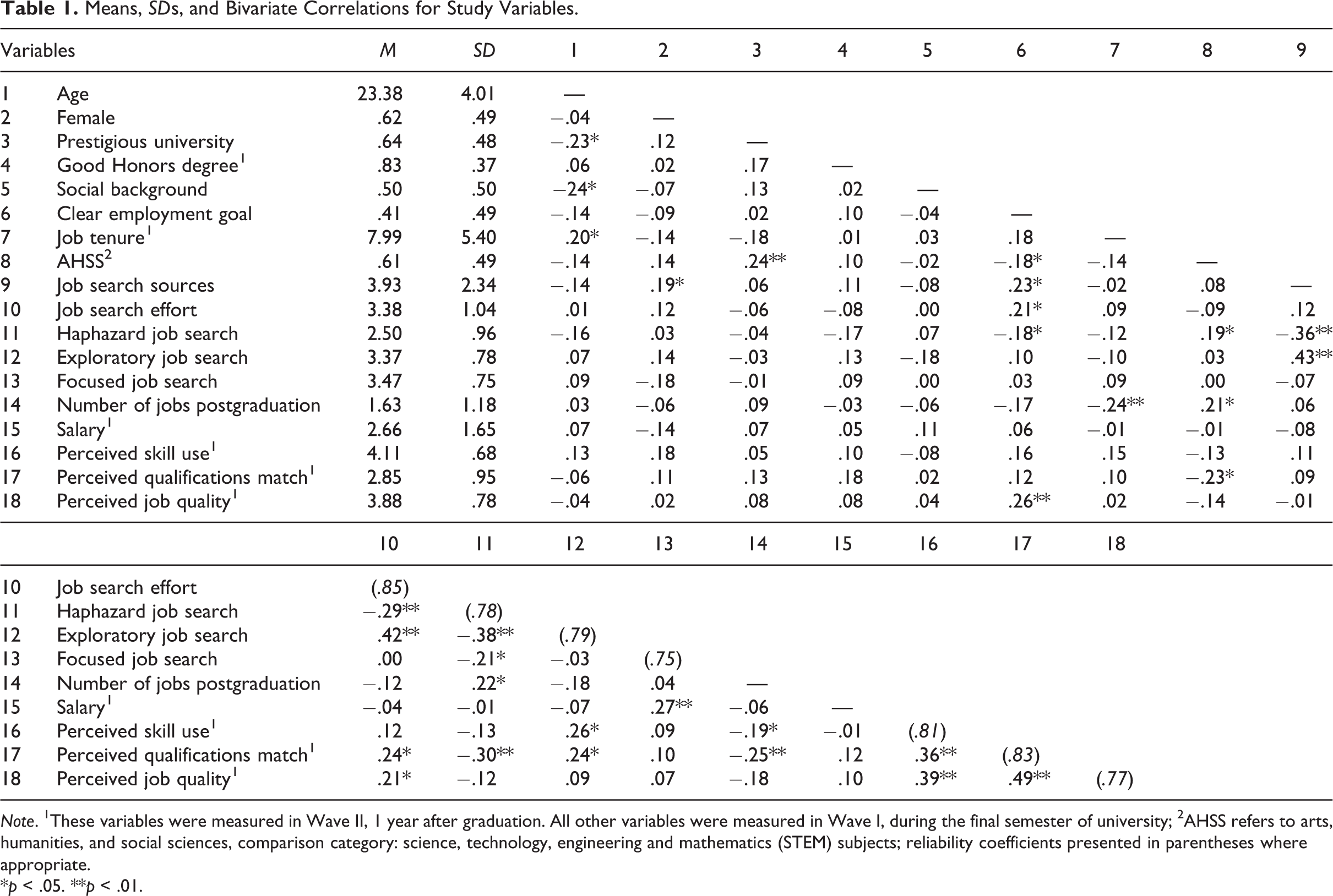
Note. 1These variables were measured in Wave II, 1 year after graduation. All other variables were measured in Wave I, during the final semester of university; 2AHSS refers to arts, humanities, and social sciences, comparison category: science, technology, engineering and mathematics (STEM) subjects; reliability coefficients presented in parentheses where appropriate.
*p < .05. **p < .01.
Wave I Measures
Wave I measured job search strategies using Crossley and Highhouse’s (2005) information search strategies scale. The scale is comprised of three subscales as follows: haphazard (four items, e.g., “I use a ‘hit or miss’ approach when gathering information about jobs,” α = .78); exploratory (six items, e.g., “I try to get my resume out to as many organizations as possible,” α = .79); and focused strategies (six items, e.g., “I have a clear idea of what qualities I wanted in a job,” α = .75); 5-point scale, 1 = strongly disagree, 5 = strongly agree. Average scores were computed for each subscale. Confirmatory factor analysis showed that the three-factor structure fit the data relatively well (χ2/df = 1.76, p < .001, CFI = .92, TLI = .95, and RMSEA = .07).
Degree subject was coded (1 = “AHSS” and 0 = “STEM”) using the Joint Academic Coding System (JACS 3.0) developed by the Higher Education Statistical Agency in the UK. This allows consistency with other research that focuses on subject differences in university-to-work transitions (e.g., Lyonette et al., 2017).
Wave II Measures
Wave II included measures of university-to-work transition success, all of which were adopted from the 2012 Skills and Employment Survey (Felstead et al., 2014), which is often used by UK researchers focusing on employment quality (e.g., Ogbonnaya & Daniels, 2017). This is a national, publicly funded survey that contains 12 blocks of questions measuring various aspects of skill use and employment quality at work. The items used in this analysis are all drawn from the “detailed job analysis” block. Perceived skill use was measured with eight items (e.g., communication and teamworking; 5-point scale reporting on how important each skill is for performance on the job, 1 = not important at all and 5 = essential; α = .81). Perceived job quality was measured with eight items, for example, autonomy, job control; 5-point scale reporting on the extent to which the job provides each feature, 1 = to a very little extent and 5 = to a great extent; α=.83). Finally, perceived qualification–job match was measured with two items corresponding to the extent to which one’s job requires a university degree to get the job and to do the job (5-point scale, 1 = definitely unnecessary and 5 = definitely necessary; α = .77). Confirmatory factor analyses, where each indicator of university-to-work transitions success was a latent variable with the above-described indicators, showed a good fit with data (χ2/df = 1.44, p < .001, CFI = .94, TLI = .92, IFI = .94 and RMSEA = .06).
In order to check for the possibility of common method variance due to the self-report nature of the data (Podsakoff et al., 2003), we applied the common latent factor approach. Our comparison of standardized regression weights for each observed item with their respective latent variable, with and without an additional common latent factor, showed that none were >.20.
Control Variables
The analyses controlled for known predictors of university-to-work transition success based on UK evidence. It has been shown that university type (1 = prestigious and 0 = less prestigious), degree classification achieved (Time 2 measure, dichotomized as 1 = good Honors and 0 = poorer Honors classification as determined by the British classification system) and social background (Time 1 measure, 1 = first generation university goer in family and 0 = at least one parent has degree qualification) have a systematic impact on university-to-work transition outcomes, favoring those from older, more prestigious universities, those who achieved good Honors classifications, and those who are continuing generation university goers (Holmes, 2013). We also controlled for: job tenure (in months) to account for socialization to work impacting responses to successful university-to-work transitions (Bauer et al., 2007); salary as an objective outcome of university-to-work transition; job search effort (Blau, 1993; four items (e.g., “Devoted much effort to looking for a job”), 5-point scale, 1 = strongly disagree and 5 = strongly agree, α = .85); and job search sources during Time 1 as potential explanations of employment outcomes. Finally, we controlled for individual-level employment goal clarity based on an item from Okay-Somerville et al. (2020) asking about immediate plans following graduation: 0 = unclear goal (if participant selected “I have no idea” and/or “any available job” from a list of seven postgraduation employment scenarios) and 1 = clear goal (if participant selected any other scenario, for example, secure a graduate trainee position).
Analytical Strategy
Analyses were run using the PROCESS macro (Hayes, 2017) with template 74, which allows testing the model for each dependent variable for direct, indirect and interaction effects. Prior to hypothesis testing, tests were conducted to examine the direct effect of degree subject on job search strategies (from the independent variable to the mediator in the indirect model, Hayes, 2017) and of job search strategies on indicators of successful university-to-work transitions, controlling for degree subject (from the mediator to the dependent variable of the indirect model, Hayes, 2017). In the analyses, 5,000 bootstrap samples were used in order to counterbalance the relatively small sample size. Interpretation of results for the hypothesis tests relied on overall model significance (as reflected in significant F(df1, df2) and R2 statistics) and 95% bias-corrected (95% CI) upper and lower confidence intervals to determine significance of the predicted relationships.
Findings
Table 1 describes means, standard deviations and bivariate correlations between study variables. This confirms that AHSS graduates were less likely to report clear employment goals at graduation (Table 1, r = −.18, p < .05). AHSS graduates only differed from STEM counterparts in their significantly more haphazard job search (Table 2, B = .50, SE = .19, 95% CI [.12, .89]). There were no other differences in job search strategies based on degree subject. Moreover, as observed in Table 3, only exploratory job search strategies during the final semester of university were associated with perceived qualifications match (B = .53, SE = .23, 95% CI [.07, .99]) and perceived job quality (B = .43, SE = .19, 95% CI [.06, .80]).
Regression Analyses Predicting Job Search Strategies During University Education by Degree Subject.
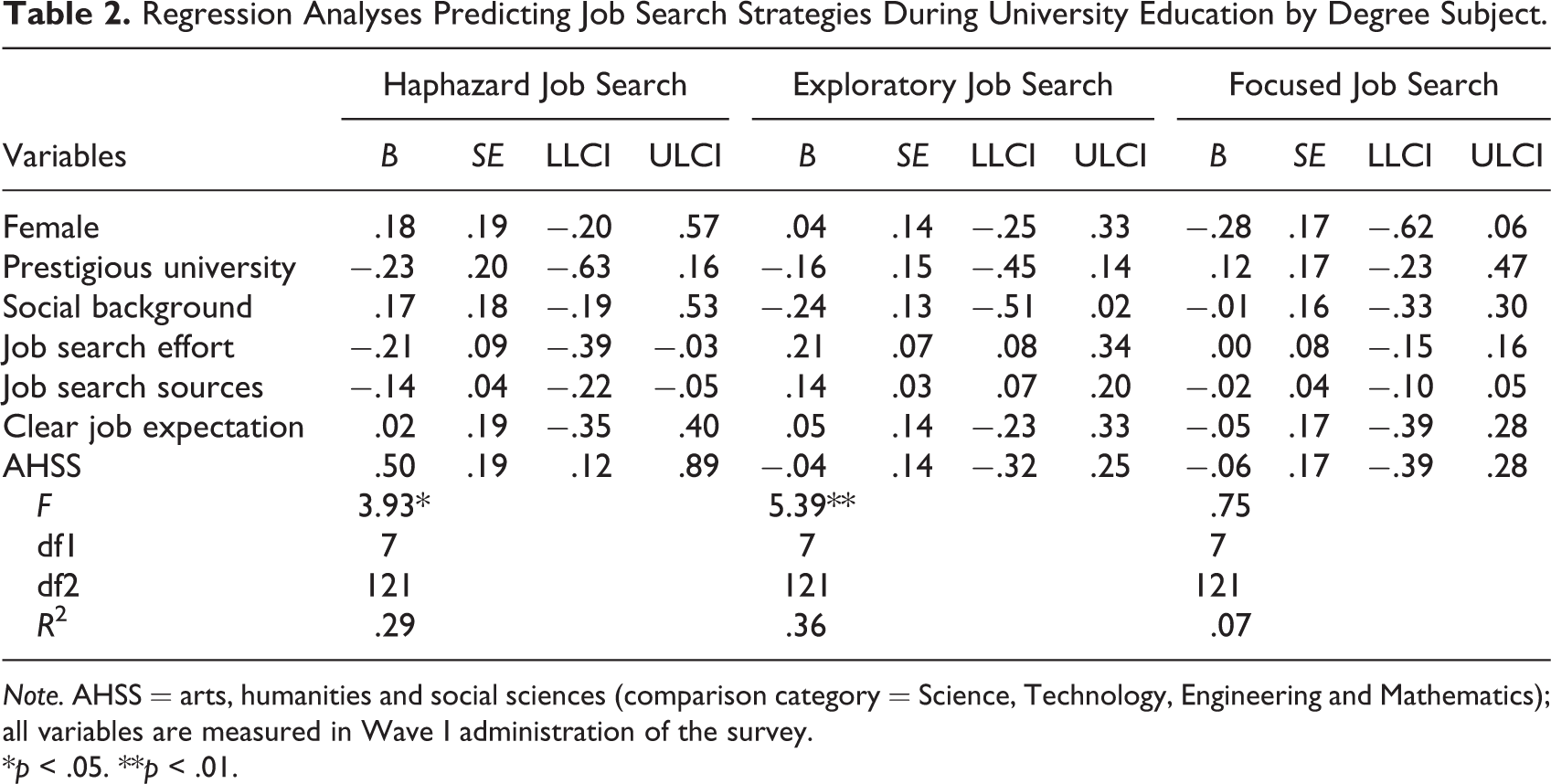
Note. AHSS = arts, humanities and social sciences (comparison category = Science, Technology, Engineering and Mathematics); all variables are measured in Wave I administration of the survey.
*p < .05. **p < .01.
Regression Analyses Predicting Successful University-to-Work Transitions One Year After Graduation.
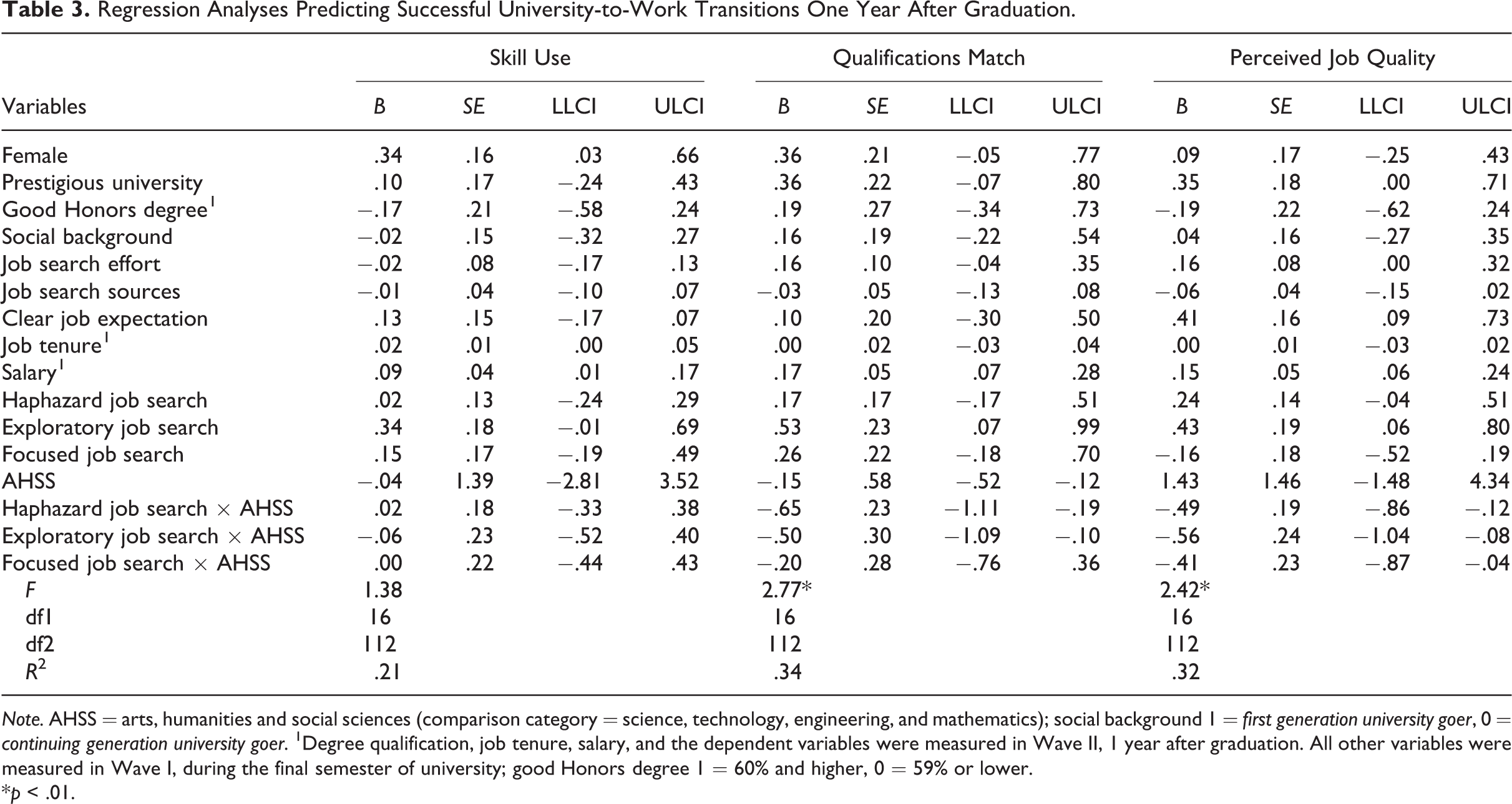
Note. AHSS = arts, humanities and social sciences (comparison category = science, technology, engineering, and mathematics); social background 1 = first generation university goer, 0 = continuing generation university goer. 1Degree qualification, job tenure, salary, and the dependent variables were measured in Wave II, 1 year after graduation. All other variables were measured in Wave I, during the final semester of university; good Honors degree 1 = 60% and higher, 0 = 59% or lower.
*p < .01.
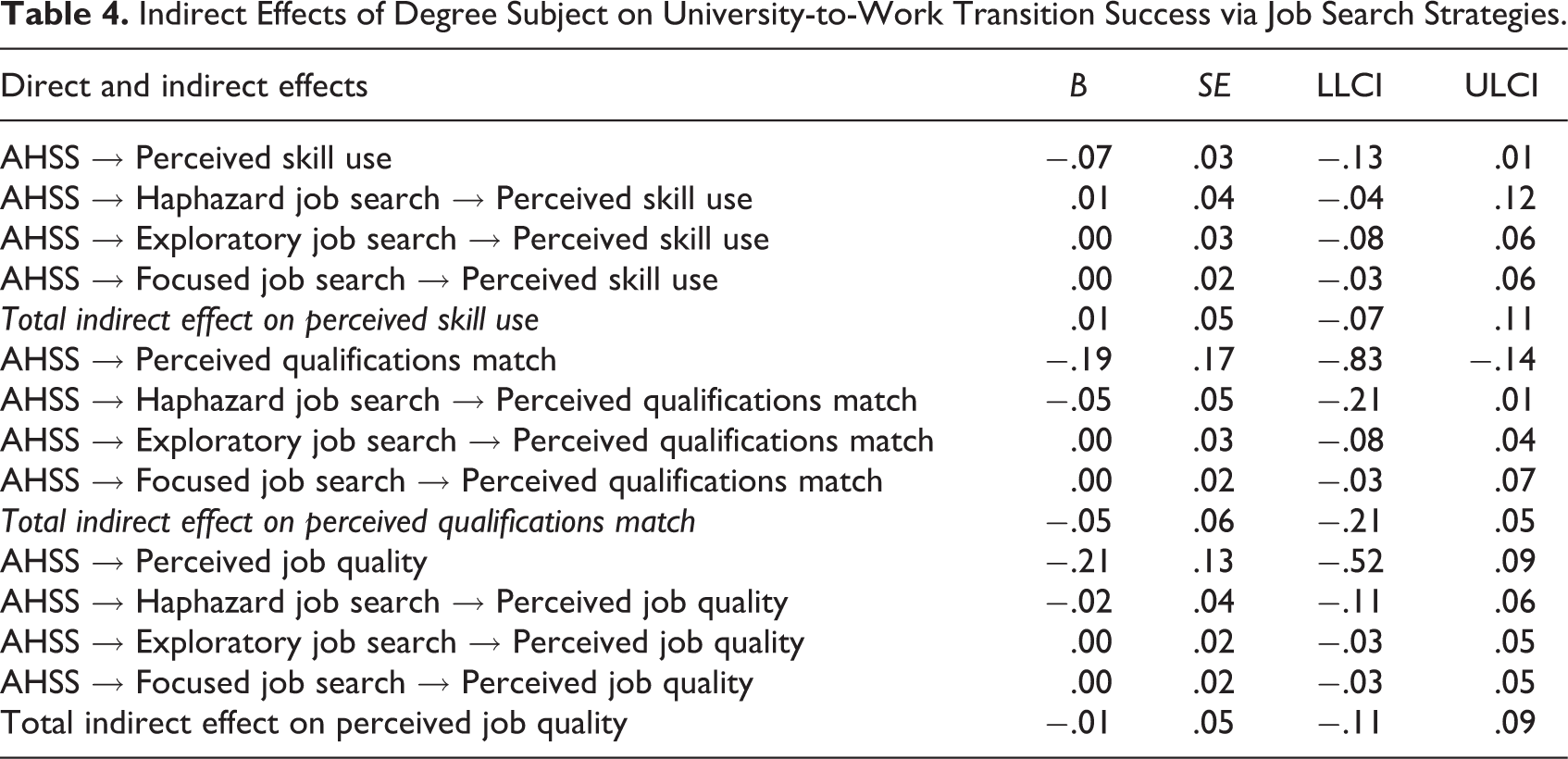
Being an AHSS graduate was associated only with lower perceived qualifications match at work in comparison with STEM counterparts (Table 3; B = −.15, SE = .58, 95% CI [−.52, −.12]). This provides partial support for H1a (i.e., AHSS graduates experience less successful university-to-work transition). None of the indirect effects of degree subject via job search strategies on the three measures of successful university-to-work transitions was significant (Table 4). There was no support for the mediation hypothesis, H1b.
Indirect Effects of Degree Subject on University-to-Work Transition Success via Job Search Strategies.
Models predicting perceived qualifications match and job quality were significant (Table 3; R2perveivedqualificationmatch = .34 and R2perceivedjobquality = .32). We observed significant interaction effects between degree subject and (i) haphazard job search (B = −.65, SE = .23, 95% CI [−1.11, −.19]) and exploratory job search (B = −.50, SE = .30, 95% CI [−1.09, −.10]) in prediction of perceived qualifications match and (ii) haphazard (B = −.49, SE = .19, 95% CI [−.86, −.12]), exploratory (B = −.56, SE = .24, 95% CI [−1.04, −.08]) and focused job search (B = −.41, SE = .23, 95% CI [−.87, −.04]) in prediction of perceived job quality at work.
Engaging in haphazard job search strategies during university is associated with poorer perceived qualifications match (Figure 2) and job quality (Figure 3) 1 year after graduation for AHSS, whereas these effects are relatively stable for STEM graduates. Moreover, engaging in exploratory job search strategies during university is more beneficial for perceived qualifications match and job quality of STEM graduates in comparison with that of AHSS graduates (Figures 2 and 3, respectively). For AHSS graduates, engagement in focused job search during university is associated with greater improvement to perceived job quality 1 year after graduation, whereas we observe a negative effect for STEM graduates (Figure 3). These findings provide partial support for Hypothesis 2; that is, job search strategies will moderate the impact of degree subject on successful university-to-work transitions.
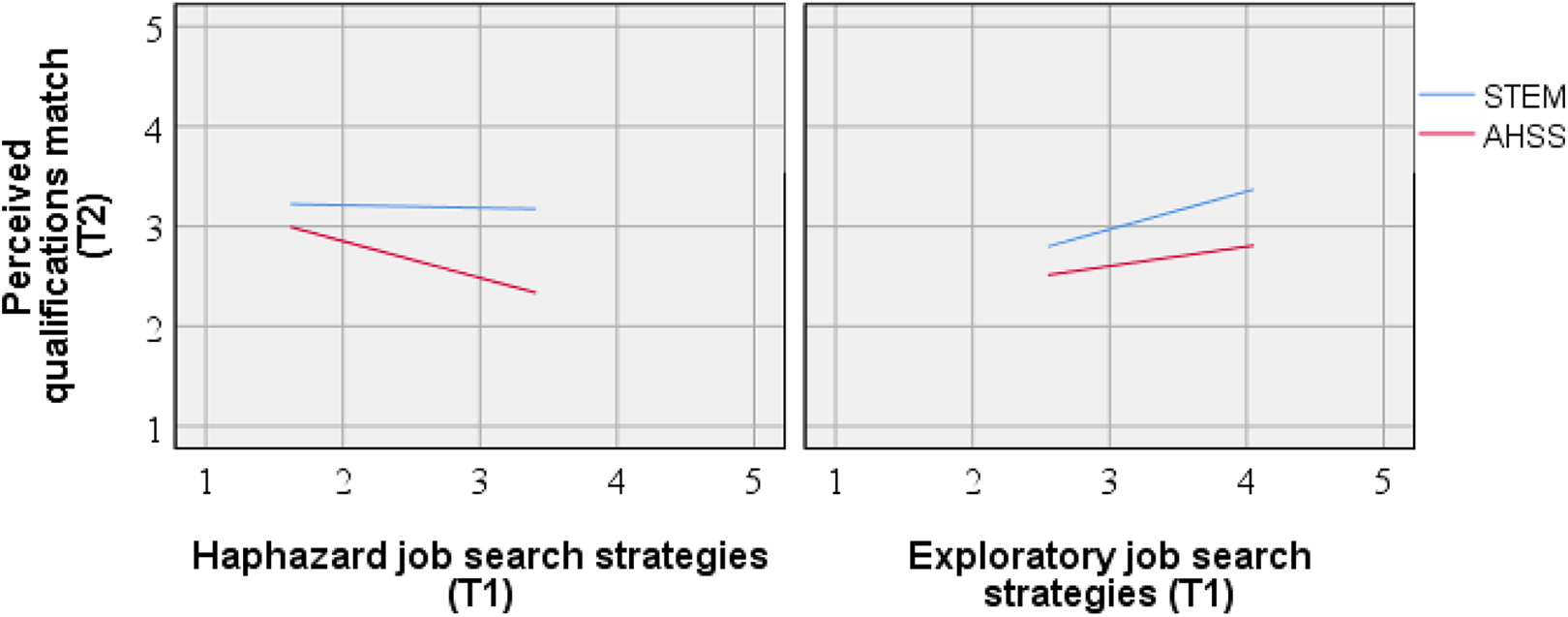
Differential impact of haphazard (left) and exploratory (right) job search on perceived qualifications match based on degree subject.
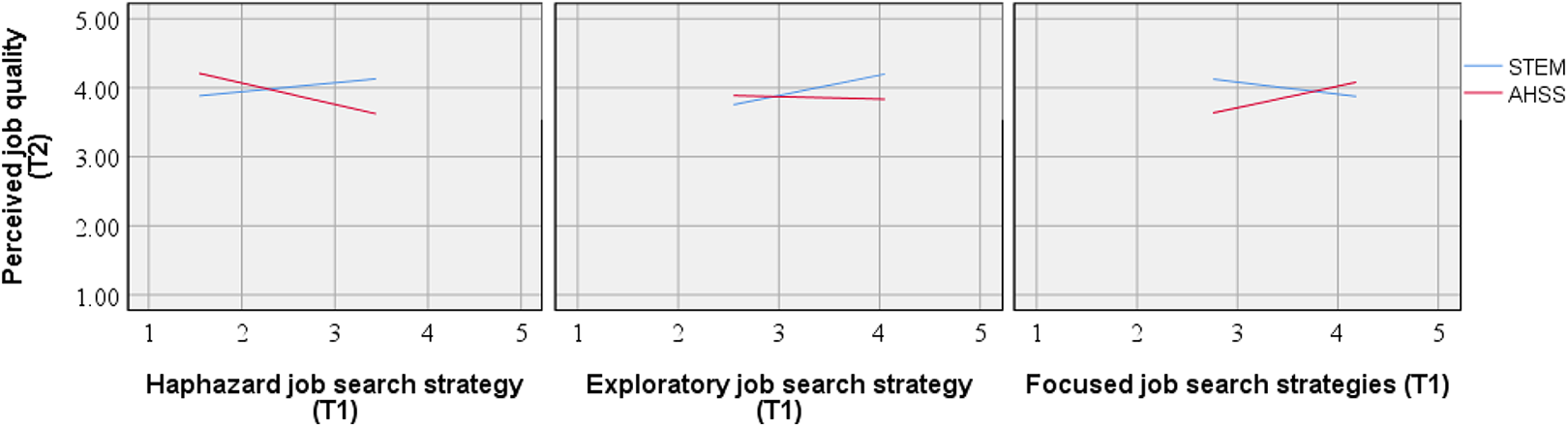
Differential impact of haphazard (left), exploratory (middle) and focused job search strategies (right) on perceived qualifications match based on degree subject.
Discussion
This article examined (i) the extent to which student job search strategies explained three indicators of a successful university-to-work transition 1 year after graduation and (ii) whether job search strategy could overcome potential negative effects on these outcomes related to ambiguity of labor market opportunities. Job search strategies were conceptualized as self-regulatory activities with different degrees of goal-directedness and contextualized within two contrasting graduate labor markets with typically high or low labor market ambiguity (i.e., graduate job seekers with AHSS vs. STEM degrees, respectively).
Although AHSS graduates reported significantly lower perceived qualifications match 1 year after graduation (H1a), there was no support for the role of job search strategies in explaining the link between degree subject (i.e., representing either high or low ambiguity labor market contexts) and successful transition for any of the three outcomes (H1b). However, significant interaction effects between degree subject and job search strategies (H2) indicated a stronger downward effect of haphazard strategies for AHSS graduates (high labor market ambiguity context) on perceived qualifications match and job quality, and a stronger upward effect for STEM graduates (low labor market ambiguity context) when engaging in exploratory strategies. Focused strategies were more beneficial for AHSS than for STEM graduates in improving perceived job quality after 1 year.
Theoretical Implications
The study’s first theoretical contribution is to provide a contextualized understanding of the efficacy of career agency during the university-to-work transition. We situated goal-directed job search strategies during university within two varying labor market contexts, one of which captured the ambiguity of many graduates’ career paths and the other which represented more traditional, predefined career trajectories. Integrating concepts of goal-directed self-regulatory activity during job search with labor market ambiguity allowed us to theorize the success of early job search activity as an interplay between individual agency and structural constraints. This was most clearly visible in our paradoxical finding that job search strategies did not explain, yet differentially impacted, differences in university-to-work transition success due to degree subject.
Confirming our first hypothesis based on goal-setting theory (Locke & Latham, 1990), graduates in a labor market context representing high ambiguity (AHSS degrees) reported lower perceived qualifications match 1 year after graduation than those in a labor market context with low ambiguity (STEM graduates). Exploratory job search strategies had a direct beneficial effect on perceived qualifications match 1 year after graduation for all graduates. However, no significant explanatory effects of degree subject via job search strategies were observed. These findings contradict previous research on goal clarity related to career indecision (e.g., Creed et al., 2020) or job search clarity (e.g., Zikic & Saks, 2009), and career behavior and outcomes. Our study design introduced labor market ambiguity as a contextual variable represented by degree subject, while also controlling for individual perceptions of goal clarity at the time of job search. As such, the findings question the efficacy of individual career agency (in the form of job search strategies) for overcoming a contemporary contextual barrier to university-to-work transitions success: labor market ambiguity.
Our findings show support for a resource allocation model of goal setting (Kanfer & Ackerman, 1989), which argues that resources allocated to tasks and their efficacy differ based on the nature of the goals and on context. We observed a differential impact of job search strategies in high and low labor market ambiguity contexts for successful university-to-work transitions. Supporting goal setting theory–based expectations (Locke & Latham, 1990), we observed that graduates in a high ambiguity context (AHSS graduates) were more likely to engage in haphazard job search strategies. Moreover, haphazard job search strategies were more detrimental for perceived qualifications match and job quality for AHSS than STEM graduates. With high labor market ambiguity during job search (i.e., for AHSS graduates), a focused strategy brought the greatest gains compared with either haphazard or exploratory strategies. In contrast, with low labor market ambiguity during job search (i.e., for STEM graduates), more focused strategies were related to lower perceived job quality while more exploratory strategies improved both perceived qualifications match and job quality.
Contrary to previous research (e.g., De Battisti et al., 2016), our findings highlight the possible detrimental effects of focused (i.e., highly goal-directed) job search in low ambiguity contexts. Supporting the resource allocation model of goal setting (Kanfer et al., 2013), this tunnel vision (Seijts & Latham, 2001) may be attributed to the absence of self-regulation such as monitoring or evaluating one’s performance. In the present study, this may have applied to STEM students who often expect to enter predefined career trajectories and already have strong employer links through anticipatory socialization. In fact, 70% of engineering and computing students report having a core employer group that they apply to in job search (Mellors-Bourne et al., 2011). The present findings showed that such highly goal-directed behavior was most beneficial when labor market ambiguity was high, in this case, for AHSS graduates, who may have been more likely to engage in self-regulation due to the demoralizing effects of poor employment outcomes in the graduate labor market (Purcell et al., 2017).
The findings challenge previous research which suggests that exploratory strategies should be avoided (Koen et al., 2010) and shows that exploratory job search behaviors are beneficial for successful university-to-work transitions to the extent that there are visible opportunities in the labor market. Thus, for STEM graduates, exploratory job search is an important goal-directed activity. Overall, the differential impact of job search strategies on university-to-work transition success, based on their goal-directedness and the extent of labor market ambiguity, shows the interplay between agency and the structure of opportunities for university leavers’ early career development.
The study’s second theoretical contribution is to analyze a specific case of job search context—labor market ambiguity during university-to-work transitions—as a boundary condition in the process leading to successful outcomes (Boswell et al., 2012). Existing knowledge of university leavers’ job search emphasizes the degree of effort or intensity of particular activities (e.g., Saks, 2015). Although evidence indicates that job search quality has incremental meaningful effects on career transitions (Koen et al., 2010), the impact of context, especially of employment goals (Kanfer & Bufton, 2018), on the success of the job search process has not been empirically studied for university-to-work transitions. Building on the goal-directed distinction between focused, exploratory, and haphazard search behavior (Crossley & Highhouse, 2005), our findings show that the efficacy of job search strategies is intertwined with labor market ambiguity: similar job search strategies may have different impacts depending on the structure of opportunities in different graduate labor markets.
Overall, these findings question the strong emphasis on career agency for successful university-to-work transitions. Findings show that different forms of agency, in the form of goal-directed job search strategies, work in different ways for successful university-to-work transitions depending on structural labor market conditions, in this case, the ambiguity of employment opportunities.
Practical Implications
The findings have implications for various stakeholders involved in university-to-work transitions, most directly students/graduates, careers services at universities and employers. Career actors, such as the students and graduates in our study, take individual responsibility for gathering career-relevant information through goal-directed job search. In contrast to previous research, the present study recommends alternative goal-directed strategies for different groups of graduates. Our findings show that graduates who are socialized into more structured career routes (i.e., STEM) benefit from more flexible job search, in particular exploratory job search strategies. STEM students may lack career and self-awareness (Toland, 2011) and engagement in career planning (Wakeham, 2016). Our findings also show the beneficial effect of exploring opportunities beyond the core set of employers that are targeted by most students. Conversely, graduates who face ambiguity of opportunities benefit from more goal-directed, structured job search strategies. This would imply putting extra effort into identifying career goals and where these may be realized within the vague structure of opportunities. Hence, it can be argued that career exploration is crucial for both groups of graduates but for different reasons.
For university careers advisers and those involved as job search intermediaries, the findings imply encouraging university leavers to engage in proactive career behaviors which develop stronger career identity and adaptability. The impact of degree subject on successful university-to-work transitions shows the importance of advice tailored for the needs of individuals based on their subject background. Particularly for AHSS graduates, it may not be straightforward to locate opportunities and/or make sense of career structures in the labor market. Similarly, the nature of STEM degree structures means that graduates are not socialized into exploring the world of work and may therefore need extra encouragement and persuasion to do so. This distinction between degree subjects emphasizes the importance for careers advisers to work closely with students/graduates, employers, and professional bodies, either to increase the availability and visibility of opportunities or to encourage individual career exploration activities. According to our findings, both approaches, depending on the job search context, will result in more successful university-to-work transitions into the early career stage.
Study Limitations and Future Research
The study’s first limitation concerns the sample size available from Wave II of the survey, although this represents 37% of the Wave I job seeker sample. Emerging adulthood is a rather unstable period in one’s life and participant retention is therefore particularly challenging for researchers, resulting in typically high nonresponse rates in college surveys (Hanna et al., 2014). Time-elapsed between the two surveys, while allowing for graduates’ adjustment to the labor market realities, may also have caused participants to lose interest. The small sample size is not unprecedented (see, e.g., Holtschlag et al., 2020). Nevertheless, it limits the number of predictor and control variables that we could include in the analysis without losing explanatory power. With larger samples, we could have selected more contemporary analytical models, for example, structural equation modeling. Nevertheless, use of the Process Macro in careers research is not uncommon (e.g., Hirschi et al., 2013). This was a second limitation. Despite these limitations, research on university surveys indicates that nonrespondents do not introduce particular bias in population estimates (Fosnacht et al., 2017) and we have some confidence in the response rate from our job seeker sample. There were no significant demographic differences between those who only responded to Wave I and those who completed both surveys.
Conclusion
This article examined the role of job search strategies during university in influencing successful university-to-work transitions in the context of labor market ambiguity, by contrasting the experience of AHSS and STEM graduates. Using two-wave data from the final year of university and 1 year following graduation, our findings suggest that successful university-to-work transitions depend on tailoring job search activity to the structure of opportunities in the labor market. However, job search strategies do not explain the labor market disadvantage experienced by AHSS graduates in the form of differential availability and visibility of labor market entry routes. The study finds that labor market ambiguity and career agency during university education operate in conjunction, in their effect on successful university-to-work transitions 1 year after graduation.
We reconfirm the reality of labor market barriers for graduates and their impact on graduate employability. The study further demonstrates that these barriers are not necessarily compensated by goal-directed behaviors during university education and thus we contribute to the structure versus agency debate for successful university-to-work transitions. Crucially, we suggest that education-to-work transitions would best be studied at the intersection of labor market barriers and individual agency.
Footnotes
Declaration of Conflicting Interests
The author(s) declared no potential conflicts of interest with respect to the research, authorship, and/or publication of this article.
Funding
The author(s) disclosed receipt of the following financial support for the research, authorship, and/or publication of this article: This research was funded by the British Academy Small Research Grant (SG132411).
