




Abstract
The aim of this study was to validate the French version of the Career Decision-Making Difficulties Questionnaire (CDDQ) and to assess its measurement invariance across gender, age groups, countries, and student versus career counseling samples. We also examined the sensitivity of this instrument to discriminate a career counseling population from a general student sample. Third, we studied the relationship between career decision-making difficulties, career decision-making self-efficacy, and self-esteem in a sample of 1,748 French and French-speaking Swiss participants. A confirmatory factor analysis confirmed the overall hierarchical structure of the CDDQ. Multigroup analysis indicated that the level of invariance across groups almost always reached configural, metric, and scalar invariance. Differences between countries were very small, whereas differences between the general population and career counseling subsamples were much larger. Both self-esteem and self-efficacy significantly predicted career decision-making difficulties. Moreover, as expected, self-efficacy partially mediated the relationship between self-esteem and career decision-making difficulties.
Keywords
Career counseling interventions aim at helping people make career choices, manage career transition, or self-direct their career. Making a career decision is a complex process that involves mastering a wide array of difficult tasks in an ever-changing and unpredictable context (Amir & Gati, 2006). Under these conditions, some people may encounter difficulties (Gati et al., 1996), delay the professional choice, or make inappropriate career decisions (Gati & Saka, 2001). Therefore, identifying possible career decision-making difficulties is a central task for both career counselors and career counseling researchers, and efforts have been made to identify and classify the potential obstacles that may hinder career choice process (e.g., Gati et al., 2019; Kelly & Lee, 2002).
Gati and colleagues’ (1996) general theoretical hierarchical taxonomy of career decision-making difficulties is based on a general career decision-making theory (e.g., the prescreening, in-depth exploration, choice model; Gati & Asher, 2001) and on career experts’ observations. This general theoretical hierarchical taxonomy of career decision-making groups 10 career decision-making difficulties drawn from that literature into three major categories: lack of readiness, lack of information, and inconsistent information. Lack of readiness refers to difficulties that a person may encounter before entering the career decision-making process. This includes lack of motivation, indecisiveness—a dispositional, stable, and persistent personality trait that makes it difficult to make choices, in general—and dysfunctional beliefs—irrational ideas about career choice and its consequences. The process of career decision making can also be impeded with difficulties associated with lack of information or inconsistent information. Lack of information may include that about the career decision-making process, about the self, about occupations, or about ways to obtain more information. Inconsistent information refers to information that is present but unreliable and the presence of internal or external conflicts (for a review, Gati et al., 2019).
To assess these difficulties, Gati and colleagues constructed the Career Decision-Making Difficulties Questionnaire (CDDQ, 1996), which includes statements corresponding to the major difficulties in career counseling. The authors empirically validated the theoretical hierarchy using cluster analysis and found a reliable structure in American and Israeli samples. The questionnaire was found to discriminate undecided from decided students (Gati & Levin, 2014). Assessments conducted with this questionnaire were also seen to corroborate career counselors’ judgment of their clients’ difficulties (Gati et al., 2000) and career counselees’ subjective perception of these difficulties (Amir & Gati, 2006). Additionally, these dimensions of indecision showed differential sensitivity to career counseling interventions, such as face-to-face career counseling (Masdonati et al., 2009), group-based life design intervention (Di Fabio & Maree, 2012), or internet-based interactive intervention (Gati et al., 2003).
This instrument has since been adapted and used for clinical and research purposes in more than 60 countries. In the literature, validations of versions of the CDDQ in more than 45 languages are available, usually normed on samples of students (Udayar et al., 2020). The authors of these validations typically found similar but not identical three- (e.g., Bacanli, 2015) or 10-factor structures (e.g., Sovet et al., 2015). Some authors also found an alternative two-factor structure (e.g., Creed et al., 2007). Some studies encountered difficulties with the Lack of Readiness Scale, which groups three slightly heterogeneous career decision-making difficulties (i.e., lack of motivation, indecisiveness, and dysfunctional beliefs) together, and some authors suggested that this scale needed to be further refined and developed (e.g., Gati & Saka, 2001; Sovet et al., 2015). On the other hand, a recent reanalysis of the structure of the English-language version of the questionnaire on a sample of more than 30,000 participants aged 14–50, from 7 countries, who completed anonymously an online career service, confirmed the structure of 10 difficulties, grouped into three categories, and contributing to an overall Career Decision-Making Difficulties Scale (Levin et al., 2020).
Recent research demonstrates that adolescents’ career decision-making difficulties are influenced by environmental factors, such as family belongingness (e.g., Slaten & Baskin, 2014), parenting style (e.g., Marcionetti & Rossier, 2017), and culture (e.g., Atitsogbe et al., 2018), as well as by personal characteristics such as gender (e.g., Levin et al., 2020), cognitive abilities (e.g., Šverko & Babarović, 2019), self-esteem (e.g., Udayar et al., 2020), self-criticism (e.g., Braunstein-Bercovitz, 2014), depression symptoms (e.g., Anghel & Gati, 2019), emotional intelligence, and personality traits (e.g., Di Fabio & Saklofske, 2014; Martincin & Stead, 2015). Moreover, indecision has been found to relate to other vocational-or career-related variables such as vocational identity (P. J. Santos et al., 2014), time perspective (e.g., Taber, 2013), vocational interest (e.g., Burns et al., 2013), career choice–related emotions (e.g., Braunstein-Bercovitz et al., 2012), career plans crystallization (e.g., Amir & Gati, 2006), career maturity (e.g., Tak & Lee, 2003), and career decision-making self-efficacy (e.g., A. Santos et al., 2018).
A certain level of career indecision can create a motivating dissonance, while a chronic or a very high level of career decision-making difficulties can constitute vulnerabilities for facilitating a smooth process of career choice. Other components can be considered as protective factors, such as self-esteem and career decision self-efficacy. Derived from Bandura’s (1986) concept of self-efficacy, career decision self-efficacy specifically refers to the perceived ability to master important tasks related to the career decision-making process, such as collecting and prioritizing relevant information (e.g., Betz et al., 1996). Unsurprisingly, this concept has been repeatedly found to be negatively related to cognitive and emotional indecision and to have an important influence on young adolescents’ career choice (Creed et al., 2007). Similarly, high self-esteem—a global positive evaluation of our value as human being (Rosenberg, 1965)—has been positively related to the development of mature career attitude, career exploration, and career decision (e.g., Cai et al., 2015). Saka and colleagues (2008) thus identified low self-esteem as a predictor of persistent career decision-making difficulties. Career decision self-efficacy and self-esteem differ in that self-esteem is considered less context and task related than self-efficacy and more like a personality characteristic (e.g., Udayar et al., 2020). According to the conceptual framework developed by Rossier (2015a, 2015b), the influence of some dispositions or contextual factors on career related outcomes can be mediated or moderated by regulation processes allowing adaptation and adjustment. According to this perspective, self-efficacy as described by the social cognitive career theory (SCCT; Lent et al., 1994) can be seen as regulating/mediating the relations between more stable dispositions (described as person inputs in the SCCT), such as self-esteem, and career outcomes such as difficulties to make a choice—a behavioral outcome. For this reason, the relationship between self-esteem conceived as a more or less stable personality characteristic (Udayar et al., 2020) and career decision-making difficulties is expected to be partly mediated by self-efficacy, as a more processual variable on which intervention can have more impact (Rossier, 2015b).
The French version of the CDDQ has already been frequently used (e.g., Atitsogbe et al., 2018; Rochat, 2019), but no validation study has yet been published. Moreover, many practitioners express interest in using this instrument. To be able to offer a validated instrument for both career counseling and research, the primary purpose of this study is to validate the French version of the CDDQ and to test whether the structure proposed by Gati et al. (1996) can be replicated in two French-speaking countries, with students whose age corresponds to periods of major career changes. Measurement invariance across gender, age groups, countries, and general versus career counseling samples is investigated in order to identify whether unique or specific norms should be developed (Rossier & Duarte, 2019). The secondary purpose of this study is to examine the sensitivity of the CDDQ to discriminate a career counseling from a general student sample. Finally, this study examines the relationship between career decision-making difficulties (considered as an antecedent), career decision self-efficacy (considered as a mediator), and self-esteem (considered as an outcome) as postulated by models such as the one proposed by Rossier (2015a).
Method
Participants
Participants were 1,748 French-speaking adolescents and young adults (1,126 women and 622 men) from Switzerland (n = 813) and France (n = 935). Age ranged from 13 to 29 (Mage = 18.05, SD = 3.01). The general student sample was collected among the general population of compulsory school, vocational or high school, and university students (n = 1,578). The Swiss educational system offers 11 years of compulsory school and is slightly more selective (students are assigned to different tracks according to their grades for the last years of compulsory school) than the French educational system which has 13 years of compulsory school (aged 3–16 years). After compulsory school, Swiss students are directed to vocational training or general education paths according to their grades. Vocational training is more valued in Switzerland compared to France where general education is more highly valued. In both countries, public counseling services are available to students. The Swiss sample consisted of 300 women and 343 men with an age ranging from 13 to 25 (Mage = 15.77, SD = 2.65). The French sample of students consisted of 744 women and 191 men with an age ranging from 14 to 26 (Mage = 19.57, SD = 2.12).
The career counseling sample was collected among a population of Swiss individuals seeking such an intervention (n = 170). The sample consisted of 82 women and 88 men with an age ranging from 15 to 29 (Mage = 18.99, SD = 2.86). The three subsamples (Swiss students, French students, career counseling) differed significantly in age, F(2, 1745) = 468.91, p < .001, η2 = .35, the Swiss student sample being slightly younger. The proportion of women and men was also significantly different across subsamples, χ2(2) = 201.60, p < .001, Cramer’s V = .34, with women being overrepresented in the French student sample. Participants were grouped according to their age, either as adolescents from 13 to 18 years old (n = 909) or as adults from 19 to 29 years old (n = 839).
Measures
The Career Decision-Making Difficulties Questionnaire (CDDQ)
The French version of the CDDQ includes 34 items assessing 10 subscales, grouped into three subdimensions: lack of readiness (including lack of motivation, indecisiveness, and dysfunctional beliefs), lack of information (about the career decision-making process, the self, occupations, and ways to obtain additional information), and inconsistent information (unreliable information, external conflict, and internal conflicts; Gati et al., 1996). Each item is rated on a 9-point Likert-type scale ranging from 1 = does not describe me to 9 = describes me well. Among the 34 items, two are control items that are not usually included when computing scores (Amir & Gati, 2006). The mean of the 10 subscales constitutes the total career decision-making difficulties score. The original English version of the CDDQ has been validated in an Israeli and an American sample by Gati and colleagues (1996) who reported internal reliabilities of .95 for the total score for both samples, internal reliabilities ranging from .63 to .95 (Mdn = .90) for the three subdimensions and ranging from .29 to .91 (Mdn = .79) for the 10 subscales. All test–rest reliabilities were equal or above .50.
The Self-Esteem Scale (SES)
The validated French version of the SES contains 10 items assessing a person’s overall evaluation of their worthiness as a human being (Rosenberg, 1965). Items are rated on a 4-point Likert-type scale ranging from 1 = strongly disagree to 4 = strongly agree. The SES contains the same number of positively and negatively keyed items. The original version of the scale has been validated by Rosenberg who observed an internal reliability of .90. The test–retest reliability was of .85 (Silber & Tippett, 1965). For the French version, Vallières and Vallerand (1990) found an internal reliability of .89 in a large sample of students.
The Career Decision Self-Efficacy Scale–Short Form (CDSE-SF)
The validated French version of the CDSE-SF contains 25 items divided in five subscales: accurate self-appraisal, gathering occupational information, goal selection, making plan for the future, and problem solving (Gaudron, 2013; Betz et al., 1996). Responses are made on a 5-point Likert-type scale ranging from 1 = no confidence at all to 5 = complete confidence. As the appropriate number of subscales is being debated, only the total score is considered here. The original version of the short form of this scale has been developed and validated by Betz and colleagues (1996) who observed an internal reliability of .94 for the total score. Gaudron (2013) reported an internal reliability of .88 for the French version. Sovet and Metz (2014) reported similar reliabilities.
Translation
The CDDQ was translated into French by a group of three French-speaking Swiss career counseling experts and then back-translated into English by an independent translator. The author of the original version of the CDDQ reviewed the back-translation and made several suggestions. Amendments were made and reviewed after back-translation. This process continued until the author of the CDDQ and the Swiss group of experts agreed upon the translation.
Procedure
In Switzerland, questionnaires were administered to students in compulsory school, in high school, and in university departments of law and social and political sciences in the French-speaking regions of Switzerland as well as to individuals seeking career counseling at a public career counseling service of the state of Vaud and at a private career counseling service. This career counseling subsample completed the CDDQ at the end of the first counseling session (counseling typically includes three sessions). In France, students completed questionnaires during psychology and sociology courses at four public universities in diverse regions. In order to be able to compute modification indices for confirmatory factor analyses (CFAs), questionnaires with more than two missing data points on the CDDQ were excluded. The remaining 49 missing values were replaced by the participant’s mean score from the other items assessing the difficulty or the category. In Switzerland, 219 students who completed the CDDQ also completed the SES, and 403 others completed the CDSE-SF; none completed all three scales. In France, of the 935 students, 809 completed all three scales. The Swiss career counseling subsample only completed the CDDQ. Most participants completed a paper-and-pencil version of the questionnaires (>90%), a minority an online version. This research complies with the ethical rules of the American Psychological Association and with the ethical rules enforced in psychological professions in France and Switzerland.
Analyses
Internal reliabilities were assessed using Cronbach’s α, and the normality of each scale was assessed by computing skewness and kurtosis. An α equal or above .90 is considered as excellent, an α equal or above .70 as good, and an α equal or above .60 as acceptable. A skewness or kurtosis in absolute value exceeding 1 indicates a nonnormal distribution (Kline, 1998).
CFAs were performed using the maximum likelihood estimation method to assess the construct validity of the French version of the CDDQ in the AMOS 21.0.0 statistical package. To achieve model identification, regression coefficients of the error terms over the endogenous variables were fixed to 1. As indices of model fit, we use χ2/df, the comparative fit index (CFI), the Tucker–Lewis index (TLI), and the root mean square error of approximation (RMSEA). A model is considered to have acceptable fit if the χ2/df value is equal or below 3 and if the CFI and TLI values are equal or above .90. If the RMSEA value is equal or below .08, it indicates adequate fit, and if the RMSEA value is equal or below .05, it indicates a good fit. In order to assess the measurement invariance of the CDDQ across countries, gender, age groups, and student versus career counseling subsamples, a series of multigroup CFAs were conducted. Following the procedure suggested by Van de Vijver and Leung (1997; see also He & van de Vijver, 2012), the configural, metric, and scalar invariance were tested by constraining all loadings across groups for the scalar invariance and by constraining all loading and intercepts for the metric invariance. Metric invariance thus also implies configural invariance, and scalar invariance implies both metric and configural invariance (Rossier & Duarte, 2019). From one level of invariance to the other, the change in the CFI should be less than .01 (Byrne & van de Vijver, 2010) or less than .002 according to Meade and colleagues (2008), and the change in RMSEA should be less than .05 (Cheung & Rensvold, 2002). However, this approach has been described as too restrictive by some methodologists (e.g., Millsap, 2011), and the less restrictive cutoff value is therefore considered for ΔCFI. Because the CDDQ reached scalar invariance, we further investigated age, gender, country differences, and the differences between the student and the Swiss career counseling subsamples.
The relationships between self-esteem, career decision self-efficacy, and career decision-making difficulties were analyzed by computing correlations for both Switzerland and France. Mediation analyses were conducted using hierarchical linear regressions and the Sobel’s (1982) test in a French subsample (n = 809) only.
Results
CFA, Descriptive Statistics, and Multigroup Analyses
The theoretical three-component model was tested considering the 32 CDDQ items as the observed variables. Given the complexity of this model, it was unsurprising that fit indices did not reach the expected values, apart from acceptable RMSEAs, χ2(451) = 3,721.18, p < .001, χ2/df = 8.25, CFI = .858, TLI = .844, RMSEA = .064. The variance of the error term for the lack of readiness (R) subdimension was small, indicating that the presence or absence of this dimension might not modify the structure significantly. In order to improve this model, we took into account 12 covariances between error terms associated with a modification index of 50 or more, and we allowed Item 8 (“I expect that entering the career I choose will also solve my personal problems”) to load on the CDDQ total latent variable (this item being slightly different from the others assessing dysfunctional beliefs and more related to general difficulties) and obtained an adjusted model that fit the data well, χ2(438) = 2,381.89, p < .001, χ2/df = 5.44, CFI = .916, TLI = .905, RMSEA = .050; here only the χ2/df was slightly too high.
The internal reliabilities were very similar in France and Switzerland (see Table 1). For the CDDQ, the internal reliability of the total score was .93 in both subsamples. The reliabilities ranged from .57 to .93 for the three categories (Mdn = .87) and from .58 to .87 for the 10 difficulties (Mdn = .78). Reliabilities were slightly lower for the Swiss career counseling subsample. For the SES and the CDSE-SF, reliabilities were similar in both countries and always above .80. The skewness and kurtosis values were always below 1 in absolute value, except for the external conflict difficulty of the CDDQ. The scale of this difficulty was slightly positively skewed in all three subsamples and had a slightly peaked distribution in France. Considering the French and Swiss samples together, the values were 1.31 for skewness and 1.00 for kurtosis.
Descriptive Statistics for the Career Decision-Making Difficulties Questionnaire, Self-Esteem, and Career Decision Self-Efficacy Scales.
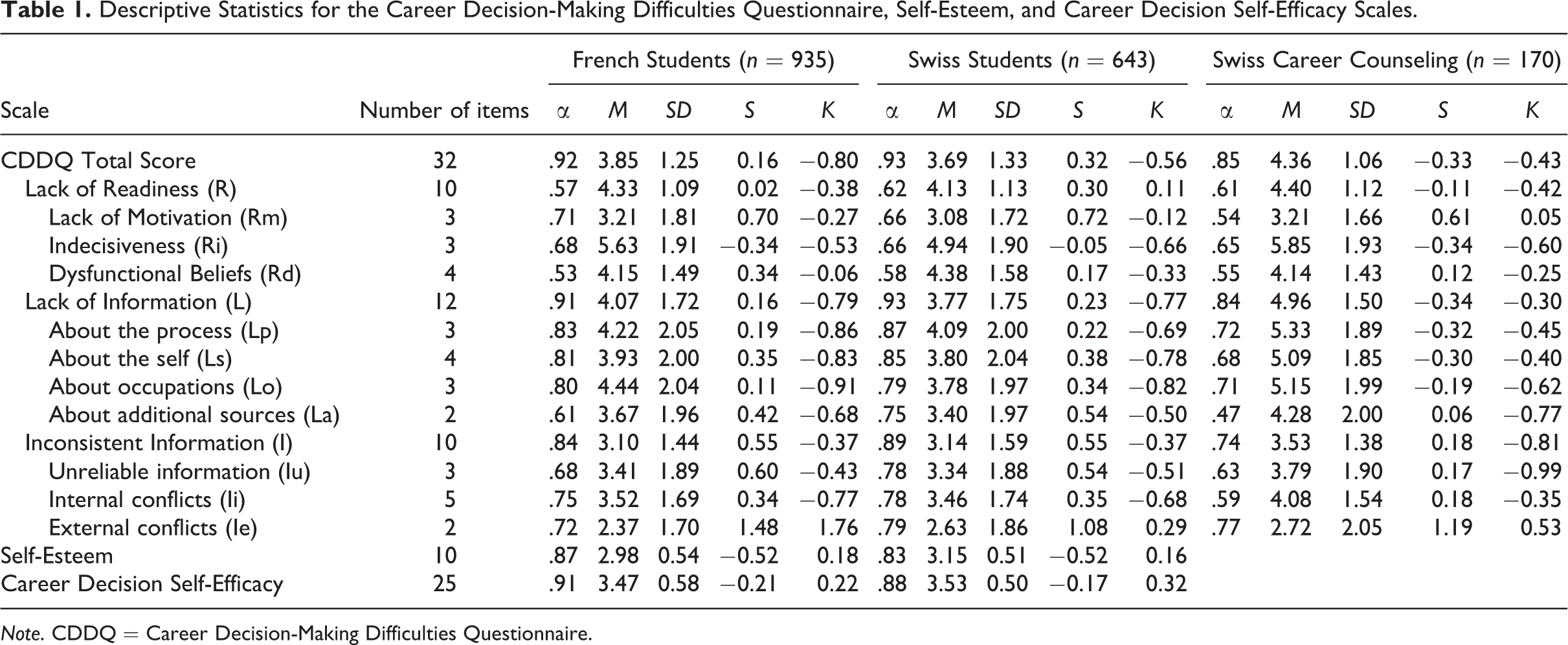
Note. CDDQ = Career Decision-Making Difficulties Questionnaire.
Measurement invariance was tested using multigroup CFAs based on the adjusted theoretical three-component model. The level of invariance across countries, gender, and student versus career counseling subsamples reached configural, metric, and scalar invariance, the ΔCFI and ΔRMSEA being always equal or lower than .01 and .05, respectively (see Table 2). CFIs and TLIs were always above or very close to .90. However, χ2/df values were always slightly above 3. Measurement invariance across age groups reached configural, metric, and partial scalar invariance when the intercept of Item 11 (“I believe that a career choice is a one-time choice and a lifelong commitment”) was released. In fact, Item 11 was the only one associated with a relatively large mean difference across age groups (d = .40). However, it has to be noted that the ΔCFI value for the scalar invariance is just above the threshold.
Measurement Equivalent Across Countries, Gender, Age Groups, and the General Population and Career Counseling Samples.
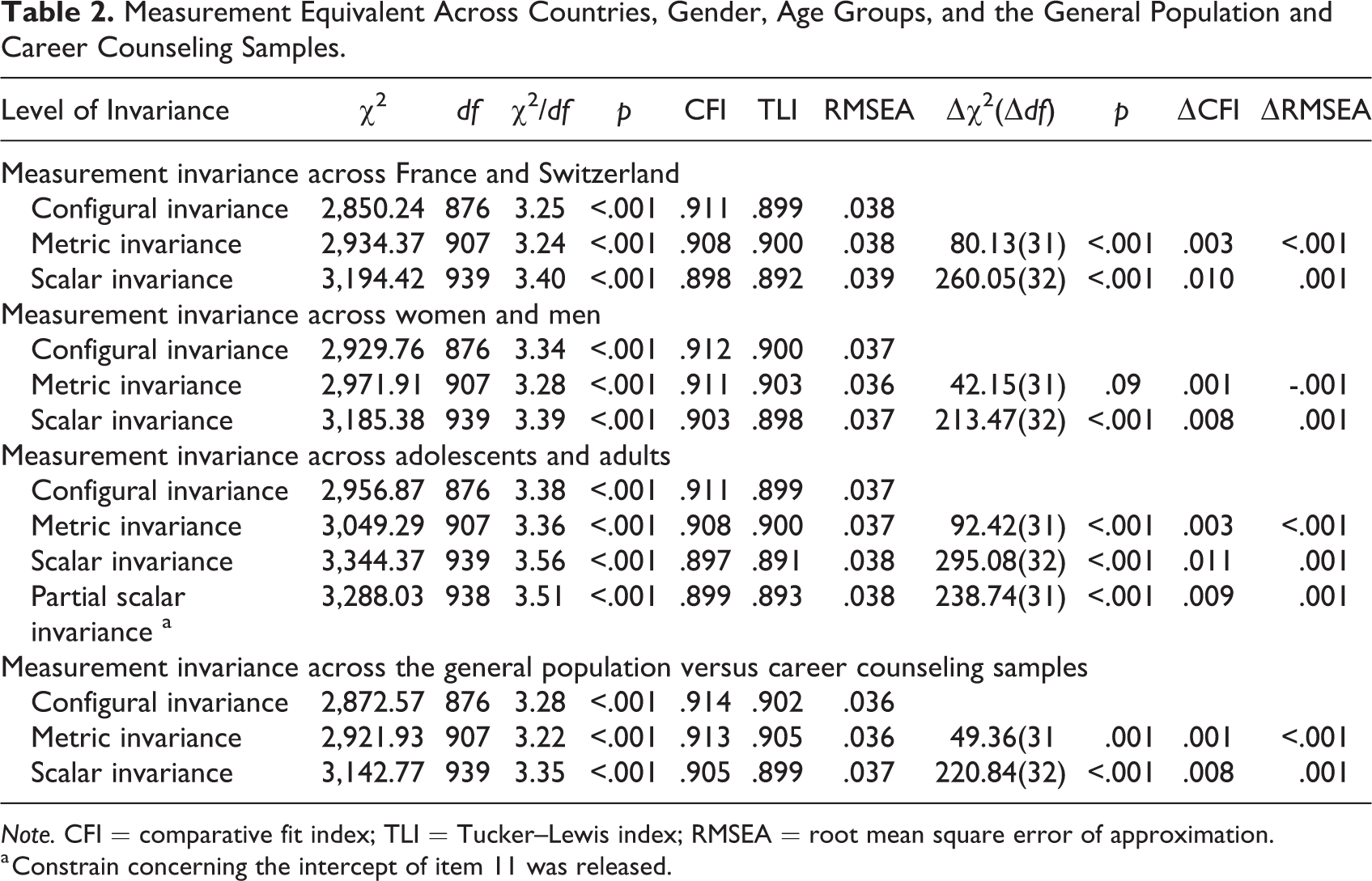
Note. CFI = comparative fit index; TLI = Tucker–Lewis index; RMSEA = root mean square error of approximation.
a Constrain concerning the intercept of item 11 was released.
Age, Gender, Country, and Group Differences
Correlation between age and the CDDQ total score and the subdimensions were usually nonsignificant or negligible (<.10), except the correlation with lack of information in France (see Table 3). Nevertheless, the overall pattern of correlation was very similar in both countries. Concerning subscales, most of the correlations were nonsignificant or negligible; the only negative correlation that was clearly above the .10 threshold and thus associated with a small effect size was that with the indecisiveness (Ri) subscale (r = −18). Concerning gender, no significant or meaningful difference was observed for the total score or the three subdimensions (d ≤ .09). For subscales, two gender differences were significant and associated with a small effect size. Men scored slightly higher on lack of motivation (Rm), t(1,576) = 4.29, p < .001, d = .23, and women on indecisiveness (Ri), t(1,576) = 8.08, p < .001, d = .43. Age and gender has thus only a very limited impact on career decision-making difficulties.
Correlation Between Age, Career Decision-Making Difficulties, Self-esteem, and Career Decision-Making Self-Efficacy.
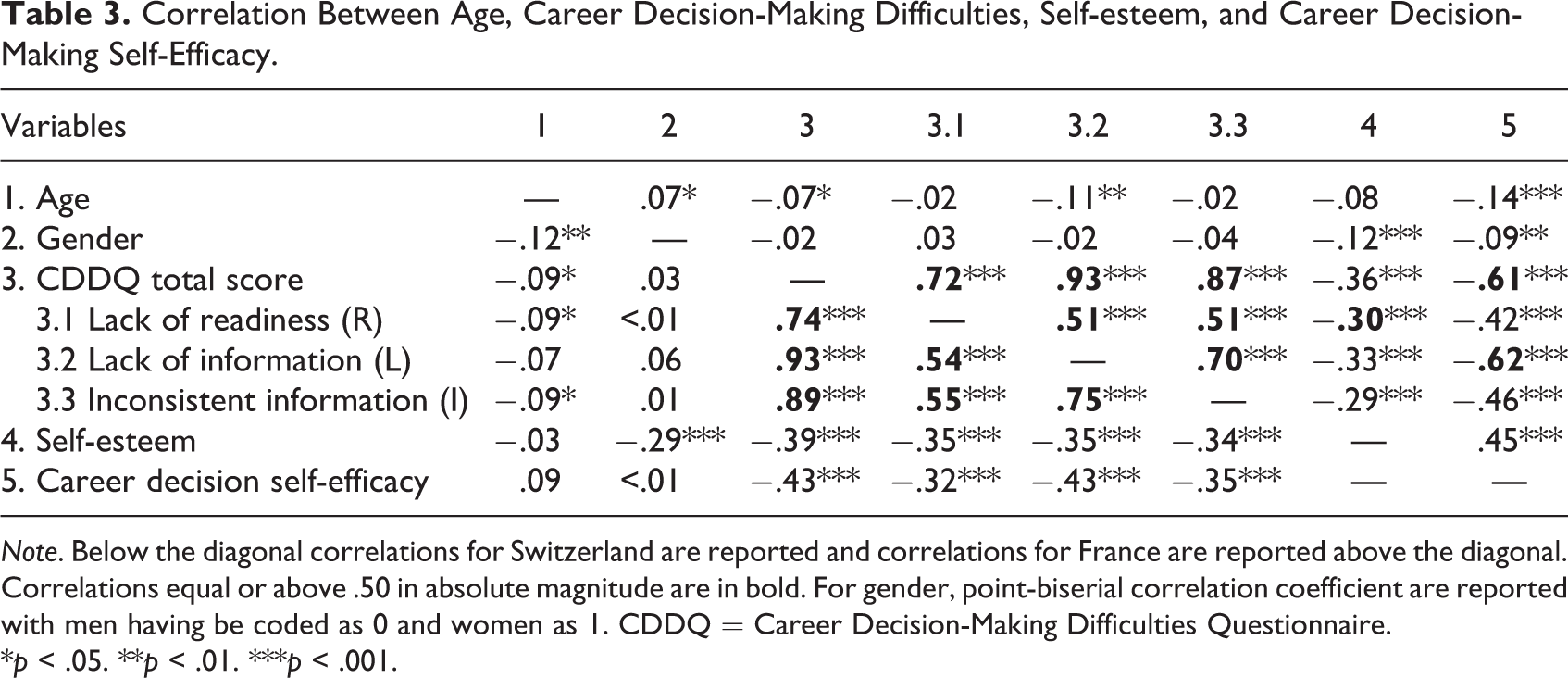
Note. Below the diagonal correlations for Switzerland are reported and correlations for France are reported above the diagonal. Correlations equal or above .50 in absolute magnitude are in bold. For gender, point-biserial correlation coefficient are reported with men having be coded as 0 and women as 1. CDDQ = Career Decision-Making Difficulties Questionnaire.
*p < .05. **p < .01. ***p < .001.
Concerning the mean differences between Switzerland and France, all differences for the CDDQ total scores and the three subdimensions were nonsignificant or negligible (d ≤ .18). Differences for two subscales were significant and associated with a small effect size: indecisiveness (Ri), t(1,576) = 7.06, p = < .001, d = .36, and lack of information about occupations (Lo), t(1,576) = 6.40, p = < .001, d = .33. However, after controlling for age and gender, the difference between countries became negligible for Ri, F(1,1574) = 10.96, p = .001, η2 = <.01. Thus, the only difference associated with small effect size we observed was that the French scored slightly higher on Lo; all other differences on subscales were negligible (d ≤ .15).
As expected, the differences between the subsample of students and the career counseling subsample were much larger. For the CDDQ total score, the difference was significant and almost associated with medium effect size, t(1,746) = 5.65, p < .001, d = .46. For subdimensions, the differences were significant for lack of information (L), t(1,746) = 7.31, p < .001, d = .59, and inconsistent information (I), t(1,746) = 3.46, p = .001, d = .28, associated, respectively, with a medium and small effect size. No significant difference was observed for lack or readiness (R). However, a significant difference associated with small effect size was observed for the indecisiveness subscale of the R subdimension, t(1,746) = 3.23, p = .001, d = .26. All subscales of the L subdimension differed significantly across groups, t(1,746) ≥ 4.53, p < .001, with effect sizes ranging from .37 to .60. Finally, differences on subscales unreliable information (Iu) and internal conflicts (Ii) of the I subdimension were also significant and associated with small to medium effect size, t(1,746) ≥ 2.68, p ≤ .007, d ≥ .22.
Self-Esteem, Self-Efficacy, and Career Decision-Making Difficulties
The relationships between self-esteem, career decision self-efficacy, and career decision-making difficulties have been analyzed by computing correlations for the French and Swiss subsamples. To further study these relationships and assess the possible mediation of self-efficacy between self-esteem and career decision-making difficulties, we followed the classical procedure of Baron and Kenny (1986) using hierarchical linear regressions and the Sobel’s (1982) test in a French subsample (n = 809).
The overall impact of age on self-esteem and self-efficacy was nonsignificant or negligible (r < .08). The gender effect was significant and associated with a small to medium effect size for self-esteem, t(1,026) = 6.36, p < .001, d = .46, but was negligible for self-efficacy. Differences across countries were nonsignificant or negligible for both self-esteem (after controlling for gender) and self-efficacy. So the only significant relationship found between demographic variables and self-esteem and self-efficacy was that men tend to have higher self-esteem scores.
Self-esteem and self-efficacy were positively correlated (see Table 3) and both negatively correlated with total career decision-making difficulties and all three CDDQ subdimensions. The correlations between self-efficacy and CDDQ scales were slightly higher, with a particularly high correlation for lack of information (L), r = −.56. Both self-esteem and self-efficacy correlated negatively with all 10 subscales, except for dysfunctional beliefs (Rd). A series of linear regressions (hierarchical for mediation analyses) showed that both self-esteem and self-efficacy significantly predicted career decision-making difficulties, explaining 38.0% of the total variance, and its subdimensions, explaining 19.0% of lack of readiness (R), 39.0% of lack of information (L), and 21.6% of inconsistent information (I). Finally, self-efficacy partially mediated half of the contribution of self-esteem in the overall score of career decision-making difficulties, Z = −11.15, p < .001 (partial mediation explained 6.3% of the variance of the CDDQ total score out of the 12.8% explained by self-esteem). A significant partial mediation was observed for all three subdimensions: lack of readiness, Z = −8.27, p < .001 (accounting for 2.6% of the variance); lack of information, Z = −11.40, p < .001 (accounting for 7.1% of the variance); and inconsistent information, Z = −8.99, p < .001 (accounting for 3.3% of the variance).
Discussion
We first studied the validity of the French version of CDDQ and assessed how this measure is invariant across age groups, gender, countries, and student versus Swiss career counseling samples. Second, we examined the sensitivity of this instrument to discriminate a career counseling from a student sample. Finally, we examined whether self-efficacy mediates the relationship between self-esteem and career decision self-efficacy. Overall, we were able to confirm the validity and the measurement invariance of the French version of the CDDQ that self-efficacy partially mediates its relationship with self-esteem.
Descriptive statistics indicate that the French version of the CDDQ has very similar internal reliabilities in France and Switzerland, although they are slightly lower for the Swiss career counseling subsample. CFA confirmed the overall hierarchical structure of the CDDQ, with only the loadings of the three subscales of the lack of readiness subdimension (lack of motivation, indecisiveness, and dysfunctional beliefs) being slightly lower. Multigroup analysis indicated that the level of invariance across groups reached configural, metric, and scalar invariance, except for age groups, which only reached partial scalar invariance. Correlations showed that age and gender have only a very limited impact on career decision-making difficulties. Moreover, cross-country comparisons revealed that the French scored slightly higher than the Swiss on lack of information. As expected, differences between the sample of students and the career counseling subsample were much larger. Regarding self-esteem and self-efficacy, the only significant relationship found for demographic variables was that men tend to have higher self-esteem scores than women. Both self-esteem and self-efficacy were found to significantly negatively predict career decision-making difficulties. As expected, self-efficacy partially mediated the relationship between self-esteem and career decision-making difficulties.
This study indicated that the French version of the CDDQ fit Gati and colleagues’ (1996) three-component structure, confirmed by Levin et al. (2020). Reliabilities were comparable with those of the Israeli and Anglo-Saxon population (Gati et al., 1996; Levin et al., 2020), although with a low Cronbach’s α for the dysfunctional beliefs subdimension, indicating that the French version is relatively similar to prior versions. In accord with the original assumptions (Gati et al., 1996), the low saturation of the three subscales on the lack of readiness subdimension attest that these difficulties are quite different. This is not new, as other authors also report difficulties to confirm the lack of readiness factor structure (Creed et al., 2007; Sovet et al., 2014, 2015). The fact that these subdimensions only moderately load on lack of readiness suggests that the total score for lack of readiness should be interpreted with caution and that interpreting the subscales independently might provide more reliable information. This finding can be related to the four-factor structure of indecision identified by Brown and Rector (2008) including (1) indecisiveness, (2) lack of information, (3) interpersonal conflict and barriers, (4) lack of readiness. However, some authors (Forner, 2010; Picard., 2015) instead suggest a six-factor structure for indecision. Difference between these models could form the subject of a broader study about the underlying structure of different measurement instruments such as the CDDQ, the Career Indecision Profile (Hacker et al., 2013), the Assessment of Vocational Indecision (EDV-9; Forner, 2010), and so on.
Ensuring that “the instrument measures the same construct(s) in exactly the same way across all group” (Byrne & van de Vijver, 2010, p. 107) is a crucial prerequisite to valuable cross-group comparisons (Rossier & Duarte, 2019). In order to verify whether the same norms can be used in Switzerland and France, and among different groups, and to ensure that these groups can be meaningfully compared, measurement invariance was tested. The model reached configural, metric, and scalar invariance, which indicates that the scales are similar across countries, age-group, gender, and student and career counseling populations. Meaningful mean score comparisons can thus be made across these groups, and same norms can be used for these populations. Table 1 can therefore be used as norms for the French-speaking population of France and Switzerland, from adolescence through the age of about 30. Using the same norms for men and women also makes the questionnaire easier to use. Contrary to previous research demonstrating an impact of gender on career decision-making difficulties, with contradictory results that boys experience greater career decision-making difficulties (Vahedi et al., 2012) or the opposite (Bacanli, 2015), differences between women and men appeared to be very low in the present study. However, we observed that career decision-making difficulties arise slightly differently for women and men. For men, the difficulties were more related to lack of motivation, whereas for women, they were more linked to indecisiveness, as previously observed by Sovet and Metz (2014). This result might be explained by the gender difference in self-esteem. Men’s high self-esteem can diminish their alacrity to respond to contextual demands to make a career choice, while women’s low self-esteem may make them more prone to doubt themselves when they must make a choice. Surprisingly, in contrast with some previous studies (e.g., Zhou & Santos, 2007), there was no significant evolution of career decision-making difficulties or educational setting observed between age 15 and 25, although this moment is marked by initial choices of a career and changes in educational setting. This could be due to the fact that problems can occur at different moment and that some individuals have to make a career decision at a younger age than others. In Switzerland, the first vocational and educational choice occurs at the end of compulsory education at age 15, whereas in France, this occurs 1 or 2 years later. Additional studies with a more diverse population might increase our knowledge about career decision-making difficulties across the life span. Such studies could seek to distinguish between developmental stage and chronological age, which might not match in the same manner from one context to another.
Comparison between the student and the career counseling samples highlighted lack of information, internal conflict, and unreliable information as core difficulties in career decision-making difficulties for the counseling-seeking group. Difficulties related to the lack of motivation, dysfunctional beliefs, and indecisiveness are less frequent, but their impact on the career decision-making process is probably more severe as suggested by Gati et al. (1996). These results indicate the necessity of providing both vocational guidance activities, centered on information delivery, and career counseling activities, involving a deeper understanding of the client situations and obstacles. The results of the present study are in line with those of Masdonati and colleagues (2009) who observed the efficacy of a face-to-face career counseling intervention in “improving both the quantity (Lack of Information) and the quality (Inconsistent Information) of the clients’ information about the world of work” (p. 196). These results suggest the relevance of using the CDDQ in the context of face-to-face career counseling interventions in order to identify the counselee’s major difficulties in career decision making and to adapt the content of career counseling activities correspondingly (e.g., Rochat, 2019). However, weak reliability indices for the career counseling sample compared to the student sample may suggest the need for a more in-depth assessment of the client’s items responses for an appropriate use of this questionnaire as a diagnostic tool.
Similarly to previous studies (e.g., Saka et al., 2008; Sovet & Metz, 2014), this study shows that career decision-making difficulties correlate negatively with self-esteem and career decision-making self-efficacy. The overall correlation between the CDDQ and CDSE-SF was large and similar to the one observed by Di Fabio et al. (2013) or Sovet and Metz (2014) for the French subsample, but slightly lower for the Swiss subsample, which was more similar to the correlation observed by Creed et al. (2007). This could be due to the fact that Swiss students are expected to make a career choice at a younger age, as two thirds of them are expected to enroll in vocational and educational training at the age of 16. Contextual constraints may thus moderate the strength of the association between career decision self-efficacy and career decision-making difficulties. We observed a similar pattern of correlations between the CDDQ’s subdimensions and the CDSE-SF that were slightly higher for the French sample compared to the Swiss sample. On the other hand, correlation between career decision-making difficulties and self-esteem were very similar in both samples.
According to SCCT (Lent et al., 1994), predispositions, as personality traits, have an impact on learning experiences that drive choice behaviors. Additionally, several authors consider self-esteem to be a personality trait (see Udayar et al., 2020). Moreover, the relationship between person inputs and choice behaviors is believed to be mediated by self-efficacy expectations allowing adaptation and adjustment (Rossier, 2015a). In this study, as expected, career decision self-efficacy was found to partially mediate the relationship between self-esteem and career decision-making difficulties. This result highlights the importance of strengthening counselees’ regulatory resources such as self-efficacy beliefs in the career decision-making process, especially when they display low self-esteem. Even unsophisticated career counseling interventions, such as interest inventory feedback, are likely to have a positive impact on career decision-making self-efficacy (e.g., Isik, 2013). As suggested by the results of this study, the benefits of a career intervention, however, can be improved by paying specific attention to the four sources of self-efficacy information (Scott & Ciani, 2008): (a) accomplishments, (b) modeling or vicarious learning, (c) anxiety management, and (d) verbal persuasion (Bandura, 1986).
There were several limitations to this study. The French sample included a large number of university students but may not have been representative of the student population at that age-group in terms of educational level (e.g., underrepresentation of individuals making a vocational training). Moreover, the students and Swiss career counseling subsamples may be too homogeneous in terms of age. The student sample included undecided students and therefore cannot be considered as a true comparison group (without career decision-making difficulties) but rather as a group that is roughly representative of the general population.
To conclude, in this article, we demonstrated the validity of the French version of the CDDQ and indicated that the same norms are sufficient for diverse French-speaking populations. The relationship between self-esteem and career decision-making difficulties was partially mediated by career decision-making self-efficacy as predicted by the resource cognitive career theory and other conceptualizations that suggest that the behavioral expression of a disposition is shaped by self-regulation processes (Rossier, 2015a). Considering the coexistence of different models of career indecision, more research on the latent structure of career decision-making difficulties is certainly needed to better understand the communalities and differences of these models.
Footnotes
Acknowledgment
The authors thank Ruta Areya and Laura Raisin for their assistance with the data collection and capture and Itamar Gati for his help and support.
Declaration of Conflicting Interests
The author(s) declared no potential conflicts of interest with respect to the research, authorship, and/or publication of this article.
Funding
The author(s) disclosed receipt of the following financial support for the research, authorship, and/or publication of this article: The contribution of Jérôme Rossier was made partly within the framework of the National Centre of Competence in Research—LIVES financed by the Swiss National Science Foundation (Grant Number 51NF40-160590).
