




Abstract
Family business research across academic disciplines has increasingly considered the causes of “bad behavior” in family firms and its impact. A review of this literature is important because different emphases in different disciplines may obscure the nature of dysfunctional behaviors in family firms. After reviewing 160 studies from 64 journals, we propose family firm dysfunction is better understood by emphasizing the roles the family and the firm’s external environment play because negative behavior often traces to family interactions predating firm engagement and to external pressures. We also present research questions to guide future studies on family firm dysfunction across disciplines.
Introduction
For more than 30 years, researchers have debated whether family involvement promotes “good” and healthy or “bad” and dysfunctional behaviors in a firm (e.g., Chrisman et al., 2005; H. S. James, 1999; Madison et al., 2016; Schulze et al., 2001; Verbeke & Kano, 2012). Studies rooted in agency theory and transaction cost economics, for example, tend to paint a bleak view of family firms, focusing on the damaging effects of nepotism, moral hazard, and bifurcation bias. In contrast, research drawing from stewardship theory and the resource-based view highlights the strengths of family involvement such as trust, bonds, and social capital. Surprisingly, however, research has also revealed that many of the characteristics previously portrayed in a positive light can be triggers or offer justification for dysfunctional behavior in family firms (Eddleston & Mulki, 2021; Kidwell et al., 2018; Rosecká & Machek, 2023). This lack of consistency has made it difficult to identify the root causes of dysfunctional behavior in family firms and why some family firms can be described as bad actors that hurt society and the physical environment.
Because a fundamental goal of family firm research is to understand how family involvement shapes internal and external firm behavior, it is important to critically assess what we know about family firm dysfunctional behavior and to identify patterns that explain how the dysfunctional behavior of family firms varies from that of nonfamily firms, and the reasons for differences among family firms. Simply debating whether family firms are “good” or “bad” without understanding the reasons behind their dysfunctional behaviors or their stakeholders’ views of such deleterious actions is likely hampering the field’s progress and its ability to support family firm functioning and success (Eddleston & Mulki, 2021; Madison et al., 2016). This is particularly apparent considering the abundance of research on family dysfunction in the family science and family psychology literatures, which, to date, has not been fully integrated into family firm research grounded in economics and business. Yet, insights from the family science and family psychology literatures about sibling rivalry, parenting styles, and parent–child interactions have shown promise in predicting dysfunctional behavior in family firms such as workplace deviance and delayed succession (Eddleston & Kidwell, 2012; Huang et al., 2020; Shanine et al., 2023). Therefore, with research on dysfunctional behaviors in families and their firms spanning multiple disciplines, including economics and business as well as family science and family psychology, silos of research have been created that have obscured our full understanding of dysfunctional behaviors in family firms. As such, a systematic, comprehensive review of dysfunctional behavior in family firms is necessary to share insights across disciplines and improve our knowledge of how families and their firms can behave badly.
Accordingly, the goal of this review is to determine what we know about family firm dysfunctional behavior, including antecedents, moderators, and consequences at both micro and macro levels of analysis, explore why some family firms are more susceptible to dysfunctional behaviors than others, and synthesize our findings to develop a framework that guides future research. We assessed 160 articles across multiple disciplines, including family business, entrepreneurship, strategy, finance, economics, human resource management, accounting, family and marriage therapy, and family studies. Our review highlights the importance of understanding the antecedents and consequences of family firm dysfunctional behaviors because they can seriously damage individuals, their families, organizations, and society. Recognizing the inextricable tie between families and their firms, it also highlights the complexity of family firm dysfunctional behavior, thus explaining how such harmful actions develop, occur, and are viewed within and across family firms and how the processes and justifications underlying dysfunctional behaviors are vastly different from those in other types of businesses. More specifically, our review was inspired by the following research questions:
In reviewing research on dysfunctional behavior in family firms at the individual, family, and firm levels, we cast a broad net on willful workplace behavior that either violates organizational norms or has potentially negative consequences for the individual, family, organization, or other stakeholders at the firm and societal levels. Therefore, the phenomena examined in the 160 studies included in this review represent a broad view of dysfunction that crosses levels of analysis and academic disciplines and includes counterproductive work behavior, bifurcation bias, nepotism, theft, bullying, gender discrimination, relationship conflict, intrafirm conflict, financial misconduct, fraud, bribery/corruption, tax avoidance/ evasion, and various forms of corporate social irresponsibility. From our review, we discovered that extant research tends to focus on antecedents and behaviors that occur in family firms, but rarely considers antecedents of dysfunction that stem from familial interactions prior to firm involvement. We also found that previous research focuses largely on relationship conflict in families and family firms as a major catalyst for dysfunction in family firms, with less attention being placed on external factors that can influence negative behaviors. These findings informed our proposed framework and ideas for future research.
Our study makes three main contributions to the study of dysfunctional behavior in family firms, thus advancing the state of knowledge in the literature. First, we identify, organize, and categorize a wide variety of dysfunctional acts into behaviors, antecedents, and consequences studied in family firms across different academic disciplines, including accounting, economics, finance, management, psychology, and family studies. This allowed us to recognize common themes across different disciplines in the study of family firm dysfunctional behavior. Second, through our analysis of previous research, we identified several gaps in the literature that offer opportunities for future research. We present a series of questions for future inquiry that should help explain the heterogeneity of dysfunction in family firms. Third, our review discovered that behaviors typically labeled “dysfunctional” or “negative” can be viewed as positive and “functional” by family firm stakeholders. Moving forward, researchers need to consider the different motives for (and perceptions of) behaviors typically seen as dysfunctional, disentangle intentions from behaviors, and further explore the short- and long-term impact of such behaviors on a family firm’s various stakeholders.
Method
A systematic literature review requires a clearly defined process for identifying articles of interest and synthesizing their findings (Tranfield et al., 2003); therefore, we engaged in a deliberative process of planning and conducting the review. Because, as noted earlier, this subject matter spans many fields, our research team was multidisciplinary. In the first phase, we developed a list of search terms to identify articles of interest. These terms included words and phrases used in the prior work of the authors in the fields of management, family business, and accounting, identified in prior literature reviews of family business, and suggested in consultation with marriage and family counseling experts. 1 Most of the terms regarded specific types of dysfunction, or family business practices that prior researchers have found lead to dysfunction, while others related to theories frequently used in family business literature but not so broadly elsewhere, so as not to cast too wide a net. For example, socioemotional wealth (SEW) was included, but agency theory was not because the study of SEW is central to family firm research. It is described as “the most important differentiator of the family firm as a unique entity and. . .helps explain why family firms behave distinctively” compared with non-family firms (Berrone et al., 2012, p. 258). As SEW does not reject agency arguments that family members engage in opportunistic behavior, the inclusion of SEW as a search term provided greater opportunity to find articles relevant to the study of dysfunctional behavior in family firms.
We narrowed our scope of journals to include only peer-reviewed, non-predatory journals. We used databases, that is, Business Source Premier, Academic Search Premier, and ABI/ INFORM, and constrained the search to peer-reviewed academic journals, with articles in English. We drilled down by expanding the search process to relevant journals in the top two tiers of the Australian Business Deans Council (2022) journal quality list and the Financial Times 50 (Ormans, 2016) to capture articles that did not appear in the full database search results for whatever reason. 2 The search resulted in 8,276 articles.
In the second phase, pairs of collaborators conducted a preliminary screening of all 8,000+ articles for potential relevance, eliminating articles that a pair agreed did not involve family firms or elements of dysfunction (e.g., many involved individual work–family life balance issues). This initial screening resulted in a reduced set of 362 articles. The full team of authors reexamined these 362 articles for relevance. Again, we resolved any disagreements among the team by developing a consensus on whether the behaviors or consequences were dysfunctional to the family, the firm, or external stakeholders, and in this secondary screening, the number of articles was reduced to 177, eliminating those that were not relevant to dysfunction, were duplicates from the initial searches, or were practitioner-oriented articles that did not advance or rigorously test related theory. In the third phase, two of the five team members classified the remaining articles by year, author(s), article title, journal, theoretical perspective, whether the article was theoretical or empirical, methodology, variables, and additional characteristics. The articles were then broadly categorized by type of dysfunction.
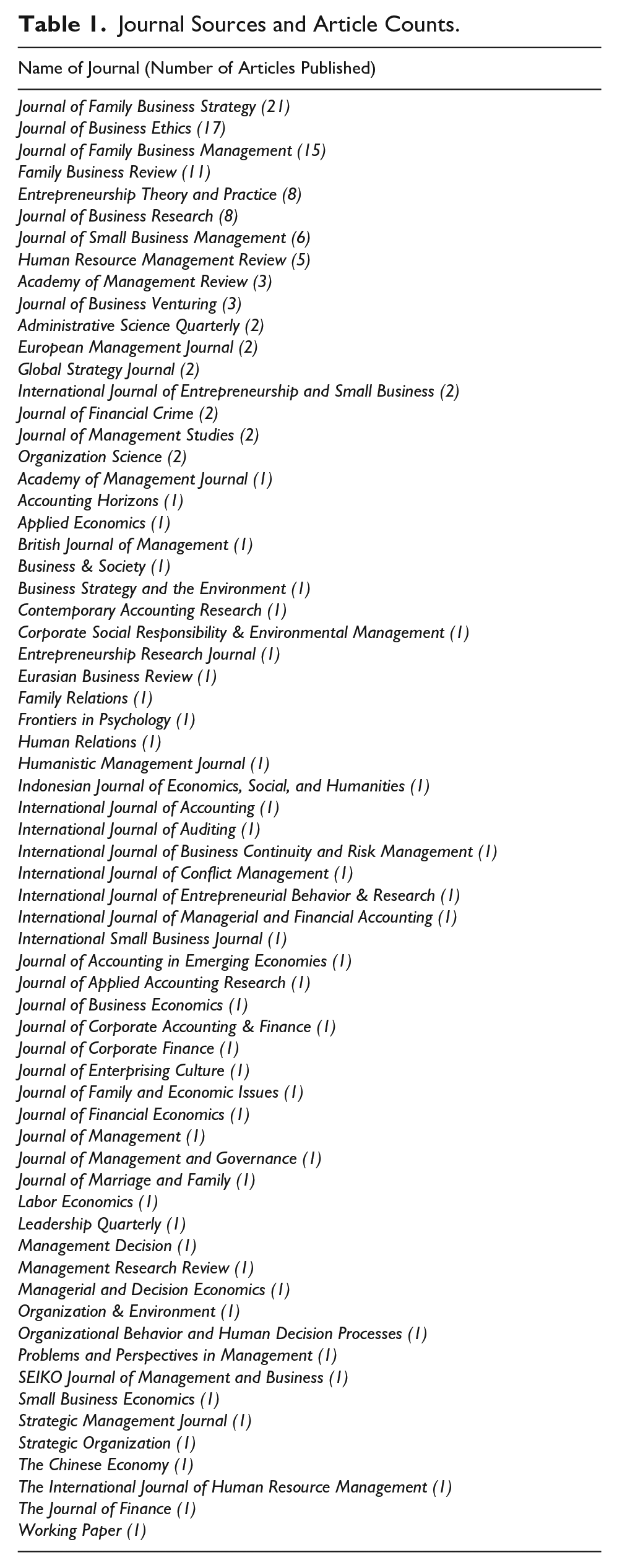
Two authors identified topic areas independently and initial agreement was reached on 90% of the articles. Where topics were inconsistent, or classification did not agree, a third team member resolved any inconsistencies. Finally, as we identified significant themes, we refined our topics into the following categories: personality, affect/attitudes, relationship conflict, firm-level antecedents, counterproductive workplace behavior, bifurcation bias, firm-level conflict, gender discrimination, fraud, financial misconduct (including earnings management and insider trading), bribery, corruption, corporate social irresponsibility, negative environmental performance, and tax avoidance/evasion. Through this process, an additional 52 articles, which did not propose or test specific relationships related to the topic of dysfunctional behavior were eliminated, resulting in a final set of 127. Finally, we conducted an updated second search, through ABI/INFORM, Business Search Premier, and Google Scholar, for articles that cited those in the set of 127. The phased analysis was repeated, and out of 900 new articles generated, 32 more articles, including one working paper, were added and classified. The results of our search and classification included 160 articles. The search process is illustrated in Figure 1. Articles retained through the screening process appeared in 64 journals with Journal of Family Business Strategy, Journal of Business Ethics, Journal of Family Business Management, and Family Business Review as the only journals to publish more than 10 papers concerning dysfunction in family firms, as shown in Table 1.
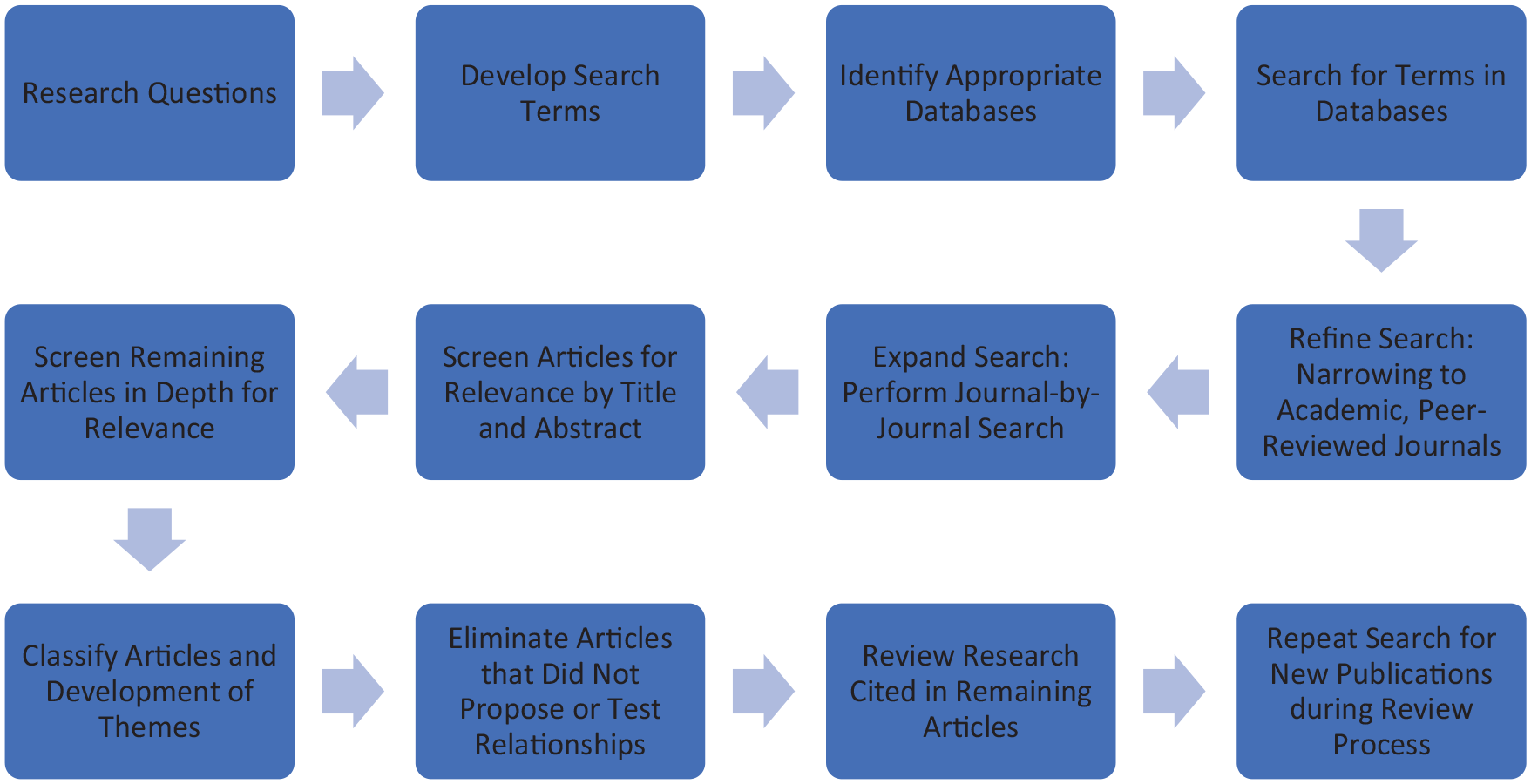
Literature Search and Refinement Process.
Journal Sources and Article Counts.
Findings and Analysis: Behaviors, Antecedents, and Consequences
Extensive research on dysfunctional behavior in organizations began in the 1990s (e.g., Griffin et al., 1998; Robinson & Bennett, 1995). In this review, we distinguish dysfunctional behavior from deviance (Lawrence & Robinson, 2007; Robinson, 2008) because although deviance reflects employees’ voluntary behaviors that violate organizational norms (Mackey et al., 2021), some behaviors that deviate from the norm, e.g., innovation, can have positive effects. To be consistent in our focus, we use dysfunctional behavior as a general category that includes specific types of negative or “bad” behaviors (cf. Griffin & Lopez, 2005). Thus, we first define dysfunctional behavior as motivated acts by an employee or group of employees that result in negative consequences for individuals in organizations, groups in organizations, and the organization itself, some of which include forms of negative deviance: bullying/aggression, theft, drug/alcohol abuse, withholding effort, badmouthing, and lying or concealing information (Griffin et al., 1998; Griffin & Lopez, 2005; Kidwell & Martin, 2005). We extend this definition to include family firm member behaviors that result in negative consequences for those outside the organization, including such acts as bribery, corruption, tax avoidance, tax evasion, and social irresponsibility. While these acts can have negative consequences for others, they could have positive results for the focal family firm due to benefits associated with undetected fraud, bribery, corrupt behavior, and acts that damage the physical environment.
Due to the heterogeneous nature of dysfunctional behavior, we used wide parameters to consider what to examine. We found several studies focused on conditions that could result in dysfunction, whereas others clearly involved dysfunctional behavior. Some research compared nonfamily and family firms on issues involving corporate social irresponsibility and various types of unethical behavior. Our review consisted of 37 conceptual articles and 123 empirical articles. Articles included in our review are in Table 2; the table lists the authors and year of the article, classification and focus, empirical or conceptual basis, theoretical framework(s) employed, and key findings. We ordered the table with behaviors by specific category followed by antecedents of dysfunctional behaviors and arranged the articles chronologically in each category to showcase how research interests and emphasis have developed over time. We have organized the discussion of our review findings into four major areas: dysfunctional behaviors committed by family firm members within the family firm, dysfunctional behaviors committed by family firm members that extend outside the family firm, antecedents that drive these sets of negative behaviors, and the consequences these actions have on the family firm and its individual stakeholders.
Papers Included in the Current Review.

Note. FF- Family Firm; SME - Small Medium-sized Enterprises; HR - Human Resources; OIT - Organizational Identity Theory; CWB = counterproductive work behavior; CEO = Chief executive officer; OCB = organizational citizenship behavior; SEW = Socioemotional Wealth; BAM = Behavioral Agency Model; UET = Upper Echelons Theory; BOD - Board of Directors; TMT = Top management team; RBV = Resource Based View; CFO = Chief Financial Officer; SEC - Securities and Exchange Commission; CSR - Corporate Social Responsibility; LMX = Leader Member Exchange; ST = short term; POI = previous owner’s involvement; OSC = organizational social capital.
What Kinds of Dysfunctional Behaviors Have Been Studied in a Family Firm Context?
Internally Directed Dysfunctional Behaviors
One insight gleaned from our review of extant research is that perpetrators can direct negative behaviors internally (to the firm) or externally (to the firm’s environment). Internal dysfunctional behavior in the family firm consists of negative acts committed by individuals and by individuals or groups at the firm level that are aimed inside the firm. While one person’s (or group’s) dysfunctional behavior can target other members of the family business, the consequences of the behavior can cross levels of analysis to impact not only family and/or nonfamily employees individually or in groups/teams but the family and the firm as well.
We use the general term counterproductive work behavior (CWB) to encompass types of dysfunctional behavior that family or non-family employees commit within the firm. CWB is defined as an individual’s intentional behavior that may harm the interests of the organization and/or its employees (Zheng et al., 2017). It has been studied in organizations at the interpersonal level, guided generally by social exchange and justice theories (Berry et al., 2012, 2007; Mackey et al., 2021), but only a few studies center specifically on family firms. Types of CWB that have been studied in family firms include resistance to change (Chirico et al., 2018), acting in secrecy, withholding information (Hadjielias et al., 2021), theft of company property or time (O’Brien et al., 2018), interpersonal aggression (i.e., bullying; Baillien et al., 2011), and generally impeding the operation of the business (Kidwell et al., 2012). Our review indicates that a greater focus on individual attitudes and the work context combined with personality traits and their relationship with dysfunctional behavior is a fruitful area for family firm research (e.g., Barnett & Kellermanns, 2006) that could help to uncover the impact of the family on individual engagement in dysfunctional behavior (Eddleston & Kidwell, 2012). We found that research into CWB in the family firm is just beginning to identify the effects of unique family firm variables such as socioemotional wealth, familiness, and family system dynamics on negative employee behavior (e.g., McLarty & Holt, 2019), and there is much room for applications from other disciplines to explain why family firm members behave badly toward their co-workers, family members, and the firm.
Other types of dysfunctional behaviors in which the perpetrators have an internal focus with a potential to negatively impact individuals as well as the firm include bifurcation bias, i.e., unequal treatment of family and non-family members in a family firm (Daspit et al., 2018; Verbeke & Kano, 2012); gender discrimination that often results from primogeniture (e.g., Chadwick & Dawson, 2018); and firm-level conflict (Frank et al., 2011). Firm-level research considers dysfunctional behavior’s potential to damage family firm performance as well as the family (Minichilli et al., 2010). Examples include agency conflicts (Blanco-Mazagatos et al., 2016; Schulze et al., 2001), owner–manager governance disputes (Purkayastha et al., 2019), favoritism (Hudson et al., 2019; Schmid & Sender, 2021), parent–child relationship/parent leadership style/firm culture (Miller et al., 2003), kinship identification (Collin & Ahlberg, 2012), family membership/kin density (Spranger et al., 2012), and kinship ties (Ertug et al., 2020).
However, some researchers also considered gender discrimination and bifurcation bias as dependent (outcome) variables, operationalized as compensation disparity and gender diversity (Jain et al., 2021), nepotism/favoritism/cronyism (Akuffo & Kivipõld, 2019), and nepotism perceptions/justice perceptions (Spranger et al., 2012) that have been affected by the competitive environment (Miller et al., 2003), cultural dimensions (Samara et al., 2021), board effectiveness (Corten et al., 2017), and HR professionalism (Madison et al., 2018) on manifestations of dysfunction.
A key insight that can be drawn from the research into firm-level, internally directed dysfunctional behavior is the extent to which drivers operating both within the firm such as relationship conflict, lack of professionalization of firm processes, and characteristics of the leadership as well as other factors such as non-family ownership stakes, family traditions and norms, and the strength of family ties can lead individuals and groups to act in ways that harm others. These behaviors include discrimination against non-family employees and women and conflict in the governance and succession processes of the firm.
Externally Directed Dysfunctional Behaviors
Dysfunctional behaviors that are committed by perpetrators within the family firm but extend outside the business include acts such as fraud, financial misconduct, bribery, corruption, corporate social irresponsibility, environmental performance, and tax avoidance/evasion. While these behaviors may have negative ramifications for external stakeholders, again crossing levels of analysis, they can benefit the family firm and its members through unmerited competitive advantage, lower expenses, lower taxes, and more access to outside funds. These benefits may accrue at others’ expense and enrich family members unless they are caught committing unethical or illegal activities (e.g., Kidwell, 2008).
Our synthesis of the literature indicates that although most research on dysfunction at this level compares family firms with nonfamily firms, studies are increasingly focusing on differences across family firms. Our review found that much of this research is empirical, often involving large databases such as the Business Environment and Enterprise Performance Survey or using data on publicly listed firms. The availability of archival data provides opportunities to conduct macro-level studies in accounting and finance on such topics as financial misconduct, tax aggressiveness, and corporate social irresponsibility. Thus, insights regarding these externally directed dysfunctional behaviors perpetrated by family firm members are more plentiful than what is known about negative acts directed within family firms, particularly counterproductive work behaviors. Our findings also indicate that external dysfunction at the firm level follows two general themes: Dysfunctional behaviors motivated by the external environment and dysfunctional behaviors affecting the external environment. To avoid confusion, we focus here on family firm members’ dysfunctional behavior that affects the external environment and discuss the dysfunctional behaviors that may result from environmental pressures in the section on antecedents.
Financial dysfunctions affecting the external environment include fraud and financial misconduct. Fraud can involve illegal activities such as stealing from stockholders, government agencies, and other businesses, and financial misconduct, which may or may not be illegal (Anderson et al., 2017; Ding & Wu, 2014). Fraud and firm governance researchers generally employ agency theory as a theoretical context, as information asymmetry may act as a driver that allows the business-owning family to benefit at the expense of non-family investors (Anderson et al., 2017; Ghafoor et al., 2019b). Financial misconduct includes earnings management, insider trading, and other activities that damage or threaten a firm’s financial performance. Ning (2009, p. 36) distinguishes earnings management (“[E]xercising the discretion accorded by accounting standards and corporate laws, and structuring activities in such a way that expected firm value is not affected negatively”) with earnings manipulation (“[M]anagement’s action taken to bring about a desired level of reported earnings).” Manipulation includes deferring maintenance, delaying discretionary expenditures to the next reporting period, or using incentives for customers to accept products ahead of normal ordering times. Earnings management and manipulation are not illegal in most cases, although both emphasize short-term earnings at the expense of long-term business sustainability and are the subject of recent SEC scrutiny (Whoriskey & Gottlieb, 2019). Earnings management can improve a family firm’s performance and may help the family retain control; however, when detected, it can be perceived as manipulating the numbers to the detriment of nonfamily and external shareholders (Avabruth & Padhi, 2023; Duréndez & Madrid-Guijarro, 2018; Gao et al., 2021).
Other activities that may constitute financial misconduct include those threatening the financial performance of family firms, including intermingling of funds (Yilmazer & Schrank, 2006), poor internal controls (Bardhan et al., 2015), and top management team pay dispersion (Jaskiewicz et al., 2017). Financial misconduct, particularly earnings management/manipulation, can create adverse consequences for the firm and external stakeholders (customers, creditors, and investors). However, some of this behavior may enhance the financial position and control of the business-owning family illustrating the point that dysfunction external to the firm may be functional for family firm insiders but not for those adversely affected by their actions.
As studies increasingly focus on heterogeneity among family firms, findings are revealing how and why family firms can be responsible as well as irresponsible (Block & Wagner, 2014; Cruz et al., 2014) and when family firms are most likely to rationalize bad behavior (Eddleston & Mulki, 2021). For example, while the presence of the founder (Brune et al., 2019a) and greater family control and management appear to lessen tax aggressiveness among family firms, later-generation family firms report more tax aggressiveness (Sanchez-Marin et al., 2016). In addition, studies reveal a positive association between family firm corporate misconduct and philanthropic giving (Du, 2015) and a negative association between tax avoidance and social/environmental performance (Lopez-Gonzalez et al., 2019), suggesting that family firms try to compensate for past wrongdoing by being more socially responsible.
Although several theories and frameworks have been used in this research, most studies considering external dysfunction incorporate the concept of SEW, which is often used to explain a family firm’s aversion toward risk and losses (e.g., Bassetti et al., 2015; Brune et al., 2019a), and concern for its image and reputation (e.g., Cruz et al., 2014; Ding et al., 2016). Thus, a recurring theme in this research is that studies portraying family firms as less dysfunctional than nonfamily firms tend to emphasize the importance of protecting the family and firm’s identity and image among stakeholders and within their community (e.g., Block & Wagner, 2014; Cruz et al., 2014; Dekker & Hasso, 2016; Lopez-Gonzalez et al., 2019; Steijvers & Niskanen, 2014). In contrast, studies aiming to explain why or when family firms are more dysfunctional argue that risks to the firm’s health and survival allow the business-owning family members to rationalize their unethical or illegal behavior (Bassetti et al., 2015; Eddleston & Mulki, 2021).
What Are the Potential Antecedents of These Dysfunctional Behaviors?
Based on our review, findings in this section are presented as antecedents/drivers of both internal and external dysfunctional behaviors in family firms. Researchers have identified several antecedents with the potential to drive individuals toward engaging in dysfunctional behavior and creating performance decrements in the family firm. These include personality traits such as the Dark Triad (Galvin et al., 2015; Harrison et al., 2018; McLarty & Holt, 2019; Montiel Mendez & Maciel, 2020); individual affect/attitude, for example, personal pride (Umans et al., 2020); entitlement and altruism (Eddleston & Kidwell, 2012); perceived pressure (Ramos, 2003); work context, including interpersonal interactions that include various forms of conflict, (Kellermanns & Eddleston, 2004); and phenomena such as nepotism (Jaskiewicz et al., 2013; Jeong et al., 2022) and the pursuit of socioemotional wealth (Kellermanns et al., 2012).
In some cases, family members actively involved in the business, who we subsequently refer to as family employees, may engage in destructive behavior driven by individual personality traits. Narcissism or other personality traits, such as Machiavellianism and psychopathy (Galvin et al., 2015; Harrison et al., 2018; Montiel Mendez & Maciel, 2020) may create prime conditions for dysfunctional behavior by members of the family firm. For example, previous research indicates that a family firm founder’s narcissism and other dark personality traits may result in dysfunctional succession and governance mechanisms (Montiel Mendez & Maciel, 2020) and exploitation of the organization for personal benefit (Galvin et al., 2015).
Attitudes formed due to pride, asymmetric altruism, entitlement, and resultant feelings of unfairness and injustice may lead family employees to engage in dysfunctional behavior (Cooper et al., 2013). Some family firm leaders’ hubris leads them to assume they are indispensable to the business; thus, they fail to turn over leadership to the next generation (Umans et al., 2020). The next generation may engage in negative behaviors due to feelings of entitlement, rebellion against their parents in the family firm, or need-based altruism on the part of parents, which leads to a vicious cycle of dysfunction (Eddleston & Kidwell, 2012). Finally, nonfamily employees may resort to dysfunctional behavior due to being in the out-group rather than having in-group status (Marler & Stanley, 2018), potentially stemming from the practice of nepotism and bias against non-family employees.
Employees—family or non-family—can be driven to engage in dysfunctional behaviors such as theft or fraud for reasons that include low self-control and deviant morals (Gottschalk & Asting, 2019) as well as the level of pressure they feel to commit fraud, the opportunity to do so, and the ability to rationalize that committing the act is consistent with their ethical code (Albrecht et al., 2006; Cressey, 1953; Ghafoor et al., 2019a; Ramos 2003). Ramos (2003, p. 28) notes that “some individuals possess an attitude, character, or set of ethical values that allows them to knowingly and intentionally commit a dishonest act.”
Our review indicates that relationship conflict is one of the most studied drivers of dysfunctional behavior in family firms. Conflict research highlights how the family system influences individual behavior and its impact on family firm processes, such as succession, governance, and value formation, and across stakeholder groups (Montiel Mendez & Maciel, 2020). Relationship conflict consists of personal animosity and issues of incompatibility that result in negative emotions, such as annoyance, irritation, and anger. Researchers often portray conflict between individuals (i.e., relationship conflict) as driving counterproductive behaviors. For example, research demonstrates that relationship conflict among family members, both in the same generation and across generations, promotes dysfunctional behavior (Eddleston et al., 2008; Eddleston & Kellermanns, 2007; Kidwell et al., 2012).
As family firms age and grow to involve multiple generations and extended family members, such as cousins, conflict tends to increase across the business-owning family (Davis & Harveston, 2001). Conflict among siblings or between generations reduces satisfaction in the succession process (Handler, 1991) and may risk the firm’s survival (Cater et al., 2016; Großmann & Von Schlippe, 2015; Jayantilal et al., 2016). Thus, relationship conflict affects a family firm throughout its life cycle, and when family managers delegate control to nonfamily managers, there is potential for relationship conflict regarding strategic decision-making of the business.
Among the many sources of conflict is deficient communication, which may lead to disagreements, clashes, and dysfunctional behavior among family employees (Michael-Tsabari & Weiss, 2015). For example, multiple studies address the issue of divorce within family firms, with most focusing on how divorce impacts a firm’s financial aspects (Sanchez-Ruiz et al., 2018), as well as treatment of the firm as an asset limiting application of family law (Haag & Sund, 2016), and divorce’s negative impact on short-term firm performance (Galbraith, 2003).
Firm-level drivers of dysfunction focus on policies, practices, and conditions within the business and the family that serve as antecedents to behaviors that have potentially negative consequences for others. Two concepts that highlight dysfunctional relationships and interactions among members of business-owning families, and specifically, preferential treatment of some or all family members at the expense of others, are altruism and nepotism. As a defining element of family firms (Lubatkin et al., 2007), altruism describes the parent–child relationship in business-owning families and why the firm-owning parents are often overly generous toward their children, which in turn, encourages dysfunction and dependency among the next generation (e.g., Eddleston & Kidwell, 2012; Schulze et al., 2002, 2003). Although reciprocal altruism has been tied positively to stewardship theory because it can align a family member’s interests to the fate of the family firm (Eddleston & Kellermanns, 2007; Zahra, 2003), asymmetrical altruism has been used in agency theory research to explain the dysfunctional behavior of business-owning families (Schulze et al., 2002, 2003).
Extant research identifies nepotism as a potential antecedent of dysfunctional behavior rooted in family relationships. Nepotism occurs when family firm members favor fellow family members in hiring, promotion, and related factors (cf., Bellow, 2003; Jaskiewicz et al., 2013). While business-owning family leaders may show favoritism to family members in the firm, seeing nepotism as a way to ensure that family values are considered in decision-making (Jaskiewicz et al., 2013; Jeong et al., 2022; Salvato et al., 2012; Schmid & Sender, 2021), nepotism is also seen as a driver of dysfunctional behavior because it can lead to perceptions of injustice and discrimination against nonfamily employees (Boutilier, 2009; Collin & Ahlberg, 2012; Spranger et al., 2012). Furthermore, because nepotism suggests that a smaller applicant pool is considered for a job, it can lead to hiring less qualified family members and hurt the firm’s ability to attract and retain qualified personnel (Burhan et al., 2020; Schulze et al., 2002).
Another driver of family firm dysfunctional behavior is the business-owning family’s pursuit of socioemotional wealth (SEW). SEW often encourages family firm members to engage in activities and behaviors that add non-economic and emotional value to the family firm, as it supports a family’s quest for influence, identity, and continuity (Gomez-Mejia et al., 2007; Swab et al., 2020). However, while it is recognized that SEW can lessen the likelihood of counterproductive work behavior in a family firm (McLarty & Holt, 2019), there is also a side of SEW that appears to motivate the firm’s denizens to engage in behaviors that negatively impact nonfamily internal and external stakeholders (Fehre & Weber, 2019; Kellermanns et al., 2012; Zientara, 2017). For example, SEW is often used as a conceptual perspective in family business research to explain dysfunction among individuals, for example, relationship conflict (Rousseau et al., 2018), internal dysfunction in the firm, for example, bifurcation bias (Samara et al., 2021), and dysfunction external to the firm, for example, corporate social irresponsibility (Cabeza-Garcia et al., 2017). Thus, SEW has been used to explain how business-owning family members’ pursuit of non-economic goals related to the family and firm can drive dysfunctional behaviors that affect individuals, the family, the firm, and external stakeholders.
Research focusing on how the external environment drives a firm’s dysfunctional behavior tends to center on that environment’s dysfunctions, such as weak institutions, weak legal protections, and pervasive corruption, defined by Transparency International as abuse of power for private gain. This research explores how family firms deal with highly corrupt environments (Bassetti et al., 2015; Yamanoi & Asaba, 2018) and navigate institutional voids, including a lack of legal protection of property rights (Tang et al., 2013) and weak macro governance (Ding et al., 2016). Research comparing family and nonfamily firms shows that political connections are more likely to benefit family firms (Tang et al., 2013) and that family firms are more sensitive to corruption than nonfamily firms (Bassetti et al., 2015; Eddleston et al., 2020; Yamanoi & Asaba, 2018). Research also explores the roles that firm performance (Cruz et al., 2014; Eddleston & Mulki, 2021), founder presence (Brune et al., 2019a), generation (Sanchez-Marin et al., 2016), and political connections (Du, 2015) play in predicting dysfunctional behavior external to the firm. Research focusing on the effects of a firm’s negative behavior is more likely to portray firms as the source of dysfunction, for example, bribery (money or favors given to influence a person in a position of trust). Studies on global corruption reveal that foreign countries with greater corruption lead firms with greater family involvement to prefer greenfield (start from scratch) investments and more family ownership when expanding abroad (Yamanoi & Asaba, 2018).
A key consensus in the literature regarding dysfunctional acts of bribery and corruption by family firms is they are driven largely by external conditions. It appears that the distinct context of family firms, with their inextricable ties between the firm and family and the desire to pass the business to the next generation, creates unique tensions that make them susceptible to external pressures. For example, a family’s dependence on the firm for financial sustenance allows family firm leaders to rationalize dysfunctional acts for the sake of the family (Eddleston & Mulki, 2021). This research also suggests that firms with a greater number of family members and households relying on the firm financially feel more compelled to succumb to corruption. As such, dysfunctional external environments breed family firm dysfunction as the business-owning family weighs what is right to do versus what is right for the family.
What Are the Consequences of Dysfunctional Behavior in Family Firms?
Previous research focuses on how dysfunctional behavior impacts individuals, the family, the firm, and the external environment. It often focuses on differences in how dysfunctional behaviors affect different stakeholders, mainly due to the motivations of those who commit dysfunctional acts and who or what the actions are targeting. For example, bias against non-family employees could result in higher turnover, lower job satisfaction, and lower firm performance due to the loss of key personnel. In addition, bias against non-family employees may be a key barrier to the firm’s prospects for globalization (Kano & Verbeke, 2018). Yet, family members could benefit from this bias, at least in the short term, by obtaining jobs, promotions, and higher pay at the expense of non-family members.
Behaviors within the firm that are counterproductive, including incompetence and shirking, as well as bullying, gender discrimination, and theft, can offer a short-term benefit for the perpetrators of dysfunctional behavior. However, these behaviors also have detrimental effects on other employees and family members because they harm trust, raise perceptions of workplace injustice, result in reputational damage to the firm, and have a negative economic impact on various stakeholders including employees, customers, and investors. For example, due to gender discrimination, next-generation daughters may avoid working in the family firm and not consider seeking firm leadership unless motivated by a critical event (Overbeke et al., 2013). The consequences could be less-than-optimal firm performance.
Acts and conditions that result in firm-level conflict can damage the succession process, governance, firm performance, and business family relations that transcend the business. For example, the forming of family firm factions (Minichilli et al., 2010) and complexity of multiple generations of ownership (Sacristan-Navarro & Cabeza-Garcia, 2019) that result in firm-level conflict can harm financial performance. In addition, when incumbent family business leaders fail to clearly designate the successor generation leader, years of unresolved relationship conflict among siblings may surface, fracturing the family and destroying the business (Cater et al., 2016). However, conflict in the family firm that focuses on tasks and processes rather than emotions and relationships can also present constructive challenges that lead firm and family members to work together to attain positive results (Bettinelli et al., 2022).
Another theme researchers have explored is how externally directed dysfunctional firm behaviors, which may enhance short-term firm performance, damage the firm’s external and physical environments, the firm’s sustainability, and its reputation or brand. Dysfunctional behaviors committed by family firm leaders or members such as fraud or environmental degradation can hurt stakeholders’ perception of the firm as a reputable organization, creating further negative implications for future performance or even viability (Rondi et al., 2023; Sageder et al., 2018).
Related studies often explore differences between family and nonfamily firms’ behavior, including their corporate social irresponsibility, negative environmental performance, loan interest rate discounts, perception of business obstacles, and tax avoidance/evasion. Some of this research emphasizes how family firms tend to be more socially responsible and environmentally conscious than nonfamily firms (e.g., Cruz et al., 2014; Lopez-Gonzalez et al., 2019) and less likely to avoid/evade taxes (e.g., Steijvers & Niskanen, 2014). One study drawing from sensemaking shows how frequent payment of bribes more negatively affects family firms’ perception of business obstacles over time, suggesting that family firms interpret the effects of negative acts differently than nonfamily firms (Eddleston et al., 2020).
In summary, our review indicates that although dysfunctional behavior in family firms may benefit some actors in the short term, long-term consequences show negative results for the family, the family business, and society. Our review suggests that for the family, these outcomes can include a growing sense of entitlement among family members (Eddleston & Kidwell, 2012), a damaged reputation (Sageder et al., 2018), and shame for the sins of the previous generation (Litz & Turner, 2013). For the family firm, the future can bring declining performance, greater employee turnover, lawsuits, fines, and even prison sentences for firm leaders. For society, the long-term consequences can include social and environmental deterioration, unfair competition, and greater business obstacles. Thus, while anticipated benefits from dysfunctional behaviors may motivate families and their firms to behave badly, there is often a double-edged sword: the “benefits” tend to come with severe costs.
Why is Dysfunctional Behavior More Likely in Some Family Firms Than Others?
Synthesis: A Framework for Future Research
Figure 2 provides a general model of dysfunction in family firms, derived from our literature review, that classifies examples of root causes, antecedents/drivers, internal and external dysfunctional behaviors, and consequences of these behaviors within and across levels of analysis. The model addresses our research questions regarding the kinds of dysfunctional behaviors that have been studied in a family firm context, their antecedents, and their consequences—indicated by the solid boxes in Figure 2. The arrows suggest general connections from extant research, but potentially positive consequences for short-term firm performance (ST+) and negative consequences for long-term firm performance (LT−) are acknowledged. The dashed boxes and dashed arrows in Figure 2 offer possible lines of inquiry to our third set of research questions, that is, Why is dysfunctional behavior more likely among some family members and family firms than others? What family interactions explain these differences? What role does the cultural context play in shaping these differences?
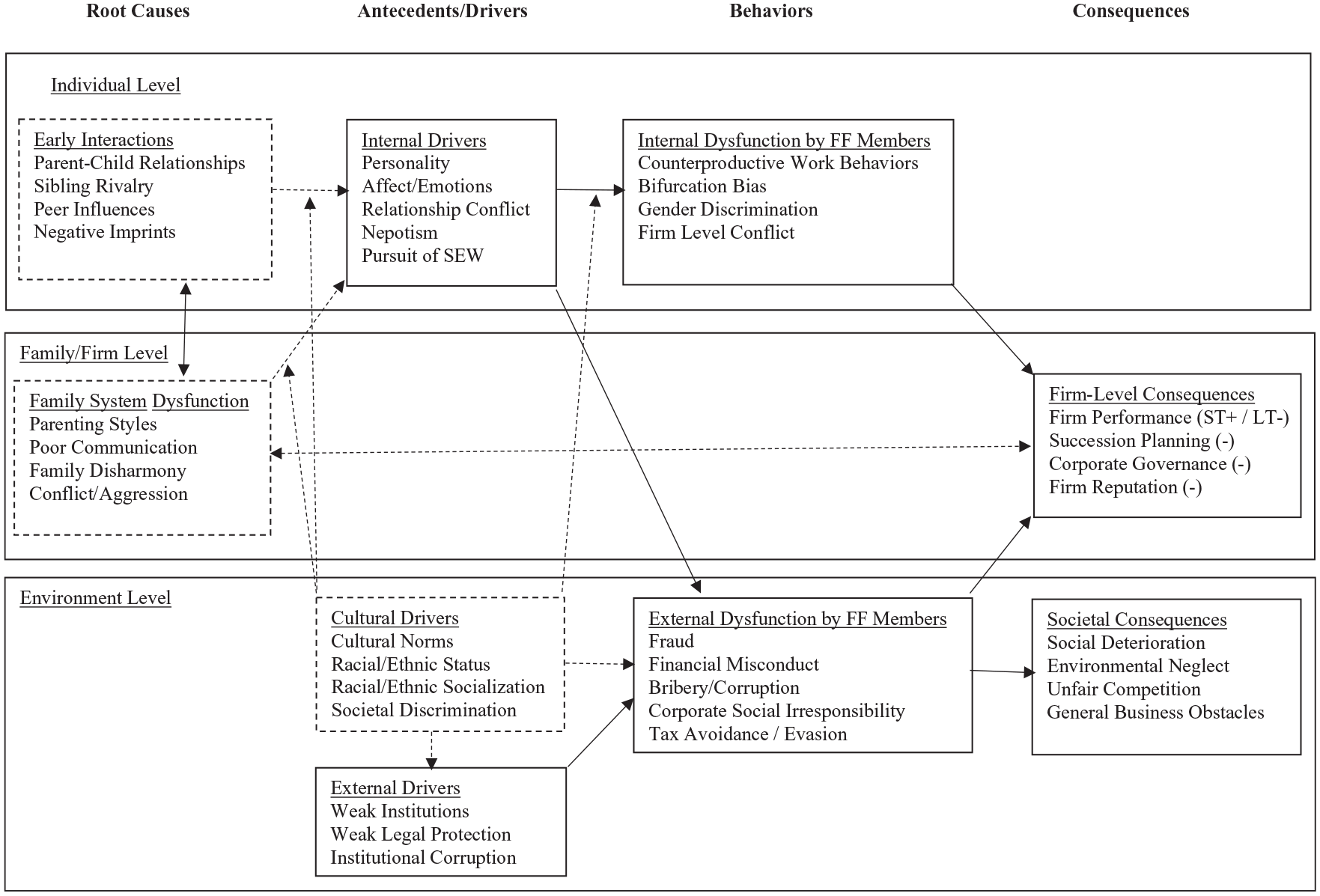
Multi-Level Model of Dysfunction in Family Firms.
To address these general questions, we synthesized themes from the review and developed lines of reasoning that identify prospects for future research, integrate theory from other relevant disciplines, and propose sample research questions to assist in framing further investigation into family firm dysfunction. We also recognize promising theoretical perspectives that could enrich research and explain differences in dysfunctional behavior across family firms. We propose this variance may be traced to dysfunctional interactions in the family that transfer to the workplace as well as external conditions that impact the family and the firm.
Specifically, inspired by what we found in our review and further investigation across disciplines, we propose that parent–child relationships and sibling rivalry (individual level) along with dysfunctional processes in the family system (family level) are likely to predict an individual’s negative behaviors in family firms. We also propose that another set of factors (environmental level) including cultural norms, racial/ethnic status, and racial/ethnic socialization, are potential antecedents or moderators of bad behavior. As such, the root causes of dysfunctional behavior may stem from a child’s early interactions within the family and family system issues that result in familial dysfunction as well as environmental factors that affect dysfunctional behavior.
Developmental Interactions: From Family to Firm
Focusing on individuals embedded within a family, family systems theory (Bowen, 1978; Broderick, 1993), as applied to business-owning families (Combs et al., 2020), is a starting point to explain differences across family firms in varied areas that include citizenship and counterproductive work behaviors (e.g., Shanine et al., 2023), and executive compensation (e.g., Michiels et al., 2022). Moreover, considering family systems goes beyond family members’ personalities and family structure to consider the processes that underlie how the family develops and functions over time (Danes & Brewton, 2012; Zachary et al., 2023). These processes include dimensions such as communication, conflict management, decision-making, and regulation of family resources (Hanson et al., 2019; Zachary et al., 2023). When the firm is successful and the family is functional, both can experience long-term health and sustainability (Zachary et al., 2023). However, when childhood experiences include poor communication, conflict and aggression, family disharmony, problematic parenting styles, and tense sibling rivalries, dysfunctional behaviors are likely to ensue (e.g., Cater et al., 2016; Eddleston & Kellermanns, 2007; Eddleston & Kidwell, 2012).
The family is a complex, open, hierarchical system where members establish rules, values, and rituals and use them to try to maintain boundaries by separating elements that may harm the system (Broderick, 1993; Olson, 2000). As a result, dysfunctional families are wrought with conflict, aggressive behavior, excessive and chaotic interactions, and a lack of transparent relationships, all of which can lead to the family’s collapse (Ariel, 1987; Constantine, 1983). Because family members’ personal and professional identities are linked together in family firms, their career paths and independence are often limited, thus increasing conflict (Stamm, 2016). While many family firms experience complex levels of intrafamily conflict (Gordon & Nicholson, 2008; Kubíček & Machek, 2020; Qiu & Freel, 2020), the impact of this conflict can vary greatly across family firms. For example, firm-level conflict can either break and divide families or encourage family firms to face situations where task and process conflicts can be resolved to improve firm performance (Hoelscher, 2014).
Further inquiry into the relationship between early family conflict to later firm dysfunction may be better informed by increased application of research based on family therapy and family studies. While few articles related to family dysfunction were included in our final review because they lacked a family firm element, we found several potential avenues of interdisciplinary inquiry when considering family interactions that could impact family firms (e.g., J. Lee & Danes, 2012). Topics from family studies that should be extended to research on family firm dysfunction include perceptions of injustice in how parents treat adolescent and adult siblings (Jensen et al., 2013; Loeser et al., 2016), the impact of interparental conflict on adolescent children (Davies et al., 2019), estrangement between siblings in adulthood (Blake et al., 2022), the development of sibling relationships into adulthood (Gilligan et al., 2020), and the impact of divorce and perceived marital satisfaction on sibling dynamics (Milevsky, 2019).
Researching the behavior of individuals nested in a family system provides rich questions for empirical examination of relationship conflict, counterproductive work behavior, and other negative engagement among family employees, nonfamily employees, and the business-owning family that hurts the family business. Recent applications of family systems theory to the family business literature (Combs et al., 2020) include broadening the definitions of family to consider socio-legal, social-biological, and role-based families (Kushins & Behounek, 2020), evolving gender roles and opportunities (Aldrich et al., 2021; Kushins & Behounek, 2020), and role ideologies across generations and their impact on conflict (Gamboni et al., 2021). Indeed, Zachary et al. (2023) commented on the diverse forms of family structure (couples who are heterosexual, homosexual, married, remarried, cohabiting with or without children, separated, divorced, or single adults with children) in additional to cultural and ethnic identity structures that should be considered when examining business-owning families and their firms. Thus, we propose these research questions that blend individual, family, and family business.
Developmental Psychology
As noted, the current research gap into family firm dysfunction includes a lack of focus on how early family interactions, discord, and dysfunction impact negative behavior in the firm by spouses, children, blended families, and other stakeholders. Thus, we consider two areas of psychology highlighted in recent calls for more research into psychological elements that relate to behaviors and outcomes in family firms (Picone et al., 2021; Sharma et al., 2020): developmental and evolutionary psychology. We focus on these two areas because both perspectives closely relate to how individual traits may be first ingrained and then grown in the family during childhood and adolescence. This focus may provide a deeper dive into differences in dysfunction (antecedents in particular) by considering how family members grow and adapt intellectually, emotionally, and socially before entering the firm. For example, family members and peers account for most of the conflict a person experiences in early and middle childhood (Laursen & Pursell, 2009), which likely shapes family members’ conflict management style and subsequent behavior as they engage with others in the family firm.
Developmental psychology focuses on how individuals develop, grow, and change over time, and has been expressed in concepts and theories such as stages of psychosocial development, identity crisis /role confusion (e.g., Côté, 2018; Erikson, 1963; Maree, 2021), and adulthood development stages (e.g., Levinson, 1978). Family business researchers have used the latter theory to consider relationships over life stages and generations (Hoy, 2006) and how families manage conflict between tradition and innovation (Erdogan et al., 2020). Additional developmental psychology approaches can provide insights for family firm research into how dysfunctional behaviors, for example, sibling bullying and victimization (Menesini et al., 2010), develop and change over time. For example, research summarized by Rodkin et al. (2015), indicates that insensitive parenting, coercive interaction, family instability, and family dysfunction are critical factors in explaining how bullying develops.
In coercive and hostile relationships with caregivers and exposure to family violence, children who are maltreated may come to expect that aggression is fundamental to interpersonal relationships, affecting children’s expectations. . . of new social interactions and guiding their behavioral responses. . . (Rodkin, et al., 2015, p. 314).
Both childhood experiences and parental behaviors are associated with potentially serious issues in an individual’s later career development (Müller et al., 2022) in that feelings of failure, dysfunctional interpersonal relationships, and disrupted activities affect the career plans and personal lives of managers. Müller et al. (2022) noted that research on lived experience can reveal the effects of childhood experiences, an important topic in the fields of self-development and career development. In addition, peer influence is a pervasive force that shapes positive and negative attitudes and behaviors (Laursen & Veenstra, 2021; Yoho et al., 2022), suggesting that childhood friends should be considered in future family firm dysfunction research. Applying developmental psychology to research into family firm dysfunction inspires the following research questions:
Evolutionary and Biological Perspectives
In contrast with developmental psychology, evolutionary psychology builds off Darwin’s theory of natural selection and presents potential insights into genetic factors that might drive such behaviors as altruism and conflict (Nicholson, 2008; Sharma et al., 2020). Applied to family firms, it stresses the concepts of kinship and kin altruism (Madison et al., 2021) in that “an individual can spread his or her genes into future generations by helping those who share some of his or her genes. . . Hence kin selection is a hardwired characteristic of our evolved minds, regardless of cultural variations” (O’Brien et al., 2018, pp. 423/424). In this perspective, when the family members focus on assisting relatives in hiring and promotion, they set the groundwork for nepotism in policy and practice, eventually increasing the potential for bias against nonfamily. The use of an evolutionary perspective to study behavior across family firms has been applied to studies of executive compensation (Yu et al., 2020), theft (O’Brien et al., 2018), preferential benefits (Stewart, 2020), and organizational citizenship behavior (Madison et al., 2021). Further applications of how kinship ties relate to nepotism can expand our knowledge of the drivers and consequences of negative behavior in business-owning families and their firms. For example, later-generation firms may have more distant kinship ties, which could mitigate the negative effects of nepotism and lessen the level of bias against non-family employees.
The concept of imprinting is also relevant to our discussion of using evolutionary psychology to study family business dysfunction in and across generations. Borrowed from biological ecology, the term “imprinting” describes a process in which a subject develops characteristics that reflect prominent aspects of the environment that continue despite subsequent environmental changes (Jaskiewicz et al., 2015; Marquis & Tilcsik, 2013; Stinchcombe, 1965). The imprinting process emphasizes sensitive transitions in which an individual or organization is highly vulnerable to external influences and reflects elements of its environment in that period.
In family firms, the imprinting process has been applied to explain a variety of strategies and outcomes. On the upside, family leaders have used stories to imprint the organizational path of family firms across generations for many years (Kammerlander et al., 2015; Marques et al., 2022), to enhance entrepreneurial legacy (Jaskiewicz et al., 2015), and to shape varied approaches to innovation (Erdogan et al., 2020). On the downside, imprinting as a learning process has been linked conceptually to negative behaviors and dysfunctional outcomes in family firms (Kidwell et al., 2018). While a founding family is said to imprint a common purpose (shared vision), culture, and conflict management style on their family firm (Alvarado-Alvarez et al., 2021; Eddleston, 2008), dysfunctional family dynamics may provide imprints that have dire consequences for family firms (Kidwell et al., 2018) such as unearned entitlement, personal feelings of perceived injustice, damaging altruism, and unethical behavior. More research is needed on how imprints that promote negative acts can explain dysfunction within family firms. Therefore, we propose the following research questions:
As discussed, dysfunctional behaviors committed on any level—individual, family, or firm—can negatively impact the family firm and the larger environment in which it functions. Likewise, the external environment can motivate the family, firm, and people within it to engage in dysfunctional behavior. Applying research from family science studies (e.g., Bamaca-Colbert et al., 2019; Erdem & Safi, 2018; A. G. James et al., 2018; Krueger et al., 2021), we propose that differences in the presence and impact of dysfunction across business-owning families and their firms may be rooted in how the firm’s systems develop in cultural and societal contexts, strongly affecting differences in the types and levels of dysfunctional behaviors and their effects. For example, differences in societal norms, such as the importance of the family versus the firm in certain cultures (Zachary et al., 2023), is likely to affect how dysfunctional behaviors like nepotism and primogeniture are viewed. In turn, the effect of dysfunctional behavior on different family firm stakeholders is expected to depend on social norms and how the behavior is interpreted. Building on research discussed earlier, we highlight two phenomena that have received little attention in extant family firm research but could impact the relationship between a family firm’s dysfunctional behavior and its environment: Cultural norms and race/ethnicity status/socialization of the family firm’s leadership.
Impact of Cultural Norms on Family Firm Dysfunction
The cultural norms of the environment, such as a city, region, or country in which a family firm operates (or the firm’s family originates), significantly impact its business practices and ideals (Bamaca-Colbert et al., 2019; Erdem & Safi, 2018; Krueger et al., 2021; Zachary et al., 2023), including a family firm’s perception of fraud (Sison et al., 2020). When there is a gap between a family firm’s cultural expectations and the larger environment (Bamaca-Colbert et al., 2019), there’s room for misconceptualization and mismeasurement of dysfunction. Thus, definitions of nepotism, bribery, and even corporate social irresponsibility and ethical behavior may need to be altered to fit the cultural contexts of a given study (e.g., Samara et al., 2021).
Our review found that researchers have explored the importance of the external environment in determining whether family and nonfamily firms behave ethically or unethically, such as the lower likelihood of family firms using tax havens when internationalizing (Temouri et al., 2022) and the lower environmental performance of family firms except when they are socially embedded in the community (Dekker & Hasso, 2016). In addition, one theoretical article that applied elements from family science and family development theories explored how Aristotelian versus Confucian traditions shape family firm attitudes and practices (Sison et al., 2020). The authors explained why some attitudes and practices typically seen as dysfunctional according to Aristotelian culture, such as nepotism, bribery, gift-giving, and guanxi, are not similarly viewed through a Confucian lens. Other studies that brought cultural elements to the conversation primarily examined firms in one country (e.g., Eddleston & Mulki, 2021; Ghafoor et al., 2019a, 2019b; Jeong et al., 2022) rather than comparisons across cultures.
Based on our review, researchers should consider the experience of business-owning families from more collectivistic cultures when studying dysfunction in family firms. Changes in societal norms could affect how such constructs as family, nepotism, and bifurcation bias are defined across cultures. Cross-cultural differences are also likely to explain family firms’ divergent views of bribery, fraud, nepotism, and gender roles (e.g., Chadwick & Dawson, 2018; Samara et al., 2021; Sison et al., 2020; Wated & Sanchez, 2015). Therefore, because societal norms and cross-cultural differences are expected to shape business-owning families’ views of what is dysfunctional and their ability to rationalize dysfunctional behaviors, we propose the following research questions:
Impact of Racial/Ethnic Status/Socialization on Family Firm Dysfunction
Racial/ethnic minority status has been examined within family science research (e.g., A. G. James et al., 2018) and in business disciplines such as marketing (e.g., Bone et al., 2014), but it has been less explored in the family firm and entrepreneurship literatures. A. G. James et al. (2018) recommended that the constructs of historical time and choice be added to the family systems model and proposed that the concept of racial and ethnic socialization be added to family systems theory discussions to account for how socialization within racial/ethnic minority families impacts how their members navigate the world. Following this view as well as a recent call to highlight structural underpinnings of racial disadvantage for underrepresented minority entrepreneurs (Bruton et al., 2023), we consider how racial and ethnic minorities navigate the family firm context within the broader external environment. Applying these ideas to negative behavior in family firms, we propose that specific consideration for racial and ethnic minorities in future family firm dysfunction research can be viewed in at least three ways: racial discrimination as a form of internal firm-level dysfunction, racial discrimination as an environmental burden/impact on racial/ethnic minority-owned family firms, and racial/ethnic minority status/socialization as a form of family firm heterogeneity.
Discrimination based on race or ethnicity as a form of dysfunction within the family firm was not considered in the literature reviewed for this study. However, racial discrimination committed at the firm level is likely to result in significant legal, financial, and even SEW costs for family firms. In addition to considering racial discrimination as its own type of dysfunction, the context of race and gender discrimination within bifurcation bias is an impactful area to explore across various country/regional cultures, particularly from regulatory, legal, and ethical standpoints. Regardless of the underlying cultural norms, racial/ethnic minority-owned family firms can experience discrimination in the external environment, which adds burdens to those family firms that other family firms do not typically experience. For instance, racial/ethnic minority businesses and individuals have historically experienced discrimination in bank lending (Bone et al., 2014), making credit-constrained companies much less likely to survive (Cole & Damm, 2020). In addition, because of the well-established link between the family and the firm (Jaskiewicz et al., 2017), racially motivated credit constraints that cause financial and other harm to the firm can pressure the family, the firm, and its members to engage in dysfunctional behavior and to see such behavior as justified. However, there are constraints on racially motivated behavior, for example—religious faith. Family business leaders’ religious beliefs often form the basis to shape the firm’s organizational values and culture through generations (Sorenson, 2013). In a recent study, faith-led values among family leaders led to organizational stewardship and a focus on the entire family business rather than self-serving behavior, thus fostering honesty and trust within the firm (Carradus et al., 2020).
Nonetheless, racial discrimination’s salience across the experiences of racial/ethnic minorities within their external environments permeates the basic development of those individuals and their families (A. G. James et al., 2018). These differences likely contribute to significant differences across family firms as well as racial/ethnic minority-owned firms. For example, T. Kim and Marler (2020) found evidence of bifurcation bias toward non-blood related family members in family firms. However, in many racial/ethnic minority families, blood and non-blood relatives share similar places in the family hierarchy because the definition of family is defined differently within these firms (Kushins & Behounek, 2020). Thus, bifurcation bias may not only present differently in racial/ethnic minority-owned family firms, but it may have different antecedents and outcomes. Also, the socialization of racial/ethnic minorities, their families and their businesses may influence perceptions of corruption, tax avoidance/evasion, or social irresponsibility. Future research should consider minority-owned family firms and multicultural contexts as key elements of difference in family firm dysfunction. The following research questions consider how elements from the environment motivate and impact effects of dysfunctional behavior in family firms.
External Pressures/Ambiguous Consequences
Research indicates that family firms and their external stakeholders can be harmed, and even destroyed, by dysfunctional behaviors. However, as our review revealed, whether a “negative act” is “good” or “bad” / “functional” or “dysfunctional” is often in the eyes of the beholder. For example, while nepotism is often framed as a negative and dysfunctional behavior, it can also be strategic and beneficial for the family firm by helping it to maintain the family’s control and ownership of the firm (Jaskiewicz et al., 2013; Jeong et al., 2022). Secrecy in the firm might be considered dysfunctional if it implies a lack of trust, but its use by family firm leaders can have positive results for the firm when practiced against distrusted actors, thus limiting potential negative behaviors (Hadjielias et al., 2021). Bribery and tax evasion are characterized as dysfunctional, illegal activities, yet both can be “costs of doing business” that keep a family firm operating, thus benefiting family and nonfamily employees alike (Eddleston et al., 2020; Eddleston & Mulki, 2021). Thus, dysfunctional behavior that may be perceived differently by family firm stakeholders should be examined to determine its positive and negative impacts on family firm actors and their value to the firm relative to its economic or non-economic performance. Based on this discussion, we offer the following research questions:
Discussion
Our review provides a summary and classification of a range of dysfunctional behaviors studied in a family firm context, identifying their antecedents as well as the consequences that result from the focal behaviors. Returning to our original research questions, we identified the dysfunctional behaviors studied in a family firm context, their antecedents, and consequences, and we have proposed reasons why family firms and stakeholders are affected differently by these behaviors. To begin to address the question of why dysfunctional behavior is more likely in some families and firms than others, we have explored and applied different theoretical frameworks and developed a potential agenda for future research focusing on the conditions that make it more or less likely for family employees and family firms to engage in negative acts, specifically on the effects of early family interactions and the external context.
Our model of dysfunctional behavior in family firms (Figure 2) proposes that the drivers of dysfunctional behavior tend to manifest in the family system whether mainly affecting the individual, the family, or the family firm. In addition, the model recognizes the important role of the external environment in triggering dysfunctional behavior in a family firm and the stakeholders’ interpretation of that behavior. As such, the multi-level framework shown in the figure captures the complexity of family business dysfunction by acknowledging the underlying micro- and macro-level antecedents that provoke dysfunctional behaviors that can harm a range of stakeholders, including individuals, family, firm, environment, and society. In addition, the model considers how internal and external dysfunctional behaviors ultimately affect the business-owning family, the firm, and society. Thus, in proposing this framework, we recognize how each level (i.e., individual, family/family firm, environment) is affected by and can affect the others, thus making the diagnosis, prevention, and remedy for family firm dysfunctional behavior quite complex and worthy of additional research.
All dysfunctional acts involve individuals engaging in behaviors often guided by their perceived situations, with varying amounts of pressure, opportunity, and rationalization impacting their choices. In the family firm, for example, family members may perceive pressure to engage in behavior detrimental to the firm, the opportunity offered due to their position in the family, and rationalization provided as “I deserve more because my name is on the door.” The pressure, opportunity, and rationalization to engage in bad behavior can be guided by family values and firm culture in various negative acts, providing another clue as to why occurrences and severity of bad behavior differ across family firms (Eddleston & Mulki, 2021).
We believe the next step involves testing elements of our model across levels of analysis as this would further assist in organizing future research around “the range of categorical and/or variational difference(s) between or among family firms at a given time or across time,” that is, family firm heterogeneity (Daspit et al., 2021, p. 298). These differences were evident in our review as we found instances in which family firms may outperform non-family firms by guarding against dysfunctional behaviors (Astrachan et al., 2020) and in other cases, family values leading to misplaced trust and dysfunctional behaviors (Ding & Wu, 2014). To better grasp and facilitate actions to overcome such deleterious acts, it is important to address the rationale for dysfunctional behaviors across levels of analysis in future theorizing and empirical work. In addition to our proposal regarding negative behaviors focused both internally and externally, continued attention should be placed on identifying additional factors that help explain why bad behavior is more likely in some family firms than others and in what conditions it is more or less likely for family or nonfamily employees to engage in it.
This review has limitations that present opportunities for future research. First, we did not categorize the research reviewed on dysfunctional behavior in family firms by methodological strategies. Second, due to the breadth of the review, the distinction between internal and external dysfunction needs more in-depth investigation as do the processes and mechanisms by which dysfunctional behaviors affect stakeholders differently. Third, while we are confident that our rigorous search process has found, retained, and properly classified the academic articles relevant to our review, we acknowledge that the process contains a degree of subjectivity and—due to the multi-faceted nature of the review—researchers from other disciplines might have eliminated (included) articles that we included (eliminated) or classified them differently. For example, researchers in varying disciplines may disagree as to whether a behavior such as tax avoidance, as opposed to tax evasion, should be considered dysfunctional.
However, the multidisciplinary nature of the topic also creates an opportunity for future research. Researchers have a chance to bridge gaps between various theoretical perspectives in which research in families and family firms regarding dysfunctional behavior might inform inquiry in other areas including psychology and ethics (e.g., Liyanagamage et al., 2023), social psychology (e.g., Levine, 2014), conflict management systems (e.g., Cronin and Bezrukova (2019), corrective action of organizational misconduct (e.g., Hersel et al., 2019), and accounting, for example, the fraud triangle (Cressey, 1953; Ramos, 2003). For example, an examination of CEO wrongdoing in the workplace led Schnatterly and colleagues (2018, p. 2407) to suggest that a “common language” can help combine the fraud literature across multiple disciplines. We propose that a similar focus would provide a valuable means to explore antecedents of family firm dysfunction at the intersection of the individual, family, firm, and environment.
We hope this review inspires researchers from different disciplines to cooperatively explore the multilevel nature of family firm dysfunctional behavior. We also hope this review encourages family business researchers to apply theories and insights from developmental psychology and evolutionary perspectives to their work and to consider how the external environment shapes a family and its firm’s negative acts. Future work can benefit theory and research in other disciplines by providing insights into how the firm shapes family members’ development and interactions that, in turn, affect their job performance and family relationships (Shanine et al., 2023). Thus, we encourage scholars interested in studying dysfunctional behavior in business-owning families and their firms to collaborate across disciplines.
Footnotes
Declaration of Conflicting Interests
The author(s) declared no potential conflicts of interest with respect to the research, authorship, and/or publication of this article.
Funding
The author(s) received no financial support for the research, authorship, and/or publication of this article.
Notes
Author Biographies
 . Professor Eddleston’s research focuses on family businesses and the careers of entrepreneurs. Her research has accumulated more than 18,000 citations leading her to be ranked among the world’s top 2% of scientists by Stanford University.